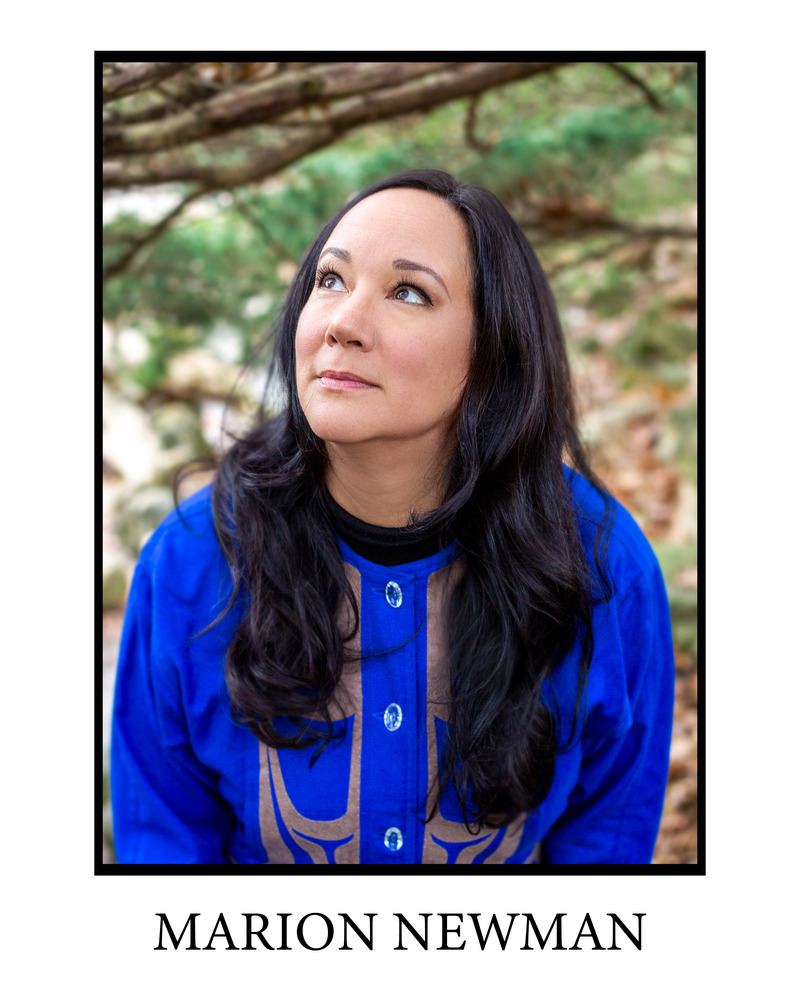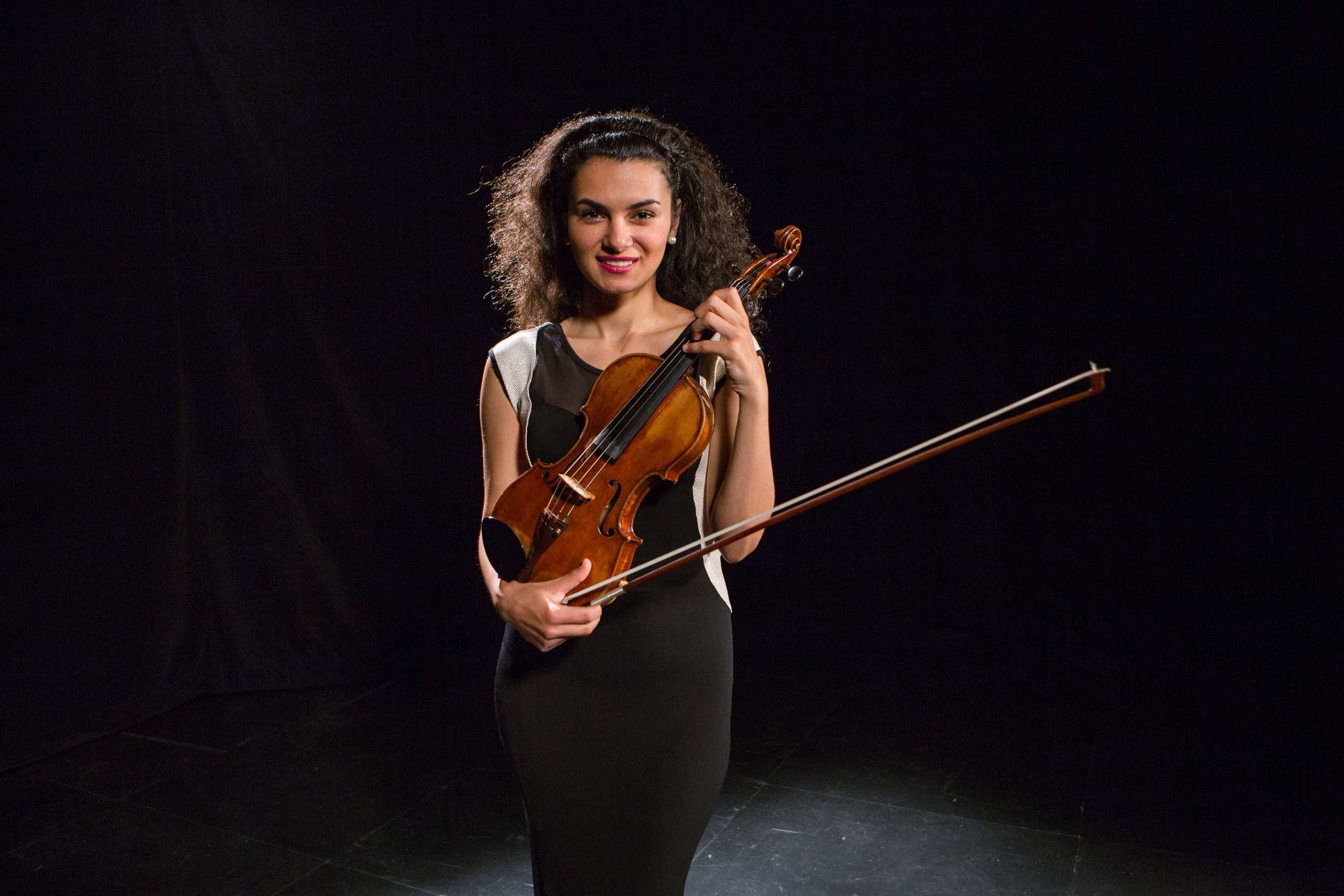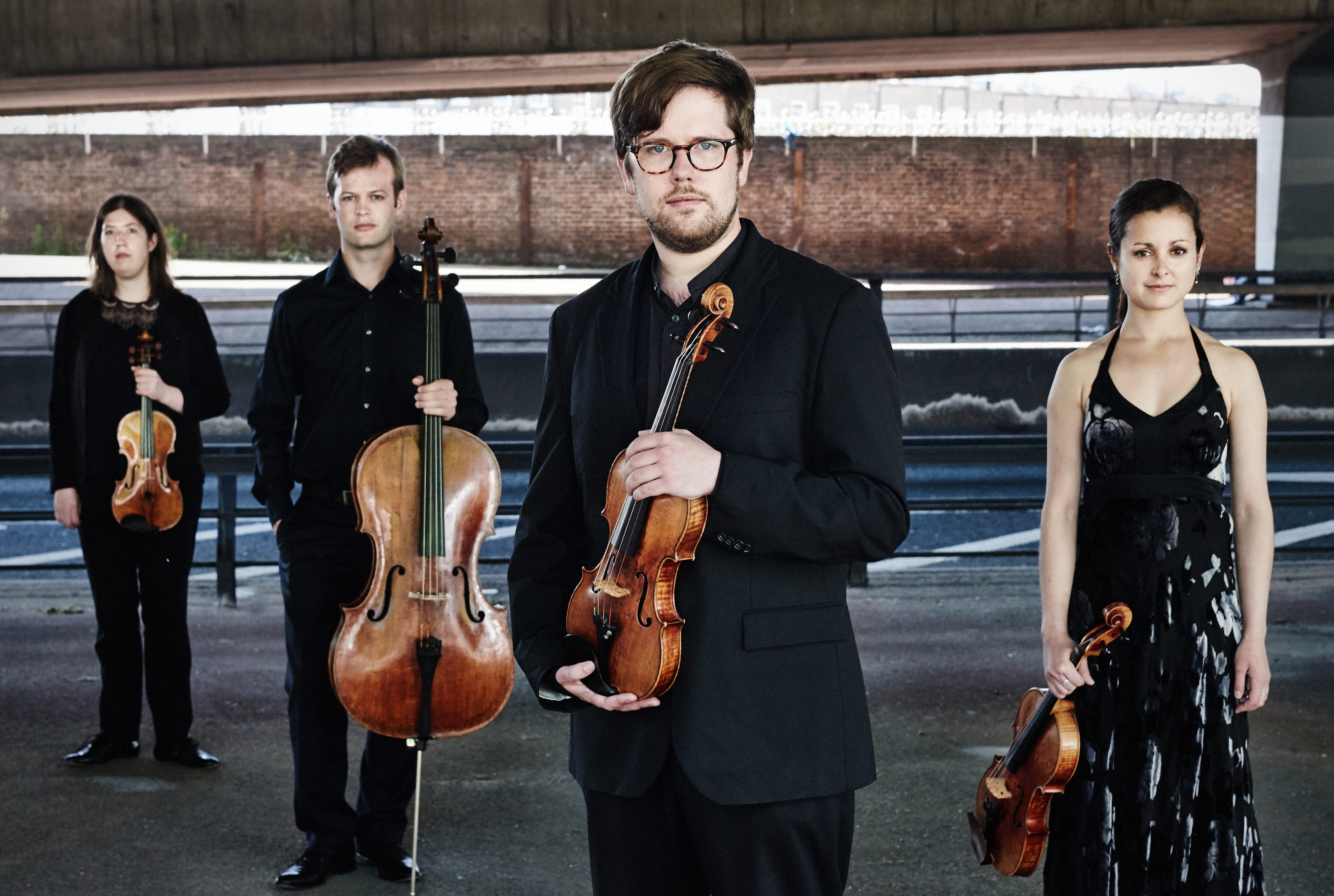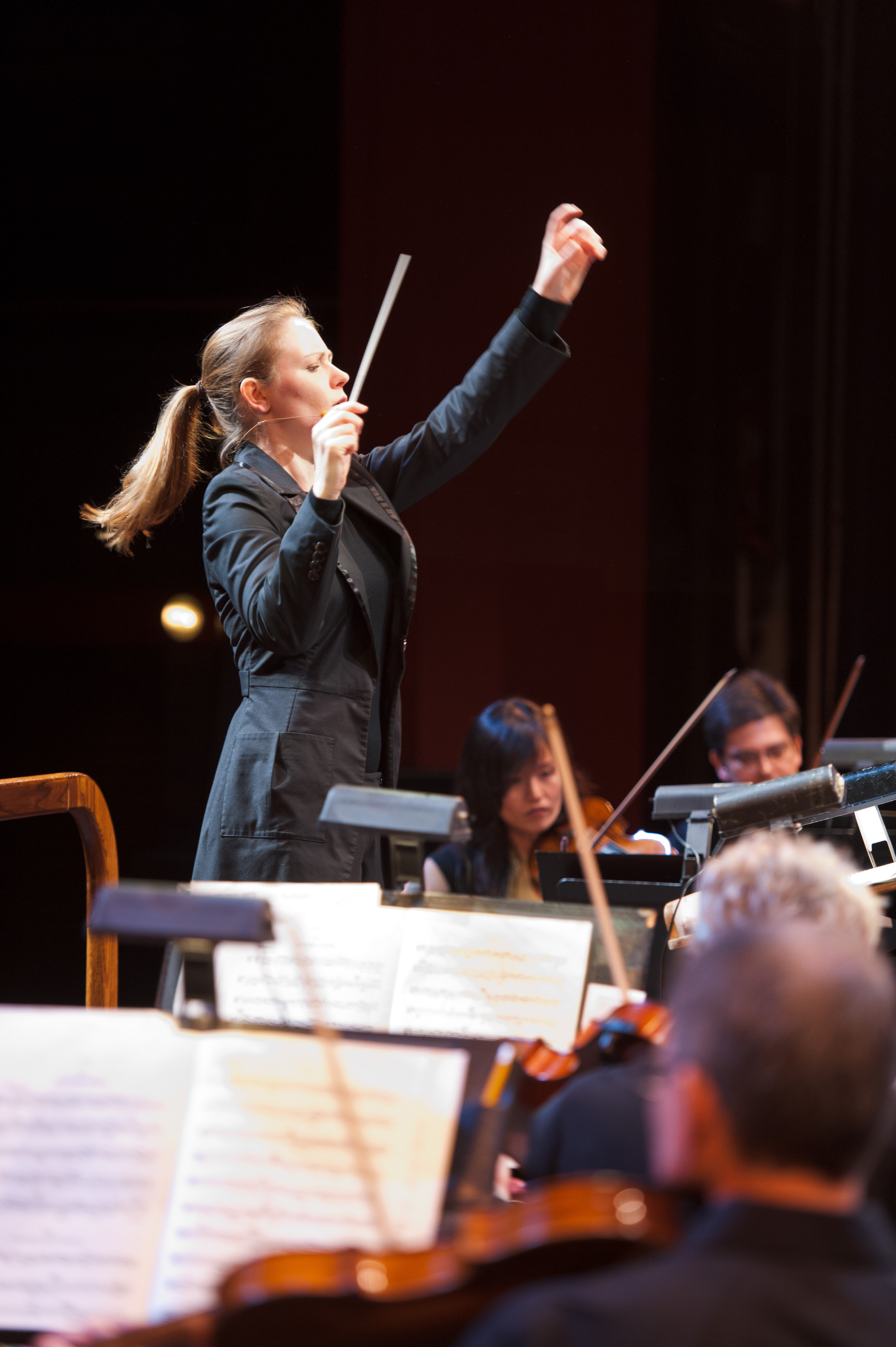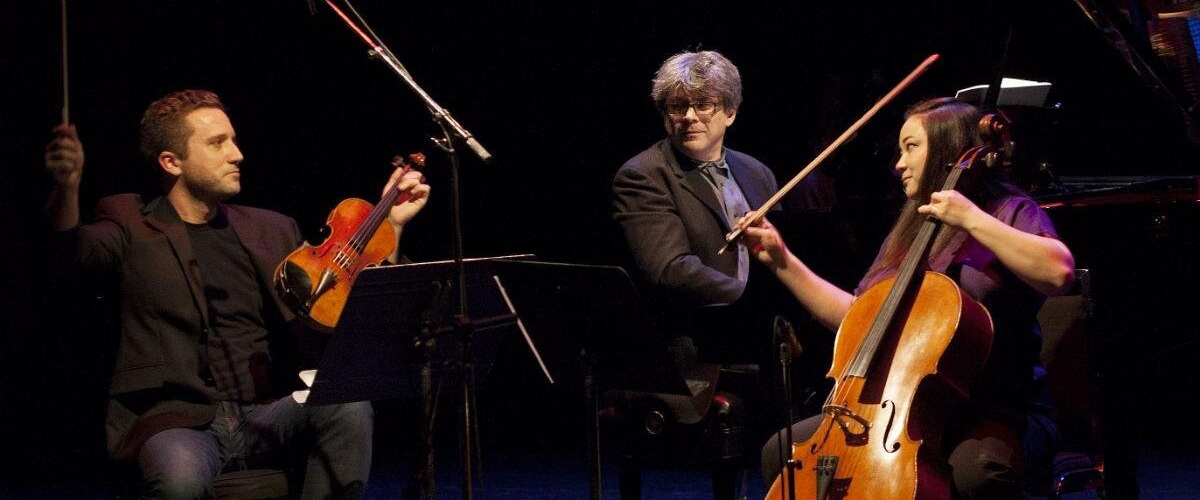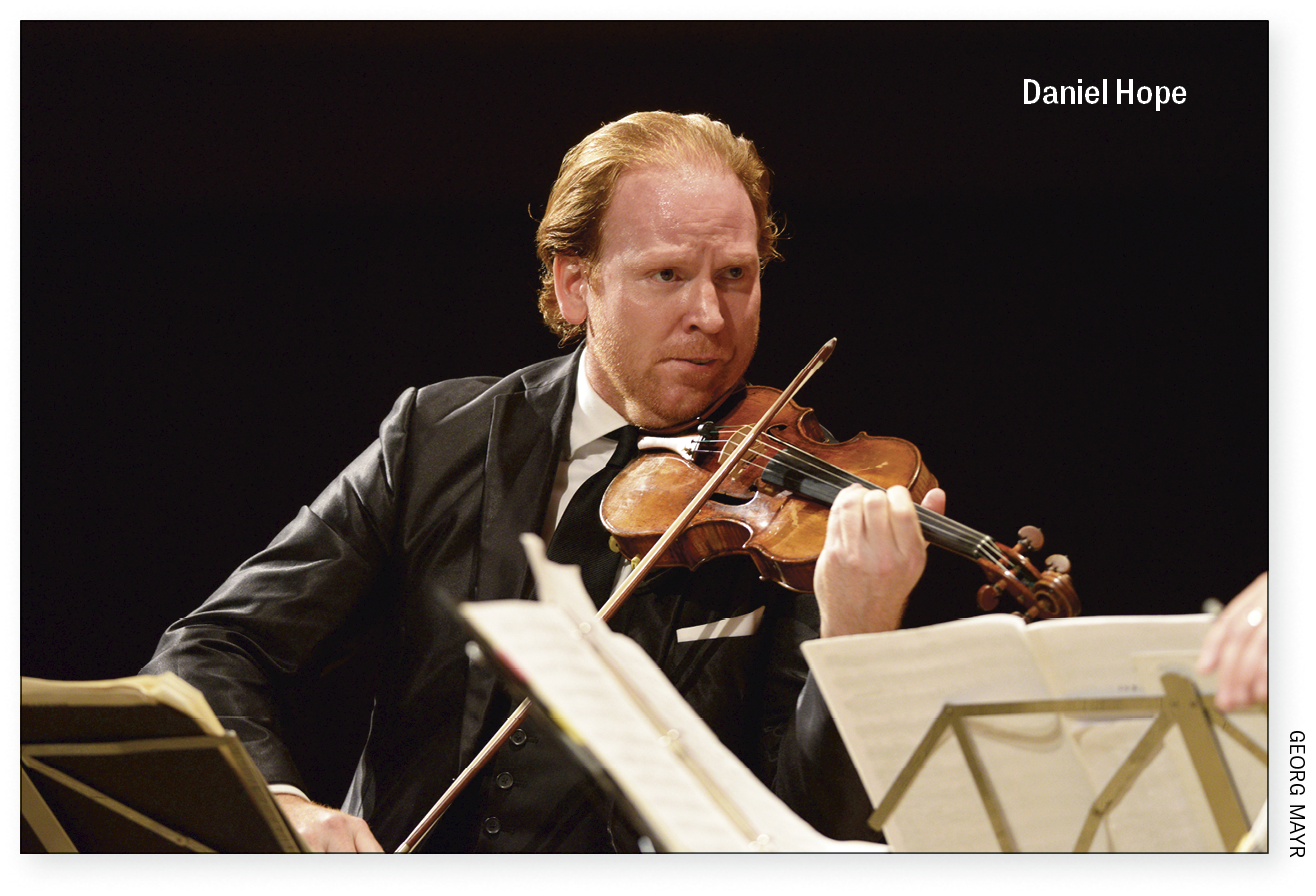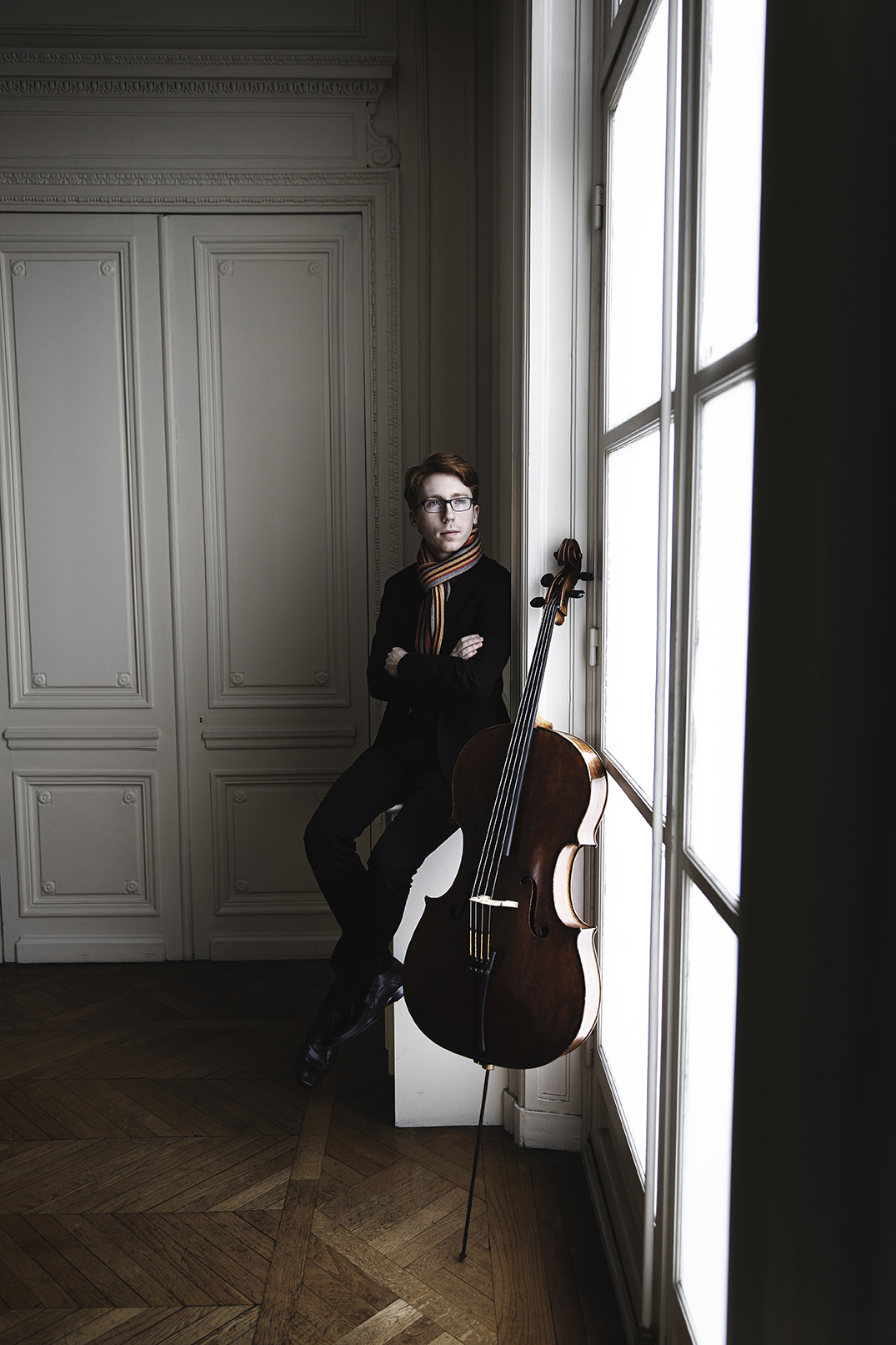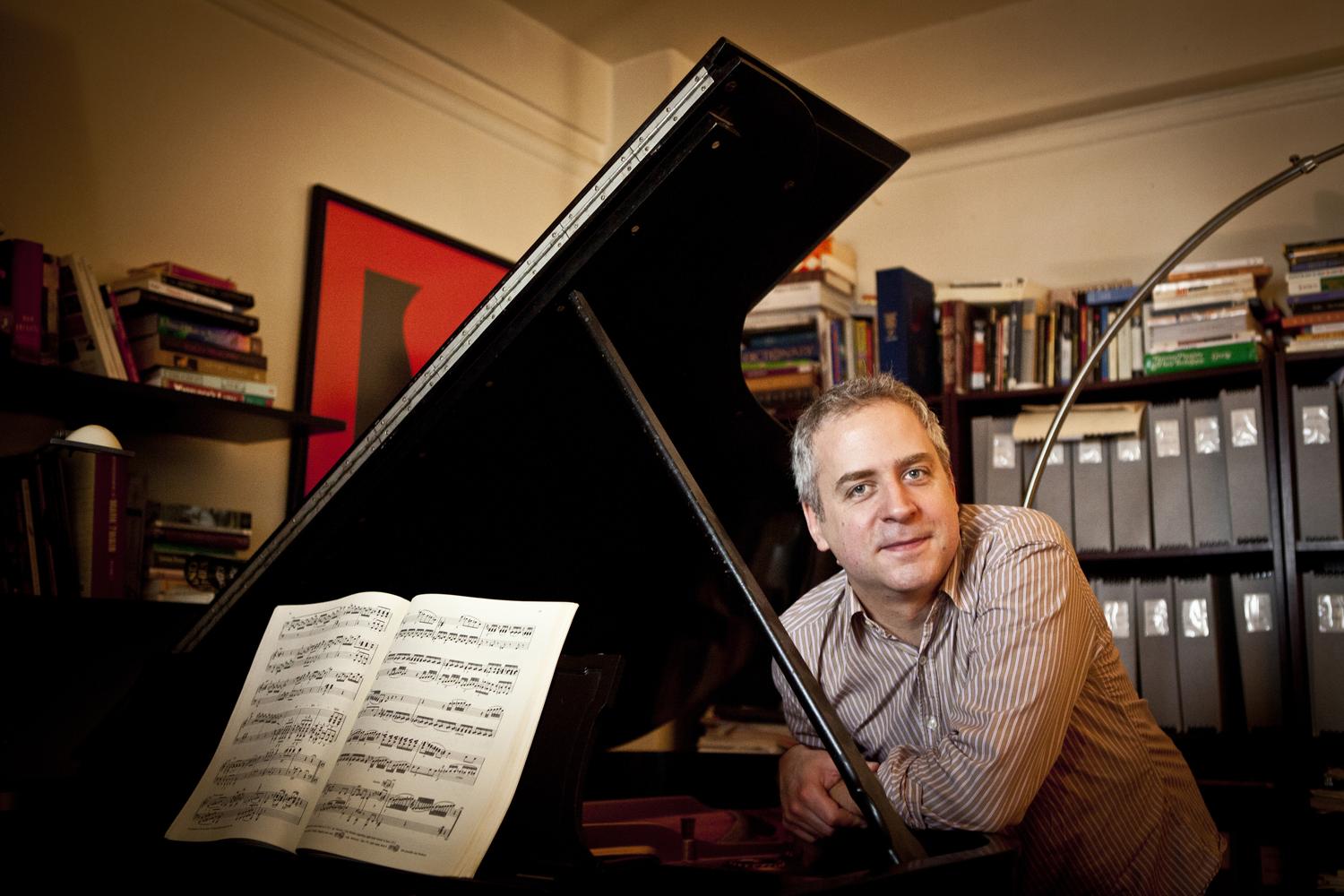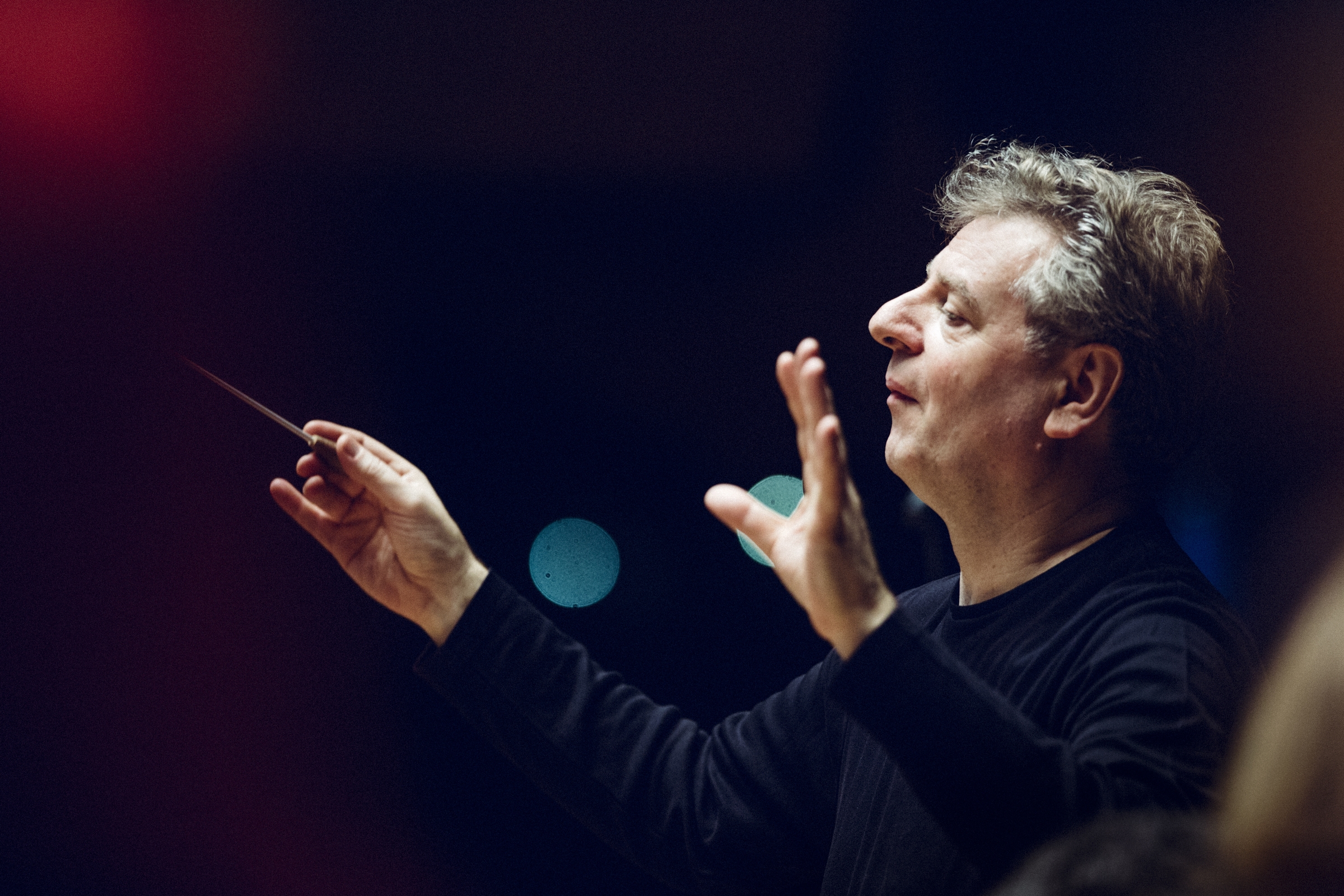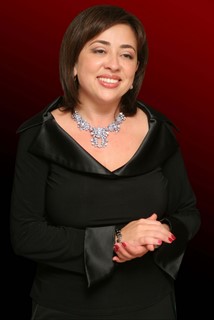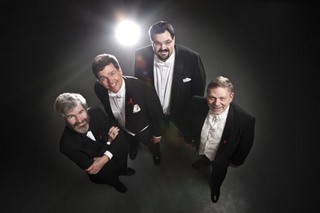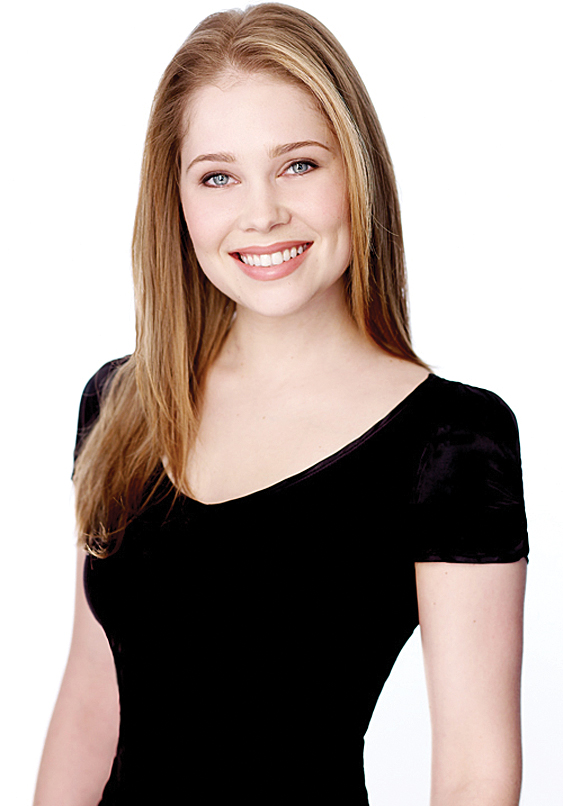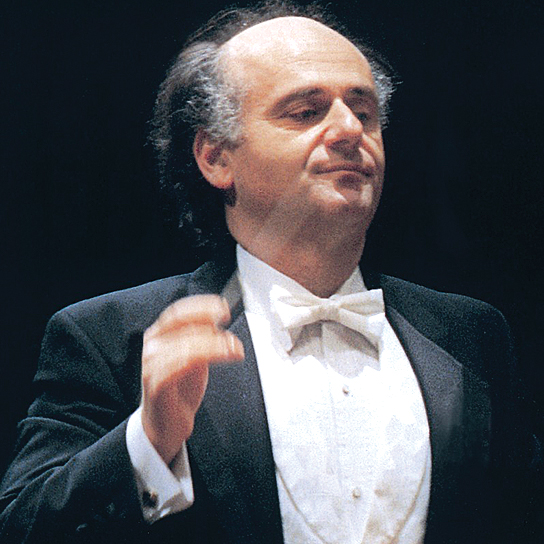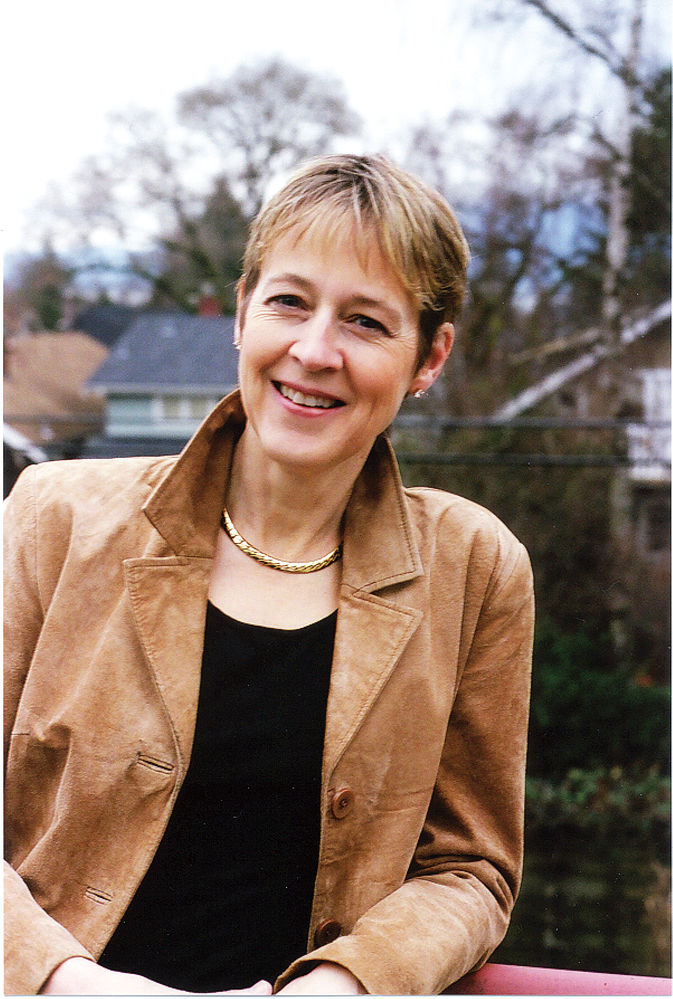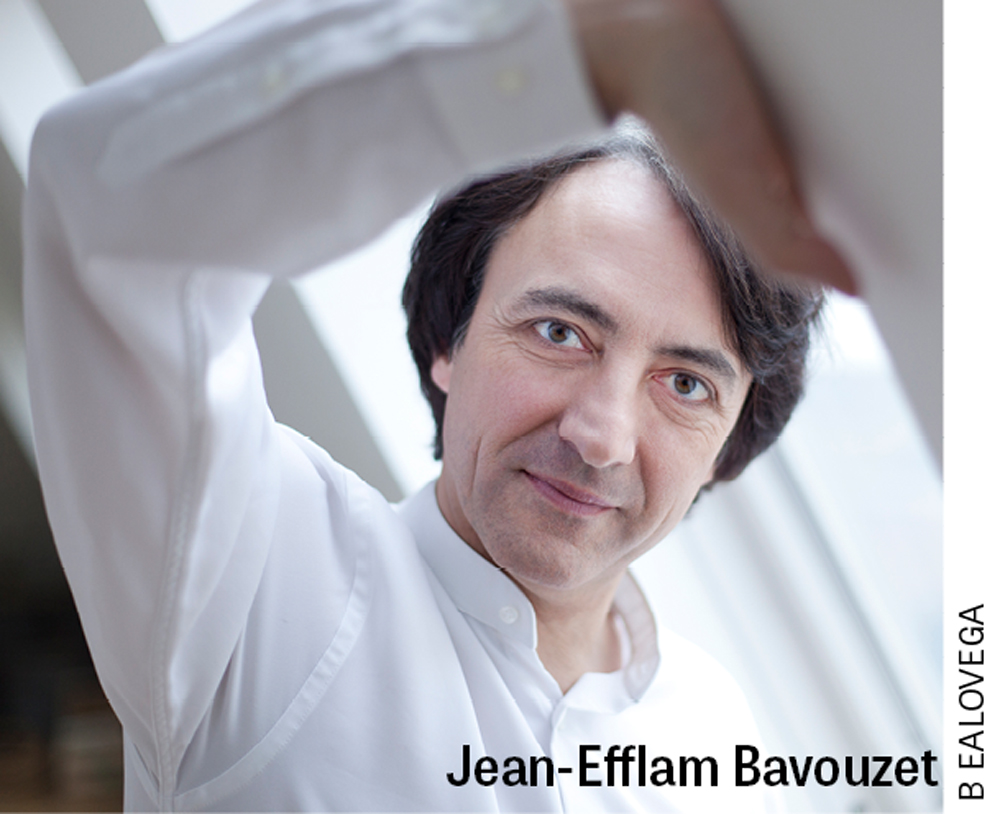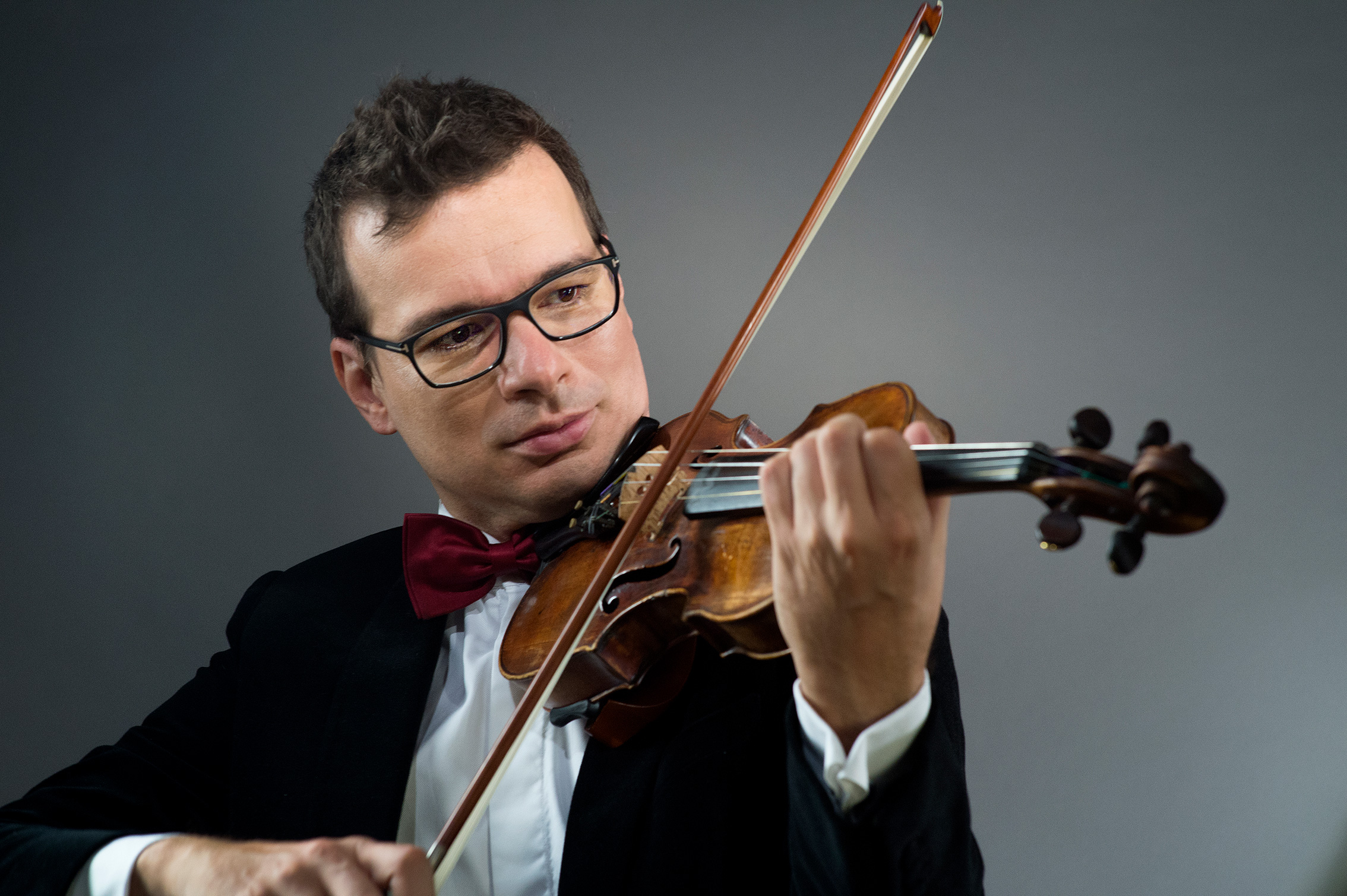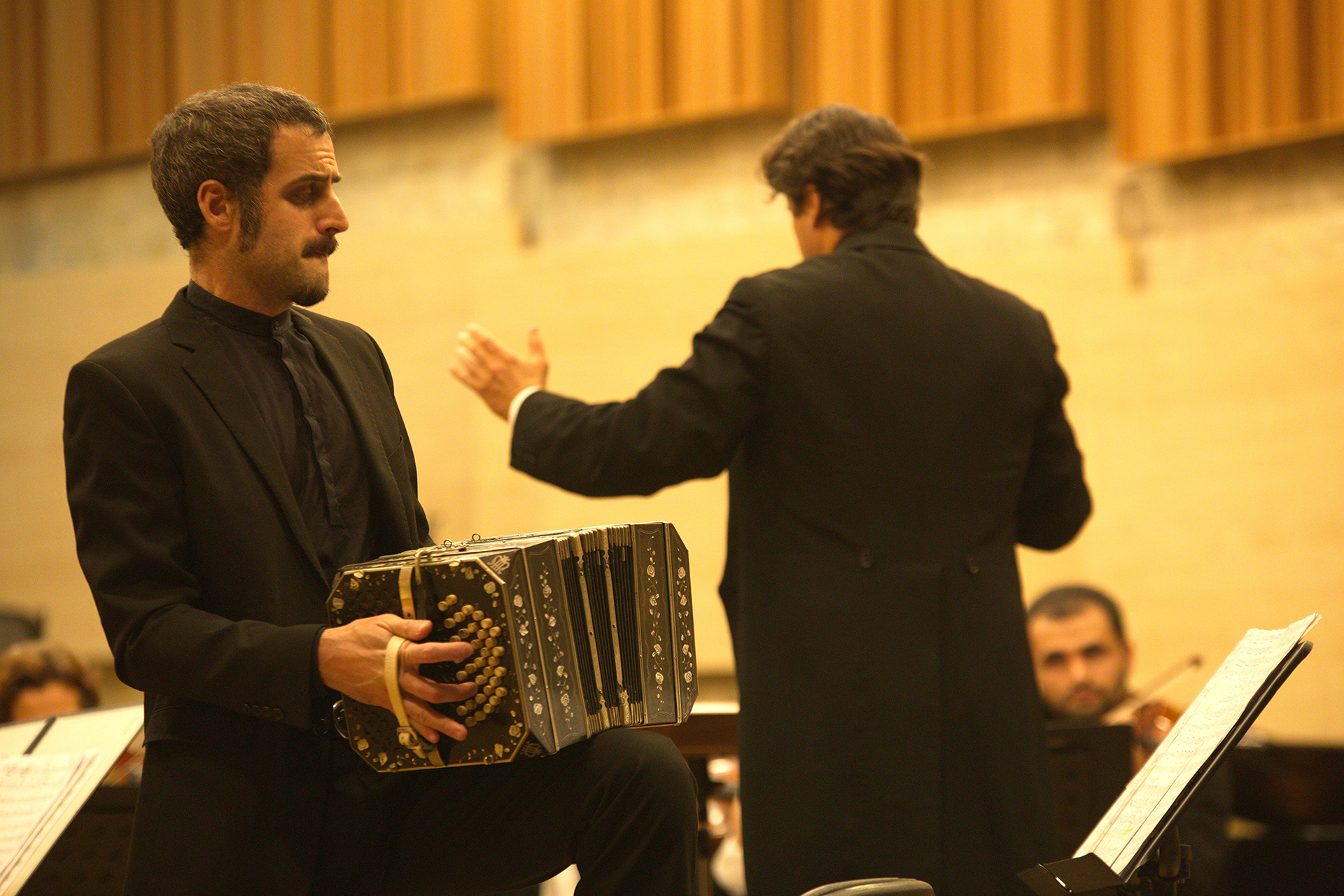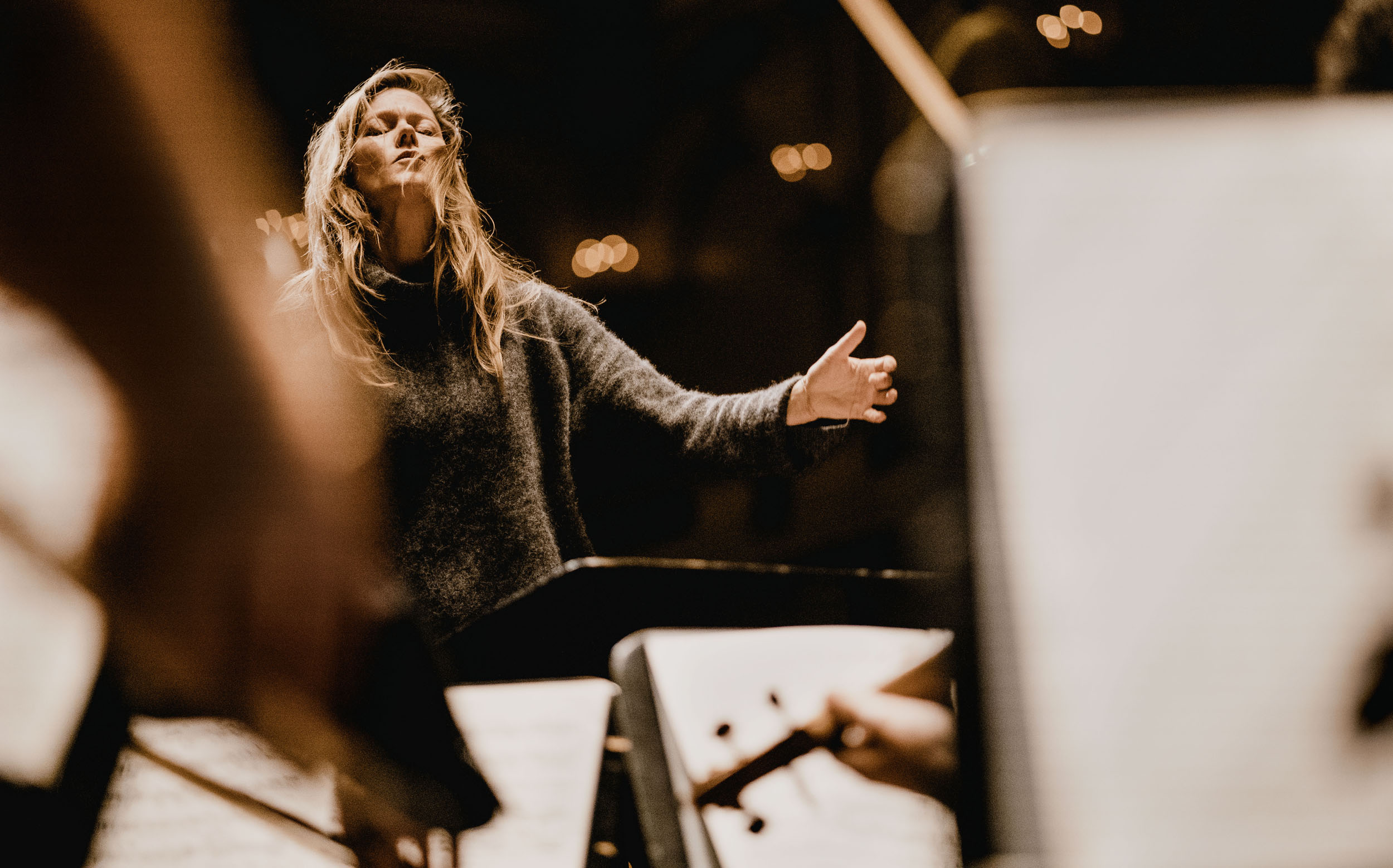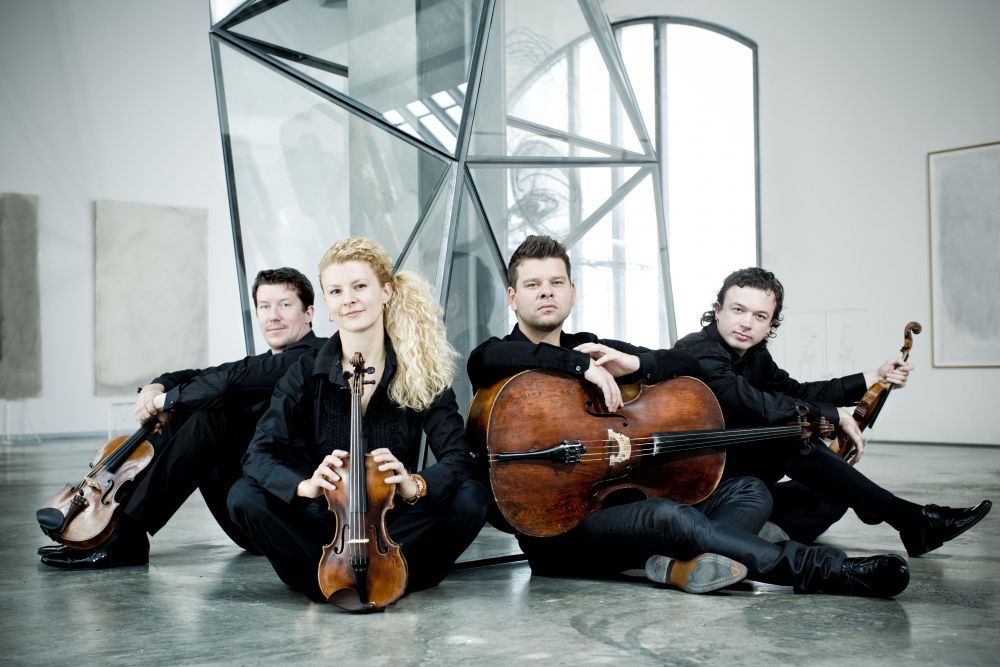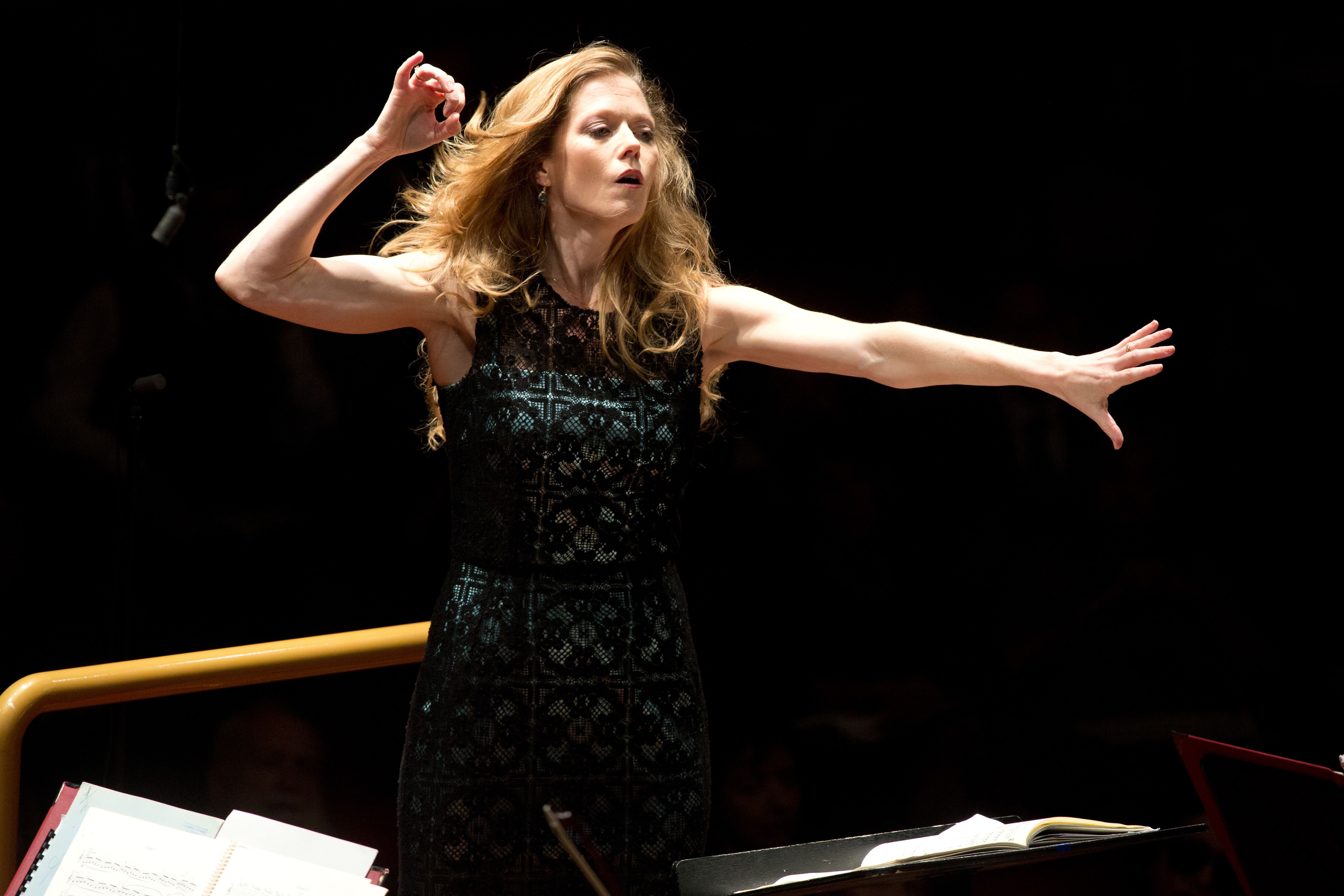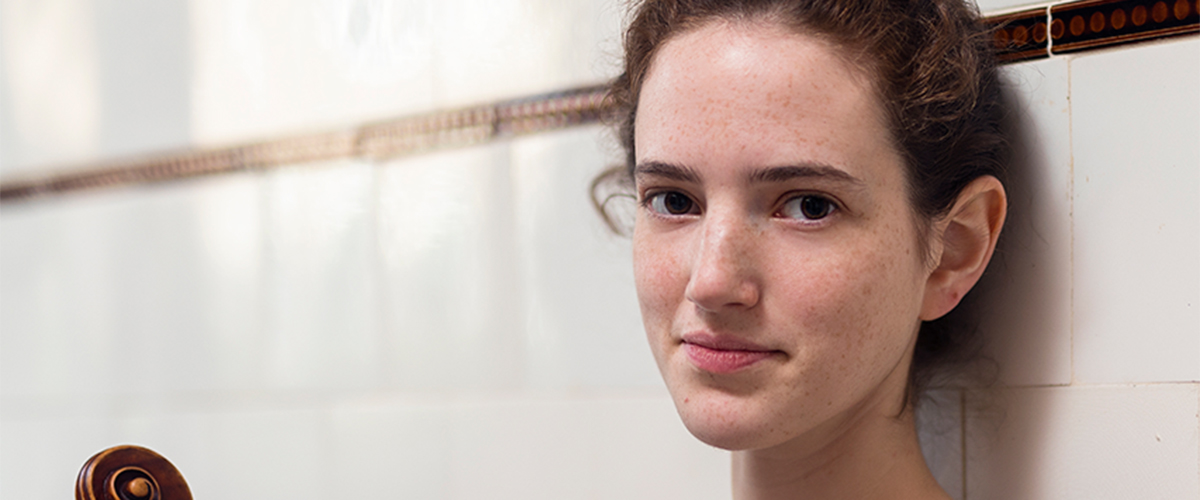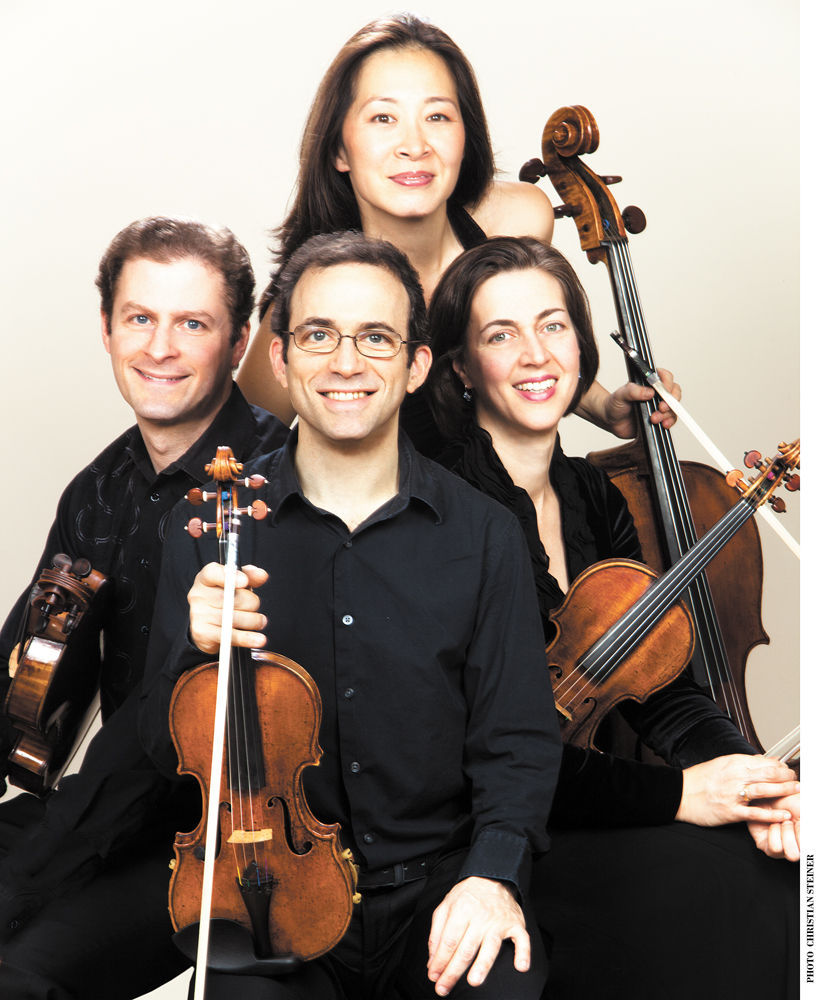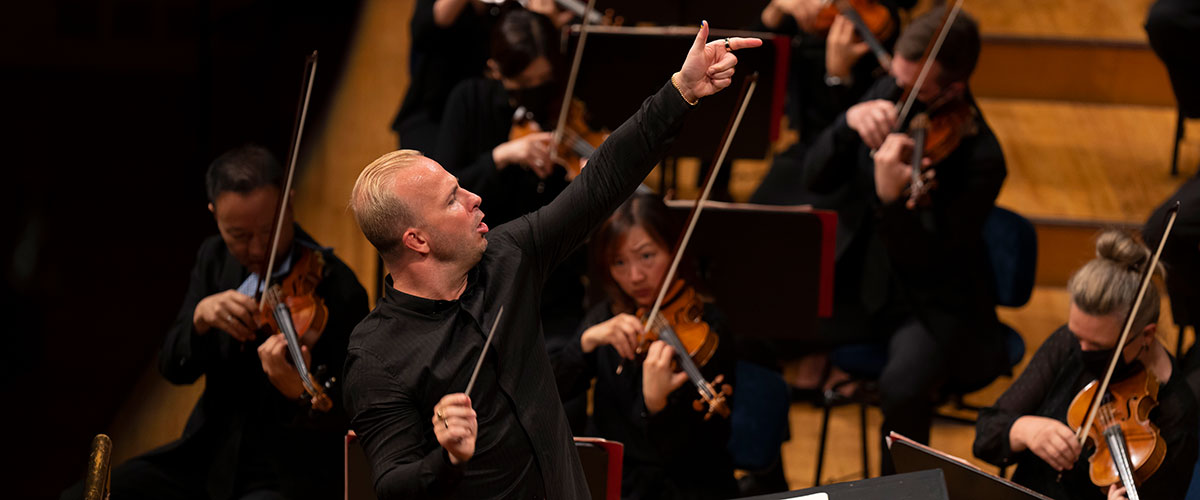
Gustavo Gimeno and TSO cellist Emmanuelle Beaulieu Bergeron Photo: STUART LOWEIn what promises to be an unforgettable night, the Toronto Symphony Orchestra is bringing all five of their living music directors to the Roy Thomson Hall stage on April 9 at 7:30 for a unique historical event. The five conductors’ tenures span the last 47 years, as the TSO eases into its hundredth year. Former TSO music directors Sir Andrew Davis (1975-1988; 2018-2020), Günther Herbig (1989-1994), Jukka-Pekka Saraste (1994-2001) and Peter Oundjian (2004-2018) will join current music director Gustavo Gimeno and host Marion Newman for this special Centennial Season event – a program of orchestral showpieces highlighting key moments in TSO history. 

Marion Newman Photo: HOWARD J. DAVISDavis starts the evening off by taking the podium for Berlioz’s Roman Carnival Overture which has been conducted by seven of the TSO’s music directors, notably by Davis as part of the TSO’s Canadian Odyssey tour of the North in 1987. Davis also leads the orchestra in Delius’ The Walk to the Paradise Garden, paying tribute to Davis’ British roots. (British-trained Canadian, Sir Ernest MacMillan, is the only other TSO music director to have performed it.)

Read more: Across the board, there’s a spring in the seasonal step!

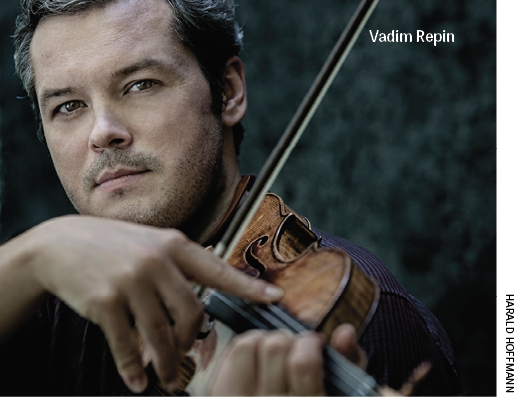
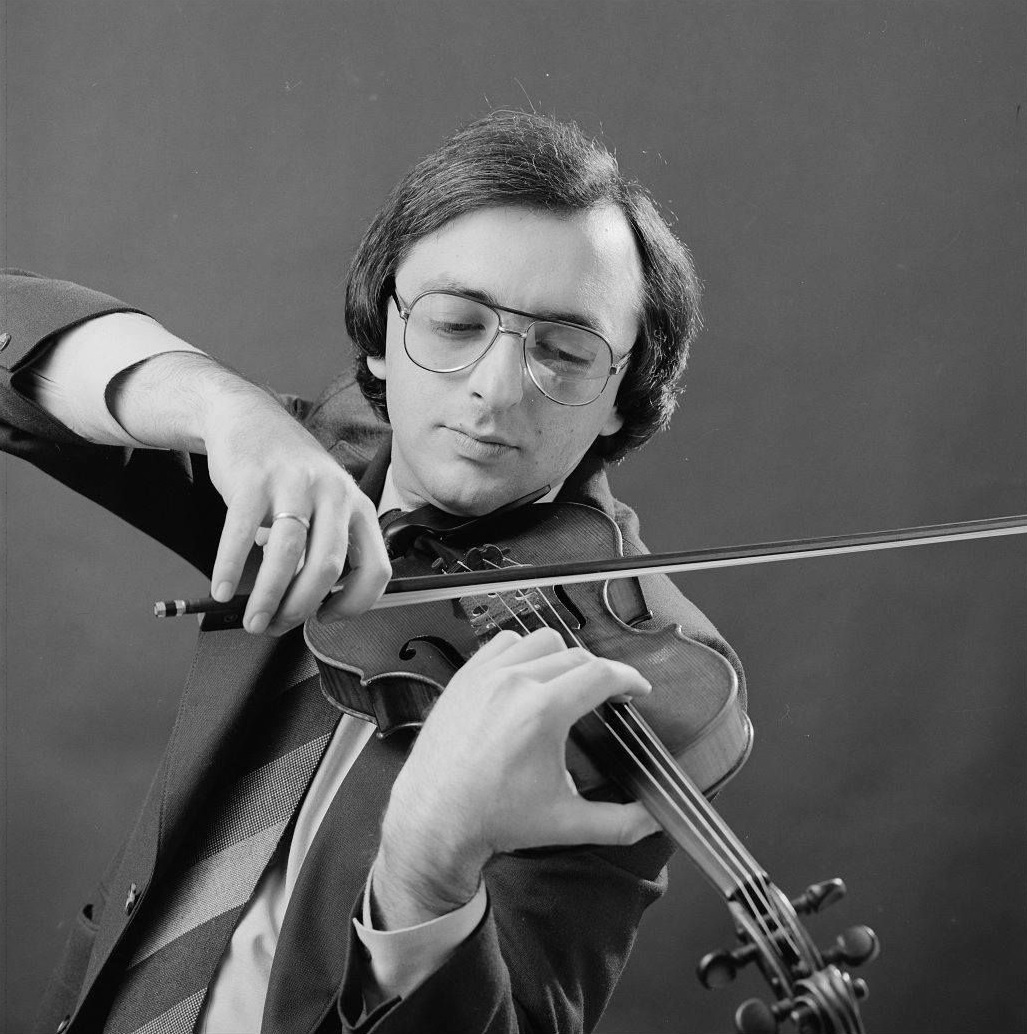
2005_-_Beat_-_Classical_-_Vadim_Repin.pngRussian-born Vadim Repin may just be the best violinist you’ve never heard of. Unless you happened to catch his TSO appearance in 2007 playing Prokofiev’s Violin Concerto No.2 with guest conductor Thomas Dausgaard, his only exposure here has been through recordings (most recently with Deutsche Grammophon) and YouTube clips. The clips span almost 30 years of an acclaimed career that took international flight after he won the prestigious Queen Elisabeth Competition in Brussels in 1989 when he was only 17.

In a recent telephone conversation the warm and gracious violinist described how he felt at that time: “The competition itself was really tough, very difficult psychologically and [physically]. It goes forever [one month]. For the next four years it put me in the spotlight of the music world but then there was a new winner, so forget about it. You have to do other things to get noticed and get the spotlight.”

This virtuoso, for whom technique is always a means to a musical end, never an end in itself, began violin lessons at five by “pure chance.” His mother, who had been encouraging her son to play with musical toys since he was three, took him to school intending to sign him up for accordion studies. Only violin places were available so he took up the violin. By age seven, chance took him under its wing again; his teacher advised studying with Zakhar Bron (who later taught Maxim Vengerov and Daniel Hope), a relationship which would continue for 13 years.

Read more: Ax to Repin: What a Month

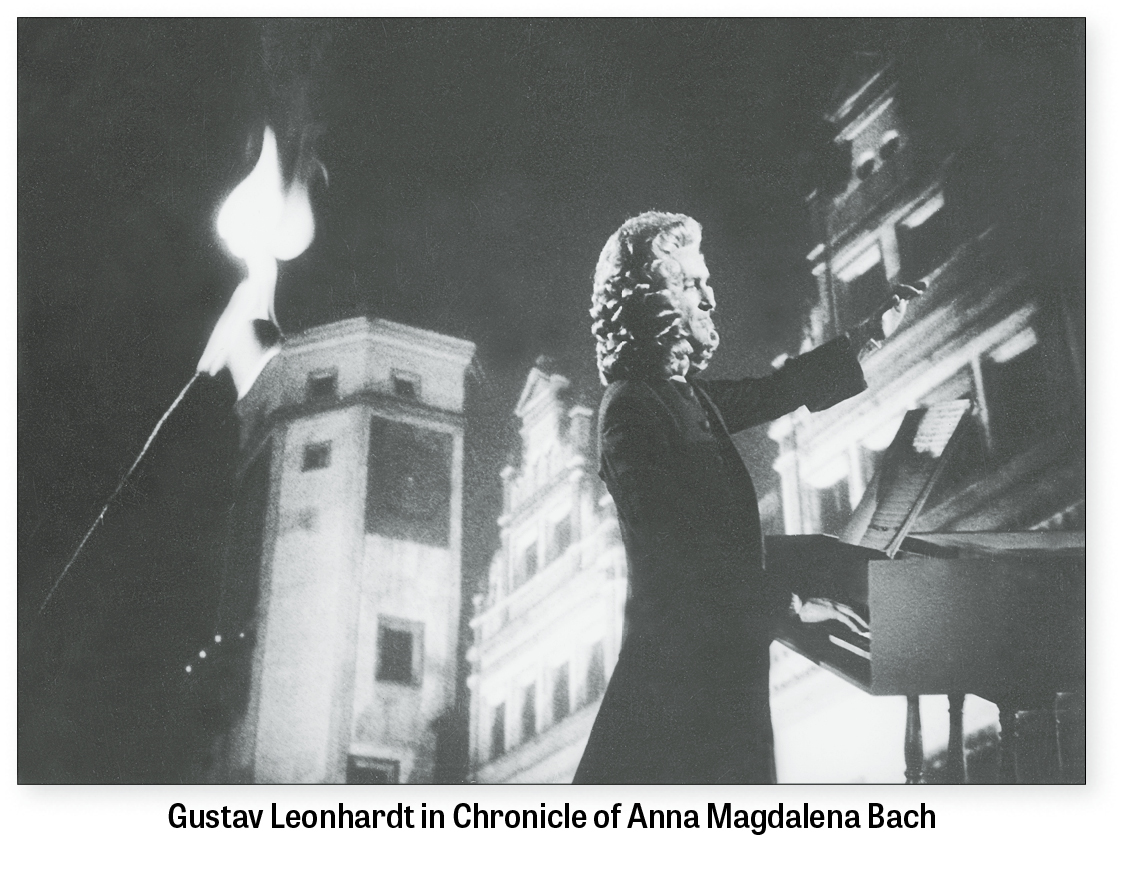
2206-BBB-Classical 1.jpg"Not Reconciled: The Cinema of Jean-Marie Straub and Danièle Huillet” is a retrospective of 31 films by the singular filmmaking duo that takes hold at TIFF Bell Lightbox March 3 with the screening of a new 35mm print of Chronicle of Anna Magdalena Bach. Whether or not you’re familiar with the austere dissociation of the filmmakers’ style, this black and white 1967 film is essential viewing for any music lover. Compulsively watchable, it’s of key historical importance on two counts. As a portrait of J.S. Bach, it’s a focused biography zoning in on the last decades of his life, from the end of his stint working for Prince Leopold of Anhalt-Köthen to his time in Leipzig as cantor of St. Thomas Church (1723-1750). And as a 50-year-old film in which Bach is portrayed by harpsichordist Gustav Leonhardt and the music is directed by Nikolaus Harnoncourt with musicians from his Concentus Musicus Wien, it’s also a record of a period-instrument movement that was then in its infancy.

The film is awash in music, all inspired by Bach’s love of, and devotion to, God. Almost the entire film consists of excerpts from 24 of Bach’s works – it’s a total immersion experience largely because most of the excerpts are each several minutes long. The bewigged Bach and musicians perform in period costume in the very places where the compositions were first played. The Straubs’ rigorous aesthetic reinforces this effect by selecting a camera position with a striking perspective and letting their unmoving camera soak up the moving image; they concentrate our attention on the music.

The film is narrated in a matter-of-fact manner by Bach’s second wife, a singer he married in 1721 after the death of his first wife. She gives a bare outline of Bach’s early years, touching on his organ prowess and the famous 250-mile walk he took from Arnstadt to Lübeck to hear his idol Buxtehude play, but once she introduces herself events flow according to the pulse of time. For the most part the music follows in chronological order beginning with a sizable excerpt from the middle of the first movement of the Brandenburg Concerto No.5, the first great keyboard concerto and arguably the zenith of his time in Köthen. The camera placement is over the right shoulder of Bach as we watch Leonhardt play his double-keyboard harpsichord unfettered.

Just as Bach is about to take up his post in Leipzig, we’re treated to Leonhardt and Harnoncourt in lovely performance of the first movement adagio from the Sonata No.2 for viola da gamba and harpsichord BWV 1028. Then it’s a seamless parade of cantatas (embracing many instrumental passages, Bach conducting from the keyboard) with the Magnificat, St. Matthew Passion and Mass in B Minor included, all integral to the narrative. Only a smattering of keyboard works interrupt the flow, notably the opening of the magisterial Prelude in B Minor for Organ BWV 544. Later, the camera actively moves in on Leonhardt for an intimate snippet of the Clavier-Übung organ chorale. He explains how his left hand plays written notes (basso continuo) while the right hand plays in consonance and dissonance; and that the music is for the glory of God.

Camera placement is critical. For example, in the Cantata BWV 198, written for the funeral of Queen Christiane, the vantage point is from the instrumental side focused on the lute, with Bach at left in front of the choir. Occasionally there will be a cut to a close-up of a singer or instrumentalist; even a view of the thick scores black with the density of notes. Despite the lack of camera movement, there is a variety of perspective, often at an angle, which adds to our involvement. The filmmakers also point us to original documents, contracts and the like. They are careful to point out the economics of Bach’s daily life and his concerns with his working conditions as he navigates his relationship to his employers.

The other major musical component of the retrospective, is the screening March 12 of the Straubs’ film of Schoenberg’s unfinished opera Moses and Aaron (1974), shot in a Roman amphitheatre with the Austrian Radio Choir and Austria Radio Symphony Orchestra (recorded in Vienna), along with the 1972 short film Accompaniment to a Cinematic Scene (which uses text by Schoenberg and Brecht to condemn anti-Semitism). Preceding the films will be a 15- to 20-minute live performance of five extracts from Schoenberg’s Pierrot Lunaire as well as Claude Vivier’s Hymnen an die Nacht presented by Against the Grain Theatre with soprano Adanya Dunn and collaborative pianist Topher Mokrzewski.

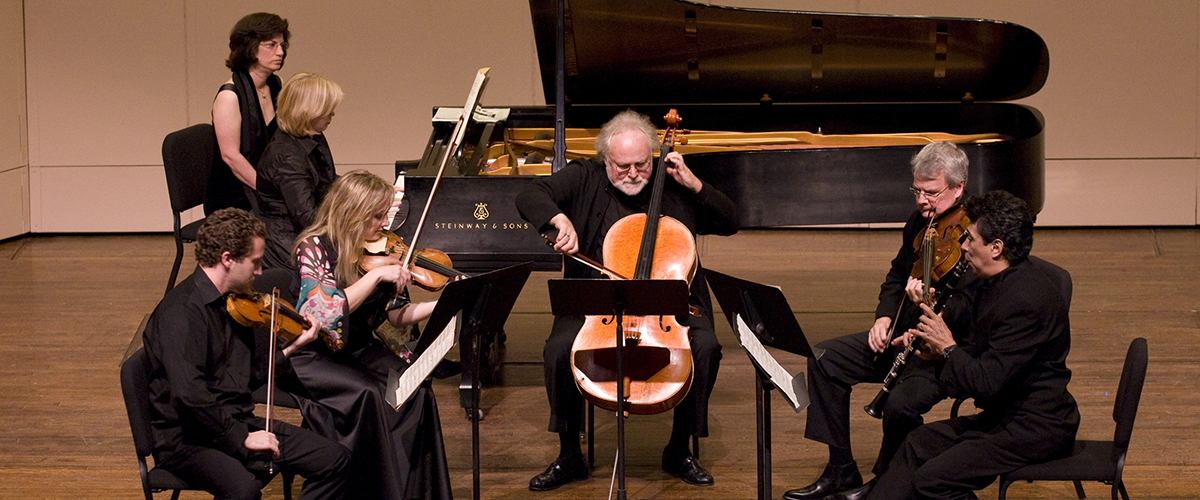
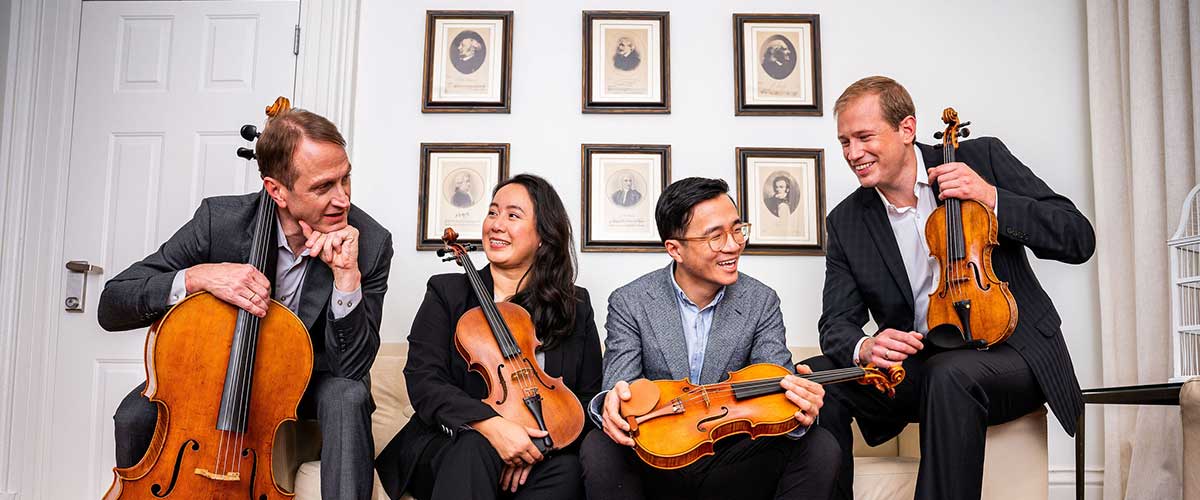
2206-BBB-Classical 2.jpgAssociates of the TSO. Now in their 45th season, the Associates of the Toronto Symphony Orchestra continue their current series March 6 with “Classics of Vienna Meet Voices of Britain.” TSO oboist Sarah Lewis is joined by Eri Kosaka, violin, Diane Leung, viola, and Emmaneulle Beaulieu Bergeron, cello, in Mozart’s effervescent Oboe Quartet K370, Britten’s Phantasy Quartet for Oboe and Strings Op.2 (written when the composer was 19 and featuring a singing oboe line). Beethoven’s splendid Trio Op.9 No.1 opens the concert.

On February 13, I heard their second concert of the season, “Paris en mille notes,” a delightful evening of chamber music in the friendly confines of Jeanne Lamon Hall. The distinctive Gallic-flavoured program began with a lively look at Stravinsky’s Suite from L’Histoire du Soldat. Stravinsky’s septet consisted of violin, clarinet, bassoon, trumpet, trombone, double bass and percussion, a larger number of players than the Associates usually bring to a concert. The enthusiastic audience, who appeared to be made up of the proverbial “seven to seventy,” took up most of the seats on the main floor and seemed to energize the players.

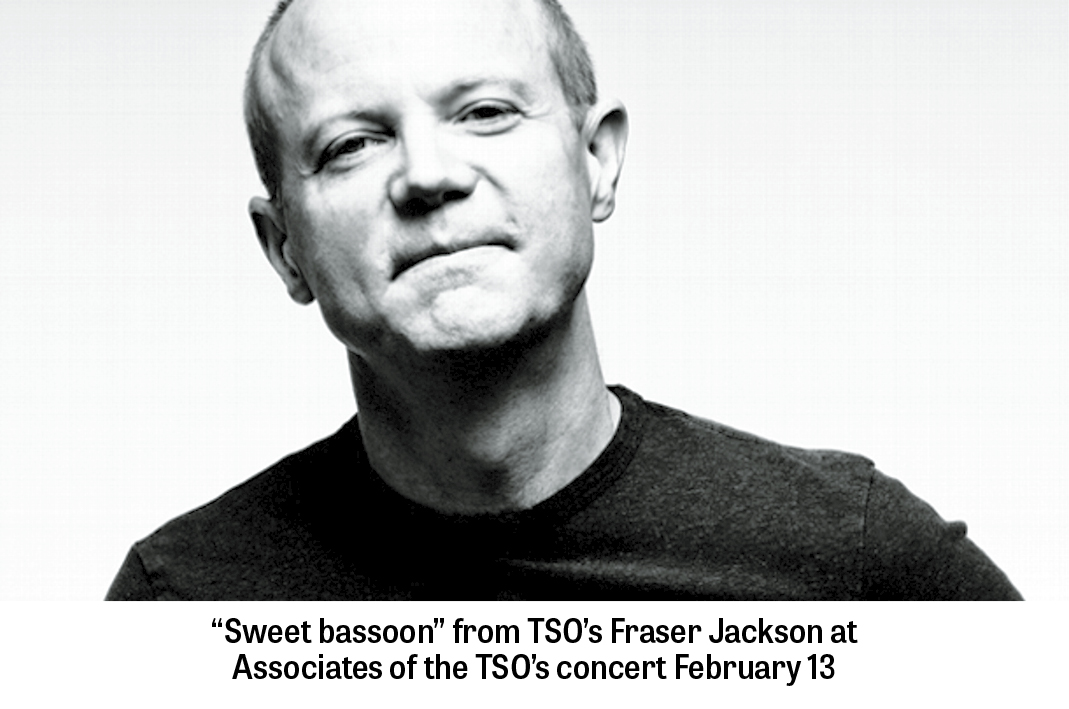
Stravinsky’s score, which takes advantage of its instruments’ unique instrumental colour, was suitably raucous and lively with memorable violin playing by TSO assistant concertmaster Etsuko Kimura (as it should be given the story of a violinist-soldier who sells his instrument to the devil), the sweet bassoon of Fraser Jackson and buffoonery from the brass.

Poulenc’s Sonata for Flute and Piano, which followed, acted as a palate cleanser after the Stravinsky’s exoticism, creating a wonderful sense of space with long flute lines and wide intervals that felt very French, all delivered with aplomb by Leonie Wall and collaborative pianist Monique de Margerie.

After intermission the duo joined the septet plus another percussionist for Jackson’s clever chamber arrangement of Ravel’s Piano Concerto in G Major which was being performed for the first time. With similar instrumentation as the Stravinsky, the concerto began in wind-band style before moving into its languorous piano theme with piccolo backing. Conductor Ryan Haskins brought a subtle baton to Ravel’s jazz touches, providing a good steady groove for the second movement’s lovely theme, while de Margerie’s intimate solo piano playing was well-suited to the chamber format.

Kudos to the musicians and their contagious spirit. It augurs well for the rest of the season to come. Following the March 6 concert previously mentioned, their season continues May 29 with a transcription of Schubert’s song cycle Die schöne Müllerin arranged for violin and viola and Beethoven’s String Trio in E-flat Major Op.3. June 5, it’s music for piano trio by Haydn, Luedeke, Piazzolla and Brahms.

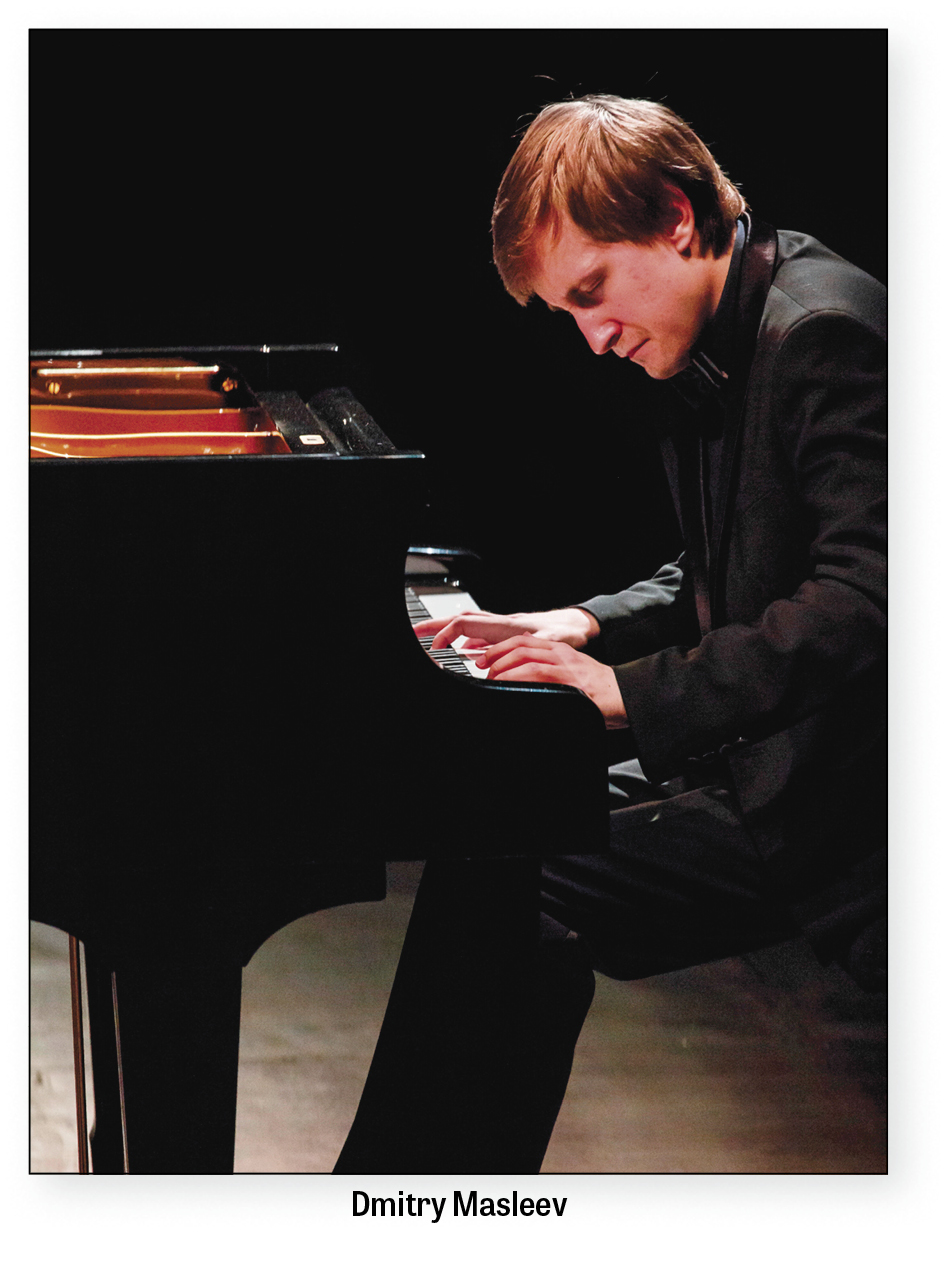
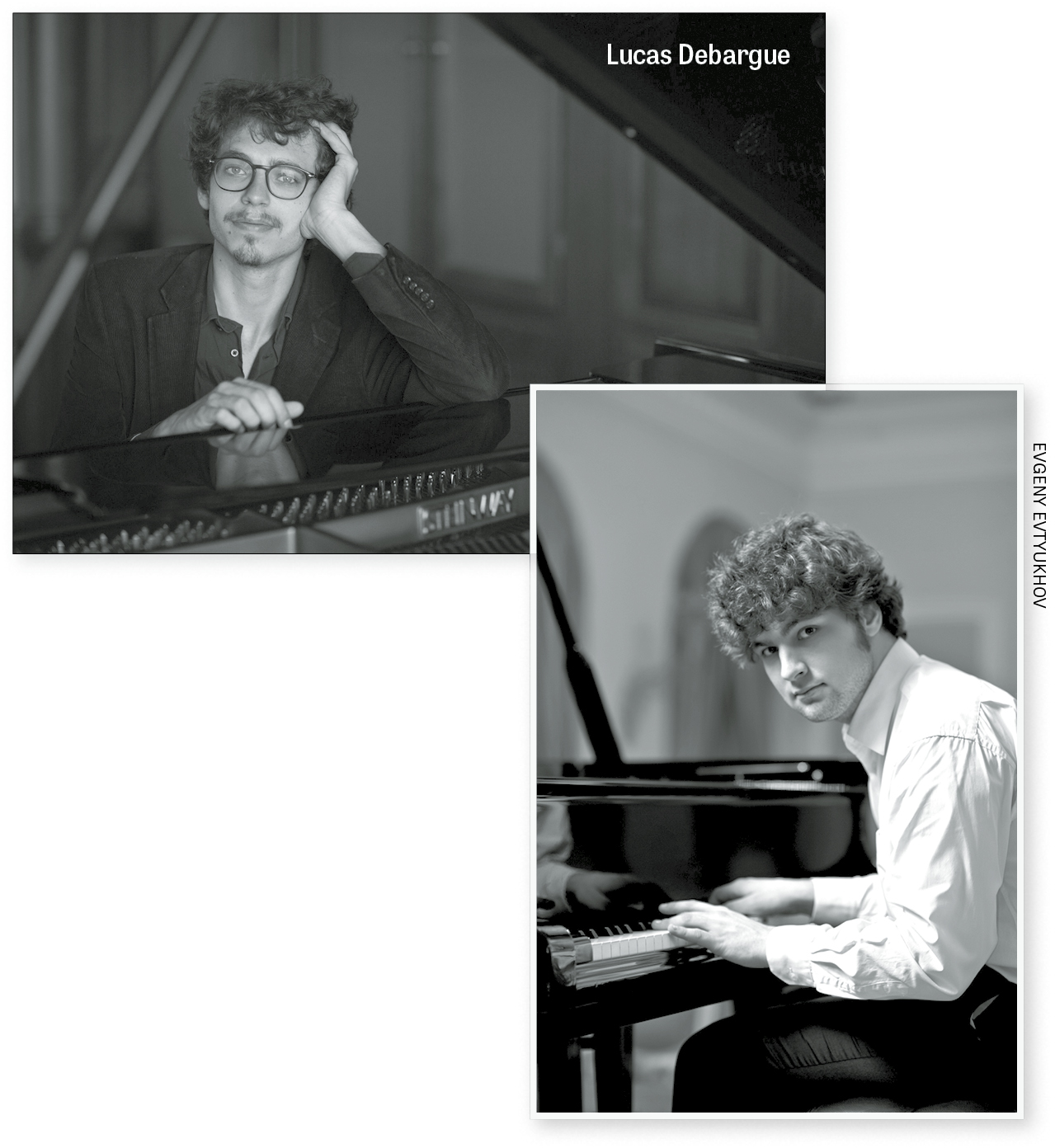
2206-BBB-Classical 3.jpgDmitry Masleev. Following in the footsteps of the 13 first-place winners of the International Tchaikovsky Competition, the Siberian-born Dmitry Masleev joins such legends as Van Cliburn (1958), Vladimir Ashkenazy (1962) and Grigory Sokolov (1966) and most recently Denis Matsuev (1998), Ayako Uehara (2002) and Daniil Trifonov (2011). His Koerner Hall recital March 22 includes works he played in Round 1 of that competition (two of Rachmaninoff’s Études Tableaux Op.39 and Beethoven’s Sonata Op.81a “Les Adieux”) and Liszt’s Totentanz from Round 2. Four Scarlatti sonatas, additional Rachmaninoff pieces and Prokofiev’s Sonata No.2 in D Minor Op.14 complete his ambitious program.

In response to a question I emailed him shortly before we went to press, Masleev told me that his musical hero is Sergey Rachmaninoff. “He was not only a genius composer whose music inspires all classical music lovers, but he was also a brilliant pianist,” he said. “Thank God we have lots of his recordings available and can listen to them.

“He has his own style of performing,” the 28-year-old said. “You will always be amazed by his precise touch, deep forte and piano, and of course, just incredible technique. His music combines deep meaning that touches your heart, a variety of harmonies, just unbelievable beautiful melodies. There is a quality in it that will find a response from any person in the audience.

Daniil Trifonov. Coincidentally, the previous Tchaikovsky winner, Daniil Trifonov (having just turned 26) returns to Koerner Hall just six days after Masleev, March 28 in a recital devoted to Schumann, Shostakovich and Stravinsky’s Three Movements from Petrushka. The concert is sold out but a few rush tickets will be available 90 minutes prior to the performance. When he was 23, Trifonov gave a masterclass/interview at Mazzoleni Hall one evening in January 2015. He mentioned Rachmaninoff, Friedman, Horowitz, Hofmann and Michelangeli among pianists from the past who inspired him. He said then that the two hours before a concert is a period of intense concentration and that “somehow warming up for me is more mental [than physical].”

QUICK PICKS

Mar 4: Hamilton Philharmonic Orchestra principal trumpet Michael Fedyshyn joins violinist Bethany Bergman, cellist Rachel Mercer and pianist Angela Park as 5 at the First presents music by Biber, Barnes, Ewazen and Piazzolla.

Mar 4: Academy Concert Series presents “A Frankly Fabulous Foray,” piano quintets by Franck and Fauré (See what they did there!), two lush chamber works. OSM principal second violin Alexander Read, HPO second violinist and Windermere String Quartet first violinist Elizabeth Loewen Andrews, TSM 2016 fellow Emily Eng, viola, Academy Concert Series artistic director Kerri McGonigle, cello, and Leanne Regehr, piano, bring the works to life.

Mar 5: Trio Con Brio Copenhagen’s concert, presented by Chamber Music Hamilton, includes Schubert’s uncommonly beautiful Piano Trio in B-flat Major Op.99.

Mar 5, 7 and 9: The Kitchener-Waterloo Chamber Music Society presents the Aviv String Quartet performing Mozart’s great last ten quartets. Mar 21 and 23: Movses Pogossian honours Bach’s birthday by playing his six sonatas and partitas for unaccompanied violin in the KWCMS music room. Mar 22: Peter Vinograde, who played the first solo recital in that music room in 1980, returns to play Bach, Beethoven and Peter Mennin. Apr 2, 4, 5, 7 and 9: Another major programming coup for KWCMS: the Lafayette String Quartet playing the complete Shostakovich string quartets.

Mar 5: It’s cloning time as Mooredale presents Paganini Competition prizewinner In Mo Yang at Walter Hall, while RCM presents the inimitable Sir András Schiff at Koerner Hall, and Roy Thomson Hall presents Andris Nelsons and the Boston Symphony Orchestra, recent Grammy winners for Best Orchestral Performance. All concerts will take place Sunday afternoon at three o’clock.

Mar 7: GGS scholarship student Charissa Vandikas plays Chopin, Schumann and Rachmaninoff in a free noon-hour concert at the Richard Bradshaw Amphitheatre. Apr 4: Another COC free noontime concert features Mark Fewer in solo violin works by Bach, Ysaÿe and Chris Paul Harman. Apr 5: Rossina Grieco, a native of Southern California and winner of the GGS Ihnatowycz Prize in Piano, fills the Bradshaw Ampitheatre with Liszt’s iconic Sonata in B Minor in her free concert.

Mar 9: The relatively new Trio Shaham Erez Wallfisch brings their chamber music bona fides to the Women’s Musical Club of Toronto for what promises to be a memorable afternoon of music by Rachmaninoff, Schumann and Shostakovich.

Mar 10: The celebrated duo pianists, Anagnoson and Kinton, continue their 40th anniversary season with a concert at Brock University in St. Catharines.

Mar 16: Music Toronto presents the Philharmonic Quartett Berlin (made up exclusively of members of the Berliner Philharmoniker) in a classic program of late Haydn, early Beethoven and middle Schumann.

Mar 18: TSO concertmaster Jonathan Crow is the soloist in Brahms’ lyrical Violin Concerto with the Niagara Symphony Orchestra conducted by Bradley Thachuk, at FirstOntario Performing Arts Centre in St. Catharines.

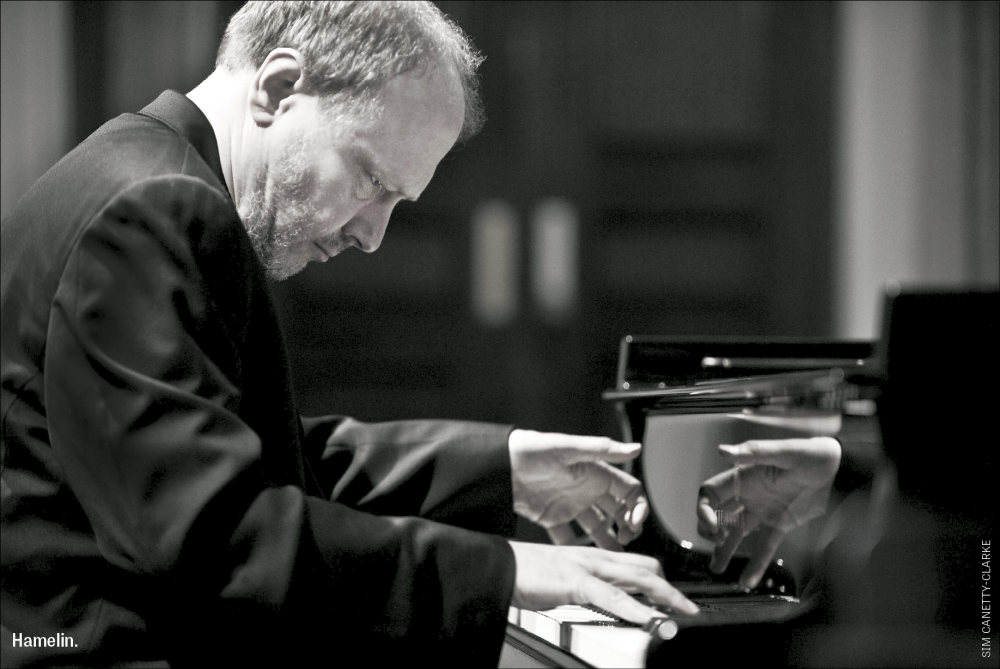
Mar 19: Four days before his Music Toronto recital, Marc-André Hamelin performs at the Isabel Bader Centre for the Performing Arts in Kingston. The all-sonata program is anchored in the first half by Beethoven’s fervid Appassionata Sonata and in the second by Chopin’s dark Sonata No.2 in B-flat Minor “The Funeral March.”

Mar 23: One-time protégé of the great Arthur Rubinstein, Janina Fialkowska brings her pianistic sensibility to an all-Chopin recital at the Aurora Cultural Centre.

Mar 27: The U of T Faculty of Music presents the dedicated and dependable Gryphon Trio performing Beethoven’s buoyant Piano Trio Op.11, Dinuk Wijeratne’s Love Triangle and Brahms’ romantic signpost, the Piano Quartet No.1 in G Minor Op.25. Currently artists-in-residence at the faculty, the Gryphon is joined by guest violist Ethan Filner for the Brahms.

Apr 1: The indefatigable Angela Park joins Canadian Sinfonietta’s first violinist, Joyce Lai, and first cellist, András Weber, for an evening of chamber music by Rachmaninoff, Handel-Halvorsen and An-Lun Huang.

Apr 1, 2: Tokyo-born, Montreal-raised Karen Gomyo brings her superb musicianship to Beethoven’s splendid Violin Concerto. Young American, Robert Trevino, also conducts the TSO in the 1947 version of Stravinsky’s Petrushka rooted in Russian folklore and melody. Apr 6, 7: TSO favourite Thomas Dausgaard returns to conduct Deryck Cooke’s version of Mahler’s magnificent Symphony No.10; TSO principal cellist Joseph Johnson is the soloist in Schumann’s ravishing Cello Concerto in A Minor Op.129, the opening work on the program.

Apr 2: Pianist Anton Nel, fresh from two masterclasses on March 31, performs Mozart and Schumann in a free concert (tickets required; available from March 2) in Mazzoleni Hall.

Apr 7: Bravo Niagara! Festival of the Arts presents pianist Jon Kimura Parker in a fascinating program comprised of Beethoven’s formidable Appassionata Sonata, Ravel’s shimmering Jeux d’eau, Alexina Louie’s Scenes from a Jade Terrace and two movie-themed pastiches by William Hirtz: Bernard Herrmann Fantasy and Fantasy on the Wizard of Oz.

Paul Ennis is the managing editor of The WholeNote.

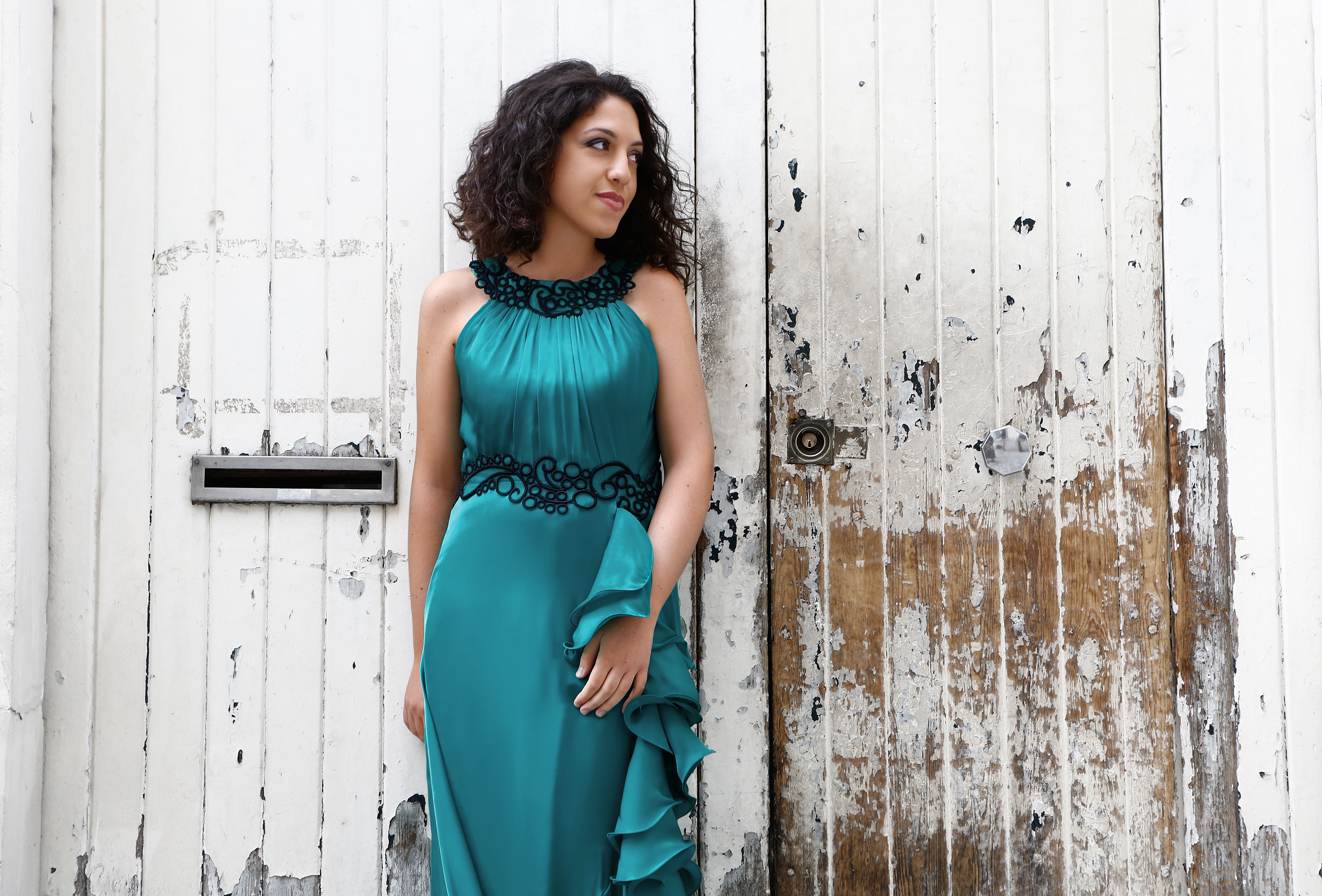
Gramophone’s 2017 Young Artist of the Year, 25-year-old Italian-born pianist Beatrice Rana, makes her Koerner Hall debut April 8. I remember fondly her Toronto Summer Music concert in 2014, where she brought the Walter Hall audience instantly to its feet with a heartfelt, technically gripping performance of Prokofiev’s Sonata No.6. Her career was clearly on the rise then; it continues on its upward path. I recently had an email Q&A exchange with her.

Beatrice Rana - photo by Marie StaggatWN: What are your first memories of playing the piano?
BR: I began studying piano when I was four, but before that I have some little memories of me trying to repeat the melodies of cartoons four hands with my father. I also remember my parents taking me out for concerts on Friday nights; it was always a very special feeling.

Your parents are professional pianists and your younger sister plays the cello. Please describe the musical atmosphere in your home growing up.
I would say that music is really part of our daily life, as much as drinking water or eating lunch. The house could be pretty noisy at times (!), but it was absolutely wonderful to grow up in a family that really understood and supported our musical choice.

Who was the first composer you fell in love with as a child?
The first musical challenges when I was a child were some pieces by Mozart and Schumann, but the composer that was giving me the biggest sense of accomplishment was Bach, and I ended up playing a lot of his music. I still have a very special relationship with Bach’s music, even though I constantly fall in love with so many other composers.

Who were the first musicians you fell in love with?
Martha Argerich and Glenn Gould.

Do you have any piano idols?
I wish I could have listened live to Horowitz and [Arturo] Benedetti Michelangeli.

How life-changing was winning the Silver Medal and Audience Award at the Cliburn piano competition in 2013?
It was absolutely a shock – a good shock of course! The first big change in my musical career came with [winning] the Montreal competition in 2011, but after the Cliburn I really reached what I was looking for, which was having the chance to be a concert pianist. The thing is that you don’t know what it really means to be a concert pianist until you become one: it’s an amazing life, full of travel, people, different cultures, but sometimes it can be tiring.

I’d like to focus on your upcoming Koerner Hall recital on April 8. What is it about Schumann’s music that speaks to you in general? And what about Blumenstück and the Symphonic Etudes in particular?
I always loved Schumann, probably also because of my close relationship to Bach with whom there are many connections. Blumenstück and Symphonic Etudes really reflect Schumann’s aesthetic with his two opposite personalities: on one hand there is Blumenstück, which represents Eusebius with his poetic, intimate and dubitative approach to life; on the other, the Symphonic Etudes are Florestan, incredibly extroverted and brilliant, inspired also by the bigger sonorities of an orchestra.

What fascinates you about Ravel’s Miroirs?
The choice of Miroirs is connected to the choice of the piano as a symphonic instrument. Ravel was an incredible orchestrator and two pieces of the Miroirs were in fact orchestrated. What strikes me the most in this music is the imagination and plasticity of sound, which is able to recreate vividly either the hysteric movement of a butterfly in the night or a ship moving on the ocean and struggling with the storms.

What are some of the challenges of Stravinsky’s The Firebird?
Again, the piano is imitating an orchestra but this time the process is the opposite: The Firebird was originally written for the orchestra, and [Guido] Agosti – an incredible pianist of the last century – wrote this amazing transcription. The main challenge is of course to recreate the different sounds that such a big orchestra can reach, but on the other side, the advantage is the freedom with the interpretive choices that it’s impossible to have with an orchestra.

What do you find most rewarding and most challenging in your professional life?
It is very fascinating to travel so much and get to know so many audiences: every country is completely different, because of its culture and its musical traditions. Still, being able to communicate with all of them through music is a real privilege, and sharing moments of such authenticity on so many different stages is just incredible.

Alison Chernick’s Itzhak

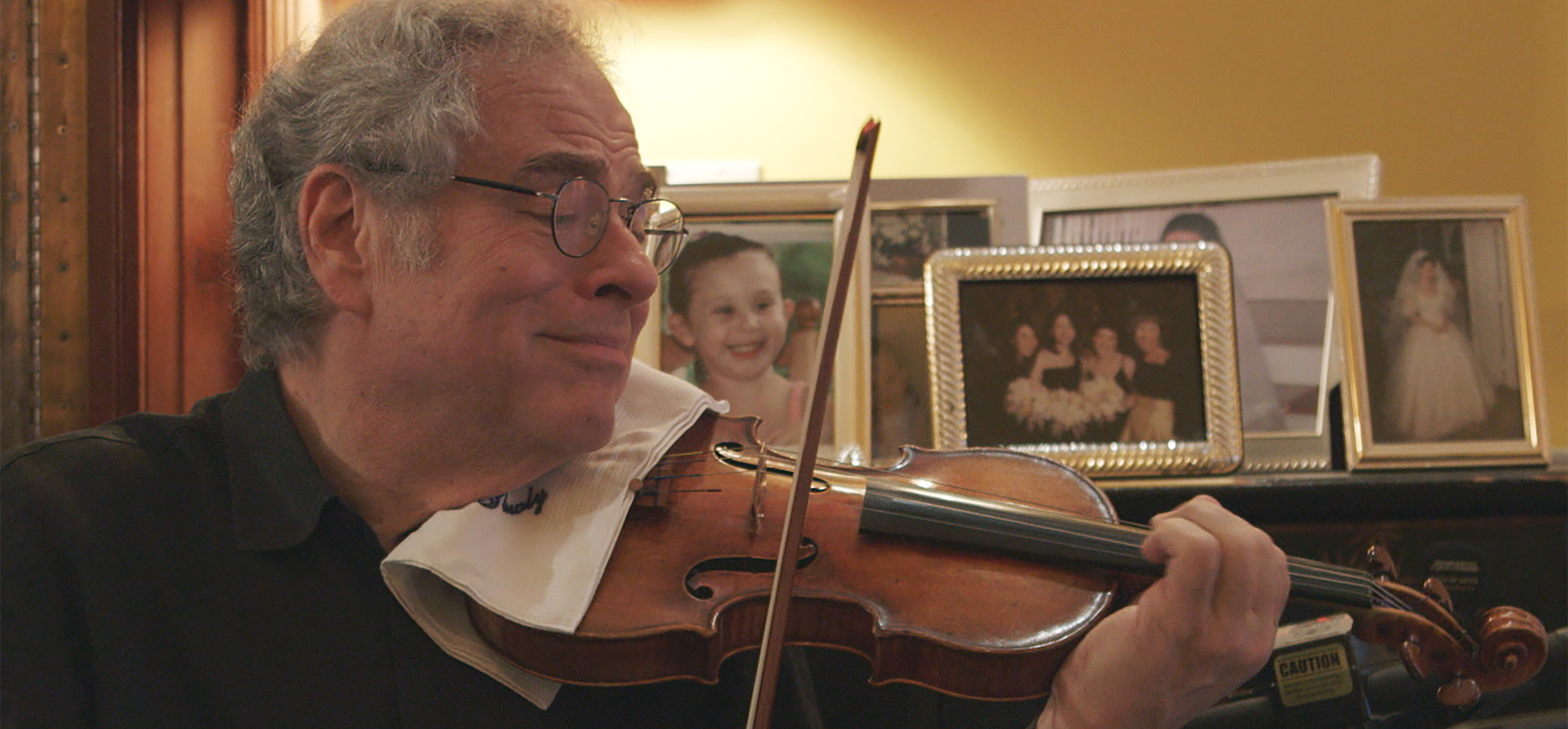
“When you finally get the sound [of the violin], you are really getting something out of yourself,” the young Itzhak Perlman says in black and white footage from Israeli television in 1974, during Alison Chernick’s new documentary Itzhak. “The more you have in your heart, the more you have to give,” he explains, having noted that to get a sound out of a piano you merely have to strike a key. The Israeli-born Perlman has given an enormous amount over his long professional career; and he’s been in the public eye since his appearance in 1958 as a 13-year-old on The Ed Sullivan Show playing an excerpt from Mendelssohn’s Violin Concerto. Itzhak is a congenial portrait of the living legend, from the child crippled by polio to the 70-year-old musical icon travelling out to the CitiField pitcher’s mound in his motorized wheelchair to play The Star-Spangled Banner in the home of the New York Mets.

Itzhak Perlman in 'Itzhak' - photo by Films We LikeWith the aid of old video, photographs and home movies we get a sense of what drove the young violinist to succeed. More recent footage records the love and devotion of his wife Toby and the importance to him of their family and Jewish heritage. His physical challenges are constant, his triumph over them as a performer, teacher, husband and father implicit throughout.

But it’s the singularity of his musical life and the joy he brings to it that is the raison d’être of Chernick’s film. Where does she lead us from the baseball diamond? To a rehearsal of Tchaikovsky’s Piano Trio Op.50 with cellist Mischa Maisky and pianist Evgeny Kissin. Then the star-spangled musical trio takes a break in Perlman’s New York City kitchen where the host animates the eating of takeout Chinese food with a hoary old Russian-Jewish joke.

Richard Strauss’ Violin Sonata, Bruch and Wieniawski Violin Concertos, Brahms, Respighi and Ravel, Vivaldi, Bach, Mozart and Schubert all resonate on the soundtrack. Marian Anderson’s singing of the spiritual Crucifixion has a special place in Perlman’s iconography. As his playing of klezmer music with The Klezmatics does in ours. And what is the most requested piece of music in his repertoire? The theme from Steven Spielberg’s Schindler’s List by John Williams.

You can watch how Perlman evokes the beauty of a phrase and marvel at the way he brings out the colour of a melody when Itzhak plays at the Hot Docs Ted Rogers Cinema April 6 to 12, followed by a run at the Mt. Pleasant Theatre beginning April 13.

Massey Hall/Roy Thomson Hall presents Itzhak Perlman and pianist Rohan De Silva in recital at Roy Thomson Hall April 22, performing works by Schubert, Beethoven and Dvořák.

Paul Moon’s Absolute Beauty

Recently I celebrated what would have been the 108th birthday of American composer Samuel Barber by watching Absolute Beauty, a comprehensive portrait of a man who wrote some of the most beautiful music of the 20th century. H. Paul Moon’s documentary has just now become available via internet streaming or purchase, having made the rounds of film festivals over the last several months. I found Moon’s assemblage of Barber scholars, musicians, personal reminiscences, film footage and photographs so touching that I immediately put on two of my personal Barber favourites: his Violin Concerto with its lovely first two movements; and his evocative Knoxville: Summer of 1915 for soprano and orchestra, the setting of James Agee’s clear-eyed nostalgic picture of family life from the point of view of a five-year-old boy. I had just learned that Agee and Barber were the same age and that Agee’s text spoke directly to Barber’s own youthful memories.

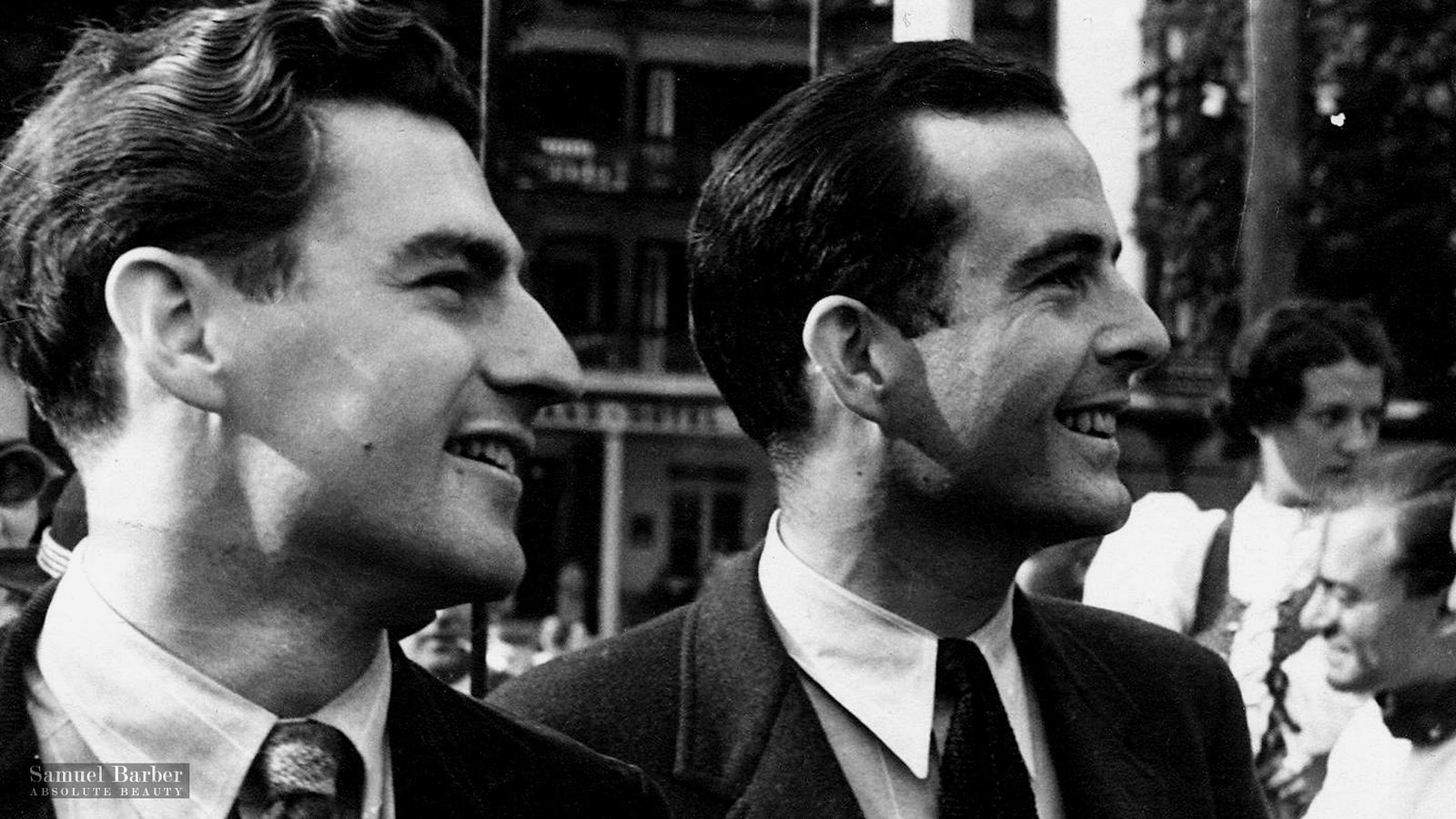
Gian Carlo Menotti (left) and Samuel Barber in the summer of 1936 from 'Absolute Beauty' - photo by HP MoonMoon took the film’s title from Leonard Bernstein: “I’ve always associated Sam’s music in my mind with Plato – I think, in terms of what Plato called the Absolutes, he’s a Platonic composer… the concept that there is an absolute truth and an absolute beauty and the absolute rightness of things… that all Sam’s music has tried to form one version or another of absolute beauty.”

The documentary begins with the transfixing melancholy of Dover Beach Op.3, written for baritone and string quartet (from the poem by Matthew Arnold) when Barber was 21 and still a student at the Curtis Institute. “Barber found the profound essence of the poem in very small motives,” Thomas Hampson says. The film moves through Barber’s compositional output from the Cello Concerto, Symphony No.1, the justly famous Adagio for Strings, the Piano Sonata (written for Horowitz, a frequent visitor to Barber’s Mt. Kisco home), Hermit Songs (and his collaboration with Leontyne Price) et al, ending with his 1966 opera Antony and Cleopatra and its misplaced stage direction by Franco Zeffirelli that blinded the critics to its musical qualities. Conductor Leonard Slatkin, one of Absolute Beauty’s roster of talking heads, says that he was enchanted listening to the opera on the radio when he was 22.

Barber wrote very little after those negative reviews and spent the last years of his life without his longtime partner Gian Carlo Menotti. Unable to afford Capricorn, their country home with its sylvan setting, Barber moved back to New York City where a Fifth Avenue apartment was of little consolation. He left us with a legacy of blissful melancholy as Absolute Beauty’s moving soundtrack depicts.

Absolute Beauty is available for purchase through Amazon and for rental at watch.samuelbarberfilm.com and at
https://vimeo.com/156522774.

TSO and Friends

Up-and-coming violinist Ray Chen is the soloist in Bruch’s beloved Violin Concerto No.1; Sir Andrew Davis leads the orchestra in Sibelius’ magnificent Symphony No.2 Apr 5, 7 and 8. Christian Tetzlaff performs Berg’s ineffably beautiful Violin Concerto; Kent Nagano leads the OSM in Bruckner’s ever-popular Symphony No.7 Apr 13. Violinist Blake Pouliot, recently named Women’s Musical Club of Toronto’s 2018 Career Development Award Winner, plays Beethoven’s lyrical Romances 1 and 2 as part of an all-Beethoven program under the baton of resident conductor Earl Lee that also includes the iconic Symphony No.5 Apr 14 and 15. The Associates of the TSO perform two of the greatest string chamber works: Schubert’s Quintet in C D946 and Brahms’ String Sextet No.1 Apr 23. Bramwell Tovey conducts the 1993 concert version of Leonard Bernstein’s brilliant musical Candide (essentially Bernstein’s 1989 recording with a few excisions) Apr 26 and 28. The legendary pianist Leon Fleisher brings the wisdom of his 89 years to Mozart’s Piano Concerto No.12; Peter Oundjian conducts Bruckner’s immense Symphony No.8 May 2 and 3 (RTH), May 6 (Montreal) and May 8 (Ottawa).

QUICK PICKS

Apr 6: The indefatigable Stewart Goodyear joins Nurhan Arman and Toronto Sinfonia for Vinzenz Lacher’s chamber version (originally for piano and string quintet) of Beethoven’s masterful Piano Concerto No.5 “Emperor.” Also in Barrie Apr 7. Later in the month Goodyear joins the estimable Trio Arkel (COC concertmaster Marie Bérard, TSO principal violist Teng Li and associate principal cellist Winona Zelenka) and Silk Road Ensemble bassist Jeffrey Beecher for a performance of Schubert’s sublime Trout Quintet Apr 27. Music by Schoenberg, Boccherini and Barrière complete the program.

Apr 8: Syrinx Concerts presents three internationally known musicians who happen to be on the faculty of the Schulich School of Music at McGill University – Ilya Poletaev, piano; Axel Strauss, violin; and Yegor Dyachkov, cello – performing music by Beethoven, Ravel and Oesterle.

Apr 12: Music Toronto presents the German-based Schumann Quartet, proteges of the Alban Berg Quartet and winners of the BBC Music Magazine Newcomer Award 2016 in a program of Haydn, Shostakovich and Schumann.

Apr 14: WholeNote Early Music columnist Matthew Whitfield is the organist in “The Wagner Effect” presented by Abendmusik at St. John’s Norway. (Apr 21 Whitfield plays harpsichord and organ in Bach’s The Musical Offering with Molly Evans-Stocks and Jimin Shin, violinists, another Abendmusik presentation.)

Apr 21: Cathedral Bluffs Symphony Orchestra’s Annual Fundraising Concert features two young soloists, cellist Alik Volkov in Tchaikovsky’s charming Variations on a Rococo Theme and pianist Lauren Esch in Grieg’s enduring Piano Concerto.

Apr 22: Pocket Concerts has decided it’s time to tackle Late Beethoven. Shane Kim and Katya Poplyansky, violins, and Amy Laing, cello, join co-director Rory McLeod, viola, in a performance of String Quartet No.12 Op.127.

Apr 22: Nocturnes in the City presents pianist Karolina Kubálek (Antonín Kubálek’s daughter) performing music by Mozart, Rachmaninoff, Chopin and Ravel.

Apr 26: The dean of Canadian pianists, Robert Silverman (soon to turn 80), gives an all-Chopin recital at Gallery 345. The program is repeated Apr 28 in the Music Room of the Kitchener-Waterloo Chamber Music Society.

Apr 27: Soprano Isabel Bayrakdarian joins Amici to celebrate the ensemble’s 30th anniversary in a program of works by Respighi, Dohnanyi and much Bernstein.

Apr 28: Charismatic French cellist Gautier Capuçon and his longtime duo partner Jerome Ducros grace the Koerner Hall stage with a selection of Fauré, Brahms and Rachmaninoff plus French and Russian short pieces from their latest CD Intuition.

May 3: The Women’s Musical Club of Toronto’s final concert of the season “Cellodrama!” features principal cellist of the Regina Symphony Orchestra, Simon Fryer, who also happens to be artistic director of the WMCT. He’s programmed himself along with seven cellist friends and special guest soprano Sarah Slean in a recital featuring works for solo cello, four cellos and eight cellos by Barrière, Penderecki, Jocelyn Morlock, Bach, Kelly-Marie Murphy, Queen and Villa-Lobos (the incomparable Bachianas Brasileira No.5).

May 3 to 6: Tafelmusik, with guest conductor Bruno Weil at the podium, takes a fresh approach to Beethoven, dipping into two classics from his fertile middle period. Music director emerita Jeanne Lamon is the concertmaster for the evening. Current music director Elisa Citterio is busy as the soloist in the Violin Concerto, which opens a strong program that ends with the Pastoral Symphony.

May 4: Festival of the Sound artistic director James Campbell gets ready for summer with music for clarinet, piano and cello in various combinations by Beethoven, Ravel, Fauré, Saint-Saëns and Brahms, at the Aurora Cultural Centre.

Paul Ennis is the managing editor of The WholeNote.

Imagine how cohesive an orchestra that has had one stellar principal conductor for a couple of decades must become. Compare that in your mind to one that has been without a principal conductor for the same amount of time. You can speculate that the orchestras in question would evolve in very different ways with very different strengths and weaknesses.

Now, imagine if you can an orchestra that as a matter of fundamental policy has had no principal conductor for almost eighty years ... but can call regularly on Nikolaus Harnoncourt, Gustavo Dudamel, Andris Nelsons, Franz-Welser-Möst, Georges Prêtre, Christian Thielemann, Mariss Jansons, Esa-Pekka Salonen...  You can imagine that such an orchestra might evolve into something remarkable. As indeed it has, and they’re coming to town.

18_semyon_bychkov_1_credit_sheila_rockThe Toronto stop of the Vienna Philharmonic, March 6, is their only Canadian stop, and the last of an eight-concert, nine-day North American tour under the baton of Semeon Bychkov. The orchestra will rotate three different programs over the course of the nine days – one all Mahler, one Schumann and Brahms, and the third (the one we will hear) Schubert, Wagner and Bartók (see listings for details).

Bychkov’s most important Great Lake so far has been Erie, not Ontario. “My first five American years were in New York City” he says, “and I learned pretty quickly that it is not typical America.” The five years he spent after that in Michigan as music director of the Grand Rapids Symphony would doubtless have strengthened that impresssion. Around that time, he stumbled into a one-time engagement with the Buffalo Philharmonic – Il trovatore at the ArtPark Festival in Lewiston. It led to a ten year relationship. “My career in America was entirely fulfilling,” he says on his website. “I always look at that time as my second birth.”

For those who lost track of Bychkov after he left the Buffalo Philharmonic in the mid-nineties: he returned to Europe in 1989 to become music director of the Orchestre de Paris. From Paris he went to WDR Symphony Cologne, a post he still holds. Again from his website: “After ten years this must mean that we are not bored with each other, and that we all feel we are progressing and fulfilled in what we are doing. Anything other than that is a horrible life for a musician.”

Around the same time as the appointment with “very forward-looking” Cologne he was also appointed chief conductor of the very traditional Dresden Semperoper, “the house of Wagner and Strauss. It was fantastic for me [having both appointments] as if I was able to live in the 19th century and the end of the 20th as well.”

His equal delight in both the operatic and orchestral bodes well for the tour. Certainly the Vienna Philharmonic is no stranger to doing similar double duty; they are the pit band (if you pardon the expression) for the Vienna State Opera – a tradition going back further even than the idea that a great orchestra does not need a principal conductor. With “guests” like theirs on ready call, it’s hard to disagree.

One sometimes observes that orchestras on the road play it safe, going for a “trademark” sound so as not to disappoint the buyers of their records. With repertoire on tour that Bychkov is exploring for upcoming projects he’s passionate about, that ain’t going to happen.

THERE’S A HUGE ORCHESTRAL BUZZ right through the concert listings this month. Nowhere is that more evident than in the Beyond the GTA listings (page 43 on) where the Kingston, Hamilton, Huronia, Georgian Bay, Guelph, and Kitchener Waterloo Symphony Orchestras account for almost a concert a day between them. An overall search for orchestral music in our online listings would doubtless yield a harvest several times that many.

20_edwin_outwater_2_-_sean_puckett_credit_-_6Particularly interesting to observe so far this season is the cracking pace being maintained by the Kitcher-Waterloo Symphony under Edwin Outwater’s aegis. Now in his fourth season with the KWS, Santa Monica born Outwater seems to stirring up a mix of music sure to appeal to every taste – from rock-solid mainstage productions of masterworks to family and child-centred fare with tantalizing titles like “Dan Deacon’s Electronic Bus” and “Symphony in Space.” From reading about him, Outwater is passionate about the educational aspect of his job, and he has the track record to prove it. As former music director of the San Francisco Symphony, he championed programs for school, community performances and outreach.

Oddly enough, the most eclectic programming of all for the KWS in the next little while is happening not in the K-W area but of all places, at Toronto’s Sony Centre. And what a contrast!

March 1-6 the orchestra takes on the responsibility of playing for the Mariinsky (aka Kirov) Ballet performances of Swan Lake. (Watch out for that Black Swan, though, Edwin. From what I saw in the trailer for the movie, she’s likely to rip your face off if she doesn’t like your tempi!)

And then April 9 (two shows only) they are back to provide live orchestral backing for a cartoon-fest titled “Warner Brothers present Bugs Bunny at the Symphony,” featuring the original Looney Tunes cartoons set to Carl Stalling’s original scores. Stalling is a ferociously interesting miniaturist – a bit like an orchestral Satie on speed. You can imagine why the project might have caught Outwater’s interested eye.

David Perlman is deputizing for Allan Pulker, the usual patroller of this beat.

Calidore String Quartet. Photo by Sophie ZhaiThe Calidore String Quartet (Jeffrey Myers and Ryan Meehan, violins, Jeremy Berry, viola, and Estelle Choi, cello) made a name for themselves in 2016 by winning the $100,000 Grand Prize in the inaugural M-Prize International Chamber Music Competition, the world’s largest chamber music prize. More recently, they were awarded the 2018 Avery Fisher Career Grant. During the upcoming season they will complete their three-year residency with the Chamber Music Society of Lincoln Center. They took time in August for an email Q&A in advance of their Mooredale Concerts recital of their “Music and Conflict” program in Walter Hall, on September 30.

WN: Please tell us about when and where the Calidore String Quartet began.

CSQ: We met at the Colburn School in Los Angeles where we were completing our music studies. Estelle and Jeff had been in a different quartet and we were looking to continue working together. Jeremy on viola was the next addition followed shortly by Ryan on second violin. The quartet officially formed in 2010.

How was your “Music and Conflict” program conceived?

Given the chaotic and uncertain world that we live in, we wanted to find guidance in the music that we spend our lives studying and performing. How did the great artists in our field take conflict and channel it creatively? How did they make their voice heard? Taking the Mendelssohn Op.80 as the anchor piece of the [new] album, we then began building the program by looking at composers who faced different challenges throughout their lives. This led to the addition of Prokofiev’s Second String Quartet, Janáček’s “Kreutzer,” and finally Golijov’s Tenebrae.

What is your approach for each of the four works on that program?

We tried to learn as much as we could about the circumstances each of the composers faced that led to them to write the works. Where were they in their lives, both physically and mentally? How did they resolve the cacophony around them?

In the Prokofiev, the composer was evacuated due to the Nazi invasion of Moscow, so this displacement must have left him feeling homesick and unsure of the future. Despite all of this he wrote a piece drawing on the folk music that surrounded him and produced a piece that evokes a sense of pride and an optimism for the days ahead. Prokofiev also conveys a wistfulness in the second movement, perhaps recalling better days.

While Prokofiev faced an external war, Janáček battled a personal struggle in his marriage. It is no wonder he felt that Leo Tolstoy’s novella, The Kreutzer Sonata, spoke to his own situation of being locked in a loveless marriage. In the novella, a husband becomes increasingly mad from jealousy. His pianist wife has begun learning Beethoven’s “Kreutzer” violin and piano sonata with a dashing violinist. He arrives home late at night to find the two of them conversing intimately. This drives the husband to kill his wife out of madness. In this piece, we become actors, playing all the different roles from the married couple to the new violinist and even including the husband’s growing insanity. This string quartet requires a playing style that is very physical and aggressive while also being able to sing with lyricism and tenderness. It is a visceral experience that Janáček has created, so it is important to highlight the physicality of the work.

From the brutality of the Janáček, we felt a sense of calm was needed to balance the tumultuous story of Tolstoy. Golijov’s Tenebrae acts as the fulcrum to the album. It takes the quiet serenity of the cosmos, and intersperses it with the chaos and conflict of the Middle East, drawn from the composer’s experiences closely tied to each. The experience of seeing the world as a tiny blue dot at the planetarium contrasted with the devastating violence in Israel and led Golijov to write this piece that brings light to a world often shrouded in darkness.

Finally, the Mendelssohn Op.80 string quartet closes the album. This work is a sharp contrast to all of his others and was written towards the end of the composer’s short life. Having lost his sister unexpectedly, Mendelssohn was swimming in grief, unable to write music from the sheer weight of the tragedy. In an attempt to elevate himself from the loss, he took to composing to channel the hurt, frustration and anger of the departure of his family member and dearest friend. The nostalgia of the slow movement evokes the tenderness of their relationship which launches the listener back to the turmoil of his mourning in the fourth and final movement. Even in his darkest days, Mendelssohn gave the world an outlet to help both himself and the audience to cope and rise above the difficulties of life.

How did your relationship with the Emerson Quartet come about? How important was it to your development as a quartet?

Our relationship with the Emerson Quartet first began when we first played for David Finckel in 2012 at the Aspen Music Festival and School. We simply approached him and asked if he would have any extra time to hear us. He graciously took time out of his busy schedule to coach us on our repertoire for a few upcoming competitions. We kept in contact over the next few years and as our time studying at the Colburn School came to an end we were looking for possible residency programs for which to apply. At this point David recommended us for an opportunity to work with the Emerson at Stony Brook University. We were incredibly fortunate to get to study with the Emerson String Quartet for the next two years.

The Emerson Quartet has played an instrumental role in the development of our quartet. Not only have they provided us with profound musical insight, but they have offered us advice on everything that makes the life in a string quartet work.

On The Horizon

Toronto Symphony Orchestra. The TSO’s post-Oundjian journey begins in earnest September 20 to 22 with interim artistic director Sir Andrew Davis conducting. The program brackets Jacques Hétu’s Variations concertantes with Berlioz’s rarely heard Fantasy on Shakespeare’s The Tempest from Lelio, or The Return to Life and his Symphonie fantastique, one of the cornerstones of the orchestral repertoire. The parade of guest conductors begins on September 26 and 29 with the TSO debut of Ukrainian conductor Kirill Karabits, the chief conductor of the Bournemouth Symphony Orchestra. The program includes Karabits’ countryman Valentin Silvestrov’s Serenade for String Orchestra, Rachmaninoff’s Symphony No.3, and charismatic Scottish violinist Nicola Benedetti as the soloist in Prokofiev’s Violin Concerto No.2 with its lovely middle movement. The ever-popular Mahler Symphony No.5 is coupled with Ravel’s jazz-tinged Piano Concerto in G on October 3 and 4. Spanish pianist Javier Perianes is the soloist; artistic leader and chief conductor of the Trondheim Symfoniorkester, South Korean-native Han-Na Chang makes her TSO debut.

Han-Na ChangRoyal Conservatory (RCM): The Academy of St Martin in the Fields Chamber Ensemble get the RCM-Koerner Hall regular season underway on October 3, with music by Nielsen, Françaix (his Octet for clarinet, bassoon, horn and string quintet) and Beethoven (his celebrated Septet for clarinet, bassoon, horn, violin, viola, cello and bass). Worth hearing alone for the distinctive timbre the unusual instrumentation produces. When Yannick Nézet-Séguin and his Orchestre Métropolitain made their exciting Koerner Hall debut in April 2015, they brought the cello phenom Stéphane Tétrault; for their return visit, October 5, to augment a program that includes Sibelius’ Symphony No.1 and Nicolas Gilbert’s Avril, it’s the well-established pianist Nicholas Angelich who will be the soloist in Rachmaninoff’s first work composed after leaving Russia for good, the Piano Concerto No.4.

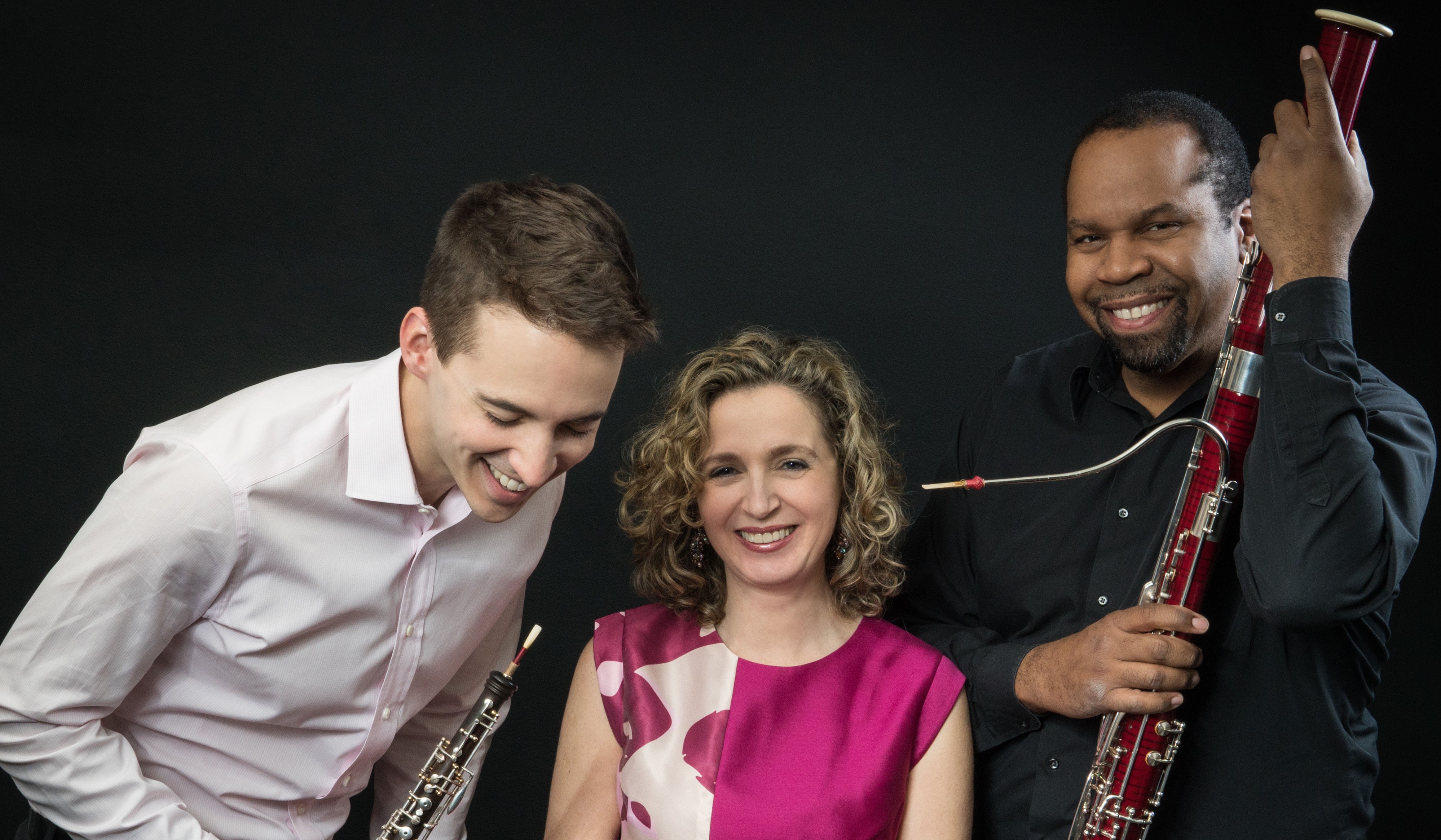
Poulenc TrioMusic in the Afternoon. Francis Poulenc’s invigorating, amusing, noble and otherworldly Trio for Oboe, Bassoon and Piano is the best-known example of music written for this unusual combination of instruments. No double reed player can resist its charms, so it’s no wonder that the Poulenc Trio (pianist Irina Kaplan Lande, bassoonist Bryan Young and oboist James Austin Smith) named themselves for its composer. They launch the 121st season of the Women’s Musical Club on October 4 in Walter Hall, with a modernist program of music by Schnittke, Viet Cuong, Shostakovich, Previn and their namesake (whose famous trio they will perform) should enliven the first afternoon of the new month.

Summer continues. It’s still summer for the Prince Edward County Chamber Music Festival. Artistic directors, the enterprising New Orford String Quartet, open this year’s edition on September 7 with Mozart’s “Dissonance” quartet along works by Burge and Ravel. André Laplante’s ambitious program on September 9 includes Schubert’s delightful Sonata in A Major D664 and a significant Liszt component: Three Sonetti del Petrarca, from Années de pèlerinage, deuxième année: Italie and his revolutionary masterpiece, the Sonata in B Minor. September 15 violinist Mark Fewer heads a jazz evening heavy on Ellington, with pianist David Braid and bassist Joseph Phillips. The next afternoon it’s Fewer with his classical pals doing a variety of chamber music headed by Dvořák’s Piano Quintet Op.81.

CLASSICAL & BEYOND QUICK PICKS

Jarred DunnSEP 20, 8PM: Brampton-native Jarred Dunn, a former assistant to, and collaborator with, the well-known author, pianist and teacher David Dubal, performs works by Szymanowski, Debussy, Górecki, Liszt and Chopin in his recital at Gallery 345.

SEP 23, 2PM & SEP 29, 2PM: Pocket Concerts launches their sixth season of chamber music in an intimate setting with Montreal-based violinist, Andrea Tyniec and Pocket Concerts co-director pianist Emily Rho in music by Beethoven, Sokolović and Debussy. In his Strings Attached column in our Summer 2016 issue, Terry Robbins praised Tyniec’s faultless technique and outstanding musicianship.

SEP 27, 7:30PM: Gallery 345 presents Payadora Tango Ensemble-member, Rebekah Wolkstein, performing music from Norway on the nine-string Hardanger fiddle. Tom King is the collaborative pianist.

OCT 2, 8PM: Marc-André Hamelin’s virtuoso program for Music Toronto’s new season continues his current examination of Samuel Feinberg with the Russian pianist-composer’s Sonata No.3, Op.3 and showcases old favourites like Alexis Weissenberg’s charming Six Arrangements of Songs Sung by Charles Trenet. Busoni’s arrangement of Bach’s famous Chaconne and Mario Castelnuovo-Tedesco’s Cypresses bring out Hamelin’s astonishing technique, which of course also supports the Chopin Polonaise-Fantaisie and Scherzo No.4 that conclude the recital.

Paul Ennis is the managing editor of The WholeNote.

Last year, in October, flush with the excitement of the new season in full swing, I wrote about some recent artistic appointments, focussing particularly on conductor Uri Mayer’s new role as artistic director and principal conductor of the Toronto Philharmonia Orchestra. Mayer had exciting and ambitious plans for the ensemble. Fast forward to this past October and its future appears significantly different than the one Mayer had envisioned. Like so many arts organizations (both large and small) plagued with money worries in these economically difficult times, the Toronto Philharmonia’s very survival is now in jeopardy due, in great part, to its ongoing financial problems.

In an interview with John Terauds (see musicaltoronto.org) October 16, the TPO’s president, Milos Krajny, said: “We are not opening the season because we couldn’t raise enough money.” According to Terauds, Krajny sent out an urgent plea to the orchestra’s patrons and friends on September 10 but the appeal came up short of the $150,000 required to open the season.

Read more: Calling All Concert-Goers

As Beethoven’s 250th birthday approaches – thought to have been born on December 15 or 16 he was baptized on December 17, 1770 – there are several notable chamber music concerts being livestreamed from December 5 to December 13, the last remnants of what was to have been a year-long celebration that was curtailed by the pandemic.

Goodyear and Ehnes

Internationally acclaimed superstar and Canada’s preeminent violinist, James Ehnes, will be joined by virtuoso pianist Stewart Goodyear for a complete traversal of the ten sonatas for violin and piano in three recitals – to be livestreamed from Koerner Hall December 11, 12 and 13. Goodyear is celebrated for prodigious pianistic feats like performing all 32 of Beethoven’s piano sonatas on the same day. 

Despite the marathons and the prodigious technique and memory that they require, the basis for Goodyear’s appeal is his empathetic relationship with the music he performs and his ability to communicate that to an audience. 

Read more: Chamber Beethoven As His Birthday Beckons

Christian Blackshaw. Photo by Si BarberOn March 17, Christian Blackshaw, now 70, brings a selection of works from his acclaimed Complete Mozart Sonata Series, performed and recorded at London’s Wigmore Hall, to Walter Hall. Hailed as “magical,” “captivating,” and “masterful,” the fourth volume of the series was named as one of the Best Classical Recordings of 2015 by The New York Times. Blackshaw’s all-Mozart program for Mooredale Concerts will include Sonata No.11 in A Major, K331 and Sonata No.14 in C Minor, K457.

In a 2013 interview with Gramophone after his year-long Wigmore Hall series, Blackshaw spoke of Mozart as a particular passion. “It was a sort of penny-dropping moment discovering Mozart,” he said. ‘”I think I’m a frustrated singer and to me the sonatas can be construed as being mini-operas. I find his whole being informed by the voice and the vocal line.” In the interview he rejected a characterization of Mozart’s music as being “restrained.” “There have got to be elements of joie de vivre,” he responded. His own ultimate goal in performance is a state of “slow, calm release” where he can reach “a sense of communion.” And does he find music more conducive to communion than words? “Yes,” he said instantly. “There’s no small talk [in music].”

Nuné MelikCOC Noon-hour Concerts

Born in Siberia to a family of medical PhDs, Nuné Melik started playing the violin at the age of six; her first solo performance with orchestra took place a year later at the Kazan Symphony Hall. A prizewinner of numerous competitions and audience awards, she has performed across the globe, including the Stern Auditorium and Weill Recital Hall in Carnegie Hall and our own Glenn Gould Studio. In 2010, as an umbrella for her exploration of new repertoire, Melik founded the Hidden Treasure International Project, comprising research, performance and lectures of rarely heard music. By way of performances and lectures she also advocates for and promotes the music of the Caucasus, her heritage. Together with her longtime collaborator, pianist Michel-Alexandre Broekaert, in October 2017 she launched Hidden Treasure, a CD featuring unknown works by Armenian composers with Melik’s own original program notes; CBC radio called it a “love letter to Armenia.”

A multi-talented artist who speaks five languages, Melik produced and directed a documentary last year about Armenian composer Arno Babadjanian. She has published books of poetry in Russian, which were translated into Armenian by the Writer’s Union of Armenia in 2016. Together with her CD, a book of French and English poetry was simultaneously released in October 2017.

COC presents Nuné Melik’s “Hidden Treasures – Armenian music unearthed” on March 12, with collaborative pianist Michel-Alexandre Broekaert, a free concert in the Richard Bradshaw Amphitheatre of the Four Seasons Centre.

Castalian String Quartet. Photo by Kappa KikkasThe Castalian String Quartet, founded in 2011 and based in London, England, was a finalist in the 2016 Banff Competition won by the Rolston String Quartet. Last year they were named the winner of the first Merito String Quartet Award/Valentin Erben Prize which includes €20,000 for professional development, along with a further €25,000 towards sound recordings and a commission. The award came as a complete surprise to the quartet since there was no application process or competition for it; instead a secret jury assembled a shortlist of five quartets which were then observed in at least two concerts during the course of a year, always without the musicians’ knowledge.

According to the award announcement, “The aspects that were evaluated included their professional approach, repertoire, programming, the artistic quality of the concerts, their musical profile, and also the imagination and innovation displayed by the musicians. Their artistic career to date and recordings, where applicable, were also evaluated.”

The award is an initiative of Wolfgang Habermayer, owner of Merito Financial Solutions, and Valentin Erben, founding cellist of the Alban Berg Quartet. “The critical factor for us is how the young musicians behave in ‘everyday life’ on the concert stage,” said award co-founder Erben. “The human warmth and aura radiated by these four young people played a key role. They are never just putting on a show – the music is always close to their heart. You can feel their intense passion for playing in a quartet.”

The Castalian String Quartet performs in the Richard Bradshaw Amphitheatre of the Four Seasons Centre in a COC free noon-hour concert on April 4. The program includes Haydn’s String Quartet Op.76, No.2 “Fifths” (a reflection of the Castalians’ passion for the inventor of the string quartet), and Britten’s String Quartet No.2, written just after WWII to mark the 250th anniversary of Henry Purcell’s death.

Mariam BatsashviliWomen’s Musical Club of Toronto

Now in her mid-20s, Georgian pianist Mariam Batsashvili is another promising young artist. She began studying the piano at four; by seven, “completely in love with the instrument,” she knew she wanted to be a pianist for the rest of her life. She gained international recognition at the tenth Franz Liszt Piano Competition in Utrecht in 2014, where she won First Prize as well as the Junior Jury Award and the Press Prize. This success led to performances with leading symphony orchestras, and to an extensive program of recitals in more than 30 countries. She was nominated by the European Concert Hall Organisation (ECHO) as Rising Star for the 2016/17 season. A BBC Radio 3 New Generation Artist, she is performing at major festivals and concert venues across the UK as part of that award.

Her comprehensive April 4 recital in the Music in the Afternoon series of the Women’s Musical Club of Toronto begins with Busoni’s soaring arrangement of Bach’s iconic Chaconne from Partita No. 2 for violin, BWV 1004, taps into  Schubert’s fountain of lyricism, the Impromptu Op.142, No.1 D935, moves on to Mozart’s haunting Rondo in A Minor, K511 and Liszt’s virtuosic Hungarian Rhapsody No.12; then concludes with Beethoven’s notoriously difficult Sonata No.29 in B-flat Major, Op.106 “Hammerklavier.” In Walter Hall; just a few weeks after a performance in London’s Wigmore Hall.

Kitchener-Waterloo Chamber Music Society

Janina Fialkowska’s March 11 recital for the Kitchener-Waterloo Chamber Music Society, marking her 37th year of performing for KWCMS, features an ambitious, well-packed program that begins with Mozart’s beloved Sonata in A Major, K310. An impromptu by Germaine Tailleferre; a nocturne by Fauré; an intermezzo by Poulenc; two pieces by Debussy; and Ravel’s Sonatine – a selection of music by French composers, reminiscent of a French program by Fialkowska’s teacher, Arthur Rubinstein – lead into three mazurkas, a nocturne (Op.55, No.2), scherzo (No.3) and ballade (No.4) by Chopin (the composer with whom she is most identified) performed in Fialkowska’s inimitable style.

Later in the month, clarinetist James Campbell joins the Penderecki String Quartet for Brahms’ splendid Clarinet Quintet. Dvořák’s Quartet No.10 in E-flat Major, Op.51, “Slavonic” is the other major work on the March 20 program.

Timothy Steeves steps away from his usual role as pianist with Duo Concertante for a recital of four adventurous Haydn sonatas on April 1, his second all-Haydn recital for the KWCMS.

Music Toronto

Danny Driver’s March 5 recital was the subject of my conversation in our February issue with the Hyperion Records artist, who “may be the best pianist you’ve never heard.” Works by CPE Bach, Schumann, Saariaho, Ravel and Madtner will be performed by this uncompromising artist who demands a lot of himself: “When I feel I have come close [to achieving what I set out to achieve artistically], it’s an intensely rewarding experience.”

The following week on March 14, the Lafayette String Quartet – artists-in-residence  at the University of Victoria since 1991 – who have spent more than 30 years together with no changes in personnel – partners with the Saguenay (formed in 1989 as the Alcan) String Quartet to perform three string octets. Join them in this rare opportunity to hear Niels Gade’s String Octet in F Major, Op.17, Russian-Canadian Airat Ichmouratov’s String Octet in G Minor, Op.56, “The Letter” and Mendelssohn’s deservedly famous Octet in E-flat Major, Op.20.

The Saguenay String Quartet) and the Lafayette have played together many times, a reflection of their special musical bond and creative friendship.

CLASSICAL AND BEYOND QUICK PICKS

MAR 8, 8PM AND 9, 2:30 & 8PM: Critically acclaimed violinist Nikki Chooi is the soloist in Vivaldi’s indispensable The Four Seasons with the Kitchener-Waterloo Symphony. Nicolas Ellis, who was recently named artistic partner to Yannick Nézet-Séguin and the Orchestre Métropolitain for the 2018/19 and 2019/20 seasons, leads the KWS in Beethoven’s essential Symphony No.6 “Pastoral.”

Gemma New. Photo by Fred StuckerMAR 9, 7:30 AND 10, 3PM: Gemma New leads the Toronto Symphony Orchestra in Shostakovich’s kinetic Symphony No.5; Kelly Zimba, flute, and Heidi Van Hoesen Gorton, harp, take charge of Mozart’s Concerto for Flute and Harp K299/297c, the first work Mozart ever wrote for that combination of soloists.

MAR 10, 2:30PM: Bradley Thachuk leads the Niagara Symphony Orchestra and TSO concertmaster Jonathan Crow in Sibelius’ richly Romantic Violin Concerto Op.47. Sibelius’ satisfying Symphony No.3 completes the nod to the great Finnish composer.

MAR 16, 7:30PM: Gemma New conducts the Hamilton Philharmonic Orchestra in a heavenly program featuring Debussy’s hypnotic Prelude to the Afternoon of a Faun and his impressionistic Nocturnes. Holst’s riveting The Planets completes the exciting evening.

MAR 20, 2:30PM: Georgian Music brings the Lafayette and Saguenay String Quartets to Barrie for a repeat of their Music Toronto program of March 14 headed by Mendelssohn’s youthful masterwork, his Octet in E-flat Major, Op.20.

MAR 23, 7:30PM: Barrie Concerts presents the Penderecki String Quartet in an evening of Dvořák’s chamber music. Included are the composer’s String Quartet No.10 “Slavonic” and, aided by pianist Benjamin Smith, both of his piano quintets, the second of which (Op.81) is one of the masterpieces of the form.

MAR 23, 7:30PM: The Oakville Chamber Orchestra celebrates their 35th anniversary with a performance of Bach’s Six Brandenburg Concertos, an invigorating choice of music for such an auspicious occasion.

MAR 27 AND 28, 8PM: Gunther Herbig, TSO music director from 1989 to 1994, conducts two pillars of the 19th-century repertoire: Schubert’s moving  Symphony No. 8 “Unfinished” and Bruckner’s Symphony No.9, the fourth movement of which the composer left unfinished on the day he died, leaving only the first three movements complete.

MAR 30, 7PM: Mandle Cheung continues to realize his conducting dream, leading his orchestra in Tchaikovsky’s Piano Concerto No.1 (Kevin Ahfat is the soloist) and Mahler’s titanic Symphony No.1.

MAR 30, 8PM: The Canadian Sinfonietta, with guest violist Rivka Golani, mark the onset of spring with the world premiere of David Jaeger’s Raven Concerto for viola and chamber orchestra, Copland’s lovely Appalachian Spring, Britten’s Lachrymae Op.48a for viola and strings and Elgar’s Serenade for Strings. Tak Ng Lai conducts.

MAR 30, 8PM AND 31, 2PM: The Oakville Symphony celebrates the musical friendship between Brahms (Symphony No.2) and Dvořák (Violin Concerto). Leslie Ashworth is the violin soloist; Robert De Clara, music director since 1997, conducts.

APR 7, 1PM: Gramophone magazine called American-born Marina Piccinini “the Heifetz of the flute.” Find out why at the RCM free (ticket required) concert at Mazzoleni Hall; with Benjamin Smith, piano.

APR 7, 3PM: RCM presents the justly celebrated American pianist Richard Goode in an all-Beethoven recital that includes the “Pastoral,” “Moonlight” and “Les adieux” sonatas, and selections from the Op.119 Bagatelles, all topped off by the master’s final sonata, the celestial Op.111.

Paul Ennis is the managing editor of The WholeNote.

What a wealth of chamber music there is on offer this month! The early days of April offer two opportunities to hear Arnold Schoenberg’s seminal early work, Transfigured Night — April 2 in its original string sextet version by the St. Lawrence String Quartet complemented by former quartet members, cellist, Marina Hoover and violinist/violist, Barry Shiffman, and April 3 by Sinfonia Toronto in the string orchestra version.

April 3 Amici will present “Poulenc’s Musings,” a program of Francis Poulenc’s chamber music, including his famous Sextet with the brilliant TSO wind principals, and his “Story of Babar” for piano, with Steven Page (formerly of the Barenaked Ladies) as narrator. Definitely not your average evening out!
Those who love Haydn’s string quartets will have two opportunities to hear the Eybler Quartet play an entire program of them: on April 6 at the Church of St. George-the-Martyr, and on April 9 at the Music Room of the Kitchener-Waterloo Chamber Music Society. And all this in just the first 9 days of the month. (See the listings for many others, or better still search for chamber music in the listings on our website.)

Read more: Chamber wealth - Quodlibet: April 09

This year is the two hundredth anniversary of the births of both Frédéric Chopin and Robert Schumann – a fact that hasn’t gone unnoticed by music presenters. On February 4 Music Toronto will present soprano Susan Gilmour Bailey, pianist Michael Kim and actor Colin Fox in “The Schumann Letters,” chronicling the composer’s troubled life through readings and song. And just two days later, the bicentenary of both Schumann and Chopin will be celebrated by soprano Donna Bennett and pianist Brian Finley, in a programme presented by the Lindsay Concert Foundation.

P14aIn the last week of February there are several concerts featuring very accomplished women singers. The young but already well-regarded Canadian mezzo Wallis Giunta will perform with guitarist Jason Vieaux, in a Mooredale Sunday afternoon concert on February 21 – and again on February 24, with Amici Chamber Ensemble and American superstar soprano Dawn Upshaw. Upshaw will be performing with the Toronto Symphony Orchestra the next evening, on February 25. Both the Amici and the TSO concert programmes will include music by the Argentinean composer Osvaldo Golijov. (In preparing this column I discovered the website, forum-network.org, which has interviews with both Upshaw and Golijov.)

Continuing with singers in the final week of February, in the afternoon of February 25 the Women’s Music Club presents a concert by soprano Isabel Bayrakdarian at Koerner Hall. Right next door, in Walter Hall at 12:10, soprano Monica Whicher will be performing music by the 20th-century English composer William Walton. On the same day at the same time but in Guelph, soprano Sarah Kramer will give a solo recital with pianist, Anna Ronai. On the last day of the month, mezzo and CBC Radio host Julie Nesrallah will give the 639th Sunday concert at Hart House. You might also want to get a ticket to the Toronto Symphony Orchestra’s March 3 concert, which will be a rare opportunity to hear Canadian soprano-in-exile extraordinaire Barbara Hannigan, in a programme that includes music by Golijov.

I was shocked when I read the last sentence of the following press release, sent to me early in January: “Violin/Piano duo returns to Toronto after eleven years to honour former patron: The international Violin/Piano Duo of Ariadne Daskalakis and Miri Yampolsky will give a concert at the Royal Conservatory of Music, Toronto on March 6, 2010…to honour the memory of Susan Alberghini.”

There are, of course, two stories here. The first is Susan Alberghini, who was among the first people I met through The WholeNote (it was called Pulse, in those days), a person who really “got” what the magazine was all about, and encouraged us during times when it was easy to get discouraged. One of Kenneth Mills’ circle of devotees, and a supporter of his Star Scape Singers, she was an arts administrator, the co-founder of the Huntsville Festival of the Arts and, up to the time of her untimely death in January 2009, the executive director of the Guild of Canadian Film Composers. Personally I felt she tried in her life to bridge art and life, to bring beauty into her life and the lives of others and to infuse art with vitality.

The other story is the Daskalakis/Yampolsky recital on March 6. Originally scheduled by Alberghini for 2009, she passed away before the arrangements were put in place. Judging by Elissa Poole’s enthusiastic review of the duo’s last Toronto concert in February 1999, we can look forward to some very fine music-making on March 6.


P14bP14cThere are many, many more interesting concerts both in Toronto and in a good many other Southern Ontario centres in February. Indeed, I was particularly impressed by the “Beyond the GTA” listings, not just their quantity, but also their programming, sometimes very unusual and ambitious. For instance, there’s the “The Attar Project,” at the University of Western Ontario on February 26, and the Peterborough Symphony Orchestra’s February 13 programme, which includes the Fifth Symphony of Dmitri Shostakovich.

Allan Pulker is a
flautist and a founder of The WholeNote who currently serves as Chairman of The WholeNote’s board of directors. He can be contacted at classicalbeyond@thewholenote.com.

April 2013: how time flies. Benjamin Bowman, Andrew Burashko and Rachel Mercer in Art of Time’s live recording of Schubert’s "Piano Trio No. 2 in E Flat Major, iv. Allegro Moderato". Photo by John Lauener.The sheer number of concerts in our listings is impressive enough. Even more impressive is the resonances between seemingly unrelated events once you start to dig a little deeper and start to connect the dots. Take, as an example, Art of Time and Sinfonia Toronto, mainstay ensembles in our midst for almost as long as The WholeNote has been around. Each is in the midst of a silver anniversary, 25th season with the founding artistic directors of both groups (Nurhan Arman and Andrew Burashko) still at the helm of their respective ensembles. Both of them delight in arranging music, and in creative programming, constantly seeking to blend the familiar with the new, introducing top-flight soloists to challenge their ensembles and delight their audiences.

Read more: Connecting the Dots...


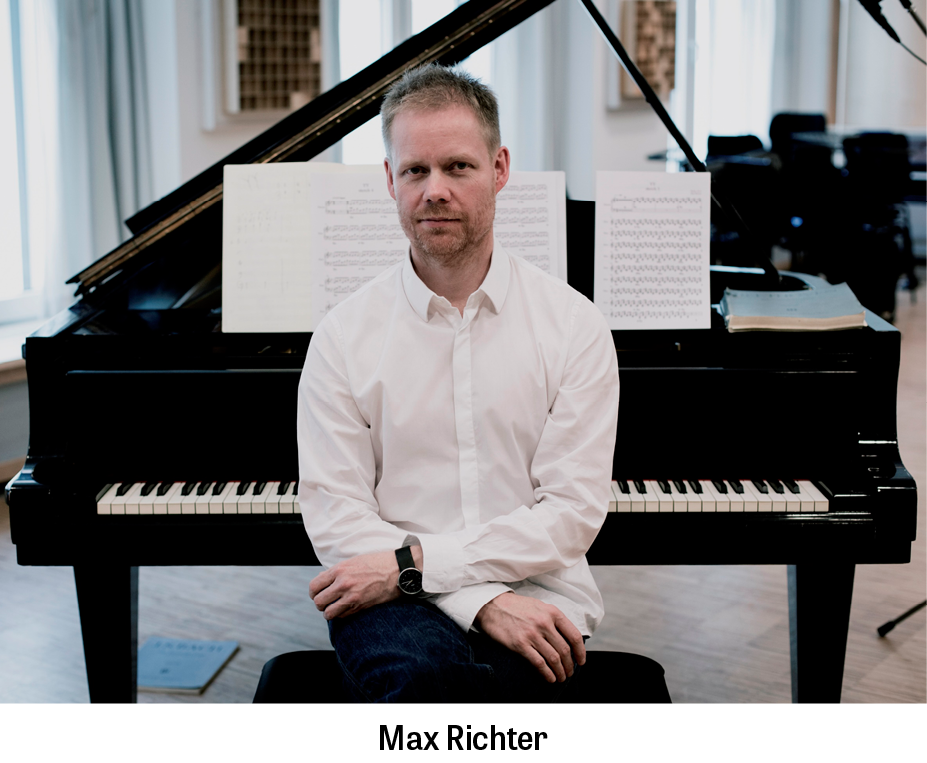
“You know, my piece doesn’t erase the Vivaldi original. It’s a conversation from a viewpoint. I think this is just one way to engage with it.” – Max Richter

bbb - classicalThe opening notes seem to emanate from otherworldly ether, tentatively falling into the familiar notes that begin The Four Seasons, but there’s something quite different that’s engaging us. In a November 2012 interview with NPR’s Audie Cornish, German-born, British composer Max Richter elaborated on the opening bars of his recomposition: “I took the opening motif, which I always thought was a dazzling moment in the Vivaldi, but in the original it’s only four bars. I thought, ‘Well, why don’t I just treat this like a loop, like something you might hear in dance music, and just loop it and intensify it, and cut and paste – jump-cut around in that texture, but keep that groove going.’”

The essence of the music that was once the most recorded piece in the classical music catalogue is there but it’s got a contemporary feel, definitely not staid, bursting with energy, but not the heightened propulsion of Il Giardino Armonico, for example. In fact the clarity of violinist Daniel Hope’s crystalline playing is inviting.

The synth effects are so subtle they’re barely discernible but their presence is palpably modern, sleek and beguiling. The combination of the bones of Vivaldi’s original and the cloak Richter has wrapped it in make for a 21st-century experience that is pleasingly addictive, the kind of piece you put on repeat and listen to over and over and over. It never feels like it’s too much, its novelty easily trumped by its freshness, its mysteries slowly revealing themselves after five, six hearings.

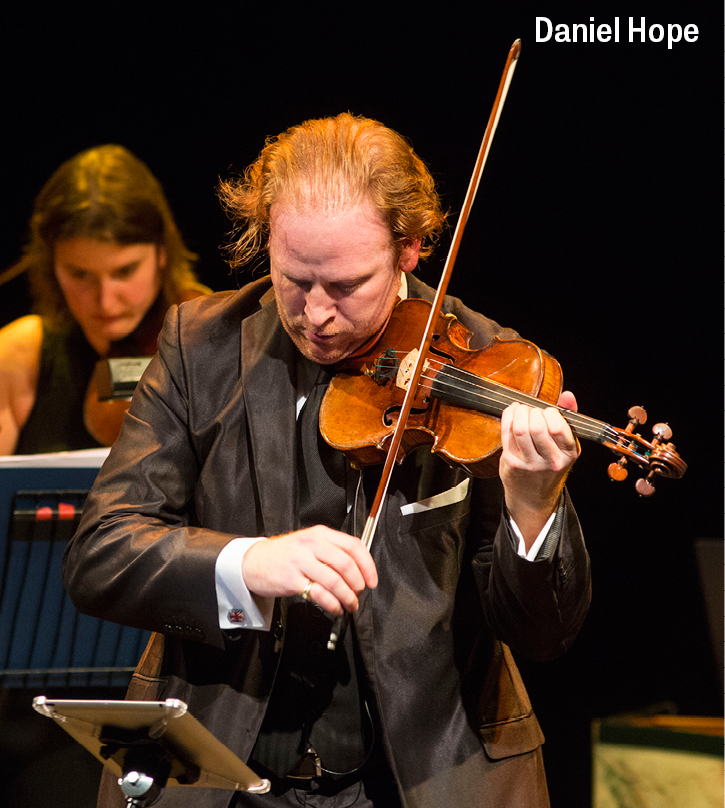
Less than two weeks before he was to perform Richter’s Four Seasons Recomposed at the Ravinia Festival in Chicago, the acclaimed British violinist Daniel Hope participated in a live YouTube chat on June 10, 2013. (In addition to a versatile solo career, Hope was a member of the distinguished Beaux Arts Trio from 2002-2008.) Now more than a year later, in anticipation of the September 30 Toronto premiere of the Richter work, I’m watching the genuinely engaging Hope patiently answer questions.

bbb - classical2“The fact that Max Richter was willing to recompose The Four Seasons was incredibly brave and I think he’s done a fantastic job,” he begins. “I was contacted by [him] about one to one and a half years ago and told about wanting to recompose The Four Seasons,” he continues. “The first thing I said was ‘What’s wrong with the original?’ He laughed and said nothing’s wrong with the original, it’s perfect, it’s a fantastic piece but I feel that in a sense I’ve fallen out of love with it. I’ve been bombarded with it. Every time I go into an elevator or a shopping centre I hear The Four Seasons piped at me. [Max] wanted to rediscover it and by recomposing it he was rediscovering it. He asked me if I would like to take a look at it and I thought that [it] was a really interesting way of revisiting a masterpiece ... As soon as I saw the early sketches for his piece I was absolutely knocked out. I thought this was something really amazing and I wanted to be part of it.”

Hope details his contribution to the process: “I made a number of suggestions. [Richter was very open to suggestions] with regards to the tempos and some of the passagework. It was so well written it didn’t need many changes but it did need to be adapted here and there to make it more violinistic. In the recording session we created it in the moment so a lot happened with sound effects and various colours.”

Asked if he has a “favourite” movement in the piece he hedges: “My favourite season is ‘Summer.’ The Recomposed is a different piece. It has all of the great themes of Vivaldi. It has the inspiration of Vivaldi but it also has its own music. The last movement of Max Richter’s ‘Summer’ is absolutely amazing. But also the last movement of ‘Winter’ is mindblowing.”

When asked if it’s difficult not to get mixed up with the original when playing the recomposed version, Hope – who has already divulged that he’s been playing the original since he was a boy (“It’s still so modern after 350 years”) – talks about the very subtle changes in the passagework, eight notes to seven, for example. He adds that every time they play Recomposed it changes and evolves.

Elsewhere in that 2013 YouTube chat, Hope reveals that when he was four he announced to his parents that he wanted to be a violinist. That got me curious about his musical education. I found a partial answer in a different (ClassicFM) YouTube video where he talked about his crucial relationship with Yehudi Menuhin, whom he knew from an early age: “Menuhin was very, very outward-looking. He’s somebody I think about almost every day – a huge inspiration to me and to many musicians and somebody who really believed in opening your ears to any kind of music. You know his legendary collaborations with Ravi Shankar or Stephane Grappelli are things that I witnessed as a small boy (Hope was born in 1973). I was lucky enough to grow up in that environment. It taught me from an early age that you can find connections in different musical worlds if you take it seriously and you spend the time.”

It has been two years since I discovered Richter’s recomposition on a listening post at Grigorian’s when it drew me in with its compulsive originality coupled with its uncanny resemblance to Vivaldi. Happily, Soundstreams is now making it possible to hear this innovative work live with Daniel Hope as the soloist, in their season-opening concert, September 30.

It’s Still Festive: Summer’s not over until the fall equinox and the Prince Edward County Music Festival (PECMF) in Picton and the SweetWater Music Festival in Owen Sound are taking full advantage of those last seasonal days to launch their 11th editions.

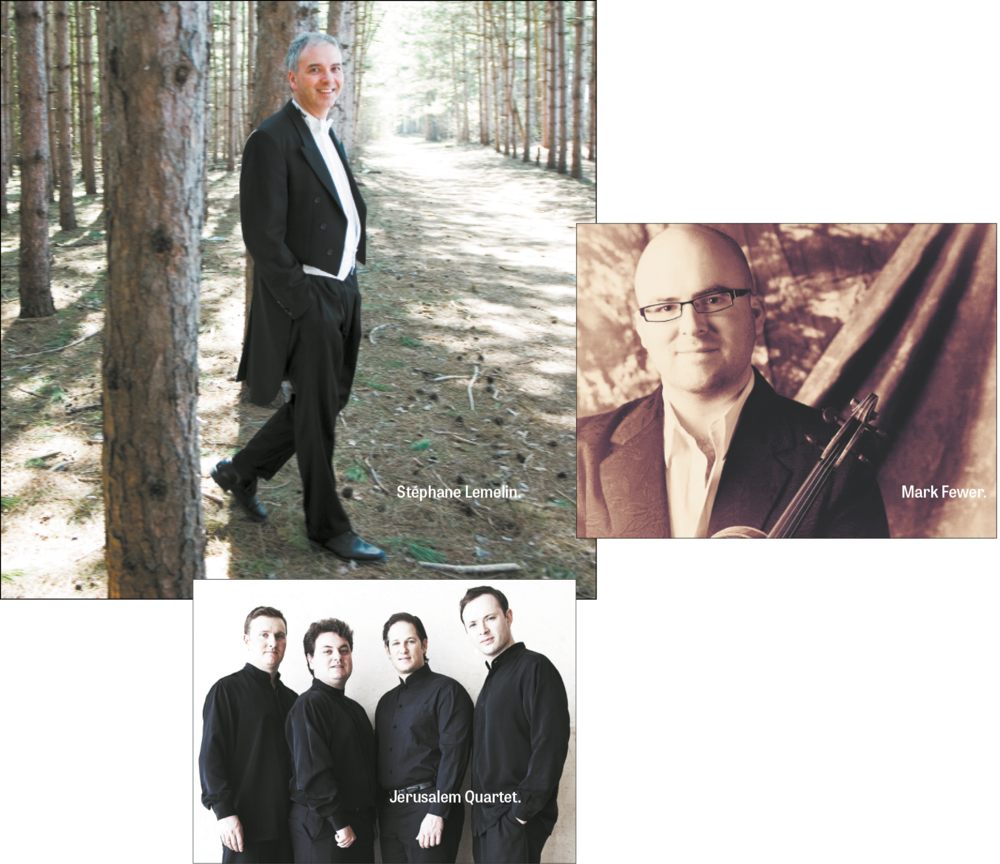
The “superlative acoustics” of St. Mary Magdalene Church play home to several content-rich PECMF concerts. Augmenting the opening concerts, artistic director pianist Stéphane Lemelin joins the Penderecki String Quartet to perform Taneyev’s romantic Quintet for piano and strings in g minor Op.30 on September 19, then accompanies cellist Denise Djokic in Rachmaninoff’s Sonata for cello and piano in g minor Op.19 the following day. September 21 brings André Laplante’s deep musical sensibility to bear on a trio of Liszt piano masterworks. Highlights of the rest of the festival include the young Canadian musicians Nikki Chooi, violin, and Philip Chiu, piano, in a September 25 recital that ranges from Bach to Prokofiev, and Ensemble Made In Canada in piano quartets by Dvořák and Fauré September 26.

St. Lawrence String Quartet violinist Mark Fewer, the artistic director of the SweetWater festival, brings his chamber music versatility to bear in a concert September 19 in the historic Leith church with its ideal acoustics. Vivaldi, von Biber, Schmelzer and Bach supply the music that the celebrated baroque violinist Elizabeth Wallfisch, Lucas Harris (theorbo), Hank Knox (harpsichord) and Fewer will perform.

The next day Fewer joins his St. Lawrence colleagues and soprano Meredith Hall, flutist Leslie Newman, double bassist Joseph Phillips and pianist Kati Gleiser for a program of Haydn and Beethoven. A few days later Fewer and the other members of the St. Lawrence String Quartet, along with Wallfisch, Newman and Phillips, are joined by Brad Turner (trumpet), Drew Jurecka (violin) and David Braid (piano) for a concert showcasing Bach and Braid.

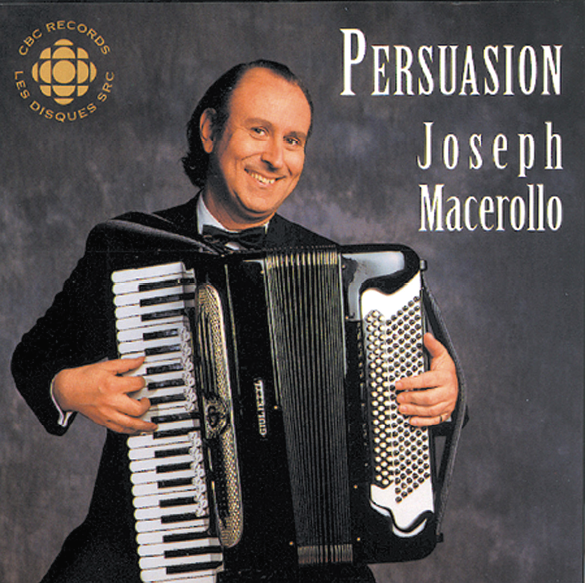
bbb - classical3U of T Faculty of Music: Before travelling to Owen Sound, Fewer, violinist Geoff Nuttall, violist Leslie Robertson and cellist Christopher Costanza (aka the St. Lawrence String Quartet) bring their infectious energy to the opening concert of the U of T Faculty of Music season September 16, which includes Golijov’s tuneful Kohelet and Verdi’s sublime String Quartet. Two weeks later, the Faculty celebrates accordion virtuoso Joe Macerollo’s 70th birthday and his appointment as Officer of the Order of Canada with an accordion extravaganza featuring current and former students and guest artists, and including compositions from Macerollo’s past plus a new commission by Anna Höstman.

Macerollo’s infectious musical spirit was most recently on display July 28 at Church of the Holy Trinity in a Music Mondays re-imagining of the songs of Kate Bush, Prince and Radiohead with soprano Zorana Sadiq where the performers “boiled the songs down to their deep, dark essence – from the Bulgarian sweep of Bush’s pop-scenas to the sweet synth build of Prince’s perfect pop.” Macerollo’s recent CD, Persuasion – The Contemporary Accordion, showed his commitment to contemporary composers Walter Buczynski, Charles Camilleri, Alexina Louie, Torbjorn Lundquist, Norman Symonds and Beverley Johnston. August 30 Macerollo hosted the always interesting CBC Radio 2 program This Is My Music. If you’re quick you can still hear it streamed on the Internet.

Flute Street at Church of the Holy Trinity: Internationally acclaimed piccolo virtuoso Jean-Louis Beaumadier and pianist Jordi Torrent will perform music by Damase, Reichert, Feld, Novak and Gyöngyösi September 26. The legendary Jean-Pierre Rampal wrote about Beaumadier: “Endowed with marvellous technique, he stands out, thanks to his winning personality and his developed artistry. It is a joy to hear him in turn dream and turn pirouettes; he is the Paganini of the piccolo.”

TSO Returns: Back from their successful European tour, the TSO begins the new season September 18 with a trio of romantic orchestral showpieces with the charismatic violinist Joshua Bell as soloist in Lalo’s Symphonie espagnole. September 20 and 21 sees concertmaster Jonathan Crow take the spotlight in Rimsky-Korsakov’s Scheherazade, the first public performance of the piece since its August CD release that marked the TSO’s new recording contract with Chandos Records. The live performance of Beethoven’s Ninth Symphony is incentive enough to hear this iconic work but on September 23 to 25 the TSO is making it even more essential by including Rachmaninoff’s Rhapsody on a Theme of Paganini with piano soloist Daniil Trifonov. No less than the great Martha Argerich said of the young Russian’s touch: “I never heard anything like that – he has tenderness and also the demonic element.”

Two Innovative Presenters: Two of the most creative Toronto series reinforce their programming reputations with the opening concerts in their 2014/15 seasons. September 28, the Jupiter Symphony Chamber Players bring their enthusiasm to a Mooredale Concerts program that includes Beethoven’s invigorating Septet, Dohnányi’s lyrical Serenade in C Major for String Trio and Mozart’s mysterious Clarinet Quartet in B Flat Major after K378.

And I’m particularly looking forward to the Toronto debut of the highly touted France-based Trio Wanderer (after Schubert). Their October 2 Women’s Musical Club of Toronto program includes piano trios by Fauré, Liszt and Tchaikovsky.

Paul Ennis is managing editor of The WholeNote.


Toronto Concert June 30 2009
Gala Concert brings master organist Gillian Weir full circle

Royal Canadian College of Organists Celebrates 100th anniversary with major international organ festival

On Friday May 1 this year, I listened to Dame Gillian Weir, master organist, give a breathtaking recital, jet-lag be damned, to open the fourth annual ORGANIX festival, on Casavant Organ Opus 3095, newly installed in Holy Trinity Church, in the shadow of the Eaton Centre. The following morning I caught up with her for a whirlwind interview, a few blocks east, at the console of Metropolitan United Church's mighty Casavant Opus 1367, en route to the airport on her way back home to England.

Between those two organs hangs this particular tale.

gillian weir 002

Read more: Dame Gillian Weir, master organist

Classical 1Daniel Hope has built a substantial international career as an acclaimed violin soloist, chamber musician and music festival curator. A champion of contemporary music and an advocate of the classical canon, his musical curiosity cannot be pigeon-holed. He was the violinist with the legendary Beaux Arts Trio for six years and is currently associate artistic director of the Savannah Music Festival. He is a prolific writer (with three German-language books to his credit) who has devoted much of his time over the last 15 years to the study and preservation of music by composers murdered by the Nazis. He has worked with the brilliant, Oscar-winning German actor, Klaus Maria Brandauer, on  projects combining music and the spoken word, including a look at Stravinsky’s A Soldier’s Tale through the prism of war and peace.

Hope’s father, author Christopher Hope, was an outspoken critic of apartheid. Those beliefs forced the whole family to leave South Africa in 1974 when Daniel was six months old. They moved to London, where his mother took a job as Yehudi Menuhin’s secretary, later becoming his manager.

January 28 Hope returns to Koerner Hall for his third Toronto concert in 16 months following memorable appearances September 30, 2014 as soloist in Max Richter’s Vivaldi’s Four Seasons Recomposed, and April 8, 2015 when his singing tone contributed greatly to the Chamber Music Society of Lincoln Center’s performance of Mahler and Brahms piano quartets. His upcoming recital “Yehudi Menuhin @ 100” with pianist Sebastian Knauer is a tribute to the man in whose house he grew up and with whom he performed many times during Menuhin’s last ten years.

The program consists of music dear to Menuhin’s heart. He and Glenn Gould famously recorded J.S. Bach’s Violin Sonata No. 4 in C Minor, BWV 1017. The next piece on the program, George Enescu’s Impromptu concertant reflects the fact that Menuhin studied with Enescu from the age of 11, a mentorship that led to the two becoming lifelong friends. Menuhin speaks about him on YouTube: “Enescu will always be my guiding light as a man, as a musician.” Menuhin also had great affection for the next piece on the program, Mendelssohn’s Sonata in F Major, which Menuhin was instrumental in publishing for the first time in 1953.

The Walton Violin Sonata was commissioned by Menuhin in the late 1940s. It’s followed by Ravel’s “Kaddisch” from Deux mélodies hébraïques. Hearing Menuhin play it on YouTube from a recording he made when he was 20 is a very moving experience. He lets the music speak for itself; his playing is serene yet paradoxically forceful. Bartók’s Romanian Folk Dances, which conclude the program, acknowledge Menuhin’s devotion to the Hungarian composer (Menuhin commissioned the Sonata for Solo Violin from Bartók). All in all, a splendid way to evoke Menuhin’s spirit.

Hope and Menuhin: I spoke briefly with Hope backstage after his  Soundstreams concert last year and he told me a little about growing up in Yehudi Menuhin’s house and what an extraordinary influence it was on his life, how it was absolutely incredible in so many ways.

“That it happened completely by accident, that was the thing. My parents are not musicians at all; they have no musical training. But we were kind of thrown into this musical environment and then Menuhin himself, of course, but also the people who came to that house, who played with him, who came to work with him. The amalgamation of musical styles in that house was something out of this world. You would have on the same day Rostropovich and Ravi Shankar. Or Wilhelm Kempff and Oscar Peterson.

“So you had great, great music, the essence of music. And as a result, it took me until I was 10 or 11 to actually realize there were different categories of music. I didn’t understand that. I heard amazing music and this music amazed my ears. And the fact that it happened to be Indian music or it happened to be a Beethoven sonata didn’t make a difference to me. It was just fascinating.”

When Hope was four he announced that he was  going to become a violinist. I asked how he came to that decision.

“It came about,” he said,” because of absorption. It was hearing the violin, it was seeing the violin. There were violins everywhere; there were real violins, there were images of violins. He had the most incredible collection of Paganini original concert posters. He had sketches and drawings of Paganini everywhere. Hundreds of them. So, wherever you looked you saw an image of a violin or a violinist.

“Plus you had him always with a violin, you had violinists who came in there. So I heard this sound all the time so it wasn’t perhaps so much of a surprise when I announced that this is what I wanted to do but it did throw my parents slightly a curve because they didn’t really know how to deal with that. And it was out of the question to go to my mom’s boss.

“Because I could have said the next day, ‘I want to be a fireman or an astronaut or something.’ So ... four-year-old child, whatever. So they decided instead to find a teacher who lived around the corner. And that was the next bit of great luck. This lady happened to be one of the great, great pedagogues of children. We didn’t know that. We just asked a few people who said, ‘This lady’s pretty good with kids.’ Sheila Nelson was a groundbreaking teacher. And she was the one who made this happen actually.

“Menuhin, much later in life, took a real interest, but only when I was 16 or something. So I had to make my way and I had to learn how to practise and meet the teachers that defined the way I played and the way I worked. And it was through my last teacher, Zakhar Bron, the great, great teacher, that Menuhin became quite interested because [Bron] had great success with Maxim Vengerov and Vadim Repin, at the time, 15-, 16-year-old kids. And I think he was curious to see what could Bron have done. And that’s when I went to play for him when I was 16 and it was a mixture of shock and delight because [I was] the little kid who always ran around the house, who was very close to him (he was like a family member to us). Suddenly it changed and we became kind of teacher-student, mentor, colleague.”

That was the beginning of 60 concerts Hope performed with him.

“Starting from that moment on, until his death, his last concert. That was a period of about ten years; going on the road with him, studying with him, then playing in the evening, playing the concerts. That was the ultimate because you could learn so much in a lesson but nothing actually prepares you for that moment when you go out and play, when you perform.

“And do the great concertos with him, you know, the Elgar, and the Bartóks – the things that he had, you know, he’d met the composers and he’d worked with them – was just incredible.”

Hope’s January 28 concert precedes the international release of his new CD, My Tribute To Yehudi Menuhin, by just a few days. There are many parallels between its contents and the program of the Koerner Hall recital. The CD includes Mendelssohn’s Violin Concerto in D Minor which Menuhin resurrected after one of the composer’s relatives presented it to him in 1951. There are works by Bartók and Enescu. There is an homage, Unfinished Journey, by Bechara El-Khoury, written ten years after Menuhin’s death. There are three tributes to Menuhin, by John Tavener, Steve Reich and Hans Werner Henze, part of the Compassion project that Menuhin undertook with violinist  Edna Michell.

Quick Picks

Dec 2 The Kitchener-Waterloo Chamber Music Society presents pianist Alexander Tselyakov and the Canadian Sinfonia Chamber Musicians in Hummel’s Piano Quintet Op.87 and an intimate setting of Chopin’s Piano Concerto No.2Dec 9 Duo Concertante’s pianist Timothy Steeves goes it alone in a performance of four diverse Haydn sonatas. Dec 16 K-WCMS celebrates Beethoven’s birthday with the Penderecki String Quartet’s program of two of the composer’s most riveting quartets, Op.59 No.3 and Op.132Jan 27 Mozart’s birthday is acknowledged in a diverting program by Trio+ that includes the piano Sonata K457, two trios (K502 and K542) and the poignant Sonata for violin and piano K304, reputedly Albert Einstein’s favourite piece to play. Jan 30 André Laplante studied with Yvonne Hubert in Montreal and no doubt had the same experience as all of Hubert’s students; she would sit on her student’s right and, with her left hand, play all the right-hand passages flawlessly. Laplante’s K-WCMS program consists of crowd-pleasing jewels by Schubert, Ravel, Liszt and Chopin.

Dec 10 The iconic Gryphon Trio begins the third decade of its annual Music Toronto association with a program that includes an early Beethoven trio (Op.1 No.3), a world premiere by Vincent Ho (Gryphon Realms) and Arno Babajanian’s Piano Trio in F-Sharp MinorJan 14 The compelling JACK Quartet brings their contemporary focus to works by John Luther Adams, John Zorn and Iannis Xenakis. Feb 4 Music Toronto’s season continues with the Toronto-based Annex Quartet, whose program includes Janáček’s powerful Quartet No.1 “Kreutzer Sonata”, R. Murray Schafer’s Quartet No.5 “Rosalind” and Mendelssohn’s Quartet No.2

Jan 17 A period ensemble that plays on gut strings with classical bows, the London Haydn Quartet brings a quintessential classical program to Mooredale Concerts’ first event of the new year.  Their performance of the same program – Mozart’s sublime Clarinet Quintet in A Major, K581 (with guest clarinetist Eric Hoeprich), Haydn’s String Quartet in Bb Major, Op. 50, No.1, and Beethoven’s String Quartet in D Major, Op. 18, No. 3 – was called “revelatory” by the New York Times last year. The review went on to praise “the earthy, warm sounds of the gut strings [that] blended beautifully throughout” and the “myriad details of shading and contrast, and beautifully calibrated phrasing.”

Jan 18 Pianist Christina Petrowska-Quilico heads a stellar group of chamber musicians in this Associates of the Toronto Symphony Orchestra concert with the intriguing title “Colours in Music: Composers with Synaesthaesia.” The sensation of experiencing sounds as colours manifests itself in a wide-ranging program of works by Liszt, Ellington, Sibelius and Caravassilis.

Jan 1617 The TSO’s “Mozart @ 260” features a representative sampling of the great composer’s creative output: the overture and two arias from Don Giovanni, his “Jeunehomme” piano concerto (with French pianist Alexandre Tharaud) and his final symphony, all conducted by Bernard Labadie. Jan 2728 The musical treasure that is Barbara Hannigan returns to the TSO in a performance of Dutilleux’s Correspondances. Hannigan and Dutilleux had a very close artistic relationship which the singer touched upon in CBC RADIO 2’s This Is My Music recently. Peter Oundjian also leads the orchestra in Berlioz’s ever-fresh Symphonie fantastique, which will share the stage with Richard Strauss’ buoyant Horn Concerto No.1 on Jan 30. The TSO’s principal horn, golden-toned Neil Deland, is the soloist.

Jan 30 Winner of the 1998 Tchaikovsky Competition, 40-year-old Russian pianist Denis Matsuev puts his poetic and virtuosic talent on display in a program that begins with Schumann’s Kinderszenen and Kreisleriana before concluding with Rachmaninov’s Etudes-Tableaux Ops.3,6 and 9  and Sonata No.2. As we go to press the Koerner Hall concert is almost sold out. Act quickly.

Daniel Hope performs “Menuhin @ 100” at Koerner Hall, January 28. 

Paul Ennis is the managing editor of The WholeNote.

Founded in 1994 by pianist Janina Fialkowska, Piano Six and Piano Plus brought live classical music events – mostly solo performers – to under-serviced parts of Canada until 2010. Over a period of 16 years, Fialkowska’s efforts reached over 100,000 people directly – and tens of thousands indirectly – through over 430 events across Canada. In addition to Fialkowska, the other original members of the powerhouse ensemble were Angela Cheng, Marc-André Hamelin, Angela Hewitt, André Laplante and Jon Kimura Parker.

At each destination, a musician would collaborate with local presenters, schools and volunteers to provide multiple experiences directly with audiences, through concerts, workshops, masterclasses and Q&A sessions.

The initiative was launched in February 1995 with concerts in Toronto (broadcast on CBC) and Quebec City. Although the program concentrated on individual rather than ensemble visits, the pianists occasionally appeared together – at the Festival international de Lanaudière in 1999 and the 2000 Ottawa Chamber Music Festival, for example.

Daniel Wnukowski. Photo by Claudia ZadoryIn 2017, pianist Daniel Wnukowski resurrected the original Piano Six model and relaunched it as Piano Six – New Generation. The new ensemble consists of Marika Bournaki, David Jalbert, Angela Park, Ian Parker and Anastasia Rizikov. Using many technological advances including web 2.0, social media and video streaming, Wnukowski has shifted the model to focus on the next generation of Canadians, especially post-millennials. Five colleagues joined the board having only met via Skype and Facetime.

Piano Six – New Generation will begin its first season of touring this month, starting with Wnukowski visiting Rainy River and Fort Frances in Ontario on May 6 and 8 respectively, and Fort Nelson BC on May 9 and 10, in a program he calls Piano through the Ages (Handel, Mozart, Chopin and Morawetz). Park and her program, Scenes from Nature (Chopin, Ravel, Burge, Beethoven, Lizst and Debussy), travel to Fort St. John BC (May 13 and 14) and Slave Lake in Alberta (May 16 and 17).

Then, on May 25, Bravo Niagara! will present a special Piano Six Gala Concert at St. Mark’s Anglican Church in Niagara-on-the-Lake featuring Bournaki, Jalbert, Park, Parker, Wnukowski and special guest Godwin Friesen.

Wnukowski told me that the goal of the gala concert is “to leave audiences awed and inspired by the solo, four and six hands repertoire – with performances that range from scintillating to formidable. We are aiming through the May 25th concert to generate awareness about our cross-Canada tours and to garner enthusiasm and support for next year’s tour,” he said.

“The idea behind this particular concert program is to showcase the individual personalities of each pianist. First, we commissioned jazz composer Darren Sigesmund to write a short work involving all six pianists,” he said. “And each pianist was then asked to submit a short solo piece as well as suggestions for four-hand/two-piano repertoire.”

To Wnukowski’s surprise, every pianist submitted a French work as their choice of a solo work! Bournaki submitted Poulenc’s Trois novelettes; Jalbert chose Fauré’s Nocturne No.6; Park picked Ravel’s Miroirs No.3, Une barque sur l’ocean; and Friesen selected Debussy’s Clair de lune. “This was an interesting coincidence,” Wnukowski said, “as the harmonic progressions of Impressionism have long been considered a catalyst to the development of the jazz idiom.” Ian Parker and Wnukowski also decided to jump onto the jazz bandwagon and contributed several jazz works to provide the program with better form. [Parker chose Gershwin’s Three Preludes and Wnukowski picked Bill Evans’ sublime Peace Piece; together they will play Gershwin’s Rhapsody in Blue for their four-hands/two-piano selection.]

The French/Jazz theme has at this point taken on a life of its own, “offering a fine balance between bombastic and artful, introspective” Wnukowski said. “The program ends on a whirling tone with ecstatic, two-piano arrangements of Bernstein’s West Side Story, followed by Darren Sigesmund’s commissioned work for 12 hands on two pianos. We spend a great deal of time curating our programs in order to immerse our audiences in an extrasensory experience,” he adds, “providing commentaries between pieces, pulling the music apart and suggesting why certain components generate specific emotional responses within listeners.”

For Wnukowski, having the concert in the Niagara region is extremely meaningful; he spent his early childhood in Niagara Falls where his mother owned a children’s clothing shop. “There is a great deal of sentiment for me in having the first Piano Six Gala Concert where my most precious childhood memories were formed,” he said.

The Montreal Chamber Music Festival: Ludwig van Beethoven was born mid-December of 1770, likely on December 15 or 16 – his baptism was recorded as December 17 – so 2020 marks the 250th anniversary of his birth. Beethoven’s music is always in the air, but there have been serious rumblings of ambitious celebrations to come in recent weeks, in programming by the TSO and Mooredale Concerts. So too the recent announcement that the Montreal Chamber Music Festival’s 24th anniversary season – June 7 to 16, 2019 – will be the first of a three-year project to celebrate Beethoven, with the master composer’s 250th birthday coinciding with the Festival’s 25th anniversary. “Unlike any programming Montreal has ever heard,” according to founder and artistic director Denis Brott, each of the 2019, 2020 and 2021 “Beethoven Chez Nous!” festivals will feature “significant cycles of complete works by Beethoven. Not only is Beethoven perhaps the greatest classical composer of all time, he also wrote the most chamber music, perfected the string quartet form, and single-handedly transitioned classical music from the classical to the Romantic era.”

Two complete surveys highlight the 2019 program: 2019 Grammy Award-winner James Ehnes, with longtime pianistic partner Andrew Armstrong, will perform Beethoven’s ten sonatas for violin and piano over three evenings (June 13 to 15). Gramophone magazine, in an Editor’s Choice review, called the duo’s recording of Sonatas 6 & 9 for Onyx Classics “a compelling addition to Ehnes and Armstrong’s remarkable discography.” And in an even more ambitious programming stroke, the Festival will present Franz Liszt’s astonishing transcriptions of Beethoven’s nine symphonies over a span of five late-afternoon concerts at Salle Bourgie (June 11 to 15). Among the most technically demanding piano music ever written, Liszt’s remarkable reproductions will be performed by six pianists including Alexander Ullman, First Prize winner of the 2017 Liszt International Piano Competition (Symphonies 1 & 3); Vancouver’s Jocelyn Lai (Symphonies 2 & 6); Juilliard alumnus Carlos Avila (Symphonies 8 & 7); Conservatoire de musique de Montréal faculty member, Richard Raymond (Symphonies 4 & 5); and the virtuosic David Jalbert and Wonny Song (artistic director of Orford Music and Mooredale Concerts) in a two-piano version of the Ninth Symphony. The 5pm concerts include a complimentary glass of wine!

Cameron Crozman. Photo by Nikolaj LundAnother festival highlight: a new series of five free noon-hour concerts (June 11 to 15 at Salle Bourgie) spotlights emerging artists under 30: pianist Alexander Ullman; cellists Cameron Crozman and Bruno Tobon; and violinists Christina Bouey, Byungchan Lee and Emmanuel Vukovich. Tobon opens the series with a program devoted to cello duets (artistic director Denis Brott is the other cellist); British pianist Ullman’s June 12 hour includes late Liszt and two dynamic suites (Tchaikovsky’s The Nutcracker arranged by Pletnev; Stravinsky’s The Firebird); Lee’s program on June 13 moves from Bach to Kreisler to Prokofiev, and Ryan to Hermann in music for a combination of violinists including Martin Beaver, Heemin Choi and Amy Hillis; the June 14 concert headlined by Bouey and Vukovich also features violinists Hillis and Carissa Klopoushak and cellist Crozman in music by Ysaÿe, Honegger and Ernst’s Last Rose of Summer; Crozman and violinist Lee bring their solo and collaborative skills to the June 15 program which ranges from Bach to Ysaÿe and Casado to Glière and Handel-Halvorsen.

Eager to get a start on the summer festival season? There are plenty of reasons to start in June as spring winds down. Beethoven Chez Nous beckons.

Toronto Symphony Orchestra: The TSO’s season intensifies this month as the 2018/2019 season moves toward June and the next visit of music director-elect, Gustavo Gimeno. On the heels of Kerem Hasan’s Beethoven’s Symphony No. 3 “Eroica” the TSO turns to another English guest conductor, 33-year-old Nicholas Collon, to lead the orchestra May 11 and 12 in Beethoven’s fateful icon, the kinetic Symphony No.5. Born in London, Collon trained as a violist, pianist and organist, and studied as Organ Scholar at Clare College, Cambridge. He is founder and principal conductor of the groundbreaking Aurora Orchestra, chief conductor and artistic advisor of the Residentie Orkest in The Hague, and principal guest conductor of the Guerzenich Orchester in Cologne. Israeli-born, New York resident and Juilliard grad, 43-year-old Shai Wosner is the soloist in Mozart’s ever-popular Piano Concerto No.21 K467.

A month after their stirring performance of Mahler’s Symphony No.2 “Resurrection,” under guest conductor Matthew Halls, on May 15 and 16, the TSO takes on the composer’s Symphony No.7, a work of contrasting moods, from darkness to light, an orchestral chiaroscuro, under the baton of interim artistic director, Sir Andrew Davis. The elegant Louis Lortie is the soloist in Franck’s exuberant Symphonic Variations for Piano and Orchestra. A week later, May 24 and 25, Lortie and Davis return with a program of showpieces – Rossini’s familiar Overture to William Tell, Saint-Saëns’ late-Romantic masterwork, Piano Concerto No.4 and Respighi’s electric crowd pleaser, Pines of Rome.

Jeremy DenkKnown for what The New York Times calls “his penetrating intellectual engagement,” pianist Jeremy Denk, winner of the MacArthur “Genius” Fellowship, has concocted an all-Mozart program which he will lead on May 29, May 30 and June 1. Included are the Piano Concerto No.14 (generally considered the first of the composer’s mature works in that genre) and the magisterial Piano Concerto No. 25 (separated in the evening by the darkly melancholic and ethereally beautiful Rondo for Solo Piano K511).

Karl-Heinz Steffens. Photo by Michael BodeFormerly principal clarinet with the Berlin Philharmonic, German-born conductor Karl-Heinz Steffens makes his TSO debut, June 5, 6 and 8, in Brahms’ inspired Symphony No.4. Earlier in the evening he and the orchestra are joined by Jan Lisiecki, the rapidly rising former wunderkind, in Mendelssohn’s infectious Piano Concerto No.1 (a version of which you can find on Lisiecki’s most recent Deutsche Grammophon CD).

CLASSICAL AND BEYOND QUICK PICKS

MAY 11, 7:30PM: The Georgian Bay Symphony and TSO concertmaster Jonathan Crow perform Sibelius’ lush Violin Concerto at the Regional Auditorium in Owen Sound.

MAY 11, 7:30PM: Gemma New leads the Hamilton Philharmonic Orchestra in Mahler’s Symphony No.5. According to Sir Simon Rattle: “Of all Mahler’s symphonies, this is the one most rooted in Viennese rhythms. This makes it much tougher to play. You don’t play what you see in the score. You have to play what it means.”

MAY 12, 1PM: Bravo Niagara! Festival of the Arts presents pianist Jamie Parker, hornist Brian Mangrum and violinist Boson Mo in a sparkling program that ranges from solo piano (a Debussy Book Two Prélude and Brahms’ quintessentially Romantic Intermezzo Op.118, No.2), piano and horn (Schumann’s Adagio and Allegro Op.70) piano and violin (Franck’s glorious Sonata in A Major) to all three instruments (Brahms Trio for Violin, Horn and Piano in E-flat Major). Stratus Vineyards, Niagara-on-the-Lake.

MAY 12, 2PM AND MAY 13, 7:30PM: Canzona Chamber Players present Richard Strauss’ early Serenade Op.7 for 13 Winds and Mozart’s great Serenade K361 “Gran Partita.”

MAY 12, 5PM: Nocturnes in the City presents Montreal-based Duo Ventapane (Martin Karlicek, piano, ManaShiharshi, violin) in works by Martinú, Janáček, Dvořák and others at St. Wenceslaus Church, 496 Gladstone Ave.

MAY 21, 12PM: COC presents pianist Stéphane Mayer playing Frederic Rzewski’s De Profundis. Richard Bradshaw Amphitheatre. Free.

MAY 24 AND MAY 25, 8PM: Kitchener-Waterloo Chamber Music Society presents cellist Cameron Crozman and pianist Philip Chiu performing music by Bach, Debussy, Françaix and Mendelssohn on May 24. The following evening, Jeffery Concerts presents the same program at Wolf Performance Hall, London.

MAY 25, 8PM: Gallery 345 presents James Giles in an ambitious program in their Art of the Piano series. Giles, who is based at Northwestern University in Chicago, follows a selection of Brahms’ Waltzes Op.39 and Schubert’s final sonata (D960) with miniatures from the piano’s golden age by Godowsky, Levitski, Rosenthal, Friedman and Paderewski.

Paul Ennis is the managing editor of The WholeNote.

BBB-Classical1.jpgBorn at the height of the Cold War in 1958, the International Tchaikovsky competition (held every four years, most recently in 2015) has a checkered history, beginning with its first winner, the American Van Cliburn. Conceived by the Soviet regime to celebrate the pre-eminence of its own musicians in a contest that welcomed contenders from around the world, Cliburn’s first-place finish (the jury included Shostakovich, Richter and Gilels) was acclaimed by music lovers in Moscow and the West. Last year’s competition likely produced the biggest surprise since 1958, although it wasn’t the winner, Dmitry Masleev, a by-the-book Russian.

Lucas Debargue: The surprise was an unheralded Frenchman, Lucas Debargue, who swept through the first two rounds captivating audiences and critics with his playing. Seymour Bernstein (Seymour: An Introduction) was so moved, he sent an email to his list of followers celebrating Debargue’s artistry: “First, the Medtner is unbelievable! But I doubt that anyone will ever hear Ravel’s Gaspard performed like this. The French pianist Lucas Debargue must be in another world. Simply the most miraculous playing. Perhaps because of this alone he may win the competition.”

 Reportedly, though, Debargue faltered in the final round concerto performances (he had limited experience in playing with an orchestra) and was awarded Fourth Prize. More importantly, the Moscow Music Critics Association bestowed their top honours on him, and SONY signed the 25-year-old pianist to a record contract.

And now Show One impresario, Svetlana Dvoretsky, has had the acumen to bring him to Toronto! In what promises to be one of the most exciting events of the season, Debargue and fellow Tchaikovsky winner, Lukas Geniušas, will give a unique, joint recital at Koerner Hall, April 30.

(Debargue’s first CD – which he chose to record live in Paris’ Salle Cortot to preserve a sense of risk and spontaneity – with works by Scarlatti, Chopin, Liszt, Ravel (Gaspard de la nuit), Grieg, Schubert and his own variation on a Scarlatti sonata has just been released. In a brief sampling, I was struck by the ethereal quality in his playing of Scarlatti’s K208/L238 Sonata and the breathtaking articulation of K24/L495. He made K132/L457 his own, ruminative, other-worldly. K141/L422 was Horowitz-like but with fresh emphases. He also found the melancholic quality of Grieg’s Melody from Lyric Pieces Book III and brought an exquisite elegance to Schubert’s familiar Moment Musical Op.94.)

If Debargue’s backstory weren’t true, few would believe it as fiction. He heard the slow movement of Mozart’s Piano Concerto No.21 K467 when he was ten, fell under its spell and into the world of music. He played a friend’s upright piano by ear before beginning lessons at 11 with his first teacher, Madame Meunier, in the northern French town of Compiègne. He credits her with helping him to find his way as an artist, but when he moved to Paris to study literature at Diderot University – yes, he learned English by reading Joyce’s Ulysses – he stopped playing piano (“I had no great guide, no one to share great music with,” he told the BBC), using the bass guitar as a musical outlet. After being away from the piano for years, he accepted an invitation to a competition in his home province. He won and began an intense pupil-teacher relationship with Rena Sherevskaya in Paris at 21.

In a recent interview Debargue gave the German magazine Crescendo right after he recorded his second solo album in Berlin, he was asked if he is living differently now, after the competition: “Externally everything’s changed but internally not. I’m looking for the clarity in my interpretation and I always feel that I need to progress. I’ve always had it that way. It is far more difficult for me to put up with many people around me than to concentrate on the music. Music gives me a new strength.”

Just a few days before his March 24 Paris recital, Debargue graciously took the time to answer a few of my questions via email. His answers were brief, to the point and illuminating:

What is your goal as an interpreter of music?

To find out and then keep as much as possible the spirit of the music I play. Let it live and reach the listener by being clear and expressive.

Which pianists from the past or the present do you especially admire? And why?

Horowitz: for his boldness and freedom. Sofronitsky: for his boldness and freedom. Gould: for his boldness and freedom. I strongly think that no other pianist reached the dimension of Rachmaninov’s playing though. Sokolov and Pletnev are my favorite living pianists. But how can one forget Art Tatum, Monk, Powell and Erroll Garner? Speaking strictly about piano playing they’re the best so far. [Debargue is also a jazzer who’s played clubs in Paris; his Ravinia Festival appearance in August will see him give one classical and one jazz recital on the same day.]

(I asked about two pieces on his Toronto program.) What is your approach to playing Gaspard de la nuit?  

Live it from the inside after having found the right tempo and sound for each note.

And Scriabin’s Sonata No.4?

It’s music of fantasy and terror but one has to be very precise in choosing the right pictures and dynamics for each episode.

Lukas Geniušas: Coming from a musical family, headed by his grandmother, Vera Gornostaeva, a well-known Russian pedagogue, Lukas Geniušas took a more conventional path to his second-place Tchaikovsky finish, which followed second place in the 2010 Chopin Competition. Geniušas, like Debargue, is just 25 years old and also took time to answer my email questions. He told me that his grandmother’s importance in his musical life “both early and current is impossible to overrate.” It went beyond the bounds of music in building a foundation for the overall comprehension of art.

Geniušas told me that he has three goals as an interpreter of music: to create his own personal interpretations without harming the composer’s intentions; to seek moments of spiritual presence in a concert; and to pass on traditions that were passed on to him by his teachers.

He told me that he grew up admiring Richter and Michelangeli. “Somehow, intuitively, I have chosen them to be my favourites among many others whom I listened to on CD and DVD (yes, before YouTube!),” he said. “Their playing still appears to me the most complex, multi-layered and profound. Out of contemporary pianists, I would point to Radu Lupu, Zoltan Kocsis and Boris Berezovsky, who mostly capture my attention.”

When I asked him about his approach to Prokofiev’s Sonata No.7 and the seven Chopin mazurkas he will play in Toronto he told me that he first played Chopin mazurkas under his grandmother’s supervision when he was 11 or 12. He spoke of them as “little jewels” that were like a diary, about how a traditional Polish dance reveals “some of the most intimate shades of feelings” as embodied by Chopin, and how this music was a “particular side” of the teaching experience of his grandmother’s teacher, Henry [Heinrich] Neuhaus, who taught Richter, Gilels and Lupu, among many others from 1922 to 1964.

He called the Prokofiev Sonata No.7 one of the central pieces of 20th-century piano music: flawless in form, matchless in its violent brutality inspired by the outrage of WWII. Instead of taking a stormy virtuosic approach that may mislead the listener with flashy tricks, Geniušas prefers an articulated rendering that conveys its depth of meaning.

With eight CDs to his credit already, Geniušas’ path to an international career is well on its way. The Guardian wrote of his recent Southbank recital that he “plays with a prizewinner’s brilliance, yet with a mature ability to recreate a work’s architecture, and an expressiveness that doesn’t overtly draw attention to itself.” I can’t wait to hear him play the two-piano version of Ravel’s La valse with Debargue, the final piece of their Koerner Hall concert.

Geniušas has been in Toronto before: he came last December (and will return in April) to play for Dmitry Kanovich’s Looking at the Stars project that brings professional musicians to unusual venues. “This experience sweeps beyond words,” he said. “I never expected that performing in hospitals, shelters and jails could be so emotional and inspiring.”

Leonid Nediak: A student of Michael Berkovsky, Leonid Nediak (b. 2003) already has extensive concert experience. (He made his debut with the Montreal Symphony Orchestra under Kent Nagano in February 2014.)  The grand prize winner of the 2013 and 2014 Canadian Music Competition, both times receiving the highest marks ever awarded in this event, Nediak makes his TSO debut next January playing Mozart’s Piano Concerto No.27 K595 under the baton of Peter Oundjian. At the recent announcement of the TSO’s 2016/17 season, Nediak played Rachmaninov’s Prelude in G Minor, a performance that touched all who were there. If you want to get a sense of this wunderkind before next January, there are two contrasting opportunities in the next few weeks. On Apr 16, Nediak joins with Norman Reintamm and the Cathedral Bluffs Symphony in Beethoven’s kinetic Piano Concerto No.3 Op.37. On May 7, he is the soloist in Rachmaninov’s romantic masterpiece, his Piano Concerto No.2 Op.18, with the Kindred Spirits Orchestra, conducted by Kristian Alexander, the second time Nediak has appeared with this Markham-based ensemble. (In 2014, they performed Chopin’s Piano Concerto No.1 Op.11 together.) In an email exchange, Alexander told me that Nediak played the first movement of the Rachmaninov concerto at a Kindred Spirits audition in 2014. “Leonid played very well, with the right balance of musicality, expression and technique. His performance was convincing and offered qualities that resonated with my interpretational concept about the piece,” he said, explaining the origin of the May 7 concert. Their Chopin collaboration came about just after that audition – Nediak already had it in his repertoire -- and “Leonid’s approach to Chopin’s melodic line was free-spirited and fresh and required a much higher level of elasticity and flexibility from the orchestra than usual.”

Describing Nediak’s qualities as a pianist, Alexander said: “Leonid is a great communicator, able to unlock the emotional content of the piece and unfold the storyline of the composition. He also has a reach and versatile palette of colours, natural sense of phrasing and flawless energy flow.”

QUICK PICKS

Royal Conservatory: Young organ virtuoso Cameron Carpenter brings his contemporary sensibility to Koerner Hall Apr 1. (Two days later, Apr 3, he moves his new custom-designed organ to the Isabel in Kingston, where, four days later, on  ABBB-Classical2.jpgpr 7, the Korean-born Minsoo Sohn, will give a live version of his acclaimed recording of Bach’s Goldberg Variations). Continuing with the Royal Conservatory, legendary pianist/conductor/teacher/mentor, Leon Fleisher, conducts the Royal Conservatory Orchestra, Apr 8. On Apr 12, the current crop of Rebanks Family Fellows performs a free concert (tickets required) in Mazzoleni Hall; on Apr 19, another free concert there is an opportunity to gauge the future as the Glenn Gould School presents its Chamber Music Competition Finals.   
Syrinx presents Ensemble Made in Canada Apr 3 playing piano quartets by Beethoven, Mendelssohn and Omar Daniel at the Heliconian Club. The following week Ensemble Made in Canada travels to Kitchener-Waterloo Chamber Music Society for a double dose, Apr 8 and 9, including more Beethoven, Schumann and John Burge as well as the three pieces the group are doing in Toronto. The group’s cellist Rachel Mercer returns to KWCMS Apr 24 as part of Ménage á six, in a program of string trios by Dohnányi and Schubert along with Brahms’ Sextet No.1. And May 3 Till Fellner (whom I profiled in the March 2015 issue of The WholeNote) also returns to the Narvesons’ house in Waterloo – that “amazing place” – for a recital of works by Schumann, Berio and Beethoven.  

The Cecilia String Quartet is joined by James Campbell at U of T’s Walter Hall for a performance of Brahms’ Clarinet Quintet, a cornerstone of the clarinet repertoire, Apr 4. Sunday, May 1 at 11am, the Cecilia invites children on the autism spectrum and their families to the next in its series of free Xenia Concerts. The one-hour performance, “Bach, Beethoven, and Brahms by the Numbers,” takes place in the Sony Centre’s lower lobby performance space.

The COC orchestra’s top two violinists, Marie Bérard and Aaron Schwebel, give a free noontime concert featuring music by Ysaÿe and Leclair, in the Richard Bradshaw Amphitheatre, Apr 5.

Music Toronto: Apr 5, Duo Turgeon, husband-and-wife duo pianists, perform a heavyweight program that includes a new arrangement of Ravel’s Second Suite from Daphnis and Chloe by Vyacheslav Gryaznov, Lutoslawski’s Variations on a Theme by Paganini and Brahms’ Variations on a Theme by Haydn. Music Toronto is well-known as the hub of string quartet concerts in this city, for bringing the world’s finest ensembles to the intimacy and congeniality of the Jane Mallett Theatre. On Apr 14, Music Toronto’s current season closes with the Berlin-based Artemis Quartet’s highly anticipated Toronto debut.

The TSO: Danish conductor Thomas Søndergård and Swiss pianist Francesco Piemontesi make their TSO debuts, Apr 6 and 8, with Sibelius’ cyclic, texturally rich Symphony No.1 Op.39 and Beethoven’s poetic Piano Concerto No.4 Op.58. Associates of the TSO present the Halcyon String Quartet (TSO principal and associate principal second violins, Paul Meyer and Wendy Rose, and TSO violist Kent Teeple and cellist Marie Gélinas) playing Schoenberg and Mendelssohn, Apr 11. Angela Hewitt remounts her Bach hobbyhorse to perform two keyboard concertos, BMV1052 and 1056 on Apr 13 and 14. (On Apr 16, only BMV1052 will be played.) Peter Oundjian accompanies Ms. Hewitt on all three days and leads the orchestra in Shostakovich’s Symphony No.8 Op.65, written in the shadow of  the horror of  WWII. The exciting composer/conductor Matthias Pintscher follows a performance of his own work, towards Osiris, with Mahler’s perpetually positive Symphony No.1 “The Titan” on Apr 28 and 30. Israeli pianist Inon Barnatan is the soloist in Mozart’s dark-hued Piano Concerto No.24 K491.

WMCT:  The Women’s Musical Club of Toronto showcases the eminent violist Steven Dann, his family and friends, Joel Quarrington and Jamie Parker, in an eclectic recital dubbed  “Dannthology,” on Apr 7. Their 118th season concludes on May 5 with a crowd-pleasing program by Honens Laureate, Pavel Kolesnikov.

The Blythwood Winds’ program on Apr 7 “explores the musical geography of continental Europe, contrasting old-school German romanticism with the French school of the early 20th century.”

In an intriguing concert at Alliance Française Toronto on Apr 8, Belgian pianist Olivier de Spiegeleir, plays works by Bach, Beethoven, Chopin and Schubert that the movies made even more famous.

In the third concert of a Beethoven String Quartet Cycle that concludes next season, Jeffery Concerts presents the Pacifica Quartet, quartet-in-residence at Indiana University, performing the master’s youthful Op.18 Nos.4 and 6 and the incomparable Op.59 No.1 (“Razumovsky”) on Apr 8.

Apr 9, one day after the Conservatory Orchestra’s concert, the U of T Symphony Orchestra (led by Uri Mayer) performs two masterpieces of the orchestral canon, Brahms’ Symphony No.3 and Shostakovich’s Symphony No.5.

Gallery 345 presents the indefatigable cellist, Rachel Mercer, in a solo concert, Apr 13. On Apr 15, the versatile violinist, Andréa Tyniec, joins forces with the sensitive collaborative pianist, Todd Yaniw, in a wide-ranging program of works by Sokolović, Ysaÿe, Piazzolla, Franck and Brahms.    

The dynamic Eric Paetkau leads the Hamilton Philharmonic in Elgar’s ineffable Serenade for Strings and Tchaikovsky’s eternal Symphony No.4 on Apr 16.

Mooredale Concerts presents the infectious Afiara String Quartet in works by Haydn, Mendelssohn and Dvořák (where they will be joined by the redoubtable bassist Joel Quarrington) on Apr 17.

Finally, don’t let this under-the-radar concert presented by Music at St. Andrew’s/Austrian Embassy/Austrian Cultural Forum slip by. Austrian cellist, Friedrich Kleinhapl, and German pianist, Andreas Woyke, bring their romantic European sensibility to Mendelssohn, Franck, Beethoven, Piazzolla and Gade, Apr 22. Steve Smith wrote this about their September 2009 NYC recital: “Mr. Kleinhapl and Mr. Woyke supported their idiosyncratic vision of Beethoven with unimpeachable virtuosity and a thrilling unanimity of spirit. The intensity with which they listened and responded to each other’s impetuous gestures was its own reward, but they also shed new light on these familiar pieces.”

Paul Ennis is the managing editor of The WholeNote.

Toronto’s music-presenting scene could be described as being like a good hockey team – having depth, and with strength in all areas. The Toronto Symphony Orchestra and Canadian Opera Company are both thriving; Tafelmusik is one of the best baroque orchestras in the world; in Sinfonia Toronto and the Esprit Orchestra we have two other professional orchestras, one focussed on the chamber orchestra repertoire and the other on contemporary repertoire. There’s great contemporary music strength in Toronto: Soundstreams consistently gives us innovative programming, as also do New Music Concerts, the Music Gallery, the Art of Time Ensemble, Continuum and Arraymusic.

At the presenter end of the spectrum, Music Toronto brings some of the world’s best chamber music and pianists to the city; the Aldeburgh Connection maintains a high level vocal recital series; and Roy Thomson Hall brings some of the world’s best singers, pianists and orchestras to its stage; Off Centre and the Women’s Musical Club also present chamber music at a very high level. While we have lost the influx of performers brought here when Livent was alive and well, others – such as a newly invigorated Mooredale Concerts under Anton Kuerti’s direction and the RCM’s new Koerner Hall series – have moved in to take up the slack.

page 18 Svetlana Dvoretskaia Karolina BalashAnother relatively new presenter is Show One Productions, founded and run by Russian-born “superwoman,” Svetlana Dvoretskaia. As I write she is busy in Montreal, where she’s presenting the Rotterdam Philharmonic Orchestra, which, as you’ll know if you read my column last month, performs in Toronto on February 24. On March 20 she is putting together on the stage of Roy Thomson Hall the remarkable combination of baritone Dmitri Hvorostovsky, soprano Sondra Radvanovsky and l’Orchestre de la Francophonie with guest conductor Constantine Orbelian.

A relatively new company, Show One first stepped into Toronto’s cultural scene in 2004, presenting  Vladimir Spivakov and the Moscow Virtuosi at the George Weston Recital Hall. In the early days, most of the audiences at Show One productions were from the Russian community; but now, according to Dvoretskaia, “It’s totally different. Russians are still supporting me a lot, but I would say they’re about 30-35 percent of my patrons now.” Encouraged by the success of her Weston Recital Hall concerts, she knew she wanted to move to a downtown location. At that time (a little over two years ago) there was nothing downtown comparable in size to the Weston so she took the risk and presented a recital by Hvorostovsky at Roy Thomson Hall, with more than twice the seating. “Of course it was a big risk on my part, but so is our business – always a big risk!” That concert was a great success, so concerts by the Moscow Virtuosi and the Moscow Soloists followed, and now the March 20 concert.

This collaboration between Hvorostovsky and Radvanovsky is one of many. They’ve performed together in Russia and Europe, as well as in productions by the San Francisco Opera and the Metropolitan Opera. Orbelian is a frequent collaborator with “Dima” (as Dvoretskaia refers to Hvorostovsky) – and a fortuitous meeting with Jean Philippe Tremblay, conductor of L’Orchestre de la Francophonie, led to its involvement.

To say that Svetlana Dvoretskaia is enthusiastic about the show, which is also being done in Montreal, would be an understatement: “Italian opera is very dramatic – especially when it’s performed by such superstars.” Kudos to Svetlana for her courage and willingness to take risks! Toronto, as well as Montreal and Vancouver, are the richer for what she is doing.

Now let’s look beyond the Greater Toronto Area, where, if you look at our listings, you’ll see there is no shortage of music. There are ten listings this month for the Kitchener-Waterloo Chamber Music Society. If you have never been to one of their concerts, you really must, as the venue – a large (22- by 32-foot) living room that seats 85 in the home of Jan and Jean Narveson in Waterloo – is ideal for listening to chamber music. The society, which was founded in 1974, began presenting its concerts in local churches and other public venues, but in the 1980-81 season chose to present all its events in the “Music Room.” What struck me as I read the society’s listings this month was the variety: two string quartets, a piano trio, as string trio, a quartet of ancient Chinese instruments, two pianists, a guitarist and a saxophone, viola, piano trio.

The Kitchener-Waterloo Symphony Orchestra is also very active. Pushing the envelope of the pops concert tradition, it will present three concerts celebrating St. Patrick’s Day (two in Kitchener, one in Guelph), entitled “From the Rock,” acknowledging the Irish presence in Newfoundland, with guest soloist, accordionist Bernard Philip.

March is really the last full month of the academic year, and so is a busy time not only for student ensemble concerts and solo recitals but also for concerts and recitals by the professional musicians who are on faculty. This is as true at McMaster University and the University of Western Ontario as it is at the universities in Toronto, so you may want to look at their listings. Something that caught my utist’s eye was a performance of Howard Hanson’s Serenade for flute, Harp and Strings with the McMaster Chamber Orchestra – a wonderful work that’s not often enough performed, especially in its orchestrated version, although I have heard it with flute and piano.

page 20 Three CantorsIf you live in Toronto but don’t have the time or energy to break through the city’s force of gravity, all is not lost: music from beyond the GTA is coming to town, in the form of “The Three Cantors,” three singing Anglican clergymen and their organ- and piano-playing accompanist, from London, Ontario. For the last dozen or so years, they’ve been charming audiences all over the country – and in so doing have raised over $1 million for The Primate’s World Relief and Development Fund. In other words, their audiences love them not only because their voices blend, but also (according to their website) because their concerts “are a tour-de-force of everything from beloved music of the church, contemporary anthems, spirituals, and new, original compositions, to folk songs and the best of Broadway.” They will be in Toronto at St. Anne’s Church on March 26.

Finally, this year is the 200th anniversary of the birth of Frédéric Chopin – in fact my Grove Dictionary indicates, with a question mark, that his birthday may have been March 1, so look for concerts featuring his music – there are quite a few!

Allan Pulker is a flautist and a founder of The WholeNote who currently serves as Chairman of The WholeNote’s board of directors. He can be contacted at classicalbeyond@thewholenote.com.


p14As well as bringing some of the best pianists and string quartets to Toronto, Music Toronto also supports young talent with its three-concert Discovery Series. The second Discovery concert of the season will be a recital on January 20 by soprano Laura Klassen, with collaborative pianist Megan Chang.

I asked Jennifer Taylor, the artistic and administrative director of Music Toronto, how she selects young artists for the three annual Discovery Series concerts. She told me it’s not by a formal process, but rather by getting out and hearing performances and sometimes even by reading about young musicians who sound interesting. She first heard Laura Klassen in a student opera at the University of Toronto a few years ago. Klassen made an impression, not only on her but also on some of her subscribers, and a year or so ago, when programming the 2010-11 season, Taylor invited her to participate.

There are various bits of biographical information about Klassen on the Music Toronto website: she has ARCT diplomas in both piano and voice, has a Master’s degree from the U of T Opera School, received the Canadian Opera Volunteers Committee Borowska Distinguished Graduate Award, and sings with the Canadian Opera Company Chorus and with the Orpheus Choir. But who is the person behind all this good news? What kind of person earns the opportunity to give a solo recital presented by Music Toronto’s prestigious Discovery Series?

In corresponding with Klassen, I was astonished to learn that it wasn’t until her second-last year of high school that she started to sing. “I went to an arts high school to play the flute and we all had to sing solos as a ‘music project,’” she said. “In grade 12 I got the lead role in our school musical, Once Upon a Mattress. I was terrified, but my love of acting helped get me over my fright pretty quickly!” With that under her belt she started taking private voice lessons from her high-school teacher just in time to be ready for university auditions.

What she had been doing musically since the age of two was playing the piano, which undoubtedly helped her to progress quickly with singing. “My mom was my first and only piano teacher. When we were kids, it was made clear that all three of us would become proficient pianists. I thank my mom so much for it all now! I sing often with my mom at the piano, and she has really encouraged me with all of my performing.”

Asked why the voice rather than the piano is her instrument of choice, she said that she has found it much easier to perform as a singer than as a pianist, and that singing just came naturally. “I’m really thankful that I started out on the piano, though, because I feel that I have a solid musical background. Also, it’s handy to be able to play my own accompaniments when practising!”

I asked Klassen how her years of music have shaped her character. Not only has work in music fostered her creativity but it has also helped her to channel her competitive nature. “University was very competitive, and I learned to be more focused on competing with myself rather than with others.” What led to this was the realization that there will always be someone out there who’s better than her, which put things into perspective.

Now, with university studies behind her, she is fortunate that all her work is music-related: “I enjoy it so much, and I think that makes me a really happy person. I’ve started singing in the Canadian Opera Company Chorus this year, and though it probably won’t enhance my solo career, it’s a great job. It’s a lot of fun, and I feel like I’ve learned a lot just being able to sing on the same stage as the amazing singers who have the lead roles. It’s also very interesting to be able to view all that goes on behind the scenes of such a large company.”

As for the future, her plan is to do her best and sing for as many people as she can. “So far, all of my big opportunities haven’t come from auditions, they’ve come from other performances that I’ve done. Of course I’ll keep on auditioning and see where it takes me! Every performance is an audition, and you need to be fully prepared. I just make sure that I’m as prepared as I can be for every performance and then just try to do my best. You never know who’s going to be in the audience.”

I was intrigued by her programme for January 20: it’s varied, covering four centuries and a variety of genres. “I wanted a very diverse programme,” she commented, “different languages, different periods, different styles. I wanted it to be interesting. I mostly chose songs that I absolutely love, and I hope that comes through in my performance.”

I’m sure it will – along with an energetic and practical personality with more than a tinge of idealism. I think it is true to say that behind every great singer there is a great person, a person who has risen to the challenges both of music and of life. Brava Laura!

Laura Klassen's Music Toronto recital, January 20th CANCELLED!

For health reasons: Ms Klassen recently had emergency surgery and  has been advised she will need 4-6 mnths for complete recovery. To inquire about a ticket exchange or refund tickeholders should contact the box office 416-366-7723

Elsewhere in the News

Superstar soprano Renée Fleming will sing with the Toronto Symphony on December 8 as will the Canadian mezzo Marie-Nicole Lemieux on January 22 and 23, in performances conducted by Bernard Labadie.

p15bOn December 10, Sinfonia Toronto will be joined by Spanish trumpet player Vicente Campos, who will perform the Hummel Trumpet Concerto. On January 21, violinist Judy Kang will perform Affairs of the Heart by Canadian composer Marjan Mozetich.

The Royal Conservatory’s Koerner Hall is making an enormous contribution to the musical life of the city. In December, along with a number of other performers in genres covered elsewhere in The WholeNote, it is bringing us the Canadian-born violin superstar Leila Josefowicz to do a solo recital on December 10, and on December 12 the highly individual American pianist Simone Dinnerstein. January is particularly busy, with the RCM Orchestra conducted by Peter Oundjian on the 21st, pianist Hélène Grimaud on the 23rd, the RCM Piano Competition Finals on the 26th, the Banff String Quartet Competition winners, the Cecilia String Quartet, on the 27th, and flutist Kathleen Rudolphe and collaborators on the 30th.

Mooredale Concerts will bring us trombonist extraordinaire Alain Trudel, and organist also extraordinaire Patrick Wedd, at Yorkminster Park Baptist Church on January 16. And two days later, on January 18, the co-founders of the CCC Toronto International Piano Competition, Lu Wang and Lang-Ning Liu, will perform as the Juilliard Duo at the Glenn Gould Studio.

All this is, of course, just scratching the surface. Read the listings to get the whole story!

Allan Pulker is a flautist and a founder of The WholeNote who currently serves as Chairman of The WholeNote’s board of directors. He can be contacted at classicalbeyond@thewholenote.com.

March has arrived and with it the vernal equinox, Saint Patrick’s Day, the famous Ides, probably an early thaw, and with it a flood of student recitals at music schools here and everywhere. Go to the website of the Faculty of Music at the University of Western Ontario, for example, where events on the calendar are colour coded: student recitals are orange, and the March calendar is almost all orange! We cannot list all student solo recitals – there just isn’t the space in the print magazine to do so. But I recommend going to one in March. It’s great fun being able to say, down the road, that you spotted a great artist early in their career. Just go to the website of the music school nearest you and find out what is going on. That is not to say there are no student performances in our listings pages. We list music school recitals by student ensembles or by particular teachers’ students. For example, see the recital on March 4 by the York University Brass Ensemble or the one the following day by students of the voice teachers at York University.

Meanwhile faculty recitals continue through March: the Faculty Woodwind Quintet at Wilfrid Laurier University will perform there on March 3. The flutist in this ensemble, incidentally, is Amy Hamilton, whose flute quartet’s new CD, “Canadian Flute Quartets,” I have reviewed in this month’s “DISCoveries.” Other university teachers, Brock University piano professor Karin Bella and U of T guitar professor Jeffrey McFadden will give recitals on March 1 and 7 respectively, to name but a few.

Vocal Recitals

It looks like another good month for vocal recitals, getting off to an early start on March 1 with U of T voice students presenting a programme of songs composed by New Zealanders and Australians at the Richard Bradshaw Amphitheatre. The very next day, hot on the heels of “Nixon in China,” the COC’s vocal series continues with compositions by John Adams, introduced by the composer himself, in town because of his major role, as composer and conductor, in the TSO’s New Creations series.

16_isabella_stewart_gardner_portraitOn March 6 the Aldeburgh Connection will tell the story in song of the life of Boston socialite and philanthropist, Isabella Stewart Gardner. Aldeburgh artistic co-director, Stephen Ralls told me this about the programme: “It’s one of those programmes which is so difficult to describe [because it] has so many [interwoven] threads!” The unifying theme, however, is the connection of the music with Bostonian Isabel Stewart Gardner. She patronised American composers, such as Clayton Johns, Margaret Ruthven Lang and Charles Martin Loeffler, who will be represented on the programme. As a young woman she spent time in France and when back in Boston programmed a lot of French music in concerts at her home, so there will also be songs by Fauré, Debussy, Chausson, D’Indy and Bemberg. One of her causes, Ralls told me, was the welfare of black people in Boston, so there will be arrangements of spirituals as well as other music of her time, including piano duets by Gottschalk and MacDowell. “As you can see,” Ralls said, “it’s a rich vein! We will take in all the people whom she patronised or who were friends of hers in Boston, [such as] John Singer Sargent, Bernard Berenson and Henry James…”

Returning for a moment to the universities, Brock University in St. Catharines appears to be a hotbed of vocal activity, with three recitals, March 15, 22 and 25; and on March 26 the Port Hope Friends of Music are presenting a concert by three singers from the Opera School of the University of Toronto. Other upcoming vocal recitals are mezzo Vilma Indra Vitols presented by the Latvian National Opera Fund Canada on March 27 and baritone Michael Fitzgerald at Metropolitan United Church on March 31.

Piano Recitals

17_jane_coopA number of fine pianists are performing in Toronto in March. Two of these are faculty members at the University of British Columbia, Jane Coop and Sara Davis Buechner. Jane Coop will give two recitals for Mooredale Concerts, one designed for children and one for the rest of us, featuring music by Beethoven and Scriabin, on March 20. Then on March 25 she will be at the Aurora Cultural Centre’s Brevik Hall, a beautiful new 150-seat facility that sells out fast, especially when an artist of Ms. Coop’s calibre is performing! I asked the newest member of The WholeNote team, Sharna Searle, herself a pianist, who has recently come here from Vancouver and has heard Jane Coop play on several occasions, to say something about her. Searle wrote: “I admire her focussed, considered and keenly intelligent understanding of, and approach to, the music. I’ve always thought she was a very grounded player with this wonderfully clean, unfussy, flawless technique, something I always appreciate in a pianist. My teacher at music school (U. of Western Ontario), Ronald Turini, had a similar technique; he never ‘got in the way of the music.’”

17_buechnerSara Davis Buechner will perform with Sinfonia Toronto in its interesting “Fantasies” programme on March 11 and for the Kitchener-Waterloo Chamber Music Society on March 12. She has an astonishing range of musical affinities, and an encyclopaedic concert and recital repertoire, spanning the breadth of keyboard music from Bach to contemporary. An indication of this: her back to back Sinfonia Toronto and K-WCMS appearances do not have a single composer in common.

Speaking of the K-W Chamber Music Society, yet another eminent pianist, Janina Fialkowska, will also perform for the K-W Chamber Music Society on March 15. This remarkable organization, you may be interested to know, has no fewer than eleven different concerts listed in this month’s issue. If you haven’t gone – I know I’ve said this before – go! It’s like a house concert but with artists who usually perform in larger, less intimate, venues. Fialkowska can also be heard on March  5 with the Hamilton Philharmonic Orchestra and on March 13 in a concert presented by Visual and Performing Arts Newmarket.

The list of piano recitals this month goes on and on, but I will mention three more. Sa Chen, a Chinese pianist, who has won prizes at the Van Cliburn International Piano Competition (2005), the 14th International Frederic Chopin Piano Competition in Warsaw (2000) and the Leeds International Piano Competition (1996), will perform at the MacMillan Theatre on March 27 under the auspices of the Li Delun Music Foundation. This will be her first appearance in Toronto. Just two days later, on March 29, Music Toronto will bring us the internationally renowned Montreal pianist, Marc-André Hamelin; and on March 30 and 31, French pianist, Jean-Yves Thibaudet will be the soloist with the Toronto Symphony Orchestra in the second concert of a TSO “Signature Series” celebrating the 200th anniversary of Liszt’s birth.

Also Noteworthy

Of the several events designed for children, one in particular caught my eyes: the Kitchener-Waterloo Symphony Orchestra’s concert called “Bella the Tuba Gets Her Melody” on March 26.

On the community orchestra front, the Scarborough Philharmonic Orchestra continues its pattern of innovative programming on April 2, including in its programme three world premieres, including one by the evening’s guest conductor, Alex Eddington and a violin concerto by Bruce Broughton, a Hollywood film composer with Canadian roots.

AND FINALLY, A WARM WELCOME to an astonishing array of distinguished visitors this month: Marina Piccinini and Andreas Haefliger (March 11); Hilary Hahn, violin,  and Valentina Lisitsa, piano, March 1; John Williams, guitar, March 27; the Scharoun Ensemble of the Berlin Philharmonic, March 11; John Adams (as conductor), (March 5); The Barra McNeils, (April 5 and 6) Evelyn Glennie, (March 2); Borealis Quartet, (March 3); Tokyo Quartet, (April 4); Karen Gomyo, violin, (March 23).

As Richard Margison observed in the very early days of WholeNote Magazine, the great thing about The WholeNote is that it includes local artists as well as internationally known stars. Since everyone’s career starts at the local level, he said, this is good for everyone. So, let’s all try to get out to hear at least one concert by a local artist and one by a student as well as one or two by our distinguished visitors. Our participation as part of the audience is just as important in creating a living musical culture as our participation as performers. Bravo, I say, to the man who came out to a concert by my students in January. “What brings you to our concert?” I asked him during the intermission. His answer was simple: “I wanted to hear some music I had never heard before.” He was not disappointed, and all of us who participated in the music-making were helped and affirmed by his presence there. ν

Allan Pulker is a flautist and a founder of The WholeNote who currently serves as Chairman of The WholeNote’s board of directors. He can be contacted at classicalbeyond@thewholenote.com.

One of the more unusual concerts this month is “Samantha Chang and Friends” on April 16. Flutist, Samantha Chang, the enterprising woman behind the event, is a fine example of “musician-as-entrepreneur,” which is, in my opinion, what you have to be if you want to be a musician. Chang has a head start on many. “I see myself as someone who truly wants to take something I love and make it into a career,” she says. “I first started out as a commerce student at U of T, which gave me a lot of insights into the business world. I also worked in the financial district for nearly ten years, and you learn a lot by interacting with the bankers!”

19_classical_samanthachangMost musicians, when they do a solo concert select a venue like the Heliconian Hall or Gallery 345, venues with a capacity of about 85. You don’t need a large audience to fill the house and you can focus on the music without worrying (much) about filling the hall. The venue for Chang’s concert? Koerner Hall, with a capacity of just over 1,100. “If you have a dream,” she says, “you have to dream big!” What’s more, in a typical solo recital there are at most only a few other musicians – a collaborative pianist, of course, and occasionally a small ensemble. In Chang’s upcoming concert there are 16 other musicians – flutists, pianists, cellists, bass players, a violinist, a singer, an oboist, a harpist and even a drummer!

Having put on a few concerts myself, I had to ask how she has balanced the artistic and the management components. “I admit,” she says, “I am … sleep deprived … [but] I wouldn’t do any of this if I didn’t enjoy it. As a musician, I often feel like I am always at work: my ears are constantly listening, and my brain is churning.”

So obviously this is no ordinary flute recital. It is a veritable Babette’s Feast of a concert: “I like to be entertained at a concert, and I hope to do the same for the audience when I am on stage by presenting … diverse programs and performers.” With a view to avoiding giving the audience an overdose of flute, she is including two works for violin that will be played by Conrad Chow, the Debussy violin sonata and the Canadian premiere of Gold Rush Songs by Bruce Broughton. (I mentioned Broughton’s name in last month’s column in connection with the Scarborough Philharmonic’s April 2 concert at which his Triptych for Violin and Chamber Orchestra will be premiered by the same Conrad Chow).

Another original on the program will be a Rumba by Chick Corea arranged for flute quartet by Dimitriy Varelas, an Uzbekistani flutist and former arranger for the Helsinki Wind Quintet, who now lives in Toronto and will be among the performers.

There is more to Chang than business smarts and good programming instincts. She took her first flute lessons at the age of 13 from Mizi Tan, the flute teacher at the Shanghai Conservatory, and played all through high school. In her third year of commerce studies at university, she realized that this what she really wanted to do with her life. She began to take lessons again, holding down a number of part-time jobs to pay for them. After graduating, having responded well to master classes with English flutists, Peter Lloyd and William Bennett, she auditioned for a number of English music schools and was accepted by them all. (Some of you may remember a concert she gave, with an orchestra, at the George Weston Recital Hall a few years back. A video of that concert was her audition!)

She chose to go to London’s Royal Academy, where she studied with Kate Hill. There, having been told that she would need to study for two years in order to graduate, she completed all her written assignments by the end of October and after one year received her diploma! “However, I go back every summer,” she told me. “I’m considering going back for another degree.”

Her artistic vision? “A great musician/flutist is someone who can touch the audience’s soul. I love listening to Rampal shape a phrase so effortlessly, same with Moyse, he breathes music! WIBB (William Bennett) has so much enthusiasm for music making that it shows in every performance.”

“And what personal qualities does one need to become a great musician?” I asked. “Persistence is key! Patience is a given! Also, learn to listen to other people, learn from their qualities … For me, the flute is the closest thing to singing. You can honestly breathe and speak through your flute.”

It’s been said that each generation must re-invent the musical tradition. I would take that a step further and say that each musician needs to re-invest in the musical tradition, absorb it as thoroughly as possible and mould it anew, into something that reflects the spirit of one’s time and one’s own awakening musical soul, infused with life through the assimilation of an artistic tradition. April 16, at Koerner Hall, let’s see how Chang is doing on her chosen path.

Brahms, Brahms and Brahms

THE MUSIC OF JOHANNES BRAHMS is prominent in the listings this month. For example, three of Brahms’ four symphonies will be performed in April, beginning with the Guelph Symphony Orchestra’s performance on April 3 of his fourth symphony. On April 9, the Oakville Symphony Orchestra will perform the third symphony. At the very end of the month, on April 29, the Ontario Philharmonic Orchestra will perform the first symphony in Oshawa and also the next day at Koerner Hall, the last concert in this season’s Mooredale Concerts series. The programs for these two concerts consist entirely of music by Brahms, and in both, the incomparable Anton Kuerti will perform Brahms’ Piano Concerto No.1 in D Minor.

There’s an abundance of Brahms’ chamber music too. The Academy Concert Series’ concert on April 16 is an all-Brahms program performed in the style of the time. According to Academy artistic director Nicolai Tarasov, the program will “display the depth and the power of Brahms’ musical intellect, the wisdom, lyricism, warmth and charm of his melodies, and the manifold beauties and moving, passionate passages contained within [his] music.” Tarasov also let me know that this is, in fact, his last concert as artistic director of the Academy Series, a post that will be filled by cellist Kerry McGonigle.

One of the works on the Academy Series’ April 16 program is the Clarinet Sonata Op.120, which, coincidentally, will also be performed this month, on April 10, by Katarzyna Marczak, as part of Trio sTREga’s concert at Gallery 345. And there will be yet another Brahms-centred program on April 16 presented by The Chamber Music Society of Mississauga. The focus of their program, however, will be the friendship between Brahms and Clara Schumann, and will include music by both. There will also be two opportunities to hear Brahms’ Hungarian Dance No.5 on April 2, performed by the Hart House Symphonic Band, and on May 7 by Orchestra Kingston. There will be at least two other opportunities to hear chamber music by Brahms, and several to hear his choral music, including at Tafelmusik’s series of concerts between April 7 and 10.

Eye Catchers

THREE OTHER UNUSUAL PROGRAMS in the first half of the month also caught my eye: on April 7 pianist-composer Adam Sherkin, who is from Toronto and has, I believe, recently returned from England’s Royal Academy, is giving his Toronto debut at the Jane Mallett Theatre, with a program that combines works by Bach, Beethoven, Claude Vivier and Colin McPhee with three of his own compositions. On April 9 a group of musicians associated with Vermont’s famous Marlboro Festival will perform chamber music at Koerner Hall.

Finally, this year is the 39th season of The Associates of the Toronto Symphony Orchestra, which from January to May presents four concerts given by members of the TSO and one by the Toronto Symphony Youth Orchestra. This month’s concert, on April 11 is, according to Armin Weber, Director of Marketing for the series, “… one of the biggest concerts the Associates of the Toronto Symphony Orchestra have launched.” What makes it one of the biggest is that two ensembles will perform, the first a quartet of traditional Chinese instruments, led by Anna Guo, who plays the yangqin, a Chinese hammer dulcimer. Ms. Guo taught at the Shanghai Conservatory of Music, and from 1985 to 1996, was head of the Shanghai Women’s Silk String Quintet. In 1996 she settled in Toronto. The other ensemble on the programme will be a string sextet led by TSO violinist, James Wallenberg. For most of the programme the two groups will perform separately, but for the final work, depicting harmony, the two ensembles will join forces, demonstrating the universality of music and by extension, of humanity. Ah, if only politics could be left to musicians, then we would have concerts instead of wars!

Need I repeat that what I have written about here just scratches the surface of our always abundant listings? So read those listings thoroughly to find what interests you.

Allan Pulker is a flautist and a founder of The WholeNote and serves as Chairman of The WholeNote’s board of directors. He can be contacted at classicalbeyond@thewholenote.com.

BBB-Classical1When Rafal Blechacz (pronounced BLEH-hatch) won the Chopin competition in Warsaw nine years ago, becoming the first Polish-born competitor to do so in 30 years, the jury saw fit to give no award for second place. Such was the dominance of Blechacz’s performance. The venerable contest, celebrating the Pole with arguably the highest worldwide name recognition, began in 1927 when Lev Oborin (best remembered today as a chamber music partner of David Oistrakh) came out on top. Held every five years since 1955 (when Vladimir Ashkenazy finished second and Fou Ts’ong finished third), the list of winners reads like a who’s who of pianists of the last half century: Maurizio Pollini (1960); Martha Argerich (1965); Garrick Ohlsson (1970, with Mitsuko Uchida second); Krystian Zimerman (1975); Yundi Li (2000, with Ingrid Fliter second).

Twice in recent history (1990 and 1995), the competition declined to award a first prize, saying no one played well enough. Blechacz, by contrast, won every possible prize in 2005: first prizes for Polonaises, Concertos, Mazurkas and Sonatas in addition to the overall First Prize.

Blechacz, whose highly anticipated Koerner Hall debut October 19 is part of the Canadian Chopin Society’s Canadian Chopin Festival, is the seventh and most recent recipient of the Gilmore Artist Award. This $300,000 award recognizes extraordinary piano artistry with some of the most generous financial support given in the musical arts and is conferred every four years to an international pianist of any age and nationality following a rigorous and confidential selection process.

Sometimes referred to as music’s answer to the MacArthur Foundation “genius grants,” the Gilmore is bestowed through a non-competitive process. Pianists are nominated by a large and diverse group of international music professionals. An anonymous, six-member artistic advisory committee appraises the nominees over a period of time and assesses their musicianship and performing abilities through numerous performances under varying conditions. Throughout the four-year process, candidates for the award are unaware they are under consideration.

Blechacz, who is 28, joins such previous winners as Leif Ove Andsnes, Piotr Anderszewski, Ingrid Fliter and Kirill Gerstein.

According to a New York Times story from January 8, 2014, Blechacz is writing a book about musical interpretation. He told Michael Cooper about a performance of Chopin’s Mazurkas that he gave in Hamburg that has stayed in his mind.

“After the last chord, it was extremely silent in the hall. The audience did not applaud. And I felt that there was something unique – it was the greatest reward for me from the audience, because I knew that they were completely in my musical world.

Sometimes, it happens.”

For his Toronto recital, Blechacz has included 3 Mazurkas, Op.56 as well as 3 Waltzes, Op.64, a polonaise and a nocturne by Chopin plus Bach’s Italian Concerto and Beethoven’s “Pathétique.”

“I’ve always enjoyed imagining the timbre of various other instruments when I play certain passages in Classical sonatas,” the pianist has written. “While working on Haydn, Beethoven or Mozart, I’ve often attempted mentally to ‘orchestrate’ the work, or part of it, whenever I had doubts as to articulation, pedalling or timbre. After performing this ‘instrumentation in the mind,’ those doubts about interpretation would disappear ... it would be wrong to suppose that Classical composers felt a different kind of joy, sadness, hope or despair than the Romantics. The fundamental nature of emotion is always the same; only its expression changes. When playing works from the Baroque, Classical, Romantic or even Impressionist repertoire, I often feel that these composers always convey the same substance, feelings and emotions, even though the style and approach of each is unique.”

The Canadian Chopin Festival begins its celebration of the beloved composer October 17, with a Mississauga concert featuring former winners Leonard Gilbert, Anastasia Rizikov and Li Wang, and concludes with the winners of this year’s competition performing in Koerner Hall October 26. In addition to three days each of senior and junior competitors vying for honours, the festival will feature a masterclass with pianist and pedagogue James Anagnoson, the dean of the Royal Conservatory’s Glenn Gould School, a lecture by Dr. Alan Walker, a workshop and demonstration of Polish dances as well as an event October 24 that promises a modicum of intrigue. “Chopin and Friends: 19th Century Salon Recital” features the competition’s jury, pianists Krzysztof Jablonski, William Aide, Bernadene Blaha, Kent McWilliams and Lisa Yui.

Everybody loves Chopin, including Ira Sachs, director of the lovely new film Love Is Strange. “We wanted to use Chopin not unlike how Simon & Garfunkel are used in The Graduate, to create a whole world for the movie while at the same time maintaining the integrity and beauty of the original.” For more see my Music and the Movies blog on thewholenote.com.

BBB-Classical2Janina Fialkowska’s entrée onto the world’s stage was launched in 1974 by Arthur Rubinstein after her prize-winning performance at his inaugural Master Piano Competition in Israel. She plays Chopin with a clarity and rigour that is formidable. Music Toronto hosts her October 28 and the Kitchener-Waterloo Chamber Music Society does likewise October 30 in an identical program that includes three mazurkas and a ballade by Chopin among works by Grieg, Schubert and Ravel.

In her story in People magazine almost 40 years ago, Barbara Rowes told it like it was: “In January 1975 Fialkowska was summoned by Rubinstein to a series of auditions at Manhattan’s Drake Hotel. ‘I was the dessert after his elegant lunches,’ she smiles. He would puff on a cigar and request ‘sonatas and études I hadn’t touched in years.’ Janina would then rush home and practice through the night for the next day’s recital. Mornings, her stomach knotted and her palms turned clammy. The pace was exhausting, and the exacting master showed no mercy as he tested her range, touch and determination. After six days her prowess and endurance were proved, and Rubinstein became her mentor. Lest anyone leer, Janina insists that Rubinstein, an avowed womanizer, never made non-musical overtures to her. But he helped swing a record deal with RCA’s high-toned Red Seal classical series and then helped set up her first series of concerts through his management. ‘For me, he said after one of her performances, ‘Janina was a revelation. I have never heard any pianist play the great Liszt sonata with the power, temperament, understanding, beauty of tone and, above all, the emotion and complete technical command she has shown.’”

Víkingur Ólafsson, Iceland’s award-winning rising star pianist and host of the Icelandic TV series Útúrdúr (roughly translated as OutofTune), makes his Toronto debut October 27 at Remenyi House of Music and October 28 at the Richard Bradshaw Ampitheatre, performing Nordic music while also paying tribute to one of his greatest inspirations, Glenn Gould, in a performance of Bach’s Goldberg Variations.

“I got the idea to do a TV series on music as early as in 2008, when I played the opening phrases from Beethoven’s Sonata Op.101 in an Icelandic TV interview, demonstrating how their impact can change drastically, depending on how one shapes them – you know, direction of line, balance between the voices, dynamics, pedal etc … The reaction I got took me by surprise, quite a few people told me that they really had no idea there was so much involved in playing a seemingly simple phrase, that they had a really vague idea about the elements which we interpreters spend our lives on refining.

“I kept this idea at the back of my mind for a few years (studying among other things the great stuff that Bernstein and Glenn Gould did on TV), and then started working seriously on the project in late 2011.”

Also appearing in a COC noontime concert (October 15) is award-winning 15-year-old Canadian pianist Anastasia Rizikov who, as mentioned earlier, helps launch the Canadian Chopin festival October 17. In this COC concert she showcases her virtuosity and passion in a demanding program of Russian repertoire: Tchaikovsky’s Romance in F Minor, a selection of Rachmaninoff preludes, Mussorgsky’s Pictures at an Exhibition and Balakirev’s knuckle-busting Islamey.

BBB-Classical3Bavouzet with the London Phil: French pianist Jean-Efflam Bavouzet joins Vladimir Jurowski and the London Philharmonic Orchestra October 17 in Roy Thomson Hall for Prokofiev’s Piano Concerto No.3. Bavouzet’s Chandos recording of all five of Prokofiev’s piano concertos with the BBC Philharmonic under Gianandrea Noseda was recently named the Gramophone award-winner in the concerto category. Toronto audiences are fortunate to be able to hear the most popular of these concertos. Rob Cowan wrote in the magazine that Bavouzet’s “superb cycle of the concertos promotes a combination of lyricism and chutzpah that lies at the very heart of these endlessly fascinating works” and that Bavouzet’s “way with the Third is chipper and cool.”

The Moscow-born Jurowski will undoubtedly connect with the emotional core of the major work on the program, Shostakovich’s Symphony No.8, which was composed at the height of WWII in 1943 and confronts the catastrophic violence and suffering Russians were being forced to witness daily in chilling, tragic and mysterious ways.

TSO: Shostakovich’s formidable Violin Concerto No.1 alternates profound melancholy with searing sarcasm; it highlights the TSO program October 22 and 23 conducted by Stéphane Denève. Scottish-born and Sistema Scotland-raised Nicola Benedetti will tackle this complex work that David Oistrakh premiered in 1955 – written in 1948, the composer wisely deemed it too dangerous to play in public until after Stalin’s death. Oistrakh reportedly begged Shostakovich to give the opening of the finale to the orchestra so that “at least I can wipe the sweat off my brow” after the daunting solo cadenza that concludes the third movement.

Earlier in the month, October 8, 9 and 11, another violinist, Tokyo-born and Montreal-raised Karen Gomyo, will play Sibelius’ shimmering, sensuous Violin Concerto and string quartets. Guest conductor Jakub Hrůša will lead the TSO in Dvořák’s tuneful audience favourite, Symphony No.9 “From the New World.”

A Sextet of Quartets: Music Toronto is bringing two world-class string quartets to the St. Lawrence Centre this month. The St. Petersburg String Quartet was formed in 1985 by graduates of the Leningrad Conservatory under the guidance of Vladimir Ovcharek, the first violinist of the Taneyev String Quartet.  As glasnost settled in and the Cold War thawed, their fame grew and their name changed from Leningrad to St. Petersburg just as the city’s did. Their complete Shostakovich string quartet recordings were greeted glowingly – Shostakovich’s String Quartet No.8 Op.110 from 1960 is included in their October 9 Toronto program. That program concludes with Tchaikovsky’s exquisite String Quartet in D Major Op.11, the composer’s first chamber work, a masterpiece by the 30-year-old Russian, noteworthy as the first work of Russian chamber music. Its second movement contains one of classical music’s greatest hits and, according to Tchaikovsky’s own diary, it moved Tolstoy to tears.

The Belcea (pronounced BEL-chah) are musicians of diverse cultural backgrounds, a characteristic that may account in part for their dynamic and free interpretative style. Founded at the Royal College of Music in London in 1994, the Belcea Quartet is based in Great Britain. However, Romanian violinist Corina Belcea and Polish violist Krzysztof Chorzelski, the two founding members, bring a very different artistic provenenance to the ensemble while drawing from the best traditions of string quartet playing received from the quartet’s mentors: the members of the Alban Berg and Amadeus Quartets. Their October 23 Toronto recital includes Beethoven’s Third Quartet as well as the First by Brahms and Schubert.

On October 9, the U of T Faculty of Music’s ensemble-in-residence, the Cecilia Quartet, is joined by the Gryphon Trio for an exploration of humour, play and games through the lens of chamber music in a free noontime concert at Walter Hall.

The Attacca Quartet continues its historic traversal of all of Haydn’s 68 string quartets October 24 to 26 under the auspices of the Kitchener-Waterloo Chamber Music Society.

The legendary Talich Quartet, recognized since 1964 as one of Europe’s finest, is evolving as a more youthful ensemble under the leadership of Jan Talich, Jr., who took over the first violin post from his father. Chamber Music Hamilton presents them October 26 in a characteristic program that includes Dvořák’s String Quartet No.13 animated by its Czech dance rhythms and Smetana’s moving String Quartet No.1 “From My Life.”

Finally, Mooredale Concerts presents the New Orford String Quartet November 2 in a program that includes Ravel’s ravishing String Quartet in F Major. Violinists Jonathan Crow and AndrewWan are concertmasters of the Toronto and Montreal Symphony Orchestras, Brian Manker is principal cellist in Montreal and Eric Nowlin is assistant principal viola of the TSO. They will be joined by TSO principal violist Teng Li for Mozart’s String Quintet No.4 in G Minor K516. The program will be repeated at The Isabel in Kingston November 4.

Paul Ennis is managing editor of The WholeNote. He can be reached at editorial@thewholenote.com.

As summer fades into fall, it’s time for one last lingering look at Toronto Summer Music’s 2019 season. I was fortunate to attend 16 events this year, nine mainstage concerts, five edifying TSM Connect sessions, one Shuffle Hour solo recital (excerpts from violinist Jennifer Koh’s Shared Madness project) and one reGENERATION concert. [See my two Concert Reports on thewholenote.com.] Several of the mainstage concerts were among the ten that were sold-out. Spontaneous standing ovations were the rule – Jonathan Crow and Philip Chiu’s recital on July 29 garnered two: the first following the singular beauty, roiling intensity and dynamic contrasts of Franck’s Sonata for Violin and Piano in A Major; the second after John Corigliano’s Sonata for Violin and Piano, which Crow called “youthful, exciting, with lots of notes, fun to play.”

The 33 Academy fellows and the 42 artist mentors entertained a record 16,000 audience members, of whom a score or so sat on the Koerner Hall stage (a TSM first!) for Angela Hewitt’s idiosyncratic, wildly well-received traversal of Bach’s Goldberg Variations. The recital was preceded by a conversation between Eric Friesen and the award-winning author of Do Not Say We Have Nothing, Madeleine Thien. Thien wrote her Scotiabank Giller Prize winner while listening to Glenn Gould’s recordings (mostly the 1955 version) of the Goldbergs 10,000 times over the five years it took her to complete the novel. She was walking beside rail tracks in Berlin listening to music on headphones in shuffle mode when Gould’s 1955 recording began to play. It had been years since she’d heard it and it “cracked her open,” she said. So began her purposeful routine. Hewitt’s performance on July 30 was the first time Thien had heard the piece live.

TSM’s irrepressible artistic director, Jonathan Crow, was the fulcrum of the festival, essential to its success and well deserving of the accolades he received. He and several of this year’s mentors will return to their main gig as members of the TSO – more on that later – but his next local appearance is an unexpected one, delightful as it promises to be.

Alexandru Tomescu. Photo by Ioana HameedaGeorge Enescu Festival

On September 7 in Trinity-St. Paul’s Centre, Crow and pianist Coral Solomon will inaugurate Toronto’s part in the George Enescu Festival. “We actually centred all three recitals mainly around pieces we loved,” Solomon said via email. “We also wanted to lightly centre these as a tribute to George Enescu who was one of the most remarkable musicians of 20th century Europe. An internationally acclaimed violinist, pianist, conductor, and composer who often advocated for new music and composers, as well as being an inspiring pedagogue and mentor to many prominent young musicians. We will follow his tradition and include some pieces that are not too often performed but that we are really passionate about, and hope the audience will fall in love with them as well!”

The festival began in Bucharest in 1958, three years after Enescu’s death; it’s been held every two years since then, with concerts throughout Romania and the world, including Canada for the first time this September. (Coincidentally, Charles Richard-Hamelin, a TSM mentor in 2019 will give two recitals in Romania as part of this year’s festival.) The programs for the three Toronto recitals sparkle on paper, with exciting and varied works spread over three venues.

Crow and Solomon (who is the artistic director of the Canadian branch of the festival) fill their program with late-19th- and early-20th-century fireworks representative of Enescu’s legacy. Ravel’s Sonata in G Major was premiered by Ravel at the piano and Enescu on the violin in 1927; Ysaÿe’s “fiery” Sonata for solo violin No.3 was dedicated to Enescu in 1923; Bartók’s Romanian Dances; Brahms’ Sonata No.3 for Violin and Piano; and Enescu’s Toccata from Piano Suite Op.10 and Impromptu Concertant.

RCM faculty members, pianist Michael Berkovsky, violist Barry Shiffman with violinists Conrad Chow and Nuné Melik and cellist David Hetherington settle in for the second concert (at Eglinton St. George’s United Church) featuring Enescu’s Sérénade lointaine, for violin, cello and piano; selections from Ilan Rechtman’s ”very engaging” Jazzicals for Piano Trio and Paul Schenfield’s Cafe Music; plus Brahms “epic” Piano Quintet in F Minor, Op.34. “In the mission of promoting young talent, this concert will also showcase a young rising star, Bill Vu from the Taylor Academy of the Royal Conservatory of Music, in a performance of a short and sweet highly virtuosic Toccata by Paul Constantinescu,” Solomon said.

Omar Massa. Photo by Alex VladAfter playing Montreal on September 21, violinist Alexandru Tomescu and bandoneon master Omar Massa repeat their program on September 22 in the Glenn Gould Studio. It’s a classical potpourri of Bach, Beethoven, Handel, Massenet, Kreisler, Enescu and Porumbescu miniatures before intermission “related to Enescu’s inspirations from Romanian and other European cultures” and “some of the finest works by the jazz giant, Astor Piazzolla,” in the second half. Tomescu’s Strad – he won the right to play it by winning a competition in his native Romania – will doubtless shine.

Barbara Hannigan. Photo by Marco BorggreveToronto Symphony Season Begins

The TSO’s season-opening concerts, September 19 and 21, will showcase the unique talents of the guest artists – Canadian soprano/conductor Barbara Hannigan and Finnish violinist/conductor John Storgårds. Hannigan, the supernova of contemporary song, who just happens to be enamoured of Haydn, will conduct Beethoven’s Egmont Overture, Haydn’s Symphony No.96 “Miracle” and Dutilleux’s Sur le même accord for violin and orchestra, with Storgårds as soloist. Then Storgårds takes the baton for Hannigan to sing Bret Dean’s And once I played Ophelia for soprano and string orchestra before leading the entire orchestra in Sibelius’ Symphony No.3.

Dean’s work uses Shakespeare’s original lines from Hamlet to present Ophelia’s thoughts, as well as what other characters say to and about her, delivered from her own perspective. The libretto is by Matthew Jocelyn, formerly artistic director of Canadian Stage. Interestingly, when Hannigan was in Toronto in March 2015 to take part in the New Creations Festival and give a lecture at U of T, she performed Hans Abrahamsen’s let me tell you, the text of which (by Paul Griffiths) consists entirely of Ophelia’s words in Hamlet. On September 20, Hannigan returns to U of T to give a masterclass on one of her signature roles, Ligeti’s Mysteries of the Macabre, which she called her “party piece” back in 2015. “I felt that Ligeti’s music was so strong that I could exist inside it,” she said. “I felt I could become myself.” The soloist will be Maeve Palmer, who sang Stravinsky’s The Nightingale’s Soliloquy in Hannigan’s 2017 masterclass at the Glenn Gould School, as a Rebanks fellow.

Immediately after the September 20 masterclass in Walter Hall ends at 3pm, Hannigan and Dean will sit down for an hour-long conversation, also in Walter Hall. Both events are free to attend and highly recommended.

Ever-popular conductor Donald Runnicles returns to the TSO on September 27, 28 and 29 leading the orchestra in Brahms’ bucolic Symphony No.3 and two works by Richard Strauss. TSO principal oboist, Sarah Jeffrey, brings her singing tone to Strauss’ charming Concerto in D Major for Oboe and Small Orchestra before Runnicles illuminates the climactic radiance of Strauss’ early tone poem Death and Transfiguration. (Jeffrey was also a mentor at TSM2019. Weeks later, I still vividly recall the lovely interplay between her oboe and Crow’s violin in Schoenberg/Riehn’s stripped-down chamber version of Mahler’s Das Lied von der Erde played by an all-star band of virtuosi.)

Last June 28, 29 and 30, Gustavo Gimeno conducted the TSO for the first time as music director to be – his five-year contract begins with the 2020/21 season – and the result was an exhilarating evening the night I was there, a scene that reportedly repeated itself on the other nights as well. It was a love-fest of music making highlighted by the visceral virtuosity of Stravinsky’s The Firebird. Gimeno returns to the RTH podium on October 9, 10 and 12 and I look forward to listening for the orchestral balance and sense of musical architecture that Gimeno evinced then in a quite different program featuring the remarkable 26-year-old pianist, Beatrice Rana, who will bring her fearless expressiveness to that bravura staple of the repertoire, Prokofiev’s Piano Concerto No.3. Gemeno follows with Tchaikovsky’s The Tempest Fantasy-Overture and Ravel’s Daphnis et Chloé Suite No.2. After the concert, the audience is invited to stay for a chat with the personable Spaniard whose intelligence and charm were evident after the June concerts when he, concertmaster Jonathan Crow and TSO chief executive officer, Matthew Loden held a lively conversation onstage.

U of T Music Events

The new season of Thursdays at Noon free concerts begins in a big way in Walter Hall on September 12 with a performance by the venerable Gryphon Trio. The following week, September 19, Aiyn Huang and TorQ Percussion perform works by Michael Oesterle, Peter Edwards and more. Violinist Erika Raum and pianist Lydia Wong complete the month’s Thursday midday concerts with Székely’s Sonata for Solo Violin, Op.1 and Bartók’s Violin Sonata No.2.

On September 30, fresh from mentoring at TSM, pianist Steven Philcox joins fellow U of T faculty member, soprano Nathalie Paulin, to present a program inspired by Messiaen’s Chants de Terre et de Ciel (1938), a deeply personal song cycle celebrating the birth of Messiaen’s son in 1937. Quartet-in-residence, the Calidore String Quartet, puts its youthful virtuosity on display as it gets an early jump on Beethoven’s 250th birth-year celebrations with a program of the composer’s Op.74 “Harp,” Op.18, No.4 and Op.131 String Quartets.

CLASSICAL AND BEYOND QUICK PICKS

SEP 9, 5:30PM: Leaf Music presents an album release concert for Duo Kalysta’s latest recording Origins. The harp (Emily Belvedere) and flute (Lara Deutch) twosome, collaborators since 2012, perform Debussy’s haunting Prélude à l’après-midi d’un faune and Morlock’s Vespertine I & II at Burdock Music Hall (free admission).

SEP 13 TO 15 AND 20 TO 22: The Prince Edward County Chamber Music Festival, with its distinctive and appealing program, takes over Picton’s St. Mary Magdalene Anglican Church for two weekends. The A-list lineup includes the New Orford String Quartet; Jon Kimura Parker and Jamie Parker, pianist-brothers; the Gryphon Trio; soloists from Les Violons du Roy; soprano Julie Nesrallah and pianist Robert Kortgaard; and Charles Richard-Hamelin. Details at pecrmusicfestival.com.

SEP 14, 6PM: DISCoveries contributor Adam Sherkin launches The Piano Has Fallen on Your Head at Rainhard Brewery.

SEP 15, 4PM: Visiting cellist Kate Bennett Wadsworth takes time away from her Tafelmusik commitments to perform Bach’s Suite No.5 in C in the Toronto Music Garden.

SEP 28, 8PM: Confluence Concerts celebrates the music of pianist-composer Clara Schumann with performers Christopher Bagan, Alison Beckwith, Patricia O’Callaghan, Angela Park and Ellie Sievers, all hosted by the engaging Tom Allen. At St. Thomas’s Anglican Church, Toronto.

OCT 3, 1:30PM: The Women’s Musical Club of Toronto’s 122nd season opens with the effervescent Montreal-based Trio Fibonacci in a diverse program anchored by Beethoven’s sparkling Piano Trio Op.70 No.1 “Ghost” – its nickname derived from its eerie-sounding slow movement.

Paul Ennis is the managing editor of The WholeNote.
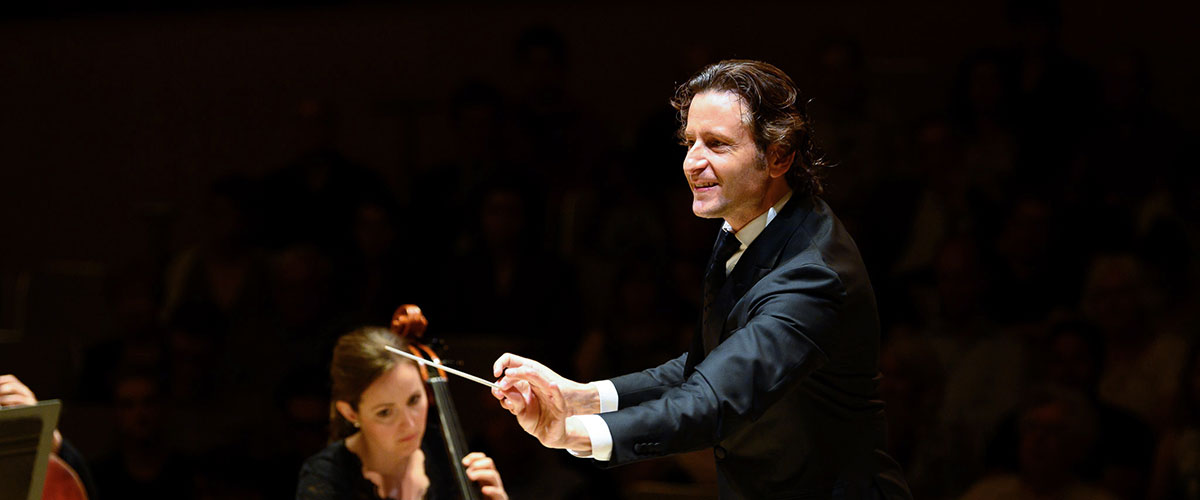
classicalandbeyond pavelhaasquartet-credit-marcoborggreveThe Pavel Haas Quartet, the acclaimed Czech string quartet, makes its highly anticipated Toronto debut April 10 in Walter Hall. The music world began to take notice of the group’s youthful vigour three years into the quartet’s life when it won the Paolo Borciani competition in Italy in the spring of 2005. A Supraphon record contract soon led to their first two CDs containing material close to their hearts, Janáček’s two string quartets and Pavel Haas’ three. Their penultimate recording, a disc of Dvořák’s String Quartets No. 12 in F major “American” and No. 13 in G major, was greeted with widespread critical acclaim culminating in Gramophone magazine’s Record of the Year award in the fall of 2011.

I’m looking forward to their performance of Brahms Quartet No. 2 in A minor with its lovely opening movement’s dusky poignancy. Like The Young Person’s Guide to the Orchestra, Britten’s String Quartet No. 2 in C Major celebrates the work of Henry Purcell, whom Britten rightly called “the last important figure of English music.” I’m also eagerly anticipating the Pavel Haas Quartet’s venture into such a singular British realm, in particular the last movement theme and variations chacony that ends with a huge celebration. They’re certainly familiar with the U.K., having performed in Wigmore Hall and beyond and been artists in residence for three years in Glasgow Royal Concert Halls.

First violinist Veronika Jarůšková formed the group with fellow students of Milan Škampa, the legendary violist of the celebrated Smetana Quartet. An interview on Tokafi.com in 2007 soon after their first recording, revealed that Škampa was their biggest artistic influence: “He taught us about quartet dialogue and about life as a quartet.” Their idea of what constitutes a good live performance continues to be their byword: “Most important is to hand over our feeling through music to the audience.”

In an email exchange I asked founding PHQ violist Pavel Nikl how the quartet chose its name:

“It was a coincidence,” he said. “At the time when we were trying to find a suitable name, a good friend of ours showed us a recording of the second string quartet composed by Pavel Haas and we liked it very much. So we asked his daughter, who still lives in Brno to get her consent to name our group after her father. She agreed. And all of us are happy that such great music [of Pavel Haas] will not fall into oblivion despite the fact he died very young [at 45] in a concentration camp and a lot of his music disappeared with him.”

In a 2010 interview with Graham Strahle in the Adelaide Review, PHQ cellist Peter Jarusek (Jarůšková’s husband) said that their namesake is a beacon for what the quartet seeks to achieve on an artistic level. “It is the unwavering genuineness of the man and what he did that means a lot to us. We are a young group, but that doesn’t mean that we consciously set out to be more attractive, stylistically innovative or anything like that. We just try to communicate the best we can to our audience, that is with intimacy and no artifice.

Haas’ music is all highly personal, original music from a man who believed very deeply in what he was doing. Throughout his music he uses many Jewish melodies, and you can feel it is Jewish. At the same time, he was fearlessly innovative. His Second String Quartet, for instance, which he called ‘From the Monkey Mountains,’ actually includes percussion in the last movement, and it’s an absolute riot. It really is like big band music for string quartet.”

In response to a question about the way the group chooses its material Nikl replied: “We try to choose pieces from every period of classical music to achieve a rich repertoire. We are lucky that no one is forcing us to play what we ourselves do not want to play. So we simply choose what we would like to play. The repertoire for string quartet is so rich that we are not able to play so much beautiful music during a lifetime. “

The quartet’s most recent recording was released last September. Featuring Schubert’s String Quartet No. 14 “Death and the Maiden” and the Cello Quintet with Danjulo Ishizaka, the CD has generated a major outpouring of praise. Here’s an example from British blogger Peter Smith: “The Times reviewer wrote ‘If CDs had grooves I would already have worn out these marvellous recordings  … the perfect fusion of virtuosity and profundity.’ Indeed. These performances are of a quite unworldly quality, deeply felt yet utterly thought-through, the most passionate you have heard but with moments of haunting delicacy, with an overarching architectural vision always holding it all together.”

The Gramophone reviewer wrote about their “fearless risk-taking, their fervency” and “insanely memorable phrasing,” calling the PHQ “absolutely mesmerizing” and “raw, visceral, and with an emotional immediacy that is almost unbearable.”

Their upcoming concert presented by the Women’s Musical Club of Toronto is comprised of Shostakovich’s String Quartet No. 1, in addition to the Britten and Brahms, all from the same C major tonal family. When I pointed this out to Nikl, he said it was coincidence, something he had not realized until now. These pieces have only been part of the quartet’s repertoire for a short time, about a year for the Brahms and Britten but less for the third. “The Shostakovich quartet is almost a new piece for us,” he said.

Replying to a question about live performance versus studio work, Nikl piqued my curiosity once more about their April 1o debut. “Our approach is always the same. We try to play hard and do not distinguish whether we are playing on the concert stage or whether we are recording. But there is a fundamental difference. Unlike recording, on the stage we have just one shot for all ...”

Recent Events

Stephen Hough’s masterclass at RCM’s Mazzoleni Hall March 3 overflowed with insights from that most discerning of pianists:

•“Have the courage to do nothing sometimes.”

•“Late Chopin – he became more interested in counterpoint – needs clarity; the right hand has to be able to whisper and still the accompaniment must be softer.”

•“Descending chromatics in Western music from the Renaissance on is all about suffering.”

•“Let’s find a real pianissimo so that it’s floating from the elbow; a real pianissimo in the concert hall makes an audience listen [as Hough’s blissful unveiling of Schoenberg’s Six Little Pieces in his March 2 Koerner Hall recital illustrated].

•“We have evidence (Horowitz’s Rach 3) where you don’t have to play all the notes; sometimes you need to thin things out – this was Horowitz’s great trick. Rubinstein admitted he left out notes in Iberia by Albéniz to get the ‘lift.’”

•“Some kind of musical clarity is more important than playing all the notes.”

Gustavo Dudamel’s visit to Roy Thomson Hall March 19 ignited his orchestra, the Los Angeles Philharmonic, and electrified the near-capacity crowd. His stellar status stems from his musical approach which energizes his players and invigorates the notes they play. The Toronto concert juxtaposed John Corigliano Jr.’s Symphony No. 1, an alternately tuneful and violent reflection of the composer’s reaction to the AIDS epidemic, with Tchaikovsky’s Symphony No. 5, with its own brand of fateful splendour.

Dudamel turned Corigliano’s massive outpouring of pain and beauty (written at the end of the 1980s and inspired directly by the death of three of his friends) into a showcase for his superb orchestral instrument. The conductor laid bare the work’s many textures, from an offstage piano quoting Albéniz to double tympani at opposite ends of the stage, from a heavenly solo cello to the stark shrill of three piccolos at triple fortissimo.

But it was the Tchaikovsky that confirmed Dudamel’s reputation and justified an immediate standing ovation. He revealed the visceral power of the music, making the familiar fresh -- with great clarity throughout and restraint when appropriate, from the snark of the brass to the anguish of the strings, with perfectly phrased moments and bars snapped off as if by a bullwhip, even unearthing a note you’ve never really heard before.

And then, at the end, with an elegance that acknowledged his love and respect for the orchestra, he disappeared into their midst to soak up the applause.

Concert-copia

The Toronto Symphony Orchestra bids farewell to a stellar month April 30 and May 1 with Sir Andrew Davis conducting Mahler’s essential Symphony 9 in D. April 17 and 19 finds the fascinating pianist Hélène Grimaud as soloist in Brahms’ Concerto No. 1 under the baton of Andrey Boeyko, music director of the Düsseldorf Symphony Orchestra. On April 11 and 12 Mozart’s vivacious Piano Concerto No. 17 comes under the scrutiny of the highly respected Richard Goode while Peter Oundjian also leads the orchestra in Richard Strauss’ gloriously hubristic Ein Heldenleben.

The Kindred Spirits Orchestra celebrates Good Friday April 18 with Rimsky-Korsakov’s Russian Easter Overture, Andre LaPlante performing Beethoven’s Concerto No.5 “Emperor” and Schumann’s Symphony No.1 “Spring.” Kristian Alexander conducts.

April 6 the Royal Conservatory concludes another season of Sunday afternoon piano recitals with a power-packed program by Khatia Buniatishvili. Liszt’s Piano Sonata and Chopin’s Second Sonata bookend Ravel’s iconic La valse. Stravinsky’s Three Movements from Petrushka conclude the breathtaking proceedings.

Music Toronto brings back Kikuei Ikeda, former violinist of the beloved Tokyo String Quartet, to join the Parker Quartet as a violist April 10 in a performance of Dvořák’s Quintet in E-flat Op.97 while April 28 finds the Associates of Toronto Symphony Orchestra playing Mozart’s String Quintet No.3 in C, K515 and Brahms’ String Quintet No.2 in G Op.111.

In their program May 4, the Windermere String Quartetnote that “the 13th quartets of Haydn and Beethoven [the lyrical Op. 130] bookend the era of the classical quartet: from the making of the mould to the breaking of it.”

The Kitchener-Waterloo Chamber Music Society offers an alternative interpretation of Britten’s String Quartet No.2 when they present the Enso Quartet April 11, one day after the Pavel Haas Quartet plays it in Toronto. On April 15 pianist Philip Chiu includes his own arrangement of the Suite for Oboe and Piano by Pavel Haas in his free noontime concert “Music in the Time of War” at the Richard Bradshaw Ampitheatre.

Two Grammy Award Winners: April 4 Jeffery Concerts presents James Ehnes accompanied by Andrew Armstrong performing LeClair’s Sonata No. 3 in D major, op. 9, Brahms’ Sonata No. 3 in D minor, op. 108, a new work by Alexina Louie and Richard Strauss’ Sonata in E-flat major, op. 18 while the iconic Canadian Brass concludes the Mooredale Concerts current season April 27.

  Paul Ennis is managing editor of The WholeNote.

Escape the February doldrums and get a taste of spring! The National Arts Centre Orchestra is planting musical seeds with its February 23 concert at Roy Thomson Hall by making Schumann’s Symphony No.1 “Spring” the program’s centrepiece. Two years after he composed it, Schumann sent a letter to the conductor Wilhelm Taubert, in Berlin: “If only you could breathe into your orchestra, when it plays, that longing for spring! It was my main source of inspiration when I wrote the work in February 1841. I should like the very first trumpet call to sound as though proceeding from on high and like a summons to awaken. In the following section of the introduction, let me say, it might be possible to feel the world turning green; perhaps . . . a butterfly fluttering; and in the Allegro the gradual assemblage of everything that belongs to spring. However, it was only after I had completed the composition that these ideas came to my mind.” Before intermission, Jocelyn Morlock’s Cobalt, a concerto for two violins and orchestra, sets the table for French pianist David Fray who joins conductor Alexander Shelley and the NACO for Chopin’s Piano Concerto No.2 with its lyrical Larghetto. Chopin was 19 when he wrote this elegant work.

February is a busy month for the TSO. Brahms’ final work for orchestra (1887), his Double Concerto for Violin and Cello showcases the considerable talents of concertmaster Jonathan Crow and principal cellist Joseph Johnson on February 6, 7 and 9. Conductor Sir Andrew Davis has recorded all nine of Dvořák’s symphonies so we can look forward to an insightful performance of the Czech master’s Sixth Symphony (1880). It may not have the cachet of the Eighth or Ninth, but Dvořák’s inimitable tunefulness is delightful in its own right. And its Brahmsian nature makes a good pairing with the concerto.

Barbara Hannigan. Photo credit Musacchio Ianniello Accademia Nazionale di Santa CeciliaThe force of nature that is Barbara Hannigan brings her immersive soprano voice and burgeoning conducting chops to a program that places Haydn’s Symphony No.86 squarely in the middle of a 20th-century mindset (Debussy’s sinewy Syrinx for solo flute and Sibelius’ ominous and icy tone poem for soprano and orchestra, Luonnotar, open the program). From Haydn to Berg brings Hannigan into her comfort zone with the Suite from Lulu. Bill Elliot and Hannigan’s arrangement of Gershwin tunes, Suite from Girl Crazy, brings the February 13 and 14 evening’s entertainment to a rousing finish. The orchestra even joins in to sing the chorus of Embraceable You.

Humphrey Bogart and Ingrid Bergman in Casablanca.When Casablanca was released in 1942 it marked the beginning a beautiful friendship between moviegoers and this Hollywood classic. Currently No.2 on the American Film Institute’s Greatest Films List, this romantic tale of a cynical American expat/nightclub owner whose idealism triumphs over his broken heart has never lost its lustre – Humphrey Bogart and Ingrid Bergman head the indelible cast. Max Steiner’s score subtly supports the movie’s mood without intruding on the action or the dialogue; but when called upon, as in the Paris flashback, its lush nostalgia rises to the occasion. The Austrian-born composer (his godfather was Richard Strauss) scored more than 300 films, from King Kong and Gone with the Wind to The Treasure of the Sierra Madre. Strategically programmed post-Valentine’s Day on February 15 and 16, the TSO’s live accompaniment to the film will make for a memorable cinematic experience.

February 20 and 21, Seattle Symphony principal guest conductor and music director-designate, Thomas Dausgaard, leads the TSO in Bartók’s Concerto for Orchestra, one of the touchstones of the 20th century. Before intermission, American cellist Alisa Weilerstein brings her intensity and sensitivity to Shostakovich’s profound Cello Concerto No.2.

Reminders

Now to several February concerts that I wrote about more extensively in our December/January issue. The renowned klezmer violinist/vocalist/composer, Alicia Svigals, performs her original score to the 1918 silent film, The Yellow Ticket, along with virtuoso pianist Marilyn Lerner, at FirstOntario Performing Arts Centre in St. Catharines on February 7, the Burlington Centre for the Performing Arts on February 8 and the Oakville Centre for the Arts on February 16.

The Heath Quartet returns to Mooredale Concerts on February 3 following their memorable Toronto debut two years ago. Their program includes Mozart’s Dissonance Quartet (one of his most famous string quartets), Britten’s First String Quartet and Beethoven’s iconic String Quartet No.3, Op.59 No.3 “Razumovsky.”

Celebrated Finnish pianist, 37-year-old Juho Pohjonen – praised by The New York Times for “his effortless brilliance” – appears on the Jane Mallett stage February 5 playing Rameau, Mozart and Beethoven. Even more celebrated are the musicians in Music Toronto’s February 14 recital. After an early Beethoven quartet and a newly commissioned work by Lembit Beecher, the latest incarnation of the legendary Juilliard String Quartet is joined by the illustrious pianist, Marc-André Hamelin, for a performance of Dvořák’s sublime Piano Quintet in A Major, Op.81, one of the greatest piano quintets ever written. Don’t miss this rare opportunity to hear Hamelin play chamber music!

The Royal Conservatory presents rising star, violinist Blake Pouliot, in a free (ticket required) concert in Mazzoleni Hall, February 3. The appealing program includes music by Mozart, Janáček, Kreisler and Saraste. Later in the afternoon of February 3, but in Koerner Hall, RCM presents Charles Richard-Hamelin in a recital of Schumann and Chopin (all four of the sumptuous Ballades). Jan Lisiecki, now almost 24, continues nurturing his international career. His March 3 Koerner Hall concert is sold out but a few rush seats will become available on the day of the performance. Works by Chopin, Schumann, Ravel and Rachmaninoff comprise the challenging program. 

CLASSICAL AND BEYOND QUICK PICKS

FEB 3, 2PM: Chamber Music Hamilton presents the Grammy Award-winning Parker Quartet playing Shostakovich’s Two Pieces for String Quartet and Janáček’s “Kreutzer Sonata” Quartet before being joined by Chamber Music Hamilton’s co-artistic director, violinist Michael Schulte and veteran cellist David Hetherington for Brahms’ beloved String Sextet No.2.

FEB 3, 7:30PM: The LARK Ensemble takes its name from the first names of its members: National Ballet Orchestra principal flute Leslie Allt; COC Orchestra concertmaster and National Ballet Orchestra associate concertmaster Aaron Schwebel; TSO cellist Roberta Janzen; and COC Orchestra principal viola Keith Hamm. They write that their program features various combinations of keyboard, flute and strings: “We’ve put together an evening filled with unexpected gems, beautifully capped off by J.S. Bach’s joyous Musical Offering in its entirety, with illuminating commentary by [guest harpsichordist] Christopher Bagan. Also on offer (pardon the pun) are Bach’s D-Major viola da gamba sonata, along with Bohuslav Martinů’s cheery Promenades (flute, violin and harpsichord), and the quietly haunting Revenant, by Jocelyn Morlock (Baroque flute, harpsichord and strings).”

FEB 9, 8PM: Kristian Alexander conducts the Kindred Spirits Orchestra in a rousing program of Respighi’s crowd-pleasing Fountains of Rome, Prokofiev’s virtuosic Sinfonia Concertante Op.125 (with cello soloist Andrew Ascenzo) and Rachmaninoff’s Symphonic Dances Op.45.

FEB 10, 3PM: Amici chamber ensemble, augmented by TSO winds and Glenn Gould School students, presents Mozart’s marvellous Serenade No.10 in B-flat Major K361/370a “Gran Partita” and Mozart’s Piano Trio in C Major K548; in Mazzoleni Hall.

Joshua BellFEB 12, 8PM: Roy Thomson Hall presents acclaimed violinist (and music director of the renowned Academy of St Martin in the Fields) Joshua Bell in recital with pianist Sam Haywood. The program includes sonatas by Beethoven (No.4), Prokofiev (No.2) and Grieg (No.2). The rest of the program (à la Itzhak Perlman) will be announced from the stage.

FEB 17, 2PM: The always entertaining Eybler Quartet presents the aptly named “Esterházy to Vienna, A Road Well Travelled,” comprising string quartets by Asplmayr (Op.2), Haydn (Op.54, No.2) and Beethoven (the resplendent Op.59, No.2 “Razumovsky”).

FEB 22, 7:30PM: Since its formation in 2010 by four graduate students at U of T, the Ton Beau String Quartet “aims to highlight voices of young composers, particularly women composers and composers from under-represented communities.” Their upcoming recital, presented by 3 in the 6ix, features Joaquín Turina’s La Oracion del Torero, Toronto-based Laura Sgroi’s String Quartet No.1 and Debussy’s brilliant String Quartet in G.

FEB 27, 7:30PM: Getting to know Toronto even more since their Mooredale Concerts recital last September, the Calidore String Quartet, currently in residence at U of T’s Faculty of Music, performs Haydn’s String Quartet in F major, Op.77, No.2; Caroline Shaw’s new commission, Entr’acte and First Essay: Nimrod; and Beethoven’s monumental String Quartet in C-sharp Minor, Op.131. Anyone who heard Shaw’s delightful “ballad” Taxidermy, one of several highlights of Sõ Percussion’s 21C Music Festival concert on January 19, needs no urging to hear her piece for string quartet.

Joel QuarringtonFEB 28, 1:30PM: The Women’s Musical Club of Toronto presents “Bass Masters through the Ages” with double bass virtuoso Joel Quarrington and friends Yehonatan Berick and Blythe Allers, violins; David Jalbert, piano; Alisa Klebanov, viola; Carole Sirois, cello; and Gabriel Sakamoto, double bass. Music by Schumann, Korngold, Schubert and Tovey.

MAR 3, 8PM: Gallery 345 presents “Music from Marlboro”: Haydn’s Piano Trio in C; Kodály’s Serenade Op.12; K. Ueno’s Duo (Marlboro commission/premiere); and Ravel’s Piano Trio in A Minor. With Robin Scott and Tessa Lark, violins; the inspirational Kim Kashkashian, viola; Christoph Richter, cello; and Zoltán Fejérvári, piano.

Paul Ennis is the managing editor of The WholeNote.

Jonathan Crow. Photo by James Ireland.If I were talking only to long-time readers of this magazine right now, I would suggest you do some online homework before carrying on with reading this story, by heading off to one particular spot on the Toronto Summer Music (TSM) website. Once you arrived, I’d ask you to scroll your way up through the two lists of musicians you’ll find there – the alumni of the TSM’s two Academy programs (chamber and vocal music) from 2012 to 2023. (The lists are easy to find even if you don’t have a link: just go to “Alumni” under the tab “Academy.”)

Read more: Fellows and Mentors: The Warp and Weft of Toronto Summer Music

September is kind of an oddball month around here: the summer festivals have wound down, for the most part, and the season of regular concert series doesn’t really get under way until October. So, what’s a classical music columnist to write about this month? Plenty, actually: there are those exception-to-the-rule summer series and festivals to take us into the end of September (look for Colours of Music and SweetWater in our Beyond the GTA listings), and the gutsy presenters who are first out of the starting gate each year with season launches in September. See, nothing to worry about!

17 classicalandbeyond brentano string quartet  1 photo credit christian steinerSeptember’s septet of quartets:You can’t talk about quartets in Toronto without talking about Music Toronto. For 40 years, this venerable organization has consistently presented some of the most sublime, memorable and musically satisfying evenings of chamber music, many of which have involved one major, or up-and-coming, string quartet or another (in addition to outstanding trios, duos and soloists). Here’s a non-exhaustive list: Juilliard, Guarneri, Orford, St. Lawrence, Jerusalem, Kronos, Tokyo, Lafayette, Cecilia, Molinari, Bozzini, Brentano and Amadeus.

The person who, with little fanfare, has been shepherding Music Toronto since 1990 — first as general manager and since 2006 as both GM and artistic producer — is Jennifer Taylor. Roman Borys, artistic director of Ottawa Chamberfest, and cellist with the Gryphon Trio (Music Toronto’s ensemble-in-residence from 1988 to 2008), sings her praises during a June 12, 2012, video interview he did for The WholeNote’s Conversations@TheWholeNote YouTube video series: “Jennifer Taylor, Music Toronto, there’s an organization and a particular individual ... one of the great foundations in chamber music in this country ... who understands the genre, who understands the business of presenting music, presenting concerts, and who, luckily, also has great stamina!” Borys adds that Taylor gave the Gryphon “wonderful opportunties to continue to develop our own skills as chamber musicians and learn from one another.”

For Music Toronto’s 41st season, Taylor has assembled yet another superb lineup of quartets, trios, pianists and other soloists, with concerts at the Jane Mallett Theatre — its regular venue since its inception. First up of the quartets, on September 13, is the Brentano, with a fascinating 20th anniversary program called “Fragments: Connecting Past and Present.” They have taken six fragments by great composers from the past, and invited six living composers to respond to them. In their Music Toronto concert you’ll hear “fragments” of Schubert, Bach, Haydn, Shostakovich and Mozart juxtaposed with “completions” by Bruce Adolphe, Sofia Gubaidulina, John Harbison, Stephen Hartke and Vijay Iyer, respectively. Also on the program is a work by Charles Wuorinen, based on the music of Josquin and Dufay, the earliest music in the “Fragments” project.

(You can also hear — but only hear, not see — the Brentano Quartet in a film titled A Late Quartet. It’s one of several featured films on offer at this year’s TIFF to “use music in interesting ways,” according to Paul Ennis, whose TIFF-focussed article is here.)
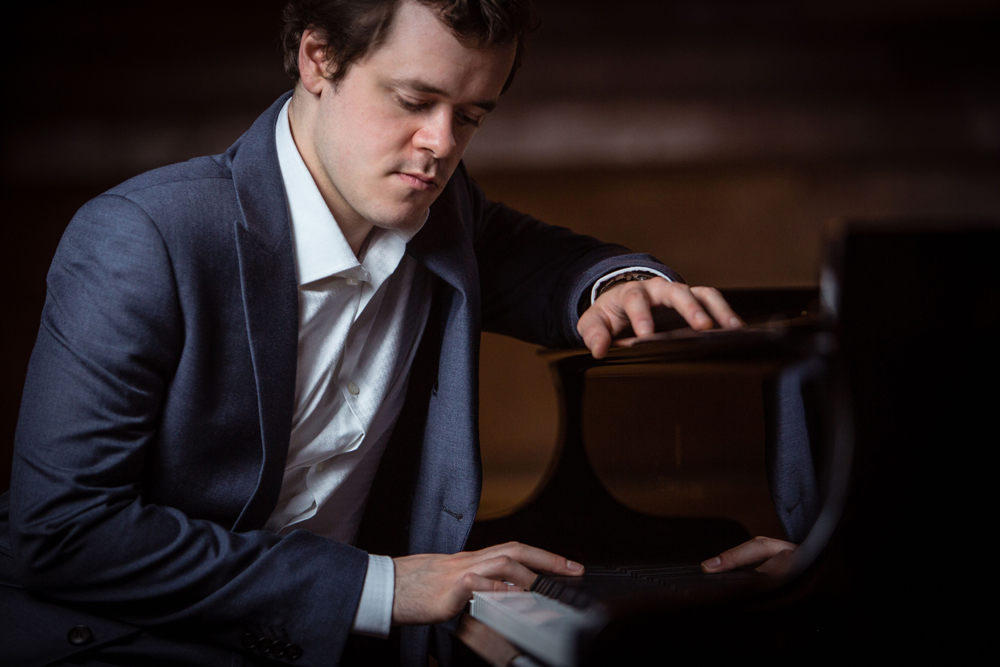
The Attacca Quartet was formed at the Juilliard School in 2003, (as was the Brentano in 1992 and the Tokyo in 1969), and they’re the second quartet presented by Music Toronto this month. Making their Toronto debut, the Attacca will perform quartets by Haydn (Op.77 No.2), Prokofiev (No.1) and Mendelssohn (No.2 Op.13). This group also has an interesting project on the go, a multi-year performance series titled “The 68,” referring to the number of string quartets Haydn wrote over the course of his life. And while the series itself takes place in New York City, we will have the pleasure of hearing the Attacca perform one of the “68” here in Toronto on September 27.
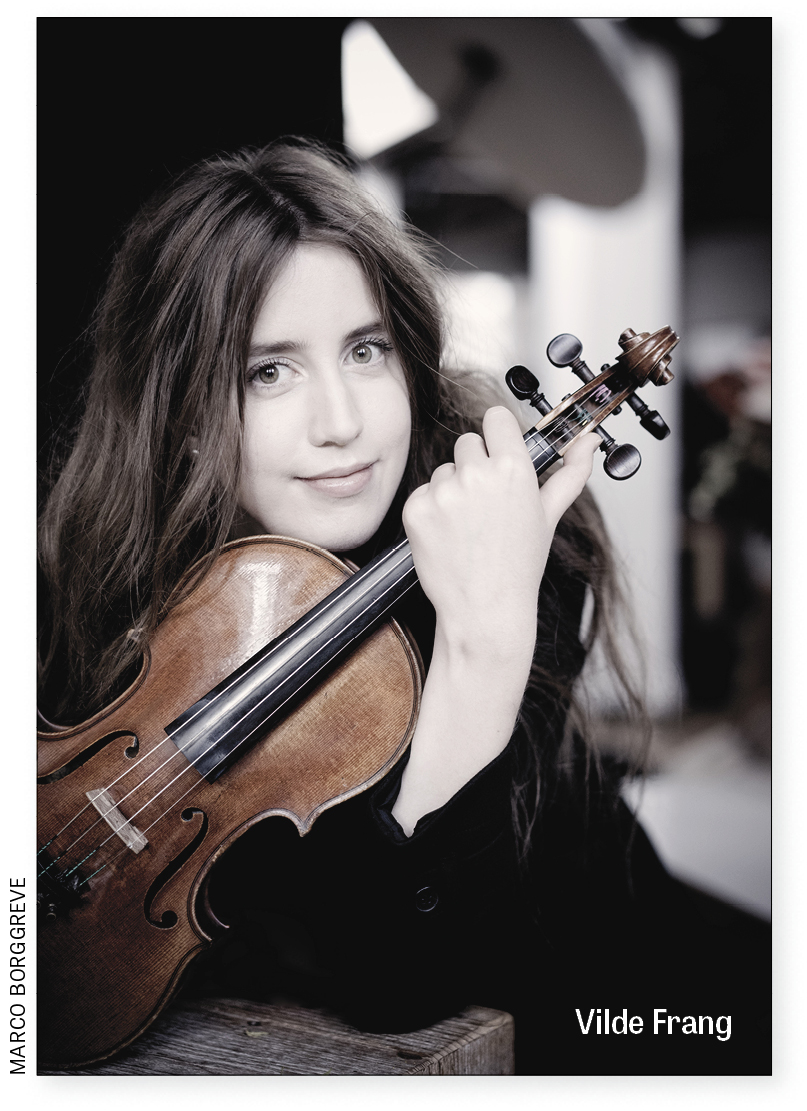
I mention the Tokyo Quartet this early in the season for a couple of reasons. First, they will perform their 45th and 46th concerts for Music Toronto on January 10 and April 4, 2013, respectively, to conclude their three-concert series of all six Bartók quartets. Second — and this may or may not come as a shock to some of you — the Tokyo will be retiring from the concert stage in June, 2013, after 43 years, and will be giving an extra special “Farewell Performance” in Toronto, in support of Music Toronto, on April 5, 2013. I wanted to give you plenty of time to arrange your schedules, accordingly — it’s going to be one heck of a farewell. For the rest of Music Toronto’s stellar season, please go to www.music-toronto.com

As for the rest of the the issue’s “septet” of quartets, they, along with several other noteworthy concerts, are included in the Quick Picks at the end of this column.

17 classicalandbeyond musicmondays 1 photo by blacksMonday Monday: Music Mondays began its 21st season on June 4, and has been treating us to an astonishing array of music and musicians, every Monday throughout the summer, at 12:15pm, at the “exquisitely tuned” Church of the Holy Trinity. And for the second year in a row, they’ve extended their season into the fourth week of September. Talk about gutsy!

I asked Eitan Cornfield, Music Mondays’ new artistic director, to say a few things about his first year at the helm of the series, what he calls a “sanctuary in the heart of the city’s commercial, financial and administrative core, a musical respite from the workaday world.” (As a long-time CBC music producer, Cornfield is well aware of Holy Trinity’s “rich, acoustic environment,” as he puts it, having produced CBC Radio Two’s Music Around Us there.)

The challenge, now, according to Cornfield, is to “develop a sharpened focus for Music Mondays ... [to] remain relevant and distinctive while maintaining the core values of Holy Trinity’s inner-city mission, ... to build on Music Mondays’ historic strengths ... by featuring an eclectic fusion of western classical music and traditional art music of various cultures, all the while providing a contemplative, inclusive and accessible sanctuary ... ” The goal, as he looks forward to new alliances and “new programming initiatives” with his keen core team is “to be able to say you first heard it here!”

Next “first” could be as early as September 3, when Music Mondays presents Triceratonin, a young “made in Toronto” piano, oboe and bassoon trio fresh from their NYC debut at the Juilliard School, as participants in the Imani Winds Chamber Music Festival. I came upon this expression of sheer glee in someone’s daily blog on the IWCMF: “Wait til you see the Triceratonin Trio perform synchronized swimming with their oboe and bassoon!” Curious? Check them out on YouTube. And don’t forget to get to the church on time, September 3, for some jazz-inflected works by Poulenc, Previn and others, performed by the good-humoured, talented and very synchronized Jialiang Zhu on piano, bassoonist Sheba Thibideau, and Aleh Remezau on the oboe ... and snorkel?

The remaining Music Mondays concerts take place September 10, 17 and 24, with music ranging from Porter to Purcell to pop!

QUICK PICKS: FESTIVAL FARE AND ELSEWHERE

QUARTETS

New Orford String Quartet: September 15 and 16:
Prince Edward County Music Festival; September 12: Kitchener-Waterloo Chamber Music Society; September 11: Gallery 345.

Penderecki String Quartet: September 21 and 22:
Prince Edward County Music Festival; September 23, 26, 27, 28: Colours of Music.

Ton Beau String Quartet: September 9: Summer Music in
the Garden; September 14: Gallery 345.

Silver Birch String Quartet: September 23: Colours of Music (with the Penderecki).

TRIOS

Gryphon Trio: October 1: U of T Faculty of Music.

Amity Trio: September 22: Colours of Music.

Junction Trio: September 26: Post-Industrial Wednesdays
at St. Anne’s Anglican Church.

Trio Kokopelli: October 4: Nine Sparrows Arts Foundation/
Christ Church Deer Park.

ORCHESTRAS

Toronto Symphony Orchestra: September 20 and 22:
Opening weekend with James Ehnes; September 27 and 29: Pictures at an Exhibition; October 3 and 4: Anne-Sophie Mutter.

Royal Conservatory Orchestra: October 5: with Uri Mayer
at Koerner Hall.

Kitchener-Waterloo Symphony: September 28 and 29:
Last Night of the Proms at Centre in the Square.

So, slip gently into September as you take advantage of the last vestiges of summer. And while September may be an oddish month for music, there’s no real shortage of those musical threesomes and foursomes — and moresomes — ready to dazzle you. Enjoy!

Sharna Searle trained as a musician and lawyer, practised a lot more piano than law and is listings editor at The WholeNote. She can be contacted at classicalbeyond@thewholenote.com.

Benjamin Grosvenor. Photo by Patrick AllenBenjamin Grosvenor first came to prominence when he won the Keyboard Final of the 2004 BBC Young Musician Competition at the age of 11. He was invited to perform with the BBC Symphony Orchestra at the First Night of the 2011 BBC Proms at 19. In the same year he became the youngest British musician ever, and the first British pianist in almost 60 years, to sign with Decca Classics. Gramophone named him Young Artist of the Year in 2012. A riveting performer with keen musical insights, many inspired by pianists of the past, Grosvenor’s Music Toronto recital on March 31 marks his fourth appearance here since 2014, a testament to his prodigious talent. In the following email Q & A, which took place in mid-February, Grosvenor spoke about his latest CD and the program for his upcoming Toronto concert.

WN: I very much enjoyed your new recording of the Chopin piano concertos which I found to be highly contemporary yet informed by a sensibility reaching back into the last century. I interviewed you in the fall of 2017 and remember your response to my question “Who was the first composer you fell in love with as a child?” being Chopin. How did you decide to select his piano concertos as your first recording since Homages in 2016? How long have the concertos been part of your repertoire?

Read more: Fourth Grosvenor Recital Tops an Intriguing List

2105-Classical.jpgTwo brilliant young European violinists make their local debuts in February. In winning the 2001 Queen Elizabeth Competition, Latvian violinist Baiba Skride joined such luminaries as Oistrakh, Kogan, Laredo and Repin in the fiddling firmament. The Guardian recently called Skride “a passionate heart-on-sleeve player.” Now 34, she will appear with the TSO in Brahms’ richly sonorous Violin ConcertoFebruary 17 and 18.

According to BBC Music Magazine, the 29-year-old Norwegian, Vilde Frang, “has the knack of breathing life into every note.” Frang will give a recital at Koerner Hall, March 2, with Michail Lifits on piano. Her program begins with Schubert’s Fantasy in C Major for Violin and Piano D934, another masterpiece from the last year of the composer’s life, and moves through Lutoslawski’s Partita, commissioned by Pinchas Zukerman in 1985, before concluding with Fauré’s ever-popular Violin Sonata No.1. Frang began her musical education at four, played Sarasate’s Carmen Fantasy with the Oslo Philharmonic Orchestra, conducted by Mariss Jansons, when she was barely 13, and was thrust into the limelight when she was named Credit Suisse Young Artist of the Year in 2012. A recording contract and worldwide touring were the result.

It’s illuminating to hear both violinists talking about inspiration and interpretation in interviews readily available in cyberspace. Skride told Tobias Fischer (on Tokafi.com April 20, 2006) that interpretation “means giving my opinion to the audience, while at the same time respecting what the composer might have wanted. It’s a combination of my personal beliefs and the composer’s probable intent.” Her interpretive process, she continued, is “almost always emotional. Of course, there are certain things you have to know about and naturally you do get your facts straight while preparing. But 99 percent is intuition, absolutely.” Her approach to performing live is “simply giving everything you have in that very moment.”

In a YouTube video biography made shortly after her Credit Suisse honour, while soaring on her violin in rehearsal for Bruch’s Violin Concerto No.1 with Jakub Hrůša and the Philharmonia Orchestra, Frang spoke of the importance she places on trusting her instincts,  how it’s crucial to take in things and let yourself be inspired. “Inspiration is really the most important thing,” she said. “I use my instrument as a tool [to transform inspiration]. Whether you hear Dietrich Fischer-Dieskau, a wonderful horn solo or the sound of the sea, it’s something you can actually work with.”

Later that year, on August 1, 2012, Frang spoke with Laurie Niles of violinist.com about what brought her to the violin. “My father is a double bass player, and my sister is also a double bass player – my mother isn’t a musician, actually. But I watched my sister play in youth orchestras, when I was small, and obviously I thought I was the next one in line, in the double basses family! To me it was a natural thing, but then my father made this argument: our family had a Volkswagen, which was a very tiny car. He said, ‘Can you imagine, when we go on holiday, with three double basses? There is no chance the whole family will get space in the car!’

“So he made me a smaller instrument. It was made of cardboard – there were no strings on it. So I could put my Little Twin Star stickers on it, and Hello Kitty stickers – but the fact that it didn’t make any sound – I found this to be very frustrating! I had to ‘play’ on it for almost a year until I finally got a violin which was alive, which made sound.

“I remember the moment I got the violin that was real, that was really living and alive – I’ve never practised so inspired in all my life, as I did the first couple of days with that violin! I was in seventh heaven, I was so happy.”

Niles asked Frang, who began with the Suzuki method, how she  connected with Anne-Sophie Mutter (See my November 2014 column in The WholeNote for more on Mutter and her foundation): “I first played for Anne-Sophie Mutter when I was 11-years-old,” she said. “After that, she asked me to keep her updated, and she followed my development. I kept sending her recordings and tapes of my playing, and letters about how I was doing. It was obviously a very inspirational thing for me, because I knew that she was always there watching, somewhere. When I was 15, she invited me to Munich to audition for her again, and then I was taken into her foundation, her Freundeskreis Stiftung, or Circle of Friends Foundation, and I was also given this Vuillaume instrument.

“Ms. Mutter has also been a great, great mentor to me over all these years. I did a tour with her in 2008, and we played in Carnegie Hall and the Kennedy Center in Washington. I played the Bach Double with her. Of course, I learned a lot from this experience, not only playing for her, but playing with her. I think the most important was that she encouraged me to always trust my own instincts and follow my own voice. That is her top priority, and that’s the message she wanted to give, which I think is a wonderful thing.

“But more than any other musician I know, she is extremely focused on exploring the musical score, in order to get as close as possible to the composer. Many people might consider her to be very free, but actually she has the most authentic and strictest approach that I know of. I think that is why she allows herself to have that amount of freedom. The more you know the piece and the better you know the score, the more freedom you actually have yourself.”

Hamelin past and future. Marc-André Hamelin’s Music Toronto recital on January 5 had a blissful component running through it from Liszt’s Bénédiction de Dieu dans la solitude to the Schubert Sonata in B-flat D960 and the well-chosen encore, Messiaen’s Prelude “The Dove.” For me, this emotional line reached its apex with the sublime second movement of the Schubert which had a profundity that reminded me of the last three Beethoven sonatas. There was a serenity to Hamelin’s playing that was more pronounced than when he played at Koerner Hall the previous March. At times he seemed to slow the music just enough that you could feel it palpably.

During the conversation I had with him in November (see my article in the December 2015-January 2016 issue of The WholeNote), Hamelin described his  relationship with Mendelssohn’s Piano Concerto No.1, which he will perform with the TSO on February 25 and 27. “I learned it very early,” he told me. “I remember the first time I played it was with Skrowaczewski and the Montreal Symphony. I believe it was somewhere like 1990 or ’91. It’s certainly not the deepest piece ever written but it shows consummate craftsmanship. And it’s also very entertaining for audiences. And in some ways quite touching.” Louis Langrée, famous for his stewardship of the Mostly Mozart Festival, his career blossoming as music director of the Cincinnati Symphony Orchestra, will conduct.

Quick Picks

2105-Classical2.jpgFeb 4 The last time I heard the Annex Quartet, they showed their sensitive musicianship supporting Jan Lisiecki in the chamber versions of Beethoven’s Piano Concertos Nos. 2 and 4. Their solid Music Toronto recital includes string quartets by Janáček, R. Murray Schafer and Mendelssohn. Feb 18 The irrepressible St. Lawrence String Quartet makes its annual visit to Music Toronto with works by Haydn, Samuel Adams and Schumann. Mar 1 The distinguished British pianist Steven Osborne performs two Schubert Impromptus D935 (fresh from his sparkling new Schubert CD) and a selection of Debussy and Rachmaninoff, in his Music Toronto return.

Feb 5 Conductor Eric Paetkau’s contagious energy and musicianship guide the eclectic group of 27 in Finzi’s bucolic A Severn Rhapsody and a trio of French works including Dubois’ Cavatine for Horn featuring the TSO’s Gabe Radford. The dynamic Nadina Mackie Jackson is the bassoon soloist in the world premiere of Paul Frehner’s Apollo X.

Feb 11 An ingenious piece of animation, The Triplets of Belleville is filled with cultural references that fly by with terrific panache, Sylvain Chomet’s 2003 film has rightly become a classic. Composer Benoît Charest leads Le Terrible Orchestre de Belleville and special guest Nellie McKay in the live performance of his infectious, original score for the film (rooted in 1930s vaudeville/jazz) accompanying this special screening at Roy Thomson Hall.

Feb 12 Cellist Rachel Mercer follows up her well-received CD of Bach’s unaccompanied cello suites with an exciting concert of music for solo cello at Gallery 345, beginning with one of those Bach suites. Mercer then moves from Cassadó’s early 20th century suite to contemporary pieces by Andrew Downing and the world premiere of Darren Sigesmund’s Solo Suite.

Feb 13 Celebrate the Year of the Monkey with the TSO as the great violinist Maxim Vengerov is the soloist in the Butterfly Lovers Concerto. Long Yu, artistic director of the China Philharmonic Orchestra and music director of the Shanghai Symphony Orchestra, conducts. Feb 22 The Associates of the TSO present works by Françaix, Janáček and Brahms for various combinations of flute, oboe, horn, bassoon and two clarinets. Mar 2 Seven soloists from the TSO’s ranks (including the ubiquitous Teng Li) showcase their talents when the TSO presents music by Paganini, Vivaldi and Haydn (his elegant and tuneful Sinfonia Concertante in B-flat Major for the unusual combination of soloists, violin, cello, oboe and bassoon).

Feb 17 The hip, Brooklyn-based orchestral collective, The Knights, make their Koerner Hall debut, joined by violinist Gil Shaham, whose warm playing should illuminate Prokofiev’s Violin Concerto No.2, in all its angularity and dark beauty. Feb 26 Koerner Hall gives us the rare gift of hearing violinist Christian Tetzlaff, his sister, cellist Tanja Tetzlaff and pianist Lars Vogt performing piano trios by Schumann, Dvořák and Brahms. Richard Haskell praised them in these pages last September for their “conducive music-making in the three Brahms piano trios.” Andras Schiff’s monumental Feb 28 recital in Koerner Hall is sold out. Those lucky enough to have tickets (myself included) can look forward to a program memorable for its inclusion of the final piano sonatas by Haydn, Beethoven, Mozart and Schubert. Mar 4 Much-in-demand (especially since she received the Avery Fisher Career Grant in 2008) Canadian violinist, Karen Gomyo, teams up with well-regarded cellist, Christian Poltéra, and talented young Finnish pianist, Juho Pohjonen, to perform trios and sonatas by Haydn, Janáček and Dvořák. All four of these events are presented by the Royal Conservatory.

Feb 19 The charming Trio Arkel (TSO members violist Teng Li and cellist Winona Zelenka, COC concertmaster Marie Bérard) move into their new venue, Jeanne Lamon Hall at Trinity-St. Paul’s Centre, with a program including Gubaidulina’s exhilarating String Trio, Kodály’s Serenade for Two Violins and Viola and Beethoven’s glorious Quintet for Strings, Op.29 “The Storm.” Joining them for this and a repeat concert in London, Feb 29, presented by the UWO Don Wright Faculty of Music, will be violinist Scott St. John and violist Sharon Wei.

Feb 20 Also in London, Jeffery Concerts presents the award-winning cellist Yegor Dyachkov and longtime chamber music partner, pianist Jean Saulnier, in works by Brahms, Schumann and Janáček.

Feb 23 Charles Richard-Hamelin, who finished second in last year’s prestigious Chopin competition in Warsaw, will give a COC free noon-hour concert of a selection of Chopin’s last piano works at the Richard Bradshaw Amphitheatre. Based on his thrilling performance of Chopin’s Sonata No.3 at Mazzoleni Hall on January 15, I urge you not to miss it.

Mar 3 The Women’s Musical Club of Toronto’s talent-laden season continues with the widely acclaimed Daedalus String Quartet performing Sibelius’ String Quartet in D Minor “Voces Intimae” Op.56. Montreal native, clarinetist Romie de Guise-Langlois, joins them in James MacMillan’s powerful lament, Tuireadh, and Brahms’ sublime Clarinet Quintet in B Minor Op.115

Paul Ennis is the managing editor of The WholeNote.

Photo by Dahlia KatzOn February 22, in response to the continuing uncertainty about when the Ontario government would ease the COVID-19 lockdown protocols disproportionately affecting the live performing arts, the Toronto Alliance for the Performing Arts (TAPA), which represents 164 professional theatre, dance and opera companies, sent Lisa MacLeod, Minister of Heritage, Sport, Tourism and Culture Industries “an urgent plea requesting regulatory fairness with the television and film industry.” 

The letter continues: “Restrictions preventing professional theatre, dance and opera companies from doing the same [as TV and film companies] threaten the survivability of our sector. We are planning to return to engaging our communities in our theatre venues when it is safe to do so. In the meantime the creation of digital content has become the only form of artistic practice for the professional theatre, dance and opera industry in Toronto, and our members have found new and creative ways to continue to operate and connect with our audiences.” 

Meanwhile, even though many TAPA member companies have temporarily shifted to hybrid theatre, dance and opera models that include livestreaming, pre-recorded film and digitization, “entertainment concert venues, theatres and cinemas (includes drive-in or drive-through events) [are] closed for all purposes, including rehearsing or performing a recorded or broadcasted event, artistic event, theatrical performance or other performance.” However, the letter points out, the Businesses Permitted to Open and Sector Specific Restrictions (14) have allowed film and television to continue to operate: commercial film and television production, including all supporting activities such as hair, makeup and wardrobe.”

Read more: From limbo to grey zone: Inconsistent lockdown protocols hamper the live performing arts

Here’s what’s really neat about the classical music scene in June: it seems to me that performers and presenters, alike — having thrown off the heavy mantle of winter and survived their various spring concerts and season finales — are now ready to have some real, summer fun! Given what’s on offer — Green Pages and all — perhaps an apt motto for the month might be, “Go Big or Go Late Night!”

classical_stewart_goodyear_photo_by_gary_beecheyA good day for Goodyear: And when I say “big” I mean BIG, as in having pianist Stewart Goodyear perform all 32 of Beethoven’s piano sonatas in the order in which they were composed — in one day! Let’s see, now. That translates into approximately ten and a half hours of some of the most complex, difficult and profound music ever written, played by one remarkable, strong-minded (and strong-bodied) pianist in a single day over three “concert sittings” starting at 10am and, with two breaks, ending at 11:30pm. Phew! —not for the faint of heart (and I’m talking about both performer and audience, here). Co-presenters Luminato and the Royal Conservatory haven’t billed this “The Beethoven Marathon” for nothing!

Goodyear — a Toronto native now living in New York — stopped by The WholeNote for a “Conversations” video interview session, May 10, with the magazine’s David Perlman.

Read more: Going for the Gusto

Stewart Goodyear Photo credit: ANITA ZVONARThere are hopeful signs of live-music life at the RCM’s Koerner Hall. On November 27, virtuoso pianist Stewart Goodyear, joined by the Penderecki String Quartet, perform the world premiere of his piano quintet based on themes from Beethoven, after which Goodyear takes on Beethoven’s monumental Symphony No. 9, in Franz Liszt’s transcription for solo piano and voices, accompanied by members of the Toronto Mendelssohn Choir, soprano Jonelle Sills, mezzo-soprano Beste Kalender, tenor Zachary Rioux and baritone Korin Thomas-Smith, all current or recent students of The Royal Conservatory. I caught up with Goodyear for an email conversation that touched on his response to the pandemic, his relationship to Beethoven and how he is feeling about his first public appearance in Toronto since the pandemic.

Read more: Goodyear, then Lisiecki at Koerner; RTH at 60% capacity for Gimeno’s TSO return

On September 25, 2017, Glenn Gould would have been 85. To mark the occasion, the TSO is presenting a tribute concert to him on September 22 and 23 with two works of great significance to his biographical and musical legacy. 

Siegfried Idyll

Mark Skazinetsky in 1981In July 1982, just weeks before suffering the stroke that led to his premature death on October 4, 1982, Gould began recording Wagner’s Siegfried Idyll in its chamber version for 13 instruments. It was released by Sony on a CD that also included Gould’s own piano transcriptions of other Wagner works, but it was Gould’s role as conductor (of Siegfried Idyll) that caught people’s attention. The recording was stunning in its transparency, rigorous in its controlled Romanticism and finely balanced as a large chamber work. The orchestral version of this piece is one of the programmatic keys to the TSO tribute this month. Remarkably, four members of the current TSO participated in the Gould recording, among them associate concertmaster Mark Skazinetsky. He graciously took the time to fill WholeNote readers in on the nuts and bolts of that historic occasion.

WN: What are your memories of the recording sessions of Siegfried Idyll?

MS: First of all was the fact that I was going to work with GLENN GOULD himself! It was a hot summer day and he came dressed in a heavy coat, wearing gloves, kind of looking a little strange, but when he started to talk he struck me as being a very kind and friendly, respectful person.

WN: How much rehearsal time was there?

MS: We didn’t have much rehearsal time but everyone could sense something very special and unique was happening and that made the rehearsal more effective.

WN: Do you recall Glenn Gould’s approach? Any specific instructions?

MS: Glenn Gould’s approach was very unique. At first we thought that all the tempi were very slow, or slower than we expected. But as we were getting deeper into the music it started to make more and more sense. His interpretation of this piece was so sincere and deeply felt that it “infected” us very much. He was asking for very long lines and phrases and that made the whole piece like one big painting. The end result was amazing!!!

Brahms Concerto No.1

Glenn Gould was 22 when he first recorded Bach’s Goldberg Variations for Columbia Masterworks in 1955. Jan Lisiecki is now 22 and a graduate of the Glenn Gould School of the Royal Conservatory. His fourth recording for Deutsche Grammophon, Chopin Works for Piano and Orchestra, was released last March. For his part in the TSO Gould tribute, Lisiecki will play Brahms’ Piano Concerto No.1 in D Minor, Op.15, the same work that prompted Leonard Bernstein to address the audience in Carnegie Hall on the evening of April 6, 1962, when Gould played it with the New York Philharmonic. Bernstein said that he could not agree with Gould’s “remarkably broad tempi and frequent dynamic departures” but that “Mr. Gould is so valid and serious an artist that I must take seriously anything he conceives in good faith.”

I asked Lisiecki about his relationship with Gould and what he thought about Bernstein’s pre-performance words.

WN: When did you first become aware of Glenn Gould?

JL: I cannot even describe a particular moment when I became aware of Glenn Gould. He seems to have been a part of my musical life from the very start, and is inseparable from it in my view.

WN: How has he been important to you?

JL: There are many inspirational aspects about Mr. Gould. For one, I love his answers to interviews. They were different, insightful and fun. I also like his approach to making music, and adhering to the principle that if there’s nothing new to say, then there’s no point in performing or recording it. He was also never afraid to break with the tradition, and as a result, completely changed the way the entire world sees and experiences some music.

WN: What do you think of Bernstein’s famous words to the audience before Gould and the New York Philharmonic performed Brahms’ First Piano Concerto?

JL: I actually think these words could have been spoken at many other concerts, and that it is frankly not a surprise that a conductor and soloist don’t get along. After all, each musician is very individual, and when you add in someone’s personality (their amenability and openness, or lack thereof), musical disagreements do occur.

WN: How long have you been playing the concerto?

JL: This concerto is actually very new to me, and I performed it for the first time in Warsaw only on August 12. My “debut” with this work was a full immersion, too, with live broadcast on radio, YouTube and TV recording.

WN: What is your approach to it?

JL: I’m not sure how I can answer this question in words. I invite the audience to listen and assess for themselves. :-)

WN: Have you played much Brahms in concert?

JL: I have included Brahms in my recitals before, but my closer association is with Schumann. In fact, I recorded one of Schumann’s last works for the piano, his Introduction and Concerto Allegro Op.134 for Piano and Orchestra, which inspired Brahms when writing this concerto.

I’m reasonably certain that TSO conductor Peter Oundjian will address the Roy Thomson Hall audience before the Brahms concerto is performed. And I’m also confident that Lisiecki will have a few words to say at its conclusion. The prospect fills me with great anticipation.

Mooredale Concerts Season Opener

Again this summer my musical life in Toronto was bound up in the Toronto Summer Music Festival, the first under artistic director Jonathan Crow. This year – the festival’s 12th edition – was primarily a celebration of chamber music performed almost entirely by Canadian-born or Canadian-resident musicians. It was a roster driven by the notion of celebrating Canada’s sesquicentennial. The overwhelming artistic success of TSM was an affirmation of the high level of talent our country has produced. The total audience of 15,000 was a 20-percent increase over last year and included several sellouts and many near sellouts in both Koerner and Walter Halls. I was fortunate to take in 15 concerts, three masterclasses, two open rehearsals, two “Conversations” and two “Kids Concerts,” less than half of what the extensive program offered. Visit www.thewholenote.com for my TSM concert reports.

Two of the sold-out programs, “The TSO Chamber Soloists” and the “Tribute to Anton Kuerti,” had a direct connection to Mooredale Concerts (of which Kuerti is artistic director emeritus). The TSO players, under the leadership of TSO concertmaster Jonathan Crow, will open Mooredale’s new season on September 24 at Walter Hall.

Violist Teng Li and cellist Joe Johnson riding Via Rail to Brockville on the TSO BMO tour, November 17, 2012. They will join Jonathan Crow to perform Francaix’s String Trio, the most straightforward (in terms of instrumentation) of the TSOCS’ intriguing program.Crow will be joined by Teng Li, principal viola; Joseph Johnson, principal cello; Jeffrey Beecher, principal bass; Michael Sweeney, principal bassoon; Neil Deland, principal horn; and Miles Jaques, clarinet.

Their diverse program features the Françaix String Trio, Nielsen’s Serenata in vano, CNW69Till Eulenspiegel’s Merry Pranks, Op. 28, by Richard Strauss and Beethoven’s Septet in E-flat Major, Op. 20. The Nielsen is a quintet for clarinet, bassoon, horn, cello and double bass; the quintet arrangement of the Strauss uses similar instrumentation with the violin replacing the cello.  

Crow was gracious enough to answer several questions about the TSO Chamber Soloists (TSOCS) and the program of the Mooredale recital.

WN: What was the impetus behind the origin of the TSO Chamber Soloists?

JC: There are a couple of different reasons behind the TSOCS, but foremost for us is a chance to present TSO players in a more intimate setting, as we generally only get to interact with our audiences in a very large space. There is something very special about a chamber music setting that allows audiences to get to know their favourite musicians more as individuals, and also allows us to have a little more creativity in our own interpretations. There is also so much great chamber music repertoire that we want to play, and having the chance to do it with a regular group of TSO players only helps us to feel more connected when we get back to the orchestra!

WN: How many concerts do you do over the course of the year?

JC: Personally? Too many to count! The TSOCS does four concerts a year at RTH before TSO shows, and perhaps three or four more touring concerts every season. The schedules of all the players are too complicated to allow for much more than this unfortunately.

WN: How was the upcoming Mooredale recital conceived? Did it begin with the Beethoven Septet and move outward from there?

JC: We like to mix well-known chamber works with other wonderful but lesser known works, and one of the goals of the TSOCS is to feature all the parts of the orchestra, not just the string section! The Beethoven Septet is one of the great works of all time for strings and winds and was an obvious choice for this show, after which we looked at other works that would complement the Beethoven to fill out the program. For this concert we focused on works that would be composed in the same style as the Septet – fun, upbeat music that doesn’t take itself too seriously!

WN: How would you characterize the Francaix String Trio?

JC: This piece always makes me think of a champagne cork popping out – it’s such a light and bubbly piece! Extremely fun to play, and very enjoyable for audiences.

WN: The Serenata in vano, CNW69 by Carl Nielsen is new to me. Can you tell us something about it?

JC: The TSOCS did this work a few years back at RTH – Nielsen himself referred to it as “a humorous trifle.” In his words: “First the gentlemen play in a somewhat chivalric and showy manner to lure the fair one out onto the balcony, but she does not appear. Then they play in a slightly languorous strain (Poco adagio), but that hasn’t any effect either. Since they have played in vain (in vano), they don’t care a straw and shuffle off home to the strains of the little final march, which they play for their own amusement.”

WN: Are you playing the quintet version of Till Eulenspiegel? Such a joyful piece. Do you recall the first time you ever heard it? Or played it?

JC: Yes! This is an amazing arrangement of one of the great orchestra pieces of all time! I first did it at the Montreal Chamber Music Festival probably about 15 years ago. It’s a virtuosic showpiece for the five players and has all the excitement of the orchestral version, but the intimacy of a chamber ensemble – everything we aim for with the TSOCS!

WN: What is your approach to Beethoven’s Septet?

JC: We tend to think of Beethoven as a very serious composer, but sometimes I think we miss some of the humour and lightness in his compositions. This piece is truly a serenade, and we like to think of it as something perhaps a little lighter than many of the Beethoven symphonies that we play so much. In a way I think it presents a different side of Beethoven – a side of a composer who wasn’t yet deaf and didn’t yet have any idea about the loss that would inflect so many of his later works.

Paul Ennis is the managing editor of The WholeNote.

The most acclaimed British pianist of his generation, the remarkable Stephen Hough, makes his Koerner Hall debut March 2, his first solo recital in Toronto since his Music Toronto appearance seven years ago. A few weeks earlier his 21-year-old countryman Benjamin Grosvenor, who’s been not so quietly building a burgeoning career of his own appears on Music Toronto’s Jane Mallet stage February 11, following that up February 14 and 15 as piano soloist with the Kitchener-Waterloo Symphony in Saint-Saëns’ Piano Concerto No.2 (which Grosvenor plays with the Royal Liverpool Philharmonic on his latest Decca CD).

bbb - classical 2 - grosvenorGrosvenor: In one so young – he’s only 21 – we expect the notes and hope for the music; in this case there are good reasons to be hopeful. The Times said of Grosvenor’s first recording (which included Chopin’s Four Scherzi and Ravel’s Gaspard de la Nuit) that “he jumps inside the music’s soul.”

Just who is this pianist upon whom the venerable magazine Gramophone bestowed its “Young Artist of the Year” and “Instrumental Award” in 2012?

At 11, Grosvenor’s exceptional talent was revealed when he won the keyboard section of the BBC Young Musician of the Year. At 19, shortly after becoming the first British pianist since the legendary Clifford Curzon to be signed by Decca, he became the youngest soloist to perform at the First Night of the Proms.

The youngest of five brothers, his piano teacher mother shaped his early musical thinking. He divulged in a 2011 video that he decided at ten he would be a concert pianist and wasn’t fazed at all by playing on the BBC shortly thereafter. Only when he became more self-aware at 13 or 14 did he suffer some anxious moments. On the video, a piano excerpt from Leonard Bernstein’s Age of Anxiety follows, the musical core of which he expresses beautifully both literally and figuratively, before adding: “The pieces you play the best are the ones you respond to emotionally.”

In a May 2013 YouTube webcam chat in advance of a return engagement in Singapore, he spoke of his musical taste. From the beginning he was attracted to Chopin but over the years hearing Schnabel for the first time led to an attraction to Beethoven and hearing Samuel Feinberg opened his ears to Bach. He’s a bit of an old soul in that he has a great interest in recordings by pianists like Moriz Rosenthal, Ignaz Friedman, Benno Moiseiwitsch, Shura Cherkassky and Vladimir Horowitz made in the early half of the 20th century. “Their primary concern was in imitating the voice especially in romantic repertoire,” he explained. “Horowitz was obsessed with the voice. They were the masters of that asynchronization of the hands.”

In a profile in The Guardian three years ago when Grosvenor was 18, Tom Service wrote that he “talked of his early years as if he’s a seasoned professional looking back on the sins of his youth. But he’s talking about 2004.”

“Listening back to the Chopin D-Flat Major Nocturne I did when I was 12 -- I think it’s really interesting, some of the expressive things I do, like the asynchronization of the hands.” Asynchronization, Service went on to explain, is “a technique where the left hand plays a microsecond before the right, something associated with pianists of an earlier age ... and frowned on by today’s virtuosos.”

Grosvenor continued: “I don’t really know where that came from; I hadn’t heard any of those early 20th-century recordings by then ... If you compare the way people perform Mozart now with, say, Lili Kraus’ recordings, or Schnabel’s Beethoven with today’s players – today, things are so much blander and more boring. They were each so unique back then ... Maybe it’s because of recording and the pressure to make things note perfect, or the influence of competitions, but we’ve lost touch with that tradition of playing, with its imagination and expression.”

The Independent has described Grosvenor’s sound as “poetic and gently ironic, brilliant yet clear-minded, intelligent but not without humour, all translated through a beautifully clear and singing touch.” After his Wigmore Hall recital last fall, which contained much of what he will be playing in Toronto, International Piano compared Grosvenor to a young Krystian Zimerman. I’m looking forward to it.

bbb - classical 2 - houghHough: It had been eight years since Stephen Hough became the first classical musician to receive the MacArthur Fellowship, the so-called “genius award,” so it was only fitting for him to be named by The Economist in 2009 as one of 20 polymaths the magazine determined to excel in diverse fields (in Hough’s case: pianist, poet, composer, writer on religion – this was before his first solo exhibit of paintings in the fall of 2012 at London’s Broadbent Gallery).

In the last two years Hough has been profiled and/or interviewed in Le Monde, Classical Music, the Houston Chronicle, Sunday Times, New York Times and London Evening Standard, all of which are available on his well-ordered website. There you can also link to the blog he writes for The Telegraph, where you may read his highly literate, well-argued thoughts, insights and reminiscences on everything from religion (he’s a sceptical Catholic) to the death of Lou Reed:

“In my teenage bedroom – dark purple ceiling, light purple walls, joss sticks a-burning – I used to listen to Lou Reed: ‘Take a walk on the wild side’ he suggested with that ironic, sing-song, cooler-than-cool voice. I didn’t take his advice in the end and went back to Beethoven, despite years of neglecting the piano and neglecting to do my homework. But in those voice-breaking years as I lounged around in my flared jeans covering my (purple) platform shoes, and as the LP, scratched and coarse, spun lazy circles in the smoke, I did feel a certain coming of age. I felt maturity arriving as if a shoot in a plant pot pushing out of the brown soil (no, not that plant). I was wrong; I was still a kid; it was a false Spring. But writing this in night-time New York, realizing that such a force of nature as Lou Reed is now a dead leaf beyond the Autumn of life, is strange and poignant.”

And he tweets, which is where you’ll find him showing his cheeky side, diaristically sharing choice words on whatever catches his fanciful fancy, revealing his peccadilloes (he loves shoes) or offering insights on the news of the day. An example, this tweet from the day  Claudio Abbado died:

“I did a German tour w/@londonsymphony & #Abbado in the mid 80s. ‘I’m Claudio’: my youthful nerves instantly removed RIP”

Or these:

“My weird, wonderful life: solo on stage for 2000 people ... then 20 mins later solo slice of pizza @UnionStation_DC”

“Frank Sinatra on the speakers in the restaurant: comforting sounds before comforting food. That masterly swoop with its agogic accent. [continued] I think piano students can learn more from Frank Sinatra about phrasing and rubato than from most classical instrumentalists.”

Indeed. By the nature of the medium, the musical insights on twitter may outnumber those onstage or in recordings. In any case, they’re a most welcome way to keep up with this uncommon musician whose live appearances here are all too rare a gift. On March 3, Hough will give a masterclass at RCM. I was fortunate to attend a similar event at RCM’s temporary home in 2007. It buoyed me for weeks while providing invaluable insights into my own modest world of piano playing. I’m looking forward to being reinvigorated.

The Year of the Horse: Celebrate the Chinese New Year February 3 with the TSO and an all-star lineup of guests including conductor Long Lu, the scintillating pianist Yuja Wang (playing Rachmaninov), the soulful violinist Cho-Liang Lin (in a Dvorak Romance) and Deutsche Grammophon recording artist Yian Wang (performing Tchaikovsky’s delightful Variations on a Rococo Theme) plus popstar Song Zuying (a household name in China) and a new work by Tan Dun (incorporating music from his best-known film scores).

Double Duty: Cellist Winona Zelenka brings her singing tone to Bach, Haydn and Beethoven in the Associates of the TSO concert February 10 at Trinity-St. Paul’s Centre and then wears her Trio Arkel hat as part of Chamber Music Mississauga’s Belated Valentine concert February 22 in The Great Hall of The Unitarian Congregation of Mississauga.

Not To Be Missed: The Attacca Quartet’s foray into the complete string quartets of Haydn presented by the Kitchener-Waterloo Chamber Music Society continues February 7, 8 and 9 in Waterloo with four concerts, each one including an early, middle and late quartet, and two introduced by a talk by violist Luke Fleming. For more information on the Haydn 68 series see my article in WholeNote’s November 2013 issue.

Paul Ennis is the managing editor of The WholeNote.

Benjamin GrosvenorJennifer Taylor has a knack for programming. Music Toronto’s artistic producer and general manager admitted in a recent chat that while she has “a tiny reputation for piano recital debuts,  just say that I am lucky.” We met in her office in an older building high above the city’s downtown core. Glancing at the list of pianists who have made their local debuts under Taylor’s watch over the last 25 years, many of the names jump out: Pascal Rogé, Misha Dichter, Nikolai Lugansky, Markus Groh, Andreas Haefliger, Simon Trpčeski, Piotr Anderszewski, Steven Osborne, Arnaldo Cohen, Alexandre Tharaud, Till Fellner, Peter Jablonski and Benjamin Grosvenor, who returns to the stage of the Jane Mallett Theatre on October 13, a mere 19 months after his memorable debut there in 2014. Conceding that she doesn’t usually gamble on pianists as young as Grosvenor, she said: “He was the real thing.”

Grosvenor’s exceptional talent was widely revealed at 11 when he won the keyboard section of the BBC Young Musician of the Year. At 19, shortly after becoming the first British pianist since the legendary Clifford Curzon to be signed by Decca, he became the youngest soloist to perform at the First Night of the Proms. The venerable magazine Gramophone bestowed its “Young Artist of the Year” on him in 2012.

Read more: Grosvenor’s Return

Justyna Gabzdyl PHOTO BY Beata NawrockiJustyna Gabzdyl: After graduating from the Fryderyk Chopin Academy (now University) of Music in Warsaw in 2005, Polish-born pianist, Justyna Gabzdyl, continued her studies at the École Normale de Musique Alfred Cortot in Paris before earning a doctorate at Université de Montréal in 2012. Now 36 and based in Canada, Gabzdyl will be performing in Walter Hall in a U of T Faculty of Music recital on January 24; works by Syzmanowski and Gershwin will be featured. She spoke to La Scena Musicale for their February/March 2018 issue and detailed her fondness for Syzmanowski.

“I find his music incredibly stimulating to the imagination,” she said. “His style is unique, characterized by a beautiful, sensual tone. His huge sensibility to colour and sound is impressionistic. At the same time, the ecstatic climaxes make his style closer to expressionism.”

Szymanowski often travelled to Italy, Sicily, North Africa and France – destinations with which Gabzdyl is familiar, having lived in France, and visited the Maghreb numerous times.

“Countries that are culturally different from our own arouse our curiosity,” she said. “They open us to new smells, tastes, landscapes, lifestyles…I think all these factors affect our emotions and inspire us. In this case, travelling in the composer’s footsteps helped me to understand his intentions and galvanized my enthusiasm.”

Studying in Canada influenced her in several ways. She was introduced to a musical perspective that stressed the architecture of a piece. “In Poland, there is generally more interest in the progress of the music’s ‘character.’ This focus is quite typical of Slavic schools,” she said. Gabzdyl was also influenced by the French technique of jeu perlé (passages played quickly, lightly and clearly) which she uses in Chopin and Szymanowski. And she thinks that music interpretation is somehow influenced by the spirit of the nation. “Moving to Canada improved my positive thinking. I became more relaxed. I find Canadians more jovial. Polish people have a tendency to be melancholic.”

Hugo Kitano, 22, is a double major at Stanford (music and computer science) and an international prizewinner. His COC free noon-hour recital January 31 is comprised of Beethoven’s penultimate piano Sonata No.30, Op.110 and Chopin’s resplendent Polonaise-Fantaisie Op.61. Kitano has worked extensively with John Perry who also finds time to visit the Glenn Gould School on a regular basis as a faculty member.

Charles Richard-Hamelin’s star is still rising; the honeymoon from his Warsaw Chopin Competition honours in 2015 has evolved into a major concert schedule that brings him to Koerner Hall on February 3. Two C-Major works by Schumann, the Arabesque Op.17 and the Fantasy Op.16 precede a performance of Chopin’s Four Ballades. The 29-year-old pianist gave an insightful interview to Bachtrack on September 30, 2016 that showed the same maturity beyond his years that his piano playing already reflected.

In answer to a question about his relationship to the score: “The more we play a work, the less we leave the score. But it is not because we play by heart that we must not have it in mind anymore. For Chopin, it’s complicated because the editions are very contradictory, there is not really a reference edition. Finally, the most important thing is to read between the lines: if we just scrupulously execute what is written on the score, we fall into academism. There is a lot of unspoken music, such as rubato. In Chopin, for example, we sometimes find ornaments formed by several quick notes: obviously, he did not expect that we play them identically. You have to know how to distance yourself from the score; for it to be alive.”

On how his repertoire has changed since the Warsaw win: “Before the contest, I could choose to play what I wanted. But the audience did not want to hear me: I had a few concerts in Canada and Quebec but I never played abroad. Now, this is largely the case because the Chopin Competition is a showcase for the international scene. Playing what you want is good, yet you have to be engaged to play on a stage. That said, I was already very happy: I made a humble living, but I made a living.”

And on Chopin becoming a label that’s hard to get rid of: “Indeed, I have many commitments in Japan, but for Chopin! There are worse labels to have. If I were only to play Saint-Saëns for the rest of my life, I think I’ll stop playing the piano. Fortunately, we do not get tired of Chopin so quickly. I had to play three or four hours of music, while he wrote 12 or 13. And then, some programmers show more openness and let me build recital programs around Chopin, with other composers who accompany him well, by contrast or similarity.”

Juho Pohjonen CREDIT Henry FairJuho Pohjonen: The celebrated Finnish pianist, 37-year-old Juho Pohjonen, is another “fast-rising star” (The Guardian). His impressive NYC recital debut in 2004, while he was still a student at the Sibelius Academy, was praised by The New York Times as “formidable” and “breathtaking.” Lately his association with the Chamber Music Society of Lincoln Center has brought him more attention for “his effortless brilliance.” All of which only adds to my anticipation for his Music Toronto recital on February 5. His program pairs two suites by Rameau from his Nouvelles suites de pièces de clavecin with late works by Mozart (Rondo in A Minor K511) and Beethoven (Sonata No.28 in A Major, Op.101).

Younggun Kim: Fifth in this handful of talented young pianists, South Korean-born, Toronto-based, U of T Faculty member Younggun Kim will show off his dazzling technical prowess in a recital in Walter Hall on February 7. The demanding program moves from the Bach-Busoni Chaconne to Godowsky’s fiendishly difficult Studies on Chopin’s Etudes and Ravel’s jaw-dropping La Valse.

Heath Quartet CREDIT Simon WayTwo String Quartets

Heath: When the Heath Quartet made their memorable Toronto debut in January 2017, their second violinist had just left the ensemble to spend more time with her family. Nonetheless, their dynamism and exuberance were evident even with a last-minute replacement. Now, with a new violinist in place, they make a welcome return to Walter Hall early next February.

When I spoke to first violinist Ollie Heath two years ago I asked how he constructs a program. “Nearly always we begin a concert with a piece from earlier in the repertoire,” Heath said. “The simpler, cleaner textures and conversational aspects of these pieces is a good way of bringing everyone ‘into the room,’ and introducing the possibilities of what a string quartet can do. The second work is often more complex – more demanding on both listener and player. We then fill the second half with a more generously sized work – from one of the Romantic, nationalist composers or one of the big Beethoven quartets.”

Sure enough, the paradigm still stands. For their Mooredale Concerts recital on February 3, they begin with Mozart’s Quartet K465 “Dissonance,” its nickname owing to the harmonic boldness of the slow introduction to its first movement. The most famous and last of the six quartets Mozart dedicated to “my dear friend Haydn,” will undoubtedly introduce the possibilities of what a string quartet can do.

The quartet is devoting this concert season to all three of Benjamin Britten’s quartets. We get to hear his first, commissioned in 1941 by the famous American patroness, Elizabeth Sprague Coolidge, who had previously commissioned Bartók’s Fifth Quartet (1934) and Schoenberg’s Fourth (1936). The emotional centre of the work, the long Andante Calmo third movement, is filled with melancholy beauty. The afternoon concert concludes with Beethoven’s iconic String Quartet No.9, Op.59 No.3, one of the biggest of Beethoven’s quartets.

Van Kuick: Despite its Dutch-sounding name, the Van Kuijk Quartet, founded by Nicolas Van Kuijk in 2012, is French. Its growing international reputation was kindled by winning First Prize in the 2015 Wigmore Hall Competition and First Prize and Audience Award at the Trondheim International Chamber Competition; and its members have been named BBC New Generation Artists until 2017. Their Music Toronto concert on January 31, curiously enough, follows a similar programming concept as that of the Heath, beginning with Haydn’s celebrated late Quartet in D Major, Op.76, No.5, written at the height of his fame. Ligeti’s Quartet No.1 “Metamorphoses nocturnes” with its beguiling angularity, chromaticism and dissonance, is followed by Schubert’s monumental Quartet No.14 in D Minor “Death and the Maiden.”

Two violinists

Benedetti: The enthralling Scottish violinist, Nicola Benedetti, makes her second visit to Toronto this season with her Koerner Hall recital on January 25. Her TSO engagement last September, playing Prokofiev’s Violin Concerto No.2, broadened into a visit to Sistema Toronto that was chronicled by David Perlman on thewholenote.com in October. In Koerner Hall, she’ll be performing with Kiev-born pianist Alexei Grynyuk, a regular chamber music partner with Benedetti in the Benedetti, Elschenbroich, Grynyuk Trio. In 1942, Prokofiev found himself in far-off Central Asia working on the score for Eisenstein’s classic film Ivan the Terrible. For a change of pace he began to compose a sonata for flute and piano which was premiered in Moscow the following year to a lukewarm response. David Oistrakh suggested that Prokofiev turn it into a violin sonata, which he did, saying that he wanted to write it in a “gentle, flowing classical style.” That Violin Sonata No.2, with all its wit, lyricism, expressiveness and mood changes, is a centrepiece of a recital that begins with Bach’s unalloyed solo masterwork, the Chaconne from Partita No.2, and includes a Wynton Marsalis premiere and Richard Strauss’ surprisingly seductive Violin Sonata Op.18.

Blake Pouliot CREDIT Jeff Fasano PhotographyPouliot: Twentysomething Canadian violinist Blake Pouliot won the 2018 Women’s Musical Club of Toronto Career Development Award, an honour that followed his Grand Prize win at the 2016 Orchestre Symphonique de Montréal (OSM) Manulife Competition. His recent Debussy-Ravel Analekta CD was praised by WholeNote Strings Attached columnist Terry Robbins as “an outstanding recording debut.” Robbins noted that “Pouliot plays with strength, clarity, warmth, faultless intonation and a fine sense of phrase… [drawing] a gorgeous tone from the 1729 Guarneri del Gesù violin on loan from the Canada Council for the Arts.” With Hsin-I Huang at the piano, Pouliot gives a free (ticket required) concert in RCM’s Mazzoleni Hall Sunday afternoon, February 3. Don’t miss the opportunity to experience this star on the rise in an appealing program of Mozart (K379), Janáček, Sarasate and Chausson (the divine Poème). 

CLASSICAL & BEYOND QUICK PICKS

DEC 8, 8PM: Violinist Alexandre Da Costa, who divides his time between Montreal and Australia, brings his Stradivarius 1701 to the Glenn Gould Studio stage when he joins Nurhan Arman and Sinfonia Toronto in “The Eight Seasons,” featuring Vivaldi’s The Four Seasons and Piazzolla’s The Four Seasons of Buenos Aires.

DEC 16, 8PM: The Kitchener-Waterloo Chamber Music Society celebrates Beethoven’s 248th birthday with a compelling program that includes the Kreutzer Sonata, Eyeglass Duo and Archduke Trio. Angela Park, piano, Yehonatan Berick, violin, and Rachel Mercer, cello, make it happen as the AYR Trio.

JAN 10 AND 12, 8PM; JAN 13, 3PM: Intrepid Mississauga-born violinist, Leila Josefowicz, joins the TSO for a performance of Stravinsky’s Violin Concerto, the composer’s particular take on the Baroque era. David Robertson, American-born conductor of the Sydney Symphony Orchestra, leads the orchestra in Sibelius’ grandly romantic Symphony No.2 and Kurt Weill’s evergreen Suite from the Threepenny Opera.

JAN 13, 3PM: Musical inheritance is the theme of the Windermere String Quartet’s upcoming concert, “Keeping It in the Family.” The period-instrument ensemble’s program opens with a J.S. Bach fugue arranged by W.A. Mozart, followed by a divertimento by Leopold Mozart, Wolfgang’s father. Guest artist, traverso player Alison Melville, is featured in J.S. Bach’s son, Johann Christian’s Quartet No.1 for flute and strings; W.A. Mozart’s final string quartet, the masterful String Quartet No.23 in F Major, K590, concludes the Sunday afternoon recital.

JAN 15, 12PM: Osvaldo Golijov’s haunting Dreams and Prayers of Isaac the Blind heads a program of chamber music (that also includes works by Villa-Lobos and Piazzolla) performed by artists of the COC and National Ballet Orchestras, in this free noon-hour concert in the Richard Bradshaw Amphitheatre of the Four Seasons Centre.

JAN 27, 3PM: Pittsburgh-based guest violist, David Harding, and talented pianist, Todd Yaniw, join Trio Arkel members, Marie Bérard and Winona Zelenka for “the melodies just surged upon me.” The Trio chose this quote by Dvořák because it directly refers to his Piano Quartet No.2 in E-flat Major Op.87, the centrepiece of their Sunday afternoon concert, which also features music by Schubert and Röntgen.

JAN 28, 7:30PM: TSO principal cellist, Joseph Johnson, and chamber musician supreme, Philip Chiu, join forces for a U of T Faculty of Music recital featuring music by Beethoven, Britten and Chopin.

JAN 31 AND FEB 2, 8PM: After hors d’oeuvres of Wagner’s The Ride of the Valkyries and Berg’s Three Pieces for Orchestra, Sir Andrew Davis and the TSO settle in for the main course: Act I of Wagner’s Die Walküre, with Lise Davidsen, soprano; Simon O’ Neill, tenor; and Brindley Sherratt, bass.

Paul Ennis is the managing editor of The WholeNote

bbb - classical and beyond - haydn - in the narvesons chamber 1Haydn was a composer known for surprises but it’s likely that even he would have been amazed to find a complete cycle of his 68 string quartets being undertaken in Waterloo over the next three and a half years. Anyone familiar with the breadth and enterprising programming of the Kitchener-Waterloo Chamber Music Society (KWCMS), however, won’t be so surprised.

If someone were to quiz you on the three leading concert presenters in the greater Toronto region, the TSO and RCM’s Koerner Hall, would come to mind immediately. Yet the KWCMS, with more than 70 concerts this season is barely behind The Royal Conservatory’s 80+ and the TSO’s 109. It’s incredible really, that one dedicated couple’s love affair with music would rival the accomplishments of two such prestigious institutions. At The WholeNote we’ve been well aware of the bountifulness of the KWCMS programming since their concerts have been filling our listings pages (and the 85-seat Music Room in Jan and Jean Narveson’s home) for as long as we’ve been in existence.

Over the years the cumulative volume of talented performers who made their way to the Narvesons is astonishing enough, but it is the KWCMS’ penchant for programming complete cycle concerts that really made one sit up and take notice. Over the years, they’ve presented all the Bartók, Beethoven, Shostakovitch and even the second Viennese School quartets, three cycles of the Beethoven piano sonatas, four of the Beethoven sonatas for violin and piano, three of the Beethoven cello and piano sonatas, the complete Ravel piano works and all 49 of the Haydn piano trios.

Read more: Haydn in the Narvesons’ Chamber

Last issue, way back in June, I made what I hope was a successful case — I am an ex-lawyer, after all — for “staying put” and exploring Toronto’s busy summer concert series scene. And, admittedly, I gave short shrift to the abundance of festivals that were on offer around the province all summer. So, to make amends, I now encourage you to head out of the city and experience some of the fall festival fare. However, if you’re intent on staying put, there is enough going on in September/early October to put you in that beginning-of-the-new-concert-season state of mind.

classicalFestivals sweet, PECturesque and colourful: There are three festivals in September that are definitely worth the drive out of the city ... and even the often-exasperating drive back in. Two of them, SweetWater Music Festival and Prince Edward County (PEC) Music Festival, begin on the same day (September 20) and each is celebrating its tenth season; the third and much larger Colours of Music begins a week later (September 27) and celebrates its 11th season over ten days. One of the things they share amongst themselves is the roster of artists; and sometimes even concert themes. A delightful byproduct — for audiences and musicians alike — and a financial practicality when mounting festivals in smaller communities. SweetWater, for example, takes place in the village of Leith and the neighbouring smallish city of Owen Sound; PEC Music Festival happens mostly in the “unincorporated community” of Picton, with one concert in the village of Bloomfield. Colours of Music, too, while located in Canada’s 34th largest city, Barrie, benefits from the joys of sharing. And with that little preamble, it’s off to the festivals!

Prince Edward County (PEC) Music Festival: PEC Music Festival artistic director, the distinguished Canadian pianist, Stéphane Lemelin, has this to say about his approach to programming the festival: “I have always believed that musical communication is a three-way street flowing between performer, composer and audience. The intimate setting and superlative acoustics of St. Mary Magdalene Church in Picton have for the last ten years repeatedly allowed for that communication to inspire performers and audience members alike. Our programming has been broad and I have sought to balance celebrated masterworks of the past with music of our time.”

You can experience what he’s talking about in “Festival’s Greatest Hits,” the opening concert on September 20. It features works by Schubert, Brahms and Ottawa composer Steven Gellman, with some excellent performers including violinist Jacques Israelievitch, soprano Donna Brown, Ross Edwards on clarinet, and Lemelin, himself, at the piano. The Gryphon Trio will perform works by Haydn, Mozetich and Dvořák on the 22nd. And the “Grand Finale! Piano 1-2-3-4-5-6 Hands” on September 28 sounds spectacular ... and maybe even a little bit dangerous! “Can David Jalbert, Andrew Tunis and Stéphane Lemelin all fit on the same bench?” we’re asked. Find out for yourself, as the program progresses from music written for one hand to works for six — that’s 30 highly-skilled fingers — on one piano!

You can also catch hilarious musical antics with “Mary Lou Fallis and Peter Tiefenbach, More or Less Alive,” the premiere of Jeunesses Musicales’ touring production of La Bohème, and the debut of some of the region’s young artists. I’d say that Lemelin has met, and quite possibly exceeded, his programming principles!

SweetWater Music Festival: SweetWater is, indeed, a sweet little three-day/five-concert festival, programmed by the hugely talented violinist Mark Fewer, the festival’s founding and present-day artistic director. Its Friday evening opener features the Gryphon’s Annalee Patipatanakoon (violin) and Roman Borys (cello), along with several other superb musicians including violist Phillip Ying, Fewer and fellow violinist Edwin Huizinga (he of “Classical Revolution” fame; worth a google), in works by Schulhoff, Haydn, Ryan and Dvořák. Those “Gryphonites” can also be heard, along with the other members of the “SweetWater house band,” including clarinettist James Campbell, flutist Rosanne Wieringa, cellists Denise Djokic and David Ying, (along with Fewer, Huizinga and violist Ying) in two beautiful concerts featuring the music of Bach: the complete Brandenburg Concertos on September 21, with Rob Carli’s Seventh Brandenburg; and the Concerto for Two Violins on the 22nd; violinist Emily Aquin, introduced in SweetWater’s “Young Artists Concert,” joins them in the Bach “Double.”

SweetWater is a festival that “explores the continuities and evolution of small ensemble music from the Baroque to contemporary music and jazz.” True to its word, on September 21 it hosts a fabulous afternoon of Hot-Club-of-France/gypsy-jazz-inspired music, “A Musical Celebration of Django Reinhardt and Stéphane Grappelli,” with the Vancouver-based ensemble Van Django.

classical2Colours of Music Festival: “Wonderful Music, Wonderfully Performed.” Those apt words appear on the homepage of Colours of Music’s website, which also informs us that the festival will “expose you to talent from all across Canada and other parts of the world.” Returning to the topic of festivals sharing their artists and concert ideas, five concerts for which that seems to be the case at Colours of Music provide a nice taste of the festival’s myriad offerings.

On September 28, SweetWater’s Mark Fewer, and James Campbell, join pianist Angela Park for “Classics at Noon,” in works by Bartók, Milhaud, Brahms, Beethoven, Saint-Saëns and Catoire. The next evening, Fewer and Campbell, along with guitarists Graham Campbell (yes, the clarinettist’s son), Roberto Rosenman and Chris Bezant, and bassist Chris Kettlewell, pick up the gypsy jazz fever where Van Django left off, in a concert titled ... can you guess? Oui, “Hot Club of France: music of Django Reinhardt and Stéphane Grappelli.”

A little earlier on September 29, in a bit of “downsizing” from the PEC Music Festival’s 30-finger extravaganza the day before, pianists Robert Kortgaard and Peter Tiefenbach play an exciting — though perhaps less perilous — program of works by Mozart, Schumann, Dvořák, Ravel, Poulenc and Grieg for one piano and 20 fingers. Any way you cut it, that’s still a lot of fingers on one keyboard.

The tireless and ubiquitous James Campbell appears twice more: once with the Gryphon Trio in a performance of Messiaen’s Quartet for the End of Time on October 1, and the next day in a concert titled “On the Upbeat,” with the Amara Piano Quartet. They will perform works by Beethoven, Suk, Ager and others.

Beyond the five concerts mentioned, there are another 21 to consider, ranging from “Music for the Dance,” performed by Duo Concertante with narration by ballet legend Evelyn Hart, to Bach and Debussy on the banjo. The festival’s website said it best: “What a colourful, relaxing way to spend those first few lazy days of autumn!”

And, for those of you thinking to yourselves, “enough already with the festivals,” fear not. The 2013/14 concert season is about to begin.

QUICK PICKS: SPLENDID SEASON STARTERS

Kitchener-Waterloo Chamber Music Society

Sept 11, 8:00: Soheil Nasseri, piano. Works by Beethoven, Brahms, Rachmaninoff, Hersch.

Sept 18, 8:00: Andrew Sords, violin; Cheryl Duvall, piano.
Works by Elgar, Mozart, Bach, Hubay.

Sept 22, 8:00: Peter Stoll, clarinet; Joseph Macerollo, accordion. Works by Kovacs, Nimmons, Messiaen, Palej, Nordheim and others.

Sept 27, 8:00: TrioEstonia. Works by Cirri, Piazzolla, Sumera/Kangro/Kuulberg, Pärt, Beethoven.

Toronto Symphony Orchestra

Sept 18 & 19, 8:00: Elgar Cello ConcertoAlisa Weilerstein, cello. Works by Britten, Elgar, Dvořák.

Sept 21, 7:00: Gala Performance – Lang Lang Plays Mozart. Piano Concertos Nos.17 and 24.

Sept 25 & 26, 8:00: Perlman Plays Tchaikovsky. Works by Britten, Walton. Itzhak Perlman, violin.

Gallery 345 – The Art of the Piano

Sept 18, 8:00: Kara Huber. Works by Chopin, Beethoven, Debussy, Rachmaninoff, Liszt.

Sept 22, 3:00: Thomas Alexander. Works by Chopin, Liszt, Gershwin.

Sept 23, 8:00: Martin Soderburg. Works by Soler, Albeniz, Granados, Mompou, Infante, de Falla.

Music Toronto

Oct 3, 8:00: Quartet Series: Jerusalem Quartet. Works by Mozart, Shostakovich, Dvořák.

Flato Markham Theatre

Oct 4, 8:00: Chamber Orchestra Kremlin. Works by Rossini, Prokofiev, Tchaikovsky.

Roy Thomson Hall

Oct 6, 2:00: Mariinsky Orchestra. Three works by Stravinsky.
Valery Gergiev, conductor.

Mooredale Concerts

Oct 6, 3:15: Cecilia and Afiara String Quartets. Works by Tchaikovsky, Haydn, Mendelssohn.

Whether you head out to the festivals or into the new concert season, enjoy fall’s early days in all their colour and splendour. 

Sharna Searle trained as a musician and lawyer, practised a lot more piano than law and is listings editor at The WholeNote. She can be contacted at classicalbeyond@thewholenote.com.

As always in June summer festivals of various kinds are getting under way. Some are big productions that are hard to miss, while others are smaller, out-of-the way events.

Brott Music Festival

The 23rd annual Brott Music Festival, which goes on through much of the summer, opens this year in Burlington, with three performances on three consecutive Wednesdays by the National Academy Orchestra, which principal conductor Boris Brott founded as a training orchestra for young professional musicians and conductors. This year the orchestra has two apprentice conductors: Geneviève Leclair, winner of the 2010 MacMillan Prize for conducting, is a doctoral conducting student at Boston University; Samuel Tam, a graduate of McGill University, has spent the last two years as apprentice and assistant conductor at the Canadian Opera Company, and will continue his training at the University of Toronto.
Each of the three Burlington concerts will feature a young instrumental soloist: cellist Denise Djokic on June 16, clarinettist Giampiero Sobrino on June 23, and violinist Jonathan Crow on June 30.

The Canadian Aldeburgh

On June 5, the fourth annual Bayfield Festival of Song opens with a recital by soprano Virginia Hatfield, mezzo Lauren Segal and pianist Bruce Ubukata. The festival will continue until June 13 with master classes and vocal and piano recitals. Bayfield is on Lake Huron halfway between Grand Bend and Goderich.

Luminato

The fourth annual Luminato Festival runs from June 11 to 20, with many events that will be of interest to WholeNote readers. All those events can be found, of course, on Luminato’s website. Events include an opera by Rufus Wainright, a late-night performance by the Toronto Symphony Orchestra of Beethoven’s Ninth Symphony and a concert on June 12 by the Vienna Academy Orchestra.

Music at Sharon

p18bSharon Temple’s annual month-long Sunday afternoon concert series, under the new artistic leadership of Larry Beckwith and Rick Phillips opens on June 6 with a recital by mezzo-soprano Wallis Giunta and pianist Stephen Philcox. This will be a great opportunity to hear this talented young singer, who, Globe and Mail reviewer Paula Citron predicts “is heading for stardom.” The series continues on June 13 with Ensemble Polaris, June 20 with the Tokai String Quartet and pianist Anton Kuerti, June 27 with pianist Alexander Seredenko, and on July 4 with Montreal’s Les Voix Baroques.

Blue Bridge Festival

Like Music at Sharon, The Blue Bridge Festival also takes place in York Region, and its artistic director Brenda Muller is also a music teacher with the York Region Board of Education. It opens on June 4 with a very eclectic programme of everything “from opera to folk, from chamber music to jazz, to the poetry of the spoken word.” All this takes place in beautiful Roches Point on the southern shores of Lake Simcoe. The festival continues the next evening with a Gala Concert in Newmarket. The third and last day of the festival, Sunday, June 6, offers a variety of events including a parade, opera singers performing from a raft and workshops at the Varley Art Gallery. For those of you who would like to make it a weekend getaway, festival pass holders will receive discounted rates from two really great local resorts, the Briars and Whispering Pines Inn.

Music Mondays and the Music Garden

You don’t, of course, have to leave the metropolis to hear music beside a lake or in an historic venue. Music Mondays offers a wonderful series of concerts at noon on Mondays at Holy Trinity Church from June right through to Labour Day and the Music Garden offers a great variety of music in an enchanting downtown lakeside location. Summer in Toronto just isn’t complete without at least one concert from each of these series.

Off the Beaten Track

Gallery 345, at 345 Sorauren Avenue in Toronto’s west end, between Lansdowne and Roncesvalles, has become a really busy venue over the past couple of years. I gave a concert there myself with pianist Elena Tchernaia, a couple of years ago – and can say from experience what a great place it is to perform in, with its lively acoustics and friendly ambience. In this magazine, there are six concerts listed there between June 4 and 30.

On June 6, the first of what I expect will be many concerts at Merriam Music in Oakville is taking place. Since Merriam Music is a high-end piano dealership, you can expect to hear high calibre music making on great instruments at these events. At this opening event the performers will be Adrean Farrugia, Robi Botos, and Stu Harrison, performing on three different pianos, covering a broad range of repertoire in a unique three-piano format. Take note, pianists: in his message to me, Stu Harrison wrote: “We’re also looking to expand the series in 2011 to include recording possibilities for artists who want an inexpensive method of recording live events on a Fazioli, or like pianos.”

I’ve often written about the Kitchener-Waterloo Chamber Music Society, which for those who live in K-W is right on the beaten path, of course. In this issue there are a staggering 16 events listed taking place in three locations, the Music Room, Maureen Forrester Hall and Keffer Memorial Chapel.

The Arts and Ideas Studio, located in what used to be a bank in an aging and definitely off the beaten track suburban location on O’Connor Drive, just northeast of St. Clair Avenue East, is used as a dance studio. With an intimate atmosphere, good acoustics and great light, however, this is a perfect venue for chamber music. The first of three concerts currently scheduled for the Studio will be on June 19, with the young jazz group Café Olé playing all original music by its leader, bassist Justin Shaskin; and the newly formed Ensemble Espressivo with clarinettist Nicolai Tarasov, Yours Truly on flute and a t.b.a. guitarist performing a delightful trio by the early 19th century guitarist-composer Francesco Molino, among other things.

Elsewhere in the News

At intermission during a performance of the opera Giiweden on May 14, I spoke to Aradia director Kevin Mallon, who told me he’d just been appointed artistic director of Thirteen Strings Chamber Orchestra in Ottawa. There’s a resonance here between orchestra and conductor. Mallon, after all, is best known as an early music specialist. It was Tafelmusik that brought him to Toronto in the first place, and he has made a name for himself and many recordings as the director of the Aradia Ensemble. Indeed, only a couple of years ago in a WholeNote review of Aradia’s Israel in Egypt CD, reviewer Robert Tomas dubbed him “Canada’s crown prince of period performance” – hastening to add that “frequently he is invited to guest-conduct standard repertoire and contemporary music.”

It will be interesting to see what new directions Mallon takes the ensemble in.

Allan Pulker is a flautist and a founder of The WholeNote who currently serves as Chairman of The WholeNote’s board of directors. He can be contacted at classicalbeyond@thewholenote.com.

New Orford String Quartet, left to right: Brian Manker, Sharon Wei, Andrew Wan and Jonathan Crow. Photo by Dahlia KatzToronto Summer Music (TSM) is back, bigger than ever – July 7 to July 30 – with “Inspirations” as its theme. Toronto’s go-to summer classical music event will present an ambitious program of 26 mainstage concerts. Eight of them will showcase the TSM Academy Fellows and Mentors, highlighting one crucial aspect of the festival’s mandate – to offer high-level training to emerging musicians. The details of those eight Regeneration concerts will be announced in June; the contents of the other 18 were made public in late April.

I took the opportunity in early May to discuss the “Inspirations” theme with TSO concertmaster Jonathan Crow, now in his sixth year as TSM’s artistic director. (This interview has been edited for length.)

WN: In the festival release, you describe inspiration as “deeply motivating moments that connect us to one another.” Given that the backbone of Toronto Summer Music is the TSM Academy with its Mentors and Fellows, there is clearly a wealth of inspiration to be had, in any TSM season, in terms of teachable/performing moments. But how did you make the leap from that to basing the whole festival on that theme?

JC: I don’t think the leap came about because of one specific moment, but rather from thinking about how we’ve put together themes these last five years at TSM. There are so many things that come into play when tying music together – the specific reasons for the composition, the actual inspiration of the composer, the meaning of music to the artists… I thought it might be interesting to explore more explicitly the reasons behind how we program great music.

Read more: Inspired by Inspiration at TSM

Marie Bérard, Winona Zelenka and Rémi Pelletier of Trio Arkel. Photo by Chung Ling Lo.

Trio ArkelMarie Bérard (concertmaster of the COC Orchestra), Rémi Pelletier (associate principal violist of the TSO) and Winona Zelenka (assistant cello of the TSO) – are celebrating the tenth season of their concert series and we at The WholeNote were curious about how a string trio could thrive despite obstacles ranging from COVID-19 to the departure of founding member, violist Teng Li. The following email conversation with cellist Zelenka and violinist Bérard, took place in mid-January.

WN: What was the origin of Trio Arkel? What brought you two together originally with violist Teng Li? 

Winona Zelenka: It was a kind of synergy that was surprising when we played our first concert back in 2008 at the same venue we play in now – Trinity-St. Paul’s – before Jeanne Lamon Hall was built. Our combination was an experiment, but we found that our three points of musical expression combined in an interesting way, and I think we were intrigued.

Marie Bérard: Gradually we came to realize that we wanted to spend more time playing together but also collaborating with other musicians and the idea of having our own series was born. In 2013, ten years ago, we started out in the Church of the Holy Trinity next to the Eaton Centre, in the heart of the city, and we were there for a few years before switching to St. Paul’s Centre.

When did Teng Li leave the group? Please describe the search for her replacement.

MB: Teng won the extremely coveted position of principal viola in the Los Angeles Philharmonic and although she had such strong ties to the Toronto music community, she couldn’t pass on such an opportunity. 

WZ: Yes, it was in 2018, and it was a difficult thing for us, much as we were thrilled for her to win such an important post. The delicate balance and ease we had achieved was special, we felt. We played with many great musicians while we worried about finding that ease again. But then…

MB: Rémi came to the Toronto Symphony from the New York Philharmonic; for him it was a return to his Canadian roots. We read trios with him soon after, feeling an instant kinship, and we haven’t looked back. Our rehearsals are filled with good cheer and mutual support and we are all aware of how special a gift that is.

WZ: There is a unique warmth to our sound, we feel, and lots of joking around and talking about adventures, especially his. He has many interests – he’s a sushi chef and an enthusiastic traveller – he gives a lot as a person and as a musician.

How did you cope during COVID? What was the experience of pivoting to an online video format for two years like for you? 

MB: The first casualty of COVID was the cancellation of our May 2020 concert, which was such a disappointment. We quickly rallied and realized that since we had been recording all our concerts, streaming them on demand was a logical solution during the lockdown. At first, we found that playing with masks and without an audience was a strange experience but being able to play music at all was a blessing in those days so we just charged ahead and felt that recorded concerts were better than no concerts at all. 

WZ: We put on our bravest smiles; a concert I’ll never forget is the one in the spring of 2021 with Russell Braun, recorded with no audience and plexiglass shields separating him from us and us from Carolyn, his wife who is his pianist: but it was still amazing and I don’t really know how we all did it. Music is that powerful – but it was very strange.

MB: The return to live concerts was very emotional and we all realized how much energy we get from an audience, something the pandemic taught us never to take for granted.

How do you compensate for the fact that the string trio repertoire is less well known than the string quartet repertoire?

WZ: Marie is the programming genius, and she’s discovered many unknown and lesser-known gems in the repertoire.

MB: A lot of the trio repertoire has been wonderful to discover specifically because it is not as well known as the quartet repertoire. We found some lovely jewels, music that is very satisfying to explore and that our audiences seem to be excited to discover; some examples are Taneyev, Françaix, Gubaidulina, Schoenberg…

Please describe the eclectic and collaborative nature of your programming. You often begin a concert with a string trio before pivoting to larger chamber music works.

MB: There are a few different ways in which our programs come together. Sometimes it is our guests who propose a particular piece and we build around that, sometimes with a theme which could be music of a particular country or we find that sometimes a set of two very contrasting pieces can inform each other, providing a reflection for each other in a sense. On other occasions it is just a particular desire to play a much-loved piece that sends us looking for a guest who we feel would bring the right flavour to the piece.

WZ: Being such an expert on the operatic repertoire and knowing so many wonderful singers, Marie has found some amazing vocal works to showcase as well, such as Jake Heggie’s Into the Fire or Respighi’s Il Tramonto; I’ve also loved some of the crazy things like Black Angels by George Crumb where I got to hit a gong.

MB: That was a specific idea that came suggested by a colleague; one of the great things about the collaborative nature of chamber music is the excitement we can give each other in the planning of what journey to take on each program.

How were your upcoming concerts of March 12 and May 28 designed? The May 28 concert is filled with unusual repertoire. How did you select it?

MB: We’ve long wanted to perform Oliver Knussen’s Cantata as it has at its core a string trio and the composer was a dear friend. The Mozart Oboe Quartet, such a superb example of Mozart’s genius, was a natural companion. We then will complete our March 12 program with trios by Taneyev and Sibelius. 

The meat of the May 28 program, the Strauss Metamorphosen, is this great reduction for seven players and since we have a bass player among us we looked for a somewhat less-perennially played piece than the Dvořák or Trout quintets, introducing [composer George] Onslow to most of our audience. 

WZ: We want to always program from our own repertoire of course, so this seemed like a good occasion to include three wonderful smaller pieces that are almost more like encores, but with this program will showcase the eclectic nature of music for string trio.

Visit Trio Arkel’s website and YouTube channel for more of their content!

QUICK PICKS

Valerie Tyron

FEB 12, 2PM: British-born pianist Valerie Tryon who has made Canada her home since 1971, has a fondness for the Hamilton Conservatory of the Arts’ Black Box Theatre, giving an annual recital around Valentine’s Day for several years: this year, Chopin in the first half, followed by John Ireland, Ernst von Dohnányi and Franz Liszt.

Charles Richard-Hamelin and Andrew Wan.

FEB 12, 3:15PM: Mooredale Concerts presents violinist Andrew Wan, concertmaster of the Orchestre Symphonique de Montréal and pianist Charles Richard-Hamelin, silver medalist at the 2015 International Chopin Piano Competition. Expect warmth and intimacy in sonatas by Schumann, Medtner and Franck.

FEB 17, 7:30PM: The TSO and conductor Gustavo Gimeno return to Massey Hall with Tchaikovsky’s Symphony No.5 (which the orchestra played in 1923 at their first-ever concert). María Dueñas is the soloist in Bruch’s ever-popular Violin Concerto. The 20-year-old Dueñas, makes her Deutsche Grammophon recording debut in May with Beethoven’s Violin Concerto.

FEB 18, 2PM: Five at the First’s latest presentation features music scored for an unusual combination of instruments – Susan Hoeppner, flute; Rachel Mercer, cello; and Angela Park, piano.

FEB 22, 6:45PM: Louis Lortie will play Berg’s Piano Sonata Op.1 as his contribution to the TSO Chamber Soloists’ pre-concert performance - free to ticket holders for that evening’s 8PM main event. The 8PM program, FEB 22, 24 and 25, features conductor Sir Andrew Davis’ arrangement of the Berg sonata, and Lortie in Mozart’s heavenly Piano Concerto No.23 K488.

Imogen Cooper. Photo by Michael Eleftheriades.

MAR 5, 3PM: Imogen Cooper’s marvellous Koerner Hall program includes Beethoven’s Sonatas Op.109 and 111 and a handful of Liszt from a pianist Sir Simon Rattle calls “one of the greatest musicians England has produced. Mozart, Schumann, and Schubert could have been written for her.”

MAR 22, 23 & 25, 8PM; MAR 26, 3PM: Gustavo Gimeno conducts the TSO in Beethoven’s eternal Symphony No.5 but not before the orchestra joins with Montreal-born cellist Jean-Guihan Queyras in concertos by Schumann and Ligeti.

MAR 31, 8PM: The Benedetti Elschenbroich Grynyuk Trio – a “trio of true stars” (Daily Telegraph) – violinist Nicola Benedetti; cellist Leonard Elschenbroich; and pianist Alexei Grynyuk – perform two landmarks of the piano trio canon: Schubert’s Piano Trio No. 2 in E-flat Major, and Tchaikovsky’s Piano Trio in A Minor, Op. 50. At Koerner Hall.

Paul Ennis is the managing editor of The WholeNote.

Yannick Nézet-Séguin’s tail-less Philadelphia Orchestra come to Koerner Hall on April 21. Photo by Todd Rosenberg.

It’s time I rumble (fussing with the shirt studs and cufflinks) “once again” (muttering while untwisting the back strap on my white vest) “to carp and whine about this ridiculously outmoded uniform requirement!

The occasion? Getting set to join my colleagues in the Hamilton Philharmonic, a fine regional orchestra where I am sometimes called as a substitute. We are to perform music by Mozart, who wrote his beloved Symphony No.40 in G Minor before white tie and tails were a thing, and Richard Strauss, who lived during their rise as formal evening wear.

Read more: It’s Time to Ditch the Tails

1904 classical - hamelinThree pianists, Quebec-born and internationally celebrated, will all find themselves on stages in Toronto and vicinity over the course of six days in January 2014. The last time such a confluence of singular dexterity occurred was during the Glenn Gould 75th anniversary celebrations in late September and early October of 2007. Then, in homage to Gould’s love of the genre, Louis Lortie’s entire recital consisted of piano transcriptions by Bach, Grieg, Gould and Lortie; André LaPlante saluted the 50th anniversary of Gould’s Russian debut with music by Prokofiev and Shostakovich that curiously also included Mozart’s Piano Sonata K282; Marc-André Hamelin’s program comprised works championed and recorded by Gould, including Jacques Hétu’s Variations for Piano Op.8 and surprisingly Mozart’s Sonata in C, K545.

I happened to be in the audience at the Glenn Gould Studio when Hamelin began the second half of his concert by introducing the Mozart, saying that it was his least favourite of any Gould recording he heard growing up.

Hamelin began playing the piano at five. His pharmacist father was an amateur pianist enamoured of the pianists of the Golden Age — Vladimir de Pachmann, Benno Moiseiwitsch, Leopold Godowsky — and sufficiently proficient at the instrument to be able to play difficult pieces like César Franck’s Symphonic Variations and some of the Chopin Études. In a recent interview with Colin Eatock for the summer 2013 issue of Queen’s Quarterly Hamelin spoke candidly about his father’s early influence:

“Listening to these pianists [in his father’s record collection] taught me to view music with a great sense of freedom. Perhaps this wasn’t too healthy, from the perspective of today’s musicological advances, because I grew up with a disregard for the letter of the score. This is something I acquired later on. I believe it’s the combination of these two elements that make me who I am today, and make me do what I do the way I do it.”

From the age of 11 to 17 he studied with Yvonne Hubert at L’école de musique Vincent-d’Indy. Hubert taught LaPlante and Lortie among many others — Janina Fialkowska tells a wonderful story on CBC Radio 2’s This Is My Music about hearing LaPlante practicing Liszt when they were both students at the school in Montreal, she nine, and he two years older.

Hamelin has literally brought to light many works by 19th and 20th century composers whose compositions were rarely played in the last several decades. There’s an especially revealing response to Eatock’s question about Hamelin’s recorded music and whether he has followed “certain definable tendencies”:

“If you look at my discography, I don’t think you’ll find anything like it anywhere else. I’ve always had a taste for the unfamiliar, and a desire to bring it to the forefront — in the hope of enlarging awareness of the repertoire, and helping other pianists by offering them a greater diversity of things to choose from. And I’ve pretty much always been able to do what I wanted.”

Responding to a question about whether it’s his virtuosity that appeals to his fans, Hamelin answered:

“For many people, difficulty has an attraction all its own. But I don’t enjoy playing difficult music for its own sake — and I wish people understood this. If I do it, it’s because I believe in the music, and I’ll do whatever it takes to play it. But I want people to transcend virtuosity, and I’m a little less into that sort of thing now. I’ve found joy in simpler repertoire.

“And there’s a lot of the standard repertoire that I still haven’t done. For next year, I’ve programmed Schubert’s Sonata in A Major D.959 and his Impromptus — and I’ll be playing the Impromptus for the first time. But I’ll also revisit Nikolai Medtner’s Night Wind Sonata, which I think is an unsung masterpiece. It would benefit any young composer to study it very closely.”

Hamelin’s international career has maintained its lofty status. He’s currently artist-in-residence at London’s prestigious Wigmore Hall (where he made a memorable live recording slmost 20 years ago). He recently gave the first of five recitals there; the program’s first half was identical to the one he will be performing in Toronto January 21 and repeating in Lindsay the next evening. London blogger Frances Wilson summed it up: “The program traced a darkly lit narrative from the brooding opening bars of Hamelin’s atmospheric Barcarolle, through the sprawling musical landscapes of Medtner’s Night Wind piano sonata.” Here, he’ll be playing the last four Schubert Impromptus after intermission.

Hamelin is a pianist whose mastery of the mechanical aspects of music making has always been in support of his artistic vision, a means of fulfilling the music’s emotional content. Mark the date.

LaPlante and Lortie: LaPlante’s recital at the Narvesons’ Kitchener-Waterloo Chamber Music Series, in Waterloo January 18, harks back to that autumn week in 2007. Included in a program of the kind of virtuosic romantic music for which the pianist is known — Chopin, Liszt and a Busoni arrangement of the Bach Toccata, Adagio and Fugue in C — is the Mozart Sonata in E-flat K282 he played six years ago. Coincidentally he’s also performing the Jacques Hétu Variations Hamelin played during that same anniversary celebration.

Lortie will be leading the TSO from the keyboard in a performance January 22 and 23 of Mozart’s Piano Concerto No.22, K482 with its haunting middle “Andante” and elegant cantabile slow menuet that hijacks its “Allegro” third movement. “The important thing about a soloist being able to conduct,” Lortie says on his website, “is that he is a master of time in all senses.” He believes that it’s the time involved in rehearsal (“which ideally is as much time as needed”) that is essential. Since he believes that the Mozart concertos are true chamber music and that every player brings his own input to the playing of them, “you must have time to discuss phrasings with people.” People who play a Mozart trio or quartet will take hours to discuss their approach; he wants to bring those same values to the concertos.

Bezuidenhout: On the subject of Mozart, fortepiano specialist Kristian Bezuidenhout conducts the Tafelmusik Baroque Orchestra from the keyboard December 5 to 8 in Mozart’s Concertos Nos. 9 & 11, K271 and K413. Like Hamelin’s, Bezuidenhout’s boyhood home had a massive record collection and by the age of 9 or 10 he was intimately familiar with Mozart’s music. He discovered his fascination with historic keyboards as student at the Eastman School of Music. “The scale of the piano went just far enough that one could recapture the sense of sturm and drang and tempestuousness that is present in Mozart’s music,” he observes in a video available on the Tafelmusik website.

Finally, a third pianist-conductor, Ignat Solzhenitsyn (son of the iconic Soviet writer and dissident), will, like Lortie, bring his talents to Roy Thomson Hall as part of the TSO “Mozart @258 Festival.” On January 11 he will perform the Concerto No.18, K456 with its second movement “Andante” exhibiting a pathos rare for the composer.

QUICK PICKS

Two in Waterloo: Highly touted American pianist Andrew Von Oeyen’s December 2 concert ranges from Bach’s Partita No.1 to Ravel’s La Valse; the gifted French pianist Jean-Philippe Collard’s eye-opening program January 15 consists of Debussy’s Preludes, Book I and Mussorgsky’s Pictures at an Exhibition. Both at the Perimeter Institute.

Koerner Hall Debut: Russian-born pianist Kirill Gerstein who divides his time between America and Germany is that rare classical pianist with a jazz degree from the Berklee College of Music. His December 8 program includes two Ligeti Etudes, two Virtuoso Etudes by Earl Wild from songs by Gershwin and Pictures at an Exhibition.

COC Piano Virtuoso Series: RCM Rebanks Fellowship-winner Stefan Chaplikov takes on Beethoven’s massive masterpiece, the Hammerklavier Sonata December 10; fellow RCM Rebanks Fellowship-winner (and one of the few Arabs performing Western classical music), Algerian-born Mehdi Ghazi looks to reveal the passion in works by Rachmaninov, de Falla, Prokofiev and Messiaen January 7; young American Christopher Goodpasture plays Fantasies by Schumann and Hétu and Etudes by Chopin and Debussy January 16. All concerts are free and at noon in the Richard Bradshaw Auditorium.) 

Paul Ennis is The WholeNote’s managing editor.

A quick glance at last month’s column could lead a person to conclude (erroneously) that there were only men making music on the “classical and beyond” scene. If, as the old adage goes, a picture — in this case more than one — is worth a thousand words, then, indeed, we (inadvertently) told a skewed story.

So, dear readers, I intend to rectify the picture with this, my last installment, after two years on the Classical & Beyond beat.

classicalOf saints and season starters: And what better way to do so than to start things off with concerts featuring the Cecilia String Quartet (CSQ) — four formidably talented women whose namesake is none other than that patroness of musicians, herself, Saint Cecilia. Apparently it was the group’s coach at the time, Terry Helmer, who suggested “Cecilia” and the name stuck. While the quartet’s cellist, Rachel Desoer, “confesses” that the saint connection isn’t all that important to them, she does admit that “it is a fun bit of trivia.”

Asked about when the group gelled, founding violist, Caitlin Boyle, says that “at the very first rehearsal [in 2004, when the original CSQ members met as classmates in the University of Toronto’s Faculty of Music chamber music program] there was a sense that there was a very dynamic chemistry to our group, and it felt like we just ‘clicked.’ After that, many things just fell into place, and we were fortunate that the many opportunities that came our way led us down this magical quartet path.”

Currently ensemble-in-residence at U of T, the much-lauded CSQ launches Mooredale Concerts’ 25th season — Bravo, Mooredale! — on October 6, with two concerts at Walter Hall. The first, Mooredale’s always entertaining and educational series, Music & Truffles, offers an early afternoon interactive concert for young audiences ages 6 to 15. The second, starting two hours later at 3:15pm, is the extended concert Mooredale presents to its more adult patrons. These concerts will also mark the CSQ’s first Mooredale Concerts appearance, though violinist Min-Jeong Koh tells me that both she and fellow CSQ violinist, Sarah Nematallah, have played on the series several times over the years and that Koh also played in the Mooredale Youth Orchestra.

For the 3:15pm concert, the quartet will perform Tchaikovsky’s String Quartet No.1 in D Major Op.11 and Haydn’s Quartet No.4 in D Major Op.20. And then sparks will fly with double the fun, when special guest, the Afiara String Quartet (ASQ) joins the CSQ in Mendelssohn’s splendid and iridescent Octet in E-Flat Major. (For the earlier Music & Truffles concert, the two will perform excerpts from the Octet.)

The two quartets appear to be connected by only two degrees of separation, if that. For starters, the CSQ’s Koh is married to the ASQ’s cellist, Adrian Fung, and the two groups have performed together a number of times. In 2010, the CSQ won first prize at the Banff International String Quartet Competition, with the ASQ coming in second. Closer to home, the CSQ was the first recipient of the Royal Conservatory’s Glenn Gould School Quartet Residency Fellowship in 2010, and the ASQ the second in 2012. They performed the Mendelssohn Octet at the Festival of the Sound this summer and, earlier in the spring, at Stanford University’s Bing Concert Hall during its inaugural season. Interestingly, both quartets were first introduced to the Stanford campus by the university’s resident ensemble, “our” St. Lawrence String Quartet, who, just last month, awarded the CSQ the 2013 John Lad Prize (now in its third year), named in honour of the SLSQ’s dear friend John Lad (Stanford ’74), a violist and ardent chamber music lover who died in 2007.

In presenting the prize, the SLSQ’s violist and co-founder, Lesley Robertson, stated: “This award recognizes the Cecilia Quartet not only for the extraordinary impact this young ensemble has made already on the world’s concert stages but perhaps more significantly for the impact off stage — for their dedication and generous contributions as chamber music ambassadors in the greater community.” Nicely done, CSQ! (I figure the ASQ’s got to be the shoo-in for next year.)

All speculation aside, you can be sure that Mooredale’s 25th anniversary season openers will be a winning combination with these two exceptional quartets!

From Saint to St. and ST: Continuing with this business of “saints” and season launches, powerhouse Canadian-born violinist Lara St. John has been invited by Sinfonia Toronto (ST) to open the ensemble’s 15th season, the evening of October 26, at the George Weston Recital Hall.

Some things never change, and sometimes that’s a good thing. St. John’s first (and only) concert with ST was four years ago, almost exactly to the day (October 23, 2009). John Terauds, former music critic for the Toronto Star and now Toronto’s best-known classical music blogger, interviewed St. John for the Star in 2009, reporting that the program allowed her to “show off her wide-ranging repertoire.” Well, ST music director, Nurhan Arman, has done it again, with a wonderfully varied program that we’re told “dances from Bach to the vivid melodies of Nino Rota,” affording the six-foot-tall St. John significant opportunity to strut her stuff.

A skilled, prolific and thoughtful interpreter of Bach, St. John will perform Bach’s exhilarating and beloved Violin Concerto in E Major and then skip a few centuries to play the North American premiere of Australian composer Matthew Hindson’s evocative Maralinga for violin and string orchestra, which St. John co-commissioned and premiered in 2011. St. John has high praise for Hindson and this work, which she calls an “about-to-be” classic piece: “It was pretty amazing to play a piece called Maralinga in South Australia, for sure ... Every part of the world with such a story [think secret, nasty, nuclear testing] should be so lucky as to have Matthew write a piece about it.”

The program also includes Grieg’s Holberg Suite for string orchestra and Rota’s Concerto for Strings. I asked if she might join the ST in the Rota and her answer was classic St. John: “I think I’ll be leaving the Rota to the fabulous Sinfonia, seeing as I wouldn’t be there for enough rehearsals. Also, I am a terrible sight reader (everyone thinks I am joking until they actually see/hear this, at which point they try to leave the room).”

Other examples of her refreshing candour, humour, energy, passion and intelligence: in July, 2010, St. John was interviewed for an NPR special series titled, “Hey Ladies: Being A Woman Musician Today,” during which a few of her earliest CD covers, deemed by some to be “sexually suggestive,” ended up being the main topic of discussion. Somewhere in the middle, she said, teasingly, “I suppose I could have had a picture of a babbling brook on the front, but what would have been the point?” And toward the end, she simply told it like it was, and is: “Music is all about life and passion and love and death ... And if it takes sexuality to exude that visually, then so be it. It makes more sense for us, as women musicians, to express ourselves any damn way we want.”

St. John also expresses herself, exuberantly, through the record company she founded in 1999, where she gets to call all the shots (any damn way she wants), including naming the company Ancalagon, which I learned (and she confirmed) was in memory of her pet iguana. “Ancalagon, who I named after a dragon from Tolkien’s Silmarillion, died right before I began my company, and I was devastated. So I decided to keep him alive in a way. Now, I have another iguana ... named Cain.”

The woman definitely has a thing for reptiles. Which brings us marching full circle, back to the saints. Turns out, St. John has maintained an online WordPress page for years, under the name “sauriansaint.” And guess what? Saurian, in case you missed that evolutionary biology class, is defined as being “any of a suborder (Sauria) of reptiles including the lizards.”

Here’s a wee taste of some of the titles to her entertaining blog entries: from January 19, 2013, “Variations on ‘Is That a Violin???’”; from October 17, 2011, “Tricks For Getting Your Violin On a Plane”; and from June 7, 2003, “The Grey Plastic Laundry Tubs at Airport Security.” All cheeky and hilarious! (sauriansaint.wordpress.com)

Who wouldn’t want to invite Lara St. John to their gala — with or without her pet iguana? It will be thrilling to see and hear her, as Sinfonia Toronto ushers in its 15th year with grand gusto!

I’d love to fill several more pages with stories of successful women musicians but, unlike St. John, I don’t get to call the shots. For one final time, though, I can leave you with these:

QUICK PICKS

More women (and a few good men) to watch for this month:

Women's Musical Club of Toronto

Oct 17, 1:30: Music in the Afternoon: Bax & Chung, piano duo.

Gallery 345

Oct 18, 8:00: The Art of the Piano: Beatriz Boizan.

Nov 2, 8:00: Leslie Ting, violin, and Sarah Hagen, piano.

University of Toronto Faculty of Music

Oct 26, 7:30: University of Toronto Symphony Orchestra. Bianca Chambul, bassoon.

Oct 31, 12:10: Thursdays at Noon: Debussy and Ravel. Shauna Rolston, cello; Erika Raum, violin; Lydia Wong, piano.

Royal Conservatory

classical 2Oct 27, 3:00: Yuja Wang, piano.

Nov 3, 2:00: András Schiff, piano.

Kitchener-Waterloo Chamber Music Society

Oct 18, 8:00: Triple Forte Trio. Jasper Wood, violin; David Jalbert, piano; Yegor Dyachkov, cello.

Oct 23, 8:00: Ang Li, piano.

Toronto Symphony Orchestra

Oct 10 and 12, 8:00: Masterworks: James Ehnes, Violin, Plays Britten.

Oct 19, 7:30: Light Classics: From Dvořák to Tchaikovsky. Vilde Frang, violin. Also Oct 20, 3:00.

University of Waterloo Department of Music

Oct 23, 12:30: Noon Hour Concerts: New Canadian Duos.
Stephanie Chua, piano; Véronique Mathieu, violin.

York Symphony Orchestra

Oct 19, 8:00: Heroic Exploits. Vivian Chon, violin. Also Oct 20 (Richmond Hill).

These last two years as Classical & Beyond columnist have been rich and rewarding. I don’t know that I’m any closer to answering that always-niggling question, “Beyond what?” and that’s okay. Above and beyond all else, the journey toward trying to figure it all out has been a true joy. To the music! 

Sharna Searle trained as a musician and lawyer, practised a lot more piano than law and has just wrapped up a three-year stint as listings editor at The WholeNote. Comments on and items of interest for the column should continue to be sent to classicalbeyond@thewholenote.com.

A protégé of legendary lyricist Oscar Hammerstein and student of serialist composer and electronic music trailblazer Milton Babbitt, Stephen Sondheim is equally famous as a lyricist and tunesmith. Midway through the first decade of the 21st century, American pianist Anthony de Mare acted on his lifelong immersion in Sondheim’s work and commissioned a wide net of composers from multiple genres to create their own “re-imaginings” of a favourite Sondheim song for solo piano. By the time the Liaisons project was completed in 2014, 36 composers (31 men and five women; 32 of whom were American-born) had contributed and de Mare’s love affair with Sondheim’s music had borne a bountiful harvest.

Drawn from 12 shows – A Funny Thing Happened on the Way to the Forum (1962) to Passion (1994) – Liaisons explores the sound world of the foremost creator of American musical theatre in the last half of the 20th century through the singular lenses of composers from Steve Reich to Gabriel Kahane. “Each of the composers is having a conversation with Mr. Sondheim,” de Mare told The New York Times, “with his material but also his influence, his musical wit and his craft.”

The lone Canadian contribution, Rodney Sharman’s Notes on “Beautiful,” written in the Valentine Studio, Leighton Arts Colony, Banff, Alberta, “is a transformation of the duet between mother and son, Beautiful, from Sunday in the Park with George, and dedicated to Anthony de Mare and the memory of my mother.” Sharman’s piece is one of 14 de Mare will be performing in Mazzoleni Hall on May 24 as part of the 21C Music Festival. A second concert, the following evening in Temerty Theatre, contains ten additional works concluding with a reprise of Reich’s Finishing the Hat.

Anthony de MareWN: How does it feel, as a lifelong fan of Stephen Sondheim’s music, to play a dozen or two of the Liaisons transcriptions in an evening?

AdM: It is always an exhilarating experience for me to perform these works, no matter how many are included on each program. And because I’m so enamoured with the entire canon of Sondheim’s work, there are just so many of his shows in addition to dozens and dozens of his songs that I love so much. He has often said that Sunday in the Park with George is the show “closest to his heart” and I would say that has [also] always been one of my favourites. And I would just add that for myself, the more I work and live with this material, the more I learn – it has become a body of work that I hold very close to my own heart and it is an honour to be able to share it with the world now.

The flexibility of the project allows me to create programs based on what each individual presenter desires coupled with my own instincts and choices. Some presenters have had me perform two to three concerts as a series covering a vast portion of the collection.

However, selecting the program content is very important to me, as is its shape. I actually consider the entire program (and its sequencing) to be its own “piece,” carefully assembled to guide the listener on a journey through these fascinating works. Each piece is very much a marriage between the composer’s individual style and Sondheim’s original material. Add to this the inclusion often of audio and video clips of the composers speaking about their relationship to Mr. Sondheim and his work, in addition to the short film of Sondheim himself speaking (extracted from the interviews that were part of the Liaisons premiere concerts at Symphony Space here in NYC). Audiences have often commented favourably on how satisfying the entire experience is for them.

What was the first Sondheim song you fell in love with? What did it mean to you?

The first Sondheim song I encountered was the iconic Send in the Clowns from A Little Night Music. The first recording I heard of it was Judy Collins’ classic version back when I was in high school in the 1970s. I was so enamored with the shape of the melody, the beautiful sequence of harmonies, the eloquent lyrics, and of course her gentle interpretation, which made it memorable.

What is the first Sondheim song you remember hearing? How old were you?

Along with Send in the Clowns, there was Comedy Tonight from A Funny Thing Happened on the Way to the Forum. Shortly thereafter, I began listening over and over to the original cast recording of Company – the opening song of which became an immediate favourite, along with Another Hundred People. Again, this was around junior high and high school.

What prompted you to embark on such an ambitious project of commissioning piano re-imaginings of Sondheim songs? What was the genesis of the project?

This massive project was the culmination of a series of musical endeavours that I had created in years past. I have long been referred to as one of the leading exponents of contemporary music and my love of musical theatre has played a distinctive role in establishing myself as the “pioneer” of the speaking/singing pianist genre which I created in the late 1980s, commissioning a variety of composers to create specific theatrical works that I would perform solo at the piano. This in turn led to a large multimedia concert project I created titled “Playing with MySelf” – which involved a wide variety of contemporary works, video, projections, lighting, set design, costumes, etc. – which had a successful run here in NYC and abroad.

My love for Stephen Sondheim’s work dates back to my teenage years, having discovered such shows as A Little Night Music, Company, Follies and Pacific Overtures – which led to an obsessive immersion into his work, especially each time one of his new shows appeared on the theatre scene. I had always wondered what his amazing songs would sound like transcribed as legitimate piano works, much in the same vein as what pianists like Earl Wild had accomplished with Gershwin’s songs, and what Art Tatum did for so many his contemporaries. This tradition goes back as far as Franz Liszt, but no one had ever approached Sondheim’s work like this for the piano, so I thought it was about time.

In the late 1980s, I was invited to create a transcription of one of his songs [Children and Art from Sunday in the Park with George] to perform at a summer music festival and from there I decided I would like to possibly create about five or six more of these transcriptions. My performing and teaching career started to take off and got in the way of focusing on the project, so I had to shelve the idea for a while – actually a long while. Several composer friends and colleagues kept asking me throughout the 1990s (and into the new century) when I was planning to do it. Finally, in 2006, my good friend – Pulitzer Prize-winning composer Paul Moravec – and I sat down and he encouraged me to seriously pursue this. My idea at the time was to cast the net wide to a variety of composers from multiple genres (contemporary classical, jazz, theatre, film, opera, indie, pop, etc.) to create their own settings or “re-imaginings” of a favourite Sondheim song. With the help of a very talented and dedicated fund-raising producer named Rachel Colbert, the project was set afoot.

Stephen SondheimHow long did it take to complete the project from the time of the first commission? What was the first commission?

The first commissions were put forth in 2008/09. There were many composers commissioned all at once, but not the total amount that it ended up being. The first completed work to arrive was Ricky Ian Gordon’s setting of Every Day A Little Death from A Little Night Music. Following that, a few more trickled in (William Bolcom, David Rakowski, Jake Heggie) and then they started coming one after the other between 2009 and 2014.

What were your criteria for which composers you invited to participate in the project?

The project was originally going to be about 20 to 25 works, but the roster kept expanding as the composer genres expanded. Also, Steve would suggest more composers along the way who seemed perfect for the project and it gradually climbed up to 36 – “a nice round number” as the producer said – and this provided many options for presenters in addition to emphasizing the possibilities for flexible programming on my part.

I wanted to be sure from the beginning that each composer involved felt a true “connection” to Mr. Sondheim’s work and that they wrote well for the piano. Over the years, several composers continued to contact me asking to participate, but we were committed to keeping a balance within the genres.

Was it intentionally multi-generational?

Yes, definitely. We wanted to have a wide range in age, and the final roster encompassed composers ranging in age from their late 20s to their 80s.

Did you have any guidelines you asked the composers to follow?

The word re-imagining is key to this project. I presented each composer with five parameters when they started. First, they were free to choose any song they felt connected to. There was a wish list, but they didn’t need to adhere to that list per se. Second, they were asked to retain the original melodic material of the song. Third, to retain most of his original harmonies. Fourth, they were free to play with the structure, especially since they would now be creating an instrumental piece from an original song, which is where much of the re-imagining seems to have originated for many of them. And finally, I requested that they not “deconstruct the material,” although a few actually did.

Did any composer ask to transcribe a song that had already been chosen by another?

They were of course free to choose a song that had already been chosen. However, the situation occurred only a few times where they asked about a song that was already taken. Once they knew that, they each decided to choose a different one. Nearly all of them had so many favourites, it wasn’t very hard for them to choose another.

Which of the commissioned works surprised you the most?

Let me just say that each piece was a revelation and each was quite unique from all the rest. Therefore, all of them were actually wonderful surprises. There were those that chose to either add an audio track accompaniment, while others incorporated unexpected “bells ’n whistles.” In each case, the approach was usually indicative of their individual style of writing.

Sondheim is so well known for the quality of his lyrics, how did the composers deal with the absence of words in their transcriptions?

One of the core missions of the project from the start was to illustrate Sondheim’s genius as one of the great composers of the 20th/21st century.

Since Sondheim’s original musical material in each song is expanded by lyrics and narrative, the challenge for many of the composers was to capture and encapsulate the essence of the lyrics, the overall ambience/mood, the character singing it, and the core of its message through an instrumental setting of his brilliant musical material.

Some composers found this a mighty challenge – many commented that the songs were already “perfect.” Therefore, some went the route of direct transcription for piano, some more fantasia-like. Each again is unique to each composer’s individual style, active within the fabric of Sondheim’s original musical material.

Three examples: Steve Reich’s two-piano setting of Finishing the Hat – enhancing the original passionate melody with his own signature pulsing metre-shifts; David Rakowski’s ingenious setting of The Ladies Who Lunch – capturing the complete musical material combined with the pathos, sadness, humour and bitterness of the character who sings this song. Andy Akiho’s prepared piano setting of Into the Woods, where he animates the piano by orchestrating each character’s voice and personality using prepared piano techniques (dimes, poster tacks, credit cards) and exotic timbres in lieu of the text.

There are actually numerous more examples, too many to cite, especially since each piece accomplishes something unique in terms of the individual direction each composer chose to take.

What, if any, was Stephen Sondheim’s involvement with the project?

Steve was quite intrigued by the idea of the project from the start and also very humbled by the fact that so many of these “A-list” composers (as he referred to them) were so interested in setting his melodies at the piano. He has been extremely generous throughout the entire ten-year trajectory of this project, offering suggestions, commissioners, constructive ideas and a strong foundation of support. We would check in with him periodically to give him updates and he always provided a very enthusiastic “go ahead.” He seems to have a very deep respect for all of the compositions in the collection.

How eager would you be to participate in a project that examined the evolution of the musical elements of Sondheim’s songs the way Sondheim himself examined his lyrics with Finishing the Hat and Look, I Made a Hat?

Oh I would be very eager. Over the past several years, I often present workshops and classes for students and the public illustrating the connections of each re-imagined piece to its original song both from a musical standpoint as well as from a dramatic one. This has oftentimes also included exploring the composers’ process in creating and re-imagining the works – their challenges and their breakthroughs.

Anthony de Mare performs selections from Liaisons: Re-Imagining Sondheim as part of the 21C Music Festival in Mazzoleni Hall May 24 and Temerty Theatre on May 25.

Paul Ennis is the managing editor of The WholeNote.

Back to top