02 Rolando VillazonnMozartissimo
Rolando Villazón
Deutsche Grammophon 4837917 (rolandovillazon.com/now-available-mozartissimo-from-deutsche-grammophon)

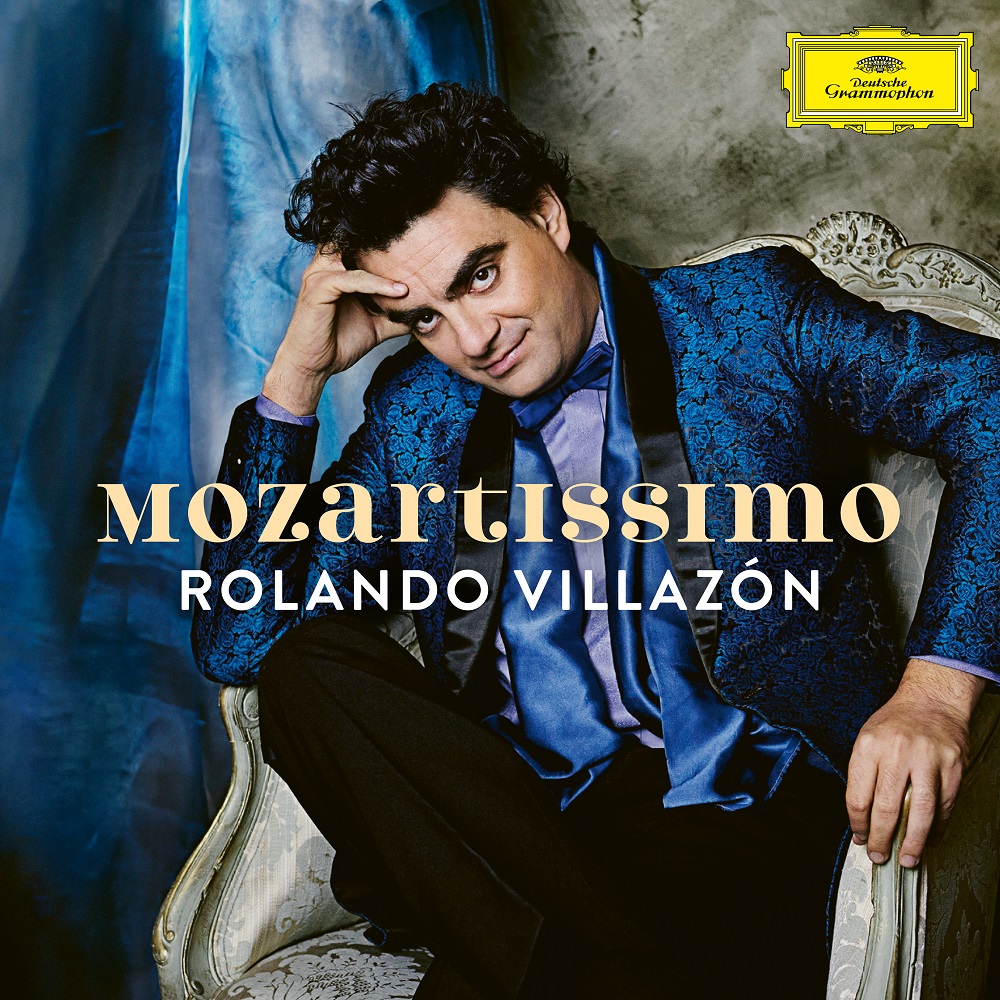
Mexican lyric tenor Rolando Villazón has justly become world famous while conquering most of the bel canto and even the heavier roles (e.g. Don Carlo, Werther etc.) and has become the darling of the opera-loving public by teaming up with Anna Netrebko creating a “dream couple” with their youthful and attractive looks, natural compatibility and lovely stage presence. His youthful exuberance, intensity and taking of chances unfortunately led him into trouble and surgery, but he successfully recovered. Now he has turned to Mozart whom he reveres and calls his “most beloved composer and dearest friend.”

 My first encounter with him in Mozart was a recent recording by DG of Don Giovanni, which I reviewed in these pages (April 2016), singing Don Ottavio and bringing an erotic Latin sensuality to the part. Since then DG has recorded all seven Mozart operas with him taking the tenor role in most. This new issue contains almost all of Mozart’s work for the tenor. A tremendous undertaking.

Villazón begins with the two famous arias from Don Giovanni including my favourite Il mio tesoro intanto, immediately showing his virtuosity with a voice that triggers varied emotions often within the same aria. What follows are excerpts from Cosi fan tutte, Abduction from the seraglio, Le nozze di Figaro, La clemenza di Tito and Die Zauberflöte where he takes the role of Papageno, again showing his versatility with this buffo role. All the foregoing are accompanied by the Mahler Chamber Orchestra and the Chamber Orchestra of Europe conducted with exquisite Mozartian style by Yannick Nézet-Séguin.

A most rewarding disc that should be enjoyed piecemeal, one or two items at a time, to come to you fresh with each listening.
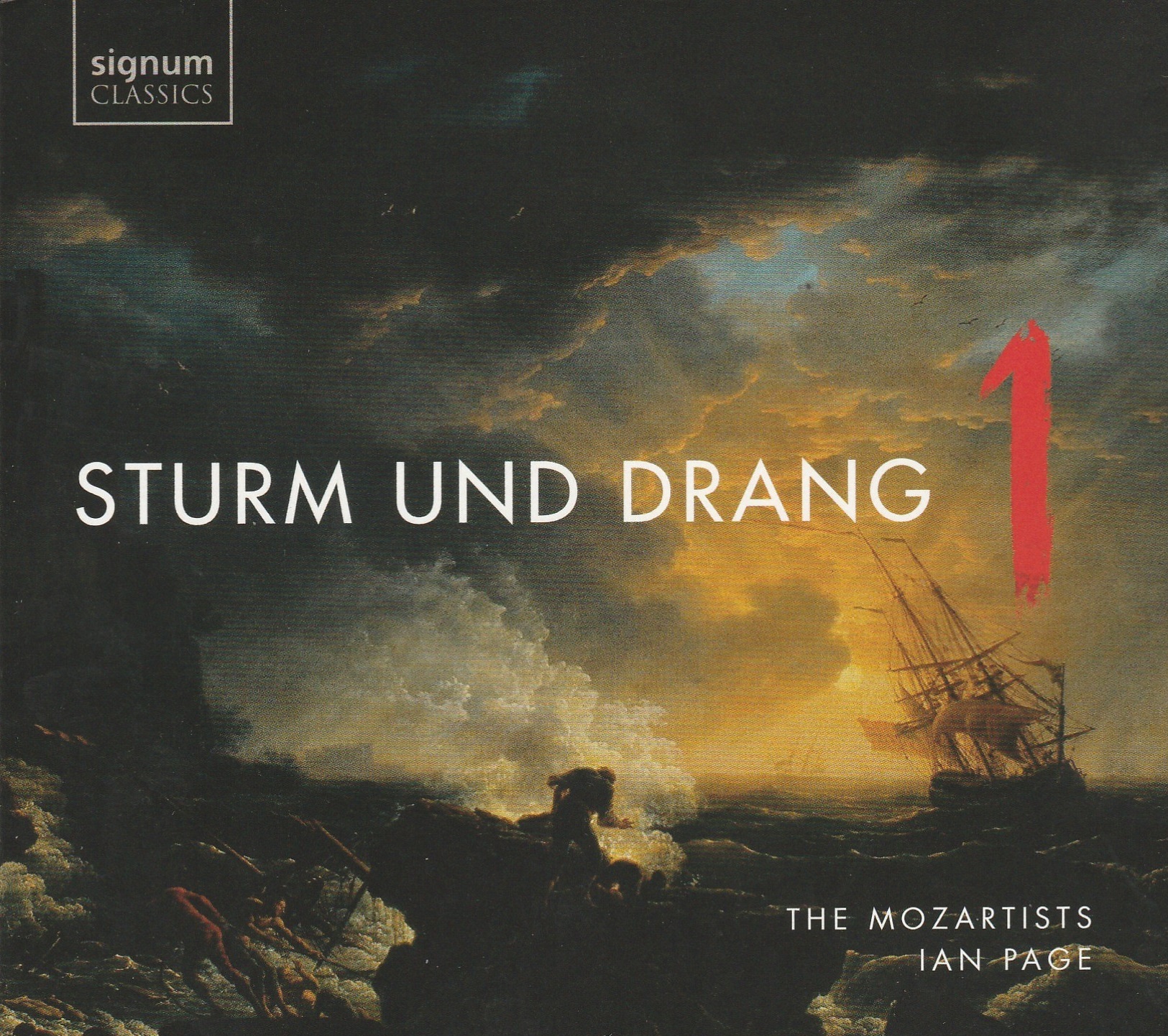
03 Sturm and Drang 1Sturm und Drang Volume 1
Chiara Skerath; The Mozartists; Ian Page
Signum Classics SIGCD619 (signumrecords.com/product/sturm-und-drang-volume-1/SIGCD619)

The Sturm und Drang movement (often translated as “Storm and Stress”) was a brief moment in post-Baroque art, lasting from the 1760s to the 1780s, characterized by extremes of subjectivity, passion and sentimentality. In some ways this movement anticipated the ideals of Romanticism, using dramatic and turbulent musical ideas to express intensely moody atmospheres, but it was also reactionary and revolutionary against the rococo backdrop of the late Baroque era.

This disc, the first in a seven-volume series exploring the Sturm und Drang movement incorporates iconic compositions from the 1760s by Gluck and Haydn, as well as largely forgotten or neglected works by less familiar names such as Niccolò Jommelli and Franz Ignaz Beck. 

Whether the composer and the repertoire are firmly in the contemporary canon or not, these works are clearly connected in style and substance. Beck’s Symphony in G Minor, for example, has all the characteristic features of an early symphony by Mozart or Haydn, including formal structures, modulatory formulae and thematic development, while Jommelli’s opera Fetonte is, in retrospect, a decidedly Mozartean effort. It is essential to note, however, that Jommelli was born in 1714, 42 years before Mozart, and it is Jommelli who is credited for advancing opera seria to a level of freedom and complexity that paved the way for Mozart and his contemporaries. 

A universal feature of the Sturm und Drang composers is a juxtaposition of relatively simple melodic and harmonic material with vibrant, aggressive and engaging rhythms. It is paramount that a performer conveys the vitality of these rhythms while still reflecting the chiaroscuro subtleties of the overall work. Fortunately, conductor Ian Page and the Mozartists are enormously capable interpreters and breathe life into these works in a way that sounds both effortless and tremendously satisfying.

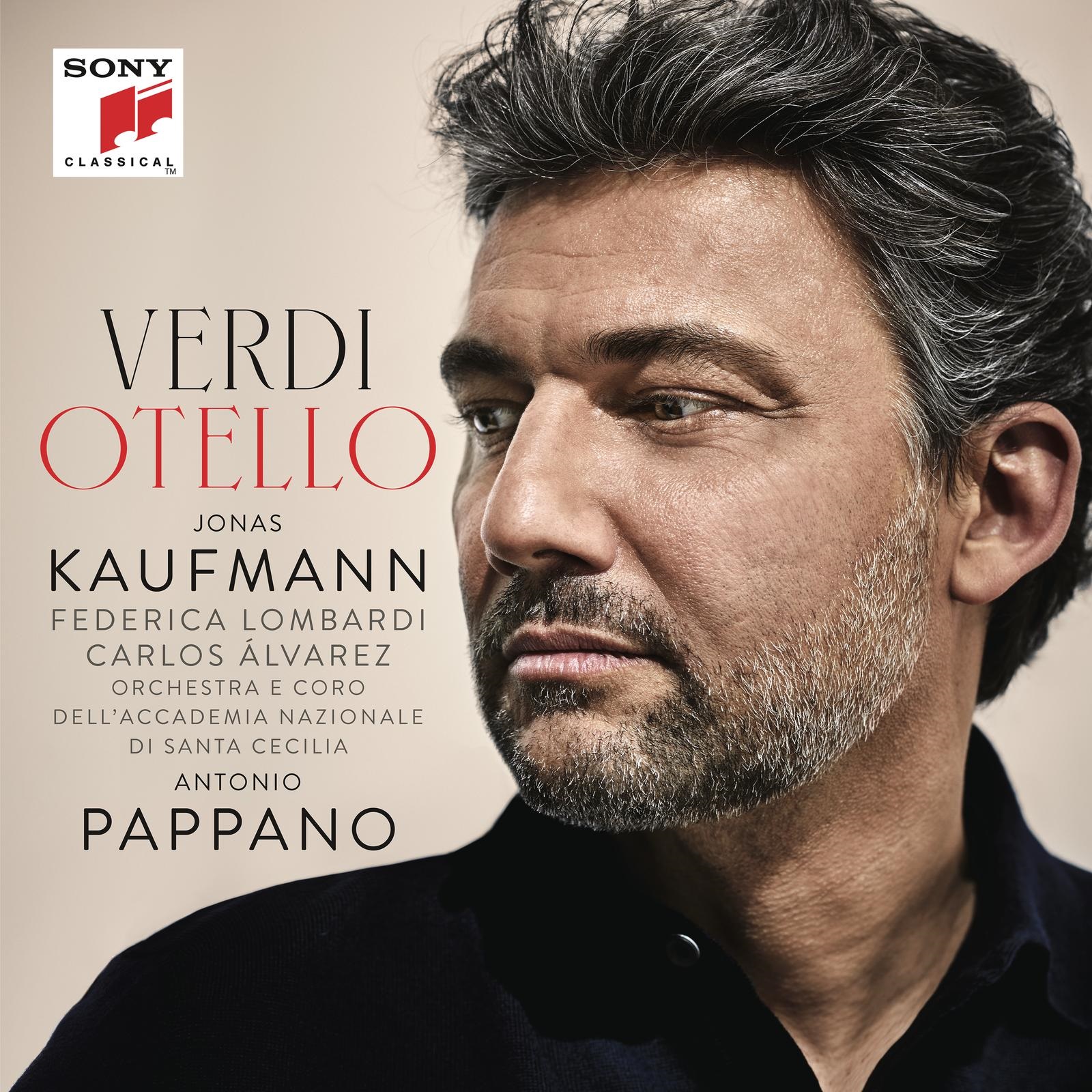
04 Verdi OtelloVerdi – Otello
Jonas Kaufmann; Orchestra e Coro dell’Accademia Nazionale di Santa Cecilia; Antonio Pappano
Sony Classical 19439707932 (jonaskaufmann.com/en/192/all-cds.html) 

My fondest memory of Otello was, as I recall, around 1960, walking in from the street to the Royal Alexandra Theatre to hear Jon Vickers sing the title role! Seven dollars for the ticket. Those were the good old days...

Now in the 21st century it is world-famous German heldentenor Jonas Kaufmann who steps into a long line of great Otellos: Vickers, Ramòn Vinay, Mario del Monaco, Plácido Domingo, José Cura et al. But it took a long period of hesitation and gestation before he decided to attempt this Mount Everest of tenor roles. Much like it took Verdi, who hadn’t composed anything for the stage for 15 years, a great deal of agonizing before he was persuaded by a brilliant librettist, Arrigo Boito, and the Shakespearean subject matter, to write again at age 74. The result was an astounding masterwork, unlike anything he had written before.

Kaufmann’s first attempt to sing the role was in 2017 at Covent Garden under Antonio Pappano’s masterly handling of the score and it was a breakthrough success. Sony Classical decided to make a recording in Rome with the same principals and the famed Santa Cecilia Orchestra and Chorus. This is actually the second “Roman” Otello, the first being from 1960 with Vickers, Rysanek and Tito Gobbi, Tullio Serafin conducting. 

Kaufmann superbly delivers a role that exhausts all emotions, the power, the passion, the grief, but also lyrical tenderness in Gioia nella notte dense, one of the most beautiful love duets ever written. His triumphant entry, the exuberant Esultate, is shattering. Italian soprano Federica Lombardi is an ideal Desdemona who “successfully brings off a marvellous musical depiction of wounded innocence” with her beautiful, many-shaded voice. Of course there is Iago, Carlos Álvarez, a veteran of the role who is suitably conniving and malevolent, but Kaufmann and Pappano’s collaboration is symbiotic and the magnum force that binds it all together. “An Otello for the ages.” (The New York Times)

05 Gurrelieder GlagoliticSchoenberg – Gurre-Lieder; Janáček – Glagolitic Mass
Soloists; Chor des Bayerischen Rundfunks; Symphonieorchester des Bayerischen Rundfunks; Rafael Kubelík
Urania Records WS121388 (naxosdirect.com/items/schoenberg-gurre-lieder-janácek-glagolitic-mass-534288)

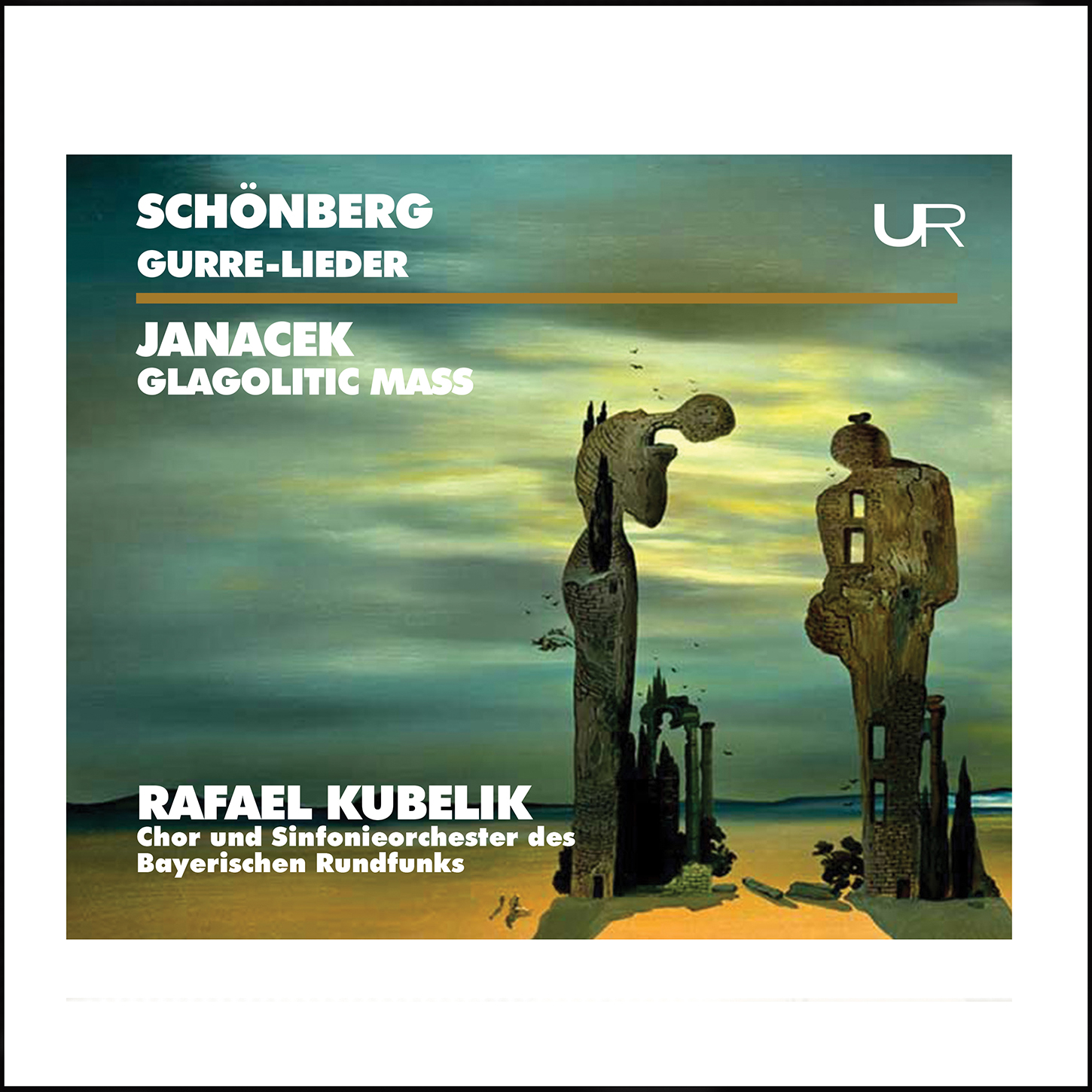
This sprawling, two-disc release pairs Arnold Schoenberg’s Gurre-Lieder with Leoš Janáček’s Glagolitic Mass. There is an unexpected symbiosis achieved from juxtaposing the two works, both masterstrokes of their respective composers’ catalogues. 

The record opens with the Gurre-Lieder. Bavarian Radio Symphony and Choir and Rafael Kubelik offer a gilded rendition of the orchestral prelude, celebrating its expressionist sonorities with a vibrant, contemporary veneer to the sound profile and design. One feels that this could almost be the work of an orchestralist titan of our own century: John Adams or Kaija Saariaho. Of course, this is due in no small part to the expert insights and overarching concept Kubelik brings to Schoenberg’s art; the conductor has a remarkable talent for breathing urgent new life into scores from the past, imbuing everything he touches with brilliance and finesse.

The singing itself and delivery of text is equally compelling. Every voice contributes a unique component to the narrative arc, expertly balanced and stylistically suitable to such sumptuous orchestral direction. The final installment of Part III, “The Summer Wind’s Wild Hunt,” proves an impressive convergence of all elements in a whirling, bristling finale where not a single musical stone goes unturned – a thrilling end to a monumental work of love and tragedy.

The second half of Disc Two is occupied by Janáček’s Glagolitic Mass, JW III/9. As is typical of the composer’s best scores, this music boasts laser-precise allocations of material: instruments and voices are grouped via singular senses of registral timbre and colour. The efficiency of expression here almost surpasses Schoenberg’s longer work, as Janáček finds the perfect compositional solution for each verse of text and instrumental interlude. 

Additionally, the composer’s penchant for writing choral music is on full display – not to mention the infamous organ solo! – all expertly enhanced by impeccable diction from the vocal soloists. While more modest in scope than the Gurre-Lieder, Janáček’s Glagolitic Mass is performed here with a breadth of expression and understanding that matches the lineage of pan-Slavic history and its corresponding inheritance. The darker Eastern tunes of old fittingly conclude this indomitable two-disc set, worthy of a second – and even a third – listen!

06 ParryParry – Songs of farewell
Westminster Abbey Choir; James O’Donnell
Hyperion CDA68301 (hyperion-records.co.uk/tw.asp?w=W47)

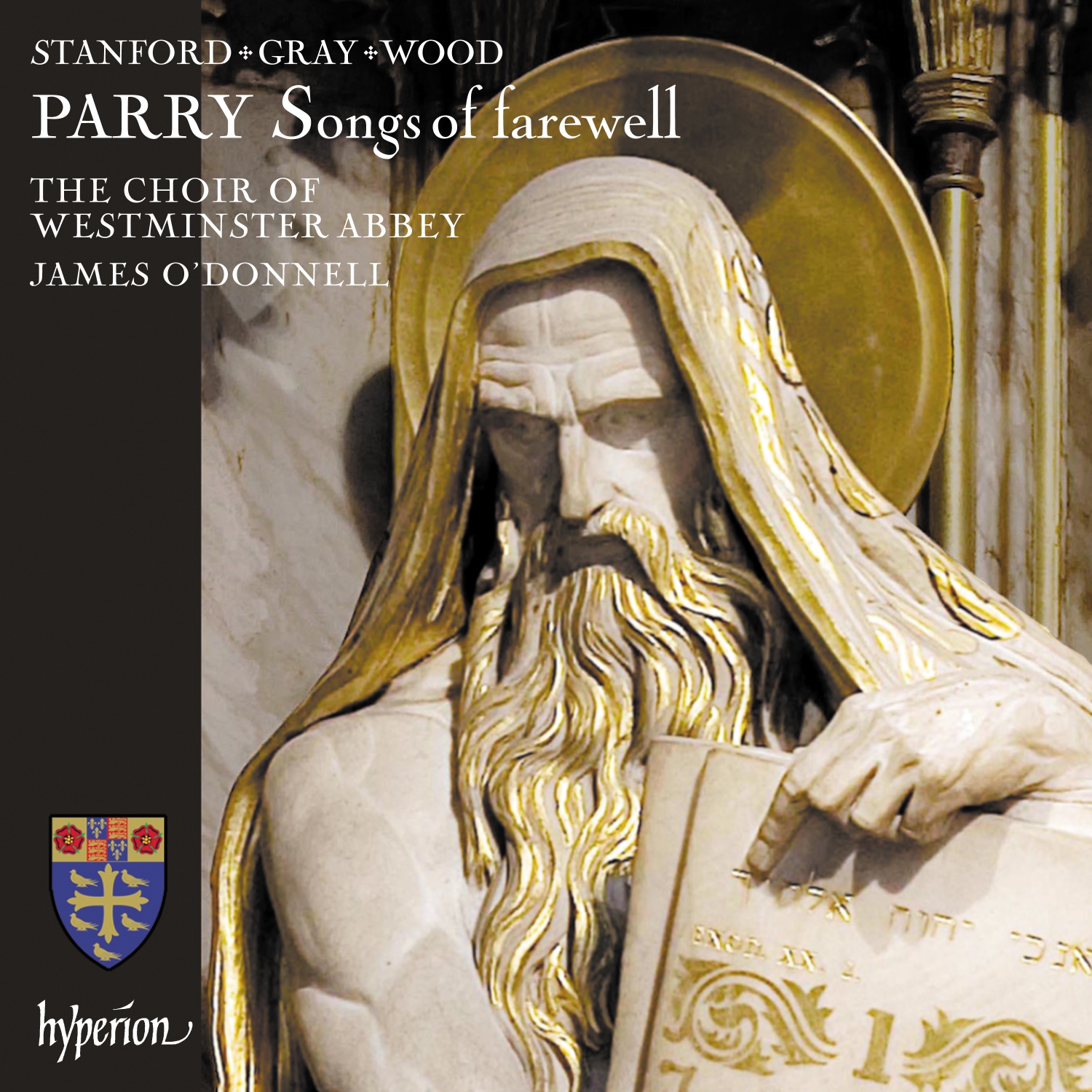
For lovers of choral music, the British label Hyperion has championed the genre ever since its founding in 1980. This latest offering, featuring works by Parry, Stanford and Gray performed by the Westminster Abbey choir under the direction of James O’Donnell, is a splendid addition.

The disc opens with Stanford’s three Latin Motets Op.38, one of the composer’s few settings of church music using Latin texts. Completed in 1892 and published 13 years later, they have long been regarded as among his finest choral compositions. The Westminster choir approaches the music with a satisfying conviction, with the second, Caelos ascendit hodie, sung with particular buoyancy.

Alan Gray was Stanford’s successor as organist at Trinity College. His Magnificat and Nunc dimittis for double choir from 1912 make use of attractive counterpoint and antiphony, while Stanford’s Magnificat in B-flat was written as a “truce” to his friend Hubert Parry with whom he had had a brief falling out. Completed in 1918, the piece draws from Renaissance and early Baroque mannerisms, and at times contains a hint of the great Magnificat by J.S. Bach.

The bulk of the recording is devoted to Parry’s six Songs of farewell, written between 1914 and 1915 using texts spanning a 200-year period. The choir’s wonderful control of phrasing and dynamics, in addition to the superb acoustics of the All Hallows Church in London, make this a memorable performance.

The final song, Lord let me know mine end based on Psalm 39, is not only the lengthiest of the set, but also the most moving and personal. It contains a range of varying tempos but ends quietly, thus bringing the set – and the disc – to a satisfying conclusion.

07 Thais600x600Massenet – Thaïs
Erin Wall; Joshua Hopkins; Andrew Staples; Toronto Mendelssohn Choir; Toronto Symphony Orchestra; Sir Andrew Davis
Chandos CHSA 5258(2) (naxosdirect.com/items/massenet-tha%c3%afs-535854) 

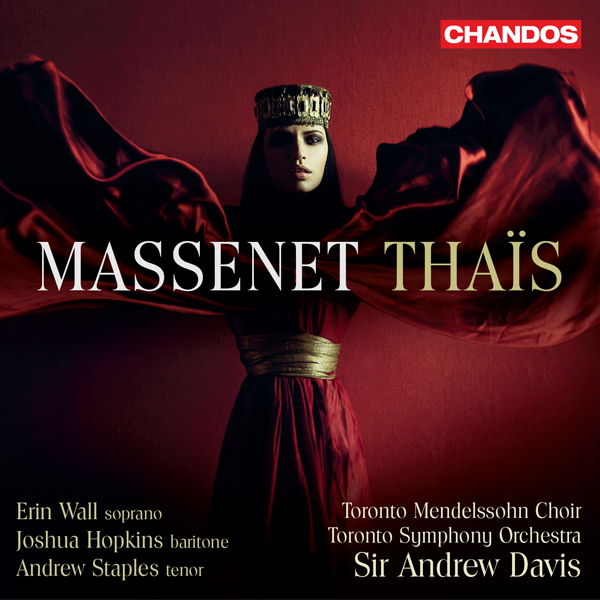
Jules Massenet may be best-known for his operas Manon and – his magnum opus – Werther, but it is for his opera Thaïs that he wrote arguably his most iconic piece of music: the gossamer-like Méditation for violin and orchestra. This five-and-a-half-minute interlude – a theme for everything that flows out of the Premier Tableau, Chez Thaïs – just after Thaïs, idole fragile, from where the entire work is raised to a level of great intensity and exquisite delicacy.

Massenet’s work is Wagnerian in more ways than one. Not only does he adopt (Wagner’s) dramatic, Germanic tradition but also dwells on the inner struggle between the spiritual and the sensual. Thaïs (1894/98), like his celebrated oratorio Marie-Magdeleine (1873), explores this theme. Thaïs, like other French music of the day, also reveals Massenet’s fascination with, and affection for, orientalism. 

Based on Anatole France’s eponymous book, the story is woven into the cultural topography of Coptic Egypt – specifically Hellenistic Alexandria – where Thaïs earns the consternation of the Cenobites, especially Athanaël, the most rigorous ascetic of them all; and beguiles, among others, the wealthy voluptuary, Nicias. The titanic battle for Thaïs, body and soul – the struggle between spirituality and sensuality in Louis Gallet’s French libretto – is magnificently directed in this version by Sir Andrew Davis. Erin Wall’s Thaïs is lustrous and magical. Joshua Hopkins’ Athanaël is magical; Andrew Staples’ Nicias is superb, the TSO and the Toronto Mendelssohn Choir are in top form throughout.

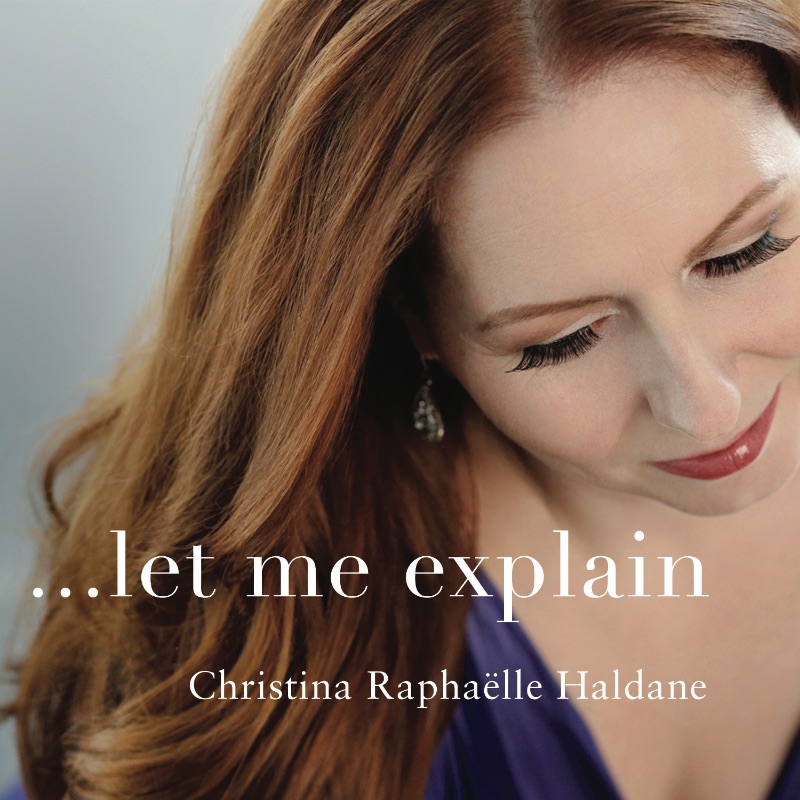
08 Christina Raphaelle Haldane…let me explain
Christina Raphaëlle Haldane
Redshift Records TK464 (redshiftrecords.org/releases/tk464) 

It would be a travesty if the celebratory and de rigueur noise of multiculturalism should drown out the voice of homegrown Canadiana in poetry and song. But worry no more, for here is an outstanding recording by a breathtaking artist that celebrates just that. Christina Raphaëlle Haldane’s recording of contemporary Canadian compositions …let me explain – a collection of Canadian Art Songs is a marvellous performance of contemporary Canadiana that brings together poetry and music in repertoire that is at once silken in its lyricism and powerfully and vividly atmospheric in colour and tone texture. 

Haldane’s inspirational and poetic soprano throughout this repertoire is something to treasure for a lifetime. Her traversal of pianist and composer, Carl Philippe Gionet’s Three Acadian Folklores is sweetly scented poesy, floribunda that would fill a whole flowershop. The pervasive melancholy of Ahania’s Lament is deeply affecting. David Jaeger’s delicately coloured music for the singer’s father Seán Haldane’s poems in The Echo Cycle is the record’s crowning glory. Haldane brings exquisite tenderness, expressive depth and consummate beauty to this cycle.

Haldane also, thankfully, celebrates the legendary Oscar Peterson with two pieces – Why Think About Tomorrow, the lyrics for which were penned by Peterson himself, and Land of the Misty Giants from his iconic Canadiana Suite. Sharing the spotlight with Haldane are the brilliant pianist Stu Harrison and bassist Ross MacIntyre. Both men perform this music with outstanding integrity and a wholly appropriate sense of occasion.

Listen to '…let me explain' Now in the Listening Room

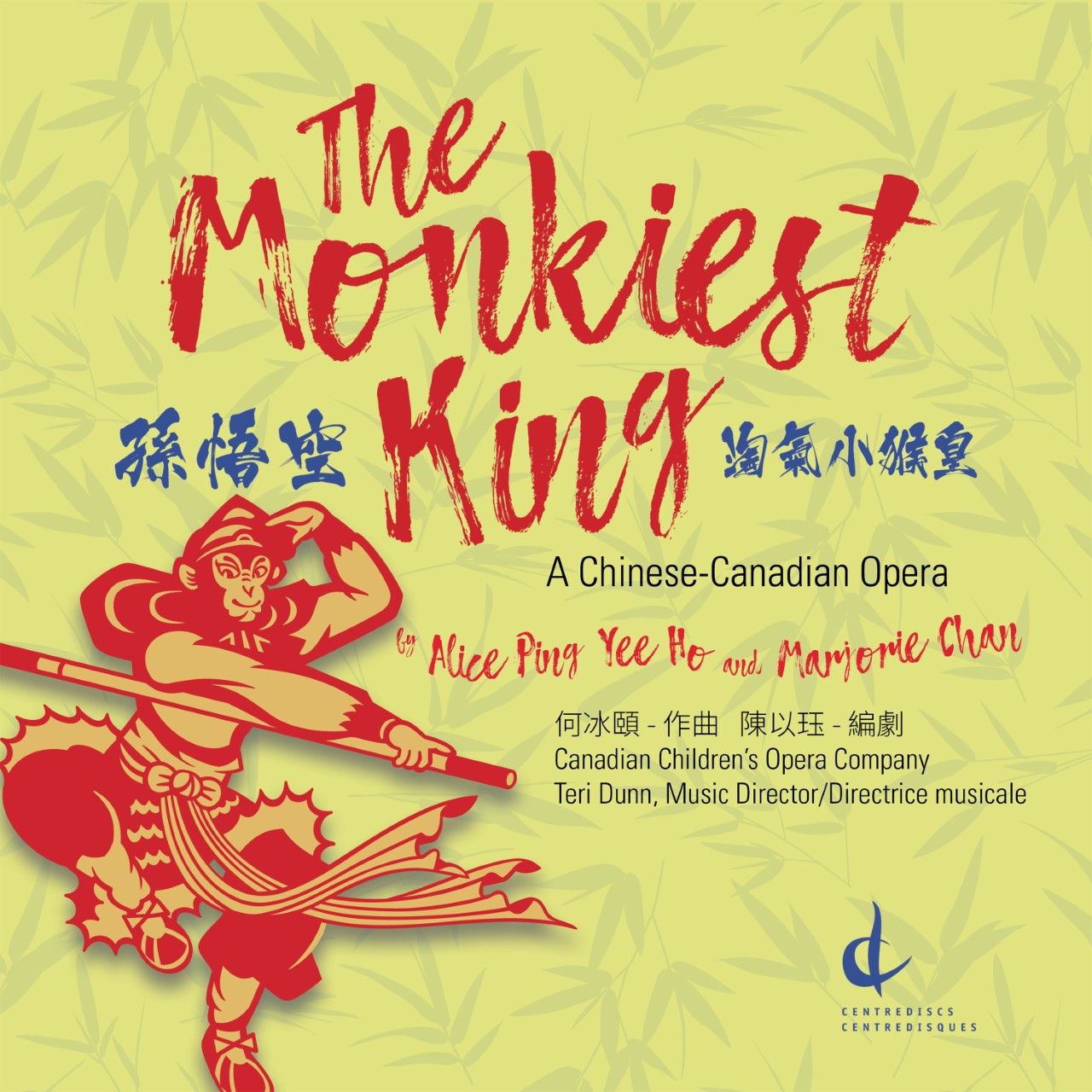
09 Monkiest KingAlice Ping Yee Ho – The Monkiest King
Canadian Children’s Opera Company; Teri Dunn
Centrediscs CMCCD 28020 (cmccanada.org/shop/cmccd-28020) 

The Monkiest King is Canadian composer Alice Ping Yee Ho’s fourth opera. Commissioned by the Canadian Children’s Opera Company for its 50th Anniversary, the 60-minute one-act opera features the most excellent soloists of the CCOC and six choruses of different ages interpreting over 30 characters.

Marjorie Chan’s libretto is based on Wu Cheng’en’s Journey to the West, a 16th-century novel considered one of the greatest classical works of Chinese literature. The opera is mostly set in an ancient and imaginary magical world and follows Sun Wukong, the Monkey King. Initially a bit of a trickster, the Monkey King’s journey leads him on a series of adventures where he learns about personal responsibility, compassion and, ultimately, courage.

Primarily sung in English with Mandarin and Cantonese words, the language is accessible to a young audience, yet the story is compelling for a variety of ages. Personal growth is explored via life themes and lessons as opposed to the old-fashioned fable. The use of Chinese instruments such as the dizi, erhu, gaohu, pipa and guzheng allows children of all backgrounds to either connect with sounds they are familiar with or make exciting new discoveries. Ho’s skillful contrast between Chinese and Western instruments, the well-placed dissonances and the numerous vocal and instrumental glissandi provide a unique and vibrant listening experience. Most exquisite, Chan’s libretto and Ho’s music are expertly woven together, seamlessly moving the action forward. The Monkiest King was nominated for two Mavor Dora Moore Awards in 2019 for Outstanding Performing Ensemble and Outstanding Original Opera.

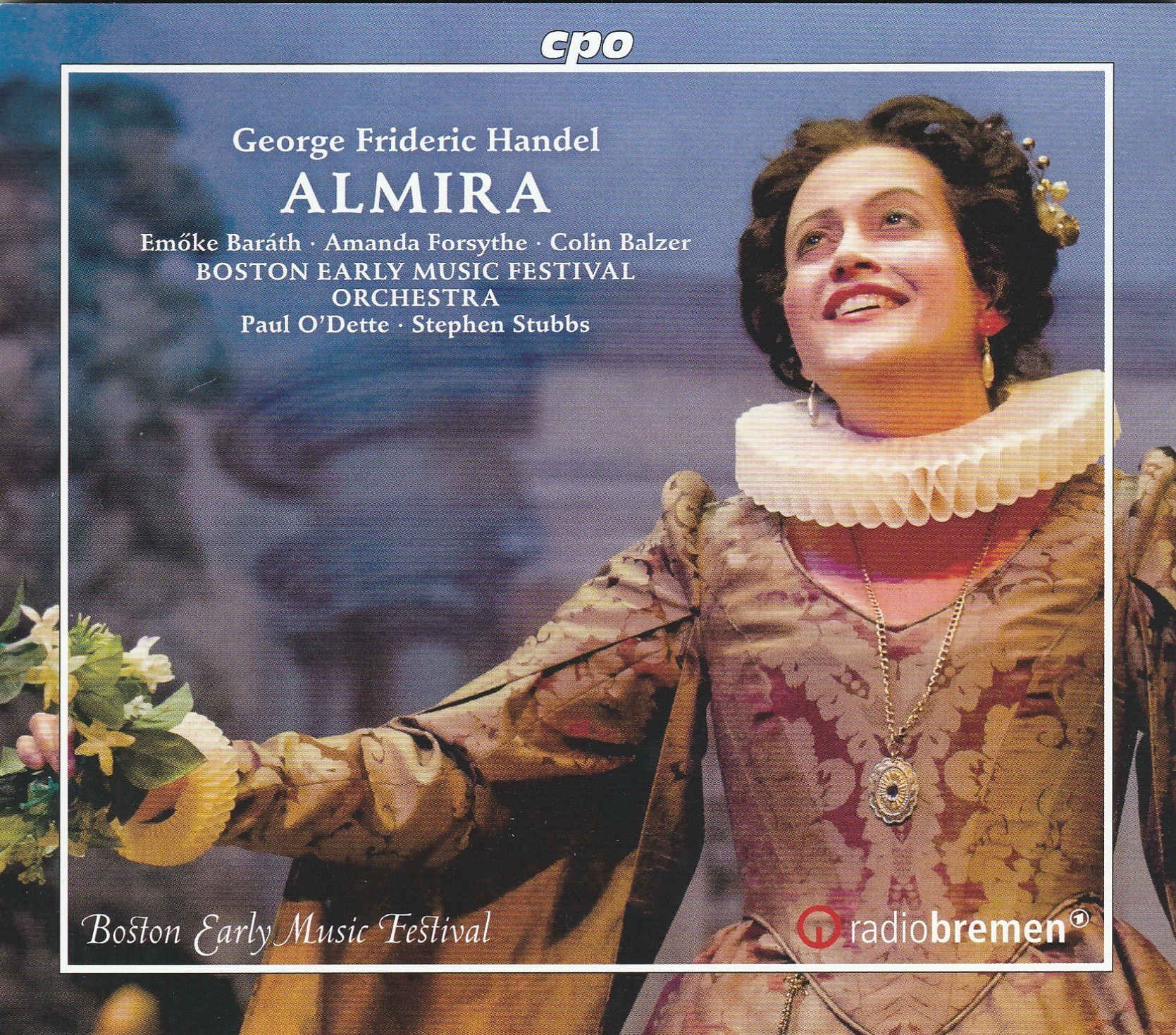
01 Handel AlmiraHandel – Almira
Emöke Barath; Amanda Forsythe; Colin Balzer; Boston Early Music Festival; Paul O’Dette; Stephen Stubbs
cpo 555 205-2 (naxosdirect.com)

Besides being Handel’s first exercise in operatic composition, Almira (1704) is a notable, if slightly eccentric work for several reasons. Various styles and languages are mixed, with the opera including both German and Italian arias, as well as vocal dance numbers, da capo pieces and instrumental ballet inserts. The result is a colourful and surprisingly unified mixture, and the melodic signatures that we consider so typical of Handel are already recognizable.

This recording features an expert interpretation of this middle-Baroque work, as the Boston Early Music Festival Orchestra and soloists manage to synthesize Almira’s Venetian, German and French influences into a cohesive and convincing musical and dramatic product. The use of harpsichord and lute in the basso continuo section provides a temporal reference point, between theorbo-based Monteverdi and the later harpsichord- and organ-grounded works of Bach.

Although Handel’s later operas and oratorios receive the vast majority of modern performances, it is worthwhile to encounter an expertly performed edition of such an early work from such an esteemed composer. Much like Bach’s early chorale preludes, Almira reflects the effort of an already extraordinarily gifted musical mind, which continues to be developed and refined as the years progress. This opera’s apparent eccentricities aside (largely due to the traditions of the Hamburg opera, rather than Handel’s own innovation), Almira is a rewarding listen for all who appreciate the style and evolution of Baroque opera.

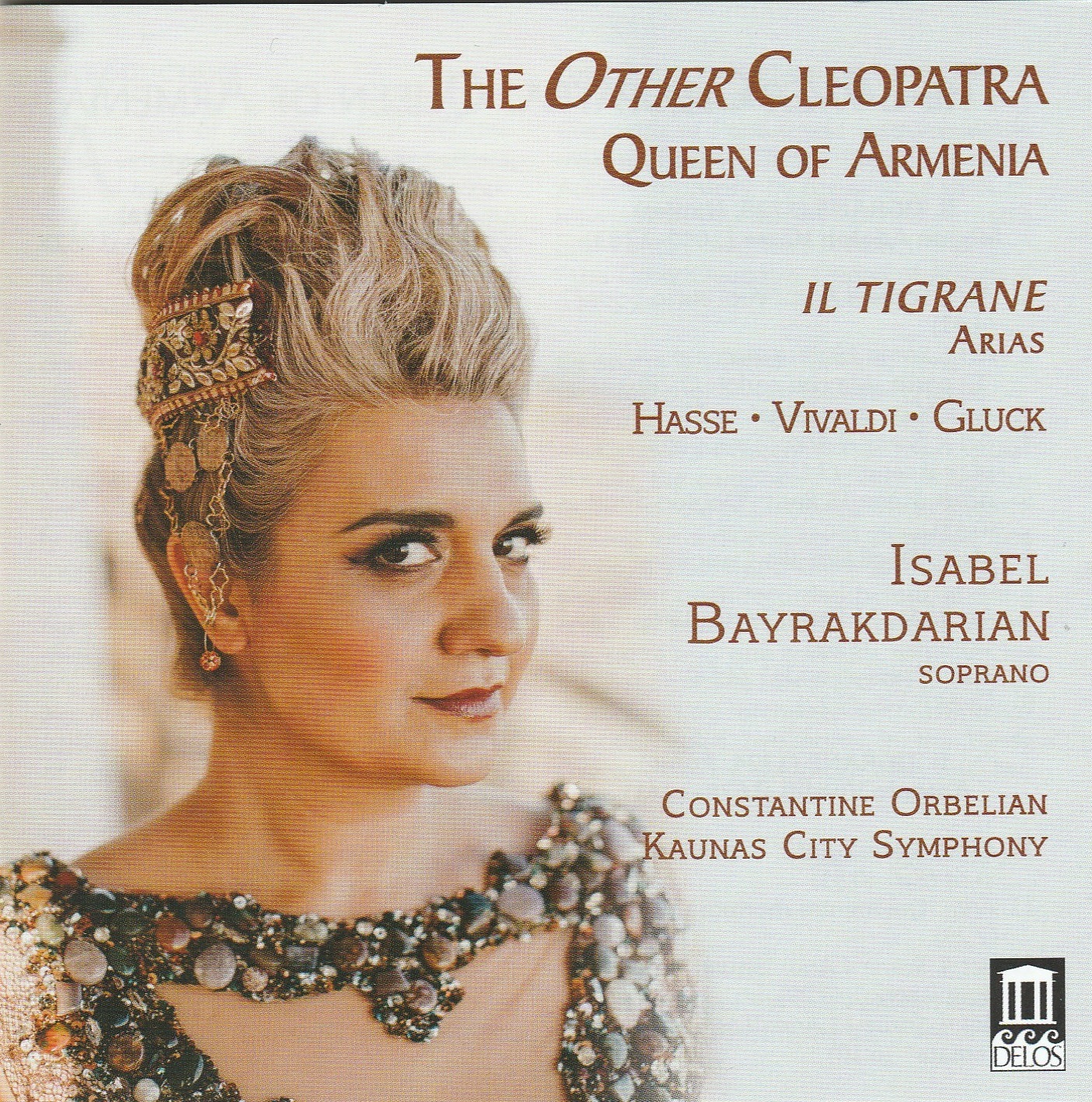
03 Other CleopatraThe Other Cleopatra, Queen of Armenia – Il Tigrane Arias
Isabel Bayrakdarian; Kaunas City Symphony; Constantine Orbelian
Delos DE 3591 (naxosdirect.com)

Yes, there was another Cleopatra and thanks, in part, to Isabel Bayrakdarian the wife of King Tigranes (140-55 BCE) has a bright new light shone on her. These arias are, of course, from composers who knew of her and first glorified her in opera: Hasse, Vivaldi and Gluck. What Bayrakdarian has also done as with many of her recordings, is to shed light on the historical riches of Armenia. More remarkably, however, on The Other Cleopatra: Queen of Armenia Bayrakdarian seems to sing as if with real, lived experience.

Bayrakdarian is a bright lyric soprano, but she can also swoop really low into what must clearly be the edge of a soprano’s comfort zone. One such example comes with Baroque smokiness in Hasse’s elegant aria Strappami pure il seno; also a wonderful example of her breathtaking eloquence and range. Chronologically Vivaldi’s version of Il Tigrane (1724) was premiered first, followed by Hasse’s (1729) and finally Gluck’s (1743). All three operas were based on the same libretto by Abate Francesco Silvani. 

Most interesting, however, is the subtle differences in the music by each of the composers. Vivaldi delivers characteristic vivacity, dazzling vocal solos with dashes of acute characterization. Gluck’s demands a complete balance between music and drama and Hasse’s is a highly lyrical blend of style and emotions. Meanwhile, Baryakdarian’s artistry enables her to deliver each style absolutely masterfully.

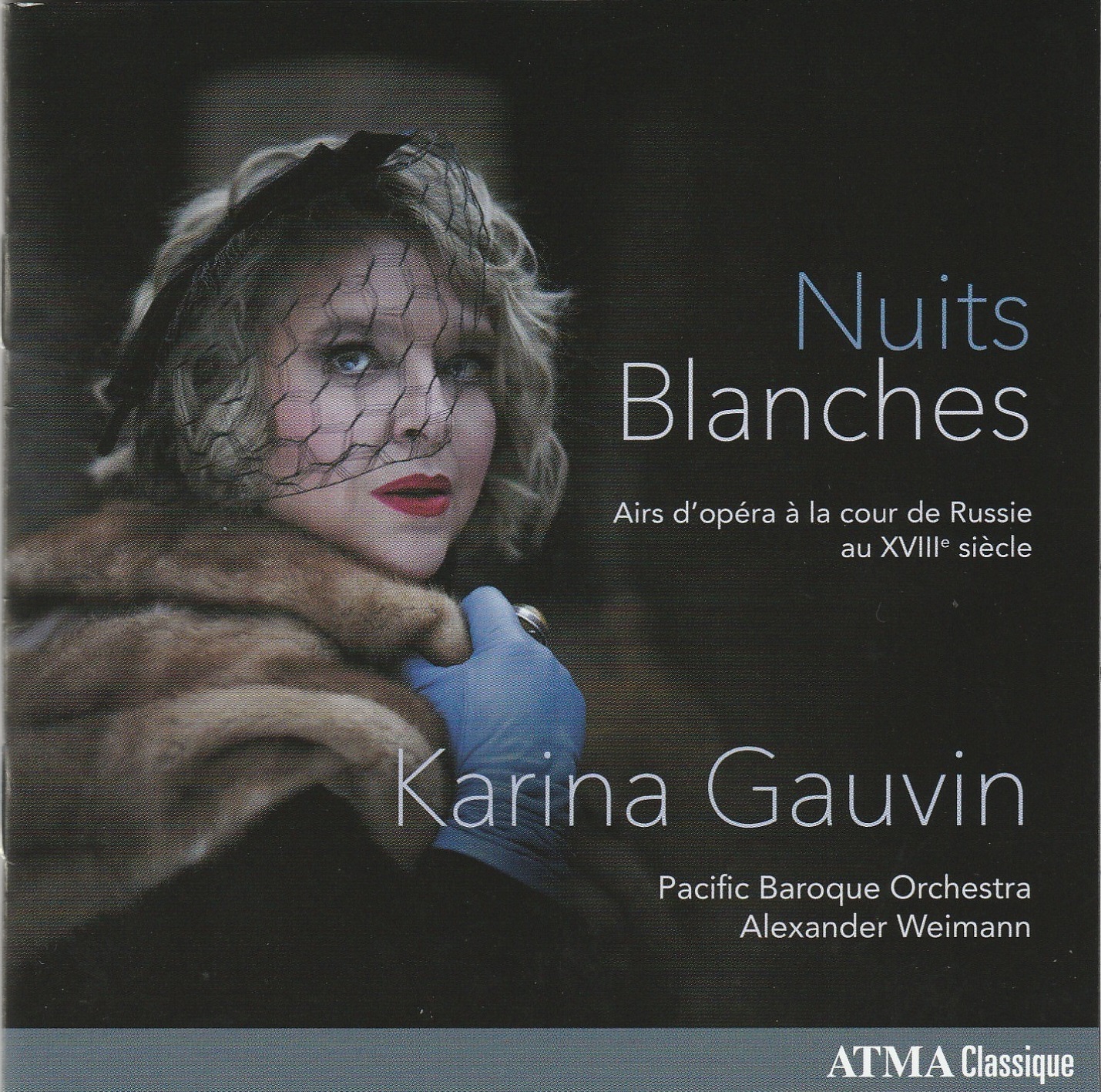
04 Karina GauvinNuits Blanches – Russian Opera Arias of the 18th Century
Karina Gauvin; Pacific Baroque Orchestra; Alexander Weimann
ATMA ACD2 2791 (atmaclassique.com/En)

Johann Sebastian Bach’s ambition of becoming a musician at the Imperial Russian Court never materialized but that disappointing fact – plus the unfortunate reputation of 18th-century Russian music – has not deterred recent musicologists from discovering some very accomplished composers. Combine that with the artists listed above and Nuits Blanches is the pleasing result. 

As might be expected, Karina Gauvin’s soprano voice dominates this CD. Listen to the variations in her voice as she literally runs a gamut of emotion in determining Armide’s relationship towards Renaud in Gluck’s Armide. And then there is the opera Demofoonte by the tragically short-lived Maxime Sozontovitch Berezovski (1745-1777). This is a work which does not survive in completeness; what does survive is a disturbing unravelling of events which is deeper in intensity than many better-known and complete operatic works. The two arias recorded here bring home not just this complexity of plot but also the extent to which Gauvin’s expertise is tested. 

In fact, Gauvin’s singing does not monopolize this CD. Listen to the Ouverture from Le Faucon by Dimitri Stepanovitch Bortnianski. It offers a genteel introduction to the subsequent complexities of the relationship between Don Federigo and Elvira. 

This CD introduces listeners to music which is almost unknown. Enjoy, incidentally, not just its soprano and instrumental qualities but also some deeply researched and sometimes rather amusing program notes.

Listen to 'Nuits Blanches: Russian Opera Arias of the 18th Century' Now in the Listening Room

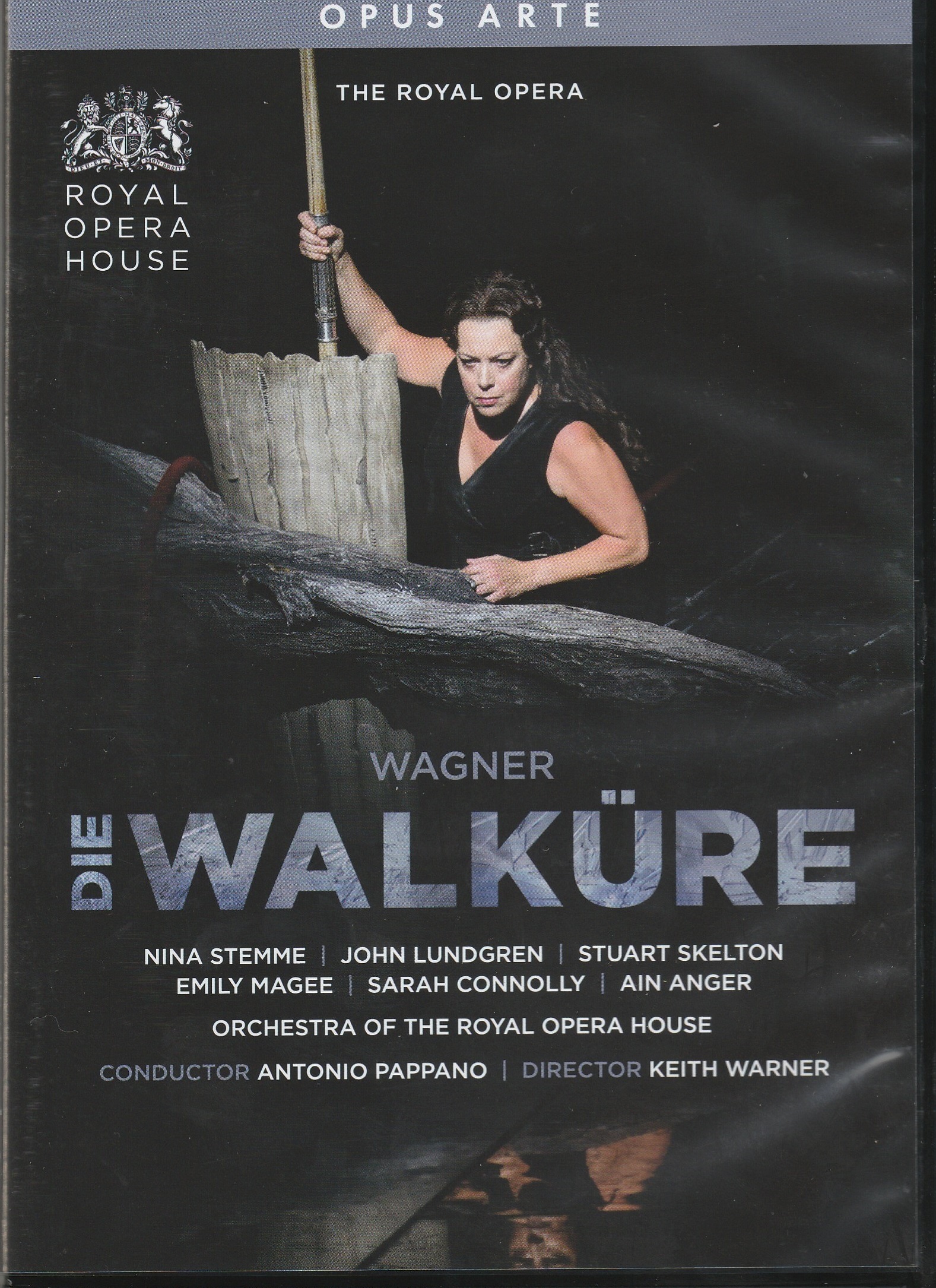
05 Wagner WalkureWagner – Die Walküre
Soloists; Orchestra of the Royal Opera House; Antonio Pappano
Opus Arte OA 1308D (naxosdirect.com)

Ever since Patrice Chereau’s centennial revival in Bayreuth in 1976, dozens of Ring productions have proliferated all over the world. In fact every major opera house has created one, all different concepts exploiting every possible angle: historic, sociological, psychological, philosophical etc. Rings are named after the various cities and/or the directors or the conductors. Now we have a Met Ring (Lepage/Levine), Berlin Ring (Kupfer/Barenboim), Stuttgart Ring (Zagrosek), St. Petersburg Ring (Gergiev), Vienna Ring (Rattle/Adam Fischer), Valencia Ring (Zubin Mehta), not to mention our own from Toronto. This production from London (2018) heralds a new, and judging by this Walküre, a momentous one directed by Keith Warner.

From the staging point of view it is a sound and light extravaganza, using all possible audiovisual technology culminating in the third act Ride of the Valkyries with films in the background combined with shadow play of the warrior maidens and superb choreography. The magic fire that envelops the stage is a spectacular finale. Pappano’s conducting is nothing less than magnificent. He absorbs himself thoroughly in the score, and no detail is missed.  There are moments of ecstasy like the first act love-duet between Siegmund (Stuart Skelton) and Sieglinde (Emily Magee) in waves and waves of passion as the “world never heard before” (Sir Simon Rattle), and at the climax when Siegmund triumphantly pulls out the sword from the ash tree, wow!  Or Wotan’s final embrace of his daughter Brünnhilde, a moment at which I almost cried when I first heard it.

The entire cast is phenomenal headed by John Lundgren as a powerful, larger-than-life Wotan, a very complex character, a god torn between his duty to the law he created and the love for his daughter, Brünnhilde (the wonderful Nina Stemme) whom he has to punish. A gripping Walküre, highly recommended.

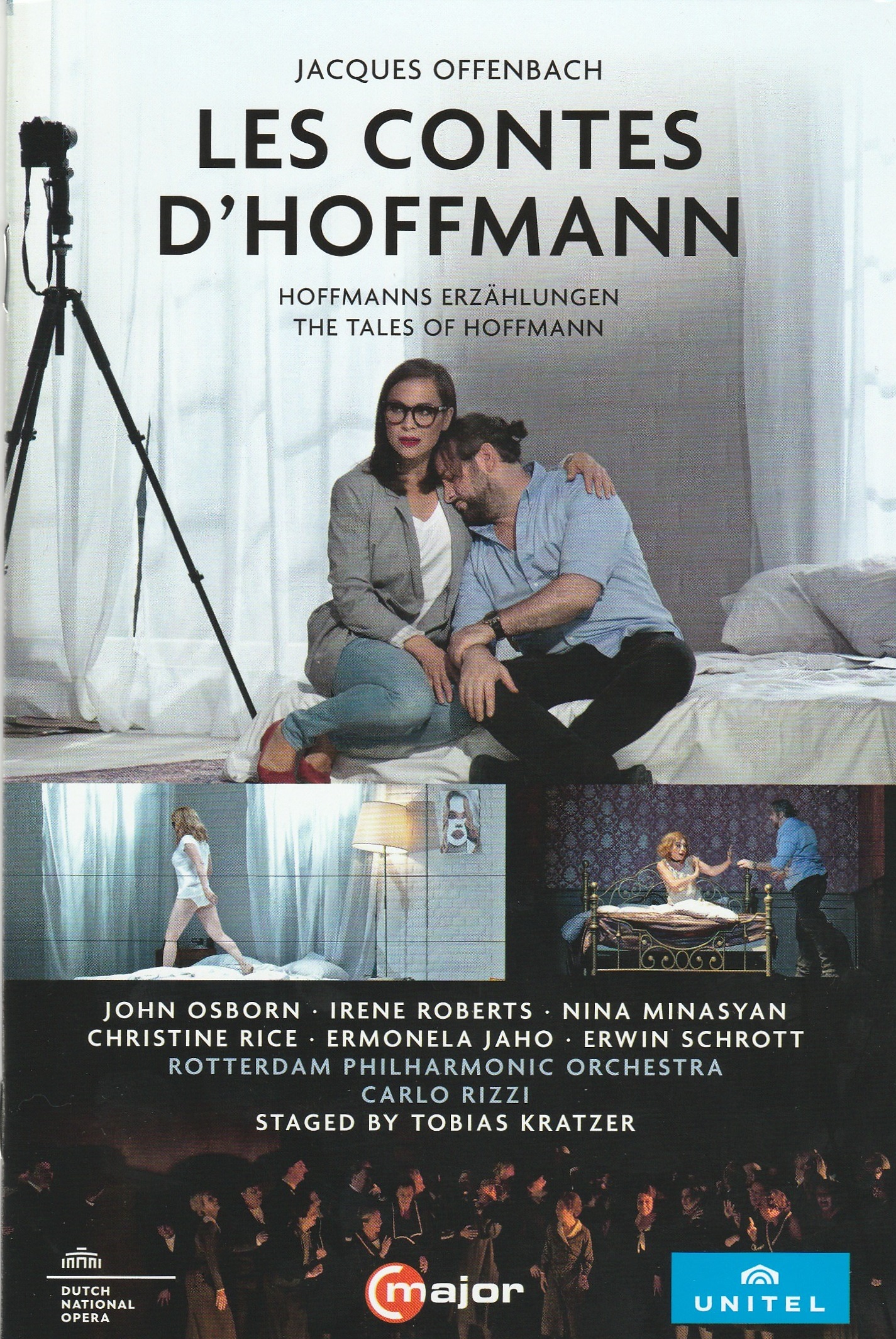
06 Contes dHofmannOffenbach – Les contes d’Hoffmann
Soloists; Rotterdam Philharmonic Orchestra; Carlo Rizzi
Cmajor 752808 (naxosdirect.com)

Often spoken of disparagingly in his day, Jacques Offenbach clearly knew what he was doing. With equal measure of sardonic humour and lyricism, he triumphantly invented the whole idea of the operetta, paved the way for Lehár and Sullivan, and eventually came to be called (by Rossini, no less) “the Mozart of Champs Élysées.” Fusing dialogue and show-stopping pieces, Offenbach also created the can-can dance and laid the ground for the modern musical. But in 1881 he also produced his first and last opera – Les Contes d’Hoffmann – his only through-composed work without spoken dialogue; replaced by a sombre libretto instead. 

Three acts recount three tales by the German Romantic writer E.T.A Hoffmann. Tobias Kratzer’s spectacular staging adds a prelude and background to the story (Act 1) followed by the three acts conceived by Offenbach. The first concerns the inventor and his mechanical doll, Olympia who seduces Hoffmann. The second involves Hoffmann’s other passion, the consumptive singer Antonia, preyed upon by the evil Dr. Miracle. The third tells of Giulietta, who tries to trick Hoffmann into selling his soul. The final act presents Hoffmann, liberated, returning to his muse.

The sweep of Offenbach’s score is supremely caught by Carlos Rizzi in a reading that tingles with frenetic energy while bringing out the lushness of Guiraud’s recitatives. John Osborn is in his richest voice, summoning the impetuous ardour of Hoffmann. Nina Minasyan excels in the bravura arias. Overall, the casting is inspired and outstanding.

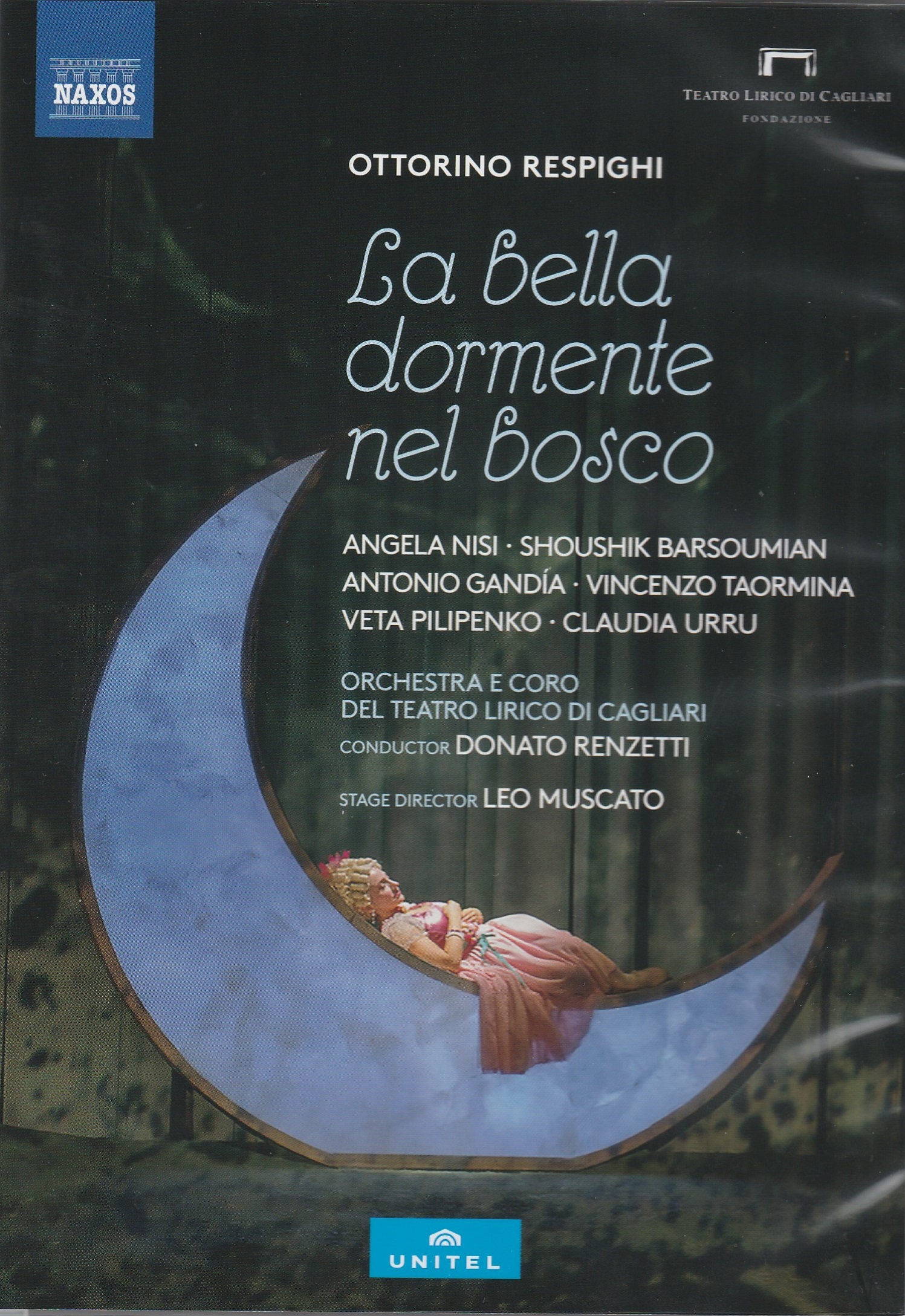
07 Respighi BellaRespighi – La bella dormente nel bosco
Soloists; Orchestra e Coro del Teatro Lirico di Cagliari; Donato Renzetti
Naxos 2.110655 (naxosdirect.com)

The legendary Ottorino Respighi’s La bella dormente nel bosco (The Sleeping Beauty) was first conceived in 1922. The version presented here by the Teatro Lirico di Cagliari has been enhanced from the original by Respighi’s inspired orchestrations. Although he died in 1936, this fresh, emotional and fantastic rendering of the original fairy tale about the Princess who pricks her finger on a spindle, and falls into a comatose state until she is awakened by her Prince, is as new and exciting as if presented on Broadway today. Brilliantly directed by Leo Muscato (with video direction by Tiziano Mancini, Donato Renzetti as conductor and a lively book by Gian Bistolfi), this production features a broad-palleted mis en scene, which is a delectable feast for both the eyes and ears.

Featured performers include the versatile Veta Pilipenko (the Queen, Old Lady and Frog); the impossibly lovely Angela Nisi as the Princess; baritone powerhouse Antonio Gandia as the Prince and the venerable Vincenzo Taormina as the King. Clever, bombastic and magical costumes (perhaps reflecting a bit of the Comedia Del’Arte) by Vera Pierantonio Giua and choreography by Luigia Frattaroli complete this thoroughly entertaining and spiritually uplifting operatic pastiche.

Written in three acts, the piece opens with a conceptual, almost surreal appearance of birds on swings and frog-like ladies (or lady-like frogs!), and ends with the expected kiss as the diaphanous princess rises up from her crescent moon bed, and into the arms of her Prince, followed by a joyous, dance-infused number by the entire cast. Huge kudos to the Teatro, for not only presenting this nearly lost treasure of one of the world’s foremost 20th-century composers, but also doing it to perfection!

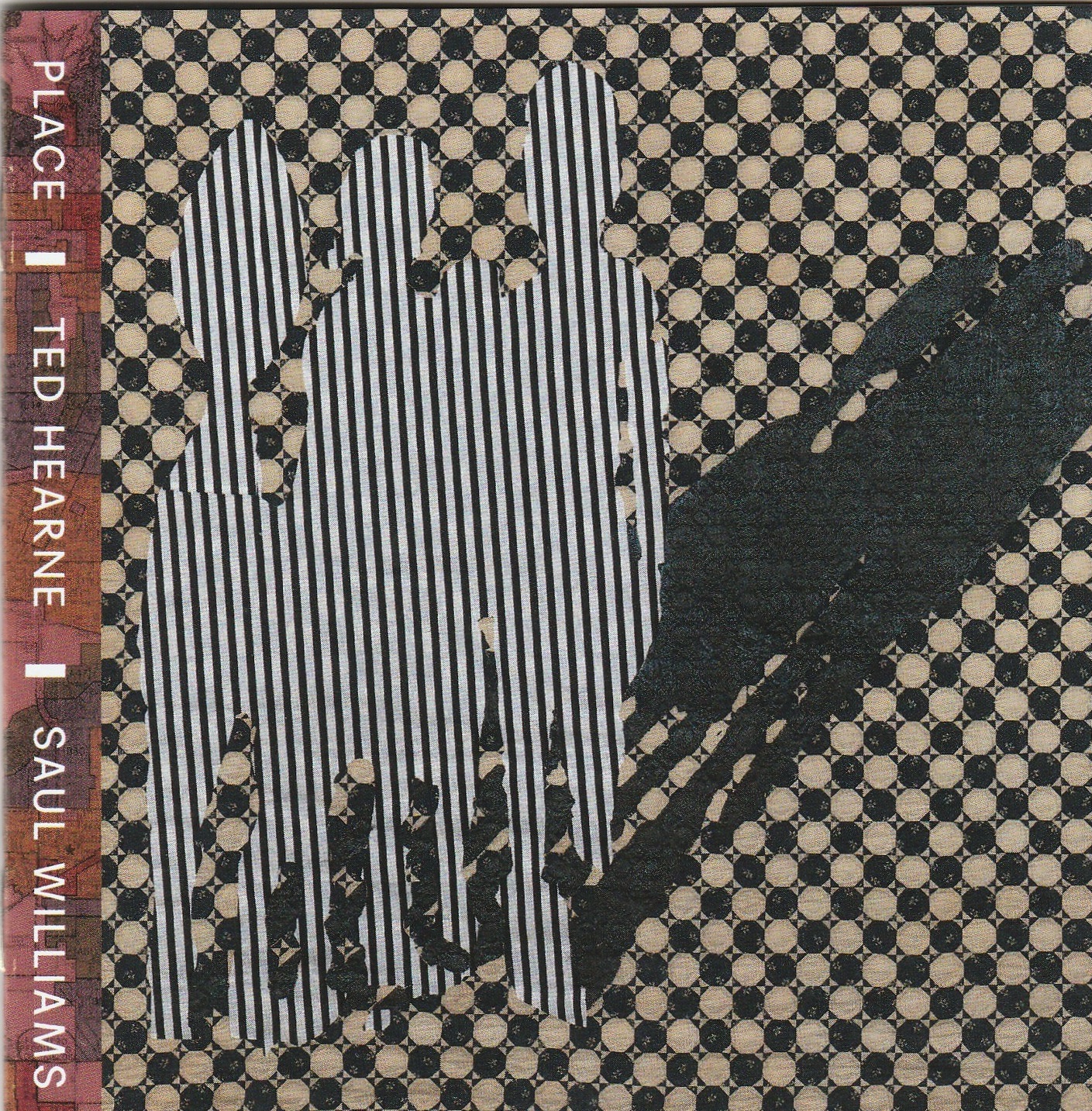
08 Ted Hearne PlaceTed Hearne; Saul Williams – Place
Vocalists; Place Orchestra
New Amsterdam Records NWAM137 (newamrecords.com)

Although the drama of Place is somewhat diminished without a visual staging (i.e. a possible DVD of a presumptive film version), its power is not diminished because of the inventive way in which its principal artists – Ted Hearne (music, libretto) and Saul Williams (libretto) – have used their respective artistic specialities. This means not only words, music and vocalizations, but also their compelling, internecine method of adapting traditional and contemporary artistic styles – from hip-hop to chamber music – and infusing this event with every possible sonic element: music, noise and pregnant silences. 

Music and poetry collide in Place as Hearne and Williams describe the emotional effects that the gentrification of a city has when people and their cultural habitat are trampled upon in the name of money and modernization. Williams’ poetry pulls no punches, especially regarding racism. Using this poetry, Hearne creates jagged miniatures to simulate a musical disruption of the senses that mirrors the socio-political upheaval of their city.

Some spiky, and often serrated, songs are like miniatures depicting human upheaval. This is characterized by extraordinary, jagged rhythmic flexibility. These episodes alternate between moments of tenderness and heartache, anger and despair. An ink-dark atmosphere pervades even when relative calmness is explored in The Tales You Tell Your Children. Occasionally brightness might break through, as in Hallelujah in White, but not for long. The glistening delicacy of the musical equanimity is broken in the finale, in the desperate plea against gentrification of Colonizing Space.

Editor’s Note: A performance video of Place is in the final stages of production and will likely be available on a major public platform by the time this article is published.

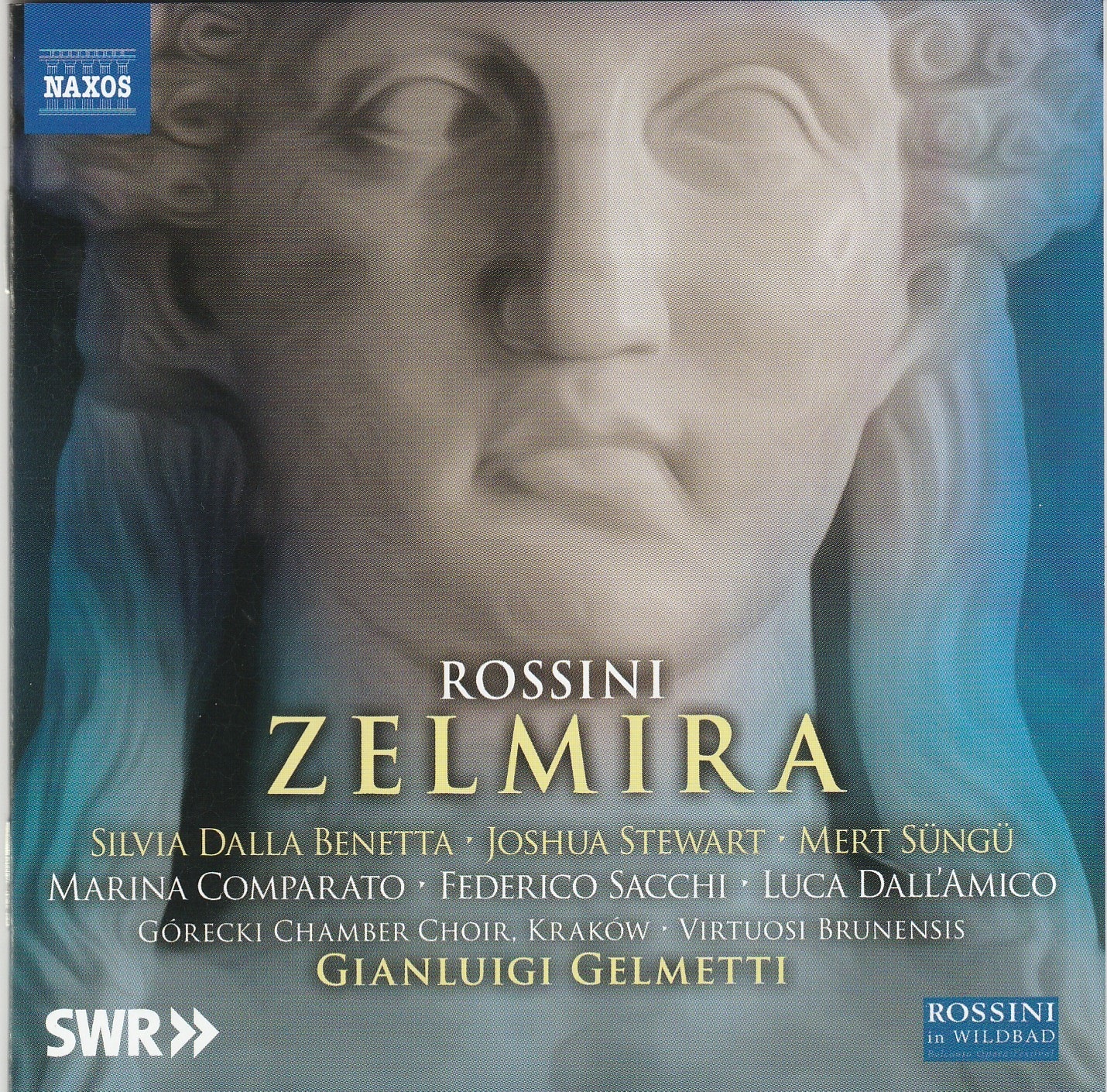
01 Rossini ZelmiraRossini – Zelmira
Soloists; Górecki Chamber Choir, Krakow; Virtuosi Brunensis; Gianluigi Gelmetti
Naxos 8.660468-70 (naxosdirect.com)

Dating from 1822, Zelmira is the 33rd of Rossini’s 39 operas and the last one he wrote in Naples. By that time he was aiming for international attention, first step to be Vienna. Zelmira achieved great success there and later in Paris, but inexplicably it fell out of public favour and simply disappeared for nearly two centuries. By a stroke of luck in 1995, Richard Bonynge and Joan Sutherland found the score in an antique bookshop in Paris and it was quickly bought by the Pesaro Festival and triumphantly performed there with a stellar cast.

The reason for the disfavour was Rossini’s attempt to reconcile Italian and German styles by devising new harmonies and orchestral effects, no doubt to please Vienna audiences, but unfortunately it was too unusual for Italians. Too bad, because it’s a tremendous grand opera with magnificent, original and highly inspired music and great opportunities for singers; particularly for the two principal tenors and the lead soprano (written for Rossini’s wife, Isabella Colbran).

The story takes us to the Age of Antiquity, to Lesbos on the Aegean Sea. It revolves around the king’s daughter Zelmira, who after many vicissitudes, false accusations and even prison, saves her father, and her son, from wicked usurpers to the throne. The main villain is Antenore, secondo tenore (American tenor Joshua Stewart) with a tremendously difficult tessitura, full of powerful high notes à la Rossini. He comes to the stage first, but just you wait for the primo tenore, Ilo, prince of Troy and Zelmira’s husband (sung by Turkish virtuoso Mert Süngü), and his first cavatina – Cara! deh attendimi! – with even more hair-raising vocal acrobatics.

Silvia Dalla Benetta is Zelmira. She crowns it all with her superb voice and is thoroughly enchanting in Perché mi guardi e piangi, one of Rossini’s most inspired creations.  All wonderfully held together and conducted by veteran Rossinian maestro Gianluigi Gelmetti.

Back to top