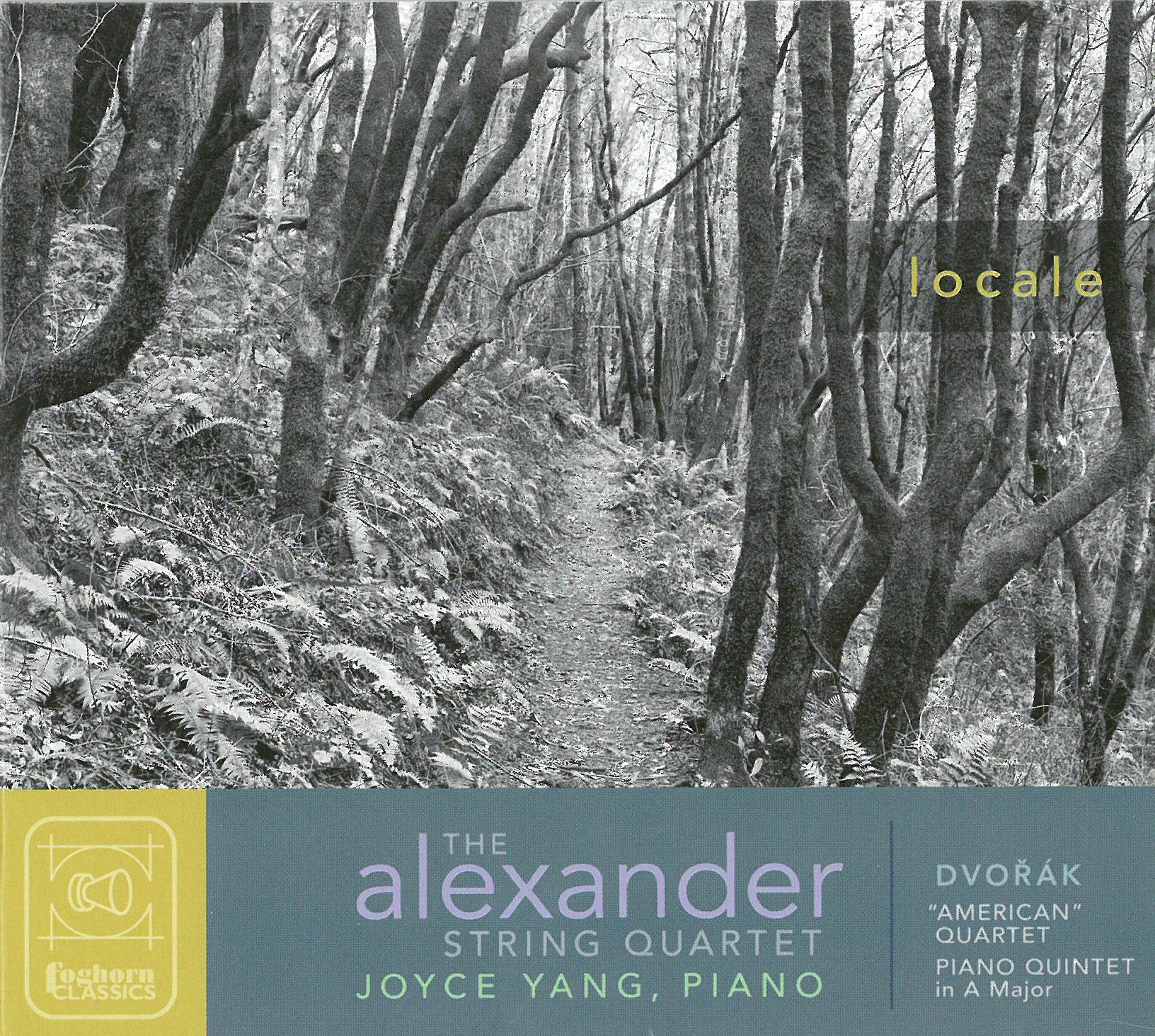
09 Alexander String Quartet DvorakAntonin Dvořák – Locale
Alexander String Quartet; Joyce Yang
Foghorn Classics FCL 2020 (foghornclassics.com)

If I was asked to describe Dvořák’s chamber music, I would say it has the characteristics of an abundant ball of energy, the one that brings joy no matter what and is enriched by the occasional touch of Slavic melancholy. The Alexander Quartet and Joyce Yang seem to be particularly attuned to that joy – here is a recording of exuberant energy and vitality that never crosses the line of being too much.

The “American” quartet is probably one of the most beloved pieces in the chamber music repertoire and it shares a number of similar elements with the Piano Quintet Op.81, thus making it a perfect pairing for this album. Although they were written some years apart and on different continents, both pieces are wonderful creations of a showcase of rhythms, dramatic gestures and, above all, memorable melodies, all of which are tastefully presented by the artists on this album. What I find the most pleasurable is the intricate tapestry of textures created by the Alexander Quartet. Their playing brings forth the elegance and lavishness of 19th-century Europe yet it does have a slight contemporary edge in terms of expression. Joyce Yang is on fire here – she displays a perfect interpretational balance between virtuosic agility and grandiose statements so typical for piano music of the Romantic period. Together they make this recording unapologetically exciting.

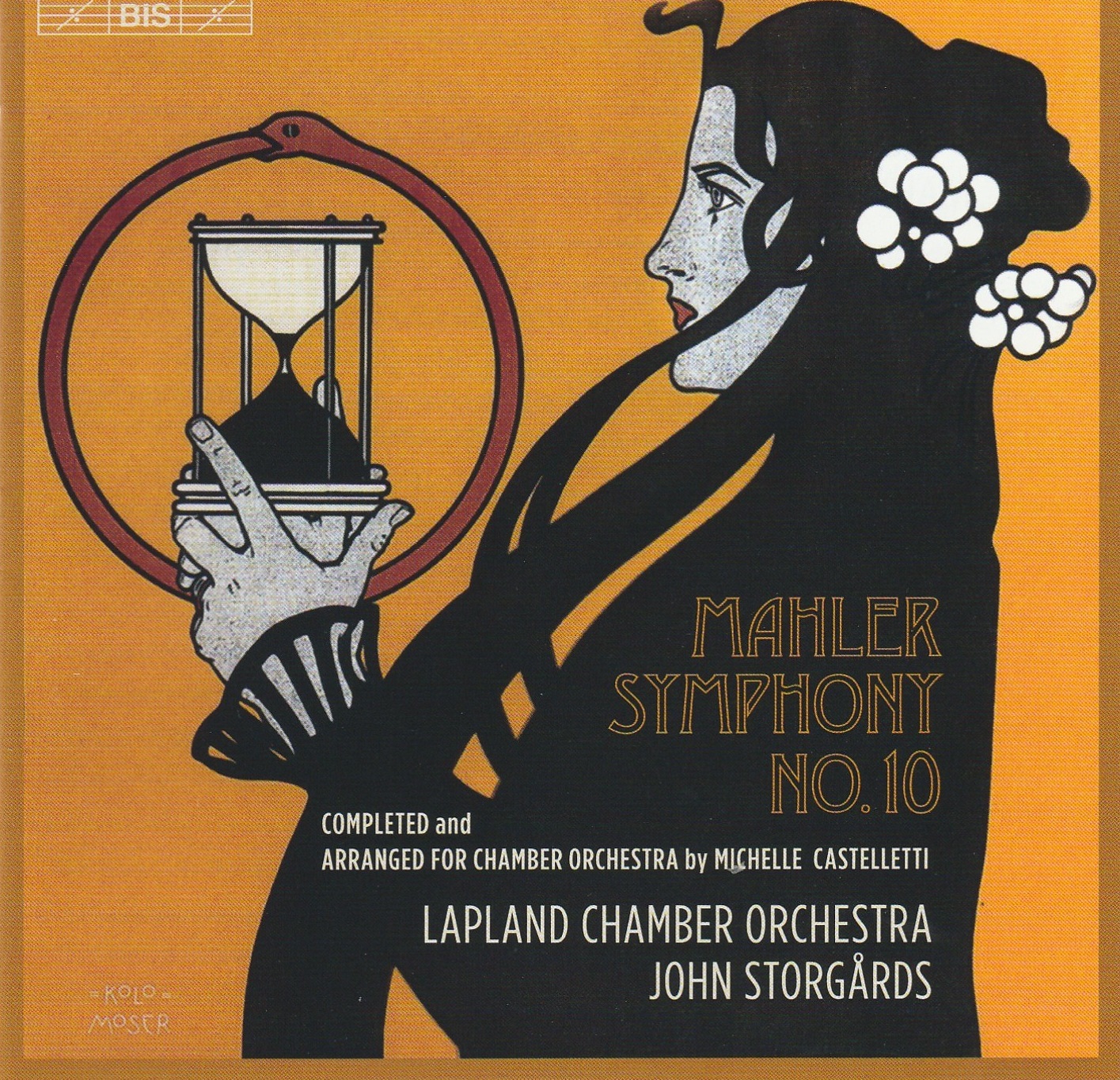
10 Mahler 10Mahler – Symphony No.10
Lapland Chamber Orchestra; John Storgårds
BIS BIS-2376 SACD (bis.se)

When Gustav Mahler died in 1911 at the age of 50 he left behind sketches for his tenth and final symphony. Of the five movements, we have Mahler’s full scores of the first and third movements with the remainder in an abbreviated short score format. These preliminary sketches, skeletal though they may be, define the entire melodic structure of the work. In this sense Mahler’s final testament is less unfinished than unrealized. It was not until the mid-1920s that efforts were made to bring the symphony to light with the publication of Ernst Krenek’s edition of the first and third movements and the release of a facsimile edition of the sketches. Numerous subsequent efforts have been made to refine the other three movements; the most successful of these has proved to be the “performing version” by Deryck Cooke first heard in 1960.

Over 30 recordings of the complete work in various versions have been issued since. This new chamber orchestra arrangement, by the Maltese conductor and musicologist Michelle Castelletti, is an exceptional accomplishment, quite brilliantly executed by the phenomenal John Storgårds and his Lapland Chamber Orchestra. I was initially quite skeptical that an orchestra of a mere 24 players (single woodwinds, a lone trumpet and horn, 14 strings, piano, harmonium, harp and percussion) would prove adequate to convey the impact of the 100 musicians Mahler normally employed. I was mistaken; even in these reduced circumstances the pathos of Mahler’s message still shines through in Storgårds sublime interpretation. This ranks as one of the most exciting and accomplished performances I have heard in my lifetime of terminal Mahleria.

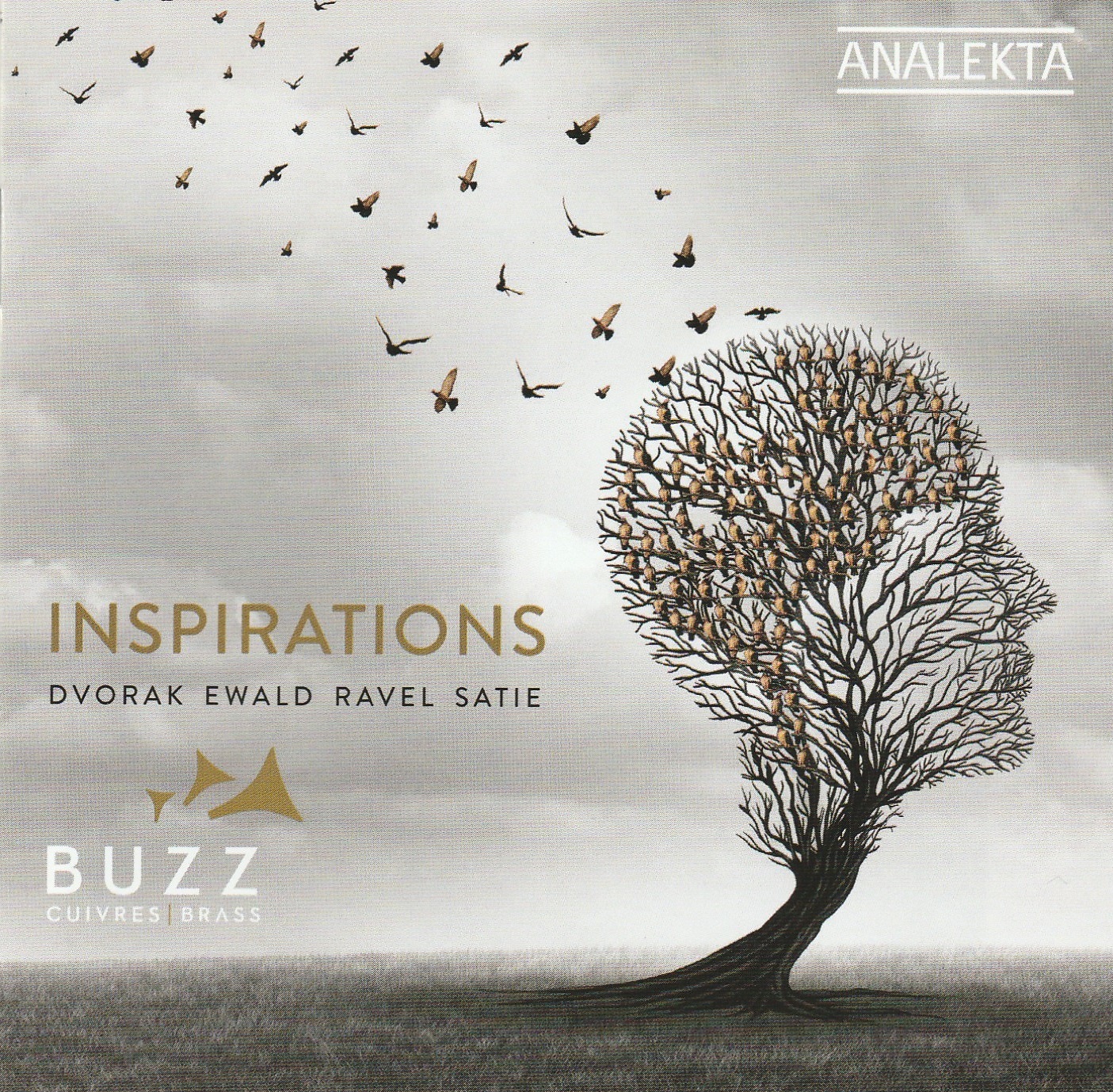
11 Buzz BrassInspirations
Buzz Brass
Analekta AN 2 8776 (analekta.com/en)

Canada’s renowned Buzz Brass ensemble presents “brand new transcriptions of major works” from celebrated composers Antonín Dvořák, Maurice Ravel and Erik Satie. Victor Ewald’s Quintet No.3 in D-flat Major (Op.7) is the only work on this disc originally intended for brass.

Inspirations is an attractive recital with each of four gems in this repertoire being polished to a glittering sparkle. This is the work of two Québécois arrangers, François Vallières and Hugo Bégin who – judging by these inspired re-imaginings – certainly ought to be better known than they might be in Québec. The imaginative arrangement of Satie’s Gymnopédies ought to be proof enough. But if there needs to be further evidence of highly original musical transcriptions, there is also proof in the transformations of Ravel’s String Quartet in F Major (Op.35) and Dvořák’s String Quartet No.12 in F Major “American” (B.179). All are highly creative re-arrangements; wholly satisfying both structurally and expressively.

The Buzz Brass parley with the familiarity of old friends, yet their playing always retains the sense of gracious etiquette associated with noble academies for which this music was no doubt originally intended. Nothing is forced, exaggerated or overly mannered; tempi, ensemble and balance all seem effortlessly and intuitively right. The brass sound is lucid. These are, in sum, sincere and poised accounts, a fitting tribute to the faultless character of the original music of the composers.

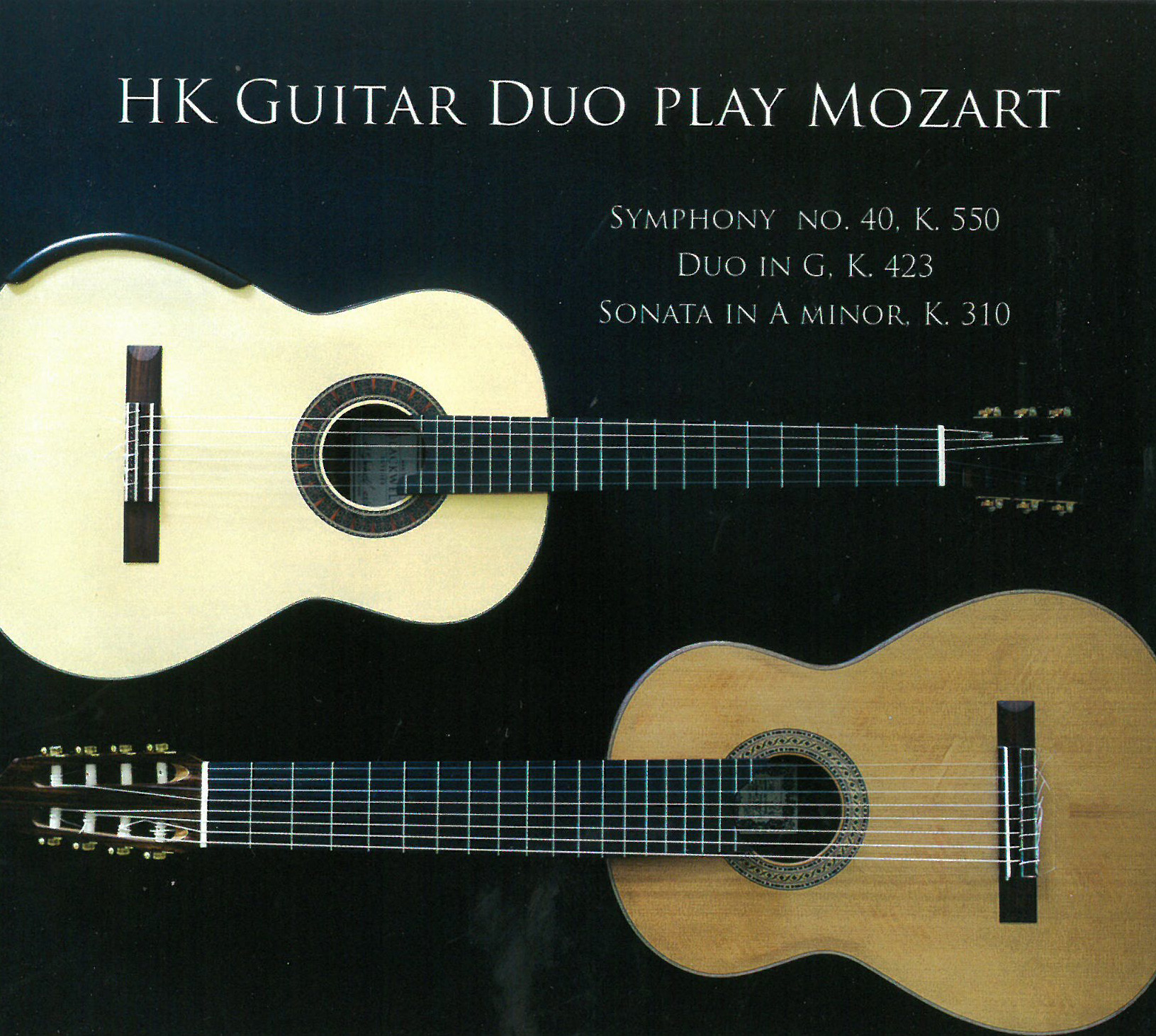
01 HK Guitar DuoThere was never any doubt about what would be the lead review once I received HK Guitar Duo Plays Mozart, the latest CD from two of Canada’s most outstanding instrumentalists, guitarists Drew Henderson and Michael Kolk (Independent, hkguitarduo.com).

What I wasn’t expecting, though, even from them, was the first of the three transcriptions on the disc – the complete Symphony No.40 in G Minor K550, the idea for the arrangement growing from some impromptu improvising on the opening theme during a break in a 2008 recording session.

Transcribing the Duo No.1 in G Major for Violin and Viola K423 was, as Kolk readily admits, a much simpler process, and finding an arrangement for two violins of the Piano Sonata No.8 in A Minor K310 clearly assisted with their excellent transcription for two guitars. Henderson plays a custom-built eight-string guitar in the Symphony No.40 as well as in the middle Adagio movement of the Duo, the two extra bass strings enabling an extended bass range that was particularly essential for the symphony.

The playing throughout the CD is immaculate, the technical artistry always matched by the musical sensitivity and intelligence. The Duo and the Piano Sonata are not exactly insubstantial works, but the real gem here is the Symphony No.40: “It’s incredible,” says the accompanying promo blurb, “that four hands and 14 strings can cover so much music that was written for an orchestra, but the HK Duo makes it sound effortless.”

Indeed they do, but more significantly – and crucially – they also make it sound both musically and artistically meaningful and an immensely satisfying listening experience in all respects. It’s a quite astonishing technical and musical accomplishment, completely convincing through all four movements.

Engineered and edited by Drew Henderson to his usual impeccable standards at the Church of St. Mary Magdalene in Toronto, this is a simply outstanding guitar CD. 
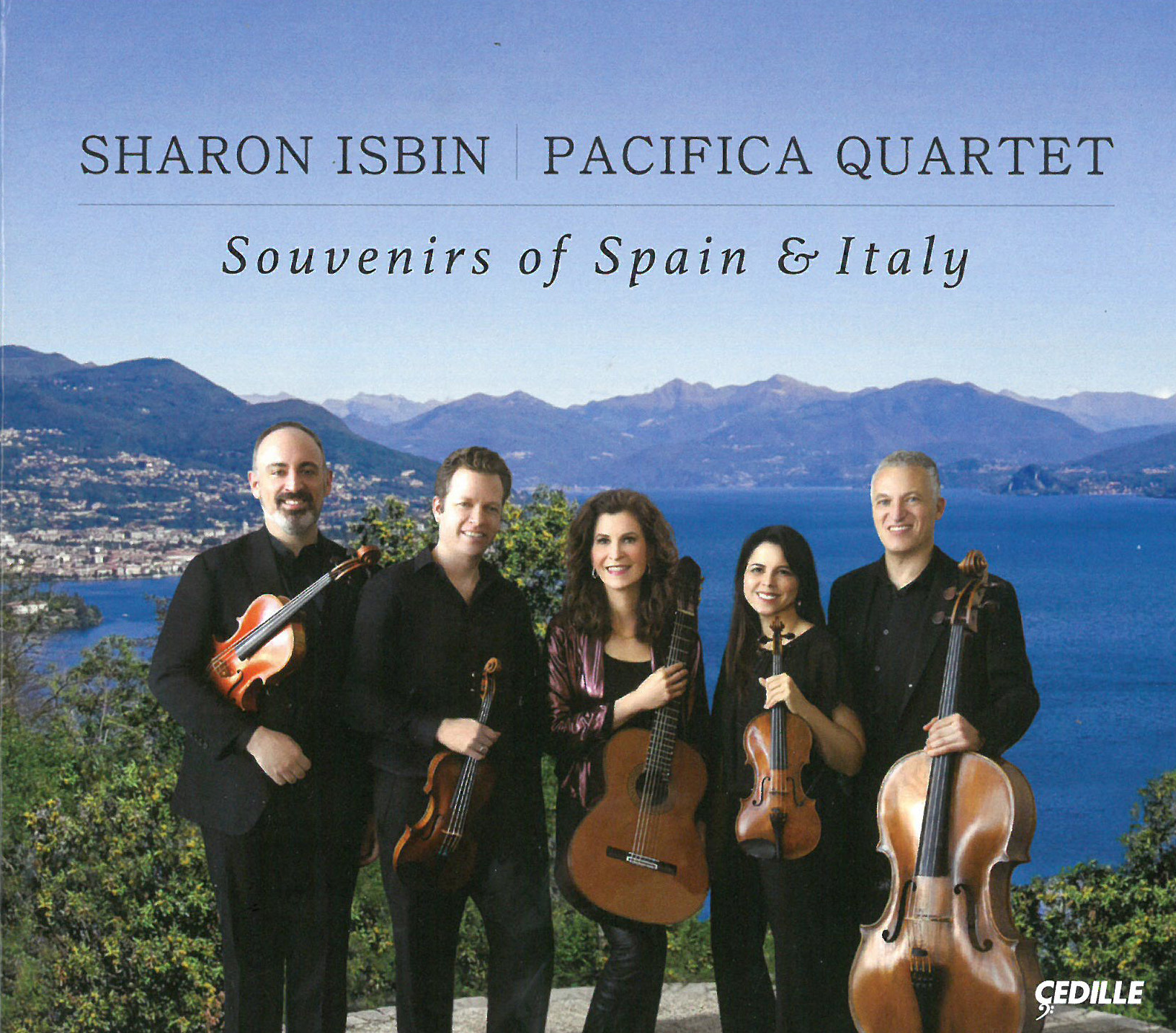
02 Sharon Isbin PacificaBy sheer coincidence, for the second month in a row I received a guitar quintet CD that opened with the Mario Castelnuovo-Tedesco Quintet for Guitar and String Quartet Op.143 and closed with Luigi Boccherini’s Quintet for Guitar and String Quartet in D Major – the one with the famous Fandango final movement. Last month it was Jason Vieaux and the Escher Quartet, and this month it’s guitarist Sharon Isbin and the Pacifica Quartet on Souvenirs of Spain & Italy, a CD that features music by Italian-born composers influenced by Spanish idioms (Çedille CDR 90000 190 cedillerecords.org).

The other works on the CD are Vivaldi’s popular Lute Concerto in D Major RV93, heard here in Emilio Pujol’s arrangement for guitar and string trio, and Joaquín Turina’s La oración del torero Op.34 in the composer’s own string quartet edition of the original for lute quartet.

Perhaps the words “seldom-heard gem” are finally becoming inappropriate for the gorgeous Castelnuovo-Tedesco quintet, which would be welcome news. There may possibly be a bit more warmth and tonal colour in Vieaux’s playing and a slightly less-forward guitar balance, but both performances feature excellent work by the soloists backed by beautiful quartet playing, and can be recommended without reservation.

The two performances of the Boccherini quintet are also very similar and equally impressive, the main difference being the addition of castanets and tambourine for almost the entire Fandango on this current disc, whereas on the Vieaux, the castanets (no tambourine) only appear for a brief single spell in the middle of the movement.

Isbin adds her own Baroque ornamentation in a measured and thoroughly enjoyable performance of the Vivaldi concerto; indeed, the two middle works on this CD give it a decided edge over the Vieaux disc.
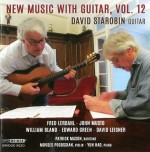
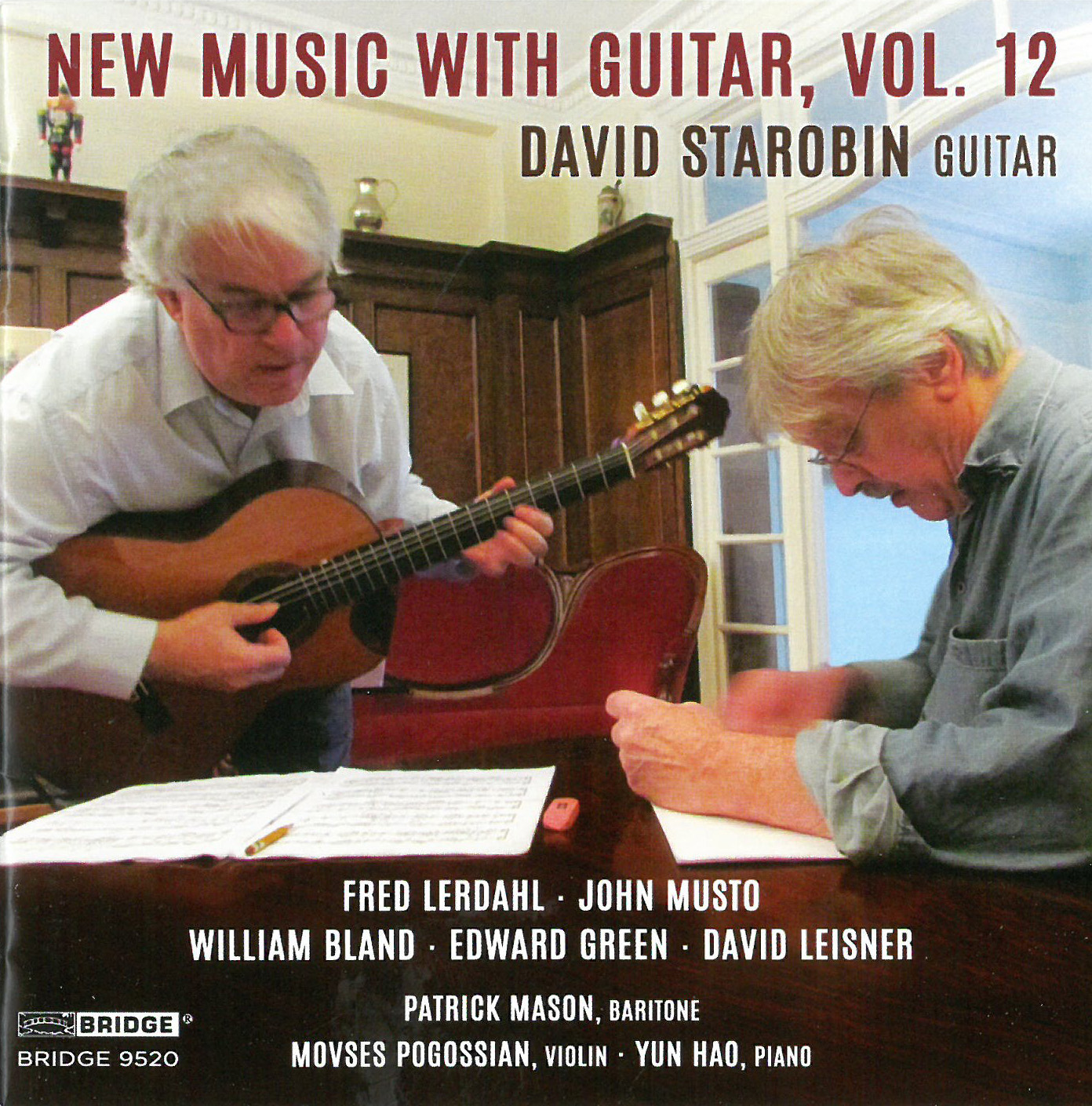
03 New Guitar 12David Starobin is the classical guitar soloist on New Music with Guitar Vol.12, the latest CD in the excellent ongoing series on the Bridge label (9520 bridgerecords.com).

All five composers represented – Fred Lerdahl, John Musto, William Bland, Edward Green and David Leisner – were born between 1943 and 1954, and the works are predominantly mature pieces, only Green’s Genesis: Variations for Solo Guitar, written for Starobin in 1974 and recorded in 1975, predating 2010.

Starobin is joined by violinist Movses Pogossian in Lerdahl’s Three Bagatelles (2017) and by pianist Yun Hao in Bland’s Sonata No.4 (2016), the latter’s Blues final movement ending effectively with Starobin unwinding the lower guitar strings.

The outstanding baritone Patrick Mason joins the guitarist in two brief but quite superb song cycles: Musto’s The Brief Light (2010) on poems of James Laughlin and Leisner’s Three James Tate Songs (2007). Leisner’s abilities as a virtuoso guitarist make for some dazzling and imaginative settings in the latter.

Starobin and partners are all in top form in a highly entertaining program.
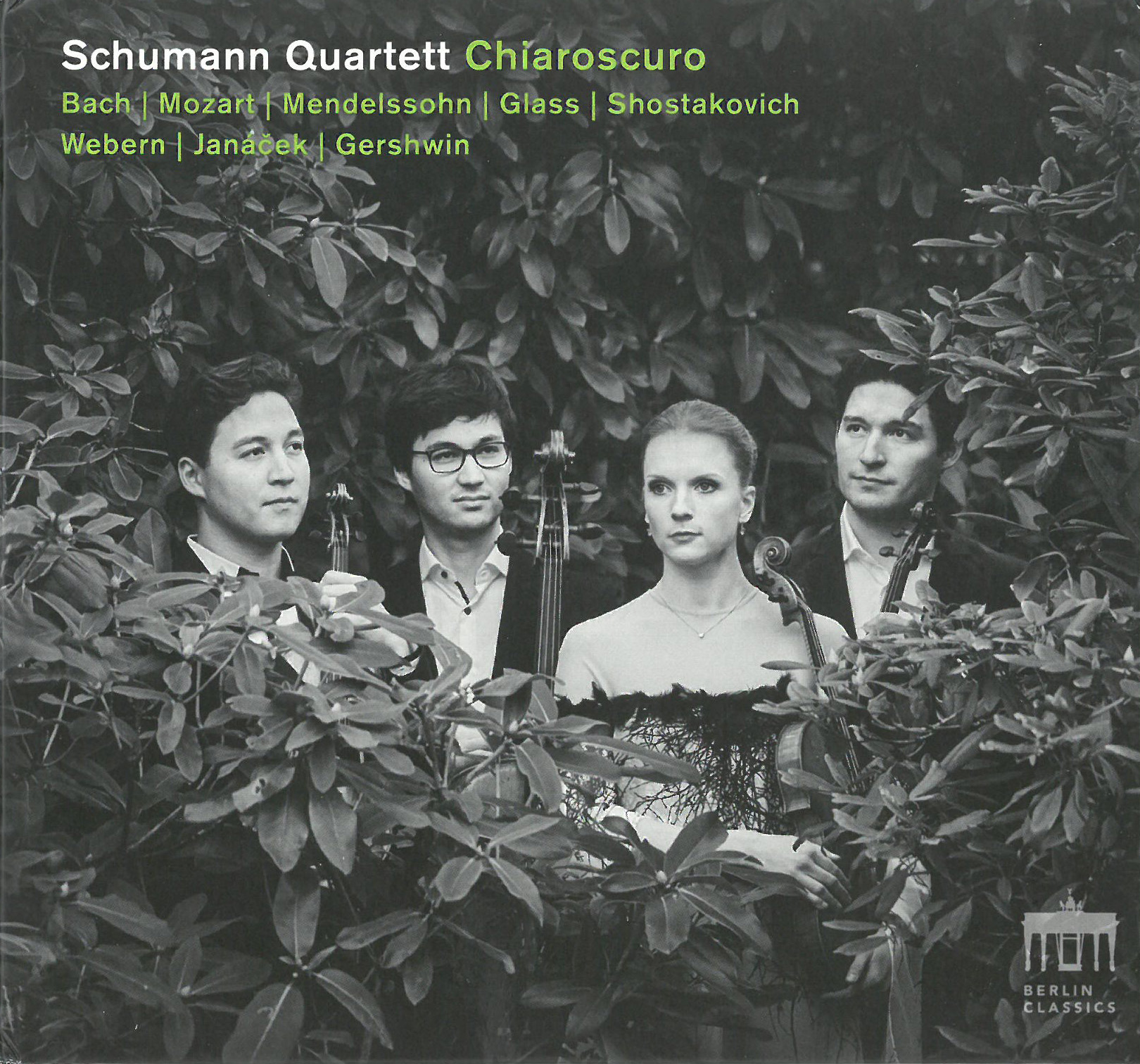
04 Schumann Quartet ChiaroscuroChiaroscuro, the latest CD from the Schumann Quartet completes the trilogy of concept albums that began with the two CDs, Landscapes (2017) and Intermezzo (2018) (Berlin Classics 0301213BC berlin-classics-music.com).

Described as “a picture-gallery of music” the album uses Mozart’s settings of Five Fugues from Bach’s The Well-Tempered Clavier K405 as the promenade music and connecting path between the various works: Mendelssohn’s Fugue in E-Flat Major Op.81 No.4; Philip Glass’ brief String Quartet No.2 “company”; Shostakovich’s Two Pieces for string quartet from 1931; Webern’s Six Bagatelles Op.9; and Janáček’s String Quartet No.2 “Intimate Letters.” Gershwin’s Lullaby adds a dream-like epilogue to the series.

The Schumann Quartet is performing the complete Chiaroscuro program in their live recitals, and recommends that the CD be listened to from start to finish without a break. It certainly works very well, despite – or perhaps because of – the disparity between the musical selections. Performances throughout are excellent, particularly the heartfelt reading of the astonishingly raw and emotional Janáček quartet.
05 Argus QuartetThe string music of the American composer Juri Seo (born 1981) is featured on the impressive CD Respiri, with the Argus Quartet and cellist Joann Whang (Innova 022 innova.mu).

The quite lovely title track for string quartet is subtitled in memoriam Jonathan Harvey, and pays tribute to the British composer – a practising Buddhist – who died in 2012, and whose signature musical gesture was an evocation of breathing.

Whang is the soloist for the Suite for Cello, a suite of five dance movements very much in the J.S. Bach solo cello mode but with an increasing use of harmonics, adding what the composer terms a lingering sense of displacement.

The String Quartet – Infinite Season aims to depict the story of a year unfolding, the four movements tracing the sounds of nature as the seasons change. There’s a lovely use of harmonics again, together with field recordings of birdsong and insect noises.
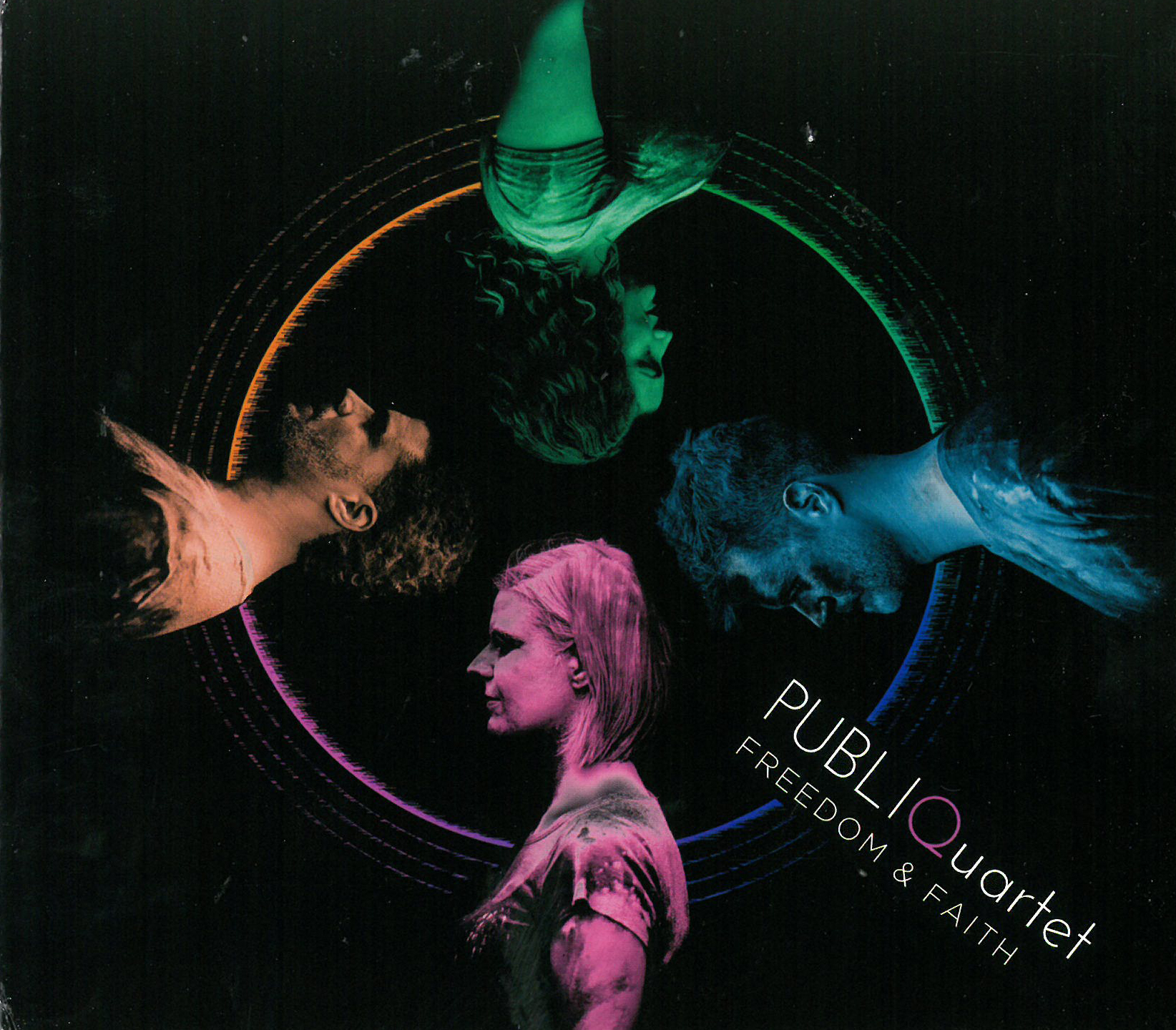
06 PUBLIQuartetFreedom & Faith is the second album from the American string quartet PUBLIQuartet on the Bright Shiny Things label (BSTC-0126 brightshiny.ninja). The quartet is dedicated to presenting new works, and the music here is from two of PUBLIQuartet’s signature initiatives: MIND I THE I GAP, collaborative compositions and improvisations by the four group members; and PUBLIQ Access, a program that commissions new string quartet works by composers living in the United States. The latter is represented by the opening and closing works – Jessica Meyer’s three-movement Get into the Now from 2017 and Shelley Washington’s Middleground from 2016 – while three collaborative creations from the former project are at the centre of the disc: Sancta Femina, reflections on Hildegard von Bingen, Francesca Caccini and Chiara Margarita Cozzolani; Ella!, based on Ella Fitzgerald’s performance of A-Tisket, A-Tasket; and Nina!, a celebration of Nina Simone.

Anything goes in the performances at times, with normal string playing being replaced by a whistle, unison singing and chanting, rhythmic clapping and percussive effects on the instrument bodies in some vibrant and decidedly upbeat music. 
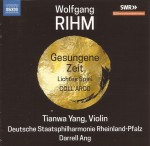
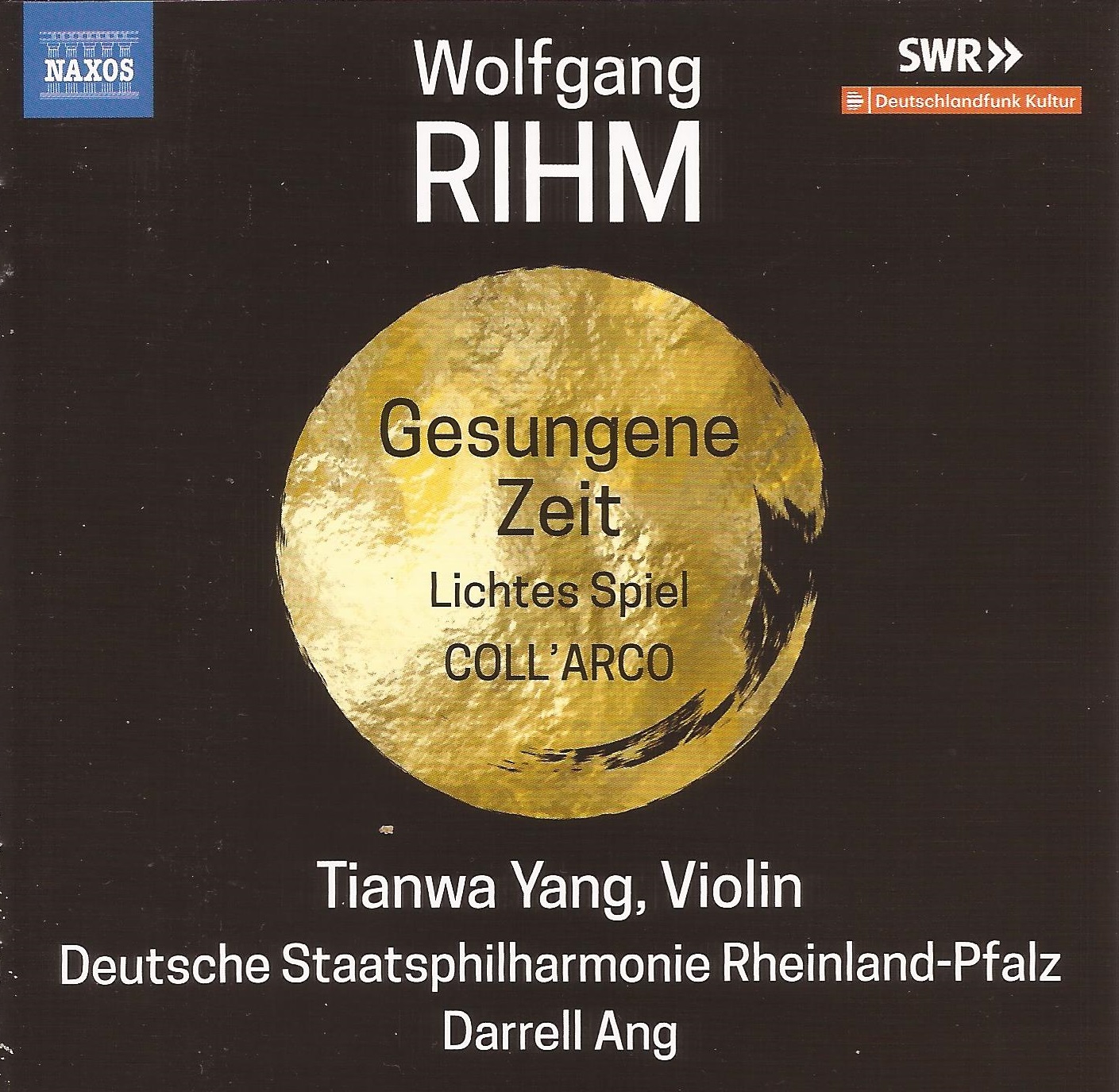
07 Rihm scanThe outstanding violinist Tianwa Yang is the soloist on Wolfgang Rihm Music for Violin and Orchestra Vol.2 with the Deutsche Staatsphilharmonie Rheinland-Pfalz under Darrell Ang (Naxos 8.573667 naxosdirect.com). Yang has a strong association with Rihm’s music, having already recorded his Complete Works for Violin and Piano (8.572730) and the first volume of the Violin and Orchestra Music (8.573812) for the Naxos label.

The three substantial works here are Gesungene Zeit (Musik für Violine und Orchester Nr.2) (1991-92), Lichtes Spiel (Ein Sommerstück für Violine und kleines Orchester) (2009) and COLL’ARCO (Musik für Violine und Orchester Nr.4) (2008).

Rihm’s music is not always immediately accessible, but these works are engrossing from start to finish with some truly beautiful moments, especially in the lengthy COLL’ARCO, which with its hints of Alban Berg often sounds like a violin concerto from the Second Viennese School.

Yang is, as usual, simply brilliant in music that makes great technical and interpretative demands.
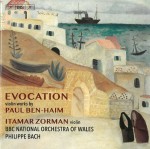
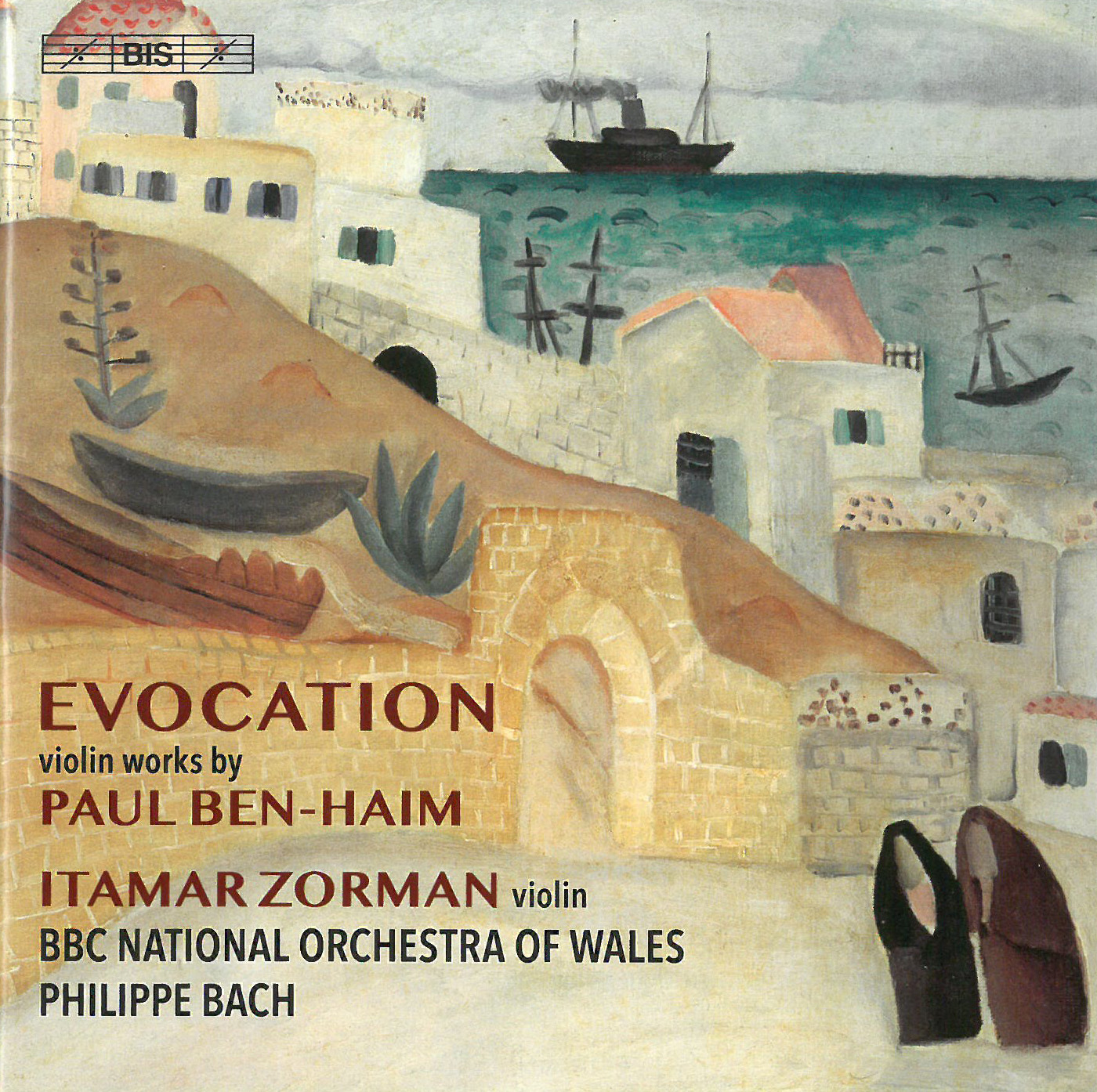
08 Ben HaimEvocation – Violin Works by Paul Ben-Haim traces the gradual assimilation of Middle Eastern influences in the music of the composer (born Paul Frankenburger in Munich, Germany) after his emigration to the British Mandate of Palestine (the future Israel) in the 1930s. Itamar Zorman is the violin soloist with the BBC National Orchestra of Wales under Philippe Bach (BIS-2398 bis.se).

The major works are the 1942 title track and the Violin Concerto from 1960, a solidly professional work with a simply lovely Andante affettuoso slow movement. Pianist Amy Yang joins Zorman for the Berceuse sfaradite from 1945 and Three Songs without Words from 1951.

The Three Studies for Solo Violin, written for Yehudi Menuhin in 1981 are among Ben-Haim’s last works. An arrangement for violin and orchestra of the Toccata piano solo from 1943 by the soloist’s father, Moshe Zorman, completes an entertaining CD.
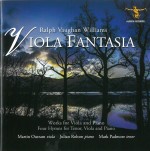
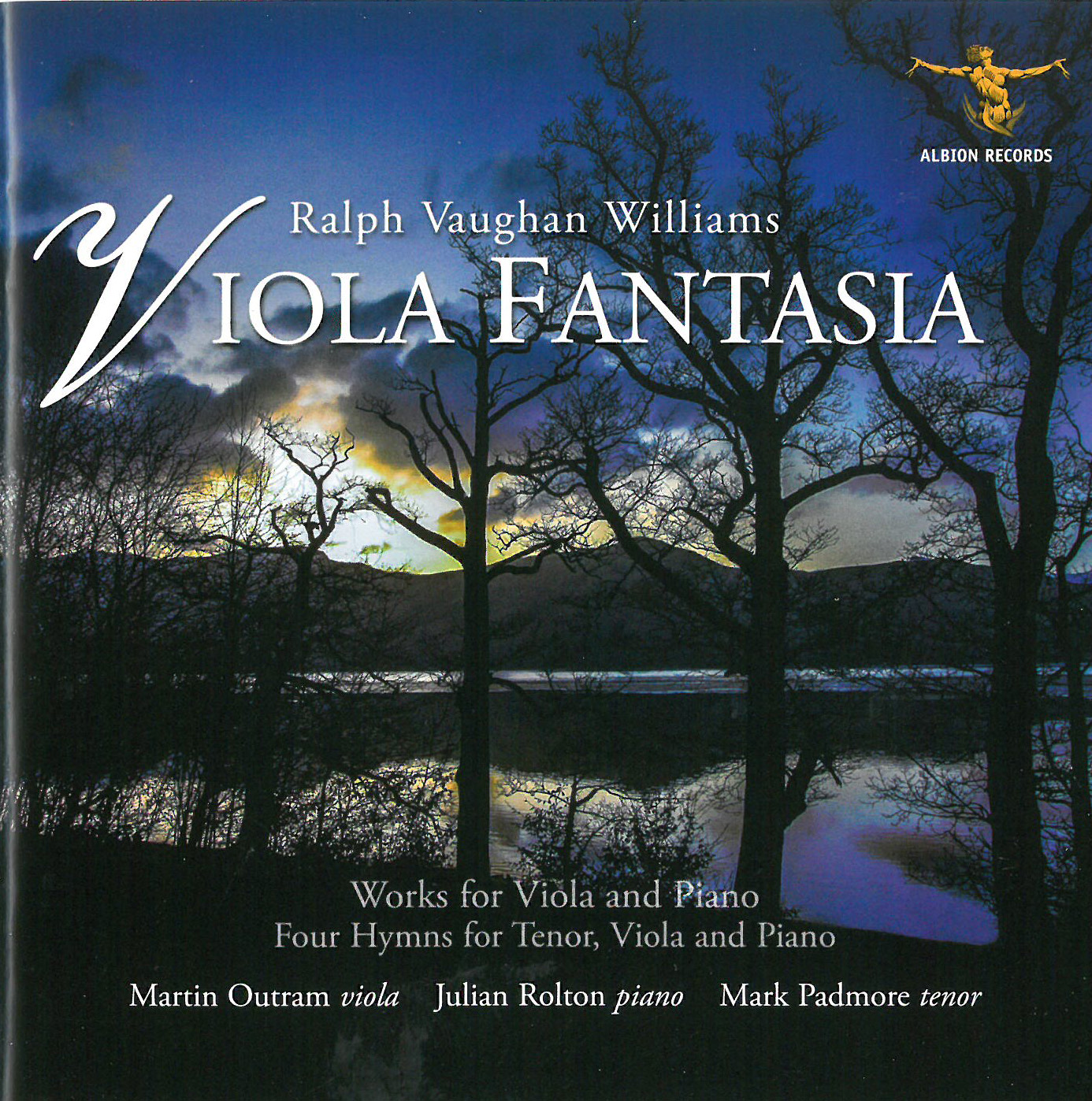
09 Vaughan Williams Viola FantasyVaughan Williams enjoyed playing the viola for most of his long life, its sound a seemingly perfect projection of the pastoral and nostalgic nature (on the surface, at least) of his music. On Viola Fantasia, on Albion Records, the official label of the Ralph Vaughan Williams Society, violist Martin Outram and pianist Julian Rolton perform the composer’s works for viola and piano, together with the Four Hymns for Tenor, Viola and Pianoforte with tenor Mark Padmore (ALBCD 036 albionrecords.org).

The Suite and Romance both sprang from Vaughan Williams’ relationship with the viola virtuoso Lionel Tertis. Six Studies in English Folk Song and the Fantasia on Sussex Folk Tunes both originally featured solo cello, the former heard here in the composer’s alternate viola version and the latter in an arrangement by Outram. The Fantasia on Greensleeves was arranged for viola and piano by another British viola virtuoso, Watson Forbes.

There’s perhaps a tendency for the viola tone to sound a bit tight at times, but there’s much to enjoy on what is clearly an authoritative CD.
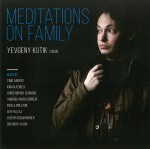
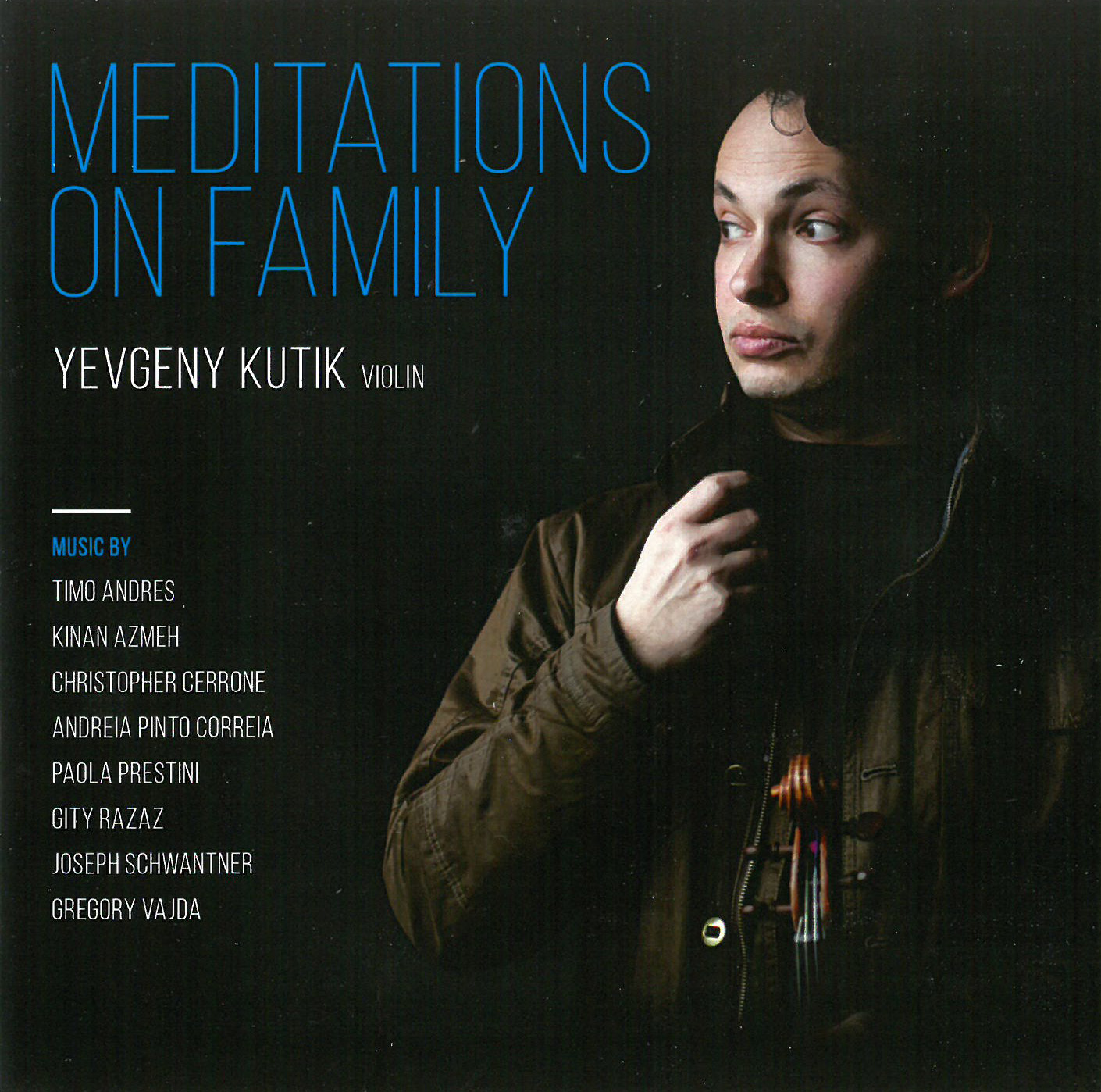
10 Yevgeny KutikFor his recording project Meditations on Family the Russian-American violinist Yevgeny Kutik commissioned eight composers to translate a family photo into a short musical miniature of about two to three minutes in length for violin and various ensemble. The resulting tracks were released digitally on a weekly basis, and were gathered together on a 23-minute Extended Play CD earlier this year (Marquis 774718149329 marquisclassics.com).

Composers Christopher Cerrone, Gregory Vajda, Joseph Schwantner, Kinan Azmeh, Paola Prestini, Timo Andres, Andreia Pinto Correia and Gity Razaz produced brief but intriguing works for solo violin, violin and piano, violin and double bass, violin and clarinet and violin with vocal quartet and glass harmonica. Kutik plays them with warmth and commitment.

The original photos, along with additional background information and audio tracks can be found at meditationsonfamily.com


01 FialkowskaLes sons et les parfums
Janina Fialkowska
ATMA ACD2 2766 (naxosdirect.com)

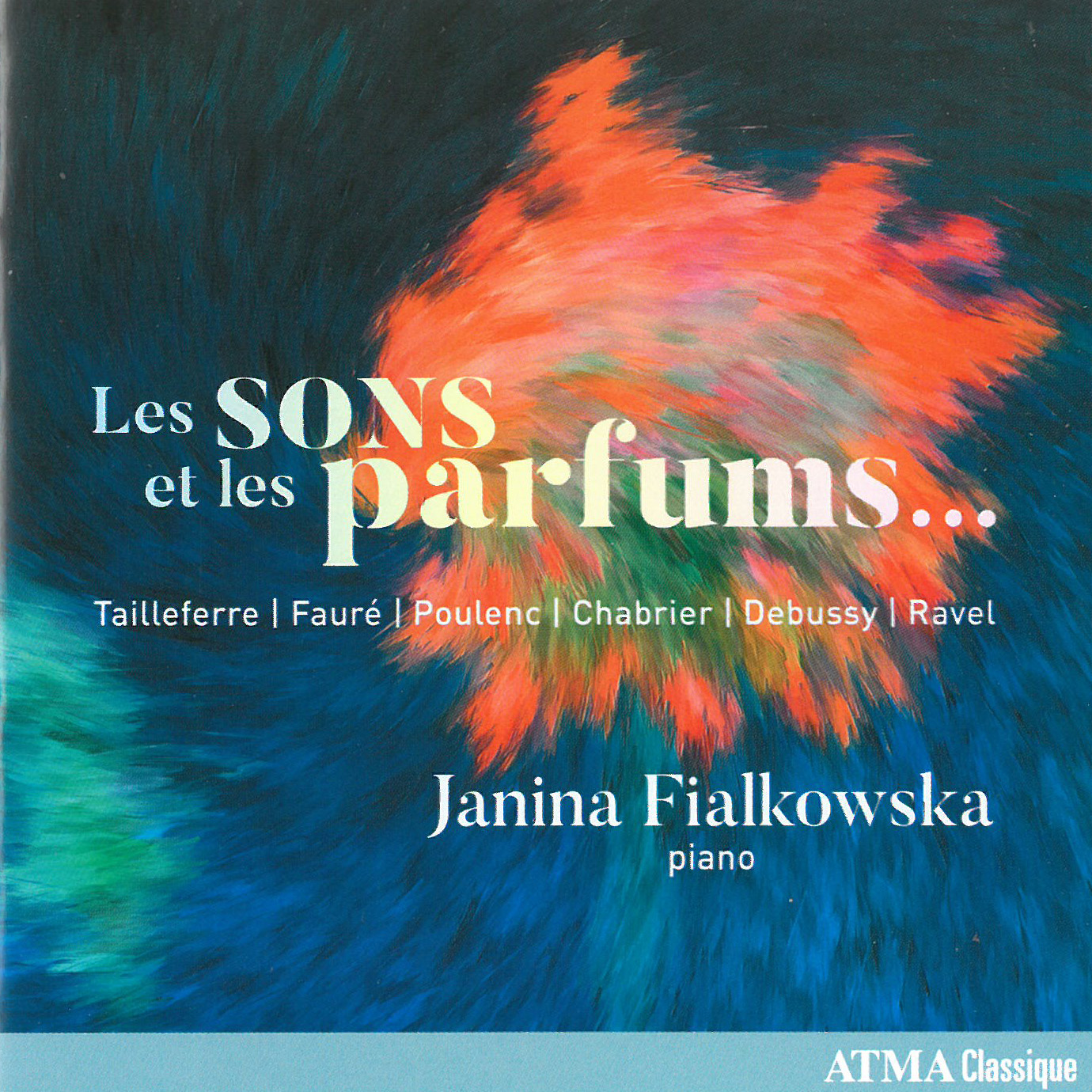
Janina Fialkowska’s latest offering is absolutely enchanting, a CD of “pure nostalgia” for the acclaimed Canadian pianist, as she states in her eloquent liner notes for Les sons et les parfums (the sounds and the fragrances).

Fialkowska transports us to the Paris of the 1950s and 1960s, when, as a youth, she visited the French capital; a time when Les Six members Francis Poulenc and Germaine Tailleferre were dominant forces on the French music scene. And, as Fialkowska tells us, a time when most of the older musicians with whom she came in contact during those visits, knew not only those noted composers, but also Ravel, Debussy and Fauré. One further fun fact: her piano teacher in Paris in the mid-60s, Yvonne Lefébure, actually worked on the two Ravel pieces featured on the CD with Ravel himself! Can anyone imagine a headier environment for one’s musical studies?

Fialkowska’s “love letter to Paris” includes works by all of the above-mentioned composers, as well as Emmanuel Chabrier. From Tailleferre’s charming and shimmery Impromptu, Fauré’s sensuously evocative Nocturne in E-flat Major Op.36, and Poulenc’s sparkling Intermezzo in A-flat Major FP118 with its sense of yearning, to Debussy’s beloved and beyond-beautiful Clair de Lune and the stunning, virtuosic and impressionistic pleasures of Ravel’s Jeux d’eau and Sonatine, Fialkowska indeed captures les sons et les parfums of a bygone Paris. It is there in the characteristic nuance, warmth, commanding musicianship, delight and dignity of her performance, which is nothing short of ravishing.

Sharna Searle

Listen to 'Les sons et les parfums' Now in the Listening Room

02 Richard Hamelin ChopinChopin – Ballades & Impromptus
Charles Richard-Hamelin
Analekta AN 2 9145 (analekta.com)

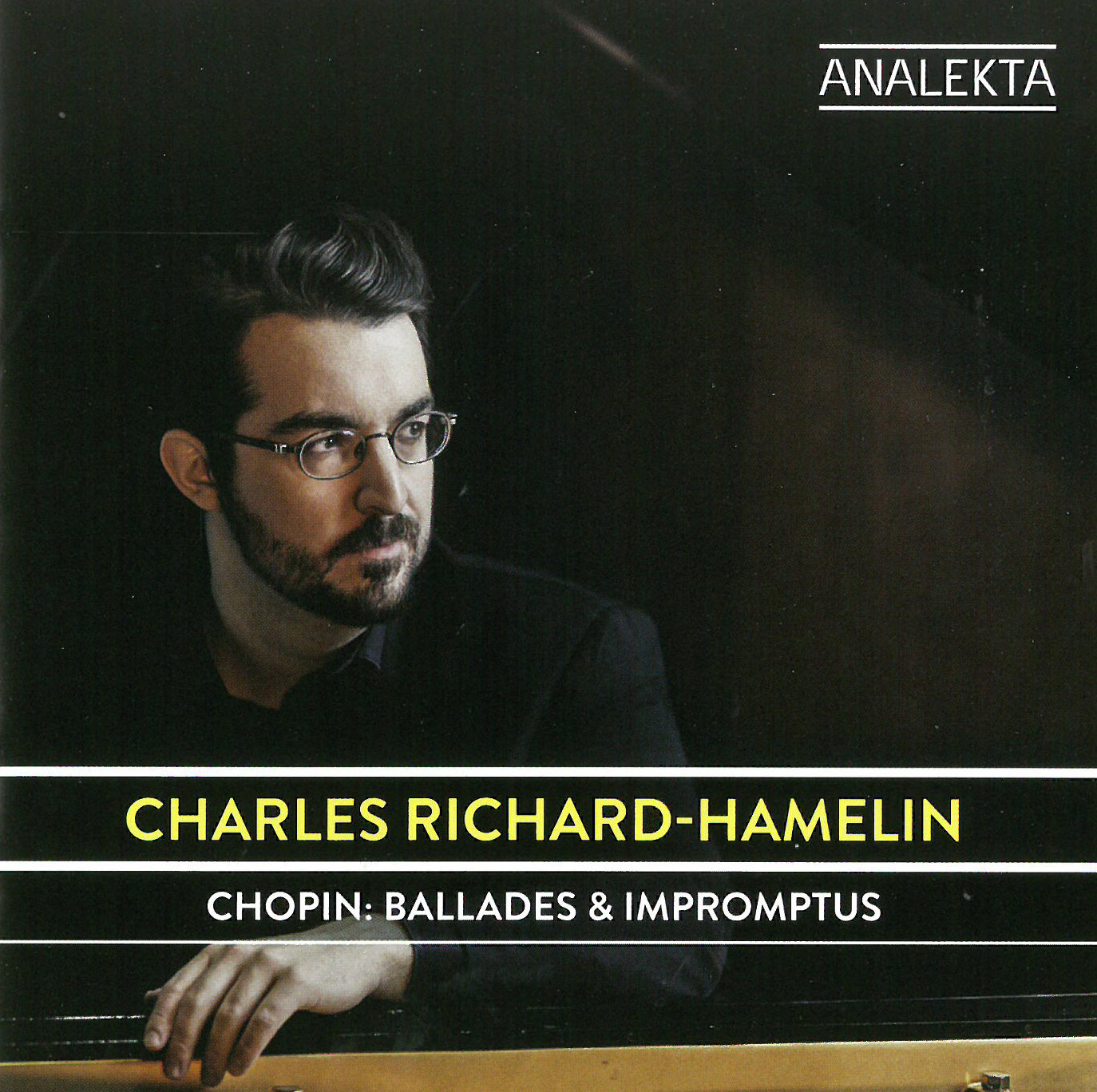
The quietly heroic Canadian pianist, Charles Richard-Hamelin, has just released a record – his fifth on the Analekta label – of Frédéric Chopin’s most expressive and inspired music: the four Ballades, (presented in chronological order) and the three Impromptus, followed by the Fantaisie-Impromptu.

Audiences the world over have heartened to Richard-Hamelin’s extraordinary talent, a talent without self-indulgence, wholly in service of musical candour on the highest order. It is this very quality, (amongst flawless technique, lyrical sensitivity, inspired voicing and impeccable stylistic command), that makes Richard-Hamelin so unique in today’s individualistic, ego-crazed culture. The pianist brings a poetic integrity to his music-making, born of a sincerity that is both reassuring and human. His craft calls on the objective – not the subjective – to aid him in his quest for beauty, awakening virtue and aesthetic perfection at every musical turn.

In these hands, not one of Chopin’s phrases, chords or moments of pause are left unconsidered or unloved. Richard-Hamelin intimately knows every last fibre of the musical canvas, from first note to last; a marvel of integral conception. It is like watching a skilled and seasoned painter in action, as he places every brush stroke – every swirl and point – with absolute care and expertise. Richard-Hamelin is redesigning this loved (and oft-performed) music, entirely afresh. Each cherished musical moment is revealed to be uniformly exquisite, and the listener is spellbound. Charles Richard-Hamelin is an artist of this rare Earth, singing of its myriad wonders.

Adam Sherkin

07 Tchaikovsky HaochenTchaikovsky – Piano Concerto No.1; Prokofiev – Piano Concerto No.2
Haochen Zhang; Lahti Symphony Orchestra; Dima Slobodeniouk
BIS BIS-2381 SACD (bis.se)

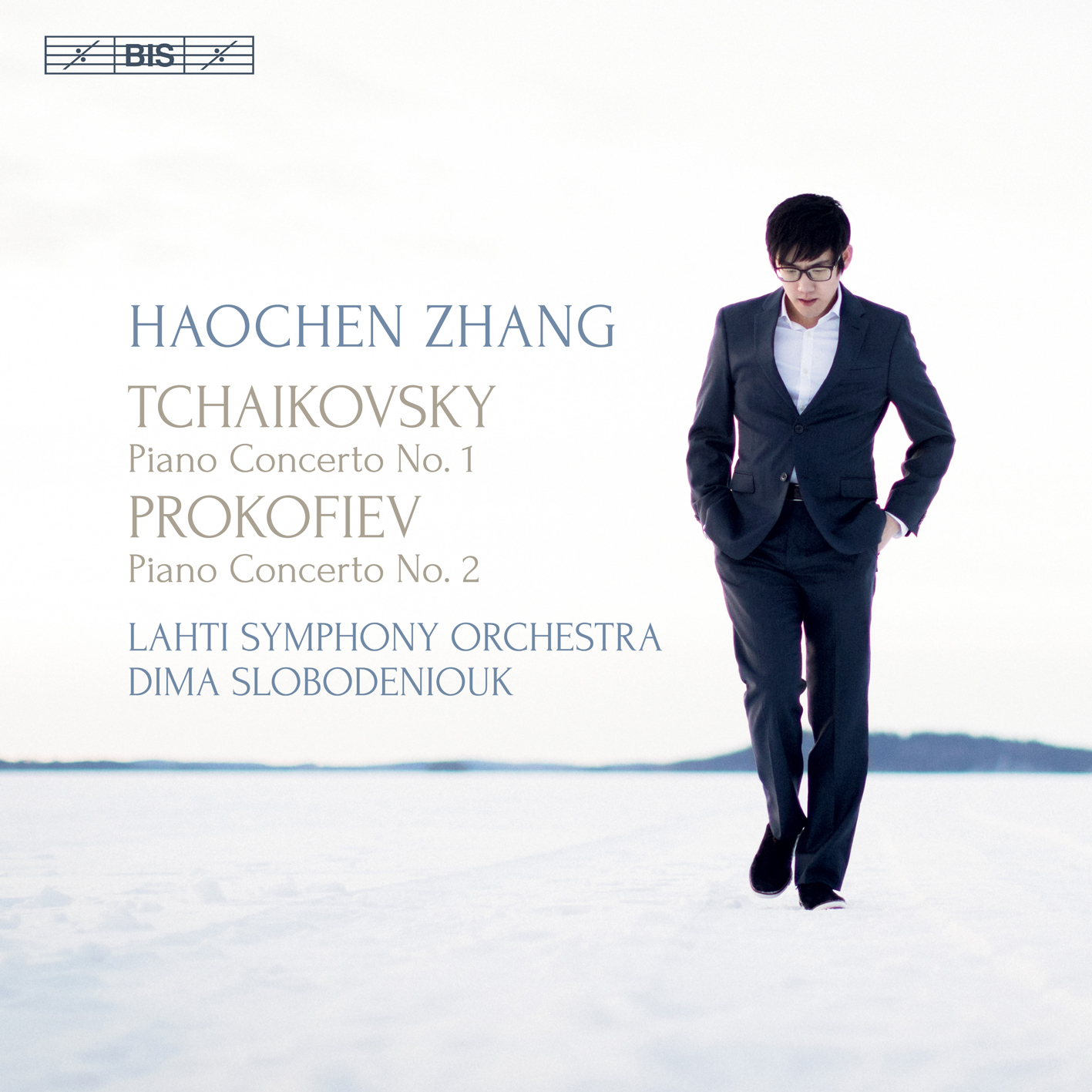
At just 29 years old, Chinese pianist Haochen Zhang ably demonstrates his coupling of a virtuoso approach with a mature and nuanced sensitivity of musical interpretation on this 2019 BIS recording, featuring the Lahti Symphony Orchestra under the measured direction of Dima Slobodeniouk. Traversing two alpine works – Pyotr Ilyich Tchaikovsky’s Piano Concerto No.1 and Sergei Prokofiev’s Piano Concerto No.2 – Zhang evidences considerable musical acumen in his handling of this well-known (and widely recorded and performed) music of these Russian masters, highlighting the embedded Romantic gestures, as well as rising to the stentorian musical challenges put forward by these mighty and canonical composers. 

Dynamics are clearly on display as the pianist takes the listener on a wild ride. This 19th- and 20th-century music is both rigorous and demanding on pianists (Prokofiev was himself a touring and creative pianist), and Zhang, a former child prodigy who won the 2009 Cliburn Competition, demonstrates that he still has the breathtaking and wide-ranging technique that initially captured audience attention when he was still a boy. But now he evidences a coalescing musical maturity that is bound to excite today’s classical musical listeners not only for what is captured here, but also for what is in store for Zhang on future recordings and concertizing opportunities. Overall, a recommended addition to one’s CD collection.

Andrew Scott

03 Beethoven ChoBeethoven – Piano Sonatas Nos.8, 21, 23
Jae-Hyuck Cho
Sony S803556 (jaehyuckcho.com/recording)

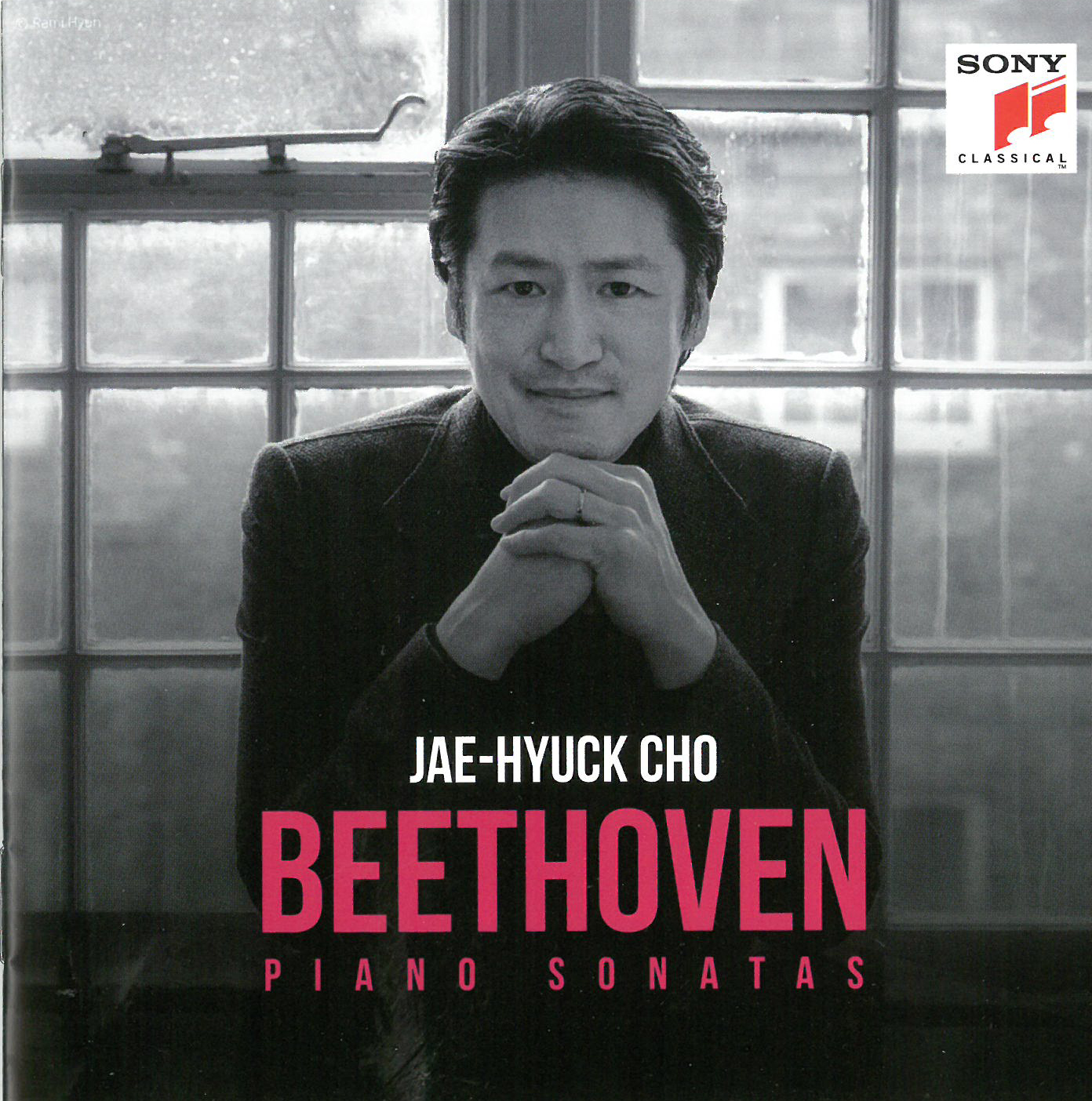
Pianist Jae-Hyuck Cho is a well-established international recitalist and a classical music radio presenter in Korea. This CD of three much-recorded Beethoven sonatas – the C minor “Pathétique,” C Major “Waldstein” and F minor “Appassionata” – is justified by its excellent playing and sound engineering. In the Pathétique Cho’s tonal control is exceptional, from the introduction’s sonorities onwards, featuring finely graded crescendos. In the Adagio, expression is fine and intimate, while the Rondo builds and does not overwhelm. No banging in this Beethoven, or in the following Waldstein Sonata. Here, with melody mostly reduced to brief motifs in the first movement, a wealth of harmonic interest, plus the raw energy of pulses and tremolando chords, carry the movement forward. Cho achieves this task, and then shows an atmospheric side to his playing in the heartfelt introduction to the Rondo. Adhering mostly to Beethoven’s blurring pedal markings and extended trills, raising the contrast level through effective accentuation in the episodes, and managing the coda’s octave glissandos well, the end result is stellar.

The Appassionata Sonata is a little overwhelming in Cho`s reading. Admittedly this sometimes aggressive work is not my favourite Beethoven – one is likely to bang and I don`t begrudge Cho`s becoming emphatic at times. With mostly controlled and clean playing here, there is much for devotees to admire. The CD adds an unlisted bonus encore: a finely-realized Liszt transcription of Schumann’s Widmung S566.

Roger Knox

04 Changyong ShinBeethoven; Liszt; Chopin
ChangYong Shin
Steinway & Sons 30115 (steinway.com/music-and-artists/label)

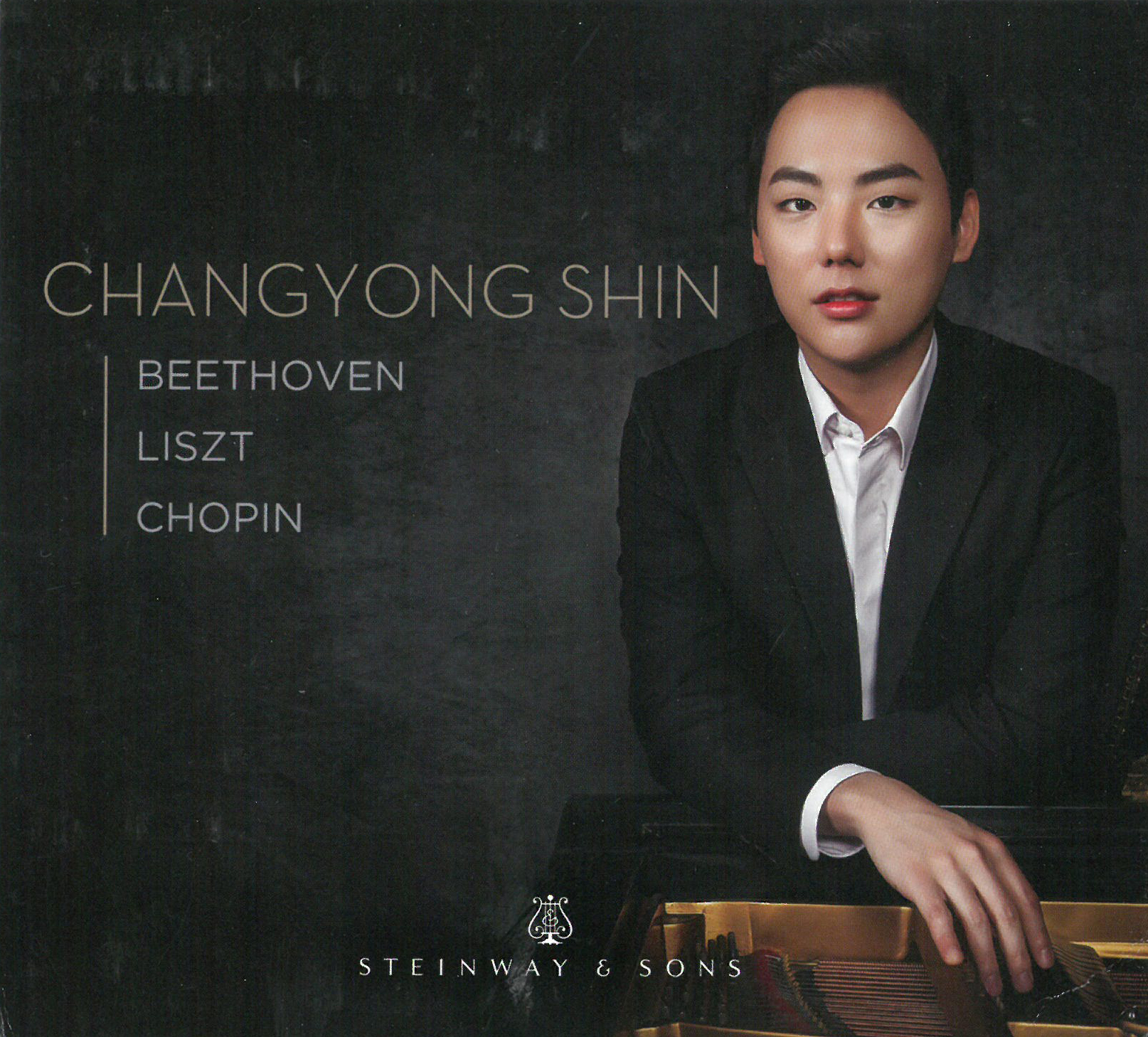
Young Korean Pianist ChangYong Shin has won several important awards including the 2018 Gina Bachauer International Artist Piano Competition. I found this pianist reticent at first. His Beethoven Sonata in E Major, Op.109 is technically secure throughout, but more colour and expression would have been welcome for Beethoven’s quasi-improvisational mode. There are great heights and depths in this work that may require risk-taking. Nevertheless, Shin handles the finale’s fugal section and the theme’s return with extended trills particularly well.

For me Franz Liszt’s Bénédiction du Dieu dans la solitude from the cycle Harmonies poétiques et religieuses, (1847) conveys a genuinely religious sense in the way the piece unfolds. Shin is flawless with the opening’s rustling background and the rich ventures into the bass register, and also in the subsequent dramatic harmony and varied figuration. He confidently paces the balance of the work well, including in the closing section where it is mainly rolled chords that support the pensive upper line. By the end, peace and calm have stilled the emotions of earlier sections.

Of the disc’s three Chopin waltzes I particularly enjoyed Op.42, informally known as the 2/4 “waltz” because of the melody’s cross rhythm against the triple-time bass. Shin is high-spirited here, pedalling lightly, creating a whirl with accents and rubato, and achieving a bravura ending. The brilliant Waltz in E-flat Major, Op.18 and Waltz in A-flat Major, Op.34, No.1 add to the lustre of a splendid CD.

Roger Knox

05 Schumann PonthusSchumann – Fantasie Op.17; Kreisleriana; Kinderszenen
Marc Ponthus
Bridge Records 9514 (bridgerecords.com)

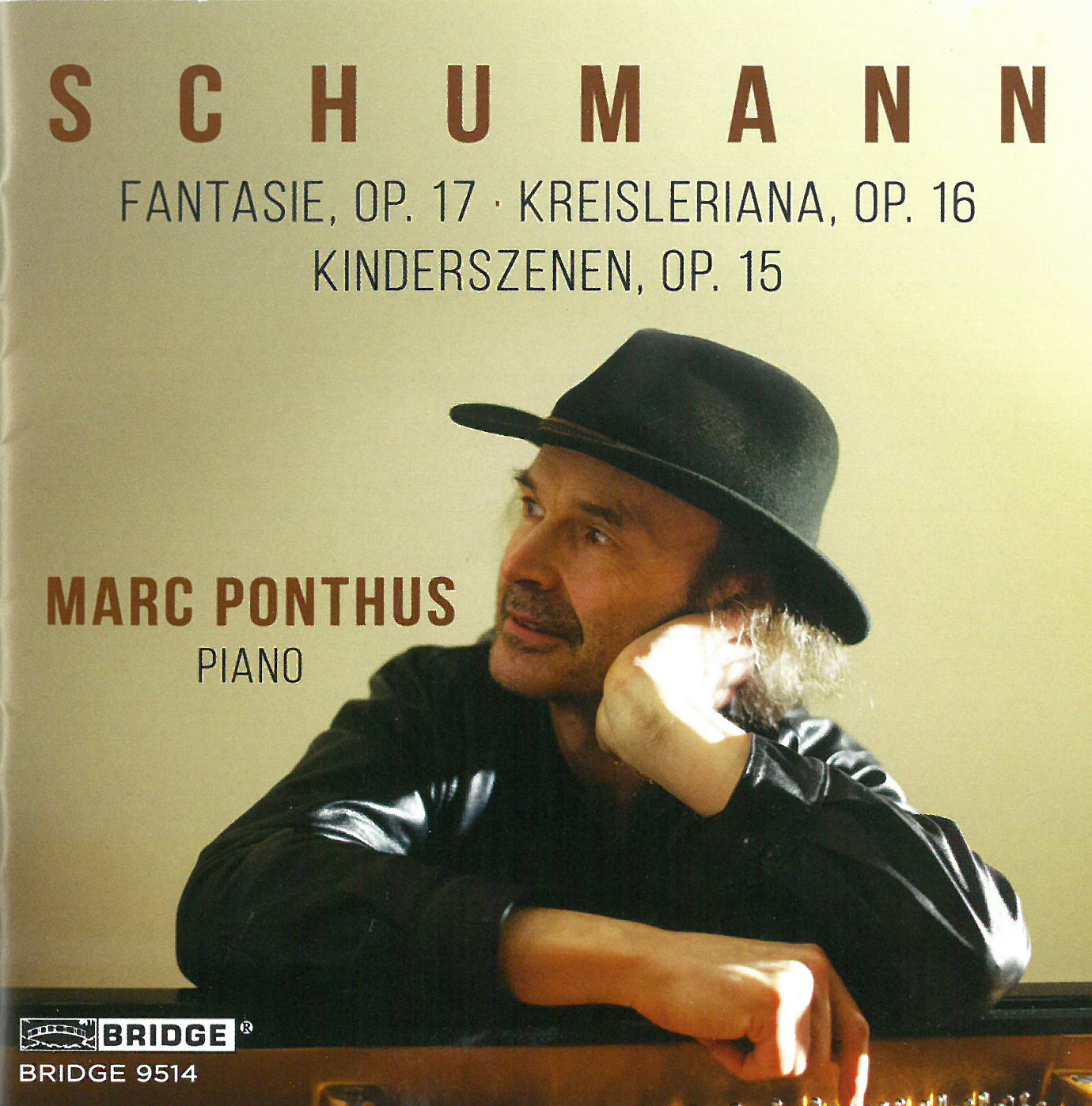
This disc of three contemporaneous Schumann works played by Marc Ponthus is revelatory. Known for major recitals of monumental works, Ponthus here offers technical brilliance with exquisite control of dynamics, voicing, and pedalling. Of the Fantasie (1836-8) his insightful program notes observe “a realm larger than reason”; in the first movement “a constantly fluctuating and forward energy” with vitalizing changes of texture. The finale becomes “an unfinished extension of the magnificent formal ruins of the first movement.” A large-scale, visionary Romantic masterpiece grounded in non-classical principles, then played with seamless continuity and fascinating detail. Using a modern piano, Ponthus adds tasteful speeding up as is now practised (controversially for some) in Romantic-era tempo modification.

With Kreisleriana (1838) Ponthus’ tempo modification becomes more prominent, in keeping with the eccentric fictional persona of Kreisler and perhaps the personalities of both writer E.T.A. Hoffmann and Schumann. But I find the lyricism of the middle section of Kreisleriana’s first piece spoiled by excessive speed; better for the player to be guided by the section’s phrase extensions and key changes. The slow pieces come off best and the fourth one for me is introspection defined. As for Kinderszenen (1838), scenes of childhood for adults, Ponthus’s idiomatic readings themselves justify purchasing the CD. These reflective miniatures are a wonderful introduction to Schumann’s piano music for anyone; no wonder Horowitz played No. 7 (Träumerei) as an encore so frequently.

Roger Knox

06 Fazil SayFerhan & Ferzan Önder Play Fazil Say
Ferhan & Ferzan Önder; RSO Berlin; Markus Paschner
Winter and Winter 910 255-2 (winterandwinter.com)

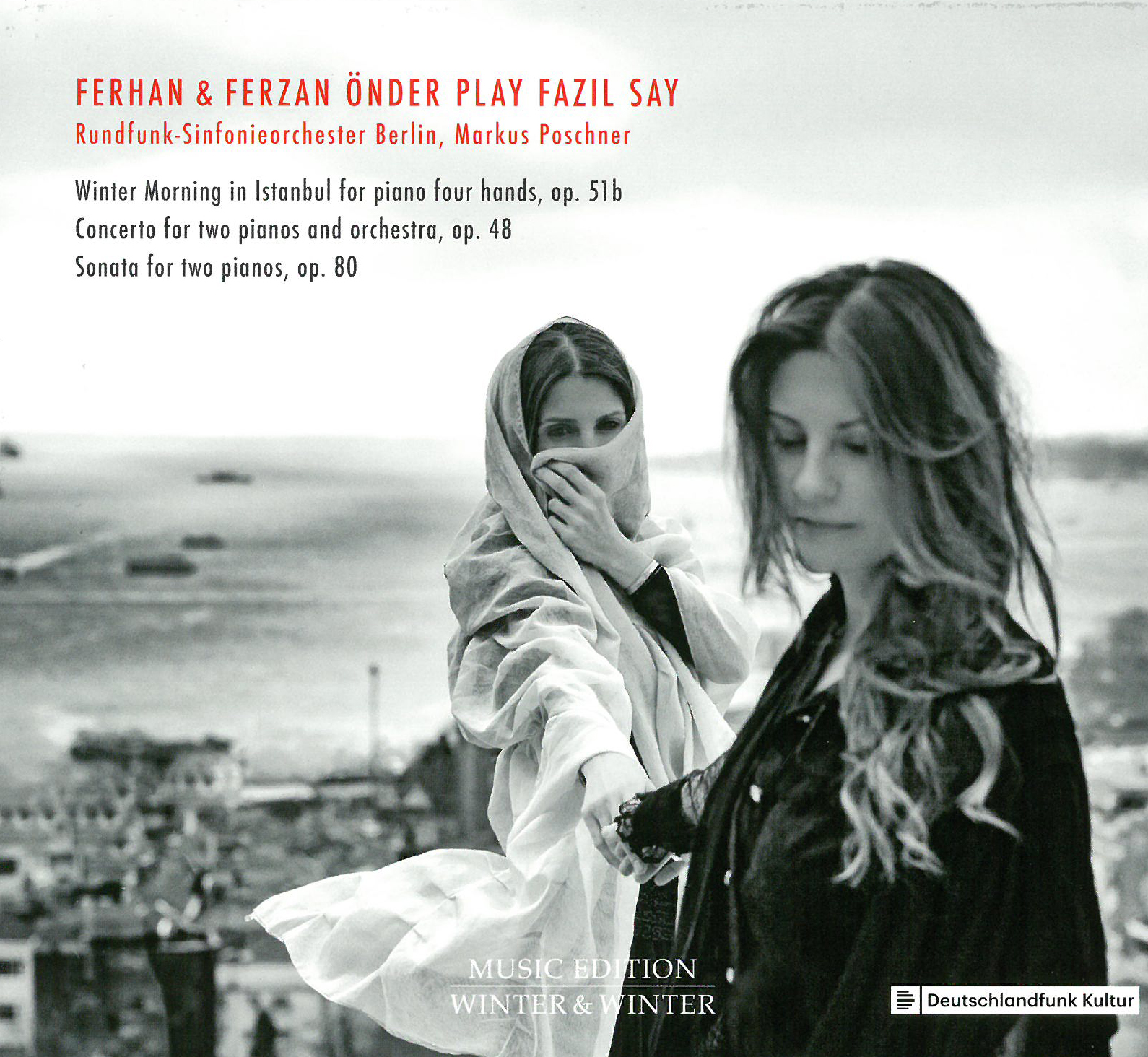
The duo piano approach of the Turkish-born Austrian twins Ferhan and Ferzan Önder comes together on this 2019 Winter & Winter recording to mine the many musical gems found in the music of contemporary Turkish composer Fazil Say. Although, unfortunately, Say has been plagued by political persecution in recent years – sentenced to jail time in 2013 for tweets that were considered “blasphemous” by the Turkish government – the now 49-year-old composer and pianist himself, has remained prolific and artistically relevant, writing challenging new pianistic and symphonic work, which is taken on here with class and aplomb by the Önder sisters with sweeping accompaniment from the Berlin Radio Symphony. Difficult to categorize stylistically – Say combines a historically rigorous mastery of Western art-music traditions, with influence taken from Turkish folk music, jazz and chance or improvisatory elements – the composer has assembled a hauntingly beautiful and unusual musical world that the talented Önder sisters tackle with virtuosity, expertise and their own recognizable musical agency.

Notable is the Sonata for Two Pianos, commissioned by the Louis Vuitton Foundation, which premiered earlier this year. Here, the sisters explore the range and expressive depth of the four-hand-piano tradition in order to bring to life this beautiful and challenging work that prods listeners to confront their own expectations of what constitutes contemporary classical performance in 2019 and to rethink what remains possible within the codified three-part sonata form employed here. Both the music of Say, and the nuanced playing of the Önder sisters, was new to me prior to receiving this recording. I am pleased to musically get to know these important and, very much of this moment, global artists.

Andrew Scott

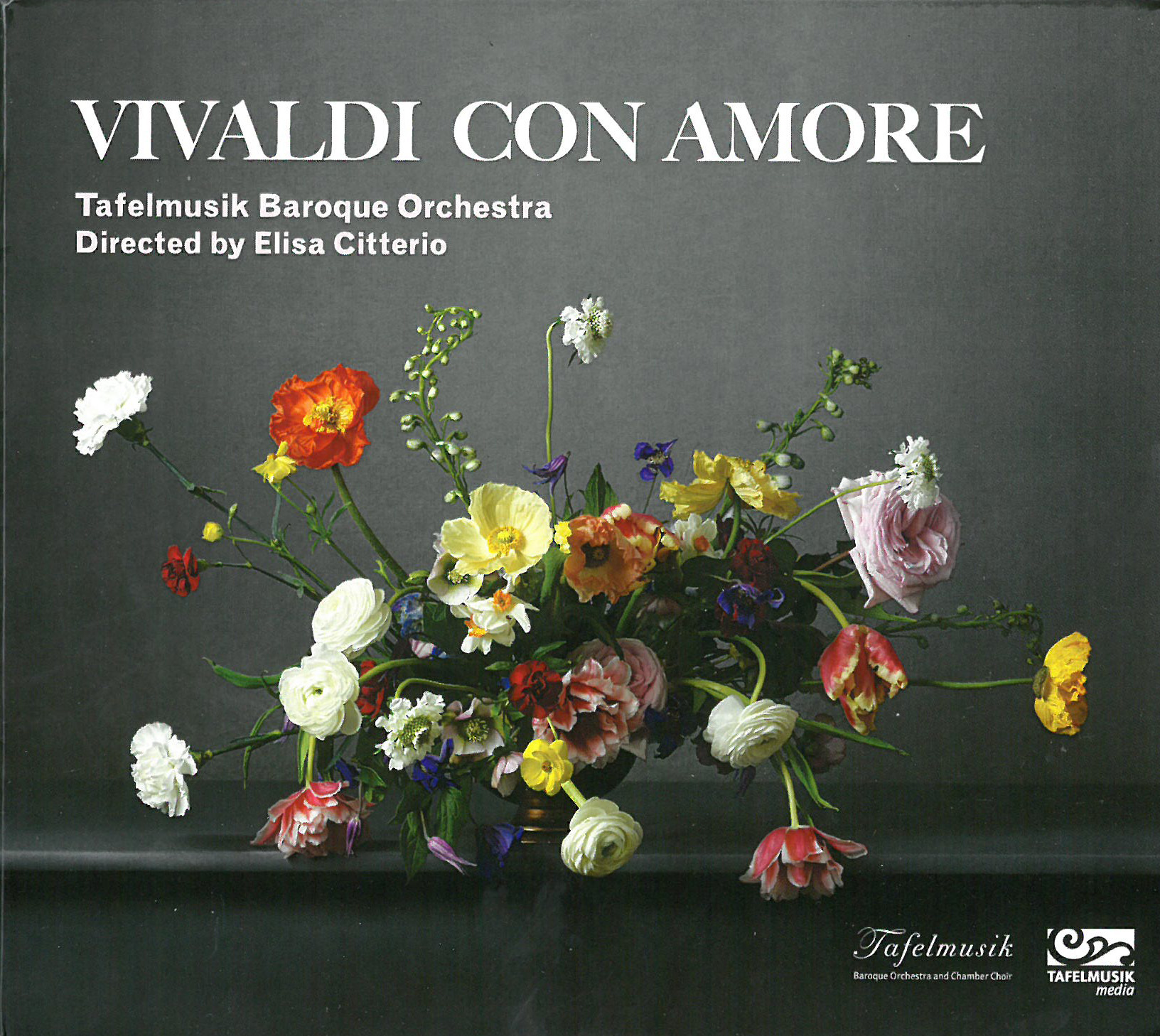
01 Tafelmusik VivaldiVivaldi con amore
Tafelmusik Baroque Orchestra; Elisa Citterio
Tafelmusik Media TMK 1039CD (tafelmusik.org)

Vivaldi con amore, Tafelmusik’s first recording under new music director Elisa Citterio, is a vivid and engaging reflection of both Vivaldi’s ebullient musical style and Citterio’s approach to working with her orchestra. Rather than releasing a disc that shines a spotlight squarely on her artistic leadership through conspicuously demanding orchestral virtuosity or by recording unexpected material, Vivaldi con amore maintains the integrity of the Tafelmusik ensemble, while putting the music first.

One of the most striking features of this recording is how, although there is a new leader at the orchestra’s helm, the “Tafelmusik sound” is maintained, such that these recordings are immediately identifiable as Tafelmusik’s own. Citterio’s respect for the ensemble is apparent in the content of the disc, which features seven separate concerti in which the orchestra’s musicians are given centre stage.

Containing over 75 minutes of the Italian master’s works, the title says it all: Vivaldi con amore; but, as the saying goes, “The devil is in the details.” No detail is overlooked in the interpretation of these works, with beautifully tapered phrasing throughout and thoughtful attention given to the contrasts present in Vivaldi’s pieces, making each come alive in its own way.

The appointment of a new music director is a tumultuous experience for any group, especially for one as established as Tafelmusik. Vivaldi con amore shows us that we need not look to the future to expect great results from this orchestra’s newest chapter; they are already here, and present on this disc.

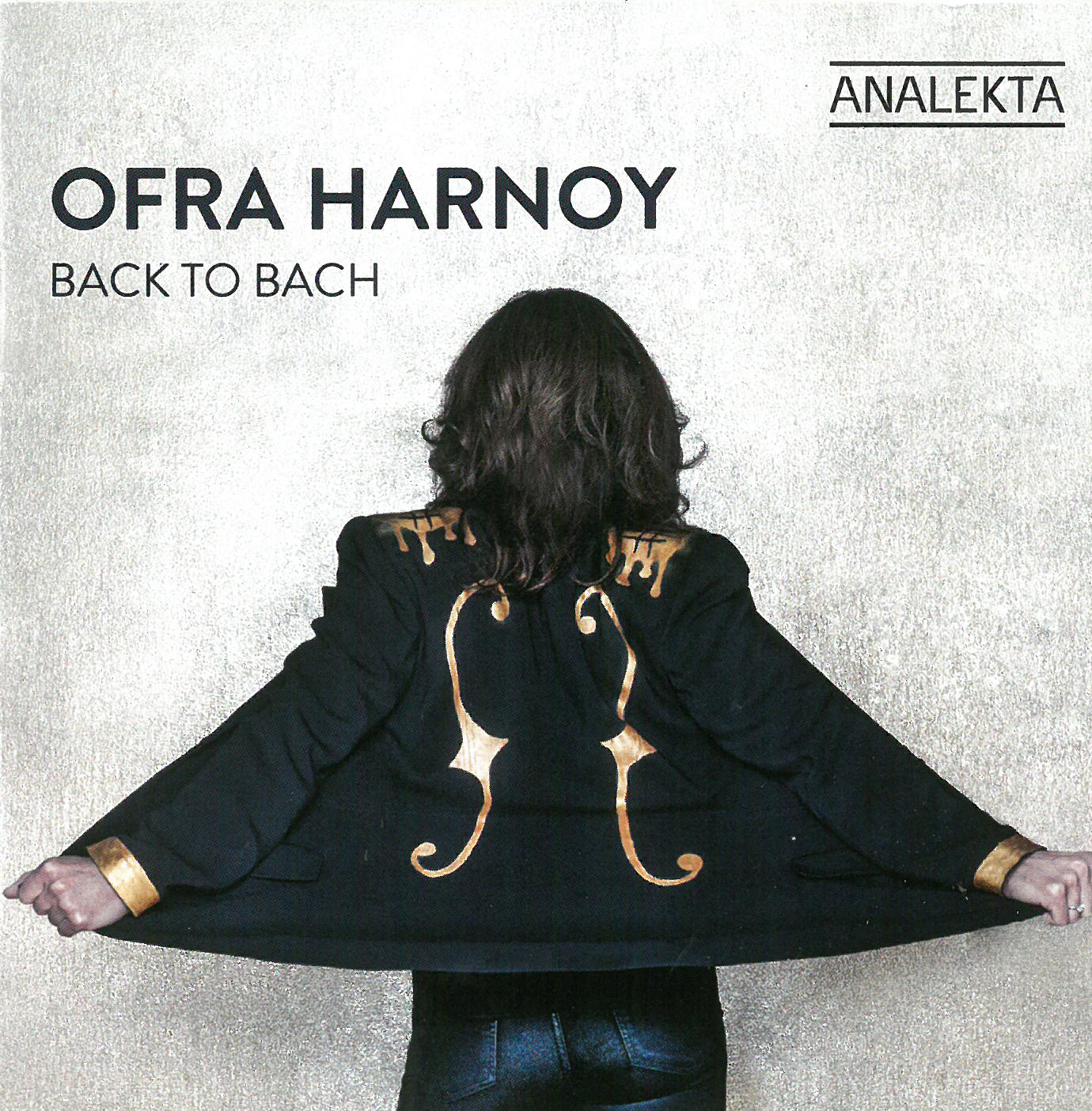
02 Ofra HarnoyBack to Bach
Ofra Harnoy; Mike Herriott
Analekta ACD 2 8907 (analekta.com)

With the release of her much anticipated new recording, luminous, gifted and transplendant Israeli/Canadian cellist, Ofra Harnoy, and her brilliant collaborator and husband, Mike Herriott, have not only brought forth a project of breathtaking beauty, but they have done the near impossible – through the use of contemporary technology, Herriott’s multi-instrumental/arranging/producing skills, Harnoy’s exquisite cello work (including large cello ensembles performed entirely by her), as well as a united, inspired vision – Harnoy and Herriett have manifested a fresh, innovative and genuine way of presenting this Baroque music in a way that is both exciting and accessible.

Not since the late Jacqueline du Pré (with whom Harnoy studied) has the world heard a cellist of Harnoy’s technical calibre and almost telepathic communicative skills. The well-chosen selections here include some material previously recorded by Harnoy from her 40-plus albums, as well as favourites such as Bach’s Air from Orchestral Suite No. 3 and Bist du bei mir, with the addition of more obscure, but stirring repertoire from Corelli and Allegri… and the sound of Harnoy’s breathtaking musicianship, multiplied by nine on Allegri’s Miserere is almost too beautiful to bear.

In bringing her vision to life, Harnoy also wanted to experiment with using brass instruments instead of the traditional string (or pipe organ, etc.) accompaniments, so Herriott created complex brass arrangements, and performed all of the parts himself: piccolo trumpet, trumpet, flugelhorn, French horn and trombone. There are literally only a handful of individuals in the world who could have accomplished what Herriott has so deftly done on this remarkable project. This recording is a triumph, and a must-have for any serious collector.

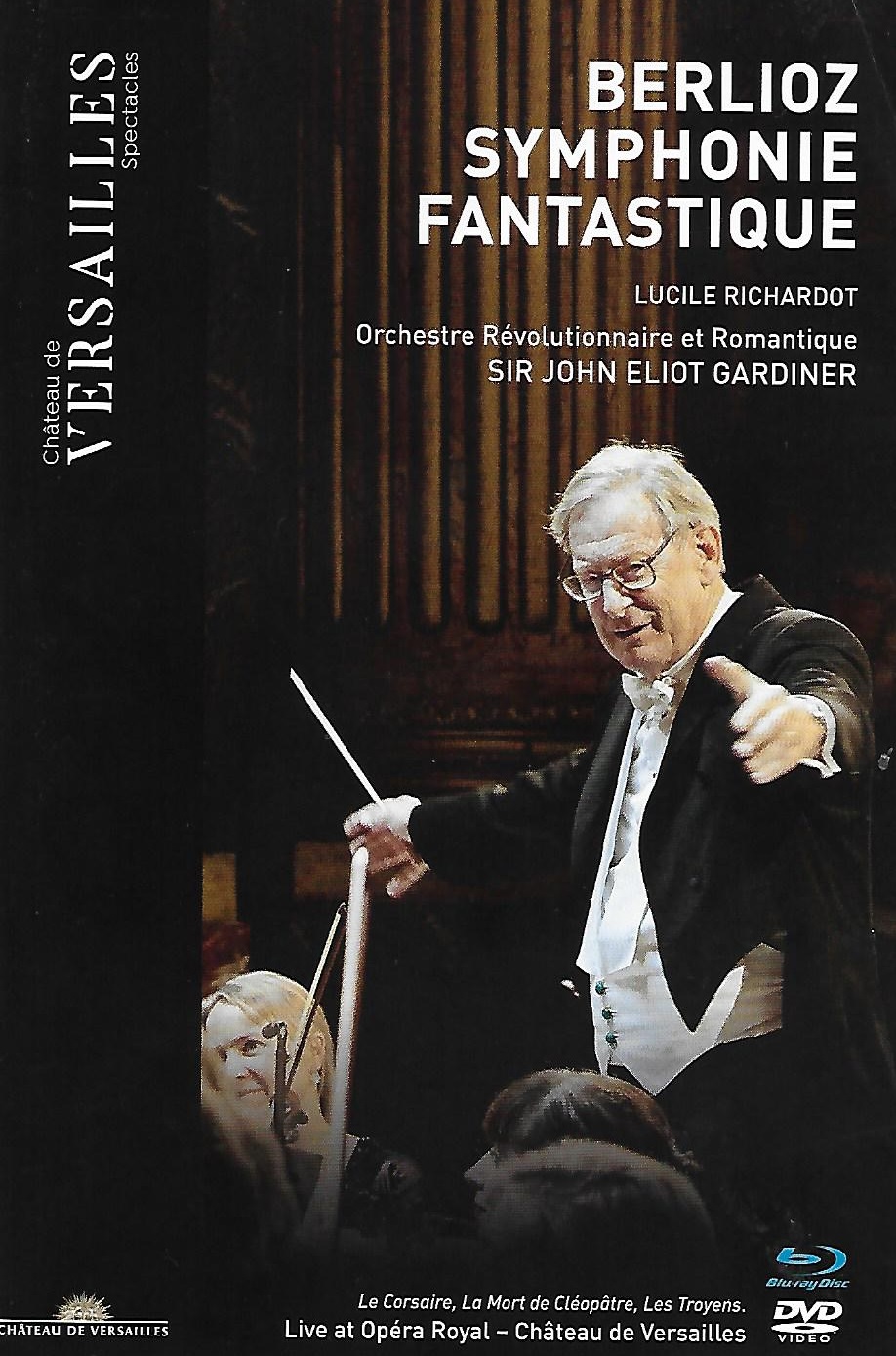
03 Berlioz FantastiqueBerlioz – Symphonie fantastique
Lucile Richardot; L’Orchestre Révolutionnaire et Romantique; John Eliot Gardiner
Chateau de Versailles CVS011 (naxosdirect.com)

There is no shortage of recordings of Berlioz’s Symphonie fantastique but here is yet another one of special interest. A hinged package contains two video discs and trilingual booklet. Presented is a video of an all-Berlioz concert given by Sir John Eliot Gardiner directing his orchestra, the Orchestre Révolutionnaire et Romantique in the opulent Opera Royal, Chateau de Versailles on October 17, 2018. The participating guest artist is mezzo-soprano Lucile Richardot. The program begins with the Overture to Le Corsaire, followed by a longtime favourite, the heartfelt, La mort de Cléopâtre, passionately delivered by the totally involved Richardot. From Les Troyens the orchestra plays The Royal Hunt and Storm and the impressive Richardot returns with a deeply felt realization of the Monologue et air de Didon, “Ah, je vais mourir… Adieu, fière cité.” Richardot is a French mezzo-soprano who is highly respected as a soloist in Baroque music and a lot more. You can readily appreciate her voice and versatility on any of her countless videos on YouTube.

As the arguments pro and con original instruments, i.e. the instruments of the composer’s day, have all been stated and debated there is no point in carrying them on here. However, here at least, these unique, previously unheard sonorities and textures of the instruments that Berlioz knew are eloquently articulate and a revelation for listener and viewer alike. Berlioz would be elated.

Footnote: “The Secret of Beethoven’s Fifth Symphony” with Gardiner and his orchestra on YouTube is a must-watch.

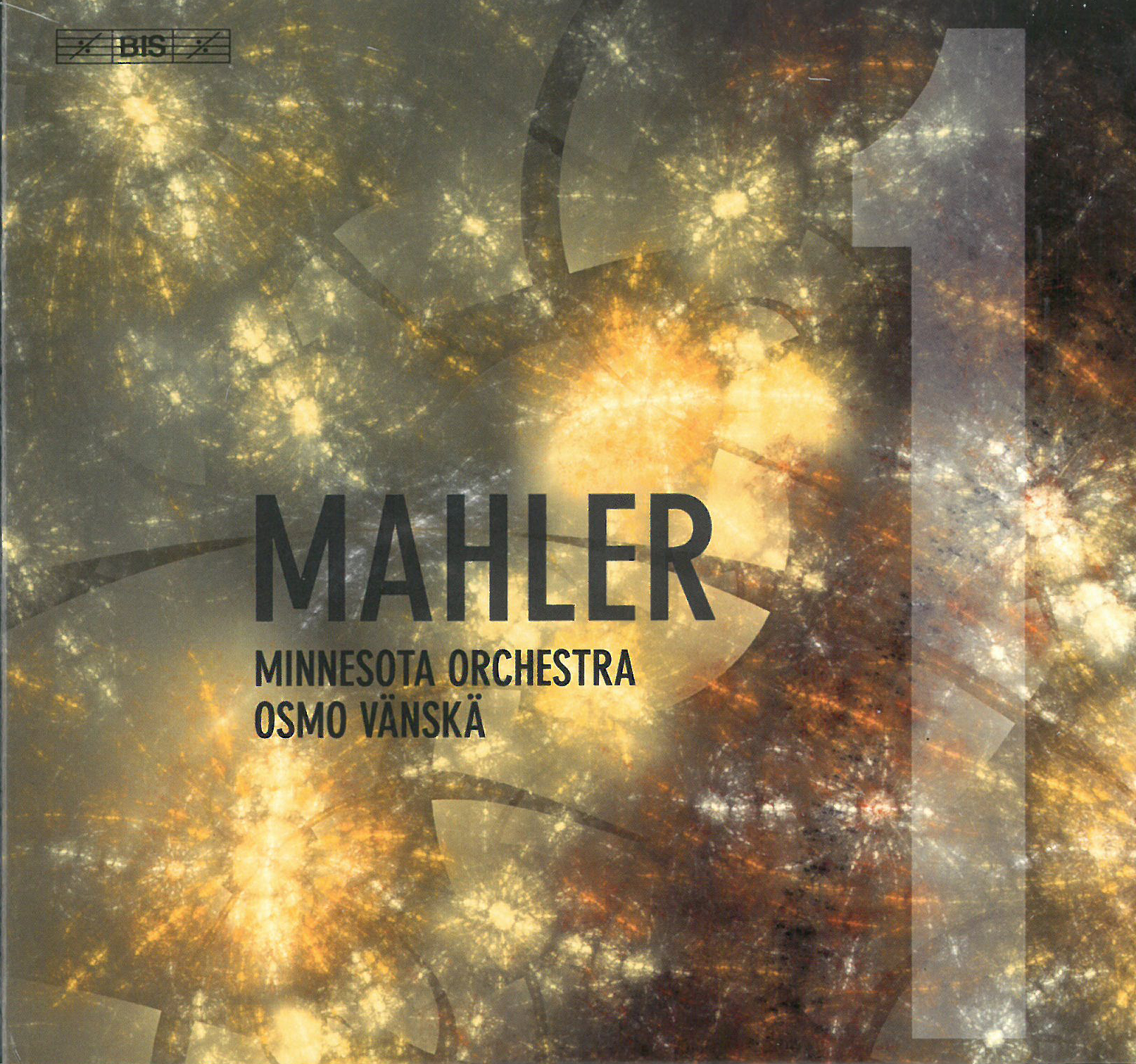
04 Mahler 1 MinnesotaMahler – Symphony No.1 in D Major
Minnesota Orchestra; Osmo Vänskä
BIS BIS-2346 (bis.se)

This is the fourth entry from the Minnesota Orchestra in a projected Mahler symphony cycle, following releases of the Second, Fifth and Sixth Symphonies under the direction of Osmo Vänskä, the well-regarded Finnish conductor who has devoted himself to bringing this ensemble to international renown since 2003. Mahler’s First Symphony, composed in his 24th year, reveals at a single stroke a unique and compelling voice; it remains one of his most-often-performed works. Vänskä’s solid and unaffected interpretation of the work, though structurally very well-paced, strikes me at times as a wee bit circumspect, particularly so in the funereal third movement, the opening of which is normally played as a mournful string bass solo but is contentiously (alas, not for the first time) assigned here to the entire bass section, robbing this introduction of its essentially grotesque quality; the underplaying of the intentionally vulgar interruptions of klezmer music that follows is yet another ironic opportunity missed. That being said, the strong bond between this orchestra and their leader provides in the end a highly compelling performance. I was tremendously impressed by the excellence and enthusiasm of the Minnesota musicians – I’ve rarely heard such a fierce viola section cut their way through the tumult of the finale of the work. Props as well to the recording team lead by Robert Suff; the low-floor recording level and resultant extended dynamic range lend an other-worldly aura to the liminal string harmonics that slowly reveal the magic of this work and conclude with a sonorous account of the glorious brass passages of the finale. While it’s admittedly not the definitive performance of this popular work in a very crowded field of contenders, it is certainly a substantially satisfying one.

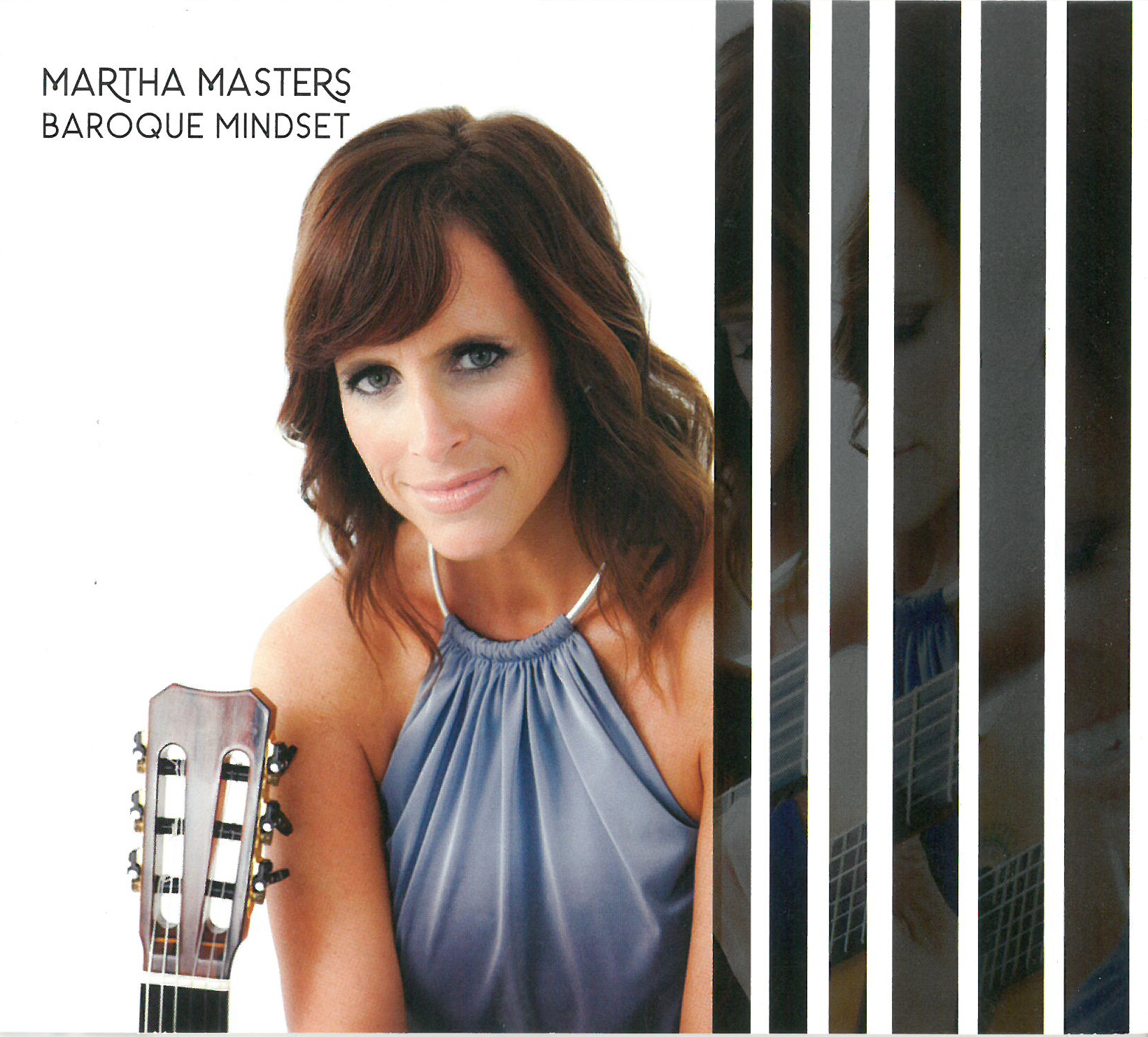
01 Martha MastersHow I’ve managed to miss the playing of guitarist Martha Masters is beyond me; she won the 2000 International Competition of the Guitar Foundation of America (of which she is currently president) and has issued five CDs. Her latest, Baroque Mindset (marthamasters.com) is an absolutely faultless and quite stunning recital of transcriptions of original violin and lute solo compositions by four exact contemporaries of the Baroque era: Georg Philipp Telemann (1681-1767); J. S. Bach (1685-1750); David Kellner (1670-1748); and Sylvius Leopold Weiss (1687-1750).

Telemann is represented by Fantasias I & III from his 12 Fantasias for solo violin; Bach by the Sonata No.3 in C Major BWV1005 for solo violin; Kellner by three pieces selected by Masters; and Weiss by the Fantasia and Passacaglia for lute. Everything here, from both a technical and artistic viewpoint is of the highest level – clarity, articulation, tonal warmth and colour, phrasing, dynamics and sense of line; are all superb.

It’s a simply outstanding CD.

Concert Note: October 19 the Guitar Society of Toronto presents Martha Masters at St. Andrew's Church, 73 Simcoe St., Toronto.

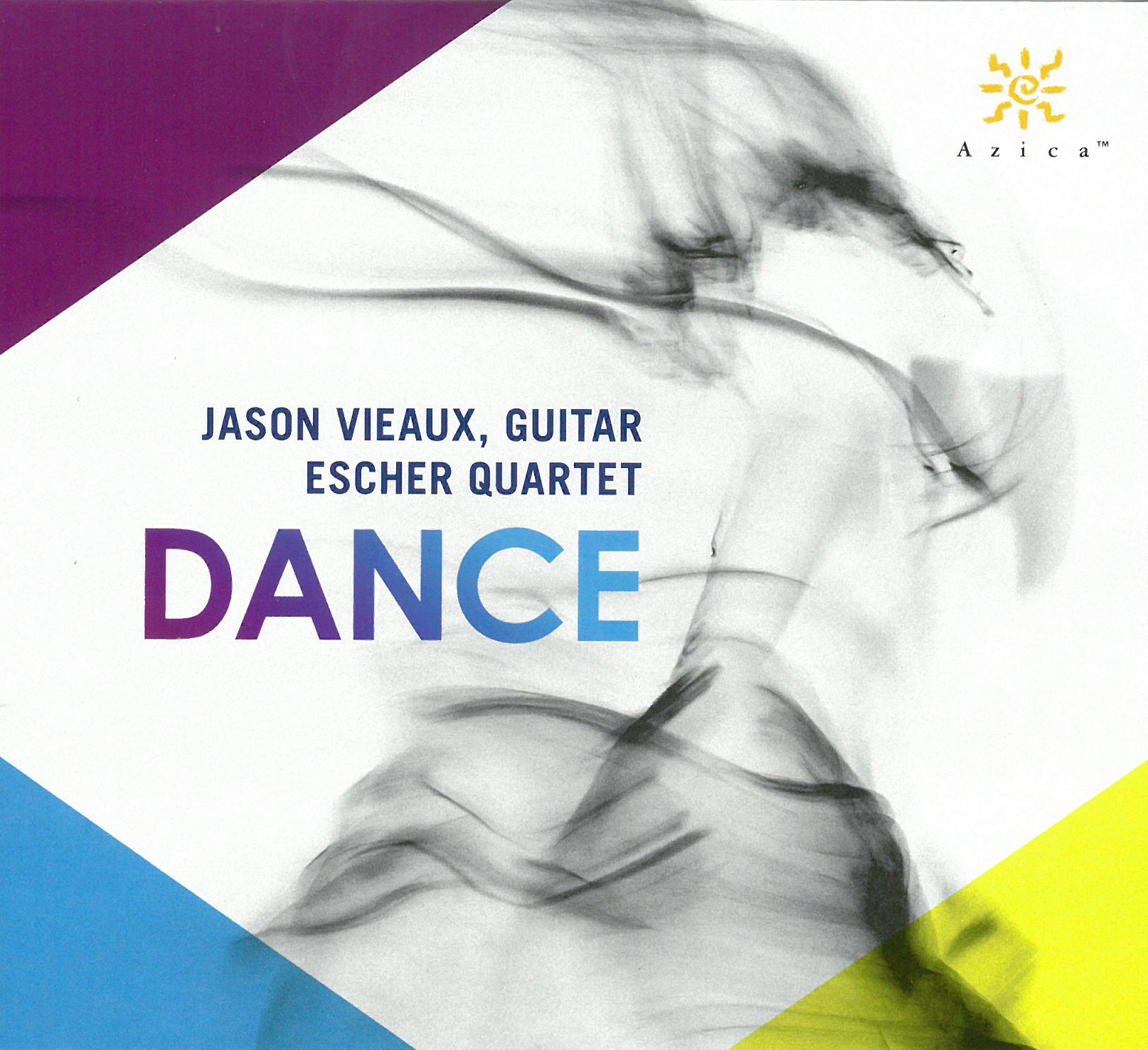
02 DanceThe guitar is just one of five instruments on Dance, a CD of chamber music featuring guitarist Jason Vieaux with the Escher Quartet (Azica ACD-71328 azica.com).

Mario Castelnuovo-Tedesco’s Guitar Quintet Op.143 from 1951 was a result of his long collaboration with Andrés Segovia. It’s a gloriously warm work that enthralls you from the opening bars and never lets go. It would be worth the price of the CD on its own, but the other two works here are anything but fillers.

100 Greatest Dance Hits from 1993, with its sounds of the 1970s, certainly shows the lighter side of Aaron Jay Kernis. Its percussive first movement is a bit jarring after the Castelnuovo-Tedesco, but the work soon establishes a delightful mood.

Boccherini’s Guitar Quintet No.4 in D Major, with the famous Fandango finale ends a terrific CD. Vieaux and the Escher Quartet have been playing these works together for the best part of ten years, and their delight and sheer enjoyment in recording three of their favourite quintets is clear for all to hear.

Listen to 'Dance' Now in the Listening Room

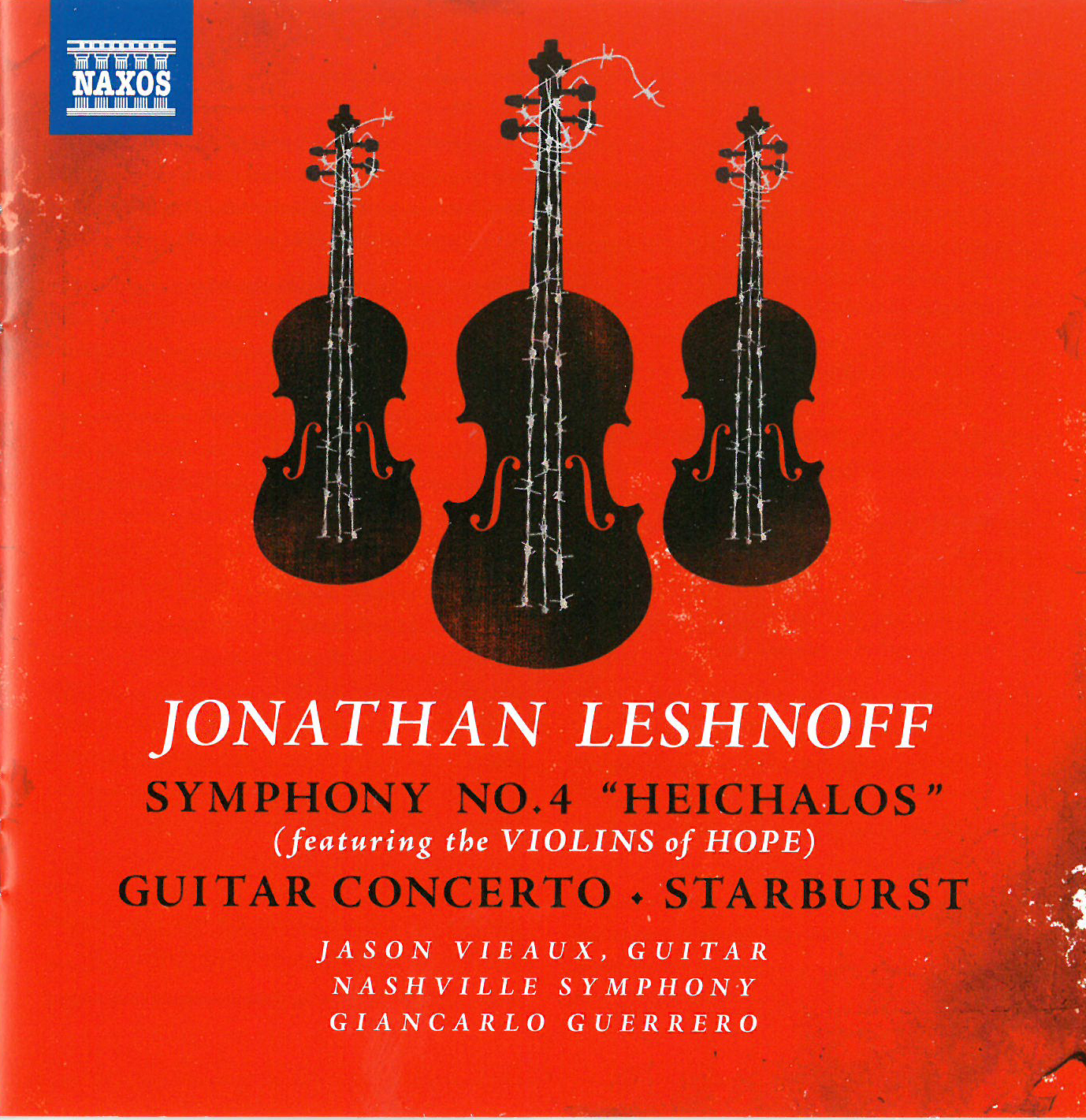
03 LeshnoffJason Vieaux is also the soloist on a CD of works by American composer Jonathan Leshnoff (b.1973), this time the Guitar Concerto with the Nashville Symphony Orchestra under Giancarlo Guerrero (Naxos 8.559809 naxos.com). It’s a really strong and attractive work, idiomatic and much in the style of the great Spanish concertos.

The concerto is the centrepiece on a CD of world premiere recordings, the two-part Symphony No.4 “Heichalos” from 2017 opening the disc and the dazzling orchestral tour-de-force Starburst from 2010 closing it, both works strongly tonal and with more than a hint of Samuel Barber in their sound.

Really top-notch performances and recording quality make for a compelling CD.

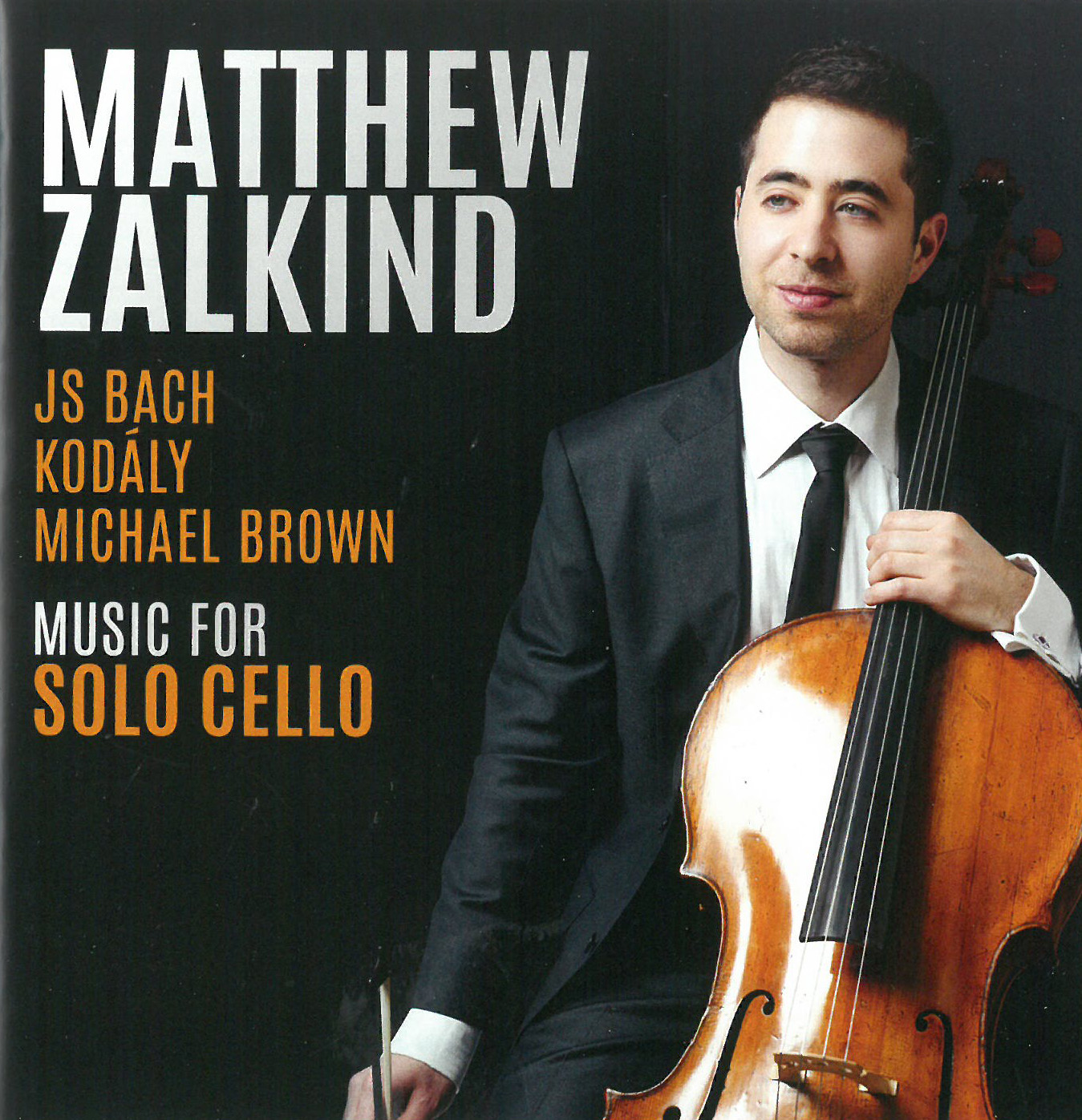
04 ZalkindThe American cellist Matthew Zalkind makes an outstanding solo CD debut with Music for Solo Cello (Avie AV2406 naxosdirect.com), featuring Bach’s Suite No.6 in D Major BWV1012, the Suite for Solo Cello by New York composer Michael Brown (born 1987) and the monumental Sonata for Solo Cello Op.8 by Zoltán Kodály.

The Bach Suite is believed to have been written for a five-string piccolo cello, but Zalkind uses a conventional modern four-string instrument and set-up. The awkward challenges this presents never impact on Zalkind’s warmth and fine sense of dance rhythm.

The Brown Suite is relatively short and, having apparently been influenced by both other works, makes a fitting bridge to a stunning performance of Kodály’s magnificent Sonata. 

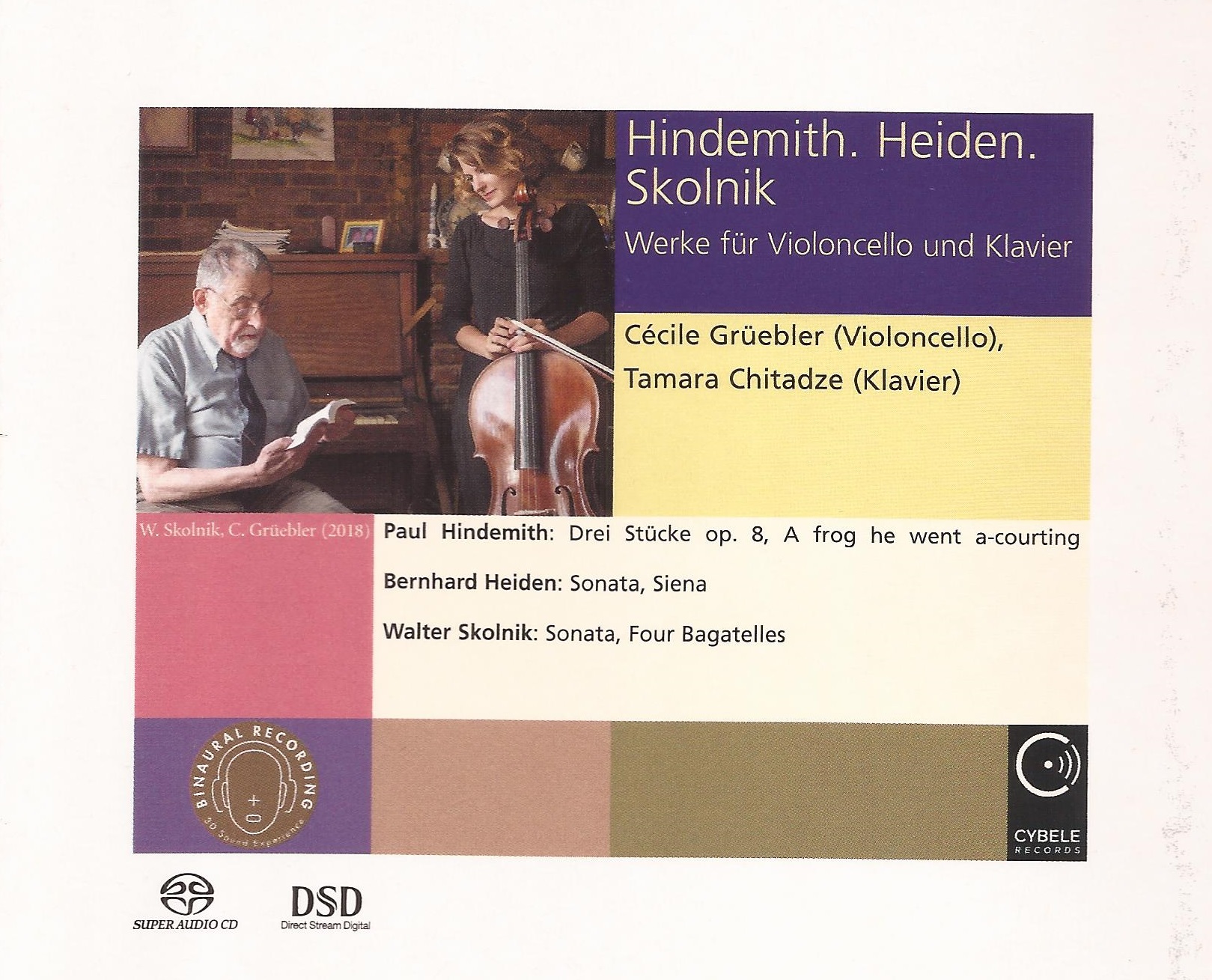
05 Gruebler scanSwiss cellist Cécile Grüebler’s first CD – one on which she wanted to tell a story and not simply play pieces – sprang from a chance meeting in New York in 2017 with the Manhattan-based American composer Walter Skolnik (born 1934). When the two played music together, Grüebler learned that Skolnik’s principal teacher, the German-American Bernhard Heiden (1910-2000) had in turn studied with Hindemith. The result is Hindemith. Heiden. Skolnik, an intriguing CD of works by all three composers, with Grüebler accompanied by her longtime duo partner, pianist Tamara Chitadze (Cybele SACD 361804 cybele.de).

The Hindemith works are Drei Stücke Op.8 (1917) and A frog he went a-courting – Variations on an old English Nursery Song (1941). Heiden, who was born in Frankfurt and immigrated to the United States in 1938 is represented by his Cello Sonata (1958) and the short Siena (1961), while the works by Skolnik, who studied with Heiden at Indiana University, are the Cello Sonata (2004) and Four Bagatelles (1998). Grüebler’s commitment to the project results in excellent performances of some little-known works.

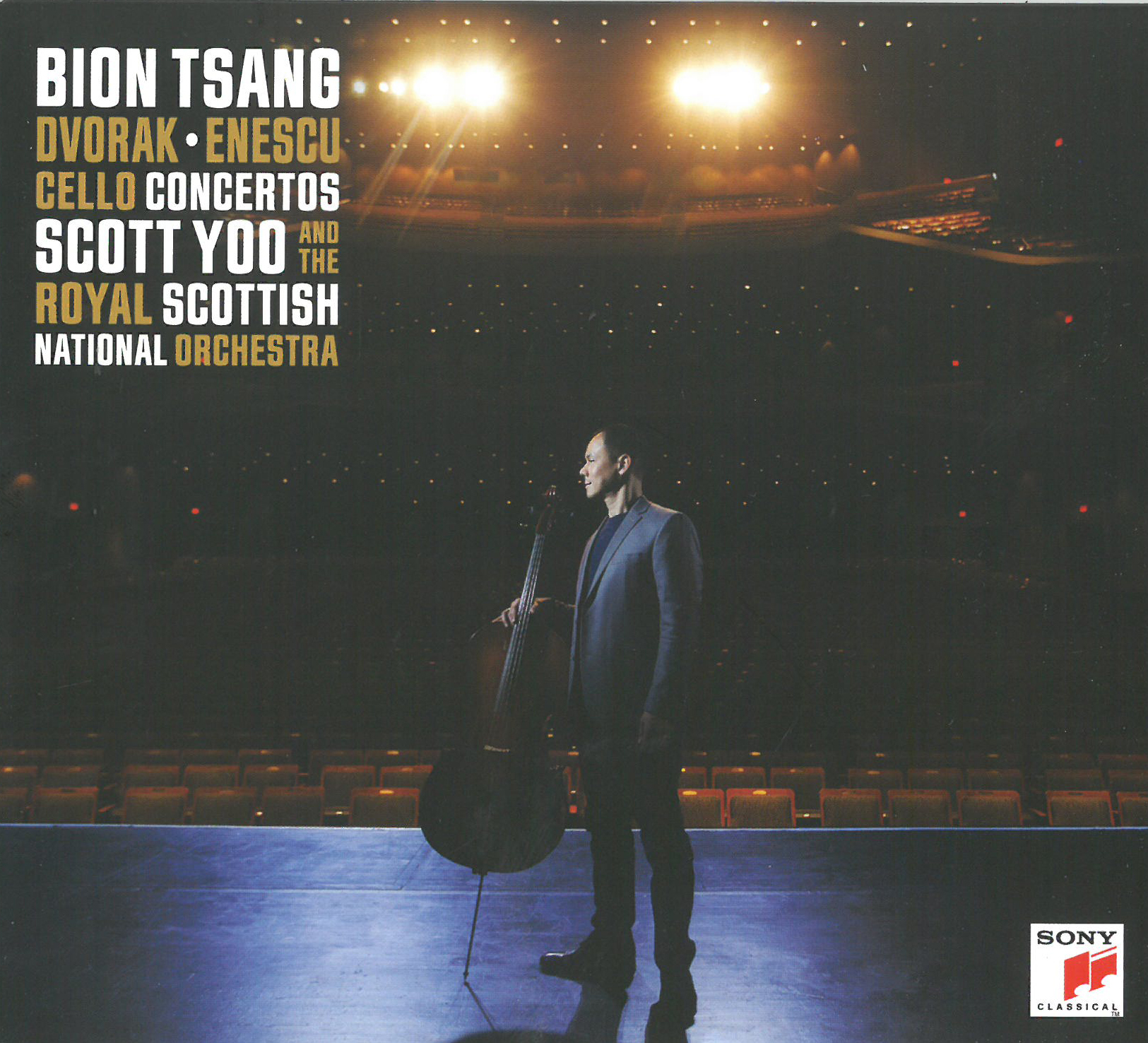
06 Bion TsangBion Tsang is the excellent soloist in the interesting pairing of Dvořák & Enescu Cello Concertos with Scott Yoo conducting the Royal Scottish National Orchestra (Sony Classical S80459C biontsang.com).

There’s no booklet and a complete lack of bio or program notes, but the infrequently heard two-movement Symphonie Concertante Op.8 by Georges Enescu is an appropriate partner for the more famous Dvořák Concerto in B Minor Op.104 – it’s in the same key and was written in 1901, a mere six years after the Dvořák, when Enescu was just 20. Both works are given lovely performances.

Listen to 'Dvořák & Enescu Cello Concertos' Now in the Listening Room

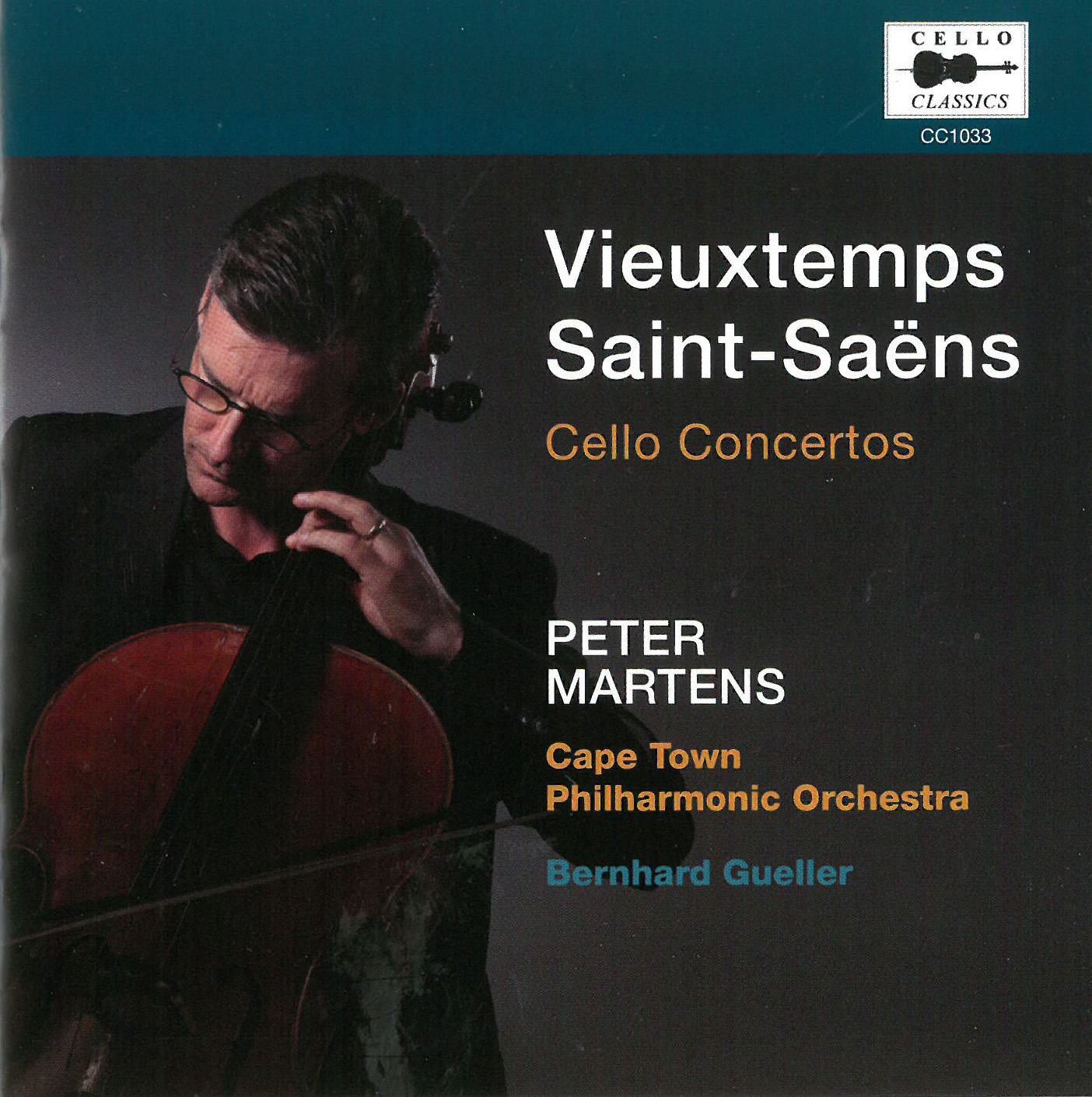
07 Vieuxtemps Saint SaensSouth-African cellist Peter Martens is the soloist in Vieuxtemps & Saint-Saëns Cello Concertos, with the Cape Town Philharmonic Orchestra under Bernhard Gueller (Cello Classics CC1033 celloclassics.com).

Connections abound in this recording project. Both concertos are No.1 in A Minor – Op.46 for Vieuxtemps and Op.33 for Saint-Saëns; both composers also wrote a second, less successful cello concerto. The Saint-Saëns was the first concerto Martens played with an orchestra – the Cape Town Philharmonic in its previous incarnation as the Cape Town Symphony. Conductor Gueller was a front-desk cellist in the celebrated recording of the Vieuxtemps concertos by Heinrich Schiff, with whom Martens had a masterclass while a student in Salzburg.

Marten’s decision to pair the concertos instead of recording two by Vieuxtemps feels absolutely right, as does his choice of the three fillers on the disc: two by Saint-Saëns – his Allegro appassionato Op.43 and, in Paul Vidal’s arrangement, The Swan; and Fauré’s Elégie Op.24 in the composer’s own orchestration.

Martens is terrific in the two extremely virtuosic and difficult concertos, handling the technical challenges with deceptive ease and displaying a fine sense of line and phrase.

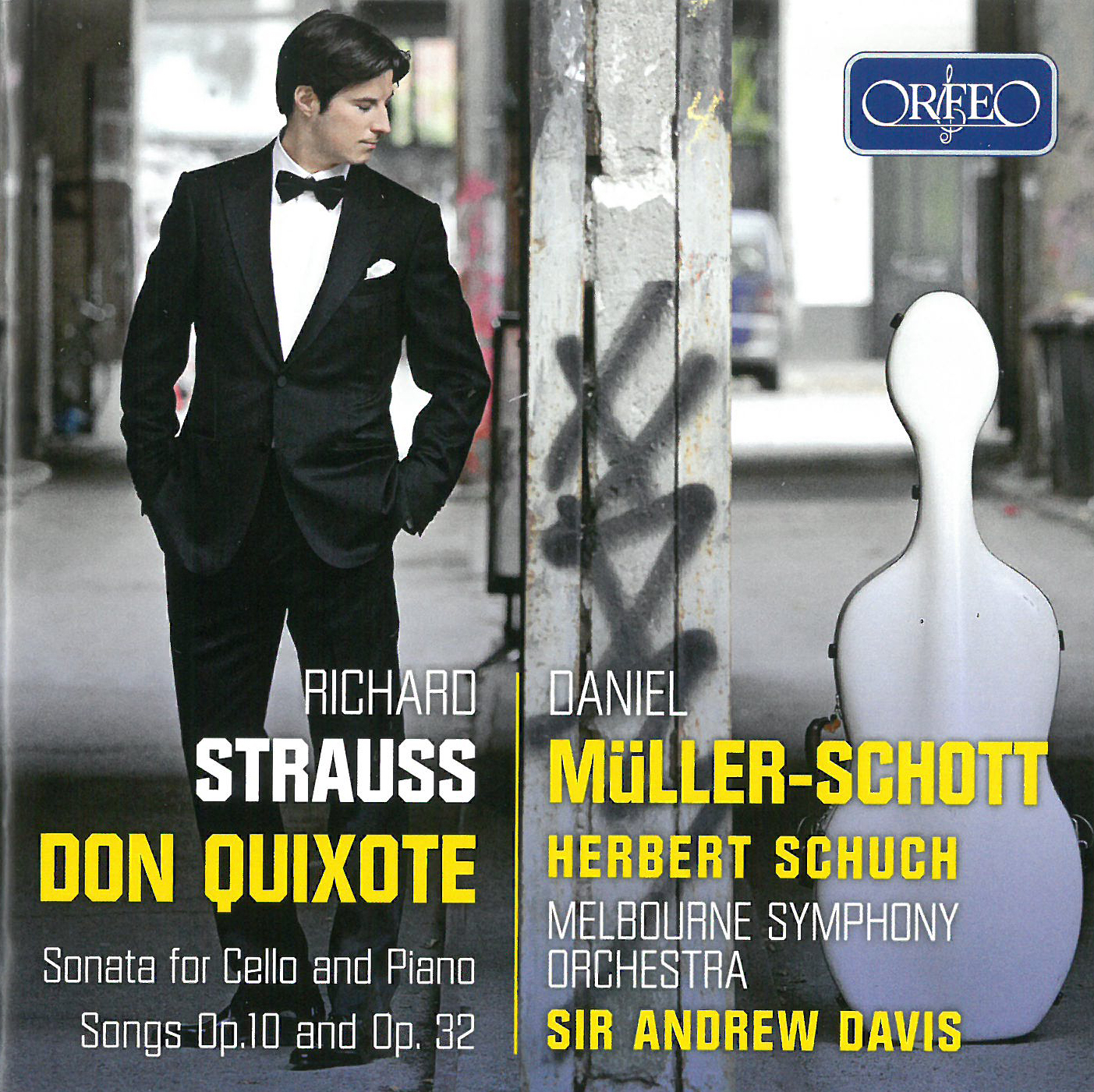
08 Strauss Muller SchottRichard Strauss left only three works for cello, and two of them are performed by the German cellist Daniel Müller-Schott on Richard Strauss Don Quixote (Orfeo C 968 191 naxos.com). Herbert Schuch is the pianist in the early Cello Sonata in F major Op.6 and in two songs transcribed by Müller-Schott specifically for this recording – Zueignung Op.10 No.1 and Ich trage meine Minne Op.32 No.1.

The sonata elicits some truly lovely playing, but the main interest here is the quasi-tone poem Don Quixote – Fantastic variations on a Knightly Theme Op.35 from 1897 when Strauss was 33 and leading the way from Romanticism to the modern era. Inspired by the Cervantes novel and recorded in live performance with the Melbourne Symphony Orchestra under Sir Andrew Davis in June 2017, it’s a richly textured work lasting over 40 minutes, drawing great playing from all concerned.

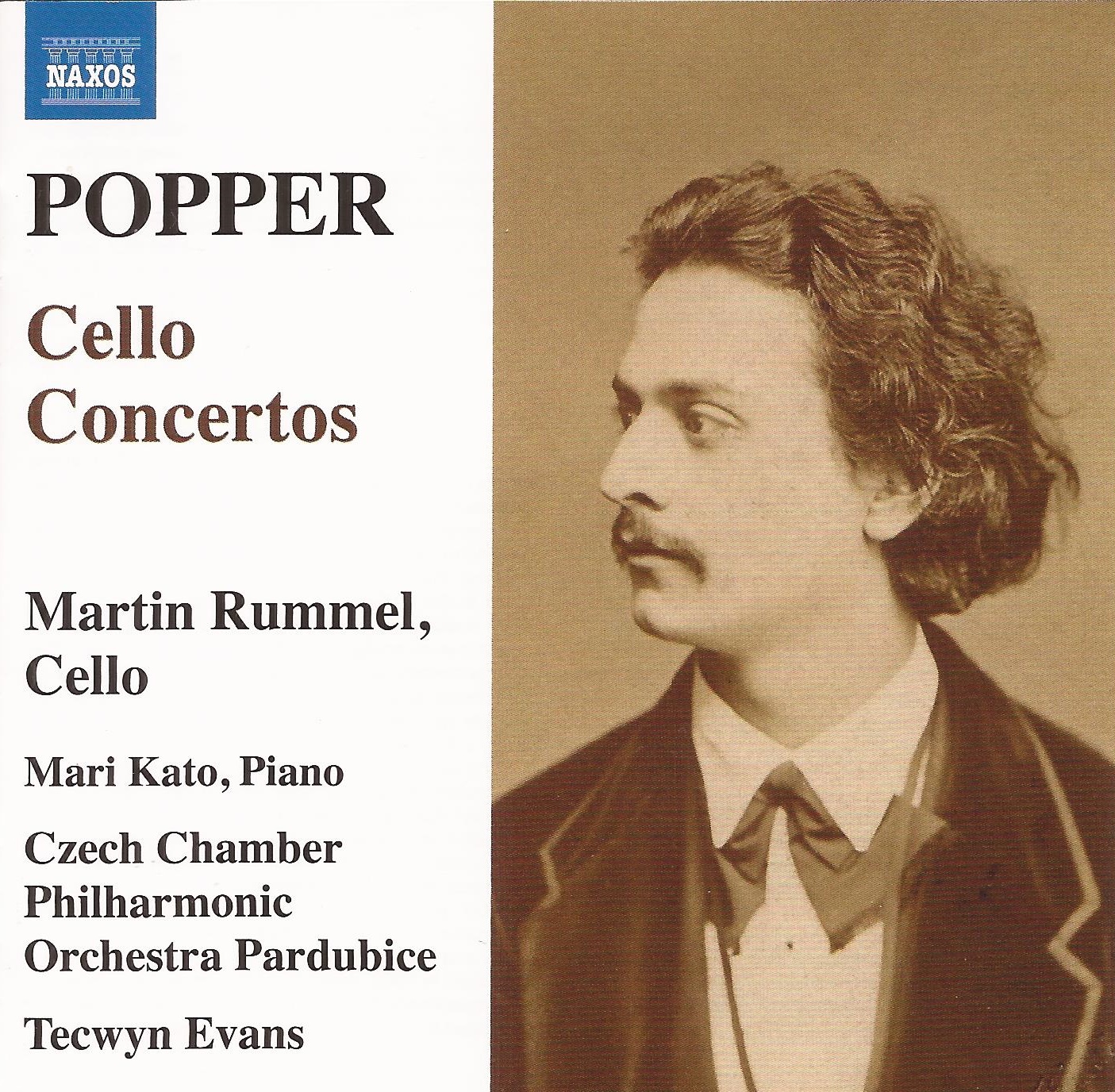
09 Popper scanDavid Popper was one of the 18th century’s most important cellists and a more than merely competent composer, as well as virtuoso and teacher. His four seldom-heard Cello Concertos are performed by Austrian cellist Martin Rummel with the Czech Chamber Philharmonic Orchestra Pardubice under Tecwyn Evans (Naxos 8.573930 naxos.com). Mari Kato is the accompanist in the Cello Concerto No.4 in B Minor Op.72, heard here in the version for cello and piano.

The three concertos No.1 in D Minor Op.8, No.2 in E Minor Op.24 and the single-movement No.3 in G major Op.59 are all delightful works, stylistically exactly what you would expect from a Romantic composer who was primarily a great cellist and pedagogue. Rummel provides really lovely playing, with a singing tone and a smoothness that belies the undoubted technical difficulties.

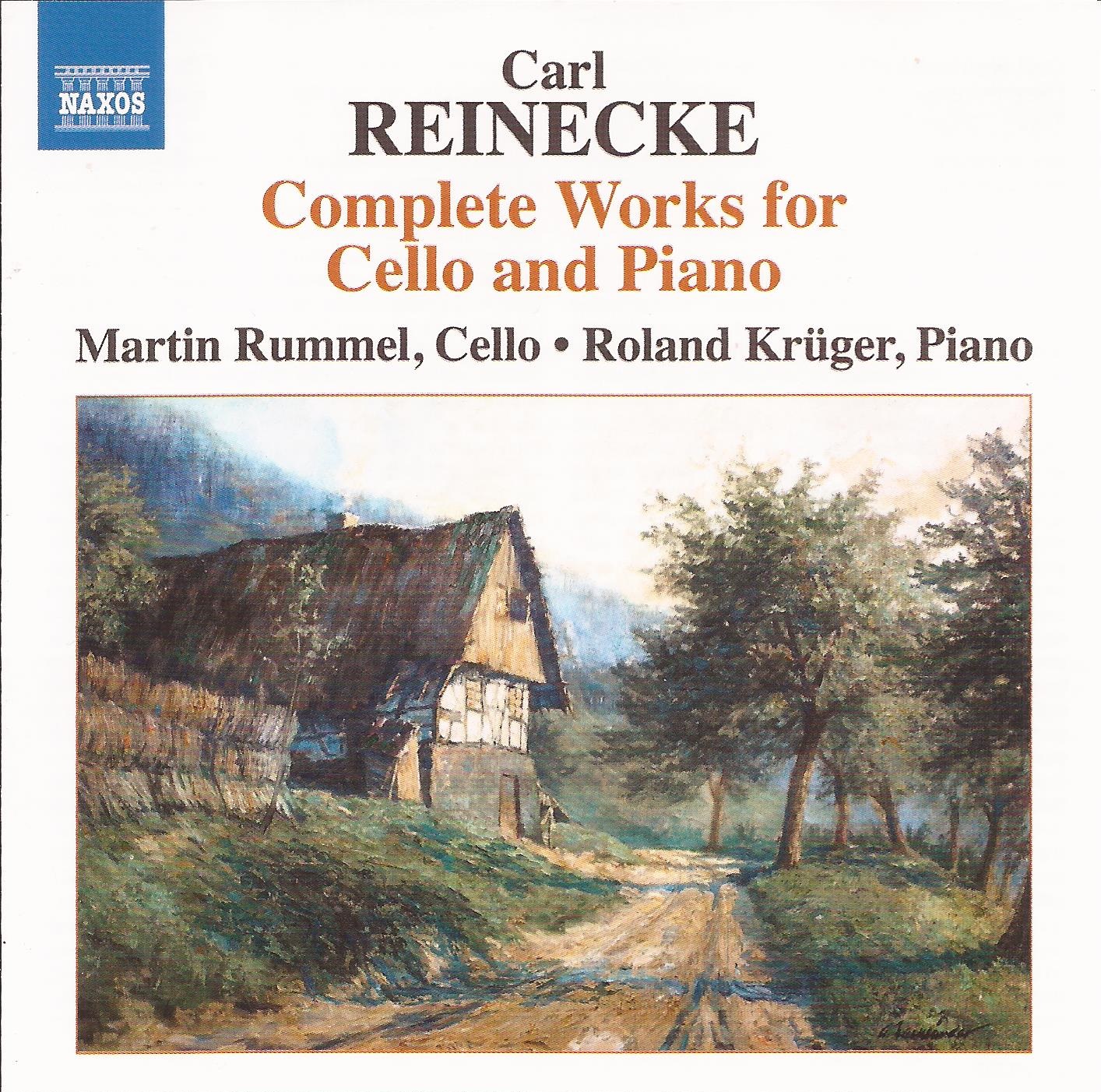
10 Reinecke scanMartin Rummel is also the soloist, this time with pianist Roland Krüger, on another excellent Naxos disc, the Complete Works for Cello and Piano by Popper’s exact contemporary, the German Carl Reinecke (Naxos 8.573727 naxos.com).

Rummel brings the same idiomatic Romantic styling to the three Cello Sonatas – No.1 in A Minor Op.42 (1855), No.2 in D Major Op.89 (1866) and No.3 in G major Op.238 (1897) and the Three Pieces Op.146 from 1893. Tully Potter’s booklet essay notes the “technical skill and easy flow of melody” in Reinecke’s cello music, with the cello and piano clearly on an equal footing.

Outstanding playing coupled with the usual top-notch Naxos production standards make for a terrific CD.

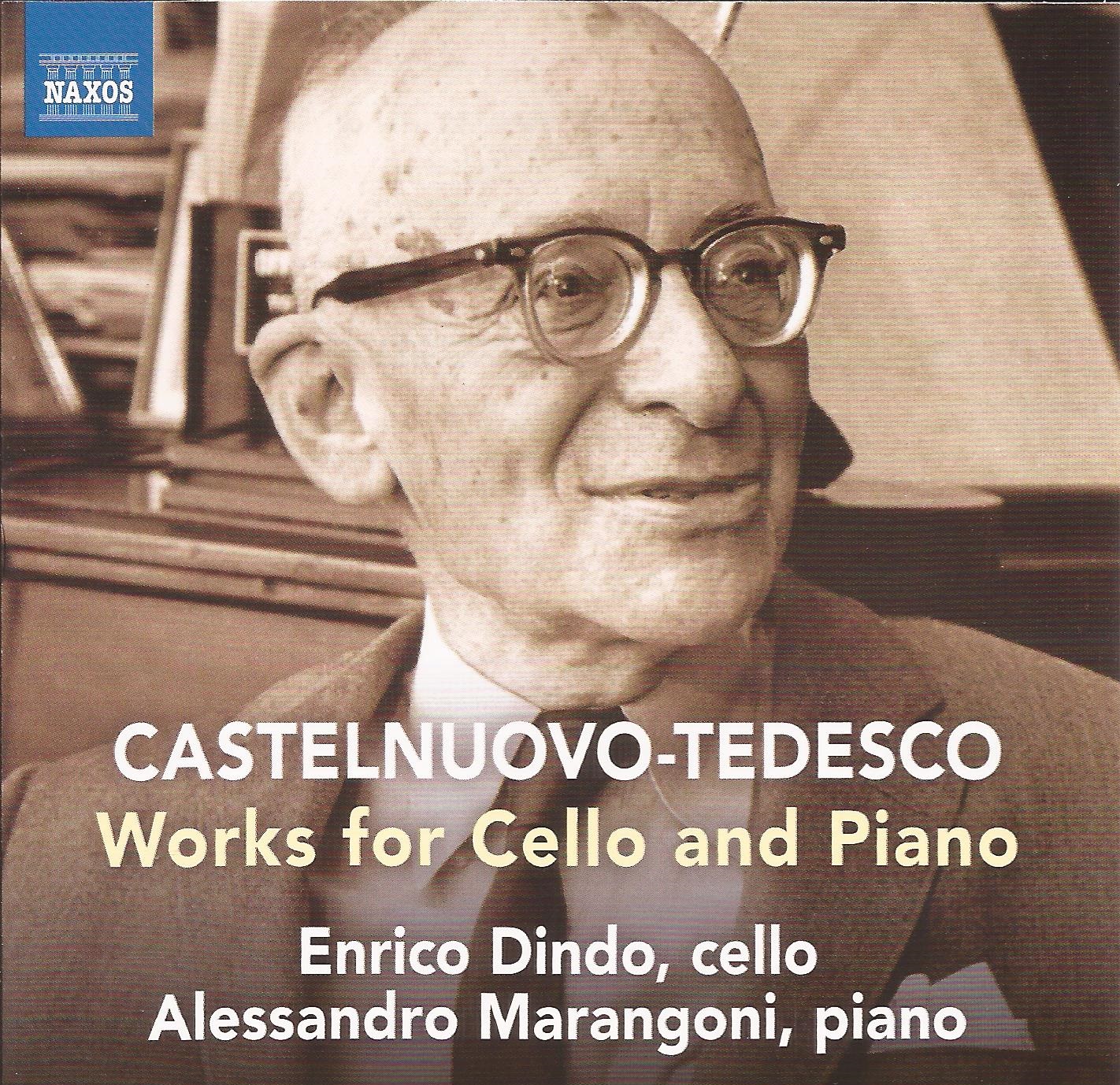
11 Mario scanAnother Naxos CD explores Works for Cello and Piano by Mario Castelnuovo-Tedesco with the Italian duo of cellist Enrico Dindo and pianist Alessandro Marangoni (Naxos 8.573881 naxos.com).

The selected pieces cover the period 1927-1946, the main works being the Cello Sonata Op.50 (1928), I nottmbuli (Variazioni fantastiche) Op.47 (1927), the Toccata Op.83 (1935) and, in a world-premiere recording, the Sonatina Op.130 from 1946. Four short pieces, including the unpublished Kol Nidre “Meditation” (1941) complete the CD.

There’s fine playing throughout a beautifully recorded disc, with the virtuoso piano part reflecting the composer’s own pianistic skills.

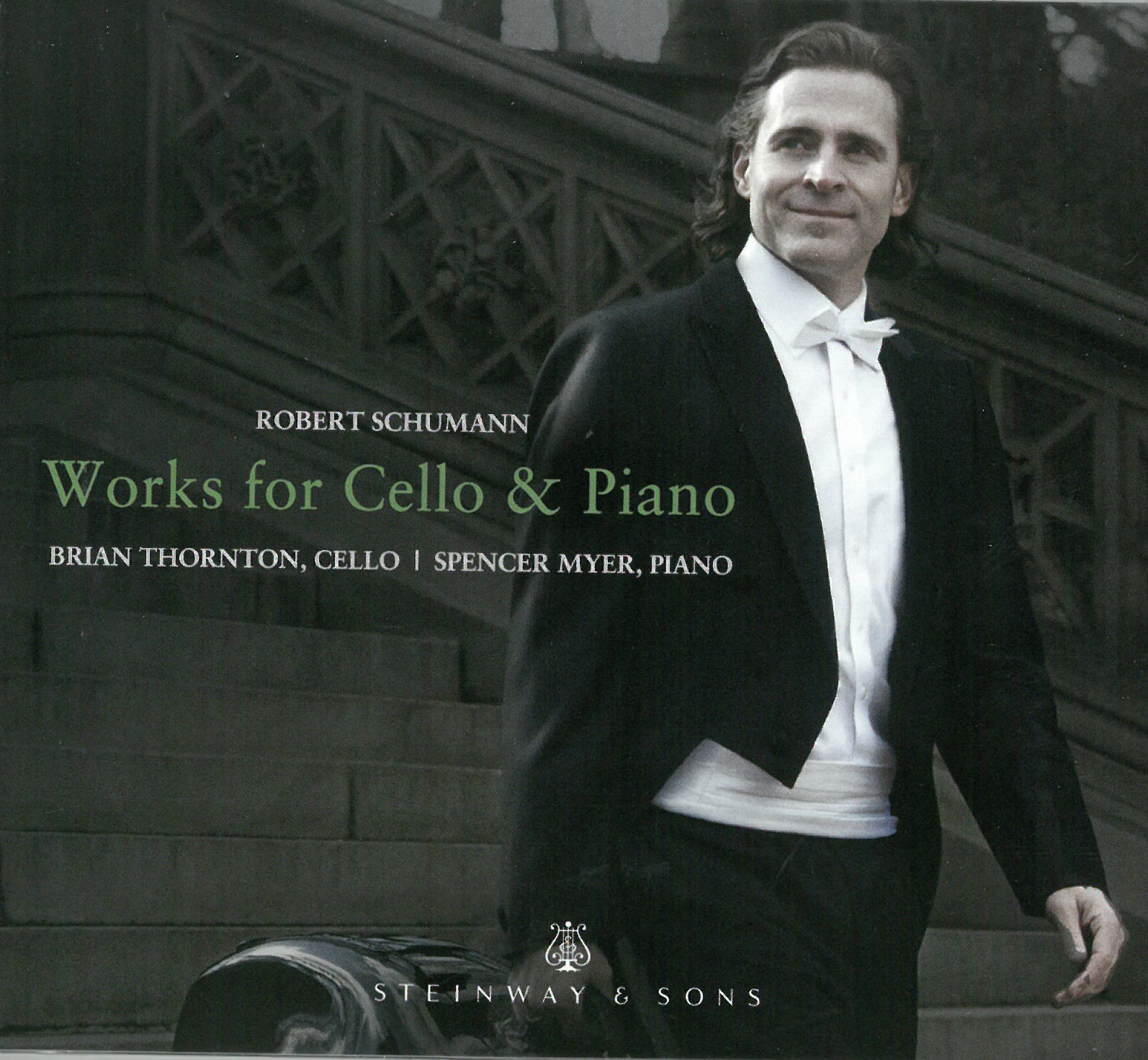
12 Schumann ThorntonCleveland Orchestra cellist Brian Thornton is the cellist and Spencer Myer the pianist on Robert Schumann Works for Cello & Piano on the Steinway & Sons label which was founded in 2010 (Steinway 30117 steinway.com).

Thornton has a deep, warm and velvety tone in the Adagio and Allegro Op.70, the Fünf Stücke im Volkston Op.102 and the Fantasiestücke Op.73, ably partnered by Myer.

Schubert’s Ave Maria D839 is a simply lovely, if somewhat unexpected, closing track.

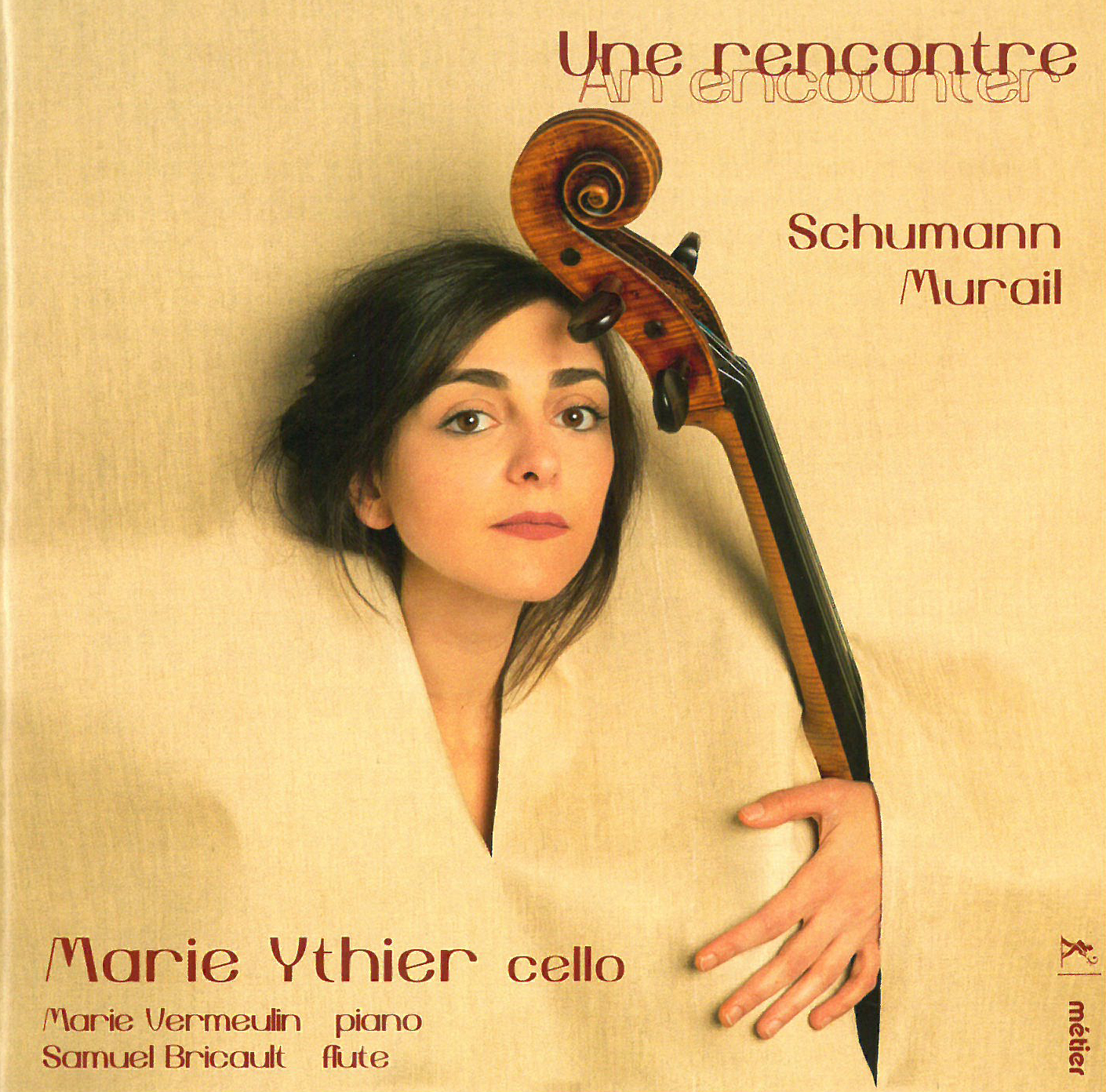
13 Schumann Murail YthierThere’s more Schumann cello on Une rencontre, a CD of works by Robert Schumann and the French composer Tristan Murail (born 1947), who explains his encounters with both Schumann and cellist Marie Ythier in the extensive booklet notes (Métier msv 28590 divineartrecords.com). There’s a lighter and cleaner balance between Ythier and pianist Marie Vermeulin in the Fünf Stücke im Volkston Op.102 and the Fantasiestücke Op.73 than on the Steinway disc, with perhaps a touch more tonal nuance.

Attracteurs étranges (1992) and C’est un jardin secret, ma sœur, ma fiancée, une fontaine close, une source scellée from 1976 are both solo cello works by Murail; flutist Samuel Bricault joins Ythier in Murail’s Une letter de Vincent (2018).

The final encounter is Murail’s recent instrumental re-interpretation of Schumann’s piano work Scènes d’enfants (Kinderszenen) Op.15, subtitled Une Relecture pour violoncelle, flûte et piano, Murail using a range of instrumental techniques to make the orchestration sound larger than a trio.

Listen to 'Une rencontre' Now in the Listening Room

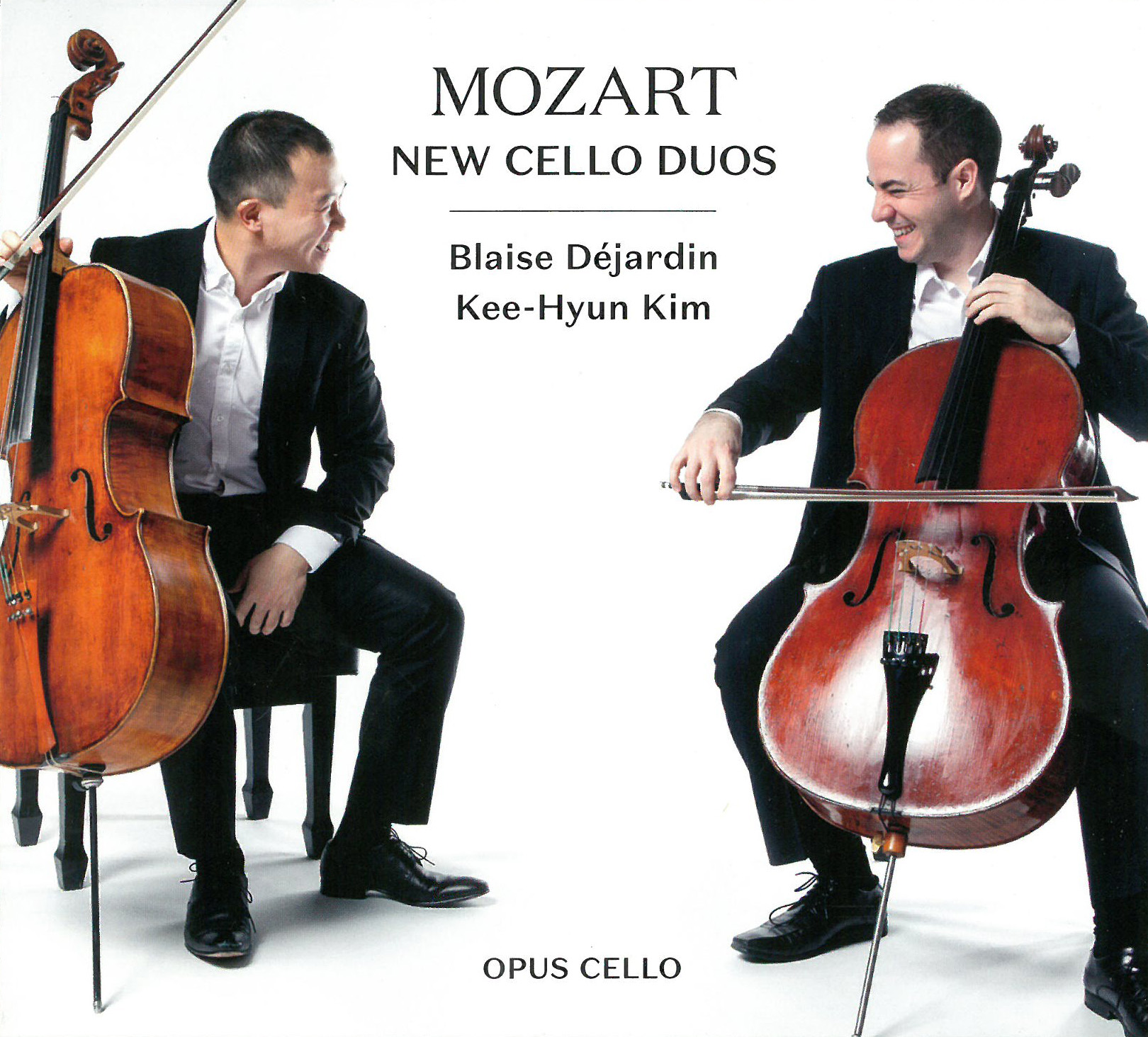
14 Mozart Cello DuetsThe sheet music publishing company Opus Cello was formed by Boston Symphony Orchestra principal cellist Blaise Déjardin in 2013 with the aim of bringing new, quality additions to the cello ensemble repertoire. Three works arranged by Déjardin are on Mozart New Cello Duos, the first CD release from Opus Cello (opuscello.com) and featuring Blaise Déjardin and the Parker String Quartet’s cellist Kee-Hyun Kim.

The 12 Variations on “Ah, vous dirai-je Maman” K265/300e provide plenty of virtuosic fireworks as an introduction to the two Duos for Violin and Viola in G Major K423 and B-flat Major K424. There’s a lovely feel to the duo transcriptions, although the lower voicings make for a slightly thicker texture at times. Still, there’s really fine playing on a nicely recorded and highly enjoyable disc.

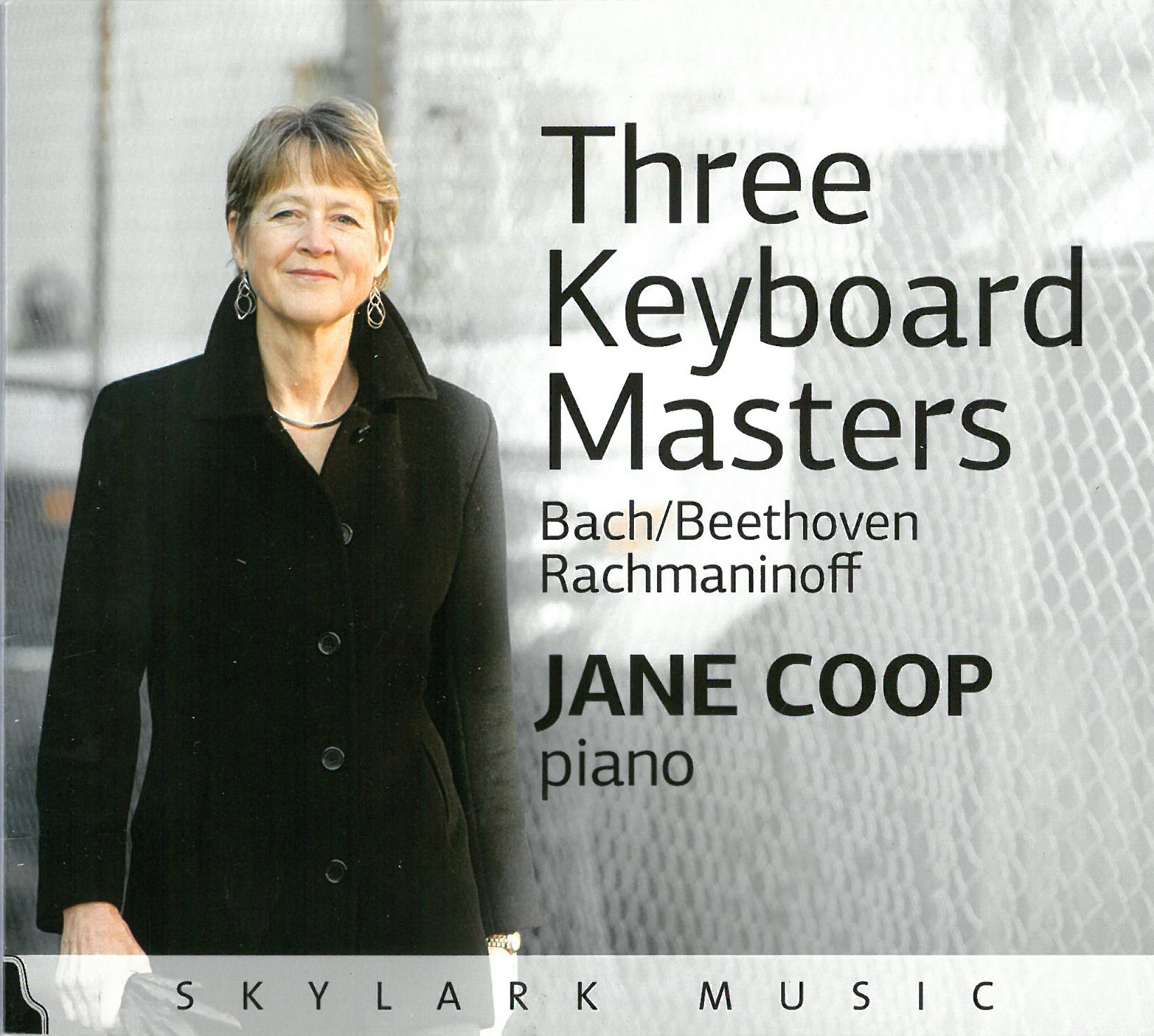
01 Jane CoopThree Keyboard Masters – Bach; Beethoven; Rachmaninoff
Jane Coop
Skylark Music Sky1901 (skylark-music.com)

Veteran pianist Jane Coop brings three composers into focus on her new fall release: Beethoven, Rachmaninoff and Bach. While the aggregate of the music on disc is indeed a favourable one, the record as a whole tends to play more as a recital program than as an album. Coop’s musical conviction and integrity merits discussion of each component, singly: 

Her choice to record the seven jejune Bagatelles Op.33 of Beethoven is a fruitful one. Coop brings a childlike exuberance to this music, augmented by just the right dash of buffoonery. She achieves an essentially scherzando quality, from which the personal side of Beethoven’s art can gleam. Coop has a zeal for these pieces, expert in the Canadian tradition of Beethoven pianism inherited from her teacher, the great Anton Kuerti.

In drastic juxtaposition, a set by Sergei Rachmaninoff plunges in next. Despite the extreme textural disparity between Rachmaninoff’s preludes and Beethoven’s bagatelles, Coop seems easily at home in the vaulting halls of Russian Romanticism. One hears an icy, almost Gouldian austerity. Punctuating the preludes are lesser-known transcriptions by Rachmaninoff, penned late in the composer’s life and intended for his own concert tours.

Finally, Bach’s Chromatic Fantasy and Fugue brings a sense of homecoming. One has the suspicion that each of these pieces has been well-worn and well-loved by Coop; this is music she’s held dear for a long time. How generous of her then, to share it with us.

Adam Sherkin

Listen to 'Three Keyboard Masters – Bach; Beethoven; Rachmaninoff' Now in the Listening Room

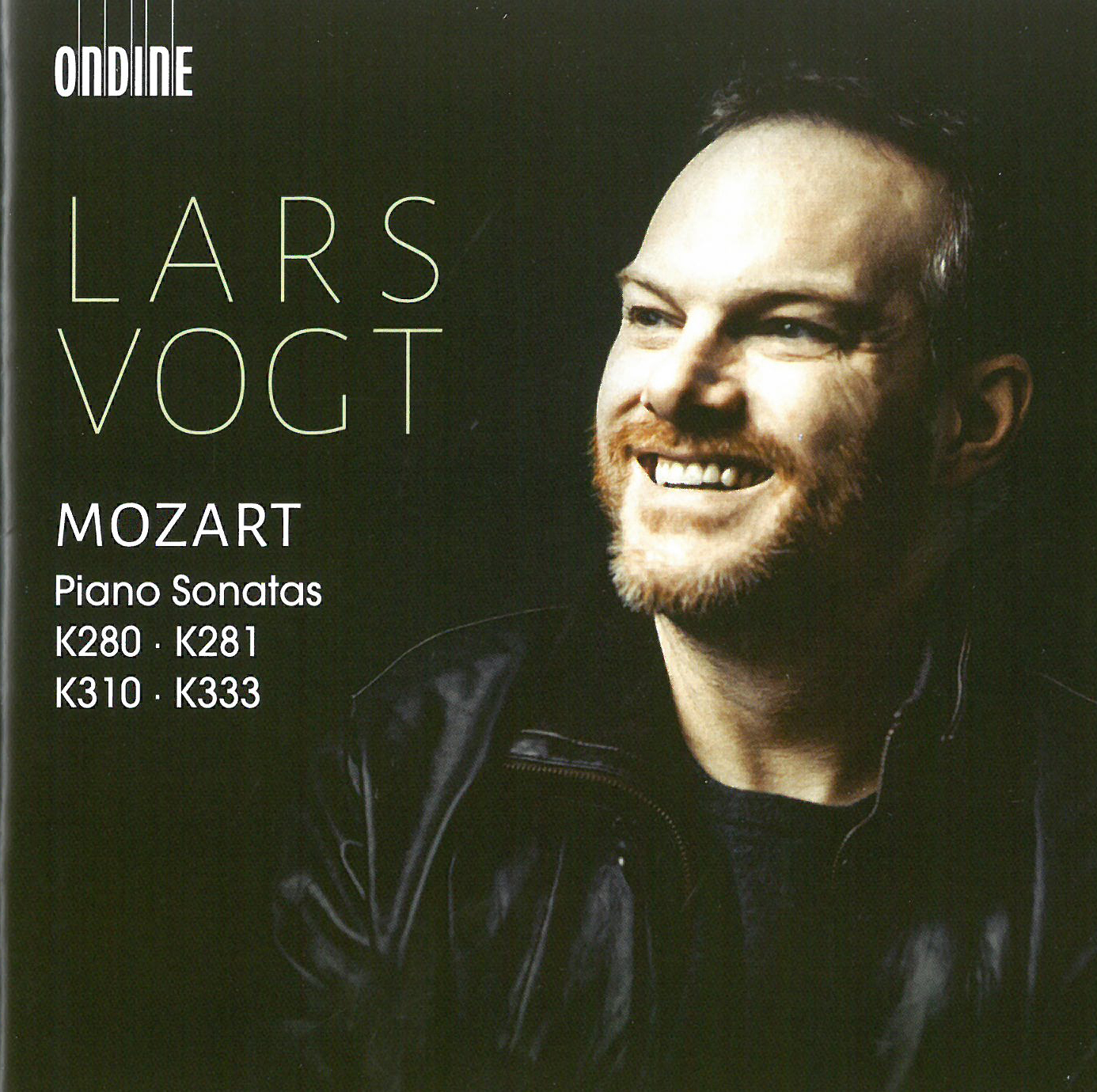
02 Mozart VogtMozart – Piano Sonatas Nos.2, 3, 8 & 13
Lars Vogt
Ondine ODE 1318-2 (naxos.com)

The newest disc from the 40-something pianist, conductor and educator, Lars Vogt, delivers refined and compelling readings of four Mozart piano sonatas. The range of curation here is admirable, as is the enticing (and thoroughly considered) nature of Vogt’s interpretation. We meet an accomplished and intellectually curious artist at the height of mid-career prowess.

To open such an album with Mozart’s early Sonata in F major, K280 is an unusual choice, yet a convincing one. Where Vogt overrides status quo classical sensibilities with modern expressive concepts (cf. the A minor Sonata, K310), he manages to steer us aptly to the brink and then back again with just enough mastery to re-charm us under his pianistic spell. It takes some level of courage to play Mozart like this. Notwithstanding, it seems more acceptable today for a performer to stretch such boundaries and take small yet consequential risks, finding novel paths through well-trodden music.

Among the disc’s notable attributes are its polish and poise. Vogt renders Mozart’s familiar notes with both a wide-eyed curiosity, (as if hearing it all for the first time) and a learned interpretive command that is exceedingly well informed (the second movement of the Sonata in B-flat Major, K333, Andante cantabile, is one such example.)

If anything is amiss, it is a reluctance to take these convictions and whims even further: to pilot the listener beyond the brink, as it were, to the very heart of Mozartian spontaneity.

Adam Sherkin

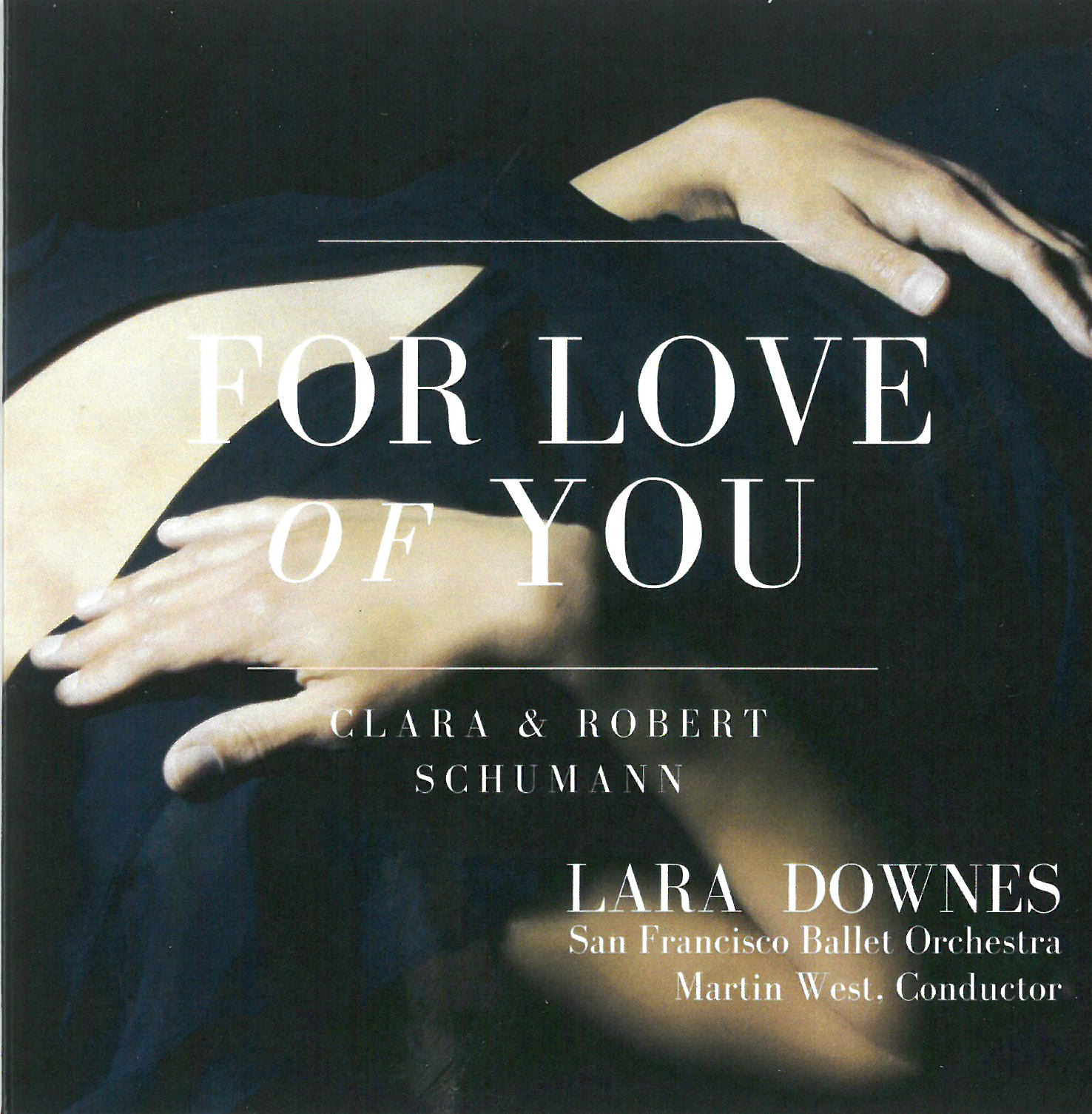
03 Schumann DownesClara and Robert Schumann – For the Love of You
Lara Downes; San Francisco Ballet Orchesra; Martin West
Flipside Music (laradownes.com)

American pianist Lara Downes offers a new release honouring the 200th anniversary of Clara Wieck Schumann’s birth on September 13, 2019. For the occasion, Downes allies with the San Francisco Ballet Orchestra, opening the disc with Robert Schumann’s Piano Concerto in A Minor, Op.54.  The proceeding tracks feature pieces for solo piano – Op.11 by Clara and Op.12 by Robert, dating from “the last three tumultuous and decisive years of courtship, before their marriage.”

Known for her lush and generous playing, Downes brings her customary warmth to bear as concerto soloist. Equally rivalling the orchestra’s might, she appears to revel in the quintessentially Romantic currents, inspired as they ebb and flow through the only concerto Schumann ever finished for the instrument. At times, Downes’ tonal command borders on a pianistic muscularity – an attractive commingling of classical training with a popularized understanding of music’s communicative shtick in the 21st century. She urges the listener to feel at ease: to embrace the brand of hospitality issued from her keyboard.

Aside from the utterly standard repertoire selections (Schumann’s Opp.54 and 12), the Three Romances, Op.11 by Clara bring a fresh and personal stamp to the record. It sounds as if Downes is just getting started with Clara’s catalogue. Surely, in 2019, this music can now stand alone, apart from Robert, and declare itself? Many accomplished proponents of Clara’s Wieck Schumann’s music are active today; Downes should consider joining this consortium, full time!

Adam Sherkin

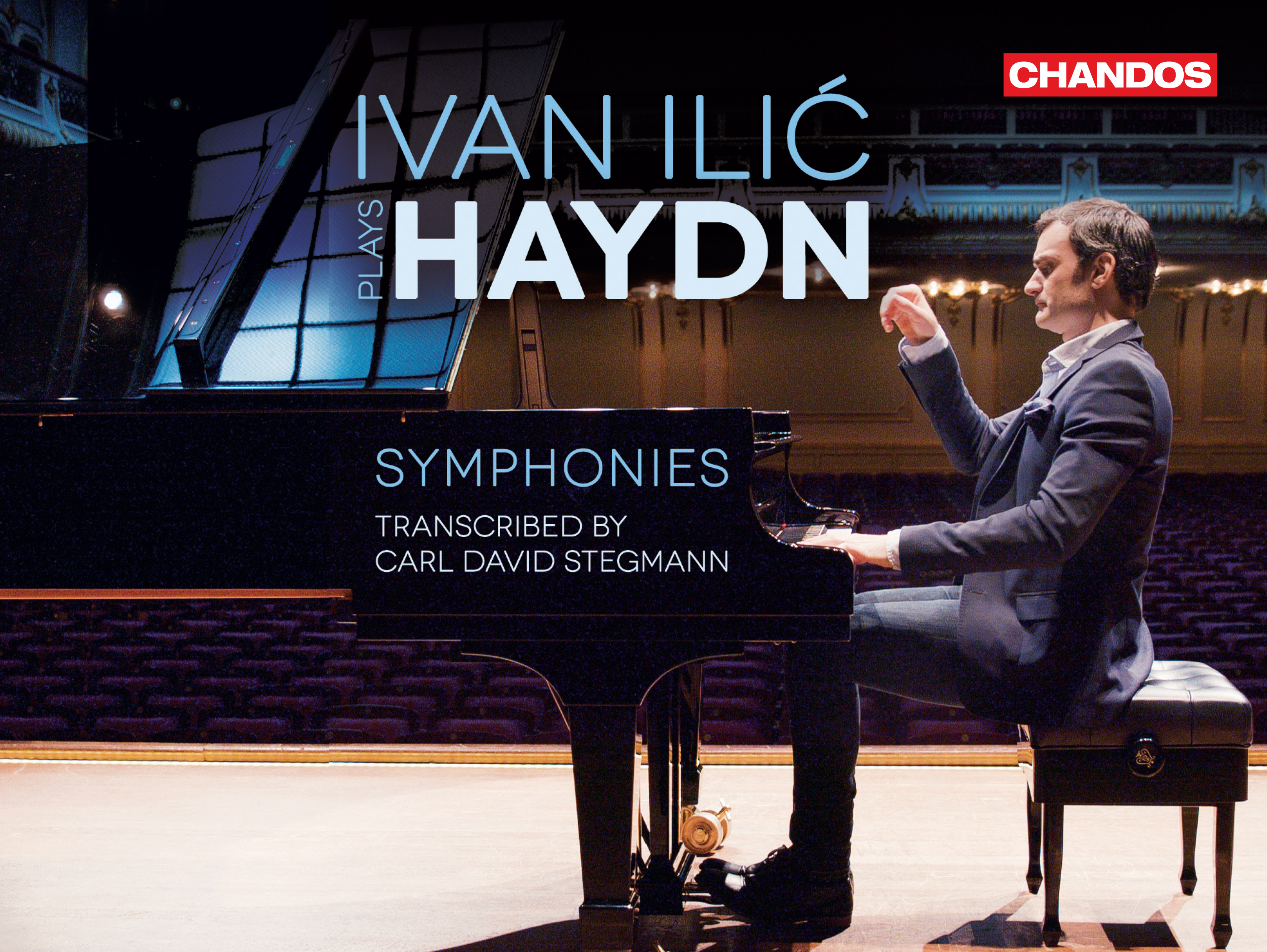
04 Ivan Ilic 1Haydn Symphonies transcribed by Carl David Stegmann
Ivan Ilić
Chandos 2020142 (chandos.net)

Here we are in for a treat. Noted Serbian-American pianist Ivan Ilić, who has already made a reputation for adventurous repertoire and has never shied away from detective work, is now unearthing century-old music found in a dusty box in someone’s attic in Cologne, Germany: actually the discovery of three Haydn symphonies transcribed for the piano dating back to 1811 by Carl David Stegmann, a musician and contemporary of Beethoven. These things can happen: after all, Schubert’s Great C Major Symphony was also found in an attic by a certain Felix Mendelssohn!

Well, Ilić immediately tried them out and they sounded terrific on the piano, so he subsequently recorded them. First and foremost is the famous Oxford Symphony No.92, one of the late ones written just prior to the London Symphonies and it is a wonderful mature work. Right at the outset we are struck by the pianist’s enthusiastic and joyful approach, a feeling of discovery, grasping the essence of Haydn and his sense of humour. With immaculate, highly precise pianism he emphasizes the clear melodic line and delves fearlessly with his strong left hand into the complex architecture of the contrapuntal middle part. By this time the piano literally sings, and how charming that little closing subject sounds!

I was also delighted by the horn imitation in the trio part of the third movement Menuetto and the terrific freewheeling bravura of the complex yet irresistibly melodic last movement. Symphony No.75 is notable for its second movement’s interesting set of variations showing Italian influences while Symphony No.44 (Mourning) has an astounding last movement Presto, a hot-headed and determinedly monothematic score” Ilić even features in a video on YouTube.

Janos Gardonyi

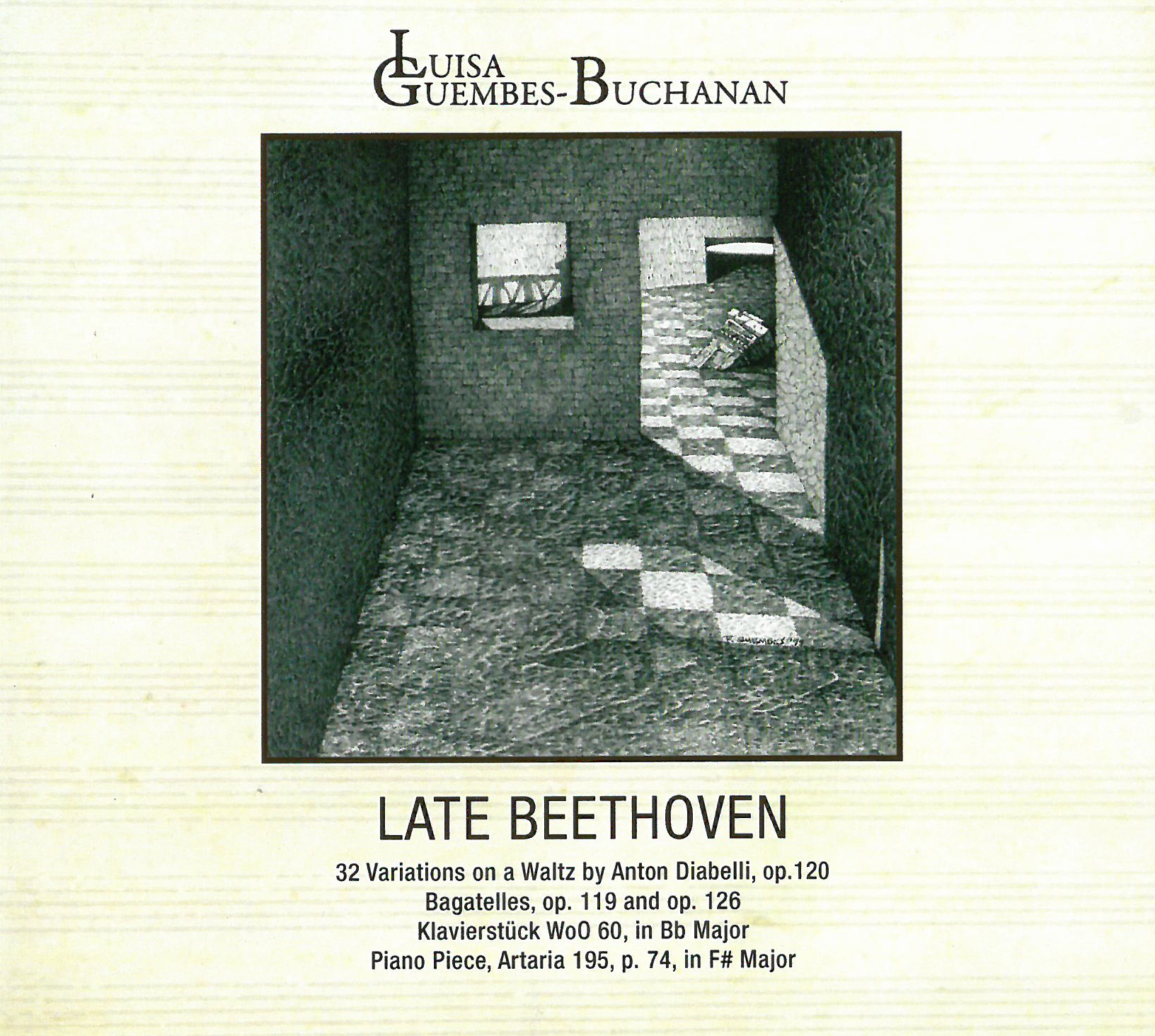
05 Beethoven Guembes BuchananLate Beethoven
Luisa Guembes-Buchanan
Del Aguila Records DA 55313(luisagbuchanan.com)

Late Beethoven such as the Bagatelles, Op.119 and the Diabelli Variations Op.120 appear to have arrived in music’s world not in a dimming of the light that comes at the end of life, but like an immeasurable future; an unimaginable time beyond time. Certainly the immortal Variations, all 33 of them, coming as they did on the heels of the great Goldberg Variations of J.S. Bach, heralded a Beethoven whose creative urge seemed to have swelled like a kind of historical floodwater, bearing Anton Diabelli’s prosaic waltz upon its crest.

Luisa Guembes-Buchanan’s recording of the Diabelli is a classic, as free flowing as Beethoven’s approach to the variation form. Her playing is muscular, yet supple, accentuating the integrity of each variation without sacrificing the sense of overall structure. That all-important final chord is like a goal reached at the end of a long, long journey.

The pianist’s approach to the Bagatelles – among the best-known of Beethoven’s shorter pieces – is a refreshingly matter-of-fact manner, bringing out the vigour and the fluidity of the pieces but not at the expense of their poetry. Her Fifth Bagatelle is pointedly unsentimental, but most exquisitely and artfully shaped.

Theodor Adorno saw late Beethoven works as profound meditations – partly conscious, perhaps – on death. But he admits that “death is imposed only on created beings, not on works of art…” which might explain the immortal nature of these late works, living fragments of life’s beauty.

Raul da Gama

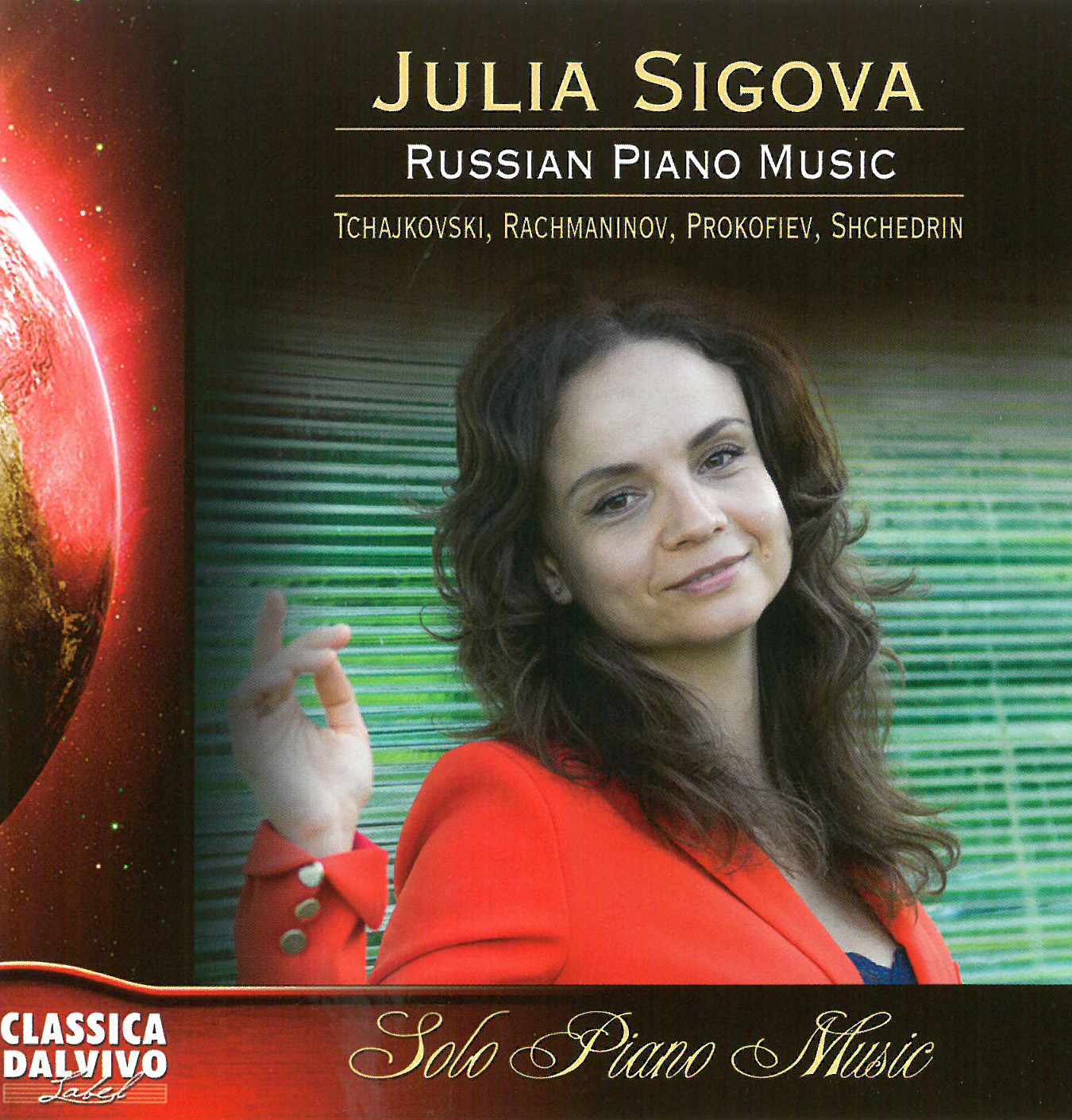
06 Julia SigovaRussian Piano Music
Julia Sigova
Classica Dalvivo CDL-0518 (juliasigova.com)

As surprising as it may seem, collections of Russian solo piano music on CD are not all that common and when they do appear, they are likely to feature the works of only one or two composers with a similar compositional style. As a result, this recording by pianist Julia Sigova on the Classica Dalvivo label is a welcome addition to the catalogue. Not only did this Minsk-born artist choose four different composers, but ones spanning an 80-year time period – from the Romanticism of Tchaikovsky and Rachmaninoff to the more austere modernism of Prokofiev and Shchedrin.

Today, Tchaikovsky is scarcely remembered for his contribution to the piano repertoire, but his keyboard compositions are still not without their charm as evidenced in the opening track Dumka Op.59 from the set titled Scenes from a Russian Village written in 1886. Sigova’s approach is elegant and self-assured, with just the right touch of melancholia that characterizes much of Tchaikovsky’s music.

Rachmaninov’s first set of Études-Tableaux Op.33 were supposedly written as “musical evocations of external stimuli” although he never really divulged their true inspiration. These are a remarkable study in contrasts – from the pensive seriousness of the Second to the bombastic fervour of the Seventh. In all, they require a formidable technique, and Sigova rises to the demands with much bravado.

Compared to the lush romanticism of Rachmaninoff, the Sarcasmes Op.17 of Sergei Prokofiev and two pieces – Humoresque and A la Albeniz – by Rodion Shchedrin are very much products of the later 20th century. Here, Prokofiev almost seemed to be thumbing his nose at the more conservative musical conventions of the time while the two miniatures by Shchedrin – with their jaunty rhythms and progressive harmonies – round out an eclectic and very satisfying program.

Richard Haskell

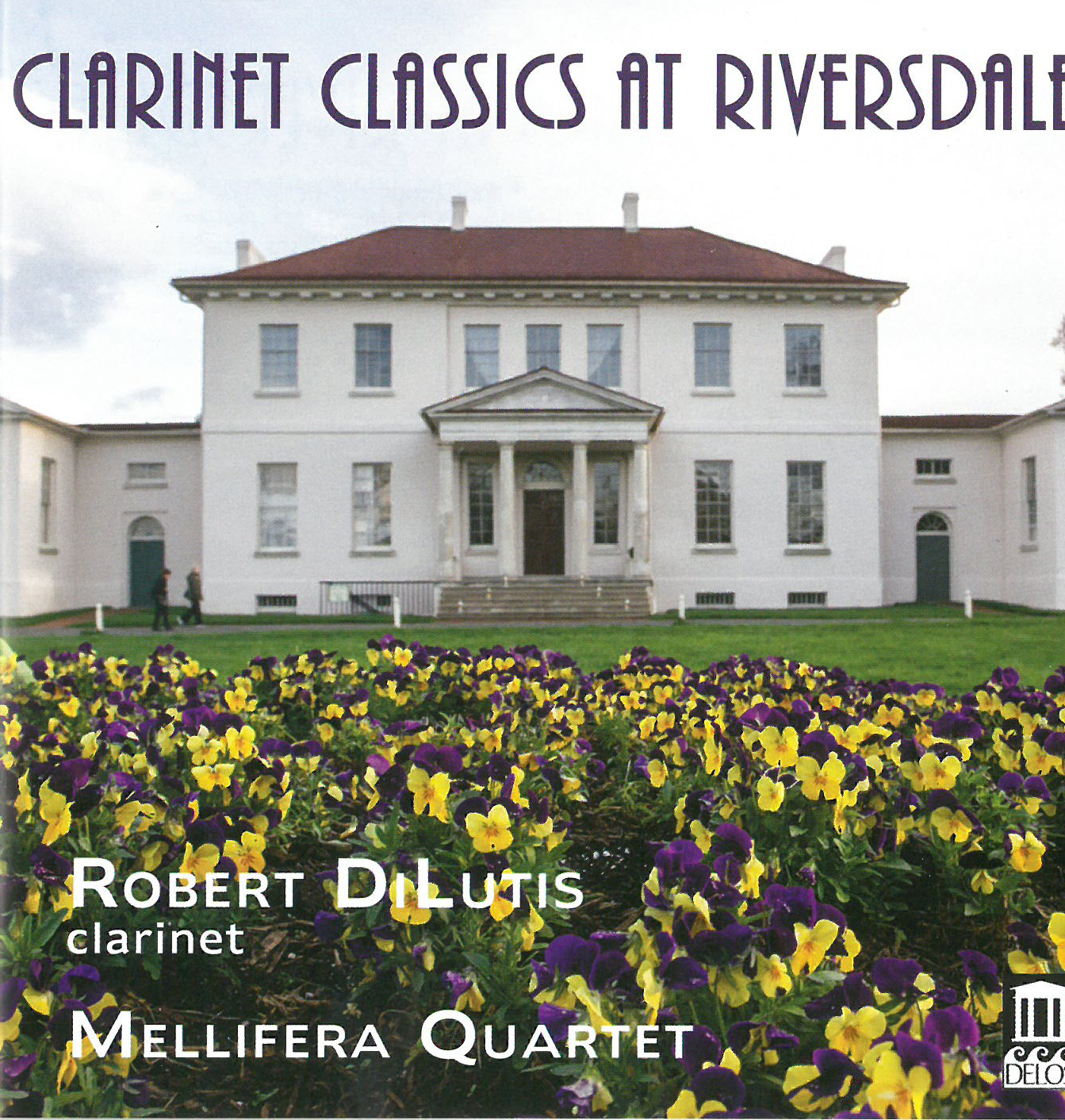
02 Clarinet ClassicsClarinet Classics at Riversdale
Robert DiLutis; Mellifera Quartet
Delos DE 3561 (delosmusic.com)

What’s not to love about Carl Maria von Weber? If you’re a clarinet player, only that by the time you’re an undergrad, you’ve been trying to play his various pieces for too long and with too little success. On Clarinet Classics at Riversdale, Robert DiLutis opens with Weber’s Quintet in B-flat Major Op.34. Accompanied by the very fine Mellifera Quartet, DiLutis gives a very able rendition. The piece gets dusted off much less often than the Mozart or Brahms works for the grouping, possibly because in the Weber the clarinet is more protagonist than chamber partner: it’s never easy convincing a quartet to work with one; then tell them it’s Weber and watch the reaction. BUT, Weber is really terrific, and in spite of the odd string writing (the attempted fugue in the finale is… valiant) the work merits a listen. DiLutis can bring the full arsenal of technical tools to the piece. His tone is more on the bright side here than in other tracks, which doesn’t please all ears, including this pair.

More sonically pleasing are the following cuts, and I appreciate his inclusion of three lesser-known unaccompanied works (“Classics” is an aspirational title for this collection). Monologue 3 by Erland von Koch should be required reading for clarinet students everywhere, as the Willson Osborne Rhapsody (originally for bassoon) is for my students. I feel the disc has no need of the inclusion of the bit of treacle by Heinrich Baermann, his Adagio for Clarinet and Strings.

03 Bela BartokBéla Bartók – The Wooden Prince; The Miraculous Mandarin Suite
Helsinki Philharmonic Orchestra; Susanna Mälkki
Bis BIS-2328 SACD (bis.se)

Who knows how Bartók would have fared had his ballet music been introduced in Paris around the time Stravinsky’s star was rising? This disc brings together his two most notable works in the category: The Wooden Prince dating from 1917, and more celebrated, The Miraculous Mandarin from1924 (revised final version 1927). One can’t help thinking sadly of how different the two men’s lives were following the end of the WWII, and how a penniless genius like Bartók deserved better.

The earlier work follows the plot of a fairy tale of love triumphing over various obstructive enchantments. Its music alternates between melodrama, ferocity and cheeky sprightliness. By contrast, the second work on the disc is anything but a fairy tale. It is a story of seduction and violence, and a supernatural character who is impervious to the latter as long as he resists the former. Where the music of the earlier work is folk-infused and tuneful, the latter is a glimpse of the modernist Bartók. As a suite, The Miraculous Mandarin clocks in at barely 20 minutes. The Wooden Prince is presented in its entirety, lasting just under an hour.

The wonderful Helsinki Philharmonic under Susanna Mälkki explores the score with flair and finesse. For my money, the more interesting piece is the darker later work, and not only because of the iconic clarinet duets that depict the three seduction scenes, although these are brilliantly performed. For those unsure they can bear the mysteries of Bartók, the first offering is an excellent warmup.

04 Havergal BrianHavergal Brian – Symphonies 7 and 16
New Russia State Symphony Orchestra; Alexander Walker
Naxos 8.573959 (naxosdirect.com)

This CD, part of Naxos’s ongoing traversal of Havergal Brian’s 32 symphonies, begins with the brightly coloured, perky overture, The Tinker’s Wedding, based on the comedy of that name by John Millington Synge. The upbeat mood continues with the fanfare for trumpets and percussion that opens Brian’s 38-minute, four-movement Symphony No.7, also from 1948.

The first movement’s jaunty character, with processional echoes of Brian’s much-admired Elgar, is sustained into the second movement, during which raucous dissonances mark the shift in the symphony’s emotional trajectory from light to dark. In the third and longest movement, an adagio filled with skittish, elusive melodies and sonorities brackets an angry, violent scherzo. The final Epilogue, a grim, almost relentless march, resolves harmoniously, but only after two savage climaxes.

The Seventh was the last of Brian’s large-scale symphonies. The remaining 25, all composed during the final two decades of Brian’s long life (1876-1972), are far more concise. The single movement of the Symphony No.16 (1960) by the 84-year-old Brian lasts only 15 minutes, but its orchestration is anything but miniaturized: quadruple woodwinds, six horns, ten (!) percussionists. Brian wrote that while composing it, he was reading about the Battle of Thermopylae, and the music is martially explosive, prevented from disintegrating by continuous, forward-marching pulsations, even during brief lulls in the mayhem. Brian could create beauty within discord, and a startling sequence of blaring, dissonant chords brings this symphony to a beautiful conclusion.
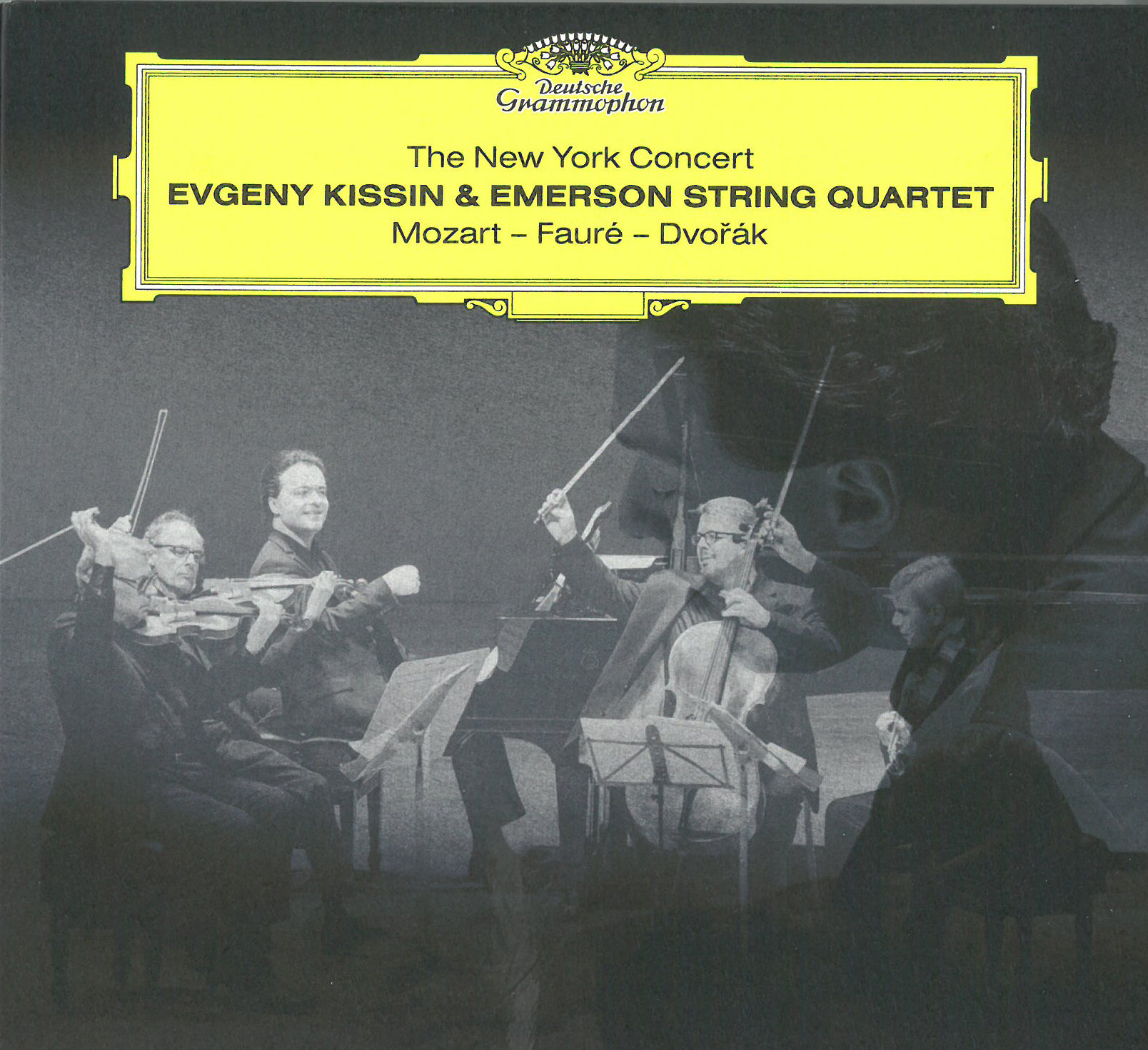
05 New York ConcertThe New York Concert
Evgeny Kissin; Emerson String Quartet
Deutsche Grammophon 483 6574 (deutschegrammophon.com)

The coming together of the inimitable Evgeny Kissin with the Emerson String Quartet represents the high watermark of the 2018 edition of Carnegie Hall’s annual programming, reminiscent of the great performances by Martha Argerich with cellist Mischa Maisky, and her chamber-work performances with percussionists Peter Sadlo and Edgar Guggeis, and with pianists Nelson Freire or Nicolas Economou, all documented on Deutsche Grammophon.

Kissin’s virtuosity and powerful key touch is without parallel. His dazzling skills are well matched by the electrifying Emerson String Quartet. And the musicians play here with palpable vigour and depth of emotion. Kissin appears to be an outstanding Mozartian, his commanding technique making for the spritely energy of his attack and the radiant manner in the Piano Quartet in G Minor K478. Meanwhile, the Emerson Quartet plays with zeal and focused sensitivity.

Both Kissin and the Emerson also respond warmly and with imagination to Fauré’s Piano Quartet No.1 in C Minor, Op.15. The composer invested much in this music which is evident from the harmonic adventurousness and unexpected modulations. Kissin and the Emerson create an appropriate restlessness reflecting the elusive quality of this music.

Dvořák’s Piano Quintet No.2 in A Minor, Op.81 is arguably his greatest chamber piece – which Kissin and the quartet play with virtuoso drive and urgency. Dimitri Shostakovich’s Piano Quintet in G Minor, Op.57 ends this double disc. It is approached with interpretive intelligence, and features gorgeous tone and expressive power.

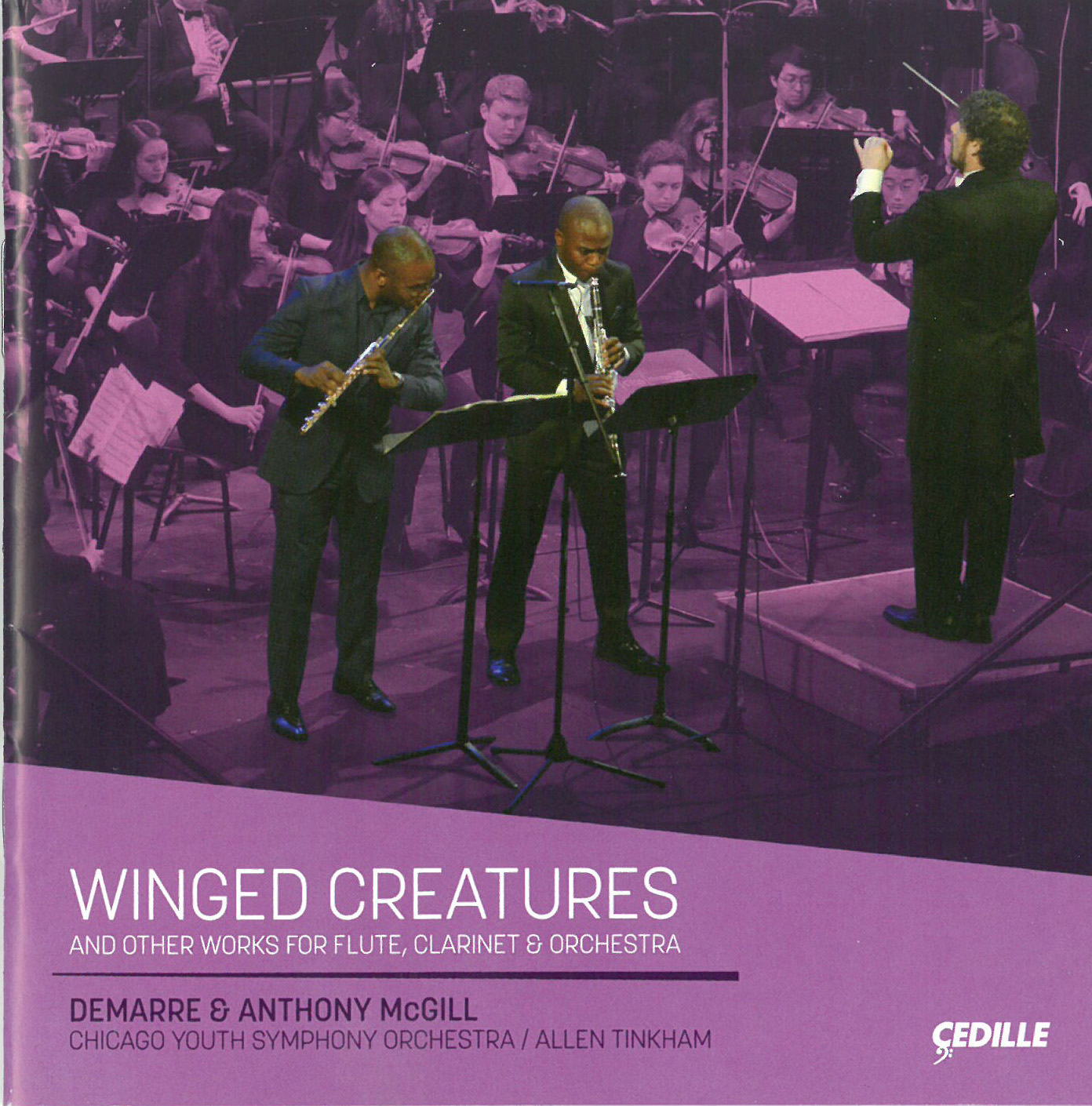
06 Winged CreaturesWinged Creatures and other works for Flute, Clarinet and Orchestra
Demarre & Anthony McGill; Chicago Youth Symphony Orchestra; Allen Tinkham
Cedille CDR 90000 187 (cedillerecords.org)

Throughout the classical music world there are the superstars and those aspiring to become one. The latter group often find themselves playing together in youth orchestras, where the synergy of working with others at the top of their game is a fantastic way to accelerate one’s progress towards that goal. Winged Creatures brings successful alumni Demarre (flute) and Anthony (clarinet) McGill together with the Chicago Youth Symphony Orchestra. As one would expect, the standard of playing in a city with such a strong musical tradition is excellent; the brothers share a beautiful limpid tone quality to match their technical mastery.

The title track, by Michael Abels, makes terrific use of the orchestral forces while highlighting the soloists’ strengths: phrasing of one mind, clear pitch and virtuostic ease. Behind them, the orchestra is led by Allen Tinkham, who might have had some help with the balance from the booth, but nevertheless manages the ensemble with utter aplomb. This is a professional band by another name, never mind the “youth” designation.

For those who feel the late 18th century is still interesting there is a Sinfonia Concertante by Franz Danzi, a charming 20 minutes where the orchestra ably demonstrates proper period style; a much more fun Tarantelle from a young Camille Saint-Saëns follows with sassy vigour. Closing the disc is Concerto Duo, by Joel Puckett. Like the music of the title track, this piece was commissioned by the brothers McGill. It’s a slice of bold beautiful Americana. Excellent liner notes come with the disc.

Back to top