06 Norgard Ruders celloPer Nørgård & Poul Ruders: Works for Solo Cello
Wilhelmina Smith
Ondine ODE 1381-2 (naxosdirect.com/search/ode+1381-2)

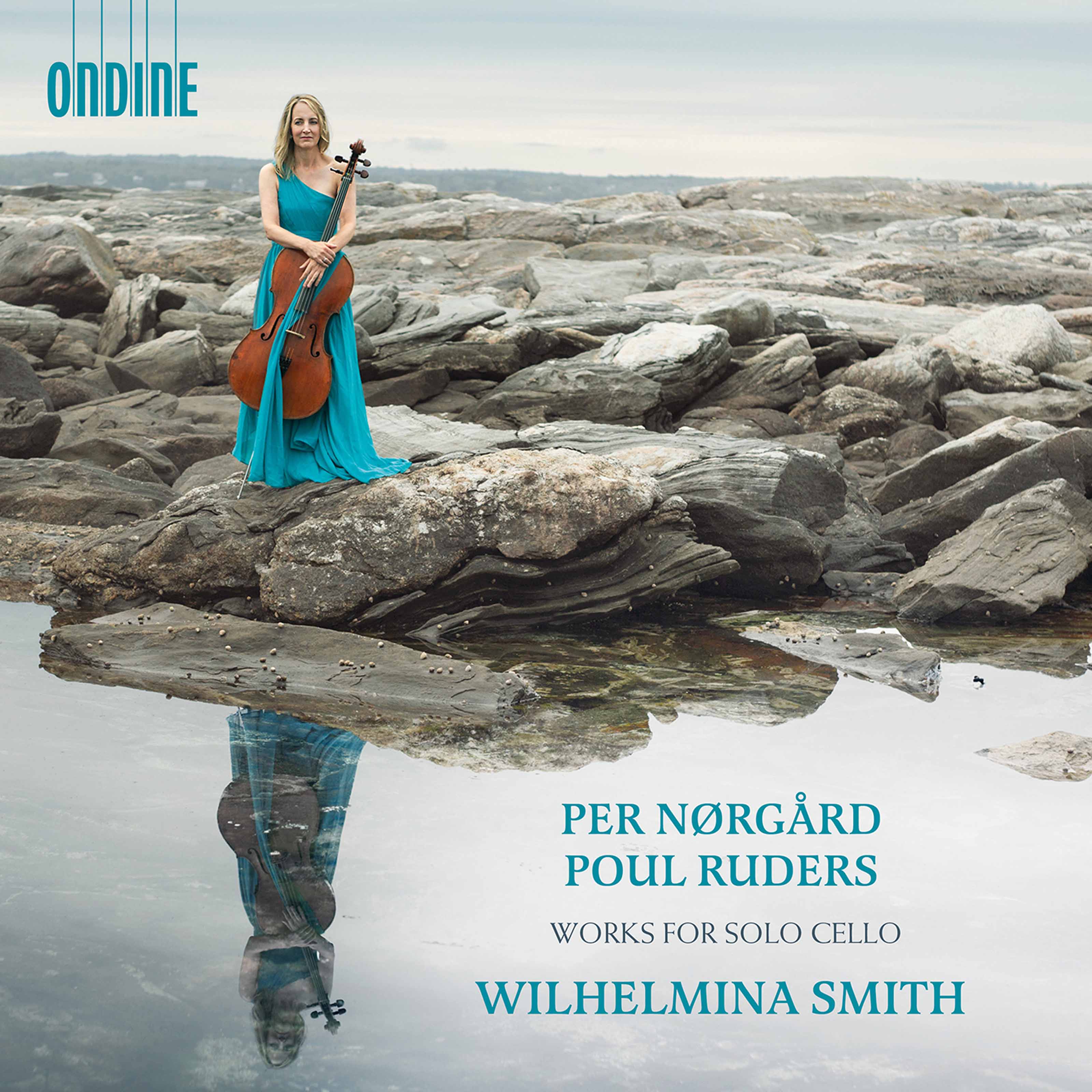
Courageous and captivating, cellist Wilhelmina Smith has released a new album spotlighting Danish composers Per Nørgård and Poul Ruders. This disc makes a welcome sequel to Smith’s previous solo release featuring Finnish cello music by Esa-Pekka Salonen and Kaija Saariaho. 

Attractively programmed in two parts, this album opens with three sonatas by Nørgård, followed by Bravourstudien, (L’homme armé Variations) by Ruders. Within the sonatas, the listener gains a chronological sense of expressive storytelling. Beloved amongst string instruments, the cello is predisposed to a masterful narrative ability, epitomizing the perfect solo instrument in a number of ways. It possesses a wide tonal and dynamic range that resonates warmly and reverberantly in multiple environments. When wielded by an expert player such as Smith, the cello can direct the most intimate modes of expression and in turn manifest a certain spaciousness, with majestic soundscapes of impressive import. It is this latter profile that proves most exceptional in Nørgård’s three sonatas; they are immediately striking with an outward sonic expanse. In this bowed string land, capacious vistas prevail. By the third work, subtitled “What - Is the Word!” we remain in awe of darkly pulsing melodies as they haunt our ears, questing after an elusive (collective) Nordic heart.

Smith then shifts seamlessly to the whimsical – even impish – soundworld of Ruders. The slightly younger composer of the twain, Ruders is a modern musical maverick; the very same might be said of Smith.
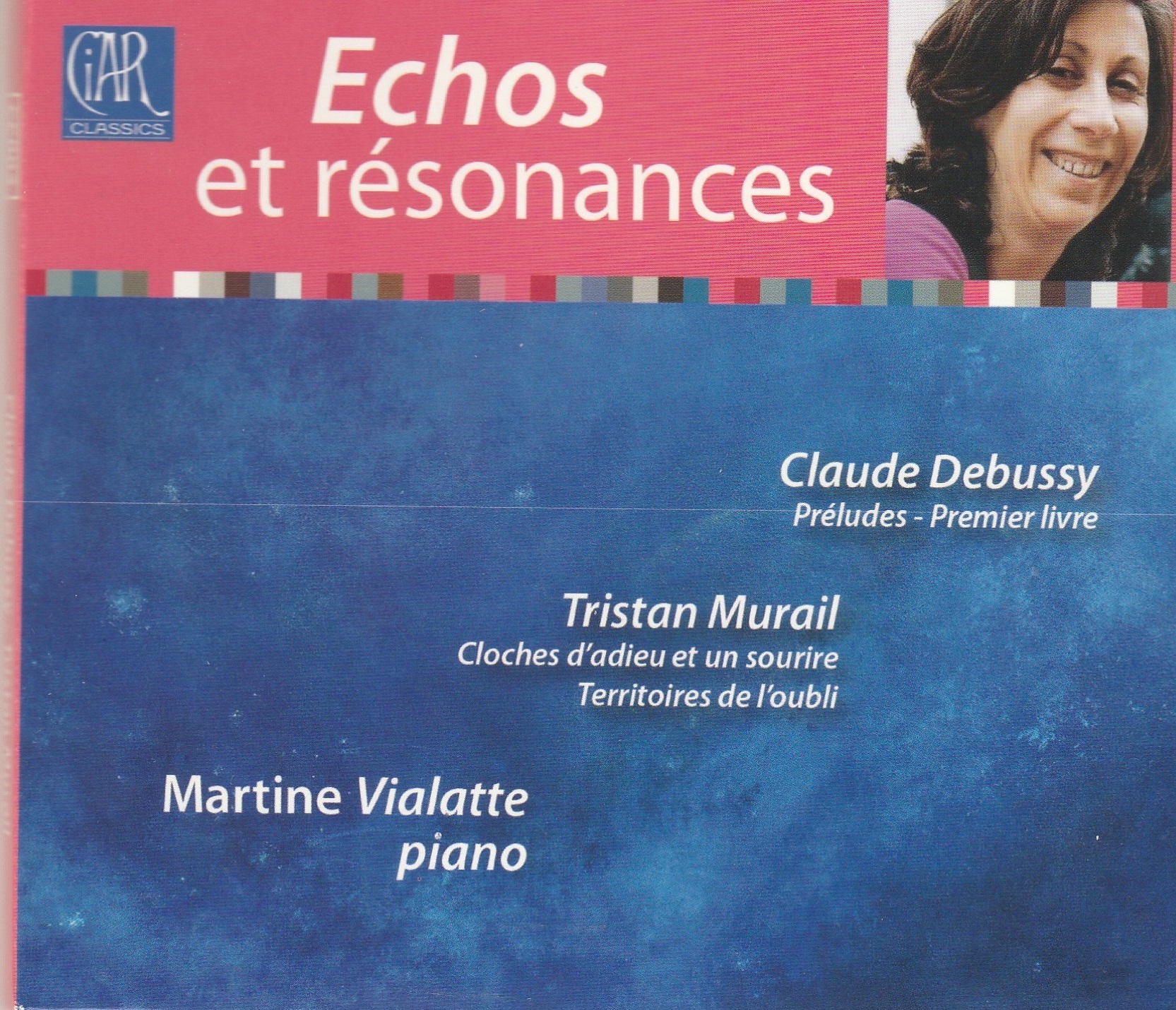
07 Martine VialatteEchos et résonances
Martine Vialatte (piano)
CiAR CC003 (ciar.e-monsite.com)

Debussy’s piano preludes have become staples of the repertoire and with so many fine recordings, it is difficult to say something different – a feat that virtuoso Martine Vialatte achieves with subtle mastery. The phrasing and careful use of the pedals creates a sonorous palette not heard in many recordings of Debussy’s set of Préludes (Premier livre)

Also found on this release, aptly titled Echos et résonances, are two pieces by French composer Tristin Murail – a short piece titled Cloches d’adieu et un sourire and the spectral masterpiece, Territoires de l’oubli. In the former, a piece dedicated to Messiaen, chords swing before the listener like memories becoming ever more elusive. In the latter, Vialatte’s delicate touch provides a stunning resonance necessary for this hypnotic and intriguing work. In spite of the composer’s reluctance to be labelled an impressionist, the two pieces by Murail do make for perfect companions to Debussy’s preludes with clearly similar evocations of the natural world. Vialatte delivers world-class interpretations of some of the most resonant works written for her instrument, making for a rich and rewarding listen.

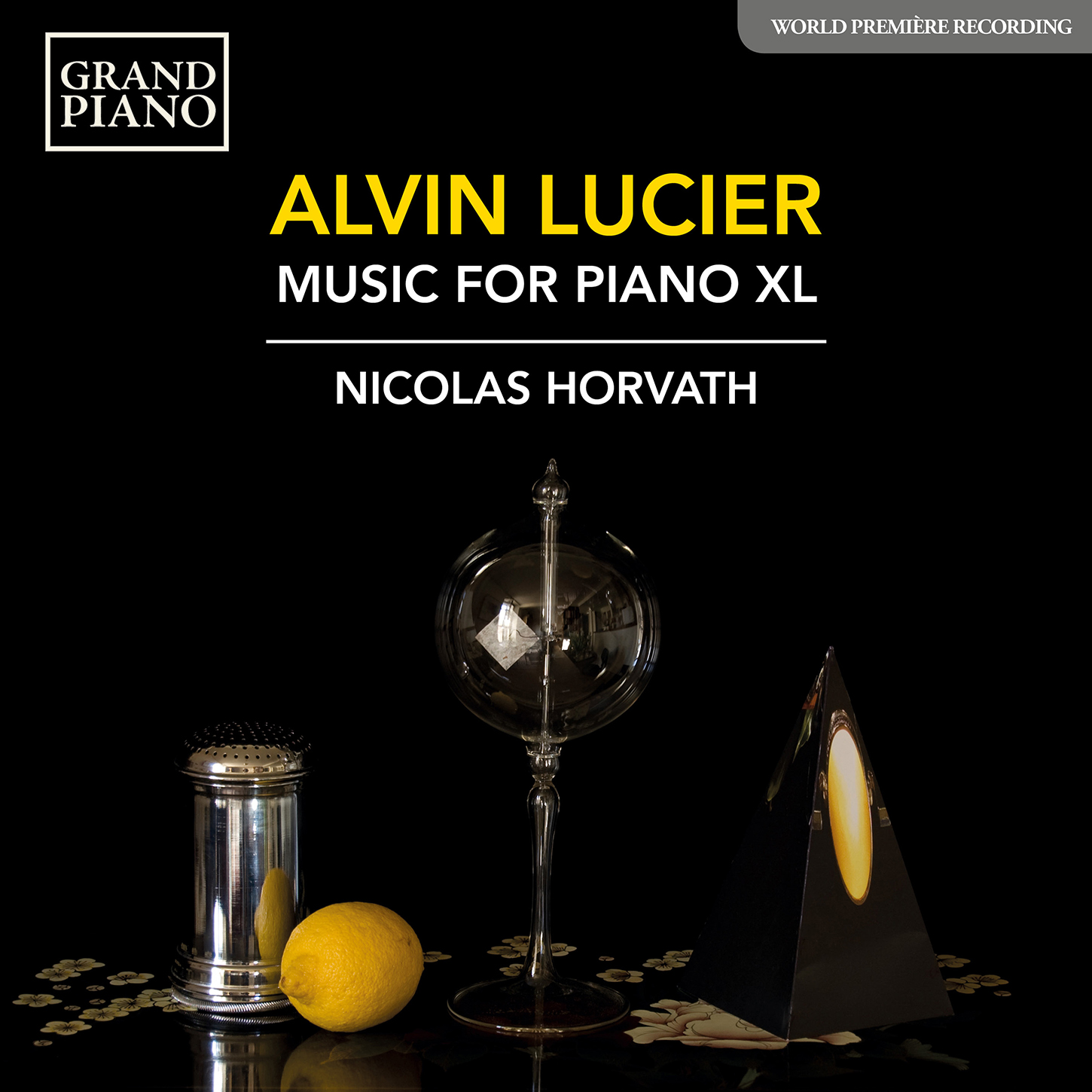
08 Alvin LucierAlvin Lucier – Music for Piano XL
Nicolas Horvath
Grand Piano GP857 (naxosdirect.com/search/gp857)

American composer Alvin Lucier has found an impressive exponent in pianist Nicolas Horvath. An artist regarded for a dizzying variety of musical tastes, Horvath is especially celebrated as a leading interpreter of Franz Liszt and yet he has recorded the music of Philip Glass, Cornelius Cardew and Jaan Rääts, to critical acclaim.

In his latest release, Horvath dives headlong into a vast, single-movement work for piano and wave oscillators. He is no stranger to such endeavours, having staged past live performances running up to 12 hours in length. Here, Horvath (via Lucier) offers a sprawling brand of listening experience, supported by “slow sweep pure wave oscillators.” Only single acoustic piano notes are struck throughout, echoing for minutes at a time over a backdrop of acoustic beating. (Two pure waves move up and down with a range of four octaves. The beats are directed by the piano tone’s proximity to pitches from the oscillator.)

While the resulting soundworld is undeniably retro, such creations can reward the assiduous listener. This aesthetic urges a holistic mode of attentiveness. One has to empty the ears of preconceived notions of structure, melody – and even of texture. These tones and beats sear through a vacuum of space on their own sort of photon, commingling and naturalistic: unhindered sonic spectres that speak truly. In what realm could such sounds move us most? Imagine that we’re listening amongst the cosmos, unbounded and flung loose into the stars.

09 LavenaIn Your Hands
Lavena
Bright Shiny Things BSTC-0145 (brightshiny.ninja)

Another stellar offering from the label Bright Shiny Things, American cellist Lavena’s debut album already feels like a veteran project. Lavena champions powerfully through one perfect piece after another – a diverse and colourful collection, each as interesting and compelling as the next.

Beginning with Gemma Peacocke’s Amygdala (“an exploration of the way in which anxiety comes in waves…” – oh, how timely!) this work for solo cello and electronics perfectly delivers its description. The duos by Jessie Montgomery, for cello and violin, and Ted Hearne, a powerful and dynamic setting for cello and percussion, are outstanding compositions beautifully delivered. In between is in manus tuas, a rich and melodic composition in Caroline Shaw’s classic multi-layered chordal style for singing cellist, based on a 16th-century Thomas Tallis motet.

The piece Tusuula, by the brilliant and multi-talented American composer Bryce Dessner, anchors the album’s solo content. Written in 2015 during the week Dessner spent as composer-in-residence at Finland’s Meidän Festivaali, Tusuula is destined to become an outstanding addition to the solo cello repertoire. Lavena leaves no doubt of her commitment to every note. 

Tender and yearning, My Heart Comes Undone, a valentine gift to the artist from her composer husband Judah Adashi, inspired by Björk’s Unravel, gently closes the album. In this iteration it’s played by solo cellist with loop pedal. This is an adventurous yet cohesive mix of compositions that manages to remain totally accessible to the contemporary newbie.

10 Leo ChadburnLeo Chadburn – Slower/Talker
Apartment House; Quatuor Bozzini; Gemma Saunders
Library of Nothing Records CD06 (leochadburn.com)

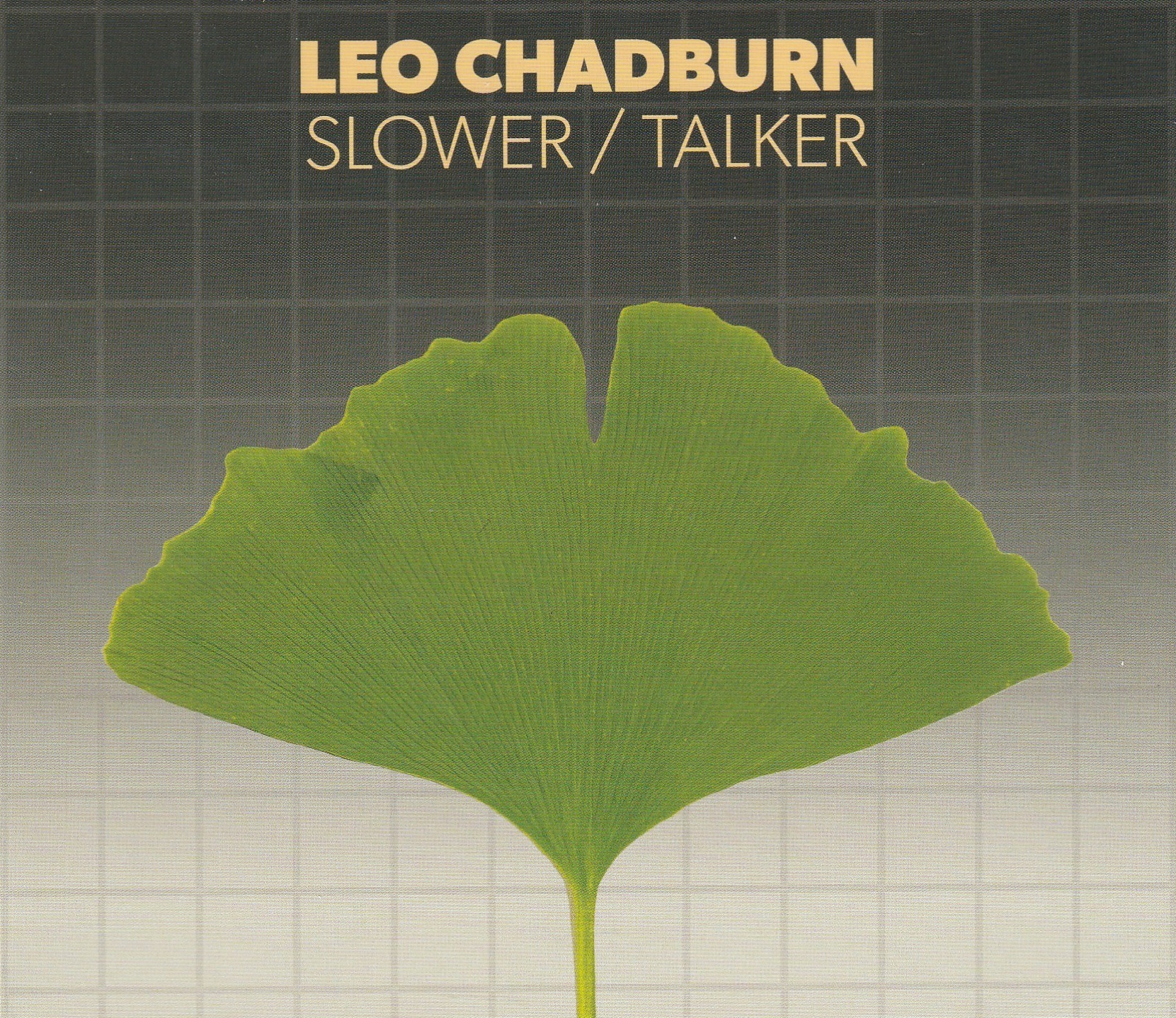
The wild card of the British contemporary classical music scene, composer Leo Chadburn (aka Simon Bookish) widens the scope of his musical experimentation with this remarkable new release. Featuring performances by Quatuor Bozzini (Canada) and Apartment House (UK), and the voices of actress Gemma Saunders and Chadburn himself, the album combines minimalism with spoken word in a way that is symmetrical in form, yet inquisitive and uninhibited in its expression.

The six compositions included on Slower/Talker span a decade of the composer’s work. All explore the relationship between found text and its instrumental counterpart, made up of mostly strings and keyboard instruments. The text’s subjects are comprised of lists of a kind – names of moth species (The Indistinguishables), topographical features encircling London (Freezywater), a lexicon of words used in the fragrance industry (Vapour Descriptors) or a stream of consciousness and properties of chemical elements (The Halogens). The words are spoken theatrically or in a musical way, always with restraint. Some are sung, understatedly, such as words of Mao Zedong in X Chairman Maos. The instruments are interweaving in and out, mostly supporting, sometimes questioning, making up meanings of their own. The textures created are beautiful in their sparseness. The result is a floating dialogue that is hypnotizing and luring, stripped of drama, smooth, as if outside of this world. 

Slower/Talker engages the listener in a subtle way. It is a sonically explorative journey, one worth taking.

11 AkropolisGhost Light
Akropolis Reed Quintet
New Focus Recordings FCR292 (newfocusrecordings.com/catalogue)

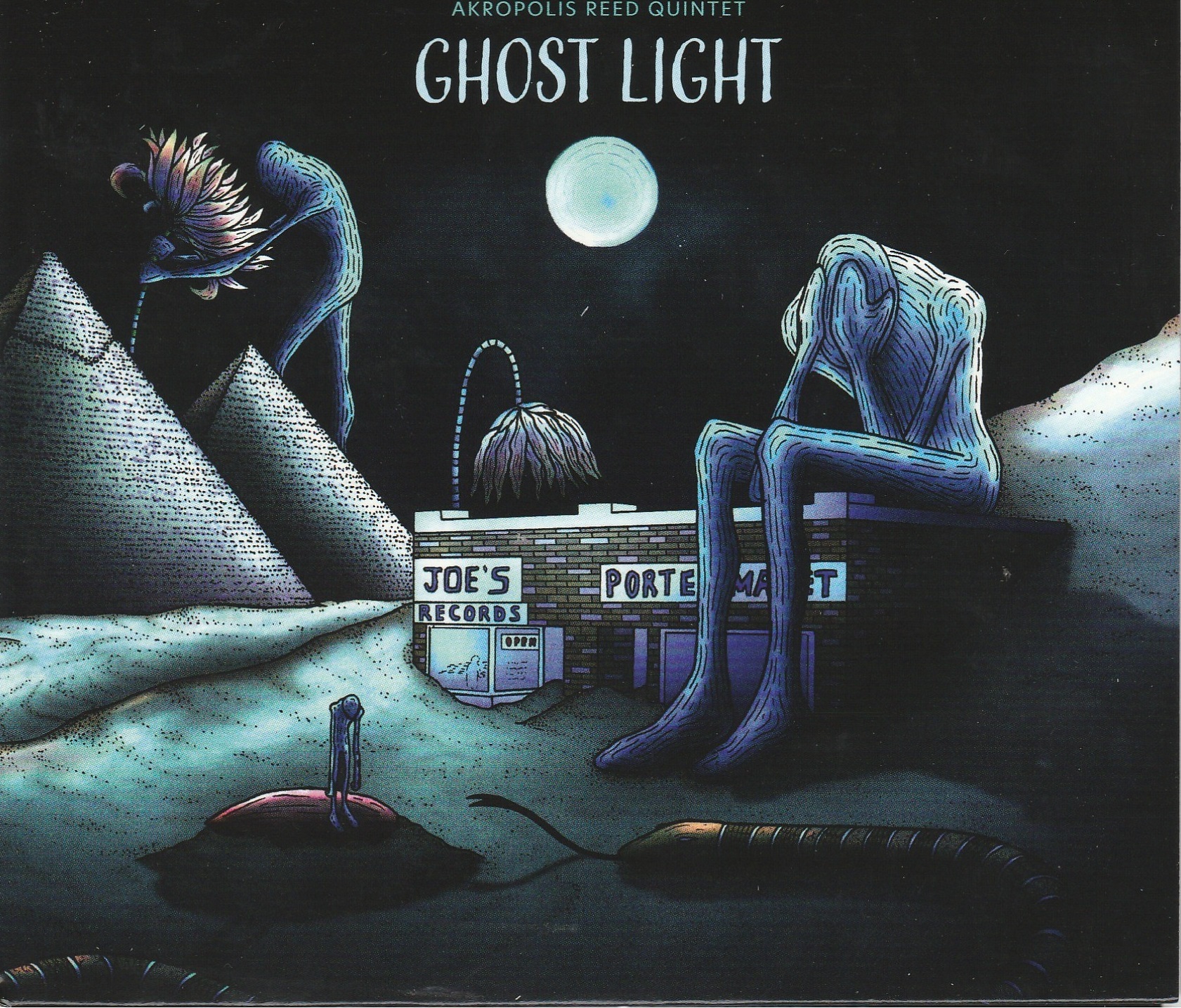
I was thinking about the Crash Test Dummies’ The Ghosts that Haunt Me, when the eerie, first moaning microtonal chord from the Akropolis Reed Quintet’s Ghost Light sounded in my headset. Spooky! This fantastic group of woodwind players from Detroit explores life and death at the far end of the musical spectrum; toe-tapping, mysterious, in tune and in synch. The cover art of the disc brought to mind the Dummies’ release from long ago. Look carefully, there’s purpose to the whimsy.

All the music was commissioned. Unusual? No, but the instrumentation is: two clarinets (soprano and bass), plus an oboe, a bassoon, and… saxophone! Here is range, here is agility and grace, here are complementary colours, never the cloying homophony of a saxophone quartet or worse, clarinet choir. Listen to the blends intentionally exploited by Michael Gilbertson in the brief and chipper Kinds of Light

That opening moan is from Rites for the Afterlife, a four-movement work inspired by ancient Egyptian rituals guiding the soul from this world to the next. Composer Stacy Garrop’s unearthly timbres of microtonal clusters, executed with clean precision, draw the listener into the mystery. Unpitched whispery effects evoke reed beds by a river. Styx or Nile? 

Iranian Niloufar Nourbakhsh based Firing Squad on the greatest opening sentence in literature, from Gabriel Garcia Marquez’s One Hundred Years of Solitude. This melancholy, melodic one-movement work explores mortality and memory. 

Jeff Scott, French horn of the Imani Winds, wrote the disc’s most substantial work: Homage to Paradise Valley. This is activist music, composed to poems by Marsha Music, commissioned to commemorate the destruction of Detroit neighbourhoods and landmarks taken from the African American community during the mid-20th century, in the name of urban renewal.

Listen to 'Ghost Light' Now in the Listening Room

12 George Lewis RecombinantGeorge Lewis: The Recombinant Trilogy
Claire Chase; Seth Parker Woods; Dana Jessen
New Focus Recordings (newfocusrecordings.com/catalogue)

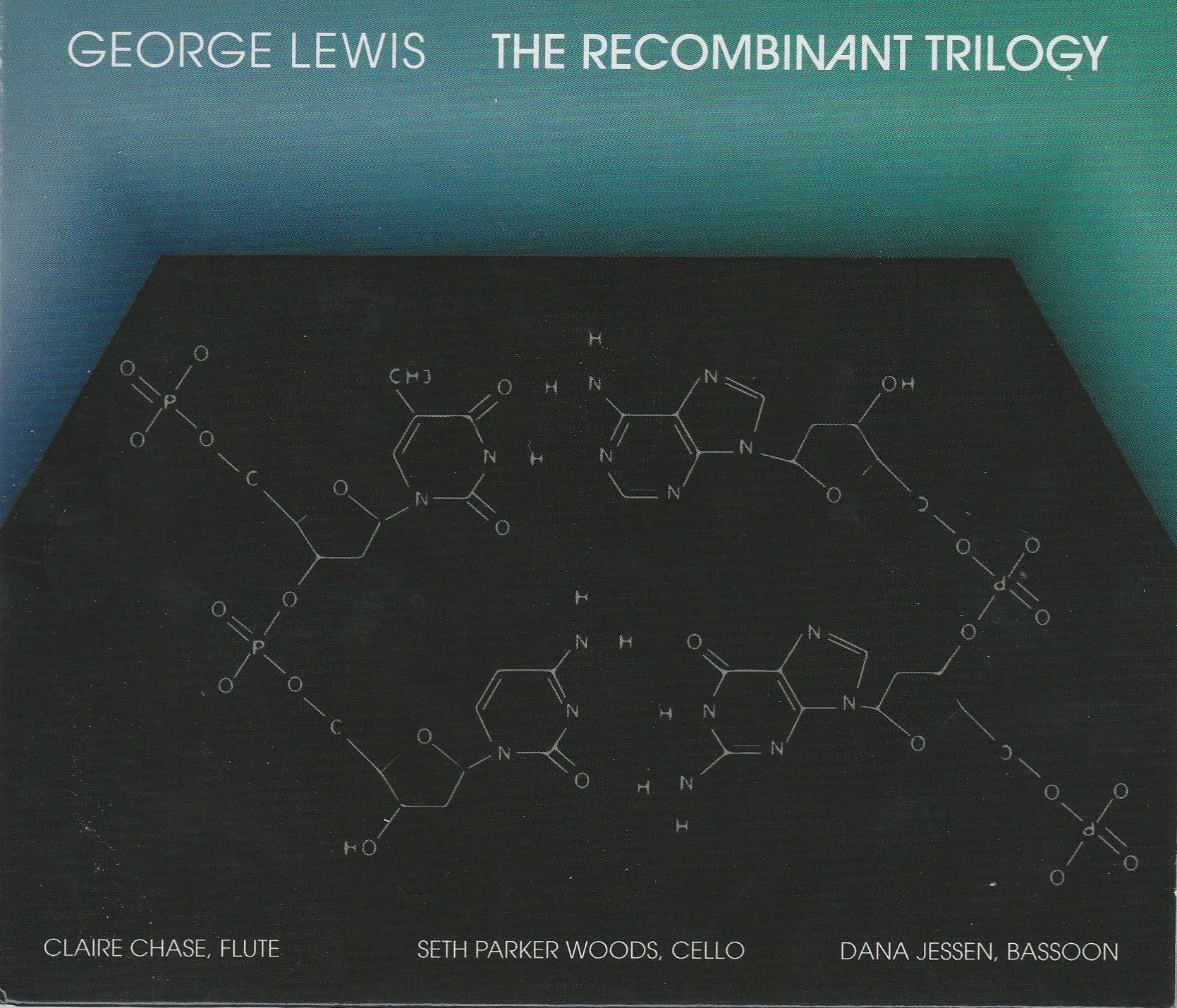
Few musicians have explored the relations between instrumental music and computer programming with the creative zeal of George Lewis, from Rainbow Family, the recently released IRCAM works from 1984 (Carrier Records), to his various interactive works with his Voyager program. His Recombinant Trilogy shifts from works employing improvisation to compositions that apply “interactive digital delays, spatialization and timbre transformation to transform the acoustic sounds of the instrument into multiple digitally created sonic personalities.”

Each of the three pieces combines a soloist with computerized electronics, in the process creating a kind of malleable ensemble that achieves often startling effects within seemingly acoustic timbres, including parallel microtonal lines. Materials are reworked out of sequence, liberating time and continuity in the process. The opening Emergent (2014), performed by Claire Chase, flute, and Levy Lorenzo, electronics, is the sunniest of the three, exploiting and expanding the flute’s mimetic powers to summon up flocks of birds that sing, soar and swoop. Not Alone (2014-15), with cellist Seth Parker Woods operating electronics as well, pushes the cello well beyond its typical sonic contour, pressing far into violin, contrabass and vocal arenas. For sheer evocative power, Seismologic (2017), performed by Dana Jessen on bassoon and Eli Stine on electronics, stands out, magnifying both the bassoon’s range and Jessen’s extended techniques to create an underground labyrinth of menacing roars, Doppler-effect turns and sudden haunted choirs. 

As with his earlier interactions with improvisers, Lewis’ computer compositions effectively extend music’s expressive range in fascinating ways.

Listen to 'George Lewis: The Recombinant Trilogy' Now in the Listening Room

13 Douglas BoyceDouglas Boyce – The Hunt by Night
counter)induction; Ieva Jokubaviciute; Schuyler Slack; Trio Cavatina
New Focus Recordings FCR 278 (newfocusrecordings.com/catalogue)

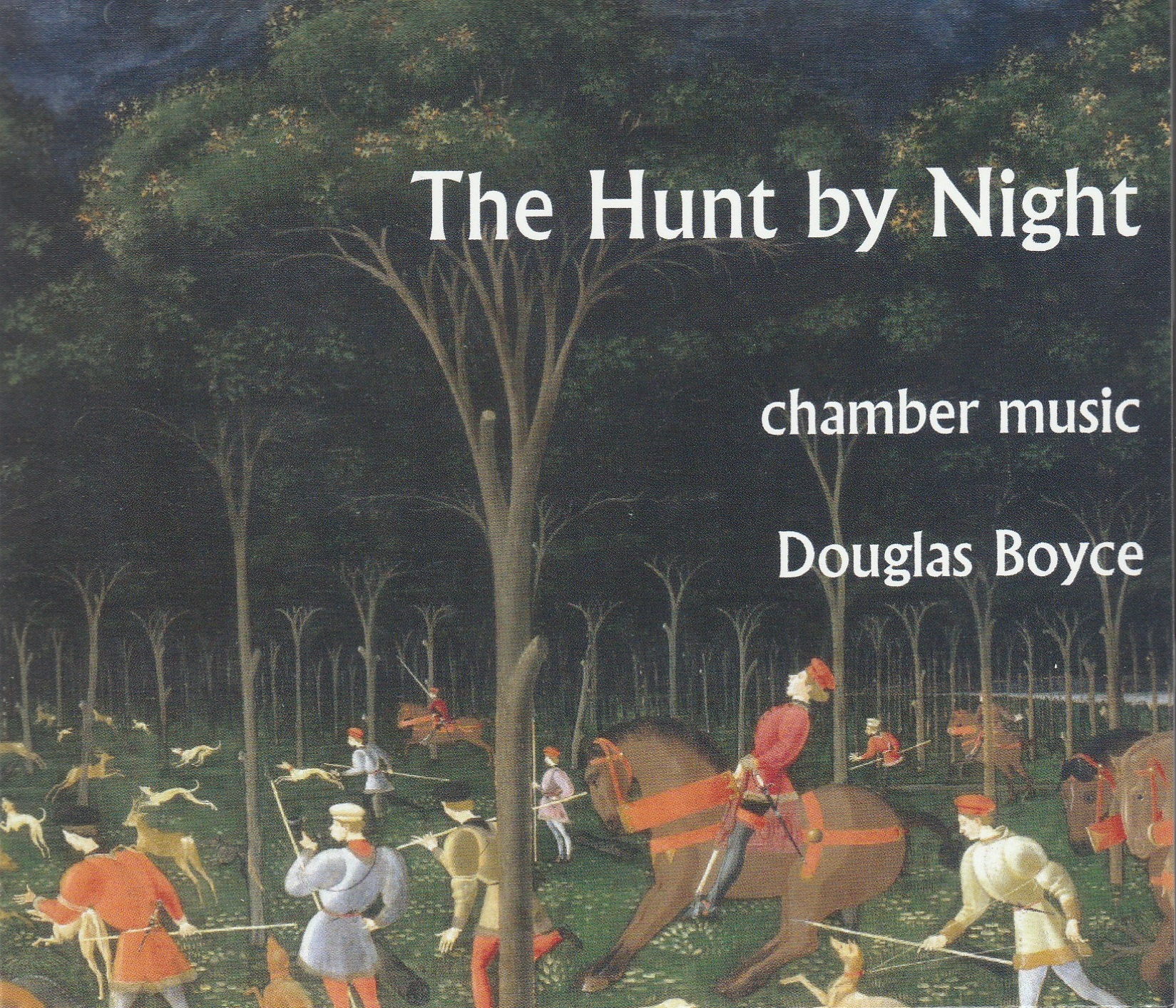
Douglas Boyce’s erudite liner notes may make you reach for a dictionary. If I read him right, chamber music is no longer mere comfortable entertainment for the well-heeled; it provides contemporary humankind with an escape from time’s clutches, through ritual provided by “music’s hierophants” (the priesthood of composer/performers). Not sure about that, but let’s turn to the music itself.

Boyce writes lively, sometimes jarring and jagged lines, demanding for clergy and congregation alike. The title track was already released by counter)induction (Boyce is a founding member), reviewed last issue. It’s terrific to have a broad collection of his music to compare to that exhilarating jaunt. 

Quintet l’homme armé references the cantus firmus Guillaume Dufay used in his eponymous Mass; extra marks if you can sing that melody, but even so, you’ll still need some imagination to find a connection between it and this mysterious descendant; I believe I hear the echoes, but I won’t bet the house. Piano Quartet No.2 involves intricate play with rhythmic blocks. There’s a chancy leeway to how the piece comes together, so this version is just one of the ways it might go. The longest track, and prize-winner for me, Sails Knife-bright in a Seasonal Wind is dedicated to Boyce’s young son. This whimsical trialogue between violin, guitar and percussion progresses from halting introductions, through a wacky little jig, and thence into the mystery world of a child’s deep slumber. Time keeps passing, but the listener feels it suspended for the duration.

Fantastic playing by the many participants. Clean crisp recording values too. Read and decipher the liner notes, if you can. Call it value added: I learned some arcane words, like apodeictic. As for the runes in the margins, no clue.

Listen to 'Douglas Boyce: The Hunt by Night' Now in the Listening Room

14 Anthhony GirardAnthony Girard – Éloge de la candeur
Jean-Pierre Arnaud; Geneviève Girard; Patrice Kirchhoff
CiAR CC 004 (ciar.e-monsite.com)

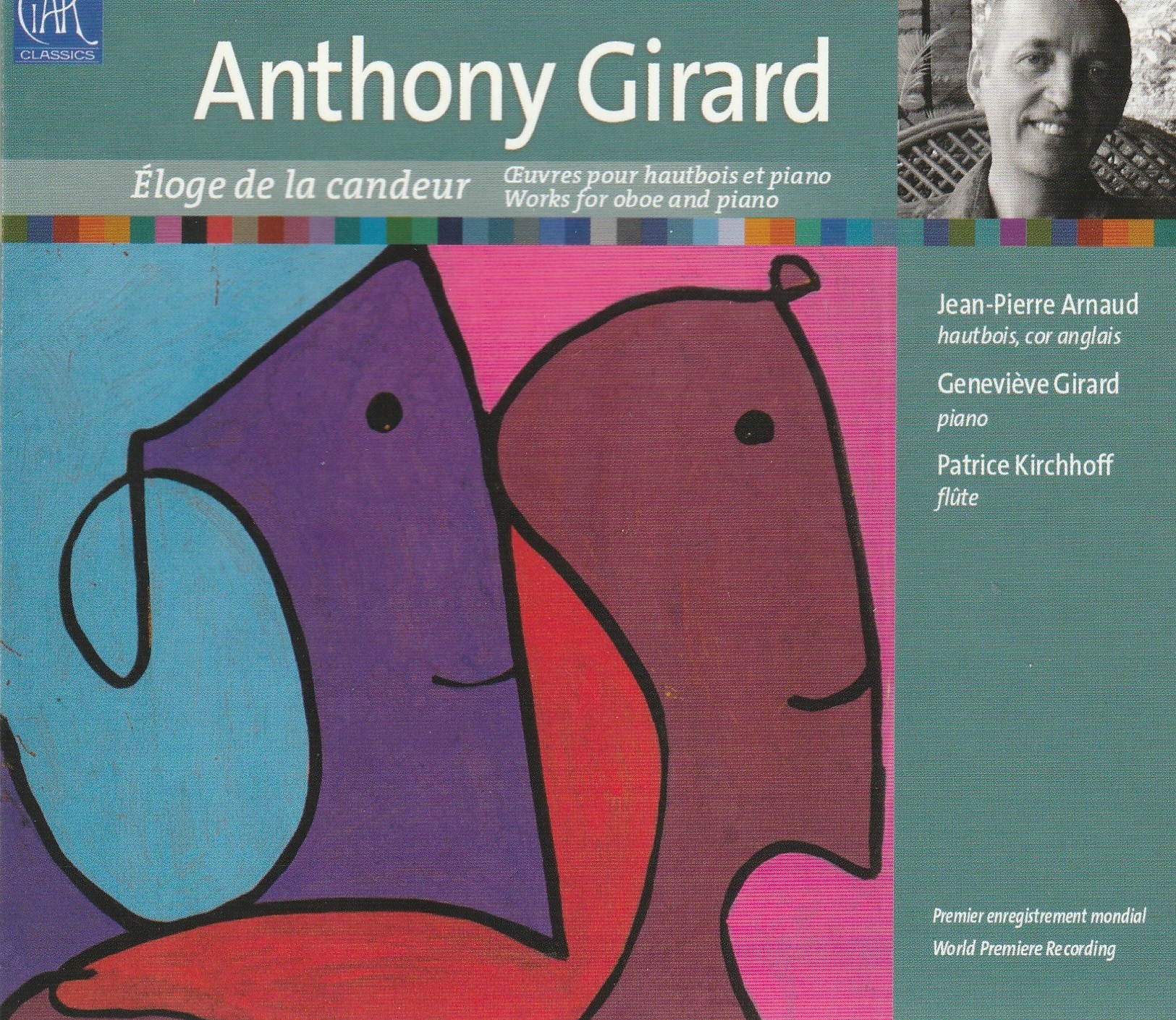
Released as a part of the “Albert-Roussel International Festival” collection, Éloge de la candeur by Anthony Girard is an offering of his works for oboe. The title piece for oboe and piano is a floating dreamscape of colours and emotions. With the use of ascending lines and the high register of the oboe, this piece uses a range of colours that seem to be influenced by the modern French school. Very close in affect to the Sonate pour hautbois et piano by Dutilleux, Éloge de la candeur paints an inspiring scene of serenity and purity in a dreamlike atmosphere.

Apothéose de la mélancolie uses the darker timbre of the English horn, as well as its often neglected higher range, to paint the haunting, melancholic mood.  Girard has the English horn and piano in a dialogue of tonal colours and expression. Epilogue en trio for flute, oboe and piano is a stark contrast to the previous works. There is an energetic playfulness throughout, exploring different textures of articulation, voicing and range of all three instruments. Onze pièces brèves for oboe and piano are 11 quick movements showing the technical possibilities of the instrument. Most lasting no more than 30 seconds, these short pieces are energetic and dissonant compared to Girard’s other writing for the oboe.

Overall, this collection of works by Girard is an inspiring addition to the oboist’s repertoire. This album was beautifully interpreted by Jean-Pierre Arnaud, former English horn soloist of the Paris Opera Orchestra, as well as pianist Geneviève Girard and flutist of the National Orchestra of France, Patrice Kirchhoff.

15 Sid RichardsonSid Richardson – Borne by a Wind
Various Artists
New Focus Recordings FCR285 (newfocusrecordings.com/catalogue)

Sid Richardson has an eloquent answer to the question: “How do you make art?” He comes together with poet Nathaniel Mackey and others to create this music. The black dots leap off the page entwined with Mackey’s lyrical recitations and the sound of horns, percussion and bass performed by the Deviant Septet. The searing heat of an artful sirocco, titled Red Wind, begins a memorable disc of Richardson’s music.

The repertoire of Borne by a Wind features three other works by Richardson. There is no sleep so deep is a gentle, reassuring work that gets a suitably sensitive performance from pianist Conrad Tao, whose fingers seem to caress the notes of the melody. LUNE follows with the mystical high and lonesome wail of Lilit Hartunian’s violin. It is a brilliantly conceived tone poem that soars skyward, evocative of a crepuscular musical event under a cloudless celestial canopy.

Richardson’s music is highly imaginative and reflects his singularly eclectic taste. The curved lenses and mirrors of a myriad of contemporary styles and movements in the arts have been telescoped into these works. The glue is, of course, Richardson’s spectral voice, somewhat reminiscent of Gérard Grisey and Kaija Saariaho. These uncanny parallels are, perhaps, most discernable in Astrolabe where the Da Capo Chamber Players’ performance is interwoven with Walt Whitman’s and Geoffrey Chaucer’s poetry, the whispered climax of which brings this remarkable disc to a dramatic end.

Listen to 'Sid Richardson: Borne by a Wind' Now in the Listening Room

16 Lukas LigetiThat Which Has Remained …That which Will Emerge
Lukas Ligeti
Col Legno WWE 1CD-20452 (col-legno.com)

Described as a meditation on aural memory, this CD presents the electroacoustic sound installation percussionist Lukas Ligeti created for Warsaw’s POLIN Museum. Designed to comment on Polish Jewish life, the project weaves locally recorded interviews and songs in Polish, English and Yiddish triggered and mixed by Ligeti’s Marimba Lumina (MIDI) with improvisations suggested by those recordings by clarinetist Paweł Szamburski, violinist/violist Patryk Zakrocki, cellist Mikołaj Pałosz, soprano Barbara Kinga Majewska plus Wojtek Kurek’s drums and synthesizer.

Juxtaposing folk songs with instruments means that the often melancholy, sometimes freylekhs melodies, suggest responses that range from stropping string thrusts and barbed reed flutters to sequences which expand on klezmer and pre-War cabaret tunes. Majewska’s bel canto lyricism is most effective in unadorned recitations or personalizing familiar tunes. Modernism isn’t pushed aside for nostalgia though, as sections find her ululating vocals framed by clanking percussion vibrations. The keenest musical commentary is by inference on the connected City of the Damned and Elusive Counterpoint. With thick drum beats and pressurized string stops alongside the snatch of a Yiddish song, Warsaw’s pre-Holocaust Jewish ghetto and its destruction are suggested by City of the Damned. Harsh spiccato sweeps from the strings are notable in Elusive Counterpoint. The sorrowful exposition gradually fades to ghostly echoes as the Yiddish tune becomes fainter subtly questioning what contemporary life holds for Jews in Poland. 

Lacking the interactive element possible in the museum’s spatial atmosphere, the disc is still a superlative listening experience.

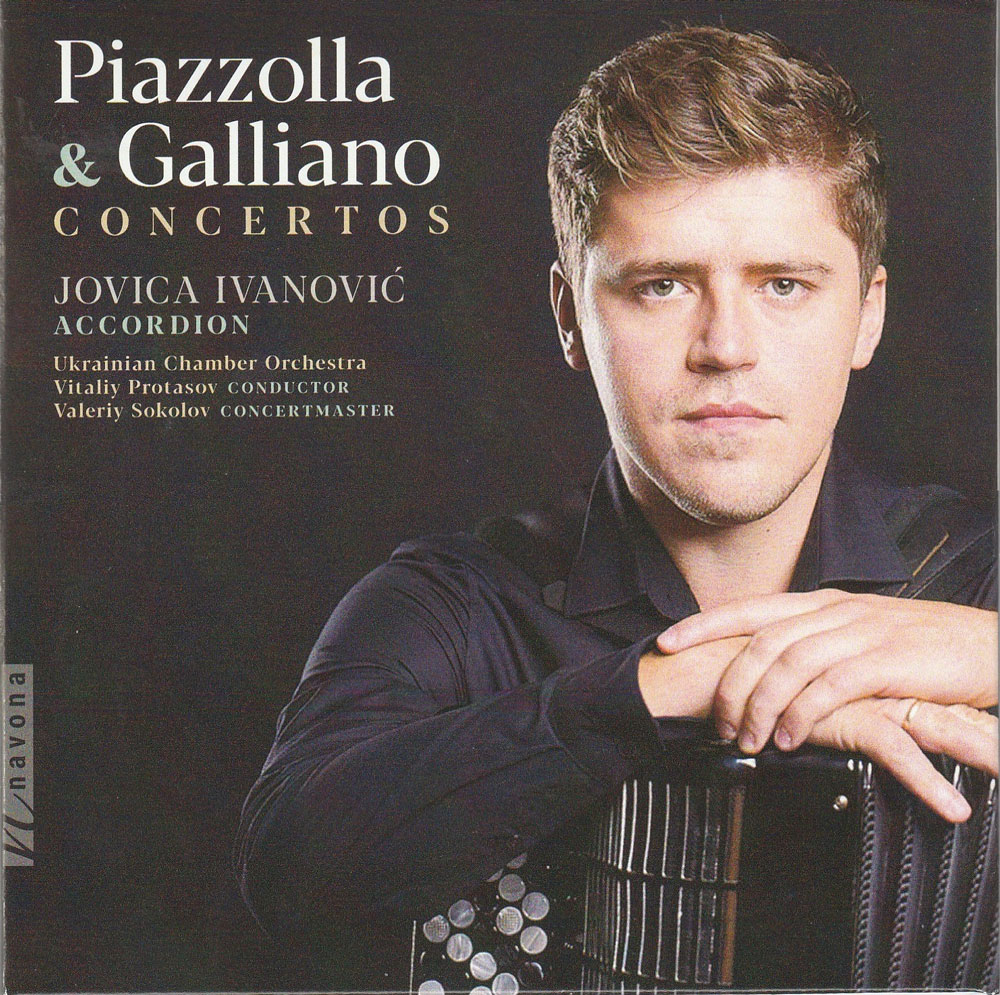
02 Piazzolla GallianoPiazzolla & Galliano – Concertos
Jovica Ivanović; Ukrainian Chamber Orchestra; Vitaliy Prostasov
Navona Records nv6317 (navonarecords.com/catalog/nv6317)

Serbian-Austrian classical accordionist Jovica Ivanović and his colleagues, concertmaster/violinist Valeriy Sokolov and the Ukrainian Chamber Orchestra under conductor Vitaliy Protasov, shine in their collaborative performances of concertos by prominent composers Astor Piazzolla and Richard Galliano. Each three-movement, fast/slow/fast, thoughtful, detailed concerto illuminates Ivanović’s talents and the tight ensemble playing of all the musicians.

Piazzolla’s Aconcagua, a concerto for bandoneón, percussion and string orchestra, was a favourite of Piazzolla himself and it encompasses his characteristic rhythmical tango nuevo melodies and orchestral sonorities. The bandoneón part translates well onto accordion as Ivanović’s intuitive musical performance is highlighted by his detached notes, florid ornamentations and clear fast runs. The orchestral balance is perfect, especially during the ringing, low-pitched string-bass accompaniments.

French composer/accordionist Galliano’s Opale Concerto for accordion and string orchestra is a mix of French, American and Balkan styles. The first movement is slightly more atonal, with such accordion specialities as bellows shakes, accented chords and wide-pitched lines alternating with string solos. The slower second movement starts with a lyrical solo, until the orchestral entry creates a “merry-go-round” reminiscent soundscape. The faster third movement builds excitement with conversational shorter accented melodies until the final ascending accordion glissando ends it with a decisive bang.

Ivanović is a superb accordionist, well-matched to the string players’ collective musicianship. Their interpretations make the Piazzolla and Galliano compositions resonate with permanent eloquence.

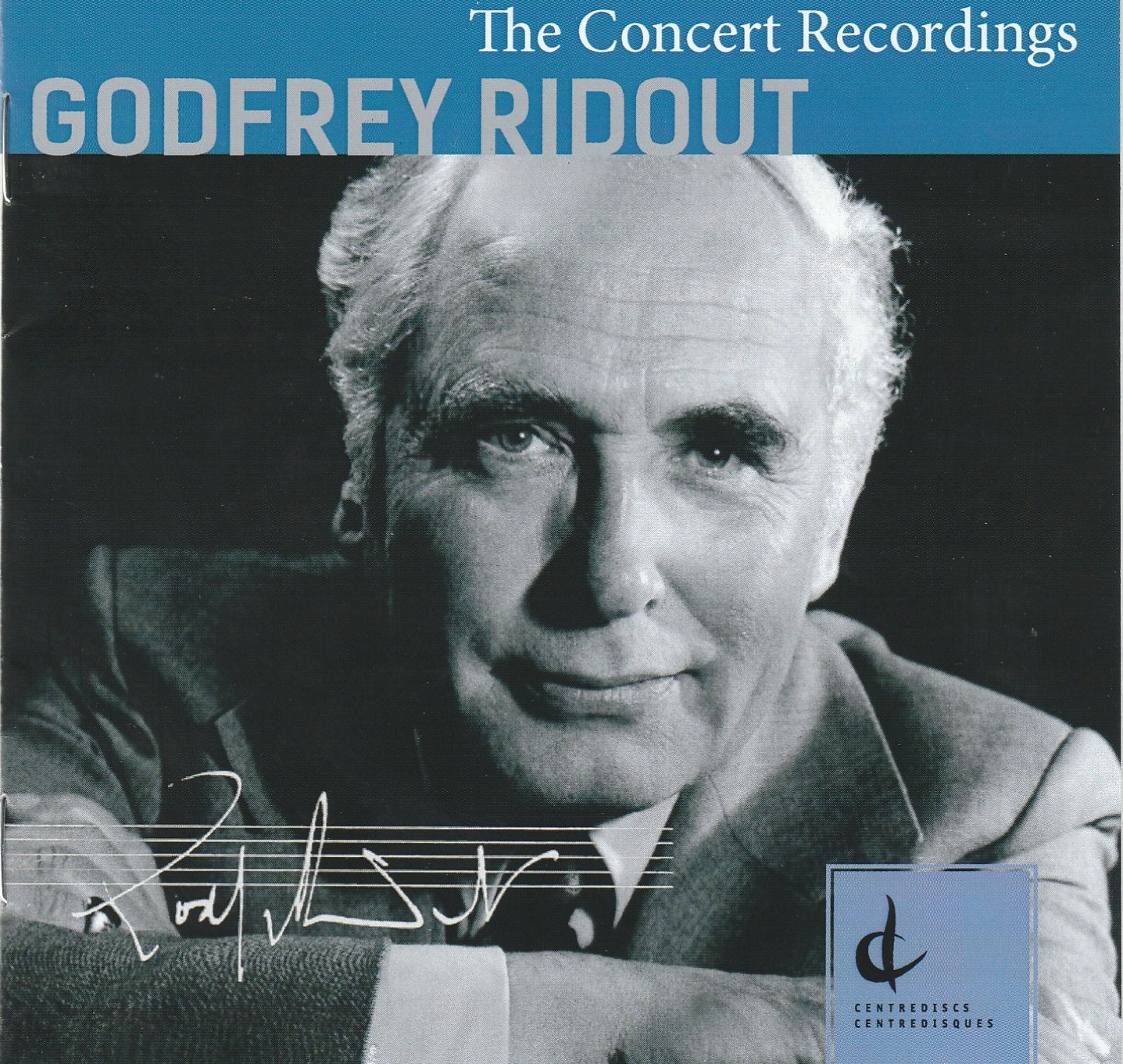
03 Godfrey RidoutGodfrey Ridout – The Concert Recordings
Various Artists
Centrediscs CMCCD 28220 (cmccanada.org/shop/cmccd-28220)

Godfrey Ridout (1918-1984) was “an old-school gentleman,” conservative in deportment, attire (three-piece suits) and compositional style. I knew him also to be very accessible, forthright and warm-hearted – just like his music! This welcome CD presents concert performances from 1975-1993, drawn from the CBC archives.

Cantiones Mysticae No.2 – The Ascension (1962) is set to a sixth-century hymn sung in English by sunny-voiced soprano Janet Smith, Brian Law conducting Ottawa’s Thirteen Strings. As the text proclaims, it opens “with a merry noise and… the sound of the trumpet” (played by Stuart Douglas Sturdevant). One line in the serene second section – “Rescue, recall into life those who are rushing to death” – was, wrote Ridout, his son critically ill during its composition, “a cri de coeur… that really struck home.”

The darkly dramatic Two Etudes for string orchestra (1946) comprise the sepulchral No.1 (Andante con malinconia) and the chugging freight train of No.2, briefly stalled by a misterioso passage. Mario Bernardi conducts the CBC Vancouver Orchestra. Violinist Victor Martin, pianist George Brough and the Chamber Players of Toronto perform Ridout’s period-jostling Concerto Grosso (1974), the jaunty neo-Baroque Allegro and sprightly Vivace straddling the extended Mahlerian Adagio. Commissioned to honour the U.S. Bicentennial, the melodic, extroverted George III His Lament – Variations on a Well-known Tune (1975) finds “avowed monarchist” Ridout playfully employing a theme from “the losing side.” Simon Streatfeild conducts the Winnipeg Symphony Orchestra.

Gratifying listening for all who remember Godfrey Ridout – and all who don’t!

04 Jacques HetuJacques Hétu – Musique pour vents
Pentaèdre; Philip Chiu
ATMA ACD2 2792 (atmaclassique.com/en)

Jacques Hétu (1938-2010) was among the leading Canadian classical composers and music educators of his generation, spending his academic career at several Montreal-area universities.

Hétu composed primarily for established forces including piano, string quartet, orchestral winds, symphony orchestra and opera in a style he once described as “incorporating neo-classical forms and neo-romantic effects in a musical language using 20th-century techniques.” His post-Alban Bergian idiom made him one of the most frequently performed Canadian composers during his career.

Commemorating the tenth anniversary of Hétu’s death, this album presents the Pentaèdre wind ensemble and pianist Philip Chiu in a program reflecting the composer’s keen and abiding interest in both wind instruments and the piano. The brilliant Quebec-based Pentaèdre currently comprising Ariane Brisson (flute), Élise Poulin (oboe), Martin Carpentier (clarinet), Louis-Philippe Marsolais (horn) and Mathieu Lussier (bassoon) takes centre stage on the album.

Hétu’s Wind Quintet and compositions for solo winds and piano invite us to discover afresh his idiosyncratic and imaginative modernist musical universe. The works draw out the best qualities of each woodwind instrument, at the same time stretching their technical, colouristic, expressive and ensemble capabilities. This music demands a high level of musicianship and Pentaèdre delivers.

The 12-minute 1967 Quintet is a standout. Mixing serial, modal and tonal languages, it’s skillfully scored, effectively showcasing each instrument and subgrouping. No wonder this dramatic work has become a favourite among Canadian wind quintets.

Listen to 'Jacques Hétu: Musique pour vents' Now in the Listening Room

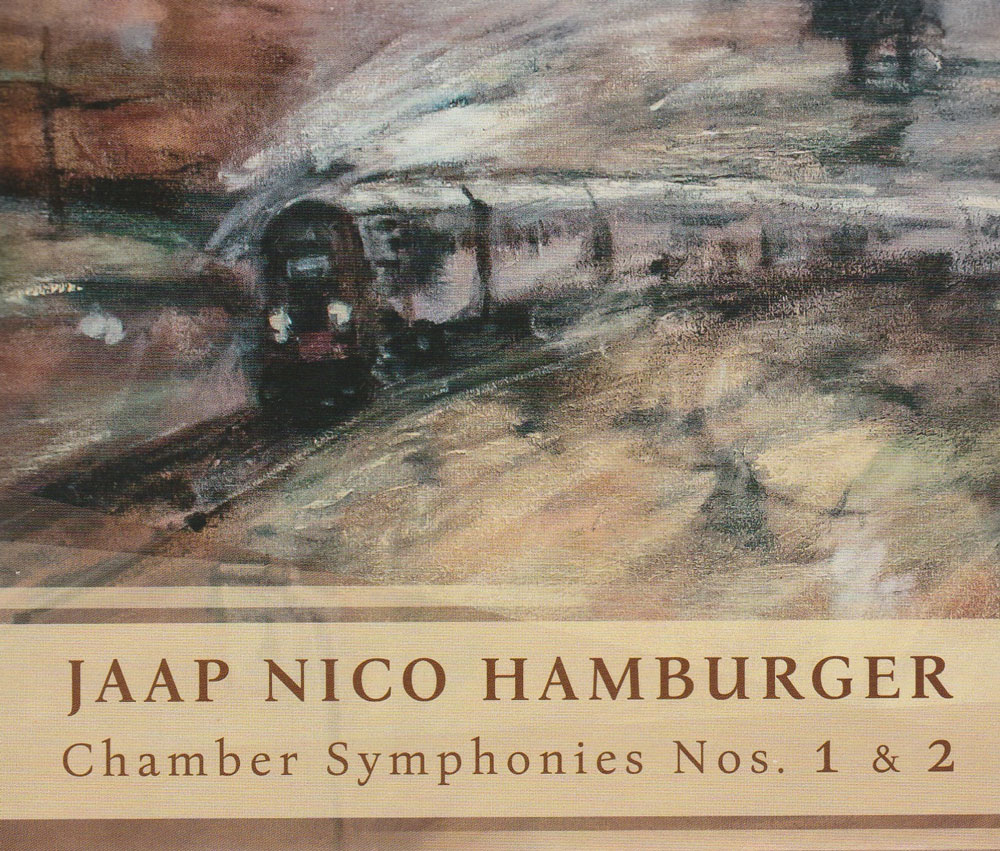
05 Hamburger SymphoniesJaap Nico Hamburger – Chamber Symphonies 1 & 2
Ensemble Caprice; Matthias Maute; l’Orchestre Métropolitain de Montréal; Vincent de Kort
Leaf Music LM235 (leaf-music.ca)

Interesting, musical, inventive and new original Canadian classical music is a reason to celebrate indeed! Here, with two chamber symphonies, composer Jaap Nico Hamburger finds inspiration in honour of Remembrance Day and the 75th anniversary of the Liberation of the Netherlands to create beautiful and well-executed long-form pieces that, while dealing with the difficult theme of the brutality of war, leave listeners with an appreciation of musical excellence and a lingering sense of hopeful optimism. 

Recorded in Quebec in 2019 by Ensemble Caprice under the direction of Matthias Maute, Chamber Symphony No. 1 “Remember to Forget,” explores, as a tone poem, the metaphor of a train journey in sound, highlighting the teleological nature of life as we, individual agents, push forward through times of challenge and adversity towards forgiveness, atonement and a life worth living. Inspired by the sounds and biography of composer György Ligeti (1923-2006), the offering here is as complex and nuanced as the subject theme itself: strident at times, then mitigated by moments of tranquil introspection. Percussion heavy, the piece dips occasionally into carnivalesque sounds and emotions that imbue a playful and irreverent spirit into this otherwise serious piece. 

Chamber Symphony No. 2 “Children’s War Diaries” features l’Orchestre Métropolitain de Montréal and explores one of the darkest periods of history, the Holocaust, channelling the writing of Hamburger’s grandmother, Jannie Moffie-Bolle, whose autobiography Een hemel zonder vogels (“A sky without birds”) documented her experiences as a teenager in Nazi Germany. As the liner notes attest, the themes explored are sobering but important. These two Chamber Symphonies add much to the canon of Canadian classical composition and are well worth your time.

Listen to 'Jaap Nico Hamburger: Chamber Symphonies 1 & 2' Now in the Listening Room

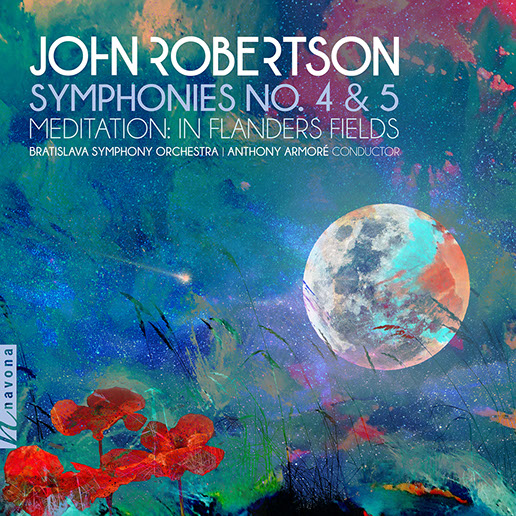
06 John RobertsonJohn Robertson – Symphonies 4 & 5 Meditation: In Flanders Fields
Bratislava Symphony Orchestra; Anthony Armore
Navona Records nv6325 (navonarecords.com/catalog/nv6325)

Anachronism is no sin nor is theft a crime when it comes to making art, not if they are accomplished with subtlety or humour. My favourite 20th-century tomb raider was Alfred Schnittke, who suffered modernity’s loss of innocence, together with nostalgia for past forms. The suffering served as impetus for his most tragic and comic utterances. Which brings me to New Zealand/Canadian composer John Robertson, and his Symphonies 4 and 5.

This music seems happily, painlessly anachronistic, full of bright orchestral effects and warm, tonal harmonies. The second movement of Symphony No.4 is a Sicilienne, a gently progressing dance in 12/8 metre, wherein an oboe laments sweetly over ghostly strings and celesta. The familiar character in the opening of the same work’s first movement recalls so much the wind writing of Carl Nielsen. For a brief moment one hears Shostakovich call out a trill from his own Fourth Symphony at the opening of the third movement. Coincidence? Homage, perhaps, although the body of the theme sounds more like Holst: a jocular, folksong-march. 

The Fifth Symphony revisits Shostakovich, Prokofiev and Samuel Barber as well. Included with the symphonies is a threnody: Meditation: In Flanders’ Fields. Leaving my thoughts on the poem out of this, I’ll say the music accompanying the recited text is fitting, including the requisite bugle call. Take up a quarrel with me on this if you must. 

Robertson is a capable composer, and not, apparently, a suffering genius à la Schnittke. The works are substantive and also pleasurable to hear, which is a refreshing anachronism in and of itself.

Back to top