12 Coleridge Taylor 1Uncovered, Vol. 1: Samuel Coleridge-Taylor
Catalyst Quartet; Stewart Goodyear; Anthony McGill
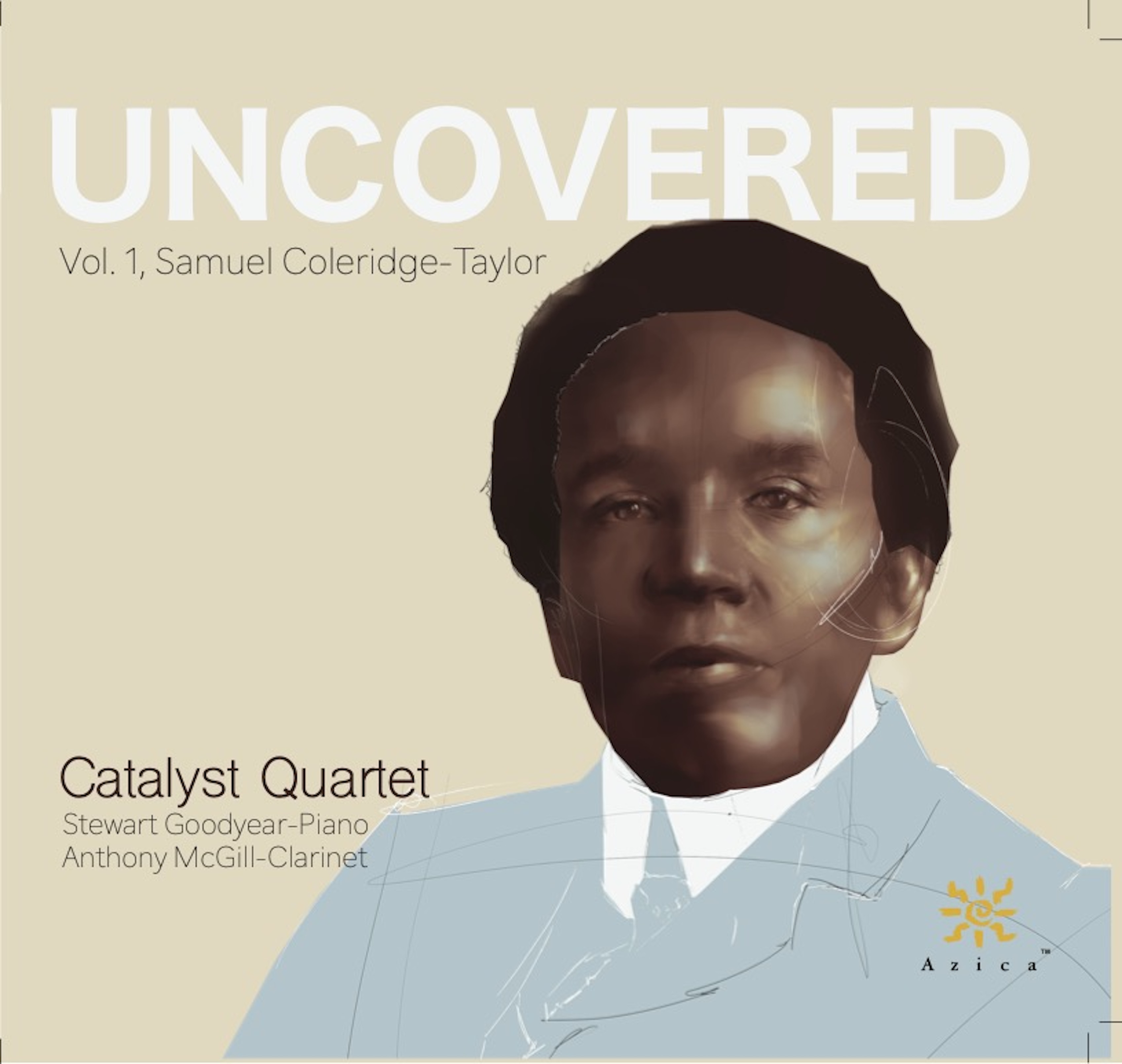
Azica ACD-71336 (catalystquartet.com/uncovered)

The late-19th-century British composer, Samuel Coleridge-Taylor, conquered the United States with his musical ingenuity. But could his being billed – somewhat patronizingly – as the “African Mahler” have blunted his singular musical achievements? We will never really know, and it may even be unimportant now as, with Uncovered, Vol. 1: Samuel Coleridge-Taylor, the Catalyst Quartet turns the marquee lights on to illuminate his elegant music, and not the colour of his skin.

But poetic justice must also come by way of inviting pianist Stewart Goodyear and clarinettist Anthony McGill – two prodigiously gifted Black musicians – to participate in this significant musical project. The association with Mahler does have some significance however, because it took decades of proselytizing by conductors such as Bruno Walter, Wilhelm Mengelberg and Leonard Bernstein before Mahler’s symphonies became audience-pullers. If it’s fallen upon the Catalyst to do likewise for Coleridge-Taylor they’ve certainly delivered. 

These are über-articulate readings of the Quintet in G Minor for Piano and Strings Op.1 featuring Goodyear, Quintet in F-sharp Minor for Clarinet and Strings Op.10 featuring McGill and Fantasiestücke for String Quartet Op.5. The Quartet’s musicians shape phrases with attention paid to every nuance of the scores, while the music’s grand sweep remains paramount throughout; Goodyear’s pianism sings in the piano quintet and McGill’s clarinet does likewise in Op.10. The Catalyst’s performance is marked by a wide range of touch and timbre, with extraordinary emphasis on the inner voices of Coleridge-Taylor’s eloquent music.
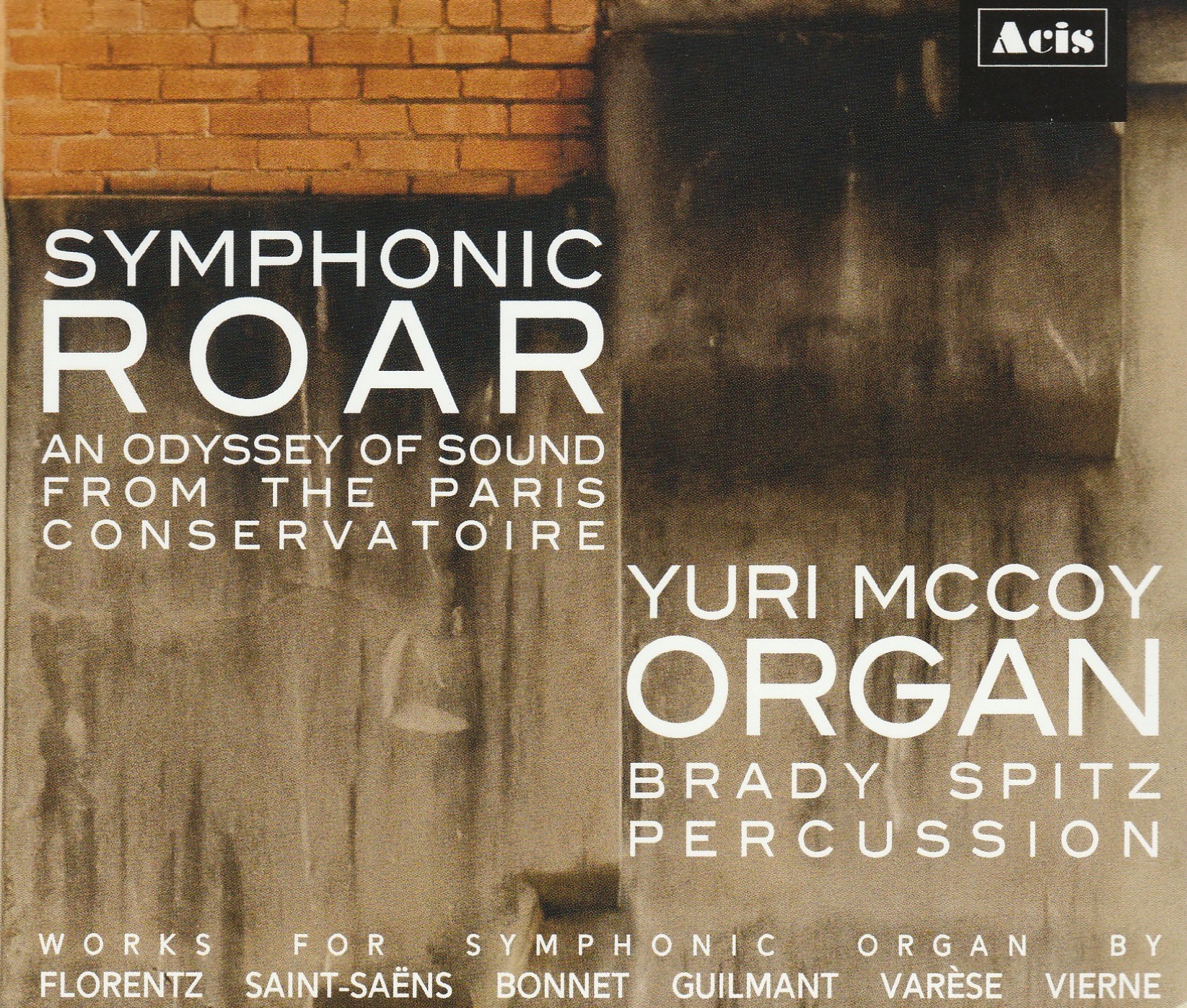
13 Symphonic RoarSymphonic Roar – An  Odyssey of Sound from the Paris Conservatoire
Yuri McCoy; Brady Spitz
Acis APL92957 (acisproductions.com)

Inspired by French composers’ exploitation of the organ’s myriad multicoloured sonorities in these “symphonic” works, Houston-based Yuri McCoy says he feels “free to orchestrate… in many different ways,” often making “many more registration changes than indicated in the score.” (As for the “roar,” wait for it!)

McCoy and console assistant Grant Wareham collaborate in Jean-Louis Florentz’s Poème Symphonique “La Croix du Sud” (2000), named for the constellation. With influences from Florentz’s teacher Messiaen, and Tuareg and Sufi music, it growls, chirps and surges around disquieting interludes that conjure mysterious, desolate landscapes.

A noble central anthem illuminates the celebratory Allegro Vivace from Felix Alexandre Guilmant’s Organ Sonata No.2 (1862). Joseph Bonnet’s brief Elfes from his 12 Pièces (1910) is a gossamer swirl of shimmering light, rendered in sound. Fantaisie, Op.101 (1895) by Camille Saint-Saëns comprises a murmuring, gentle andantino, a tempestuous fuga and a calm, reassuring finale. Clair de Lune from Louis Vierne’s 24 Pièces, Suite No.2 (1926) paints a secluded nocturnal scene in muted pastel watercolour.

At nearly 28 minutes, the CD’s longest and most “symphonic” entry is a remarkably effective arrangement by McCoy and percussionist Brady Spitz of Edgard Varèse’s Amériques (1921), the original version requiring 27 woodwinds, 29 brass and an immense percussion battery. Collin Boothby assists McCoy on organ and Spitz on percussion, employing all of Varèse’s noisemakers – lion’s roar (!), siren, rattles, cyclone and steamboat whistles, etc., etc.

Fascinating listening, from mystery-laden start to roaring finish!

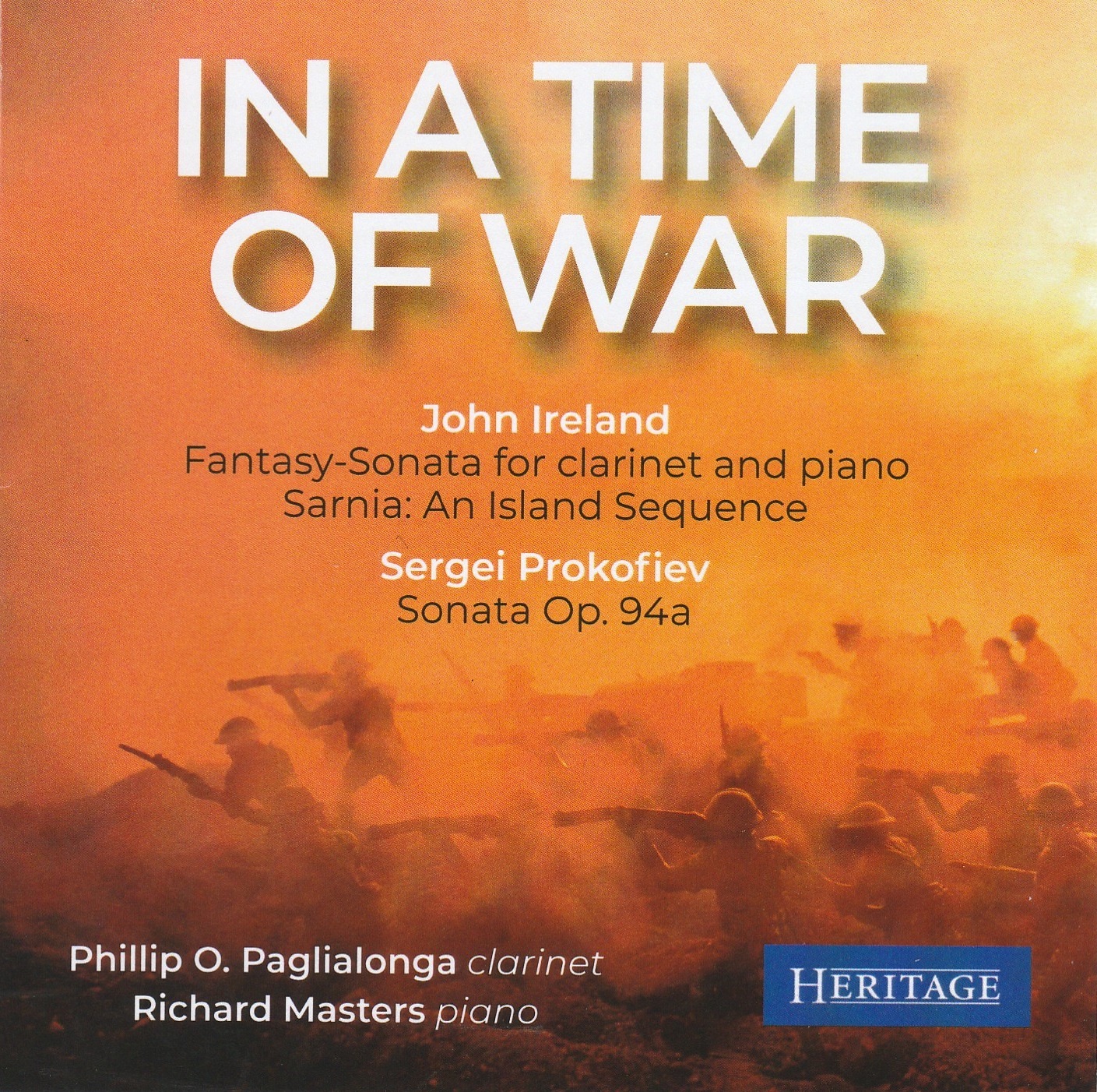
14 In a Time of WarIn a Time of War
Phillip O. Paglialonga; Richard Masters
Heritage HTGCD 173 (heritage-records.com)

In a Time of War, featuring clarinetist Phillip Paglialonga and pianist Richard Masters, proffers works by two composers suffering exile during WW2. An odd pairing to be sure, but it’s possible to hear some common ground between Serge Prokofiev and John Ireland. If you listen to the late moments of Ireland’s Fantasy-Sonata for Clarinet and Piano there’s an argument to be made. Written in 1943, the same year as Prokofiev’s Flute Sonata Op.94, the Ireland work does what a lot of mid-century English music does: explore modernity and expression, but aloof in a way that might evoke Prokofiev the man, although not his music. 

I think clarinetists should leave well enough alone when it comes to poaching repertoire, especially in the case of the Prokofiev, which after all was more or less stolen from flutists for the already-crammed violin library by David Oistrakh (with Prokofiev’s complicity!). Sorry, flutes, it’s a better piece in the second take. Opus 94a is heard as often, if not more than the original. The clarinet version here should maybe be called Opus 94a(b), I don’t know. It’s very dicey, range-wise, and hardly idiomatic for the clarinet. Paglialonga manages the high tessitura quite well, but most tempos are slower than you might be used to, and the balance has his sound too far in front of Masters, which jars a bit at the opening. The duo’s rendition is a work apart from the original, as a quick reference to Oistrakh’s recording will confirm. 

A third work is included, also from 1943, Ireland’s Sarnia: An Island Sequence, a solo Masters performs with more freedom than the other tracks demonstrate. These are good performances, if somewhat staid.

15 Classical KidsClassical Kids: Gershwin’s Magic Key
Chicago Youth Symphony Orchestras
Classical Kids Music Education 270541 (classicalkidsnfp.org)

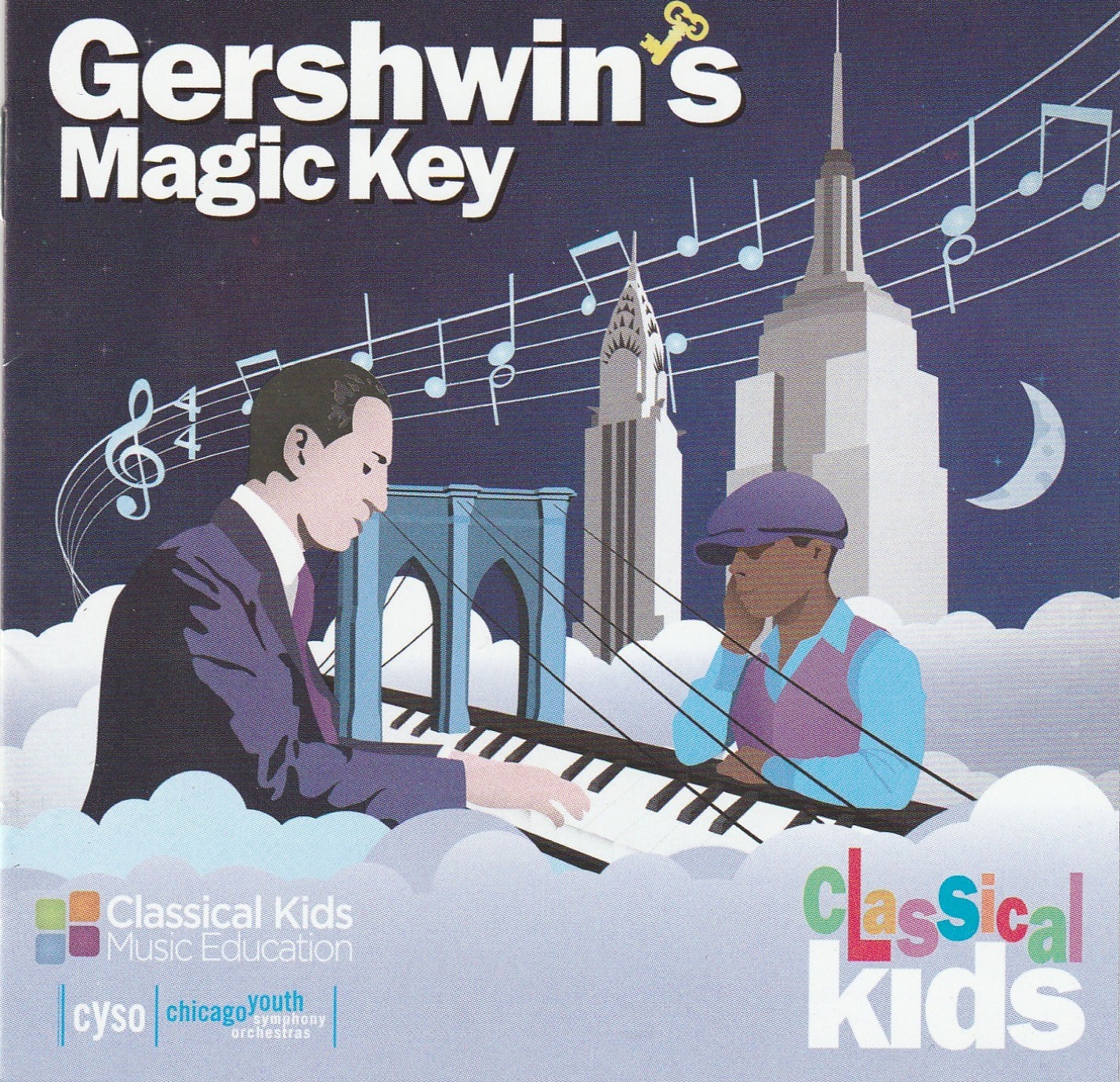
Gershwin’s Magic Key is the first new album in 20 years from the award-winning platinum-selling Classical Kids, most famous for Beethoven Lives Upstairs. This high quality, dynamic studio recording features the Chicago Youth Symphony Orchestras conducted by Allen Tinkham, voices of professional actors Elic Bramlett and Leslie Ann Sheppard, and head writer/music supervisor/featured pianist Will Martin, who premiered the original live concert.

Set in 1920s New York, the three-act story revolves around a newspaper boy’s chance meeting with composer George Gershwin, leading to the two travelling through New York, verbally telling stories based on Gershwin’s life and the times, intertwined with his music. The opening attention-grabbing string swirls, clear spoken words, piano solo and wailing clarinet set the stage for a fast-paced, exciting fact-based production both children and adults will love. The supportive spoken tips from Gershwin, such as “I was a changed person learning piano; Every sound is music; Do not let anyone tell you what you can or cannot be;” are positive reinforcement for the boy, and all children listening and reading the liner notes. 

Gershwin’s compositions featured include fabulous orchestral renditions of Summertime, An American in Paris and the upbeat singalong/dance-along I Got Rhythm. Educational musical outtakes from other composers include Dvořák’s Humoresque, the Tin Pan Alley hit Take Me out to the Ballgame, and 1920’s Baby Face. Finale recreates the world premiere of Rhapsody in Blue, from the piano/orchestra exuberant performance to the recording’s closing audience cheers. Bravo!

01 To AnatoliaTo Anatolia – Selections from the Turkish Five
Beyza Yazgan
Bridge Records 9549 (bridgerecords.com/collections/catalog-all)

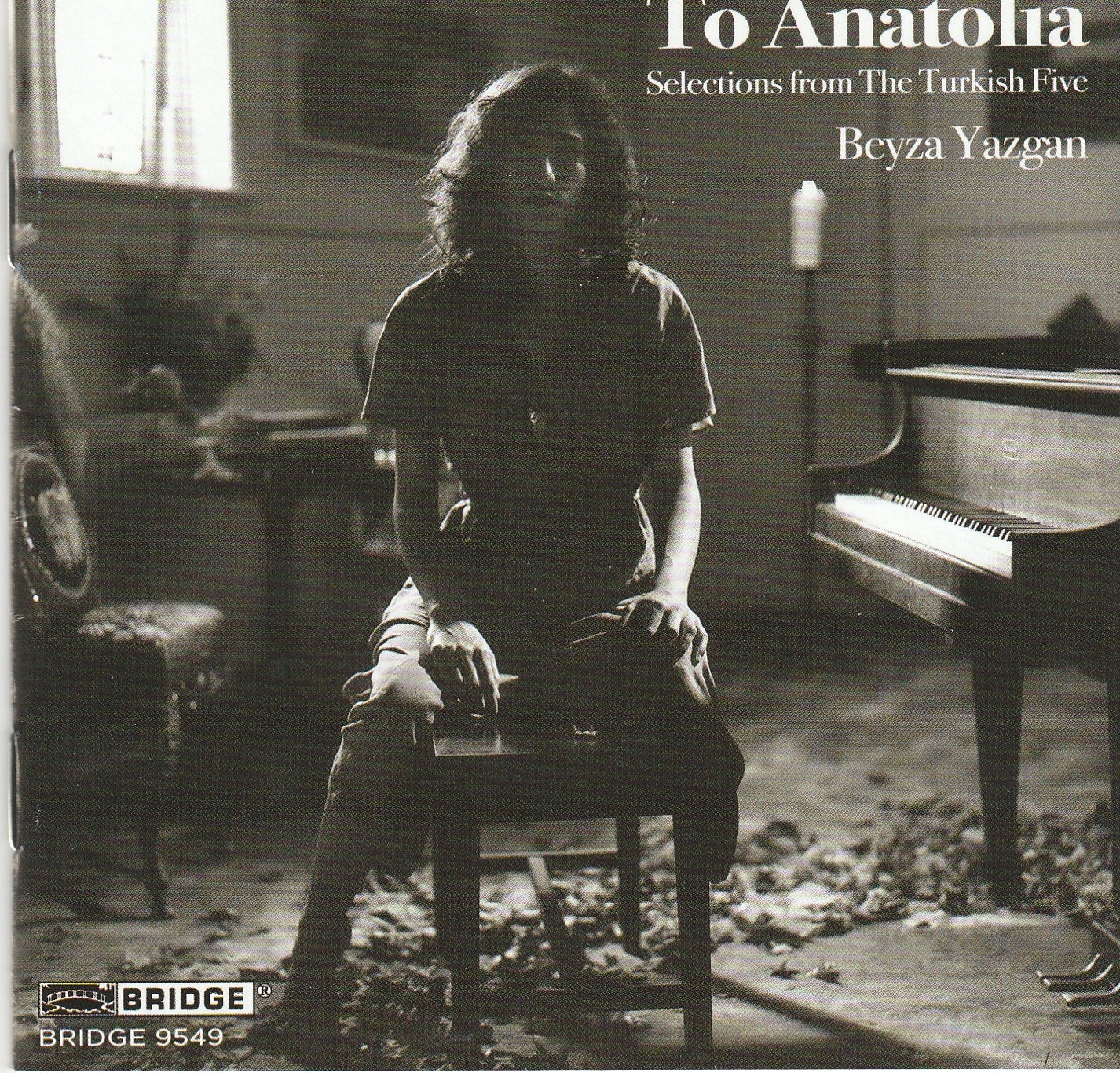
A love letter to Anatolia (Asia Minor), this album introduces young artist Beyza Yazgan, a Turkish pianist now based in New York. Yazgan expresses immense pride for her heritage and gentle longing for her homeland through a wonderful selection of piano pieces by a group of 20th-century composers known as the Turkish Five. She also includes her own illustrations and detailed liner notes on Turkish music traditions, thus making this album even more personal. 

Yazgan’s interpretation of these compositions is simply lovely. Her heartfelt approach brings out beautiful colours from gentle and melancholic pieces. On the other hand, she engages masterfully with complex rhythms in more percussive compositions, making her performance well balanced and charming. 

The Turkish Five – Ahmet Adnan Saygun, Ferid Alnar, Ulvi Cemal Erkin, Necil Kazim Akses and Cemal Reşit Rey – transformed the music of their time by introducing Western compositional styles and forms and blending them with rhythms and modes of traditional Turkish folk music and dances. Just as Anatolia itself has been the land of many cultures and flavours, so is the music on this album. From the beautifully atmospheric Little Shepherd by Erkin and feet-stomping Horon by Reşit Rey, to the elegant Zeybek Dance by Alnar, the pieces tell stories of the unique and rich music heritage of this land, its people and customs.

02 Alexander MosolovAlexander Mosolov – Symphony No.5; Harp Concerto
Taylor Ann Fleshman; Moscow Symphony Orchestra; Arthur Arnold
Naxos 8.574102 (naxosdirect.com/search/8574102)

Russian composer Alexander Mosolov (1900-1973) was active in the early Soviet era, and his artistic voice sits somewhere between Shostakovich and Prokofiev. The latest recording of director Arthur Arnold and the Moscow Symphony Orchestra is a dedicated release of the lesser-known composer’s Fifth Symphony and Harp Concerto. In the former, never performed during the composer’s lifetime, Arnold and the Moscow Symphony deliver the work with subtle musicianship and crisp articulation – aspects that are needed to execute the contrasting three movements. 

Mosolov’s Harp Concerto is a delicate and beautiful work in four movements that takes the listener on a journey from contemplative sustained atmospheres in the first movement, through a mysterious Nocturne, to a charming Gavotte, and finally a flashy Toccata. Harpist Taylor Ann Fleshman’s technique and phrasing are outstanding in this performance. Her captivating interpretation leaves no doubt that this work deserves a lasting place in the harp concerto repertoire. 

It is always nice to encounter an effort to keep lesser-known composers’ music alive – Arnold and the Moscow Symphony certainly make a strong case for increased future performances of Mosolov’s music.

03 Music for Self Isolation Album CoverFrank Horvat – Music for Self-Isolation
Various Artists
Centrediscs CMCCD-28521 (cmccanada.org/shop/cd-cmccd-28521)

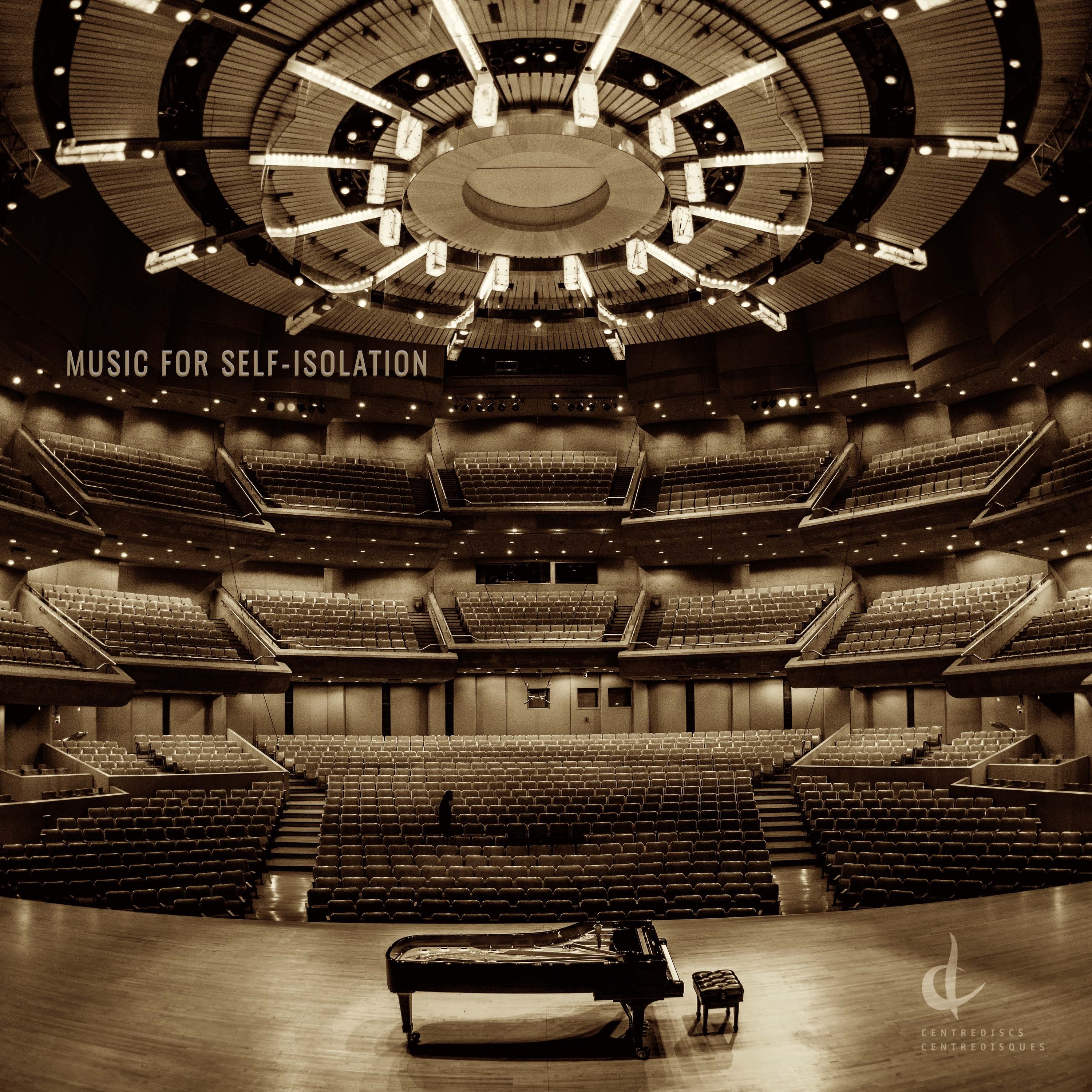
Early in the COVID-19 pandemic, Toronto composer and pianist Frank Horvat observed fellow musicians struggling to cope with loss, precarity triggered by cancelled gigs and the strain of isolation. Wondering how to effectively respond, his answer: write new compositions to counter self-isolation. Thus, during the spring of 2020 he composed 31 short classical-style pieces, shared immediately with the international community on social media. They were an instant hit. Numerous performance videos were posted on the Internet and Horvat made plans to record them on the album Music for Self-Isolation at Toronto’s Roy Thomson Hall. The session wrapped the day before Ontario’s stay-at-home order came into force on January 14, 2021. The album also includes the ensemble composition Together in Spirit, using overdubbing technology to effectively bring together the 22 talented musicians who played solos and duos on the other tracks of Music for Self-Isolation.

Part two of the album comprises eight nuanced The Idea of North-style audio documentaries titled Pandemic Stories. These layered monologues, each by a different musician, are deeply personal stories about impacted careers and lives during the pandemic, accompanied by Horvat’s instrumental music. The aim: to present “the hopes, dreams and fears,” of each musician, and their views on the arts and culture sector, “in order to heal and move forward together.”

Taking the two sections together – the 32 music miniatures and eight audio reports – the 40-track Music for Self-Isolation offers accessible, soothing music, plus international voices of resilience during this time of plague. The album reminds us that music is among the most mysterious and highest order of human skills.

04 Andrzej Pietrewicz 4 EP Cover#4
Andrzej Pietrewicz
Independent (soundcloud.com/andrzej-pietrewicz/sets/4a-1/s-h6vzdD1KKYM)

Andrzej Pietrewicz is an independent musician, small instrumental ensemble composer and producer based in Port Credit, near Toronto. His unique inspirational compositional and performing sound makes this six original-song, self-produced-during-COVID-lockdown creation, unforgettable! Pietrewicz clearly has a comprehensive technical understanding of diverse musical genres such as Baroque, jazz, blues, folk, classical and contemporary. He draws on this knowledge to develop his own vibrant sound performed here by talented instrumentalists on piano, strings, percussion, guitar, winds, programming and, in the closing track, vocalists. 

Multi-instrumental track 1 is a great introduction to his music, combining quasi-orchestral tonal sounds with modern touches such as interval jumps and tweeting bird-like piano sounds. The faster, happier track 2 with its rhythmic piano interval patterns, instrumental held notes, simultaneous tonal/modern effects and high-pitched woodwind sounds creates a musical pre/post-COVID sunny warm spring day for me! 

Track 3, with a nod to Baroque keyboard music, yet so modern day in tonality, moves from the contrapuntal mood-changing opening lines to subtle dissonant intervals, steady rhythms and detailed phrasing, performed with sensitivity, passion and hope by the composer. Nice addition of singers Nacre, Timbre, Laura and Caroline Joy Clarke to track 6 as their high pitches alternating with tight string, flute and piano parts create a captivating positive soundscape. 

This is uplifting, joyous, beautiful music to be enjoyed over and over again.

Listen to '#4' Now in the Listening Room

05a Claire Chase 1Density 2036 (2013-2015)/(2016-2017)
Claire Chase
Corbett vs Dempsey CvsD CD076 (corbettvsdempsey.com)

Claire Chase is a force. Our modern understanding of contemporary music performance is pushed forward with artists of this calibre. The eminent flutist’s latest release comes as a monumental four-disc statement toward why Chase is one of the world’s most celebrated performers. As one would expect, the execution on this release is extraordinary. That said, expected excellence must not be confused with anything inherently predictable: each piece is delivered with a stunning level of musicianship that demands attention and respect. Titled Density 2036, this release represents the first five years (2013-2017) a of a 24-year project through which Chase will commission new pieces for solo flute each year until the 100th anniversary of Edgard Varèse’s seminal flute composition Density 21.5, written in 1936.

05b Claire Chase 2The first disc begins with Marcos Balter’s Pessoa for six bass flutes – a piece that embodies a rather meditative atmosphere with shakuhachi-like gestures. There are two pieces by Brazilian-American composer Felipe Lara, the second of which, titled Parábolas na Caverna, is wonderfully mysterious in its richness, drawing the listener into a highly successful soundworld and unusual invocations for the flute. Chase takes command of the extended techniques to such a world-class level that I had to listen several times to believe what was being heard. 

It is not simply technical fireworks on display that makes Chase’s playing so compelling: it’s technical wizardry combined with a level of care, dedication and nuance that makes a recording like this so important. George Lewis’ Emergent for flute and electronics is a true gem of the repertoire. This highly original music is stunning for its thrilling otherworldliness. An Empty Garlic for bass flute and electronics written by Chinese-born composer Dun Yun is exquisite. It is a lush garden of undiscovered essences producing an irresistible listening experience. The first CD caps off with Chase’s own interpretation of Varèse’s Density 21.5 that may objectively be considered a seminal recording of this early-20th-century masterpiece. 

We also receive a dynamic and adventurous piece from Dai Fujikura and an engagingly hip work from Francesca Verunelli. Pauline Oliveros’ Intensity 20.15: Grace Chase – a work inspired by a text written by Chase’s grandmother – is 20 minutes of pure ingenuity suspended in a realm beyond imagination. 

Suzanne Farrin’s The Stimulus of Loss is an expressive and delicate work with an appearance by the ondes Martenot; the playful energy in Tyshawn Sorey’s Bertha’s Lair is a magical landscape with percussive edges; Pauchi Sasaki’s Gama XV: Piece for Two Speaker Dresses makes brilliant use of technology in a highly evocative soundscape where the ears become enveloped within an airy expanse. The fourth CD contains an eight-movement work by Balter, titled Pan, which is a substantial journey inspired by memory. This work embodies a rather theatrical aesthetic and is written with an intense and luminous brilliance and with clever novelty of material.  

This first installment of Chase’s Density 2036 project is impressive, and a profound affirmation of why Chase is one of the most important champions of contemporary music. Her tremendous musicality and breathtaking command of the flute is dramatic and remarkable. As the CD liner notes remind us, density is a matter of scale; this release deserves 10 out of 10 with any metric I can think of.

06 Norgard Ruders celloPer Nørgård & Poul Ruders: Works for Solo Cello
Wilhelmina Smith
Ondine ODE 1381-2 (naxosdirect.com/search/ode+1381-2)

Courageous and captivating, cellist Wilhelmina Smith has released a new album spotlighting Danish composers Per Nørgård and Poul Ruders. This disc makes a welcome sequel to Smith’s previous solo release featuring Finnish cello music by Esa-Pekka Salonen and Kaija Saariaho. 

Attractively programmed in two parts, this album opens with three sonatas by Nørgård, followed by Bravourstudien, (L’homme armé Variations) by Ruders. Within the sonatas, the listener gains a chronological sense of expressive storytelling. Beloved amongst string instruments, the cello is predisposed to a masterful narrative ability, epitomizing the perfect solo instrument in a number of ways. It possesses a wide tonal and dynamic range that resonates warmly and reverberantly in multiple environments. When wielded by an expert player such as Smith, the cello can direct the most intimate modes of expression and in turn manifest a certain spaciousness, with majestic soundscapes of impressive import. It is this latter profile that proves most exceptional in Nørgård’s three sonatas; they are immediately striking with an outward sonic expanse. In this bowed string land, capacious vistas prevail. By the third work, subtitled “What - Is the Word!” we remain in awe of darkly pulsing melodies as they haunt our ears, questing after an elusive (collective) Nordic heart.

Smith then shifts seamlessly to the whimsical – even impish – soundworld of Ruders. The slightly younger composer of the twain, Ruders is a modern musical maverick; the very same might be said of Smith.

07 Martine VialatteEchos et résonances
Martine Vialatte (piano)
CiAR CC003 (ciar.e-monsite.com)

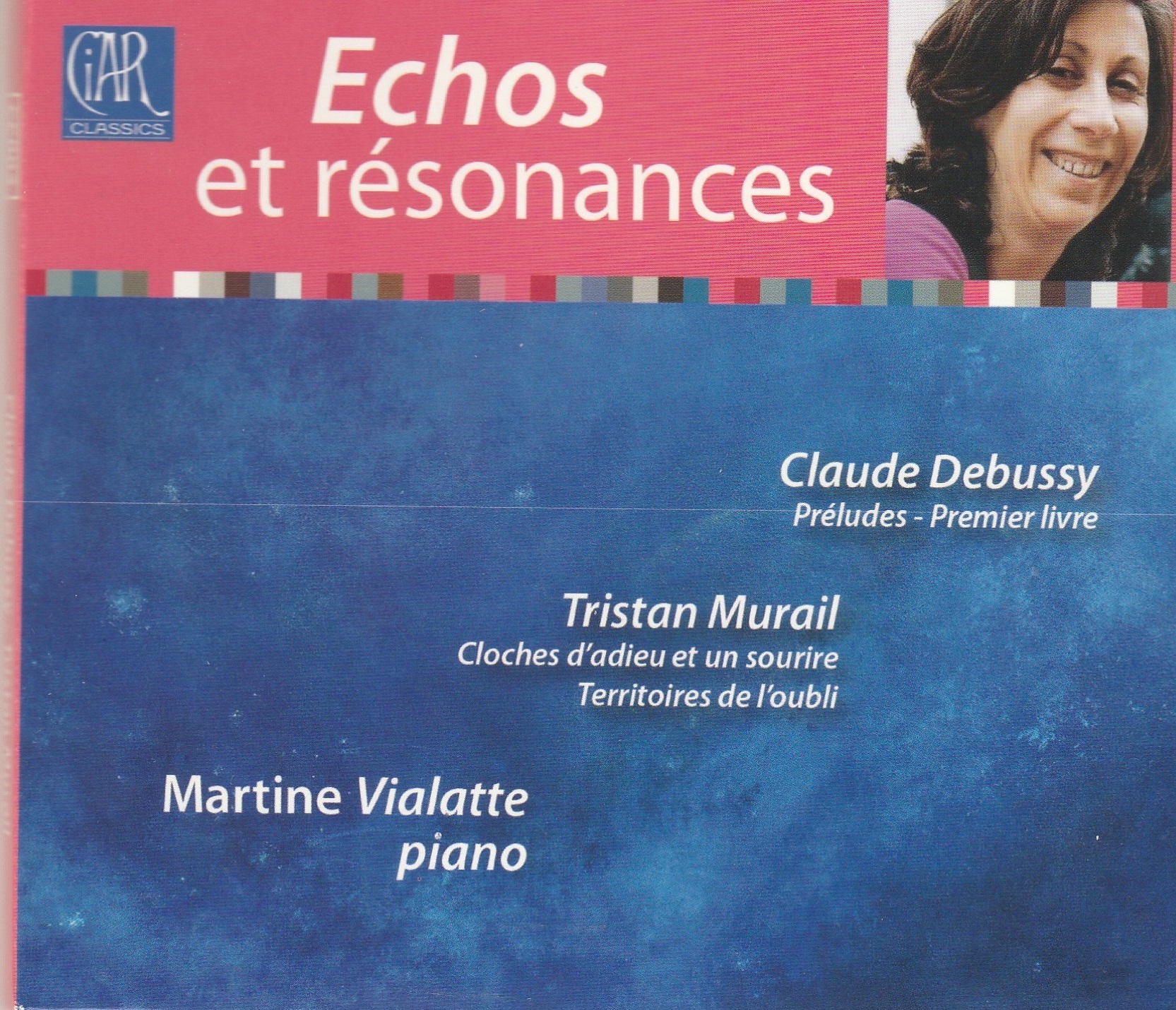
Debussy’s piano preludes have become staples of the repertoire and with so many fine recordings, it is difficult to say something different – a feat that virtuoso Martine Vialatte achieves with subtle mastery. The phrasing and careful use of the pedals creates a sonorous palette not heard in many recordings of Debussy’s set of Préludes (Premier livre)

Also found on this release, aptly titled Echos et résonances, are two pieces by French composer Tristin Murail – a short piece titled Cloches d’adieu et un sourire and the spectral masterpiece, Territoires de l’oubli. In the former, a piece dedicated to Messiaen, chords swing before the listener like memories becoming ever more elusive. In the latter, Vialatte’s delicate touch provides a stunning resonance necessary for this hypnotic and intriguing work. In spite of the composer’s reluctance to be labelled an impressionist, the two pieces by Murail do make for perfect companions to Debussy’s preludes with clearly similar evocations of the natural world. Vialatte delivers world-class interpretations of some of the most resonant works written for her instrument, making for a rich and rewarding listen.

08 Alvin LucierAlvin Lucier – Music for Piano XL
Nicolas Horvath
Grand Piano GP857 (naxosdirect.com/search/gp857)

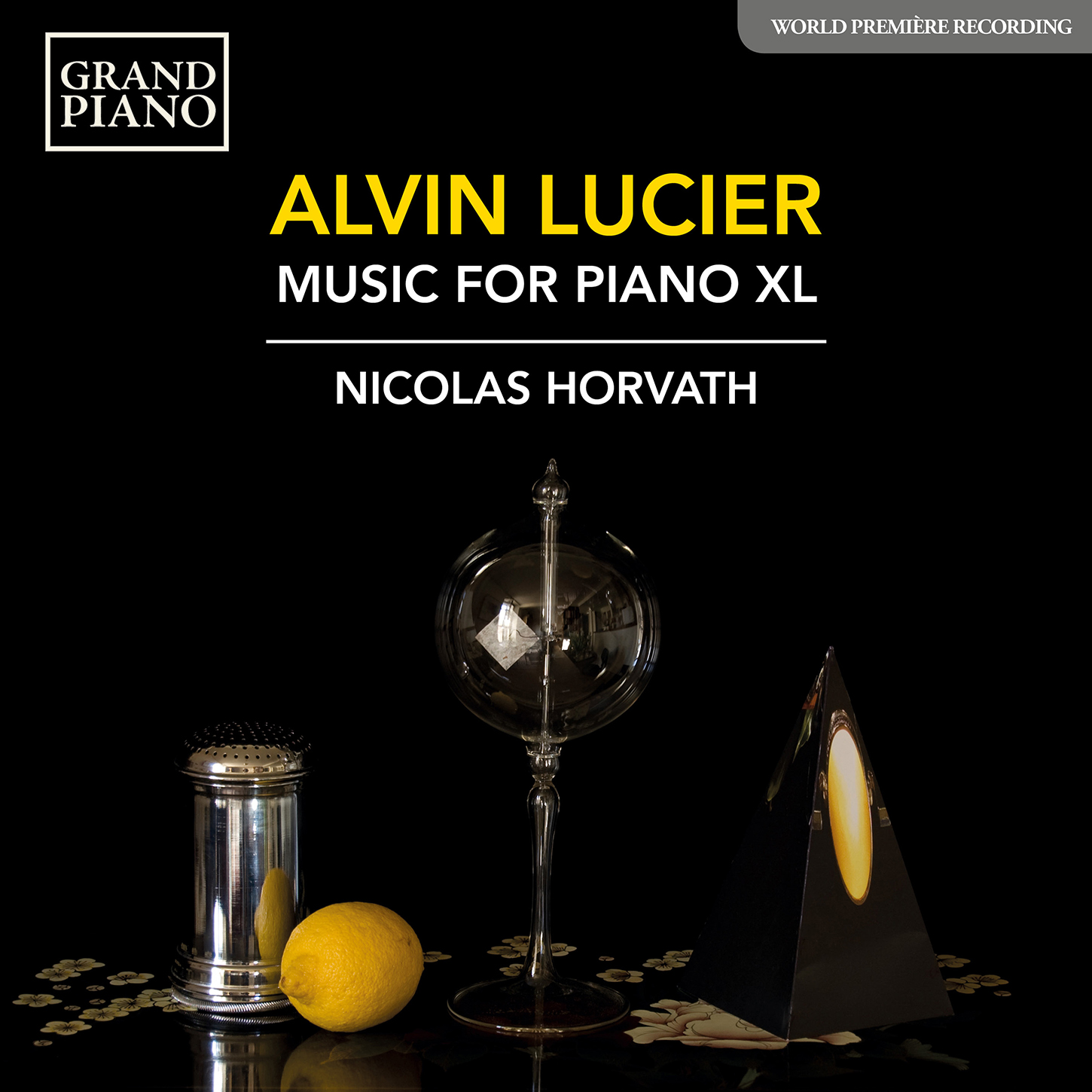
American composer Alvin Lucier has found an impressive exponent in pianist Nicolas Horvath. An artist regarded for a dizzying variety of musical tastes, Horvath is especially celebrated as a leading interpreter of Franz Liszt and yet he has recorded the music of Philip Glass, Cornelius Cardew and Jaan Rääts, to critical acclaim.

In his latest release, Horvath dives headlong into a vast, single-movement work for piano and wave oscillators. He is no stranger to such endeavours, having staged past live performances running up to 12 hours in length. Here, Horvath (via Lucier) offers a sprawling brand of listening experience, supported by “slow sweep pure wave oscillators.” Only single acoustic piano notes are struck throughout, echoing for minutes at a time over a backdrop of acoustic beating. (Two pure waves move up and down with a range of four octaves. The beats are directed by the piano tone’s proximity to pitches from the oscillator.)

While the resulting soundworld is undeniably retro, such creations can reward the assiduous listener. This aesthetic urges a holistic mode of attentiveness. One has to empty the ears of preconceived notions of structure, melody – and even of texture. These tones and beats sear through a vacuum of space on their own sort of photon, commingling and naturalistic: unhindered sonic spectres that speak truly. In what realm could such sounds move us most? Imagine that we’re listening amongst the cosmos, unbounded and flung loose into the stars.

09 LavenaIn Your Hands
Lavena
Bright Shiny Things BSTC-0145 (brightshiny.ninja)

Another stellar offering from the label Bright Shiny Things, American cellist Lavena’s debut album already feels like a veteran project. Lavena champions powerfully through one perfect piece after another – a diverse and colourful collection, each as interesting and compelling as the next.

Beginning with Gemma Peacocke’s Amygdala (“an exploration of the way in which anxiety comes in waves…” – oh, how timely!) this work for solo cello and electronics perfectly delivers its description. The duos by Jessie Montgomery, for cello and violin, and Ted Hearne, a powerful and dynamic setting for cello and percussion, are outstanding compositions beautifully delivered. In between is in manus tuas, a rich and melodic composition in Caroline Shaw’s classic multi-layered chordal style for singing cellist, based on a 16th-century Thomas Tallis motet.

The piece Tusuula, by the brilliant and multi-talented American composer Bryce Dessner, anchors the album’s solo content. Written in 2015 during the week Dessner spent as composer-in-residence at Finland’s Meidän Festivaali, Tusuula is destined to become an outstanding addition to the solo cello repertoire. Lavena leaves no doubt of her commitment to every note. 

Tender and yearning, My Heart Comes Undone, a valentine gift to the artist from her composer husband Judah Adashi, inspired by Björk’s Unravel, gently closes the album. In this iteration it’s played by solo cellist with loop pedal. This is an adventurous yet cohesive mix of compositions that manages to remain totally accessible to the contemporary newbie.

10 Leo ChadburnLeo Chadburn – Slower/Talker
Apartment House; Quatuor Bozzini; Gemma Saunders
Library of Nothing Records CD06 (leochadburn.com)

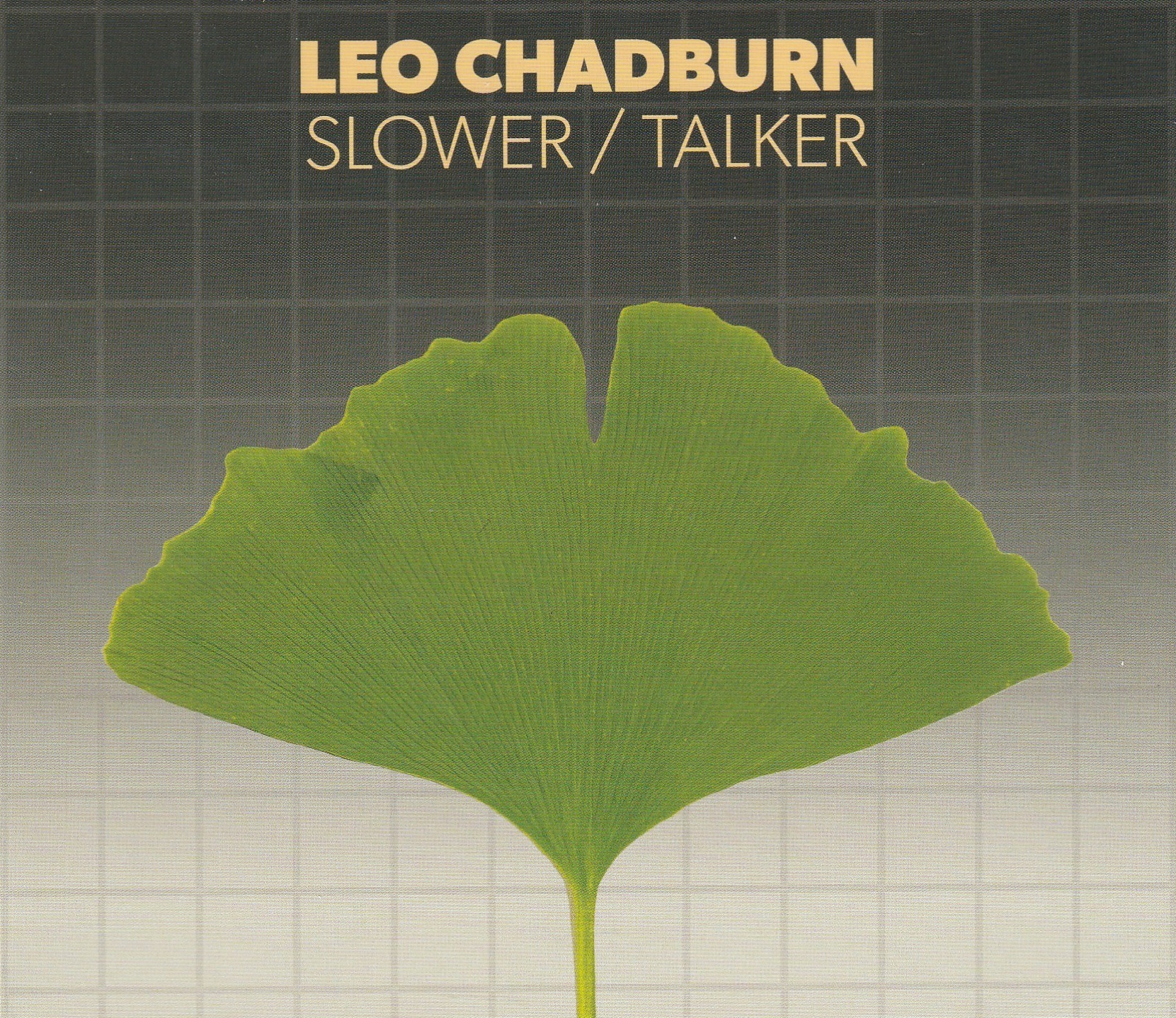
The wild card of the British contemporary classical music scene, composer Leo Chadburn (aka Simon Bookish) widens the scope of his musical experimentation with this remarkable new release. Featuring performances by Quatuor Bozzini (Canada) and Apartment House (UK), and the voices of actress Gemma Saunders and Chadburn himself, the album combines minimalism with spoken word in a way that is symmetrical in form, yet inquisitive and uninhibited in its expression.

The six compositions included on Slower/Talker span a decade of the composer’s work. All explore the relationship between found text and its instrumental counterpart, made up of mostly strings and keyboard instruments. The text’s subjects are comprised of lists of a kind – names of moth species (The Indistinguishables), topographical features encircling London (Freezywater), a lexicon of words used in the fragrance industry (Vapour Descriptors) or a stream of consciousness and properties of chemical elements (The Halogens). The words are spoken theatrically or in a musical way, always with restraint. Some are sung, understatedly, such as words of Mao Zedong in X Chairman Maos. The instruments are interweaving in and out, mostly supporting, sometimes questioning, making up meanings of their own. The textures created are beautiful in their sparseness. The result is a floating dialogue that is hypnotizing and luring, stripped of drama, smooth, as if outside of this world. 

Slower/Talker engages the listener in a subtle way. It is a sonically explorative journey, one worth taking.

11 AkropolisGhost Light
Akropolis Reed Quintet
New Focus Recordings FCR292 (newfocusrecordings.com/catalogue)

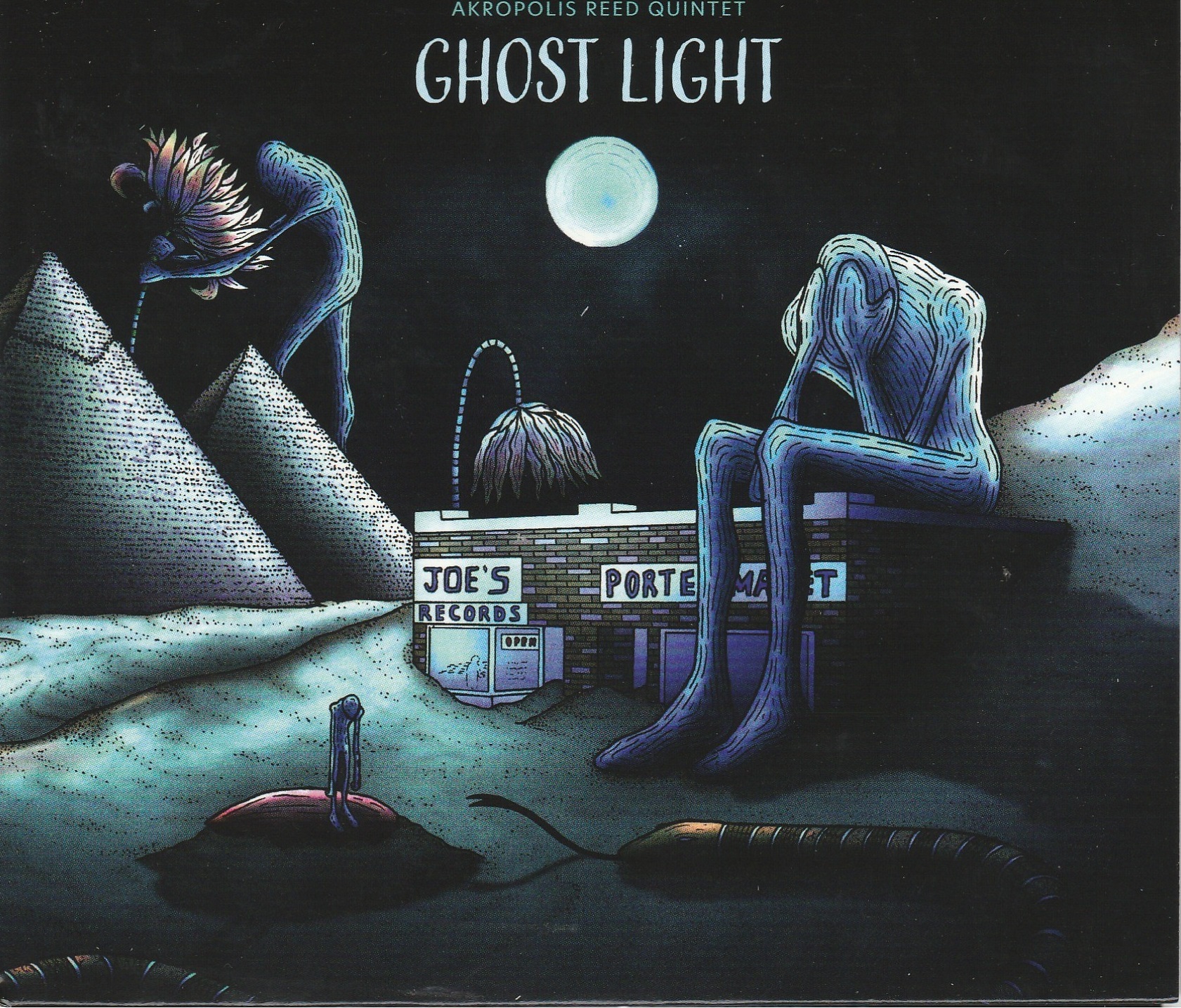
I was thinking about the Crash Test Dummies’ The Ghosts that Haunt Me, when the eerie, first moaning microtonal chord from the Akropolis Reed Quintet’s Ghost Light sounded in my headset. Spooky! This fantastic group of woodwind players from Detroit explores life and death at the far end of the musical spectrum; toe-tapping, mysterious, in tune and in synch. The cover art of the disc brought to mind the Dummies’ release from long ago. Look carefully, there’s purpose to the whimsy.

All the music was commissioned. Unusual? No, but the instrumentation is: two clarinets (soprano and bass), plus an oboe, a bassoon, and… saxophone! Here is range, here is agility and grace, here are complementary colours, never the cloying homophony of a saxophone quartet or worse, clarinet choir. Listen to the blends intentionally exploited by Michael Gilbertson in the brief and chipper Kinds of Light

That opening moan is from Rites for the Afterlife, a four-movement work inspired by ancient Egyptian rituals guiding the soul from this world to the next. Composer Stacy Garrop’s unearthly timbres of microtonal clusters, executed with clean precision, draw the listener into the mystery. Unpitched whispery effects evoke reed beds by a river. Styx or Nile? 

Iranian Niloufar Nourbakhsh based Firing Squad on the greatest opening sentence in literature, from Gabriel Garcia Marquez’s One Hundred Years of Solitude. This melancholy, melodic one-movement work explores mortality and memory. 

Jeff Scott, French horn of the Imani Winds, wrote the disc’s most substantial work: Homage to Paradise Valley. This is activist music, composed to poems by Marsha Music, commissioned to commemorate the destruction of Detroit neighbourhoods and landmarks taken from the African American community during the mid-20th century, in the name of urban renewal.

Listen to 'Ghost Light' Now in the Listening Room

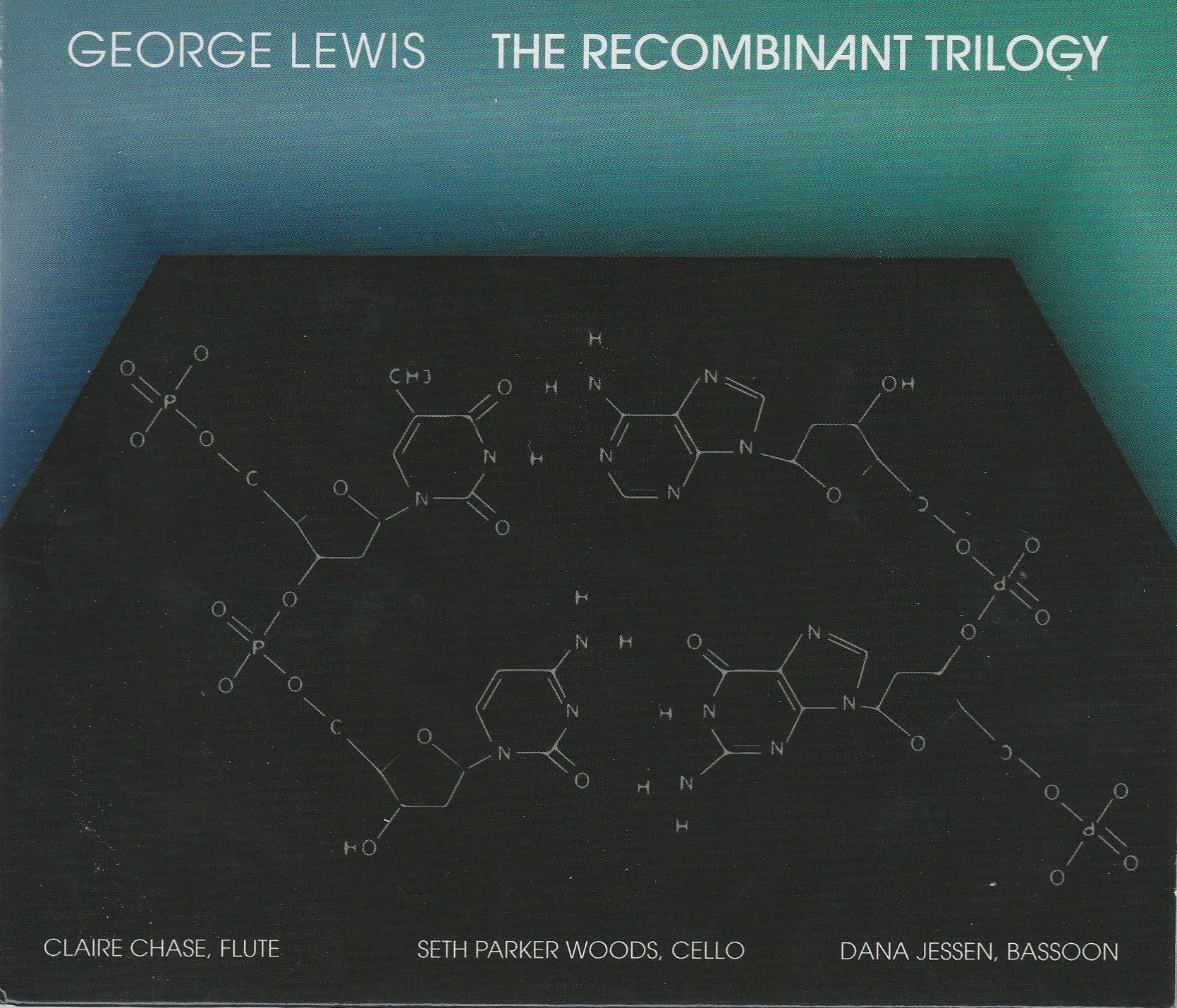
12 George Lewis RecombinantGeorge Lewis: The Recombinant Trilogy
Claire Chase; Seth Parker Woods; Dana Jessen
New Focus Recordings (newfocusrecordings.com/catalogue)

Few musicians have explored the relations between instrumental music and computer programming with the creative zeal of George Lewis, from Rainbow Family, the recently released IRCAM works from 1984 (Carrier Records), to his various interactive works with his Voyager program. His Recombinant Trilogy shifts from works employing improvisation to compositions that apply “interactive digital delays, spatialization and timbre transformation to transform the acoustic sounds of the instrument into multiple digitally created sonic personalities.”

Each of the three pieces combines a soloist with computerized electronics, in the process creating a kind of malleable ensemble that achieves often startling effects within seemingly acoustic timbres, including parallel microtonal lines. Materials are reworked out of sequence, liberating time and continuity in the process. The opening Emergent (2014), performed by Claire Chase, flute, and Levy Lorenzo, electronics, is the sunniest of the three, exploiting and expanding the flute’s mimetic powers to summon up flocks of birds that sing, soar and swoop. Not Alone (2014-15), with cellist Seth Parker Woods operating electronics as well, pushes the cello well beyond its typical sonic contour, pressing far into violin, contrabass and vocal arenas. For sheer evocative power, Seismologic (2017), performed by Dana Jessen on bassoon and Eli Stine on electronics, stands out, magnifying both the bassoon’s range and Jessen’s extended techniques to create an underground labyrinth of menacing roars, Doppler-effect turns and sudden haunted choirs. 

As with his earlier interactions with improvisers, Lewis’ computer compositions effectively extend music’s expressive range in fascinating ways.

Listen to 'George Lewis: The Recombinant Trilogy' Now in the Listening Room

Back to top