“If you don’t live it, it won’t come out of your horn.” – Charlie Parker

Jim Galloway’s way with a phrase – be it on the bandstand or on the page – was inspiring beyond words. This column is dedicated to the memory of a great artist and a true jazz ambassador whose loss is felt around the world. I’ll have more to say about him later in the column.

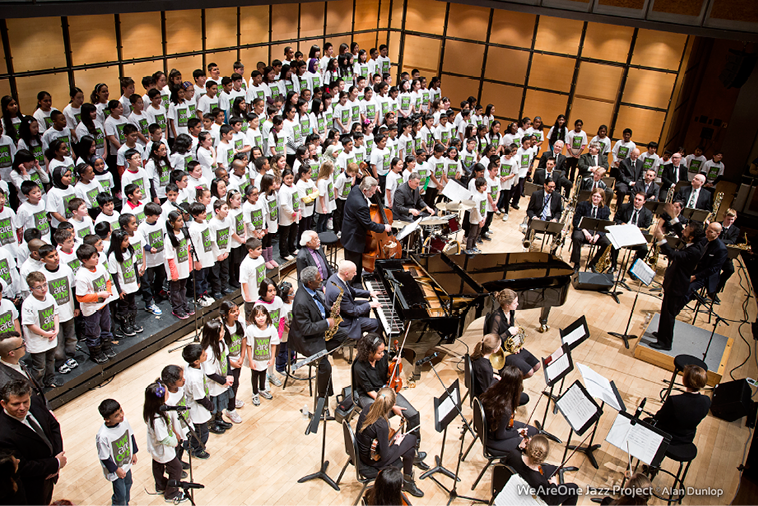
2005_-_Beat_-_Jazz_-_We_are_one.pngFirst though, I want to speak of the power music has to unite us all, as manifested in a very special event that takes place on Wednesday February 11 at the Toronto Centre for the Arts. That evening, the We Are One Jazz Project will present its sixth annual gala concert, featuring legendary jazz pianist and educator Barry Harris, multi-instrumentalist and Order of Canada member Don Thompson, a big band, a string section, an adult jazz chorus, and at the heart of it all, a children’s choir comprised of 275 members from eight north Etobicoke schools.

This incredibly ambitious undertaking is the result of many days and nights of hard work by countless individuals, most notably Howard Rees, the founder and president of We Are One Jazz Project, and 85-years-young bebop pianist and jazz education pioneer, Barry Harris. The seed of their fruitful collaboration dates back to 1978, when Rees moved to New York City to study with Harris for a period of six years.

“Upon returning to Toronto, it became very important to me to both spread the wisdom that Barry shares so freely with his students and to do my part in documenting his methodologies – which to that point had been an oral tradition,” says Rees. “Over the past 30 years this has resulted in the creation of Howard Rees’ Jazz Workshops, celebrating its 30th anniversary this year; the Barry Harris Workshop Videos, three instructional book/dvd sets featuring Barry and dubbed the ‘bebop bible’ by Tommy Flanagan; an online school featuring over 200 video lessons on Barry’s methodology; harmony articles for Keyboard Magazine; clinics at colleges in 10 or 12 countries, and the We Are One Jazz Voices, a choir that performs Barry’s original compositions and his arrangements of standards.”

In addition to bringing jazz to a wider audience and education to the general public about the jazz tradition, around 2008 Rees and Harris pondered the possibility of using jazz as a force for social change. The result was the founding of the We Are One Jazz Project as a Canadian charitable organization.

“Our purpose is to harness the beauty and power of jazz to inspire and empower young students who don’t have access to high-level music programs at their schools. We accomplish this goal through an intensive four-month program that brings together the students with master musicians in an enriched learning and performance environment. We work with several hundred students in grades 3 to 6 each year. Since 2008 we have brought the Project to 2,000 students in more than 50 schools in six priority neighbourhoods of Toronto. There are many wonderful stories, such as the student who stopped stuttering after being in the program. Another where a student sang a solo at a 300-member choir rehearsal after being mute (unbeknownst to us at the time) since the beginning of the school term. When we began in 2008, the city had identified 13 areas as ‘priority’ neighborhoods. As of this year that number has been revised to 31. So, as for future plans, we look forward to bringing this award-winning and life-changing program to many more students for years to come.”

The music performed at the concert is written and arranged by Barry Harris, and the program’s success relies greatly upon its teachers, including vocal coach Rita di Ghent who has the following to say:

“Being the jazz vocal coach for the WAOJP is endlessly fascinating and rewarding. I’ve always taught university students so for me, teaching jazz to youngsters has added this whole lovely dimension to my teaching career. Barry Harris’ tunes are stunningly beautiful and complex, but our grades 3 to 6 can sing anything you throw at them – not because they’re musically trained, but because they’re little sponges. They don’t know that jazz music is hard! The process of watching the singers unfold over the course of five months really is magical. We get to see children of all backgrounds and psychologies become hooked by the music and the spirit of working together. It changes their lives. And so it changes mine.“

A new addition to the staff this year is children’s choral conductor Sophia Perlman, responsible for rehearsing the choir and making sure that We Are One sings as one.

“Because I grew up with so much choral background in my own early musical life it has been really nice to see it reinforced,” says Perlman. “For me personally it’s interesting to see the way that choral training can reinforce jazz – I don’t think it’s a connection that necessarily gets made all of the time. For example, as an improviser, if you have to follow harmony, you’re going to have an easier time if you’ve had to be responsible for singing the inner parts of a harmony in a choir such as this one.”

Perlman also emphasizes the profundity of having Barry Harris work directly with the children.

“Kids in schools are not taught to necessarily connect composers with living people – generally if you ask kids who are some composers, they will name mostly dead composers. And so for these kids to learn these songs for weeks and weeks and then to sit there and learn the songs from the person who wrote them, and the fact that he will be playing the songs with them on the eleventh, it connects them to the music and the fact that music is made by people, and I think that’s really important.”

NOW BACK TO GALLOWAY ……………………………………………………

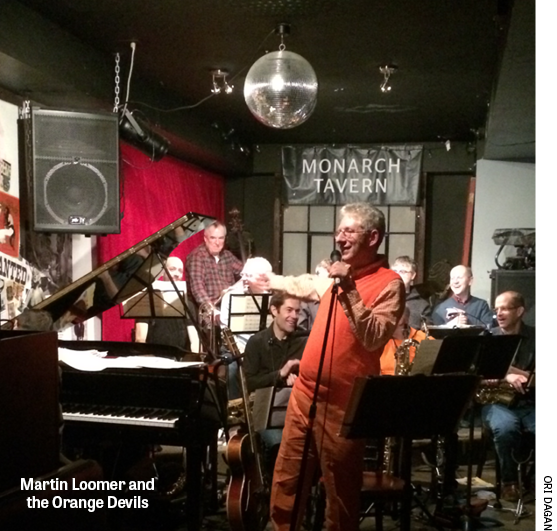
2005_-_Beat_-_Jazz_-_Martin_Loomer_and_the_Orange_Devils.pngIt’s fitting to focus on guitarist, arranger and bandleader Martin Loomer, whose 14-piece outfit, the Orange Devils, would likely not exist were it not for the encouragement of one wee yet powerful jazzman:

“I met Jim Galloway in the late 1970s,” remembers Loomer. “His cornetist with the Metro Stompers, Ken Dean, was the father of saxophonist Alex Dean, who was in the band I was in at the time, Shox Johnson and his Jive Bombers. Jim wanted to organize a band like the National Jazz Repertory Orchestra that Chuck Israels was leading in the U.S. Ted O’Reilly booked the proposed band for a CJRT Science Centre concert, forcing us both to get moving. I wrote arrangements by transcribing numbers from tapes Jim gave me, and he organized the personnel and logistics.

Jim introduced me to any number of great bands and artists whose recorded work I continue to mine for pieces the Orange Devils can recreate and perform live once again. He gave me the opportunity to transcribe any arrangement I thought suitable for the band, and to get it played as soon as it was ready. I also met and worked with many great musicians, not only from Toronto, but elsewhere, like Jay McShann, Fraser MacPherson and Clark Terry. Certainly his influence changed the direction of my musical career and most of my endeavors for the past 25 years.”

These days Martin Loomer and the Orange Devils make for happy ears and happy feet when they perform at private functions, from dance halls to weddings, as well as every second Monday of the month at the Monarch Tavern on Clinton Street.

“The band loves playing at the Monarch Tavern,” says Loomer. “The management and staff are great supporters and super co-operative. They’ve been very patient and allowed us the chance to try and develop a following. And they have that great rarity, a grand piano, which they maintain quite well! The ambiance is perfect for what we do. It’s kind of like having a paid rehearsal with a bunch of friends dropping by to listen and party with us. Relaxed and fun. Because of our size and style, we haven’t been able to play many other venues. We’ve done several concerts, notably for the Duke Ellington Society, which are wonderful, but they don’t have the same relaxed atmosphere as being in a club, not to mention the availability of alcohol.”

In addition to reed players such as Merlin Williams, Tom Skublics and Andy Ballantyne, soloists include Scott Suttie on trombone, John MacLeod on trumpet and Richard Whiteman at the piano, to name a mere few. In addition to playing instrumental charts by the likes of Fletcher Henderson, Benny Carter, Jimmy Lunceford, Count Basie and Duke Ellington, each gig features a handful of vocal tunes delivered charmingly by Rita di Ghent. Says di Ghent:

“Being the band vocalist in the Orange Devils is a dream gig. Who wouldn’t want to sing on stellar arrangements with A-list players that swing like crazy? And Marty is a dream bandleader. He knows my voice and chooses repertoire accordingly: a lot of bluesy material like Fine Brown Frame and Going to Chicago and complex ballads like Ellington and Strayhorn’s Daydream. He consults with me on every tune. He’s so kind and talented. I’m delighted that his tireless work has paid off and that the Orange Devils are quickly becoming the ‘it’ band with the swing dance crowd.”

Indeed, what has made the monthly Mondays especially marvellous of late is an increasingly loyal following of swing dancers. Says Loomer:

“I have to say, I’m always mindful of the fact that the music we play was originally conceived to be played for dancers. So we’re all very pleased when it can serve its original function and inspire swing dancers to get out on the floor and show their finest Lindy Hop moves. If the dancers are in the mood, then the band falls in the groove and we feed on each other’s energy.”

Monday February 9 will be the next gig for Martin Loomer and the Orange Devils. Ten dollars at the door is the best deal in town, and while enjoying these fantastic arrangements performed by stellar players and joyously interpreted on the dance floor, I challenge you not to smile!

Ori Dagan is a Toronto-based jazz musician, writer and educator who can be reached at oridagan.com.


2005_-_Beat_-_On_Opera_-_Luca_Pisaroni.pngOn January 14 Canadian Opera Company General Director Alexander Neef unveiled the COC’s 2015/16 season including the first mainstage world premiere of a Canadian opera since 1999 and plans for other productions of Canadian operas in the future. Unlike the present season, the COC’s 65th season includes two evenings of works the company has never before presented and is a mixture of opera rarities and masterpieces.

The 2015/16 season will open with a new production of Verdi’s La Traviata, replacing the generally disliked production by Dmitri Bertman that played in 1999 and 2007. The new COC production is a coproduction with Lyric Opera of Chicago and Houston Grand Opera directed by Arin Arbus and was well received at its Chicago premiere in 2013. Russian Ekaterina Siurina and Canadian Joyce El-Khoury alternate in the role of Violetta. American Charles Castronovo and Canadian tenor Andrew Haji alternate as Violetta’s lover Alfredo. And American Quinn Kelsey and Canadian James Westman alternate as Alfredo’s father Germont. Italian conductor Marco Guidarini leads the COC Orchestra and Chorus for 11 performances from October 8 to November 6, 2015.

In repertory with Traviata is the world premiere of Pyramus and Thisbe, written in 2010 by Canadian Barbara Monk Feldman. For those who may wonder, Monk Feldman is the widow of renowned American composer Morton Feldman (1926-87), was formerly his student and married him shortly before his death. The story, as students of Shakespeare will know, is the subject of the play the Mechanicals present to the court at the end of A Midsummer Night’s Dream (1595). Though the subject is serious, Shakespeare’s amateur troupe performs it so badly it is the comic highpoint of the play. As a tragedy of misunderstandings, Pyramus and Thisbe also served as the model for Shakespeare’s Romeo and Juliet written in the same year as Dream.

To complement Monk Feldman’s one-act opera are two works by Claudio Monteverdi (1567-1643) from the very beginnings of opera. The Lamento d’Arianna (1608) is the only fragment of music that survives from Monteverdi’s second opera Arianna about Ariadne’s abandonment by Theseus on the island of Naxos, later the subject of Richard Strauss’s Adriadne auf Naxos (1916). The second work is Il combattimento di Tancredi e Clorinda (1624), which is not really an opera at all but a section of Torquato Tasso’s epic poem Gerusalemme Liberata (1581) set to music. Toronto last saw it in a production by Toronto Masque Theatre in 2008. The major role is that of the Narrator who describes the encounter during the Crusades of the Christian knight Tancredi with his beloved Clorinda, who, unbeknownst to him, has disguised herself as an enemy Saracen knight.

Krisztina Szabó, who sings Erwartung later this season, will sing Monteverdi’s Arianna and Clorinda and Monk Feldman’s Thisbe. Phillip Addis returns as Pyramus and Owen McCausland is Testo in Il combattimento. Some COC regulars will be unhappy to learn that Christopher Alden, who gave us such unlovely productions as the Nazi Fledermaus in 2012 and the ruthless Clemenza di Tito in 2013, has been hired to direct. Johannes Debus, however, will conduct the seven performances from October 20 to November 7.

The winter season pairs Wagner’s Siegfried (in François Girard’s now familiar production) with Mozart’s The Marriage of Figaro in a production formerly owned by the Salzburg Festival. American soprano Christine Goerke, who will be making her role debut as Brünnhilde in Die Walküre this season, will return in that role in Siegfried. German tenor Stefan Vinke sings the title character. Austrian Wolfgang Ablinger-Sperrhacke sings the wily dwarf Mime, who raises Siegfried, and Alan Held sings the head Nordic god Wotan, here known only as The Wanderer. Johannes Debus conducts the seven performances from January 23 to February 14. 

The Marriage of Figaro is directed by acclaimed German director Claus Guth in a production popular at the Salzburg Festival since it first premiered in 2006. The cast includes Austrian bass-baritone Josef Wagner as Figaro, Canadian Jane Archibald as Susanna, Canadian Erin Wall as the Countess, Russell Braun, who sings the title role in Don Giovanni this season, as the Count and American Emily Fons as Cherubino. Johannes Debus leads the opera through 11 performances from February 4 to 27.

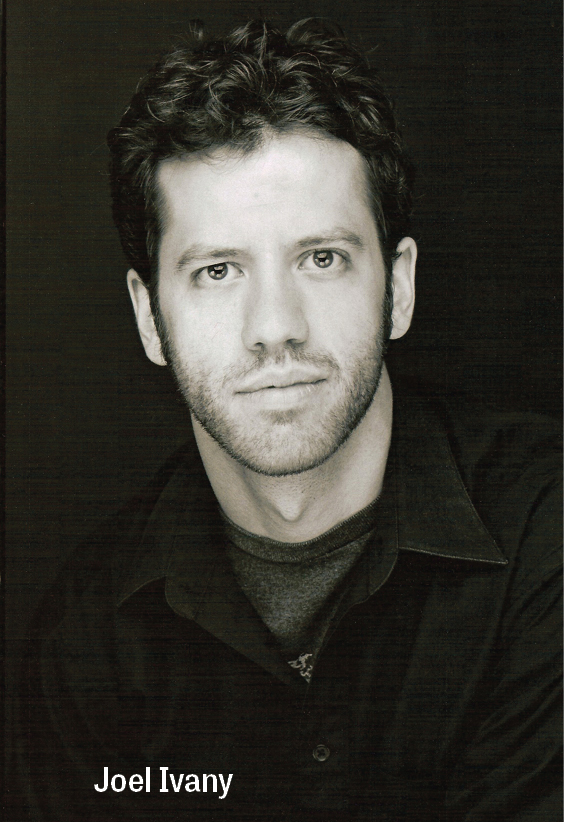
For its spring season of 2016, the COC revives its Carmen seen last only in 2010, this time directed by Toronto’s own Joel Ivany, artistic director of Against the Grain Theatre which recently presented its own inventive version of Don Giovanni as #UncleJohn last year. Georgian mezzo Anita Rachvelishvili and French mezzo Clémentine Margaine alternate in the title role. American tenor Russell Thomas and Canadian David Pomeroy alternate as Don José. Canadian sopranos Simone Osborne and Karine Boucher alternate as Micaëla. And Americans Christian Van Horn and Zachary Nelson alternate as the toreador Escamillo. Italian conductor Paolo Carignani leads the COC Orchestra and Chorus in 13 performances from April 12 to May 15.

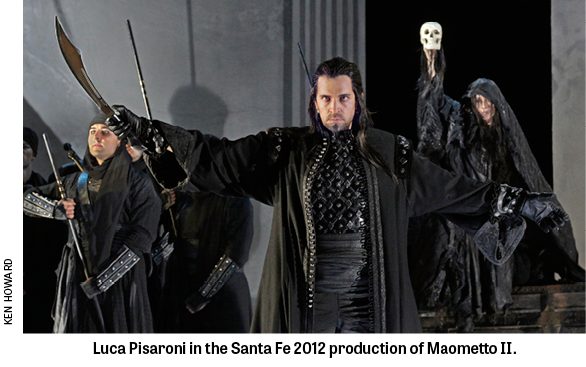
Closing the 15/16 season is the COC premiere of Rossini’s rarely performed grand bel canto opera Maometto II (1820), featuring star Italian bass-baritone Luca Pisaroni in his COC debut. The libretto is based on the historical Ottoman Sultan Mehmed II (1432-81), who set out to conquer the Holy Roman Empire. The production from Santa Fe Opera’s successful 2012 revival is directed by Christopher Alden’s identical twin brother David, who gave us Rigoletto in a men’s club in 2011. Joining Pisaroni are American mezzo-soprano Elizabeth DeShong as the Venetian noble Calbo, American soprano Leah Crocetto as Maometto’s forbidden love Anna and American Bruce Sledge as the Venetian governor Erisso. Baroque and classical specialist Harry Bicket conducts the seven performances from April 29 to May 14.  

It’s odd that Neef would rehire both Alden brothers after the loud disapproval their work has received here over the past several years (especially in light of a decline of 4924 subscription tickets from 2013 to 2014). Nevertheless, there is very good news in Neef’s reaffirmation of the COC’s commitment to new Canadian operas. Donna, previously  commissioned from composer John Rolfe and librettist Anna Chatterton, will have a workshop production at Banff this summer.  Hadrian, commissioned from pop composer Rufus Wainwright and playwright Daniel MacIvor, is moving ahead – a first draft of the libretto is at hand. New this year is the announcement of a commission of The Girl King, by Ana Soloković, composer of such hits for the much-missed Queen of Puddings as The Midnight Court in 2005 and Svadba – Wedding in 2011. The libretto will be by Quebecois playwright Michel Marc Bouchard based on his play of the same name about Queen Christina of Sweden (1626-89) that played last year at the Stratford Festival. And also in the works is a revival of Louis Riel (1967) by Harry Somers to star Russell Braun.

2005_-_Beat_-_On_Opera_-_Whisper_Opera_2.pngSoundstreams: It’s important when Canada’s largest producer of opera commits to producing so many new operas over the coming years. Yet, we should not forget that many of Toronto’s smaller companies have always had a commitment to producing new work. One such is Soundstreams. From February 26 to March 1 Soundstreams hosts the Canadian premiere of the whisper opera (2013) by Pulitzer Prize-winning American composer David Lang. Lang’s libretto is compiled from search-engine responses to such prompts as “When I think of you, I think of …” to explore the tension between our private and online selves. Soprano Tony Arnold and New York’s International Contemporary Ensemble (ICE) have already received acclaim for the piece at Lincoln Center and at Chicago’s Museum of Contemporary Art.

The opera is so quiet and so delicate that it can be experienced by only 52 people at a time. For this reason Soundstreams will present it at The Theatre Centre at 1115 Queen Street West, in a configuration never before used there. In order to maximize the closeness of the audience to the performers the playing area consists of four squares around a central hub, with the audience, seated in twos, forming the dividing lines between the squares.

In the midst of an overabundance of recorded music, Lang is composing various works that can only be heard live. As he has written, “With the whisper opera I had another of these ideas – what if a piece were so quiet and so intimate and so personal to the performers that you needed to be right next to them or you would hear almost nothing? A piece like this would have to be experienced live. In honour of this, the score to the whisper opera states clearly that it can never be recorded, or filmed, or amplified. The only way this piece can be received is if you are there, listening very very closely.” Listening very closely is, of course, something we all should do at any performance, but at the whisper opera, Lang makes this a virtue one hopes we carry over into other experiences of music.

Christopher Hoile is a Toronto-based writer on opera and theatre. He can be contacted at opera@thewholenote.com.

Even the most cursory look at the listings will show that the upside of living in Toronto is the many concerts that take place here every day. That, of course, is a good thing but the downside is that it is impossible to go to all of them. In December I wrote about the tenor Sean Clark and had every intention of catching him in one of his performances with the Pax Christi Chorale, but, alas, it was not to be. On the Saturday I went to hear Adi Braun sing Kurt Weill; on the Sunday afternoon I heard Daniel Cabena’s recital. While I am glad that I went to these, I regret that I didn’t hear Clark. Much the same thing happened on January 9, when I heard a lovely recital by Anne Sofie von Otter and Angela Hewitt, but this also meant that I could not go the Bach concert at Metropolitan United which featured all six of the Bach solo violin sonatas, or to the plainchants and motets which the Schola Magdalena performed at St. Mary Magdalene.

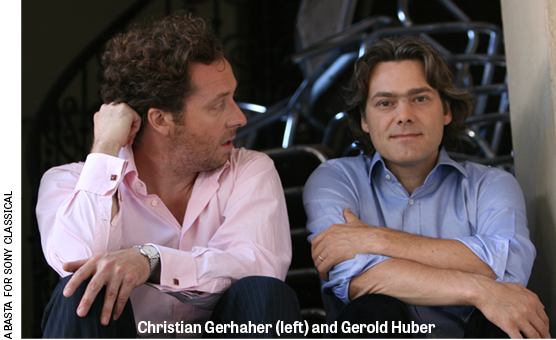
2005_-_Beat_-_Art_of_Song_-_Christian_Gerhaher_and_Gerold_Huber.pngHowever, this is nothing compared with the choice I have to make for the afternoon of Sunday February 1, when there are four concerts I would like to go to: the recital by Melanie Conly at the Heliconian Hall, which features one of my all-time favourites, Schubert’s The Shepherd on the Rock, with its lovely clarinet obbligato (the concert also includes works by Brott, Purcell and Berlioz); Bach’s second cello suite played by Rachel Mercer at Seicho-No-le Toronto; the VOICEBOX performance of Kurt Weill’s Street Scene at the St. Lawrence Centre with Allison Angelo and Jennifer Taverner, sopranos, and Colin Ainsworth, tenor; and the concert at Mazzoleni Concert Hall given by the Amici Chamber Ensemble and the New Orford String Quartet, which features, among other works, Brahms’ Clarinet Quintet

No such problems will interfere with my going to hear the baritone Christian Gerhaher and the pianist Gerold Huber in their performance of Schubert’s Winterreise on February 26 at Koerner Hall. Schubert wrote this work for a tenor voice but it has been successfully performed by baritones, bass-baritones, basses, even sopranos and mezzos. The baritone with whom the work is especially associated is Dietrich Fischer-Dieskau. Views about his singing vary. He always made sure that every detail registered and some listeners find that fussy. Others (and I include myself) feel that, in the words of Keats, he loaded every rift with ore. It will be interesting to hear how Gerhaher’s performance compares.

I am also looking forward to the performance by Monica Whicher, soprano, and Russell Braun, baritone, with the pianists Carolyn Maule and Stephen Philcox, of Hugo Wolf’s Italienisches Liederbuch at Walter Hall, February 9.

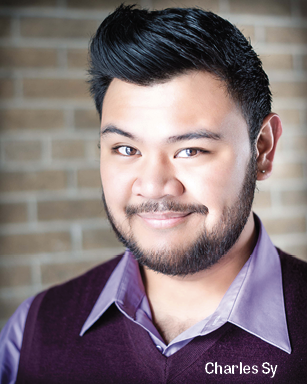
2005_-_Beat_-_Art_of_Song_-_Charles_Sy.pngThe Faculty of Music in the University of Toronto will present a free workshop for singers, composers and librettists. It will feature the soprano Barbara Hannigan, the composer Hans Abrahamsen (who is the Michael and Sonja Koerner Distinguished Visitor in Composition) and the music critic and librettist Paul Griffiths (who is the Wilma & Clifford Smith Visitor in Music) on March 2. The following day Griffiths will give a lecture with the title “Contemporary Music: A Plurality of Worlds?” Both events are in Walter Hall and are free. Hannigan is a Canadian soprano who is especially known for her work in contemporary opera. Abrahamsen is a Danish composer whose very accessible works form a sharp contrast with the serial music that dominated the mid- and late 20th century. His let me yell you is dedicated to Hannigan and was first performed by her with the Berlin Philharmonic on December 20, 2013.

Other Events: The Canadian Opera Company presents a number of free performances at the Richard Bradshaw Amphitheatre in the Four Seasons Centre: on February 3 the sopranos Aviva Fortunata and Karina Boucher will be the soloists in Messiaen’s Poèmes pour Mi (with Kerry DuWors, violin, and Liz Upchurch, piano); on February 9 members of the COC Ensemble Studio will perform and compete in the biennial Christina and Luis Quilico awards; on February 10 the soprano Jane Archibald and the pianist Liz Upchurch will perform a program titled “Songs of Love and Longing”; “Urlicht” is the title of the recital by Janina Baechle, mezzo, with the pianist Rachel Andrist, on February 17 (Baechle is singing the role of Fricka in the COC production of Wagner’s Die Walküre.). The recital by Barbara Hannigan on February 24 is titled “Rapture.”

On February 3 students from the classical vocal music performance program at York University will take part in a masterclass with the soprano Rosemary Landry; the singer Brenna MacCrimmon, with Bill Westcott, piano, will perform “Classic Blues” on February 12; singers from the studio of Michael Donovan will perform “Five Mystical Songs” by Ralph Vaughan Williams on February 24.All three recitals are free and will take place in the Tribute Communities Recital Hall, Accolade East Building, York University.

On February 8 the soprano Virginia Hatfield, the mezzo Maria Soulis and the pianist Kate Carver will perform duets by Britten, Brahms, Mendelssohn, Tchaikovsky and others in a program titled “Sisters in Song” at Rosedale United Church. This is a benefit concert for Rethink Breast Cancer.

Jessika Monea, soprano, is the singer in a free noontime recital at Metropolitan United Church on February 12.

The Art of Time Ensemble presents “Magic and Loss: A Tribute to Lou Reed” with Sarah Slean, John Southworth, Margo Timmins and Kevin Hearn at Harbourfront, February 27 and 28.

The soprano Kimberly-Rose Pefhany will be the soloist in Mozart’s Exultate Jubilate, with Sinfonia Toronto conducted by Nurhan Arman, on February 28 at George Weston Recital Hall.

And beyond the GTA: On February 1 the Spiritus Ensemble will perform a free concert of cantatas by Bach (Nach dir Herr verlanget mich), Buxtehude (Der Herr ist mit mir) and Schein (Vater Unser) in the St. John the Evangelist Anglican Church, Kitchener.

There will be a recital at the Isabel Bader Centre for the Performing Arts, Queen’s University, February 8, titled “Intimate Expressions - Dances, Stories and Songs” as part of the Queen’s University Faculty Artists Series. The artists are Elizabeth MacDonald, soprano, Jeff Hanlon, guitar, and Karma Tomm, violin.

A cabaret on the lives of Debussy and Ravel will be performed by Tom Allen, Kevin Fox, Lori Gemmell, Bryce Kulak and Patricia O’Callaghan at All Saints’ Anglican Church, Peterborough on February 27 and at Fleming College, Lindsay on March 1.

And looking ahead: Toronto Summer Music has announced the formation of a chamber choir for advanced amateur musicians, to be held from August 2 to 9. The instructors will be Matthias Maute and Laura Pudwell. The Canadian Opera Company has announced that three musicians will join the COC Ensemble Studio in August of this year. They are the tenors Charles Sy and Aaron Sheppard and the collaborative pianist Hyejin Kwon. Both Sy and Sheppard were prizewinners at the most recent COC Ensemble Studio Competition. Sy, who won the first prize, is a former Fellow of the Toronto Summer Music Art of Song Program. But you don’t have to wait until the summer to hear him. March 1 Sy joins soprano Carla Huhtanen and mezzo soprano Emilia Boteva to perform the “glorious music inspired by the most tempestuous relationships” in Off Centre Music Salon’s “On Love and Other Difficulties.”

A Correction: in my recent CD review of the Handel & Haydn Society performance of Messiah I mistakenly wrote that the duet He shall feed his flock was originally a soprano aria. I should have written “an alto aria.”

Hans de Groot is a concertgoer and active listener who also sings and plays the recorder. He can be contacted at artofsong@thewholenote.com.


A pattern I’m beginning to see in early music concerts in Toronto is something you might describe as musical tourism – rather than a mixed program or a concert built around a particular composer or work, groups experiment with a time and place in history and give the audience a soundtrack to that particular moment. I’m thinking specifically now of Toronto Consort’s “Paris Confidential,” which I saw late last year and quite enjoyed – it was a fascinating look at Renaissance Paris, complete with music from the City of Lights circa 1550. This month, I’d like to look at other Toronto groups who are both geeking out on history and putting together some fabulous concerts in the process.

2005_-_Beat_-_Early_-_The_Tallis_Choir.pngTake for example, Leopold: you have to have at least some background in history to have heard of Leopold I, a very unlikely figure, one might think, to inspire a concert program. Nevertheless, European civilization owes quite a bit to Leopold I of Austria, who ruled over the Holy Roman and Austro-Hungarian Empires for the latter half of the 17th century. Leopold came to power as the King of Bohemia in 1655, after Europe had already been wracked by decades of brutality in the Thirty Years War, which had been waged across the length and breadth of the European continent and had ended when Leopold was just a child. You might think, after three decades of constant warfare, as well as the attendant expense and famine, that a rookie 15-year-old king would welcome a break from fighting and usher in a new era of peace, but the kid wasn’t having any of it. The first thing he did was team up with Poland to wage war against the Swedes for five years. Leopold won that war, having in the meantime become king of Austria, Croatia, and Hungary, as well as Holy Roman Emperor of Germany. This bought Eastern Europe nearly two decades of peace – until Leopold went on to battle Louis XIV of France and the Ottoman Turks multiple times from the 1670s until his death in 1705. In so doing, he established himself as the major belligerent of one of the most violent centuries in human history.

Alongside waging constant warfare and his perceived obligation to defend Christendom from the Islamic hordes, the northern barbarians and France, Leopold was, surprisingly, a generous musical patron and composer himself. Many fine Baroque composers, including Antonio Bertali, H.I. Biber, J.J. Fux and Johann Schmelzer owe their careers to his patronage. This month, the Toronto Consort will pay tribute to this magnificent sponsor of European musical life. Lutenist and conductor Lucas Harris will join the ensemble for a program based on a manuscript of music from Leopold’s court in Vienna, including that composed for the emperor’s court and chapel. This all goes down at Trinity St. Paul’s Centre on February 6 and 7.

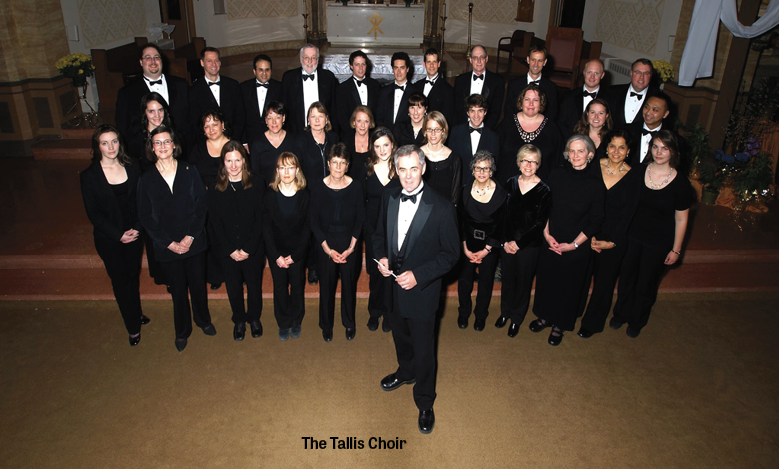
Guadalupe: Blood-soaked European battlefields are fairly common grist for history’s mill. But history can also be built on strange events in the most unlikely of places, as in our next concert, which was inspired by an apparition seen by a simple farmer in a tiny village in Mexico. When the Virgin Mary appeared to a farmer on a hill in Guadalupe (now incorporated as a suburb of Mexico City) and told him to build a church there, the Spanish authorities honoured the pious man’s request by building a monumental cathedral. Centuries later, it is surely an inspiring place. The cathedral at Guadalupe is now a number one tourist destination for Catholics worldwide and the Virgin of Guadalupe is a cultural and religious icon for Mexicans everywhere. The Tallis Choir is dedicating a program to the basilica at Guadalupe on February 28 at St. Patrick’s Church, featuring music from 17th-century Mexico and Spain. The Tallis Choir will be joined by Philip Fournier on organ and WholeNote columnist Ben Stein on lute in music by Tomas Luis de Victoria, Guerrero and Padilla. Since it’s a very rare chance to hear music from 17th-century Mexico, I highly recommend you take this opportunity to hear it.

2005_-_Beat_-_Early_-_Allison_Mackay.pngParis 1737: From the emperor’s palace in Vienna to the cathedral of Guadalupe, the next stop on the musical tour this month is Paris, which probably takes the prize for being the most clichéd tourist destination of all time. Still, when Georg Phillip Telemann took a trip there in 1737, he got a chance to perform with some of the greatest musicians of the day, including the French flutist Michel Blavet and the viola da gamba virtuoso Jean-Baptiste Forqueray. Telemann prepared for the occasion by writing a dozen quartets which the group (along with a lesser-known violinist and cellist) performed, and nearly 300 years later, the composer’s Paris Quartets are a classic of the early music chamber repertoire. This month, Scaramella will present a program devoted entirely to Telemann’s Paris Quartets at their usual haunt at the Victoria College Chapel on the U of T campus on March 7. Scaramella, or rather gambist Joëlle Morton, will be joined by American flutist Kim Pineda, as well as Toronto-based musicians Edwin Huizinga (on violin) and Sara-Anne Churchill (on harpsichord). While it may not have the variety of a mixed program, the Paris Quartets make for a great concert for anyone who appreciates late Baroque music. This concert will feature top-drawer music from a composer who in his day was considered by many to be better than Bach.

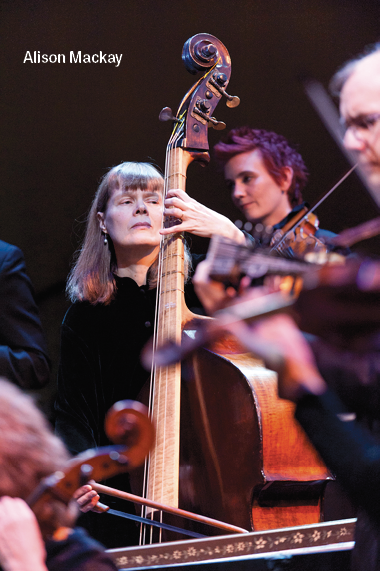
House of Dreams: Of course, if you’re into musical tourism, Tafelmusik has that beat covered with their concert and multimedia event “House of Dreams,”  the brainchild of Alison Mackay, who, not coincidentally, came up with “Paris Confidential,” mentioned above. Mackay’s presentation/concerts are a great way of giving people a chance to explore the cultural and social history of the music, and are as educational as they are entertaining for audiences (besides, it gives us something to look at during the concerts). For this project, Mackay mashed up the music of Handel, Marais, Bach, Sweelinck and Vivaldi with paintings from the same time and place as the composers. As if that weren’t enough, Mackay actually collaborated with the European museums in all these composers’ hometowns, so this concert, in addition to being a giant whistle-stop tour of London, Paris, Leipzig, Delft and Venice, will actually show you what it was once like to live in those cities. As a cultural experience and musical tour, it’s hard to beat. The extravaganza will take place February 11 to 15 at Trinity St-Paul’s Centre, before launching out on an Australian tour.  This program, which spans both the length of Europe and the Baroque era, is nothing if not ambitious, but don’t let that put you off. At least you won’t have to worry about jet lag.

David Podgorski is a Toronto-based harpsichordist, music teacher and a founding member of Rezonance. He can be contacted at earlymusic@thewholenote.com.

2005_-_Beat_-_Choral_-_Da_Capo_Choir.pngThis column starts out with information about a few choirs from outside of the GTA, interspersed with several concerts that have a Latin or Mediterranean theme. If you think this might indicate a hidden desire to be anywhere but Toronto in February , even if it’s only halfway sunny and pleasant –  you would most likely be right. Here are a few listings which even if they don’t warm you up, will at least keep you moving!

On February 7 London, Ontario’s Karen Schuessler Singers perform their annual singathon. The concert is a fundraiser and will feature special guest conductors from the London area. More information can be found here: kssingers.com.

On February 13 the Upper Canada Choristers hold a concert titled “Music of the Americas,” to help launch a CD of the same name. This community ensemble was founded in 1994, and since 2008 has begun to specialize in music of Latin America, in addition to other international repertoire. This concert will feature Cantemos, a chamber ensemble drawn from members of the UCC. The CD features music from Argentina, Brazil, Colombia, Uruguay, Venezuela, Costa Rica, Cuba, Jamaica, the U.S. and Canada, sung in Spanish, Portuguese, Latin and English. More information is available at
uppercanadachoristers.org.

On February 28, the Peterborough Singers perform “Soul,” in honour of Black History Month. The choir combines with an instrumental ensemble and vocal soloists to explore the great rhythm and blues works of Motown (Detroit), Philadelphia, Memphis and New Orleans soul writers and composers. This is some of the best popular music created in the last century, but it tends to be avoided by many Canadian choirs, perhaps because they often Break It when they try to Shake It, so to speak. It’s good to see a choral ensemble taking it on.

Also on February 28, St. Catharines’ Chorus Niagara performs “Life Eternal: The Requiems of Mozart and Rutter.” Mozart’s famous D-Minor Requiem is paired with English composer John Rutter’s tune-filled modern setting of the same text.

On March 1 Dundas, Ontario’s John Laing Singers perform “Poet’s Corner 2: Songs of Faith, Hope and Love.” The concert provides an opportunity to hear a rarely performed (around here, anyhow) choral work by Italian composer Mario Castelnuovo-Tedesco, Romancero Gitano. Castelnuovo-Tedesco is perhaps best known for his guitar compositions, which were championed by Spanish classical guitar legend Andrés Segovia. He was also a prolific film composer, and his works are very energetic, accessible and redolent with Spanish-inflected musical gestures. Romancero Gitano sets the words of Spanish poet and political martyr Federico García Lorca, and is scored for chorus and classical guitar, a rare combination.

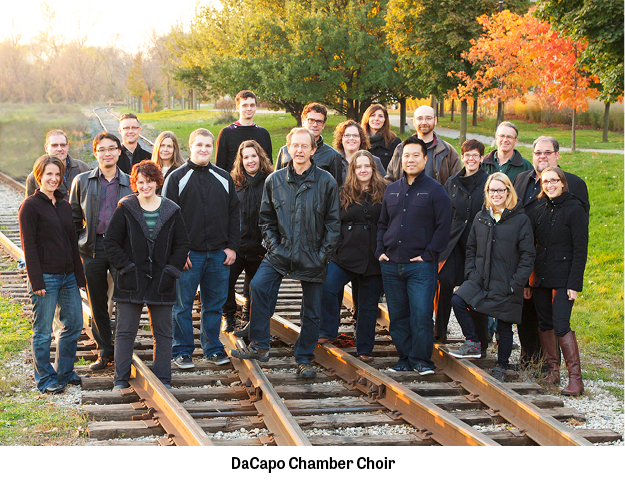
On March 7 and 8 the Kitchener/Waterloo-based DaCapo Chamber Choir performs "O Earth, Return." This ensemble specializes in unaccompanied music of the 20th century, with a special focus on Canadian repertoire. They sponsor a competition for new compositions every year, and a work by Matthew Emery, the 2014 winner, Night on a Starry Hill, will be premiered at the concert. Popular composer Arvo Pärt’s Magnificat setting will also be performed. The two performances are held in Kitchener and Waterloo respectively.

Back in Toronto, on March 7 the Jubilate Singers perform “Rhythm Fusions,” a concert featuring British composer Bob Chilcott’s Little Jazz Mass, American Norman Luboff’s African Mass and Swede Lars Jansson’s To The Mothers In Brazil: Salve Regina. The JS’s conductor, Isabel Bernaus, is a good programmer of world music, and the work of all three composers is infused with a lively knowledge of that genre.

And here are more listings, just to prove that I am not neglecting Toronto ensembles, filled with hardy choristers who brave the elements to faithfully attend rehearsals every week:

On March 1 the Toronto Classical Singers perform “Music from Two Great Rivals.” The concert features Antonio Salieri’s Mass No.1 in D and the Mozart D-Minor Requiem.

The purported rivalry between Mozart and his older contemporary Antonio Salieri is one of the many myths that has become part of the Mozartian legend since his death in 1791. This particular myth has its roots in the dramatic poem by Russian writer Alexander Pushkin, Mozart and Salieri published in 1830. But it was British playwright Peter Shaffer’s 1979 play Amadeus that gave us the modern image of the vulpine older composer, consumed with jealousy over the accomplishments of his younger colleague, planning his murder and plotting to steal his brilliant compositions.

The reality is more prosaic – Salieri was only six years older than Mozart, one of the many Viennese composers that Mozart had to compete with for the attention, approbation and patronage of the Austrian aristocracy. Italian by birth, he was a successful opera composer who also has the distinction of teaching Schubert, Beethoven and Liszt. He was a rival to Mozart, in a professional rather than a dramatic sense, but there is also evidence that he and Mozart had a friendly and collegial relationship. Still, if their rivalry is ultimately just a story, it’s a great one, and Shaffer’s Amadeus explores the gap between talent and genius that is part of Mozart’s enduring mystery.

Several of Salieri’s operas have been restaged in recent times, and his Mass in D is worth a listen on its own terms, rivalries and legends aside. The galant style that he was trained in (as were Mozart, Haydn and J.C. Bach) had been imported from Italy to the rest of Europe, and as we explore less venerated or even forgotten composers from that era, we gain new and different insights into how to play and understand this musical tradition.

The University of Toronto music faculty has new music concerts and lectures taking place throughout the months of February and March. On February 8 the Faculty’s Men’s Chorus and MacMillan Singers will perform a contemporary showcase featuring U of T student composers, emerging Canadian composers Matthew Emery and Patrick Murphy and veteran choral masters Steven Chatman and Bob Chilcott.

Another concert of contemporary music to watch out for is Warrior Songs on March 6. The Elmer Iseler Singers perform this new work by Canadian Peter Togni. Warrior Songs takes as its theme the idea of being a “warrior for non-aggression” and explores texts from Buddhism, Malcolm X and the Roman Catholic Liturgy. Togni has had a distinguished career creating work that is both accessible and complex.

Benjamin Stein is a Toronto tenor and lutenist. He can be contacted at choralscene@thewholenote.com. Visit his website at
benjaminstein.ca.

2005_-_Beat_-_Bandstand_-_James_Campbell.pngWhile the wintry blasts of January have not abated much, there are signs, on several fronts, that community band activity has not been dormant and that behind-the-scenes efforts of winter rehearsals are due to spring into a variety of programs well before Mother Nature takes her own leap into spring. However, before talking about what lies ahead, it’s worth visiting a couple of recent events that I had the pleasure of attending which created a lasting impression.

Strings Attached: The first of these was a concert by the new Strings Attached Orchestra which I mentioned in a recent column. Billed as a “Friends and Family Concert,” it was for the most part the sort of program one might expect with an all-string orchestra. However, it had one unusual feature. Senator Nancy Ruth had been invited to play percussion in the concert. Apparently, she had always wanted to play in an orchestra, and here was her opportunity. When invited to participate in the concert, she had thought that she might get to ring the telephone in Pennsylvania 6-5000 and maybe play tambourine in some selections. What a surprise when she became an honourary member of the percussion section of the orchestra and was coached on all of the timing and nuances of her small part. After the concert she stated “I had a blast” Unfortunately no photos were available of this performance. We’re wondering what interesting wrinkles co-founder Ric Giorgi can come up with for their final concert of the season in June!

Hats off to Bethune: The second event, something I rarely attend anymore, was a school concert. With our special invitation in hand we arrived at Doctor Norman Bethune Collegiate in Scarborough. For such events I had been accustomed to a token audience of parents. Not here. We had seats reserved for us or we would have had to stand. No fewer than seven groups performed. The concert began with two selections by the 110-member Junior Band and concluded with the Senior Band. Having attended school concerts in the past, I was accustomed to hearing selections such as Harold Walters’ Instant Concert to demonstrate the musical prowess of the students. Not this time. The final selections by the Senior Band were Howard Cable’s Snake Fence Country and the Festive Overture by Shostakovitch. The future of school music is certainly in good hands here. Bethune’s music head Paul Sylvester certainly deserves special mention for having a band play at that level.

Seventh Horizon: It’s that time of year for the local New Horizons group to form yet another new band. By the time this is printed the seventh Toronto New Horizons Band will have begun rehearsals shortly after their Friday evening Instrument Exploration event. A year ago at this time there was a film crew there recording the attendees trying various instruments and making their selections. The film has now been completed with the title The Beat Goes On. Originally planned for broadcast on TV Ontario, the release has been delayed while the producers investigate its eligibility in the Canadian International Documentary Festival, better known as Hot Docs.

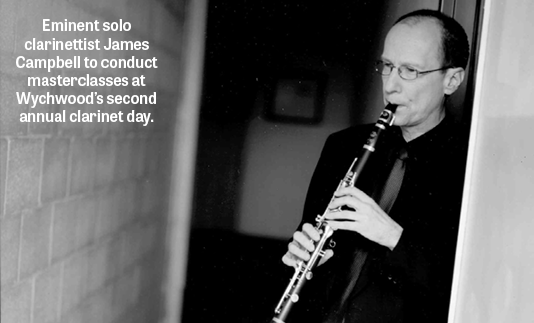
Wychwood: The Wychwood Clarinet Choir have announced that they will be having their second annual Clarinet Day on Sunday March 1 in Walter Hall of the Edward Johnson Building. There will be masterclasses with James Campbell, morning workshops with U of T faculty and a concert with both the Wychwood Clarinet Choir and the U of T Clarinet Ensemble. For information about registration go to their website: wychwoodclarinetchoir.com. They have also reminded us about their spring concert ”Swing into Spring” on May 24. It’s a safe bet that they will be performing at least one work written for them by “composer-in-residence” Howard Cable.

West End News: Some months ago I mentioned that a new concert band had been established in Toronto’s west end. That was in the fall of 2014; now that new band will soon be performing their very first concert. The Toronto Concert Band, as it is called,  has put down roots in the Etobicoke-Lakeshore district. Most members are from Etobicoke, but there are many members from all parts of Toronto. Weekly rehearsals at Lambton-Kingsway Junior Middle School have attracted more than 60 members from amateur to professional status. The band’s tag line is “We Love to Play!” and that has translated into an enthusiasm such that their premiere concert will feature works ranging from Percy Grainger and Vaughan Williams to Frankie Valli and the Beatles. Under the direction of founding conductors Ken Hazlett and Les Dobbin, they have opted to stage their inaugural concert in the CBC’s Glenn Gould Studio. In their words, selection of this venue “aptly reinforces the Toronto Concert Band’s mandate of serving not only Etobicoke but the entire City of Toronto.” I certainly intend to be there on Saturday, January 31 at 7:30. I would recommend readers attend, but I have heard that tickets are all sold. Congratulations. For information on this band, go to their website  torontoconcertband.com.

Wellington Winds: Many months ago I wrote briefly about a DVD titled Appassionato: The Wellington Winds Story released by that band. As described by producer Michael Purves-Smith, it is a collection of “performances, interviews and sectionals illustrating the life of a concert band.” In a recent email message Purves-Smith reports that they have done a lot with their project but still have a way to go. He expects to be in touch again in a couple of months. At that time we hope to publish a special detailed report of the results of their work on this project.

Briefly from Silverthorn: Silverthorn Symphonic Winds have announced that their next concert will be on Saturday, February 28 and that, intriguingly, the repertoire for this concert has been selected by band members. Many times in this column I have mounted my high horse to campaign for more member participation in repertoire selection. This was welcome news, and I hope to get more details soon.

Many years ago, a longtime friend of mine, Bob Plunkett, upon retiring as a high school music teacher as well as director of the naval reserve band of HMCS York in Toronto, moved to Orillia where he established the Orillia Wind Ensemble. Over 17 years ago, on Bob’s retirement from that band and subsequent passing, the directorship of the Orillia band was assumed by Roy Menagh. Now, Menagh has indicated that 2015-16 will be his “victory lap.” Band members have indicated that they would like to have a new person on board by this coming fall/winter season in order to plan a smooth transition to 2016-17 season. They will, of course, be setting up a search campaign to seek potential candidates. If any of our readers have any suggestions, they could contact the band’s president, Hugh Coleman at
colemanz@sympatico.ca.

Definition Department:

This month’s lesser known musical term is opera buffa: A musical stage production performed by nudists. We invite submissions from readers. Let’s hear your daffynitions.

Jack MacQuarrie plays several brass instruments and has performed in many community ensembles. He can be contacted at bandstand@thewholenote.com.

2005_-_Beat_-_World_-_Ruth_Mathiang.pngSince 2008 the Batuki Music Society has been tirelessly promoting African music and art in Toronto, seeking out local artists and working with them to book venues. It does much more than typical presenters however, providing the valuable service of advising musicians on career development, recording and touring. Moreover, Batuki appears to have an even larger social mission. As expressed on the society’s website, it provides “visibility and necessary publicity to artists who hail from minority groups by placing them in concerts and festivals in mainstream venues to help them integrate.” Incorporated as a non-profit community-based organization in 2008 by artistic director Nadine McNulty, Batuki’s artistic vision encourages local African musicians to participate in enriching the diverse arts and cultural scene through live music concerts, visual arts exhibits, film, spoken word/poetry, dance and festivals.

Spiritual Songs of Sub-Saharan Africa

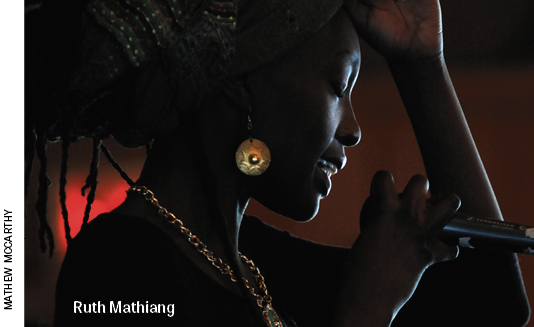
Batuki Music Society’s programming usually heats up during Black History Month and this February is no exception. On February 14 it is presenting “Spiritual Songs of Sub-Saharan Africa” at the theatre of the Alliance Française de Toronto. Reflecting spirituality in African music, the songs are rooted in multiple genres performed across the vast continent, from Guinean griot and Ghanaian highlife and gospel, to South Sudanese spirituals, Ethiopian soul, back to Congolese rumba and Zimbabwean spirit music. 

2005_-_Beat_-_World_-_Cheka_Kaetnen_Dioubate.pngThe concert’s curatorial aim is to present the evolving nature of African music from its rural roots to its contemporary urban and transnational mediations, with an emphasis on its spiritual content. The performers have been drawn from Toronto’s rich pool of sub-Saharan African musical talent. Confirmed are seven of the city’s finest African singers, Frederica Ackah, griot Cheka Katenen Dioubate, Ruth Mathiang, Blandine Mbiya, Evelyn Mukwedeya, Memory Makuri, and Netsanet Melesse. The seven singers are backed by an impressive band consisting of Donne Roberts (guitar), Tichaona Maredza (rhythm guitar), Quandoe Harrison (bass), Fantahun Shewankochew Mekonnen (acoustic krar), Kofi Ackah (drums, percussion), Ruben Esguerra (congas), and Amadou Kienou (djembe). 

I’d like to sample the rich program for you. Performing the songs of the Shona people of Zimbabwe will be Evelyn Mukwedeya and Memory Makuri accompaning themselves on the mbira (sometimes called thumb piano), as well as hand clapping, hosho and dancing. The playing of the mbira dzavadzimu, which used to be a deeply entrenched male preserve, is an important ingredient in conducting healing ceremonies among Shona communities. In the 1970s Stella Chiweshe, also a traditional healer, challenged that male exclusivity, becoming one of the first female mbira players. She is now a role model for younger women like Mukwedeya and Makuri.

Blandine Mbiya, a singer and songwriter from the Kasai region of the Democratic Republic of Congo performs songs in the gospel-inspired rumba genre as well as those in the so-called bazombo trance music. The latter – the Bazombo are members of the much larger Bakongo group whose communities lie near the Angola and DRC borders – is a music genre reputedly associated with witchcraft and other ceremonies, though solid evidence of this is hard to locate for outsiders. On the other hand, the popular DRC rumba (aka African rumba, which also overlaps with soukous), exhibits Cuban and older Franco-Belgian missionary choral strains. Rumba’s rise to prominence has been directly linked to the suppression of the Congo’s indigenous spiritual music practices during the colonial period.

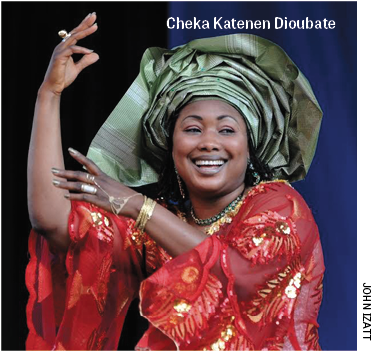
Cheka Katenen Dioubate is a Guinean griot whose job description includes storyteller, historian, poet, musician and praise singer. Griots are central to the maintenance of Mande traditions in West Africa. Serving as a living archive, they are keepers and singers of the oral history and culture of the people, performing at marriages, funerals and other rites of passage. Dioubate brings to the stage a powerful voice and commanding presence, as befits the griot who must serve as intermediary between generations of her ancestors and her living audience.

Our last stop in this incomplete concert preview is Ethiopia, as represented by the songs of Netsanet Mellesse. This singer has an impressive recording back catalogue, having produced traditional Ethiopian, pop and gospel albums back home. One of Ethiopia’s finest krar players and composers Fantahun Shewankochew Mekonnen will accompany Mellesse at the Alliance Francaise.

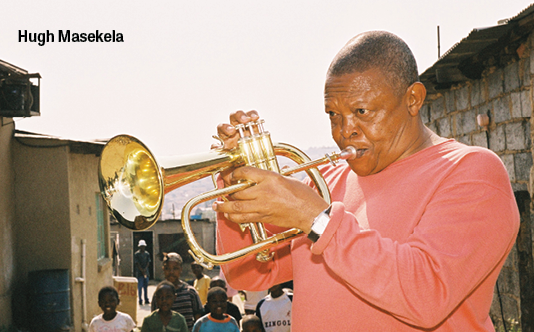
2005_-_Beat_-_World_-_Hugh_Masekela.pngVusi Mahlasela and Hugh Masekela: This is not Batuki Music Society’s only big presentation this month. On February 28, in association with Koerner Hall, they co-present “Vusi Mahlasela and Hugh Masekela: 20 Years of Freedom.” This concert is billed as “freedom songs honouring 20 years of democracy in South Africa and the official end of apartheid” and headlines the trumpeter, singer and composer Masekela and singer/songwriter Mahlasela. 

The award-winning Mahlasela, known as The Voice in his home country, is celebrated for his distinct, powerful voice and his poetic lyrics. He has released seven studio albums on Sony and worked with numerous international recording stars. His songs of hope with themes of struggle for freedom, but also forgiveness and reconciliation with enemies, inspired many in the anti-apartheid movement.

In his eighth decade, Masekela, the world-renowned multifaceted musician and defiant political voice, is still going strong. Credited as one of the founders of world fusion music, his global career began in the South Africa of the 1950s with stylist roots which tapped into jazz (ragtime, jive, swing, doo-wop, bop), musicals and pop, as well as multiple African genres including mbaqanga, South African music with rural Zulu roots. His group, the Jazz Epistles, released the first African jazz LP in 1959, followed by 40 more albums over his career. His 1986 anti-apartheid anthem Bring Home Nelson Mandela (1986) was an inspiration and rallying cry around the world at the time. After decades in exile, following the release of Nelson Mandela from prison in 1990, Masekela returned to live in South Africa. It may well be on the Koerner Hall program celebrating twenty years of South Africa’s democracy.

Other picks:

February 6 The Royal Conservatory’s World Music series presents Pavlo and his band at Koerner Hall. The Toronto native with two Juno Award nominations who goes by a single name, Pavlo may have coined the term “Mediterranean guitar sound” for his brand of music, but for his current tour Pavlo integrates “exotic instruments,” as the promotion notes. His fans can expect Pavlo’s signature sound with acoustic Spanish guitar upfront in the mix, but also infused with Chinese erhu, Portuguese guitarra, Arabic ney, Indian sitar and Greek bouzouki.

Also February 6 the Small World Music Centre’s still new intimate theatre is undertaking its first screening, rescheduled from last year. The Stirring of a Thousand Bells (2014) by emerging  American filmmaker Matthew Dunning is an experimental documentary consisting of two videos taking the audience on a kaleidoscopic visual and musical tour of life in Surakarta, a city in Java, Indonesia. It features footage of its centuries-old royal court gamelan music and dance culture, still vital today. A live music concert “Imaginary Soundtrack for Ambient Worlds: Indonesia meets Canada” by the Andrew Timar and Bill Parsons Duo, playing Indonesian kacapi and suling, will begin the program. (Yes I’m that Andrew Timar).

February 8, the Flato Markham Theatre audience will be in for a treat a concert that showcases two generations of one family with a proud musical lineage, encompassing several strands of world music. Amjad Ali Khan, the renowned veteran maestro of the sarod (Hindustani plucked lute) is joined by his sarod-playing sons Amaan and Ayaan Ali Khan for this rare three sarod concert. Billed as “The Sarod Project,” percussionists Issa Malluf (Arabic/Middle Eastern percussion) and ace Toronto tabla player Vineet Vyas join the soloists.

Hindustani music is certainly Khan’s forte but in the first set he will demonstrate his affinity for an even wider sweep of musical geography, ranging from various regions of India to the Middle East. His sons Amaan and Ayaan will then demonstrate their traditional Hindustani music cred by performing a raga to be announced at the hall, exemplifying the living tradition that has been passed down from father to son for several generations “Music is the greatest wealth in our family,” confirmed Amjad Ali Khan. 

February 13 and 14 the Aga Khan Museum in partnership with the Aga Khan Music Initiative presents “Wu Man and the Sanubar Tursun Ensemble” at the AKM auditorium. This multicultural meeting of the Chinese pipa virtuoso Wu Man and the celebrated Uyghur singer Sanubar Tursun, explore ancient cultural links between Chinese and Central Asian music traditions. Wu Man, who has multiple Grammy Award nominations as well as the 1999 City of Toronto Glenn Gould Protégé Prize to her credit, is a cross-cultural collaboration veteran. She’s worked extensively with the Kronos Quartet and Yo-Yo Ma’s Silk Road Project, among several others. Sanubar Tursun, who has become an iconic Uyghur cultural figure, employs her delicate, sensuous yet also athletic vocals in renditions of classical muqam and folk songs. The soloists are accompanied by an ensemble of Uyghur musicians.

If these concerts are any indication, it promises to be a rich and musically eventful February.

Andrew Timar is a Toronto musician and music writer. He can be contacted at worldmusic@thewholenote.com.


2005_-_Beat_-_Classical_-_Vadim_Repin.pngRussian-born Vadim Repin may just be the best violinist you’ve never heard of. Unless you happened to catch his TSO appearance in 2007 playing Prokofiev’s Violin Concerto No.2 with guest conductor Thomas Dausgaard, his only exposure here has been through recordings (most recently with Deutsche Grammophon) and YouTube clips. The clips span almost 30 years of an acclaimed career that took international flight after he won the prestigious Queen Elisabeth Competition in Brussels in 1989 when he was only 17.

In a recent telephone conversation the warm and gracious violinist described how he felt at that time: “The competition itself was really tough, very difficult psychologically and [physically]. It goes forever [one month]. For the next four years it put me in the spotlight of the music world but then there was a new winner, so forget about it. You have to do other things to get noticed and get the spotlight.”

This virtuoso, for whom technique is always a means to a musical end, never an end in itself, began violin lessons at five by “pure chance.” His mother, who had been encouraging her son to play with musical toys since he was three, took him to school intending to sign him up for accordion studies. Only violin places were available so he took up the violin. By age seven, chance took him under its wing again; his teacher advised studying with Zakhar Bron (who later taught Maxim Vengerov and Daniel Hope), a relationship which would continue for 13 years.

Read more: Ax to Repin: What a Month

Jim Galloway was The WholeNote's longest standing columnist, tenacious to the last. We greet the news of his passing, yesterday, December 30 2014, with sadness. We have lost a blithe spirit, a true champion of live music. Here are the last words he wrote for us, just four weeks ago.
David Perlman, publisher

Jazz Notes-2004This being the 15th or 16th December/January edition of these Jazz Notes for The WholeNote, I thought that rather than essaying something completely new, I’d dip back through my little stack of back issues for things that, still being appropriate, I might appropriate. Take this, for one example:

This month’s column is a departure from the familiar concert listings of previous issues, reason being that the above mentioned departure was mine - for a month-long trip to Europe! As a result this article is coming to you from the waltz capital of the world, Vienna.

First of all, for the record, the Danube is not blue, but an industrial brown which would not inspire Johann were he to see it today. Also the Viennese waltz does not make up 3/4 of the music heard in Vienna, even though it is in 3/4, and since being here I have not heard a single zither play the theme from The Third Man.

Is there jazz in this stronghold of Strauss? – this fatherland of Freud? – this Mecca of Mozart? – this city where you can have your Vienna Phil? Yes there is and quite a lot of it at that, although, as anywhere else it is music for a small minority – and a minority that is broken into at least two camps. There are the obvious ones traditional and modern, and it would seem that never – or very seldom – the twain shall meet. (No, not you, Mark!)

Read more: The More It Changes...

Classical 19Seen and Heard: After each standing ovation that followed his performances of three Beethoven piano concertos with the TSO in November, 19-year-old budding superstar Jan Lisiecki would take a seat at the piano and confidently greet the RTH capacity crowd with the words “Good evening.” He added at the last of his six concerts, “As has become traditional, I will now play some Chopin.” The Nocturne No. 20 in C Sharp Minor, Op. Posth. followed, flowing as naturally as the encores in the first two programs, the Prelude Op.28 No.1 and the Etude Op.25 No.1. Like putting on a comfortable shirt.

Lisiecki’s playing of the first movement of the Fourth Piano Concerto on November 12 had an almost fortepiano quality; the melancholy second movement had a conversational tone until it time-travelled into the future before meeting up with the impetuous Rondo. At intermission TSO composer advisor Gary Kulesha asked Lisiecki to compare Beethoven to Mozart and Chopin, the latter two composers having supplied the contents of the pianist’s two Deutsche Grammophon CDs.

“In Mozart you’re completey exposed – elegant; in Chopin you can play the concerto without the orchestra; in Beethoven you’re a member of the orchestra,” he responded.

“My modus operandi is to make the piano sing,” Lisiecki said. Along with a wonderful tone, that’s his approach to every piece he plays.

Kulesha wondered how Lisiecki would characterize the three Beethovens. The Third “has a similar ferocity and darkness as the D minor Mozart K.466 which it parallels”; the Fourth “pushes the boundaries . . .  [it] begins from the soul of the piano”; the Fifth “broadens what can be done in a concerto.”

Three days later came a first-rate performance of the Third. It had great cohesion, its architecture proceeding organically from the propulsive Allegro con brio and delicacy of the Largo to the pure joy of the inverted theme after the Rondo’s cadenza. You could feel the composer’s notes straining against classical convention but revelling in it. In the Chopin etude, Lisiecki demonstrated the beauty of tone over technique.

Lisiecki’s playing of the “Emperor” the following Saturday was dynamically diverse yet always controlled, from the wondrously hushed non-cadenza of the Allegro and the magical Adagio which felt as though the piano’s notes were walking on air, to the radical contrasts of the Rondo.

In a conversation with William Littler during intermission, Lisiecki divulged that a teacher in pre-school had suggested that the five-year-old child be given piano lessons. It took most of that year and a generous gift of a 100-year-old upright from a family friend before his parents agreed. Curiously, the Third Piano Concerto was the first piece by Beethoven he can remember as a child. Lisiecki also revealed that if he doesn’t practise he doesn’t feel right: “You don’t want to be around me.”

Talking about his instrument and the fact that every pianist is at the mercy of the venue where he performs, he raved about the piano at Koerner Hall, declined to comment on those at RTH and gushed over the one he played in Hamburg. “Not knowing what to expect forces us to create art in the moment,” he said.

Lisiecki’s Beethoven coincided with a series of three symphonies by the Danish composer Carl Nielsen, all under the enthusiastic baton of Neilsen’s countryman Thomas Dausgaard. Judging by the orchestra’s generous applause and responsive playing, their connection to the guest conductor was genuine. For his part, Dausgaard exudes joy on the podium, which manifests itself occasionally as open-mouthed. And he often lowers his arms and lets the orchestra play on their own, trusting them for bars at a time. He turned away from the audience in his introduction to the final concert and spoke directly to the players: “Can I say to you Toronto Symphony – you own this music.”

Lisiecki too fell under his spell as the two musicians intently locked eyes at the beginning of the finale of the “Emperor,” the young Canadian drawing on the Dane’s energy.

Classical 21

Trifonov Trifecta: Daniil Trifonov, only 23, the 2011 Tchaikovsky Competition multi-award-winner, having already proved his technical prowess at the Arthur Rubinstein International Piano Master Competition earlier that year, seemed intent on establishing his artistic reputation with three programs available to Toronto audiences this season. The first, a dazzling performance of Rachmaninov’s Rhapsody on a Theme by Paganini with the TSO took place in September. An ambitious solo recital December 9 at Carnegie Hall will be live streamed on medici.tv (and available free for 90 days thereafter). Consisting of Bach’s Fantasy and Fugue for Organ in G Minor, BWV 542 (transcribed for piano by Franz Liszt, S. 463), Beethoven’s Piano Sonata No. 32 in C Minor, Op. 111 and Liszt’s Transcendental Etudes, it will likely add to his burgeoning reputation.

Then on January 20 at Koerner Hall, Trifonov turns to chamber music with the great Gidon Kremer. Mozart’s Violin Sonata No. 33 in E-flat Major, K. 481. Schubert’s Fantasy in C Major, D. 760 and Rachmaninov’s Trio élégiaque No. 2 in D Minor, Op. 9 comprise a program that will certainly reveal yet another side of this talented Russian-born phenom.

A Trio of Quartets: Music Toronto presents the latest incarnation of the Juilliard String Quartet January 8 in a program headed by Webern’s shimmering Five Movements, Op.5. Three weeks later the mighty St. Lawrence String Quartet returns for its annual visit to its first home. The exuberant Geoff Nuttall will lead us in a “Haydn Discovery” followed by the father of the string quartet’s Op. 33, No.2 “The Joke.” A major new work by John Adams fills the concert’s second half. On January 6 the New Orford String Quartet treats us to Beethoven’s Op. 95 and Brahms’ Op. 51, No.1 before premiering a new work by Gary Kulesha. The New Orford then teams up with Amici February 1 for one of the most interesting programs of the new year, “Bohemian Contrasts.” They join cellist David Hetherington and violist Teng Li in a performance of Schulhoff’s String Sextet and Joaquin Valdepeñas in Brahms’ unforgettable Clarinet Quintet in B-minor, Op.115. Pianist Serouj Kradjian fills out the rest of the program with piano works by Liszt and Janáček.

KWCMS’s 40th: The Kitchener-Waterloo Chamber Music Society has designated the week of November 28 to December 7 to mark its considerable achievement. Over the years the cumulative volume of talented performers who have made their way to Jan and Jean Narveson’s home is astonishing enough, but it is the KWCMS’ penchant for programming complete cycle concerts that really makes one sit up and take notice. [For a glimpse into how they do it, see my October 2013 Classical and Beyond column.] Two cycles over the December-January period caught my eye: Trio Celeste’s complete traversal of Beethoven’s Piano Trios December 12, 14 and 16; and the scintillating Duo Concertante performing Schubert’s complete music for violin and piano January 29 and 31. It promises to be  an even more musically satisfying event than the Beethoven. Schubert’s music in this case is consistently of the highest order, charming and melodious; the opportunity to hear all of it should not be missed.

Quick Picks

Dec 6 the prodigious Stewart Goodyear performs Tchaikovsky’s The Nutcracker entirely on the piano joined by dancers from the National Ballet School of Canada and Ballet Creole, and singers from the Toronto Children’s Chorus.

Dec 7 two recent Glenn Gould School appointees, celebrated pianist John O’Conor and former first cellist of the Cleveland Orchestra, Desmond Hoebig, team up for Beethoven’s serene Cello Sonata No.3 in A Major, Op.69. O’Conor will play a selection of Nocturnes by his Irish countryman John Field and by Chopin; Yehonatan Berick, Cordelia Paw and Barry Shiffman join them for Schumann’s masterful Piano Quintet in E-flat Major, Op.44.

Dec 7 two admirable pianists make their Toronto debut in Mooredale Concerts’ “Piano Dialogue.” Wonny Song will play Beethoven’s Moonlight Sonata and David Jalbert Poulenc’s Les soirées de Nazelles before coming together for duets by Ravel and Schubert and Rachmaninoff’s Suite No.2 in C Major, Op.17 for two pianos.

Dec 12 Anastasia Rizikov brings her already considerable 15-year-old experience to Chopin’s Piano Concerto No.1 accompanied by Sinfonia Toronto before performing a staggering KWCMS solo concert Jan 24. Bach, Chopin and Liszt lead in to Mussorgsky’s Pictures at an Exhibition; then after intermission Chopin and Mozart precede Balakirev’s fiendishly difficult Islamey.

Jan 9 Angela Hewitt, the subject of this month’s cover story, is joined by mezzo-soprano Anne Sofie von Otter in a program rich in songs by Beethoven, Schubert, Brahms, Fauré, Debussy and Chaminade. Interspersed between them Hewitt will play piano music by Schubert, Brahms and Chabrier.

Jan 14, 15, 17 and 18 mark the beginning of the TSO’s Mozart@259 festival curated by Les Violons du Roy’s Bernard Labadie. The impressive young British conductor and keyboardist Matthew Halls leads the orchestra in three varied programs showing Mozart’s range as an instrumental composer.

Jan 22 to 25 will see the Montreal Symphony’s Kent Nagano make a rare foray into the forest of period instruments as he leads Tafelmusik in performances of Beethoven’s Symphony No.5 in C Minor, Op. 67 and his Mass in C Major, Op.67. It will be fascinating to compare this performance of the symphony to that in Nagano’s recent recording [reviewed by Richard Haskell in this issue of The WholeNote].

Feb 7 Pinchas Zukerman makes his final Toronto appearance as music director of the National Arts Centre Orchestra in an RTH program with two of Brahms’ most beloved concertos. Zukerman is joined by NAC principal cellist Amanda Forsyth for the Double Concerto for Violin and Cello in A Minor, Op.102; Yefim Bronfman is the soloist in the Piano Concerto No.2 in B-flat Major Op. 83, the epitome of 19th century romanticism.

Paul Ennis is managing editor of The WholeNote. He can be reached at editorial@thewholenote.com.

New 22With the climate debate and pipeline protest actions heating up, along with the coming of winter with its potentially destructive storms, we can’t help but feel something is stirring of critical significance that can no longer be ignored. Our very survival as a species is under threat, as we are well aware. Not jolly holiday thoughts to ponder, I know. However, many movements are under way pointing towards a green revolution with a commons-oriented economy and clean energy sources. One of the major voices offering an alternate way comes from the indigenous community with a world view steeped in the traditions of honouring the wisdom of the land and the practices of how to live in a balanced relationship with all creatures and the elemental forces. Music and storytelling is just one of the ways these traditions and knowledge are passed on through the generations.

Manitoulin Island-born Odawa First Nations composer Barbara Croall has risen to the challenge of this cultural moment in her new work titled Manidoog, which translates into English as the spirit beings who dwell in the waters. In this epic work in ten movements, she weaves together ten traditional stories that speak to the importance of our right relationship with water. The work was commissioned by Trio d’Argento and will be premiered on December 11 as part of Music Toronto’s season. I spoke with one of the trio members, flutist Sibylle Marquardt about the work, the upcoming concert, and the trio’s relationship with Croall.

Manidoog opens with a story that summons the presence of the underwater panther. As the piece progresses stories of different creatures and beings weave their presence onto the stage: the spirit turtle emerging from the waters; the rising of the Venus morning star; the pregnant skywoman falling through a hole down onto earth; the winds and a swan catching her as birdcalls fill the air. Stories of the underworld play an important role as well: music brought forth by the guardian of the underworld, the mermaids and mermen luring people disrespectful of the waters down into the underworld; the trickster energies of the little people who live in the forest and along the river banks; the rising and falling of the giant underworld serpent; and, finally, the protective energy of the thunderbird who flies over the world and its waters. Overall, this combination creates something akin to a visionary narrative highlighting a fundamentally different way of living in relationship with the spirit of water and all relations.

New 23bhu-xiao-ouThe piece is fully staged with lighting design and the players moving from station to station to play out the different characters of the stories. Croall herself is one of the performers, playing traditional instruments and singing and speaking in the Ojibwe language. Trio member Peter Stoll performs on the full family of clarinet instruments, recorder and whistle, while Marquardt performs on the full range of flutes. Pianist Anna Romai performs on the keys while Croall joins her at times playing inside on the piano strings. There is also a recorded soundtrack with environmental sounds to add to the mix.

Marquardt has enjoyed a long relationship with Croall, at one time performing in Croall’s Ergo Ensemble. She is passionate about the importance of this work and the need for us to rethink our relationship with the earth and in particular, the waters. The rest of Trio d’Argento’s concert that evening blends together a work by Beethoven, a piece by French composer Jacques Ibert and a funky, jazz/world music-inspired piece by Minnesota-based composer Russell Peterson. The evening will also be a celebration of Trio d’Argento’s new CD just being released on the Opening Day label that includes the Ibert piece. To learn more about this rising virtuosic ensemble, I encourage you to check out their website (triodargento.ca).

Concerts in December

New Music Concerts: On the theme of new music talents named Barbara, the January 20 New Music Concerts joins with Music Toronto January 20 to present a program performed by Halifax-based pianist Barbara Pritchard. In 2009 Pritchard was awarded the Canadian Music Centre’s Music Ambassador title for her work in promoting and performing the music of Canadian composers. This concert includes 11 Canadian works by composers primarily from the Atlantic region, and an aria from Bach’s Goldberg Variations. Prior to this event on December 11, New Music Concerts joins up with the Music Gallery to present two Canadian premieres of pieces by Italian-German guest composer Marco Stroppa, along with a new commissioned work from Paul Steenhuisen and a performance of Elliot Carter’s final work entitled Epigrams written in 2012. Stroppa worked for part of his career as a composer and researcher in Paris at IRCAM, an institution devoted to computer music. He will bring his electronic expertise to this concert, performing alongside trombonist Benny Sluchin and saxophonist Wallace Halladay.

More in December: In amongst all the traditional holiday music available in December, the Music Gallery is offering a unique way to tune into the holiday spirit with “Unsilent Night,” an outdoor walking event created by Phil Kline on December 19. Audience members are invited to bring their own portable sound system (boom box, etc) to play back one of four tracks of music, while being led on a guided walk through alleyways, crowded streets or empty spaces. You will experience your own unique mix of the tracks and the specific acoustics of each place visited. (And after the walk, at 9pm, you can return to the Music Gallery for a festive fundraiser with the O’Pears a female a cappella trio performing folk, R&B, celtic, and bluegrass music.)

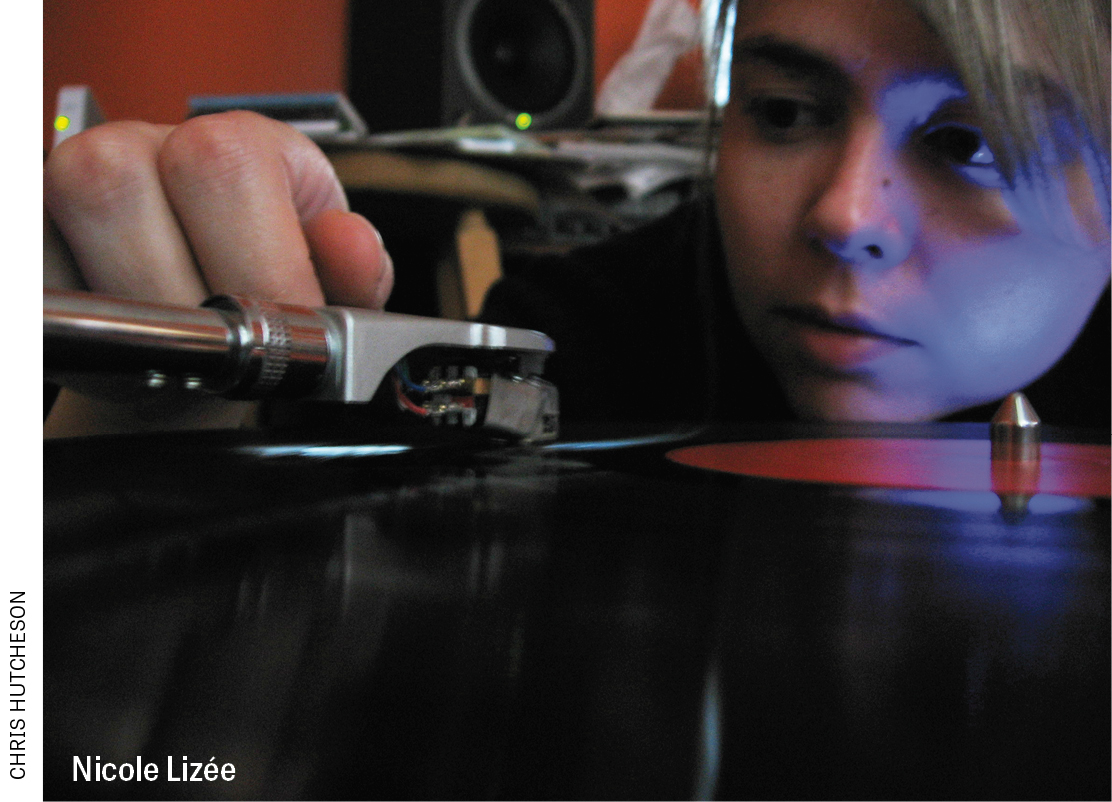
Up on St. Joseph St., on December 13, the Canadian Music Centre presents festive Canadian music in its 21st century Virtuoso series with tenor Sean Clark. December is also CD celebration time at the CMC, with two concerts of new releases: on December 12, composer and turntablist Nicole Lizée with her Bookburners launch and on December16, composer and oboist Elizabeth Raum with her Myth, Legend, Romance CD.

And speaking of CD-related concerts, I’ll be presenting works in 5.1 surround sound from my Sounddreaming CD at Array Space on December 5. Another celebration, also at Array, salutes the iconic work of experimentalist Udo Kasemets spread over two days with screenings of Kasemets’ videos December 6 and a concert on December 7. These concerts are part of this season’s ArrayMusic’s concert series.

January

The University of Toronto’s New Music Festival: Moving into January/February, we have the U of T annual New Music festival running from January 30 to February 8. This year’s festival was inspired by a meeting between University of Toronto’s Faculty of Music composer Norbert Palej and China’s Hu Xiao-ou during the Beijing Modern Music Festival a few years ago. What began as a friendship has grown to a cultural exchange. This past October, Palej travelled with 11 colleagues from the Faculty of Music to China and Hong Kong presenting lectures, masterclasses and concerts of music from U of T faculty composers and students. Now, Palej is organizing this year’s New Music Festival to present the works of Hu and several of his students from the Sichuan Conservatory in Chengdu, as well as a work by Wendy Lee, who currently teaches in Hong Kong. Both Hu and Lee will be in attendance in Toronto, and interestingly, both have Canadian connections. Hu is a part-time resident of Vancouver and Lee was a former student at U of T studying with Chan Ka Nin. The concerts on February 4 and 5 will feature chamber music by the guest Chinese composers, including the performance of a new work by Hu by the Cecilia Quartet.

The festival will finish off with a collaboration Palej developed with the Kitchener-Waterloo Symphony. On February 6 and 7, the orchestra will perform concerts featuring the world premiere of Hu’s new pipa concerto with Lan Weiwei as soloist. Also on the program will be the premiere of Palej’s Shan Shui Miniatures based on Chinese folk themes, and the winning pieces of the Friendship Orchestral Composition Competition. Other festival events include concerts on January 30 and February 1 of student operas based on a libretto by Michael Albano and on February 2, works by international emerging composers performed by the Ecouter Ensemble. The festival will finish on a lighter note with a modern jazz concert on Sunday February 8. The full schedule of events will be on the Faculty of Music website early in December.

Esprit Orchestra: Esprit’s January 29 concert brings us the world premiere of English composer Philip Cashian’s the world’s turning inspired by the sculptures of Stephen Vince. The visual theme continues with Icelandic composer Daniel Bjarnason’s Over Light Earth which pays tribute to painters Mark Rothko and Jackson Pollock. The program is rounded out with works by New Music Concerts’ artistic director Robert Aitken, whose Berceuse explores the balance of Yin and Yang while commemorating those “who sleep before us” and an Esprit-commissioned new work by Canadian Samuel Andreyev titled The Flash of the Instant.

Overview: And finally to finish off 2014 and move into 2015, an overview of other noteworthy new music concert events for December and January.

Canadian Music Centre: December 18 with the Toronto Guitar Society. Premiere of works by Leggatt, Oickle, Sandquist and Tse. January 13 the CMC’s 21st Century Virtuoso series presents works from Messiaen’s Catalogue d’Oiseaux and Gilles Tremblay’s Musique de l’eau performed by Ryan MacEvoy McCullough

Music Gallery Emergents Series: December 4 curated by Melody McKiver. Works by Clarinet Panic Deluxx and Cris Derksen, two cellist/composers. January 30 curated by Felicity Williams: Dan Fortin and Robin Dann/Claire Harvie.

Exultate Chamber Singers: December 5. Works by Canadian composers in their “A Canadian Noël” concert.

Spectrum Music: December 6. Concert titled “Journeys” with works for guitar and string quartet by Alex Goodman and Graham Campbell with the Ton Beau String Quartet.

Syrinx Concerts Toronto: December 7. Concert includes Stillness of the 7th Autumn by Brian Cherney

Toy Piano Composers: January 24. Concert titled “Grit” with works by Brophy, Labadie, Pearce, Puello, Tam and others. Performances by Chelsea Shanoff and Nadia Klein with the TPC Ensemble.

 group of 27: January 30. Concert includes Voyageur by Andrew Staniland.

Wendalyn Bartley is a Toronto based composer and electro-vocal sound artist. sounddreaming@gmail.com.

Back to top