For lovers of musical theatre, there is something uniquely magical about the holiday season this year as the world of live performance starts coming back into its own, including all the usual holiday entertainments we had to forgo last year, while we safely stayed home. 

Nutcrackers and Scrooges

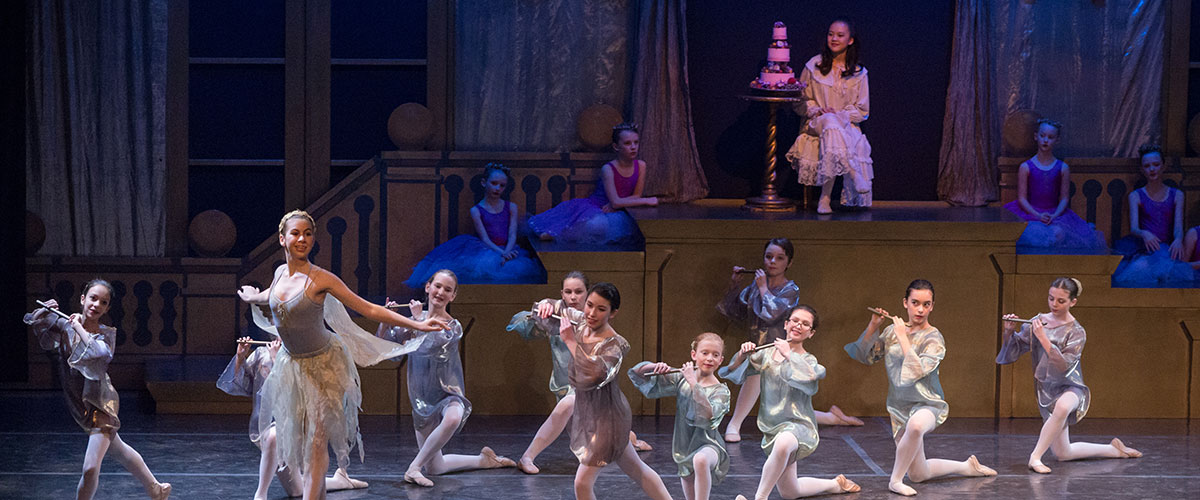
Live performances of The Nutcracker are returning, from the grand scale of the National Ballet of Canada’s perennial favourite at the Four Seasons Centre to the smaller-scale beloved production of the Pia Bouman School for Ballet and Creative Movement, with a legacy almost as long as the National Ballet’s. There is even a new entrant on the scene which straddles  the line between live and digital: Lighthouse Immersive’s Immersive Nutcracker is similar to their Van Gogh and  Klimt programs, enveloping an audience within four bare walls on which is created a projected world – in this case, a shortened 40-minute version of The Nutcracker, part ballet, and part animation, fuelled by Tchaikovsky’s iconic score. Audiences are free to roam and even dance along, which seemed to delight some of the children who were there when I was.

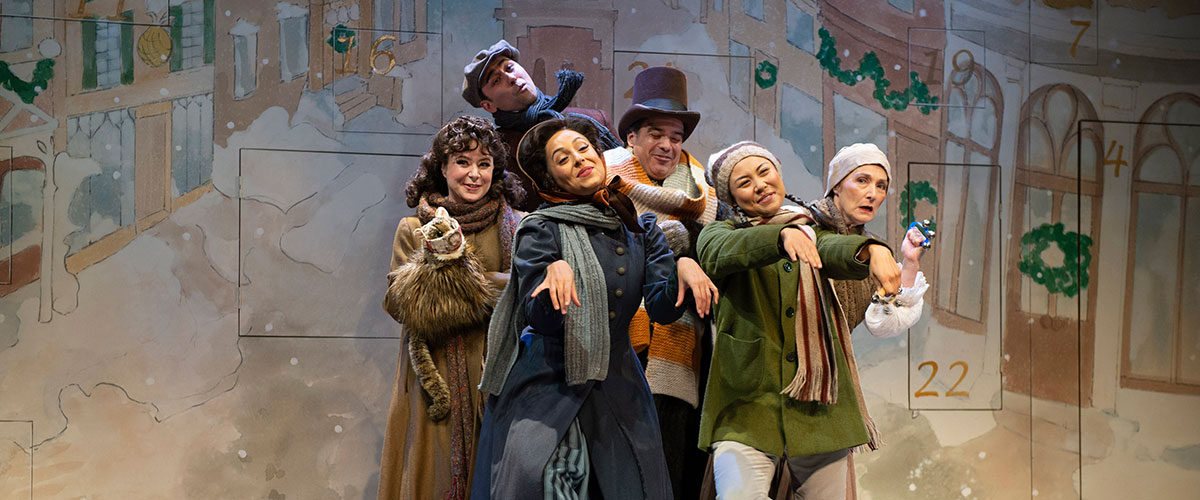
A Christmas CarolAnother returning holiday tradition is the many and varied stage adaptations of Charles Dickens’ A Christmas Carol. I had the great treat of attending for the first time the opening performance of The Shaw Festival’s version, adapted, and originally directed, by artistic director Tim Carroll, and this year directed by (former assistant director) Molly Atkinson. What was revealed to us in the cozy intimate setting of the Royal George Theatre was an intrinsically theatrical but also surprisingly musical version of the beloved transformation story: confirmed miser and hater-of-all-things-Christmas, Ebeneezer Scrooge metamorphosing into a spirit of joyous generosity. The show opens with a group of very tuneful carollers who not only set the scene and get the story started but pop up throughout to punctuate the action and to round everything off with what would – in non-COVID-wary times – be a group singalong with the audience. 

There is a magical spirit of theatrical inventiveness in this production from the use of a front screen that resembles an outsize Advent calendar – with windows to be cleverly opened and even used as props – to one of the cleverest and most whimsical depictions of the three Christmas ghosts that I have ever seen.

Read more: Emerging from postponement limbo as it all comes alive again

Vikingur Olafsson ARI MAGGVikingur Ólafsson’s Toronto debut was in 2014 – when I heard him play the Goldberg Variations at the Richard Bradshaw Amphitheatre and speak about how thrilled he was to be performing in Glenn Gould’s hometown. Since then, the 37-year-old Icelandic pianist has released critically acclaimed recordings for Deutsche Grammophon (works by Glass, J.S. Bach and Rameau/Debussy) and has been named Gramophone magazine’s 2019 Artist of the Year. His Toronto return – to Koerner Hall on January 13 – finds him performing his just-released CD, Mozart & His Contemporaries

What follows is largely gleaned from Martin Cullingford’s April 20, 2020 story in Gramophone, Katherine Cooper’s interview in Presto Music, April 9, 2021 and an EPK interview for Deutsche Grammophon coincident with the release of his newest recording.

“When I play Mozart I often feel like the ink has just dried on the page,” Ólafsson said on the DG website. “Despite the fact that the music was written 230 to 240 years ago, Mozart seems to reflect your innermost core.” On the DG site, he describes playing Mozart since he was five or six years old; one of his most vivid memories from his musical childhood is of playing the C Major sonata which is on his new DG recording (and in his upcoming Toronto recital). “It’s so serene, it’s almost impossible to play it,” he said. “It’s so perfect by itself that you almost dare not touch it – it’s like holding a newborn child – it’s so fragile, the beauty of it, that you just marvel at it. Mozart was so above us – what he did was so perfect.”

Read more: Ólafsson on Mozart, as momentum builds toward 2022

Gary Corrin CREDIT Toronto Symphony Orchestra banner“..., but Bach didn’t write a Bassoon Concerto!”
That was the reaction of the Toronto Symphony’s principal bassoonist, Michael Sweeney, as he related the story to me in May of this year. I’d had a similar reaction somewhat earlier when the TSO’s concertmaster, Jonathan Crow, emailed me a photo of a CD jacket listing “Johann Sebastian Bach, Rediscovered Wind Concertos” and asked, “How possible would it be to get the parts for any of these?” Something unusual was in the works.

As principal librarian of the Toronto Symphony, I’ve often thought that I have the greatest job in the world for gaining an appreciation of music. After researching, sourcing, acquiring and preparing those printed pages from which every musician on stage reads (a process that usually takes place over several months), I hear all the rehearsals (where the tricky spots are worked out) and then the concerts. Of course, my listening takes place over the sound monitor in the TSO Library, while I’m working on music to be performed in the months ahead. Best of all, I get to know the players. They all need to practice those printed pages, so everyone comes to the library. As I’m listening, I don’t just hear an instrument, I hear a person. It’s a fantastic experience and I often ponder how I might share it with our audience. This is a story about several of those players, their friendships, and their regard for one another. It’s my privilege to tell it – mostly in their own words.

In any normal year, the TSO would announce its events for the coming season in February. The 2021-22 rollout was delayed as we, like every arts organization, strategized around pandemic-gathering restrictions. “How many musicians will we be able to put on stage?” “Will we even be able to host a live audience?” “How long should the concert be?” “Intermission?” and “What if the guest conductor from Europe can’t get into the country?” These were the overriding questions of the time. In the midst of it, Jonathan Crow came up with an idea that turned adversity to advantage.

Read more: Adversity to Advantage | “Bach Among Friends”

Kronos and Tagaq resized C Lisa Sakulensky“It’s not so much a place I go to as a place I come to. It’s a freedom, a lack of control, an exploration, and I’m reacting to whatever happens upon the path.”
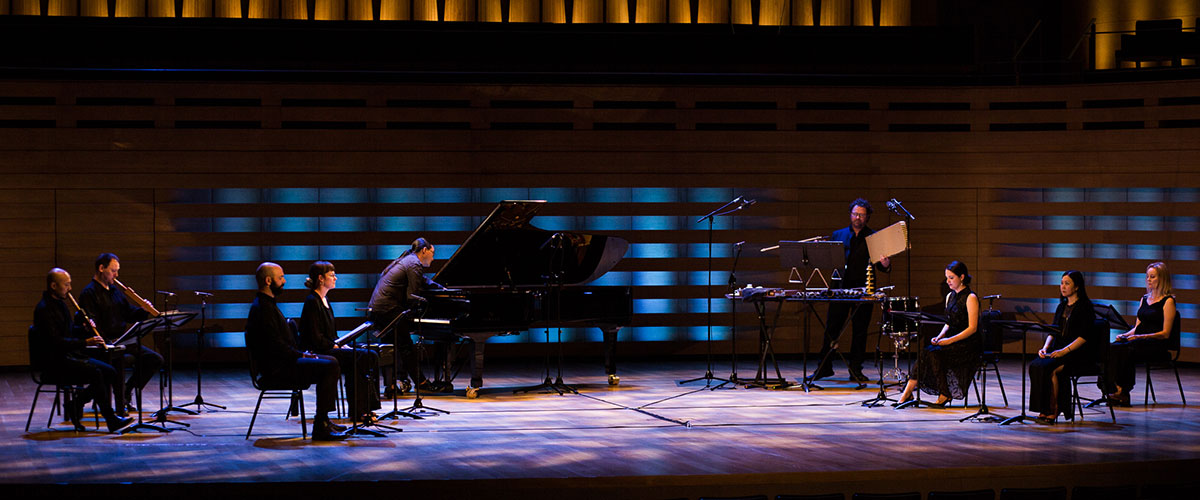
Tanya Tagaq (quoted in WN May 2016)

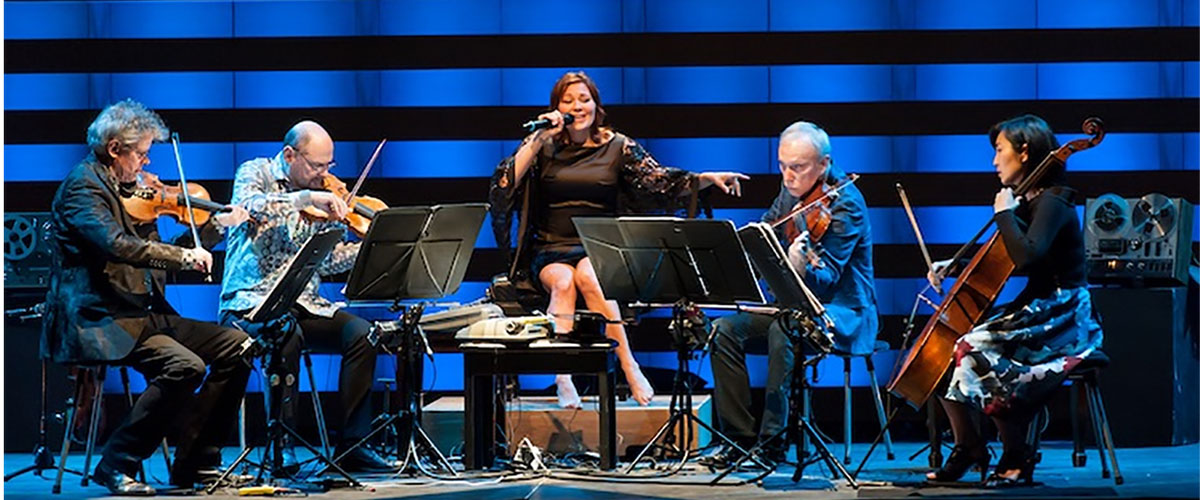
Five years ago at the 21C Music Festival, the Kronos Quartet introduced their Fifty for the Future project, performing four of these works including the world premiere of Snow Angel-Sivunittinni (meaning “the future children”) created by the exhilarating and ferocious Inuk throat singer Tanya Tagaq. Spread over five years, the project commissioned 50 new works by 25 women and 25 men for string quartet, all designed to introduce future string quartets to the diversity of contemporary musical ideas. In The WholeNote article I wrote for the May 2016 issue, David Harrington, first violinist of the quartet, described Tagaq’s voice as sounding “like she has a string quartet in her throat.”

Read more: Music for Change: Kronos and Tagaq return to 21C

emmet ray 260 nt6i8Just 8760 little hours ago, in December of last year, most of us were hunkering down, keeping safe, and preparing for a very different winter than we’d enjoyed in years past. Visits home were cancelled; stockings were half-heartedly stuffed; home-office chairs swivelled disconsolately from Zoom meetings to Zoom cocktail hours. This year, however, things are looking just a little bit brighter: vaccination rates are up, case rates are down, and – though the threat of the pandemic looms, ever present on the periphery – it is looking as though we may indeed have a more conventional (and decidedly more sociable) holiday season. 
As of December 16, we will officially be at the five-month mark of music being back in Toronto and environs in the kinds of venues I usually cover in this column. For some audience members, this has meant five months of being back in venues, watching musicians return to the stage after a lengthy intermission, and witnessing restaurants, bars and concert halls sort through the thorny logistics of making COVID-safe adjustments, training new staff and, often, enacting new payment policies to ensure a more equitable and fair disbursement of funds to musicians. For other audience members, the return to live music has been slower, whether because of worries related to COVID transmission, a change in lifestyle, or – as has happened for so many people – a move, enabled by a shift to remote work, from a dense urban area to somewhere with more affordable housing options and more accessible outdoor spaces. 

Whatever the case may be, there are quite a few exciting shows happening in December. If holiday shows are your thing, there are a number of options, including the Kensington Holiday Bash (December 10, Grossman’s Tavern), A Charlie Brown Christmas and Castro’s Christmas Party (both December 12, Castro’s Lounge), Tom Nagy’s Christmas Experience (December 17, The Jazz Room), and the Jason White Christmas Special (December 18, also at The Jazz Room).

Read more: What a difference a year makes!

Soundstreams’ presentation of Love Songs. Photo credit: Claire Harvie.Thanks to Soundstreams and their commitment to programming Canadian music, there will be a chance to hear two works by the celebrated composer Claude Vivier on November 19, 2021, during the broadcast of a livestream concert event.

Vivier’s musical influence in Toronto stretches back to the late 1970s when his works were regularly performed by Arraymusic, and has been ongoing ever since, even though his tragic death in 1983 put an end to the creation of new works by this celebrated composer. The upcoming concert was recorded in Koerner Hall and features two works by Vivier: Love Songs (1977) and Hymnen an die Nacht (1975), as well as the world premiere of Oceano Nox by Christopher Mayo, composed as a tribute to Vivier. 

Read more: “Pure sound and the light of eternity”: Claude Vivier reprised and recollected

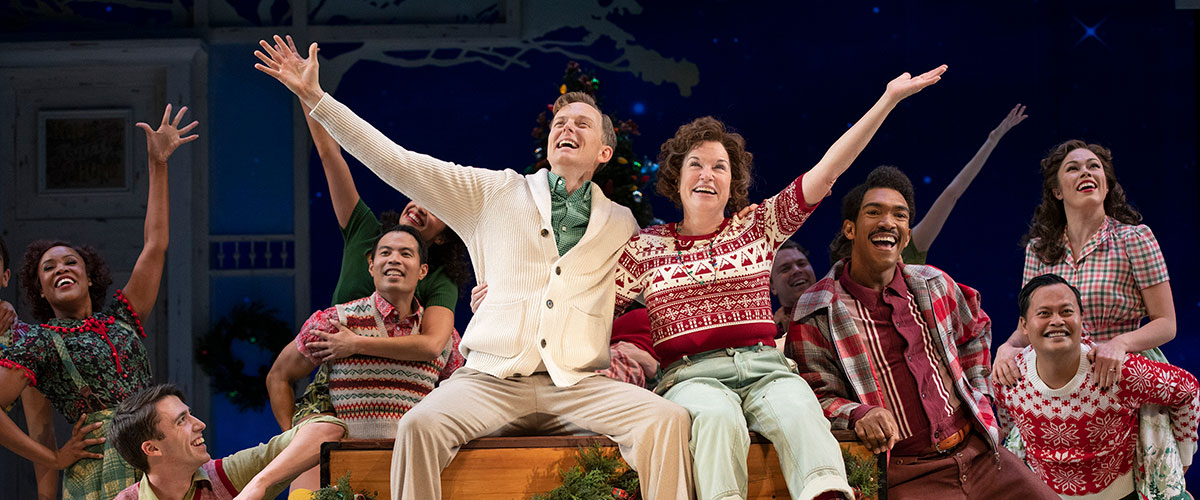
Kyle Blair as Jim Hardy, Gabrielle Jones as Louise and the cast of Irving Berlin’s Holiday Inn (Shaw Festival, 2021). Photo credit: David Cooper.On November 20, the Shaw Festival’s winter season hits its full stride, with the openings of both its holiday offerings: A Christmas Carol, and Irving Berlin’s full-scale musical extravaganza Holiday Inn.

In 2019, Holiday Inn was notable as the first musical to be programmed as part of the Shaw’s winter holiday season. It was also notable as the directing debut of one of Canada’s most versatile theatre artists: actor, playwright, teacher, and now director, Kate Hennig.  

The production was such a popular success that it was the natural choice to bring back this year with the same creative team, and many of the original cast, to celebrate the reopening of the theatres as well as the holiday season.

Read more: “A Postcard to 1946”: Director Kate Hennig chats about musical Holiday Inn

High and Dry: Zorana Sadiq at Music Mondays in July of 2014.One-woman show. A listening room. A melding of narration and sound-making. Personal and universal. A monologue but also very much a dialogue with the musical tradition. I’m seated at a picnic table in Leslie Grove Park with Toronto-based soprano Zorana Sadiq, trying to tease out what her new creation opening at Crow’s Theatre on November 9 is going to be like.

Read more: Zorana Sadiq at Crow's

Alison Melville and Rene Meshake Photo credit:COLIN SAVAGEFor almost anyone with an internet connection, streaming services are a hugely popular source for entertainment, requiring only a compatible device to access a near-infinite variety of entertainment. Classical music occupies a miniscule slice of the market, but medici.tv and a few other, smaller services, nevertheless present a wide range of performances and documentaries for enthusiasts everywhere, performed by an equally wide range of musicians, orchestras and ensembles. In December last year in this column, I wrote that early music specialists, The Toronto Consort, had joined the party by launching Early Music TV (earlymusic.tv) – the Consort’s response to external circumstances, as the global pandemic ravaged performing arts organizations around the world.

Read more: The Toronto Consort: From their home to yours

Jean-Sébastien Vallée. Photo by Tam Lan TruongI recently connected, twice, with the Toronto Mendelssohn Choir’s recently appointed artistic director, Jean-Sébastien Vallée (the eighth conductor in the choir’s 127-year history). The first time was on September 20, when I visited a TMC rehearsal; the second on October 4, for a chat in The WholeNote office. Both visits were on Mondays, because, at time of writing anyway, Mondays are Vallée’s only Toronto day.

Read more: Understanding what a choir needs - Introducing Jean-Sébastien Vallée

The air was electric with anticipation as a top-notch staged-concert production of Stephen Sondheim’s and James Goldman’s iconic musical Follies at Koerner Hall on the weekend of October 16/17 signalled the return of indoor live musical theatre to town. For most of us this was the first indoor live performance we had seen since lockdown back in March of 2020. 

Who’s That Woman (The Mirror Song) with Jackie Richardson as “Stella” at centre; and (left to right) Tess Benger, Cynthia Dale, Jenny Burke, Mary Lou Fallis, Charlotte Moore (behind Richardson), Katelyn Bird, Lorraine Foreman, Denise Fergusson, Ma-Anne Dionisio, Kimberly-Ann Truong.  Photo credit: Lisa Sakulensky

Read more: Sondheim’s Follies live and indoors!
Back to top