05 FirebirdStravinsky – The Firebird; Nikolaev – The Sinewaveland
Seattle Symphony; Ludovic Morlot
Seattle Symphony SSM1014

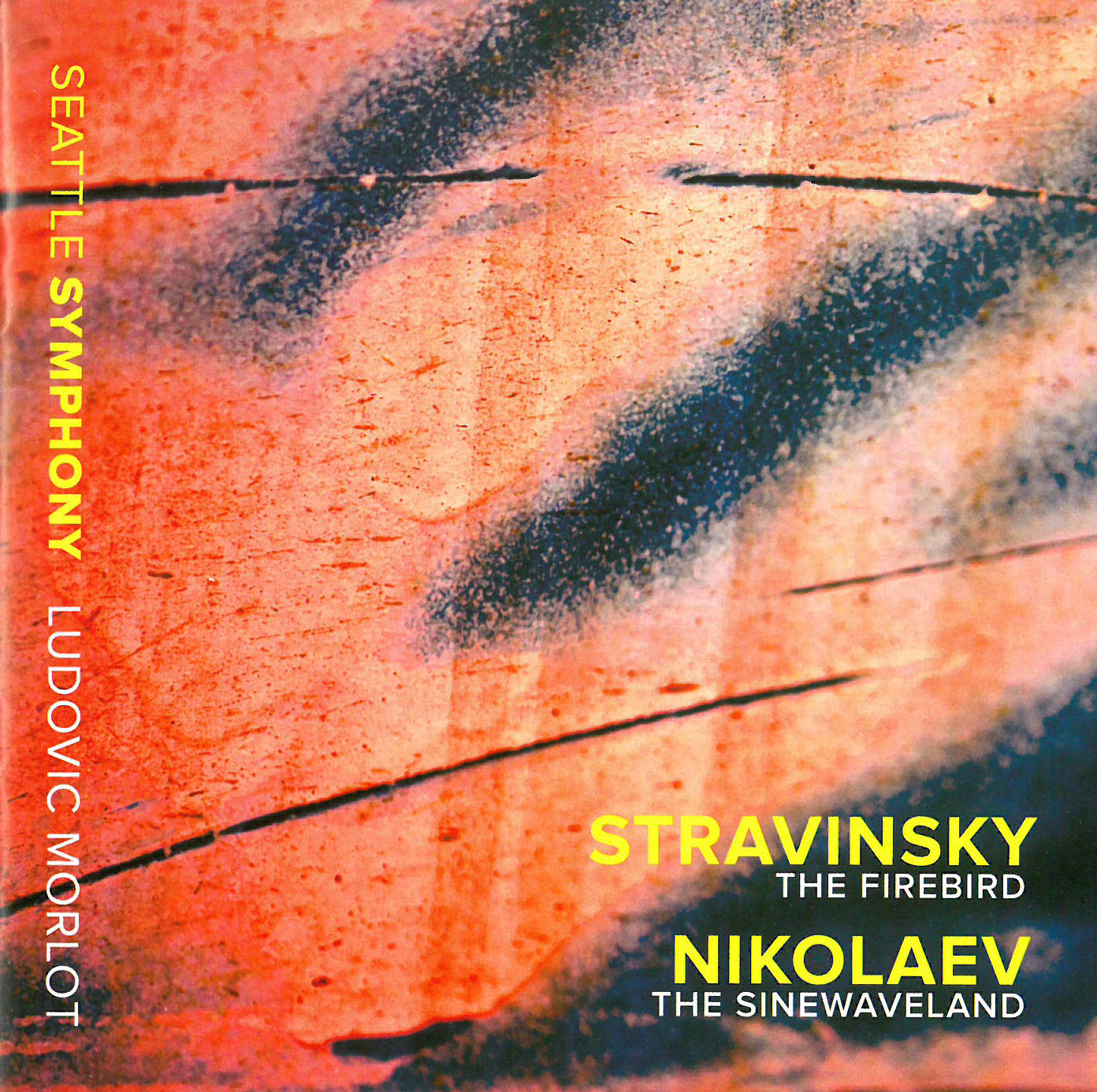
The Firebird brought the world’s attention to Igor Stravinsky, who at the time of the premiere of the ballet was an unknown composer not yet 30 years old. His first collaboration with Serge Diaghilev’s Ballets Russes, the score is broadly romantic, full of tricks practised by Ravel and Debussy. The ballet itself is rarely performed, perhaps owing too much to novelty and exoticism (pre-war Paris was all agog over things Russian), but the score remains an orchestral staple. Musically less challenging to audiences than its next of kin The Rite of Spring, the score is full of delicious moments for the ear and no more dissonant that Rachmaninoff.

This new release from the Seattle Symphony under music director Ludovic Morlot is delightful, if conservative. Moment follows descriptive moment of a fine rendering. The musicians exhibit polish in portraying the supernatural tale, but there may be a flaw inherent in the product itself: Stravinsky bridled at the job of creating too literal a musical narrative for the folk-inspired story. Perhaps his lack of investment cursed the music. Although perhaps perfect, this performance isn’t thrilling. I still believe there are possible interpretations where the terrors of Kastchei’s infernal garden are made relevant: not just polished but gripping.

Rounding out the disc is an homage to Seattle’s own Jimi Hendrix from Vladimir Nikolaev, another young composer a century later reworking the folk music of his own ethos into music that may well have staying power. Sinewaveland is the more powerful and effective performance.

06 In Search of Great ComposersIn Search of Great Composers
Four films by Phil Grabsky
Seventh Art Productions SEV194

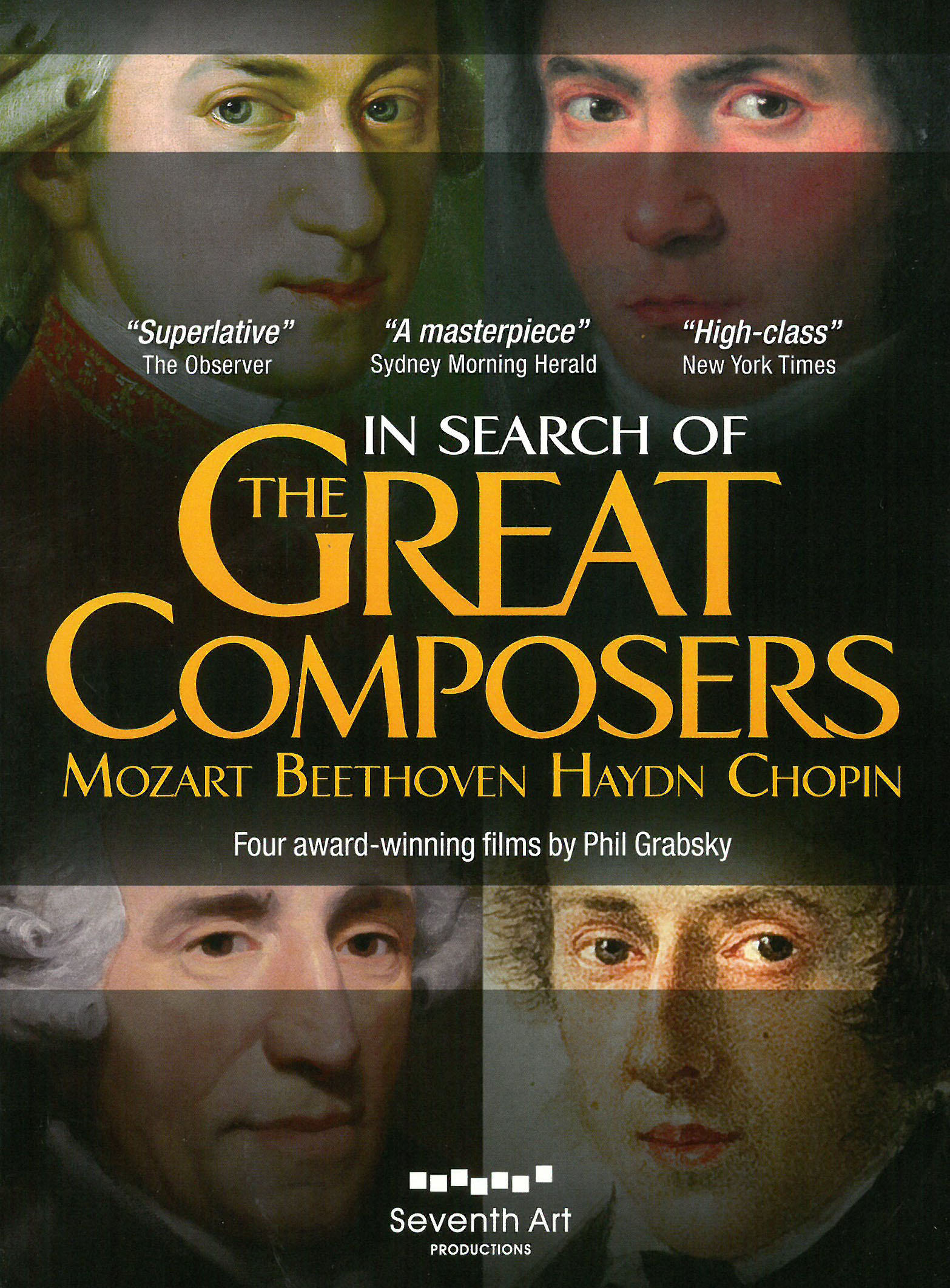
There is so much brilliant music brilliantly performed, historical and musical commentary, excitement and beautiful visuals in this documentary collection of five DVDs about Mozart, Beethoven, Haydn and Chopin that even the most bored individual with a disdain for music history will find something worth the view!

Each composer receives a respected, informative and surprisingly original recollection of their personal and professional lives. In Search of Mozart (2006) chronologically follows every road the composer travelled throughout his life with his music being centre stage. This 25,000 mile journey (that’s over 40,000 km for us Canadians) is followed by foot – such as in the modern day Salzburg sidewalks packed with cell phone-toting pedestrians – and behind the wipers of a rainy-day windshield. These visuals almost become travelogues were it not for the intersecting clips of commentary. Of course the music performed by soloists, singers and orchestras is world class with the noteworthy clip of trumpet soloist Falk Zimmermann performing from Leopold Mozart’sTrumpet Concerto in D setting the stage for more great music. Initially the jump cuts between landscape, commentary and performances created some confusion, but over the course of the film this technique increased viewing interest.
Next in the series is the two-DVD set In Search of Beethoven (2009). Beethoven aficionados may not learn anything new, but Grabsky’s approach through letters, historical facts, personal Beethoven issues, star-performer commentaries and especially the footage of their performances is superb. A highlight here is Emanuel Ax performing in clips from the Waldstein and Appassionata piano sonatas. The second Beethoven DVD features complete performances, scenes and an interview with the director.
In Search of Haydn (2012) is especially fulfilling, as the composer may not be as famous as Mozart and Beethoven, though respected by both. Grabsky’s film shows us a composer who also wrote substantial, worthy music. In this chronological documentary the focus is on the music with the great illuminating performances that should tweak one’s interest to explore more of Haydn’s output. Of note are Ronald Brautigam’s takes on Keyboard Sonata No.1 and Keyboard Sonata No.9, and Marc-André Hamelin’s performance clip from the Keyboard Sonata No.34.

Finally, In Search of Chopin (2014) takes the same approach. The documentary formula is used, but the presentation of personal facts seems pressed for time; for example, the passing mention of Chopin’s soap opera-like relationship with George Sand. But the piano performances and commentaries by the pianists should be on every piano student’s must-see-and-apply list. Of special note are performances by Daniel Barenboim and Brautigam again.

Filmmaker Phil Grabsky needs to be greatly congratulated for all the time, research, dedication, detail and reaching out to historians, musicians, performers and orchestras to create these four In Search Of documentaries. His love, respect and curiosity of everyone portrayed – composer, historian and performer – is reflected in each film. This is more than music history – these are visual and aural musical stories. All the camera close-ups, from musicians’ hands working their beloved instruments, to tree twigs and rain in scenery, are thought-provoking, especially against the clear audio of the music. Grabsky’s excitement for his material resonates throughout, subsequently broadening the excitement of the viewer. Watch, learn, enjoy, listen and be inspired!

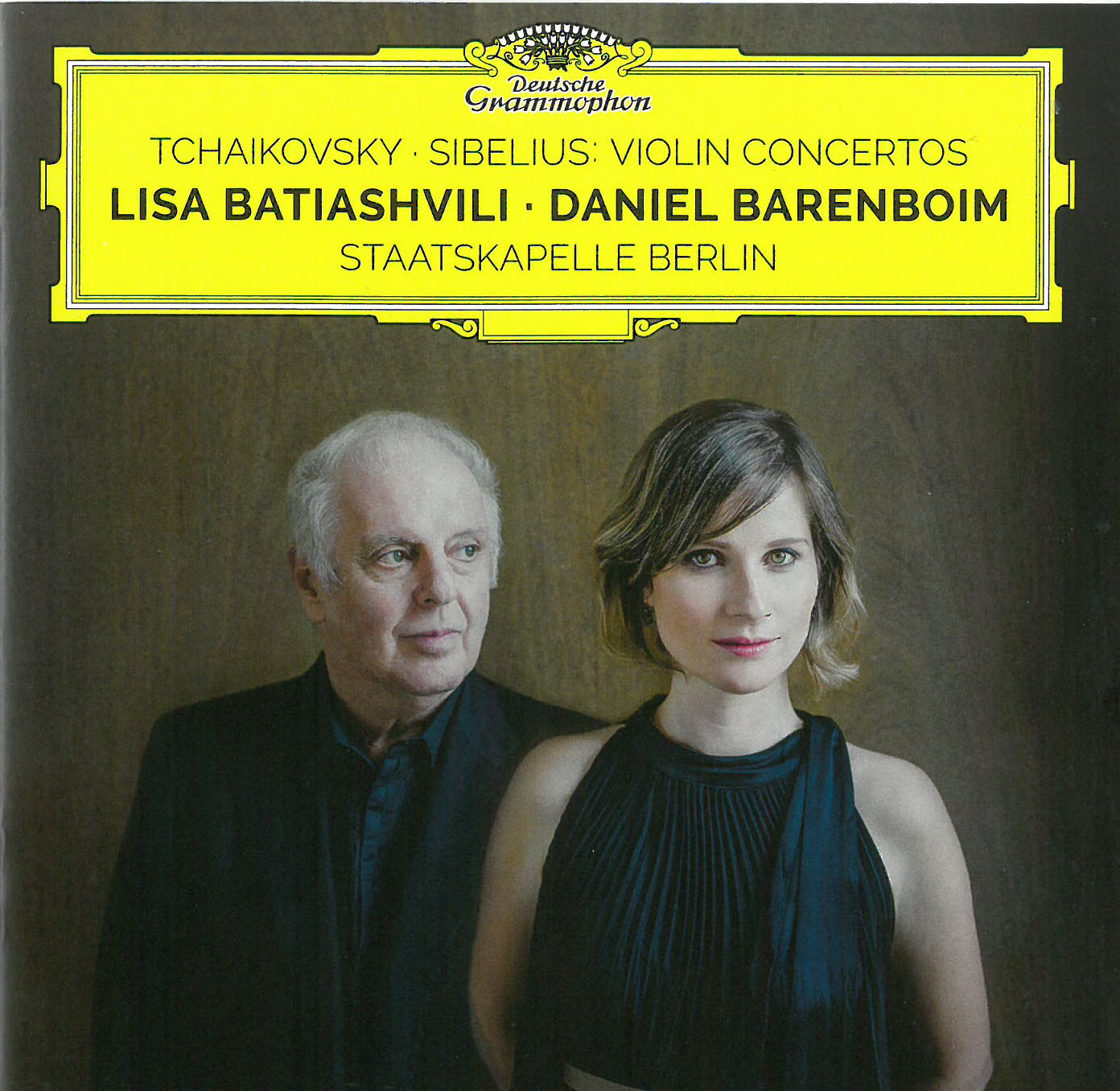
01 Tchaikovsky SibeliusThe outstanding Georgian violinist Lisa Batiashvili is back with simply ravishing performances of the Tchaikovsky and Sibelius Concertos with Daniel Barenboim leading the Staatskapelle Berlin (Deutsche Grammophon 479 6038).

The recordings are the direct result of the artists’ collaboration in the final open-air free concert of the annual State Opera for All concert series in Berlin, initiated by Barenboim in 2006. For the past four years Batiashvili has been the guest artist, playing the Beethoven, Brahms, Tchaikovsky and Sibelius concertos – indeed, it was her televised performance of the latter with the Finnish Radio Symphony Orchestra that prompted Barenboim to make the initial contact.

The Berlin studio recordings here were made within days of the 2015 and 2016 Tchaikovsky and Sibelius concert performances, and they are simply stunning. Batiashvili has a rich, clear tone with wonderful depth and a brilliant top, and Barenboim supplies a perfectly judged accompaniment with an unerring instinct for when to hold back and linger awhile and when to forge ahead. It all makes for sensitive, thrilling and passionate interpretations that grab you from the opening bars and never let go.

Add a simply outstanding orchestral and recording quality and these are performances that can hold their own with any on record.
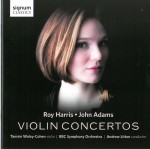
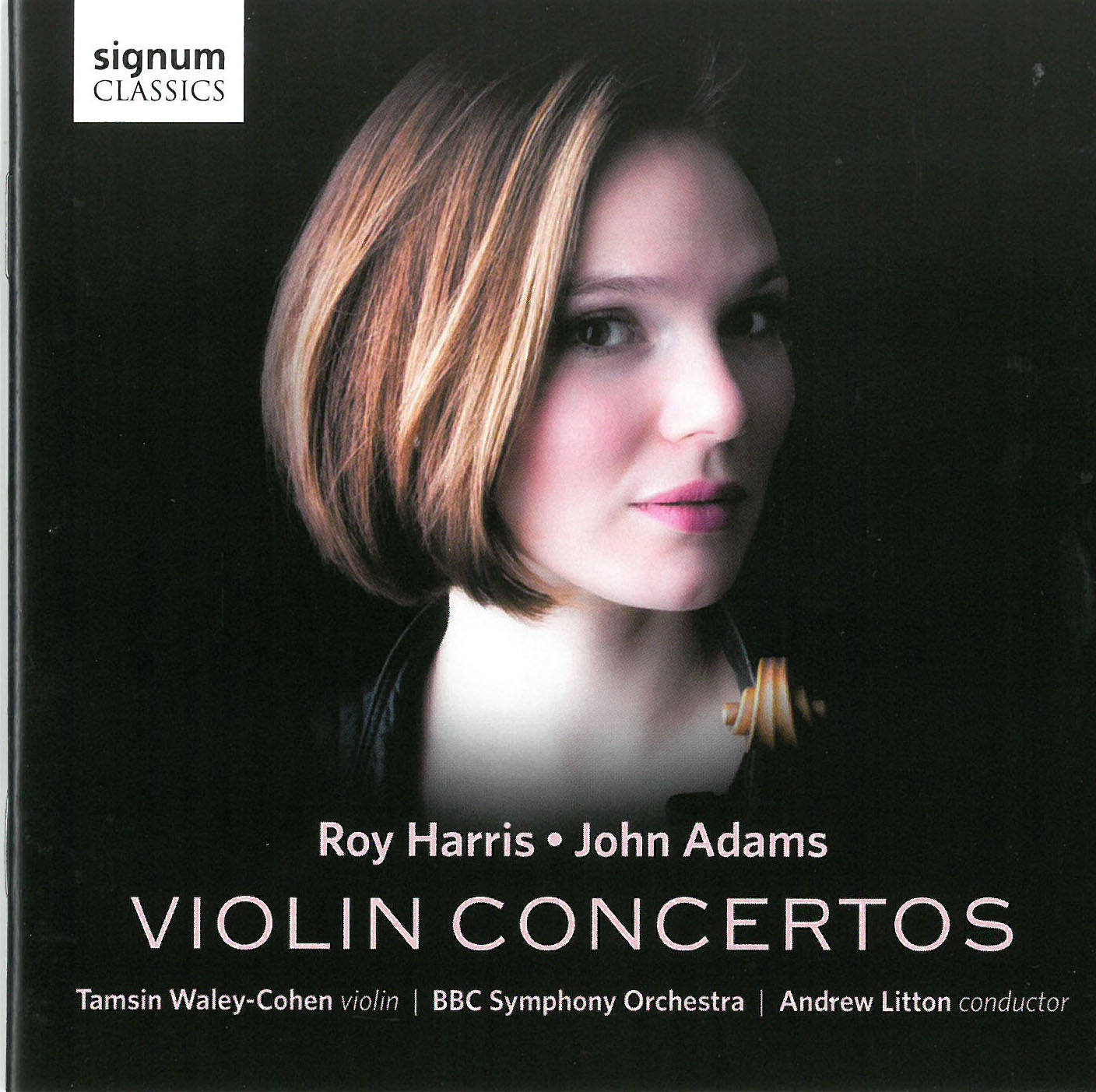
02 Harris Adams TasminThe English violinist Tamsin Waley-Cohen is the soloist in the Violin Concertos by American composers Roy Harris and John Adams on a new Signum Classics CD with the BBC Symphony Orchestra under Andrew Litton (SIGCD468).

The Harris concerto was written in 1949 on a commission from the Cleveland Orchestra for its concertmaster Joseph Gingold, but the premiere was cancelled when numerous discrepancies between the score and the orchestral parts couldn’t be corrected in time for the concert. It was 35 years before Gregory Fulkerson and the North Carolina Symphony Orchestra gave the first performance in 1984, with Fulkerson’s recording the following year making the concerto available to a wider audience.

It’s a work that is very much of its time, optimistic with a strong nostalgic feel and an American Western country folk feel throughout. Waley-Cohen consulted the manuscript source in the Library of Congress in Washington and was apparently enchanted by the rhapsodic solo writing. It certainly shows in her terrific performance here.

The Adams concerto was completed in 1993, and while in the traditional three-movement form is described by the composer as having no sense of traditional competition between orchestra and soloist, the violin instead making its way unimpeded through the body of the orchestra, which remains below or behind it. There’s a tranquil Chaconne middle movement, and a Toccare finale that is right out of the same drawer as Adams’ Short Ride in a Fast Machine.

Outstanding performances make this a significant addition to the 20th-century violin concerto discography.

Review
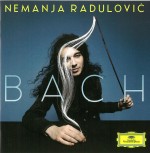
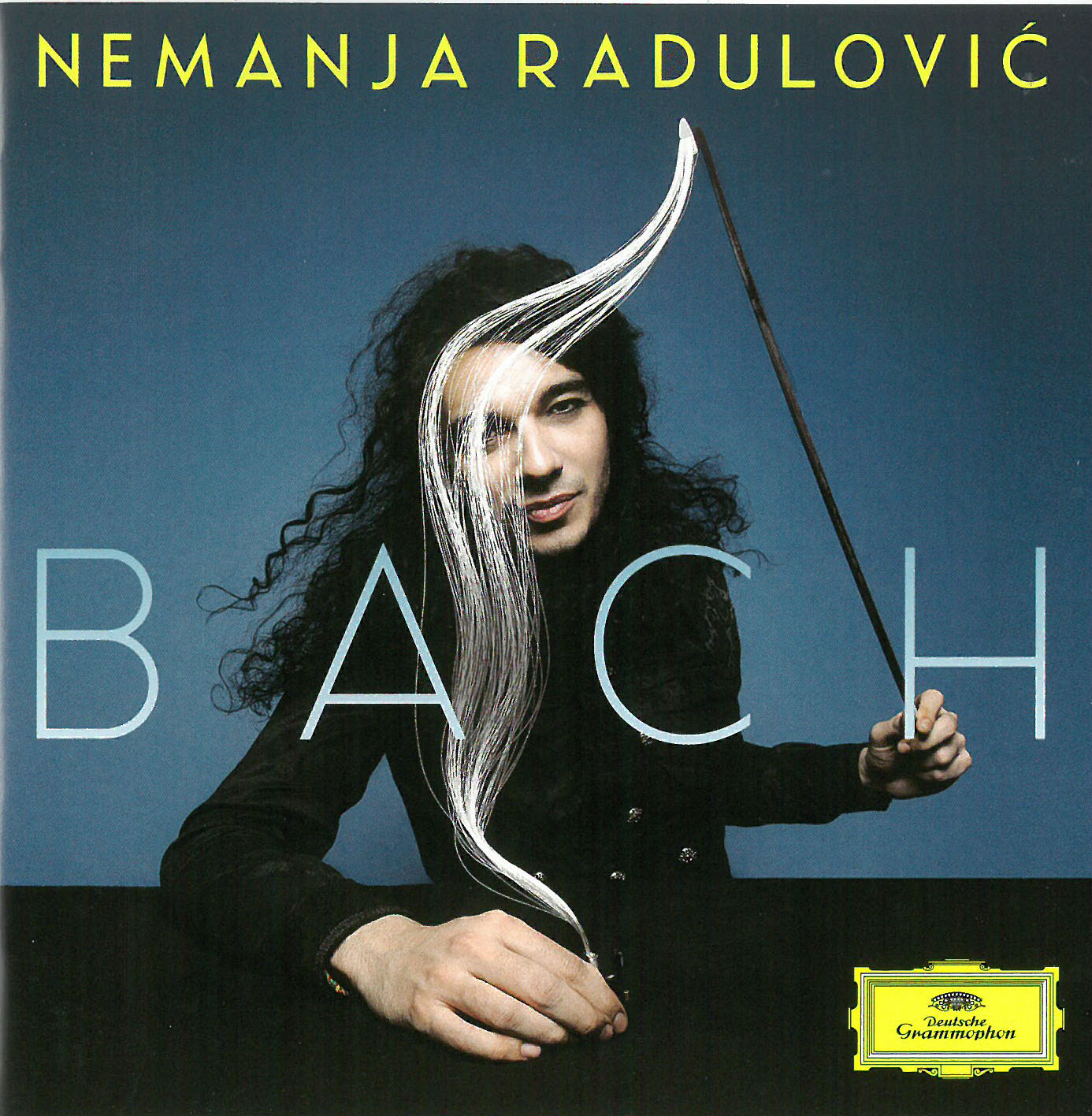
03 Bach Nemanja RadulovicIf you like your Bach bright, clean and with an abundance of energy, then you will really enjoy BACH, the new CD from the Serbian violinist Nemanja Radulović (Deutsche Grammophon 479 5933). It’s described as being in a way the continuation of his exploration of the Baroque repertory following his Vivaldi project, The Five Seasons, but it’s just as clearly a return to his roots and his earliest musical studies.

His former fellow student Tijana Milošević joins him in a performance of the Concerto for Two Violins in D Minor BWV1043 in which the outer Vivace and Allegro movements are just about as fast as you’re likely to hear them. There is lovely clean playing throughout, though. The string ensemble Double Sens provides a crystal clear accompaniment.

The Concerto in A Minor BWV1041 receives similar treatment, with a particularly lovely slow movement; Radulović really does have a beautiful tone.

The other J. S. Bach works on the CD are a mixture. The short Gavotte from the Partita No.3 BWV1006, the only solo piece on the disc, is clean and bright. The remaining three works are all presented in arrangements for violin and strings by Aleksander Sedlar: the Toccata & Fugue in D Minor BWV565 (where Les Trilles du Diable provide the accompaniment); the Air in D Major from the Orchestral Suite No.3 BWV1068; and the Chaconne in D Minor from the Partita No.2 BWV1004. There is more than a hint of the old Leopold Stokowski transcriptions here.

Radulović also learned the viola in his native Belgrade and studied the Viola Concerto in C Minor that was long thought to be by Johann Christian Bach but is now described as being “reconstructed” by Henri Casadesus. It is included here as a nod to his student days.
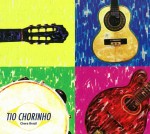
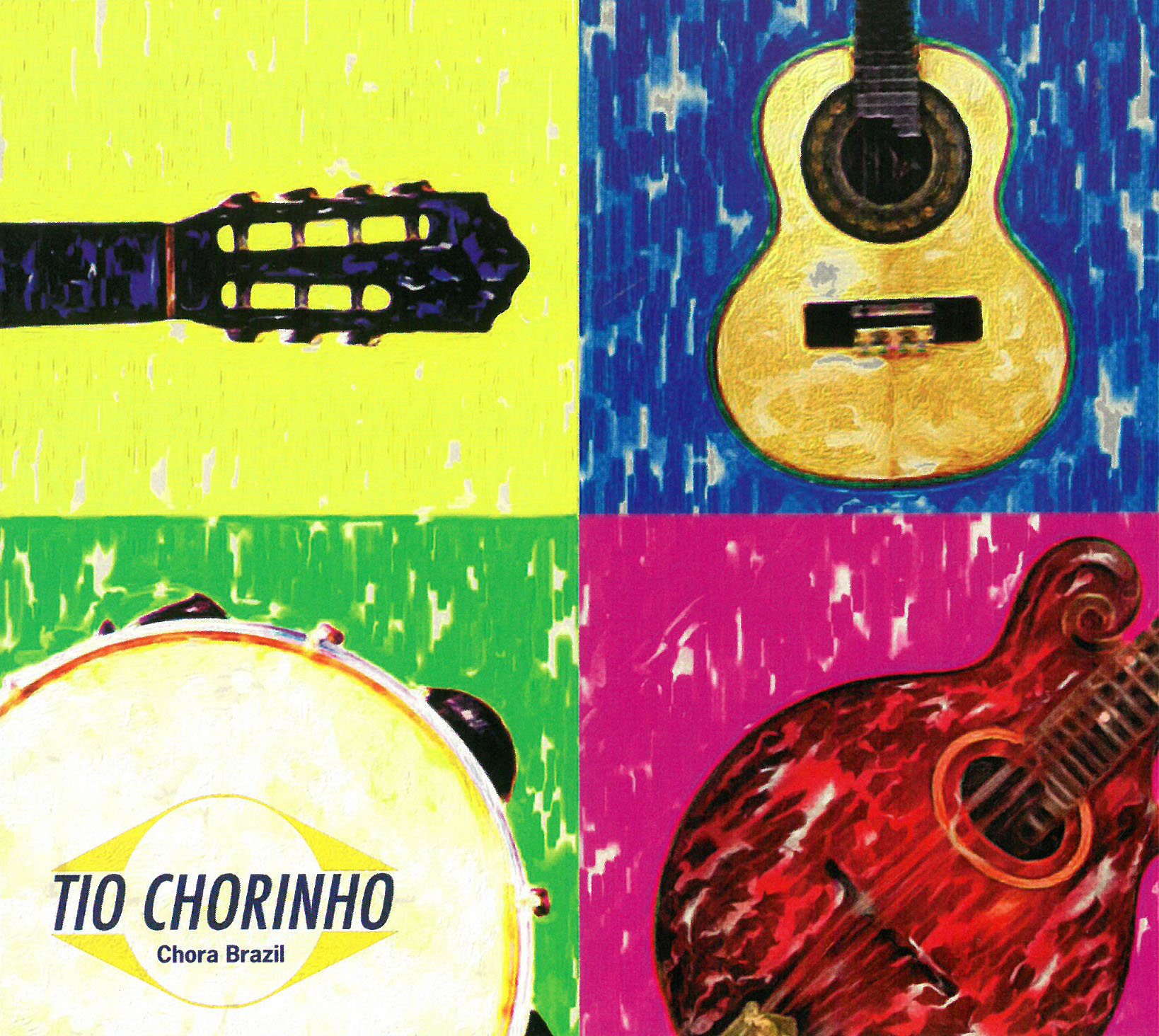
04 Tio ChorinhoChora Brazil is the debut CD from the Toronto ensemble Tio Chorinho (tiochorinho.com), the only ensemble in Canada dedicated to performing Brazilian choro music, the primarily instrumental musical form which originated in the suburbs of Rio de Janeiro in the late 19th century and provided the foundation for several modern Brazilian musical styles. The group members are Eric Stein (mandolin), Avital Zemer (seven-string guitar), Maninho Costa (percussion), Carlos Cardozo (cavaquinho) and Andre Valerio (guitar and cavaquinho).

The 12 tracks are mostly compositions by the masters of the genre, including six by the mandolin virtuoso Jacob do Bandolim, two by Waldir Azevedo and two by Pixinguinha. It’s just an absolute delight from start to finish, with some outstanding playing by the core members and occasional guest performers. Stein’s mandolin work is particularly impressive, often having the same sort of sound as the Portuguese guitar in fado music. Check out the videos of their performances on their website.

It’s a terrific debut CD; play it on a grey day and your room will be filled with sunshine!

Review
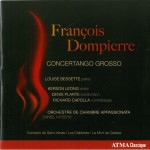
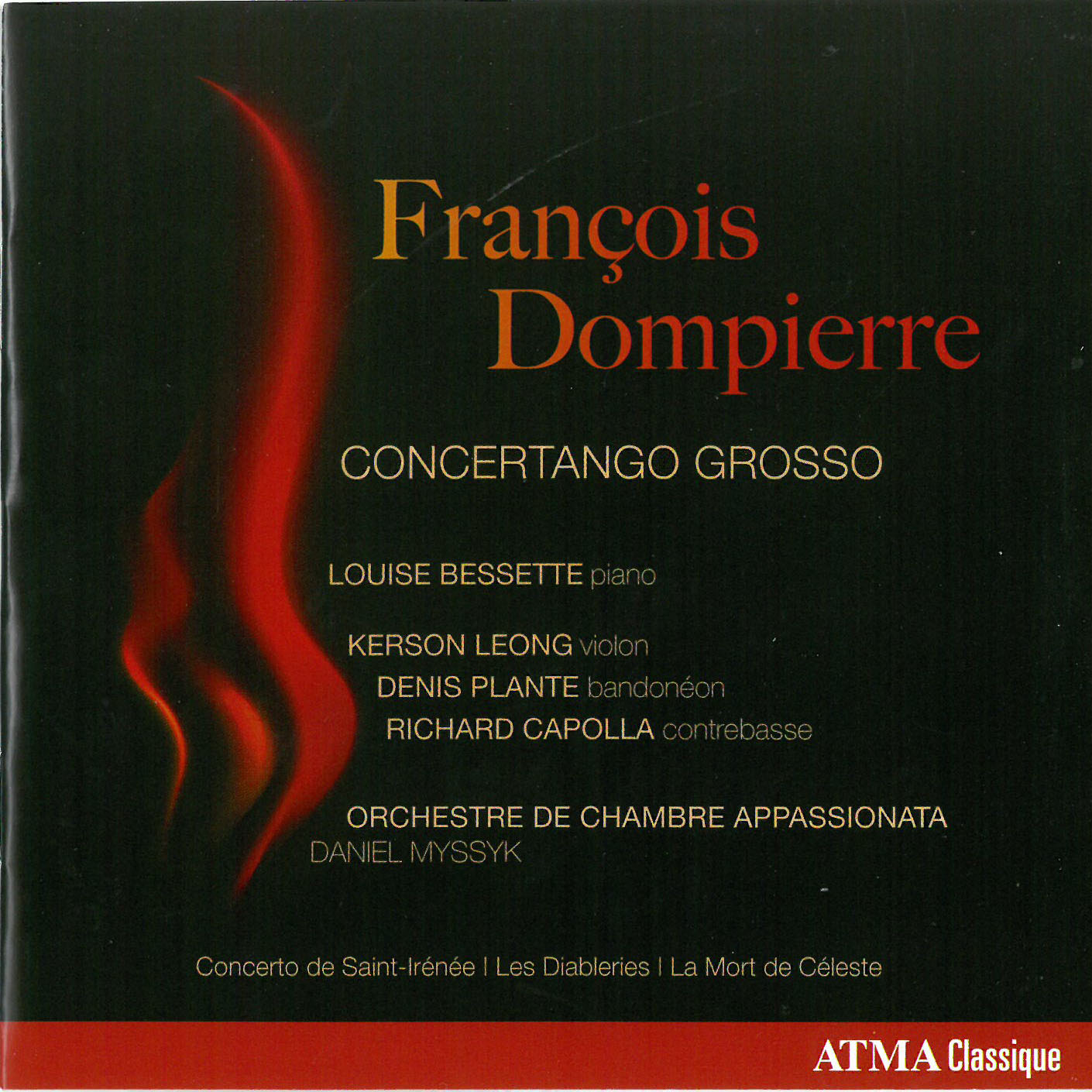
05 DompierreConcertango Grosso is a new CD from the ATMA Classique label featuring the music of the Quebec composer François Dompierre (ACD22739).

The 2015 title track was commissioned by and is dedicated to the pianist Louise Bessette and also features Denis Plante on bandoneon, Kerson Leong on violin, Richard Capolla on bass and the Orchestre de chambre Appassionata under Daniel Myssyk. It’s a highly enjoyable four-movement piece, clearly – and inevitably – influenced by Astor Piazzola, but always more than just simple imitation or pastiche. The bandoneon certainly imparts an air of complete authenticity.

Bessette is also the soloist in the Concerto de Saint-Irénée for piano and string orchestra, a classically structured work that takes its inspiration from popular music of North and South America, including jazz in the opening movement and Latin music in the third.

The terrific Kerson Leong was in fine form in the Concertango Grosso, so it’s no surprise to hear him join Bessette and do some great fiddling in Les Diableries. The five short movements were originally written (for violin and orchestra) as the required violin work in the 1979 Montreal International Music Competition, and the piece is heard here in a new arrangement for violin, piano and string orchestra.

La Morte de Céleste, the final track on the disc, is a rich, romantic and simply lovely short piece for string orchestra.

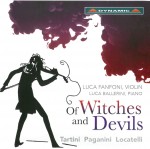
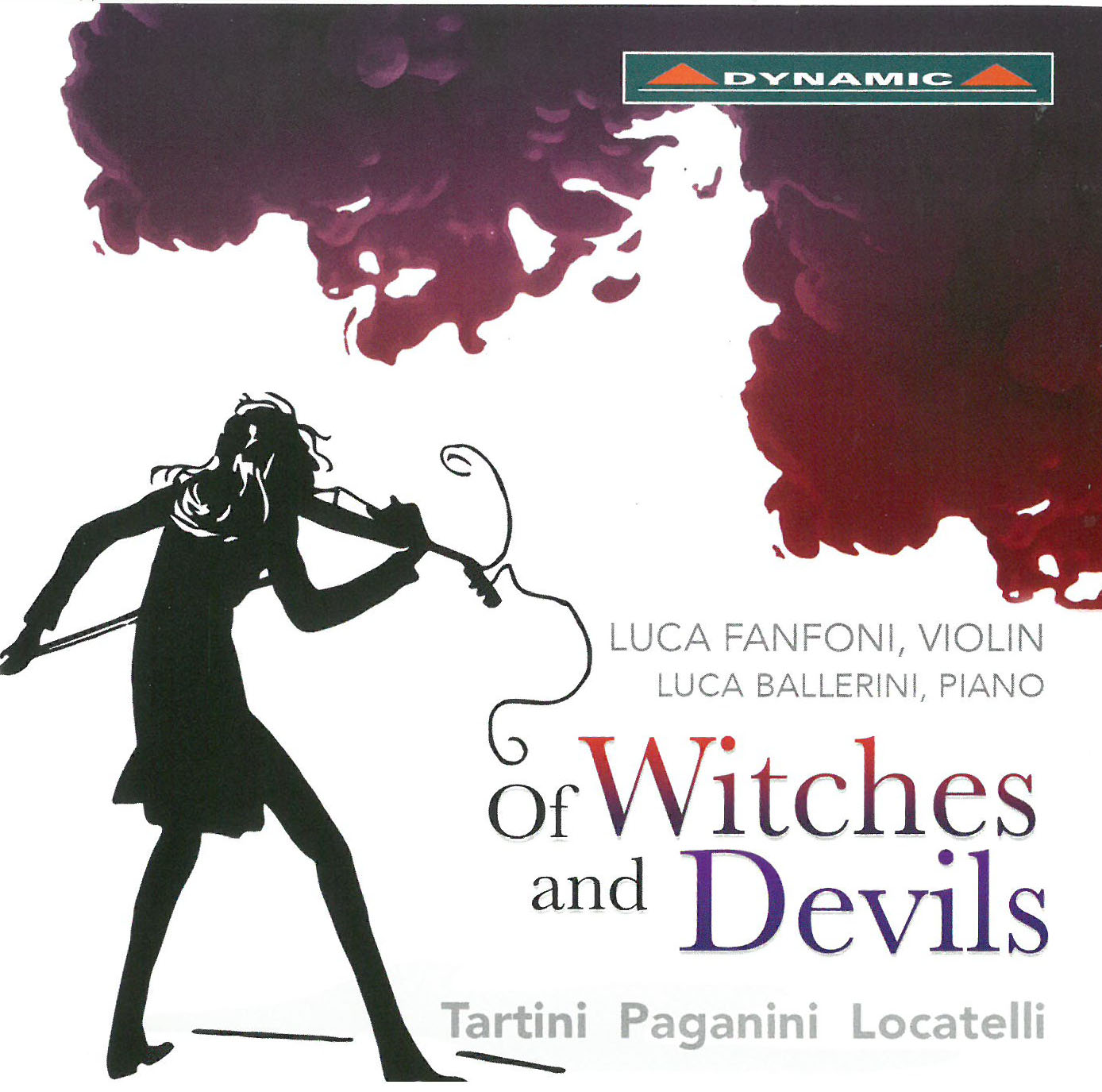
06 Witches and DevilsThere’s more fine fiddling on Of Witches and Devils – works by Paganini, Tartini and Locatelli played by violinist Luca Fanfoni and pianist Luca Ballerini on a new Dynamic CD (CDS 7749).

Some strong playing in Fritz Kreisler’s version of Tartini’s Sonata in G Minor, known as the “Devil’s Trill,” opens the program, but things really get interesting with the first of three Paganini works – Introduction and variations in G Major MS44 on Nel cor più non mi sento (by Paisello). This was one of Paganini’s dazzling show pieces and features all the usual tricks: left-hand pizzicato; arpeggios and runs; multiple stops; runs in thirds, sixths, octaves and tenths. It no longer has us believing that the composer was in league with the devil, but it still has challenges that Fanfoni certainly does more than just surmount.

The lyrical Adagio from the Concerto No.3 in E Major MS50 is next, followed by the Sonata a preghiera MS23, the work more commonly known as Variations on the G String on Moses’ Prayer from Rossini’s opera Mosé in Egitto. It’s noted here as the traditional version, by which they mean the one we’re used to hearing. More on that later.

Locatelli’s Capriccio for solo violin (“Il Labirinto Armonico”) from L’Arte del violino Op.3 is a short but quite astonishing piece with a constant flurry of bowing interrupted by single notes ticking away. Then it’s back to Paganini for Le streghe, Variations on a theme by Franz Süssmayr MS19 followed by the fascinating final track. The Moses’ Prayer Variations, it turns out, are only the final part of the complete Sonata a preghiera. Not only is this the first recording of the unabridged original version, it is played on Paganini’s own violin and with the string tuned up a minor third, a trick that Paganini himself used to obtain an even higher sound.

Fanfoni tends to favour speed over clarity, and the intonation seems a little less sure than in the traditional version, but it makes for a unique ending to a very interesting CD.
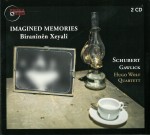
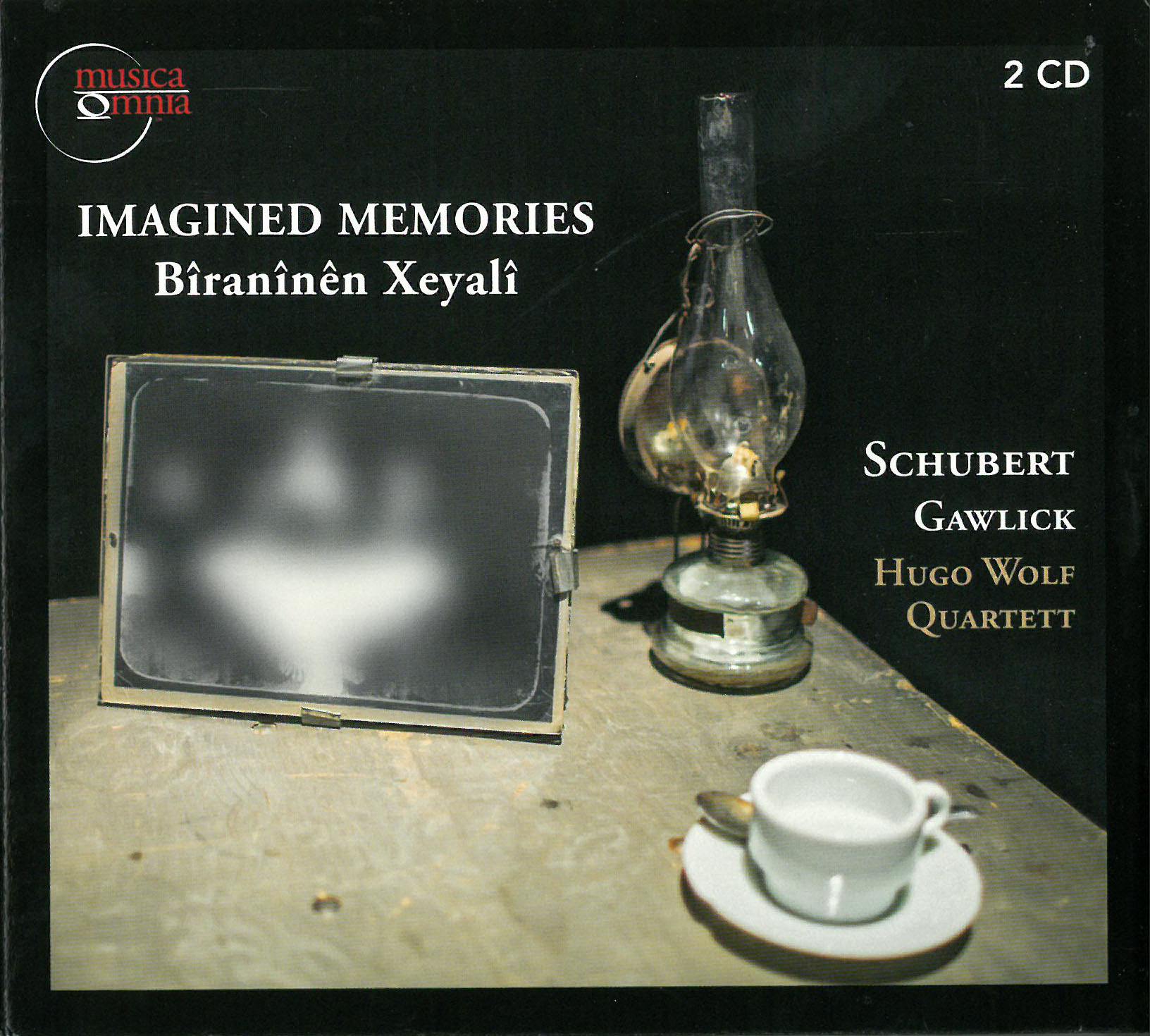
07 Imagined Memories Hugo Wolf QuartettImagined Memories is a 2-CD issue featuring string quartets by Franz Schubert and Ralf Yusuf Gawlick in performances by Austrian ensemble the Hugo Wolf Quartett (musica omnia mo0704).

Schubert’s String Quartet No.13 D804 (Rosamunde) has a lovely brooding and delicate start, and a sensitive performance throughout, recorded with a fair amount of resonance. It’s included here because the start of the quartet is quoted at the beginning and the end of the Gawlick quartet, which the composer describes as “an autobiographical work that probes into the realms of a relationship that never was, a bond with my biological mother, whom I never met.” The opening also quotes quartets by Smetana, Borodin and Shostakovich.

To say that Gawlick’s compositional process was complicated is an understatement: seven pages of booklet notes outlining thoughts, choices, graphic charts, Memory Triangles and spaces, Memory Footprints and numerical integers taken from various combinations of the initial letters of the composer’s and his birth mother’s names are almost impenetrable at times. Still, all that matters is the music – and there’s a great deal of tender, sensitive, beautifully effective writing here. Of the 17 short sections in the main body of the work, played without a break, most fall between one and two minutes in length and none reaches four minutes. It’s mostly quiet and soft, not difficult to listen to, although not traditionally tonal, and clearly quite personal and intimate.

The work was commissioned by the performers and was recorded shortly after its Carnegie Hall premiere in April of this year. Their outstanding performance here can be considered definitive.
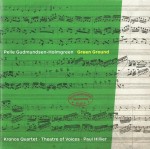
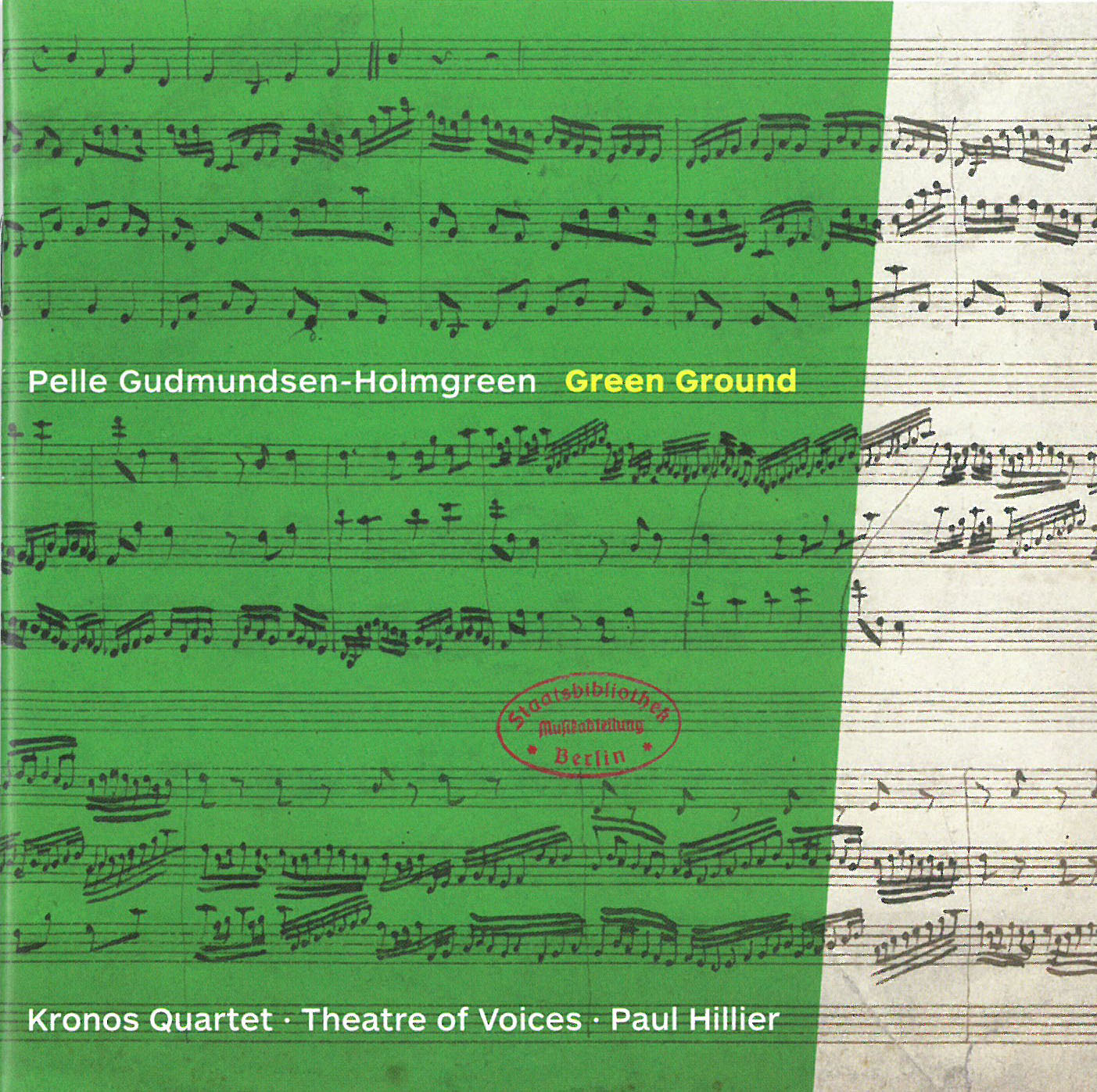
08 Gudmundsen HolmgreenContemporary string quartets are also featured on Green Ground (Dacapo 8.226153), five works from 2011 by the Danish composer Pelle Gudmundsen-Holmgreen, who died just this past June at the age of 83. The works were written for and dedicated to the composer’s longtime collaborators the Kronos Quartet and also the vocal quartet Theatre of Voices under their director Paul Hillier. These world premiere recordings are of live concert performances in Copenhagen on December 4, 2012.

The titles of the CD and the works are, at first sight, quite confusing: No Ground; Green; No Ground Green; New Ground and New Ground Green, but there is a clear logical progression here. Last Ground, the composer’s ninth string quartet from 2006, was supposed to be his last, but a tenth quartet, New Ground, and an eleventh, No Ground, were written in 2011 (three more were to follow in 2013).

When PGH felt that the two new quartets needed to be connected, he wrote Green for four voices and wooden percussion, taking lines (“To the greenwood we must go”) from Desire, by the Renaissance English composer William Cornysh as his starting point. Green is then superimposed (a technique PGH had used before) on both New Ground and No Ground to produce, in effect, two new works.

It’s certainly a fascinating soundscape, and quite difficult to describe. There are some extreme techniques employed and a basic lack of tonality, although there are beautiful moments in Green. Also, the New Ground quartet uses the ground from Pachelbel’s famous Canon, albeit with an extra bar and a chromatic twist thrown in for good measure. Don’t be fooled by the apparent easier access, though – things soon become more complicated.

Again, a set of what must be definitive performances of some quite fascinating works.
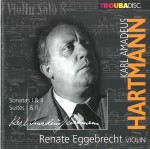
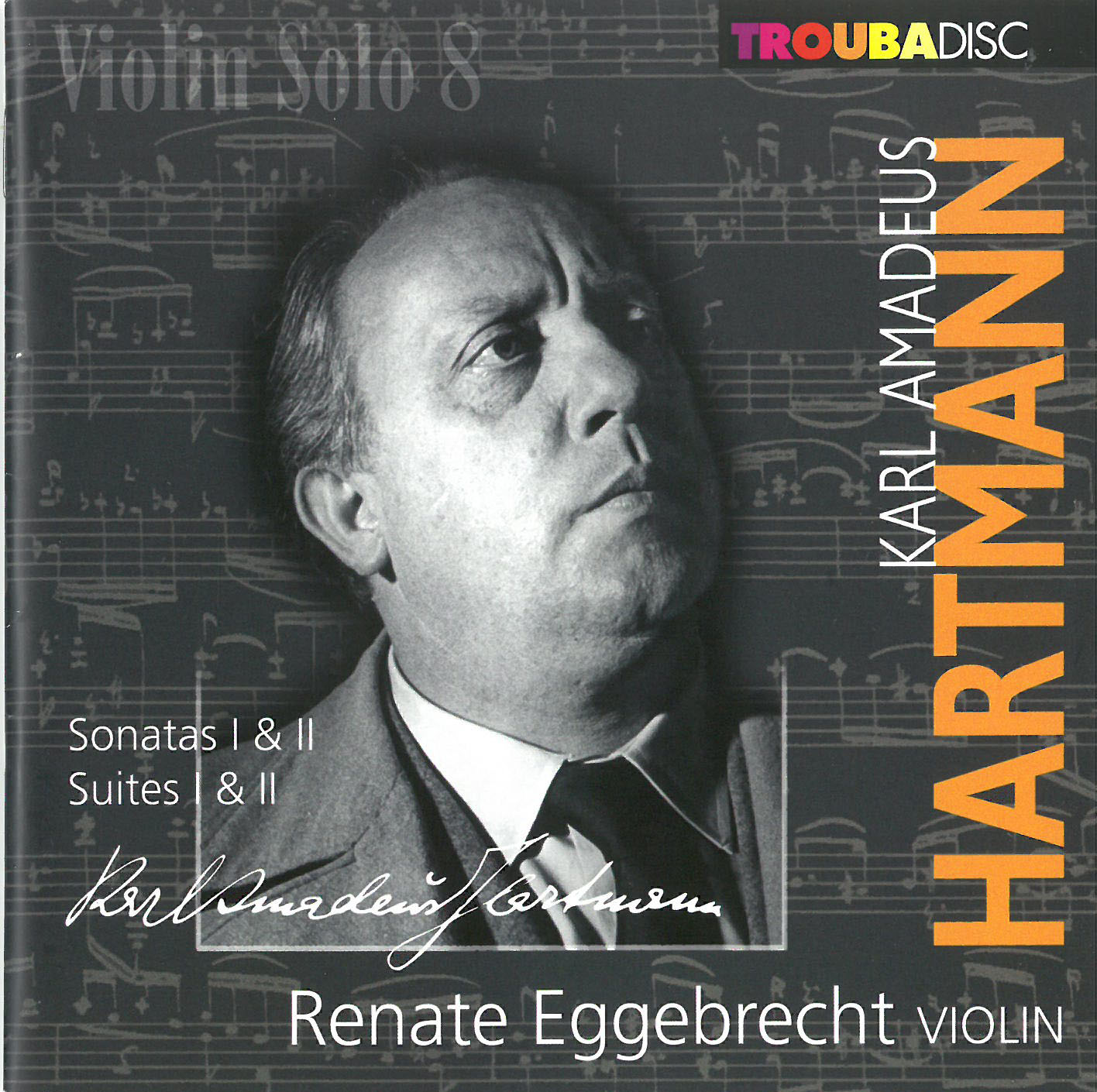
09 Hartmann soloThe German composer Karl Amadeus Hartmann wrote his Sonatas 1 and 2 and Suites 1 and 2 for solo violin in 1927 when he was only 22, but despite destroying a great deal of his early works chose to preserve these, going as far as burying them in a metal box in a friend’s garden during the years of the Third Reich. Never performed during his lifetime, the two suites were first performed in Spokane, Washington in 1984 and 1986, and the two sonatas were premiered by Thomas Zehetmair in Munich in 1987. At the time, Zehetmair called them “among the best things written for unaccompanied violin during the 20th century.”

They are featured on a new CD by the German violinist Renate Eggebrecht on the Troubadisc label that she founded in 1991 (TRO-CD 01447). They are uncompromisingly tough pieces, and the 72-year-old Eggebrecht’s somewhat dry tone and slow vibrato tend to make her playing sound a bit unsure at times.

As the booklet essay points out, these works place enormous demands on both the technique and especially the musicality of the performer. At times, it’s hard to shake the feeling that the sheer effort to get through them limits the interpretation here, and a check of the audio samples of Ingolf Turban’s excellent and smoother recordings on the Claves label would seem to confirm this. If that wasn’t enough, the brilliant Russian violinist Alina Ibragimova included these unaccompanied works on her debut recital CD in 2007, and you can hear audio samples of her recordings on the Hyperion Records website.

What’s really interesting, though, is that this CD is actually Volume 8 in a Violin Solo series that Eggebrecht has compiled, and the range of composers – Reger, Skalkottas, Honegger, Bacewicz, Milhaud, Bartók, Hindemith, Bloch, Stravinsky, Schnittke, Rodrigo among others – is quite astonishing. It sounds like a highly significant series that should be much more widely known.
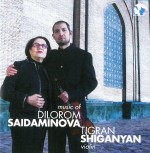
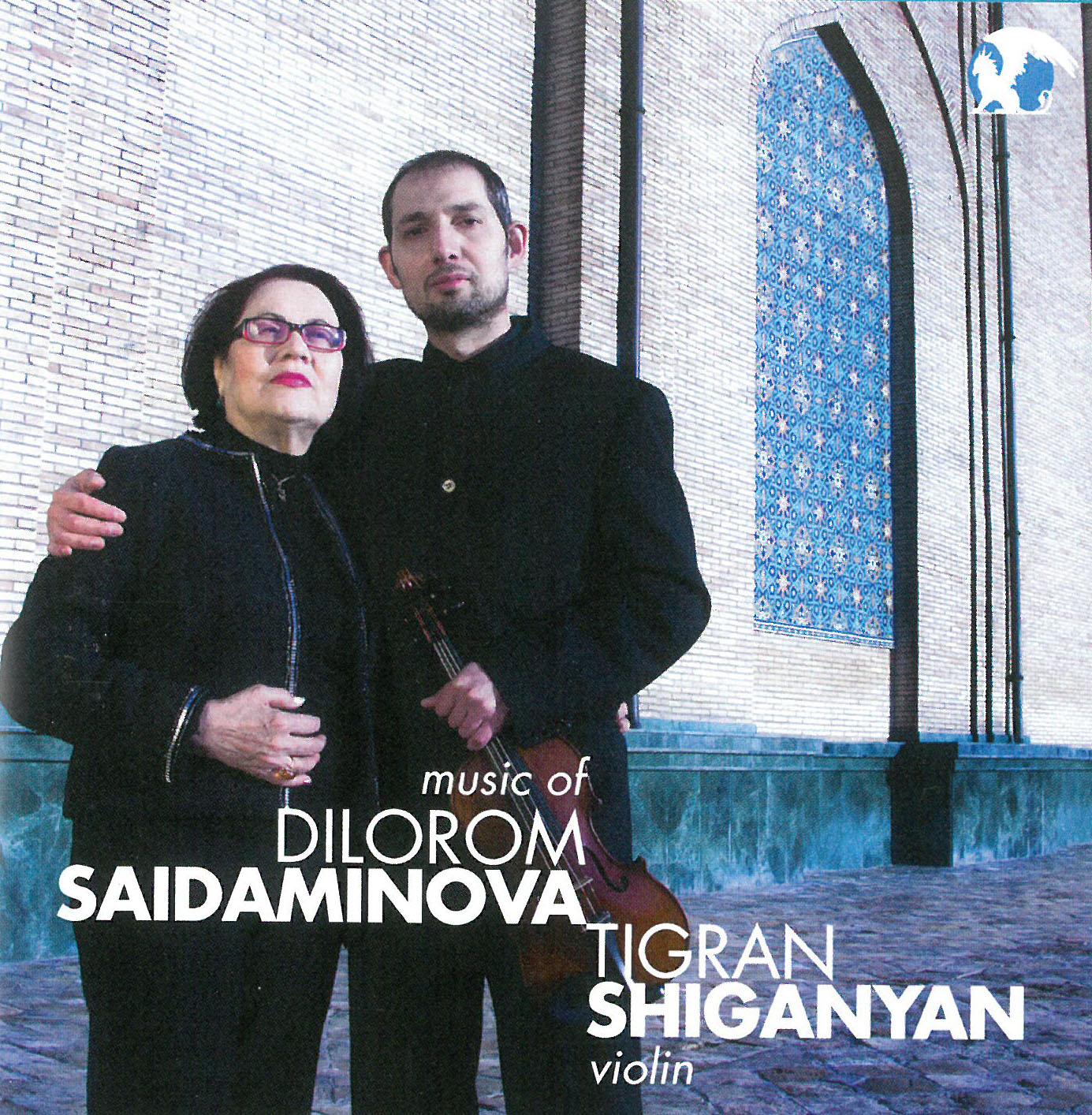
10 SaidaminovaThe music of the Uzbekistan composer Dilorom Saidaminova is performed by her son, the violinist Tigran Shiganyan and friends on a new Blue Griffin Recording CD (BGR414). It’s the first commercial recording of her works.

The music here is essentially tonal and very pleasant. Saraton for solo violin, soprano and traditional instruments is a lovely, meditative piece; the two Sonatas for violin and piano are strong works; Umid for violin and piano and the two trios Where there is no time…for violin, clarinet and piano and Sabo for violin, cello and piano are all well-written and effective.

The CD comes with a short DVD featuring Saidaminova talking about the works on the CD and a rather strange and pointless outdoor “performance” of Saraton which is poorly filmed and quite obviously mimed to a pre-recorded track.


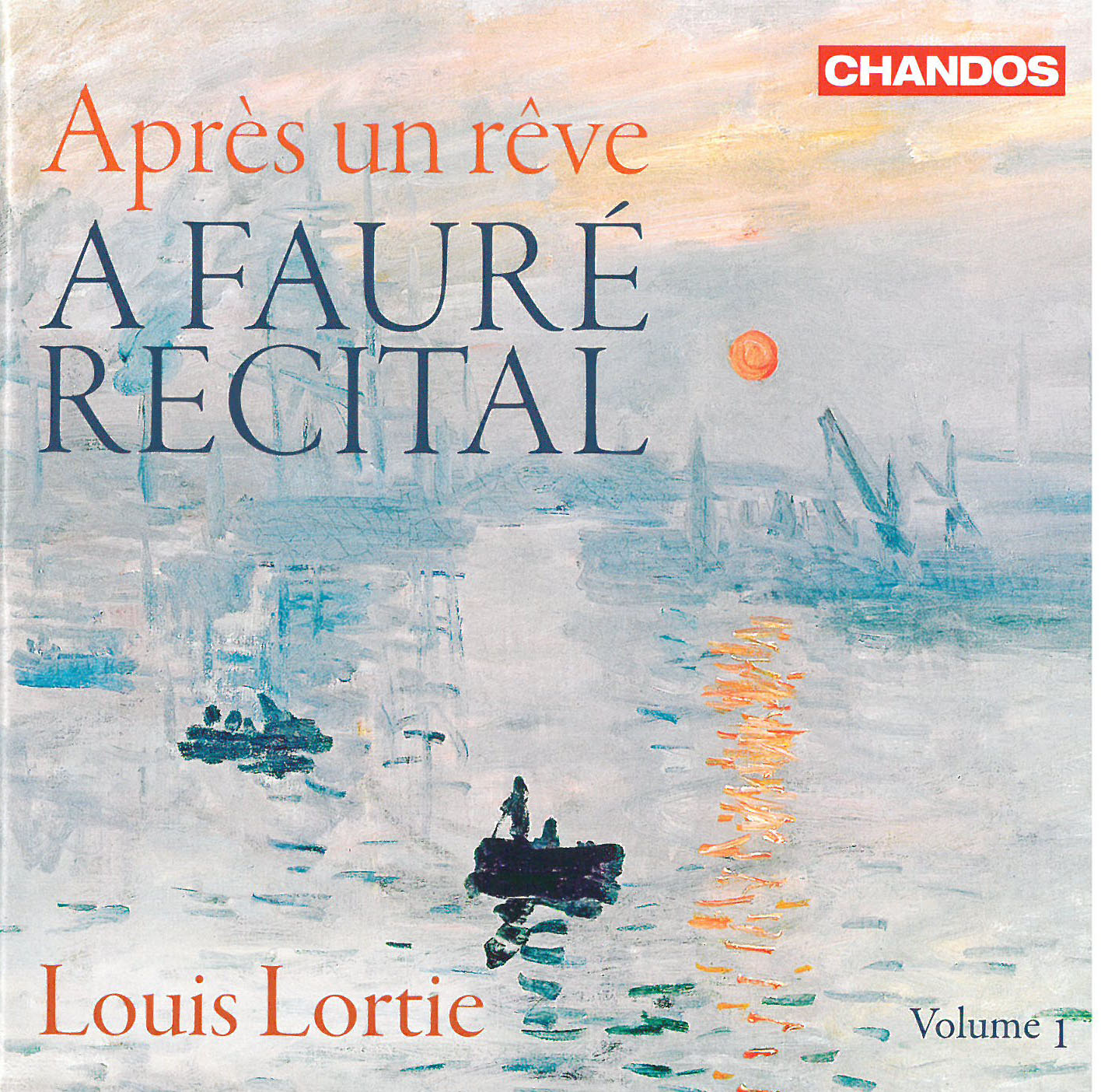
01 Lortie FaureLouis Lortie has added another recording to his list of more than 30 on the Chandos label. In Après un rêve: A Fauré Recital, Volume 1 (Chandos CHAN 10919) Lortie programs works from different periods in Fauré’s life. In the first volume of what will be a series, Lortie offers some of the early works that have easy and familiar appeal. He plays his own transcription of Pavane Op.50, originally for chorus and orchestra. It’s a clever treatment with the piano doing remarkably well at being a pizzicato string section at the same time as being a choir.

He also includes a couple of nocturnes, barcarolles and the nostalgic Après un rêve Op.7 No.1 using Percy Grainger’s 1939 arrangement. Fauré’s Suite from Pelléas et Mélisande Op.80 brings the recital to the threshold of the 20th century. Its opening Prélude is exquisite as is Sicilienne. In both these sections as well as the closing La mort de Mélisande, Lortie astonishes with a frequent bell-like touch.

Similarly he captures the modern flavour of the Nine Préludes Op.103 (1910) by emphasizing the angular rhythms and chordal patterns of the three very fast Préludes. The balance of the set is true to Fauré’s slightly wistful and lifelong melancholic nature. Lortie knows his composer’s voice and uses it as beautifully as ever.

Review

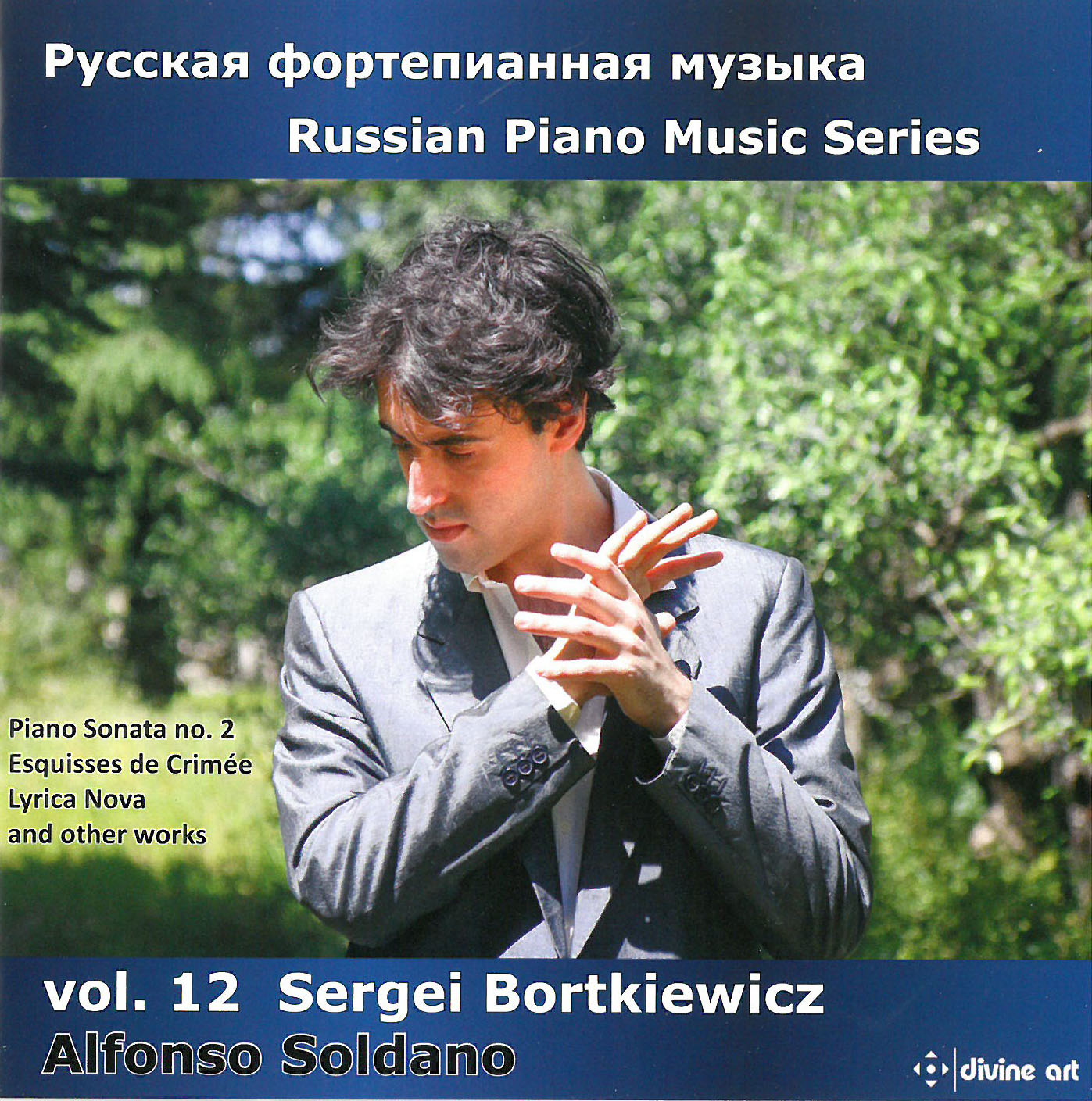
02 Russian Piano 12 BortkiewitzDivine Art’s growing Russian Piano Music Series has a new addition in Russian Piano Music Vol.12 – Sergei Bortkiewicz (dda 25142). It features Italian pianist Alfonso Soldano playing the music of Bortkiewicz (1877-1952), who produced a substantial body of works, both large and small scale. The majority was for piano but he also wrote for violin, cello and piano trio. He opposed modernism and evolved his musical language using the vocabulary of the late 19th century. He demonstrated unwavering adherence to melody, harmony and structure. His piano writing reveals an affinity for Chopin and Liszt, yet there are occasional, if brief, references to 20th-century harmonies and resolutions of popular nature.

Pianist Alfonso Soldano takes on this music for what it plainly is, a form that refused to budge with the changing currents of its time. What emerges is not an apology for the music but an argument for its credibility. Soldano argues from the keyboard, that Bortkiewicz had a voice of his own, that subtly reshaped the familiar late Romantic sound. Bortkiewicz placed great importance on how his inner voices moved to create a richness of colour too often lost to virtuosic imperatives.

While this is evident in the short pieces on this disc, the Sonata No.2 in C-sharp Minor Op.60 is where the composer truly shows his respect for structure, applying his unique subtleties to show us that the late Romantics may have given up too soon.

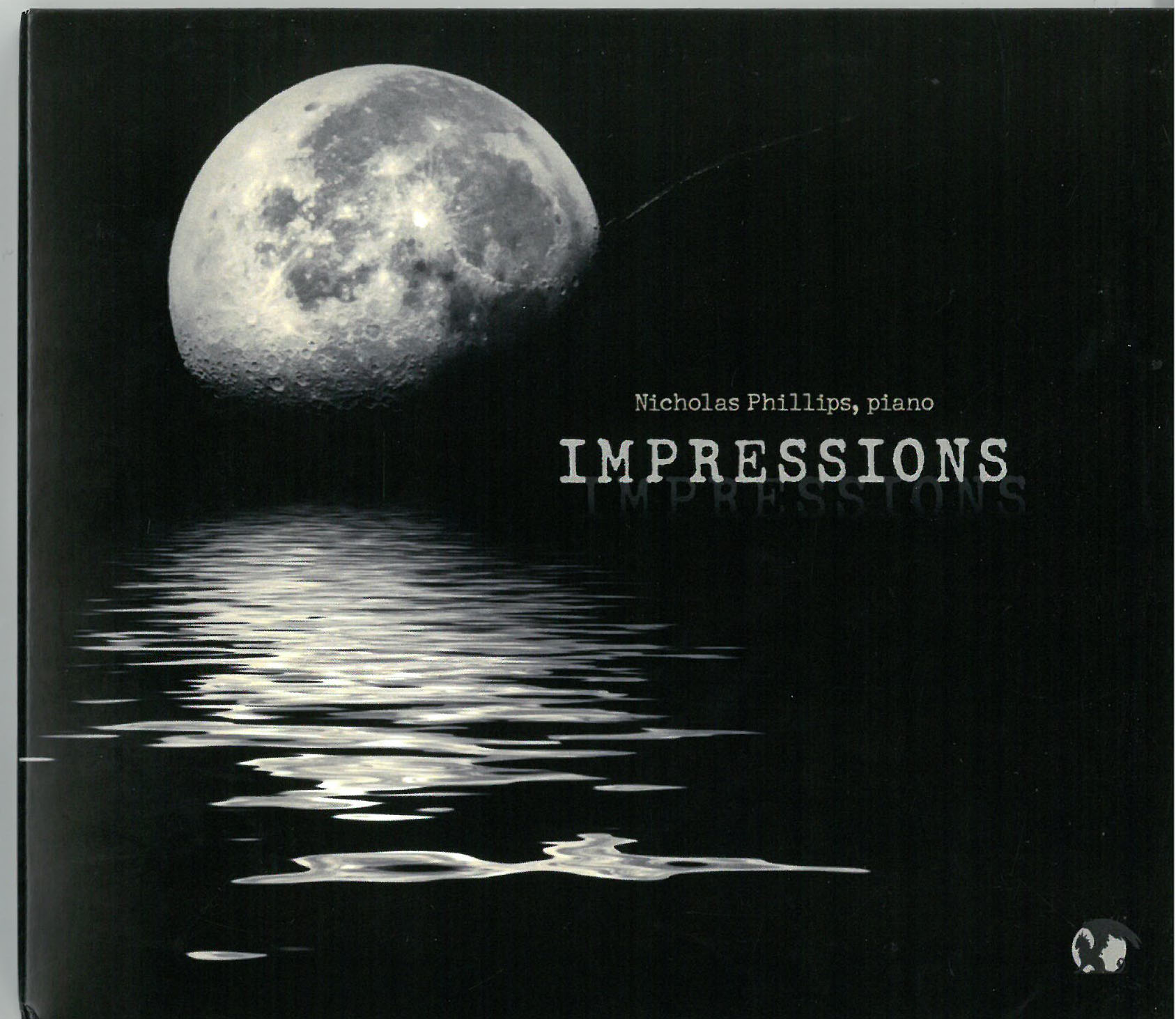
03 ImpressionsNicholas Phillips is an energetic promoter of new music, specifically piano works of the last decade by American composers. He finds new works that have already been recorded and contributes to their longevity by giving them a second recording, hence, Impressions (Blue Griffin Records BGR409). The one exception, Keyboard of the Winds (2015) is by composer Stacey Garrop. She builds an impressive sonic picture of a Colorado mountain range using massive chordal patterns and angular melodies to evoke the jagged rock formations. Equally angular is Jonathan Pieslak’s Shards (2008). Phillips embraces the duality of this work shifting adeptly between its spikey opening and the quieter, extended moments of repose.

Carter Pann’s White Moon Over Water (2011) draws inspiration from nocturnal kayaking on a wide river in Maine. Its central section depicting the expanse of starry sky is breathtaking with Phillips deeply in his element.

Hommage à Trois (2005) by Mark Olivieri is a brilliant collection of three stylistic tributes to composers particularly meaningful to him. The tributes to Aaron Copland and James Brown, especially, are beautifully crafted and immediately evoke their dedicatee’s memories.

This recording’s most effective work is Pann’s She Steals Me, a short Appalachian style waltz that lingers harmonically on many passing notes and unresolved progressions. The effect is profoundly touching and Phillips does a masterful job in leveraging its emotional potential.

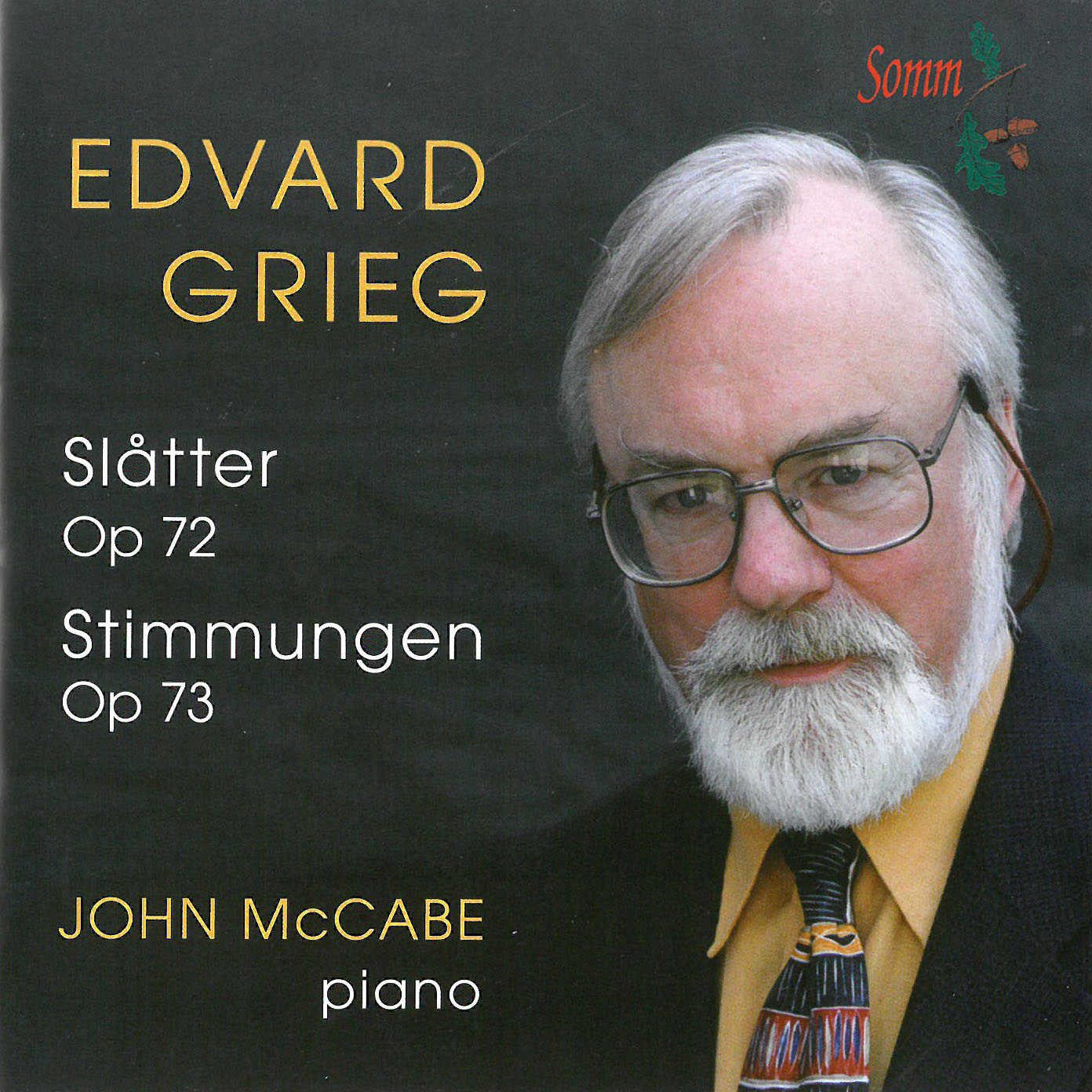
04 Grieg McCabeOriginally recorded in 1978 and released in 1980, Edvard Grieg – Slåtter Op.72, Stimmungen Op.73 (Somm Recordings SOMMCD 0154) is a reissue that offers a glimpse of a remarkably gifted English musician in his early 40s. John McCabe (1939-2015) was a prolific composer and performer. His wife recounts McCabe’s abiding affection for the piano works of Grieg, Slåtter (Norwegian Peasant Dances) Op.72 in particular. Numerous searches in the late 1970s for the published score proved fruitless until he one day came upon a worn copy in an obscure secondhand book shop. It proved sufficient for the recording project with RCA.

Stimmungen (Moods) Op.73 and Slåtter were Grieg’s final two works for solo piano. The latter is a collection of folk tunes and dances originally heard as regional fiddle melodies passed down through generations. Grieg first published these compositions along with their original fiddle scoring. McCabe’s playing captures Grieg’s rhythmically raw elements and gives the dances a characteristic fiddle drone while bringing forward the very brief melodic ideas of the folk material. There’s a very wide range of expression in McCabe’s playing. Stimmungen, especially, demonstrates his ability to probe the moody and introspective side of the composer’s writing. Folk Tune from Valders is an exquisite example of just how much mysticism McCabe can evoke at the keyboard. Studie (Hommage à Chopin) is also remarkable for its stylistic references so unerringly discerned and conveyed.

Review

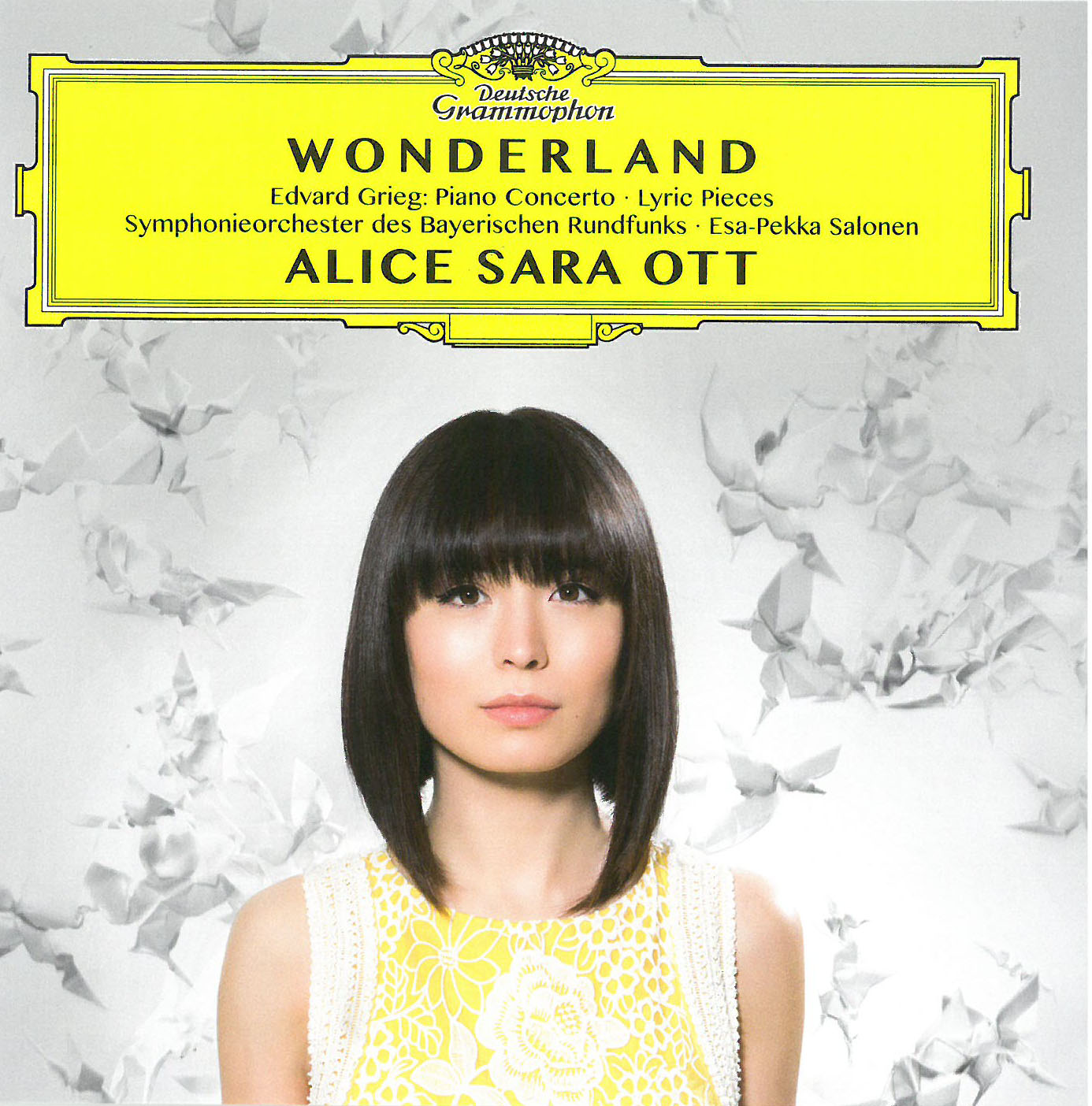
05 Alice Sara OttGrieg’s mystical introspection is also pursued in a new recording by Alice Sara Ott, Wonderland – Grieg Piano Concerto; Lyric Pieces (Deutsche Grammophon 479 4631). By the time Ott made this recording, she’d had the Grieg Concerto in A Minor Op.16 in her repertoire for ten years. That’s enough time to come to own the music and weave its threads into the fabric of her own artistic being.

Her personal stamp on this work shapes it in unique ways. Phrasings are often quite unusual and the pace of the work is slower than often heard. She very deliberately lets us know that she is exploring something of natural mysticism. She calls it Grieg’s “wonderland.”

The orchestra too, under Essa-Pekka Salonen, is in full agreement with this approach. Nothing, absolutely nothing is hurried in this performance. Only the final movement is near the traditional tempo. The effect of this on the concerto is to take an already monumental piece to an even grander scale.

Ott’s quest for Grieg the mystic continues through her playing of selections from the Lyric Pieces and Peer Gynt where Notturno and Solveig’s Song, respectively, reflect this most poignantly. There’s plenty of raw folk energy as well though; March of the Trolls (Lyric Pieces Book V, Op.54) and In the Hall of the Mountain King (Peer Gynt Suite No.1) leave no doubt about the dark side of Nordic myths.

Review

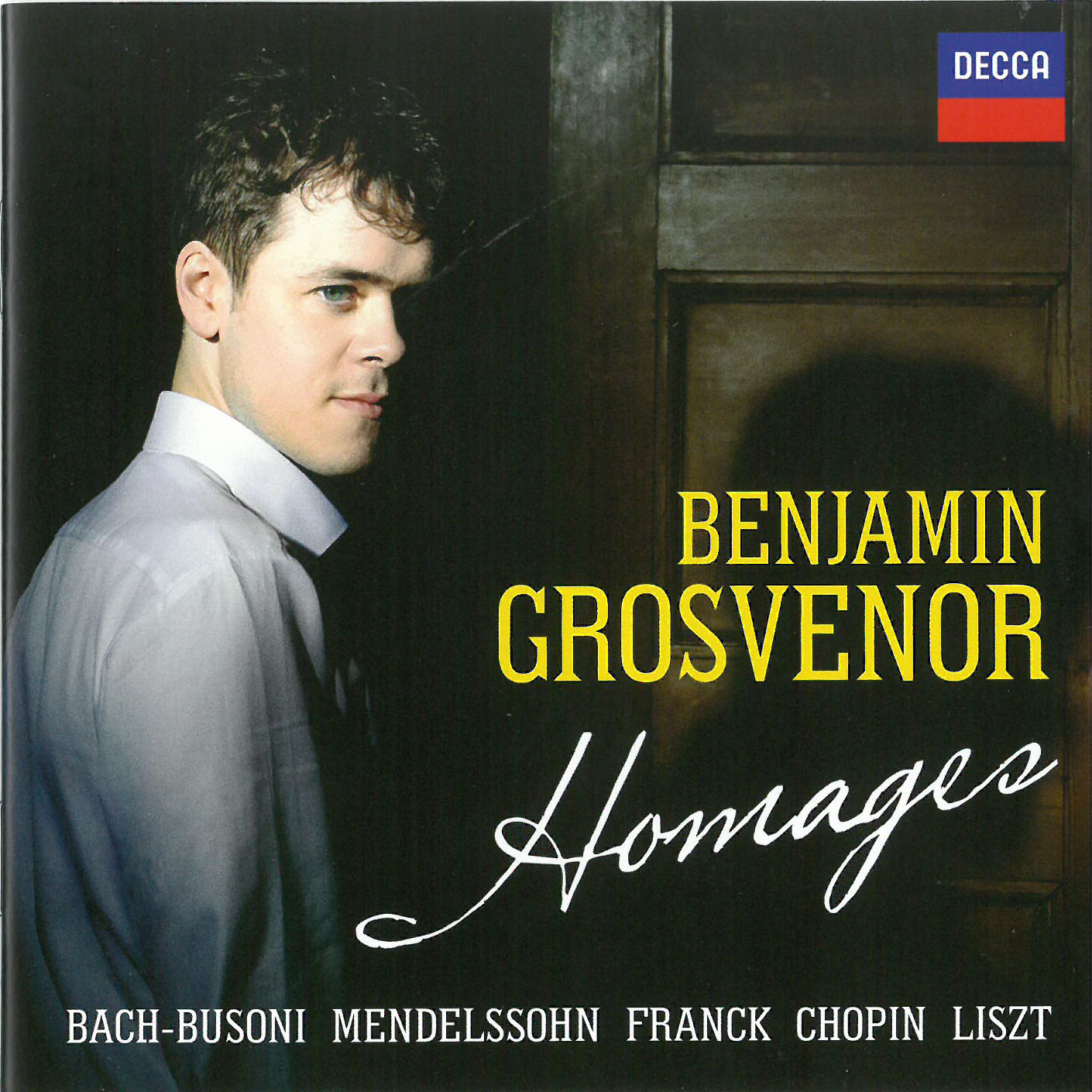
06 Benjamin GrosvenorThis new recording Homages: Bach-Busoni; Mendelssohn; Franck; Chopin; Liszt (Decca 483 0255) by Benjamin Grosvenor is youthful, powerful and profoundly exciting. At age 24 Grosvenor seems already to have conquered everything. Completely unhindered by technical challenges, he probes the alternating quiet and explosive episodes of Romantic works that look to the past for inspiration. Busoni’s arrangement of Bach’s Chaconne from BWV1004 is titanic yet floats soul searchingly through its many still moments. He plays Mendelssohn’s Fugue: Allegro con fuoco from Op.35 No.5 at an impossible speed with unbelievable clarity. Chopin’s Barcarolle in F-sharp Major Op.60 is voiced so superbly that it often sounds like two separate pianos. With selections from Liszt’s Années de pèlerinage, Grosvenor reaches the pinnacle of his Homages to conclude an astonishing program that sets the heart racing.

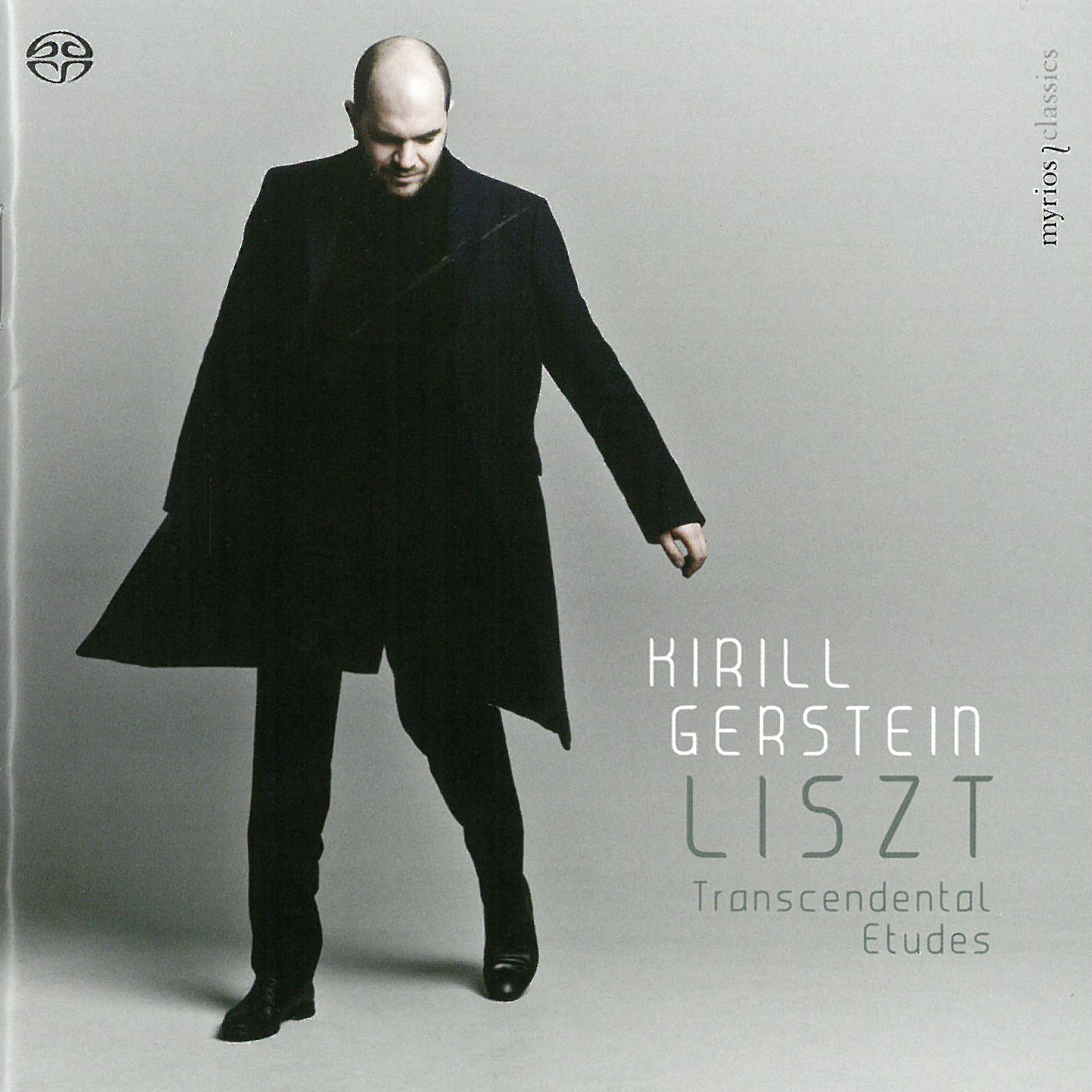
07 Kirill GersteinPianist Kirill Gerstein is as eloquent in interview as he is at the keyboard. The notes in Liszt – Transcendental Études (Myrios Classics MYR01) are insightful answers to questions about the transcendental nature of these études. Gerstein argues that their extreme difficulty leads to a heightened technique that transcends the traditional requirements of playing the instrument. He then describes Liszt’s intention that this transcendence go beyond the physical and technical.

Likening the performance of the cycle to the disciplined movement of Tai Chi, Gerstein describes his own experience in overcoming the technical challenges of these pieces. For him, it was as if he combined the discipline and exertion of a martial art with meditation to find that the transcending experience lay not just in the music but in the actual execution.

This becomes very clear as the performance reveals his virtuosic ease with the most difficult passages of Feux follets, Ricordanza and Wilde Jagd. And when Liszt’s moments of resolution or repose occur, Gerstein is so obviously playing from someplace deeply and internally transcendent that his assertions about the experience become remarkably credible. It’s a beautifully performed set of the Études and equally well recorded.

Review

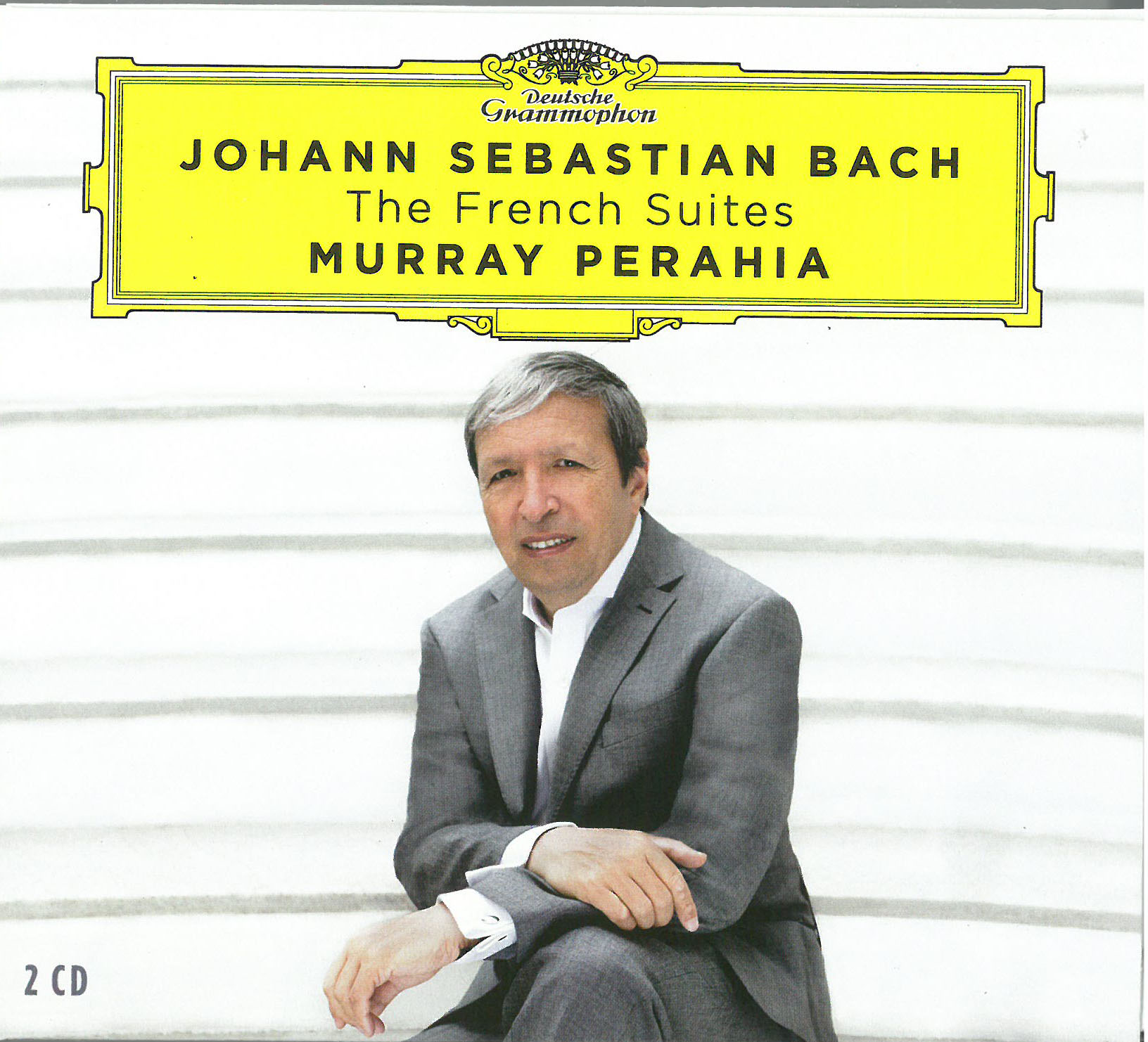
08 Perahia BachDeeper quests for meaning are becoming less rare among performers of all ages. In Johann Sebastian Bach – French Suites (Deutsche Grammophon 479 6565) Murray Perahia titles his notes “A Personal Devotion” and describes his lifelong love of Bach ignited by a performance of the St. Matthew Passion under Pablo Casals in the early 1960s. What moved the young Perahia was the humanity of Casal’s approach. It rejected the strict mechanical conventions of the time and channelled the composer’s voice through more modern sensibilities.

Perahia himself was greatly discouraged by the preference for the harpsichord and rejection of the piano as a legitimate instrument for Bach’s keyboard music. After two years of harpsichord study, he decided to return to his first keyboard love and bring to it some of the harpsichord technique he’d acquired. This hybridization has produced a style of Baroque piano playing that has all the lightness of the period instruments but brings to it the emotional palette of our present day.

 Perahia’s playing is consequently a product of considerable forethought. His application of the whole range of the piano’s expressive capability is carefully measured. He pedals very lightly, articulates immaculately and communicates superbly.

Review

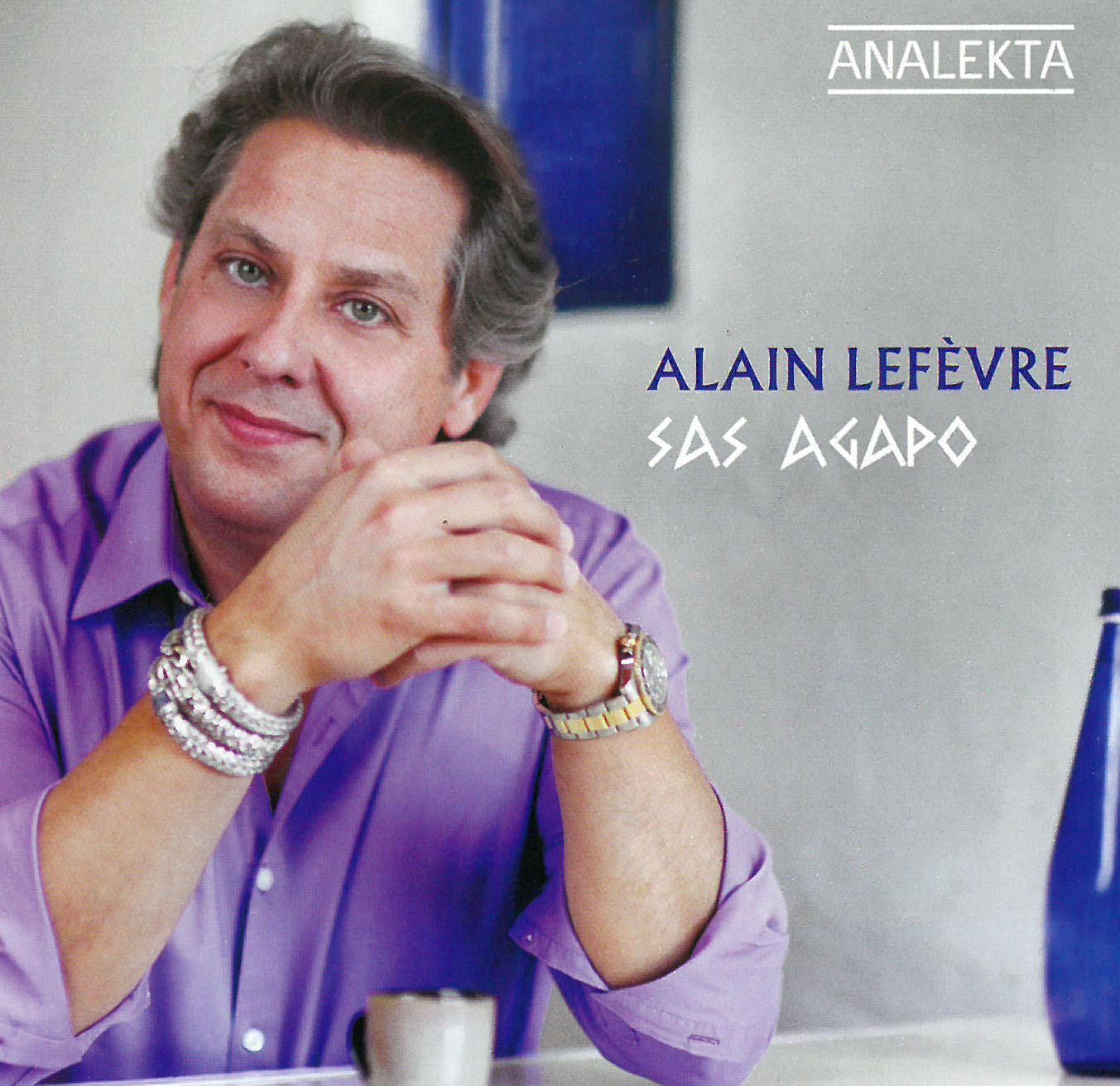
09 Alain LefevreAlain Lefèvre is one of Quebec’s best-selling recording artists. A recent stay in Greece was the inspiration behind his newest CD Sas Agapo (Analekta AN 2 9297). Lefèvre is widely known for his creative and improvisational gift as well as his formidable keyboard technique. Combined, they ensure that his performances are highly engaging and entertaining. Sas Agapo is a collection of programmatic expressions for the piano – a musical album of Aegean experiences.

Lefèvre’s inspirations are both visual and emotional. Something as simple as watching an elderly couple enjoying a seaside picnic becomes the creative kernel for Promenade à Kavouri. The piece is melancholic yet light and drifts between numerous short episodes punctuated by beautifully placed dissonances.

The opening track Sas Agapo is highly stylized to reflect the modal nature of traditional Greek music. Its charged rhythms are instantly captivating and Lefèvre’s repeated keyboard runs are part of the electrifying experience of listening to this piece.

Romance, personal loss and the general future of humanity are some of the other musings that take shape in this recording. Its conclusion is the wonderfully colourful and impish character piece Grand Carnival in which Lefèvre shows off some of his most impressive skills as composer and performer.

Concert note: On January 21 Alain Lefèvre is featured in André Mathieu’s Rhapsody romantique as part of the Toronto Symphony Orchestra’s “Canadian Legacy” concert at Roy Thomson Hall.

Review

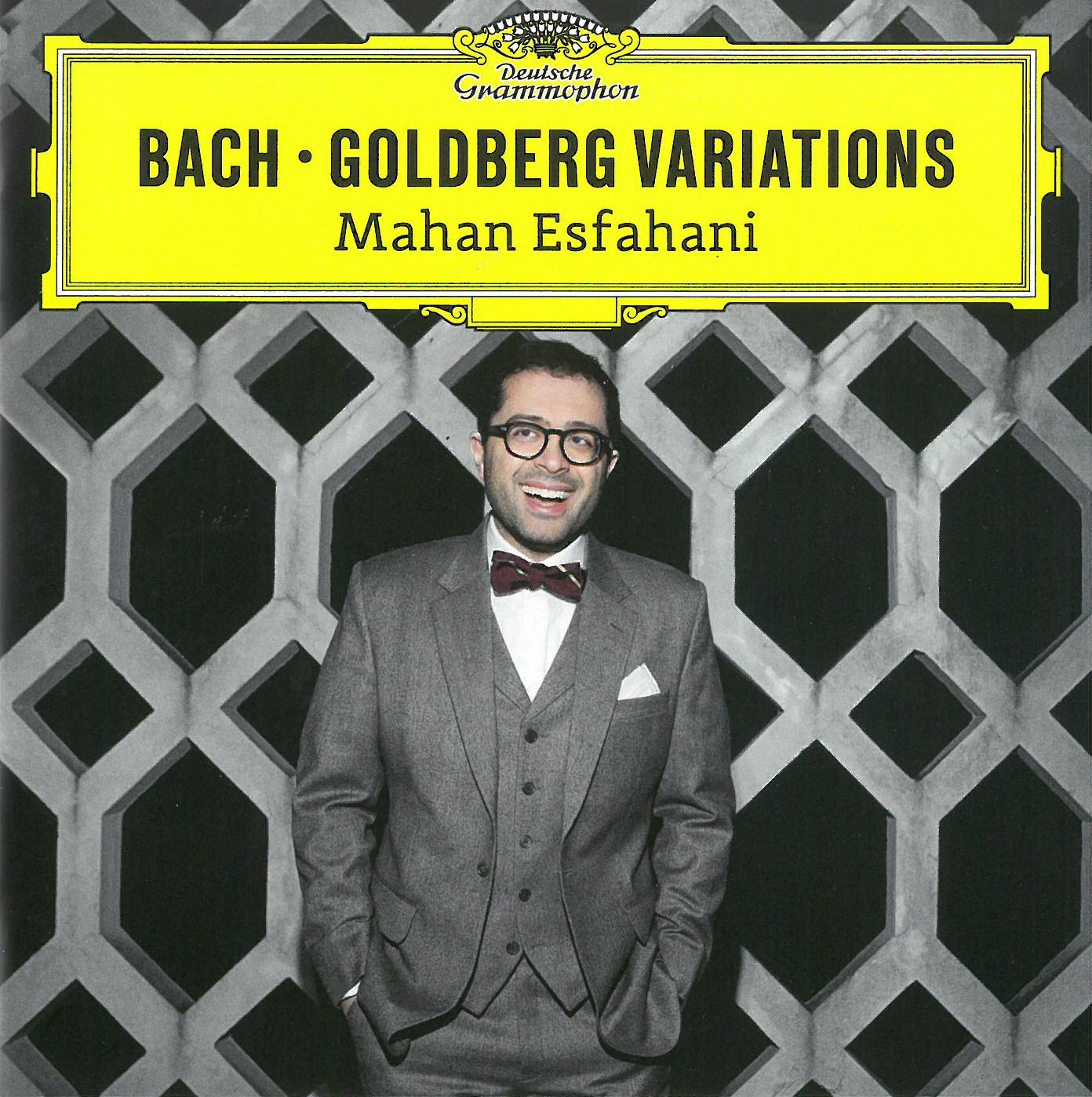
10 Bach EsfahaniThe Goldberg Variations are most often heard performed on piano, and we’ve come to assume that new recordings of the work will, naturally, be played that way. So, while harpsichord performances have narrower appeal, it’s a delight to encounter one so completely engaging and satisfying as in Bach – Goldberg Variations, Mahan Esfahani (Deutsche Grammophon 479 5929). Here’s a performance with enough zest and colour to rival your favourite piano version.

Esfahani achieves this several ways. He plays with a clean and agile technique. He is tastefully impressive with his elaborate ornamentations. His phrasings benefit from tempo relaxation at critical points in the melodic line. And perhaps most of all, he’s just not in a rush to get to the end. Esfahani loves to explore the inner voices of these variations, challenging enough on a harpsichord, but skillfully managed with clever use of changing registrations between the instrument’s two keyboards.

The recording appears to be made with large parts of the work (possibly all of it) played direct to recording without stopping for more than a second or two between variations to change keyboard stops (sounds). Performers who do this argue for the impact of the interpretive continuity this creates. Efahani’s performance bears this out once again.

A fascinating feature of this recording lies in a brief note from the harpsichord technician who describes his tuning approach and explains his choices for sweeter major thirds in the keys of G and D, the home for most of the variations.

11 Nada BrahmsBefore playing Nada in Hamburg – Johannes Brahms (MEII Enterprises 261 43930) one has to accept Nada Loutfi’s stylistic premise that the young Brahms played very much lighter pianos while in Hamburg. This would require a distinct departure from conventional approaches. Accents would be shorter, there would be more staccato and a great deal less use of the sustain pedal. Loutfi argues that modern interpretations overload and misrepresent the sound Brahms imagined at the time of these compositions.

As if to underscore her point, she programs two pieces for the left hand, where performers generally tend to pedal more generously in order to bridge the gaps the single hand is to required leap. The Bach Chaconne for the Violin, (Étude No.5) and the Étude for piano for the left hand after Franz Schubert (Étude No.6) both require a moment for the ear to adjust but quickly establish a credibility based on Loutfi’s sensitive and intelligent phrasings. The Schubert, especially, becomes an extraordinarily beautiful technical display.

From Brahms’ Eleven Chorales for Organ Op.122, Loutfi plays No.s2, 4 and 8. The organ score is for manuals alone and the parts so intricately woven that it’s often impossible to solo the chorale over the surrounding accompaniment. Nevertheless Loutfi does a wonderful job using the piano’s dynamic advantage to achieve this very feat.

The Sonata Op.1 No.1 in C Major takes on a very different feel from most other performances. Loutfi’s light detached style quickly becomes the norm and draws more attention to other aspects of her interpretation. Most noteworthy is her very introspective and raptured playing of the second movement, Andante.

This is quite an unusual disc that intelligently challenges some of our conventional ideas about how Brahms should be played.

01 VivaldiVivaldi
Lucie Horsch; Amsterdam Vivaldi Players
Decca 483 0896

Review

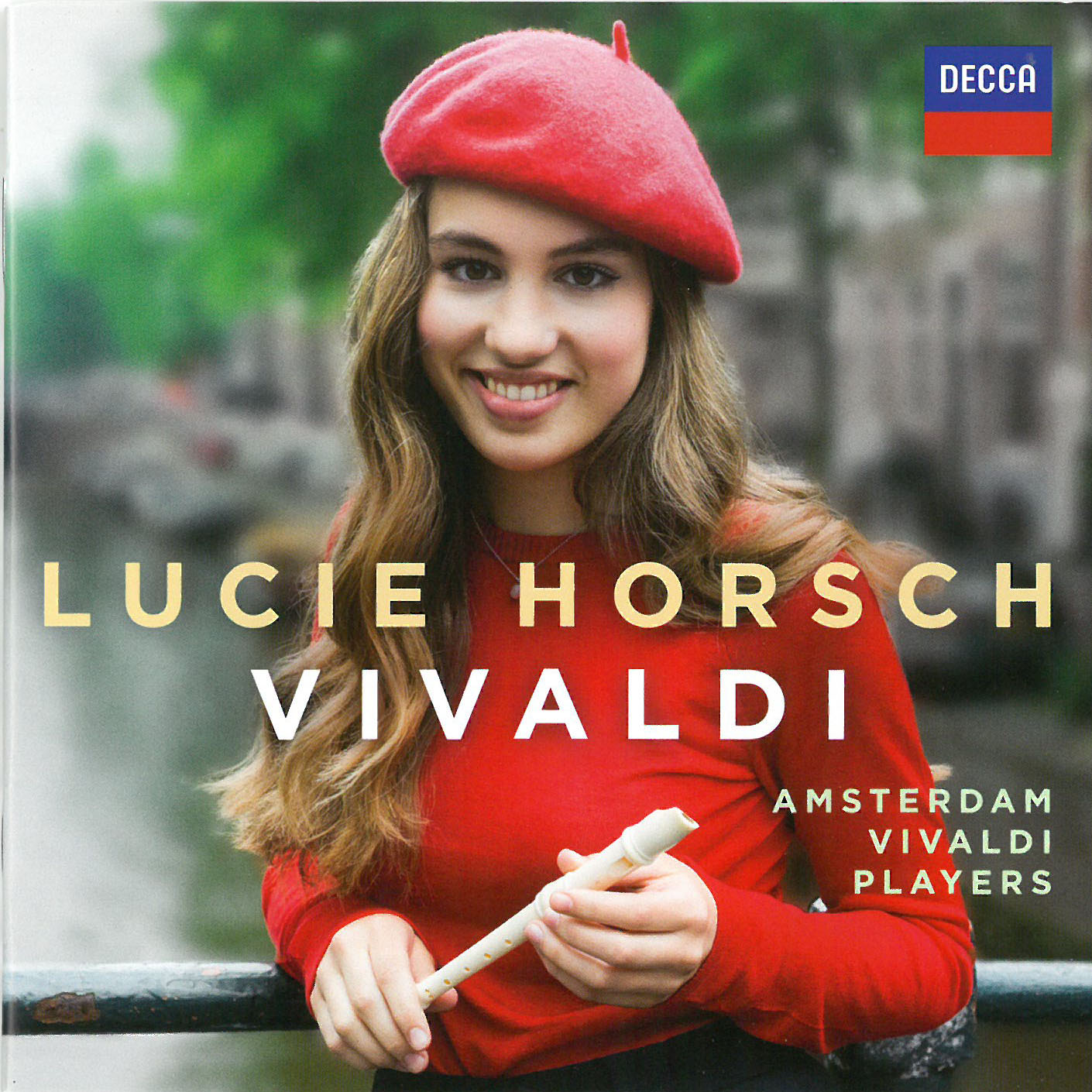
I first heard of Lucie Horsch a few years ago when her videotaped performances began appearing on the Internet. As a teenaged finalist in the 2014 Eurovision Young Musician contest, she offered a mesmerizingly beautiful rendition of the Siciliano from the familiar C Major Concerto RV443 and tastefully took complete charge of any fiery allegro she was handed without sounding like she was being chased by a demon around an athletics track. Her playing was refreshing and delightful.

This CD’s program, more varied than most others of this repertoire, features RV443 played in G on the soprano recorder, three other popular concertos and a few well-crafted arrangements. Rousseau’s arrangement of Spring from the Four Seasons is heard here on sopranino, and excerpts from the G-Major Concerto for Two Mandolins, Nisi Dominus and the opera Il Giustino are also played on a well-chosen variety of instruments. The use of tenor recorder for the Nisi Dominus is particularly evocative.

Just as in the videos of yesteryear, Horsch interprets the faster movements with technical panache, the slower ones with refined phrasing and exemplary wisdom regarding the addition of ornamentation, and most everything with an impressive musical understanding. She is accompanied by a group of excellent modern players including her father, a cellist in the Concertgebouw Orchestra. I do wish the booklet included a bit more on Vivaldi – but the celebration they make of this gifted young woman is completely understandable.

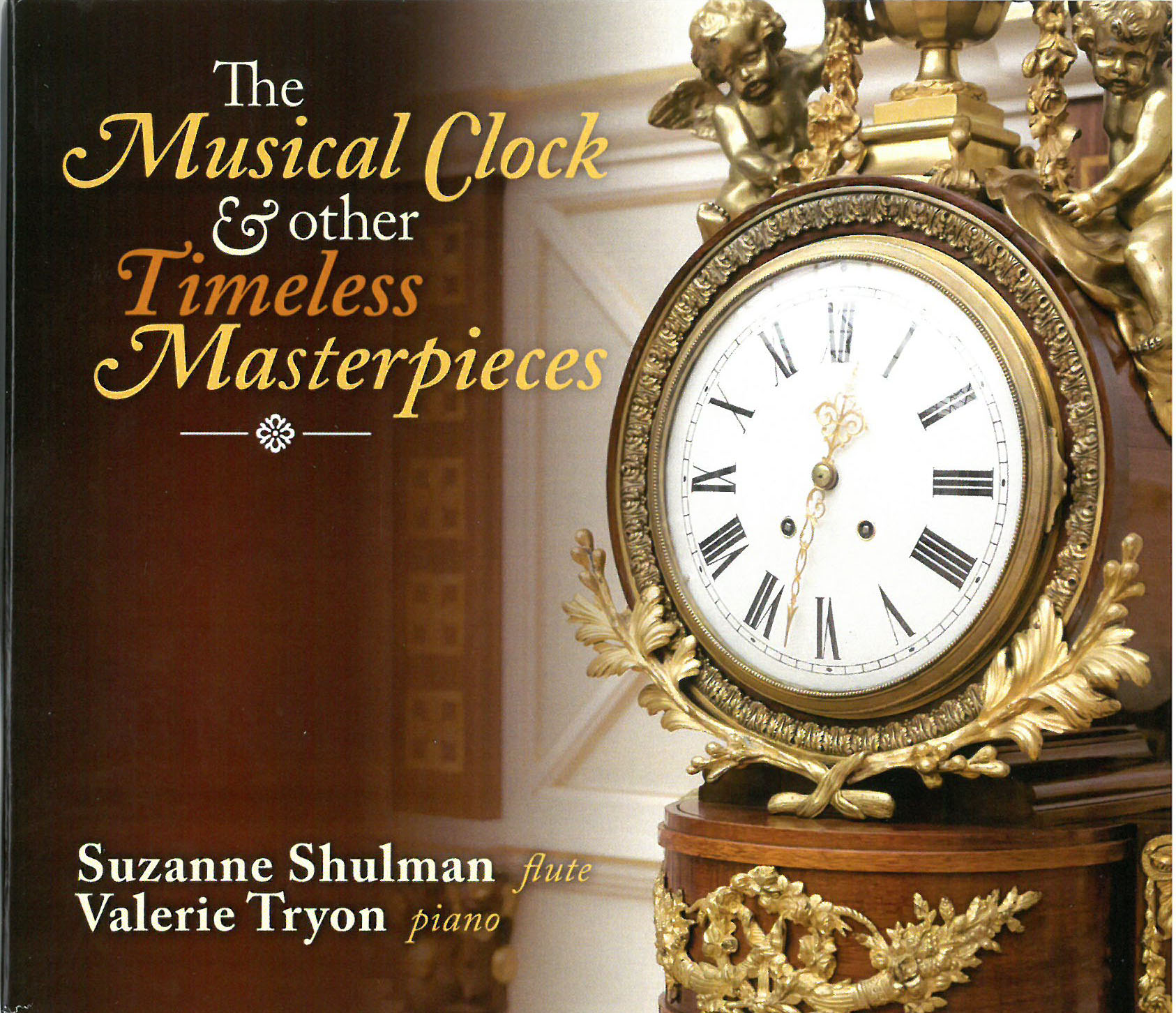
02 Suzanne Shulman Valerie TryonThe Musical Clock and other Timeless Masterpieces
Suzanne Shulman; Valerie Tryon
Marquis Classics MAR 81471 (marquisclassics.com)

Yes, a clever title for a most interesting programme of music, mostly for flute and piano but with two compositions for solo flute, impeccably performed by Camerata co-founder Suzanne Shulman and pianist, Valerie Tryon. From the opening Allegro vivace from Haydn’s The Musical Clock (the first of five) you can hear the great chemistry between the two, and it gets even better; by the fifth Tryon has proven that you can double tongue on the piano as she matches Shulman’s double-tonguing wizardry! The Sonata in B-flat Major K378 by Mozart is next. Originally composed for violin, it gives the performers something a little more substantial to work with. The Andantino second movement gives us an opportunity to hear Shulman’s dark low register. (Thank you, Suzanne Shulman, for playing this in the original key, not the transcribed for flute version!)

Next up is an intoxicating dose of wistful fin-de-siècle melancholy, a sonata by the very accomplished but little known French composer, Mélanie Bonis, followed by Francis Poulenc’s wonderful – can I say iconic? – Sonata, in which Shulman was tutored by Jean-Pierre Rampal, for whom it was written. Need I say more!

The two last pieces are Harry Somers’ EtchingThe Vollard Suite and Milton Barnes’ Music for Solo Flute, to both of which Shulman brings such artistry that I am convinced that these two pieces by Canadian composers are truly timeless masterpieces.

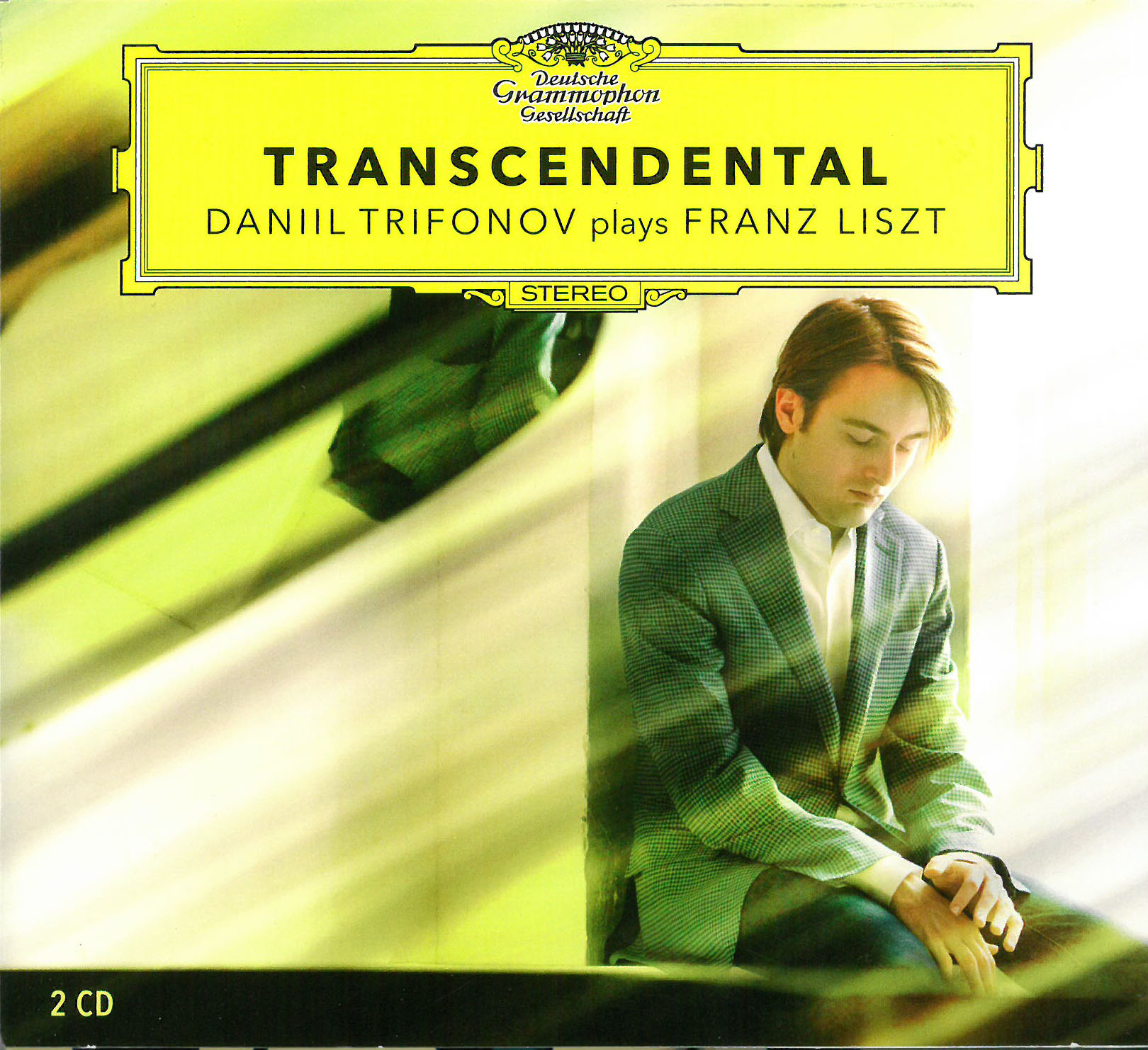
03 Transcendental LisztTranscendental – Daniil Trifonov plays Franz Liszt
Daniil Trifonov
Deutsche Grammophon 479 5529

Review

Deutsche Grammophon has struck gold again, this time with the young Russian pianist Daniil Trifonov. This is his fourth recording for the Gesellschaft and what a recording it is! Liszt’s 12 Études d’execution transcendante is the Mount Everest of pianism. Very few have recorded them complete, because it is a titanic effort both physically and emotionally, but this fellow recorded them at one sitting, lasting well over an hour and got up at the end not showing any signs of fatigue. Here is Liszt as it should be played and how he must have looked: a handsome trim young man with flowing hair and a grand manner, with a rapt expression and total absorption, cascading octaves, making the piano thunder with superhuman energy. One can easily believe that women fainted hearing him and ran away from their husbands following him anywhere.

Apart from this colossal physical effort Trifonov plays with imagination and intelligence, understanding the structure and capturing the different moods of each étude. Some are wild, like Mazeppa, depicting a man being dragged through the steppes by galloping horses, some are meditative (Paysage, Vision) or heroic (Eroica) or charmingly playful (Feux Follets) or culminate in an insane hunt (Wilde Jagd). At No.9, Ricordanza the mood changes into glorious, soft melodies, sublime moments only Liszt, “the magician of the keyboard.” could create.

The 2-CD set actually has all the Concert Études of Liszt and Disc 2 features the well-known favorites Un sospiro, La leggierezza, Gnomenreigen etc. and the complete Paganini Études also superlatively performed. You can see a preview and a glimpse of what went on in making the recording on YouTube.

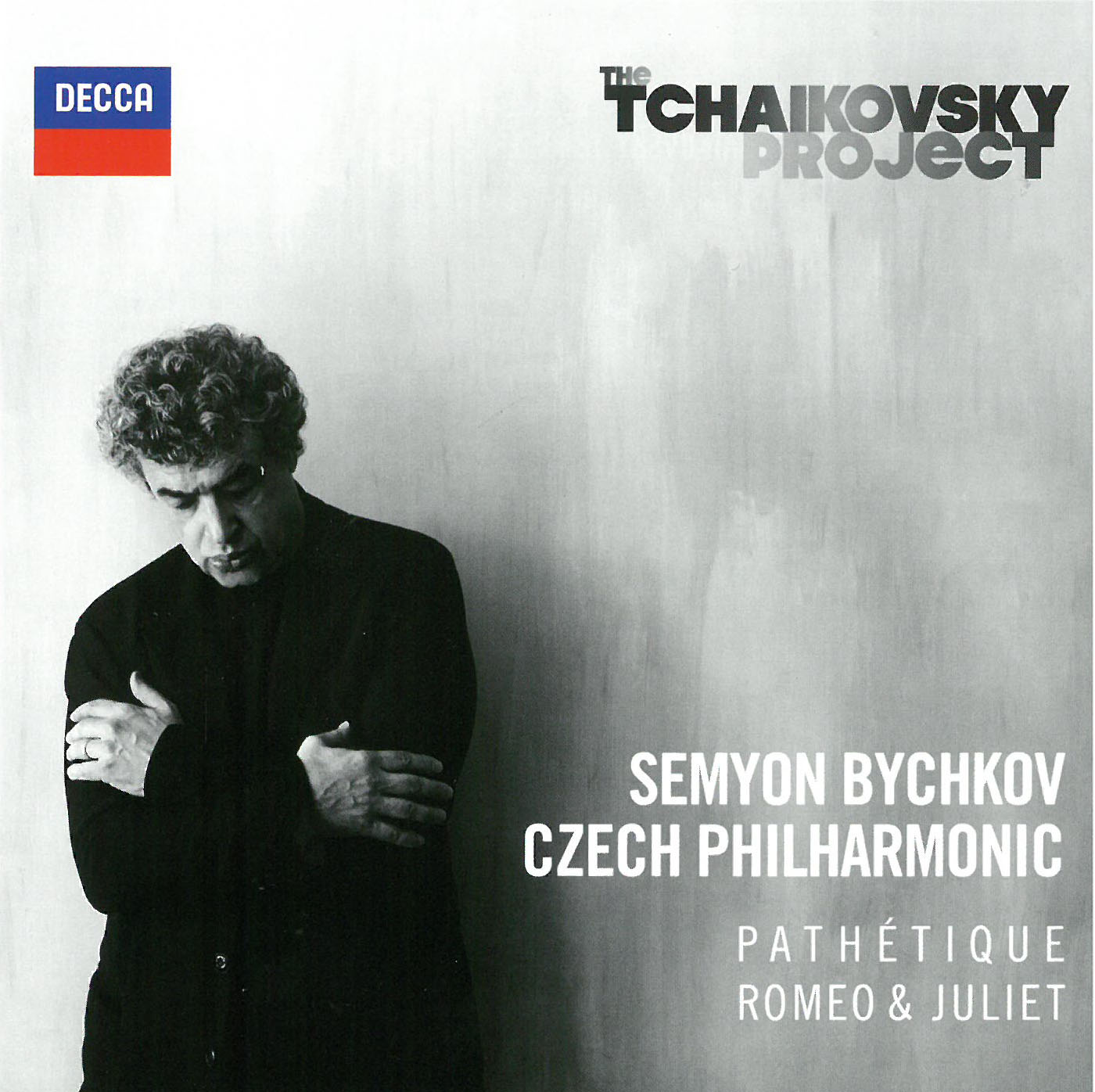
04 Tchaikovsky ProjectThe Tchaikovsky Project – Pathétique; Romeo & Juliet
Czech Philharmonic; Semyon Bychkov
Decca 483 0656

A formidable pairing of the great Symphony No.6 with the Romeo & Juliet Fantasy Overture featuring Russian conductor Semyon Bychkov and the Czech Philharmonic launches The Tchaikovsky Project on the Decca label, a multi-year endeavour devoted to re-examining the composer’s greatest orchestral works. Was it really 26 years ago that Bychkov recorded the Pathétique with the Concertgebouw? How appropriate that the major work on the initial disc in this new series should contain an underlying theme of mortality!

Completed in 1893, Tchaikovsky’s Symphony No.6 takes the listener on a highly personal journey, and the Czech Philharmonic under Bychkov’s competent direction has no difficulty conveying the sense of tragic resignation. Well-articulated phrasing highlighted by the luxuriant strings and brilliant brass makes this performance a true odyssey. The four contrasting movements are all marked by a technical precision and warmly romantic sound that particularly befits one of the composer’s final works.

The Romeo & Juliet Fantasy Overture from 1869 has long been a favourite with audiences for its interpretation of the familiar story of ill-fated love. Without overly sentimentalizing the score, Bychkov draws the full range of tonal colours from the orchestra – from the prophetic opening of the fight scenes, to the lyrical love theme and on to the cataclysmic finale.

This is a fine beginning to a promising series. Bychkov wrote: “I’ve loved Tchaikovsky’s music ever since I can remember – and like all first loves, this one never died.”

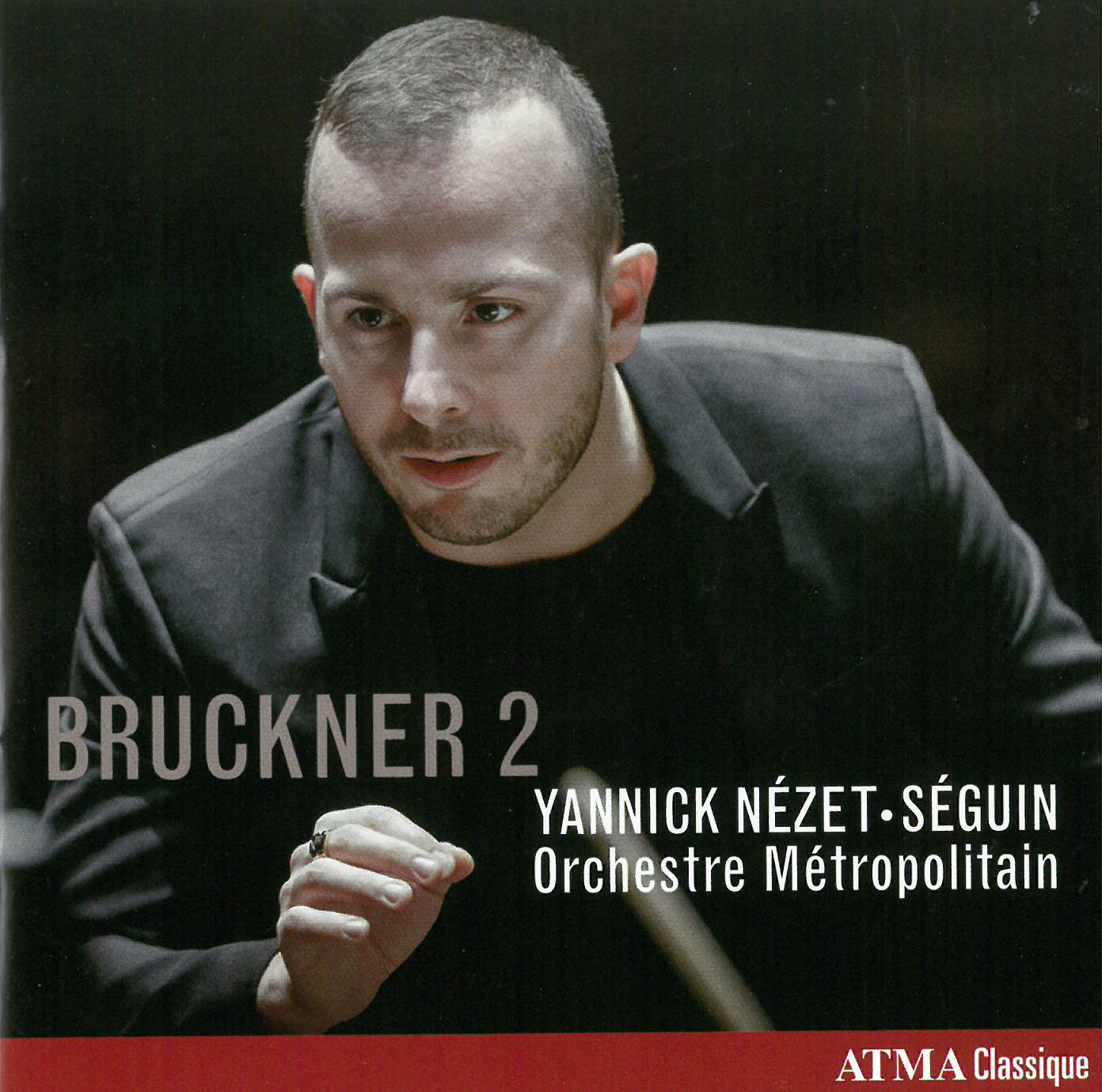
05 Bruckner 2Bruckner 2
Orchestre Métropolitain; Yannick Nézet-Séguin
ATMA ACD2 2708

Review

I heard Yannick Nézet-Séguin early in his career when he conducted the Toronto Symphony Orchestra. It was immediately clear that we had an outstanding conductor here. Since then he has become the music director of the Rotterdam Philharmonic and of the Philadelphia Orchestra. Soon he will also be the music director of the Metropolitan Opera in New York. In many of his recordings, however, he has stayed faithful to the orchestra where he started: Orchestre Métropolitain of Montreal. The record under review, Symphony No.2, is part of a Bruckner cycle which is now almost complete: only No.s1 and 5 (and perhaps No.0) are as yet unrecorded.

I am a great admirer of Bruckner’s sacred music but I find his symphonies harder to come to terms with. Too often, it seems to me, a movement will begin beautifully but then fail to develop. I may be quite wrong here and I am willing to believe that a conversion is still possible. If that happens, this CD may well have taken its part. Nézet-Séguin shapes the music beautifully and gets wonderful playing from the Orchestre Métropolitain, particularly from the principal wind players.

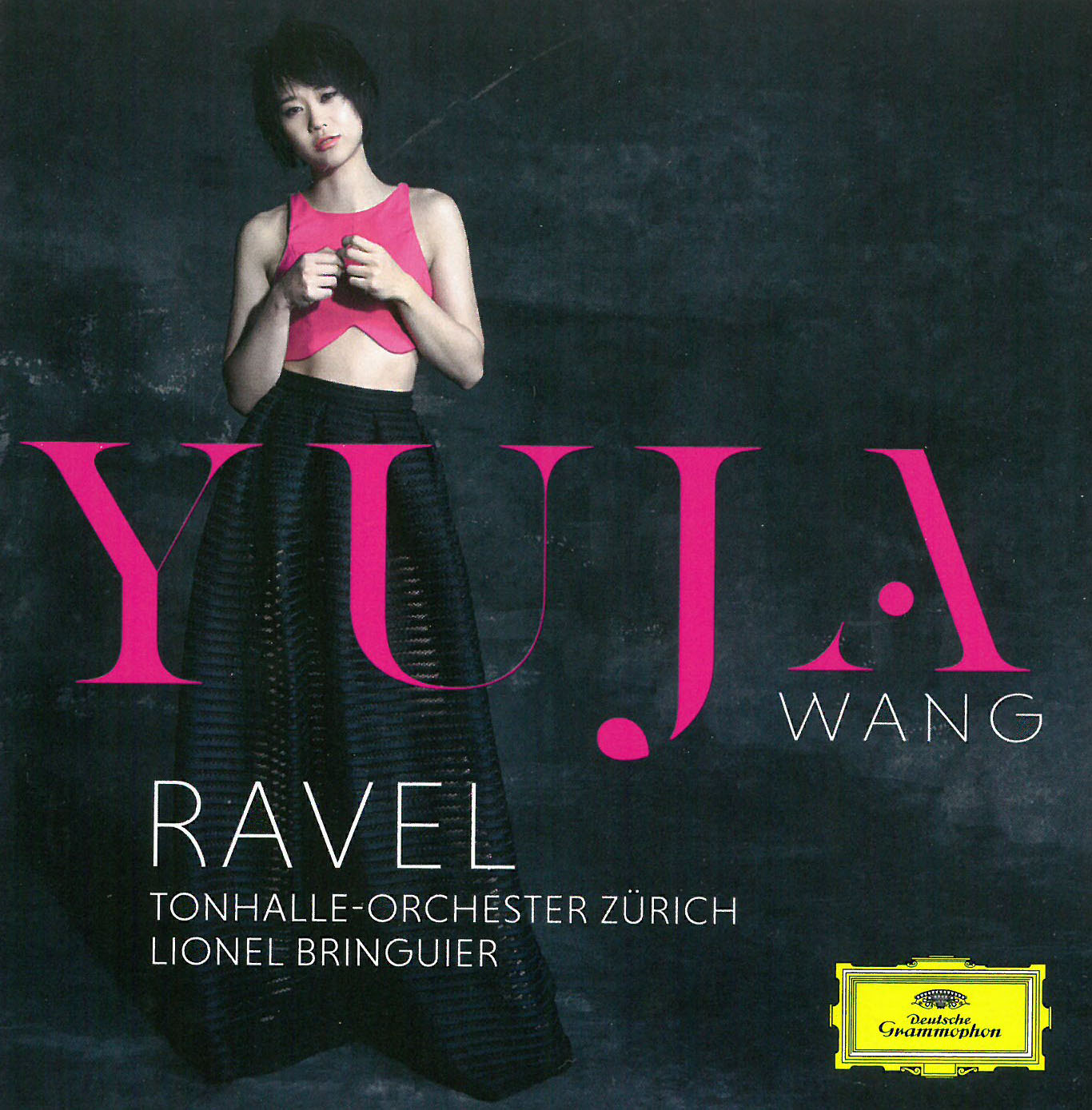
06 Yuja RavelRavel
Yuja Wang; Tonhalle-Orchester Zurich; Lionel Bringuie
Deutsche Grammophon 479 4954

DG’s latest issue of Yuja Wang is the fifth in a row of the pianist’s bestselling discs. It has already earned Gramophone magazine’s prestigious Editor’s Choice Award, probably the best recommendation today. The young Chinese virtuoso has cut through the music world like a hurricane, an elemental force, in a few years her fame skyrocketing her to the very top. I was lucky to see her at Koerner Hall a few years ago when I literally staggered out of the concert totally astounded.

The record definitely lives up to its stellar reputation. Dashing through the Ravel Concerto in G Major with her customary bravura she is totally in her element, youthful and impetuous, having the time of her life with this somewhat jazzy, very entertaining and exciting concerto. The phenomenal technical skill notwithstanding, she is also a mature pianist. This is well-demonstrated in the lyrical second movement where she creates a gorgeous sound painting with her extraordinary touch and colouring. I have heard this piece many times and it is always dazzling, but here the overall compositional structure truly shines, as both the pianist and the conductor (Lionel Bringuier) clearly understand it and have tremendous chemistry working towards a common goal.

The completely different Piano Concerto for the Left Hand is considerably more difficult, with a mysterious opening of a theme slowly emerging from darkness; as the piano enters we witness an almost titanic power in Wang’s left hand. As the pace quickens in the march-like mid-section there is dazzling showmanship, exhilarating to listen to in a recording of demonstration quality with full frequency and wide dynamic range. Top recommendation.


Review

01 Ehnes Bach

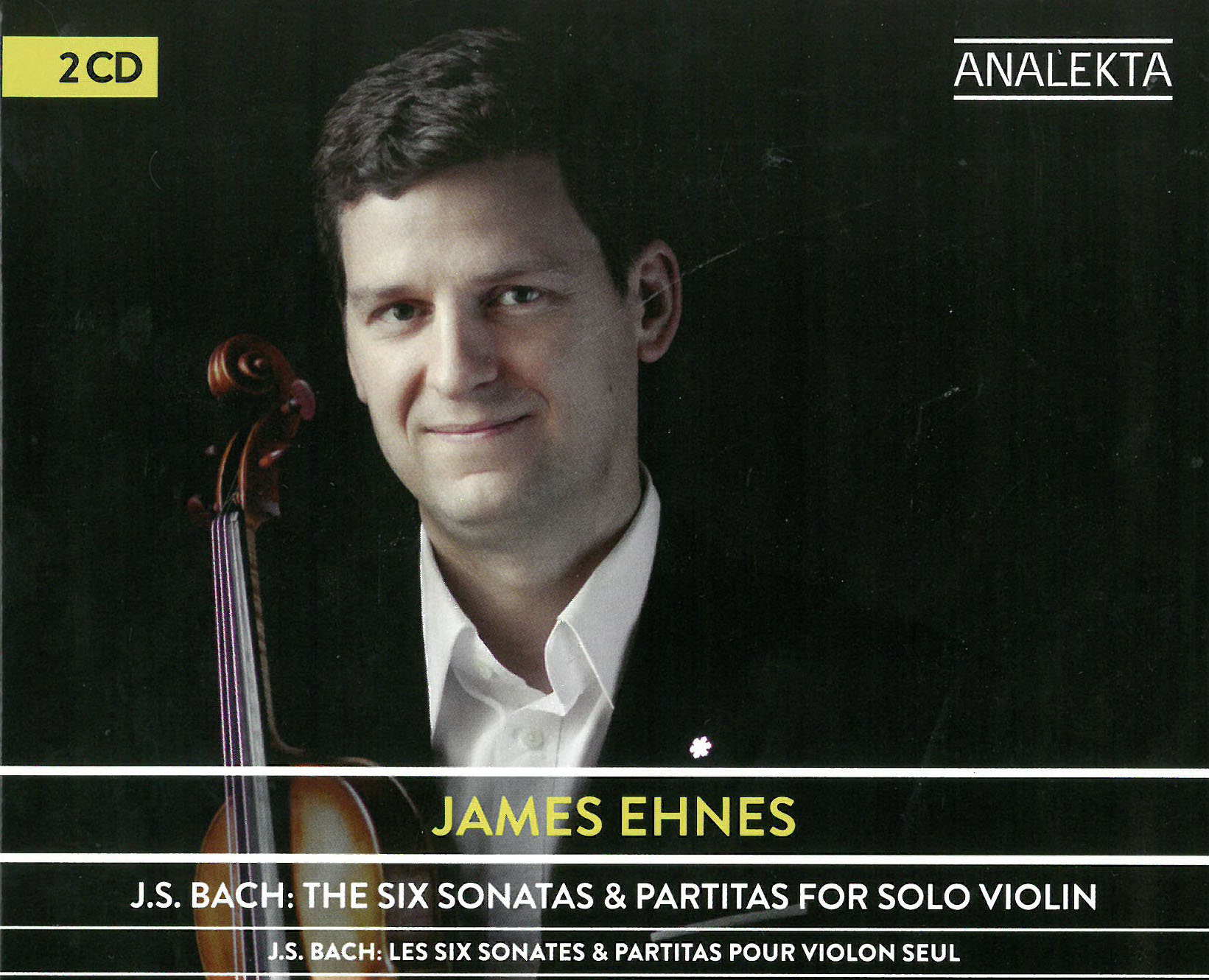
There’s a tendency among leading violinists to leave recording the Bach Six Sonatas & Partitas for Solo Violin until they have been living with them and performing them for some considerable time, given the soul-searching nature of the music. If they do revisit them at a much later date, it’s usually to offer a fresh interpretation that reflects their ever-evolving relationship with these astonishing works.

James Ehnes, who turned 40 this year, was only in his early 20s when he recorded the Sonatas & Partitas for Analekta just over 16 years ago, but his recent revisit (AN 2 8772-3) is a reissue, and not a re-recording. In his introductory note Ehnes acknowledges that his interpretations have evolved over the years, and will continue to do so throughout his life, so it’s perhaps a bit surprising that he didn’t take this opportunity to offer an updated version. Still, when you play them like this, who needs to?

This set often turns up in personal choice lists of the best versions available, and it’s easy to see – and hear – why: Ehnes plays with grace, ease and eloquence, and with complete technical mastery coupled with emotional warmth and intellectual insight. There’s a smooth, effortless and almost religious serenity to these performances (the recordings were made in a church) with towering fugues, achingly beautiful andantes and wonderfully rhythmic dance movements.

If you missed this set the first time around you might want to put that right – it’s one to treasure. And, oh, that 1715 “Marsick” Stradivarius violin!

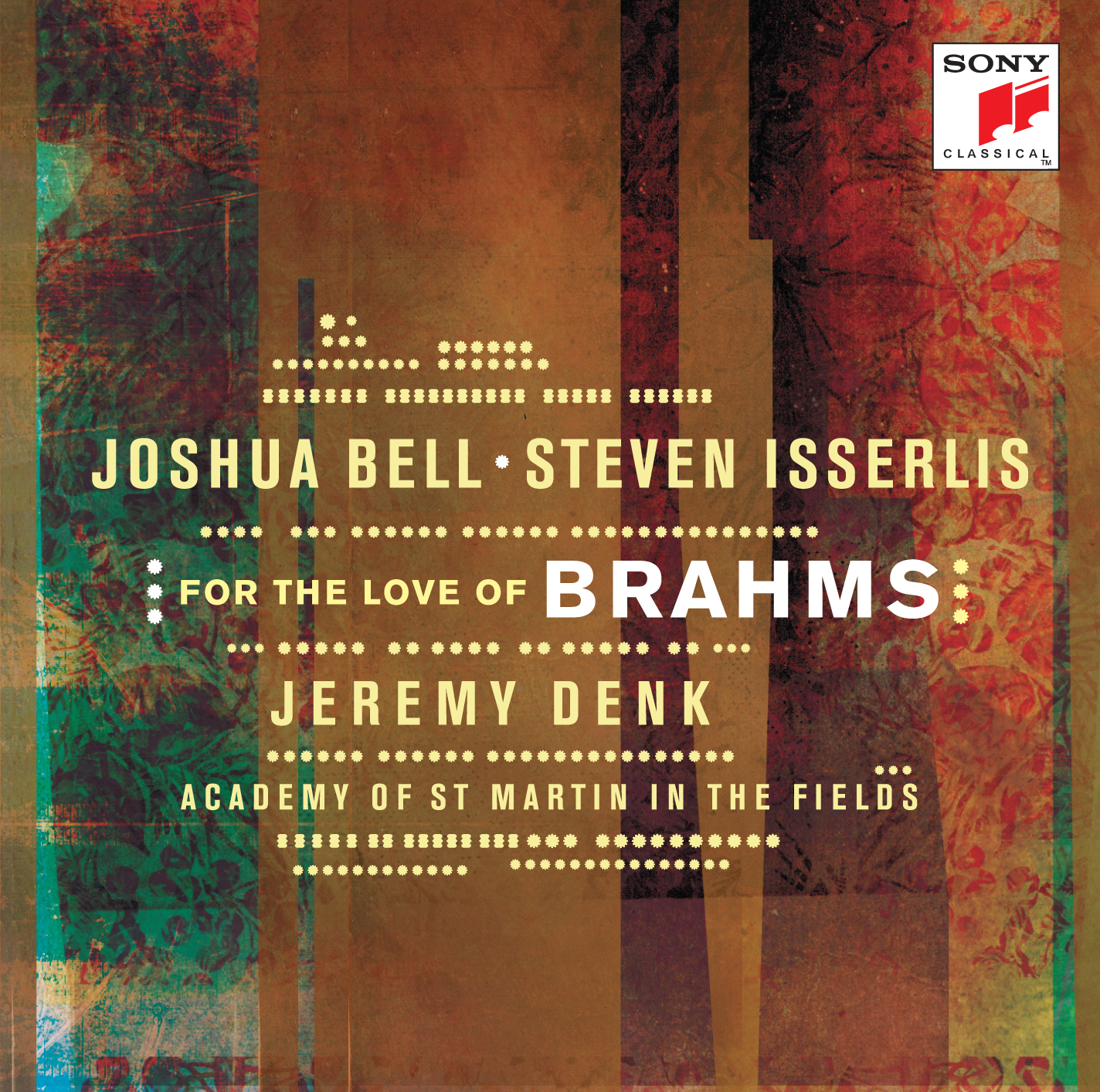
02 Joshua BellViolinist Joshua Bell and cellist Steven Isserlis get together on the new CD For the Love of Brahms, with Bell directing the Academy of St. Martin in the Fields (Sony Classical 88985 32179 2).

The Double Concerto in A Minor Op.102 for Violin and Cello has often been considered to be inferior to Brahms’ Violin Concerto in critical biographies, but it has always been my favourite of the two works. Perhaps it’s the added warmth and depth of the cello or the simple beauty of the slow movement.

In any event, the performance here is one for the ages. From the carefully measured orchestral opening statement, through Isserlis’ beautiful cello solo, to Bell’s tender entry and his dialogue with Isserlis, it’s clear that this is going to be a performance of sensitivity, rhapsodic passion and haunting beauty. Under Bell’s direction the Academy provides an accompaniment that perfectly complements the soloists. It’s a simply wonderful reading.

The two other works on the CD highlight the close relationships between Brahms, Joachim and the Schumanns (in Brahms’ case, particularly Clara). Schumann’s Violin Concerto in D Minor was written for Joachim, but later supressed by him and Clara, only surfacing in 1937. The hauntingly beautiful Langsam slow movement, with its prominent cello melody, was adapted as an Elegy for violin and strings by Benjamin Britten (who added a codetta) and Yehudi Menuhin at the 1958 Aldeburgh Festival as a memorial to the brilliant young horn player Dennis Brain, who had been killed in a car crash the previous September. Apparently unperformed since then, it is played here with Isserlis assuming the cello melody and joining Bell as soloist.

Pianist Jeremy Denk joins Bell and Isserlis in a sterling performance of Brahms’ Piano Trio in B Major Op.8, a work heavily revised and essentially reworked by the composer in 1889 but presented here in its original version from 1854, written less than a year after Brahms had met the Schumanns and replete with apparent references to his growing love for Robert’s wife Clara. Significantly – and uncharacteristically – Brahms never withdrew this earlier version, and after years of living in the shadow of the later and admittedly more polished reworking it now seems to be growing in popularity.

Justifiably so, for what it lacks in polish it makes up for in its unbridled youthful passion.

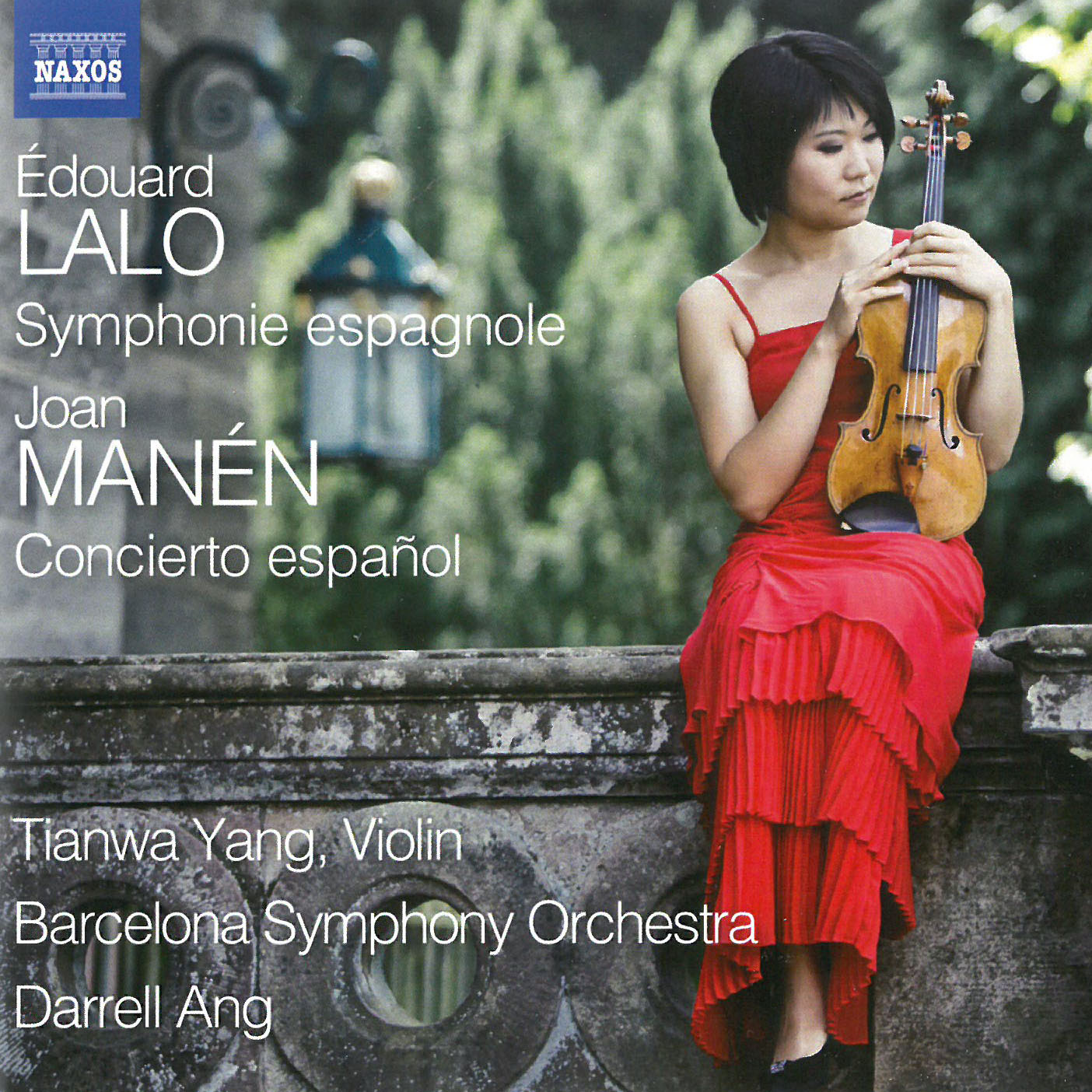
03 Lalo ManenThe terrific violinist Tianwa Yang is back with another outstanding disc on the Naxos label, this time featuring Lalo and Manén Violin Concertos (8.573067).

Yang seems to have a natural affinity for Spanish works, having already recorded the complete violin works of Pablo de Sarasate, and her dazzling brilliance seems perfectly suited to the nature of the music. As in the Sarasate set, Yang is paired with a Spanish orchestra for even more authenticity, this time the Barcelona Symphony and Catalonia National Orchestra under Darrell Ang.

Édouard Lalo’s Symphonie espagnole has long been a part of the standard repertoire and despite its symphonic title has always been viewed as a violin concerto. Although the composer was French the work is quite clearly greatly influenced by its dedicatee and first performer, Sarasate, a player noted for his purity of tone and quicksilver technique. Much the same can be said of Yang, who gives a splendid performance here.

The real revelation on this CD, though, is the Violin Concerto No.1 “Concierto español” by the Spanish composer Joan Manén, who was born in 1883 and lived until 1971. Manén was a childhood virtuoso pianist and violinist who composed from an early age and had an astonishing early career; in the pre-WWI years he was regarded as one of the best violinists of the time. His appeal and career waned after the war, and although he continued performing until 1959 his death in Barcelona attracted little attention.

The Violin Concerto No.1 Op.18 was written in the late 1890s when Manén was still only in his mid-teens, and was revised in 1935 when it was re-numbered Op.A-7. It’s an absolute gem of a work in much the same vein as the Lalo, firmly in the 19th-century virtuosic tradition but always more than a mere showcase for technique. The slow movement in particular is simply ravishing, and Yang’s brilliant and sympathetic playing throughout leaves you wondering how on earth you could not have heard this concerto before, and why it has never made its way into the standard repertoire.

Quite simply, it’s worth the price of the CD on its own.

Review

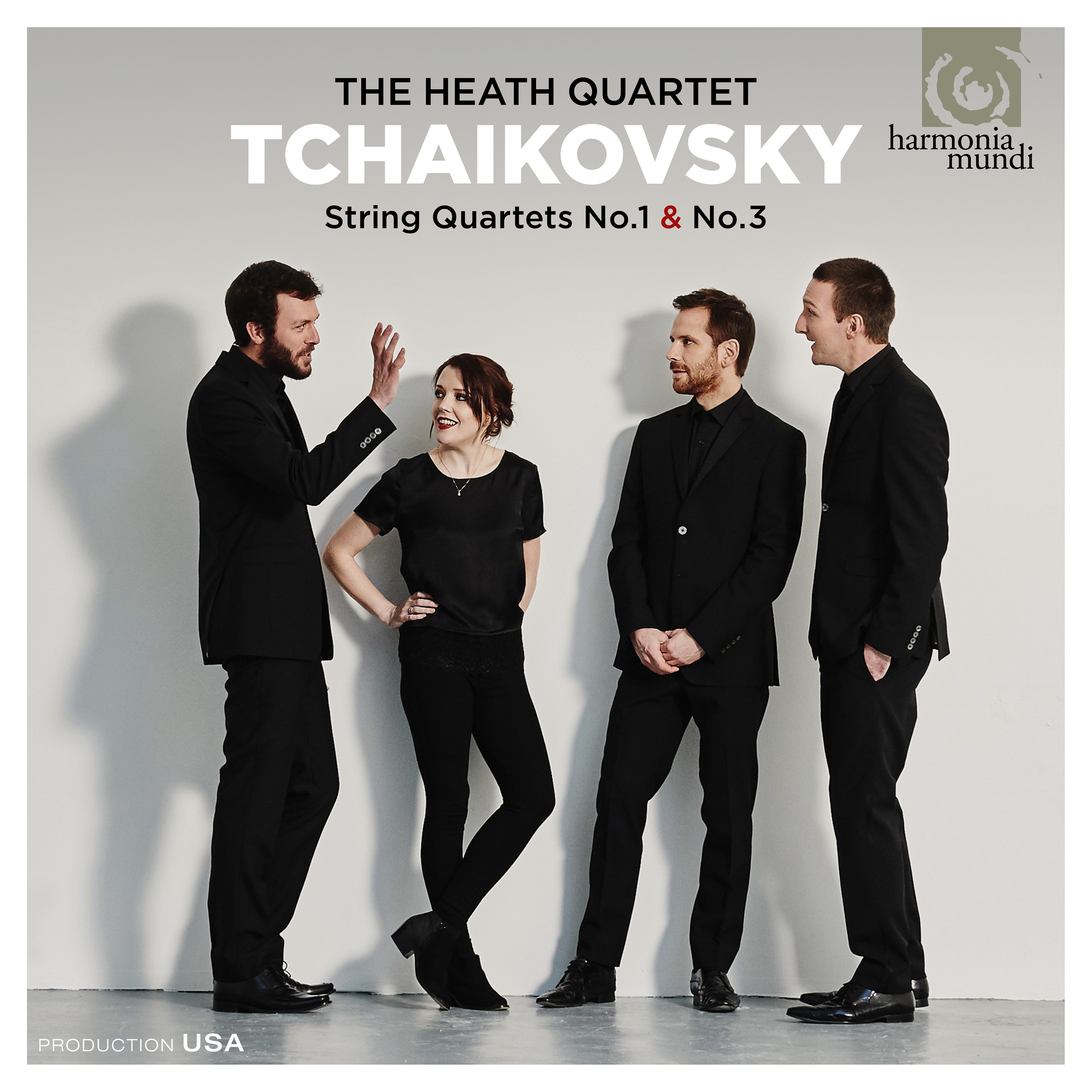
04 Tchaikovsky Quartes 1 3The British string ensemble the Heath Quartet has built an enviable reputation for itself since its foundation at the Royal Northern College of Music in Manchester in 2002, and garnered glowing reviews for its 2013/14 recording of the complete string quartets of Sir Michael Tippett that comprised its debut CD on the Wigmore Hall Live label last year.

Their new CD of Tchaikovsky String Quartets Nos.1 & 3 (HMU 907665) marks the start of a new relationship with the outstanding Harmonia Mundi label, and what a start it is!

The String Quartet No.1 in D Major Op.11 was written for a March 1871 concert intended to promote Tchaikovsky and his music, and includes the famous Andante cantabile slow movement which almost immediately achieved a life of its own. The Heath Quartet is in tremendous form from the outset, with full-bodied and passionate playing, a warm, rich tone, a lovely dynamic range and sensitive phrasing.

The players for the first performance, assembled from Tchaikovsky’s colleagues at the Moscow Conservatory, were mostly the same for the String Quartet No.2 in 1874. Ferdinand Laub, the Czech first violinist in both performances, died the following year at 43, and the String Quartet No.3 in E-flat Minor Op.30 was Tchaikovsky’s response to the loss. The third movement Andante funebre e doloroso was intended as an elegy to Laub, and not surprisingly made the biggest impression at the premiere. It really is played quite beautifully here.

The Heath Quartet’s next CD release will be the complete Bartók quartets in 2017, apparently recorded during its performance of the complete cycle at London’s Wigmore Hall this past May. That cycle won rave reviews in The Telegraph, and if this outstanding Tchaikovsky CD is anything to go by the Bartók issue should really be something to look forward to.

Concert note: The Heath Quartet will feature music of Bach, Beethoven, Bartók and Dvořák during its Canadian debut tour which includes performances at the Kitchener-Waterloo Chamber Music Society on January 20 and Mooredale Concerts in Toronto on January 22.

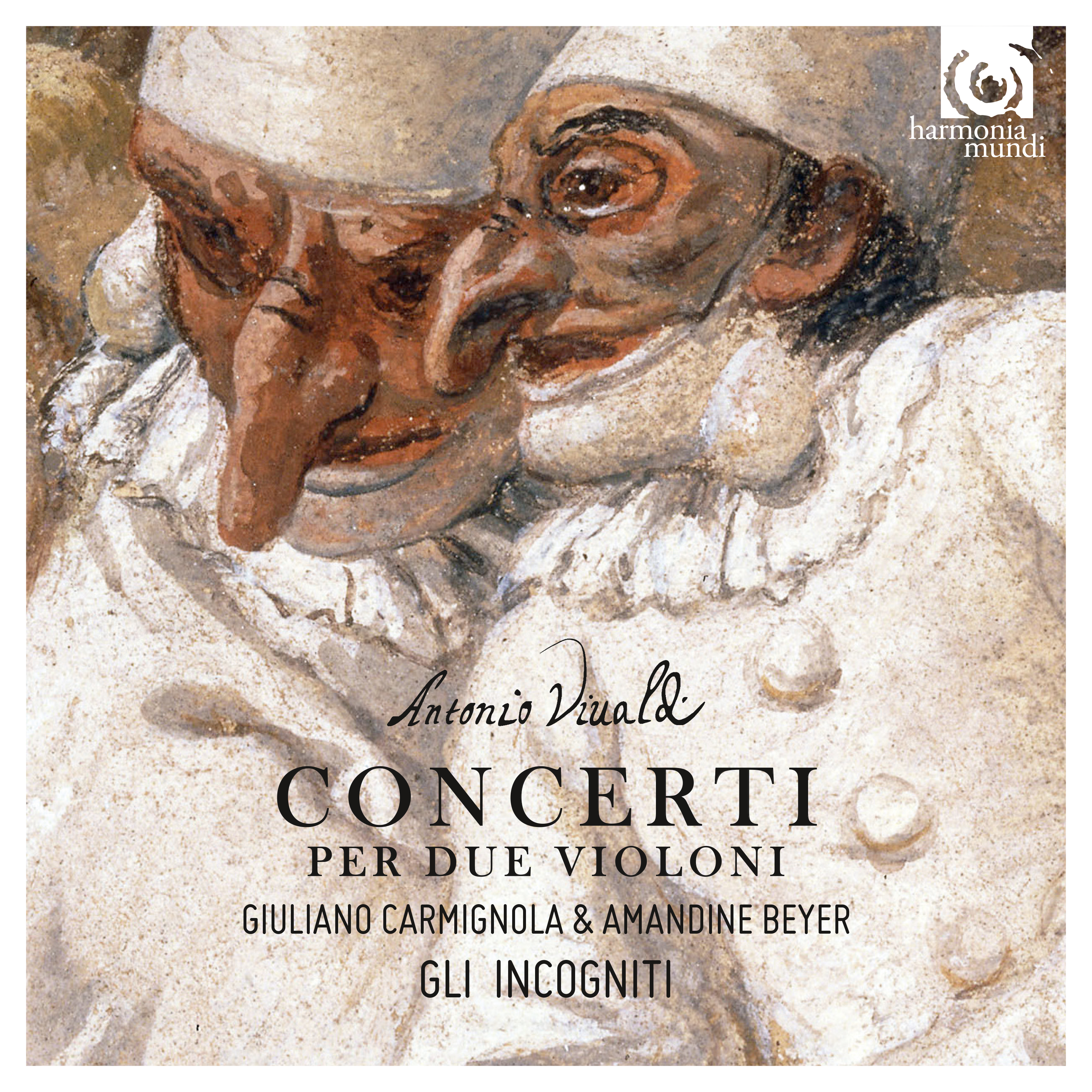
05 Vivaldi coverThe outstanding French baroque violinist Amandine Beyer joins with another outstanding violinist, Giuliano Carmignola, and Gli incogniti, the Italian historical-instrument ensemble that she founded, in Antonio Vivaldi Concerti per due Violini on another new Harmonia Mundi release (HMC902249). There are six concertos for two violins on the disc, together with the Concerto a 4 in D Minor RV127.

Beyer says that recording this CD made her realize how much her love of Vivaldi and his music deepens with each new experience; she finds Vivaldi to be “a composer endowed with humanity and a profound sense of the harmony of beings with nature.” The interplay between the two violins and the orchestra, she says, gives her a pleasure she finds hard to explain in words. But then again, she doesn’t have to – she expresses it in her playing.

The concertos are those in C Major RV507, B-flat Major RV529, C Minor RV510, C Major RV505, B-flat Major RV527 and D Major RV513. The performances throughout are simply bursting with life and dazzling virtuosity, with a wonderful lightness in an accompaniment that features just four or five violins and one each of viola, cello, violone, theorbo or guitar and harpsichord or organ.

It’s a terrific CD that makes Vivaldi’s concertos sound much more varied than some would have you believe.

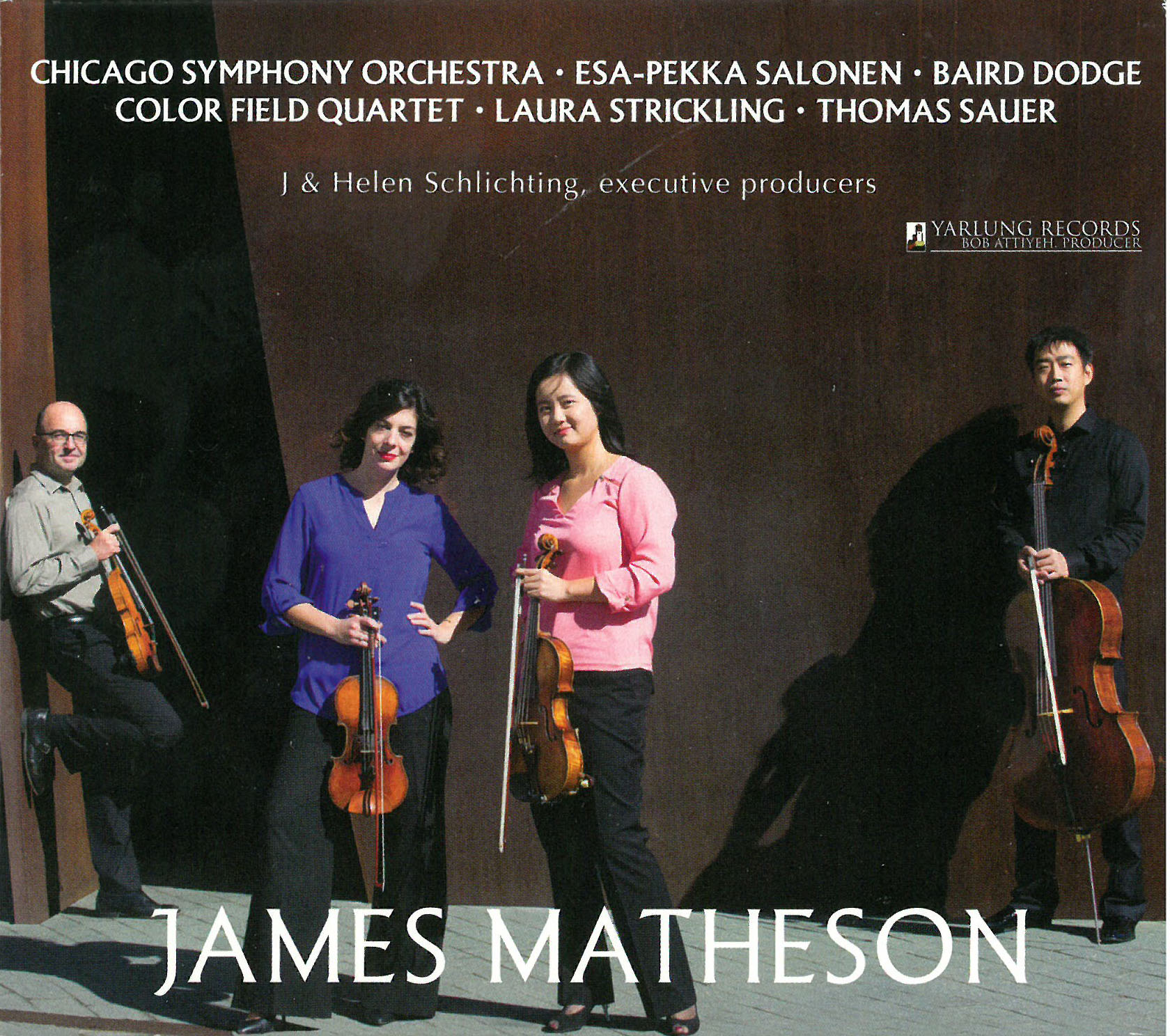
06 James MathesonThe music of American composer James Matheson is featured on the new self-titled CD from Yarlung Records (25670). His String Quartet was premiered by the St. Lawrence String Quartet in February 2014 and is played here by the Color Field Quartet. It’s an accessible three-movement work of decided substance, with some excellent instrumental writing and a lot of energy.

The leader of the quartet, Baird Dodge, has been principal second violin with the Chicago Symphony Orchestra since 2002, and is the soloist in by far the most significant work on the CD, Matheson’s Violin Concerto. Matheson and Dodge were roommates at college in the 1990s, and Dodge had harboured the idea of the Chicago Symphony Orchestra commissioning a violin concerto from Matheson ever since joining the orchestra. It finally came to fruition as a co-commission with the Los Angeles Philharmonic when conductor Esa-Pekka Salonen added his support.

The recording here is of the concerto’s premiere performance on December 15, 2011, in Chicago with Salonen leading the CSO with Dodge as the soloist. It’s a striking work with a virtuoso role for the soloist and some terrific orchestration. Matheson cites Messiaen, Lutosławski and Mahler as influences and acknowledges that the concerto’s slow movement was inspired by the slow movement of Mahler’s Sixth Symphony, but the high bird-like figures in the violin put me more in mind of the concertos of Szymanowski. It feels like a work that will not want for future performances.

There is a decided concert feel to the recording, as opposed to a studio feel, but there is no hint of an audience being present. Dodge plays quite brilliantly.

The final work on the CD fares poorly in comparison. Soprano Laura Strickling and pianist Thomas Sauer are the performers in the song cycle Times Alone, but unfortunately the high vocal register, Strickling’s big voice and constant wide vibrato mixed with an over-close and frequently heavy piano sound make the words really difficult to understand.

01 Mikolaj WarzynskiMikolaj Warszynski is a thinker. His notes read like an inspired thesis defence. He has solid and clear rationale for the program choices on his newest recording: Piano Solo – Haydn; Szymanowski; Liszt; Chopin (Anima ANM/141200001). Warszynski creates a journey that begins with classical structure and logic, and ends in raw emotion.

Haydn’s Sonata in C Major Hob.XVI:50 is unique for its references to pedalling, found in none of Hadyn’s other keyboard works. The effect is arresting, especially since Haydn allows some odd harmonies to run together. Warszynski’s keyboard technique for this piece is very direct and rather more powerful than we generally expect for this repertoire. He justifies this in his notes on the work’s recipient, a leading London pianist in 1794, who possessed both formidable technique and a powerful English Broadwood piano. The execution is crisp and clear with no sacrifices to phrasing or subtlety.

Karol Szymanowksi’s Shéhérazade from Masques Op.34 is, despite its modernity, as dependent on clarity and articulation as the opening Haydn Sonata. It’s built in a logical arch that Warszynski makes great effort to respect. Still, he captures the exotic program material with an improvisational style that begins to move us away from structure and into the world of Liszt and Chopin.

The Mephisto Waltz uses some lightly applied form and programmatic ideas that leave plenty of room for the transformation of themes that Liszt so uniquely championed. Warszynski finds all the latitude he needs to explore this through the contrasting middle section before he dives back into the emotional intensity that completes the waltz.

Warszynski arranges four pieces by Chopin to serve as a final statement about his program, concluding with the Polonaise in B Minor Op.53 “Héroique” played more slowly than most performers would ever dare. Citing Chopin’s own preferences to avoid the virtuosic showmanship this piece often elicits, he plays it with an overriding sense of nobility.

Concert Note: Mikolaj Warszynski performs with piano duo partner Zuzana Simurdova in Toronto on November 11 at Gallery 345 in The Art of the Piano series and as part of the Nocturnes in the City at St. Wenceslaus Church on November 13.

Review

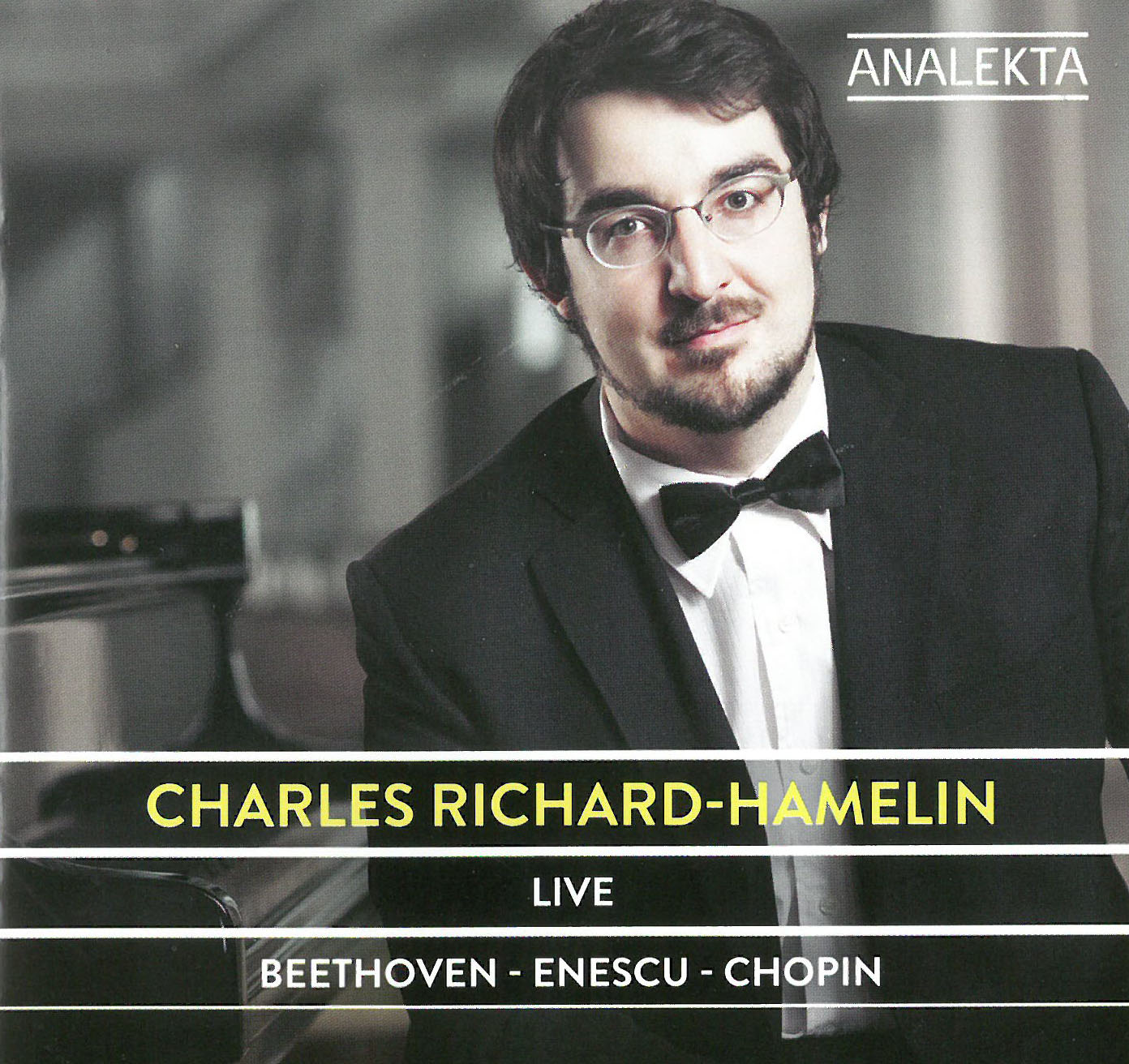
02 Charles Richard HamelinQuebec-born Charles Richard-Hamelin has added a second recording to his discography. Recorded in May this year, Charles Richard-Hamelin Live – Beethoven; Enescu; Chopin (Analekta AN 2 9129) opens with two Rondos by Beethoven. Because the pieces are so very Classical, they tend to be overlooked in favour of his later, more potboiling audience pleasers. Richard-Hamelin raises the emotional bar on these early works and plays them as Romantic flirtations. It’s very effective.

George Enescu’s Suite No.2 for Piano Op.10 dates from the turn of the 19th century and uses some surprisingly contemporary harmonies. Richard-Hamelin plays these short dance pieces with affection for the graceful nature of the suite’s four parts. Each is uniquely coloured. Pavane, especially, has a dark introspection that Richard-Hamelin explores with intimacy.

He uses the same inclination to begin the Chopin Ballade No.3 in A-flat Major Op.47 but rises to all the grandeur required as the Ballade builds to its finish. The following Nocturne in E-flat Major Op.55 No.2 requires getting deep inside Chopin’s intentions as he shifts tonalities and layers ornaments over very simple thematic ideas. Richard-Hamelin demonstrates a genuine understanding of this music and reveals more of its inner secrets in a gratifying way.

The recording concludes with Introduction and Rondo in E-flat Major Op.16 and the Polonaise in A-flat Major Op.53 “Heroique”. Each is a cauldron of technique but “Heroic” stands out for its less than traditionally punctuated phrases in favour of a more fluid approach.

Concert Note: Charles Richard-Hamelin performs in Toronto at Koerner Hall on November 10, in Aurora at the Aurora Cultural Centre on November 11 and in St. Catharines with the Niagara Symphony Orchestra at FirstOntario Performing Arts Centre on November 27.

Review

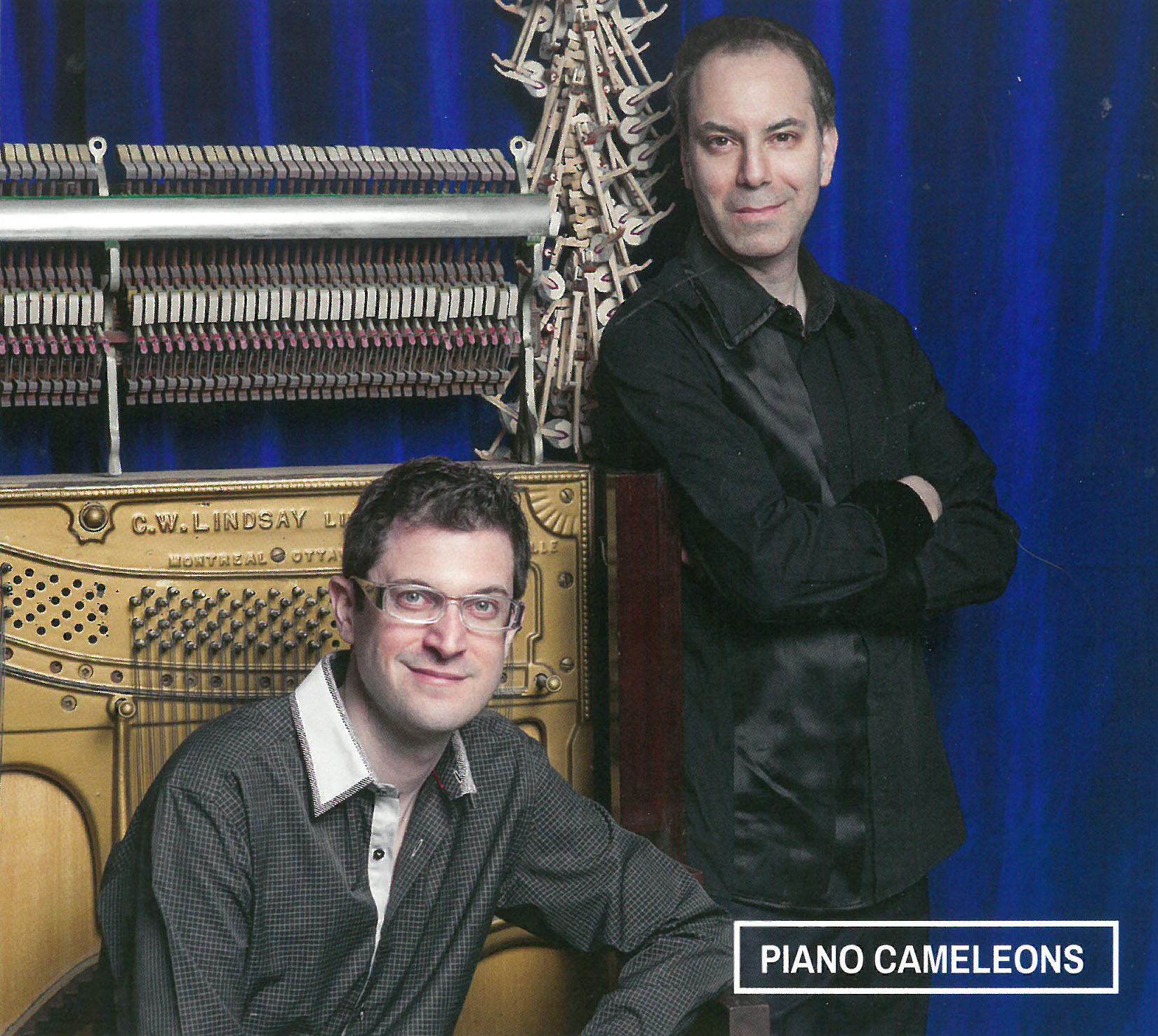
03 Piano CameleonsFusing Classical and Jazz has been done before and its success always depends on the calibre of the musicianship brought to the keyboard. A new recording, Piano Caméléons (Justin Time JUST 257-2) features pianists Matt Herskowitz and John Roney recasting many of the classical repertoire’s best known melodies in a jazz voice. The project boasts Oliver Jones as its guide and mentor, and Jones writes glowingly about what the pianists have achieved. Jones also performs with them in the Minuet in G Major BWV 114 by Bach/Petzold.

The opening track uses the Bach Prelude No.2 in C Minor from the Well-Tempered Clavier, Book I. After establishing key and rhythmic pattern, Herskowitz and Roney begin drifting from Bach’s melody into a descant that eventually develops into a catchy swing embellishment, all the while maintaining the original pulse of Bach’s keyboard idea. Very clever.

With Debussy’s Claire de lune, the approach changes. Here they use only the briefest motif from the opening measures and spend more creative effort sustaining the piece’s atmosphere. They never let go of the thematic fragment entirely, although they wander significantly before quoting it again at the close.

Rachmaninoff’s Prelude in C-sharp Minor Op.3 No.2 introduces some mysterious percussion at the outset, remains dark and ominous throughout and offers an impressive display of technique from both keyboards.

The track that emerges as a truly brilliant conception and performance is the Chopin Étude in C Minor Op.10 No.12 “Revolutionary. Starting with the familiar cascade of the work’s first idea Herskowitz and Roney create the turbulence of the “Revolution” and stay with its minor key almost entirely through their jazz treatment. It’s ingenious and impressively creative.

04 Jean Baptiste MullerAnother welcome recording from Jean-Baptiste Müller, Chopin – Sonata No.3; Schumann – Kreisleriana (JBM 40665 jean-baptiste-mueller.com) begins with Chopin’s third and final Sonata in B Minor Op.58. Formally freer than its two predecessors, it sports a wildly sparkling but brief Scherzo that Müller plays with easy abandon. The third movement that follows is marked Largo, and Müller spends a generous amount of time lingering with each of its beautiful ideas. It’s an effective way to contrast the two inner movements of this piece, especially when it concludes with the nonstop energy of the finale. The final movement demands stamina and clarity through its many relentless cascading runs and towers of chords. Müller delivers with a secure keyboard style and obvious musicality.

Robert Schumann’s Kreisleriana Op.16 is a collection of eight short pieces penned in romantic affection for the composer’s wife-to-be. It requires attention to opportunities for contrasting emotional content. While the faster, louder pieces provide short respites from their inherent tensions, the slower pieces are the real challenge to play. Müller approaches these with an unconventional pensiveness that focuses attention on the lingering pauses he uses so effectively at phrase endings. The fourth and sixth pieces in the cycle are examples of just how artfully he applies this device. The closing piece is an impish wee thing performed with a gifted naughtiness that Müller makes no effort hide.

05 Tchaikovsky NebolsinYou need more than just a good grip on the keyboard to play Tchaikovsky No.2. It’s a mental challenge, and Uzbek pianist Eldar Nebolsin has mastered it in his latest recording Tchaikovsky – Piano Concerto No.2; Concert Fantasia (Naxos 8.573462).

Given the tragedies and criticism with which he dealt during his lifetime, Tchaikovsky made a remarkably victorious statement in this work. The big opening for the orchestra is quickly echoed by the piano and it’s here that Nebolsin establishes his presence. He plays the original score, without the cuts imposed by early critical performers. He has a commanding presence at the keyboard which he uses to keep the orchestra at bay. The first movement is very much a tug of war filled with energy and grandeur that makes the second all the more surprising for its profound melancholy and chamber-like approach. Nebolsin completely surrenders to the trio portions with cello and violin and the three players weave a gorgeous tapestry with the movement’s principal theme. The New Zealand Symphony Orchestra under Michael Stern holds well back at an unusual distance, heightening the intimacy of this movement and preparing for the eruption of pure joy that begins its finale.

The Allegro con fuoco opens with a quick tempo sustained throughout but the most remarkable feature is the lightness of the piano touch. Nebolsin is simply dancing all over the keyboard in an exhilarating romp to the final chords. It’s a marvellous performance executed with intelligence and a sense of adventure.

The Concert Fantasia in G Major Op.56 is a very different work that gives Nebolsin the opportunity for much more solo playing, showing us yet another side of this accomplished young musician.

06 Steven SpoonerStephen Spooner has recently released the finished results of a huge recording project Dedications – Horowtiz, Richter, Gilels, Cliburn (A Life of Music Records stevenspooner.com). It’s a 16-CD box set that Spooner describes as an homage to the great pianists of the Russian School. The set includes audio liner notes, a live recital and a couple of discs containing hymn transcriptions and other improvisations.

The first three volumes are devoted to Vladimir Horowitz whom Spooner considers to be one of history’s greatest pianists. Without overtly attempting to play as Horowitz played, Spooner does, however, adopt the characteristic thoughtfulness that shaped Horowitz’s keyboard style. While a superb technician, even into his final years, Horowitz always impressed audiences with the feeling that he was somehow considering anew, every note he was playing. There seemed to be a brake on the impulse to rush headlong into virtuosic display for its own sake. This is most evident in Spooner’s performances of Chopin and Rachmaninoff. His Scarlatti Sonatas, some performed on Horowitz’s own piano, recall Horowitz’s crisp, acrobatic fingerings as well as his love of a well-phrased melody.

Sviatoslav Richter gets the lion’s share of the set with eight volumes devoted to his musical legacy. It’s curious that Richter gets so much recorded coverage here. Despite taking recording very seriously, he never enjoyed it as much as live performance. A great many of his recordings are, in fact, live concerts.

In his Richter volumes, Spooner includes Schubert’s Winterreise D.911 in recognition of Richter’s collaborations with both Peter Schreier and Dietrich Fischer-Dieskau. Baritone Chris Thompson performs beautifully, finding the intimacy and fluidity that both his German counterparts cultivated so successfully.

Among Richter’s most critically acclaimed recorded performances are the Liszt B Minor Sonata S.178, Debussy’s Préludes and more than a dozen Haydn Sonatas. Spooner devotes an entire volume to each of these three. Noteworthy too, is that he performs the Liszt twice in one volume using one of Liszt’s last pianos, an 1886 Bechstein, in a comparative performance.

Richter’s broad repertoire included every major composer and Spooner reflects this in volumes containing works by Schumann, Schubert, Chopin, Bartók and Prokofiev.

Emil Gilels receives only a single volume. The physical power of his keyboard technique is captured in Spooner’s performance of Liszt’s Fantasy on a Motif from Wagner’s Rienzi S439. He explores the more intimate and introspective side in a selection of Grieg’s Lyric Pieces as well as Alexander Siloti’s beautiful arrangement of Bach’s Prelude in B Minor from BWV 855.

Van Cliburn, too, gets only a single volume. Remembered as the American kid who won the 1958 Tchaikovsky competition with his stunning performance of a repertoire so close to the Russian heart, Spooner pays tribute to this pianist who beat all the odds at the height of the Cold War.

01 NACO BaroqueBaroque Treasury
Pinchas Zukerman; Charles Hamann; Amanda Forsyth; National Arts Centre Orchestra
Analekta AN 2 8783

Review

Was it really 17 years ago that Pinchas Zukerman became music director of Ottawa’s National Arts Centre Orchestra? Although he stepped down in 2015, the renowned and affable conductor and violinist hardly seems ready to slip into retirement any time soon. He remains the orchestra’s Conductor Emeritus and among numerous other endeavours also starts his eighth season as principal guest conductor of London’s Royal Philharmonic and his second as artist-in-association with the Adelaide Symphony. We should all be so active at 68!

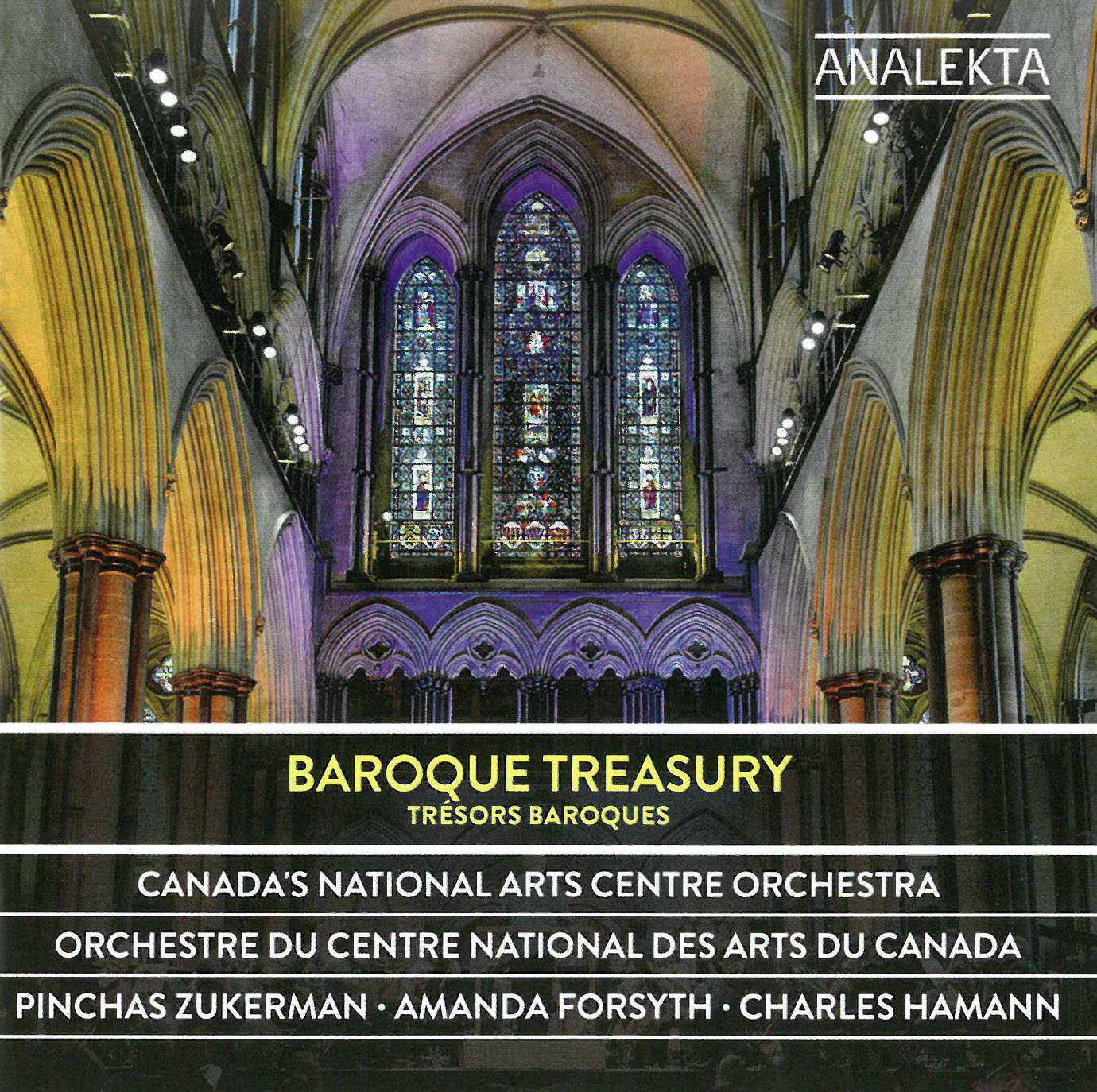
The NACO’s most recent recording, Baroque Treasury, featuring oboist Charles Hamann, cellist Amanda Forsyth and Zukerman as both conductor and soloist, is a delight, and is proof indeed that Baroque repertoire need not always be performed on period instruments in order to sound convincing. The disc presents a number of compositions, opening with the rousing Arrival of the Queen of Sheba from Handel’s Solomon. Bach’s familiar Concerto for Oboe and Violin BWV 1060 is given a spirited and sensitive performance by Zukerman and Hamann while Zukerman returns for the less-familiar Pastorale for violin and string orchestra by Giuseppe Tartini as arranged by Ottorino Respighi. He and his wife (Forsyth) then join forces in Vivaldi’s Double Concerto RV547, the pairing a rarity amongst Baroque concertos. Equally rare is Telemann’s Concerto for Viola, one of few concertos for the instrument.

Throughout, the NACO’ s solid performance demonstrates a particular affinity for the Baroque style. The final work is Bach’s familiar Orchestral Suite No.3 and here the orchestra approaches the score with much aplomb. There is a clear sense of joy in this music making, from the grandeur of the Ouverture to the final rollicking Gigue which brings the suite and the disc to a most satisfying conclusion.

While our 21st-century ears may by now be more accustomed to hearing Baroque music performed with thinner, more transparent textures, Zukerman and the NACO demonstrate that a modern ensemble and gifted soloists can also do it full justice.

02 Postcard SessionsThe Postcard Sessions
Harrington/Loewen Duo
Ravello Records RR7934 (parmarecordings.com)

Classical saxophone is, of course, a misnomer: there was no saxophone in the Classical period proper. This statement isn’t meant to ruffle any feathers, and in any case it’s hardly news to practitioners of the art. In fact, it’s been something of a boon: with no stuffy tradition to weigh it down, the instrument has been received by modern composers with open arms.

As it happens, though, the saxophone does have a Western art music heritage. Debussy composed for the instrument, albeit reluctantly; Berlioz admired its “majestic character.” In fact, there is a wealth of accessible and finely crafted music originating from the instrument’s adolescent years, before its reputation had been gilded by its association with jazz and the hypermodern.

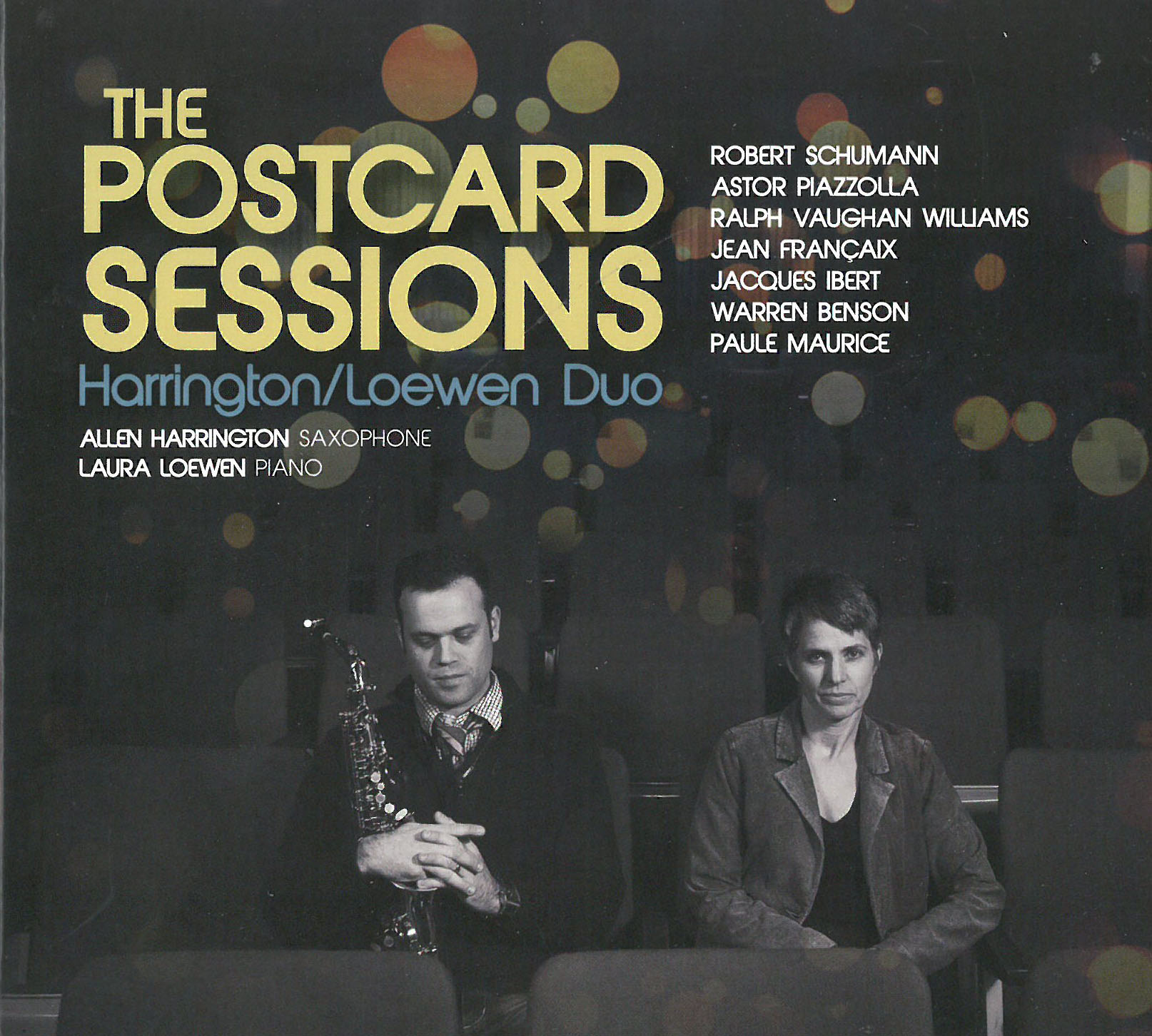
Postcard Sessions, the new CD by the Winnipeg-based Allen Harrington (saxophone) and Laura Loewen (piano), focuses on this core canon of saxophone works. By presenting them with great clarity and sensitivity, the Duo help to cement these works’ status as the bulwark upon which the modern saxophone tradition rests.

Of particular note is the clock-like precision of master miniaturist Jean Françaix’s Cinque dances exotiques, but even the pieces here which weren’t written for the saxophone originally feel as though they might have been. On Schumann’s Drei Romanzen, Harrington’s saxophone masquerades as an instrument much older than it actually is.

Harrington’s tone, always dark and warm, casts upon these seminal works a rich patina commensurate with their age and stature in the canon of saxophone music.

03 From Sea to Shining SeaFrom Sea to Shining Sea
7th Toronto Regiment Band Royal Regiment of Canadian Artillery
7RCA-003 (goo.gl/Hi9o92)

As the title indicate, this CD takes the listener on a musical journey to many parts of the world, if not actually from coast to coast in Canada. It begins with a modernized version of the traditional Post Horn Galop. With the new title of Gunner Galop, arranger Bobby Herriot has mixed the traditional sound of this work to challenge trumpeter George McCormick with sections of modern swing on the valveless post horn. From that the band moves to two prize-winning marches from the 1990 competition to celebrate the centenary of the Royal Canadian Military Institute. From such more serious works as Mussorgsky’s Night on Bald Mountain and Johan De Meij’s Loch Ness, the band shifts to the lively upbeat Bobby’s Blues, written for former band director Bobby Herriot by Paul Yoder.

The majority of the selections are compositions by Canadian composers or special band arrangements by Canadians. These include Herriot, David Allen Jacob, Jack McGuire, Ron McAnespie and above all Howard Cable. Cable gets special recognition here with no fewer than six compositions portraying musically different parts of Canada. The band takes the listener from McIntyre Ranch Country to Scene in Iqaluit, Cape Breton Moments and Point Pelee to mention some.

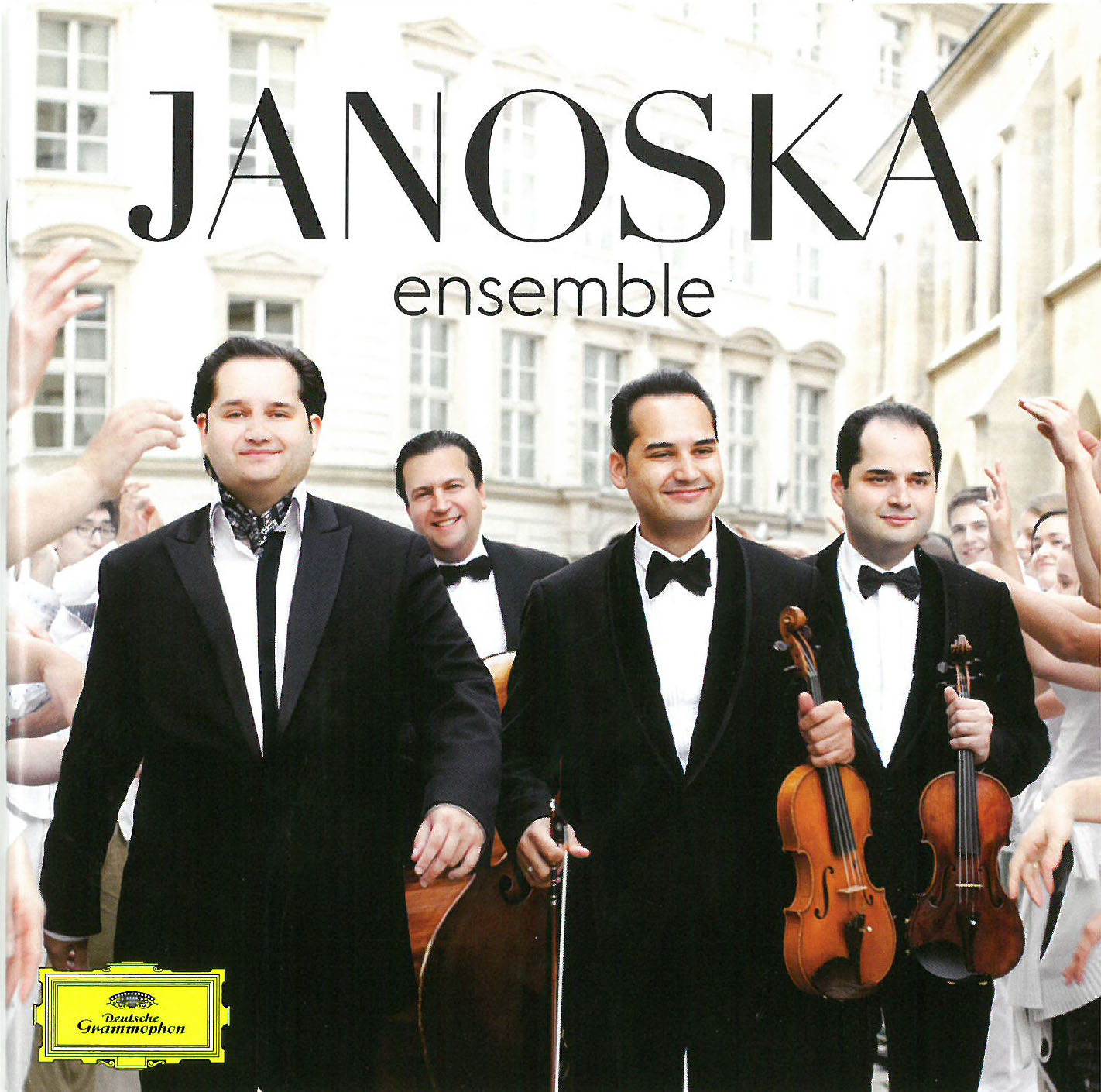
Very, very rarely does a review copy CD have such an effect on me that I simply want to keep playing it instead of listening to the rest of the month’s selections, but that’s exactly what happened with the absolutely stunning CD Janoska Style, featuring the Janoska Ensemble in a dazzling selection of their own distinctive arrangements (Deutsche Grammophon 481 2524).

01 JanoskaThe ensemble features the three Czech brothers Ondrej and Roman Janoska on violin and František Janoska at the piano, with their Hungarian brother-in-law Julius Darvas on double bass. All four musicians had significant independent careers in Vienna before deciding to concentrate on their own music with the Janoska Ensemble in 2013. They combine salon style, gypsy music, jazz and improvisation and bravura cadenzas in virtuosic arrangements that leave you short of breath and scrambling for words to describe them.

From the opening Die Fledermaus Overture à la Janoska, which morphs into a frenetic gypsy version of Those Were the Days, through reworkings of Waxman’s Carmen Fantasie, Massenet’s Thaïs Meditation, Paganini’s Caprice No.24 to Piazzolla’s Adiós Nonino, this is musical imagination, vision and virtuosity of the highest order.

We’re never asked to choose a CD of the Year, but if we were then this would undoubtedly be mine.

Review

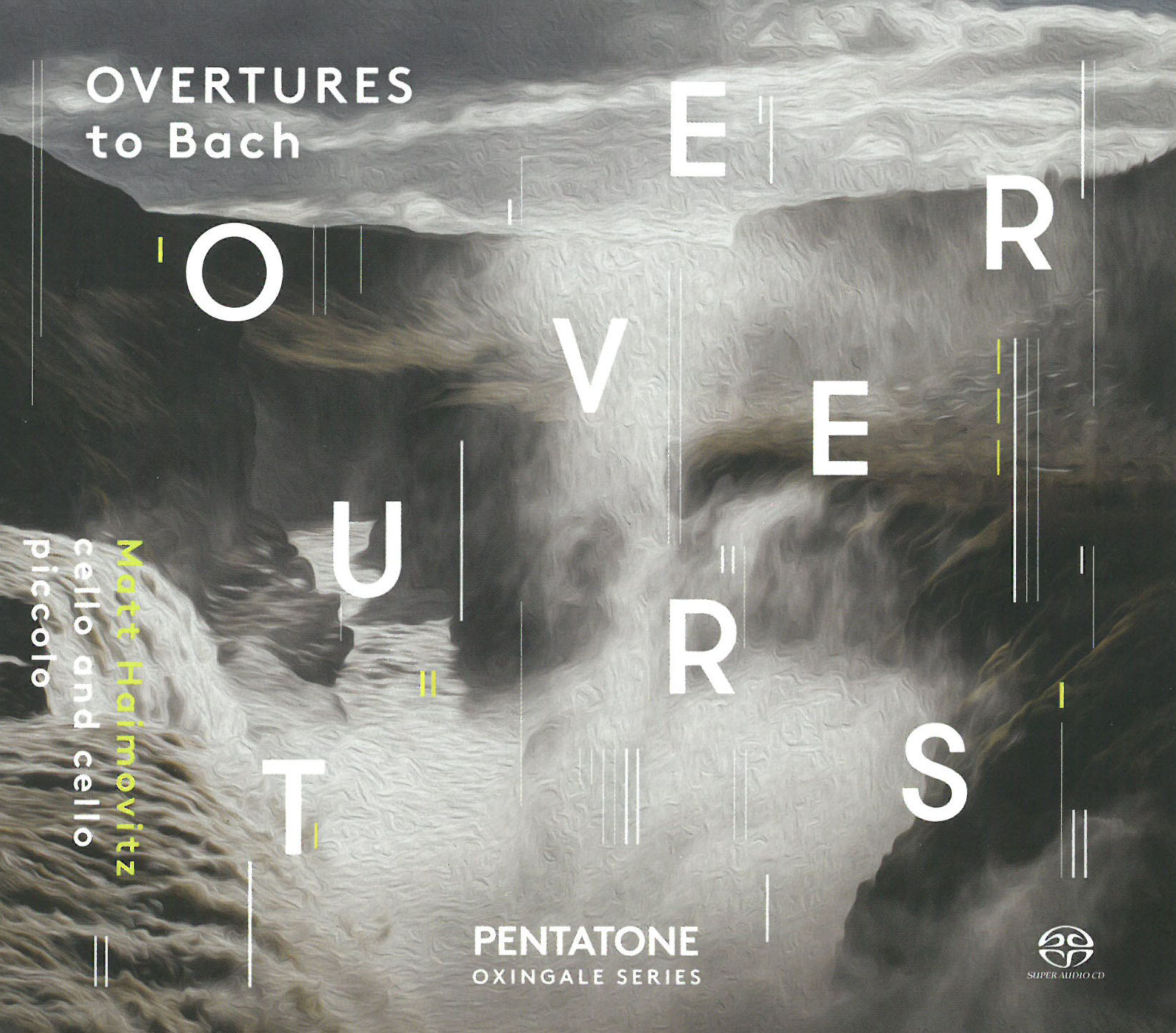
02 Haimowitz BachOvertures to Bach is the latest CD from the cellist Matt Haimovitz on the Pentatone Oxingale Series label (PTC 5186 561). It’s yet another tour-de-force solo recital of Bach and Bach-inspired contemporary works from this outstanding performer.

Haimovitz’s continuing relationship with the Bach Cello Suites stretches back over a period of more than 30 years, and in this latest venture – which he calls a culminating moment in the relationship – he has commissioned six new overtures that reflect on and anticipate the six individual suites and, by expanding on the cross-cultural and vernacular references in Bach’s music, reach both forward and backward in time. Each new piece is followed by the Prelude to the relevant Suite. The new works, in Suite order, are: Overture by Philip Glass; The Veronica, by Du Yun; Run, by Vijay Iyer; La memoria, by Roberto Sierra; Es War, by David Sanford; and Lili’uokalani for solo cello piccolo by Luna Pearl Woolf.

Haimovitz is superb in the wide range of technical challenges presented by the new works, and is as thoughtful and inquisitive as ever in the Bach Preludes. It’s a simply outstanding CD.

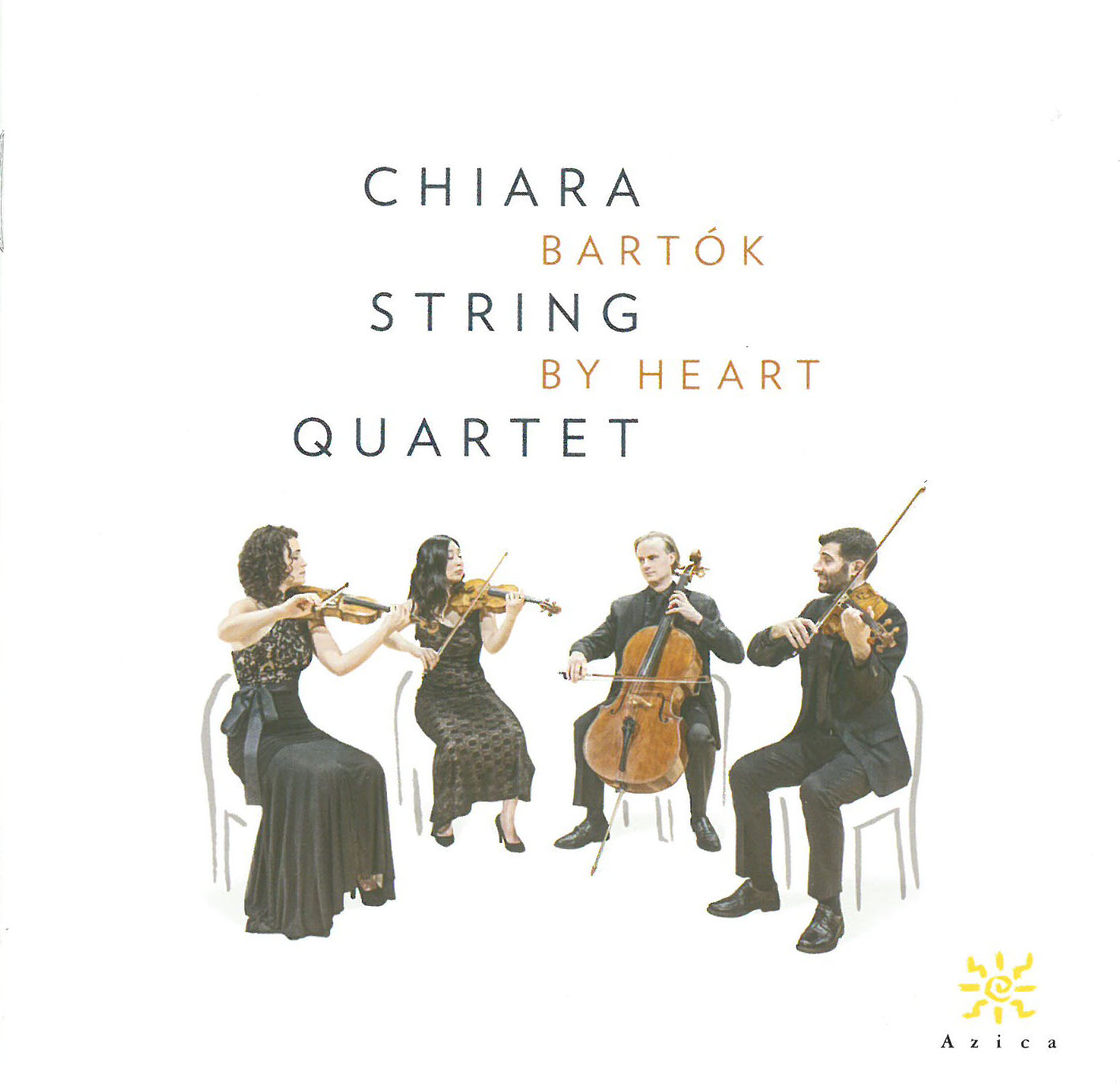
03 Bartok ChiaraWhen I saw the title of the new 2-CD set from the Chiara String Quartet – Bartók by Heart (Azica ACD-71310) I couldn’t believe my eyes. Surely it didn’t mean that they were performing all six of the Bartók quartets from memory? Well, yes it did, and yes they were.

I don’t think you necessarily have to be a string player to be able to appreciate the simply staggering nature of such a challenge, but anyone who has ever played in a string quartet will know exactly what is involved here – you don’t simply have to remember your own part, but also everybody else’s part to a large extent so that the complete picture is always present in your mind. And these are six works of huge complexity and technical difficulty.

It’s important, though, to move beyond the astonishing magnitude of the feat itself to the musical and emotional result, and the level of the performances here more than repays the effort involved. Interestingly, the quartet members feel that memorizing the music made the more difficult passages easier to play, and that the process took the music back to the aural tradition from which Bartók drew his initial influences.

One thing is certain: in a fiercely competitive field there isn’t another Bartók set quite like this one.

04 Koh TchaikovskyThe outstanding American violinist Jennifer Koh, who has produced a string of terrific CDs for the Cedille label featuring contemporary compositions, returns to the standard repertoire for her latest release, Tchaikovsky Complete Works for Violin and Orchestra, with Alexander Vedernikov conducting the Odense Symphony Orchestra (CDR 90000 166). The trademark Koh intelligence and sensitivity in programming is still there, however: Vedernikov was the conductor when the 15-year-old Koh played the Tchaikovsky Violin Concerto in D Major Op.35 in the International Tchaikovsky Competition for Young Musicians in 1992, the same year in which she first played with the Odense Symphony, and in 2011 all three performed together for the first time.

Koh admits to possibly being more patient in the concerto after all these years, and there is certainly never any sense of rushing in what is a carefully measured and highly lyrical performance. There aren’t quite the fireworks that you’ll find in some recordings, perhaps, but that doesn’t in any way diminish the interpretation here – it’s a thoughtful, personal statement from a player with impeccable technique.

Tchaikovsky’s works for violin and orchestra all date from the years 1875-78. The Sérénade melancolique in B Minor Op.26 from 1875 and the Valse-Scherzo in C Major Op.34 from 1877 open the disc, with the 1878 concerto as the central work; the Glazunov orchestration of the three-piece Souvenir d’un lieu cher Op.42, also from 1878, completes a highly satisfying CD.

Another outstanding American musician, cellist Zuill Bailey, features on two new CDs.

05 ArpeggioneOn Arpeggione (Azica ACD-71306) he teams with guitarist and composer David Leisner in a recital that includes Schubert’s Sonata in A Minor (Arpeggione) D821, de Falla’s Siete Canciones Populares Españolas and the world premiere recording of Leisner’s own Twilight Streams. Short pieces by Gluck, Saint-Saëns and Villa-Lobos fill out a CD that ends with an astonishing transcription of a virtuosic violin piece by Paganini – the Variations on One String on a Theme from Rossini’s Moses.

Terrific technique and warm tone from both players make this a charming disc. All of the arrangements other than the Villa-Lobos are by Leisner.

06 Re Imagined Ying QuartetOn Reimagined: Schumann & Beethoven for Cello Quintet (Sono Luminus DSL-92204) Zuill Bailey joins the Ying Quartet in arrangements of the Schumann Cello Concerto in A Minor Op.129 and Beethoven’s Sonata No.9 for Violin and Piano Op.47Kreutzer.” The Schumann arrangement is by the performers; the Beethoven is an anonymous arrangement from 1832.

The Schumann works well, but the revelation here is the “Kreutzer” Sonata. The absence of a piano makes for a completely different opening, for starters, but the entire work comes across not just as a transcription or arrangement but as a new Beethoven string quintet – and a stunning one at that. It makes you realize and appreciate the sheer depth and strength of the original sonata.

The playing is outstanding throughout a quite fascinating and thought-provoking CD.

07 Brahms TetzlaffHaving first recorded the Brahms Violin Sonatas in a 2002 live performance, violinist Christian Tetzlaff and his regular collaborator pianist Lars Vogt have revisited them after 14 years as they feel that their growth as a duo has resulted in their having more to say (Ondine ODE 1284-2). I’ve never heard the 2002 CD, but this latest issue provides ample proof that the duo does indeed have a great deal to say in these immensely popular works.

The opening of the Sonata No.1 in G Major Op.78 is simply lovely, and the beautiful playing that follows evokes all the usual Brahms descriptive terms – it’s warm, gentle, expansive and autumnal in feel. The Sonata No.2 in A Major Op.100 is equally lovely, and there is plenty of fire in the Sonata No.3 in D Minor Op.108.

Brahms’ contribution to the F.A.E. Sonata, the Scherzo WoO 2 completes the disc. The playing from both performers throughout is rhapsodic, passionate and nuanced, with an excellent dynamic range and a simply lovely recorded sound. This is one revisit that is quite clearly well worth the trip.

08 Prokofiev CooperThere’s more lovely duo playing on Prokofiev Music for Violin and Piano, the debut duo CD by violinist Jameson Cooper and pianist Ketevan Badridze issued on the Afinat Records label (AR1601) in celebration of the 125th anniversary of the composer’s birth. The English-born Cooper has long been active in the United States, and is the first violinist with the Euclid Quartet in residence at Indiana University South Bend, where Badridze is also on the faculty as a senior lecturer.

It’s a CD that certainly makes a lovely birthday present, with outstanding playing of the three works on the program: the Five Melodies Op.35bis; the Violin Sonata No.1 in F Minor Op.80; and the Violin Sonata No.2 in D Major Op.94bis. Both performers are in great form, with their outstanding techniques allowing them to explore the emotional depths of the dark and intensely personal F Minor sonata in particular.

Cooper and Badridze have some top competition in this field – I’ve reviewed similar CDs by Viktoria Mullova, Alina Ibragimova, Jonathan Crow and James Ehnes in the last few years – but this is a disc that can more than hold its own. Cooper’s insightful and perceptive booklet notes complete a terrific package.

09 Caroline GouldingThe 23-year-old American violinist Caroline Goulding teams with pianist Danae Dörken on her debut CD of music by Georges Enescu, Antonín Dvořák and Robert Schumann (Ars Produktion ARS 8536).

The choice for the opening work on the disc, Enescu’s Impressions d’enfance Op.28, is a surprising but strikingly successful one. This simply astonishing suite that traces the course of a child’s day is not what you would expect on a debut disc, but it provides a wonderful palette for violinists to display their range of tone colour as well as their technique, and Goulding takes full advantage of it.

There is something pleasingly old-fashioned about Goulding’s playing in some respects, with its big warm tone and vibrato and her judicial use of portamento. The Dvořák Romantische Stücke Op.75 benefits greatly from this in a lovely performance, and there is more nice playing from both performers in Schumann’s Violin Sonata No.2 in D Minor Op.121.

All in all, an excellent debut CD from a definite talent.

10 Adler Cello ConcertoMaximilian Hornung is the soloist in the Concerto for Cello and Orchestra by the American composer Samuel Adler (b.1928) on the CD José Serebrier conducts Samuel Adler (Linn CKD545); Serebrier also conducts the Royal Scottish National Orchestra in Adler’s Symphony No.6.

The concerto is a strong four-movement work written for the Cleveland Orchestra and its principal cellist Stephen Geber almost 30 years ago, when Adler was a professor at the Eastman School of Music in Rochester. The movements strike a lovely balance between slow, lyrical writing for the cello and rhythmically strong up-tempo passages that show a fair bit of jazz influence.
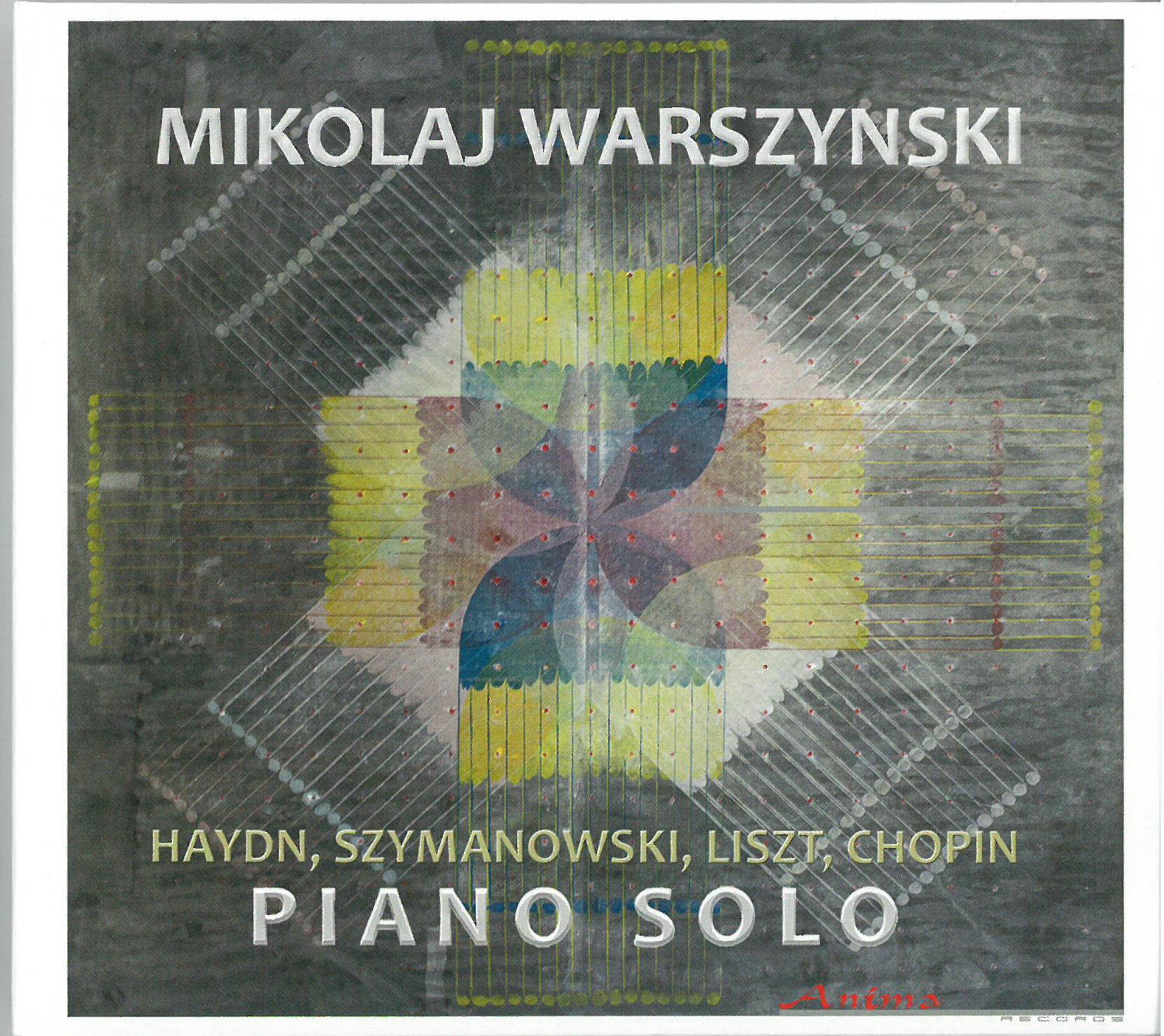
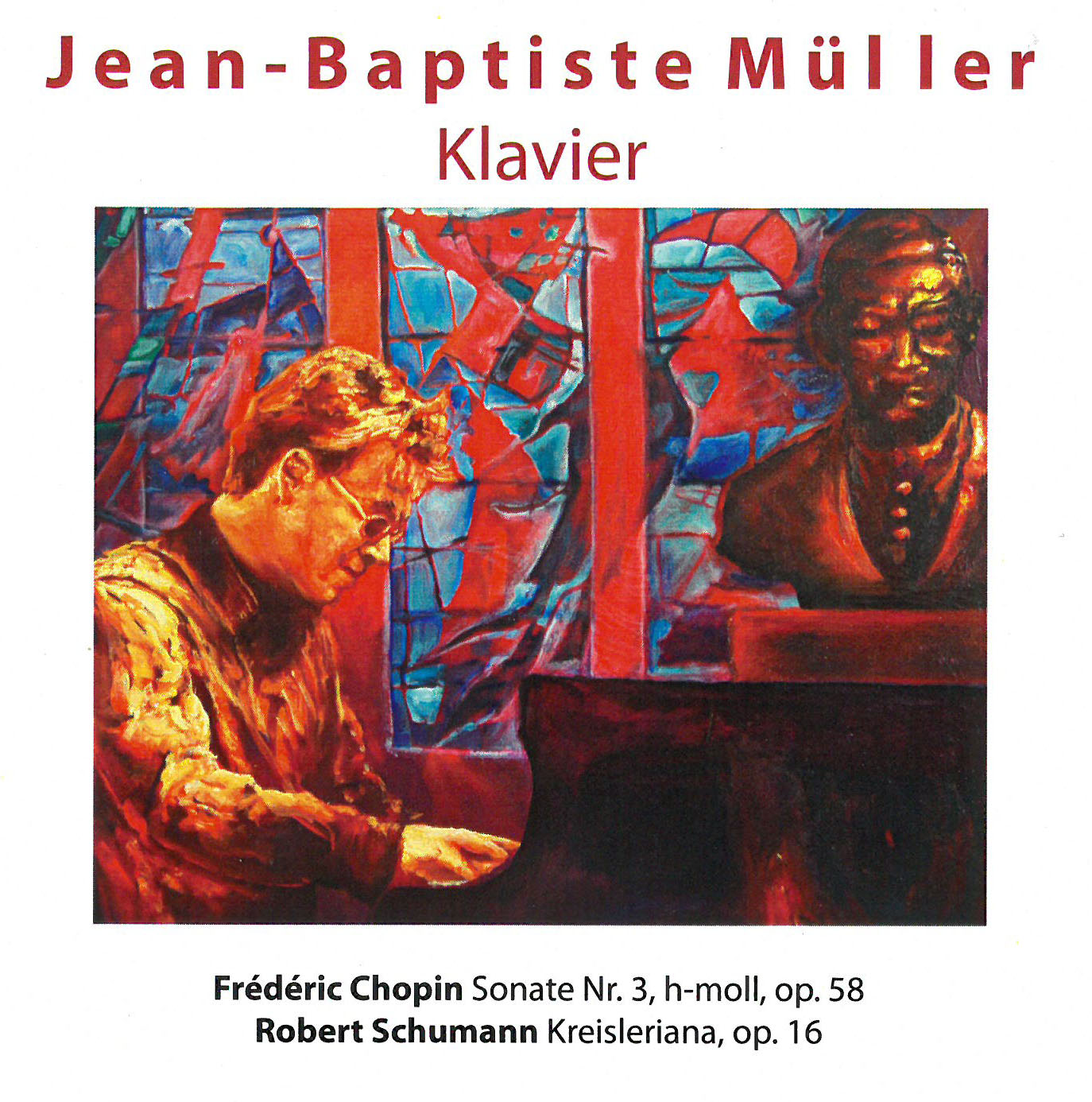
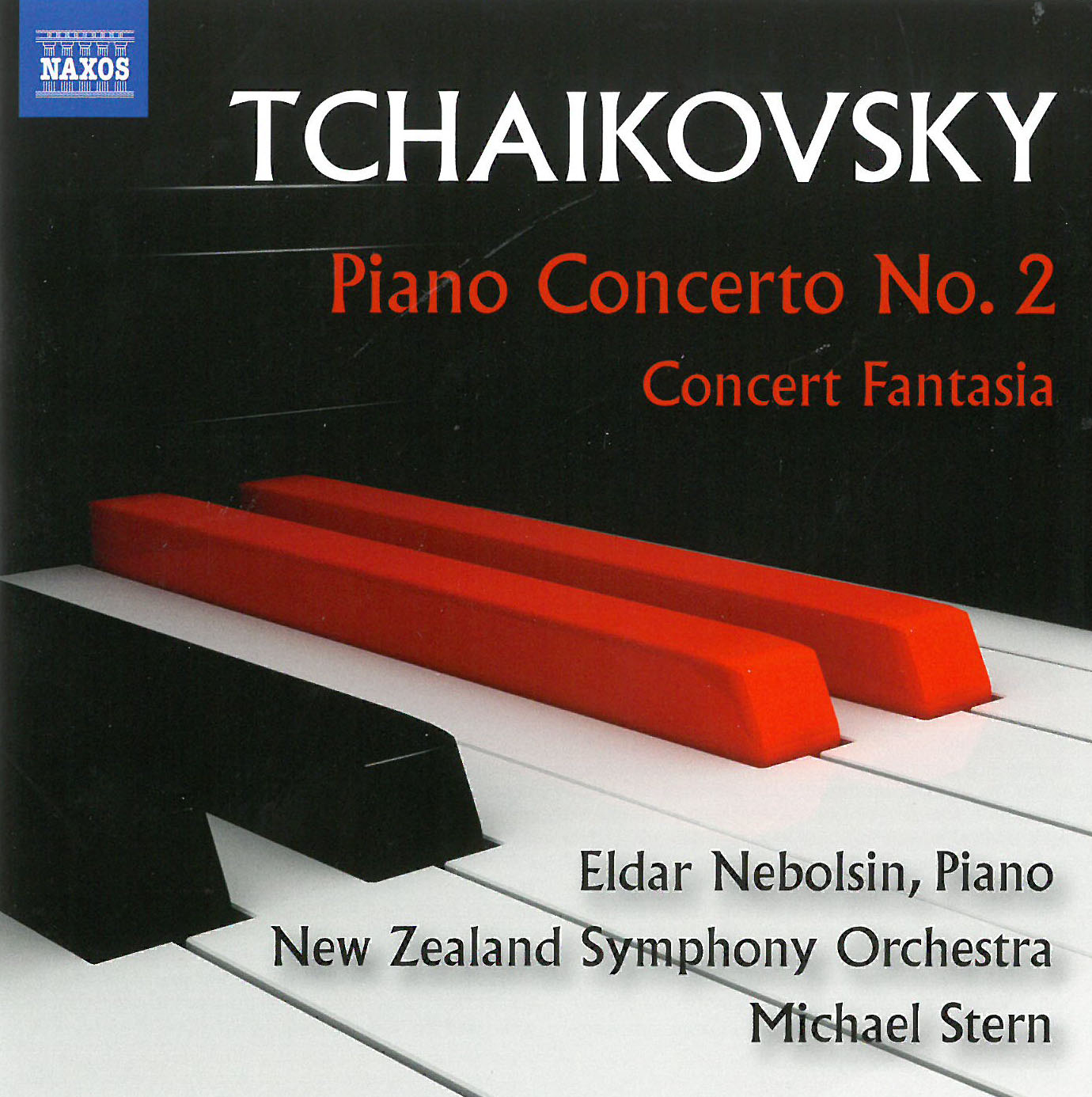
The symphony is perhaps the more significant recording here. It was written in 1984-85 for the Baltimore Symphony Orchestra and their conductor David Zinman, but Zinman left the orchestra before the work could be scheduled. This recording is the premiere performance of the symphony as well as the first recording.
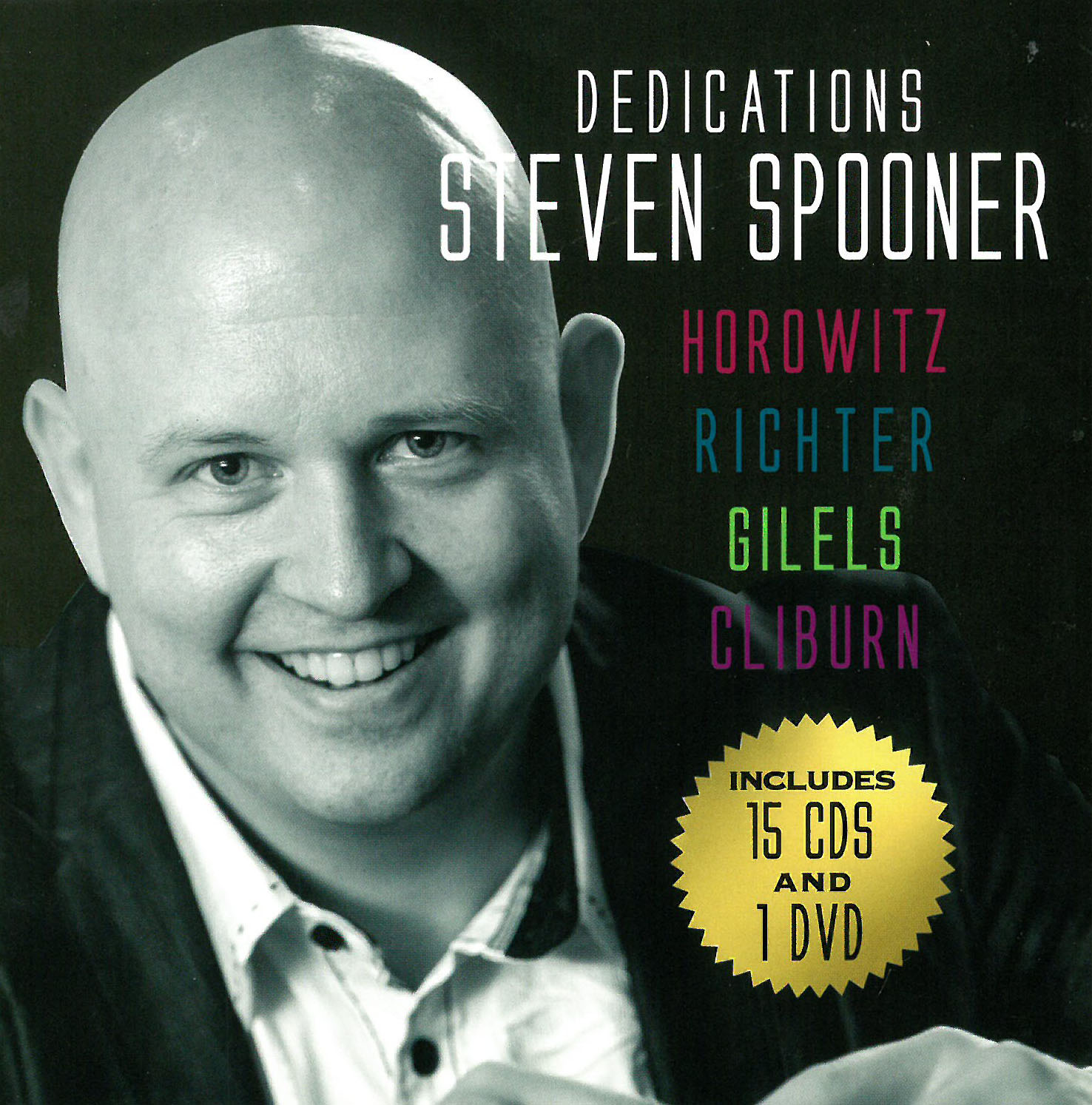
It’s a powerful three-movement work with a simply explosive start and a slow, expressive middle movement between two fast outer movements. The orchestration has a distinctively American feel, with more than the occasional hint of Leonard Bernstein, especially in the handling of the percussion and the rhythmic writing.

The short orchestral tone poem Drifting On Winds And Currents concludes an impressive CD.

Back to top