Music in the summer: the very notion evokes a field of pleasant images. I’m thinking of concerts in a green and flower-filled public park or a more intimate garden setting, touring groups appearing on festival stages throughout our province, as well as Harbourfront Centre’s lakeside venues teeming with casual, lightly clad crowds out for a good time. People generally appear more relaxed and good-humoured in the summer than in other seasons; smiles seem more common. The other seasons are meant for music encounters indoors. The few months of kind summer weather we are allotted make it an ideal time to cross paths – and share outdoor musical discoveries – with families from around the world.
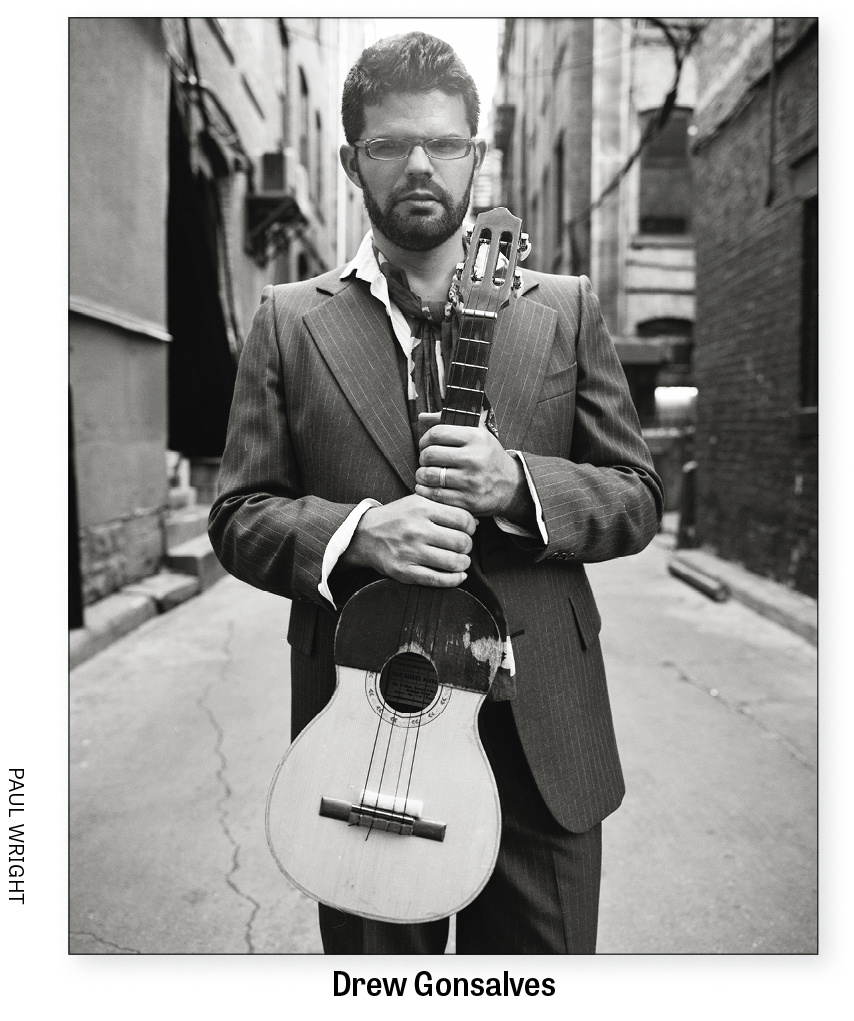
World-Gonsalves.jpgLuminato: The first major Toronto summer series featuring global music is the Luminato Festival, this year running from June 19 to June 28. In order to get a sense of the direction of the programming of interest to you, dear reader, I spoke with veteran music curator Derek Andrews over the phone. He pointed out that there will be changes this year to the venues, compared to recent Luminatos held at David Pecaut Square. “The big stage is gone at The Hub – which has a landscaped backyard garden theme this year. We now will have The Festival Shed, an indoor venue of around 200, plus an expansive outdoor venue with a much larger audience capacity called The Garden Stage (which the TSO will use on June 28). It will also host the 35 acts in my program.”

With numerous individual shows and several themed concert series spread over the ten days, Luminato has much to offer listeners out to explore world music. Many have “Americas” themes, pre-echoing the Pan Am games about to take over Toronto in July. To my regret, I can’t pretend to cover more than some part of the vast scope of this subsection of the festival. June 20, during the first weekend fete at Luminato, begins with the launch of “The North-South Project,” billed as “a collective work of storytelling authored by 12 celebrated writers working the breadth of the Americas, from the Canadian Arctic to Argentina.” It’s co-curated by Andrews and literary and ideas curator Noah Richler. The readings by the authors are accompanied by several singers articulating lyrics of dissent. Singer-songwriters Amai Kuda n’ Y Josephine, Drew Gonsalves and Quique Escamilla will also bring their own unique pan-American music to the festival stage.

Among the lineup is Ani Cordero, a founding member and drummer of the Mexican rock band Pistolera and other groups. Recordar, her latest solo album, is a tribute to the voices of dissent via reinterpretations of Latin American protest songs. Another participating artist, La Yegros, has been a powerful presence on the Buenos Aires underground music scene for years. Her signature voice and commanding stage presence is imbued with South American flair, but she also brings with it a globally aware mindset, drawing equally on deep regional folk traditions and cutting edge beats.

On June 21 the solstice, National Aboriginal Day and Father’s Day all fall on the same day. (As a dad, I’m hoping for a lavish BBQ dinner hosted by my sons as per family tradition.) Why not celebrate them all at The Hub with performances by four aboriginal women? Leela Gilday, a member of the Dene nation, transports the listener through her northern stories sung in a gutsy voice and open stage presence. Martha Redbone’s music blends Native American elements with her deep roots in Appalachian folk and Piedmont blues, plus soul and funk.  On the same day, the “New Canadian Music Series” features two emerging aboriginal musicians, cellist Cris Derksen and singer-songwriter Binaeshee-Quae. Derksen’s music braids the “traditional and contemporary in multiple dimensions,” weaving her classical music training and features embedded in her aboriginal ancestry “with new school electronics, creating genre-defying music.” Her 2010 debut album The Cusp was nominated for a Western Canadian Music Award and won the 2011 Canadian Aboriginal Music Award for Instrumental Album of the Year. Binaeshee-Quae, from Pic River First Nation, describes her musical style as “jazzy-alterna-folk mix.” She delivers her songs in a full-throated, sometimes quirky yet articulate mezzo.

Music curator Andrews has waggishly dubbed Luminato’s June 22 tribute to Mexico, “Distrito Federal Chilango Power Ska Punk meets Chiapas Mexico Message Music.” It is a mouthful, but it also serves as an accurate genre-inclusive tag. Headliners include the Toronto-based troubadour Quique Escamilla, the 2015 Juno Award-winning multi-instrumentalist singer-songwriter and producer. Active on the Canadian music scene since 2007, his powerful voice and passionate performances fuse Mexican genres such as ranchera and huapango with rock, reggae, ska, pop, jazz, cumbia, bolero and other Latin American forms. His incisive song lyrics are often keenly socially and politically engaged.

Los de Abajo from Mexico City is another politically committed group (they’re supporters of the Zapatista Army of National Liberation). Over a 23-year career, it has constructed a distinctive fusion of regional Mexican musics. A champion early on was David Byrne, in 1999 signing Los de Abajo to his Luaka Bop label. The group has gone from strength to strength, touring extensively and including yet more influences in its diverse palette: ska, reggae, hip-hop and even echoes of Balkan music.

Skipping to June 25, “Caribbean Calypso” is billed as a musical “exploration of coastal Caribbean Garifuna culture and Trinidadian Roots Reggae Calypso.” Taking centre stage will be the Canadian group Kobo Town. Named after the Port-of-Spain neighbourhood where calypso was born it was founded by Trinidadian-Canadian songwriter Drew Gonsalves. The group mixes Caribbean calypso and reggae using acoustic instrumentation along with innovative production, social commentary and an indie rock attitude. Independence, its debut album, won the International Folk Alliance Award. Another headliner is Aurelio Martinez. He is not only a star Honduran musician, but also a passionate politician and cultural ambassador for the coastal Garifuna people as well. Known by his first name alone, Aurelio possesses a gritty expressive voice with which he performs a compelling musical blend of received Afro-Caribbean cumbia fused with Latin rhythms.

The Luminato Festival celebrates in style June 27 with a “Brazilian Block Party,” billed as a “fun family event featuring day-long animation by strolling artists, craft-making workshops and irresistible food!” Luminato programmers aim to capture the Brazilian tradition of festive gatherings at this all-day public party with food, drink, music and dance, all elements embracing “a beloved part of the Brazilian cultural landscape.”

The Festival Hub’s Block Party is curated by Toronto’s own Uma Nota Culture, programming a “carnival of active cultural jamming.” That includes an invitation to connect with fellow Torontonians by dancing to live music – to irresistible forró music from the Northeast of Brazil, the martial arts-inspired capoeira and the ever-popular samba.

Among the notable acts taking the stage is the Quebec City-based Flávia Nascimento and her Smallest Big Band. Hailing from Recife, Pernambuco, Mundo Livre S/A is a genre-defining manguebeat band formed in 1984. Mundo Livre’s founding notion was to connect the culture of the mangues (mangroves) of Recife with a network of global pop genres. It has released three albums, the last of which was included in many best-of-the-year lists. Aline Morales has built a solid reputation in Canada as a percussionist and bandleader. Her Juno-nominated Flores, Tambores e Amores also showcased her interpretative, vocal and composer chops. With her project Forró Nite, Morales taps deeply into her forró music roots.

Among the newest Brazilian drum troupes in town, Tdot Batu is a diverse, youthful group performing samba reggae, but spun with their own edge. (Samba reggae became a hit in Salvador, Bahia, Brazil in the 1980s when the group Afro-Blocos mashed Bahian rhythms like ijexa and samba with Caribbean musical influences.) It sounds like quite the lively party.
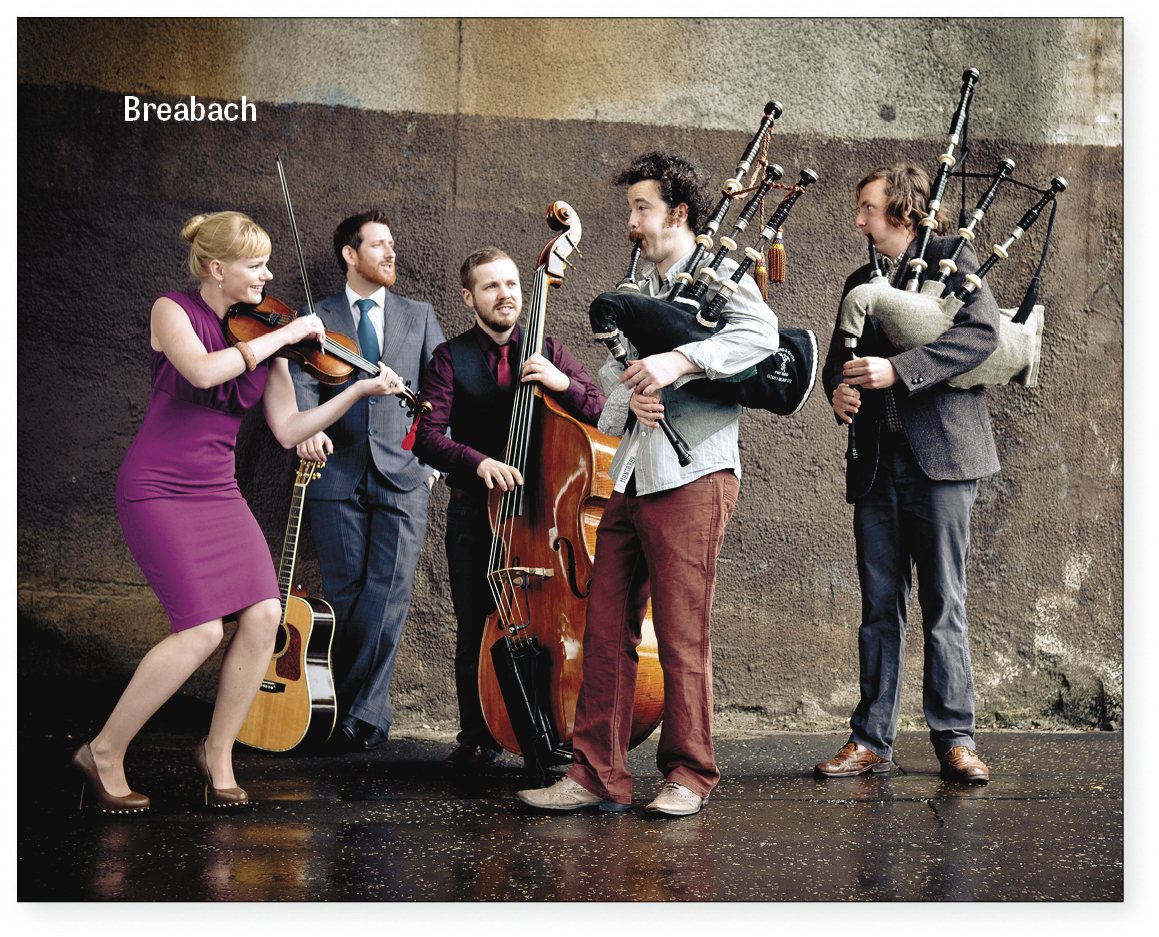
World-Brebach.jpgSunfest ’15, London, Ontario: Now to a festival decidedly outside of Toronto and sporting a pedigree older than most: TD Sunfest ’15. From July 9 to 12, downtown London’s Victoria Park is transformed into a culturally diverse playground where over three dozen world music and jazz groups entertain audiences on five stages scattered throughout the park. “Canada’s Premier Celebration of World Cultures” is its byline and all events are free.

Headliners this year include the venerable Afro-Cuban All Stars, and the new generation Scottish folk five-piece Breabach. It has been described as “the new face of Scottish Traditional music.” Paulo Flores, the distinguished Angolan singer-songwriter and author who performs in the semba genre, also takes the Sunfest stage. His lyrics often touch on the politics and hardships of Angolan life, and since 2007 he has served as a UN Goodwill Ambassador in Angola.

When my kids were young we repeatedly visited Sunfest, feasting on its small-town Ontario feel and diverse ethnic good vibes – but also on the scrumptious international street food and crafts for sale by dozens of vendors. That too is experiencing musicking in the summer for me.

Summer Music in the Garden: What more pleasant a reminder of the evanescent – and thus even more keenly savoured – summer in Southern Ontario than music in a garden? As it has for 16 years, Harbourfront Centre is this year again producing a delightful season-long series titled Summer Music in the Garden, skillfully curated by Tamara Bernstein. It’s held in the pleasantly verdant surrounds of the Yo-Yo Ma co-designed public Music Garden at 235 Queens Quay West. Cooled by the nearby waters of Lake Ontario, it’s all free. Make sure you get there in plenty of time however, to snag a seat on one of few benches. Also arrive early if you wish to claim a private pied à terre on the sloping lawn in front of the open air grassy stage area under the magnificent mature weeping willow. (I think you can guess I have performed and visited there many times over the years).

My picks? I can’t make up my mind from among the multiple tempting summer offerings. I invite you to check The WholeNote listings to discover your own old – or perhaps new – favourite. Relaxed, high-quality music in a garden: how can you lose?

A Celebration: June 14 Darbazi, the choir which was formed in a Toronto living room (yes, I was there), marks its 20th anniversary with a concert at St. Andrew by-the-Lake Anglican Church on Ward’s Island, Toronto. Darbazi is Canada’s first choir dedicated to the music of the various regions of the Republic of Georgia. Under the direction of Shalva Makharashvili and founding guest conductor Alan Gasser, the group hosts local groups Trio Zari and Hereti as guests to mark this significant occasion. I invite you to join me to celebrate in Georgian style with song, food and toasts to many more years of music and warm summer weather in which to enjoy it.

In keeping with my custom, I wish you a gloriously musical summer and invite you back to revisit me in these pages in September. 

Andrew Timar is a Toronto musician and music writer. He can be contacted at worldmusic@thewholenote.com.
Here be dragons is an English translation of the Latin phrase “hic sunt dracones,” a notation gracing a few medieval manuscript maps and reflecting the wider period practice of drawing dragons, sea serpents and other mythological creatures to identify regions of the unknown and fearful, dangerous or unexplored territories. Some researchers suggest the term may be related to the existence of giant lizards called Komodo dragons indigenous to a few small remote Indonesian islands – and which are still a tourist draw, in the region and beyond, as when in 2003 the first Canadian Komodo dragon was hatched at the Toronto Zoo.

Tales of such creatures, morphed by repeated telling into hybrid beasts, were common not only throughout Asia but also much of the world, acquiring complex and conflicting transcultural rap sheets over the centuries. The great majority – although not all – of dragons depicted in European stories and iconography represent chaos and evil (think St. George and his confrontation with his alter beast).  In Chinese legend and lore, by contrast, they are generally considered beneficial and represent orderly government, potency, auspiciousness, strength and good luck for those worthy of it. The Emperor of China often used the mythical animal as a symbol of his imperial power; in a more philosophical vein the dragon represents the yang principle complementing the phoenix’s yin. In recent decades the term “descendants of the dragon” has become a self-identifying marker of national, ethnic identity among some Chinese, both in the Chinese homelands and throughout the extensive diaspora.

A case in point is the Sound of Dragon Music Festival making its Ontario debut in five Southern Ontario venues from May 20 to 24. Its artistic director, Vancouver-based Lan Tung, explained in a recent phone conversation that the first characters calligraphed in the festival’s descriptive Chinese title refer to dragons singing across the ocean. It’s a potent poetic metaphor for music deeply rooted in Chinese tradition but expressed with a characteristic Canadian inclusive accent. Tung’s instrument the erhu, as well as others such as the pipa, zheng, sheng and ruan will share the spotlight with the violin, viola, cello, bass, flute and clarinet, enlivened with world percussion instruments. Together they perform scores by composers of several nationalities.

2008_-_World_-_Irineu_Nogueira.jpgLaunched last year in Vancouver, the festival, Tung notes, “brings a unique approach to preserving traditional [Chinese] music, while promoting creativity and innovation.” The festival’s core contingent is made up of members of the Vancouver Inter-Cultural Orchestra (VICO), along with collaborating musicians from Taiwan and Toronto. VICO, founded in 2001, has been described as “the United Nations of music” (CBC Radio) and “music that sounds like Vancouver looks” (Georgia Straight). It’s a significant and I believe particularly Canadian music development — a professional orchestra devoted to the performance of newly created intercultural music. It was one of the first such ensembles in the world and is the only one of its kind in Canada, a testament to the spirit of cultural cooperation many of us like to think exemplifies the best in Canadians.

VICO’s core roster consists of 24 musicians, trained in many world music traditions. Its mission is to “act as a forum for the creation of a new musical art form, one in which all of Canada’s resident cultures can take part….”  It moreover “serves as a voice for Canadian composers and musicians of diverse backgrounds, and fosters the creation of musical works that fuse and transcend cultural traditions.” To date VICO has commissioned and performed over 40 new works by Canadian composers.

The Sound of Dragon Festival, Tung explains, aims “to intertwine diverse styles: ancient, folk and classical Chinese repertoire, as well as contemporary Canadian compositions … and creative improvisation.” By presenting musicians from different ethnicities, nationalities, and musical genres, it aspires to “re-define Chinese music and reflect Canada’s multicultural environment.”

Each concert of the festival has a slightly different focus. It kicks off May 20 with a free concert at the Blue Barracks of the Fort York National Historic Site where members of VICO, Taiwan’s Little Giant Chinese Chamber Orchestra and the Toronto pipa virtuoso Wen Zhao perform traditional and contemporary music written for Chinese instruments, joined in the second set by guest players from  Toronto’s creative music scene to collectively explore and improvise with multiple combinations of Chinese, Western and other instruments.

May 21, as part of Small World’s “Asian Music Series,” the Sound of Dragon Festival takes the Small World Music Centre stage, presenting an intimate evening with musicians from the Little Giant Chinese Chamber Orchestra and VICO, joined by Wen Zhao, pipa soloist. The concert finale features the Toronto premiere of Vancouver composer John Oliver’s Eagle Flies to Mountain, a work which animates notions of the four elements (earth, air, water, fire) through musical combinations, and which also invokes the essential complementary duality of the ancient concept of yin and yang.

The following day, May 22, the festival moves north of Steeles Ave. to the Flato Markham Theatre. Free Chinese instrument workshops in the afternoon will be followed by an evening concert featuring a 12-member chamber orchestra conducted by the Taiwanese maestro Chih-Sheng Chen. The orchestra, consisting of VICO core instrumentalists augmented by musicians from Taiwan and Toronto, will perform Lan Tung’s 2014 signature work Sound of Dragon, a lively blend of the well-known Chinese piece Crazy Snake Dance infused with North African rhythms and sprinkled with improvised solos.

Saturday May 23, the festival shifts to the Aeolian Hall in London presented in a concert by Sunfest, formally known as the London Committee for Cross-Cultural Arts Inc. Members of VICO and Little Giant Chinese Chamber Orchestra join forces once again to present a program of Chinese folk music arrangements and commissioned Canadian works, including  “Indian, klezmer, Persian, Chinese and Taiwanese,” and no doubt Euro-North American essential features too.

May 24 the Sound of Dragon Festival completes its Southern Ontario tour with a concert at The Jazz Room, Huether Hotel in Waterloo, produced by Neruda Arts, K-W’s world music presenter.

Meden Glas: May 2 Toronto’s Meden Glas releases its debut album Balkan Mixologies at the Music Gallery. The group is directed by ethnomusicologist Irene Markoff, a specialist in Balkan and Turkish vocal styles and the bağlama (long-necked lute). Members of its expanded group and Bulgaria’s virtuoso kaval (end-blown flute) player Nikola Gaidarov will join the core quintet. Together they present a journey into the vocal styles, intricate rhythms and instrumental music of Croatia, Bulgaria, Macedonia, Greece, Turkey, Sardinia, Russia, as well as that of the Kurds and Roma. They promise an “adventure that will bend your ears and get the evening kicking with your dancing feet!” I’m in.

Footsteps of Babur: May 8 the Aga Khan Museum in conjunction with the Aga Khan Trust for Cultural Music Initiative present “Footsteps of Babur,” referring to Babur, the founder of the Mughal Empire, and the legendary lavishness of 16th-century Mughal court life in which music of many kinds and from many regions and performance genres played a prominent role. Musicians Homayun Sakhi (Afghan rubab), Salar Nader (tabla) and Rahul Sharma (Indian santoor) evoke the light refined music that filled the palace rooms of Mughal India and Afghanistan in centuries past. Sharma is the son of the important Northern Indian santoor player Shivkumar Sharma, often credited as the man who established his instrument in Hindustani classical music performance.

Jayme Stone’s Lomax Project: Also May 8, “Jayme Stone’s Lomax Project,” also the title of their delightful new album takes the Koerner Hall stage. Two-time JUNO-winning banjoist, composer and band leader Stone has distilled and reinterpreted songs made by the American ethnomusicologist and folklorist Lomax, along with his distinguished instrumental and vocal collaborators. Lomax is justly celebrated for his field recordings conducted over the 50 years straddling the middle of the 20th century. The project revives for our century the voices and spirit of that era’s rural Americana. We hear stirring renditions of sea chanties, fiddle tunes, work songs, moving Georgia Sea Islands African-American a cappella singing and Appalachian ballads. It’s an important roots revival album, and audiences can expect Stone at the core of his tight ensemble at Koerner Hall adding deft touches of his musically nuanced, never superfluous, banjo playing.

Asian Heritage Month at the TPL: May is Asian Heritage Month in Toronto. As in previous years the Toronto Public Library is celebrating it in various ways, including free music performances given by select musicians from Toronto’s Asian music diaspora. May 16 at 1pm the Richview, Etobicoke branch presents Andrew Timar (yes that’s me moonlighting as a musician) and dancer Keiko Ninomiya in a program of “Southeast Asian Dance and Music Fusion” set within a North American aesthetic. North York Central Library’s Auditorium’s stage will be particularly musically active this month. May 21 “The Music of China” takes to its intimate stage with a program of “regional, contemporary, and Western music.” For “An Afternoon of Persian Music” on May 23 the polished Shiraz Ensemble performs music from the Persian Qajar dynasty, plus works by the important composer and santur player Farāmarz Pāyvar (1933—2009), as well as improvisations.

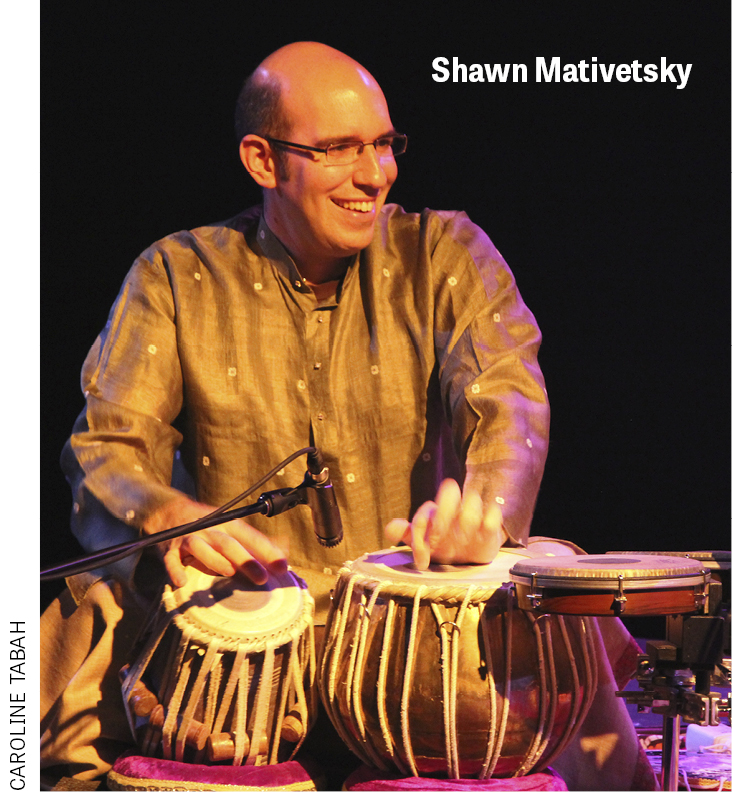
2008_-_World_-_Shawn_Mativetsky.jpgPedram Khavarzamini and Shawn Mativetsky: May 16 Pedram Khavarzamini and Shawn Mativetsky headline at the Music Gallery in a program titled “East Meets Further East.” The concert’s goal is to highlight Iran and India’s deep drumming traditions. Montrealer Mativetsky, performing with bassist George Koller, is an accomplished tabla performer and educator, an exponent of the Benares gharana and disciple of the tabla maestro Pandit Sharda Sahai (1935—2011). Mativetsky teaches tabla and percussion at McGill University and is a passionate advocate of tabla in contemporary music of many genres. Khavarzamini, who was among the most sought-after tombak teachers and players in Teheran when he was a resident there, will perform with tar virtuoso Araz Salek. He has co-authored several books on the drum’s technique and repertoire. In the early 2000s he was invited to join the Greek music innovator Ross Daly’s group Labyrinth and moved to Europe to pursue his music career. He has toured the world with musicians such as Dhruba Ghosh, Dariush Talai, Vassilis Stavrakakis, and others.  Last year he relocated to Toronto, a move which is our city’s and our country’s gain. These two outstanding Canadian drummers will explore much of the range of their respective instruments and rhythmic vocabularies, culminating in a collective performance.

Lulaworld Festival: The Lulaworld Festival is celebrating its tenth anniversary, and this year it’s a whopper. More than two dozen concerts, family workshops, Brazilian parade and other events at the Lula Lounge and environs between May 27 and June 6 work the theme “Celebrating the Music and Dance of the Americas!” Presented by Lula Music and Arts Centre, it’s billed as the summer’s Toronto 2015 PAN AM Games pre-party, guaranteed to “get Toronto dancing to the music of the Americas.” Even if you don’t dance in public, you can expect a healthy serving of Toronto’s finest world, jazz and Latin musicians, often collaborating with international guest artists on Lula’s intimate stage. With a festival on such a vast scale, I can only hint at the musical – and dance – wealth to be discovered. 

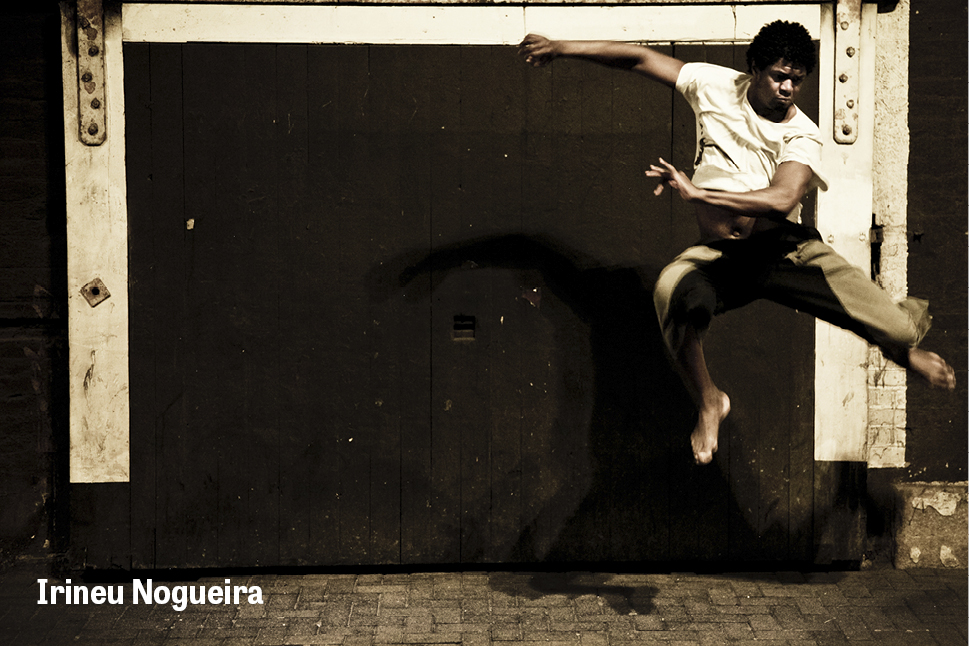
May 27, the festival’s opening night, Toronto’s leading Brazilian dance company Dance Migration is joined by guest Sao Paolo-based percussionist Alysson Bruno and Irineu Nogueira.

May 30 the Lula All Stars release their new CD. The group of musicians with roots from across the Americas plays at Lula Lounge’s weekly live salsa series, co-led by Sean Bellaviti and Luis Orbegoso.

Saturday, June 6, the Lulaworld stage at the Dundas West Fest will be chockablock with Latin jazz, salsa, Jamaican ska, Afro-Caribbean jazz, Spanish rock and pop, Canada’s biggest participatory Brazilian drumming parade and “family-friendly workshops.” Best of all, it’s all free.

Andrew Timar is a Toronto musician and music writer. He can be contacted at worldmusic@thewholenote.com.
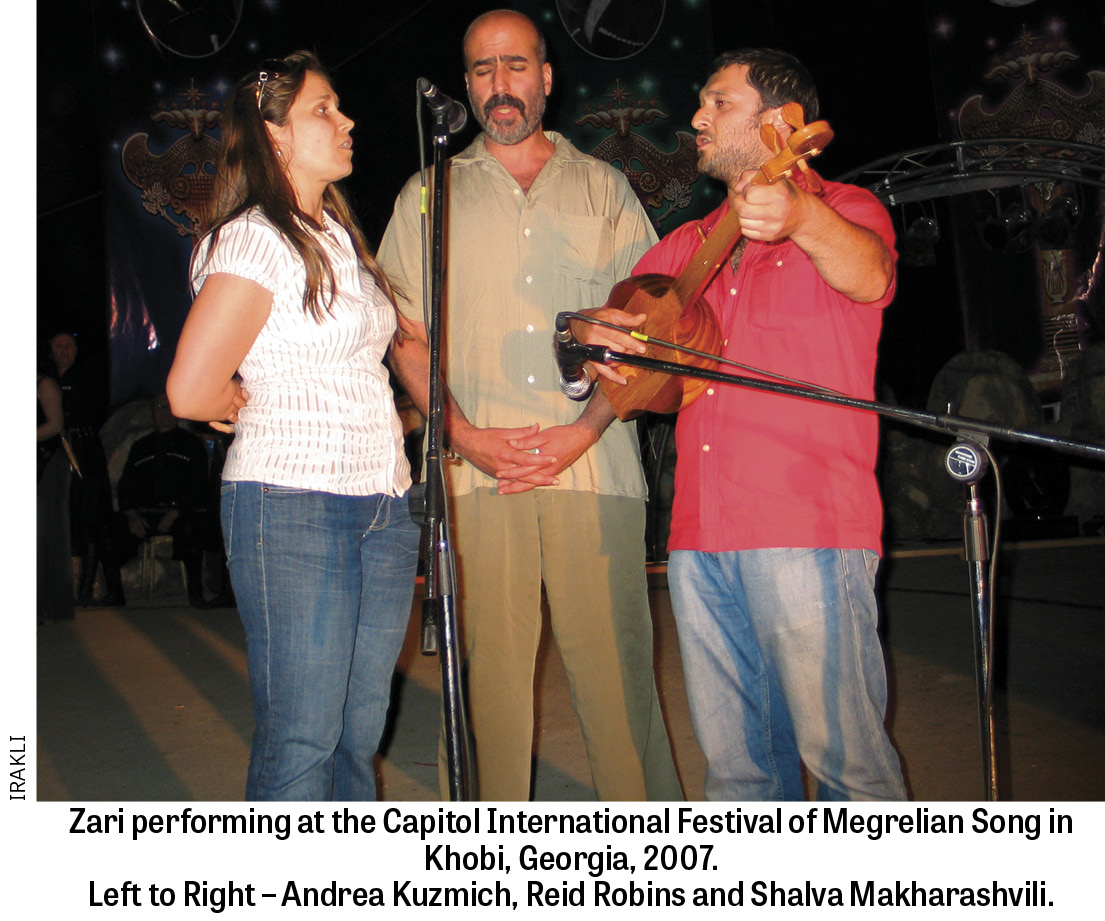
2007-World-ZariTrio.jpgLet’s call it a personal rite of spring. Along with those first warm sunny days, I also look forward to engaging with the larger world in concerts at several of our region’s universities and concert halls.

This season, my first focus falls on Toronto’s award-winning vocal and instrumental trio Zari, which performs April 25 at the little jewel of downtown venues, Musideum. Composed of Shalva Makharashvili, Andrea Kuzmich and Reid Robins, Zari (meaning “bell” in Georgian) draws on the rich regional repertoire of the polyphonic songs of the Republic of Georgia. Standing at the crossroads of Europe and Asia, their ancient country is called Sakartvelo by Georgians.

Declared an Intangible Cultural Heritage of Humanity by UNESCO in 2001, Georgian vocal polyphony, with its close harmonies and untempered scales, is characterized by three-part singing in a variety of regional styles. The songs range from the haunting melismatic melodies of the Eastern provinces, to the wild, explosive counterpoint of the West. They also include more recent romantic urban ballads.

Like many other groups I’ve highlighted in this column who have musical affiliations to another part of the world, Zari was made in Toronto. I spoke with the singer, ethnomusicologist and group co-founder Andrea Kuzmich to get the skinny on Zari.

“It was formed in 2003. We met each other a few years earlier at the downtown Toronto living room singing sessions of Darbazi” (Canada’s first Georgian choir). Kuzmich quickly identified a key feature of the group, its dedication to studying the older strata of Georgian music in its birthplace. “We want to deepen our understanding of and feeling for this musical treasure. When Zari performs, we embrace the profundity of Georgian culture: its roots embedded in ancient times, its strength and courage to survive and its inspiring hospitality.” To that end the trio plans to return to Georgia this October for another round of studies and concerts.

And like numerous Canadian groups that reference other geo-cultural milieus, Zari is perhaps better known there than here. Kuzmich notes that during past Georgian tours, “we have performed at the Chveneburebi festival, Festival of Megrelian song, First International Festival of Gurian Song and other festivals that have taken us around the country.” They have also been featured at the “best performance halls of [the capital] Tbilisi, such as the Opera House, and the Philharmonia Concert Hall.”

In addition to formal concert venues, Kuzmich points out the hard-to-overstate significance of the supra. It’s the traditional, often epic, Georgian feast which serves as an important locus for Georgian social culture – and singing. “You know ... there’s a saying that the best performances happen at the supras after the concerts. We can’t really predict how many supras we’ll attend or which ones will be most educational.” And the supra is such an integral part of Georgian culture that it’s not easy to separate the supra from what happens each day. “There will be [formal] toasting every day, if not multiple times in the day, perhaps even around a table while we’re learning a song. In that case the line between supra and lesson gets blurred.”

She gives an example of how such productive blurring can evolve. “[One day] we were all set to have a lesson, but instead had an impromptu midday supra at a small local house-restaurant in Makvaneti, the village of our Gurian [region of Georgia] teachers …. At the supra they sang many songs, interlaced with stories about music-making from when they were little boys, during Soviet times, and today. We sang with them too, sometimes trading off at inner cadence points. We probably sat there for over three hours. All three of us [in Zari] felt inspired and very connected to the tradition [after that experience], and we learned so much in that one sitting.”

I asked about Zari’s Musideum set list. “We’ll be performing songs from several regions of the country,” said Kuzmich. She mentioned a few songs on their long list. One of the Gurian songs is Chven Mshvidoba (Peace to Us). “We are in the process of learning a fourth or fifth variant, though in performance we tend to just let the improvisation happen.” Maglonia, a lyrical song from Samegrelo, features accompaniment by the panduri, a prominent Georgian three-string lute. “There are a few versions we are listening to, but the one we mostly base our version on is by Polikarpe Khubulava, the Georgian master singer who passed away on January 1, 2015,” she added. “We will also do songs from [the regions of] Imereti and Achara, which are similar, though Imereti has more parallel thirds in the top voice, plus one of those dense Svaneti chordal songs. It’s a place which is snowbound for eight months of the year and the songs, like the people, are rugged.”

Zari feels the need to regularly re-connect with those wellsprings of the oral musical tradition they’ve been born into – or as in the case of Kuzmich, chosen – in order to fuel their inspiration and artistry. Their Musideum concert is part of a series of fundraisers to help get them back to Georgia to study with elder master singers, some well past retirement age. In addition to such venerable living connections to the past, the trio also plans to re-connect with researchers at the Conservatoire, including colleagues at the Ethnomusicology Department and the Research Centre for Traditional Polyphony. “Giorgi Donadze, the leader of Basiani [a prominent choir], is also the director of the State Folk Centre, so we’ll be connecting with that institute,” adds Kuzmich. “And we always try to meet up with Anzor Erkomaishvili, who endows us with new publications on Georgian music.”

It’s always exciting to hear such a depth of passion and engagement from an artist. I plan to catch Zari’s Musideum show to hear the latest in the evolution of Georgian music, Toronto style.

World music in the university: April 1 the University of Toronto Faculty of Music holds its annual spring concert of World Music Ensembles at Walter Hall, Edward Johnson Building. This season it’s the African Drumming and Dancing, Latin American Percussion and Steel Pan student groups’ turn to shine. Kwasi Dunyo, the Ewe master drummer from Ghana who has for two decades been teaching in universities and schools in Canada and the U.S.A. from his Toronto home base, leads the first ensemble. The Latin American percussion group is led by the accomplished Mark Duggan, an orchestral percussionist, composer and jazz musician. Even 32 years ago his highly honed skills were in demand: he was chosen to play with Canada’s first gamelan, the Evergreen Club. Michelle Colton, an emerging multi-percussionist and educator, directs the Steel Pan ensemble.

The next day, on April 2 at noon, the world music focus shifts to the Maureen Forrester Recital Hall, Wilfrid Laurier University, Waterloo, where the Conrad Grebel Gamelan Ensemble performs, directed by Maisie Sum. Introduced into the university as a course only two years ago by Sum, the gamelan semara dana, a kind of Balinese tuned percussion-rich instrumental ensemble, is the first of its kind in Southwestern Ontario. In an interview with The WholeNote a year ago professor Sum reported an enthusiastic reception for the music among the students. “Enrollment for the ensemble doubled in the winter term, so we currently have two groups.”

After the excitement of the noon-hour Waterloo Balinese set, there’s still plenty of time to get down to St. Catharines’ Brock University the same day for an evening concert. Jaffa Road performs at the Sean O’Sullivan Theatre, Centre for the Arts. The JUNO short-listed Toronto world music group offers an amalgam of sacred and secular Jewish song, jazz, Indian and Arabic music, with touches of electronica and dub.

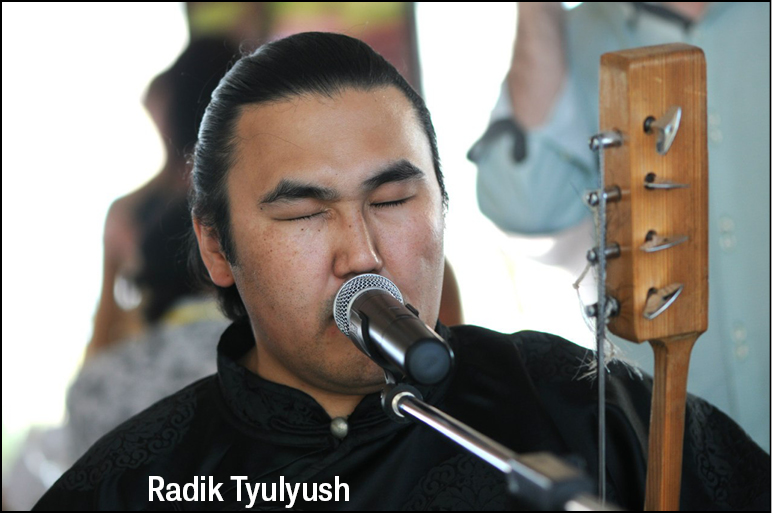
2007-World-GilbertoGil.jpgBrazil’s musical ambassador: April 7 the Royal Conservatory of Music presents “Gilberto Gil: Gilberto’s Samba” at Koerner Hall. Hailed as “Brazil’s musical ambassador,” for more than 40 years the singer, composer, guitar player – and former Minister of Culture – has enjoyed an extraordinary career. Gil is perhaps best known as an eloquent exponent of bossa nova, but he is also a pioneer of the tropicalia and Brasileira genres. The New York Times summed up his monumental yet affable stage presence: delicate bossa novas, strummed rockers and intricate sambas … Mr. Gil didn’t trumpet his virtuosity. It was offered genially, like his melodies and his un-didactic thoughts on love, poetic license and mortality.”

Taiko meets tabla: April 11 two established groups on the Toronto world music scene join for an evening of transcultural percussion-centric musical dialogues. The Japanese taiko group Nagata Shachu directed by Kiyoshi Nagata meets the JUNO-nominated Toronto Tabla Ensemble directed by Ritesh Das on the stage of the Brigantine Room, Harbourfront Centre. Having attended concerts by both groups from their early days, it’s evident that collaborations are important to each. Nagata shares that “I feel that the primal and thunderous sounds of the taiko are a perfect complement to the subtle and intricate rhythms of the tabla. Ritesh and I feel a certain connection, both musically and in terms of how we were trained in our respective traditions.” The personal history the two directors share is an important link between their groups. “I am thrilled to be once again working with Kiyoshi Nagata,” reflects Das. “[He was] one of the first artists I collaborated with after coming to Toronto in 1987. When we rehearsed for the first time in 20 years, I felt a new sense of maturity from both ends, which led to an immediate understanding between us. Together we can create a very rich and elegant Indo-Japanese collaboration.” This respectful fusion not only marks an advanced musical maturity, but is a positive thermometer of the future health of Toronto’s world music scene.

At the Aga Khan Museum: A week later the new Aga Khan Museum and the well-established Raag-Mala Music Society of Toronto join forces for the first time in two concerts at the Aga Khan Museum Auditorium. Titled “Miyan-Ki-Daane: Raags of Tansen,” the programs, presented in the Hindustani dhrupad and khayal music genres, celebrate the music of Miyan Tansen, a bright star among the composers and singers of Emperor Akbar’s 16th-century North Indian court. His beautiful compositions have been passed on through many generations of oral tradition through the guru-shishya parampara, the particular manner of transmission from teacher to disciple in traditional Indian culture.

The first program April 18 features singer Samrat Pandit and bansuri (bamboo flute) player Rupak Kulkarni. The singer received the prestigious Sangeeta Shiromani Award from the State of Maharashtra just last year, while Kulkarni is widely recognized as a leading bansuri player. On April 19 Uday Bhawalkar, among the foremost exponents of dhrupad singing today, and the respected sitarist Partha Bose, present an unusual 11am late morning concert. Audiences will thus have a rare opportunity to hear raags appropriate to that time of day, a practice still maintained in Hindustani classical music. It’s definitely worth making alternate work arrangements for this concert.

April 24, also at the Aga Khan Museum, sounds of the Sahara, the Magreb and West Africa are blended with contemporary pop and funk by the powerhouse Noura Mint Seymali. This compelling singer, a star in Mauritania, was born into a prominent Moorish griot family. She is also a master of the ardine (nine-stringed harp) and a composer.

Andrew Timar is a Toronto musician and music writer. He can be contacted at worldmusic@thewholenote.com.
2006-World-Tova_Kardonne.jpgDuring the relentless winter choke-holding the eastern half of our continent we occasionally see signs of weather more benign. Not that I’m complaining about our crisp white-scaped great outdoors, mind, but I’m not complaining either about music’s special power to open the world’s window wide to another, less icy landscape.

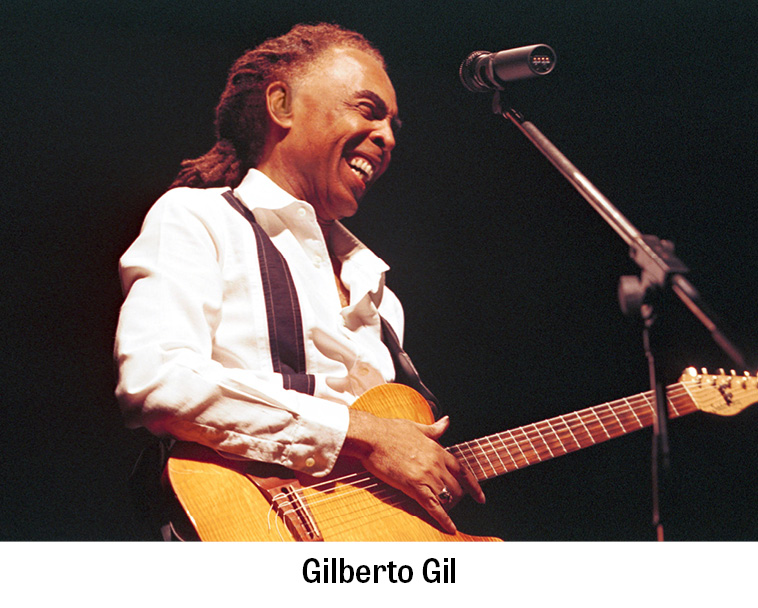
A case in point is The Lanka Suite. In it the multi-talented emerging Toronto-born composer, vocalist and violist Tova Kardonne evokes Sri Lanka’s lush natural and human landscapes, expressing her outsider musical explorations in her distinctive jazz and chamber music-inflected music. The Ashkenaz Foundation and Koffler Centre for the Arts co-present the work performed by a choir, an instrumental ensemble, as well as a vocal and an instrumental soloist, in concert at The Music Gallery on March 14.

I called Kardonne on a frosty February afternoon to chat about her ambitious Lanka Suite, and how she got there. Even before pursuing a career in music, she told me, her passion for mathematics – in which she has a degree – initially took centre stage. “I developed a taste for aspects of beauty and emotion in mathematics, for its elegance as well as its ugliness. These are parallel to characteristics I also felt in music.” But she also pursued viola and piano studies at the Royal Conservatory of Music, as well as singing alto in a series of choirs. “Singing (and playing) the alto voice is a great place to be for a composer: right in the middle of the music!” It’s a practice she actively maintains with Andrea Kuzmich’s Broulala, Christine Duncan’s The Element Choir and with the GREX vocal ensemble directed by Alex Samaras. (The latter choir has a core role in the performance of The Lanka Suite on March 14. )

In addition to music, Kardonne explained that dance has been another key to her artistic expression. “I originally studied dance with Jeannette Zingg of Opera Atelier. Later, in ’99 I was introduced to the freedom and discipline of contact improvisation, attending downtown Toronto’s weekly Contact Dance Jams. Improvised movement reinforced my evolving understanding of creation and intention. Though I didn’t quite realize at the time, it would prove important in shaping my compositional process down the road.” In 2014 she remounted an evening titled “60×60 Dance,” continuing her ongoing engagement with the dance world. It featured 60 different combinations of Canadian choreographers and composers, a complex project she co-curated and produced.

Having completed a degree at Humber College concentrating on vocal jazz, composition and arranging in 2008, jazz certainly figures in Kardonne’s musical language. She has involved a number of Toronto’s jazz elite in The Thing Is, her current eight-member band. It has included Jim Vivian, Dave Restivo, Ted Quinlan, Peter Lutek, Rich Brown, Rob Clutton and several others since its inception. Currently she favours musicians with mixed resumés who are able to excel in what she calls “non-idiomatic improvisational contexts.” That’s why she notes “my band is called The Thing Is, because it reflects an open-ended process of becoming,” an ensemble musical work. She creates an evolutionary, boundary-crossing and collegial atmosphere in the ensemble: “As my music evolved, it has attracted different kinds of musicians. At least two of them have been around [the scene] for long enough that I don’t really know where they ‘come from’.”

Kardonne points out one more significant element informing The Lanka Suite: for the lack of a better term, its “world music” features. It goes back to the Klezmer bands she played in, starting in her teens, as well as her grandparents’ Eastern European Jewish roots. “My mixed family heritage directed me along the path of seeking connections through the differences.” Citing her studies of Cuban santería batá drumming, North and South Indian drumming patterns, and her participation in the Brazilian Samba Elégua group, she conludes that  “deep down, I’m driven by rhythm.” In The Lanka Suite this fascination is reflected in unusual time signatures and phrases, drawing from both South Asian and Eastern European folk idioms, though couched in the instrumentation of a jazz combo with its affiliated rich harmonic field.

I asked Kardonne for The Lanka Suite’s back story. The four-part composition was “inspired by a trip with my partner [the experimental electric guitarist] Nilan Perera to Sri Lanka in 2012. He wished to reconnect with family for the first time since the end of the conflict in 2009 and to talk to some of the generation of artists who had grown up in the midst of conflict, not as he had, in the diaspora.” While Kardonne was a complete stranger to the country, she recounts that “those things which were most new and strange nonetheless had parallels in my experience.” Her first-hand observations elicited contrasting emotions of joy as well as confusion. She also encountered a society in transition, rebuilding the fabric of families and institutions after a devastating 30-year civil war. One music seed was sown when Kardonne heard a girl sing to entertain fellow bus commuters on the A9 highway to Jaffna, the northernmost city on the South Asian island nation. She notated the girl’s song and it surfaced in the work’s first movement titled “A9 to Jaffna.”

On returning home, her life-altering experience compelled her to rethink her “own understanding of life back in Canada through the lens of what I learned from Sri Lanka.” The profound themes she explores in her lyrics for The Lanka Suite include Sri Lankans’ essential connection to the land and the importance of self-definition through politics, even though this trust seems inevitably doomed to be betrayed by the political class. The ravages borne by the abundant natural world and the shifting role of women are also examined.

When she first presented The Lanka Suiteat The Rex Hotel last year in its stripped down eight-musician version, the favourable audience reception centred on perceptions of cultural familiarity, despite the score’s vibrant mash-up of musical idioms. Various listeners “picked up on what in the music seemed familiar to them” reported the composer, “but I certainly felt vindicated when people told me ‘I hear you and that’s my music too.’” Infusing additional jazz sparkle to The Lanka Suite’s full airing at the Music Gallery, the multi-JUNO Award winningflute and soprano saxophonevirtuosa Jane Bunnett joins Kardonne, her seven-piece band The Thing Is, and the GREX choir.

Opening the evening is Khôra, the experimental music project of Toronto’s Matthew Ramolo. He performs his music on acoustic and electronic instruments, as well as field recordings and analogue/digital processing, summoning “the spirit of Eastern modes, contemporary classical, avant and sacred minimalism, experimental rock and various forms of electronic music.”

Other Picks:

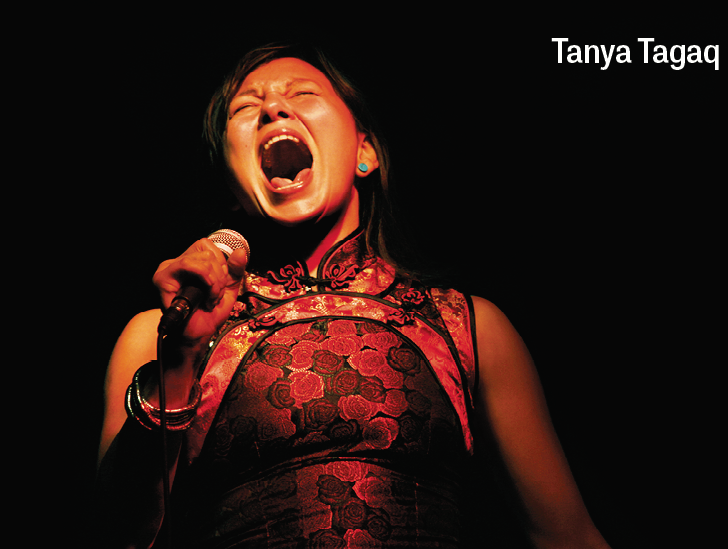
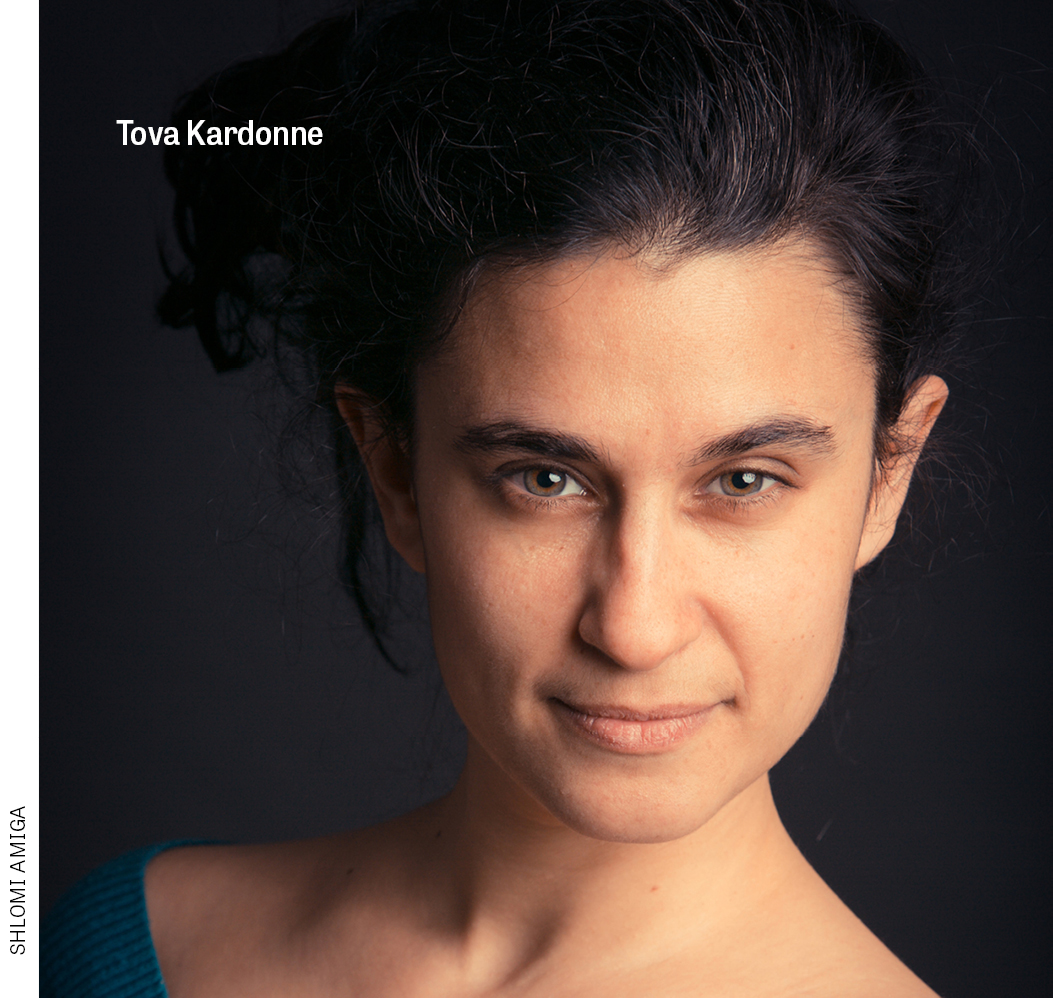
2006-World-Radik_Tyulyush.jpgMarch 6 and 7, Tuvan singer Radik Tyulyush and Inuk diva Tanya Tagaq, two masters of throat singing, split the bill at the Aga Khan Museum, presented with the support of Small World Music. Though drawing on musically distinct cultures over 6,000 kilometres apart, it’s a rare pleasure for Toronto audiences to witness these outstanding performers on a single stage. The abundantly talented Tyulyush, a member of perhaps Tuva’s most successful music group Huun Huur Tu, is not only a leading performer of the several types of indigenous throat and “regular” singing, but is a master of several Tuvan instruments including the igil, doshpuluur, shoor and khomu. He’s a Tuvan rock star to boot. His set opens the concert.

Tagaq follows. I covered her Polaris Prize performance and reviewed her brilliant album Animism which sealed the win last fall in The WholeNote. There’s no doubt in my mind that she’s among the most musically, emotionally and politically compelling avant-garde vocalists working today. I’m not sure if I have ever deemed a performance a must-see in this column, but her live vocal confrontation, accompanied by her band, of a screening of the silent film Nanook of the North (1922) is such a show.

March 12 at the Sony Centre for the Performing Arts, Japan’s Kodo Drummers return to Toronto, after a four-year absence, with their “Kodo One Earth Tour: Mystery.” I’ve seen them before and this taiko (Japanese drum) group which has been setting the bar high for decades keeps improving, making theatrically engaging, powerful music. For those who have never seen them live, they also incorporate various flutes and other Japanese instruments in their precision shows. “Mystery” is the second Kodo program directed by the famous kabuki actor Tamasaburō Bandō, designated a National Living Treasure in Japan. He became Kodo’s artistic director in 2012, and during his tenure has aimed to deepen Kodo’s theatricality and to give more prominence to women performers. Of special interest, the pre-show discussion at 7pm features members of Toronto’s Nagata Shachu Japanese Taiko and Music Ensemble examining the history of taiko in Japan, the various drums used in performance, the costumes worn, how the music is taught and learned, as well as the development of the modern taiko movement led by groups such as Kodo.

March 26, the Mississauga- based singer and songwriter Vandana Vishwas presents a selection of her sugam sangeet songs at the Musideum. Songs in the ghazal, bhajan, geet, thumri, folk, Indo-jazz and light classical genres, often reflected on Indian film soundtracks, are collectively known as sugam sangeet. Vishwas, who performed for ten years as an All India Radio artist until she left India, is accompanied by George Koller, one of Toronto’s favourite bass and dilruba players, tabla maestro Ed Hanley and Vishwas Thoke on acoustic guitar.

 March 29 the Small World Music Society in association with Batuki Music Society presents the Toronto debut of Tal National, Niger’s most popular group, at the Drake Underground. Drawing on regional West African music genres like highlife, soukous, Afrobeat and desert blues, Tal National has evolved a joyous dance-centric music driven by drums, guitars and deep grooves. While at home they are known to play till daybreak, bets are off that will happen at the Drake. One sure thing however: the relentless cyclical energy of their music will propel dancers far longer than even they thought possible.

Andrew Timar is a Toronto musician and music writer. He can be contacted at worldmusic@thewholenote.com.
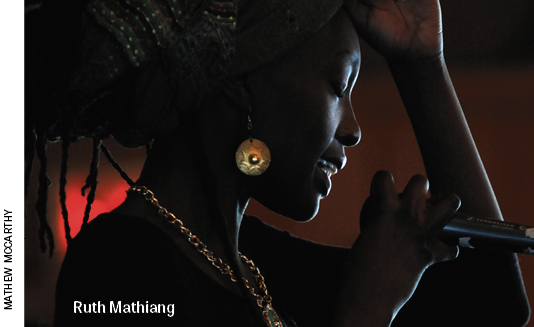
2005_-_Beat_-_World_-_Ruth_Mathiang.pngSince 2008 the Batuki Music Society has been tirelessly promoting African music and art in Toronto, seeking out local artists and working with them to book venues. It does much more than typical presenters however, providing the valuable service of advising musicians on career development, recording and touring. Moreover, Batuki appears to have an even larger social mission. As expressed on the society’s website, it provides “visibility and necessary publicity to artists who hail from minority groups by placing them in concerts and festivals in mainstream venues to help them integrate.” Incorporated as a non-profit community-based organization in 2008 by artistic director Nadine McNulty, Batuki’s artistic vision encourages local African musicians to participate in enriching the diverse arts and cultural scene through live music concerts, visual arts exhibits, film, spoken word/poetry, dance and festivals.

Spiritual Songs of Sub-Saharan Africa

Batuki Music Society’s programming usually heats up during Black History Month and this February is no exception. On February 14 it is presenting “Spiritual Songs of Sub-Saharan Africa” at the theatre of the Alliance Française de Toronto. Reflecting spirituality in African music, the songs are rooted in multiple genres performed across the vast continent, from Guinean griot and Ghanaian highlife and gospel, to South Sudanese spirituals, Ethiopian soul, back to Congolese rumba and Zimbabwean spirit music. 

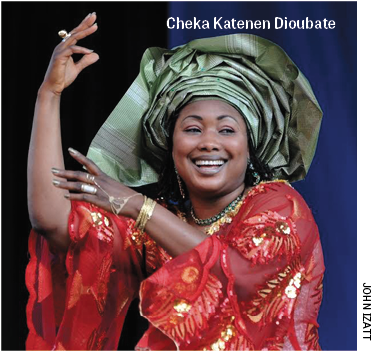
2005_-_Beat_-_World_-_Cheka_Kaetnen_Dioubate.pngThe concert’s curatorial aim is to present the evolving nature of African music from its rural roots to its contemporary urban and transnational mediations, with an emphasis on its spiritual content. The performers have been drawn from Toronto’s rich pool of sub-Saharan African musical talent. Confirmed are seven of the city’s finest African singers, Frederica Ackah, griot Cheka Katenen Dioubate, Ruth Mathiang, Blandine Mbiya, Evelyn Mukwedeya, Memory Makuri, and Netsanet Melesse. The seven singers are backed by an impressive band consisting of Donne Roberts (guitar), Tichaona Maredza (rhythm guitar), Quandoe Harrison (bass), Fantahun Shewankochew Mekonnen (acoustic krar), Kofi Ackah (drums, percussion), Ruben Esguerra (congas), and Amadou Kienou (djembe). 

I’d like to sample the rich program for you. Performing the songs of the Shona people of Zimbabwe will be Evelyn Mukwedeya and Memory Makuri accompaning themselves on the mbira (sometimes called thumb piano), as well as hand clapping, hosho and dancing. The playing of the mbira dzavadzimu, which used to be a deeply entrenched male preserve, is an important ingredient in conducting healing ceremonies among Shona communities. In the 1970s Stella Chiweshe, also a traditional healer, challenged that male exclusivity, becoming one of the first female mbira players. She is now a role model for younger women like Mukwedeya and Makuri.

Blandine Mbiya, a singer and songwriter from the Kasai region of the Democratic Republic of Congo performs songs in the gospel-inspired rumba genre as well as those in the so-called bazombo trance music. The latter – the Bazombo are members of the much larger Bakongo group whose communities lie near the Angola and DRC borders – is a music genre reputedly associated with witchcraft and other ceremonies, though solid evidence of this is hard to locate for outsiders. On the other hand, the popular DRC rumba (aka African rumba, which also overlaps with soukous), exhibits Cuban and older Franco-Belgian missionary choral strains. Rumba’s rise to prominence has been directly linked to the suppression of the Congo’s indigenous spiritual music practices during the colonial period.

Cheka Katenen Dioubate is a Guinean griot whose job description includes storyteller, historian, poet, musician and praise singer. Griots are central to the maintenance of Mande traditions in West Africa. Serving as a living archive, they are keepers and singers of the oral history and culture of the people, performing at marriages, funerals and other rites of passage. Dioubate brings to the stage a powerful voice and commanding presence, as befits the griot who must serve as intermediary between generations of her ancestors and her living audience.

Our last stop in this incomplete concert preview is Ethiopia, as represented by the songs of Netsanet Mellesse. This singer has an impressive recording back catalogue, having produced traditional Ethiopian, pop and gospel albums back home. One of Ethiopia’s finest krar players and composers Fantahun Shewankochew Mekonnen will accompany Mellesse at the Alliance Francaise.

2005_-_Beat_-_World_-_Hugh_Masekela.pngVusi Mahlasela and Hugh Masekela: This is not Batuki Music Society’s only big presentation this month. On February 28, in association with Koerner Hall, they co-present “Vusi Mahlasela and Hugh Masekela: 20 Years of Freedom.” This concert is billed as “freedom songs honouring 20 years of democracy in South Africa and the official end of apartheid” and headlines the trumpeter, singer and composer Masekela and singer/songwriter Mahlasela. 

The award-winning Mahlasela, known as The Voice in his home country, is celebrated for his distinct, powerful voice and his poetic lyrics. He has released seven studio albums on Sony and worked with numerous international recording stars. His songs of hope with themes of struggle for freedom, but also forgiveness and reconciliation with enemies, inspired many in the anti-apartheid movement.

In his eighth decade, Masekela, the world-renowned multifaceted musician and defiant political voice, is still going strong. Credited as one of the founders of world fusion music, his global career began in the South Africa of the 1950s with stylist roots which tapped into jazz (ragtime, jive, swing, doo-wop, bop), musicals and pop, as well as multiple African genres including mbaqanga, South African music with rural Zulu roots. His group, the Jazz Epistles, released the first African jazz LP in 1959, followed by 40 more albums over his career. His 1986 anti-apartheid anthem Bring Home Nelson Mandela (1986) was an inspiration and rallying cry around the world at the time. After decades in exile, following the release of Nelson Mandela from prison in 1990, Masekela returned to live in South Africa. It may well be on the Koerner Hall program celebrating twenty years of South Africa’s democracy.

Other picks:

February 6 The Royal Conservatory’s World Music series presents Pavlo and his band at Koerner Hall. The Toronto native with two Juno Award nominations who goes by a single name, Pavlo may have coined the term “Mediterranean guitar sound” for his brand of music, but for his current tour Pavlo integrates “exotic instruments,” as the promotion notes. His fans can expect Pavlo’s signature sound with acoustic Spanish guitar upfront in the mix, but also infused with Chinese erhu, Portuguese guitarra, Arabic ney, Indian sitar and Greek bouzouki.

Also February 6 the Small World Music Centre’s still new intimate theatre is undertaking its first screening, rescheduled from last year. The Stirring of a Thousand Bells (2014) by emerging  American filmmaker Matthew Dunning is an experimental documentary consisting of two videos taking the audience on a kaleidoscopic visual and musical tour of life in Surakarta, a city in Java, Indonesia. It features footage of its centuries-old royal court gamelan music and dance culture, still vital today. A live music concert “Imaginary Soundtrack for Ambient Worlds: Indonesia meets Canada” by the Andrew Timar and Bill Parsons Duo, playing Indonesian kacapi and suling, will begin the program. (Yes I’m that Andrew Timar).

February 8, the Flato Markham Theatre audience will be in for a treat a concert that showcases two generations of one family with a proud musical lineage, encompassing several strands of world music. Amjad Ali Khan, the renowned veteran maestro of the sarod (Hindustani plucked lute) is joined by his sarod-playing sons Amaan and Ayaan Ali Khan for this rare three sarod concert. Billed as “The Sarod Project,” percussionists Issa Malluf (Arabic/Middle Eastern percussion) and ace Toronto tabla player Vineet Vyas join the soloists.

Hindustani music is certainly Khan’s forte but in the first set he will demonstrate his affinity for an even wider sweep of musical geography, ranging from various regions of India to the Middle East. His sons Amaan and Ayaan will then demonstrate their traditional Hindustani music cred by performing a raga to be announced at the hall, exemplifying the living tradition that has been passed down from father to son for several generations “Music is the greatest wealth in our family,” confirmed Amjad Ali Khan. 

February 13 and 14 the Aga Khan Museum in partnership with the Aga Khan Music Initiative presents “Wu Man and the Sanubar Tursun Ensemble” at the AKM auditorium. This multicultural meeting of the Chinese pipa virtuoso Wu Man and the celebrated Uyghur singer Sanubar Tursun, explore ancient cultural links between Chinese and Central Asian music traditions. Wu Man, who has multiple Grammy Award nominations as well as the 1999 City of Toronto Glenn Gould Protégé Prize to her credit, is a cross-cultural collaboration veteran. She’s worked extensively with the Kronos Quartet and Yo-Yo Ma’s Silk Road Project, among several others. Sanubar Tursun, who has become an iconic Uyghur cultural figure, employs her delicate, sensuous yet also athletic vocals in renditions of classical muqam and folk songs. The soloists are accompanied by an ensemble of Uyghur musicians.

If these concerts are any indication, it promises to be a rich and musically eventful February.

Andrew Timar is a Toronto musician and music writer. He can be contacted at worldmusic@thewholenote.com.
 

World 25My last column, highlighting the music programming at the Aga Khan Museum, noted the concert appearance of Toronto’s award-winning group Autorickshaw at the AKM auditorium on November 15. I attended the show to get an overview of their current repertoire, the range of which is wide and the boundaries fluid.

In addition to arrangements of South Indian classical and folk songs, original songs and numbers based on tala principles (overlapping Carnatic solkattu and Hindustani tabla bols) alternated with good-humoured ironic takes on 1970s Bollywood hit film songs. “Autorickshawified” hybrid adaptations of songs by Joni Mitchell and Leonard Cohen – “Bird on a Wire” rendered in a relaxed 7/4 – and the jazz standard “Caravan” were among my personal favourites. While vivacious vocalist Suba Sankaran, the heart of the group, claimed front stage centre for most of the concert, the skilled band comprised of Dylan Bell (bass/keyboards/beatboxing), Ed Hanley (tabla), with Ben Riley (drum set) and John Gzowski (guitar) stepping in for the night, shone in solos. “Caravan” was a rollicking example.

Well into Autorickshaw’s second decade of genre-blending musicking, summing up its repertoire, which is very often multi-genre and transnational in reach, is not an effortless undertaking; especially so for a persnickety listener like me. Autorickshaw’s website nevertheless helpfully weighs in, situating its music “on the cultural cutting edge, as contemporary jazz, funk and folk easily rub shoulders with the classical and popular music of India.”

That statement makes such hybridization sound like an easy reach. It’s anything but. Anyone who has seriously attempted it, or listened to fusion experiments where genres from across the world “easily rub shoulders,” knows how easy it is to fail to satisfy musical expectations – and for many reasons. In fact it is one of the most difficult forms of musical alchemy to pull off effectively and gracefully. Having persevered as a group for a dozen years Autorickshaw is proof that diligent work in the transcultural song mines can pay off. In their case it’s been rewarded with two JUNO nominations for World Music Album of the Year and the 2005 Canadian Independent Music Award. In 2008 they were awarded the John Lennon Songwriting Competition Grand Prize in World Music, in addition to the CAPACOA Touring Artist of the Year.

Autorickshaw’s web statement also accurately geographically locates the overlapping bi-continental musical territories the group primarily explores: North America and the Indian subcontinent. Furthermore testing the effectiveness of such transculturalism in the fire of international audiences via touring seems an essential part of the group enterprise. Autorickshaw has done just that. It’s been on the road exporting its “Canadian-made Indo-fusion” not only across its Canadian home base, the U.S.A. and Europe, but also to India during a three-week tour in late 2006.

As I write this the Autorickshaw Trio consisting of Sankaran, Hanley and Bell is preparing for an unprecedented two-month subcontinent-wide tour of at least two dozen dates in ten projected cities in India and Nepal (in Pokhara and Kathmandu). Departing Toronto on November 28, “we are acting as our own agents, mainly cold-calling our way to India and Nepal” wrote Sankaran in an email interview, building on “contacts [made] the last time we toured India.” She further predicted that “once on the ground, we will likely be approached to do other performances in the various regions we are touring. This happened the last time around as well, so we’re trying to build some buffer time for that.”

I asked about the sort of venues they will be playing. Sankaran commented on their diversity. “We are doing a variety of shows, from soft-seaters to outdoor festivals, from clubs to hotel dates, house concerts, workshops in ashrams, and collaborating with string and choral departments in schools; the majority are performances, [but] we’re offering some workshops as well.”

The incentive for the tour initially came from the group’s desire to commemorate, on December 3, 2014 the 30th anniversary of the Bhopal “gas tragedy,” widely considered the world’s worst industrial disaster. Sankaran and Hanley have a personal commitment to the affected people of that city. In 2009 they co-wrote and recorded the song “The City of Lakes.” All proceeds from the song go to the Bhopal Medical Appeal which funds two local clinics offering free healthcare to thousands of survivors. While in Bhopal the Autorickshaw Trio will also appear as the opening act at the Indian premiere of the motion picture about the disaster, A Prayer for Rain, starring Martin Sheen. Another focal point of the tour is the promotion of songs from its strong new album Humours of Autorickshaw, in newly-minted trio arrangements.

In an email interview with Hanley I wondered how exporting Autorickshaw’s hybrid music to South Asia compared to performing and marketing it domestically. He replied with insight and humour: “There may be weight to the Canadian adage that you can’t ‘make it’ at home until you make it elsewhere. I’m not sure why that seems to be true, but anecdotally it does seem to be the case. We’re not trying to make it in India, but perhaps to lay foundations for future tours … The fact that we incorporate a lot of traditional Indian classical elements in our music seems to be a gateway for South Asian audiences. It’s [also] always nice to represent Canada and Canadian music,” on the international stage, therefore “we’re looking forward to playing some Autorickshawified Joni Mitchell, Leonard Cohen and Canadian folk songs (“J’entends le Moulin” with solkattu and tabla bols anyone?)”

I asked Hanley how he expected the various genres their repertoire explores to resonate with tour audiences. “We will definitely adapt our repertoire to the venue and audience. For example we’re doing some Christmas carols with local musicians in Darjeeling – at their request. That should be fun!” He added: “New audiences are always an adventure. There is a magic in performing for people who know, and perhaps like, your music, but there’s a very different kind of magic playing for an audience who has never heard you before, hearing the music … for the first time.”

As for South Asian sales of Autorickshaw music mediated via physical product vs downloads, Hanley noted that they “will take some CDs, and will ship a box ahead. We will carry a lot of download cards, which we can give away as a musical business card, or sell much cheaper than a physical CD. [Plus] all our music is online [and we’ve uploaded] lots of videos onto our YouTube channel.”

Hanley neatly summed up the music scene in India: “It’s really happening [with] clubs popping up. There are festivals galore, with lots of bands producing original music. What we do might come from a different place simply because we grew up in Canada and have a strong Western foundation in various forms such as pop, jazz etc. And why are Indian presenters eager to present us? I’m not sure. Could it be our [unique] Canadian perspective on our blend of styles?

On one hand Autorickshaw’s two-month tour sounds like a grand adventure in (re)encountering the roots of some of the musical streams it has been exploring throughout its collective career. It will also no doubt expand the awareness among South Asian audiences of a Canadian world music accent. I for one will enjoy reading the trio’s “reports from the road,” vicariously experiencing their musical travels which will take them on December 15 to the Kathmandu Jazz Conservatory, Nepal, and on January 26 to SpringFest in Kharagpur, India.

Following are some of the stories I would likely have written about in depth had I not been sidetracked into talking about covert world music elements embedded in Canadian Christmas repertoire (Aaron Davis, page 14) and Canadian world musicians about to embed themselves in South Asia.

Small World Music Centre: December 5 Nazar-i Turkwaz (My Turquoise Gaze), four leading singers and instrumentalists on the Toronto world music scene, take the Centre’s stage. Brenna MacCrimmon, Maryem Tollar, Sophia Grigoriadis and Jayne Brown are the remarkable musicians whose appearance at the Aga Khan Museum I wrote about last month. Having collected, performed and recorded songs from Turkey, the Middle East, Greece and the Balkans for decades, you can expect masterful renditions of this repertoire, “cultivating a sweet sonic union” along the way.

December 6 may well mark a first in my column: a musical film screening. The Centre presents two films by American director Matthew Dunning collectively tilted The Stirring of a Thousand Bells (2014), released on DVD by the hipster Seattle, Washington label Sublime Frequencies. This fascinating niche publisher focuses exclusively on “acquiring and exposing obscure sights and sounds from modern and traditional urban and rural frontiers.” Its roster encompasses audio field recordings, repackaged folk and pop compilations, radio collages and DVDs, mostly from Southeast Asia, North Africa and the Middle East.

Dunning’s films take viewers on a musical-visual journey of life in Central Java, Indonesia, focussing on gamelan music, a regional orchestral practice unbroken – though continuously shifted geographically, refreshed stylistically and hybridized – for some four centuries. In the city of Solo, where a Sultan still reigns, gamelan and its meditative palace dances remain a part of everyday life. I’ve been to Java five times studying and playing gamelan, and still feel like a beginner in the face of the complex interactive music’s inner workings and emotional life. The director will be present to contextualize his own gamelan practice and his films.

Ensemble Polaris: January 18, 2015 at 2pm the Gallery Players of Niagara present Ensemble Polaris in “Definitely Not the Nutcracker” at the Silver Spire United Church, St. Catharines. This fun concert celebrates Tchaikovsky’s popular music for the ballet but with a whimsical twist. Arrangements by the Ensemble alternate with songs and instrumentals from the Russian folk tradition. The instrumentation gives a hint of what they’re up to. Marco Cera (guitar, jarana barroca); Kirk Elliott (violin, Celtic harp, mandolin); Margaret Gay (cello, guiro); Katherine Hill (voice, nyckelharpa); Alison Melville (baroque flute, recorders); Colin Savage (clarinet, bass clarinet); Debashis Sinha (percussion, birimbao) and Jeff Wilson (percussion, musical saw). This new year why not stretch your musical legs, travel to St. Catharines and experience something other than customary?

Master Shajarian: January 31, 2015 [postponed to the fall of 2015] Persian master singer, composer, teacher and instrument innovator Mohammad Reza Shajarian takes centre stage at Roy Thomson Hall. Shajarian has been widely celebrated and decorated at home and internationally. UNESCO in France presented him in 1999 with the prestigious Picasso Award, one of Europe’s highest honours. In 2006 he was decorated with the UNESCO Mozart Medal and he has twice been nominated for the Grammy for Best World Music album. I had the privilege of hearing him sing about a decade ago and was impressed with his mastery of the difficult classical dastgah idiom. His vocal performances are justly savoured for their technical beauty, power and strong emotional presence. This concert is another good way to celebrate your good luck in reaching 2015 in good nick.

Andrew Timar is a Toronto musician and music writer. He can be contacted at worldmusic@thewholenote.com.
beat - world1In my last column I briefly introduced the new museum in town, one which is positioning itself to be a significant world music venue and curator: the Aga Khan Museum. Having opened its doors only in the third week of September, its inaugural music festival featured the renowned Yo-Yo Ma and the Silk Road Ensemble, a group which has collaborated since 2000 with the Aga Khan Music Initiative in concerts elsewhere.

Music is one of the prime “focus areas” of the Aga Khan Development Network, the larger entity behind the museum: the proof is that five groups are being presented in November and four in December. But is the museum really positioned to “become both major cultural destination and player in very short order” as touted by James Adams of The Globe and Mail, or “a vital new addition to Toronto’s cultural landscape” as augured by David Dacks of the Music Gallery?

As I promised, I set out to take a closer look at the AKM and its music programming. I arranged an interview and tour with Amirali Alibhai, the AKM’s head of performing arts and chief architect of its curatorial vision.

I made my trek to the stretch of Don Mills where the museum is sited, north of Eglinton Ave. and between Don Mills Rd. and the D.V.P., on a cool, rainy October weekday afternoon. To a downtowner it may seem “up there” on a mental map, but on an actual map of Toronto, it is not far from the geographic centre of the city. Located on Wynford Dr., the museum is across the street from the notable modernist mid-century Raymond Moriyama-designed Japanese Canadian Cultural Centre where I’ve enjoyed many memorable cultural events, and only a few blocks north and east of the Ontario Science Centre.

Coming face to face for the first time with the imposing white stone-clad AKM building, the new museum on the block’s standards of architectural excellence are self-evident. The 10,000 square-metre building, the design of prize-winning architect Fumihiko Maki, skillfully melds postmodern and Islamic design elements and aesthetics. The monolithic building itself is set in a formal garden within expansive grounds where multiple black infinity pools form a traditional char bagh, a Persian-style four-part garden. The pools evocatively reflected and reframed the rainy Don Mills sky as I walked up to the museum’s dramatic front entrance.

Amir Alibhai led me directly to the 336-seat auditorium, the primary venue for music performances. With teak floors and stage, graced with a high, multifaceted white dome, it’s one of the architectural focal points of the AKM. “It’s an ideal site to present an intimate and powerful experience for audiences,” he says, where they can look forward to “varied and innovative cultural programs throughout the year, including music, dance, theatre, book readings and films.” I haven’t had a chance to hear music there yet but the empty space feels intimate and quiet, an acoustic sound-friendly space, underscored by the lack of air ducts in the hall, with ventilation coming from under the seats.

To ward off the early fall chill we sat down for the interview with invigorating cups of dark hot chocolate strengthened with a shot of espresso. The museum’s small café is right next to a square glassed-in courtyard through which sunlight (and reputedly moonlight) filters through Arabic-inflected mashrabiya patterns etched in the glass. Alibhai has already vetted the courtyard as an alternative performance venue, though with five very hard surfaces it’s undoubtedly a reverberant one. He related that a recent performance of Sufi whirling and its accompanying music “worked very well in the glass-walled courtyard, granting both an effective personal ritual space for the performers, as well as allowing the audience to see the performance thorough the glass walls, if they so wished.”

Prior to moving to Toronto to take his AKM position Alibhai was a 40-year Vancouver resident with an extensive career in arts administration – and significant for readers of The WholeNote, a lifetime background in music. He has worked as an exhibited artist, a curator, educator and facilitator of visual and community-based arts for over 20 years. “I was part of the team that initially developed and ran the Roundhouse Community Arts & Recreation Centre” he said, referring to the innovative arts-centric Yaletown, Vancouver organization whose mission is to “celebrate diversity ... of people, values, ideas and activities.” He has also developed a national perspective, having served on national arts boards such as the Canada Council for the Arts and the Canadian Conference of the Arts. He has clearly had plenty of opportunity during his career to consider the place of the performing arts in public-access spaces. “It may not be obvious to the core identity of the museum that it may also serve as a venue for a series of live concerts and dance performances. But I’m at the table at every curatorial meeting working to closely integrate my programming with planned exhibits,” he says.

The AKM is the first institution in North America “dedicated to the arts of Islamic civilizations.” It’s a goal clearly reflected in the exhibit halls. Visitors can see it in rare and exquisite editions of the Koran, in the sensuous paintings, illustrations, calligraphy, early scientific instruments, sumptuous silk clothing and carpets, as well as 21st-century artworks confronting and reinterpreting the traditions displayed in galleries closer to the entrance.

 Its stated Toronto mission as an oasis of diversity and dialogue is, “to foster a greater understanding and appreciation of the contribution that Islamic civilizations have made to world heritage ... through education, research, and collaboration.”

I ask where live music fits in. “In terms of [our] music programming the vision is to bring the highest calibre of traditional and contemporary performing artists from the broad diaspora of Muslim cultures to audiences. Music is particularly well suited as a creative medium that inherently engages artists and audiences in cross-cultural understanding and dialogue. “

beat - world2Concerts at the Aga Khan Museum: In an earlier interview AKM educational consultant Patricia Bentley talked about how Islam has always responded to local traditions.” Alibhai’s programming choices to date put that vision into action. In November the five acts over eight concerts demonstrate an even-handed admixture of Canadian, international and local talent, some embedded in the global Islamic community, but also some only peripherally engaged with it.

The series launches November 1 with the show “Memory and Presence of Rumi: Mystic Music of Iran.” Presented by an international group consisting of a quartet of Persian musicians and a dancer, it is co-led by the prominent kamancheh (bowed spiked lute) player and composer Saeed Farajpouri and the Vancouver tar (plucked long-necked lute) master Amir Koushkani. Siavash Kaveh on the frame drum daf, Araz Nayeb Pashayee on the goblet drum tombak and Farzad AJ dancing the whirling Sama round out the ensemble. The concert’s theme is the poetry of Rumi, the great 13th century Sufi mystic. His works and ethos still resonate today across centuries and cultures.

November 8, the focus shifts to a local quartet of singers, but one with an international gaze – Nazar-i Turkwaz (My Turquoise Gaze) – a relatively new collective comprising Brenna MacCrimmon, Maryem Tollar, Sophia Grigoriadis and Jayne Brown. For over 30 years they have individually been collecting and performing traditional repertoire from various regions on or inland from the Mediterranean, in groups such as Maza Meze, Mraya, Doula and Altin Yildiz Orkestra, counting several JUNO nominations along the way. In a Facebook chat with MacCrimmon, in Turkey at the time, she confirmed that “the repertoire is a potpourri of Balkan, Greek, Turkish, [Middle Eastern] and beyond ... with lots of harmony [in our singing].” I don’t want to wait for the album, but plan to enjoy the sweet harmonies live.

The established local group Autorickshaw mount the AKM auditorium stage on November 15. This award-winning genre-bending group is no stranger to these pages. I gave the group’s terrific new album The Humours of Autorickshaw a resoundingly enthusiastic review on July 8, 2014 in The WholeNote. The lineup this night consists of vocalist Suba Sankaran, Dylan Bell (bass/keyboards), Ben Riley (drums), John Gzowski (guitar) and Ed Hanley (tabla). This is the last chance for Toronto audiences to catch Autorickshaw before their trio configuration heads off to India and Nepal on an unprecedented two-month subcontinent-wide tour of ten cities.

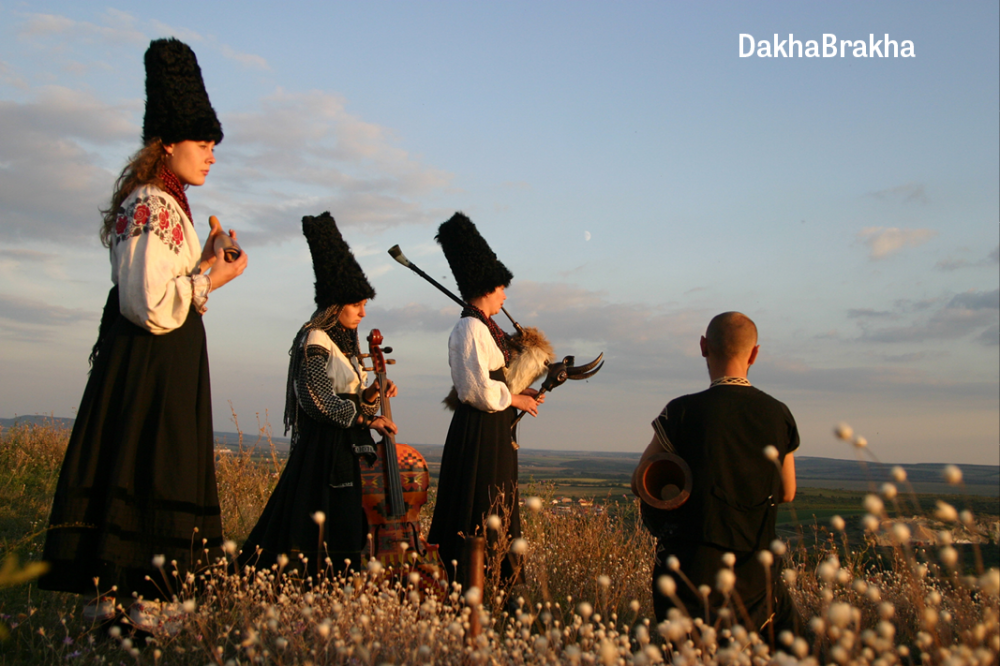
Skipping to November 27 and 28, Toronto audiences get another chance to hear one of today’s stars of world music, DakhaBrakha. They are presented with the support of Small World Music. Founded on solid taproots of Ukrainian village songs (and dress), these Kyiv-based performers add musical instruments and vocabularies of other cultures. Moreover they present their songs with the use of popular music microphone techniques, powerfully sung melodies and a theatrical performance art sensibility. It all makes for a striking show, the energy and attitude of which resonates with even those for whom their lyrics are a mystery.

Another performer with a growing international reputation is the Pakistani Sanam Marvi, emerging as an outstanding singer of ghazal, Pakistani folk songs and Sufi music. She gives two concerts on November 29 and 30. Marvi, a student of her father, Fakir Ghulam Rasool, devoted years of study to Sufi poetry and today is recognized as one of the leading singers in that tradition to emerge from the Sindh. Whether singing in Urdu, Sindhi or Saraiki, her aim is to “reach across generations and cultures” with her songs.

December 5 and 6 the Aga Khan Museum presents its first multimedia performance, the world premiere of “Siavash: Stories from the Shah-Nameh.” Written and directed by composer and award-winning sound designer Shahrokh Yadegari, this “page-to-stage” work explores the trials of Prince Siavash as depicted in the Persian epic Shah-Nameh (Book of Kings) through storytelling, music and projected images. Numerous manuscripts of this popular poem written by the Persian poet Ferdowsi between 977 and 1010, and illustrated over centuries, are on permanent rotational display at the museum. The cast of Siavash features Gordafarid as the naqal (narrator), Siamak Shajarian (vocalist) and Keyavash Nourai (violin, cello, kamancheh). This world premiere music theatre work neatly aims to bring centuries-old manuscripts alive on stage.

Andrew Timar is a Toronto musician and music writer. He can be contacted at worldmusic@thewholenote.com.
Even before the construction dust had settled in its galleries, the shiny new granite-clad Aga Khan Museum had, in quick order, been touted in many media reports and by our Prime Minister as a key addition to Toronto’s multi/inter/trans-cultural topography. Yes, it has elegant Fumihiko Maki-designed architecture and a world-class collection dedicated to the arts of Muslim civilizations, but it also promises to be a significant music programmer and destination for citizens and tourists alike.

The museum has only been open since September 18 but live music has already animated the impressive spaces within its walls. The AKM’s programming focusses on  Islamic diversity, encompassing and celebrating a vast range of cultural geographies energizing the GTA. In its opening flourish of concerts the museum’s programming also shows itself to be admirably ecumenical, auguring well for the myriad ways cultures interact musically here. 

October 3 at Koerner Hall the AKM marks one of its first co-presentations with The Royal Conservatory of Music – also part of the Small World Music Festival – an evening featuring Indian-Canadian singer Kiran Ahluwalia (her cover story was featured in the September 2014 issue of The WholeNote) and Rizwan-Muazzam Qawwali. The latter is a ten-member Pakistani group, a leading representative of the art of qawwali, Sufi devotional songs accompanied by tabla and harmonium. While the two groups are playing two separate sets in the concert, they will collaborate on one song. This column will undoubtedly revisit the AKM museum’s programs in the future.

BBB-World2The Small World Music Festival: Last issue I focused tightly on one late September concert within the Small World Music Festival, which runs until October 5. The series sets out, in its words, to “capture the world in a ten-day festival.” Here are a few others I’d like to highlight.

October 1 the spotlight falls on the music of North and South India; usually presented individually, they are here combined on the Flato Markham Theatre stage. Zakir Hussain, among the world’s preeminent tabla virtuosi, represents the Northern tradition. He joins veena maestra Jyanthi Kumaresh and violin maestro Kumaresh Rajagopalan, both representing the Southern, or Carnatic, music lineage. Rajagopalan is among India’s leading Carnatic violinists (a standard-issue fiddle but played in an inverted position, sitting on the floor), while Kumaresh performs on the veena, a plucked string instrument with ancient Indian roots. The two traditions have multiple points of divergence in music theory, as well as performance. Therefore it’s always exciting to witness top musicians from each camp issuing musical challenges, because the two parties must inevitably negotiate common ground in terms of pitch, drone tones, tempi and musical repertoire. They must also agree on phrases ending on sum (sam), the downbeat and point of resolution in both rhythm and melody.

October 5 “Cover Me Globally” occupies the intimate Small World Music Centre. The musicians on this particular evening are Drew Gonsalves, the singer-songwriter of Kobo Town; Aviva Chernick, the lead singer of Jaffa Road; Donne Roberts, a member of the African Guitar Summit; and Lisa Patterson, singer-songwriter with ROAM. Each of these Canadian artists embodies musical influences which extend in four different global directions. “Cover Me Globally” sets out to explore what happens when songs cross genre, culture and language. We’ll find out what happens when the “Canadian cultural diaspora … connects through its songwriters.”

Other Picks

BBB-World1NEXUS in the World: October 27 the venerable percussion ensemble NEXUS takes the Walter Hall, University of Toronto stage in a program that also features the Persian vocalist Sepideh Raissadat. NEXUS has from its beginnings incorporated elements of global musics in its diverse concerts and this show is no exception. Founding group member Russell Hartenberger’s percussion ensemble composition, The Invisible Proverb (2002), for example, exhibits substantial African references. Persian composer and setar player Reza Ghassemi’s Persian Songs, arranged by Hartenberger, is sung by Music Faculty doctoral candidate Raissadat, the first female soloist to perform publically in Iran since the 1979 revolution. It is another example of the cultural dialogue encouraged throughout the group’s career. In this case it’s between Persian and North American musical cultures. Twentieth-century modernist and postmodernist classics also have a central place in the core NEXUS repertoire. In this concert they also re-visit Steve Reich’s 1973 luminous minimalist opus Music for Mallet Instruments, Voices & Organ, itself profoundly influenced by the composer’s study of West African ensemble music.

Fado in the City: November 5, presented by The Royal Conservatory in association with Small World Music, singer Ana Moura headlines at Koerner Hall. At the breaking wave of the fado music renaissance, re-interpreting this soul music of Portugal for a new generation of international audiences, Moura typically sings her heartbreaking songs accompanied by a trio of a Portuguese guitar plus two classical guitars. “Even among the new breed of fado singers, which has dared to deviate from a rigid tradition, Ms. Moura is a distinctly worldly superstar,” wrote The New York Times. I couldn’t have said it better.

Polaris Music Prize Trailer: As seasoned concertgoers well know, not many formal music performances last much longer than the usual 90 minutes. That odd hybrid, the music award show, made even more tedious for general music buffs due to long pauses between performances for set changes, TV, and other media breaks, is an exception. Ever the eager reporter for The WholeNote, however, I managed to convince our stern publisher that I should obtain media accreditation for the Polaris Music Prize gala. It was the first time our august magazine was represented at the Polaris.

My story? I was following up on my review of the avant-garde Inuk vocalist Tanya Tagaq’s June 10, 2014 concert at Luminato published on The WholeNote blog. She has performed, toured and recorded with Björk, the Kronos Quartet and the Winnipeg Symphony, but it was her astounding CD Animism that had been short-listed for the Polaris best Canadian album of the year, a surprise to some in the mainstream music industry. Suited up and media pass in hand, I was set to take it all in at The Carlu on the night of September 22. Little did I know how sleep-deprived I was going to be the next day.

Many of you undoubtedly know how the endgame of this grand Cinderella music story unfolded, since it was splashed over the national media the next day. On the other hand much of its musical colour and significance for Canadian music hasn’t filtered through to the media – yet. Fortunately for you, and especially for those who have never heard of the Polaris, your hard-working reporter has the play-by-play, the inside scoop. For a backstage pass to Tanya Tagaq’s jaw-dropping ten-minute performance with her musicians backed up by Element, the Toronto improvising choir of 40 conducted by Christine Duncan, along with her political and provocative comments, I will be covering the story in detail on our blog at thewholenote.com.

Andrew Timar is a Toronto musician and music writer. He can be contacted at worldmusic@thewholenote.com.
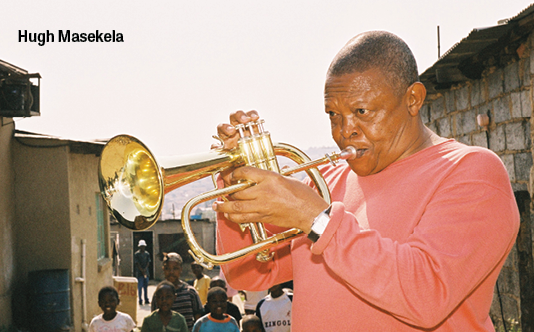
 

bbb - world viewIt’s a warm sunny weekend day in late August and here I am sequestered in my office. I’m imagining perverse things like concerts in chilly October, when I’d rather be gone fishing, metaphorically speaking that is. The lyrics of a famous 20th-century standard come to mind reminding me that it’s supposed to be the season when “the livin’ is easy.” Except it’s been a busy, busy working summer around here. But enough of my moaning. This morning I rose thinking of singing and world music festivals soon to come.

Ashkenaz: By the time you read this the always fabulous biennial Ashkenaz Festival, billed as “North America’s largest festival of global Jewish music and culture,” will be wrapping up at the Harbourfront Centre, along with almost all of the hot, long days. (We can but hope for a handful more.) This is Ashkenaz’s tenth celebration, with over 200 artists from more than 12 countries participating in dozens of events from August 29 to September 1. As usual tradition (i.e. “Havdallah”) rubs elbows with musical cross-cultural fusion (i.e. “Aaron Kula – Black Sabbath: Blues & Jews,” and “David Buchbinder’s Odessa/Havana”), along with the downright friendly-weird (i.e. “Deep-Fried Gypsy Cumbia”). You can’t say the festival doesn’t have a sense of humour.

Small World Music: The fall season starts properly with the Small World Music Festival, this year running from September 25 to October 5. The series sets out to “capture the world in a ten-day festival,” bringing the music of India, Germany, Trinidad, Serbia, Iran and Pakistan to Toronto venues.

Instead of my usual practice of chronologically going down the listings and issuing “picks” from on high, in this column I’m changing it up and sharing a more in-depth commentary on one of the concerts. I think it’s in keeping with “the livin’ is easy” attitude, don’t you?

September 26 Small World Music Festival in association with AE presents the Boban & Marko Markovic Orkestar at the Phoenix Concert Theatre. Superlatives from The New York Times and the Boston Herald precede the Orkestar’s appearance. Rather than repeating those, I propose a little vicarious field trip to Eastern Europe,  to an unlikely, remarkable festival that launched the rkestar’s success, taking this multigenerational Romani band from Serbian village weddings to large urban concert halls around the world. Consider this a page in your pocket guidebook.

What takes place in the central Serbian village of Guča is undeniably a global musical phenomenon. Since 1961 this tiny sleepy village is transformed each year into the raucous hub of the closely contested and widely popular annual Guča Trumpet Festival. It’s also the world’s largest trumpet competition – and for thousands, licence to show off, get rowdy and imbibe large quantities of their beverage of choice. A remarkable 300,000 to more than 500,000 people have swelled the village site each year, most to hear top Serbian and Balkan-style brass bands play in highly contested competitions. Some have claimed it’s the largest music event anywhere. During the festival, bands from Serbia and all over the world play on the competition stage and also wander, performing in the village’s streets night and day. This wild scene is illustrated in the 2013 U.S. feature documentary Brasslands.

The Boban Markovic Orkestar has long been among Guča’s leading contenders. It took the Best Orchestra award in 2000, as well as the coveted Best Trumpet prize for its maestro no fewer than five times. As for Boban, dubbed the “king of Balkan Brass music,” ever the gracious winner, he has retired from the competition and set his sights further afield. In the last decade he has aimed to reach international audiences through his contributions to movies, as well as by taking his funky and frenetic arrangements of dance-worthy brass music – sometimes described as “Balkan and/or Gypsy roots music” – on tour to global stages.

Following Serbian Romani tradition, in 2006 Boban Markovic formally handed over his orchestra to his son and successor, Marko, on his 18th birthday. Global Rhythm magazine opined, “With nods to klezmer, jazz, Latin and deep-fried funk injected into the mix, the … Orkestar knows where their music’s been but they’re hell-bent on slinging it straight into the future.” This multigenerational musical powerhouse has harnessed brass virtuosity, macho lyrics, lightning tempi, pop kit drumming, Romani vocals and the occasional rap, all delivered with infectious energy. The Orkestar then morphed it all into a populist style that has allowed it to segue from Serbian village celebrations to the floors of trendy Central European dance clubs.

You can join me on the evening of September 26 at the Phoenix. I’ll be the guy at the back soaking up the Orkestar’s vibrations, with a small glass of šljivovica if they stock it, toasting the end of summer.

Andrew Timar is a Toronto musician and music writer. He can be contacted at worldmusic@thewholenote.com.
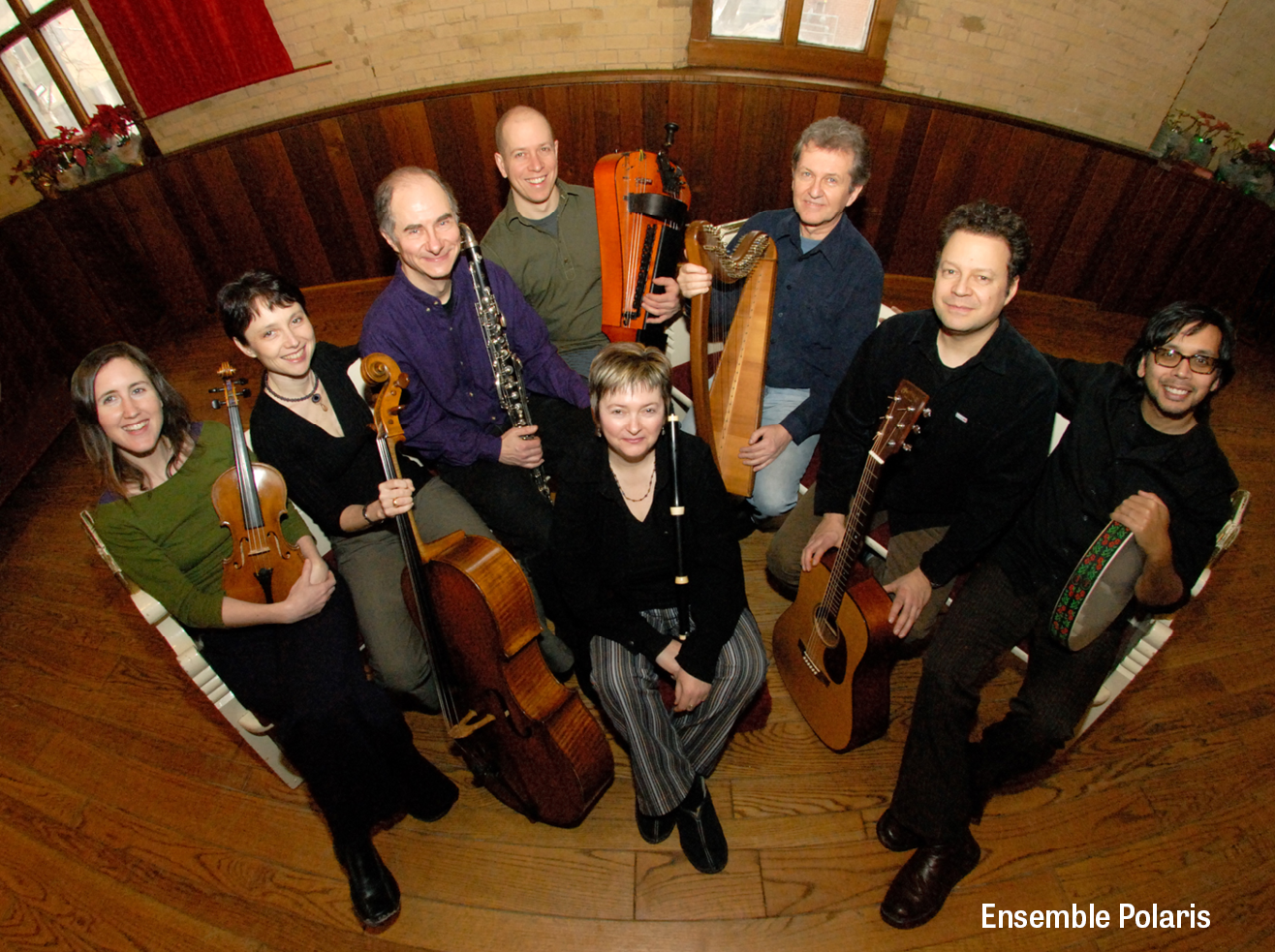
 

1909 World 1It’s still May as I write this, yet in that disconcerting way Mother Nature has in Southern Ontario, hot sticky weather’s already suddenly, shockingly arrived. “Why settle for mere spring when you can have summer?” she seems to be asking rhetorically. It almost feels like an ironic taunt coming after that miserably long winter we just endured. But as surely as the arrival of the humidex, BBQs, picnics, heatwaves and dog days – summer’s here to tarry awhile.

One of the first signs of the official arrival of our outdoor music season is the Luminato Festival. Now in its eighth year, it runs Friday, June 6 through Sunday, June 15. Luminato bills itself as “Toronto‘s international multi-arts festival” which for ten days each June transforms Toronto’s “theatres, parks and public spaces with hundreds of events celebrating theatre, dance, music, literature, food, visual arts, magic, film.” Festival artistic director Jorn Weisbrodt and his team’s ambitious aim is to reflect “Toronto as a crossroads of ideas, cultures and traditions.”

In order to navigate through the dozens of concerts scheduled and to get a firm handle on the urban geography of the downtown David Pecaut Square, I spoke with veteran world music programmer Derek Andrews, Luminato’s music curator. “There are two stages at what we call the Festival Hub, the large Pecaut Stage, and new this year: the smaller Slaight Stage.” In addition, the featured site installation this year will lend a suitably tropical feel to Pecaut Square. Luminato has commissioned Cuba‘s Los Carpinteros to design an ingenious surfside-themed environment titled Cardboard Beach stocked with loungers, umbrellas and lifeguard stations.

“One of our themes this year is a celebration of the performing arts of the Americas with a focus on the Caribbean and Latin America, in anticipation of Toronto’s 2015 Pan American Games,” added Andrews. “Audiences will be able to experience a tropical Toronto, with samples of samba, cumbia, reggae and other funky party music. We have also taken the Festival Hub up a notch with three ticketed attractions, The Roots, TV On The Radio and Ziggy Marley.” I’ll train my spotlight on a few of the world music concerts by both local and international musicians. For more, please see our listings and the well-appointed Luminato website.

The Pan American tropical leitmotif is front and centre on June 6. It’s a triple bill opening with Interactivo, the star Cuban music collective layering jazz, funk, soul and rap atop bed tracks of Afro-Cuban rhythms, melodies and harmonies. Singer-songwriter Emeline Michel “the Queen of Haitian Creole song” highlights the island nation’s rara and compass musical genres. JUNO-Award-winning proponent of nouveau flamenco Jesse Cook shares the late evening stage with the Toronto-based Amanda Martinez, with whom he shares an affinity of influences including flamenco, Mexican and South African music.

June 10 four First Nations’ acts grace The Hub in the exciting program “Northern Lights and Music.” Nick Sherman opens the night at 6pm on the Slaight Stage. His songs, deeply rooted in his Northwestern Ontario experiences, are characterised by an “uneasy, yet always fluid transition between unabashed joy and sorrow.” The JUNO-Award-winning five-piece Toronto band Digging Roots follows, co-led by musical partners Raven Kanatakta and ShoShona Kish. Their genre-blending music has been dubbed “Indie roots,” “global blues” and “Aboriginal alternative.” Best I think to hear them live as they access and layer even more vernacular musical styles including hip-hop and reggae with a very good chance of bluesy undertones.

Buffy Sainte-Marie then takes the Pecaut Stage. Certainly among Canada’s most compelling female singer-songwriters, Sainte-Marie’s impressive career spans some two dozen albums. And her Cree heritage is never far from her voice. Wielding her impressive melodic gifts, incisive lyrics and grippingly expressive vocals, she’s perhaps best known for assaying the glories and tribulations of indigenous people across the Americas. While unflinchingly “speaking truth to power” Sainte-Marie is however never afraid to rock out.

Capping the evening the brilliantly innovative Inuk vocalist Tanya Tagaq and her band perform live music to American filmmaker Robert J. Flaherty’s classic silent film Nanook of the North (1922). While widely considered a groundbreaking documentary film it has in recent decades been contested, viewed as being contaminated by directed dramatic scenes in the “salvage ethnography” genre. Tagaq is celebrated for her concerts with Björk and the Kronos Quartet. On this project she digs into her own Nunavut childhood and subsequent musical creations, along with music by Canadian composer Derek Charke, to challenge and reclaim aspects of Flaherty’s feature film, animating the film’s directed silent set pieces with emotive soundscapes.

Toronto Music Garden: I’ve spent many pleasant summer evenings over the years listening and even on occasion playing at Harbourfront Centre’s cool and colourful Toronto Music Garden. The garden was co-designed in 1999 by cellist Yo-Yo Ma and landscape architect Julie Moir Messervy to reflect Bach’s Suite No.1 for Cello. No doubt about it, though the imaginatively curated (by Tamara Bernstein) free summer-long concert series held there is on an intimate scale, it’s nevertheless a music festival. It is certainly one of Toronto’s perennial musical treasures. This garden by the lake resounds with culturally diverse concerts most Thursdays and Sundays in the summer. Here’s a sampling.

The season opener on July 3 is titled “Kahnekaronnion” (The Waters). Singing in English and Mohawk, the Akwesasne Women Singers share their songs honouring Hodenausaunee women’s experiences, wisdom and humour. The group is joined by Odawa composer and flutist Barbara Croall performing her compositions on traditional cedar flute.

July 6 marks the Toronto debut of the Vancouver based trio Lalun in “Dreams from Andalusia and the Silk Road.” Featuring the eclectic musicality of Liron Man (hang drum, flamenco guitar), Lan Tung (erhu and vocals) and Jonathan Bernard (percussion), Lalun merges their musical voices in an exploration of Spanish, Chinese and other cultural landscapes.

Vocalist Bageshree Vaze and Vineet Vyas (tabla) return to the Music Garden on July 24. In “Music from the Gardens of India” they present Hindustani classical songs with garden themes, including depictions of the iconic love story of Krishna and Radha in the garden of Vrindavan.

August 14 Jayme Stone’s group takes the space under the imposing overarching willow tree. His “Lomax Project” celebrates the work of famed folklorist Alan Lomax (1915-2002) by reviving, recycling and re-imagining the traditional music he recorded and analyzed. Jayme Stone (banjo, voice) is joined by Eli West (voice, guitar, bouzouki), Margaret Glaspy (voice, guitar), Brittany Haas (fiddle, voice) and Greg Garrison (bass).

Hanabi: Musical Fireworks in the Garden” on August 21 presents garden regulars Nagata Shachu, Toronto’s leading taiko ensemble, in a program inspired by the Japanese word for fireworks. Hanabi combines the kanji characters for “flower” and “fire.” Judging from the sonic power of their drums Nagata Shachu will probably only require a minimal PA.

August 24 the Sarv Ensemble takes the audience on “Seyr-o Safar: A Musical Journey Across Iran.” Joined by virtuoso percussionist Pedram Khavarzamini, the group performs a wide range of folk and classical Persian music in their own arrangements.

Closing the season on September 4 the U.S.-based Veretski Pass Trio, among the world’s most celebrated klezmer ensembles, presents “Jewish Music from the Carpathian Bow.” Their rare repertoire centres on pre-World War II Jewish music from Carpathian Ruthenia, Bessarabia, Ukraine and Romania as well as from the former Ottoman Empire. It’s arranged for accordion, violin, cimbalom, double bass plus other regional traditional instruments, and performed in their compelling virtuoso-raw village style.

1909 World 2TD Sunfest 2014: London, Ontario’s TD Sunfest 2014 celebrates its 20th anniversary as “Canada’s premier free-admission festival of the global arts” from July 3 to July 6. I used to frequent the festival when it was a more modest affair, charmed by its small-town feel. Today TD Sunfest turns downtown London’s Victoria Park into a culturally diverse party where over “35 outstanding world music and jazz groups representing almost every region of the planet entertain on five stages.”

This summer’s headliners include Cuban dance band stars Los Van Van, the “ferocious folk foursome from Manchester, UK” 4Square, and Comas (Ireland/Belgium/USA), a band which bills itself as “a unique blend of traditional Irish music.” Also featured is the Swedish "folk 'appella" quartet Kongero. These four women coax traditional Swedish music out of its rural past, performing it with precision, emotion and humour. Paul White of Soundonsound cheekily quipped that they’reliving proof that Autotune didn’t need to be invented.”

With more than 275 exhibitors and food vendors at TD Sunfest you come for the music and sun, but tarry for the international food, clothes, crafts and camaraderie you find there.

Afrofest 2014: Music Africa presents Afrofest 2014 at Woodbine Park on July 5 and 6, starting at 1pm on both days.

At time of writing the Afrofest programming had not been finalized, but African and Canadian musicians will perform alongside a Children’s Village and African-centric food, artifact and clothing vendors. Visit the Music Africa website for more detailed program information.

May all you wonderful readers have a fun and safe summer filled with comforting as well as challenging sounds from around the world. See you all in the fall.

Andrew Timar is a Toronto musician and music writer. He can be contacted at worldmusic@thewholenote.com.
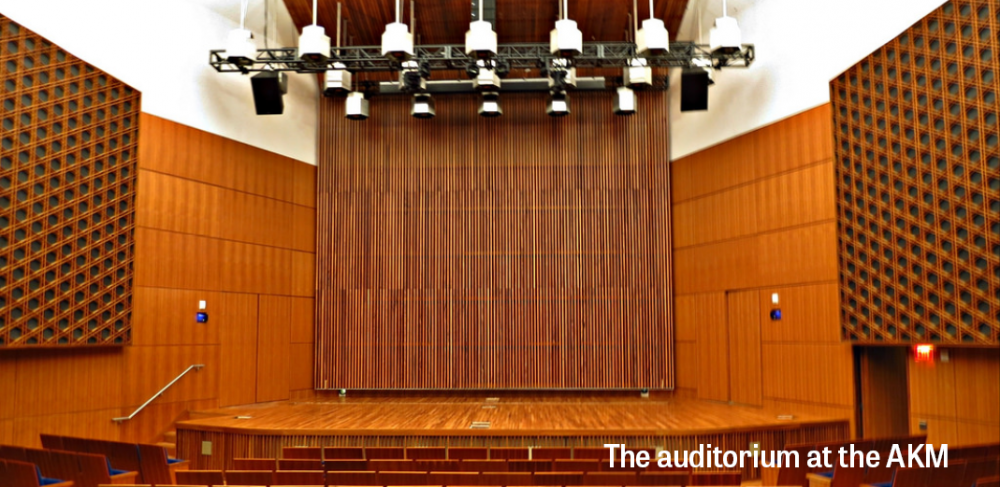
The sometime commercial music category and now broad notion I call world musics is manifest in many, ever-varied ways. It also appears to be spreading geographically to ever more communities in Southern Ontario. Concert presenters are a major vector for this diffusion. It’s notable that aspects of the world’s musics this month and next appear in programs by presenters as different as supper clubs, conservatories of music, classical new music producers, colleges and universities, as well as not-for-profit societies and venues. Yet they all claim to be presenting world music. Some of these presenters have a specific music genre, geographic or cultural construct as a focus, while others a much broader mandate, challenging received ideas of mono-ethnicity embedded in neighbourhood and community by encouraging hybrid exchanges.

I’ve explored in depth individual presenters such as Small World Music in previous columns. This time I thought it would be both fun and instructive to explore four disparate presenters for commonalities and differences, each promoting their event as a festival. Let’s see what Lulaworld 2014, the Mateca Arts Festival, Royal Conservatory of Music’s 21C Music Festival – all in Toronto – plus Conrad Grebel University College’s Sound in the Land in Waterloo have in store for our adventurous ears.

1908-WorldViewLulaworld 2014: Running from May 18 to June 7 Lulaworld 2014, the ninth such annual festival presented by the Lula Music and Arts Centre, showcases Toronto’s top world, jazz and Latin musicians, often performing alongside celebrated international colleagues. In a telephone conversation with Tracy Jenkins, Lula’s co-artistic director, she underscored this year’s theme. “In anticipation of the Toronto 2015 Pan Am Games, Lulaworld will focus on artists with cultural roots in Mexico, Colombia, Cuba, Dominican Republic, Puerto Rico, Haiti, Trinidad, Guadaloupe and Brazil.” She added that musicians with other musical influences, those “from Angola, Israel, Portugal, Turkey and Italy” also have a place on this year’s roster. In addition, for “the very first time, the festival will conclude with a day of free outdoor programming as part of the Dundas [Street] West Fest on June 7.”

I counted 19 separate concerts in Lulaworld. On one date alone, the free Dundas West Fest where the street is closed to traffic, eight groups have been programmed to play on the al fresco stage. I can therefore only touch on a few of the concerts here. The opener on Sunday May 18 kicks off with the Montreal-based singer, pianist and composer Malika Tirolien. Born in Guadaloupe, she soulfully mashes up Antillean, funk, jazz and gospel musical influences. Then the Juno-nominated Toronto group Kobo Town takes the Lula stage with their alternative take on the venerable Trini calypsonian tradition.

There are two shows on May 30. At 7pm the outstanding keyboardist, Grammy-nominated, Juno Award-winning Hilario Duran takes over Lula’s piano for a rare solo concert in his home repertoire of original works, Cuban and jazz standards. At 10pm the Turkish Latin vocalist Zeynep Ozbilen appears with Roberto Linares Brown, among Canada’s most respected salsa bandleaders and composers, plus a nine-piece band. Ozbilen brings a new project, developed with Brown, which she evocatively describes as “Latin with Mediterranean spices.”

In the last in-venue concert on June 6, headliners Jimmy Bosch and Ralph Irizarry with The Lula All Stars demonstrate an important aspect of Lulaworld’s programing: mentorship of local musicians by international stars. Lula co-artistic director Jenkins pointed out that “Jimmy Bosch, a fiery exponent of the progressive sound he calls ‘salsa dura’ (hard salsa) is New York’s most sought after [Latin music] trombonist. And NYC timbalero Ralph Irizarry [aka] the ‘Godfather of Lula’ is a legend of salsa percussion.” They’re both making repeat visits to Lula and will lead workshops and share stage time with our city’s All Stars. You’re encouraged to come for the tropical fusion dinner, take abeginner salsa lesson and stay afterward to dance salsa, merengue, bachata and top 40 to the post-show DJs.

Mateca Arts Festival: In contrast to Lulaworld’s well-seasoned operation, this is the first edition of the Mateca Arts Festival. This “Community Multi-Arts Celebration,” notes its press release, is “inspired by the riches of Latin American culture … honouring the diversity of the city of Toronto. Approximately 15 countries will be represented: Argentina, Chile, Mexico, Colombia, Ecuador, Peru, Venezuela, Spain, USA and Brazil amongst others.”

The festival takes place in Burwash Quad, Victoria College, University of Toronto on June 7 and 8. This an all-inclusive type of cultural gathering, the kind that Harbourfront Centre has popularized over the years, replete with musicians, dancers, visual artists, arts and crafts, food vendors, karaoke, workshops and yoga. Even “motivational speeches” are listed.

For world music fans however perhaps the outstanding event is the trio concert led by the Argentinean singer Beatriz Pichi Malen. With a thriving international concert and recording career, Malen draws on her deep-rooted native Mapuche (indigenous people of south-central Chile and southwestern Argentina) heritage. Her trio performs songs, some inter-generationally passed on, dominated by themes from the natural world and by the Mapuche worldview centred on its intimate and harmonious relationship with Mother Earth. Among the indigenous instruments the group plays to accompany their songs are the kashkawilla (bell rattles),kultrung (drum), trompe (jews harp), and truutruka (valveless horn). The native Quechua dancer Lucho Cruz adds to the concert’s Andean flavour with her choreography illustrating what the press release poetically calls “passages of sacred moments in an open and arid geography, splashed by the southern wind.”

21C Music Festival:The venerable Royal Conservatory, with its Koerner and other halls, is certainly no newcomer to presenting a sweeping variety of music, though admittedly until the 21st century it was mostly of the Euro-American classical variety. The RC’s five-year-old Koerner world music series offerings on the other hand have often been mentioned in this column.

The 21C Music Festival, running from May 21 through 25 is a brand new RC project hosting seven ensembles and numerous soloists, most of them Canadian. The media kit reflects one artistic inspiration for the event. Philanthropist Michael Koerner first quotes composer Charles Ives and then remarks that “21C Music Festival is … about ear stretching.” One of the ear stretching elements evidently is music outside the Euro-American classical mainstream. Let’s call it world music for the lack of a better term.

Of all the individual works and non-orchestral instruments in the festival which could claim world music provenance I’d like to focus on the concert on May 23. Titled “After Hours #1,” the event begins late, approximately at 10pm, at the Conservatory Theatre. It features the compositions and performances of two drummer-composers, Trichy Sankaran and Gurpreet Chana, respectively representatives of the South Asian “classical” Carnatic and Hindustani musical traditions.

The internationally renowned Indian-Canadian percussion virtuoso and York University music professor Sankaran has been a prominent performer on the Toronto scene since the early 1970s. He has been commissioned by the RC to compose a new work for this occasion. His Hamsa (2014) for the 21C Ensemble consisting of violin, viola, cello, flute, clarinet and Sankaran on the mrdangam (Carnatic barrel-shaped drum) will receive its world premiere at the concert. New music by Sankaran is in itself cause for celebration.

Gurpreet Chana grew up in Canada and studied Indian tabla (double drum) in the Punjab gharana (school/style). He also presents a world premiere, TABLIX, for solo tabla and electronics. In his notes, Chana states that TABLIX is the “product of four years of meticulous research and development … explor[ing] technology’s impact on the untapped melodic potential of the tabla.” Chana’s early experiences as a second-generation South Asian immigrant in Canada echo many other musicians’ experiences, “characterized by interactions with every type of musician.” It is an environment that instils an openness that echoes clearly throughout TABLIX which invites the listener to experience and communicate with contemporary music culture through the eyes of the tabla player.

Sound in the Land 2014 Festival: As illustrated in my last column, world music concerts have also taken root in Waterloo, Ontario. Presented by Conrad Grebel University College, University of Waterloo, the Sound in the Land 2014: Music and the Environment Festival, June 5 to 8, consists of a series of concerts plus a conference. Several of the Mennonite-centred, musical and ecologically themed concerts have world music threads as well as mainstream Euro-American ones. On the June 5 “Mennofolk Concert” the Buffleheads, a trio, perform what is intriguingly described as “Afro-grass” repertoire, a new (sub)genre to me. June 6 at the University of Waterloo’s Humanities Theatre in the concert titled “Sonic Convergences: Orchestra and Multimedia,” the Korean composer and media artist Cecilia Heejeong Kim stages her engaging multimedia piece Earth Songs(2009), for Korean instrumentsand Korean vocals.

Then at the Saturday matinee on June 7 the Grebel Gamelan directed by Maisie Sum plays Balinese instrumental music on the  Grebel Chapel’s patio (in keeping with the open-air presentation typical of performances in the music’s tropical homeland).

Weaving together Lulaworld’s Latin and Luso core with Mateca Arts Festival’s South and Central American community multi-arts celebration, then adding the 21C Music Festival’s embrace of performer-composers outside the received classical composer matrix and finally the multi-hued threads of Conrad Grebel’s Afro-grass, Korean ecological theatre, Balinese gamelan and choral kecak, it becomes clear that these and other such presenters are key actors defining the practice and transmission of world music in our time.

Andrew Timar is a Toronto musician and music writer. He can be contacted at worldmusic@thewholenote.com.

Back to top