Artists of many kinds feel like it should be the goal for their art to rise above the everyday – art is its own thing. Other artists strive to make the everyday the fulcrum of their art: to drive conversations to respond to them, to change narratives, and to leave people changed. Over the next month I’m highlighting two of the latter for you to attend and find yourself inserted into an ongoing conversation about the past, about now, about who we are, about who we want to be. I hope you don’t just accept the music passively and are instead empowered to respond to it. My kind of choral music is about conversations in song. Join me!

A previously unreleased conceptual design of a new $20 note that was produced by the Bureau of Engraving and Printing and obtained by The New York Times depicts Harriet Tubman in a dark coat with a wide collar and a white scarf. This preliminary design was completed in late 2016.The Woman Donald Trump Took off American Money
The Nathaniel Dett Chorale presents a concert version of American composer Nkeiru Okoye’s opera Harriet Tubman: When I Crossed That Line to Freedom as part of their Voices of the Diaspora series. Harriet Tubman has been much in popular culture lately. Beginning in 2020, she should have been on American $20 bills in circulation across the US, but Donald Trump’s office has stopped this from happening. Tubman, born Araminta Ross, is part of the black history of Canada and her incredible story and leadership continue to inspire. Cynthia Erivo brought Tubman to life in the 2019 film Harriet and has earned Oscar nominations for Best Actress and Best Original Song for it.

Read more: Conversations in Song and Choral Relevance

Along with gift exchanges and eggnog giggles with loved ones, listening to Handel’s Messiah has become a Christmas staple for me. Especially in recent years, I repeatedly listen to this masterpiece of a work, my interest for it never wavering. Even after singing it several times and watching a number of performances, I have yet to tire of the soaring harmonies and elegant solos.

Grand River Philharmonic: This year, I’m looking forward to Messiah as performed, in an annual tradition going back decades, by the Grand Philharmonic Choir in Kitchener. With orchestral accompaniment by the Kitchener-Waterloo Symphony, the concert will be conducted by Mark Vuorinen and will feature soloists, soprano Mireille Asselin, mezzo-soprano Maude Brunet, tenor Asitha Tennekoon and baritone Samuel Chan. Choosing to see this particular version is part of my quest to broaden my knowledge of the choirs around me, and attend concerts outside of the Greater Toronto Area. Their Messiah will be held at the Centre in the Square in Kitchener, Ontario on December 7. Ever the one to want to introduce the Messiah to new ears, I have gifted a ticket to a friend of mine who (aside from knowing the “Hallelujah” chorus) has never listened to the work in its entirety. 

Read more: Handel's Messiah and the Glee Effect

Choral music is not one of life’s frills. It’s something that goes to the very heart of our humanity, our sense of community, and our souls.” – John Rutter

Some of my earliest memories of community are from being a member of choir. It has always held great prominence in my life. A few weeks ago, I watched a short YouTube video from J.W. Pepper of an interview with John Rutter, a renowned composer of choral music. Although the clip is only a few minutes long, his words resonated with me, for he spoke so eloquently and profoundly of the significance of choir.

My Introduction to the Choral World

I was seven years old when my family immigrated to Canada. Shortly after settling down in Toronto, my mother became involved with the choir of our then-community church as their pianist. Soon after, she encouraged my sister and me to join it. In addition to singing in church, my sister and I also became members of a choir called VOCE, a children’s choir affiliated with the Toronto Catholic District School Board. The rehearsals were held at Cardinal Carter Academy for the Arts. (We would go on to attend the high school a few years later.)

Because I was considerably younger than the other members of the church choir, attending rehearsals weekly was something I did primarily because of my mother. However, being part of VOCE, with other singers my own age, was a completely different experience. As Rutter says during the interview, “When you get together with a group of other singers […] all of those people are pouring out their hearts and souls in perfect harmony.” I felt at ease in choir as I mingled with like-minded children; all of us bonding over music, learning our parts together, competing for solos but also supporting one another. I remember having a lot of fun.

Carol Woodward RatzlaffChoral Community and Inclusivity

I recently was affiliated with VIVA! Youth Singers of Toronto, as I worked part-time with them and sang with their Main Chorus. Founded in 2000, VIVA! is a welcoming space inclusive to singers with disabilities. After listening to the Rutter video, I was moved to discuss this theme of community with someone deeply rooted in the choral scene, so I reconnected by email with Carol Woodward Ratzlaff, founder of VIVA!, to get her perspective both as a conductor and a chorister.

When schools started eliminating arts programming 20 years ago, Ratzlaff, who was working for the Toronto District School Board at the time, felt she needed to turn to the private sector to respond. She tells me: “We need to work to inform education leaders and those in government of the personal advantages, educational benefits and holistic impact of arts opportunities. Too often, adult-centred economic concerns inform educational outcomes. I was aware of many other excellent private-sector choral experiences in the GTA, but I was not focused on what the market was already providing; it was not a business response. I was motivated by the fact that there were many children (as well as youth and adults with disabilities) who were not being provided with opportunities to sing and to create beautiful music together.” Ratzlaff’s words resonate strongly with Rutter’s. As he states: “Politicians need to take note […], and our educators, those who decide education budgets, church budgets, just need to remember [choral music is] not a frill.”

Ratzlaff’s first experiences in choir were from middle school in St. Catharines ON. Since then, she has sung with several esteemed choirs, including the Elmer Iseler Singers and the Toronto Mendelssohn Choir. She shares: “Choral singing has been one of the great joys of my professional and personal life. I am temperamentally suited to group singing and collaborative creative work. I am particularly intrigued by the rich connections that are fostered between choristers themselves, between choristers and audience, and the changing role of the conductor in this landscape.”

I asked her what she tries to instill in singers as a choral director. She replied: “I try to empower them to make decisions along with me, to take ownership of our creative journey, and to make something beautiful with their voices. […] I seek a balance between meeting individual and group needs.” Ratzlaff shares that she loves “the process of discernment in seeking how to teach a piece of music. [She loves] sound and the capacity of the human voice to produce many expressive colours to tell a story.”

John RutterThe last word on this topic goes to John Rutter again: “Choral music is like a great oak that rises up from the centre of the human race and spreads its branches everywhere. That’s what music does for us. And choral music must stand as one of the supreme examples of it.”

Concerts around the GTA

Speaking of Rutter, we can listen to some of his works that will be included in a few concerts over the next months. Under artistic director, Oliver Balaburski, the King Edward Choir will perform Rutter’s Angels’ Carol and Candlelight Carol during their concert, “Gloria!” on November 30. The Aurora United Church Chancel Choir and Handbell Ensembles, will have a Carols by Candlelight service on December 8. The first movement of Rutter’s Gloria will be one of the pieces sung. The MCS Chorus Mississauga will take you on a musical and literary journey with Christmas with Anne, also on December 8. Along with readings from Lucy Montgomery’s Anne of Green Gables books, savour the sounds of Rutter’s Carol of the Children and Angel’s Carol.

Mary Lou FallisChoral Mosaic: Invitation to Choirs

With all this dialogue on choral music and community, you may feel inspired to get out and join a choir right away. But circle your calendar too for a great choral event, the inaugural Choral Mosaic Festival, taking place from June 25 to 27, 2020. Organized by the Mississauga Festival Choir and Festival Team, under the direction of David Ambrose, it will be three days of choral merriment; the choral Osheaga, if you will. Complete choirs, as well as individuals, are welcome to participate in the festival. Take the opportunity to hone your vocal skills and gain insight from professional speakers, be challenged by a variety of workshops and enjoy fraternizing with other singers. In addition, some notable features include an act by comedian Mary Lou Fallis and a closing gala performance by all the participants. The Festival will be held at the Living Arts Centre in Mississauga. If this has piqued your interest, look for more details on the festival website, choralmosaic.com. And take note! Early-bird registration has already begun.

CHORAL SCENE QUICK PICKS

NOV 16, 7:30PM: The Bach Elgar Choir presents Brahms’ Requiem at Melrose United Church in Hamilton. The choir, under the direction of Alexander Cann, will perform with the accompaniment of a full orchestra.

VIVA! Youth Singers of TorontoNOV 23, 6:30PM: Join the VIVA! Youth Singers of Toronto with “The World in a City,” an interactive family-friendly concert. The concert will pay homage to Toronto with works conveying Indigenous roots and waves of migration. Jeanne Lamon Hall, Trinity-St. Paul’s Centre.

NOV 30, 7PM: The Incontra Vocal Ensemble presents “Creator of the Stars of Night,” under the direction of Matthew Otto. Look forward to hearing the works of Britten, Mendelssohn, and Chilcott, among others. The concert will serve as a fundraiser for the Institute for Christian Studies. At Knox College Chapel, U of T.

DEC 6, 7:30PM AND DEC 7, 2PM AND 7:30PM: Cue the Home Alone face. Relive the joyous and laughter-filled memories with this beloved Christmas film. The Toronto Symphony Orchestra, with the Resonance Youth Choir, will present Home Alone in Concert under the direction of Constantine Kitsopoulos. The music by John Williams will be ringing once again at Roy Thomson Hall.

DEC 7, 7:30PM: The Christmas season always feels complete with the soaring harmonies of Handel’s Messiah. Take in the beautiful sound of the Grand Philharmonic Choir with soprano soloist Mireille Asselin, mezzo Maude Brunet, tenor Asitha Tenekoon and baritone Samuel Chan. The Choir will be accompanied by the Kitchener-Waterloo Symphony at the Centre in the Square in Kitchener.

Menaka Swaminathan is a writer and chorister, currently based in Toronto. She can be reached via choralscene@thewholenote.com.

Autumn is the most enjoyable season of the four we are lucky to experience in Canada. All right, this may be a biased opinion, but I stand by it. The temperature is comfortable and somewhat consistent, the leaves are changing and we are presented with beautiful colours for a few weeks. And of course Thanksgiving is nigh, which means pumpkin spice everything. Cue all the excitement. I also notice people are happier around this time. That could be an arguable statement too, but I do think the brightness of the season somehow results in an overall brighter demeanour with people.

While looking through choral performances over the next couple of months, I noticed a bit of a thematic trend, in terms of human connection to nature, which reflects the season we are entering, which we appreciate for the natural beauty that surrounds us. Additionally as part of a culture where attempts at living with zero waste are slowly becoming more prominent, it seems fitting to see concerts not only calling for reflection on the state of the Earth and respect of nature but also, especially with our current political climate, providing opportunities to listen to music that takes us out of the hustle and bustle of everyday life with all its distractions, thereby keeping us zoned in to what is truly important: Earth, nature, togetherness.

Dr. Charlene PaulsAdvancing to Where We Are Today

Accordingly, a few concerts piqued my interest pertaining to these themes, one of them being a performance by the Guelph Chamber Choir of Bob Chilcott’s Five Days that Changed the World and other works on October 27. Many choristers will easily recognize Chilcott’s name, for he is a prominent composer of choral repertoire. I have experienced many a Chilcott work, both as a chorister and as an audience member; however, I had not heard of this particular work. I got in touch with Dr. Charlene Pauls, the new artistic director of the Guelph Chamber Choir, to inquire a little further about the work.

I was interested, I told her, to know why Pauls chose to perform Five Days that Changed the World and her reason for calling on this theme of unity; the concert features other pieces as well, but Chilcott is clearly the main event. Pauls explained that “in a world that seems increasingly to highlight so much of what is negative about the human spirit, we wanted to create a program that did the opposite.” As mentioned earlier, we are in a time where there is an increased urge to be more united, trying to leave behind a lighter footprint on our planet and taking care of what we have. “We tend to hear so much about the problems in our world,” Pauls continues, “however, throughout time there have always been those around us who have made an impact through positive change, who have created innovations that have improved society and who have made the world a better place.” This piece “highlights five moments in time that have connected people: the invention of the printing press, the abolition of slavery, the invention of flight, the discovery of penicillin and the first human in space. […] The music is wonderfully varied, with threads of humour, poignancy and wonder woven throughout the various movements.”

Some of the other works to be performed “celebrate connections between us.” They include Winnipeg composer Andrew Balfour’s welcoming song Ambe (sung in Ojibway), American composer Joan Szymko’s It Takes A Village, French composer Maurice Duruflé’s Ubi Caritas, Canadian composer Sarah Quartel’s Sing, My Child, and a great gospel arrangement of Paul Simon’s Bridge Over Troubled Water by Kirby Shaw. Other pieces on the program include works that challenge us to action, such as Eric Whitacre’s Cloudburst that urges us to “dream with our hands.” To top it off, there is a surprise encore piece that should not be missed. Pauls revealed the surprise to me, but I am going to keep it to myself.

Continuing on to explain her aim with this performance, Pauls comments: “Fundamentally, I believe that the foundation of society must be relationships, humanity connecting with each other, because it is only then that we can have empathy and create positive change.”

Mark RamsayNature’s Beauty and Environmental Consciousness

Similarly, another concert that I think will be a captivating listen is “Voices of Earth: In Celebration of Nature’s Beauty” by the Exultate Chamber Singers, entering its 39th season, conducted by Mark Ramsay on October 18. I was interested to know more about the program as well as his decision to set on the theme of nature. Ramsay answered a few of my questions via email..

The music is quite varied, he says, and the concert is a compilation of works by an interesting mix of composers, many of whom are Canadian.

A few works he mentioned are: Voices of Earth by Mark Sirett, which will be performed with a guest violinist, Adrian Irvine. Due North by Stephen Chatman, Ramsay tells me, “is a fun set of five pieces set in the style of soundscapes where [they] explore the sounds associated with and inspired by specific words related to our Canadian landscape, including Mountains, Trees, Mosquitoes and even Woodpecker.”

Come to the Woods by Jake Runestad, with a text by John Muir, is the cornerstone of the program, Ramsay informs me. “It’s an extended work, with a fantastic piano part, that takes us on an emotional journey.” The composer describes it as a piece that “explores Muir’s inspirations and the transporting peace found in the natural world.”

The program also includes, but is not limited to, works by Johannes Brahms, Allan Bevan, Gwynyth Walker, Matthew Emery, and Samuel Barber.

What led him to decide on the theme? Ramsay says: “I personally believe the theme is a timely one. The Earth and our environment has always been a powerful inspiration for writers, musicians and artists from all creative streams. Recently, I think we are seeing a general increased interest in our environment and our relationship with it. How are we harming it? How are we caring for it? What does our future look like? With that in mind I tried to design a program filled with beautiful texts and choral music that depicts this diverse and stunning environment we are so strongly connected to.”

Keep these questions that Ramsay poses in mind as you take in the music. We have to make a conscious effort to take a minute to centre ourselves, think about our planet, think about all that we have gained from it. This theme is one that cannot really get stale or uninteresting, as we continue to slowly but surely witness an active push in working together to keep our Earth healthy and to bridge the divides in society.

On October 27th at 3pm, the Guelph Chamber Choir will perform Bob Chillcot’s Five Days that Changed the World, amongst other works. The performance will take place at the Harcourt Memorial United Church in Guelph. In keeping with a theme of unity, the Guelph Collegiate and Vocational Institute (GCVI) high school choir will join the Guelph Chamber Choir for the main piece.

Exultate Chamber SingersOn October 18th at 8pm, the Exultate Chamber Singers will perform Voices of Earth: In Celebration of Nature’s Beauty at St. Thomas’s Anglican Church in Toronto. 

CHORAL SCENE QUICK PICKS

OCT 20, 2:30PM: The University of Toronto Faculty of Music presents “Choirs in Concert: Seasons of Song.” Be treated to a combination of the Men’s Chorus and Women’s Chorus, under conductors Elaine Choi and Mark Ramsay. Some featured works will be by contemporary Canadian composers Frances Farrell, Matthew Emery and E.K.R. Hammell. The performance will be held at the Church of the Redeemer. U of T students should be sure to carry a valid TCard for free admittance, space permitting.

OCT 27, 3PM: Orchestra Toronto, together with the Toronto Mendelssohn Choir, will present “Freude! 30 Years after the Fall of the Berlin Wall” at the George Weston Recital Hall. Under the direction of Michael Newnham, with soloists Lesley Bouza (soprano), Andrea Ludwig (mezzo), Andrew Walker (tenor) and Bradley Christensen (baritone), with pianist Elijah Orlenko; revel in Mozart’s Piano Concerto No.23 and Beethoven’s Symphony No.9.

OCT 27, 3PM: The Vesnikva Choir, the Toronto Ukrainian Male Chamber Choir and the St. Nicholas Ukrainian Catholic Church Choir come together for “Tribute to Koshyts,” a concert featuring some of the sacred and secular works of Oleksander Koshyts; at All Saints Kingsway Anglican Church with an introduction by Wasyl Sydorenko.

NOV 2, 7:30PM: Pax Christi Chorale present the world premiere of The Sun, the Wind, and the Man with the Cloak at Yorkminster Park Baptist Church. Music by Stephanie Martin, commissioned by Pax Christie Chorale. With the Intermediate Chorus of Canadian Children’s Opera Company and soloists Allison Walmsley (soprano), Catherine Daniel (mezzo), Asitha Tennekoon (tenor), and Brett Polegato (baritone).

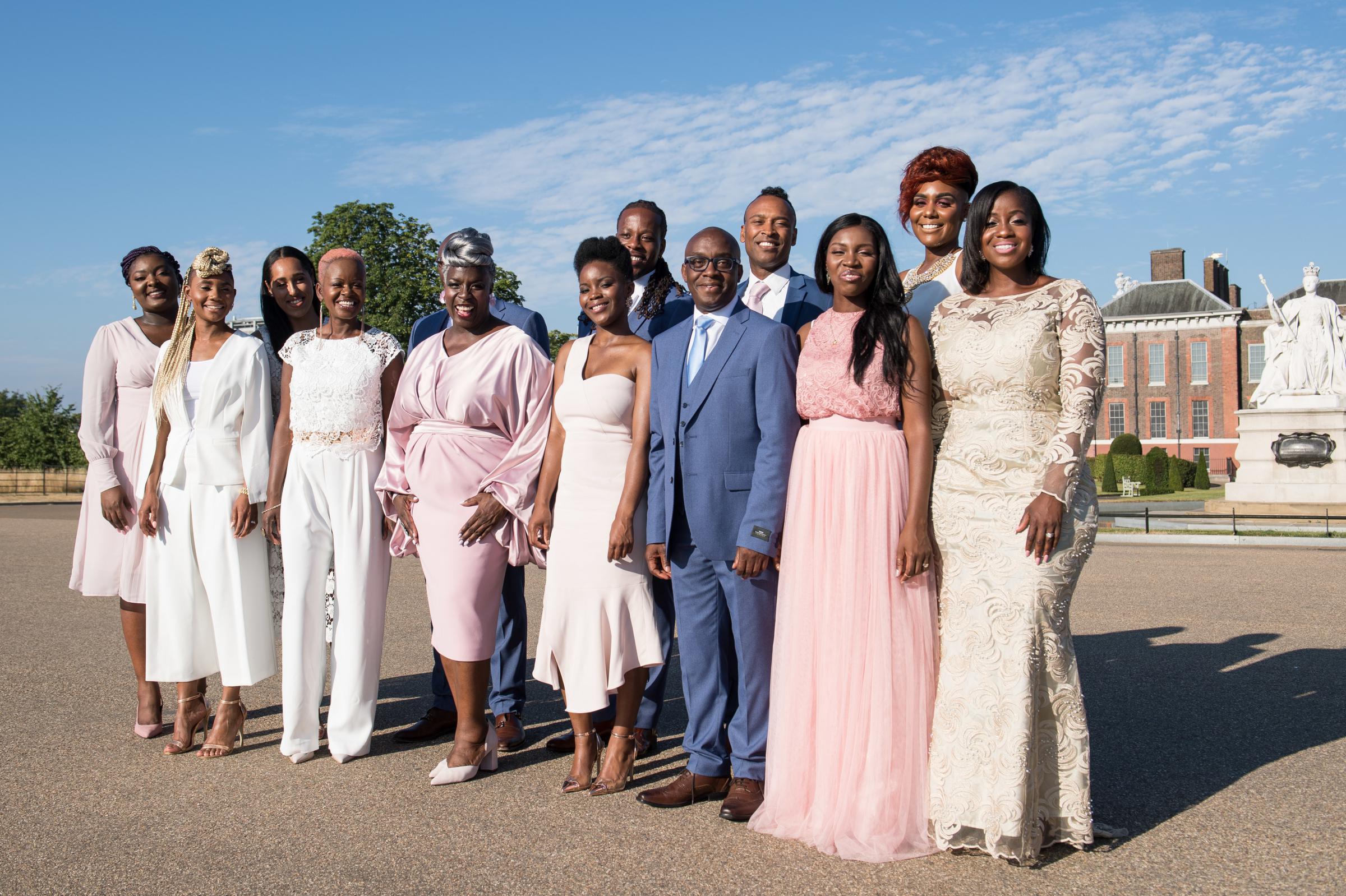
The Kingdom ChoirNOV 5 and 6, 7:30PM: Remember the choir at the big royal wedding of Meghan Markle and Prince Harry? They will be performing in Toronto soon. With two dates in November, the Kingdom Choir, with a reputation of the best gospel choir in the world, will take over the Meridian Arts Centre. Expect to hear stunning renditions of Beyoncé’s Halo, John Legend’s All of Me and of course Stand By Me, now made famous from their world-viewed performance.

Menaka Swaminathan is a writer and chorister, currently based in Toronto. She can be reached via choralscene@thewholenote.com.

If you, like me, are a once-active vocalist who took a break for an extended period of time, looking to rejoin a choir, or looking for a new choir to join, is daunting. A friend recently suggested that I could still audition for the Toronto Mendelssohn Choir (TMC) at the end of August for their upcoming season. My mind went into panic mode. I let out a quick “No!” – I mean, how could I possibly be ready for an audition with mere weeks to get my voice back into shape? And isn’t September too late to join a choir like that? Surely their plans for the coming season are firmly in place?

But it got me thinking, so I spoke to some choristers and reached out by email to the artistic teams of three different choirs in Toronto to ask about their audition requirements, and how far along they are in the behind-the-scenes preparation it takes to get a new choral seasons rolling in the fall.

Cantabile Chamber SingersLooking through WholeNote’s Canary pages to decide who to contact was a great reminder of the variety of choirs present in Toronto. Whether you prefer bigger groups, like the 65-voice ensemble of The Annex Singers, or the intimate setting of a smaller chamber ensemble, like 15 to 20-voice Cantabile Chamber Singers, or a community choir, like the 30 to 35-member Jubilate Singers, there truly is a choir out there for everyone. Many ensembles are open to people of diverse backgrounds, both musical and occupational. Singing can be solely a hobby; using music as a release. It can also be a gateway to a professional career in music. In any case, no one should feel discouraged from joining a choir if an interest in singing is present.

After the summer break, would September be too late to get in touch with any of these three choirs?

The response to my inquiries was encouraging: although holding auditions in different months in the year – May and September for the Cantabile Chamber Singers; June, August and January for The Annex Singers; June and September for the Jubilate Singers – all three ensembles welcome inquiries throughout the season.

So, the fact that it’s nearly September is no excuse! Now is as good a time as any. As for my question as to what new and existing choristers should keep in mind prior to making a commitment to a choir, the responses were unanimous: understanding the extent of the commitment so you can figure out how you will balance your own schedule is essential. As mentioned, choir members come from different backgrounds, and choirs themselves are different: the ability to balance work with rehearsals sufficiently to maintain a dedication to the choir is important. Choristers likely need to be able to commit to weekly rehearsals, make personal time to learn music, and set dates aside for performances. And depending on the choir, additional commitments may be expected for various workshops, sectionals, and choir retreats.

Behind the Concerts

Meanwhile, in these months prior to the start of the new music season, the choral scene is bustling with preparation, a lot of it unobserved by audiences and often even by choristers. Music needs to be selected, artists contacted, auditions arranged, venues booked, funding organized, and year-round administrative duties maintained. As the artistic team of The Annex Singers told me, music selection, for example, must sometimes be done as much as a year in advance.

The music community as an art is unlike the music entertainment industry. It is a labour of love, a conscientious drive to keep music as an art form alive. It is not easy. All three choirs mentioned here are led by women, all of them sharing the same determination; a determination to bring diversity to Toronto’s choral scene and to make choral music accessible to a large number of people.

Jubilate SingersI asked how specific works are selected for a music season. Cheryll Chung, artistic director of Cantabile, answered, “I usually have a running list of pieces that I want to perform. I’m always on the lookout for new repertoire – always researching, especially music written by living composers, and female composers who are local.” The music director of Jubilate, Isabel Bernaus, makes all programming decisions for their three-concert season, although she “usually consults with an informal program advisory group of choir members. Concert themes and individual works are outlined the previous January (in preparation for the arts council grant applications.)” Similarly, Maria Case, artistic director of The Annex Singers, creates the program for each concert well in advance, adding that the concerts usually centre on a theme.

With respect to collaborations with guest artists and/or ensembles, Jubilate makes their selections “depending on the music and program needs.” One example: inviting “a Spanish dance company to collaborate on a program of classical Spanish and flamenco music. […] The selection of collaborators is often dependent on the professional and personal connections of the music director (or, occasionally, of one of the choir members).”

In a like manner, The Annex Singers “match the instrument, style, and area of interest of [their] guest performers to the particular program.” They mentioned a tribute performance to Shakespeare where they welcomed guest harpsichordist, Cynthia Hiebert. They also “see supporting young artists as part of [their] responsibility within the choral community.”

As someone who previously worked behind the scenes in a choral organization, I am aware of how essential funding is to the advancement and scope of choirs. I asked if these choirs receive funding from any additional stakeholders outside of their members. As might be expected, their answers differed.

Chung shared that Cantabile hasn’t been successful with all of their grant applications, “except for the one [they] applied for with [their] composer-in-residence Laura Sgroi. It was a commissioning grant awarded by the Ontario Arts Council (OAC). [They therefore] rely solely on ticket sales and donations.”

The artistic team of The Annex Singers answered, “We receive advertising revenues from local business owners and merchants in the community who promote their services in our concert programs and provide donations to our raffles and silent auction throughout the concert season. We also receive financial support from donors within and outside the choir. Our audiences are aware of the costs of running a choir, and have proved loyal, responsive and generous to our fundraising campaigns. However, most of our revenue comes from membership fees and ticket sales.”

The Jubilate Singers have “the support of multi-year grants from the Toronto Arts Council. In some years [they] have been fortunate to receive a grant from the OAC. In addition, individual donors give some funding, and some businesses advertise in [their] programs.” I asked why arts funding is important to Jubilate. They answered, “Arts funding helps with expenses, especially for paying the honoraria to the music director and accompanist, as well as venue rental for rehearsals and concerts. This kind of funding also shows that the community at large respects our contribution and recognizes the importance of music in the life of the community.”

Why should there be an interest in investing in choirs? And why should people in the community care to expand the choral scene? For a community choir like The Jubilate Singers, it’s because they “[occupy] a special niche, performing an eclectic range of world music that reflects the diversity of the greater Toronto region. … A small donation to a choir can make a big impact on the ability of that choir to present interesting and/or unusual music […] More generally, community choirs represent the ideal of amateur musicians who rehearse and perform for the love of singing. Whatever polish a choir may lack is made up for by the energy and dedication that its members bring to the music.”

Chung adds a similar sentiment, “I think people want to give back to the arts and support living musicians. Generally they see the value of live music and enjoy the diversity of our concerts.”

As for the Toronto Mendelssohn Choir, I spoke briefly with a chorister I know, Chantelle Whiteside, who has been a TMC member, and is lamenting that, as TMC gets ready to celebrate their 125th anniversary, she won’t be able to make the commitment of time she knows she would have to, to be part of what promises to be a special year. “Being a part of Mendelssohn has been the most rewarding thing,” she says. “It’s a community, … meeting new friends who become your closest friends.” Many choral groups require a fee from members to survive; however, the experience earned and lasting relationships formed are ultimately priceless.

To inquire about any of the specific choirs mentioned above, please contact:

Jubilate Singers – info@jubilatesingers.ca; 416-223-7690

Cantabile Chamber Singers – cantabilechambersingers@gmail.com; 416-509-8122

The Annex Singers – joeidinger@gmail.com; 416-458-4434

The Toronto Mendelssohn Choir – admin@tmchoir.org; 416-598-0422

Or to delve into the myriad other opportunities out there, check out the current WholeNote Canary Pages under “Who’s Who?” at thewholenote.com.

It’s never too soon or too late!

CHORAL SCENE QUICK PICKS

SEP 28, 4PM: Bringing a Spanish and Latin flair to the St. Lawrence Centre for the Arts, the Toronto Operetta Theatre presents “Viva La Zarzuela.” Let the vocal talents of tenor Romulo Delgado and sopranos Ana Persijn Alarcon, Cristina Pisani and Olivia Maldonado, under the direction of Guillermo Silva-Marin transport you to Latin America and Spain.

SEP 29, 4PM: The Elmer Iseler Singers celebrate 40 years of the Festival of the Sound including the Toronto premiere of Eric Robertson’s The Sound – A Musical Evocation of Georgian Bay. James Campbell and the Penderecki String Quartet are among the guest artists performing at Eglinton-St. George’s United Church.

OCT 5 AND 6, 7:30PM: Enjoy the familiar, “I like to be in America!” with Leonard Bernstein’s West Side Story in concert presented by Chorus Niagara and the Niagara Symphony Orchestra. Robert Markus, fresh from his recent performance as Evan Hansen in Dear Evan Hansen, takes the lead role as Tony; soprano Meher Pavri performs Maria. Tickets can be bought online and performances will take place at FirstOntario Performing Arts Centre, St. Catharines.

Menaka Swaminathan is a writer and chorister, currently based in Toronto. She can be reached via choralscene@thewholenote.com

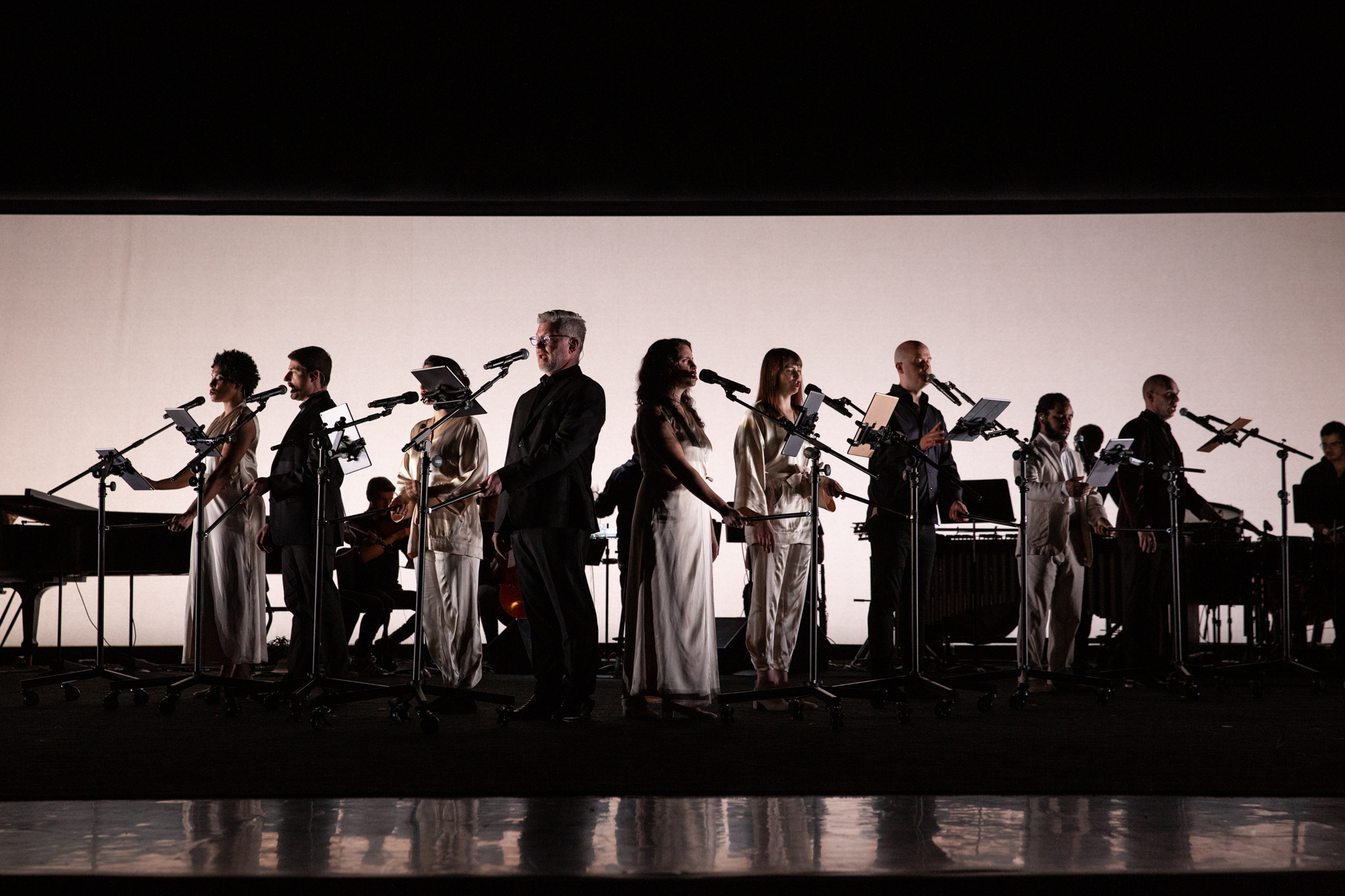
Roomful of Teeth in Triptych (Eyes of One on Another). Photo (c) Maria BaranovaOn June 22 at 8pm, Luminato presents Triptych (Eyes of One on Another), a new multidisciplinary work composed by Bryce Dessner with libretto by Korde Arrington Tuttle, inspired by the controversial and revolutionary work of Robert Mapplethorpe; at the Sony Centre (soon to be Meridian Hall), Toronto.

A consistent throughline at Luminato has been introducing local audiences to the international array of interesting, challenging collisions of storytelling and performance. In this year’s festival we have this multidisciplinary work inspired by Robert Mapplethorpe’s art. His stark black and white photography, often focused upon unapologetic queerness in a striking visual way, here collides with an equally striking vocal ensemble called Roomful of Teeth. Hand-picked by Triptych composer Bryce Dessner to bring his score to life, Roomful of Teeth is not quite a choir, not quite a band, not quite what you’d think of for an eight-voice ensemble. Their number includes bass-baritone Dashon Burton, founder Brad Wells, and Pulitzer Prize-winning composer Caroline Shaw.

Triptych’s subject is Robert Mapplethorpe himself. His photography of provocative people was challenged in American courts under obscenity laws in 1990. To this day, Mapplethorpe’s work is controversial, but his unique approach has left an indelible impact in the intersection of photography and viewer. The composer, Bryce Dessner is an accomplished orchestral writer but is mostly known for his work as guitarist in the American band, The National. Interestingly, he is a native of Cincinnati, the city where Mapplethorpe’s exhibit was shut down under obscenity laws. At the world premiere in Ann Arbor, Michigan, in March of 2019, Dessner and librettist Korde Arrington Tuttle participated in an hour-long talk with NPR’s Neda Ulaby. Their interview, available on Youtube, is a fascinating look into the creative process of collaboration and informed this month’s column.

“The images were always core to the work,” shares Dessner to Ulaby. “There are so many images that stand out … there are the images you can find which have been in exhibitions or on books or on their website and then there’s 1000 times that; his archives [in the Getty Institute] are extensive … [But] if he didn’t himself publish a photo, we’re technically not allowed to show it.” So for Dessner and Arrington Tuttle, they were able to see so much more than the public has, and this personal look has shaped Triptych.

“Mapplethorpe’s work gets deep into the heart of all kinds of issues around our identity and how we see one another,” continues Dessner. “The images are so powerful; and his art is so powerful in that way. The conflict within it is always unfolding.” Thirty years after the death of Mapplethorpe, there are still discussions around what art is, the lines of art and obscenity, and how to respond to it all. Many still call the work obscene and profane, but there is a persistent draw in the work that continues to make Mapplethorpe popular.

“I came to Mapplethorpe’s life and work in college... For me, it had something to do with how he saw,” shares Arrington Tuttle. “It had something to do with precision, it had something to do with an attempt at how to grasp at what he describes as perfection. But also a kind of transcendent beauty and a kind of love that might not look like love. It might not look like how I’m used to perceiving love or tenderness. There’s something about coming to terms with and spending time intimately with discomfort and placing myself in that discomfort … It was provocation that asked me and required my presence …the way Mapplethorpe is mixing the sacred and the profane and elevating images that some people might call pornographic but are actually great works of art.”

“There’s been intense discomfort and reckoning,” says Dessner. “Almost every day we’ll have a discussion or confront something new in terms of the bigger work of what this is. I think for me the piece has become the process of making the piece.” That process included working with Roomful and writing the music knowing it was going to be them performing it. In fact he can’t think of anyone other than Roomful performing the work. As it travels, so too does the ensemble.

“They’re really like a band, Roomful, they bring a kind of intent. They can’t just sing something, they have to know why they’re singing something.”

Roomful of Teeth as an ensemble name sounds crass and jarring., and their music can sound like that as well. There is a lot of sound and a lot of different techniques all being thrown at listeners at once. There is something dynamic about listening to a female voice sing in the style of Bulgarian women. It’s another feeling altogether to hear Tuvan throat singing droning away. Sometimes it is just plain weird to listen to –an example of “spending time intimately with discomfort” that Arrington Tuttle referred to. Roomful constantly seeks to find all the various ways that voices can make sound and confront you with them. The seductive sound of Sardinian cantu, for example, provides a fullness and constant envelope of sound much like a bagpipe. Higher tones can then play around on top of the solid bass provided by the style. Many of the singers in Roomful are composers; they understand the interplay that art has between presenting, listening, invoking, and creating. “They’ve been quite involved in shaping the work … it’s made the piece much stronger,” says Dessner.

Roomful’s intersection with Dressner and Mapplethorpe in Triptych (Eyes of One on Another) is just that – an intersection. It’s worth checking out, and it will also be interesting to see what lies next on their own path.

The State Choir LATVIJA in Moscow, 2015The 15th Latvian Song and Dance Festival

Latvian culture has a strong choral tradition of massive ensembles in summer festivals. Here in Canada, many Latvians have made indelible marks in the Canadian choral landscape. As part of the 15th Latvian Song and Dance Festival, the State Choir LATVIJA comes to Canada for the first time.

The Latvian Song and Dance Festival occurs every five years in Latvia. A distinguishing feature of the festival is the massed power of thousands of voices. These huge summer gatherings devoted to music are cultural gems in Latvia. The Toronto version of the festival includes choral, instrumental, and dance performances all centred around the significant contributions of Latvians to choral art.

In their concert of Latvian sacred music on July 4 at Trinity St. Paul’s Centre, State Choir LATVIJA performs a host of beautiful works written by Latvian composers including Canadians Imant Ramnish, George Juris Ķeniņš, Tālivaldis Ķeniņš, Arvīds Purvs and Ērika Yost. Raminsh’s stirring Ave Verum Corpus is a well-loved standard of Canadian choral programming. Ķeniņš’ work, Miss Brevis Latviensis was commissioned by the Choir and had its premiere in 2017 to celebrate the 500th anniversary of the Reformation.

On July 5, the State Choir LATVIJA – now in its 77th season – comes to Koerner Hall, the grandest of spaces for this fine choir. Featuring music from Latvian-Canadian composers Jānis Kalniņš, Tālivaldis Ķeniņš and Imant Raminsh, the choir is joined by violinist Laura Zariņa, pianist Arthur Ozolins and members of the Canadian Opera Company Orchestra.

Finally, in keeping with the Latvian large choir tradition, on July 6 at 3pm, State Choir LATVIJA conductor Māris Sirmais will lead a Mass Choir Concert – an expected 800 choristers – in a program of all-Latvian composers at Mattamy Athletic Centre. 

CHORAL SCENE QUICK PICKS

JUN 13 TO 22: Asah Productions and Luminato present Obeah Opera. An a cappella, all-female cast explore the Salem witch trials in a work conceived, written and composed by Nicole Brooks. Tituba, a young Caribbean slave was the first woman accused in the trials. This is her story amidst the paranoia that gripped colonial Massachusetts between February 1692 and May 1693: at the Fleck Dance Theatre, Toronto.

JUN 19, 20, 22, 8PM AND JUN-23, 3PM: The Toronto Symphony Orchestra presents Carmina Burana conducted by Donald Runnicles. James Ehnes performs Korngold’s Violin Concerto to open the concert. For the signature work of the evening, Nichole Haslett, Sunnyboy Dladla and Norman Garrett anchor the solos. The Toronto Mendelssohn Choir will be joined by the Toronto Youth Choir and the Toronto Children’s Chorus in performing one of the greatest pieces in the choral canon. It may well be the biggest presentation of Carmina Burana Toronto has ever seen at Roy Thomson Hall.

JUN 23, 8PM: The closing event of Luminato 2019, Maada’ookii Songlines, composed by Cris Derksen, will bring together the power of over 200 performers, including almost a dozen choirs, plus soloists and instrumentalists, in a free performance meant to bridge the time between evening and night; at Harbourfront Centre.

JUL 19, 7:30PM: The Festival of the Sound’s Opening Gala features the Elmer Iseler Singers. With a host of guests including soprano Mary Lou Fallis; narrator Colin Fox; the Penderecki String Quartet; and instrumentalists Guy Few, Suzanne Shulman, James Campbell, Beverley Johnston, and Bob Mills. A huge assortment of choral excerpts mark and evoke performances from the 40-year history of the Festival. Excerpts include Handel’s Messiah, Bach’s Mass in B Minor, Carmina Burana, Mozart’s Requiem, and the world premiere of The Sound: A Musical Evocation of Georgian Bay by Eric Robertson and Gary Michael Dault. Lots of other musical experiences can be found throughout the festival. Stockey Centre, Parry Sound.

AUG 17 TO 25: Wellington Water Week is a celebration of the water in the idyllic Price Edward County community of Wellington. Husband-and-wife duo Johannes Debus, COC music director, and Elissa Lee, violinist, curate the musical offerings for the celebration, including August 17, at 5:30pm, Opus 8 presenting an a cappella program of folk songs titled “How Can I Keep from Singin’?” at Wellington United Church, and, on August 23 at 6pm, Debus and singer/songwriter Sarah Slean presenting SING!, a crowd-sourced mass choir event. The two will co-direct songs for everyone to participate in; also at Wellington United Church.

Follow Brian on Twitter @bfchang Send info/media/tips to choralscene@thewholenote.com.

Suba Sankaran (left) and Dylan BellIn March, Suba Sankaran and Dylan Bell led a choral workshop as part of the Toronto Mendelssohn Choir’s Singsation Saturday program. In the church basement of Calvin Presbyterian Church, the duo led about 100 people in exploring their voices. No sheet music, no instruments. Nothing but the power of the a cappella, human voice.

Sankaran and Bell are partners in music and life and perform under the name FreePlay Duo. Together, they have spearheaded and led the annual Sing! Toronto Vocal Arts Festival for nine years. We exchanged questions and answers by email. “Our musical goals are to excite, to inspire, to teach, to entertain, and most importantly, to demonstrate that the human voice has infinite possibilities,” they wrote.

“The human voice is an amazing instrument,” they continued. “And group singing is such an amazing feeling of community. You might ask yourself, why do you need to sing? The answer is very simple: people have always needed to sing together. It’s part of who we are as human beings, it’s a natural impulse, and it shows us that we can work together in large numbers, in harmony.”

Sankaran and Bell have curated a festival that demands participation and offers experience, providing a host of opportunities to sing, listen or both. For those who want to get into the thick of things, “the Mass Choir event is a unique opportunity created by SING! to reach out to the community, give them a voice, an opportunity to work with a professional singer, performer and educator, and the chance to strut their stuff on stage,” they say. Kurt Sampson who is leading the mass choir performance is known for his work in Cadence, a Toronto-based a cappella quartet. Sampson is the anchoring bass in that ensemble and his athletic vocal percussion is part of their signature sound. Participants who choose to perform in the mass choir event will have much to look forward to.

“Once you register, you will be given the music (ahead of time), and then on Sunday, May 26 – the day of the event – you will be guided by Kurt… He will conduct workshops, get in-depth with the mass choir songs, provide micro-clinics with some of the local ensembles who opt to also have a performance spot that evening, and then all will culminate in a concert that features some participating vocal ensembles, the mass choir singers, as well as a performance by Cadence. You do not have to be part of a choir to enjoy this experience. If you are a singer who wants to find a choir in the moment, this is your chance!”

This type of opportunity to participate is a hallmark of the Sing! experience. In an interview last year with The WholeNote, Sankaran shared her love of being able to travel and network with a cappella singers around the world, a vibrant community all over the world focused on the human voice. But a Toronto staycation has much to offer too. “There are a few generations of people who have come up as singers,” Sankaran says. “We really are an a cappella family. One example is Debbie Fleming – founder of award-winning group, Hampton Avenue, who has been singing in the business and has been an advocate for a cappella for several decades.” Fleming will be the recipient of the Slaight Music SING! Toronto Legacy Award this year.

“As well, many collegiate a cappella groups have been formed over the past few decades and have paved a path. Wibi A Cappella from York University (where both Dylan and I cut our teeth as conductors, arrangers and composers) is an example of the longest running, independent collegiate a cappella groups in Canada.” Wibi, who will perform as part of Art Battle during the festival, celebrated their 30th anniversary in 2018!

Sankaran and Bell hope people are challenged by the breadth [of musical experiences] being presented. There is a huge range of international performing artists: Mzansi from South Africa presenting their Nelson Mandela tribute, Vocal Sampling from Cuba, The Swingles from the UK, and Jo Wallfisch (UK/US). “With this in mind, we hope to open not just voices, and ears, but minds and hearts as well. We tend to aim high with this festival, and so we hope to maintain our standards by bringing the best of the best that a cappella has to offer from around the world, and especially continue to feature our local treasures.”

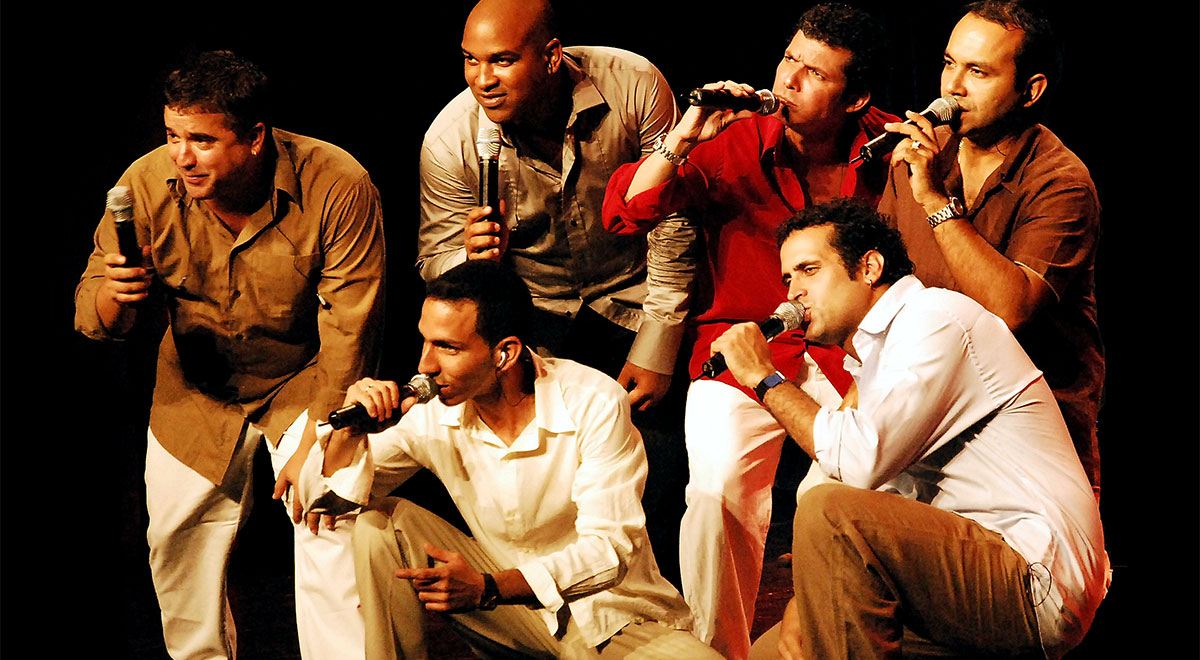
Freeplay, featuring Sankaran and Bell, are themselves one such local treasure. They will perform as opening act for Vocal Sampling. “They are an amazing a cappella sextet from Cuba,” Sankaran and Bell write, “emulating the sounds of a hot Cuban orchestra, without an instrument in sight. They have been our heroes for such a long time and we’re so honoured to share the stage with them, for both workshops and a concert on Sunday, June 2 at Lula Lounge.”

Bell and Sankaran hope also to delve more deeply into multi-disciplinary shows, like this festival’s Songs and Stories of Migration, that bring different art forms together but also provoke thought and really in-depth chances for complex conversations carried through the medium of musical storytelling in a wide range of forms and styles. Toronto’s own Pressgang Mutiny, who sing sea shanties are one such group. Shanties are often associated with a fantastical history of what life at sea was like in the days of pirates. But for sailors and passengers throughout history, boats of cargo and people have been meeting places for cultures, stories, commerce, and also war. These nautical meeting places have a history and Pressgang Mutiny breathe life into these shanties, minus the swashbuckling.

A cappella vocal music also opens doors into diverse cultures. You’ll hear the sounds of the Eastern Mediterranean instantly when Turkwaz takes the stage. This quartet of women explores the sounds and myriad stories of Greece, Turkey, the Balkans and more, the evocative power of their voices in a diverse set of styles folding the listener into the pages of beloved story after story. After all, “singing is storytelling through song, and there are so many compelling stories to tell!”

Last year, Sing! was part of the massive Fringe Festival in the Scottish city of Edinburgh. “We’ve been building inroads with our affiliate festivals, like Sing! Montreal, Sing! Texas, and Sing! Edinburgh,” share Sankaran and Bell, “We hope to continue to spread the word and joy of Sing! Around the globe.” 

Some highlights of Sing! The Toronto Vocal Arts Festival, May 24 to June 2

MAY 24, 8:30PM: Sing! Mandela Celebration with Mzansi. A musical celebration of Nelson Mandela with a cross-cutting extravaganza of sounds and styles. Young People’s Theatre, Toronto.

MAY 26, 7:30PM: The Mass Choir comes together under Kurt Sampson of Cadence. Come for the concert or join in the choir itself earlier in the day. This will be a signature festival event. Young People’s Theatre, Toronto.

MAY 28, 8:30PM: Sing! Songs & Stories of Migration featuring a host of artists and histories. Ariel Balevi with Persian folklore; Pressgang Mutiny with sea shanties; Turkwaz with Arabic, Greek and Turkish heritage; Sage Tyrtle blending stories and fairy tales; Joanna Wallfisch with looped storytelling; and Dan Yashinsky and his extraordinary tales of travels. A new feature on the docket for Sing! and bound to excite your heart and ears. Hugh’s Room Live, Toronto.

JUN 1, 8PM: SoundCrowd: Dance Party! Why should dance parties only be reserved for instruments? Scott Pietrangelo leads this a cappella powerhouse of a choir with 70 voices strong. The Opera House, Toronto.

Vocal Sampling performs at Lula Lounge June 2JUN 2, 7:30PM: Sing! Cuban Fantasies with Vocal Sampling and Freeplay. Steamy music highly likely, tropical heat not guaranteed. Lula Lounge, Toronto.

Jewish Music Week, MAY 26 TO June 2

Another musical arts festival runs over the last week of May. Jewish Music Week presents the ninth year of guests, local and international, featuring a host of fantastic music influenced, created and/or performed by Jewish artists, with significant highlights for aficionados of vocal and choral music.

MAY 29, 12PM: The Yonge Guns Quartet host a midday concert at Princess Margaret. Part of the hospital’s “Music in the Atrium” program, these award-winning four men have been singing barbershop together since high school. Princess Margaret Cancer Centre Atrium, Seventh Floor, Toronto.

MAY 29, 7:30PM: Three Famed Cantors, One Voice. American cantors from three of New York City’s Jewish congregations make their Canadian debut. Featuring a host of styles and sacred works, these three tenors combine their voices under music director Robbie Grunwald. Holy Blossom Temple, Toronto.

JUN 1, 10:15PM: Community Melaveh Malka. Marking Shabbat with an evening performance; three choirs will perform. Featuring Shir Harmony, the Toronto Jewish Male Choir and the Toronto Jewish Chorus. Beth David B’nai Israel Beth Am, Toronto.

JUN 2, 3:30PM: The Sawuti African Children’s Choir performs as part of their Canada tour, ongoing since January. These seven children and five adults from East Africa are sponsored by the Evangelical Christian organization, Seven Wells Ministries and the Jewish cross-religious organization, Return Ministries. St Andrew’s Church, (Simcoe and King), Toronto.

Follow Brian on Twitter @bfchang Send info/media/tips to choralscene@thewholenote.com.

VOCA Chorus of Toronto. Photo by Jim CrawfordFall workshop: Once in the fall and once in the spring, artistic director Jenny Crober brings in an artist to work with the VOCA Chorus of Toronto in an intensive workshop. Matthew Emery was the clinician for the fall, working on his song Still Colours, Velvet Shoes. At the very end Crober asked, “Do you mind if we take a little peek at Sing your Song? Would you mind telling them something about who you’ve dedicated this to and why?” Emery agreed and spent the time explaining his reason for writing this song – to honour one of his musical mentors, Ken Fleet, when Fleet retired from Amabile. (Fleet has been living with dementia for many years now.)

“I first met Ken Fleet as a young singer in the Amabile Choirs of London, Canada,” Emery shared by email with The WholeNote. “My first memory of him was thinking “Wow he is so tall, will I ever be that tall?” (Fleet stood six feet five inches. Those who have met Emery in person can attest that yes, he did get to be almost as tall).

“I was a young boy in Grade 4 or 5 at the time,” Emery continues. “It was his presence and influence from singing with Amabile that led me to attend Medway High School where Ken taught music for nearly 30 years. Ken was one of the early mentors I had in composition. He was always encouraging me to write. He also introduced me to the music of Stephen Chatman who I later studied with at UBC.”

The story was impactful for the choir. Crober is reminded “when you look out at the choristers and you see their faces soften; some tears in the eyes. It’s obvious when you hear Matthew speak, the fondness he has for Ken.” That fondness is felt by Crober too, who studied music with Fleet at Western University. “We were at Western together,” she shared. “He was three years ahead of me. And everyone knew who he was, partly because he was very tall, but he was a gentle giant. An extraordinarily lovely human being, a wonderful person.”

“The refrain used in this song is built on the text ‘sing your song’ which is taken from a short documentary about Ken,” shares Emery. “His wish in life was that no matter what “just sing your song” – a beautiful image to be yourself and to be proud of who you are.” For Crober, that message “means get to the heart of it, right now. Get right into it. Don’t waste time. Just do it. In a gentle and supportive way.” The choir has loved learning and singing the song.

“The song uses a verse-chorus type framework to increase its accessibility,” shares Emery. “Ken worked with musicians of all levels, so I wanted to honour that philosophy in some way. There are phrases where the voices enter in canon, a metaphor for life. After the contrapuntal middle passage, the voices join in unity on the text “come home, come home.” This is intentional, to suggest that through grief, strife – anything – music is our refuge.”

“The song has to be very active, very positive, very buoyant,” says Crober. “It really is bubbly. But not flip. There’s nothing flippant or trivial about it … It’s jubilant and tender at the same time. It’s a really lovely piece.”

Emery put significant thought into creating this outcome. “I wanted to create a poignant work,” he said. “The meaning is deeply felt, but kept light-hearted with the syncopated melodies and pulsing piano gestures. To me, I am reminded of the lessons Ken taught me about life and the values he passed on when I hear the song. He was always full of joy and generosity. I tried to capture his genuine full spirit in the work.” The notion that music can bring us “home” – a perfect image to end a concert celebrating a beloved conductor and mentor to thousands of singers.”

Matthew Emery and Jenny CroberUpcoming concert: The signature work of VOCA’s upcoming April 27 concert is the Paul Winter Missa Gaia/Earth Mass. “It has been a while since we last did the Missa Gaia/Earth Mass,” says Crober. “We did it in 2012, when the East York Choir first became the VOCA Chorus of Toronto. This was the first performance of the choir under our new name.” Crober didn’t revisit the piece until two years ago when she had to step in at the last minute to conduct it for the Achill Choral Society in Orangeville. She admits, “I had kind of forgotten how much I loved the piece.” The revisiting is the reason for the “II” added to the concert title – “Earth, Seas & Sky.”

Joining the choir is vocalist Alana Bridgewater who has done the Missa Gaia on several occasions. “I’ve known about her a long time so it’s just a joy to finally be able to work with her,” says Crober. “We’re also doing three pieces by Paul Halley: Freedom Trilogy, Sound Over All Waters and The Rain Is Over and Gone. Alana will be really featured in some of these as well. There’s a moment in the third movement of the Missa Gaia, for example, the Beatitudes. It starts off slow and contemplative and by the end it’s a rocking gospel choir. Alana’s a powerhouse.”

Andrew BalfourSpring workshop: At the end of March, the choir had its spring workshop with Andrew Balfour. (The choir has been learning his piece Ambe for their upcoming concert.) “The first time I heard the piece we were at Podium 2018 in Newfoundland,” says Crober. “It was being performed by Chronos Vocal Ensemble from Edmonton. It was so hypnotic and driving and compelling and powerful and beautifully sung. The minute it was done, I marked in my program ‘Do this!’” Crober approached Balfour later during that conference. She booked him for the VOCA spring clinic this year, so the choir would have a chance to workshop the song directly with Balfour.

Going through the experience of Balfour’s thought process and listening to him give life and meaning to the music he’s written was important. Recently, the Indigenous Performing Arts Alliance (IPAA), of which Balfour is a part, released a statement on Indigenous Musical Sovereignty. The statement is an invitation to participate in the full experience of the music created by Indigenous peoples while simultaneously acknowledging that much of what has passed for Indigenous music or Indigenous themes by outsiders has been traumatizing. The statement asks hard questions of presenters who seek to perform Indigenous music: “to non-Indigenous composers who seek to tell ‘Indigenous-inspired’ works: be honest with yourself and ask why you feel compelled to tell this story and whether you are the right person to do so.”

The statement acknowledges that there is a place for non-Indigenous musicians in partnership, but there is an added weight and depth of responsibility that Indigenous creators have to their communities. To do this work well, the IPAA says, “We seek to hold ourselves to the highest ethical standards of Indigenous community engagement, and request that our collaborators in the Canadian music community work to the same level of accountability.”

For Crober, through the opportunity to learn directly from Balfour, the choir will have a better chance to bring life to his musical offering while respecting its Indigenous nature.

See all of this in action in “Earth, Sea & Sky II” presented by VOCA Chorus of Toronto under artistic director Jenny Crober featuring guest artists Alana Bridgewater (vocalist); Colleen Allen (saxaphone); Shawn Grenke (organ); Roberto Occhipinti (bass); Mark Kelso (drums); and Juan Carlos Medrano (percussion). April 27, 7:30pm. Eastminster United Church, Toronto. 

CHORAL SCENE QUICK PICKS

APR 17, 18 AND 20, 8PM: The Toronto Symphony Orchestra is joined by the Amadeus Choir and the Elmer Iseler Singers for the superlative Mahler Symphony No.2 “Resurrection.” A stunning masterpiece of choral music caps off this transformative symphony. Under the baton of Spanish conductor Juanjo Mena, the iconic organ of Roy Thomson Hall shall shake thee to thy bones with the full force and power of orchestra and choirs blended together in a way that only Mahler could. With three options to catch these performances, do it! Roy Thomson Hall, Toronto.

APR 19, 7:30PM: The Grand Philharmonic Choir performs Bach’s St. Matthew Passion joined by the Kitchener-Waterloo Symphony Orchestra and a stellar line up of soloists: Isaiah Bell, Daniel Okulitch, Esteli Gomez and Allyson McHardy. Centre in the Square, Kitchener.

Cheryll ChungAPR 27, 4PM: Reaching Out Through Music presents “Spring Breezes.” ROTM provides free music education to children in the St. James Town community. Their hallmark is the Choral Program run by Cheryll Chung. Their Spring fundraising concert features Asitha Tennekoon. With a varied programme, this event will help ensure that the program can continue to provide accessible music education for future generations. Grace Church, Toronto, 383 Jarvis St.

Follow Brian on Twitter @bfchang. Send info/media/tips to choralscene@thewholenote.com.

Nashke miziwe bi-bepeshaabang ishpiming giizhigong.
Look everywhere how streaks of light appear above in the sky in the heavens.
Miziwe… Everywhere…

-Barbara Croall

odawa composer barbara croallOn March 31, Pax Christi Chorale premieres Barbara Croall’s Ojibwe Odawa oratorio, Miziwe…(Everywhere…). As far as the creative team knows, this is the first time that the choral tradition of oratorio and the language of Ojibwe Odawa will have been united, as Pax Christi, under artistic director David Bowser, bring to life to the stories, musical evocations and spirit that Barbara Croall embodies in her new oratorio.

Croall is Odawa First Nations from Manitoulin Island. Her music education includes degrees and diplomas from the Musikhochschule (Munich), the Royal Conservatory of Music and the University of Toronto. Croall’s extensive repertoire includes many settings of music for solo vocal, ensemble vocal, chamber, orchestral, theatre, film and more.

“I think the complete picture [of Croall’s depth] is really important,” says Bowser in an interview with The WholeNote. “It’s no small task to write a full oratorio for choir, orchestra, and soloists. The quality of the music is exceptional.” The entire oratorio will be performed in Odawa. “It will have surtitles in English and French,” continues Bowser. “The story is one that involves characters who are animals, wind, sun, different elements and creatures.” The choir evokes different aspects and elements of the world through Croall’s composition.

“I always aim for a connectivity between the human and non-human aspects of life as intertwined,” explains Barbara Croall in a written project description of Miziwe… given to The WholeNote. In it she describes the work’s “expansive use of vocal and instrumental techniques and expressive/meaningful breathing in various ways [to] extend beyond merely human notions of sound, to include sounds that we hear in nature.” Some of those sounds include one of Croall’s signature instruments, the pipigwan, a traditional cedar, wooden flute. Bowser is particularly enamoured with the timbre of the flute, a depth of sound not easily matched in similar instruments. Miziwe… includes Croall on the pipigwan as well as a vocalist.

Pax Christi ChoraleOratorio as an art form requires a a major assembly of musical forces including vocalists and instrumentalists, and Pax Christi Chorale –  an advanced 100-voice ensemble, particularly known for its focus on oratorios – fits the bill. Joining them will be mezzo-soprano Krisztina Szabó, baritone Justin Welsh, singer and dancer Rod Nettagog and the Toronto Mozart Players, particularly known for its annual Toronto Mozart Master Class Series, which for 2018/2019 featured soprano Nathalie Paulin and first prize-winner Jennifer Routhier, and of which Bowser is also the artistic director.

What unifies this particular oratorio is the essence of shared spirit. These are not sacred or religious texts or stories, though. “I never use ceremonial or sacred material in my music,” writes Croall. “Most often, the basis of a piece of music I create will be a song of my own – often influenced or inspired by sounds I hear in my time spent outdoors within nature in remote areas … this reflects my own personal need to feel interconnected with the rhythms and flow of life within nature.” The oratorio evokes and shares in the message Croall has composed, focusing on the “manidoo” – “the spirit essence, mystery, spiritual energy and life force, … “a continuity of life of all forms that can be known as ‘spirit’.”

Bowser treasures the composition he’s been entrusted and the larger context it both comes from and participates in. “Barbara wanted to create something that was more unifying and more uplifting and hopeful. And the common element is the sense of spirit that we all have together. It’s a story that ends with some sense of resolution. It’s so interesting to me that in so much oratorio there’s a moral. Here, it’s really about finding a connection. There’s no sense of imposed morality. It’s observation and the sense that we’re all connected through all these elements, and risk, and danger, and opportunity, and release and forgiveness.”

In her writing, Croall describes the work as “focusing toward the light … to always consider hope and continuity as the neverending thread of life.” In her approach, Croall’s generosity of spirit reaches beyond just her musical composition. The work of bringing the work to life in a meaningful way with each musician requires more than just a few reads through vocal lines in rehearsal. Something more was required for this particular project, and Bowser and the choir have had to adjust.

To help facilitate this, Croall has welcomed the choir into the world she has created. “The whole choir went out to Crawford Lake in November,” shares Bowser. “[Barbara] did a lot of talking about the traditional, historical, and also modern practices of different First Nations.” The choir was responsive to the learning, and Bowser was pleased: “It’s really exciting to see people opening their eyes and their ears and their hearts.”

“It’s a full relationship we’re engaging in,” says Bowser. In scale and scope, oratorio is to the choral music tradition what opera is to music theatre. Pax Christi, Bowser and Croall have all risen to the challenge of building a full relationship as the one way to ensure the best chance of success – guiding the work to a truer performance where artists, direction and composer align.

Croall has been generously present in the rehearsal process, making herself available in the teaching and the learning. “Barbara is coming to all the rehearsals, teaching us Odawa,” says Bowser. “She’s telling us about the stories and the characters and the imagery and the traditional practices and ways.”

In this process of breathing Miziwe… itself to life, the very joining of all these musical forces together starts to embody the notion of Croall’s “spirit” and her hope for the work  – that in the coming together, Pax Christi Chorale and Miziwe… will “uplift” us all.

On March 31 at 3pm, Pax Christi Chorale presents Miziwe… a world-premiere oratorio composed by Barbara Croall. Featuring Krisztina Szabó, Justin Welsh, Rod Nettagog, Barbara Croall, and the Toronto Mozart Players conducted by David Bowser. Performed in Ojibwe Odawa with surtitles at Koerner Hall, Toronto.

CHORAL SCENE QUICK PICKS

MAR 8, 7:30PM: Orpheus Choir of Toronto presents “Raising Her Voice: Celebrating the Choral Art,” in celebration of International Women’s Day. Artistic director Bob Cooper has partnered with Diaspora Dialogues to commission four new musical compositions, enhancing the female contribution to choral music in Canada. Diaspora Dialogues is an intercultural bridge that supports a community of diverse writers with multiple programs. In this exchange, Diaspora Dialogue authors Yaya Yao, Priscilla Uppal, Shadi Eskandani, and Phoebe Wang were paired with composers Katerina Gimon, Christine Donkin, Anika-France Forget and Tawnie Olson, respectively, for four new commissions by Orpheus. Grace Church on-the-Hill, Toronto.

Charles Daniels. Photo by Annelies van der VegtMAR 9, 7:30PM: The University of Toronto Faculty of Music presents Handel’s oratorio Israel in Egypt. The concert features Daniel Taylor and Jeanne Lamon at the helm of the U of T Theatre of Early Music Choir, Schola Cantorum, and Baroque instrumentalists, Collegium Musicum. Joining them will be members of Tafelmusik Baroque Orchestra and tenor Charles Daniels. Handel’s oratorios, of which there are many, are often dominated by Messiah. This is a chance to see some of his other great work. In the expert hands of a period interpretation, you can be sure of a fantastic period performance of Handel’s work. St Patrick’s Church, Toronto.

MAR 21 TO 23, 7:30PM & MAR 24, 3:30PM: Tafelmusik Baroque Orchestra and Chamber Choir, five soloists and members of the Toronto Children’s Chorus all meet to present the Bach St. Matthew Passion. Last year, Tafelmusik presented the Mass in B Minor to great acclaim. Baritone Tyler Duncan, featured last year, returns to sing in the St Matthew Passion under maestro Masaaki Suzuki. Suzuki is one of the most renowned interpreters of Bach’s works and has never conducted Tafelmusik. This is one not to miss. With several performances to choose from, early music and Bach fans should hurry and get tickets. Carry a friend while you’re at it! Jeanne Lamon Hall, Trinity-St. Paul’s Centre, Toronto.

Cheryll Chung. Photo by Richard Jonathan ChungMAR 22, 7:30PM: Cantabile Chamber Singers present “Social Justice,” a program that conductor Cheryll Chung calls “an eclectic mix of contemporary works that speak to justice and equity in the world.” The works to be performed include a premiere of Unheard: Voice of the Children, for mixed media and choir by Laura Sgroi. Other great Canadians featured include Matthew Emery and Saman Shahi. All the works touch “on issues such as the environment, the #MeToo movement as well as serenity, eternity, and hope,” shares Chung. Church of the Redeemer, Toronto.

MAR 30, 4PM: Exultate Chamber Singers present “When We Were Young.” Artistic director Mark Ramsay has gathered the Chorus Niagara Children’s Choir and their artistic director, Amanda Nelli, in this “celebration of joy and youth.” Featuring John Rutter’s Mass of the Children with its blending of William Blake poetry and different mass traditions. Other music includes music from Timothy Corlis, Ēriks Ešenvalds, Eric Whitacre and more. St Thomas’s Anglican Church, Toronto.

Follow Brian on Twitter @bfchang Send info/media/tips to choralscene@thewholenote.com.


Two upcoming choral concerts promise to take some of the chill out of winter. The Nathaniel Dett Chorale, joined by alumni, premieres a new work, Hosea, to perform what artistic director Brainerd Blyden-Taylor calls a concert of “wonderful, inspirational, moving music.” This concert continues the Chorale’s 20th anniversary season. And two of the finest chamber choirs in Canada join forces to present a joint concert; the Vancouver Chamber Choir (VCC) is hosted by the Elmer Iseler Singers on their 92nd and last tour with Jon Washburn at the head of the VCC.

The Nathaniel Dett Chorale's composer-in-residence, Dr. Stephen Newby in his role as national anthem singer for the Seattle Sounders FC.To Return, with Love: Hosea

The Nathaniel Dett Chorale takes the Koerner Hall stage to perform a new work, Hosea. “This year we have a composer-in-residence, Dr. Stephen Newby,” shares artistic director Blyden-Taylor. “He has written a mini-oratorio based on the Old Testament Book of Hosea. It is a fusion mashup of the classical, jazz and gospel genres.”

“When the Book of Hosea was written, it was a metaphor for God’s relationship with the children of Israel,” shares Blyden-Taylor. “Initially God tells Hosea he should marry a prostitute and take in her children.” Figuratively, Hosea invokes wayward Israelites, who have turned their backs on God, to turn back to God. “He calls them to repentance with an open heart of forgiveness should they return to him.” That path to repentance is one of inclusion, opening doors and hearts to the denigrated and lowly.

The Book of Hosea is controversial, more so now, for its disparaging depictions of “wanton women.” The metaphoric reading, though, is more nuanced than the literal text taken at face value. For Blyden-Taylor, “looking at it from our point of view today, it’s essentially the theme of unconditional love, reconciliation, and compassion.”

Composer-in-residence Newby is professor of music at Seattle Pacific University, a Christian college rooted in the Wesleyan Methodist tradition. He conducts the University’s Gospel Choir and teaches composition. Blyden-Taylor describes Hosea as “a combination of Newby’s two passions: music and theology.”

Hosea will be performed by the current Chorale. The other half of the concert will include alumni across the 20-year history of the ensemble. Blyden-Taylor says “there are about 18 to 20 alumni who are coming back to sing with the current ensemble. We’re doing a series of favourite spirituals in the other half of the concert. We’re doing pieces by Nathaniel Dett and Moses Hogan.” Added to this, Blyden-Taylor has programmed songs from young American composer, Brandon Waddles, making three generations of composers spanning 100 years.

It is a banner year for the Chorale, celebrating its 20th anniversary. It is also, Blyden Taylor shares, “a big year for Nathaniel Dett too. This season marks the 75th anniversary of his death, and the 90th anniversary of the school of music he founded in Hampton University, Virginia. Dett was also one of the founding members of the National Association of Negro Musicians in the US, and they’ll be celebrating their 100th anniversary in Chicago in the summertime.”

The ongoing process of exploring Afrocentric music has become a life’s work for Blyden-Taylor. “This ensemble is not just to commemorate Nathaniel Dett, but also his belief in Afrocentric music in its entirety,” he says. “It’s been a rich 20 years, and we’ve done a lot of things over that time, always striving to provide wonderful, inspirational, moving music.”

February 13, 8pm. The Nathaniel Dett Chorale presents Voices of the Diaspora… Hosea & Friends. Koerner Hall, Telus Centre for Performance and Learning, Toronto.

Vancouver Chamber ChoirTwo of the Finest; One Beautiful Concert

The Vancouver Chamber Choir comes to Toronto on its final tour with Jon Washburn as artistic director. “We’re singing the top-ten-performed pieces from the choir’s history,” says Washburn, who keeps meticulous lists of performances and songs performed. “A lot of this repertoire is repertoire that has been toured quite a bit over the years. For example, we’re doing Trois Chansons de Charles d’Orléans by Debussy; we’ve done 113 performances of that piece. The Imant Raminsh Ave Verum Corpus we’ve given 64 times.”

The concert will also feature many of Washburn’s beloved, often-performed arrangements including music of Stephen Foster and Rise! Shine!, his setting of four spirituals. “There are so many concerts at home and they kind of fade into each other over time,” shares Washburn. “But when you’re on tour, you associate a concert with a certain hall in a certain community in a certain season of the year. They are very vivid memories. For instance, the Schafer A Garden of Bells, was written for us many years ago. I remember when we did our tour of the Soviet Union in 1989, the incredible reception we got for this piece. We travelled the Baltics (Estonia, Latvia, Lithuania), the Ukraine, and Moscow, Russia. We finished that tour with the Moscow Chamber Choir in the Great Hall of the Moscow Conservatory.” The Choir has performed A Garden of Bells 82 times over the years since it was first written in 1984.

Washburn has named the tour and the performances “Music Sea to Sea: The Farewell Tour.” The tour is taking them from their usual home on the Pacific across the country to the Atlantic. Starting in Edmonton, then to Calgary, Lethbridge, Regina, Toronto, St. John’s, Halifax, Antigonish, Wolfville, Truro, Lunenberg, and back to Vancouver over 18 days. This will be the 92nd tour in the last 48 years and Washburn has been on all but one of them. This is his last as the artistic director of the VCC as they continue their search for a new leader.

The Elmer Iseler Singers are hosting this particular visit. “[Artistic director] Lydia Adams and I go way back and we’ve just always had a wonderful friendship and so it’s very special to do my last official event as artistic director in Toronto,” says Washburn. “I think there will be a lot of feelings that night.”

Adams feels the same. “For me, I’m really looking forward to this time together. I’ve known Jon since the early 90s when I played for the Ontario Youth Choir and he was the conductor. We hit it off. I was so taken by his work with the Youth Choir and the results he was able to get; his focus and attention. He was able to make great music with them, and that’s the case every time we work with him.”

The Elmer Iseler Singers, for their portion of the concert, will perform a selection of choral works new and familiar. For the new, Adams has chosen The Spheres, which is the opening movement of Ola Gjeilo’s Sunrise Mass. For the old, William Byrd’s Sing Joyfully. Rounding out the program is Healey Willan’s anthem, Gloria Deo, and James MacMillan’s The Gallant Weaver.

“It takes a lot to hand over a choir that you’ve taken care of for so long,” shares Adams. She knows herself what it is like to give up the reins; this is her final season at the helm of the Amadeus Choir. “There’s something about coming to the end of something. Things become more intense; every moment becomes very precious and there’s not a moment wasted. There’s nothing thrown away; everything has meaning.”

Washburn notes the long history of the two choirs: “We have a great working relationship that has gone back decades. It’s really nice that we have been able to work together on a regular basis.” Adams appreciates this history as well. “The choirs are so meshed,” she says, “when they come together, it’s old friends, with immediate friendship and music making.”

March 1, 7:30pm. The Elmer Iseler Singers present the Vancouver Chamber Choir “Music from Sea to Sea: The Farewell Tour.” Eglinton St. George’s United Church, Toronto. See elmeriselersingers.com for more information. 

CHORAL SCENE QUICK PICKS

FEB 16, 8PM: The Guelph Chamber Choir presents “Glory: Music of Light and Joy.” The search continues for a new artistic director with candidate Charlene Pauls taking the reins for this concert. Earlier in the season, Patrick Murray tested the baton. Pauls has programmed Leonard Bernstein’s Chichester Psalms, Somewhere from West Side Story and a host of smaller works including Sid Robinovitch’s Prayer Before Sleep, and Morten Lauridsen’s Sure on this Shining Night. St. George’s Anglican Church, Guelph.

FEB 16, 8PM:The Living Arts Centre presents “O Happy Day: Ben Heppner and the Toronto Mass Choir.” The Mass Choir has joined Heppner on a few of these concerts over the last few years. Blending the power of Heppner’s renowned tenor with the powerful Mass Choir, this collab is surefire. Living Arts Centre, Mississauga.

FEB 21 to 24, various times: York University, Accolade East Building. Finale Concert FEB 24, 7:30PM, Bayview Glen Church. The Toronto Mass Choir and guests run the annual PowerUp Gospel Music Workshop. The workshop features an entire gamut of classes from vocal technique, to keyboards, to running a choir, to gospel technique and masterclasses. The Workshop week culminates in a Finale Concert featuring the Workshop Mass Choir, Gospel Chorale and Gospel Youth Choir. Check out the full line up at powerupgospel.ca

FEB 27, 7:30PM: The Toronto Mendelssohn Choir presents “Handel and Haydn.” Featuring the iconic Handel Coronation Anthems and Haydn’s Mass in Time of War. St Andrew’s Church, Toronto.

MAR 2, 8PM: The Toronto Chamber Choir presents “Convivencia: Music Across Three Faiths.” With funding from the private Pluralism Fund, artistic director Lucas Harris has assembled a host of music to invoke the multi-religious period in medieval and Renaissance Spain. Grace Church on-the-Hill, Toronto.

Follow Brian on Twitter @bfchang. Send info/media/tips to choralscene@thewholenote.com.

Johannes Debus. credit Tony HauserToronto Symphony Orchestra CEO Matthew Loden and I are chatting about the beloved cultural phenomenon that is Messiah in Toronto. Sitting in his office overlooking Roy Thomson Hall, I can see the iconic webbing of the edifice, a physical nest that cradles the music hall. In a few weeks, the Toronto Symphony Orchestra and guests, under the baton of Johannes Debus, will present a major six-performance run of Handel and Jennens’ masterpiece.. (Full disclosure: as regular readers of this column know, I sing in the Toronto Mendelssohn Choir and will be on stage for these performances.)

“We live in a very disjointed and fractured time right now. I think that the human condition is to long for a kind of togetherness, to find your place with people,” says Loden, speaking about the need for a space for an event like Messiah. “Increasingly, we keep finding ways to disintegrate relationships. When you have a moment where you can come together collectively and still have an individual experience while feeling the music coming off the stage with a couple thousand other people – that is really powerful.” With these TSO performances alone, 15,000 people will experience the majesty of the most iconic of Toronto classical-music traditions.

“People are moved to tears not just because of the artistic nature of what they’re listening to,” Loden continues, “but because they are doing it with other people, live. It’s raw talent from 150-plus people on stage. There’s a kind of magic that happens when you get everybody together to be a part of that.”

Johannes Debus leads the Toronto Symphony Orchestra and the Toronto Mendelssohn Choir with soloists Claire de Sévigné (soprano), Allyson McHardy (mezzo-soprano), Andrew Haji (tenor), and Tyler Duncan (baritone). Surprisingly, over his significant career, Debus has never conducted the entire work. “This is my first time conducting it,” he tells me in a phone call from his home in Berlin. “But when I was in my early teens, I sang it. This was one of the strong, long-lasting musical impressions I have from my childhood. Afterwards, I made my mother buy the John Eliot Gardiner, Monteverdi Choir recording. It’s a dream come true for myself to be able to conduct this piece.”

Debus is a fixture in the classical world in Toronto, serving as the music director for the Canadian Opera Company (COC), a post he has held for almost a decade. In that capacity he isn’t often on the stage, though, in Toronto, and this marks only his second time with the TSO. He is mindful that the music lovers of Toronto are very particular about their Messiahs. “[Conducting] might come with certain expectations,” he says. “On the other hand, you can rely on the experience of the musicians and hopefully bring something new. Not to reinvent the wheel but to inspire us all and bring all forces together. Make it an event that nourishes us and prepares us for the Christmas Day. In the case of Messiah, like every other masterpiece, you discover something new every time. Like a statue, you turn it around and look at it from the back or the side. You discover new angles. That’s what makes music so brave – you perform it in the moment and it can be new every time.” Audience members can safely expect a charismatic, flowing storyteller, and for once will be able to see his whole body in action from the stage, not just the top of his head and hands from the orchestra pit.

Debus is aware of other interpretations of Messiah. He mentions Sir Andrew Davis’ 2016 recording, for one, but promises something a little more literal. “In the beginning we’re dealing with prophecy, birth, and then redemption, like chapters. It’s like a novel, three big parts,” says Debus. “If we manage to bring out a distinctiveness in character and expression of all those aspects, I will be very pleased and happy.”

The dramatic edge of Messiah can easily be lost faced with the technicality of the music. For a master musical storyteller like Debus, it is at the core. Handel’s music uses the assembled text in an emotive fashion that creates a thread of luscious descriptiveness in his music. There is the venomous roar of choir in “He Trusted in God,” remarking in great anger and frustration. “And with his stripes” plainly invokes the whip marks covering Jesus’ body. The playfulness and athleticism of “All we like sheep” finishes with the introspective acknowledgement of the faithful’s iniquity. The solos carry this emotional energy as well. The emotional tenor sings “Thy rebuke has broken his heart,” a call from the deepest depths of despair, for help. The mezzo-soprano maintains a humble supplication with “He was despised.” All of this is underpinned by the orchestra. Handel’s music carries many emotional messages over a short period of time.

“It’s part of Handel’s success in general, that he can unfold and have this incredible impact on your emotional soul, your emotional centre,” says Debus. “It can really shake you and elevate you, make you weak and so on. Among the great dramatists and operatists, Handel knew how to establish this and make it work. He knows very well how to set the mood and his talent for writing ear-worm-like melodies.”

“As a composer of Italian opera, Handel was always drawn to the ideal of theatrical, operatic writing. In terms of drama, we will work to apply that here.” Bringing to life the dramatic solos is a quartet of Canadian talent who have all worked with Debus before: in fact De Sévigné, McHardy and Haji have all been members of the Ensemble Studio, a key part of Debus’ programming direction at the COC.
Matthew LodenMatthew Loden is particularly keen on this set of soloists as well, knowing that three of them have been members of the COC Ensemble Studio. “[This performance] represents a very strong partnership with the COC,” he says, “with Johannes on the podium and three of four of soloists connected to the Ensemble Studio. The fact that there are these remarkable development opportunities for these professional singers on their way into the world, and that the TSO can be one of the stops on their trajectory, is really fulfilling. And Canadians really appreciate when they can celebrate their homegrown talent.”

The Ensemble Studio is part of a musical ecosystem encompassing the University of Toronto, Royal Conservatory of Music, and the COC, incubating, supporting and celebrating new generations of talent. Through performances such as these on the biggest symphonic stage in Canada, the TSO becomes part of that ecosystem.

Messiah is a core programmatic element of the first half of every TSO season. “We do Messiah every year is because one of the roles we play in Toronto is to gather people together into a space that allows them to feel like they are part of something that is bigger than themselves. Bigger than they are individually,” shares Loden. “There’s a ceremony around getting together with friends and family and other musicians on an annual basis that allows people to both reflect and look forward. Messiah is a perfect opportunity for that kind of gathering.”

Messiah isn’t part of any regular subscription package on offer from the TSO. Annually, ever seat sold is an add-on to a subscription, a create-your-own subscription package, or individual concert sale. Sure-fire Messiah sales are important to the TSO when balanced against new works or unfamiliar ones to audiences. Loden acknowledges that these are concerts that sell and sell out. “Whenever we open the phone lines and the next season goes on sale, Messiah is often at the top of people’s list. It tells us that this is something that is working,” says Loden. “Messiah is a highlight and focal point from a financial standpoint, but also within the rhythm of the season. I think if people want to come and be proud of being in this great city, being Canadians and experience this monumental piece of music that has withstood the test of time; to do it in this concert hall, it’s a very special thing; and I think that’s why people keep coming back.”

“The images we get through Handel’s music – with all its weaknesses, the compassion, empathy, glory, exuberance – with all these aspects, you can find them concentrated in this theatre called Messiah. I hope that many people will come to these concerts,” Debus says, adding “and that there won’t be any snowstorms.”

CHORAL SCENE QUICK PICKS

MESSSIAH IS EVERYWHERE

From the November edition of HalfTones, The WholeNote’s mid-month digital newsletter (subscribe online!): Messiah is near-synonymous with choral community-building: with festivity, with meaningful memories of classical music, with standing and singing along. Something about Messiah, and the way it unites community initiatives with musical professionals, gives it a special place in the city and scene’s musical fabric.

Just an example - this year’s Messiah for the City (Dec 22) presented by Toronto Beach Chorale in partnership with St. Andrew’s Presbyterian Church, features singers from the Toronto Beach Chorale, MCS Chorus Mississauga and the Georgetown Bach Chorale, and players from the Toronto Symphony Orchestra. Founded by the late Jack Layton, Messiah for the City is a project dedicated to providing seasonal concert opportunities to people who otherwise might not have access to such events. Tickets are distributed by United Way and its partner agencies.

And then all over the map, and in order of appearance (details in our listings):

DEC 1, 4PM: Pax Christi Chorale’s special Children’s Messiah performance for children and families; Church of St Mary Magdalene, Toronto.

DEC 4-6, 8PM: Soundstreams’ Electric Messiah IV at the Drake Underground, Toronto.

DEC 11, 8PM: An Evening of Choruses and Arias from Handel’s Messiah. The debut performance of B-Xalted! a new choir founded by Barbara Gowdy and Whitney Smith, at the Church of St. Peter & St. Simon-the-Apostle, Toronto.

DEC 8, 7:30PM: Cellar Singers. Handel’s Messiah. Orillia Opera House, Orillia.

DEC 8, 7:30PM: Grand Philharmonic Choir. Handel’s Messiah. Centre in the Square, Kitchener.

DEC 8, 7:30PM: MCS Chorus Mississauga. G. F. Handel: Messiah. First United Church, Mississauga.

DEC 8, 7:30PM: Orchestra Kingston. Handel’s Messiah. Kingston Choral Society. The Spire/Sydenham Street United Church, 82 Sydenham St., Kingston.

DEC 9, 3PM: Dufferin Concert Singers/New Tecumseth Singers. Handel’s Messiah. St. John’s United Church, Creemore.

DEC 15, 7:30PM: Chorus Niagara. Handel’s Messiah. FirstOntario Performing Arts Centre, St. Catharines.

DEC 15, 8PM: Mississauga Symphony Orchestra. Highlights from The Messiah. Living Arts Centre, Hammerson Hall, Mississauga.

DEC 15, 8PM: Orchestra Grey Bruce/Saugeen County Chorus. Messiah. Knox Presbyterian Church, Kincardine.

DEC 16, 3PM: Menno Singers. Sing-along Messiah. St. Jacob’s Mennonite Church, St. Jacobs.

DEC 17-22, 8PM AND 23, 3PM: The Toronto Symphony Orchestra and Toronto Mendelssohn Choir, Roy Thomson Hall, Toronto.

DEC 17, 7:30PM: Peterborough Singers. Handel’s Messiah. Emannuel United Church, Peterborough.

DEC 18-21, 7:30PM: Tafelmusik’s Messiah at Koerner Hall, with their famous Sing-Along Messiah on DEC 22, 2PM, at Roy Thomson Hall (while Massey Hall is being renovated). Toronto

DEC 22, 7:30: Guelph Chamber Choir. Messiah. River Run Centre, Guelph.

NOT THE MESSIAH

Just a sampling …

DEC 5, 7:30PM: Nathaniel Dett Chorale. An Indigo Christmas: Black Virgin…Great Joy.

DEC 7, 7:30PM: Surinder Mundra. A Choral Christmas from Across Europe.

DEC 7, 8PM: Exultate Chamber Singers. Winter’s Night with You.

DEC 8, 2PM: Annual City Carol Sing. Alex Pangman & Her Alleycats; Hogtown Brass Quintet; Yorkminster Park Baptist Church Choir; VIVA! Youth Singers of Toronto; That Choir; Hedgerow Singers; Kevin Frankish, host; and others.

DEC 8, 7:30PM: Forte – Toronto Gay Men’s Chorus. All Is Calm, All Is Bright.

DEC 9, 2PM: Duly Noted. Toronto vs. Everybody. All a cappella music celebrating Toronto.

DEC 11, 7:30PM: City Choir. Cakes & Ale.

DEC 16, 3PM: Pax Christi Chorale. England’s Golden Age. A cappella masterpieces from the reign of Henry VIII and Elizabeth I.

DEC 18, 7:30PM: Orpheus Choir of Toronto. A Child’s Christmas in Wales. With Geraint Wyn Davies.

DEC 22, 7:30PM: Quintessence Ensemble. Buon Natale: A Multilingual Christmas.

JAN 13, 3PM: Vesnivka Choir. Ukrainian Christmas Concert. With Toronto Ukrainian Male Chamber Choir and a folk instrumental ensemble.

JAN 13, 7:30PM: The Royal Conservatory of Music presents “We shall overcome: a celebration of Dr Martin Luther King Jr.” Damien Sneed and the Toronto Mass Choir: jazz, gospel, classical, blues, music theatre and spirituals – Sneed and guests will mark the 90th anniversary of MLK’s birth.

JAN 22 & 23, 7:30PM: Kitchener-Waterloo Symphony. KW Glee.

JAN 26, 3PM: Toronto Mendelssohn Choir. Spotlight on North America. A free community concert celebrating great composers from Canada and the United States: interim artistic director David Fallis’ first fully programmed concert

JAN 26, 7PM: Newchoir. The High Society Soir-eh.

JAN 26, 8PM: Confluence. Centuries of Souls.

FEB 2, 2PM & 7PM: Amadeus Choir of Greater Toronto. Songs from a Celtic Heart.

Follow Brian on Twitter @bfchang Send info/media/tips to choralscene@thewholenote.com.

Back to top