Goodness only knows how many attempts at string quartets Johannes Brahms destroyed before he finally felt able to present a completed work to the world in 1873 – there may have been as many as 20 – but at least the three quartets we do have are real gems.
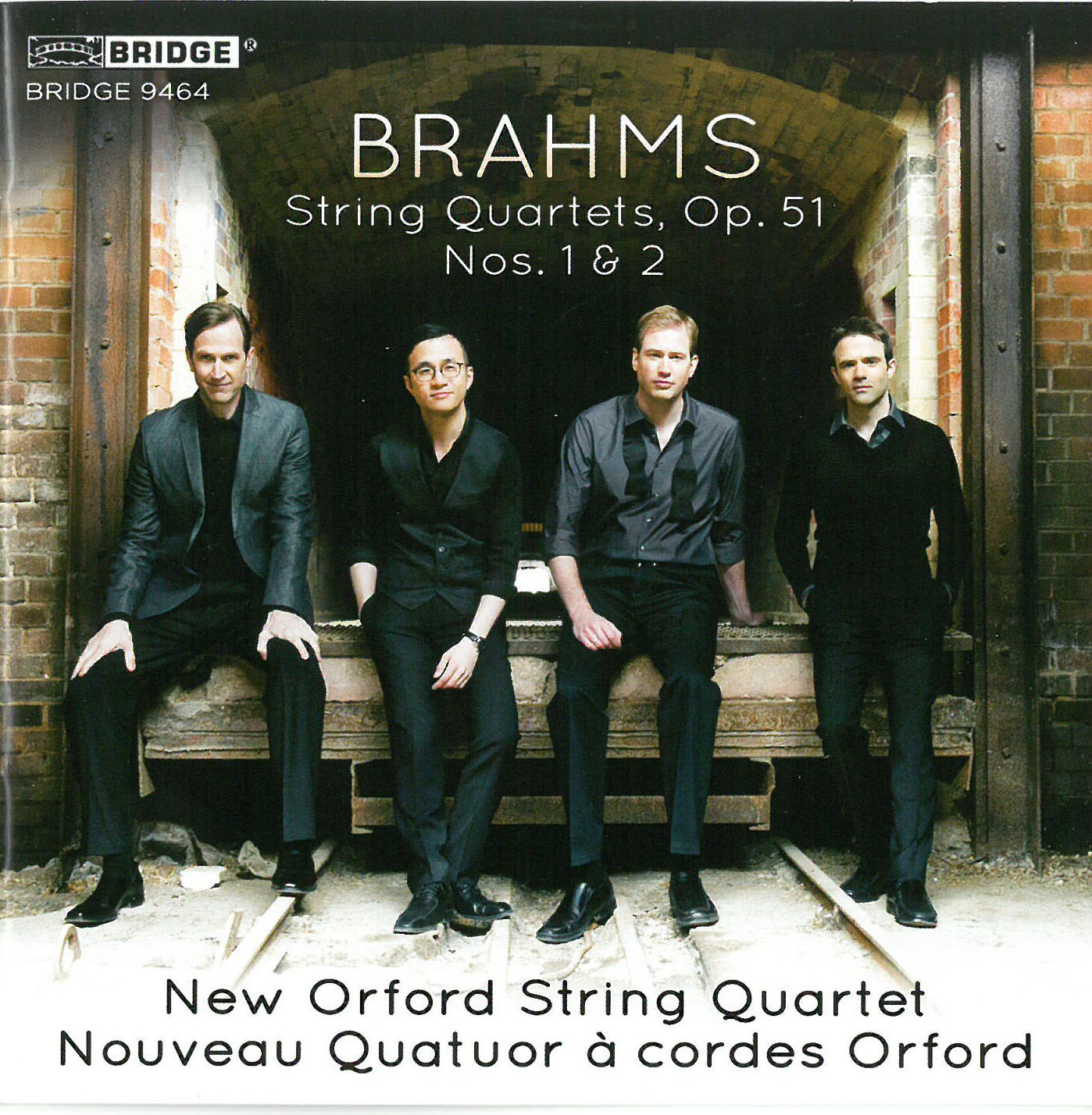
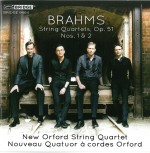 The two quartets Op.51, in C Minor and A Minor, were followed by the B-flat Major Op.67 in 1876, but with each of the three works being about 35 minutes in length it’s simply not possible to include more than two on a single CD. Still, as the song says, two out of three ain’t bad, especially when the performances are as beautiful as those on Brahms String Quartets Op.51, Nos.1&2 by the New Orford String Quartet (Bridge 9464).
Just about all of the Brahmsian qualities you would want to hear are present: these are warm, passionate, nuanced, beautifully judged and balanced performances, full of that almost autumnal, nostalgic introspection so typical of the composer and with a lovely dynamic range. Jonathan Crow and Andrew Wan play first and second violin respectively in the Op.51 No.1, changing places for the second quartet.
The warm and resonant recording quality should come as no surprise, given that the location was the Multimedia Room at McGill University’s Schulich School of Music in Montreal.
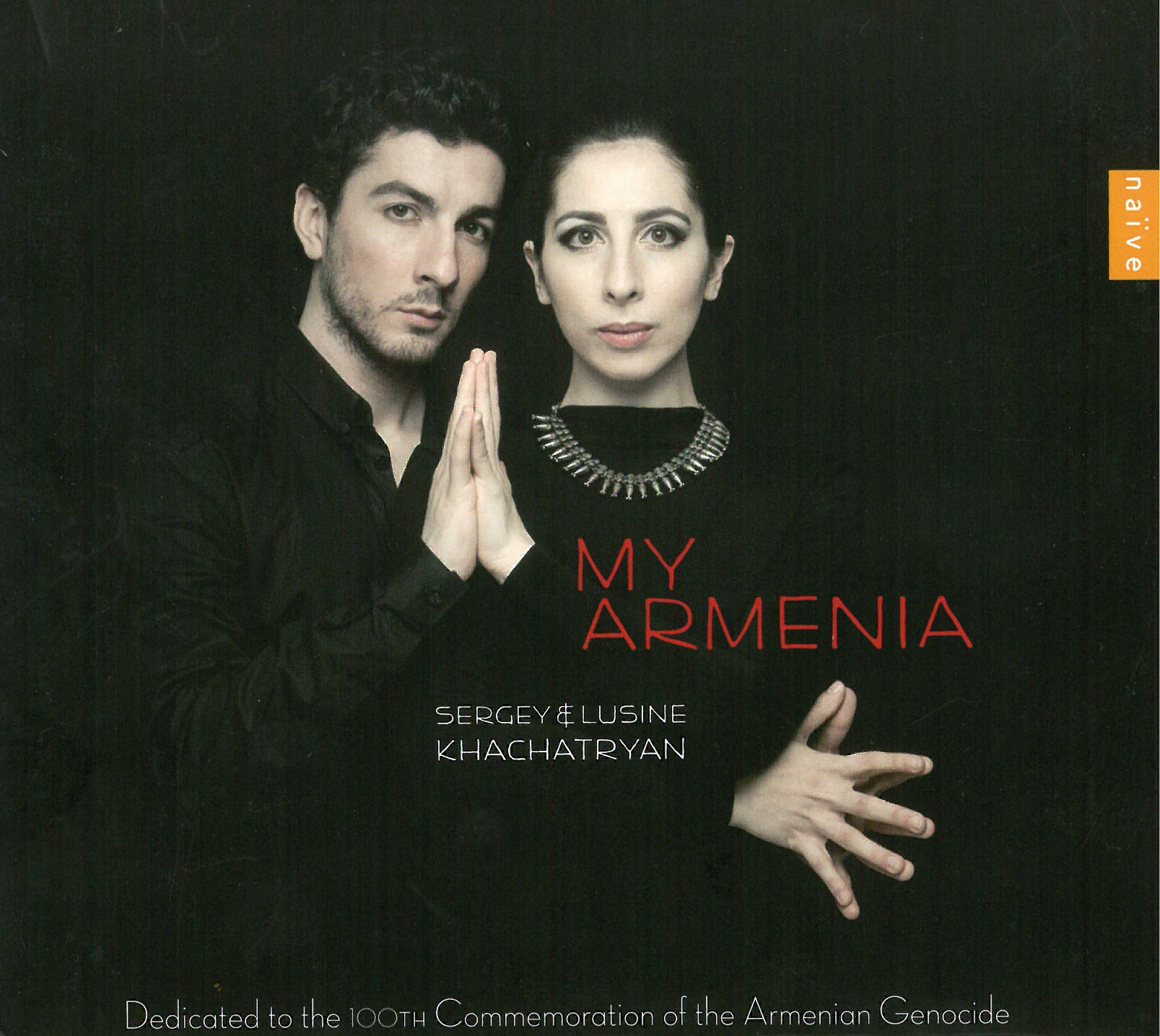
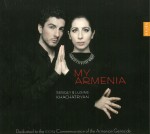 The outstanding Armenian brother and sister duo Sergey and Lusine Khachatryan are back with another superb violin and piano recital on My Armenia (naïve V5414), dedicated to the 100th Commemoration of the Armenian Genocide.
The program of works by Komitas Vardapet, Eduard Bagdasaryan, Edvard Mirzoyan, Aram Khachaturian and Arno Babadjanian gives both performers ample opportunity to shine. Lusine Khachatryan is excellent in the piano solos that account for almost half of the very generous running time of the CD – close to 80 minutes – but the disc really takes off in the duos, with Sergey’s impassioned, brilliant playing taking the music to new heights and emotional depths.
There’s a lovely recorded sound and balance right from the opening two short-but-lovely duo pieces by Vardapet before Lusine features in his Seven Folk Dances for Piano Solo. The three duo pieces at the centre of the CD – Bagdasaryan’s Rhapsody and Nocturne and Mirzoyan’s Introduction & Perpetuum mobile – are also the heart of the recital. The Rhapsody is a truly rhapsodic and beautiful piece, and the short Nocturne an absolute gem. The Mirzoyan work is a real showstopper, with a simply dazzling second half.
Khachaturian, probably the best-known of the composers on the disc, is represented by three short pieces, including the familiar Sabre Dance in a typically showy transcription by Jascha Heifetz.
The CD ends with Babadjanian’s Six Pictures for Solo Piano, a challenging work both technically and harmonically, with a brilliant Toccatina movement straight out of the same drawer as Prokofiev’s Seventh Piano Sonata. It’s another dazzler.
All in all, it’s wonderful playing and musicianship from a wonderfully gifted duo. This is music that is clearly deeply ingrained in their hearts and souls as well as in their fingers.
Regular readers will know how I feel about reviewing complete sets of the Bach unaccompanied solo works, be it the Sonatas & Partitas for violin or the Cello Suites: the sheer size, scope, depth and complexity of the music, together with the wide range of versions available, makes any in-depth review almost impossible. All you can really do is note the arrival and try to give some idea of the stylistic approach and overall effect.
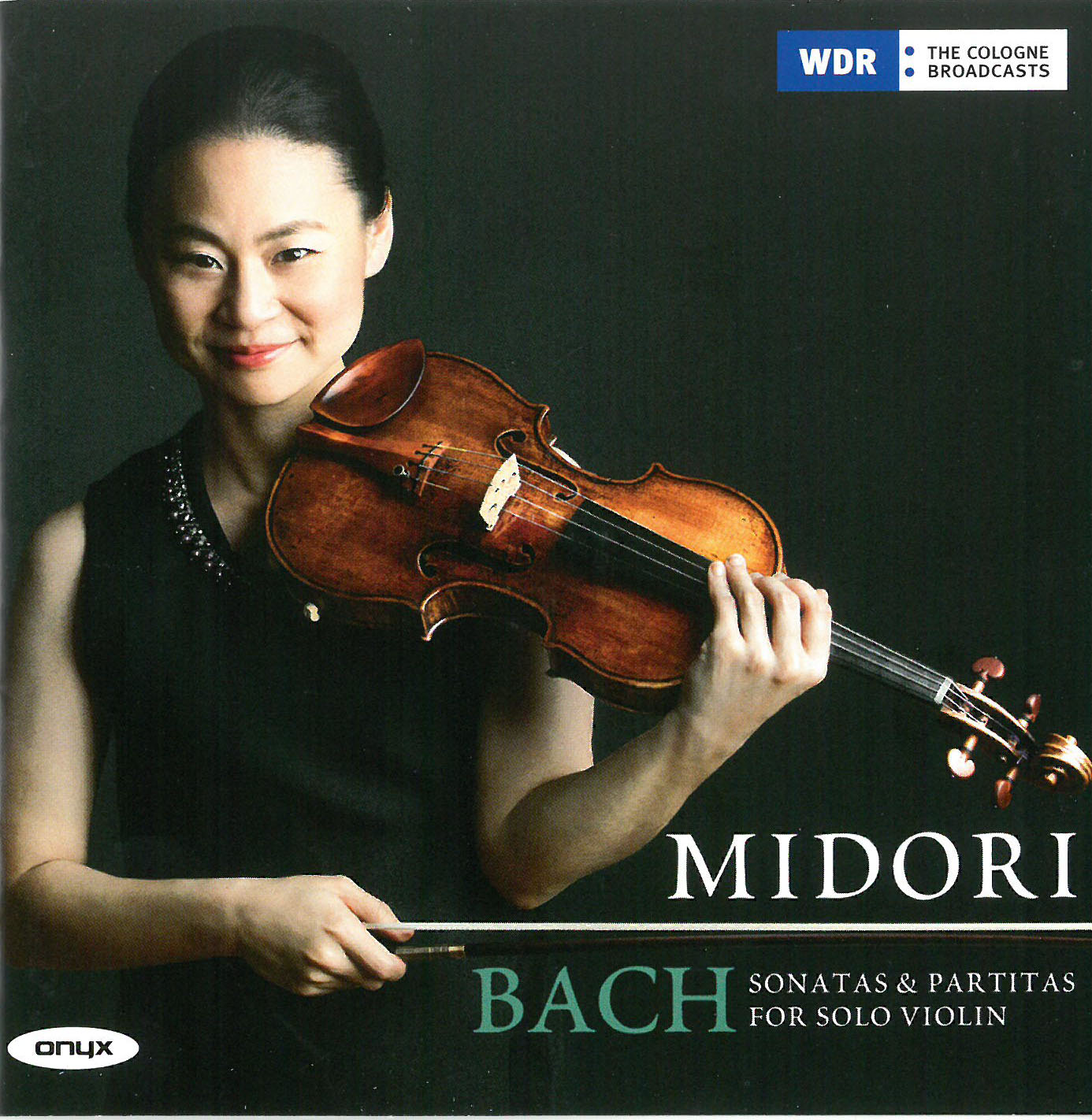
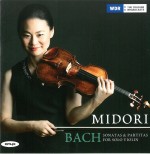 The latest addition to the already lengthy list of available versions of the Bach Sonatas & Partitas for Solo Violin is a beautiful 2-CD set by Midori (Onyx 4123). Again, as with the recent Gil Shaham release, there is a clear sense of these wonderful works having been a constant in the performer’s life, together with a reluctance to create a permanent record of what is essentially only one in a continually developing and changing series of interpretations. “After thirty years on stage,” says Midori, “the time felt right for me to fully embrace these most daunting and invaluable compositions.”
The recordings were made in Cologne in August 2013 as a result of Midori’s Bach Project that marked the 30th anniversary of her 1982 debut with Zubin Mehta and the New York Philharmonic. Presumably made for broadcast on German radio – the booklet cover has WDR The Cologne Broadcasts as a sub-heading – the recorded sound is clean and clear, with a natural presence.
There is much to comment on here: the compactness of the chords in the G Minor Fugue; the brightness, speed and sense of pulse in the uptempo dance movements in the Partitas; the lightness and ease of the multiple-stopping, without ever obscuring the line; the light and warmth in the tone, combined with a strength and richness.
It’s easy to see why violinists hesitate to commit performances of these works to disc: the more you play them and live with them, the more the challenges and possibilities, both technical and emotional, continue to grow and not diminish.
All we can do is sit back and enjoy the journey, albeit a different one each time, and feel grateful for the privilege.
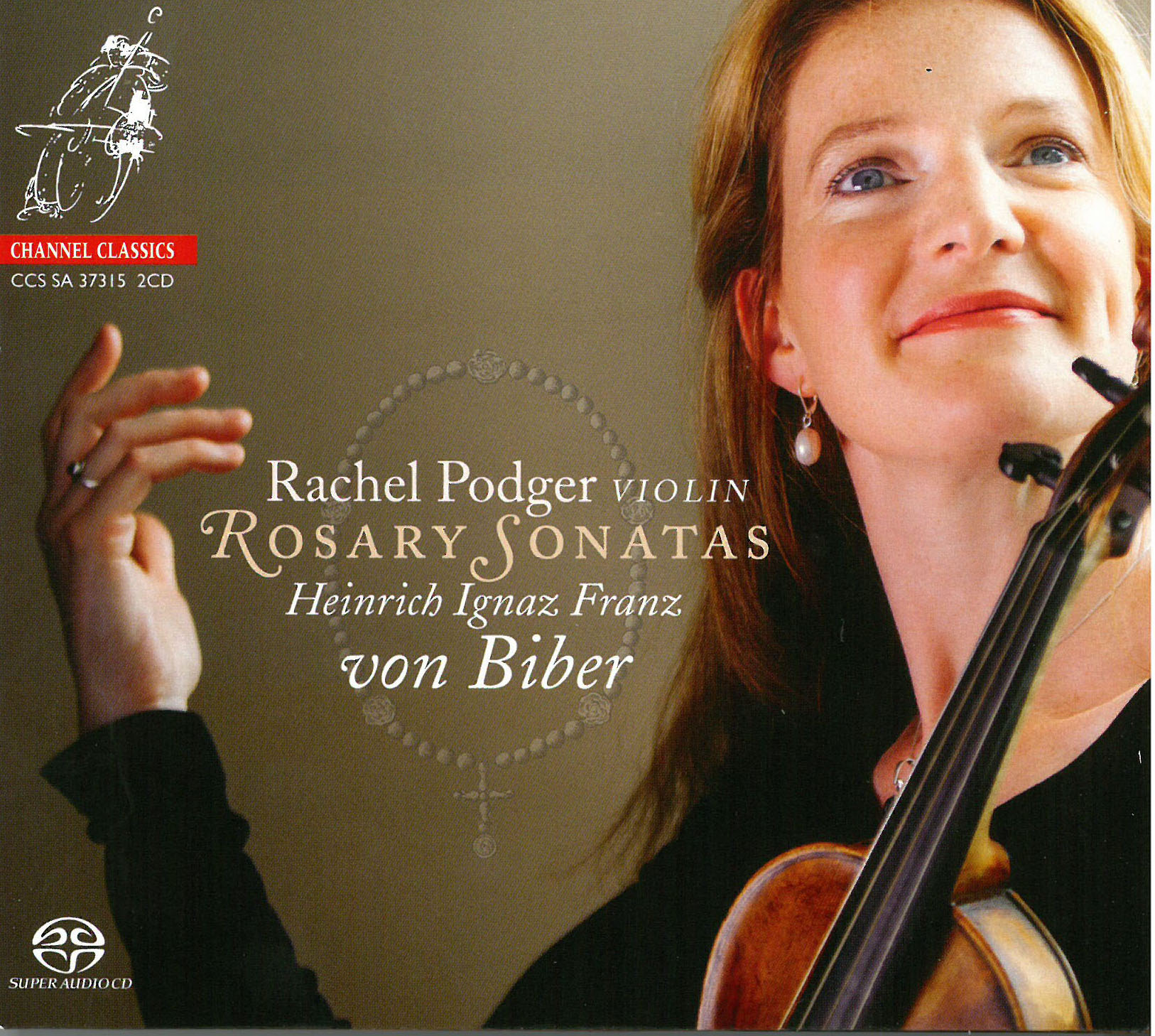
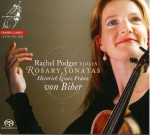 Many of the same problems for a reviewer are presented by the Mystery Sonatas (also known as the Rosary Sonatas) of Heinrich Ignaz Franz von Biber, now available in a beautifully judged 2-CD set by the outstanding period-performance violinist Rachel Podger (Channel Classics CCS SA 37315). David Miller, Marcin Świątkiewicz and Jonathan Manson supply the excellent continuo.
The sonatas depict the mysteries in the life of Jesus and the Virgin Mary. Anyone familiar with Biber’s descriptive piece Battalia will know how startlingly inventive he can be, but nothing prepares you for what he does in these 16 sonatas.
Scordatura (from the Italian word that gives us “discordant”) is a technique in which the strings of a string instrument are tuned differently from the usual arrangement. It’s not that uncommon, but in these sonatas Biber takes it to simply astonishing lengths, radically altering the violin’s normal GDAE tuning in all but the outer movements by retuning anything from one to all four of the strings by intervals as large as a fifth. Every tuning is different, and some – GGDD, DFB-flatD and BF-sharpBD, for instance – are simply eye-popping. The result is essentially a different instrument for each movement, with enormous possibilities for radically different chordal work and multiple-stopping.
These astonishing sonatas have long been a favourite with baroque specialists – a quick online search produced almost two dozen CD sets currently available – and while Podger is up against some stiff competition (including an outstanding set by Tafelmusik’s Julia Wedman) these are performances of works that stretch both the violin and the violinist to the limit that will hold their own against any.
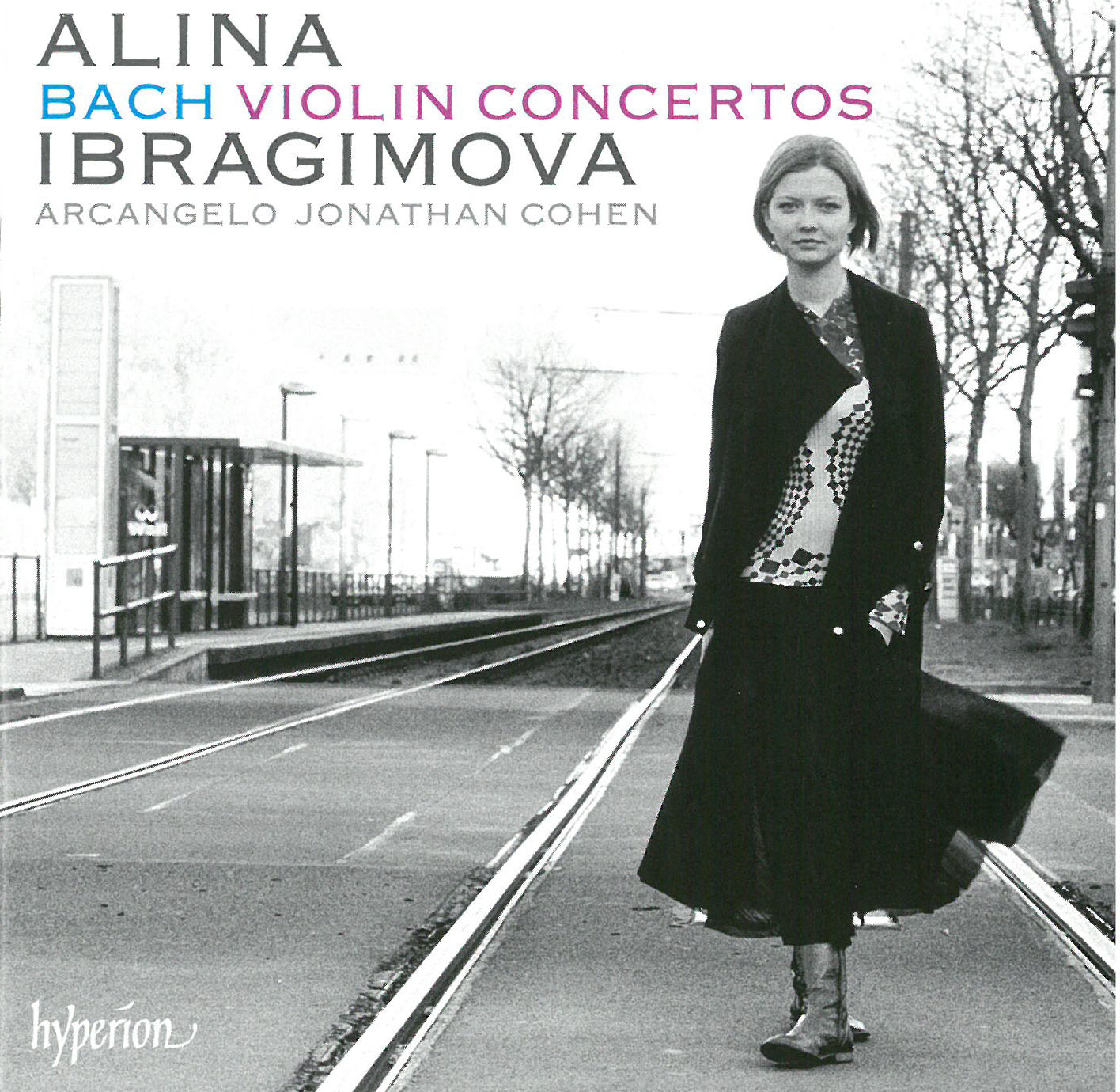
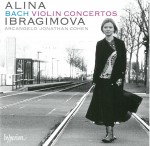 When Hyperion released the Russian violinist Alina Ibragimova’s recording of the Bach Sonatas & Partitas in 2009, Gramophone magazine noted that “… her Bach comes as something of a revelation … all her stylishness and technical refinement is at the service of an ingrained understanding of the music.” Add another six years, and it should come as no surprise that in her latest Hyperion release, Bach Violin Concertos with the string ensemble Arcangelo under their founder Jonathan Cohen (CDA 68068), Ibragimova delivers terrific performances of consummate skill and style.
Arcangelo plays with a lute and harpsichord continuo, but it’s the lute that predominates in the balance here, giving the performances a soft, warm background that provides a perfect setting for Ibragimova’s sensitive interpretations. The booklet notes point out that this music comes from an age when the distinction between star soloist and ensemble player was more blurred than it is today, and Ibragimova really seems to have taken that to heart. Her imaginative playing is full of sensitive phrasing and dynamics, but is quite laid back, sounding more like a thread running through a tapestry than an out-front solo performance. Everything is light and spacious, and never heavy or routine.
The two standard solo concertos – in A Minor BWV1041 and E Major BWV1042, both of which were transcribed for keyboard by Bach – are here, but not the D Minor Double Concerto. Instead, we have three solo concertos that are described as “back-transcriptions,” being reconstructed solo versions of keyboard concertos that were themselves transcriptions of solo works. The Concerto in A Major BWV1055 is from Keyboard Concerto No.4; the Concerto in G Minor BWV1056 is from the transposed Keyboard Concerto No.5 in F Minor; and the Concerto in D Minor BWV1052 is from the Keyboard Concerto No.1.
The original A Major concerto may have been for oboe d’amore, and the original G Minor for violin or oboe; the D Minor, however, was described by no less an authority as Donald Tovey as “the greatest and most difficult violin concerto before the time of Beethoven.”
It makes a fine ending to an immensely satisfying CD.
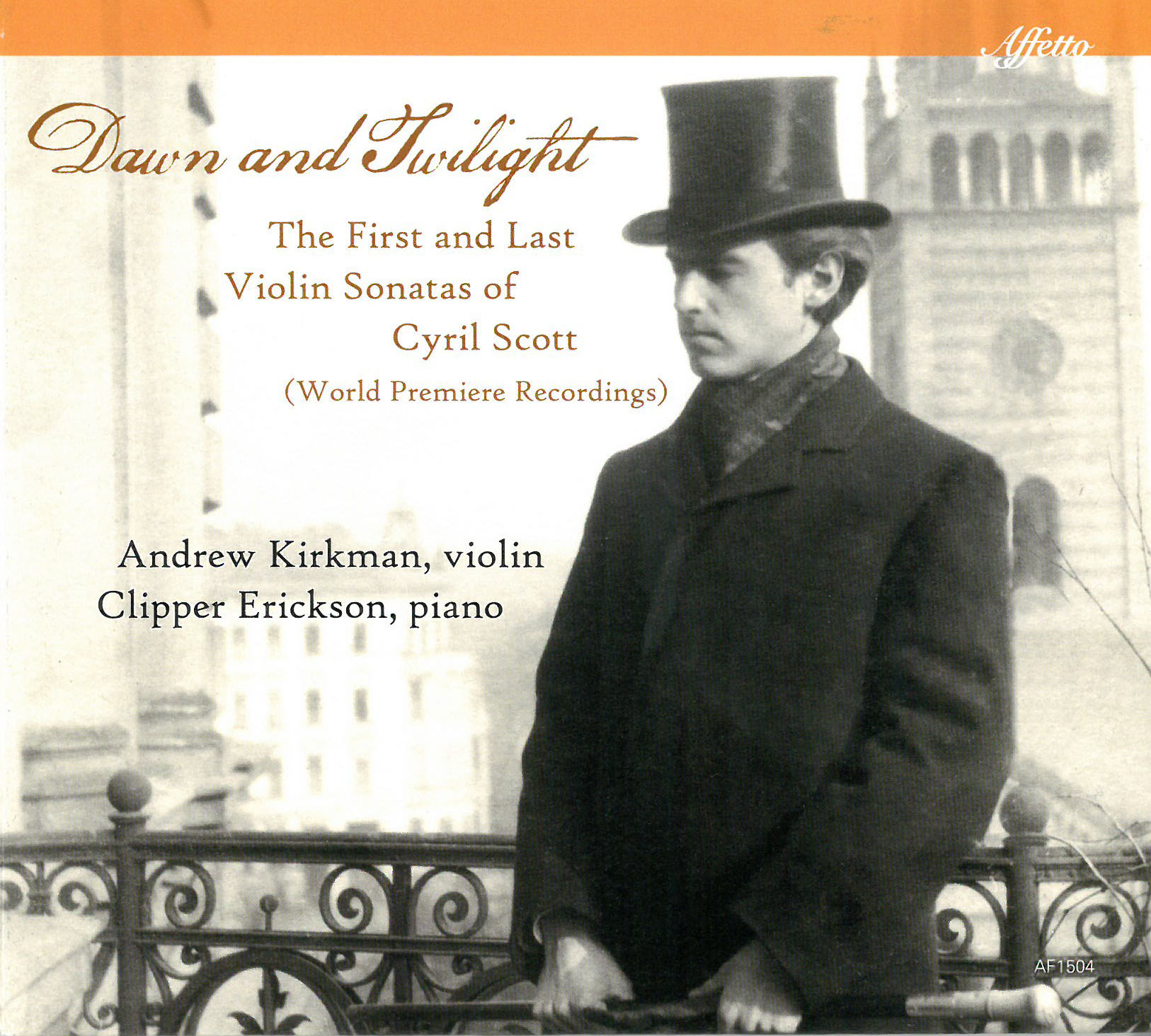
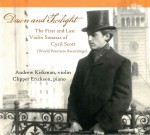 However much you may know about the music of the English composer Cyril Scott, whose Lotus Land was transcribed and recorded several times by Heifetz in the 1920s and 1930s, you’re almost certainly not going to know either of the works on the CD Dawn and Twilight – The First and Last Violin Sonatas of Cyril Scott (Affetto AF1504) unless you’ve already heard the CD: both works are world premiere recordings.
Scott, who died in 1970 at the age of 91, wrote close to 400 works in a wide range of genres but his music was largely neglected at his death, although there has been a resurgence of both interest and recordings since the turn of the century. He wrote four numbered violin sonatas, only the first of which is a youthful work: written in 1908, it was heavily revised and shortened in 1956. The revised version, along with the second and third sonatas from 1950 and 1955 respectively, was featured on a 2010 Naxos release, but Dawn and Twilight pairs the original version with the unpublished Sonata No.4, written in 1956, the same year as the revision of No.1, and provided in a photocopy of the original manuscript by the composer’s son Desmond Scott.
Violinist Andrew Kirkman and pianist Clipper Erickson are the performers here in works that are difficult to compare because, as Desmond Scott notes, there is a world of stylistic and other differences between them. Certainly the 1908 version of the First Sonata, almost a third longer than the revised version, shows a composer already leaving behind the influences of Debussy and Strauss and moving away from tonality and regular rhythm, and not surprisingly attracting a fair amount of uncomprehending attention from contemporary reviewers. To our ears it’s a stylish and finely crafted rhapsodic four-movement work, with a simply beautiful slow movement, and what the booklet notes call “a bravura disregard for the kind of formal control that informed its later revision.”
The Fourth Sonata, the direct contemporary of that revision, is another fine work that also shows the formal control and precise musical thought process of a mature composer then in his late 70s.
Kirkman and Erickson started performing the original No.1 in 2011, and gave a few concert performances of the unpublished No.4 before recording it for this release. There are times when Erickson seems to be playing with more emotional commitment and dynamic range than Kirkman, but overall these are fine performances of two works that fully deserve to be added to the standard repertoire of 20th-century violin sonatas.
 There are two outstanding CDs this month featuring the works of American women composers. Patagón (Foghorn Classics CD2015) features the Alexander String Quartet in three works by Cindy Cox, now in her mid-50s and very active as a pianist as well as a composer.
Cox’s music here is quite fascinating, quite varied and not easy to describe.The composer Robert Carl, writing in Fanfare Magazine, said that “Cox writes music that demonstrates an extremely refined and imaginative sense of instrumental colour and texture … this is well wrought, imaginative, and not easily classifiable music.” It’s exactly that.
The Alexander String Quartet was formed in 1981, and performed and recorded Cox’s first string quartet, Columba aspexit, after Hildegard von Bingen, some 20 years ago. It’s performed here along with the title work, Patagón, a five-movement work written in 2011 on commission from the Alexanders to celebrate their 30th anniversary and dedicated to them. Inspired by a trip to the Valdes peninsula nature preserve in southern Argentina, it employs some quite remarkable effects, including sliding harmonics, col legno (playing with the wood of the bow), sul ponticello (playing near the bridge), sul tasto (playing above the fingerboard) and overbowing, where the bow is pressed hard but slowly against the strings. Imagine these sounds and then look at the title of the third movement – Southern right whales and Magellanic penguins – and you will have some idea why these effects seem so perfectly suited to the music.
The quartet’s first violinist Zakarias Grafilo opens the CD with the short but lovely 1990 solo violin work Elegy, dedicated to the memory of Cox’s fellow compositional student Eric Heckard, who died in 1989 at the young age of 26.
The ASQ and Cox have been collaborating ever since that early recording of the Columba quartet, and it’s hard to imagine more satisfying or better-informed performances of these lovely works.
 All of the works on Strum: Music for Strings, the first album dedicated solely to the music of the young African-American composer and violinist Jessie Montgomery (Azica ACD-71302) were written in the past three years, and they display a remarkable self-assurance and confidence together with a striking musical inventiveness and imagination.
Starburst is a short work for string orchestra that plays on rapidly changing musical colours. Source Code for string quartet began life as sketched transcriptions of various sources from African American artists prominent during the peak of the Civil Rights era; it’s played here by the Catalyst Quartet. Break Away, a five-movement work for string quartet, was written for the PUBLIQuartet, who perform it here; born out of a series of improvisations the ensemble was working on while in residence at the Banff Centre, it requires the players to literally break away from the score and improvise, especially in the final movement.
The Rhapsody No.1 for solo violin gives Montgomery the chance to display her outstanding violin playing, and Banner for solo string quartet and string orchestra, with the Catalyst Quartet and the String Orchestra conducted by Julian Wachner, is a rhapsodic tribute to the 200th Anniversary of The Star-Spangled Banner.
Strum, the title track of the album, is the final version of a work started in 2006, but revised and partially rewritten in 2012 for the Catalyst Quartet, whose performance rounds out an impressive debut disc of Montgomery’s compositions.
This is clearly a significant talent, and definitely someone to watch. Expect to hear a lot more from this artist.


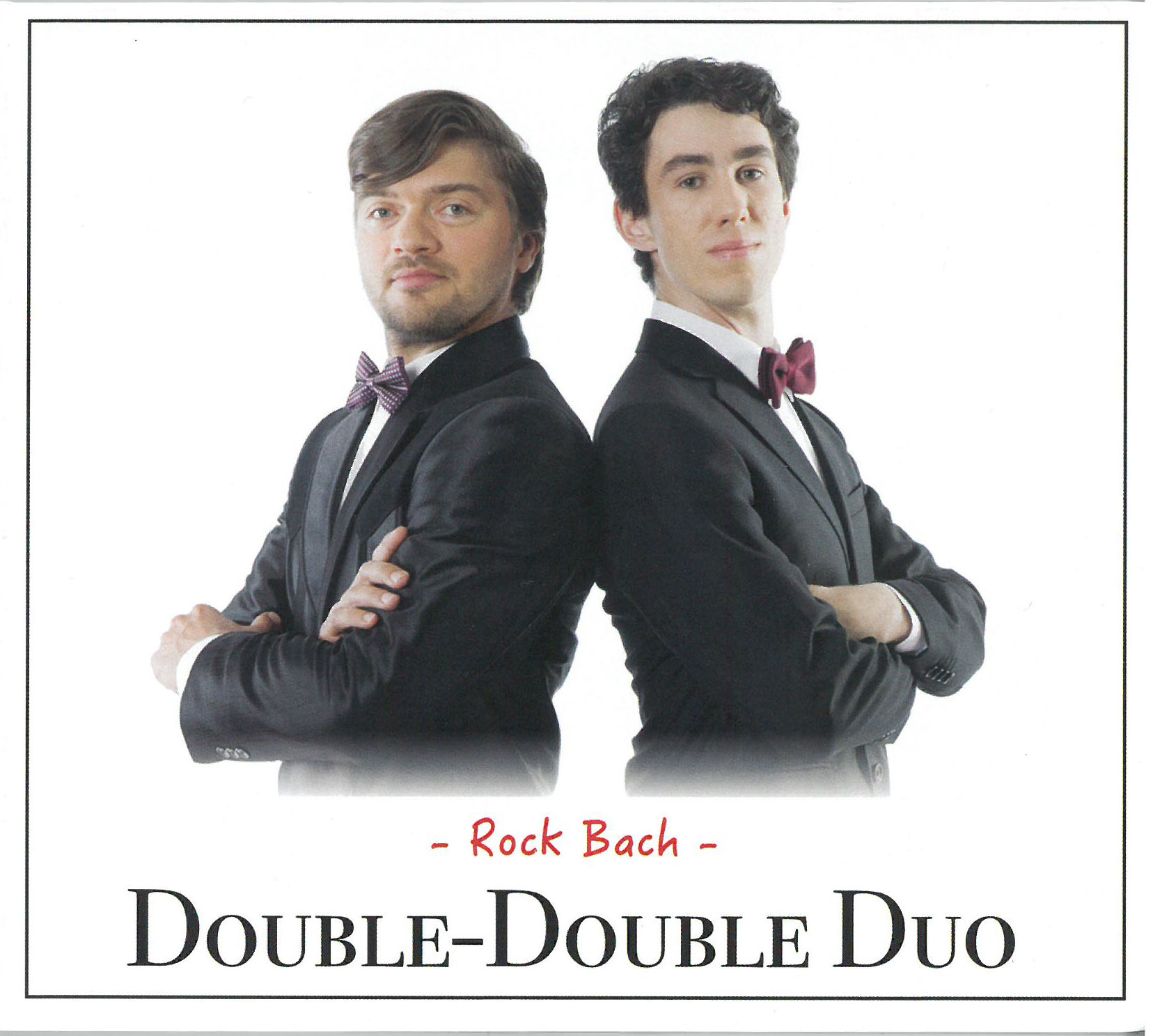 Rock Bach



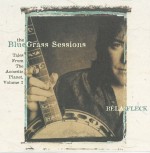 The next steps on the journey began just a block from Michael and Mary’s house, at the Dufferin bus stop at Davenport. A few minutes after I arrived at the stop another man carrying a guitar case came to wait alongside me. I asked if he was going out to play, or like me, coming home from doing so. He said he was coming from a friend’s house where they had been playing bluegrass music all evening. Long time readers of this column will know that I am enamoured of the “new grass” band Joy Kills Sorrow that was active from 2005 to 2014. I asked this guitarist if he was familiar with the band and he said no, but that he knew “the song.” Not knowing the song myself, I said “Oh?” “Yes,” he said, “it’s a great song by Béla Fleck.” And so my next quest began. It turns out that When Joy Kills Sorrow appeared on the
  In Francis Whatley’s 2013 film
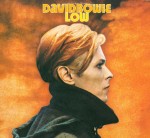
  But that picture was further enhanced by These Dreams of You (Europa Editions ISBN 978-1-60945-063-2), a 2012 novel by Steve Erickson, which I found myself reading for the third time over the past few days (which may have set a record for frequency of rereading for me). Erickson, whose eight previous novels number among my favourites – a shout out to Jowi Taylor for turning me on to Arc d’X all those years ago! – frequently incorporates pop culture, particularly music and film, into his novels. Although These Dreams of You is nominally speculative and surreal, as are most of his books, the narrative strands are fairly linear, albeit many layered. The protagonists are a family of four in contemporary L.A. in danger of losing their house as a result of the economic crisis and the nefarious machinations of the banks. The father, Zan, has recently been let go from his position as professor of literature at the local university and is the sole DJ on a low-wattage radio station broadcasting without a license from a local Mexican restaurant in the Valley. His wife, Viv, is a freelance photographer whose work is drying up and whose one claim to fame, stained glass butterfly art, has been co-opted by an infamous commercial artist. Their children are Parker, a 12-year-old whose namesake is Charlie Parker but whose musical interests favour gangsta rap, and Sheba, a precocious four-year-old orphan adopted from Ethiopia, who is seeming wired internally to a certain unnamed “red-headed British alien who wears dresses.” The not-so-veiled references to David Bowie continue as he permeates the story, in particular with tales of his time in Berlin with roommates The Professor (Eno?) and Jim (Iggy Pop?), which lead to the album Low. Erickson cleverly weaves his tales – another one including presidential hopeful Bobby Kennedy in the months leading up to his assassination, and a third, an aspiring 1970s author, who after being beaten and left for dead by German skinheads, wakes to find himself in 1919 Berlin with a paperback copy of a novel that will shape the literature of the coming century but won’t be published until 1922 – through three eras and three continents. The convolutions are eventually resolved, and although there are no particularly happy endings, it does make for a very compelling read. Part of the fun is identifying the myriad historical characters that are never actually named. A great read indeed, and a great tribute to David Bowie.
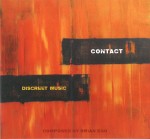 But back to Contact’s rendition of Discreet Music (Cantaloupe Music CA21114 cantaloupemusic.com). Eno’s original LP side was an electronic intertwining of some very simple melodic material according to some basic programming in Eno’s synthesizers. Four decades later Toronto percussionist and founding member of Contact Contemporary Music, Jerry Pergolesi, set out to make a live performance version of the iconic work. In the booklet notes he says: “In keeping with the spirit of the original, my ‘arrangement’ consists of seven mutually compatible melodies (the result of Eno’s original two melodies being occasionally altered) and instructions that render the band itself into the looping apparatus that Eno describes as the ‘score’ for the original. The ‘arrangement’ sets parameters for the musicians to follow, while giving them some leeway to make decisions with regard to what they play and when. Once the performance starts, however, the resulting sound is out of anyone’s hands.” The members of Contact – Mary-Katherine Finch, cello; Sarah Fraser Raff, violin; Wallace Halladay, soprano sax; Rob MacDonald, guitar; Peter Pavlovsky, bass; Jerry Pergolesi, vibraphone; Allison Wiebe Benstead, piano; complemented here by Emma Zoe Elkinson, flute and Dean Kurtis-Pomeroy, gongs – perform with real conviction – tone and intonation are warm and consistent – and they manage to hold our attention throughout the hour-long take in which “nothing happens.” I can’t imagine what it is like to take part in such a static performance, but congratulations are due to all concerned for realizing a viable live presentation of an electronic classic.
 It has been a month of losses in the musical arts. Canadian-born jazz icon, Paul Bley, and French father of avant-garde concert music, Pierre Boulez, are honoured elsewhere in these pages, although their passing garnered little attention in Toronto’s mainstream media. In contrast, much has been said about the death of David Bowie across all media and all platforms – including 24 continuous hours of programming on Much Music as I write this column – so I will not say much more here. He was a unique artist who constantly reinvented himself and touched more lives than most.