Reading a survey of “The History of Classical Music” is an experience similar to reading the Toronto Transit Commission subway map. Broken down into its basic elements, our subterranean transit system is a series of independent and direct lines with clear paths and destinations that intersect at a relatively small number of major junctions. These junctions are occasionally chaotic (think Bloor Station at 8:30am, with an obligatory delay or two) and often confusing, with the uninitiated and unfamiliar wondering just how to get from that yellow line to that green line without being trampled by a stampeding horde of commuters.

Our conventional understanding of the history of classical music is, much like our system of underground transport, often considered in linear terms – take the Yonge line to Bloor, Bloor line to Bathurst – directional, but reading more like the first chapter of the Gospel of Matthew: Abraham begat Isaac; and Isaac begat Jacob; and Jacob begat Judas and his brethren… or, Buxtehude begat J.S. Bach; and J.S. Bach begat C.P.E. Bach; and C.P.E. Bach begat Mozart... These linear streams of music history intersect, like our Bloor and Yonge lines, relatively rarely (once every 150 years or so) often landmarked by a creative supernova: the masterworks of J.S. Bach; the creation and subsequent development of sonata form by Scarlatti, Haydn, Mozart and Beethoven; the operas of Wagner; the invention of Schoenberg’s dodecaphony. These are the junctions which, we are told, changed the course of history and introduced the world to the Baroque, Classical, Romantic and modern eras, respectively.

Nothing, however, is as simple as it seems. Once we reach the surface and take a bird’s-eye view of these systems, we find that they are infinitely more complex and intertwined than we initially thought. Anyone who has been redirected out of Toronto’s subways (Line One is closed from Lawrence to Bloor this weekend) and forced to take shuttle buses, streetcars, or any other form of surface transportation, immediately realizes, in addition to the linear and direct lines which run underneath the city, there is an entire network of surface routing which connects our city in much more complex, thorough and occasionally hard-to-navigate ways. This is what real-life music history looks like, the apparently direct connections and creative supernovae actually consisting of myriad local and international interactions, increasing in fascinating complexity until our historical concept of “begotten-ness” is replaced by the understanding that everything is connected in one way or another

Once these connections are drawn and acknowledged, we see that it is no longer possible to parcel the history of classical music into comfortable categorizations. National musical schools, for example – Lully the Frenchman, Purcell the Englishman, Monteverdi the Italian, Bach the German – are no longer satisfactory criteria, for we often see that the country of one’s birth is significantly different from the country (or countries) responsible for one’s artistic development and inspiration. With a little bit of insight, broad categorizations, scholastically practical and academically satisfying though they are, are replaced by fascinating tales of professional musicians who worked, travelled, learned and borrowed from other countries and cultures, preserved and passed down through both musical and historical artifacts, such as Bach’s transcriptions of works by Vivaldi or the documented success of composers such as Zelenka and Heinichen, Bohemian composers who thrived within the courts of Dresden.

It is from this perspective that music, particularly the music of the Baroque, comes to life, the world of 17th-century Europe drawing from within itself to produce works of unbelievable creativity and breadth while simultaneously echoing a sentiment written by the Sherman brothers for Walt Disney 250 years later: “It’s a small world after all!”

Continental Contacts

This February is a wonderful month for fans of Baroque music – with the passing of December’s overwhelming musical offerings, the start of a new year gives ensembles time to rehearse, prepare and produce new and exciting programs. There’s something for everyone this month, but remember: whether you prefer your music with a touch of French grace, Italian joviality, German complexity, or English propriety, it’s all connected!

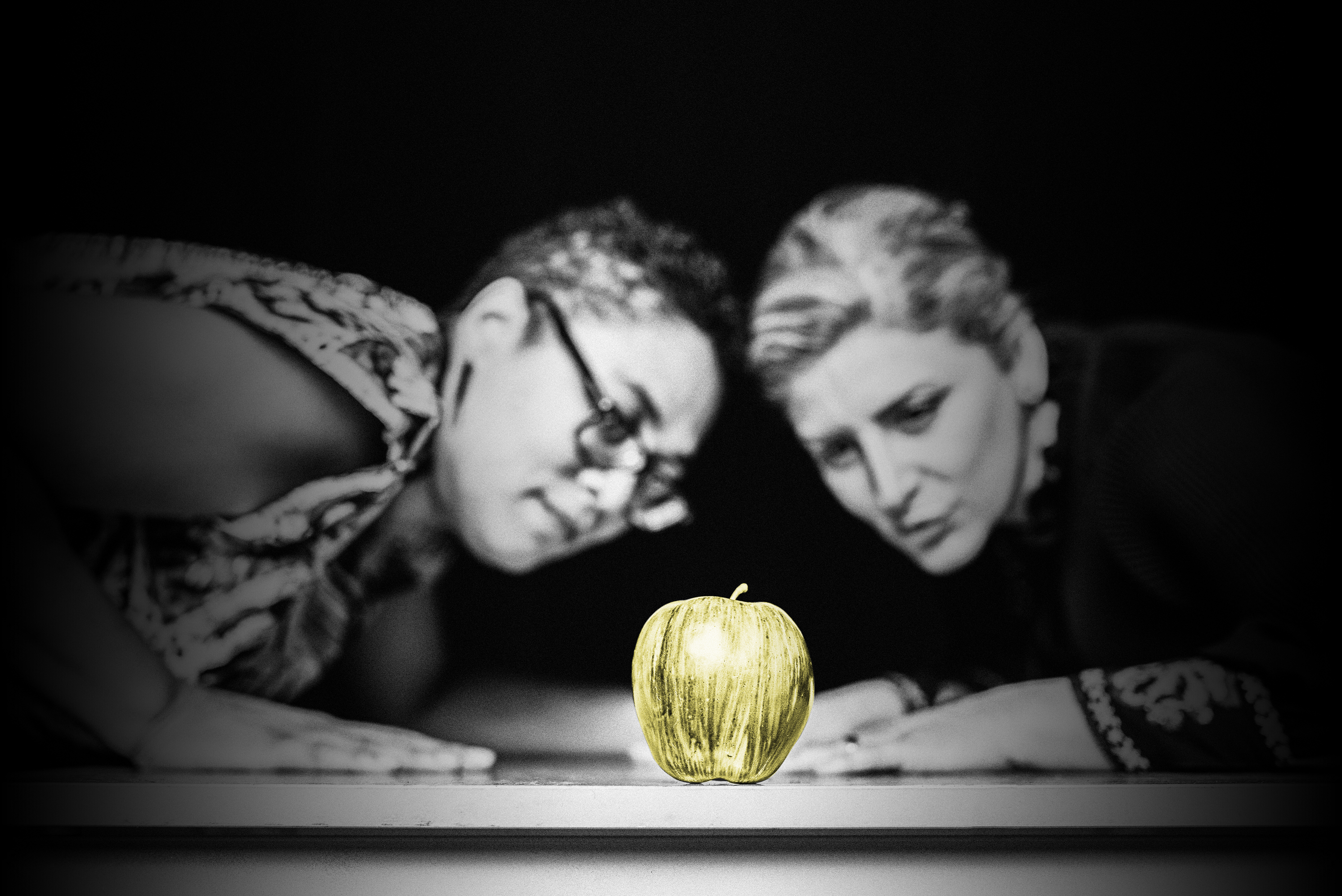
Rezonance: Last year Toronto’s newly-formed Rezonance Baroque Ensemble presented a fascinating concert which put the spotlight on partimenti, the study of improvisation in the Baroque era, drawing parallels between modern jazz and 17th-century classical music. The group is back on stage February 3 with “Versailles Confidential,” a multidisciplinary presentation featuring actress Ariana Marquis as the Marquise de Sévigné. With music by some of the French Baroque’s most esteemed composers including Rebel, D’Anglebert, Couperin and Jean-Baptiste Lully, official court composer of Louis XIV, this performance should be a delightful exploration of life in Baroque France.

Melos: For those further east in Ontario, Melos Choir and Period Instruments ensemble performs in Kingston on February 9. Their concert, “A Venetian Carnevale,” puts the spotlight on period vocal and instrumental music, theatre and dance from the time of Carnevale celebrations of Baroque Europe. Featured composers include Gabrieli, Lassus and Telemann, a musical kaleidoscope coloured by some fascinating bits of history. The Gabrielis were a dominant musical force in Venice and bridged the transition period between Renaissance and Baroque eras. Giovanni Gabrieli studied with Orlando di Lasso (Lassus) in Munich and subsequently taught the German composers Hans Leo Hassler and Heinrich Schütz, who brought Gabrieli’s works to Germany and ultimately influenced the music of later composers such as Bach and Telemann. An innovator of the highest calibre, Gabrieli is attributed with being the first to use specified dynamics (forte, piano, etc.) in his compositions, as well as introducing the concept of instrumentation!

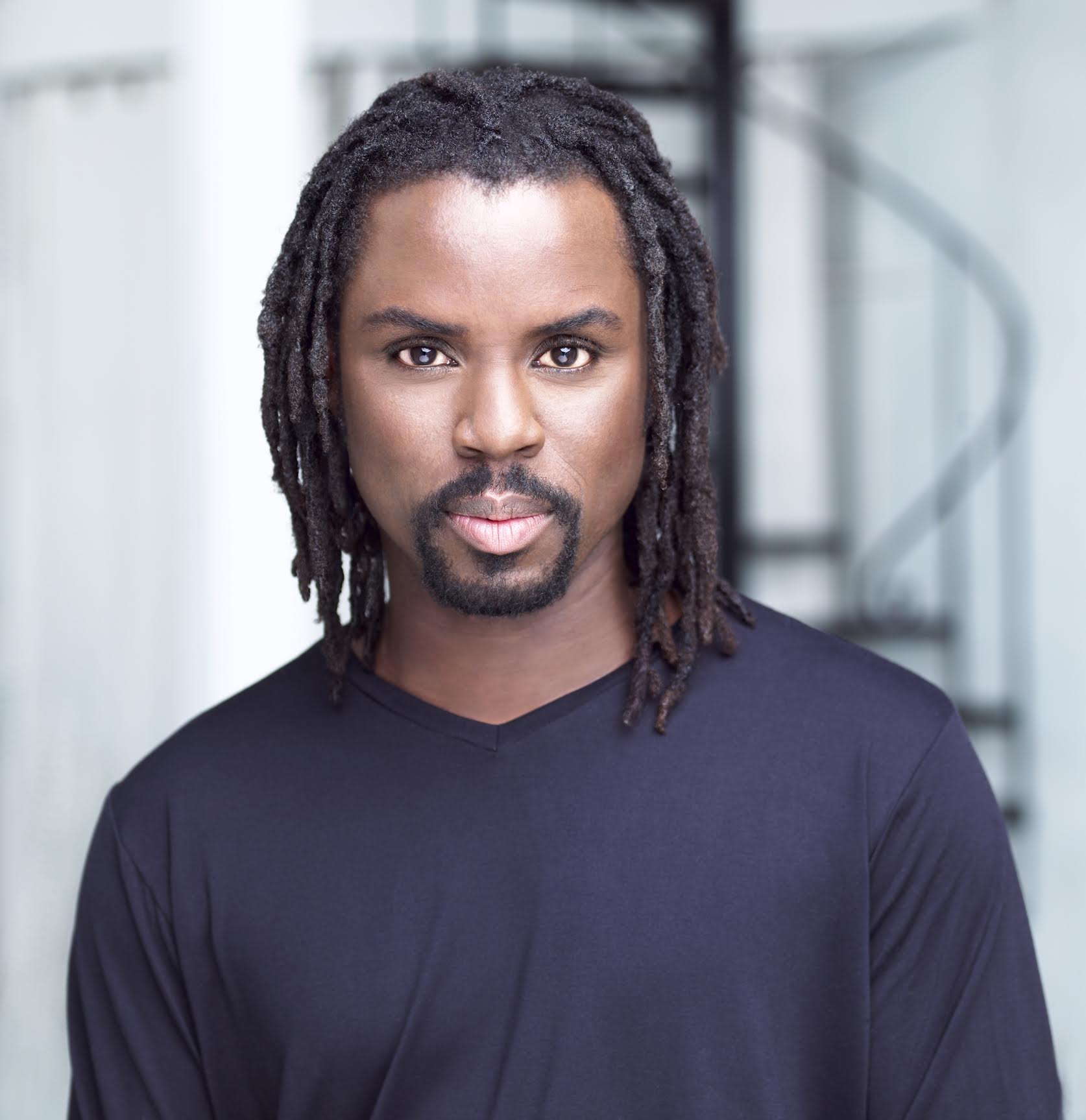
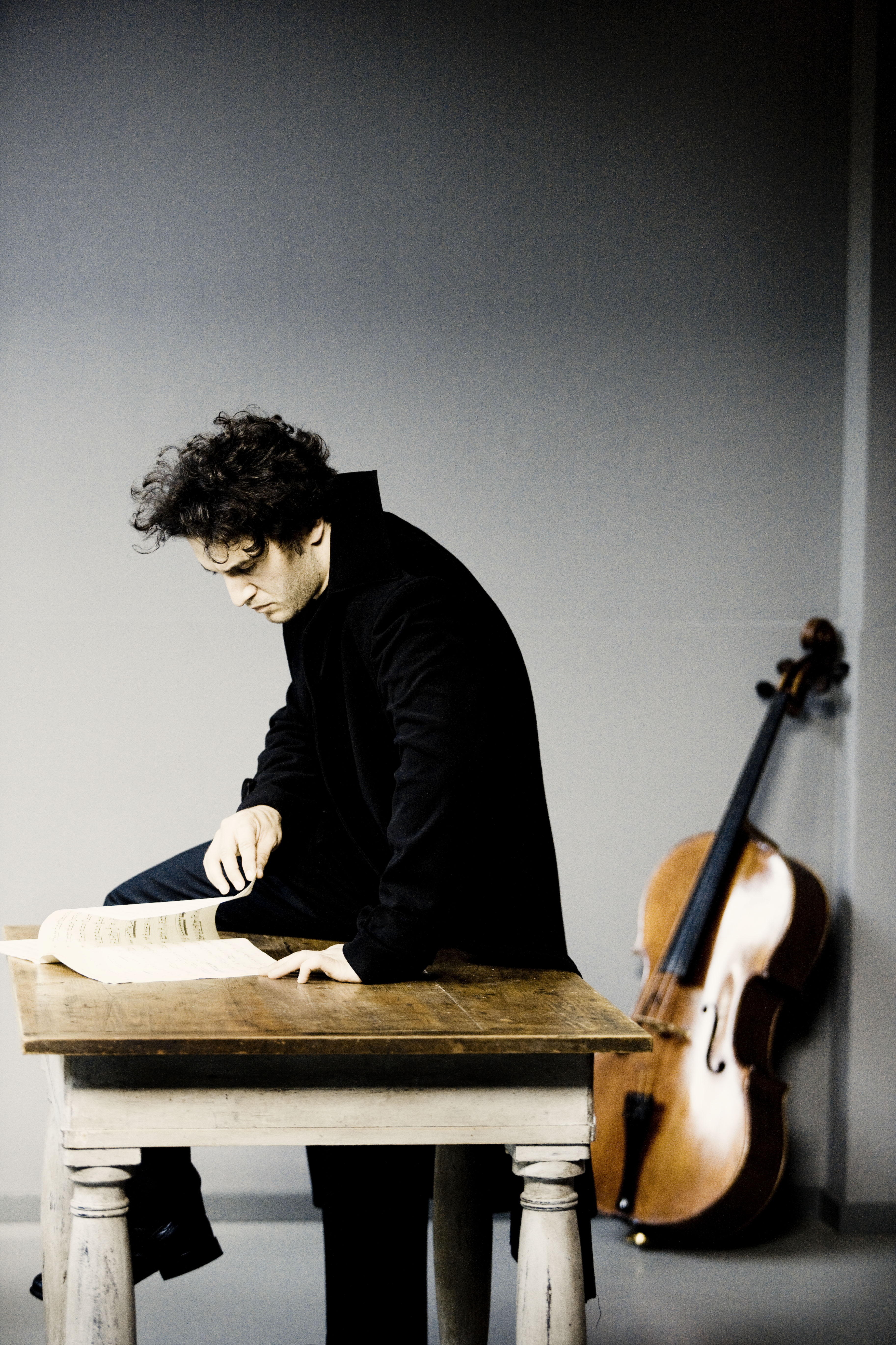
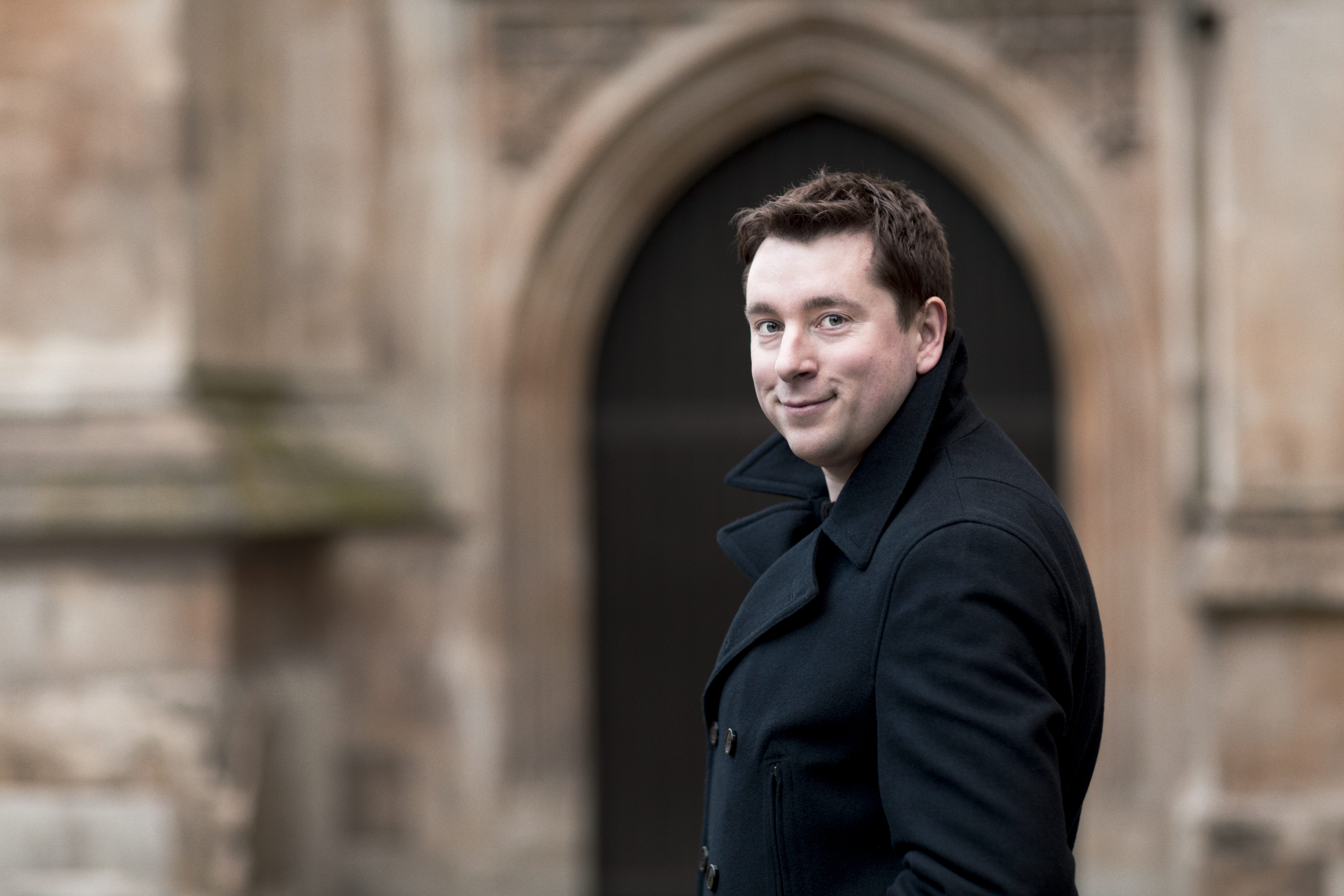
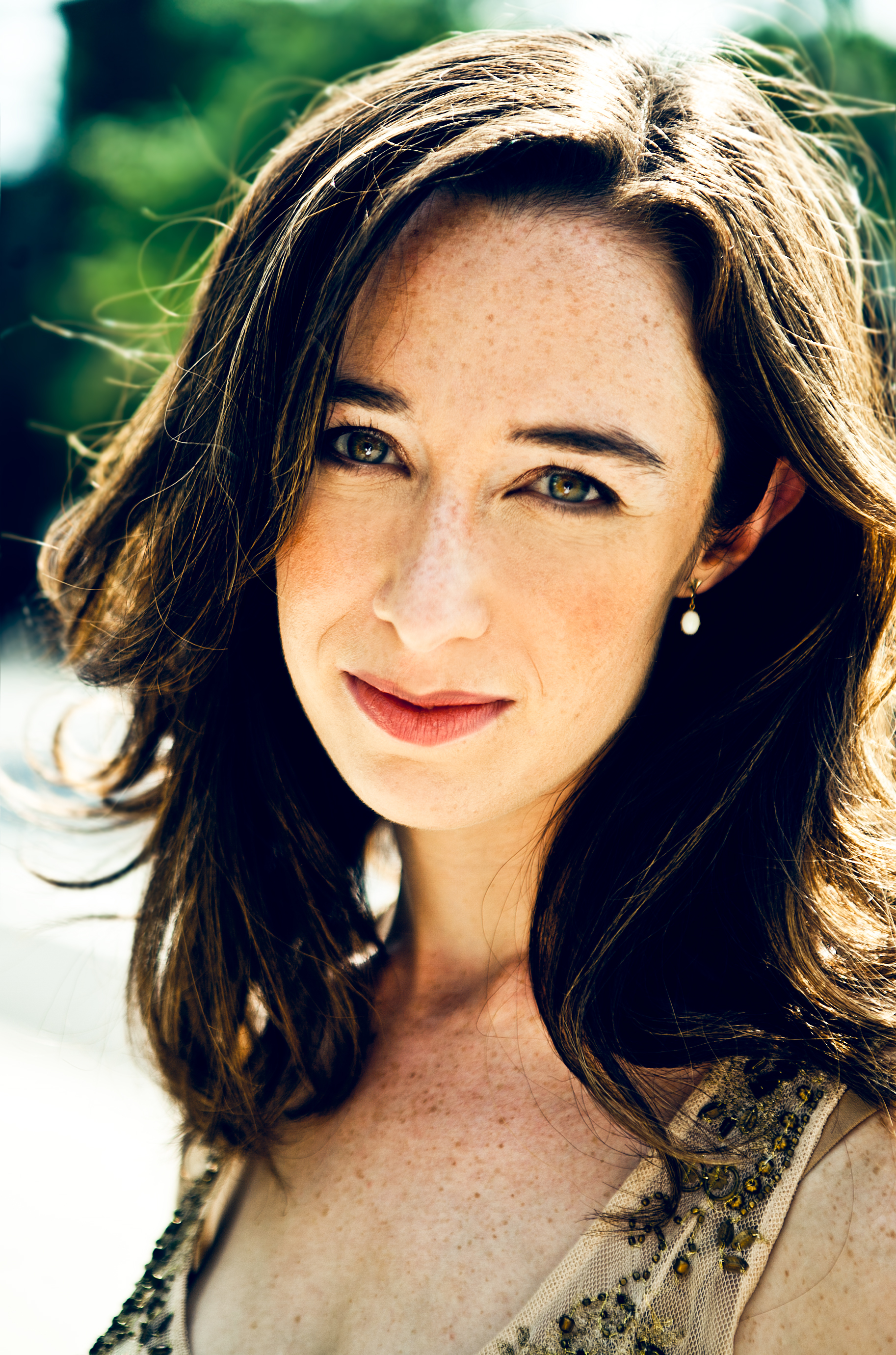
Thomas Hobbs. Photo by Benjamin Ealovega.Alexander’s Feast: George Frederic Handel is another composer whose influence on later generations of composers cannot be understated, his oratorios and operas crafting a path for the development of an entire genre of dramatic expression. Handel was an international artist himself, German by birth but writing enormously successful works in English such as Messiah, and Italian operas including Giulio Caesare. This month (February 22 to 25), Tafelmusik’s orchestra and chorus unite to perform Handel’s Alexander’s Feast, or The Power of Music with soprano soloist Amanda Forsythe, tenor Thomas Hobbs and baritone Alexander Dobson. In addition to his concert appearances, Hobbs will host a masterclass on February 24 at Jeanne Lamon Hall, where he will work with advanced students and professional musicians on Baroque vocal repertoire as part of Tafelmusik’s Guest Artist Masterclass Series. Masterclasses are fine opportunities for the public to see how much care, attention and preparation it takes to put together even the smallest amount of musical material at a professional level, a rarely seen peek behind the curtain.

St. Matthew: The works of Johann Sebastian Bach are, perhaps, the pinnacle of an individual’s internal musical synthesis, the product of an encyclopedic knowledge of musical styles coupled with a tremendous intellect and prodigious propensity for high-quality compositional output. One of Bach’s most immense, profound, and legendary masterpieces is his St. Matthew Passion, which will be performed by Chorus Niagara and the Talisker Players on March 3 in St. Catharines. If we look beyond the staggering creativity displayed within this work, it is, furthermore, incredible to think that Bach wrote such a staggering piece to be played within the context of a church service, surrounded by all the additional elements of Lutheran liturgical ritual (including a proper Protestant sermon)!

QUICK PICKS: Choir and Organ Music from Canada and Beyond

While on the topic of church music, there are two concerts taking place this month that focus on music written by legendary church musicians, one highlighting works by Healey Willan, the “Dean of Canadian Composers,” the other the inimitable organ music of J.S. Bach:

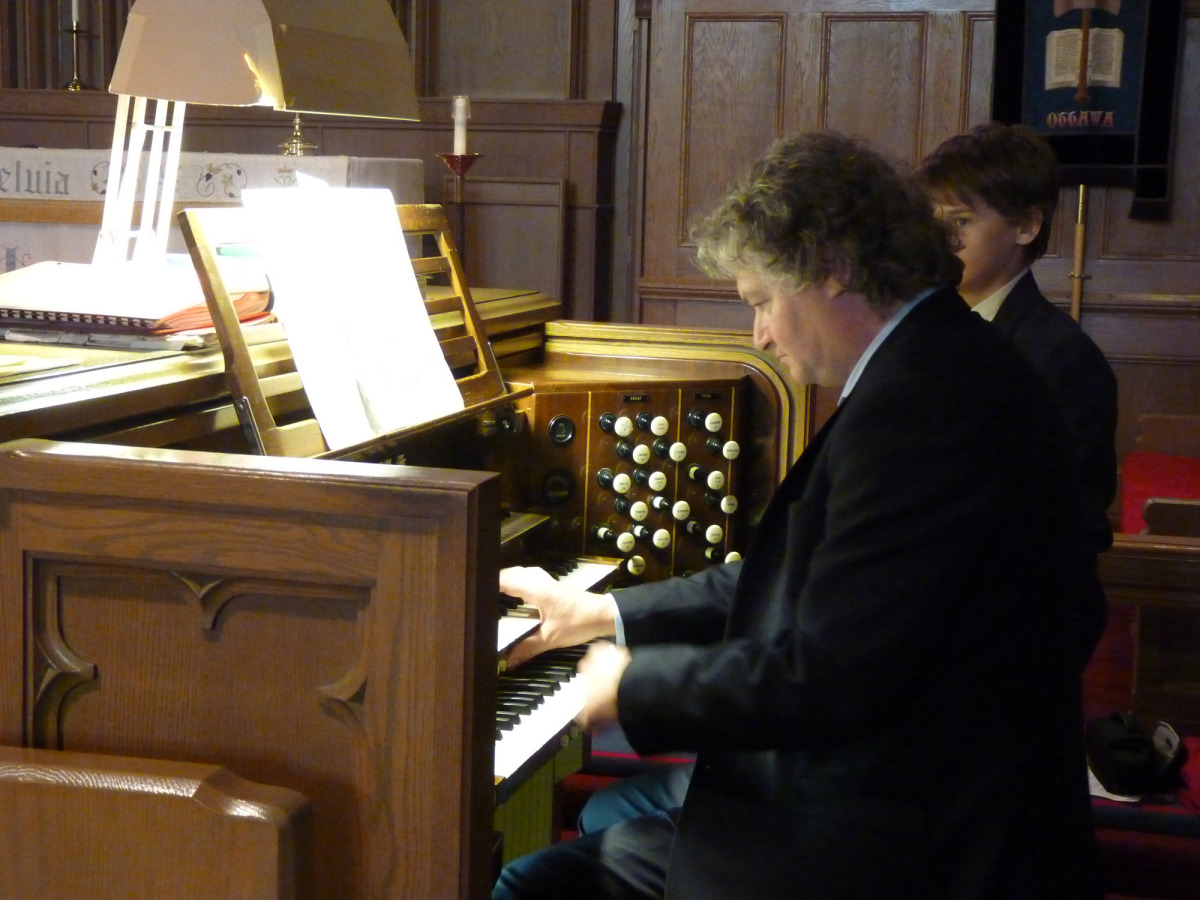
Matthew Larkin in recital on the Casavant organ in St. Matthias Anglican Church, Ottawa. Photo by Judith van Berkom.On February 16 at 8pm, the Church of St. Mary Magdalene hosts “Willan 50,” a concert commemorating the 50th anniversary of the Willan’s death. With the combined forces of St. Thomas’s Anglican Church, the Church of St. Mary Magdalene and organists Matthew Larkin, Simon Walker and Andrew Adair, this is bound to be a heartfelt, musical and moving tribute to one of Canada’s most renowned and influential compositional characters who considered himself “English by birth; Canadian by adoption; Irish by extraction; Scotch by absorption.”

Two days later, on February 18 at 4:30pm, fans of Bach’s organ music will be treated to an appearance by British organist David Briggs at St. Thomas’ Anglican Church in Belleville. Briggs, former artist-in-residence at St. James Cathedral in Toronto and a renowned performer and improviser, will play Bach’s Prelude and Fugue in G BWV541, Pièce d’orgue BWV572, Passacaglia BWV582 and more, as well as an improvisation. If you missed the chance to hear Briggs in concert as part of the “Splendours of Notre Dame” concert at St. James Cathedral last month, take advantage of this opportunity; he is a delightfully skillful player!

As always, I encourage you to explore the full range of listings in this issue of The WholeNote – in addition to these few highlights, there are a great many fine concerts and events taking place in our city this month! Your feedback is always welcome, either in person or, if you prefer to spend the month of February in solitary hibernation, emerging only when the trees are budding, send me a note at
earlymusic@thewholenote.com.

Matthew Whitfield is a Toronto-based harpsichordist and organist.

You don’t often find yourself discussing the concepts of evil and ethical conduct ten minutes into the phone conversation with somebody you’ve never met before, but that’s exactly what happened during my phone interview with the playwright and hip-hop artist Donna-Michelle St. Bernard. I rang her at the agreed time to ask about her latest project, the libretto for the opera Forbidden, and while phone interviews usually take time gearing up, she was immediately deeply engaging and generous. A Tapestry Opera production that runs February 8 to 11, Forbidden is created out of scenes of interdiction, loosely held together by the character of a girl who is visited by Lucifer. As a hip-hop emcee, St. Bernard brings the song into the mix, and how!

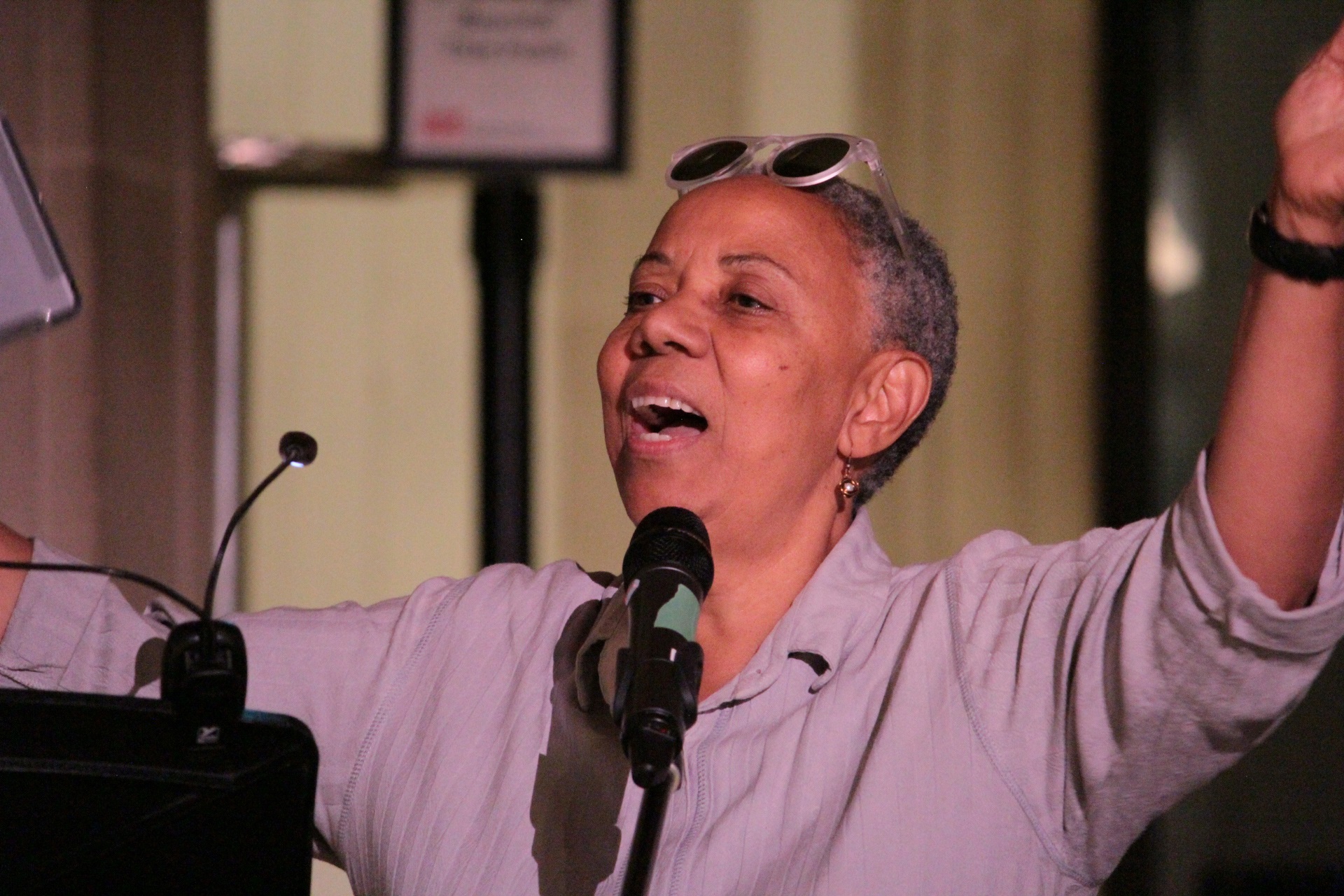
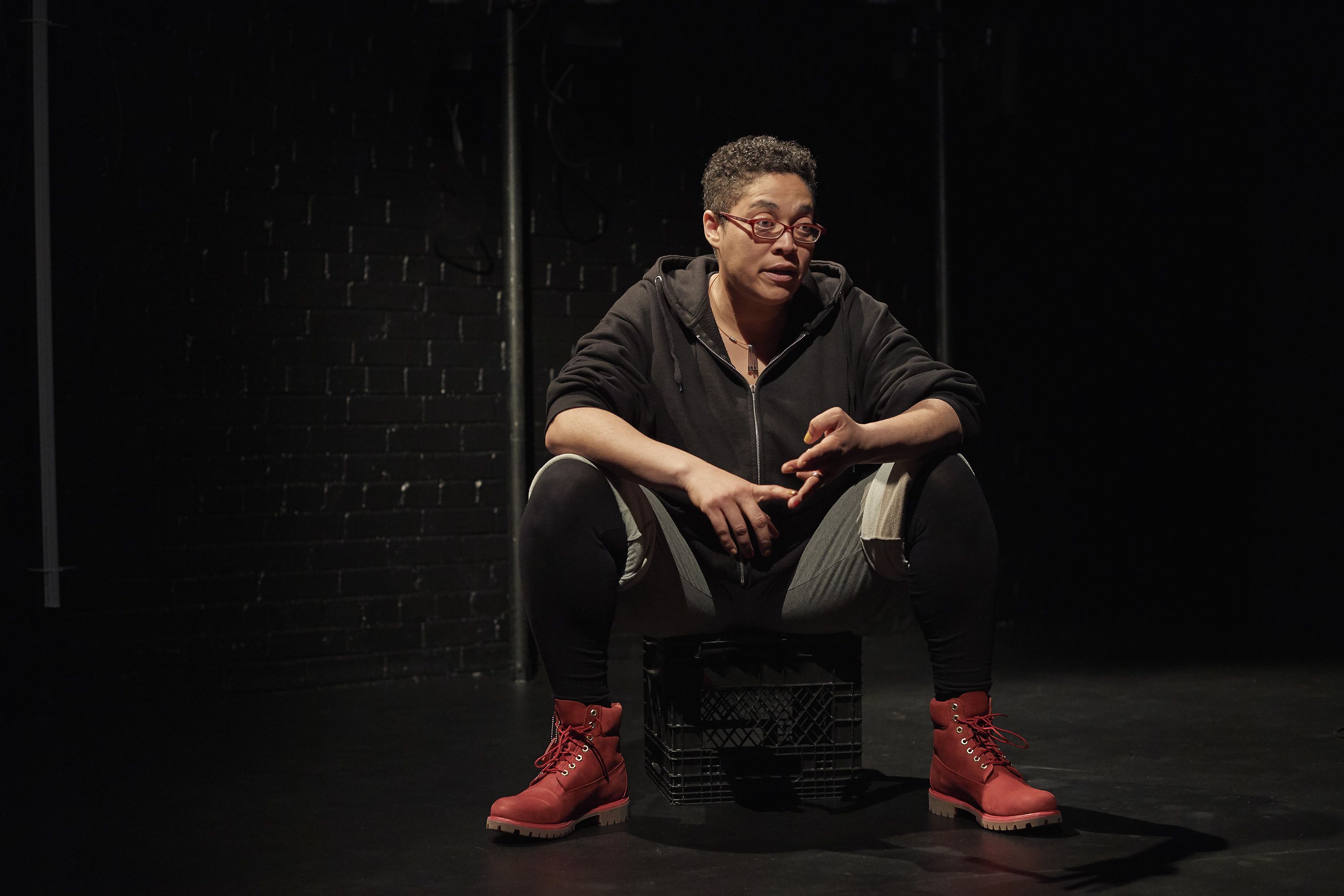
Donna-Michelle St. Bernard in the Theatre Passe Muraille production of The Sound of the Beast, 2017. Photo by Matthew Cooper.How did Forbidden come together?

Director Michael Mori and composer Afarin Mansouri started the project, and Michael invited me in and we just hit it off. It was a very collaborative process. We generated about 40 story ideas – the piece now has a number of vignettes that are stitched together – and we started out by asking what is forbidden and what interests us about the forbidden. We went with stories that both of us found most intriguing. And then talked them out. Afarin was able to describe to me scenes that she actually experienced that absolutely captivated my imagination. And I would take that back to the text and mix it with my own experience and then go back to her.

I won’t ask you what the libretto is “about,” as that’s always the hardest question, but still – what is the libretto going to be like?

We looked at questions around the management of women’s bodies, around religious restrictions, around political oppression. In the stories that we’ve chosen, the thread was rules and restrictions imposed by authority figures. I’m really interested in the conflict between the letter of the law vs. the spirit of the law. I come from a Catholic upbringing and I’d get into these arguments as a child when I was trying to understand: Why don’t we bring that homeless person to our home, mom? Well that’s not what you do, was her reply. OK, but here in the Bible… Yeah, but that’s not realistic, she’d say. What does realistic have to do with it, you told me this is absolute truth!

And as an adult I am exactly that unreasonable. If you have something that someone needs, you give it to them. I don’t understand why churches lock their doors and are gilded in gold when they can feed people instead.

So when you accept what you’ve been taught from a moral authority, and that moral authority seems to be inconsistent with what they’ve imposed on you, you have to question the teaching, you question the teacher and you have to re-orient your understanding of how the world works. That’s the territory that we’re living in. Why are things forbidden, who has the authority to forbid things, and what moral ground are they standing on – and am I following them as a matter of choice or is this somehow imposed on me? And that kind of thread runs through all of the stories in the opera.

Do all religions share a fear of the female body and the will to control it?

There are people who are drawn to leadership in those faiths who misuse the intentions of the spiritual teachings in that way. There are very few faiths with female spiritual leadership. In most faiths of which I have any experience, formal religious training happens from a male authority in a formal institution, while personal individual spiritual training happens in a home from a maternal authority. We found that to be an interesting dichotomy; institutional leadership in any faith tends to be male, but then the ongoing management of that faith tradition tends to be female-led. We are being taught to self-manage and to impose on each other rules that are not our rules; you are handed the rules and then handed a stick to keep other women in line with.

Should women not abandon all existing religious traditions, then? Why try to reform and salvage something that proscribes you?

I am very interested in Christian faiths that have women ministers. I attended a wedding once that had a woman minister officiating and I was really confused. And I have from then till now retained great disappointment in myself for how confused I was by that. Women who are fighting for leadership within the church are kind of doing it alone – women of the faith are not supporting them because we are taught not to question the religious authority. I have mixed feelings about it because as a child I thought being a nun was the greatest thing one could achieve. I really wanted that, until actually one day – I went to an all-girl Catholic school – one day a nun who was teaching there punched a student in the face. And that day I understand that being a nun would not make me a better person. That I would still be the person that I am. And that I can be the person that I am in my own clothes. And still do what I consider to be God’s work.

This is a roundabout way to say: when we think about salvaging, I think about how people who are oppressed by patriarchal structure have a desire to be absorbed into that patriarchal structure just because of the absence of alternatives – and the inability to imagine alternatives. Myself included. When I say, for example, that we should abolish prisons, that’s just obvious to me, and when people ask me then what should we do with people who break the law, all I can say is I don’t know because we haven’t been permitted the space to imagine things being any different. Maybe the institution can be salvaged, but what would it look like if we rethink the institution?

Are you in favour of the Catholic church finally allowing women to be ordained and priests to get married?

Wouldn’t that be awesome? I mean, I grew up with deacons who are married and have children and if I had a question for somebody I’d go to a deacon before a priest because I understand that they know what life is – that they’re not living in a way that’s separate and above me and at a distance from all the experiences I’m struggling with.

I guess I hope for those things, but at the same time the church has become such a political organ, and I don’t mean now with this new Pope, or with the evolution of what Islam is right now… Catholicism, and Islam, and Buddhism, it’s all becoming quite perverted in a political way and my understanding of what Christianity is is not a political Christianity. It’s so unreasonably and childishly absolute and whole. I care for everybody. I value all light. It’s hard to do, yes. That’s why it’s a goal; your spiritual life is not supposed to be easy. It’s not supposed to be, in my opinion, all about serenity. The way that the Buddhists teach that all life is a struggle, and that the struggle has a reason – yeah. Yeah. There will be poor people – give them stuff. It’s that easy to me. Yet it’s not easy. It’s simple, but nothing simplistic about it. I think that all the faiths have a valuable core. Religion is like driving or work or anything in the world – what’s wrong with it is people. And people will always be flawed, so this will always be a problem. But at the core most faiths have really valuable guidance for us. And this is not to say that if you’re atheist or agnostic, you don’t have a moral code – you do, it’s just based in something else. We all look to find things that make us our best selves.

Donna-Michelle St. Bernard (left) and Afarin MansouriLucifer too features in the Forbidden. How does that play out?

In our story, Lucifer is both the catalyst to enlightenment, and an object of pity. The central interaction is between Lucifer and a child and there’s some negotiation there. Lucifer says something I believe to be true, which is: you can’t just blindly follow this authority, you have to question things. What we’ll be seeing is a child – in my understanding, everyone’s spiritual positioning is childlike – who’s torn between the intellectual understanding that rules have to be followed, and the visceral alignment with what Lucifer is saying, You know that that guy is not always right, so why follow? Look at the world; is the world what they’ve told you?

Probably the longest conversations that I’ve had were on the nature of Lucifer. Both Afarin and I spent a lot of time looking at our respective traditions. In both cases, Lucifer has always wanted nothing but to be close to God, and my concept of how not to be allowed to be close to God is what is done to Lucifer…. I feel like western pop culture has inflated the importance and the power of Lucifer. Because it’s “juicy.” The idea that the devil wants all the souls, and evil for evil’s sake. I don’t believe in evil for evil’s sake; I believe that every villain is trying to achieve an objective, and we don’t always agree that that objective is worthy. I think that Lucifer is on this eternal punishment, and who would not be spiteful, who would not be bitter and angry in such circumstance? Who would not hurt so much that they would want to hurt everyone that they can reach?

How can I not have some compassion for that? We’re bunch of saps, I tell ya. We are a couple of soft-hearted saps, Afarin and I. But we really worked from aspects of Lucifer that are consistent between our faiths. And sort of negotiated a shared story about Lucifer. I honestly think that the devil from the movies is for people who haven’t read the Bible. If you really read the story and really look into the fallen angel concept, it’s the saddest story every told.

I don’t know if you’ve read J.M. Coetzee’s Elizabeth Costello? The title character, who’s an atheist, says something that struck a chord with me, also an atheist: evil, as a concept, survives even for the atheists. We’ve all seen it – if not in person, then in the news of war crimes, concentration camps... You don’t need an elaborate religious system; the concept remains useful, unfortunately.

Yes. There is such a thing as certain things being wrong. And if there was no God, those things would still be wrong.

But let’s return to the libretto. And the music. The opera will have Persian, Western classical and hip-hop music. Hip-hop is there thanks to you?

Yes, hip-hop is my primary artistic form. And because it’s TAP:EX, we want to experiment with form, we want to see what happens when the aesthetics collide. It’s not only a matter of rapping on opera, which is not a brand new thing, but it’s also a matter of engaging hip-hop aesthetics. We’re going to be doing something that’s probably uncomfortable for the singers - coming into rehearsals and going, like, “Switch it up!” Equally, we’ll be doing some things that are uncomfortable for the rapper. In the kind of hip-hop that I practise, you do not speak what you didn’t yourself write. And in this performance, that’s not the case. I’ll be writing rap for another emcee. In Tapestry Lib Labs, we worked on how opera is structured, and how different roles interact, and how it comes together. And then I went back home to hip-hop, and did a show where if I didn’t feel like saying a thing, I wouldn’t say that thing and would say something else instead. Now we’re trying to work in this way, with a certain amount of prepared material. And then every day – we unsettle it. Which to me is at the heart of what we’re doing: we’re unsettling both practices. And then, if possible, unsettling your entire spirit.

TAP EX: Forbidden runs February 8 to 11 at the Tapestry Opera Ernest Balmer Studio in the Distillery District, featuring Neema Bickersteth, soprano; Shirin Eskandani, mezzo; Alexander Hajek, baritone; Saye Sky, Farsi rapper/spoken-word artist; and Michael Shannon, conductor.

Lydia Perović is an arts journalist in Toronto. Send her your art-of-song news to artofsong@thewholenote.com.

Christopher Hoile, our regular opera columnist, will return to his usual spot here in March, so I will leave it to him in his upcoming column, next issue, to walk you through the fine points of the Canadian Opera Company’s just-announced 2018/2019 season.

Instead, as an enthusiastic but inexpert guest columnist, I thought it might be fun to start out by addressing myself not to the column’s usual readers, but to those of you who, either as guests to our city, or new readers of this magazine, or opera newbies might benefit from some friendly advice on how to traverse the potentially tricky terrain (both geographic and semantic) of opera in our fair town. The rest of you, who know your way around both these things, can skip ahead a few paragraphs, for what’s actually on the menu.

Rule One (Geography): Be careful what you ask for – especially if you are in a cab. You might be lucky (or unlucky) enough to get a cab driver who actually knows his way around town, in which case responding to “Where to?” with a nonchalant“The Opera House, please” could result in finding yourself 3.7km due east of your intended destination, in an old Queen St. E. venue (that is actually called The Opera House!) in a throng of 1,200 or so mostly bobbing and weaving concertgoers, listening to Avatar, The Brains & Hellzapoppin’, with Gilda and Rigoletto nowhere in sight.

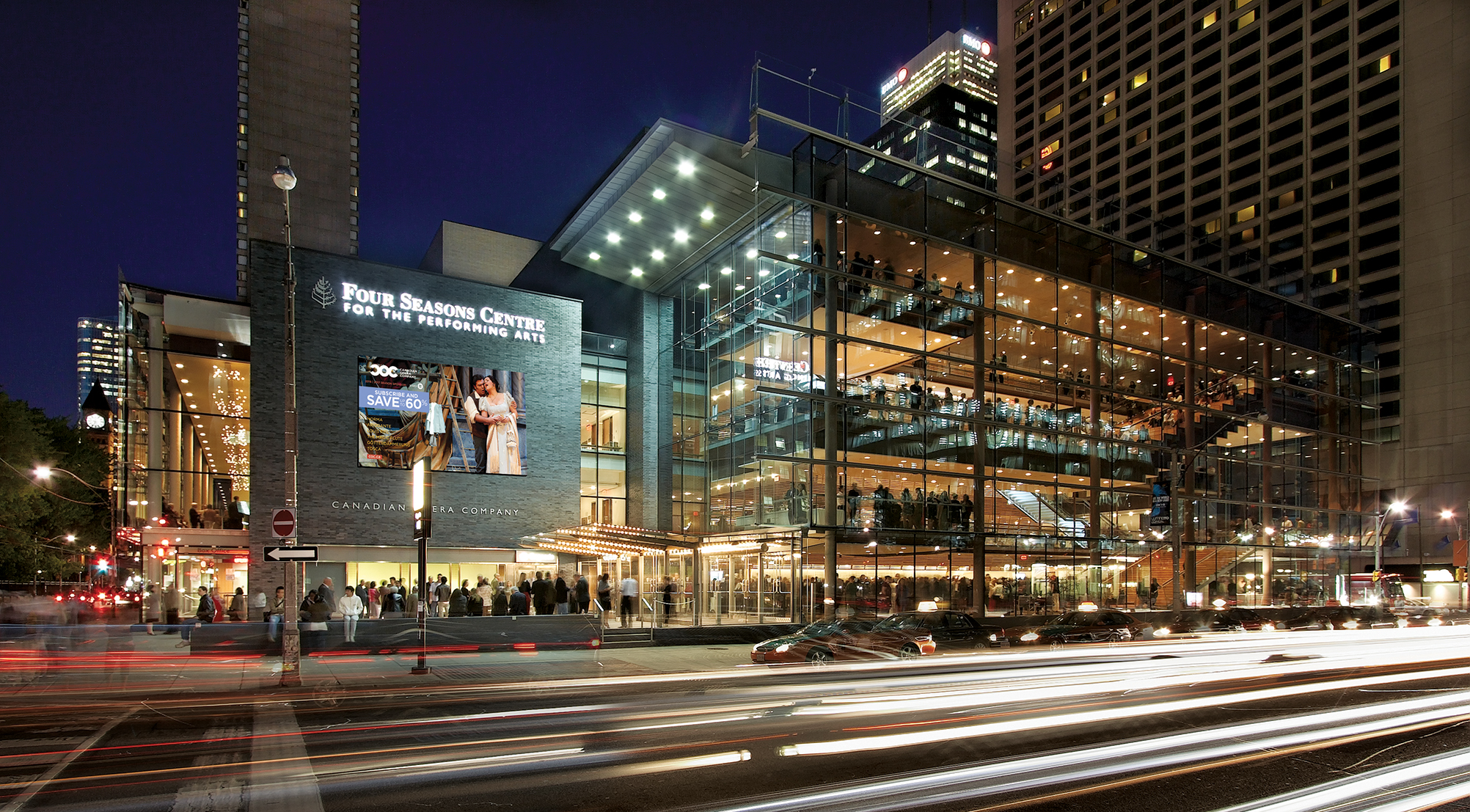
The actual opera house here is called the Four Seasons Centre for the Performing Arts (named after Vivaldi’s favourite hotel chain), and the city’s premier opera company, with typical Toronto understatement, is called the Canadian Opera Company. The COC shares the FSCPA, for performing purposes with Toronto’s premier ballet company, the equally modestly named National Ballet of Canada, otherwise known as NBoC, or “the Ballet.”

The Four Seasons Centre for the Performing Arts - Photo by Sam JavanouhRule Two (Semantics): Having established that “The Opera House” is not the opera house, let’s move on to an equally crucial distinction, this time semantics. It is this: in Toronto, expressing an interest in "the opera" does not mean the same thing as expressing an interest in "opera." The former is generally assumed by listeners to mean performances by the the city’s premier opera company in the city’s premier opera house. The latter can mean a far more nuanced range of things.

 So listen very carefully when someone tells you about their relationship to this particular art form! The distinction between “I went to the opera” and “I went to an opera” is as important as the difference between a residential address on the 200s block of Chaplin Crescent or on the 300s block, the latter being where, after that winding avenue of stately homes crosses Eglinton Avenue, it peters out in a little thicket of mostly post-World War II midrise apartment buildings.

(I also suspect, with only the slightest tinge of arts worker bitterness, that more residents of the 200 block of Chaplin Crescent would be likely to have tickets to the opera than their trans-Eglintonian 300-block counterparts.)

All that being said, within their respective genres the COC and NBoC are, without doubt, the definite article, towering like forest giants above the Torontonian cultural undergrowth, and well-worth a visit.

So, now that we’ve established what the opera means in this town, and how to get there, let’s take a little ramble instead through the city’s operatic undergrowth, where the fascinating biodiversity of the town’s actual operatic culture can be observed and measured.

Welcome to the Undergrowth: It must first be said that “forest giant” and “undergrowth” are highly unscientific terms. For one thing, calling everything other than the two or three tallest trees in town the undergrowth is a vast oversimplification. Passionate devotees of Opera Atelier are almost as likely to say “the opera” as to say “an opera” when asked where they have been. And there are other companies out there (Tapestry and Against the Grain) which at this point have the capacity to flip between mainstream finesse and indie panache almost at will. There are also theatre companies that have tall tree status within their own non-operatic realm that occasionally turn their attention to the art form (Canadian Stage Company is perhaps the most notable among these, and we'll have much more to say about them in a future issue.)

That being said, there’s a pleasantly rich tangle of operatic activity in town. Some of it, to be sure, focuses on rendering, on a smaller, more community-friendly scale, the repertoire most usually performed at “the opera” (Toronto City Opera, Opera York and Opera by Request come most readily to mind.)

And there is a uniquely Torontonian gem of a company around, called VOICEBOX: Opera in Concert, featuring top-flight performers in very lightly staged concert renditions, occasionally of new works but more often of rarities from the grand operatic tradition too risky or problematic, for one reason or another, for the forest giants to stage.

And then there is the mysterious thing called “Indie Opera.”

Indie Opera: At any given moment in time, Toronto seems to have 10 or 12 indie opera companies, on the go. Not always the same 10 or 12, mind you. Birth, decay and death are as necessary to a fertile operatic climate as they are to a good operatic plot. And even within the 10-or-12-company official membership of Indie Opera Toronto, it doesn’t do to generalize as to individual companies’ stated purposes.

Loose Tea Music Theatre, for example, is currently investing significant time and passion in a third-Sunday-of-every-month residency at Bad Dog Comedy Theatre on Bloor near Ossington (their next show is February 18), with a madcap improvised show called “Whose Opera Is It Anyway?” Under the inspired co-direction of Loose Tea artistic director Alaina Viau and comedy improv heavyweight Carly Heffernan, Loose Tea’s core ensemble has been steeping themselves in the standard games and structures that are the meat and potatoes of comedy improv. It’s a win-win-win. The show is a delight for fans of opera and of improv alike. And the ensemble itself is learning the conspicuous bravery of actually listening affirmatively to each other and responding truthfully in the moment – attributes that will stand them in good stead as they re-engage down the line with projects with the social and artistic heft of their 2016 Carmen.

Meanwhile, Essential Opera, another indie stalwart, is working towards an April 22 concert performance with Orchestra Toronto of Puccini’s Gianni Schicchi, an exercise in cross-genre audience building and in carrying forward the key message inherent in the company name -- namely that the essence of opera is something different than its trappings and machinery.

What these two companies, and everything in between, have in common is that at some point in their gestation some individual or individuals said “If we are going to ever get to do operatically what we are interested in, we are going to have to do it ourselves.”

As already mentioned, you can get a rough idea of the players in the indie opera undergrowth by visiting indieoperatoronto.ca. But again, a cautionary note: like its member companies are, or were, Indie Opera Toronto has sprouted from do-it-yourself, volunteer-driven roots. So the information on the website is best viewed as a snapshot of the scene, compiled at a particular moment rather than chapter and verse. It nevertheless offers a way to delve deeper into projects and plans of the companies listed there, but it sometimes takes the site a while to catch up with the scene.

The Electric Bond Opera Ensemble

Soprano Sara Schabas' newly created Electric Bond Opera Ensemble is definitely the new kid on the indie opera block, but Schabas herself is not, having grown up in the world of “the opera.” So she comes to this project with a deeply rooted, organic passion for the storytelling power of the medium. Her grandfather, Ezra Schabas, among other musical achievements, was head of the University of Toronto Faculty of Music performance and opera department from 1968 to 1978, where Sara Schabas herself went on to complete an undergraduate degree in vocal performance. “Dad was a french horn player before he became a lawyer,” she explains, “and both my parents and all my grandparents had a huge love for opera. Starting at age four, they’d put on a VHS of La Boheme, Act 1 for me. I’d listen to Saturday Afternoon at the Opera every week. I was that weird kid who loved opera from a very young age. So it’s always been a very natural thing for me.”

Sara SchabasThe ensemble's name, she tells me, is a quote from Thomas Huxley, the agnostic 19th-century British biologist, nicknamed “Darwin’s Bulldog.” “We aim to present classical and operatic works that tell untold stories, reminding audiences and performers of what Huxley called the ‘electric bond of being’ by which all people are united.”

The company’s first show dives headlong into the company's stated aims – a fully staged, Canadian premiere performance, on February 10 and 11, of “ two one-act operas of survival,” Another Sunrise​ and ​Farewell, Auschwitz, by U.S. composer Jake Heggie and librettist Gene Scheer – partners in operatic crime for Moby-Dick (2010) and the more recent It's a Wonderful Life which premiered at Houston Grand Opera in 2016.

The Toronto Another Sunrise​ and ​Farewell, Auschwitz will take place in Beth Tzedec Congregation’s Herman Hall on Bathurst Street and will represent, at several different levels, a journey of return for Schabas. We chatted briefly in The WholeNote offices.

WholeNote: So how did you discover Heggie?

Schabas: After undergrad at U of T, I went to Chicago College of Performing Arts at Roosevelt University for a master's, and from there into an internship with Dayton Opera Company. I was one of their artists-in-residence and Jake Heggie actually came and did a short residency with us – so we put on a concert of his works that he narrated and coached us on. And then we also did Dead Man Walking [Heggie’s first big hit, in 2000, with librettist Terrence McNally]. Getting to know him and hearing the personal stories behind each of his works really drew me in, as well as the visceral reaction we got from audiences in all those performances. So when I heard he had this Holocaust one-act/two-act opera I thought it would be a really interesting experience for me not only to perform more of his works but to explore my heritage through an art form that doesn’t often explore Jewish stories.”

So which was the chicken and which was the egg? You wanted to do this particular opera so you decided to do it yourself? Or you wanted to do your own thing, and this was a perfect fit?

Well, moving back from the States after my student visa expired it took a bit to re-establish myself within the community. So, like many other singers, I started producing my own concerts, and I did a lot of refugee fundraising recitals – three of them when I moved back – as well as some other volunteer work. I knew I wanted to produce my own work with this specific social-justice-oriented angle. This piece was already there as a side passion project, and it fit perfectly.

Right now I’m guessing you are in the DIY thick of things …

Exactly right. When you’re in do-it-yourself mode you’re doing your own press releases, you’re pulling together the partners and in the middle of all of it you’re learning the music and all the rest of it.

So who is the actual artistic team you've assembled? The ones who are going to force you to take off your producer’s hat when you’re on the stage? Who had you already worked with?

SS: Yeah – well Michael Shannon, our music director, I worked with earlier this year at Tapestry Opera for Bandits in the Valley. I played Henri, which was both a piano-playing and a singing character. So Michael Shannon and I got quite close because he had to help me a lot with the piano, which is not something I’ve studied extensively, and he was just such a vibrant strong leader in that experience and in the other performances that I’ve seen him in that I thought he would be a perfect person to take the helm on this project. And Aaron Willis I’ve actually never worked with before ...

Aaron is …?

He’s the director – I’ve worked with his wife, Julie Tepperman, who was the librettist for Bandits in the Valley so we did a lot of talking about our shared Jewish heritage and I initially actually reached out to her to see if she’d be interested in directing. She she said she wasn't, but her husband would be. He has never directed an opera by himself before – he assisted with Julie last year at Canadian Stage – but he’s a very interesting director: he’s done a lot of immersive theatre, some of which also has a Jewish angle. He has this one famous play called The Yehud which is a comedy about two Orthodox Jews and what happens right after they get married – there’s the yehud room. The opportunity for me taking on this really meaty acting role to work with someone – he also has a background as an actor – with a strong theatrical background was a priority. So some old, some new ...

You say it's a meaty role? Does that tie in with the “untold stories” goal you talked about?

Krystyna Zywulska is a very interesting story because she’s someone who actually hid her Jewish identity: when she was in the Warsaw ghetto she created this new identity, and when she was imprisoned at Auschwitz it wasn’t as a Jew it was as a political prisoner; her story is one of reconciling with the terrible thing she did to her fellow Jews, and then finding out if her past can exist with her present …

So how to embrace the dichotomy ...

Absolutely. So hers is a very conflicted Holocaust story and a very rich one.

And the partnership with Beth Tzedec and with the Azrieli Foundation. How does all that happen?

Well – since moving back I’ve been doing a lot of singing in synagogues, so I’ve been a member of the choir at Beth Tzedec and they’re very interested in presenting survivors’ testimonies in different ways so basically I pitched the opera to them and they were interested. Azrieli also happened to be interested ...

How did you know about Azrieli?

That was a bit of an aha moment: I was at the Canadian Children's Opera Company's Brundibár last year, for which I know they also received help from the Azrieli foundation. So then I started looking them up ...

So, getting back to the show itself, what’s the breakdown of instruments?

It’s piano, clarinet, violin, cello and bass.

Sounds like almost a klezmer feel to it.

Yeah, the clarinet voice definitely has that feel. It has this certain chant-like melody that occurs throughout the piece and I was just remarking to Michael Shannon on how Jewish it sounds at times.

So how did you find the other singers?

Again, recommendations – I sang with Sean Watson in the Beth Shalom choir and Georgia Burashko I’ve just heard wonderful things about and she was very interested.

Any other projects already in the works? Do you dare wait to get the next thing going?

Yeah ... there are some ideas floating out there ... my friend Jacques Arsenault who’s a tenor and accordion player – also from Bandits in the Valley – and a couple of other friends and I are working on a potential Satie program for next year but we’re still finding the social justice, untold-story lens for that. He was a bit of an outcast in his lifetime – Satie – and he also has a lot of interesting dichotomies in his life between his cabaret works and his more formal works so we’re looking to put together a program about that. That’s the main thing right now. But it’s true – once you do one you have to start thinking about the next

Even while you're still doing the one ...otherwise you're stuck in the middle ...

Yeah – and then you miss out.

David Perlman can be reached at publisher@thewholenote.com.

The winter music theatre season is off to a great start with Tarragon Theatre’s exhilarating experimental rock-‘n’-roll-scored Hamlet showcasing some of the city’s most versatile theatre and music performers led by a sympathetic and passionate Noah Reid as Hamlet. The score itself, under the guiding hand of music director Thomas Ryder Payne – is this a first? – is composed and arranged by the ensemble, and played by them, in varying combinations, in between acting their Shakespeare roles.

On the more traditional musical theatre side, Podium Concert Productions gave us a chance to see a concert staging of Maury Yeston’s Nine (the Tony Award-winning musical based on Fellini’s famous autobiographical film 8 1/2) starring Stratford veteran, triple threat Juan Chioran, at Trinity St Paul’s Centre. I have to say, this is not one of my favourite musicals as I find the book and some of the songs weak, but it can be a great showcase for a talented cast and that was the case here. Surrounding Chioran in the central role of Guido Contini, world-famous film director, were some of the country’s best female musical theatre performers in the other leading roles. Tracy Michailidis, who was so strong in Britta Johnson’s Life After last fall, again brought her exquisite subtlety of emotion to the important underpinning role of Contini’s wife Luisa. Against this strong centre those in the more eccentric or extravagant roles could let rip, notably Kira Guloien as Guido’s mistress Carla, stunning in a slinky green dress, singing and acting seductively just over-the-top enough to satisfy; Rebecca Poff as Liliane La Feur, very demanding, deliciously dramatic and very French as Guido’s film producer; and Alexis Gordon, in contrast to the last two, projecting a yearning sweetness and reluctant strength as Guido’s muse Claudia Nardi. The only real drawback to the evening was the very uneven sound, with quieter lyrics sometimes hard to hear from the balcony over the volume of the orchestra onstage. Perhaps another venue with a different or more elaborate sound system would be better for projects like this as opposed to TSP’s, which is designed for its usual – less wired – tenants Tafelmusik and the Toronto Consort.

At the Mirvish theatres, alongside large-scale traditional and rock musicals, a growing importance and presence of musical scoring for otherwise straight theatre productions could be seen. This year already, two in particular stood out for me.

North by Northwest (adapted by Carolyn Burns and directed by Simon Phillips) used much of Bernard Herrmann’s original film score in the soundscape created by composer Ian MacDonald as an essential tool to pull the audience into the – admittedly rather odd and rather tongue-in-cheek – experience of seeing this famous Hitchock thriller recreated live onstage before our eyes.

In Marianne Elliott’s deservedly award-winning production of The Curious Incident of the Dog in the Night-Time (adapted by Simon Stephens from Mark Haddon’s acclaimed novel) the potentially overwhelming technological ingenuity of the set and effects was balanced by a constantly present sympathetic musical score by Adrian Sutton to project the very simple heartfelt and very human story at the centre.

Looking ahead, coming up in the current Mirvish season is a musical I am dying to see as, like many others in the city, I couldn’t get a ticket during its first run back in the fall of 2016 since it sold out much too quickly, though I have since listened to the songs and loved them.

Come From Away, famously based on the true story of the tiny community of Gander, Newfoundland, that took in the stranded passengers of 38 planes forced to land there on the day of 9/11, was a runaway hit in 2016 at the Royal Alex and has since triumphed on Broadway to the tune of seven Tony nominations (winning Best Direction of a Musical for director Christopher Ashley) and many other Best Musical awards. This month it returns to the Royal Alex with a new all-Canadian cast while the original production continues in an open-ended run on Broadway.

Eliza Jane Scott in Come From Away - Canadian cast 2018. Photo by Matthew Murphy.Unlike The Drowsy Chaperone, another Canadian hit that triumphed on Broadway in 2006, Come From Away did not start at the Fringe but from a suggestion by Michael Rubinoff of Sheridan College’s Music Theatre Program to husband and wife co-creators Irene Sankoff and David Hein in 2010. That suggestion did follow, however, the great success at the Toronto Fringe in 2009 of their first musical My Mother’s Lesbian Jewish Wiccan Wedding and likely was inspired by that musical’s folk-music inspired score and staging style that included talking directly to the audience; two characteristics also of Come From Away.

With lucky timing and a Canada Council grant, Hein and Sankoff were able to go to Gander in September 2011 when not only the residents would be there to be interviewed, but also many, if not all, the “come from aways” – the passengers who had been unexpected guests on that day in 2001 – were visiting to commemorate the tenth anniversary of their meeting.

The show grew from the stories Sankoff and Hein heard and the people they met. It then began a five-year development process with workshops and performances at Sheridan College’s Canadian Music Theatre Project followed by further development south of the border that led to its 2015 debut as a full-fledged production directed by Christopher Ashley at La Jolla Playhouse in California and the Seattle Repertory Theatre. Pre-Broadway runs followed in Washington and here in Toronto before the Broadway opening on March 12, 2017. All along the journey Come From Away garnered praise and followers and awards including many Best Musical nods, and even a Twitter shout-out from Hamilton‘s Lin-Manuel Miranda. Now a North American touring company is being put together, the original cast album (recorded in Toronto) has been nominated for a Grammy and a feature film is being made, written by the show’s creators.

As I write this column the new Canadian company of Come From Away is in Winnipeg performing a sold-out run at the Manitoba Theatre Centre until February 3 before returning to Toronto to prepare for the run here.

Leading up to the second first-night at the Royal Alex on February 13, I wanted to touch base with Irene Sankoff and David Hein to ask a few questions about this new stage of their incredible journey.

WN: How does it feel to be coming home after the huge success you have had with the show on Broadway, particularly when the show had it’s first beginnings here at Sheridan College and then the sold-out run at the Royal Alex last year?

IS: It’s practically unbelievable. When we started at Sheridan – and even at the Royal Alex – there’s no way we could have had any idea how far this would go. We originally hoped it might play in Canadian high schools because it had historical content and many characters, and now to have it playing in two countries every night, it’s beyond our wildest dreams – but it is such a testament to the power of the story that we’re telling. That’s what we fell in love with in the first place and it’s thrilling to see so many others feel the same way.

DH: As a kid who grew up on Canadian folk music, there’s something really exciting about seeing this story and these traditional instruments brought back and celebrated by a Canadian cast – especially in the town where we were first started. It means the world to share it with the community that supported us while we were obsessed with telling this story and following every opportunity that came our way.

Irene Sankoff and David Hein. Photo by Sankoff and Hein.WN: I understand you have an all-Canadian cast for this remount, which is exciting. Did you find that you looked for different qualities – or did you discover different casting possibilities in the process this time around?

DH: Many of these performers we’ve either worked with before or have admired their work – some were new to us. It’s such a joy watching them create and invent it again. Chris Ashley, our director, really let the cast work through it organically.

IS: When we first cast the show, we all agreed that we weren’t looking for dopplegangers of the real people – and when we cast it in Canada again, we weren’t looking for copies of the Broadway cast. What’s so exciting, within this intricately detailed and blocked-out show, is how much interpretation each actor can bring. That, and apparently their Newfoundland accents are a little better.

WN: Is there anything else new or different in the show compared to the original production that we can expect? I understand that there is at least one new song.

IS: There is! As we were leaving the Royal Alex, we recorded the cast album in the last week. (I think it’s the only Grammy-nominated Original Broadway Cast Album recorded in Canada.) Chris had been asking us for another song for one of the characters since La Jolla Playhouse two years earlier, but we didn’t feel like we had a real way in to that character until a couple weeks prior to recording when we spent an afternoon with her and her family. Suddenly this new song appeared, about a mother being far away from her son. It was recorded for the album before it was ever put in front of an audience, which was risky.

DH: And yet now – we can’t imagine the show without it! It feels like we’ve made a million tiny changes, right up to opening night – but in so many ways it’s the same true stories which made us laugh and cry and cheer out, in Newfoundland – and it’s so wonderful to return to celebrate everything that’s happened on this crazy journey.

Performances of Come From Away begin at the Royal Alexandra Theatre on February 13.

QUICK PICKS

Feb 1 to 11: Richard Rose’s exhilarating rock-‘n’-roll-scored Hamlet continues at Tarragon Theatre.

Feb 1 to 4: St Anne’s Music and Dramatic Society presents the wonderful and too rarely seen Gilbert & Sulivan Ruddigore.

Feb 4 to 25: Coal Mine Theatre presents Rumours, by Fleetwood Mac, not a musical but a recreation in concert of the well-known and beloved Fleetwood Mac album by a chosen group of Toronto musicians.

Feb 9 to 22: Soulpepper continues its hybrid concert/storytelling series with a spotlight on the Roaring 20s with Prohibition, the Concert, created by Richard Ouzounian, Gregory Prest and Mike Ross.

Feb 15: Opera Atelier recreates the concert they performed in the Royal Chapel of the Palace of Versailles last May. Transforming the concert into a moving dance/music theatre hybrid event is the inclusion and integration of the lyrical and moving new contemporary dance piece choreographed and danced by Tyler Gledhill to an evocative solo violin score composed and played by Edwin Huizinga. One Night Only.

Feb 22-24: Canadian Stage continues its showcase of original and groundbreaking music makers with Musica Nuda featuring vocalist Petra Magoni and double-bassist Ferruccio Spinetti. Not a musical but apparently dramatic and deconstructing performance.

Feb 26: “How to Succeed in Musical Theatre Business Without Really Trying,” hosted by the The Musical Stage Company. This one-day event will be held at the Al Green Theatre in Toronto and is free of charge for Canadian musical theatre writers.

Toronto-based “lifelong theatre person” Jennifer (Jenny) Parr works as a director, fight director, stage manager and coach, and is equally crazy about movies and musicals.
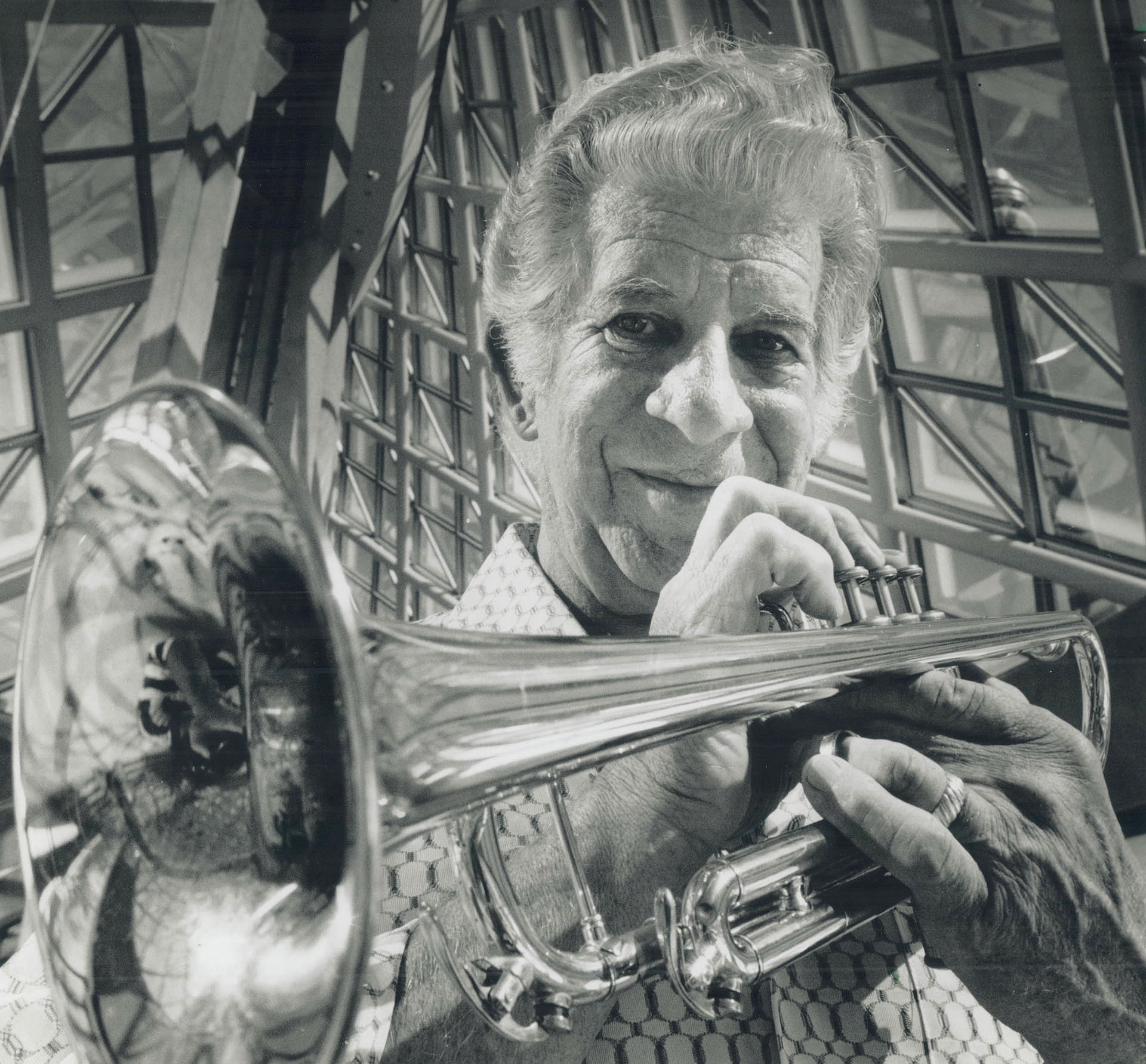
There are some big and unique choral experiences this month. There’s a celebration of the 50th anniversary of Healey Willan’s death, the combined forces of choirs from the University of Toronto and York University, a rare performance premiere for Tafelmusik and a new interpretation of Bach’s St Matthew Passion! We’ll return in March with all you need to know about the best of Easter choral music offerings. Stay warm and singing in the meantime.

Willan - 50 years on

Andrew Adair, music director of the Church of St. Mary Magdalene, convenes artists to celebrate the 50th anniversary of Willan’s death. Of choral composers in Canada, Willan was a pinnacle. With hundreds of choral works, operas, symphonies and organ works amongst many others, Willan’s main contribution to Canadian music was through sacred music, much of it created at and for the choir at St Mary Magdalene, where he was music director and organist.

“Willan left a lasting impact on the Church of St. Mary Magdalene through his shaping of the liturgy and music,” shares Adair. “His work at St. Mary Magdalene’s created a very special environment, one which has allowed the music to flourish and survive against all odds.” A lot of Willan’s choral music is a cappella. Adair shares that this is because of the layout of St Mary Magdalene where the choir loft is in the west gallery and the organ on the other side of the building. For a music director who was also the organist, this meant Willan was unable to play and conduct at the same time. This lasting effect means that even today, the choir at St. Mary Magdalene still mostly sings a cappella. Adair looks forward to bringing forward Willan’s accompanied works at this concert.

Adair is joined by organists Simon Walker and Matthew Larkin, each performing one of Willan’s great organ works: the Introduction, Passacaglia and Fugue in E-flat Minor; Prelude and Fugue in C Minor; and the Passacaglia and Fugue in E Minor. Matthew Larkin’s choir of Saint Thomas’s Anglican Church will join the Choir of St Mary Magdalene. February 16 at 8pm; Church of St. Mary Magdalene, Toronto.

The Mozart Requiem: The Music of Unity

With the rich history, detail, and artistry available to students in Toronto, I’m excited to see inter-university programming. I’m particularly interested in the joint events between Lisette Canton and Daniel Taylor and the combination of ensembles from York University and the University of Toronto, a model for future collaborations.

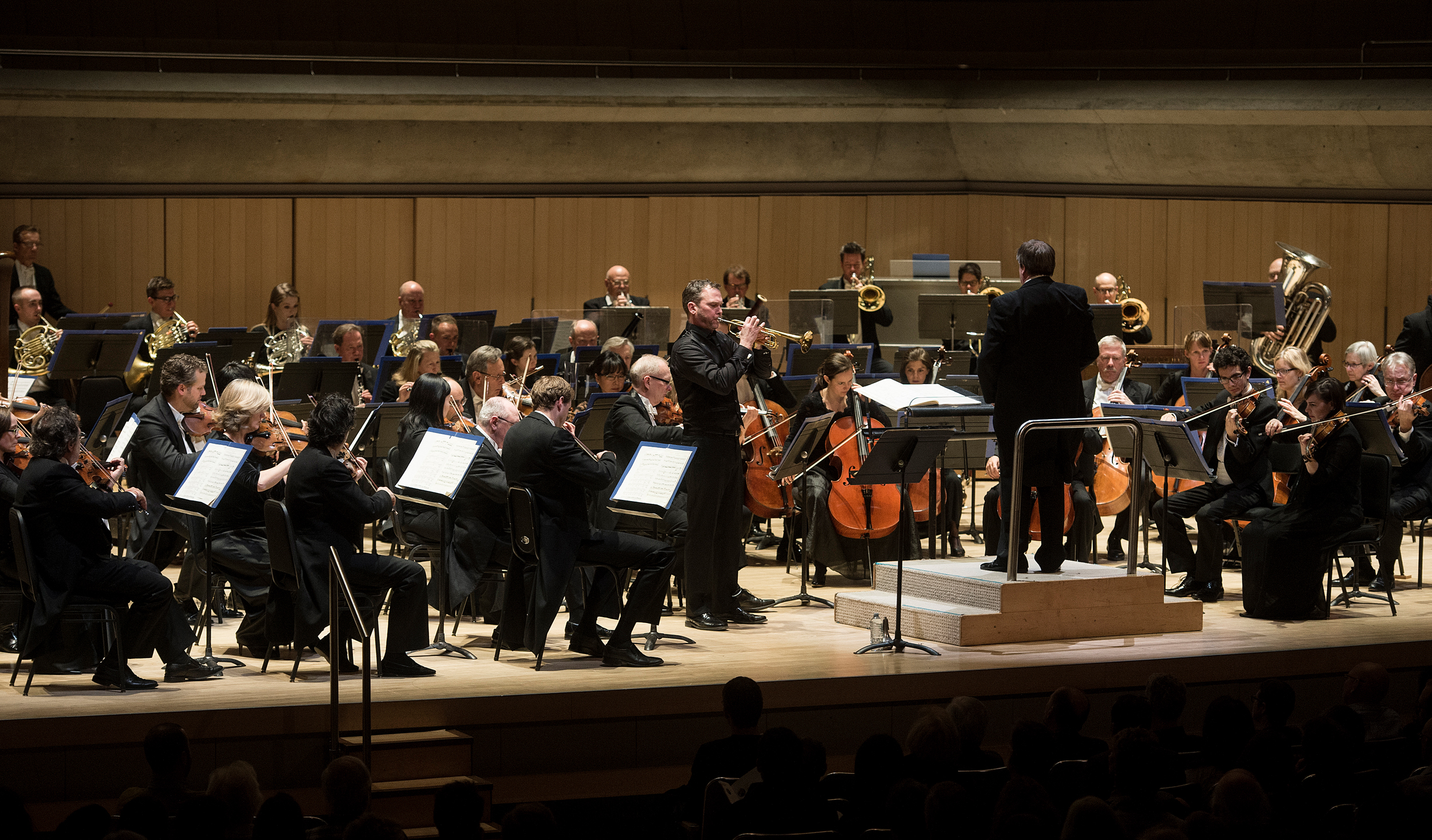
Lisette CantonCanton’s ensembles, the York University Chamber Choir and Ottawa Bach Choir, are joining forces with Daniel Taylor’s musicians at the University of Toronto Schola Cantorum and the Theatre of Early Music. Along with an orchestra made up of Tafelmusik performers and soloists, the combined forces will perform two performances of Mozart’s Requiem.

“Dan Taylor and I have a similar philosophy on music,” Canton shares, “that it carries a universal message of hope, transcending all religions and cultures, and unites us all. And it is this philosophy that has prompted us to collaborate on various musical productions for the past two decades.” Through their longstanding connection, Canton and Taylor brought their ensembles together in 2014, performing the music of the Coronation of King George II in 1727 (the coronation that established Handel’s Zadok the Priest as a standard at every coronation since.)

 “Collaborations of this nature are so important – for the students, professionals and for the community – in that they unite us in a common musical goal and become bigger than the sum of the individual parts. And when the music is as powerful as the Mozart Requiem, these become life-changing experiences,” says Canton. Choristers and instrumentalists alike have long known the unique power of the Mozart Requiem. While incomplete, the experience of performing the work can be incredibly significant. “Mozart’s beloved Requiem is one of those works in the choral canon that continues to inspire every generation,” Canton says. “Its widespread ability to reach to the depths of human emotions on this most universal theme makes it a timeless work of dramatic and spiritual intensity that moves us to greater depths of understanding.” Many choirs perform this work in full or portions of it frequently. For many musicians, it has become musical vernacular.

York University Chamber Choir“Once the students graduate – especially in a city as large as Toronto – they will continue to work together in common settings, ensembles, and as soloists,” Canton says. The nature of music requires collaborations, sometimes wonderful and transcendent, other times a bit messy – but necessary to the task of musical creation. She continues: “Our job as mentors/conductors is to initiate these contacts and guide up-and-coming performers in meaningful concert experiences, as well as to help them find potential opportunities and career directions. Beginning these connections during their university experience only ignites their passion for the art of music and helps them to forge significant friendships and professional connections.”

The Mozart Requiem: conducted by Dr. Lisette Canton: March 3, 7:30pm. Church of the Redeemer, Toronto; conducted by Daniel Taylor: March 4, 7:30pm. 7:30pm. St Basil’s Church, Toronto.

A Rare Premiere Performance by Tafelmusik

Tafelmusik has a Handel premiere: Alexander’s Feast, or the Power of Music. This old set of music by Handel was set to words by Newburgh Hamilton based on an earlier text from John Dryden. Ivars Taurins leads the orchestra and Chamber Choir in a performance of this work celebrating Alexander the Great’s conquest of the great Persian city of Persepolis. Charlotte Nediger tells us that the original performance was done to coincide with the feast day of St Cecilia, the patron saint of music. “The aim of St. Cecilia odes is to celebrate music,” says Nediger in the program notes, “and it is evident here in the range of orchestrations in the airs and choruses, and by the inclusion of two concertos – one for harp, representing Timotheus’ lyre, and one for organ, representing “the divine Cecilia.” With soprano Amanda Forsythe, tenor Thomas Hobbs, baritone Alexander Dobson, harpist Julia Seager-Scott and organist Charlotte Nediger. The work includes the well-known Concerto for Organ in G Minor and the Concerto for Harp in B-flat Major. February 22 to 24, 8pm; February 25, 3:30pm. Koerner Hall, Toronto.

Evoking the Passion – Bach Reinterpreted

Chorus Niagara, under Robert Cooper, takes on Bach’s St. Matthew Passion. Everything about this performance sounds intriguing. Not only is the Passion a large work, with two orchestras, six soloists, children’s and adult choir, Cooper is leading a semi-staged production. “More and more, choral performances are wanting and needing some extra musical design to guide you through the experiences,” shares Cooper, who has a theatre background himself. Cooper has worked with Joel Ivany on other stagings of works normally done in straight performance. The staging will be set by Torontonian Aria Umezawa, who is currently an Adler Fellow at the San Francisco Opera in direction and is the artistic director of Opera 5. It will be interesting to see how Umezawa’s contributions reflect her mentorship by Peter Sellars; Sellars famously staged a Berlin Philharmoniker performance of the St. Matthew Passion in 2010.

Robert Cooper conducts Chorus Niagara and the Chorus Niagara Children’s Choir with the Talisker Players; James McClean as the Evangelist; Michal Robert-Broder as Christus; Maeve Palmer, soprano; Lillian Brooks, mezzo-soprano; Zach Finkelstein; and Stephen Hegedus, bass. March 3, 7:30pm. FirstOntario Performing Arts Centre, St Catharines.

QUICK PICKS

Feb 10, 7:30pm. The Grand Philharmonic Choir presents Gloria, a presentation of Leonard Bernstein’s challenging Chichester Psalms, Poulenc’s Gloria, and Timothy Corlis’s Psalm 150. St Peter’s Lutheran Church, Kitchener.

Feb 11, 2:30pm. Georgian Music is hosting Dr Hilary Apfelstadt and the Exultate Chamber Singers. Apfelstadt, a champion of Canadian choral music, has programmed works by Canadians Healey Willan, Eleanor Daley, Ruth Watson Henderson and Stephen Chatman. The Choir will also perform Mozart’s Ave Verum Corpus and Eric Whitacre’s Five Hebrew Love Songs. Grace United Church, Barrie.

Feb 16 and 17. The Kitchener-Waterloo Symphony Orchestra presents “Sing-Along Musicals,” a fun family concert. With classic selections from The King and I, Oklahoma!, the Sound of Music and Mary Poppins just to name a few, the Grand Philharmonic Youth Choir will provide the vocals. Bring the family and have a fun time singing along at the Centre in the Square, Kitchener.

Feb 25, 4pm. The Toronto Children’s Chorus presents “Rainbows and Icicles.” With special guests, the Claude Watson School of the Arts Boy’s Choir, the various TCC choirs will perform beloved songs from films and musicals like Mary Poppins, the Muppets and the Aristocrats. North Toronto Collegiate, Toronto.

Mar 3, 7:00pm. The Mississauga Festival Chamber Choir presents “Phantom Unmasked.” The 1925 Phantom of the Opera was made as a silent film. Andrew Downing, a Canadian composer, has set it to music for orchestra and choir. Quite a few choirs have performed this work as it proves popular with audiences. The Mississauga Festival Chamber Choir performs and is collecting non-perishable food donations. RBC Theatre, Living Arts Centre, Mississauga.

Mar 6 and 7, 7:30pm. The Toronto Mendelssohn Choir presents “MacMillan and Pärt.” Two years ago Soundstreams hosted Scottish composer James MacMillan in Toronto as part of its mainstage. Macmillan himself took the helm in a presentation of his masterpiece Seven Last Words from the Cross. Noel Edison, artistic director of the choir brings this work to life with a smaller contingent of singers. The choir in full performs Arvo Pärt’s Berliner Messe. Pärt’s unique meditative music will wash over interested audiences. Church of the Holy Trinity, Toronto. clip_image001.png

Follow Brian on Twitter @bfchang Send info/media/tips to choralscene@thewholenote.com

Since the last issue of The WholeNote went to press, the jazz world suffered the deaths of three major and long-term contributors: producer George Avakian, innovative singer Jon Hendricks – both on November 22 – and on December 21, trombonist Roswell Rudd. Momentous losses indeed, but at least these blows were softened by the realization that each of them lived long, productive lives – Avakian was 98, Hendricks, 96, and Rudd, 83.

I had a mild heart attack on the morning of November 23 and the subsequent fallout took me out of my routines and away from the jazz grapevine, so I completely missed the passing of Avakian and Hendricks and it was some time before I heard the news. And Rudd’s death came amid the hustle and bustle of Christmas preparations, so I was late hearing about that too. Given all this and the significant contributions each made to jazz, I feel it’s only right to use this space to pay tribute to them.

George AvakianAvakian became an obsessive jazz fan listening to the radio as a teenager and while attending Yale University began to amass a huge record collection and to write a relentless series of letters to the Decca and ARC record labels, urging them to reissue the back catalogues of bankrupt imprints such as Brunswick and Okeh. In 1940 Jack Kapp of Decca responded to these letters and hired the young Avakian to produce his first record, Chicago Jazz, featuring Eddie Condon and musicians in his circle. Consisting of six 78s issued in a set with Avakian’s copiously detailed liner notes, this was considered the first jazz album long before the emergence of the LP. It was a success in every way and set the tone for future Avakian projects while also raising the bar for jazz releases in general.

George Avakian - photo by Ian CliffordThe rest, as they say, is history – jazz history. CBS acquired ARC in 1940 and decided to form a subsidiary called Columbia Records. Eventually they asked Avakian to supervise a reissue series and the young man leapt at the chance to comb through the company’s vaults. Using the format he established at Decca, he created box sets devoted to Louis Armstrong, Bix Beiderbecke, Fletcher Henderson, Bessie Smith and Billie Holiday, among others. In the process he discovered many unreleased sides, including some priceless Armstrong Hot Fives and Hot Sevens, which he included in the reissues.

After war service he returned to Columbia, responsible for popular music at large, but always with an eye toward strengthening and promoting the label’s jazz roster. During this time Columbia perfected the LP format and Avakian was immediately alive to the possibilities of exploiting this new technology for both marketing and artistic purposes. He brought Erroll Garner, Dave Brubeck and Miles Davis to the label just as each was set to become a star, while continuing to produce albums by Armstrong, Gerry Mulligan, Art Blakey, Tony Bennett, Buck Clayton (he co-produced the trumpeter’s legendary Jam Session LPs with John Hammond), Eddie Condon, J.J. Johnson and many others including classical and folk performers.

He also became a pioneer in live jazz recording, issuing many performances from the Newport Jazz Festival and other venues. He supervised the first issue of Benny Goodman’s historic 1938 Carnegie Hall concert and also Duke Ellington’s legendary 1956 Newport performance, which did so much to revive Ellington’s career. His tenure at Columbia was studded with too many masterpieces to mention, but highlights would include Louis Armstrong Plays W.C. Handy and Satch Plays Fats; Erroll Garner’s Concert By the Sea; such Miles Davis classics as ’Round About Midnight and Miles Ahead; many by Brubeck such as Jazz Goes To College and Jazz Red Hot And Cool, as well as the aforementioned classics.

He elected to leave Columbia in 1958, but was hardly done. He created the record label at Warner Brothers and soon after moved on to RCA where he produced Sonny Rollins’ celebrated comeback album The Bridge, as well as his notable encounter with Coleman Hawkins, Sonny Meets Hawk. While there he also produced a superb series of Paul Desmond records with Jim Hall, which did a lot to cement Desmond’s identity apart from Brubeck.

Avakian also branched out into artist management at this point, overseeing the phenomenal mid-60s success of the Charles Lloyd Quartet at a time when many jazz artists were feeling the pinch of rock ‘n’ roll. This brought Avakian into contact with Keith Jarrett and he shepherded the pianist through the early part of his career as both his manager and record producer, helping to launch one of the most influential and successful careers jazz has witnessed in the last half century. There’s much more, but enough. Suffice it to say that it’s impossible to overstate the positive impact that George Avakian had on jazz, or to imagine it without him.

Jon HendricksEddie Jefferson and King Pleasure are generally credited with inventing modern, bebop vocalese – the practice of putting lyrics to an instrumental jazz solo and singing it, a kind of scat with words. But Jon Hendricks took the idea and ran with it, making it more popular while broadening its horizons and raising its vocal and literary (i.e. lyric writing) standards. And with the formation of Lambert, Hendricks & Ross in 1957, for which he is best known, he translated it into a vocal group art. L, H & R remade the idea of the vocal group – they weren’t The Modernaires or The Four Freshmen or The Four Lads – they were funnier, rawer and swung more. They were hip, baby.

Jon Hendricks on his 90th birthdayDave Lamberts and Annie Ross were both formidable vocal talents and ideal partners, but Hendricks was the driving force behind the group both organizationally and musically, doing most of the arranging and the lion’s share of the ingenious lyric writing. His skill at this was unsurpassed, earning him the title “The Poet Laureate of Jazz” as well as the “James Joyce of Jive”. He had an uncanny gift for shaping and infusing words which made sense into the jagged and acrobatic rhythms of jazz solos. His pithy lyrics always had something to do with the original soloist involved or with the title of the given tune; they told a story and were always delivered with swing and feeling. Hendricks went on to do much more after the eventual breakup of L, H & R and his witty performances, ever alive with both tradition and inventiveness, always fostered the idea that jazz could be both fun and high art.

Roswell RuddMuch of his career took place outside the jazz mainstream and was interrupted by several hiatuses, so Roswell Rudd may be less known than these other two except to hard-core jazz fans. A New Englander, Rudd began his career in the mid-50s playing trombone in a Dixieland band at Yale University called The Eli Chosen Six. The group recorded two albums, including one for Columbia, which show Rudd entirely at home in the gutbucket trombone tradition of men like Kid Ory and Jimmy Archey.

Roswell RuddBut like Steve Lacy, a frequent collaborator who also started his career in traditional jazz, Roswell was equally interested in the expressive abstraction of free jazz and spent his career in that astringent field. He performed around New York and on records with Lacy (sometimes offering highly personal takes on the music of Thelonious Monk), lifelong friend Archie Shepp, Cecil Taylor, John Tchicai, the New York Art Quartet, Charlie Haden’s Liberation Music Orchestra and his own groups. His playing – always interesting, human and very alive – was both intelligent and emotional. He could definitely blast but had the kind of projecting sound that could be heard at the back of a room even while playing quietly. His musical oeuvre combined both adventurous and traditional elements and offered the paradox that jazz, even in its earliest forms, was always iconoclastic, always subversive.

I had the unexpected pleasure of getting to know Roswell Rudd in 2007, so his death is more personal for me. I took part in a week-long recording project led by Toronto percussionist Geordie MacDonald which yielded a suite over two CDs called Time, After Time, a collaboration of 18 Canadian musicians with Rudd aboard as a ringer/featured guest. He was a joy to be around both musically and personally, a mensch who radiated integrity and unpretentiousness. I remember his humour and energy and him entertaining us on breaks by sitting down at the studio’s (intentionally) beat-up old upright and playing some highly personal stride, boogie-woogie and Monk.

Here’s the kind of guy he was: he took down the names and addresses of every musician on the session and some weeks later each of us received in the mail a beautiful folio of Herbie Nichols compositions, signed with a nice note from Roswell. He was a long-standing expert on Nichols and had assembled and published the book himself. It was a gesture of extraordinary generosity and the book remains one of my most prized possessions.

“Jazz is dead” predictions have continuously been trotted out through the years but I have to ask: how is jazz going to die when it’s had the devoted and passionate commitment of brilliant men like these, among so many others? 

Toronto bassist Steve Wallace writes a blog called “Steve Wallace jazz, baseball, life and other ephemera” which can be accessed at wallacebass.com. Aside from the topics mentioned, he sometimes writes about movies and food.

With this first issue for the year, we are, in a way, wondering in what fresh directions 2018 might take the Bandstand beat. For over a year we have been hearing about and reporting on the many sesquicentennial events in the community band world. For almost all of the bands that we heard from, their repertoire seemed to focus on works which had some connection to that 150th anniversary for the country. To top that off, there was the usual festive season offerings ranging from medieval carols to Frosty the Snow Man and Rudolph. Now that these are all in the past, what are we going to be offered now? There were hopes that we would hear from the banding community all about their plans for the coming year. Alas: no news! Perhaps all of the bands are taking a rest after a busy season. Usually, prior to each issue, we receive a good number of notices from bands about upcoming events. So far, we have received little information.

In the meanwhile, how about we take the time to look past winter altogether, into the topic of park concerts and parades, their origins and evolution?

Welcome to the Bandshell

CNE Bandshell in the late 1950sSince arriving in the Toronto area after WWII I have witnessed quite an evolution in the band world. During the war the Canadian National Exhibition did not operate because most of the buildings were used as barracks. In 1948, for the reopening of the CNE, the main Bandshell was updated with the finest theatre-quality sound system, and the first of a series of feature bands was booked to appear. The feature band that year was the Band of His Majesty’s Royal Marines, Plymouth Division under the direction of Major F. Vivian Dunn. I had the privilege of discussing the format of each concert with Major Dunn and operating the sound system for all concerts. In that and ensuing years band concerts were the prime form of entertainment at the CNE. There were two concerts per day by the feature band and two per day by local bands on the Bandshell. There were also at least two concerts each day on the North Bandstand. That practice continued for some years. Similarly, Toronto Parks and Recreation sponsored regular band concerts during the summer months at Kew Gardens, High Park on Sundays and in Allan Gardens in downtown Toronto on weekday evenings. They seemed to be at their height during Centennial Year in 1967. These did not all end suddenly, but within the next 20 years they had all disappeared. Will the end of Canada’s sesquicentennial year see a change in direction?

A Major Anniversary

As mentioned, we have not yet received any indication of significant band plans for the coming year from any band. However, on the bright side, we did receive some wonderful information on the activities of the Concert Band of Cobourg during the past year. Not only did they stage a variety of events for Canada’s 150th anniversary, but they channelled the bulk of their resources into the celebration of the band’s 175th anniversary.

The Cobourg Concert Band has a long and varied history, and has had quite a range of names over the 175-year period since the first town band appeared in Cobourg in 1842. During the late 1960s the band went through a period of gradual decline. By 1970 it was in a rather sad state. That was when Roly White appeared on the scene as director of music. Before immigrating to Canada, Roly had served for 12 years in bands of the Royal Marines under the same conductor whom I mentioned above, now bearing the title Colonel Sir Vivian Dunn. With his previous Royal Marine connections, Roly managed to have the Cobourg band officially designated as “The Band of Her Majesty’s Royal Marines Association, Ontario.” With that new designation, the band was outfitted with almost identical uniforms to those of the Royal Marines. Over the years, the band progressed in other ways to the point where they have their own building with fine space for rehearsal, storage and socializing. After many years at the helm, Roly turned the baton over to longtime band member Paul Storms 17 years ago.

As a part of the band’s anniversary celebration, longtime band member, Robert Irvine, authored an extensive history of the band called Journal of a Band. Mr. Irvine spent over ten years researching and documenting each of the entries that went into the Journal. This detailed history of over 700 pages, looks back to band activities since 1842. That made 2017 the 175th year that a community band has been part of the daily life experience in Cobourg. With this documentation, band members believe that theirs is the oldest community band in Canada. However, they may get some challenges on that. The Newmarket Citizens Band has some documented information indicating that their band was also active during that time period.

According the Cobourg band president, Brian Clarkson, “Irvine’s book is full of rich detail concerning the band and the members of the band, all set in the context of key world events that transpired over the last 175 years. Many pictures help bring into view what life must have been like, how important music has always been in Cobourg, and how some families had members spanning several generations – right up to and including the present day. From our early roots as offshoots of the local fire brigades, through independent membership, and all the way to our current affiliation with the Royal Marines Association - Ontario, you can see the band evolve and grow in importance both locally and internationally.” He tells me: “It is a great read for any musician, historian, or lover of small town Ontario.” The book sells for $35 plus any shipping charges that may apply and can be ordered from the same website as the CDs: cbcrmab@cogeco.net.

While on the subject of the Band’s new CD, I would like to add a few comments about it that are not in my review of the CD elsewhere in this issue. One comment would be on the talent in the band. There are several members with music degrees, including at least two Masters degrees, from the University of Toronto and the prestigious Berklee College of Music. How often are you liable to find such composing and arranging talent in a small town band? Another comment concerns the cover design. As part of the CD project, the band sponsored a contest at all of the local high schools for a piece of art work for the cover. The winners, Sarah McLoughlin and Annie Sawyer, produced a vibrant design depicting the band performing under the Canadian flag.

Before leaving the subject, I would like to share a story from a conversation I had with Roly White some years before he joined the Concert Band of Cobourg. He told me about an incident, at some point while he was serving as assistant under Sir Vivian Dunn. He was chastised for conducting with his left hand and told to change over to using his right hand as this was the norm. After some time away from the band to study conducting with Sir John Barbirolli, he returned to the band. Once again he was conducting with his left hand. When queried by Dunn about reverting to his left hand, Roly simply stated “Sir John conducts left-handed.” That ended the discussion and Roly was still conducting left-handed in Cobourg when he retired.

Changes coming

We have just learned of two significant changes in local bands. The Whitby Brass Band, which will celebrate 155 years this year, is looking for a new conductor. The band rehearses on Thursday evenings, and like other bands, has performances at various times throughout the year. Preference will be given to someone with previous brass band conducting experience. Applications will be accepted until March 2. Information is available at whitbybrassband.com.

The other change is the possible return of the Uxbridge Community Concert Band. After 25 seasons, conductor Steffan Brunette took a year off last year to pursue some other interests. He is now back in town, and with the assistance of other interested musicians, hopes to have something to report on possible future directions for another season of summer music.

Sam Caruana

As is so often the case in relationships in the world of music, I can’t recall where or when I first met Sam Caruana. All I know is that I played alongside Sam in many groups over many years. Having chatted with Sam just a few weeks before, I was shocked to learn of his passing on December 16, 2017. Sam served in the King’s Own Royal Malta Regiment during WWII, then moved to England after the war for a job in music. While touring with the Benny Daniels Dance Band in Belfast, Northern Ireland, Sam met Kay and they married in 1952.

Sam CaruanaAfter a musical career in Britain, Sam moved to Toronto in 1974, initially staying with his sister in the Junction (Little Malta) neighbourhood of Toronto. He was joined by Kay and son Paul shortly thereafter. Sam is survived by his wife Kay, sons Benny and Paul and their families. Sam will certainly be missed by his many musical friends, including those in the Metropolitan Silver Band, The Encore Symphonic Concert Band and the Malta Club Band. He played in all of them until very recently.

In a recent email his daughter-in-law Joanna told me that she had “forgotten to say that in addition to the Benny Daniels band in Britain, Sam also played with the BBC and for a circus band, where his paper-bag lunch got stolen daily, until he discovered that an elephant was stealing it from under his chair on the raised stage! In Toronto he played for too many bands to mention, including a Schwaben Oompah band, and more recently, the Toronto Mambo Project.”

Coming Events

Feb 1 at 12pm the Encore Symphonic Concert Band presents “In Concert.” Big band swing, jazz, film scores and marches. Wilmar Heights Centre, 963 Pharmacy Ave., Scarborough.

Feb 25 starting at 10am, this year’s York University Community Band Festival will begin. The four bands participating will be the Newmarket Citizens Band, the Aurora Community Band, the Thornhill Community Band and the Richmond Hill Concert Band. In the morning each band will rehearse their selections in separate rooms. After lunch, each band will have 15 minutes to perform their own numbers and then the massed band will perform the finale for the afternoon.

Feb 25 at 3pm, the Guelph Concert Band presents “Broadway Showstoppers,” selections from Frozen, Hamilton, Wicked, 42nd Street, Chicago, Phantom of the Opera, Les Misérables and others; Patrick Stiles, vocals/piano; Bridget Walsh, violin; guests: Kelly Holiff and Jeigh Madjus, vocals. River Run Centre, 35 Woolwich St., Guelph. 519-763-3000.

Mar 4 at 3pm, the Weston Silver Band will present “Kaleidoscope,” including Blue Rondo a la Turk (Brubeck), Impressions (Kevin Lau), Pink Panther (Mancini), The Red Novae (Graham), David of the White Rock, and the march, The Thin Red Line, at Glenn Gould Studio, 250 Front St. W.

Mar 4 at 3:30pm, the Wychwood Clarinet Choir presents “Midwinter Sweets” featuring Five Bagatelles Op.23 by Gerald Finzi; Minuet from “A Downland Suite” by John Ireland; Georgia on my Mind by Hoagy Carmichael, Steve Macdonald tenor saxophone soloist; Rikudim, “Four Israeli Folk Dances” by Jan Van der Roost; Baby Elephant Walk by Henry Mancini. Artistic director and clarinet soloist Michele Jacot. Church of St. Michael and All Angels, 611 St. Clair Ave, W; wychwoodclarinetchoir.com.

Jack MacQuarrie plays several brass instruments and has performed in many community ensembles. He can be contacted at bandstand@thewholenote.com.

This article appears in The WholeNote as part of our collaboration in the Emerging Arts Critics programme.

Bernard Labadie conducts the TSO in Mozart's Symphony No. 39. Photo credit: Jag Gundu.Entering the hall for the first night of the Mozart@262 Festival, I was struck by the sparseness of the stage. In contrast to the visual fullness of Handel’s Messiah just a few short weeks ago, with its rows of choir singers stacked onstage and the balcony behind the stage bursting with audience members, only 12 chairs, one stool, and a tufted leather piano bench for conductor Bernard Labadie – all black in a pleasing contrast to the pine-coloured stage – formed a perfect backdrop on January 10 for the rich tapestry of winds comprising Serenade No. 10 in B-flat Major.

The Toronto Symphony Orchestra opens Serenade No. 10 – known as Mozart’s “Gran Partita” – with a series of four, sustained notes in rhythmic unison, before splitting into layered, ascending tones. The two clarinets quickly emerge into the foreground of the music, setting the tone for a recurring motif in which they provide an articulate, agile phrase and the ensemble responds with a fuller variation. This back-and-forth provides a perfect vehicle to appreciate the basset horn, an instrument that reaches lower than the clarinet and adds a richer sound to sparser moments of the work. The piece feels particularly grounded for a wind ensemble, even as short, cheerful phrasing bubbles up through quickly ascending notes.

Both Serenade No. 10 and Symphony No. 39 in E-flat Major – the second work of the evening – were composed in the 1780s, during the latter part of Mozart’s career when he was effectively a freelance artist. The harmonie, a musical genre written for wind ensembles to be performed during dinner, became hugely popular during this time. Mozart took full advantage of this commercial opportunity to pen four serenades, including this intriguing, yet unobtrusive, Serenade No. 10.

Given that the harmonie originated in the dining room of Emperor Joseph II of Austria, Serenade No. 10 perpetually conjures the image of a dinner party. The shifts between movements are exactly as one would desire for a varied, yet refined, party soundscape. The adagio of the third movement, with the clarinets gliding gently over a pulsing pattern in the horns, eventually gives way to the fourth movement’s stronger melodies, executed in forceful unison. The mood lightens significantly for the fifth movement – at one point we are left with only quick, isolated pairs of notes in the clarinets – after which the tone takes a lower, darker turn; however, the soft, round gestures of conductor Bernard Labadie bring the ensemble quickly back to delicate, trill-laden phrases that highlight the agility of the orchestra’s performers.

As preparations are made for Symphony No. 39, the stage fills dramatically. Unchanged is the presence of a bench for Labadie, from which he conducts for the entire evening. While conducting seated may appear unusual, it is the new normal for Labadie following a diagnosis of stage four lymphoma in 2014 and subsequent treatments. He noted to the Montreal Gazette in 2016 that the rehabilitation process entailed “relearning my body, how I use my body to make music.” His upbeat and lively, though physically-economic, style provides a firm through-line to this evening’s program.

The slow opening of Symphony No. 39 is grand – perhaps even “on the pompous side,” as Don Anderson suggests in the program notes. This is the first in the final trio of Mozart’s symphonies, composed during the summer of 1788, which some scholars believe were written to be performed together as a single work. Although there is no known evidence of such a performance, simply the thought that Mozart created what are often considered his greatest symphonies over the span of a few months is undoubtedly a feat grand enough to warrant a fair bit of pompousness.

Throughout the symphony, the entire orchestra unites for strong allegros that begin in unison. There is an overwhelming sense of movement in the first forte note the musicians play together, and I frequently find myself lost in their synchronized, physical enactments of musical force. Body weights shift in unison. Limbs sway with grandeur. And Labadie demonstrates a tendency to lift one or both feet and literally step into that first bold note as his torso leans forward. This visual fullness, contrasting greatly with the performance of the serenade, mirrors the wider range of sound and clever dynamism of Symphony No. 39.

Continuity between the program choices is provided by the strong role of the clarinets, which take of the place of the usual oboes in the symphony orchestra. In the third movement of the symphony, there is a call-and-response feeling that mirrors the role of the clarinets within the structure of the serenade. In this movement of the symphony, extremely quick phrases in the winds are mimicked by the full orchestra; the pattern repeats itself, this time with a lead-in from the violins, before the entire orchestra responds with a bold, definitive response to the questions posed by its individual sections.

Presented under the overarching title “Majestic Mozart,” Serenade No. 10 and Symphony No. 39 are perfect introductions to a composer who tailored his brilliance to fit the conservative tastes of Vienna, while nonetheless inserting subtly subversive elements into his work. These tensions shine through early on in the symphony, with a short series of dissonant notes, and in the hands of the TSO, its conclusion leaves the audience with an abrupt final note that seems to hang in the air, suggesting that there is more to be said ­– appropriate for a composer who died so shortly after composing this work with masterpieces left to be written. A fate whose drama is certainly not lost on Labadie in the miraculous “second act” of his own life and musical career.

The Toronto Symphony Orchestra presented “Majestic Mozart” on January 10 and January 13, 2018 as part of the Mozart@262 festival at Roy Thomson Hall, Toronto.

Kallee Lins is an arts administrator, writer and researcher who has spent her life studying dance and theatre both in studios and in graduate university departments. She frequently contributes to The Dance Current.

This article appears in The WholeNote as part of our collaboration in the Emerging Arts Critics programme.

Bernard Labadie conducts the TSO in Mozart's Serenade No. 10 "Gran Partita." Photo credit: Jag Gundu.On January 10, the audience excitedly hurried to take their seats for the opening performance of the Mozart@262 Festival. An annual tradition for the Toronto Symphony Orchestra, this series of performances ran until January 21 and was co-curated by musical director Peter Oundjian and Bernard Labadie. The evening’s program, titled “Majestic Mozart” and conducted by Labadie, featured two pieces – inviting the audience into the pure pulse of Mozart with Serenade No. 10 in B-flat Major, K. 370a/361 “Gran Partita,” for twelve winds and a string bass, and Symphony No. 39 in E-flat Major, K. 543, with an orchestra featuring flute, clarinet, bassoon, horns, trumpets, timpani and strings.

Serenade No. 10 consists of seven movements. Historically, a serenade was meant for the open air, to be played under the balcony of a loved one to draw them out to their windowsill. This particular serenade has become a staple in the wind repertoire. In this work, Mozart writes for the basset horn for the first time in his career, only to be utilized again in his Requiem.

Labadie successfully captured the intimacy and breathiness of an open-air performance in Roy Thomson Hall. What began in the first movement and followed throughout the piece was an enthralling interplay of instruments and exploration of texture. Each instrument provided a unique voice-like quality, with the oboes rounding out the ensemble's sound while the clarinets played with delicate mastery.

The music evoked a lively back-and-forth – a question and answer between the instruments that presented itself as a symbolic sounding of relationship. Although the piece began timidly, there was a progressive nature to the music, a process of exploration peppered with suspenseful jolts of unexpected notes, even comedic moments that caught me by surprise. The orchestra highlighted Mozart’s incredible control in his music: how he claimed the ears of his audiences, allowing them to lean in to the sweet simplicity of the clarinet during the fifth movement’s scalar passages, only to be sent unpredictably reeling as the instruments swell.

Their playing awakened memories of my own trip to Vienna this past December, with something familiar hidden beneath Mozart’s trills. The rhythm of feet skittering across stony pathways, the sonorous quality of a town square teeming with people, running hand in hand past gilded windowsills that had perhaps hosted serenades long ago.

With each reverberation I heard echoes of Mozart’s whirlwind romance with his wife Constanze, the heartache when his marriage caused a rift with his father, the respect he held for colleagues, like clarinetist Anton Stadler, for whom he likely moulded this piece with intricate solos. The orchestra channelled regal warmth in both minuets, with trios repeated in Viennese dance fashion – an ode to Mozart’s true home, where he was appreciated most and perhaps felt most free to express himself as an artist.

The second piece, Symphony No. 39, showed the breadth of Mozart’s musical influences, and the growth of his style throughout his career. Most notable were the dotted rhythms in the introduction, first used by his father Leopold Mozart, and a nod to Haydn’s Symphony No.26, which begins in the same key.

I delighted in hearing the instruments weave together multiple melodies to create complex layers of sound. Rather than the usual use of oboes, there was an unbridled use of the clarinet – a new instrument in Mozart’s time. The clarinet solo, emerging in the central trio of the third movement and played by Joaquin Valdepeñas, treated the audience to a brief moment of simplicity. Notes floated by effortlessly, in contrast to the captivating descending scales that followed, played by the violins with great fervour. Finally, the repetition of the thematic tune culminated in standout performances by the strings in the final movement. As Labadie conducted the symphony’s last moments, I became overwhelmed with the feeling of desperation, of chasing and being chased in the unique pattern of the music’s twists and turns.

Suddenly, I was back in Vienna, experiencing my first attempt to hear this symphony played. Memories of my family and I caught on a never-ending journey, winding the various Plätze of Mozart’s Vienna in search of a concert venue we never did find. While sitting in Roy Thomson Hall and listening to the Toronto Symphony Orchestra delve into Mozart’s music, I had a realization. Both in Vienna, and in Toronto, the true charm of Mozart was all around me.

When the symphony came to a close, the orchestra allowed a few final notes to escape, Mozart’s omission of coda serving as a way of completing the composition while leaving it simultaneously unfinished – a story to be continued in his next two works.

Although history often regards Mozart as a godlike being, an untouchable genius shrouded in mystery, I now view his symphonies as a product of the places and people that formed him, captured forever in the notes of his music. If played correctly, as it was by the TSO, his music has a unique ability to transport its audiences. Mozart is a marvel, not purely for his musical talent, but for what that music reveals about the person underneath.

For an hour and fifty minutes, Labadie and the TSO delighted in a balancing act of his music, of daring to experiment but remaining loyal to its classical roots, teetering on the fine line between complexity and simplicity. With this performance, the Toronto Symphony Orchestra took its audience below the surface, enough for us to marvel in the majesty of Mozart but still leaving us, even after 262 years, craving more.

The Toronto Symphony Orchestra presented “Majestic Mozart” on January 10 and January 13, 2018 as part of the Mozart@262 festival at Roy Thomson Hall, Toronto.

Josette Halpert is both a supporter and active participant in the arts. With a screenwriting degree and a multitude of awards under her belt for both acting and writing, she continues to work towards her lifelong goal: being a driving force in the entertainment industry.

This article appears in The WholeNote as part of our collaboration in the Emerging Arts Critics programme.

Krisztina Szabó, in the TSO's production of Handel's Messiah on December 18. Photo credit: Jag Gundu/TSO.Growing up as the son of a minister, I learned early on that a religious story like Handel’s Messiah can be told to a faithful audience without emotion or presence from its narrators. With those sacred texts – the proclamation of the coming of Jesus Christ, or the passion of the Christ – the weight is in the words, not in the nuances of how the stories are being told. But for the non-religious, Messiah is an epic story of prophecy, miracles, condemnation and resurrection – and that story requires passion, presence and conviction to be experienced memorably. As an increasingly non-religious society, I believe that these requirements will become increasingly influential in the performance of oratorio.

Following GRAMMY Award nominations for last year’s recording, this year’s Toronto Symphony Orchestra (TSO) Messiah, running December 18 to 23, was brimming with fresh colours and presence, led by story-shaper Matthew Halls conducting the TSO, the Toronto Mendelssohn Choir and four exceptional Canadian soloists (soprano Karina Gauvin, mezzo-soprano Krisztina Szabó, tenor Frédéric Antoun and baritone Joshua Hopkins). An annual tradition for many, Roy Thomson Hall was packed with a vast and loyal audience, many of whom would appreciate any performance of the work simply due to its status as a cultural devotional activity. But if we focus on the future of Messiah and the future audiences of the work – then Messiah requires refreshing.

Luckily, a few of the key players in the TSO’s Messiah understood this. From the top of the piece, guest conductor Matthew Halls established an energetic introduction with the overture, declaring his intention to present a refreshing take on the work and offering noticeably stark contrasts in tempo and colour. This unpredictable pacing continued throughout the night, with some tempos nearly startling, like the entrance before the baritone’s “For Behold.” Halls’ unusually agile tempo here – despite its rushed opening measures – flattered Hopkins’ flexible voice.

New pacing and new colours are exciting alone, but to refresh Messiah also requires presence from its other storytellers – the soloists. Tenor Frédéric Antoun entered with a soothing, calm disposition for his opening aria, “Comfort ye,” his radiant composure evident before he even opened his mouth to sing. The accompagnato built into a well-supported “Ev’ry valley,” with brave ornamentation. Antoun’s voice is well suited to the repertoire; his preference for soft consonants enhanced the lush characteristics of the music.

Not as calming, but equally as refreshing, mezzo-soprano Krisztina Szabó brought fierce presence to her music. Szabó vocalized the text with as much passion as one would with an operatic role, her interpretation rooted in feeling, depth and understanding. Because of her expert command over her instrument, Szabó demonstrated a genuine commitment to the text, inviting listeners to empathize with her burning intensity.

The Toronto Mendelssohn Choir echoed some of these colourful moments, paying careful attention to Halls’ conducting. Responding to Szabó’s “O thou that tellest good tidings to Zion,” Halls manipulated the choir through sweeping dynamic shifts and energetic crescendos, the sweet, unified choral sound providing an interesting contrast to Szabó’s dramatic vocals.

Baritone Joshua Hopkins also understood the need to be present with the material. Displaying marvellous animation in Part Three’s “The trumpet shall sound,” Hopkins soared through the coloratura so quickly that it nearly adopted the qualities of a Rossini aria. Hopkins was about as dramatic acting as they come. Before his first entrance, “Thus saith the Lord,” in true baritone fashion, Hopkins purposefully waited until every single person in the hall was quiet and attentive before rising to begin, introducing us to his exquisitely balanced instrument.

A well-balanced instrument will always be a focus of devoted Messiah attendees, and for them, soprano Karina Gauvin delivered an ideal baroque performance. Gauvin was technically sound, vocalizing with well-executed ornaments and a near-flawless navigation through her registers. Her performance was polished and focused, lips quivering from her energetic vibrato – but she stood out from the others in terms of presence.

The devoted Messiah audience will cherish her portrayal. It’s hard to match the dexterity of her voice in the coloratura sections of “Rejoice greatly.” But for the viewer that this review focuses on, the viewer that struggles to connect with this religious, classical mammoth – for this viewer, Gauvin may have come off as a stereotype of the inaccessible, unrelatable opera diva. This viewer would favour Szabó, whose performance may not have been as polished, but who was there, committed to telling a story in the moment.

This is not to say that technique doesn’t matter. Without a solid foundation, it would be impossible to navigate the grandiose singing required for this piece. But to inspire a new generation, Messiah needs something more. A safe Messiah will not endure. The TSO is on the right track, presenting a Messiah packed with ethos and colour. Fill the work with talented singers who are passionate about sharing a story, and add a conductor who isn’t afraid to expand on the expected – and suddenly Messiah becomes an experience that creates memories. That becomes a Messiah that will survive.

The Toronto Symphony Orchestra presented Handel’s Messiah from December 18 to 23, 2017 at Roy Thomson Hall, Toronto.

Taylor Long is fairly new to Toronto. Born and raised in Halifax, NS, Taylor studied classical voice at Dalhousie University and writes for BroadwayWorld Toronto and Opera Canada.

This article appears in The WholeNote as part of our collaboration in the Emerging Arts Critics programme.

Matthew Halls, conducting the Toronto Mendelssohn Choir and TSO on December 18. Photo credit: Jag Gundu/TSO.Traditions are at the heart of the holiday season and George Frideric Handel’s Messiah is undoubtedly a holiday essential.

Taking the form of an oratorio, Handel’s Messiah features orchestra, choir and four soloists, and in three parts, tells the story of God’s redemption of humankind. Part One focuses on the birth of Jesus, Part Two navigates His death, and Part Three offers a view into Christ as Saviour. Messiah was originally conceived of as a work for Easter but by the Victorian period, it had found a home amongst Christmas celebrations and has remained so ever since.

On the evening of December 18 at Roy Thomson Hall, the Toronto Symphony Orchestra (TSO) was ready to delight audiences again with its annual production of Handel’s Messiah.

This year, the TSO presented itself as a smaller string orchestra, absent of many of the brass and woodwinds but including a harpsichord – a gesture to the Baroque era to which Messiah belongs. The Toronto Mendelssohn Choir (TMC), which typically performs under the artistic direction of Noel Edison, sat directly behind the orchestra onstage. When the lights dimmed, guest conductor Matthew Halls entered the stage, followed by the four finely dressed soloists: baritone Joshua Hopkins, tenor Frédéric Antoun, mezzo-soprano Krisztina Szabó and soprano Karina Gauvin.

After a resounding opening overture to Part One by the orchestra, Frédéric Antoun began to beautifully sing the tenor accompagnato “Comfort ye.” He skilfully handled the music’s melismatic passages and gave a thoroughly engaging performance. When the choir rose from their seats and entered with the chorus “And the glory of the Lord,” their full sound marked a distinct departure from the soloist. Seeing the entire choir standing behind the orchestra was stunning – and hearing their rich tone added to this awe.

A shower of applause came down after this segment, and an unusually long silence followed until baritone Joshua Hopkins walked to the centre of the stage and began his accompagnato “Thus saith the Lord.” His deep voice carried effortlessly through the hall – and also carried away any remaining confusion over the empty silence that had preceded.

With the opening notes of the mezzo-soprano air “But who may abide the day of His coming,” Krisztina Szabó quickly established herself as a strong and exquisite performer. She embraced the dramatic element of the performance as much as the vocal technique and musicality, and was captivating to watch and listen to throughout the concert.

The recitative “There were shepherds abiding in the field” introduced soprano Karina Gauvin, who treated each of her notes with poise and made them shimmer despite the high register. Like Szabó, she heeded the drama associated with performance, particularly in Part One’s “Rejoice greatly.” Giving warm smiles throughout her performance, she demonstrated that audience and performers alike could share in the enjoyment of the piece.

When the orchestra offered up the first notes of the Hallelujah chorus at the end of Part Two, a current of excitement rippled through the audience. Adhering to tradition, people began to rise for the chorus.

The practice of standing during the Hallelujah chorus was started in London, when King George II supposedly stood up during that part of the piece. Royal protocol ordained that everyone had to stand when a monarch did, so the rest of the audience followed suit. The enduring custom is equally a learning experience for those uninitiated to a live Messiah performance and a powerful marking of tradition for seasoned attendees.

In Part Three, the instrumentalists of the TSO brought the notion of celebration immediately to mind. The bright and joyous trumpet solo added liveliness and vivacity to Hopkins’ “The trumpet shall sound” – and the buildup of energy and excitement channelled by the timpani kept the audience on the edges of their seats until the final chord rung out into the hall.

Halls’ conducting moved Messiah along with great energy and vibrancy. He conducted the entire work from memory, the music guiding him as much as he guided the performers. And while there were a few moments where the ritardandos between the orchestra and soloists didn’t quite line up, these minor slips simply spoke to the work being a collective human effort, inclusive of imperfections and triumphs alike.

When Halls’ arms came down after the final chord, his hands swiftly came together to applaud the musicians and singers. The audience also didn’t waste any time getting to their feet and offered all the performers ample applause.

Handel’s Messiah is truly a work that demands to be experienced – and under the direction of Halls, the TSO did a spectacular job of bringing the piece to life and fulfilling holiday traditions in which Messiah has found a cherished place.

The Toronto Symphony Orchestra presented Handel’s Messiah from December 18 to 23, 2017 at Roy Thomson Hall, Toronto.

Melissa Poon has always considered the arts, music and performance to be essential aspects of her life. She is a classically trained violinist and flutist, an avid regular at the orchestra and theatre, and a wishful world traveller. 

Back to top