When it comes to guitarists in jazz and improvised music the most common trio configuration seems to be guitar/bass/drums. Much exceptional music has come from groups like that, but recently more musicians are finding that stretching group parameters with one or two other instruments to balance guitar expression can create novel sounds. Most of these trio discs do just that.
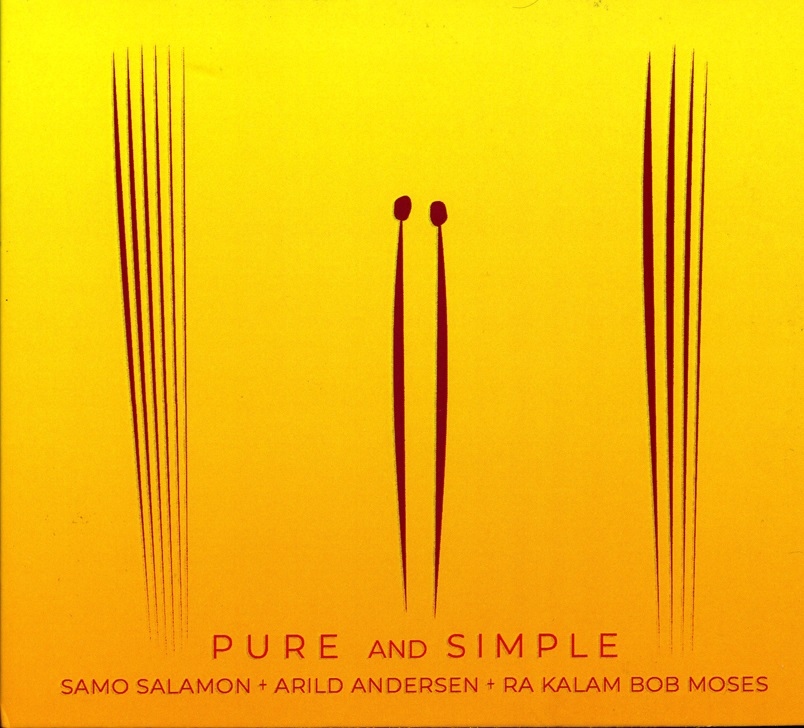
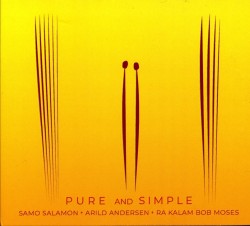 That said, Slovenian guitarist Samo Šalamon, 43, still finds a way to make inspiring sounds with a conventional trio structure. He does that on Pure and Simple (Samo Records samosalamon.com) by going back to the future. His associates are two players whose pioneering playing helped create jazz-rock fusion in the 1960s: American drummer Ra Kalam Bob Moses, known for his stint with Gary Burton, and Norwegian bassist Arild Andersen, a founding member of Jan Garbarek’s group. Moving into the 21st century with their chops intact, Moses, 74, and Andersen, 77, improvise with the mastery and subtlety that belies fusion’s reputation as a repository for accelerated showy solos. Moses, who vibrates, ratchets and hand pats percussion instruments as often as he lays down a beat, plays constantly throughout the CD, but his rhythmic sense is so ingenious that it’s a drum aura rather than a sound that’s often there. With his instantly identifiable string slides and tandem interaction with the guitarist, Andersen adds melody to the mixture. When the trio plays The Golden Light of Evening, its closest link to jazz-rock for instance, the bassist’s string slithers vibrate in elastic counterpoint to rein in the guitarist’s buzzes and flanges from dominating the track. Meantime, the one time Moses smashes instead of strokes his drums is when playing Albert Ayler’s Ghosts. Yet it’s Šalamon’s slurred fingering that makes his strings soar like a saxophone and Andersen’s perfectly shaped solo that confirms the melodic lift as well as the strength of this free jazz anthem. Just as the three are too accomplished to display energy for its own sake, when it comes to folksy lyricism on tunes like Little Song, harmony among clarion-pitched guitar, mid-range bass strokes and percussion clunks is steely enough to avoid cloying smoothness. But perhaps the best instance of their cerebral interaction is on You Take My Arm. Operating on top of Moses’ hand drumming, Šalamon’s 12-string guitar clangs and the bassist’s gruff chording make the performance loose and languid. It still includes enough strength though so that the rhythmic string plinks and rim clangs hang in the air after the track is completed.
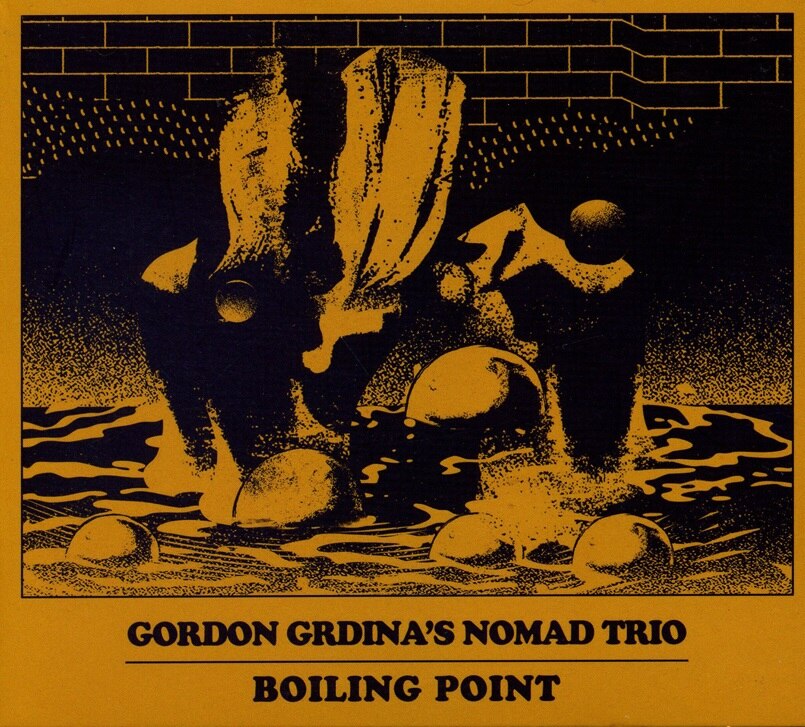
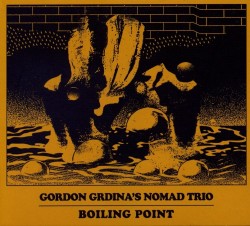 Altering one part of the equation, Vancouver guitarist Gordon Grdina organizes his Nomad Trio with American drummer Jim Black, as well as extra chordal input from New York pianist Matt Mitchell to reach a Boiling Point (Astral Spirits AS 201 gordongrdina.bandcamp.com). One of the ways this trio usually operates at 100 degrees Celsius is the vaporous pressure created by the guitar and piano blend. Steadily ascending in pressure like heating water with a flame, Grdina’s strained string bites and Mitchell’s chordal clips appear to be in continuous motion, backed by Black’s irregular pumps and crashes. Grdina also often slaps his lower strings to create a funky bass line when needed. The blend can sometimes encompass effects pedals and string flanges for rock-directed shading as on the concluding All Caps. But in the main, slurred fingering from the guitarist harmonizes with top-of-scale key tinkling or reflective keyboard sweeps from the pianist, making the two connected no matter the tempo. Grdina also plays the oud here, without adding any false exoticism, though in a situation with Mitchell’s authoritative comping and Black’s syncopated pulsations it’s difficult to tell one strummed instrument from the other. The expanded string oud may figure into the atmospheric and moderato introduction that characterizes Cali-lacs, for instance. But once the string player connects with the pianist’s key clips and the drummer’s claps and pats, identification seems vestigial. From that point on, the three alternate between interludes of methodical interaction and speedier thrusts. Black slaps hi-hat and clashes cymbals; Mitchell rasps metronomic keyboard pumps; and Grdina’s picking is so swift that at times it reaches flamenco-styled, blurred-note intensity. How the trio wraps up these contrasting motifs into a solid whole is a metaphor for its playing on the entire session.
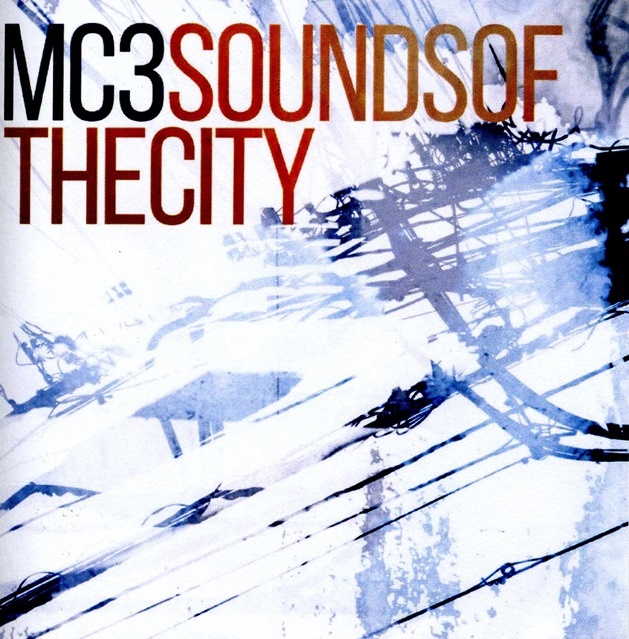
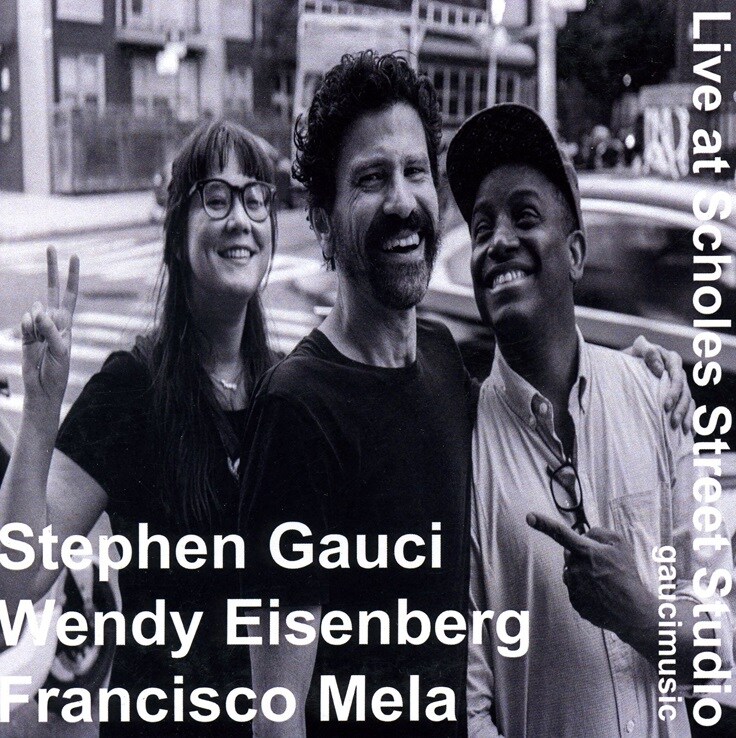
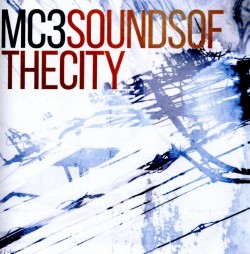 Keeping the guitar and drums in the trio, but making a horn its third member is a strategy followed by groups like the UK’s MC3 and Brooklyn’s Stephen Gauci, Wendy Eisenberg and Franciso Mela. The British date on Sounds of the City (Phonocene Records mattclarkmusic.co.uk) adds Charlotte Keefe’s trumpet or flugelhorn to Matt Clark’s guitar and James Edmunds’ drum. On Live at Scholes Street Studio (Gauci Music gaucimusic.com), it’s Gauci’s tenor saxophone playing alongside Eisenberg’s guitar and Mela’s drums.
In MC3’s case, Keefe’s technical prowess is such that by default Clark becomes the melodist. While the two create a contrapuntal dance between dissonance and tonality, Edmunds stays in the background with the occasional snare pop or cymbal vibrations. What that means is that most of the eight tunes resemble the strategy on Conversation #1 (Dispatches). Clark’s usual warm strums and expressive frails are constantly challenged by Keefe’s digging out timbres from within her horns that aggressively growl and are often displayed with triplet flurries. Here, however, the guitarist introduces chiming licks and the two end up complementing each other’s output as they attain a groove. Besides theme deconstruction with sharp whines, portamento breaths and plunger detours, Keefe cannily sneaks in brief quotes from familiar tunes, and at one point a Latin-like upsurge, to move along the program. Improvisational friction doesn’t mean the trio avoids slower pieces however. Altercations, the closest to a ballad, includes Clark’s gentle folksy comping and Keefe’s slurring reprise of a snatch of Round Midnight in the middle section. She still interjects some raspberries and pointed pops into her solo, but that’s what defines MC3’s POMO sensibility. Furthermore, when Edmunds asserts himself with press rolls in tandem with swinging guitar fingering on the penultimate Traffic, Keefe’s half-valve smears race along at double the tempo to confirm individuality and the group’s distinct parameters.
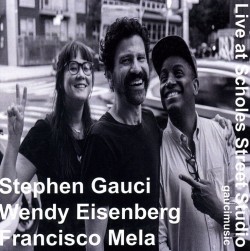 Eisenberg’s playing is more forceful than Clark’s and Gauci’s tenor saxophone projects more robustly than a trumpet so that Live at Scholes Street Studio is the fiercest trio disc here. But while saxophone timbres are screeched and guitar licks flanged and Mela’s drums rumble and pop, each of the six untitled selections are played with certain control. Building up to the extended final track, the trio members advance diverse strategies. At points, Eisenberg twangs the lowest pitched of her strings to create a double bass-like pulse, which contrasts with and accompanies her flat picking or squealing flanges for folk or rock music inferences. Mela studs the tunes with a collection of shuffles, ruffs and rebounds locking together the others’ sound shards into horizontal motion. He adds to the free-form excitement of the concluding tune by unexpectedly yelping Spanish-inflected tones to accelerate the climax. Gauci buzzes tones as often as he bites off textures, with his broken chord expositions boomeranging in and out of the altissimo and sometimes sopranissimo ranges. He introduces continuously breathed sections as well as spectrofluctuation and scooped snorts often in tandem with the guitarist’s slurred finger or chunky rhythm licks. Still his strained skyward squeaks and Eisenberg’s exploration of the strings’ constricted highest tones or the alternative basement-level string strums and nephritic reed cries doesn’t preclude swinging linear underpinning, especially when the drummer solidifies the beat. Eisenberg introduces electronics-like crackles and fuzzy rubs on the sixth and final tune adding to its electric feel. But while waves of pressurized tones intensify as the piece reach a crescendo, tension is released following Mela’s vocal mumbles as the guitarist’s finger picking slides downward to tonality.
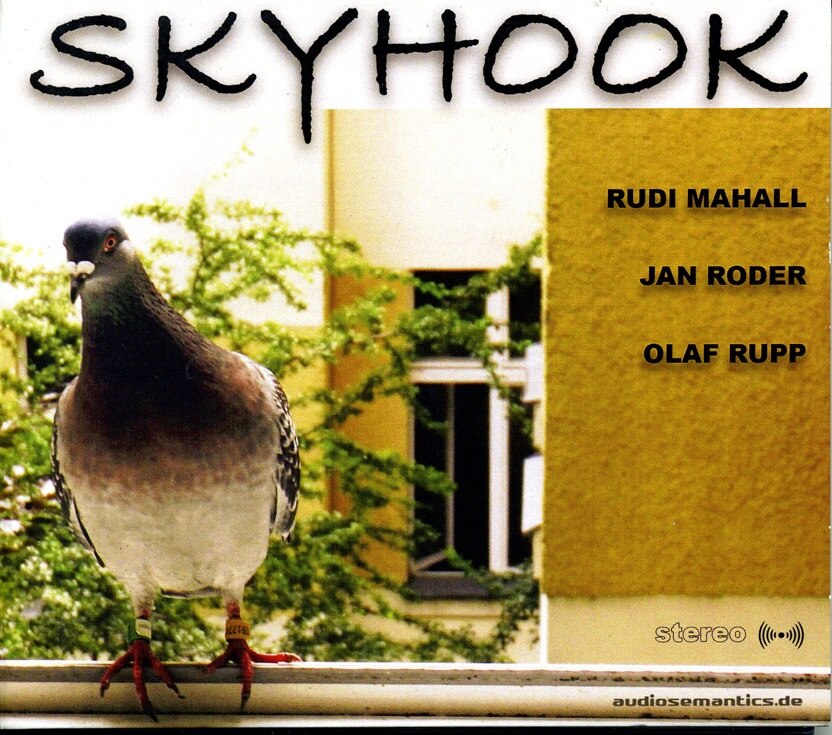
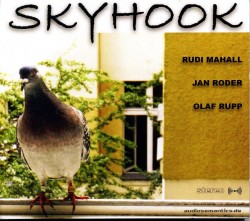 German trio Skyhook (Audiosemantics 21002 audiosemantics.bandcamp.com/album/skyhook) consisting of bass clarinetist Rudi Mahall, bassist Jan Roder and guitarist Olaf Rupp are confident enough of their individual skills that they cheerfully improvise in this unique configuration. With peerless rhythmic command the bassist guides linear connection from the bottom with intermittent but steady strokes. The clarinetist sounds a collection of split tones in chalumeau or clarion registers to advance or deconstruct the tunes. Meanwhile the guitarist’s strums and stops bridge potential divisive intervals by capricious adjustments from foreground to background textures; from high-pitched to low-pitched tones; and by frequently using harsh string chops to add extra percussion to comprehensive melody affirmations. Skyhook was recorded live so that every contrapuntal challenge suggested by slurred fingering and crying reed slurs at one point, or constant strumming facing clarion reed peeps at another, must be resolved in real time before the program can proceed. Yet this doesn’t faze the three, who in different combinations have a history of involvement in all manner of advanced sounds. Should Roder for instance, cut off his connective rumble for squealing sul ponticello slices as on vernünftig, then Rupp’s potent strumming takes on that comping role, muting Mahall’s reed barks and bites. Or if the clarinetist completes his exposition with unbroken glissandi as on the concluding was nicht existiert, then the guitarist’s finger picking adds to the linear narrative. With the ability to incorporate into logical motion every extended technique from bony string flanges or resonating twangs plus altissimo clarinet screeches or body-tube exhumed renal honks, Skyhook is like an aerial act that never has to rely on the waiting net. And if you listen closely, especially on tracks like durch and existiert, you may even hear snatches of swing plus perhaps a song quote that buttresses the sound deconstruction and exploration.
None of the instrumental mixes here include unknown or little used instruments. But it’s the way in which they blend with the guitar that makes these discs memorable.


 Small Bridges