p16aThis year May is the new April. In the past, in Southern Ontario, April has seen the most operatic activity of any month of the year – but this year, May seems to have taken over that position. This month there are works from the 17th century to the 21st, most fully staged but some in concert format.

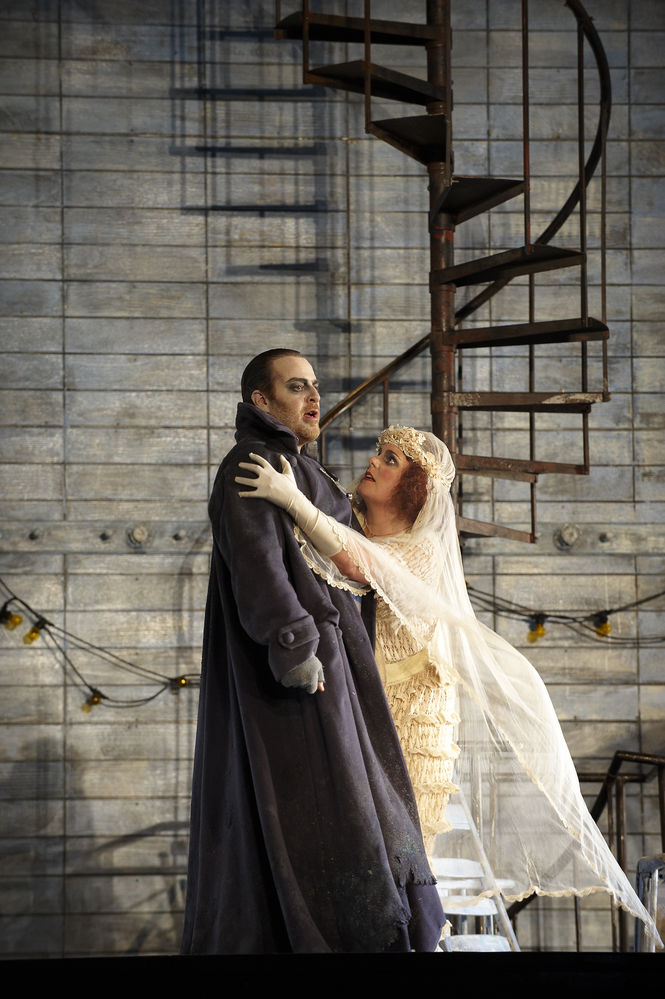
Dominating the schedule are three works staged by the Canadian Opera Company. The COC’s revival of its 1996 production of Wagner’s The Flying Dutchman opened on April 24 but continues until May 20. Evgeny Nikitin sings the title role, while Julie Makarov is Senta and Mats Almgren is Daland. The original director, Christopher Alden, directs, and COC music director Johannes Debus conducts his first Wagner opera for the company.

From May 1 to 30 the COC presents its first-ever Maria Stuarda, the 1835 opera by Gaetano Donizetti that premiered only three months after his Lucia di Lammermoor. Serena Farnocchia sings the title role with Alexandrina Pendatchanska as Elisabetta. Stephen Lawless directs the 2007 Dallas Opera production and Antony Walker conducts.

The COC concludes its 2009-10 season with its first production of Mozart’s Idomeneo since 2001. Toronto was treated to an outstanding Idomeneo from Opera Atelier in 2008, so it will be interesting to see how this 2007 production from l’Opéra du Rhin, directed by François de Carpentries, compares. Paul Groves sings the title role, with Krisztina Szabó as Idamante, Isabel Bayrakdarian as Ilia and Tamara Wilson as Elettra, so memorably sung for OA by Measha Brueggergosman. The opera runs from May 9 to 29 and is conducted by early music expert Harry Bicket.

Three more fully staged works come from smaller companies. Toronto Masque Theatre presents “A Molière Celebration.” In addition to purely spoken comedies, Molière also wrote so-called “comédie-ballets” that included interludes of song and dance often omitted in modern revivals. TMT will present the interludes written by Jean-Baptiste Lully for Le Bourgeois Gentilhomme in 1670 and those written by Lully’s rival Marc-Antoine Charpentier for Le Malade imaginaire in 1673. Soloists will include sopranos Shannon Mercer and Dorothea Ventura, countertenor Richard Whittall, tenor Cory Knight and baritone David Roth. Performances take place at the Al Green Theatre in the Miles Nadal Jewish Community Centre from May 12 to 15, directed by Derek Boyes and conducted by Larry Beckwith. Visit www.torontomasquetheatre.com for details.

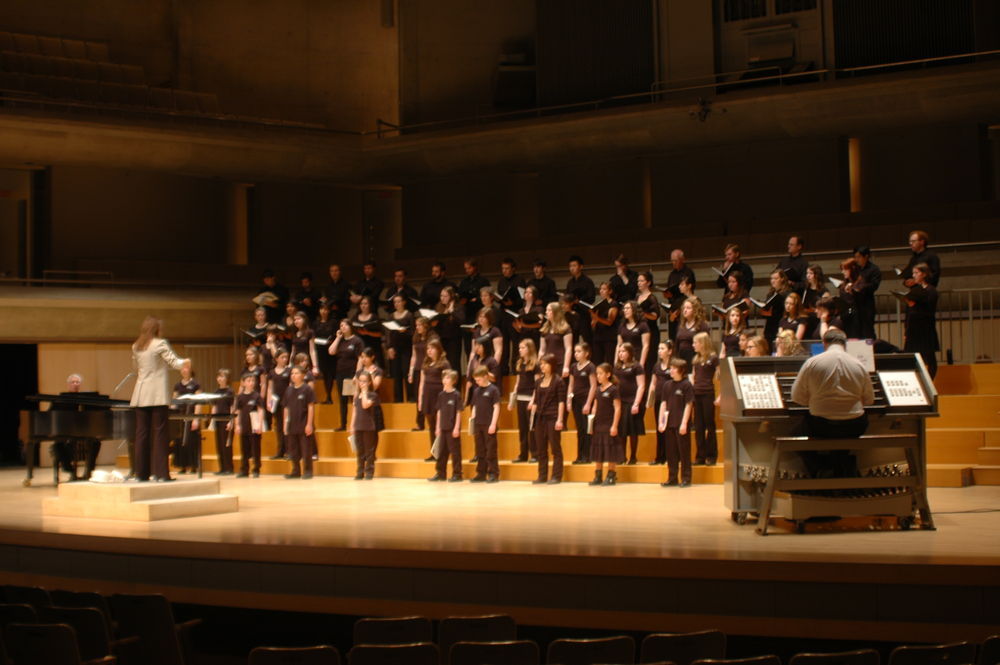
p16bMay will see the world premiere of Dean Burry’s The Secret World of Og, adapted from the beloved 1961 children’s book by Pierre Berton. The work is a commission by the Canadian Children’s Opera Chorus, and all 200 members of the CCOC will be on stage. As many will know, the story concerns four children who descend through a trapdoor into an underground world of mushrooms whose green inhabitants can only utter the word “Og.” CCOC artistic director Ann Cooper Gay will conduct and Joe Ivany will direct. The opera runs from May 5 to 9. For more information visit
www.canadianchildrensopera.com.

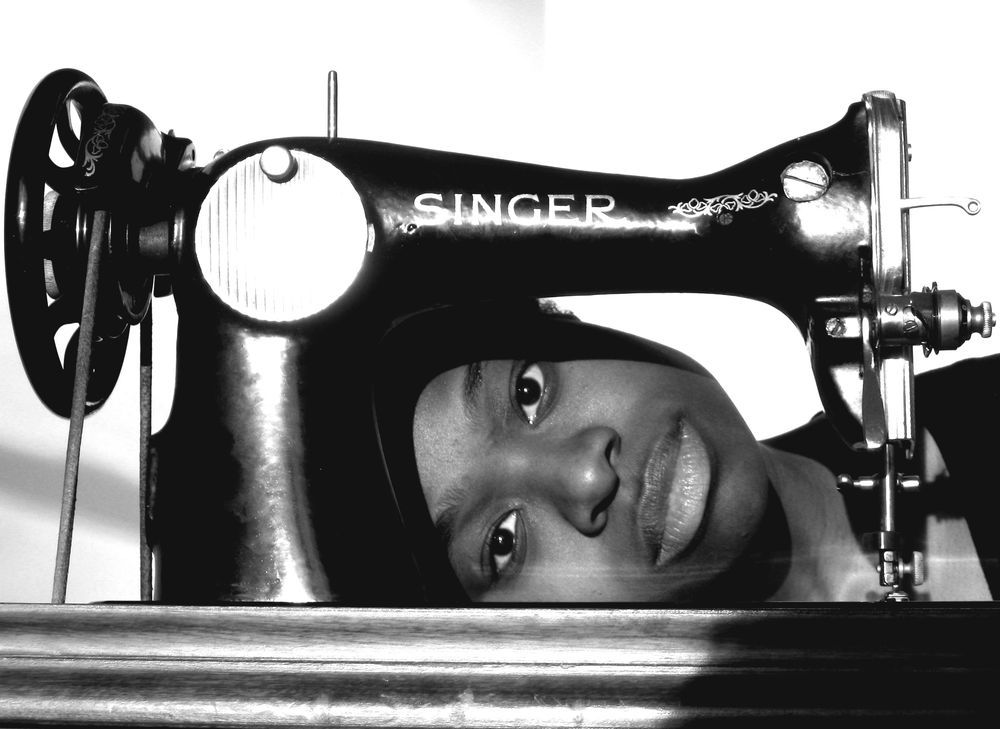
p17Later in the month, from May 26 to 30, Urbanvessel revives its popular but highly unusual opera Stitch at the Theatre Centre. The 45-minute opera, subject of an “On Opera” interview with composer Juliet Palmer and librettist Anna Chatterton in March 2008, is written for three female voices accompanied only by the sound of sewing machines and concerns the mechanization of women’s work and its political ramifications. As in 2008, Christine Duncan, Patricia O’Callaghan and Neema Bickersteth will perform under the direction of Ruth Madoc-Jones. For more information visit
www.urbanvessel.com.

Two concert performances from Opera By Request fill out the month – Mozart’s Die Entführung aus dem Serail on May 7 and Carl Maria von Weber’s Der Freischütz on May 15. Both take place at the College Street United Church, 452 College St. See www.operaby-request.ca for details.

Finally, on May 1 and 2 Toronto Operetta Theatre is holding “A Gilbert and Sullivan Extravaganza,” a gala concert of G&S highlights including high tea. All the funds raised will go to assist TOT’s 2010-11 season. TOT patrons will know that the company was forced to cancel its production of The Pirates of Penzance last month for financial reasons. One consequence of the economic downturn in the arts has been the loss of donors and sponsors. TOT was hit particularly hard when a major sponsor pulled out just before the current season began. The company had to raise emergency funds simply to stage its second show, Canada’s own operetta, Leo, the Royal Cadet, a work that TOT’s efforts had rescued from undeserved obscurity. As Canada’s only professional operetta company, as one of the few in the world that strives to present works from all the national traditions, and as a company that from the beginning has showcased Canadian singers, TOT is a gem that must be preserved. Potential sponsors and donors please take note. Visit www.torontooperetta.com for more information.

Christopher Hoile is a Toronto-based writer on opera. He can be contacted at: opera@thewholenote.com.

With the wealth of choirs, opera companies and vocal music presenters that have a penchant for new music, we’re never at a loss for performances of contemporary repertoire. But this month there’s a visibly larger interest in the human voice, with several new-music presenters offering programs from the traditional to the unusual. Accompanying these concerts, summits and site-specific installations is an equally far-ranging exploration of themes concerning our place in the world and the state of humanity.

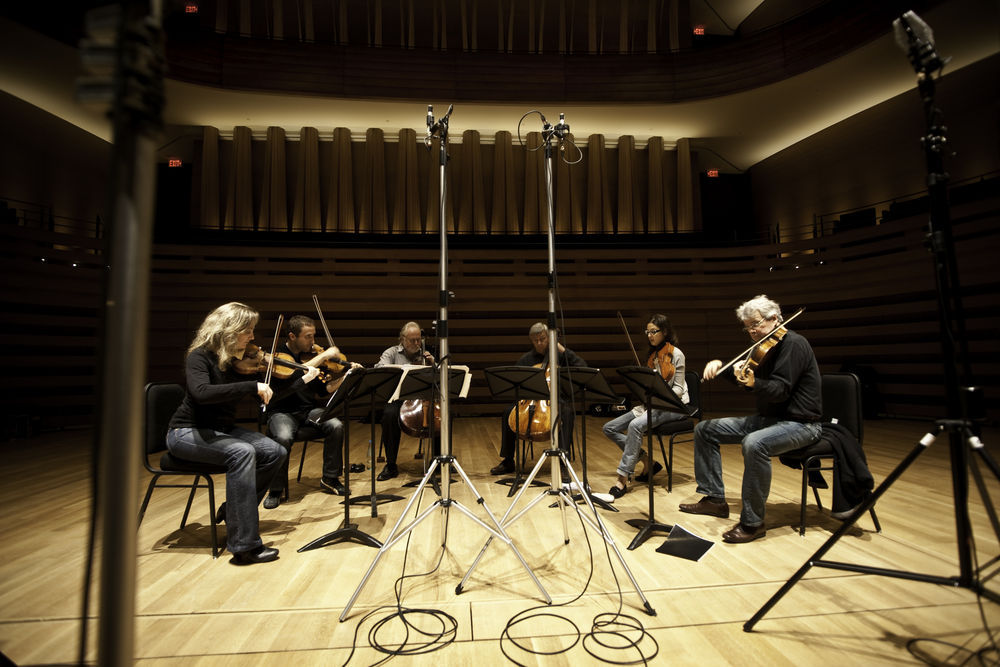
p18The Talisker Players, who are certainly no strangers to vocal music, close their 10th anniversary season on May 11 and 12 with “Illuminations” – a title that refers to the mystical and visionary texts that influence the selected pieces. The Taliskers depart from their usual chamber ensemble format to present Benjamin Britten’s stunning Illuminations, based on the fantastical poetry of Rimbaud, for soprano and string orchestra. Rising talent William Rowson conducts soprano Meredith Hall, who reaches beyond her renown in early music circles to also perform Harry Freedman’s Trois Poèmes de Jacques Prévert for soprano and string quartet. (It’s a shame that we won’t get to hear the Freedman in its original setting for soprano and string orchestra; he withdrew that version in 1981 and replaced it with the current setting.)

Also joining the Talisker’s is the much-in-demand tenor Lawrence Wiliford. Credited for his luminous projection, lyrical sensitivity and brilliant coloratura, Wiliford will perform Gerald Finzi’s Dies Natalis for tenor and strings, and Toronto-based Andrew Ager’s From the Rubáiyát for tenor and string quartet. A generation older but still a contemporary of Britten’s, Finzi may be lesser known, but certainly no less talented when it comes to lush writing, here inspired by metaphysical texts from Thomas Taherne. Ager’s rich and expressive piece, based on words from Persian philosopher Omar Khayyám, shows stylistic affinities with these British composers. It would have been lovely to hear the version for string trio and French horn, as it appears in the CentreStreams online audio service. Perhaps there is an opportunity to programme it with Britten’s Serenade for Tenor, Horn and Strings in the future?

Nonetheless, these two concerts at Trinity St. Paul’s Centre allow us to hear lush music in the capable hands of excellent performers. For more info visit www.taliskerplayers.ca. For tickets call 416-978-8849 or e-mail words.music@taliskerplayers.ca.

A few days later, we take a sharp turn towards the outer reaches of vocal exploration when a trifecta of adventurous vocalizers land at the Music Gallery and surrounding sites for the Voice Summit. Toronto’s Christine Duncan, Vancouver’s DB Boyko and New York City’s Shelley Hirsch show us why the world’s oldest and most democratic instrument has retained its power to create unbounded sonic experiences that also collapse social barriers.

At 8:00pm on May 16, Duncan and Boyko launch the Summit with a site-specific performance of Stall, a newly commissioned work by Victoria-based composer Christopher Butterfield, at the Harrison Baths and Swimming Pool. Stall, for voices and ambient sounds, explores the soundscape and social boundaries of the public washroom. The work is intended to cajole, disturb and at the same time demand restraint. Using a combination of absurd spoken word, humorous chant and a barrage of cut-up text, Stall examines the more subtle aspects of this particularly ubiquitous but often socially uncomfortable location.

Duncan and Boyko have a history of collaboration and over the years have developed a mesmerizing musical rapport that should make for a captivating world premiere performance. Back in the Gallery, the remarkably accomplished Shelley Hirsch will deliver a solo concert vocal improvisations at 9:00pm. Her practice encompasses story telling, staged performances, compositions, improvisations, collaborations (with a “who’s who” of contemporary music), installations and radio plays that have been presented on five continents. Those inspired by what they hear may want to attend Hirsch’s free vocal improvisation workshop on May 17. For more details visit www.musicgallery.org. For tickets call 416-204-1080 or visit www.ticketweb.ca.

Continuum’s 25th anniversary season closes on May 21 at the Music Gallery with “Wisdom of the Elders,” a concert that ambitiously seeks to ask questions about the human race and its place in the world. A cornerstone of the programme is a newly commissioned work by Toronto composer Juliet Palmer. How it Happened for ensemble and narrator re-examines an aboriginal creation myth in a setting of text taken from Thomas King’s Green Grass, Running Water. Renowned actor and activist RH Thomson joins Continuum as narrator for this world premiere.

Two works by American proto-minimalist Tom Johnson draw on diverse sociological inspirations. Narayana’s Cows uses the population explosion calculations of 14th-century Hindu mathematician Narayana as cumulative musical building blocks. Tortue de Mer for bass saxophone transcribes sand-drawing games and story-telling practices of the Vanuatu people of the Pacific islands. Soprano Carla Huhtanen returns to Continuum to perform British composer Geoff Hannan’s Where I Live is Shite/Where I Live is Posh, a politically satirical work that tackles the subject of contemporary population pressures that result in absurdity, irritation and unhappiness. The progamme is rounded out by a reprise of early-career Canadian composer Aaron Gervais’ Jackhammer Lullaby – a re-arrangement of his work Community-Normed, which was commissioned by Continuum in 2008. In writing about the piece, Gervais said “I’ve become increasingly interested in presenting pieces in multiple versions and combinations. Why multiple versions? Because music today is multiple. Everyone is exposed to music from multiple cultures, from multiple time periods and in multiple versions. Musically, Jackhammer Lullaby presents a humorous musical setting of trying to fall asleep with construction going on outside the window.” For more info visit www.continuummusic.org. For tickets, visit www.wisdom.eventbrite.com.

p19The month closes out with Urbanvessel’s remount of its Dora-nominated Stitch from May 26 to May 30 at the Theatre Centre. This production brings together the original creative team behind the sold-out, critically acclaimed production that premiered during the 2008 Free Fall festival. Stitch is an a cappella opera created by composer-librettist duo Juliet Palmer and Anna Chatterton. As they describe it, the opera is “hemmed in by the language of sewing and the inexorable rhythm of the machine, [where] three women fight to find space for imagination and individuality. Stitch gives voice to the unseen women who clothe us all.” Ruth Madoc-Jones directs a remarkable cast of vocalists: Christine Duncan, Patricia O’Callaghan and Neema Bickersteth. For more info, including details about the May 29 gala performance and links to sneak-peek videos, visit www.theatrecentre.org. For tickets, call 416-538-0988.

Jason van Eyk is the Ontario Regional Director of the Canadian Music Centre. He can be contacted at: newmusic@thewholenote.com.

p20aMay is “Canary” month – the month in which The WholeNote publishes its annual Choral Directory – so I thought it fitting to first mention what some of the choirs are doing with world music. Echo Women’s Choir (directed by Becca Whitla and Alan Gasser) celebrates spring, freedom and the outdoors with “Throw the Window Open,” May 16 at Church of the Holy Trinity. Among others works, the programme will include songs from South Africa and the Republic of Georgia sung in the original languages, as well as Holly Near’s Hay una mujer, which commemorates women who were “disappeared” during the Chilean junta of the 1970s. Toronto’s Afrocentric choir, the Nathaniel Dett Chorale, performs May 26 and 29 at the Glenn Gould Studio. “And Still We Sing...Steel Singin,” features the new steel pan ensemble Legacy Groove Pan. The programme will showcase Trinidadian Calypso rhythms, West Indian folk music, works by David Rudder, and more.

The Toronto Jewish Folk Choir presents its 84th spring concert at Walter Hall, May 30. The concert which celebrates the memory of Emil Gartner, the choir’s longest serving conductor, will feature his daughter, Toronto Symphony cellist Esther Gartner, in Srul Glick’s Yiddish Suite No. 1, composed to poems by Yiddish-Canadian poets. She’ll also premiere a new work by Raymond Luedeke, commissioned for this concert, as well as perform in Prokofiev’s Overture on Hebrew Themes with a chamber ensemble. The programme also features classical works, as well as songs in Hebrew and Judeo-Spanish.

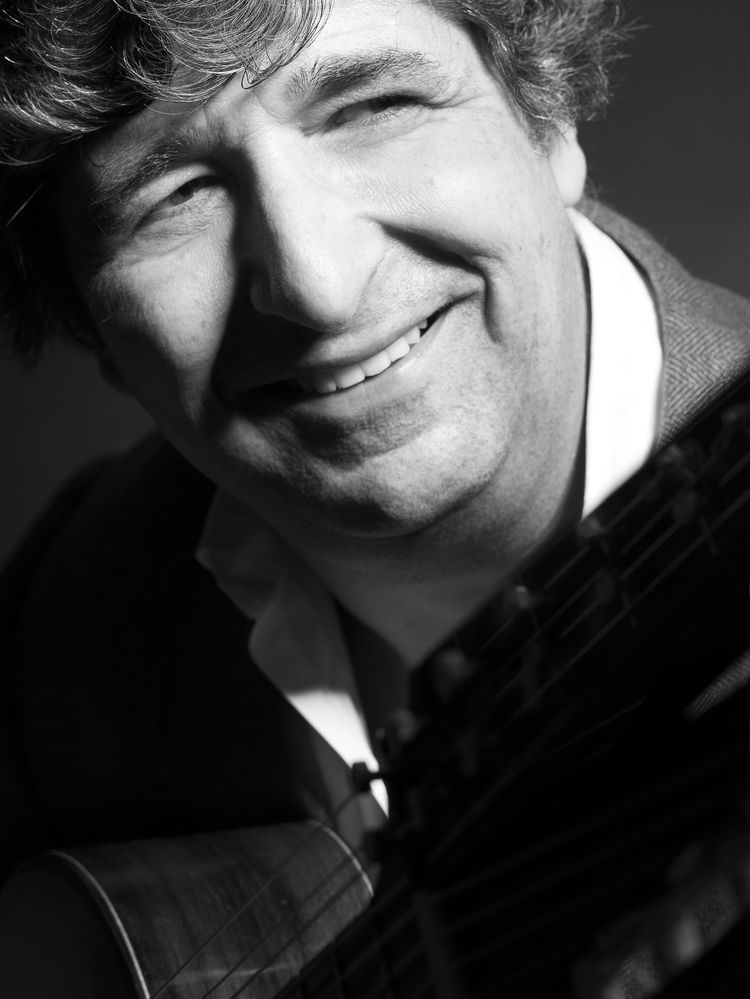
As much a world-music concert as an early music one, “Lutefest” closes the Toronto Consort’s season with performances on May 7 and 8. I won’t go into detail here as it’s the topic of our cover story, but I couldn’t leave it out entirely. The programme features three instruments that are essentially cousins: the Middle Eastern oud, played by Bassam Bishara; the western lute (whose name is derived from the French “l’oud”), played by the Toronto Consort’s Terry McKenna; and the Chinese pipa, played by Wen Zhao. Do read the cover story for more!

Presented by Small World Music, the Gundecha Brothers present an evening of Indian Dhrupad music. Dhrupad is a slow, meditative, deeply spiritual ancient vocal music tradition, and Umakant and Ramakant Gundecha are, like the Dagar brothers before them, two of India’s leading artists in this style of music, performing both at home and internationally. You can hear them at The Yoga Sanctuary (2 College St.) on May 7.

Toronto’s Lula Lounge is a well known hotbed of musical activity, and this month they present “Lulaworld 2010,” a festival of world music running May 5 to 30. This concert series presents both Canadian and international artists, representing a truly global array of musical identities, with a special focus this year on Latin America. The festival opens with Latin jazz ensemble Bomba with bassist Fito Garcia and vocalist Marlin Ramazzini. There are too many artists to list here, so please visit Lula’s website at www.lulalounge.ca.

p20bHere are some highlights of “Lulaworld 2010.” Afrolatino Dance Company and Roberto Linares Brown present a Cuban Cabaret, “I am Cuba,” with show-girls, a Cuban orchestra and dance lesssons, May 8. Kinobe and Soul Beat Africa perform Ugandan roots music and original compostions, May 13. Colombia Mon Amor with Orquesta Fantasia present Colombian music, featuring a salsa ensemble with dance lessons by Bailaboogaloo, May 15. Son Jarocho with Cafe con Pan and Yohualichan offer an evening of Mexican music in honour of the bicentennial of Mexican independence, May 16. (This is preceded the afternoon before with a film screening of Los Soneros del Tesechoacan, followed by a dance and music workshop.) Mondo Uke features world music for the ukulele, with a bossa nova workshop for uke players followed by a concert of global ukulele music, May 17. Viva Celia presents a tribute to Celia Cruz, “Queen of Salsa,” featuring vocalists Patricia Cano, Alberto Alberto and Luis Mario Ochoa, May 22. And there’s a whole lot more!

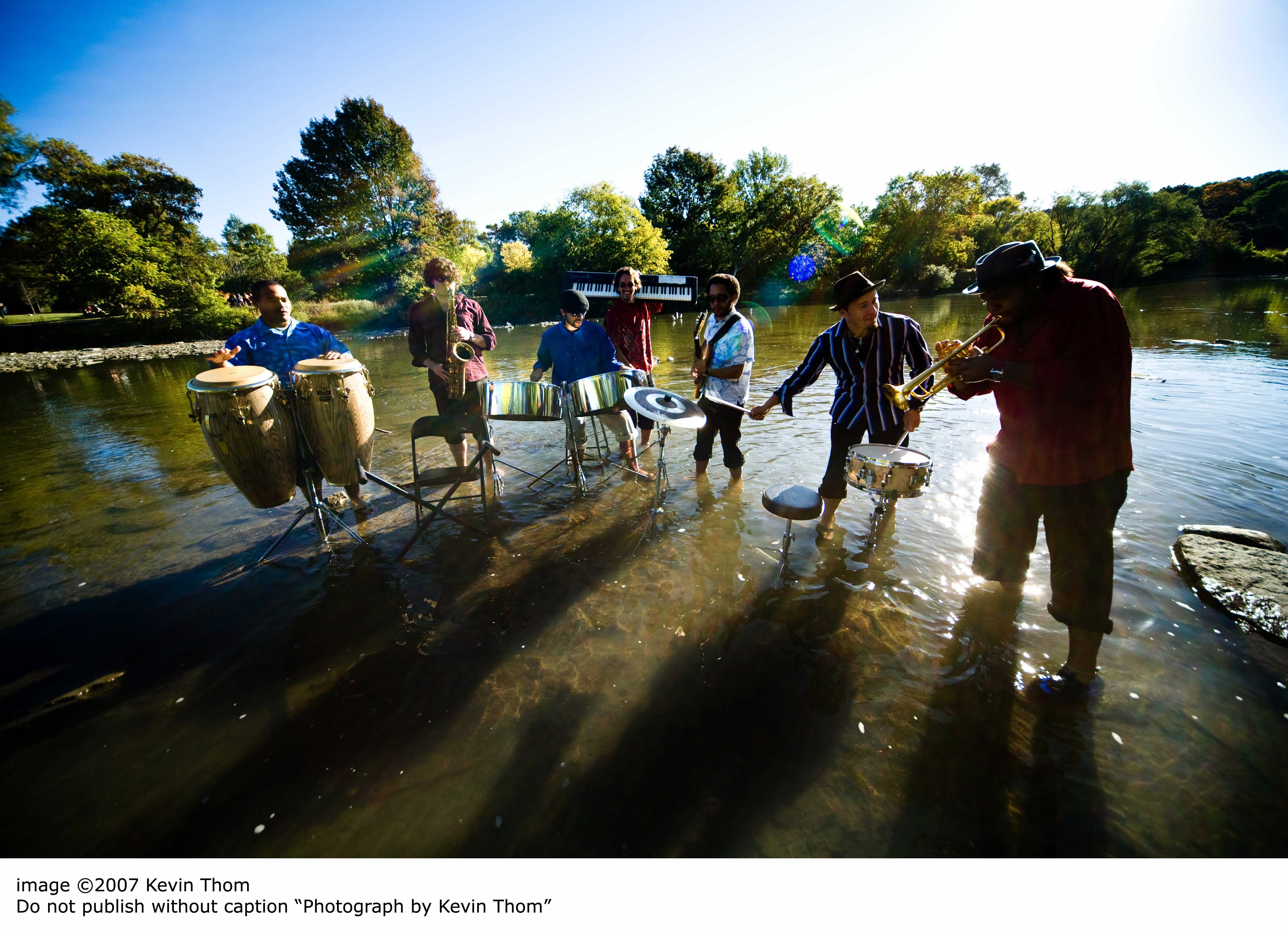
Caribbean/Latin Jazz ensemble CaneFire launches its second CD, Pandemonium, May 19 at the Glenn Gould Studio. This Toronto group has been around for the past five years, and has won praise in Trinidad and Tobago after appearing in festivals there. I’ve had a listen to some of the album, and can testify that this is top-notch, polished performing of instrumental and vocal jazz, with the virtuoso steel-pan playing of Mark Mosca as one of the many highlights. Headed by pianist and composer Jeremy Ledbetter, the band features well-known guest musicians David Rudder and Hermeto Pascoal, as well as Alexis Baró (trumpet), Braxton Hicks (saxophones), Yoser Rodriguez (bass), Alberto Suárez (percussion) and Chendy León (drums). This promises to be a lively evening!

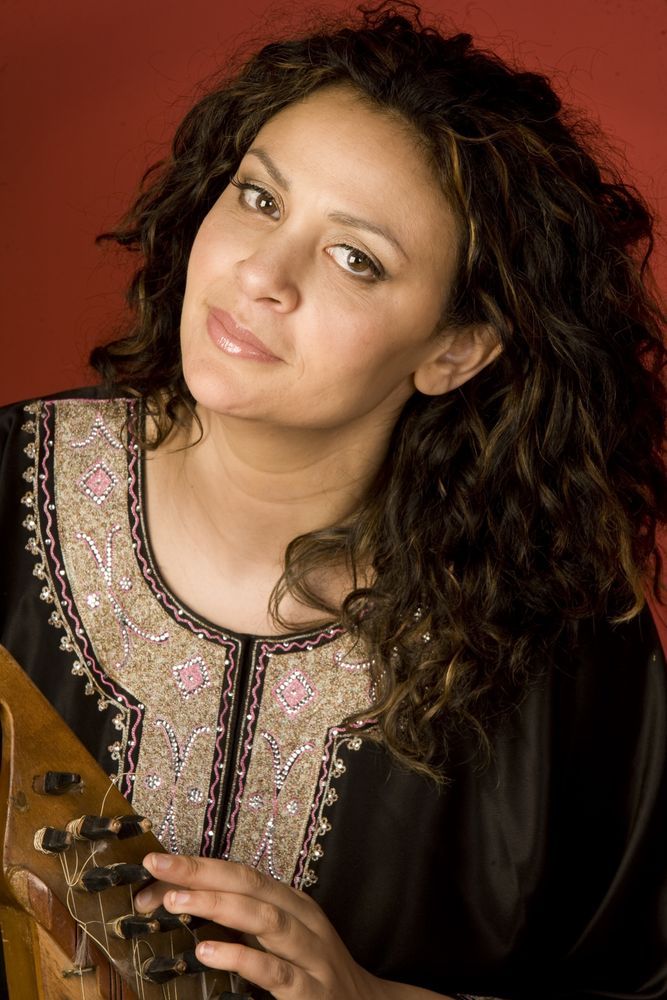
p21Opening May 19 and running to the 23rd, Seventh Stage Theatre presents 9 Parts of Desire by Heather Raffo. The play presents a portrait of nine Iraqi women, “a timely meditation on the ancient, the modern and the feminine in a country overshadowed by war.” The production features an all-star cast including someone who neeeds no introduction here, Arabic singer Maryem Hassan Tollar, who wrote the music for the production as well as acting in it.

Here’s some news about world renowed mrdangam player and and professor of south Indian music at York University Trichy Sankaran: “I wanted to let you know that my father is releasing a book, The Art of Konnakkol (Solkattu – Spoken rythms of south India),” writes his daughter Suba, of Autorickshaw fame. “It’s a groundbreaking work and educational manual, including accompanying CD”. Both father and daughter, members of Autorickshaw and other special guests celebrate with a free concert at the Music Gallery, May 27. The book will be available at a reduced price, this time only!

And heading to the traditions of North India, the Toronto Tabla Ensemble performs at Harbourfront’s Enwave Theatre, May 28 and 29. They join forces with two dance companies, Chhandam and Lavish. For more info, visit www.tablaensemble.com.

Coming up in June is another Small World Music presentation, in partnership with Roy Thomson Hall, Persian vocalist Mohammad Reza Shajarian performs with Shahnaz Ensemble, June 6. One of the most well known artists of Iranian classical music, Shajarian has had a career spanning over 40 years, both at home and internationally. He’ll be accompanied by an ensemble of 15 instrumentalists.

Karen Ages can be reached at worldmusic@thewholenote.com

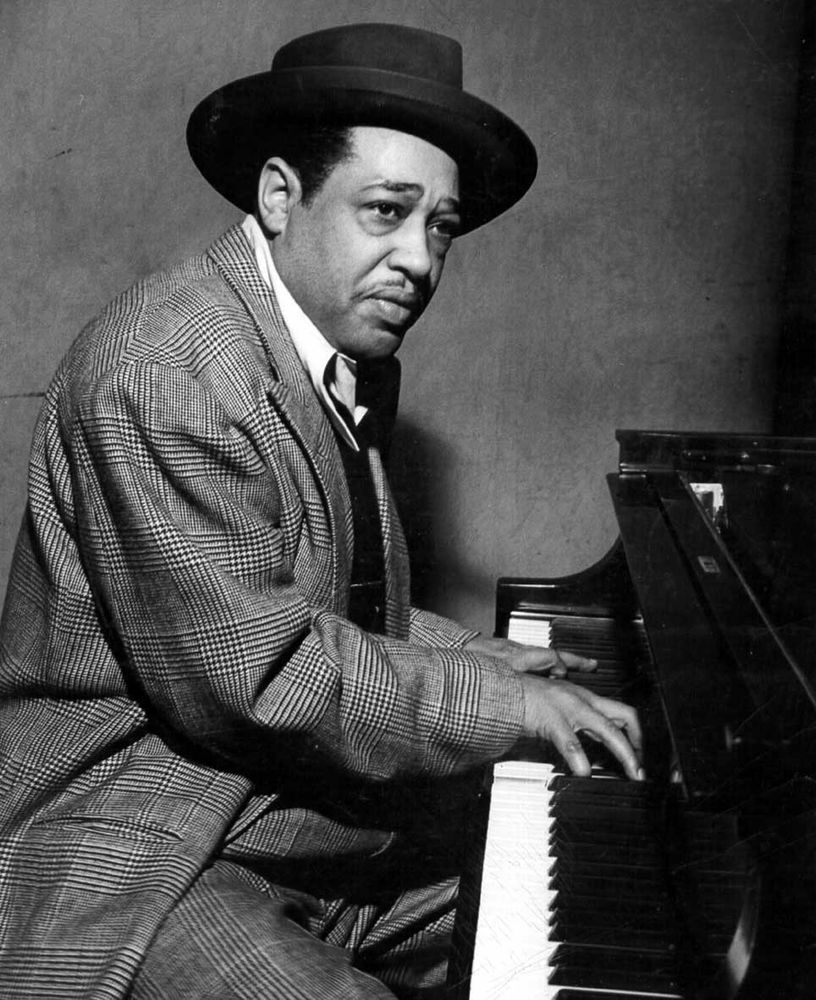
We all know who Satin Doll is – but how many of you know Queenie Pie? They both inhabited the world of Duke Ellington, although one was a lot more successful than the other.

Satin Doll, a collaboration with Billy Strayhorn – and indeed there was some question as to who was the real father – saw the light of day in 1953; Queenie Pie had a much longer gestation period beginning in the early 60s and was still a work in progress at the time of Ellington's death in 1974. (I've reviewed a new recording of it in the DISCoveries section of The WholeNote this month.)

Queenie Pie was a musical, originally intended for National Educational Television in the USA, which in 1970 became PBS. The work was loosely based on the story of C.J. Walker who developed hair-care products and through her efforts and business acumen was the first known African-American woman to become a self-made millionaire.

p22Jazz impresario Norman Granz remembered Ellington having begun the project in the early 60s and that Ella Fitzgerald was supposed to play Queenie Pie, but PBS support was withdrawn and, necessity no longer having to be the mother of invention, the work languished to the extent that when the Duke died it was still incomplete. What material there was consisted of some lead sheets, lyrics and harmonic progressions.

When the work was first performed in 1986, a libretto had been adapted from Ellington's original story, additional lyrics were written and a score in the style of Ellington had been arranged.

Now, here's the 64 dollar question: Is it still Ellington?

There are, of course many examples of unfinished works, completed by other musicians – Gustav Mahler's Symphony No. 10, Franz Schubert's Symphony No. 7 and Wolfgang Amadeus Mozart's Requiem are famous examples – but they were certainly partially completed, not simply melodic lines and harmonic suggestions.

It has to be understood also that Ellington's true instrument was his orchestra and he wrote with his own musicians, especially his soloists, in mind, and was able to experiment with colourings, tonal effects and the unusual voicings that were his hallmark. And having a working orchestra enabled him to hear his music being played. It is well known that in lean years the royalties from his "hits" subsidized the band, enabling him to keep using his "instrument." In a Newsday interview in 1969 he said, "The writing and playing of music is a matter of intent... My music fits the tonal personality of the player. I think too strongly in terms of altering my music to fit the performer to be impressed by accidental music."

It all leaves me just a bit uncomfortable about calling Queenie Pie an Ellington work. Any thoughts?

Mary Lou Williams

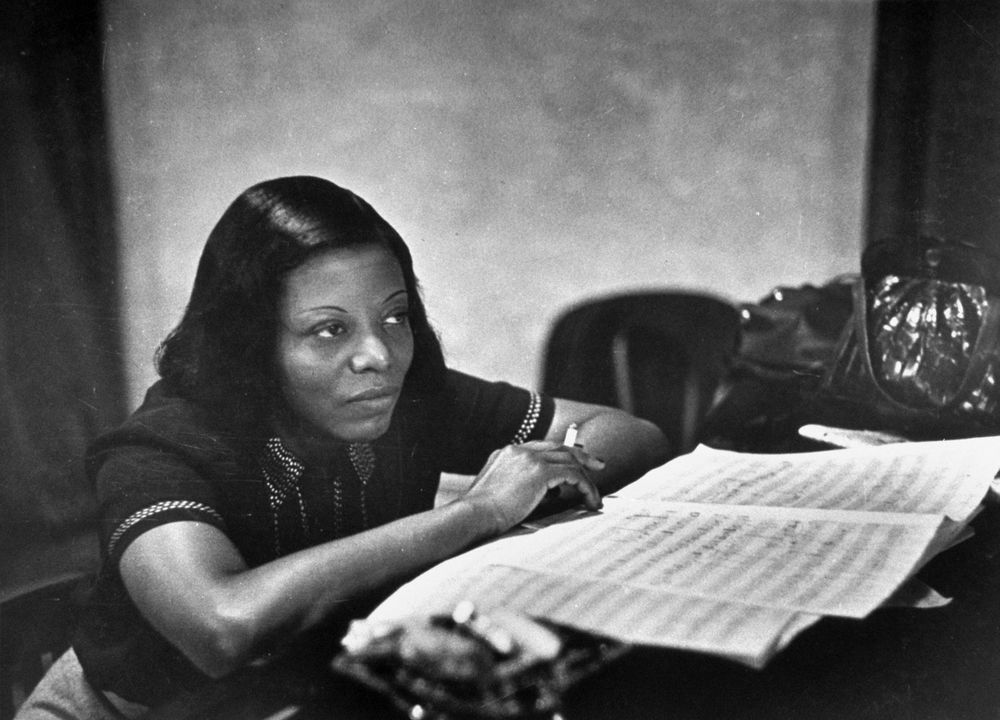
This month sees the centenary of one of the most significant women in jazz, a fact that is sadly overlooked by many. I'm referring to Mary Lou Williams, who was the most important female jazz musician to emerge in the first three decades of the music. She also had a bearing on the career of Duke Ellington; in 1941 Mary Lou traveled with and wrote for the Ellington Band for about six months. One of her arrangements was called Trumpet No End, based on the changes of Blue Skies and it is a prime example of just how well she could write. Duke Ellington said of Mary Lou, "Her music retains, and maintains, a standard of quality that is timeless. She is like soul on soul."

p23aShe was a composer, arranger and master of blues, boogie woogie, stride, swing and be-bop. She also had to cope with a musical environment in which women instrumentalists were hardly plentiful and women arranger/composers were as scarce as hen's teeth.

She was the first jazz composer to write sacred works. She composed three complete Masses, one of which, Mary Lou's Mass, was performed right here in Toronto. I was fortunate enough to know her and privileged to assist in presenting that performance.

If your travels should take you to Washington DC, the 15th Annual Women in Jazz Festival at the Kennedy Centre will celebrate the 100th anniversary of pianist Williams' birth with three evenings of concerts featuring top female jazz artists: vocalist Dee Dee Bridgewater, drummer Terri Lyne Carrington, pianist Geri Allen, bassist Esperanza Spalding and saxophonist Grace Kelly; vocalist Catherine Russell, drummer Sherrie Maricle and the Diva Jazz Orchestra.

There will also be a celebration in New York on Williams' birthday, May 8, at the Church of St. Francis Xavier. A very special lady indeed.

Right here in Toronto here are a few things worth the mention. On May 2 there will be a fundraiser at Koerner Hall for the Geneva Centre for Autism featuring Chaka Khan and Matt Savage and his band. For info call 416-408-0208.

On the 8th, St. George's Memorial Church in Oshawa will present Jazz at George's with vocalist Lynn McDonald, Dave Restivo, piano; Pat Reid, bass and Ted Warren, drums. Call 905-263-2791. On the 25th and 26th of the month at the Enwave Theatre, Harbourfront Centre, the Art of Time Ensemble will present "The Songbook 4," featuring vocalist Mary Maragret O'Hara, saxophonist Phil Dwyer, guitarist Rob Piltch and cellist Rachel Mercer. For reservations call 416-703-5479.

The Annual Ken Page Memorial Trust Gala fundraiser will be held at The Old Mill on May 20. Warren Vaché and brother Allan Vache, trombonists George Masso and Laurie Bower, John Sherwood, Neil Swainson, Don Thompson, Reg Schwager, Terry Clarke and Lucian Gray are confirmed at time of writing. They will also be joined by a saxophone player called Galloway. It promises to be a pretty special evening. For reservations please call Anne Page at 416-515-0200 or e-mail anne@kenpagememorialtrust.com

I hope your May days will be distress-free. Happy listening.

Jim Galloway is a saxophonist, band leader and the former artistic director of Toronto Downtown Jazz. He can be contacted at: jazz@thewholenote.com.

p23bThere were a few musical events in my life in recent weeks that furnished a couple of topics for my column this month. The first has to do with joint performances of choirs and bands.

In last December’s Bandstand column I talked about choirs performing with concert bands and how that form of joint venture was very popular over the Christmas holiday season. At that time we lamented the dearth of music written specifically for such a combination. Subsequently, I received a few letters on the subject, but little evidence to contradict what I had written. I still found little evidence of any conscious effort on the part of bands, choirs, arrangers or composers to rectify that situation. What a pleasant surprise it was then when, a few weeks ago, I was treated to no fewer than three such works on a single programme.

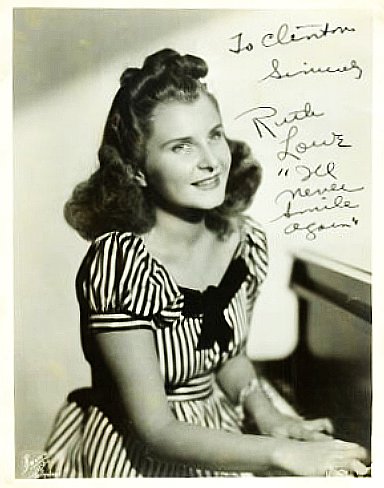
The event was a joint concert in late March by the Oriana Singers of Cobourg and the Concert Band of Cobourg. With the assistance of a grant from the Trillium Foundation of Ontario these organizations were able commission two special very diverse arrangements. The first arrangement, entitled A Ruth Lowe Celebration, was a medley of tunes by that Canadian composer, including “I’ll Never Smile Again” and “Put Your Dreams Away.” I’m accustomed to hearing choirs perform with bands, but there’s always the sense that separate groups are sharing the platform. Rather, in this concert, there was the sense of hearing a unified single ensemble, and listeners were treated to a smooth blend of voice, woodwind and brass rarely heard.

Their rendition of Freddy Mercury’s Bohemian Rhapsody was very different. It bore no resemblance to the arrangement often performed by concert bands, and certainly did not indicate that its roots were in a rock band some years ago. The third joint venture was an original work on a sacred theme. “Benedictus” by Steven M. Baric exploited the unique tonality of these combined forces in a way rarely heard.

In a future issue I hope to be able to get some insight into the process involved with the Trillium Foundation for such purposes. I also hope to get information on how other groups might obtain copies and performance rights for these works, which deserve to be heard more widely.

In our concert listings in last month’s issue there was an announcement of a joint venture on May 1 by the Orillia Wind Ensemble and the Cellar Singers. I hope to attend their version of the “Last Night of the Proms," in my quest for more of that combination.

The second topic has to do with how the role of women in bands has changed over the years. When I first started playing in a “boys’ band” some years ago, I was unaware of how girls were routinely excluded. That’s probably because there were girls in our band. Solo cornet and first trombone positions were both held by girls. On reflection though, perhaps they had received some preferential treatment; they were daughters of the bandmaster.

Some time ago I wrote about the controversy sparked at the University of Toronto in 1947 when a young woman applied to join the band. The student council held a formal debate to determine whether or not the musician in question should be permitted to join the band. I’m happy to report that the woman is still playing regularly in a community band some 63 years later.

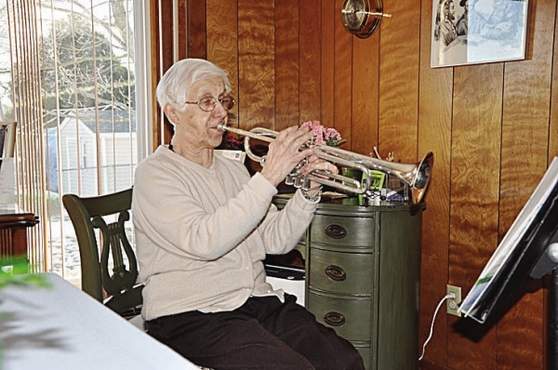
p24aMy interest in this subject was kindled again when a friend sent me an email with an article about a trumpet soloist in a community band in Massachusetts. As a child in elementary school, Edith Pliskin always wanted to play an instrument and thought of taking up the violin, she said, “but my brother, Jimmy, suggested the trumpet because few women play that instrument.” When she attended the University of Massachusetts in Amherst, the university did not permit women to play in the band. “At that time it was for men only.” Sound familiar? Well Edith now has her day. Her next performance will be with a wind ensemble at the University of Massachusetts, Dartmouth, on May 4. As usual, she will probably play at least one solo. Oh, I guess I forgot to mention that Edith celebrated her 90th birthday a while back.

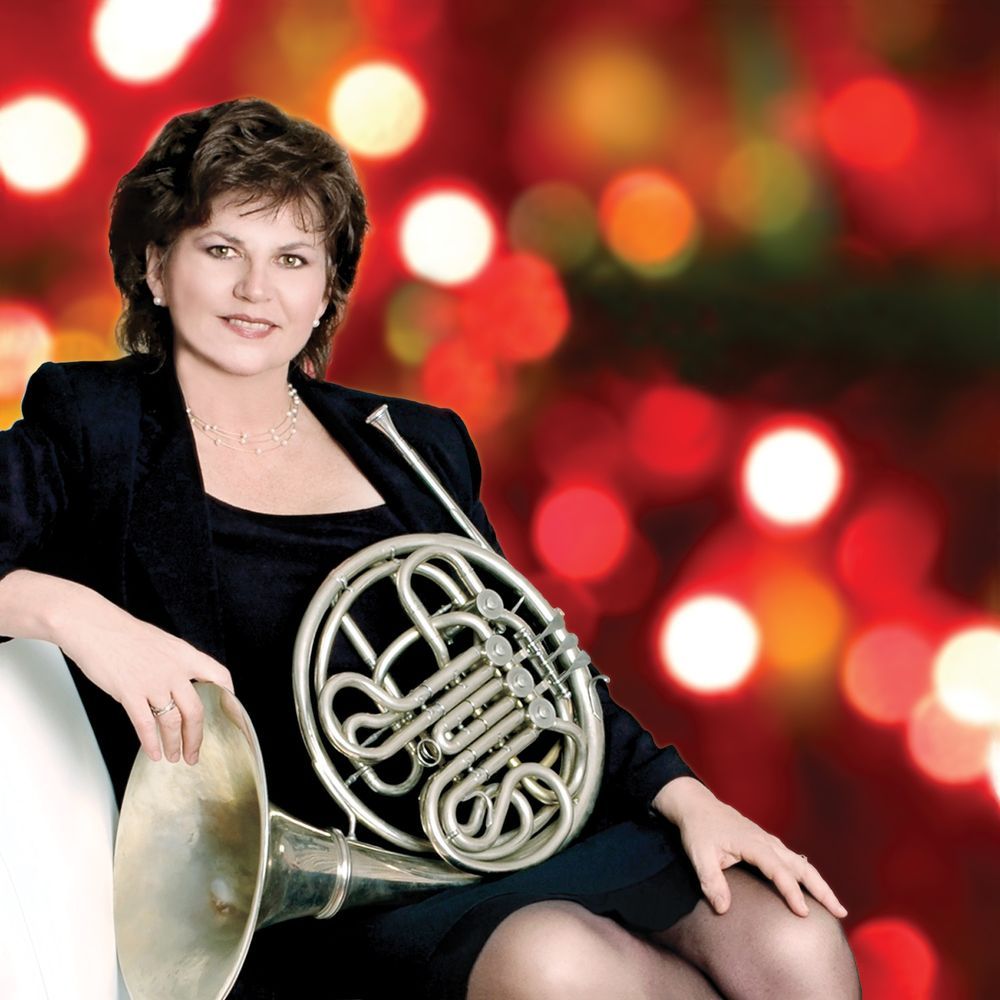
p24bIf that isn’t sufficient evidence of how the role of women in bands has changed, consider this. The next International Women’s Brass Conference will be held June 16-20, 2010, in Toronto at Humber College. This annual conference was founded in 1993 by Susan Slaughter, principal trumpet of the St. Louis Symphony Orchestra who is retiring at the end of this season after 40 years of leading the brass section of that orchestra. In her honour, the conference has announced the 2010 Susan Slaughter International Brass Competitions. These competitions for women performers of all brass instruments will be held prior to the conference from June 13 to 16. The conference will be hosted by well known Toronto hornist Joan Watson and Denny Christianson, head of music at Humber College.

Most portions of the conference will take place at the Humber College Lakeshore Campus with concerts at the Assembly Hall a short distance to the East. The Grand Finale Concert of the conference, appropriately named “Brass Belles,” will take place at The Jane Mallett Theatre. It promises to be a spectacular pairing of some amazing IWBC Guest Artists and Toronto’s own Hannaford Street Silver Band. Look for more details in the June issue of The WholeNote. In the meantime visit their website, www.iwbctoronto2010.com.

Another item I was going to talk about was migrating back to orchestral playing after years of playing in concert bands. However, I’ve run out of space – more on that in a future issue. Let’s hear your stories.

Definition Department

This month’s lesser known musical term is CACOPHANY: “a composition incorporating many people with chest colds.”We invite submissions from readers.

Coming Events

• May 1, 7:15pm: Milton Concert Band presents “A Perfect Score – Music from Movies and Television.” St. Paul’s United Church.

• May 1, 7:30pm: Orillia Wind Ensemble presents “Last Night
of the Proms.” Rule Britannia, and other classics. Roy Menagh, director, with the Cellar Singers. Orillia Opera House, 20 Mississaga St. W., Orillia.

• May 2 and 9, 3:00pm: Wellington Winds presents “The Sun Never Sets on the British Empire.” Works by Vaughan Williams, Elgar, Grainger, Cable, Benjamin and others. Daniel Warren, conductor; Michael Purves-Smith, oboe. First United Church, 16 William St., Waterloo.

• May 7, 8:00pm: Etobicoke Community Concert Band, John Edward Liddle, conductor present “Glorious and Free,” a programme of marches, anthems and songs. A musical tribute to our Canadian military featuring Kathy Thompson, guest vocalist. Silverthorn Collegiate Auditorium, 291 Mill Road, Etobicoke.

• May 15, 2:00pm: Northdale Concert Band, with conductor Stephen Chenette, pays tribute to legendary Canadian composer and trumpet player Johnny Cowell. The concert will feature some of Cowell’s most famous solos as performed by well-known trumpet player John Edward Liddle plus a special guest appearance by Johnny Cowell himself. Scarborough Civic Centre, 150 Borough Drive. Admission free.

• May 15, 7:30pm: Festival Wind Orchestra offers “Spring into Summer,” Keith Reid, conductor. Jarvis Collegiate Institute.

Down the Road

• June 20, 3:00pm: Hannaford Street Silver Band presents “Brass Belles” with brass band showpieces by international composers, performed by an all-female cast of soloists and led by guest conductor Gillian MacKay, Jane Mallett Theatre, St. Lawrence Centre.

Jack MacQuarrie plays several brass instruments, and has performed in many community ensembles. He can be contacted at: bandstand@thewholenote.com.

Live music is the red thread that ties the club listings together, but the ever-expanding list contains everything from extravagant to unpretentious, from dance hall to pool hall. To help plan your next outing, in the spotlight this month are places where dancing and dining are ideal.

Feet first

Dovercourt House: Dancing is the main attraction at the Dovercourt, where Swing Toronto (aka “Odd Socks”) gives happy feet a chance to dance every Saturday! Sensational swing bands set the scene every Saturday from 9:30pm-1am, preceded by two beginner dance classes at 7pm. $13 for unlimited dancing, $15 including one class, $18 includes both classes. On Saturday May 29, a non-profit tribute to influential American dancer, instructor and choreographer Frankie Manning (1914-2009), one of the founding fathers of Lindy Hop. www.odd-socks.org

The Reservoir Lounge: The charming “Res” is one of Toronto’s historic jazz venues, and the only one with a dance floor to boot. Known for being Michael Buble’s old stomping ground back in the day, this club is where you can find great jazz, jump blues, and boogie woogie including endearing acts like Sophia Perlman and the Vipers on Monday nights, Bradley & the Bouncers on Wednesdays and Tyler Yarema every Tuesday and Saturday Night. The fantastic fusion menu is very much worth mentioning and so is the mouth-watering martini selection! www.reservoirlounge.com

Lula Lounge: Lovers of world music will embrace the Lula World festival from May 5 to 30. If your mom likes to dance, don’t miss Mother’s Day brunch on May 9 with the incomparable Luis Mario Ochoa and his Cuban Sextet, followed that evening by a passionate concert with vocalist Eliana Cuevas featuring Luanda Jones. A double bill on May 12 unites eclectic vocalist Yvette Tollar and Serbian saxophonist Jasna Jovicevic. On May 22 musical director Sean Bellaviti presents Viva Celia: a tribute to the Queen of Salsa, Celia Cruz. Full details on this extraordinary multicultural extravaganza at www.lula.ca

Hungry? Famished? Pregnant? Craving?  Hear live music here

Aquila Restaurant: Passionate about good food, owner and Chef Jose Corniellis smokes meat the old fashioned way using natural wood, and sticks to organically grown produce. Entrees on the extensive menu include bison striploin ($19.95), naturally smoked salmon ($18.95) and Australia rack of lamb ($25.50); plenty of lunch specials and weekend brunch. Stay for live jazz every Saturday night including “Bari’d Alive” with Anthony Terpstra and Phil Skladowski on the last Saturday of every month. www.torontorestaurants.com/aquila

Ten Feet Tall: This east side eatery is a significant source of good times, thanks largely to its tastefully creative menu. Savoury items include Chicken Imperial ($14), Pad Thai ($14), make your own pizza and the popular new, Mac ‘n’ Cheese Boutique! Live music fits well with the funky décor in this vibrant Danforth spot; Saturday night cabarets go from 8-10pm and Sunday afternoon jazz matinees go 3:30-6:30, no cover charge, reservations encouraged.

Plum 226: Formerly the Anabella Lounge, this charming new Cabbagetown room is under new management and has recently reopened after renovations. Below the restaurant, the intimate 30-seat lounge has much to boast: an appetizing Italian menu, friendly service, stellar atmosphere and priceless live music. Romantic, elegant and reasonably priced, this is a great date destination! Exquisite tapas, pizzas and pastas, and mains including Atlantic Salmon ($20) and Sea Bass ($23). Catch the Lisa Particelli Trio on Friday May 21, No Cover, 8-11pm. Norman Marshall Villeneuve plays the last Friday of every month.
www.plum226.com

Happy Birthday To NMV: Speaking of Norman Marshall Villeneuve, the veteran jazz drummer celebrates his 72 birthday at The Pilot Tavern on Saturday May 29th from 3:30-6:30pm.
www.thepilot.ca

Rarities & Reservations

Funny how some patrons seem to have reservations about making them. Or perhaps, they forget. In any case, to avoid disappointment, be sure to buy your tickets or book your seats in advance. The following rare appearances are definitely worth reserving for:

p46The Old Mill: Thursday May 13, 7:30-10:30pm, experience the world-renowned talents of the Peter Appleyard Quintet in the Old Mill’s Dining Room. British by birth, Appleyard made Canada his home in 1951 and has since enjoyed a glorious career as studio musician and television personality. At 82, he still swings like nobody’s business. Joining Appleyard in concert will be four fine gentlemen of jazz: guitarist Reg Schwager, pianist John Sherwood, bassist Neil Swainson and drummer Terry Clarke. $35 Cover. Also at the Old Mill this month, on May 7 and 8, a two-night stint with gifted pianist, vocalist and composer Laila Biali at the Home Smith Bar with bassist Jordan O’Connor and drummer Ben Wittman. www.oldmilltoronto.com

Chalkers Pub: Saturday May 15 from 6-9pm, don’t miss a rare club appearance by seasoned vocalist Lisa Martinelli, an expert jazz educator at Humber College, The University of Toronto and formerly York University. She’ll be accompanied by Adrean Farrugia on piano, Pat Collins on bass and featuring Kevin Turcotte on trumpet. $10 Cover. Also at Chalkers Pub, don’t miss two Donny Hathaway Tributes this month starring the sensational Michael Dunston Sundays May 2 and 16 from 7-10pm, $20 cover, available online at ticketweb.ca or by calling 1-888-222-6608. www.chalkerspub.com

Hugh’s Room: Tuesday May 18 starting at 8:30pm soulful vocalist Sacha Williamson showcases her heartfelt music heard all too rarely in this city. Tickets are $15 in advance, $18 at the door…you know the drill! www.hughsroom.com

Speaking of buying your tickets in advance, the TD Canada Trust Jazz Festival has announced the lineup for this year’s edition, and certain shows are bound to sell out. Headliners include: Nikki Yanofsky (June 25), Herbie Hancock Imagine Project plus Brandi Disterheft (June 26), Harry Connick Jr. (June 27), Stanley Clarke Band featuring Hiromi (June 28), Dave Brubeck Quartet (June 29) and Keith Jarrett with Gary Peacock and Jack DeJohnette (June 30). Full details available at www.torontojazz.com

jazz@thewholenote.com.

For most Canadians, the event of the year so far has been the Winter Olympic Games in Vancouver. By an unanticipated quirk, the massive media coverage of the games spawned the overnight evolution of our national anthem into an international pop song of sorts. Canadians were joined in the spontaneous rendition of O Canada in the spectator seats at the events and in the streets by visitors from around the world. It even made its way on to more than one late night American TV show.

For me, this sudden unprecedented attention to the national anthem, and the not-infrequent controversies surrounding some performances, put my curiosity into overdrive and spawned a series of questions. What were the origins of national anthems in general, and Canada’s in particular? What should be the criteria for a good national anthem? How and where should the national anthem be performed? Should all those present at an event sing or should it be left to a soloist? Should a soloist be permitted to improvise on the melody? How should our citizens behave during its performance? Who wrote the music? Who wrote the words? Are the words appropriate, or should they be changed to placate the wishes of various interest groups? And so it goes.

According to most authorities, national anthems had begun to appear in a number of European countries by the beginning of the 18th century. However, the practice of having a government designate a particular patriotic song as the country’s official anthem didn’t become widespread until late in the 19th century. As for criteria for a good national anthem, the general consensus is that it should have a good melody, meaningful words, be easy to remember and easy for the average individual to sing.

As for Canada’s national anthem, like the country’s progress to nationhood, the process was evolutionary rather than revolutionary. As early as 1836 we had a list of acceptable patriotic songs. Over the years, O Canada, The Maple Leaf Forever and God Save the Queen came to the fore as leading contenders. It wasn’t until 1964 that Prime Minister Lester Pearson proposed some government action to proclaim an “official” national anthem. By 1967 a parliamentary committee unanimously recommended that O Canada be so designated. It wasn’t until June 27, 1980, three days after the one hundredth anniversary of its first performance, that parliament passed the bill making it official. It was actually signed into law on July 1, 1980 as part of that year’s Dominion Day celebrations (Now changed to Canada Day).

The song O Canada was originally commissioned by the Lieutenant-Governor of Quebec, the Honourable Théodore Robitaille, for the 1880 Saint-Jean-Baptiste Day ceremony. Calixa Lavallée wrote the music, which was a setting of a patriotic poem composed by the poet and judge Sir Adolphe-Basile Routhier.

Calixa Lavallée was born in Verchères Quebec in 1842, studied for a while in Paris and eventually settled in Boston. He was well regarded in his day as a performer, composer and conductor, and performed regularly throughout North and South America.

The original lyrics were in French, and it wasn’t until 1906 that they were translated into English. While the original French words have remained unchanged and spared from tampering over the years, the same can’t be said for English words. Two years after the original literal translation appeared, Robert Stanley Weir wrote another English version, one that is not a literal translation of the French. In October 1969 the government accepted the offer of publishers Gordon V. Thompson to sell to the Crown, for the sum of one dollar, the copyright to the Weir words for O Canada. Weir’s lyrics have been “officially” revised by parliament at least twice. On a number of occasions, the 1980 version has been under attack by special interest groups.

With Olympic fervour running high, Prime Minister, Stephen Harper suggested that he might legislate the words “all our sons command” out, in favour of more “gender neutral” wording. It didn’t take long for the Prime Minister to beat a hasty retreat from that front when the responses from many quarters came thundering in. Some of the most interesting came from Ottawa correspondents for news organizations. One such response was the suggestion that the idea had been hatched by a group from the Prime Minister’s office while hung over after celebrating the victory of the Canadian men’s hockey team.

Canada’s only woman Prime Minister, Kim Campbell, also stepped into the fray. She did not just want the words “all our sons command” changed to something “gender neutral”. On a national radio interview she objected to “our home and native land,” and suggested that be changed to “our home on native land.” That did not sit well with all people born here, whose ancestors arrived a few centuries ago before Canada was a nation. In any case, for now at least, the storm on words has subsided. When it might return is anyone’s guess.

The criterion of being easy for the average individual to sing is certainly not a characteristic found in the US Star Spangled Banner. This may be the reason why it has become the norm at major sporting and cultural events in the US to have a soloist sing the national anthem. Perhaps the original intent was to have the audience join in with the soloist providing a solid base. Unfortunately, that is rarely the case. Which brings up a pet peeve of mine, that of a soloist improvising on the melody. In some cases this might better be described as butchering the melody.

One reader of a small town community newspaper summed up his reactions to the rendition at the official opening of the Olympics as follows: “Is it just me or is there anyone else tired of hearing our national anthem twisted into some artistic ego trip? There should be a level of respect required by the artists selected to represent us on the international stage. A performer or an event organizer has no right to re-work the song. It is not open to interpretation.”

He then goes on: “The publicity of the moment should be enough of a thrill and a boost to a performer’s career without the need to hijack a country’s national anthem. If they wish to put their own spin on the song, they can do so on their own album and take their chances on whether the consumers appreciate it.” I concur. Any organization engaging the services of a vocalist to perform the national anthem should write into the contract that the “official” melody is not to be changed in any manner.

At some stage somewhere around 1900 it had become the accepted custom to have a “national song” performed prior to every concert, theatrical production and other similar public event. In fact, the city of Toronto for many years had by-law requiring such a performance. That by-law was not abolished until 1967. For most community bands the national anthem is an integral part of most programmes. On the other hand, I can’t recall ever hearing it at any community orchestra performance. Why the different standard?

Next month we’ll be back to the community music scene after the huge Hannaford Brass Band Binge. We also hope to have a better look at the Johnny Cowell tribute concert next month.

Definition Department

This month’s lesser known musical term is APPROXIMENTO: “A musical entrance that is somewhere in the vicinity of the correct pitch.” We invite submissions from readers.

Coming Events: See the listings section for full details.

Weekend of April 9, 10 and 11: The Hannaford Street Silver Band presents its seventh annual Festival of Brass at the St. Lawrence Centre. See listings for details.

Wednesday, April 14 7:30: The Plumbing Factory Brass Band, Henry Meredith, conductor, presents “Heros – ordinary and extraordinary.” Byron United Church, 420 Boler Rd., London, Ontario.

May 7 8:00 pm: The Etobicoke Community Concert Band, John Liddle, conductor, presents “Glorous and Free,” a programme of brilliant marches, grand anthems and beautiful songs – a stirring musical tribute to our Canadian military featuring Kathy Thompson, guest vocalist. Silverthorn Collegiate Auditorium, 291 Mill Rd.

Down the Road

Saturday, May 15 2:00 pm: The Northdale Concert Band, with conductor Stephen Chenette, pays tribute to legendary Canadian composer and trumpet player Johnny Cowell. The concert will feature some of Cowell’s most famous solos as performed by well-known trumpet player John Edward Liddle, plus a special guest appearance by Johnny Cowell himself. Scarborough Civic Centre, 150 Borough Dr.

Jack MacQuarrie plays several brass instruments, and has performed in many community ensembles. He can be contacted at: bandstand@thewholenote.com.

When Curtain Call Players’ production of Titanic sails into Fairview Library Theatre on April 1 for a two-week run, you will have a great opportunity to hear Maury Yeston’s sweeping score in all its majesty and beauty. You had a similar opportunity four years ago, when Civic Light Opera presented the show in the same theatre, but there is one crucial difference this time around: whereas CLOC used a full 18-piece orchestra, in the Curtain Call production there won’t be a live musician in sight – or out of sight either, for that matter.

Every community theatre group has choices to make regarding the music itself whenever it stages a musical, and the issues aren’t necessarily simple. What type of show is it? What size show will it be? What’s the orchestration? Are reduced versions available? What shape and size is the theatre space, especially the backstage facilities? What’s the orchestra budget? How many players can you afford? How good are they? How tough is the score?

Generally speaking, there are four options. Go with the original orchestration, or, if it’s too large, with as many players as you can accommodate and/or afford. Go with a reduced orchestration, if there is one. Use a small combo, with just the critical instruments covered, keyboard only. Use a pre-recorded track, usually synthesizer

This last option has always been viewed by virtually everyone – and not just the musicians – as quite literally the last choice. Apart from the huge issue of sound quality, the major problems have been always been the lack of atmosphere and – most crucially – the inflexibility of the recorded track. A singer misses a verse? Tough. You want the tempo to pick up when the show is really jumping? Sorry. Need an emergency vamp for a few bars? Nope.

With the huge developments in music technology over the past few decades, especially in the professional Broadway and West End theatres, it was surely only a matter of time before the community theatre world was forced to address the issue of pre-recorded show scores. Sound and lighting have embraced computer technology, so why should the orchestra pit be considered sacrosanct?

Is this really the way of the future, though? Are theatre musicians really a doomed species, dinosaurs waiting for the technological asteroid to crash into their planet and change their world for ever? A production of Titanic seemed the perfect invitation to explore the issue – after all, the eight musicians on the original ship played on to the very end, despite the knowledge that they were almost certainly doomed.

For Keith O’Connell, founder and artistic director of Curtain Call Players, the cost of a full orchestra, perhaps surprisingly, was not the major consideration – in fact, he will be spending more on the music by not having one. His production values for this show are high, with a two-level 40-foot wide set that uses hydraulics to tilt 6 feet in the second act, and it wouldn’t have been possible to put a full orchestra either on stage or in the wings.

Moreover, he didn’t want to. Maintaining the integrity of the set and the score were key considerations, and while a big orchestra would also have been wrong for the period, a small orchestra would have been unable to do justice to the score.

The solution? Sinfonia!

Sinfonia, which CCP also used for their recent production of Cats, is a technology developed by Realtime Music Solutions of New York, and provides either full orchestra or orchestra enhancement capability for all levels of music theatre. It runs the gamut from the top-of-the-line Sinfonia Grande (for professional touring productions and theatres) through Sinfonia Molto (for smaller spaces) and Sinfonia Mezzo (for regional and community theatre) to Sinfonia Piccolo, which offers lap-top orchestra enhancement for amateur and community groups.

What is so hugely significant about it, though, is that it has apparently solved all of the problems associated with pre-recorded music: it sounds great; it’s flexible; it will vamp on the fly; it will jump back to a certain bar number; it will transpose; you can use live musicians with it and mute or unmute instruments of your choice; it has tempo variation and control, and can follow a conductor and the constantly-changing nuance during a live performance.

Two of the three major rights organizations have warmly embraced the new technology, both Music Theatre International and the Rodgers & Hammerstein Organization now have alliances with RMS, and their own specialized systems. MTI currently offers OrchExtra for 20 of their shows, while R&H have AccompanEase for rehearsal/practice purposes, and InstrumentEase as a performance enhancement tool for a whole range of top shows, including most of the Rodgers & Hammerstein classics.

Ironically, the only one of the three organizations that apparently has no interest in pre-recorded music of any description being used in their shows is Tams-Witmark – the rights holder for Titanic! The orchestration is already available on Sinfonia, however, with composer Maury Yeston’s full approval, and after checking with Yeston Tams-Witmark agreed to make an exception and allow CCP to use the system in their upcoming production.

Not that it is saving O’Connell any money: not only will CCP be paying over $3,000 for the Sinfonia system rental, but they will also still have to pay Tams-Witmark for the orchestral parts rental even though, says O’Connell, “We won’t even get to open the box!”

It’s difficult to see live music completely disappearing from the community stage – apart from anything else, pre-recorded systems are clearly not going to save anyone any money in the short run – but groups are obviously now going to have more options when it comes to the sound of the music they present to their audiences.

If you have the chance, go and see Titanic at Fairview: you will hear Yeston’s score in all its glory, and it may well be a sneak peak at the future of community musical theatre as well. Curtain Call Players production of Titanic runs April 1, 2, 3, 4, 8, 9 & 10 at Fairview Library Theatre; tickets are $24 from (416)703-6181 or curtaincalltickets@hotmail.com.

Terry Robins is a musician and musical theatre enthusiast. He can be contacted at: musicaltheatre@thewholenote.com.

eisenmanKey www.jazzpiano.com into your browser and you’ll be in youtube heaven. By clicking backspace twice and adding an “eh” to produce www.jazzpiano.ca, you’ll be linked to one of Canada’s most treasured jazz pianists, Mark Eisenman. The New York native has been Toronto-based since 1972, and has previously worked with Lew Tabackin, Barney Kessell, Ed Bickert, Rob McConnell and Pat LaBarbera. A top-notch vocal accompanist and long time jazz educator at York University, he’s often found “in any situation where taste, feel, and a jazz sensibility are important.” 

The cruelest month finds Eisenman fairly busy: on April 9 he accompanies vocalist Arlene Smith at the Old Mill; on the 11th he’s part of a tribute to Louis Armstrong at Christ Church Deer Park; on the 15th he plays solo piano at the Palais Royal Ballroom for the Houselink charity Auction; on the 17th his trio headlines the Piano Masters Series at The Old Mill; on the 24th his trio plays Roy Thomson Hall as part of the “Spirit of Toronto Whiskey Show”; and on the 25th his trio is back at Christ Church Deer Park. See our concert listings and jazz club listings for more details.

Being busy is good for the uncompromising Eisenman, a pianistic purist who won’t settle for electronic keyboards. His passion for the acoustic pervades Pianos are Orphans, a spirited rant he wrote and sent to us about “the problem with pianos.” At the root of the problem, he says, is having to  hire “highly trained crafts-people to even tune the instrument.” He also details the neglect the instrument suffers: “Drinks have been spilled on it, it has been sitting near a heat source, without climate control … it has been treated like a piece of furniture, not a highly complex musical instrument. No one is responsible to it, and for it. The only people who can speak to its condition have a great incentive to keep their respective mouths shut. After all, managers don’t want to hear about something that will just cost them money, especially when they can’t hear the difference.” (You can read Eisenman’s entire text online at www.thewholenote.com.)

The following excerpt from Pianos are Orphans has haunted me for weeks now: “You can see the problem. A piano in a public venue is an orphan. It’s not just an orphan. It’s a poor, neglected, abused, fetal alcohol syndrome, crack baby that grows into one pathetic old beast that can break your heart.”

Is Eisenman overdramatizing just a little?  The sad truth is, not much. To echo Jim Galloway, Toronto today is not what it used to be, and this is certainly true in terms of piano rooms. It is sad to note that in the entire WholeNote jazz club directory which has now surpassed 60 locations in Toronto where you can regularly find live jazz, it’s hard to come up with a dozen of them that offer an acoustic piano that’s even remotely in tune.

Here then are ten recommended live music venues where you can find jazz played on an acoustic piano, accompanied by April highlights:

              Lula Lounge: Artist, musician, actor, and spectacular poet Don Francks (www.donfrancks.com) will wow with pianist Steve Hunter on Thursday April 15 starting at 8:00 pm. Priceless Francks will be followed by Word Jazz: original poetry set to music, performed by Dale Percy, Chris Hercules and Jaymz Bee. $20 general, $10 for students.

              Hugh’s Room: Legendary Danish harmonica player and manufacturer Lee Oskar (www.leeoskar.com) is showcased with the David Rotundo Band on Wednesday, April 21 starting at 8:30pm. Oskar is heralded as one of the world’s greatest rock-blues-soul harmonica players. This show will likely sell out at $25 in advance, $30 at the door.

              The Old Mill: “Mays at the Movies” starring legendary New York pianist Bill Mays (www.billmays.net) with bassist Neil Swainson and drummer Terry Clarke, as part of the new Thursday Night Jazz Club series at The Old Mill. April 22 at 7:30pm, $30 Cover, no minimum.

              Chalkers Pub, Billiards & Bistro: Shannon Gunn Quartet on Saturday, April 10, 6:00-9:00pm, featuring Brian Dickinson (piano), Neil Swainson (bass), Ethan Ardelli (drums), with the leader on voice. Originally from the West Coast, Gunn is a highly sought-after educator who understands and feels jazz in a profoundly deep manner. $10 Cover.

              Axis Gallery & Grill: Located in the Junction, this art hub is where you can find Juno-winning Blues singer/pianist Julian Fauth (www.julianfauth.com) with bassist James Thompson every Saturday and Sunday from 12:00-3:00pm. The piano’s far from faultless, but Fauth’s magic touch is formidable.

              stacey bwN’Awlins: Live jazz nightly in this cozy, elegant King West spot where magnificent Stacey McGregor (www.staciemcgregor.com) plays solo piano every Tuesday from 7:00-11:00pm.

              The Rex Hotel, Jazz & Blues Bar: The Richard Whiteman Trio (www.myspace.com/therichardwhitemantrio) plays every Wednesday this month, 6:30pm. Whiteman is a great player who always solos with gusto. He’s also one of the charming Hogtown Syncopators who lighten up the Rex every Friday from 4:00-6:00pm. Pay what you can, generous people!

              The Pantages Martini Bar & Lounge: Fridays at the Pantages Hotel find the always impressive Robert Scott (www.robertscottmusic.com) paired with positively outrageous Great Bob Scott (www.myspace.com/greatbobscott). Now that’s entertainment!

              Gate 403: Dazzling songstress Gillian Margot (www.gillianmargot.com) delivers the goods at the Gate on Sunday April 11 at 9:00pm with Stu Harrison on piano and Jordan O’Connor on bass.

              Ellington’s Music & Café: Good mornings with Ben D’Cunha (www.bendcunha.com) playing piano and singing at this artsy St. Clair West hang, weekdays from 9:00-10:00am. Yup, you read right.


Have I left out a grand piano room? Send me a note by emailing jazz@thewholenote.com and I’ll do my best to mention it next time.

Finally, still speaking of pianos, don’t miss out on what Jane Bunnett calls her “most important and exciting concert in 20 years” when Art of Jazz presents a very special event at Koerner Hall, April 17 at 8:00pm. Flutist and soprano saxophonist Bunnett will be joined by three generations of Cuban Piano Masters: Hilario Duran, Elio Villafranca and 83-years-young Guillermo Rubalcaba. Tickets range from $20-50 and are available at www.rcmusic.ca. For what promises to be a harmonious evening you can rest assured that those pianos will be in tune!


In the wake of Canada’s triumphant performance at the Vancouver Olympics, I can’t help but wonder: where are our live broadcasts of choral concerts, anticipated for months by the music press, watched by millions on television, attended live by thousands of screaming fans with “Tenors Rule and Basses Drool” scrawled across their naked chests?

I propose that Canada found the International Choral Olympics. Singers will be luxuriously sequestered in the Chorister’s Village and fed only the best coffee and cookies during rehearsal breaks. Gold, Silver and Bronze medals will be awarded in such events as loudest fortissimo in the last movement of Beethoven’s Ninth Symphony; most obscure languages learned phonetically over a six-week period; choir best able to sing a cappella without tuning problems. But the ultimate Choral Olympic event will be the Broadway Medley Marathon. Choirs able to prevail in this grueling contest could look forward to years of lucrative endorsement contracts with throat lozenge manufacturers and Andrew Lloyd Webber’s publishing company.

Of course, such potential riches could tempt choirs to cheat. Any winning ensemble will thus have to be carefully reviewed for unfair tactics such as extra rehearsal time, longer coffee breaks, illicit coaching in North German pronunciation of “ich” and most crucially, going home after dress rehearsal for a restful night’s sleep instead of convening at the pub for several hours. Such heinous practices will have no place in the Choral Olympics.

I challenge choral enthusiasts to envision a Canada in which a young boy grows up dreaming not of being the next Sidney Crosby, but a member of the bass section of the North Woodchuck, Sask. Community Chorale. Let us build this dream together!


Down to Earth

Becca Whitla 3In the meantime, choirs continue to compete for our ears in upcoming weeks. Several groups present spring and Earth-themed concerts. The University of Guelph choirs present “Force of Nature” (April 11); the Annex Singers perform excerpts from Orff’sin “Songs of the Earth” (April 17);Hamilton’s John Laing Singers present “Spring’s Joy” (April 24); and the Echo Women’s Choir, Povera Chamber Choir and Holy Trinity Choir combine in a massed celebration of Earth Day entitled “Hymnody of Earth: A Ceremony of Songs for Choir,
Hammer Dulcimer and Percussion” (April 17).

There are also several choices for Good Friday and Easter (several notable concerts were mentioned in last month’s column – please go to www.thewholenote.com to read about them). On April 2, the Toronto Mendelssohn Choir performs “Sacred Music for a Sacred Space.” On the same night, the Newman Festival Chorus and Orchestra present Bach’s St. Matthew Passion. The Elmer Iseler Singers play catch-up on April 7 with “The Glory of Easter.” Other Good Friday evening concerts are by the All Saints Kingsway Anglican Church Choir in Toronto, the Cantabile Chorale of York Region in Thornhill, and the Durham Community Choir in Oshawa.

Themed concerts include the Brampton Symphony Orchestra Chorus in an all-French programme entitled “La Vie en Rose”: (April 1), and Toronto’s Kir Stefan Serb Choir’s “Slavic Sacred And Traditional Music” (April 24). In Bradford, Achill Choral Society sings movie music in “Sounds of the Silver Screen” (April 24-25). On April 25 the Elora Festival Singers present cabaret and theatre music in “Spring Fever.”
For those who like to see choral singers unleash their inner diva or divo, two opera-centred concerts are given this month by the Kingston Choral Society and Kingston Symphony Orchestra (April 25) and the Toronto Mendelssohn Choir (“A Night at the Opera,” April 28).

Toronto’s Cantemus Singers present an intriguing programme entitled “The Fairer Sex: A celebration of women in Renaissance madrigals and motets” (April 17-18). Combining music that praises female saints and holy women with some deliciously salacious and decidedly secular madrigals, this sounds like a ideal programme to which one might bring a date.

For those interested in large scale works: the NYCO Symphony Orchestra and Chorus perform Beethoven’s Mass in C (April 10). On the same night, Amadeus Choir celebrates its 35th anniversary season with an all-Mozart programme that includes the D minor Requiem and his lesser known Vespers. The latter work, one of two Vespers settings by Mozart, is a true gem, preferred by many to his Salzburg masses.

Catherine Robbin 1The Mozart Requiem is also being performed by Hamilton’s Central Presbyterian Church choir on April 2, and by the Pax Christi Chorale on April 24-25. The King Edward Choir performs a winning combination of Mozart’s Mass in C Minor and Poulenc’s Gloria in Barrie (April 10) and the Mississauga Choral Society sings Fauré’s Requiem (April 11). Cantores Celestes Women’s Choir perform Pergolesi’s luminous Stabat Mater on April 17. A portion of proceeds from this concert will go to the Because I am a Girl foundation.

As an alternative to lengthy works, choirs often combine smaller scale works in pleasing and varied programmes. On April 10, the Healey Willan Singers.offer a mixed programme in Toronto, while the Georgetown Bach Chorale and Chamber Orchestra perform various works by Vivaldi in a concert that also includes the composer’s well known Four Seasons. Similarly styled concerts are given by the Voices Chamber Choir (April 17) and the Tactus Vocal Ensemble (April 18-19). A combination hymn-sing and concert is given by the Glenview Choir and North Toronto Salvation Army Band (April 25).

Spring also affords us an opportunity to see what the next generation of choral singers has been working on this year. The Church of St. Simon-the-Apostle hosts a “Young Musicians Showcase” on April 16, in a fundraising concert. The Viva! Youth Singers perform a free noon-hour concert (April 7). The Toronto Secondary School Music Teachers’ Association presents band, string, and choral students in the “59th Annual Sounds of Toronto Concert” (April 15). The Oakville Children’s Choir hosts four other boys choirs in a concert entitled “Let the Boys Sing!”(April 17). And the Toronto Children’s Chorus performs “All Creations Sing,” featuring a rare appearance by revered mezzo-soprano Catherine Robbin (April 1).

Finally, on April 17, “Singing Together: A Celebration of Cultures” assembles a panoply of choirs worth listing in their diversity: the Caribbean Chorale of Toronto; Toronto Maple Leaf Chorus; CroArte Chorale; Chinese Canadian Choir of Toronto; Schola Cantorum; Edelweiss Chor; Nayiri Armenian Choir; Coro San Marco; and Creative Notes. Such a concert, which could only take place in sprawling, multicultural Toronto, suggests that we already have a pan-cultural choral Olympics of our own well under way.


Benjamin Stein is a tenor and theorbist. He can be contacted at: choralscene@thewholenote.com.
 

Spring is here – and by association I think of people in the spring of life, who are well represented in The WholeNote’s listings this month.


Lang Lang 2International Touring Productions brings the Slovak Sinfonietta, conducted by Kerry Stratton, to Toronto and six other cities in Southern Ontario in late April and early May. With the orchestra will be two pianists: Haiou Zhang, who will perform Beethoven’s Piano Concerto No.5 in E Flat (the “Emperor”); and Elaine Kwon, who will play Rubinstein’s Piano Concerto No. 4. Both pianists are young artists, still in their 20s.

There’s yet another orchestra visiting from Europe this month, the Schleswig-Holstein Festival Orchestra, which according to its websiteis comprised of the world’s finest young musicians under the age of 27, hand-picked through a rigorous auditioning process.” The young musicians are given an extraordinary opportunity to grow together as an orchestra under the direction of principal conductor Christoph Eschenbach, in a community setting based on “mutual understanding, respect, tolerance and awareness of the universality of music and life beyond it.”

The Toronto stop on their first North American tour will be at Roy Thomson Hall on April 6. On their programme will be Mozart’s Piano Concerto No.17 in G K453, performed by Lang Lang – who, speaking of youth, is only 27. I recently read on his website that when he was only two years old, he saw a Tom and Jerry cartoon on TV, in which Tom was attempting to play Liszt’s Hungarian Rhapsody No. 2 in C-Sharp Minor. This first contact with Western music at this incredibly young age is what motivated him to learn piano! I hope the creators of Tom and Jerry have come across this story!


The Kitchener-Waterloo Symphony Orchestra’s three concerts on April 23, 24 and 25 are called simply, “Zeitouni Conducts Brahms.” At a relatively young age, Jean-Marie Zeitouni, another product of the fertile musical soil of Quebec, was appointed associate conductor of Les Violons du Roy. With a long and impressive list of guest conducting appearances to his credit, including the Toronto Symphony Orchestra, he has become a big enough name to draw audiences.


Sibelius at the TSO

The Toronto Symphony Orchestra has put together an ambitious Sibelius Festival, highlighting the orchestral music of Finland’s most famous composer. Over the course of five performances, taking place from April 14 to 22, all seven of Sibelius’ symphonies will be performed, as well as several lesser-known works for violin and orchestra. Guest conductor Thomas Dausgaard will be on the podium for the whole week – no stranger to the TSO or Toronto audiences. The featured violin soloist will be Pekka Kuusisto, the first Finn ever to win the International Jean Sibelius Violin Competition. He’s no stranger, either: Kuusisto played with the TSO in September 2008, and he’s also appeared in recital at Hart House.


“Spring” Quartets

Martin_BeaverA frequent visitor to Toronto, thanks to Music Toronto, is the Tokyo String Quartet. While the quartet’s genesis was in the 1960s at the Toho School of Music in Tokyo, and it has been quartet-in-residence at Yale University since 1976, it also has a strong Toronto connection through Martin Beaver, its first violinist. When you hear the Tokyo String Quartet, you are hearing not only one of the best string quartets in the world, but also “The Paganini Quartet,” a set of Stradivarius instruments named after the legendary virtuoso Niccolò Paganini, who acquired and played them during his illustrious career. The Tokyo String Quartet will perform Beethoven’s Quartet in C Major Op. 59 (“Razumovsky”), the Quartet in E-flat Major Op. 74 (“The Harp”) and the Quartet Op. 95 (“Serioso”) in Music Toronto’s last concert of the season, on April 10


There are several more fine opportunities to hear string quartets. Also on April 10, the Lindsay Concert Foundation presents the Cecilia String Quartet, and the Oakville Chamber Ensemble will perform string quartets by Mozart and Mendelssohn. On April 19, a quartet composed of members of the string section of the TSO will play quartets by Schubert, Beethoven and Brahms as part of the Associates of the TSO’s “Five Small Concerts” series. On April 25, Mooredale Concerts will present the Afiara Quartet, which some people think will be the next great Canadian string quartet. Flutist Robert Aitken, who needs no introduction to WholeNote readers, joins the Quartet in a Boccherini quintet, Alberto Ginastera’s Impresiones de la Puna, and Donald Francis Tovey’s Variations on a Theme by Gluck. The quartet will complete the programme with the Lyric Suite by Alban Berg and Mendelssohn’s Quartet in F minor. On April 29, the Silver Birch String Quartet will give a concert for the Kitchener-Waterloo Chamber Music Society.


Student Talent

Last but not least, there’s plenty of student talent to be heard in April. The Toronto Secondary School Music Teachers’ Association “59th Annual Student Concert” on April 15 stands out. Others are the university choir visiting from East Stroudsburg, Pennsylvania on April 9, the benefit concerts for the St. Simon’s and University Settlement music programmes on April 16 and 18 respectively, the Toronto Symphony Youth Orchestra on April 16, the Toronto Wind Orchestra on April 30 and the Toronto Children’s Chorus on May 1. On April 17 and May 2 respectively, the Canadian Sinfonietta and Arcady are presenting concerts showcasing young artists. The post-secondary music schools, of course, are hotbeds of music-making by young people – and even though many of the student ensemble concerts took place in March, there are still several in April. There are also student solo recitals at York University, the University of Toronto, Wilfrid Laurier, Waterloo, Guelph, Western, Queen’s and the Royal Conservatory’s Glenn Gould School.


Allan Pulker is a flutist and a founder of The WholeNote who currently serves as Chairman of The WholeNote’s board of directors. He can be contacted at classicalbeyond@thewholenote.com.

Back to top