11 A ClaudeÀ Claude
Benedetto Boccuzzi
DiG Classic DCTT111 (naxosdirect.com/search/8054726141112) 

Twentieth-century piano-repertoire specialist, Benedetto Boccuzzi (b. 1990), is not only a concert pianist but also a composer, improviser and teacher. He regularly performs in Italy and conducts workshops on contemporary piano repertoire, extended techniques and improvisation.

À Claude, Boccuzzi’s debut album, is an eclectic keyboard feast, featuring works by Claude Debussy, George Crumb, Toru Takemitsu, Olivier Messiaen, Diana Rotaru and Boccuzzi himself. The programmatic conceit of the album pays homage to Debussy, before moving on to a selection of the French maître’s musical heirs.

Beginning with three miniatures from Debussy’s Images: Cloches à travers les feuilles; Et la lune descend sur le temple qui fut; and Poissons d’or (1907); the album sets a relaxed, impressionistic atmosphere inviting the listener to let imagination roam. Boccuzzi then very effectively renders six of American composer George Crumb’s texture- and allusion-rich Makrokosmos I (1972-1973). This collection of aphoristic piano pieces describes the temperaments of the houses of the zodiac, famously using an encyclopedic range of colouristic effects including plucking the strings, producing massive tone clusters, coaxing overtones from depressed keys not played and directly quoting music of composers such as Chopin.

Three pieces of the Vingt regards sur l’enfant-Jésus (1944) by French composer Messiaen receive a muscular performance here, though sections of Regard de la Vierge exude a poignant cantabile quality. Particularly admirable is Boccuzzi’s precise rendering of the demanding birdcall references throughout.
Listen to 'À Claude' Now in the Listening Room

12 BlowBlow – Wind Quintets by Donatoni, Salonen & Lash
The City of Tomorrow
New Focus Recordings FCR294 (newfocusrecordings.com)

Part way through the sixth movement of Leander and Hero (2015) by Hannah Lash, a ghostly flute-like voice enters the texture. As the liner notes reveal, the sound is one player blowing across the open mouth of another. When it comes to unusual directions from composers, I apparently have neither seen nor heard it all. This new release, from the spectacularly capable woodwind quintet The City of Tomorrow, delights and amazes.

Put aside that in the current circumstances this would simply be an unacceptable breach of personal safety for both performers, the intimacy of the act demands trust and care, to say nothing of technical control of “embouchure” and/or “instrument.” It wouldn’t surprise me to learn the effect was overdubbed onto the track, but I’m willing to bet the players didn’t need to. Given how the rest of this disc is presented with complete assurance and musicality, a little thing like playing your colleague’s head like a jug in a jug band would hardly be beyond them. 

The title track, Franco Donatoni’s stutter-stepping Blow (2000), provides the players an opportunity to show off more conventional contemporary skills. I love his music, it’s always full of swing and fire, and this is no exception. The group’s sound is crisp, tart and sweet, like a perfect fall apple.

Esa-Pekka Salonen closes things with Memoria (2003), music reworked partly from unpublished material, composed over a period of 20 years, and compiled to celebrate the 20th anniversary of the Avanti! Chamber Orchestra, a group he co-founded. Angst-y Finnish melancholia suits the group to a tee.

Listen to 'Blow – Wind Quintets by Donatoni, Salonen & Lash' Now in the Listening Room

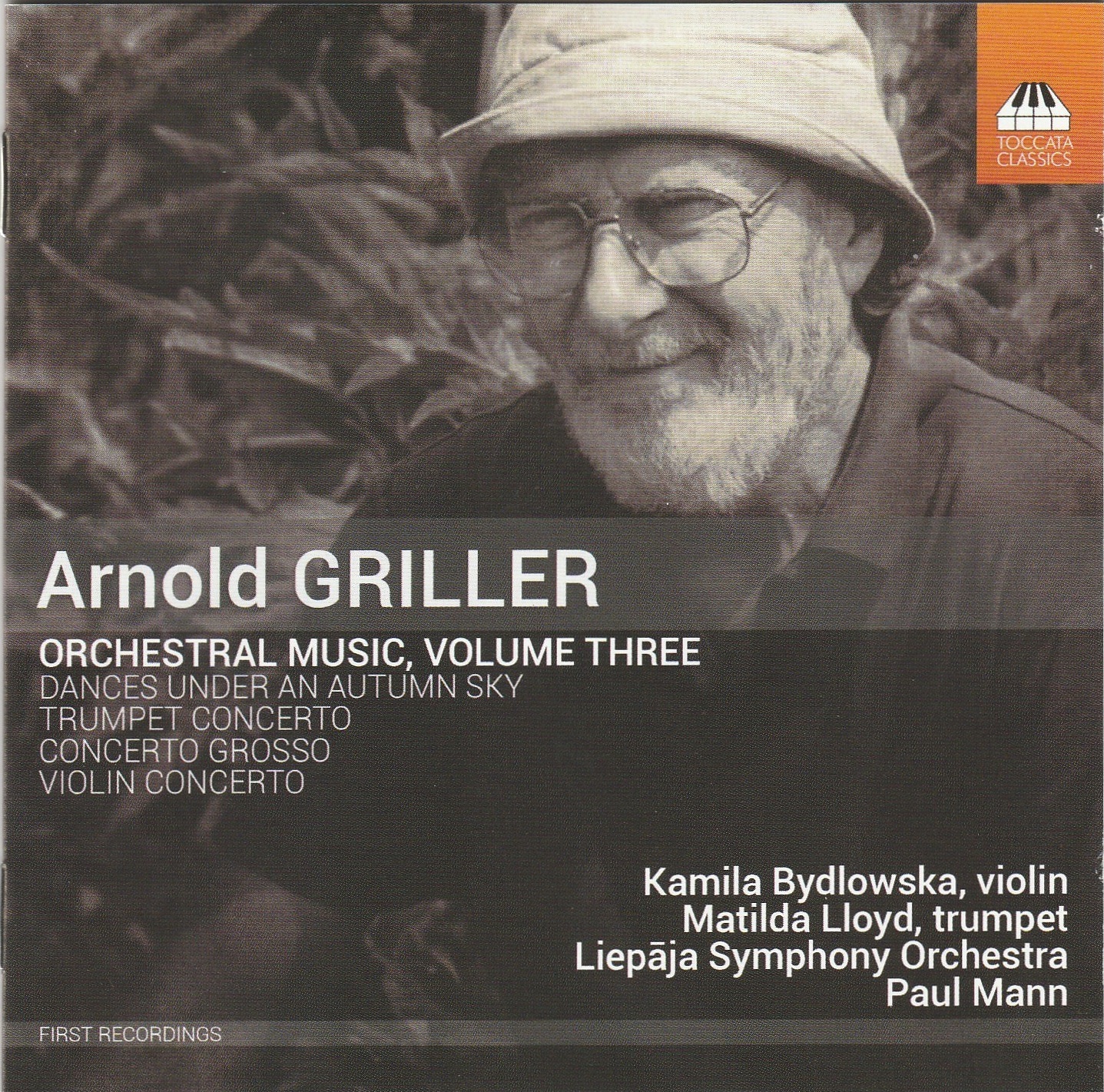
14 Arnold GrillerArnold Griller – Orchestral Music, Volume Three
Kamila Bydlowska; Matilda Lloyd; Liepaja Symphony Orchestra; Paul Mann
Toccata Classics TOCC0590 (naxosdirect.com/search/tocc0590)

In 1955, while studying composition with Darius Milhaud, Arnold Griller (b.1937 in London, England) wrote his 13-minute, Coplandesque Concerto Grosso for strings, filled with long-lined, brooding melodies. Griller’s father Sidney was first violin of the renowned Griller Quartet but, writes Douglas Finch, “Griller chose to withdraw from the musical maelstrom into which he was born and for most of his adult life has remained in relative seclusion.” Now living in a small Cornwall village, Griller even spent 25 years teaching ESL in Winnipeg!

Three recent (2017-2018) works, each over 20 minutes, variously utilize what conductor Paul Mann calls “the Griller gamelan” – harp, xylophone, marimba, celesta, glockenspiel and harpsichord.

Griller’s Violin Concerto memorializes Yodit Tekle, Toccata Classics founder/CEO Martin Anderson’s partner, cancer victim at 37. The dark-hued orchestra, lacking violins, growls atonally while Kamila Budlowska’s agonized violin struggles, rallies briefly with a rising tonal sequence but succumbs to snarling brass. Now alone, it sustains a long-held single note, then vanishes.

Dances under an Autumn Sky has no stated program, but its jagged rhythms, angry brass and percussion outbursts create an increasingly violent scenario, ending in tragedy. The Trumpet Concerto opens with soloist Matilda Lloyd busily meandering over fragmented, percussion-heavy, violin-less sonorities. A march past Dvořák’s house begins in high spirits, then darkens, the muted trumpet playing a dirge marked “with great sadness.” The concerto – and the CD – concludes with a motorized crescendo of celebratory fanfares and percussive fireworks. Finally, a happy ending!

15 Poul RudersPoul Ruders – Dream Catcher
Bjarke Mogensen; Odense Symphoniorkester; Sebastian Lang-Lessing; Scott Yoo
Bridge Records 9553 (bridgerecords.com/collections/catalog-all) 

Danish composer Poul Ruders is renowned for his symphonies, and his operas like The Handmaid’s Tale based on Margaret Atwood’s novel of the same name. Here, three Ruders instrumental works showcase his intriguing compositions.

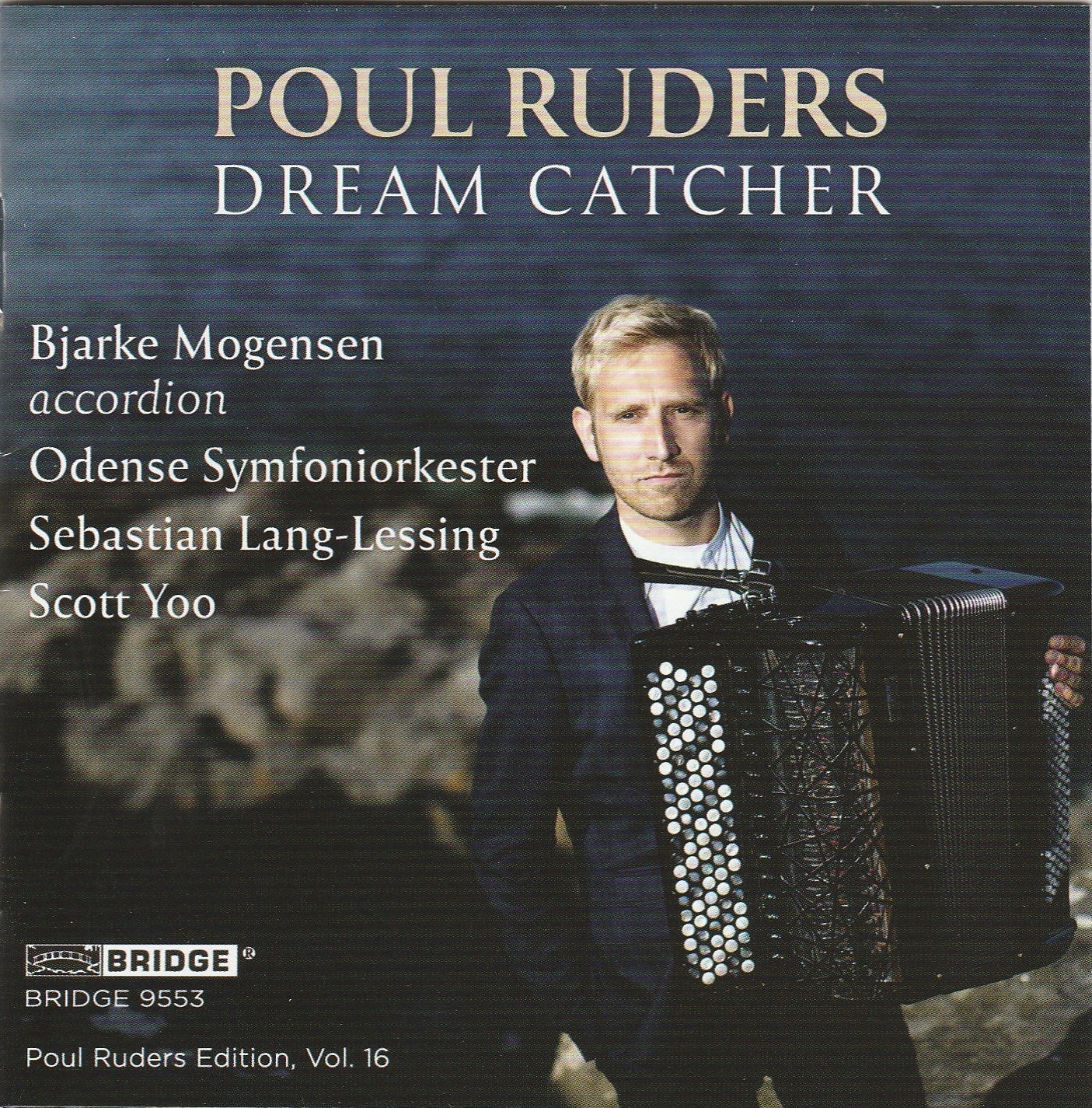
This world premiere recording of the seven-movement Sound and Simplicity (2018) concerto is performed by Danish accordionist Bjarke Mogensen and the Odense Symfoniorkester conducted by Sebastian Lang-Lessing. I. Rain opens with high staccato accordion replicating the sound of surface-landing droplets, followed by an energetic full orchestra section. Love the percussion thunder-like rumbles. Calming sustained four-note II. Trance, presented over three octaves, makes for relaxing “simple” sounds. Mogensen’s accordion performance of IV. Smoke paints a smoky soundscape with steady held notes, wide pitch range, brief controlled bellow shake and contrapuntal melodies, supported by orchestral diverse floating pitches and dynamics. Rollicking VII. Wolf Moon bounces along with faster interchanges and dynamic swells between orchestra and accordion, to the penultimate ascending line and the final accordion chord.

Dream Catcher is Mogensen’s arrangement for solo accordion of Ruders’ accordion and string quartet Serenade on the Shores of the Cosmic Ocean. This diatonic work features musical, hypnotic held notes, a high-pitched slow tune and closing repeated soft notes, highlighting Mogensen’s virtuosic bellow control. 

Previously released by Bridge, Symphony No.3 “Dream Catcher” is a two-movement orchestral extravaganza conducted by Scott Yoo. The loud percussive start transforms into a tonal, sweet-dream string section. In the second movement, faster birdlike horn trilling leads to full-steam-ahead virtuosic orchestral multi-rhythmic chase music.

Catch this great Ruders sound release!!

16 PiazzollaPiazzolla Cien Años (100 Years 1921-2021)
Juanjo Mosalini; Pro Arte Chamber Orchestra of Boston; Gisèle Ben-Dor
Centaur Records CRC 3844 (giseleben-dor.com)

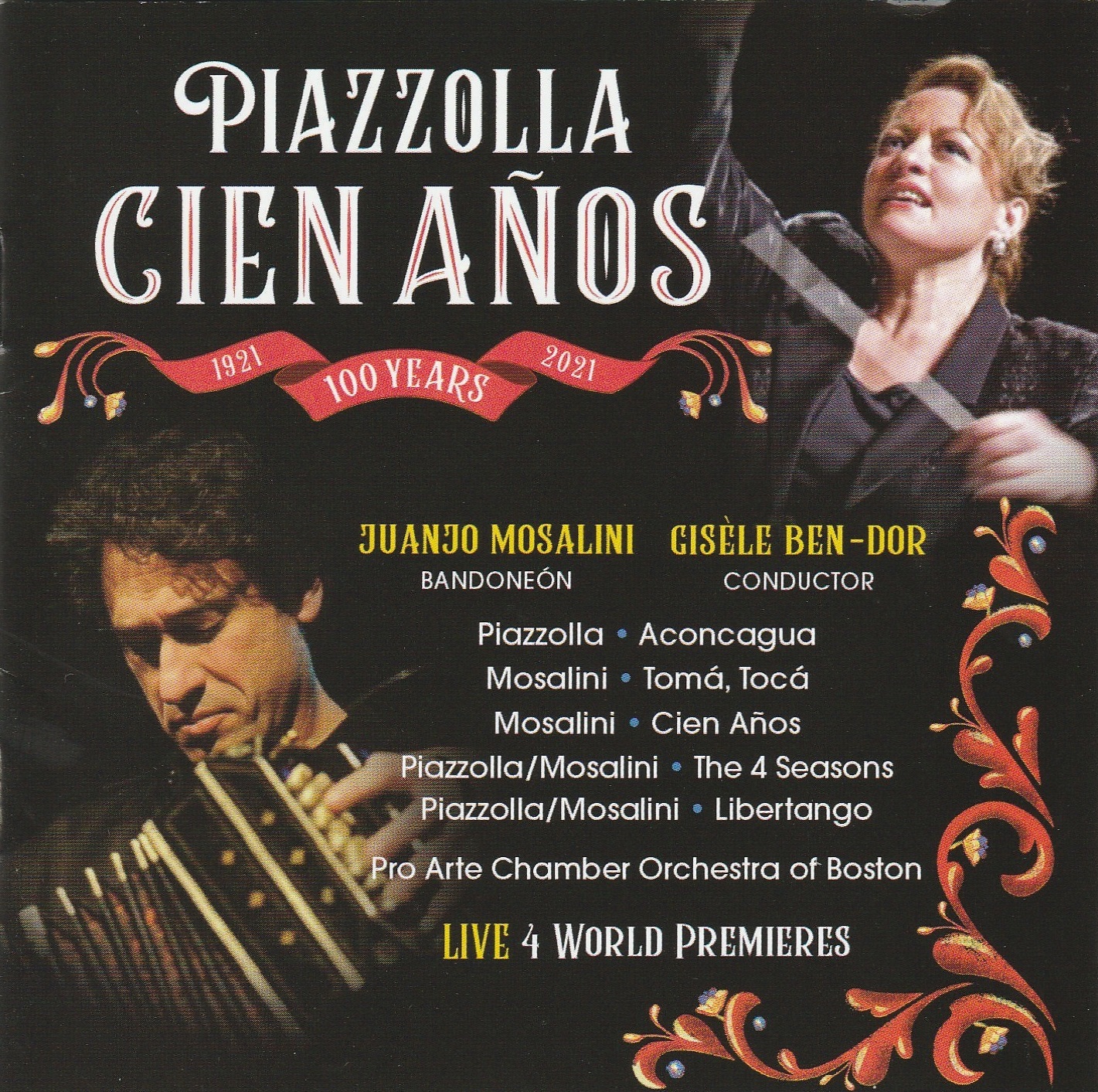
This is another memorable release celebrating the centenary of Argentine composer/bandoneonist Astor Piazzolla (1921-1992) as conductor Gisèle Ben-Dor leads the Pro Arte Chamber Orchestra of Boston and bandoneon soloist Juanjo Mosalini.

The recording opens with a Piazzolla original Aconcagua, Concerto for Bandoneon (1979) a three-movement, true-to-his-style work, featuring rhythmic symphonic grooves, lyrical bandoneon solos with fast trills and virtuosic lines, and tight soloist and orchestra interchanges creating a danceable yet concert-hall classical-flavoured rendition performed perfectly by all concerned.

Four world premiere recordings scored for bandoneon and orchestra follow. Two Mosalini single-movement original compositions incorporate Piazzolla influences with popular/classical touches in his own soundscapes. Tomá, Tocá (Take It, Play It) is faster with repeated notes and virtuosic flourishes. Cien Años (One Hundred Years) combines tango elements with nostalgic bandoneon melodies, long phrases and bright high pitches.

Two Piazzolla works arranged by Mosalini follow. Originally in four movements, The Four Seasons of Buenos Aires is presented as one long, connected work. Piazzolla purists will respect this for its true-to-style playing. Shifts in tempos, grooves and moods, the deep cello lines, florid fast bandoneon and orchestra accompaniments are amazing, ranging from danceable and fun to serious and slow. In the closer, Piazzolla’s popular Libertango, technically challenging solos now alternate with colourful orchestra lead lines above bandoneon rhythmic accents.  

Fantastic performances and great music, what more could we want?

01 Alain Lefevre OPUS 7 Cover preview 1 Alain Lefèvre – Opus 7 Préludes
Alain Lefèvre
Warner Classics 9029540078 (alainlefevre.com/composer)

Charismatic Alain Lefèvre is a perfect composer and pianist in his seventh release featuring seven piano preludes, six of which were recorded in spring 2019 in his native Quebec.

Composing and then performing one’s own works must be exceedingly gratifying. Lefèvre started his career as a pianist, reaching international acclaim. The liner notes state he started composing in the late 1970s and first recorded his compositions in 1999. He accurately describes himself compositionally as a storyteller.  

No.1 Force fragile is reminiscent of Romantic-style music with a waltz opening, sparkling high notes, contrasting lower pitches, runs against melodic held notes and loud, percussive, yet surprisingly, never-banging notes building to a happy story finale. No.3 Amour fou utilizes subtle touches of contemporary harmonic shifts, shorter repeated melodic phrases, rubato, and an unexpected triple-time faster programmatic section with staccato chords and melodies with turns, all recounting the search for true (not crazy/fou) love. No.5 Aux portes du destin, composed for a Syrian friend with cancer, is a dramatic grief-laden major/minor tonality piece enveloped by melodic high single notes, and at the ending creating a tinkle of hope. No.7 Mati, for piano and bouzouki (Thanasis Polykandriotis), was composed after a tragic 2018 fire in Mati, Greece. Recorded in Athens, the bouzouki’s plucked strings and piano-hammered keys create a unique sound, especially during quasi-unison duets, melodic conversations with bouzouki high notes.

Lefèvre’s Opus 7 Préludes are colourful, multi-character “best-selling” piano stories!

Back to top