The Fall is always a showcase for the best in Canadian jazz – this month’s collection is a prize package, the top three world class.
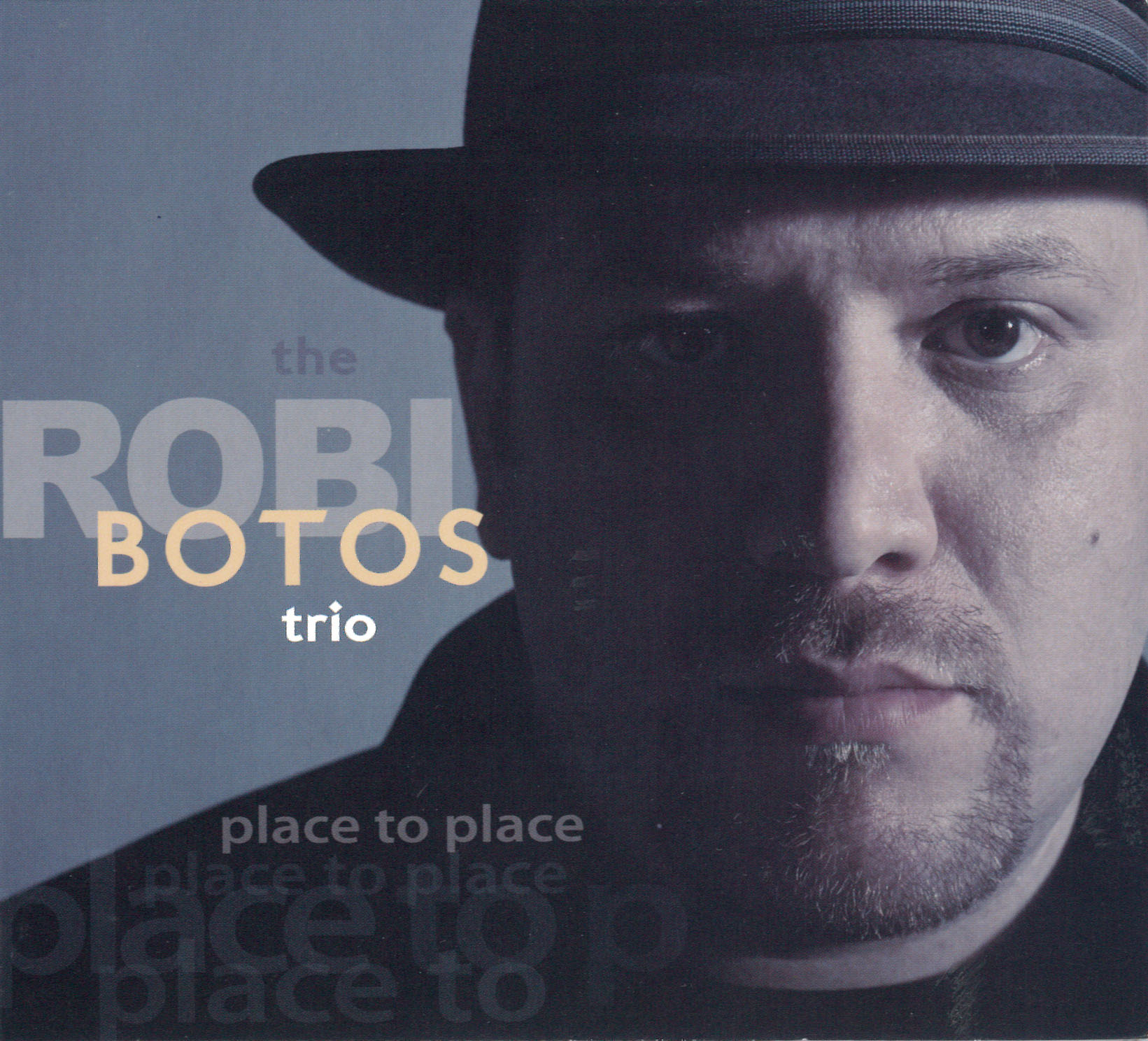
01_robi_botosUp first is a splendid trio disc from pianist Robi Botos, who since his arrival from Hungary has consistently brought audiences to their feet with sparkling imagination and a fabulous technique. The impressive Robi Botos Trio - Place To Place (A440 002 www.robibotos.com) is the first album under his name, 68 minutes on which he’s backed by brother Frank on drums and long-time associate Attila Darvas on bass. The 14-cut outing (mostly originals) is terrific from the first notes of Life Goes On with Darvas a revelation in a unit demonstrating impeccable interaction. A fab reworking of Wayne Shorter’s Footprints, a delightful take on the classics with Be Bach, a lovely tribute to Oscar Peterson (Emmanuel), a storming title piece, a bristling Smedley’s Attack and the humour delivered on Inside Out are just a few disc highlights, which assert the leader’s firm grasp of pianistic essentials. Some might quibble at the Botos delight in fiery, top gear playing but to these ears it’s simply splendid.
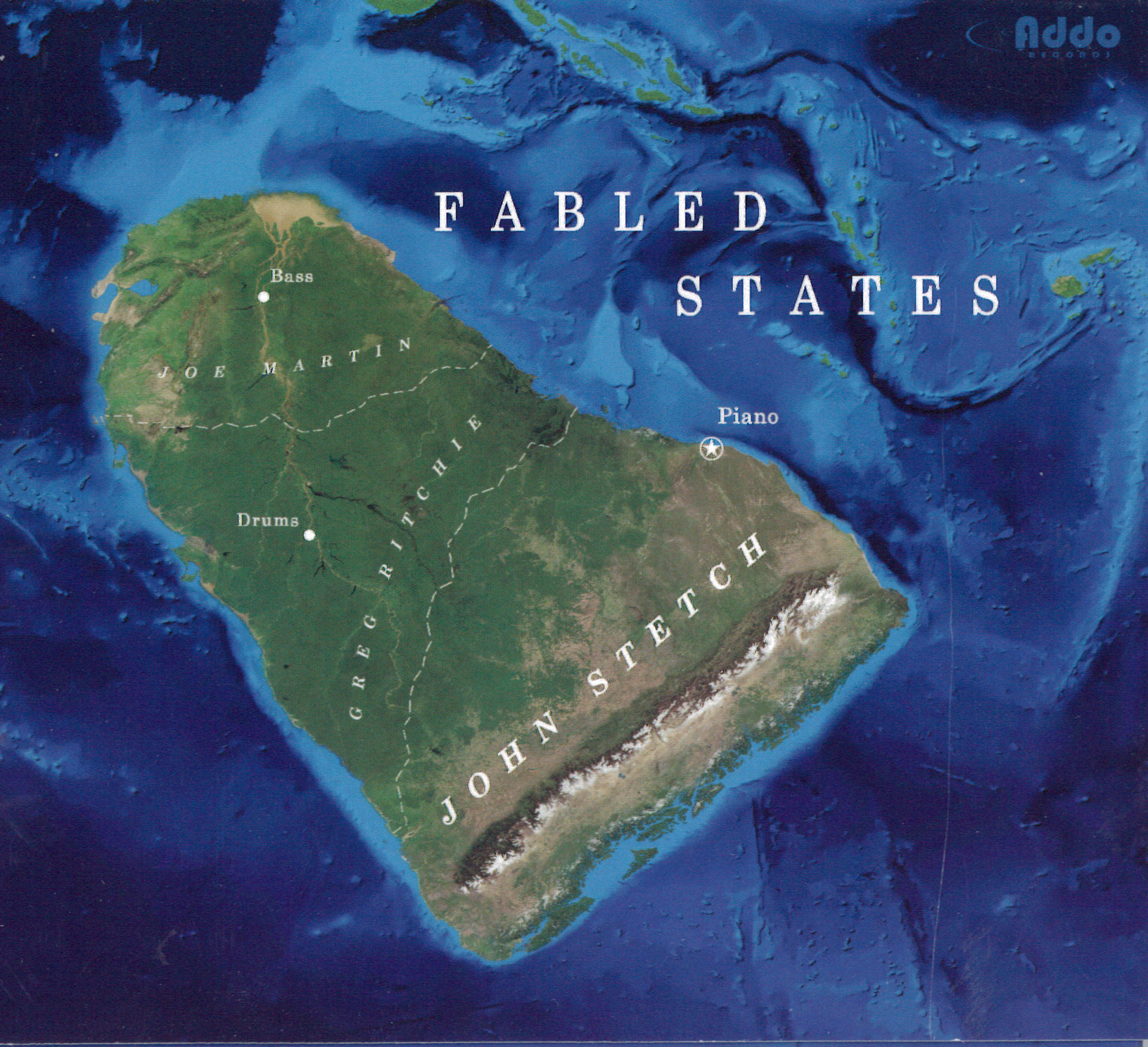
02_john_stetchPianist John Stetch is a seriously gifted musician whose presence unfortunately is rare in the GTA despite an international reputation. Edmonton-born but U.S.-based, his releases invariably are stunningly original and on the dozen tunes of John Stetch Trio - Fabled States (Addo Records AJR010 www.addorecords.com) he demonstrates his fluent skill at embracing a plethora of styles, rich textures and harmonic progressions. His virtuosic playing and arranging is a constant here, with the opening Oscar’s Blue Green Algebra an energetic, sweeping homage to Oscar Peterson with gospel underpinnings. The pulsating 12-minute Black Sea Suite is a brilliant fusion of world music and western jazz, Plutology (based on the indestructible I Got Rhythm) spins way out and What The McHeck conveys bracing hard bop. Fascinating considerations of jazz approaches continue with Do Telepromptu probing bluegrass, Gmitri reacting to a Shostakovich prelude and the title tune riffing on Benny Golson’s Stablemates. Bass Joe Martin and drummer Greg Ritchie contribute fluently to an often breathtaking disc.
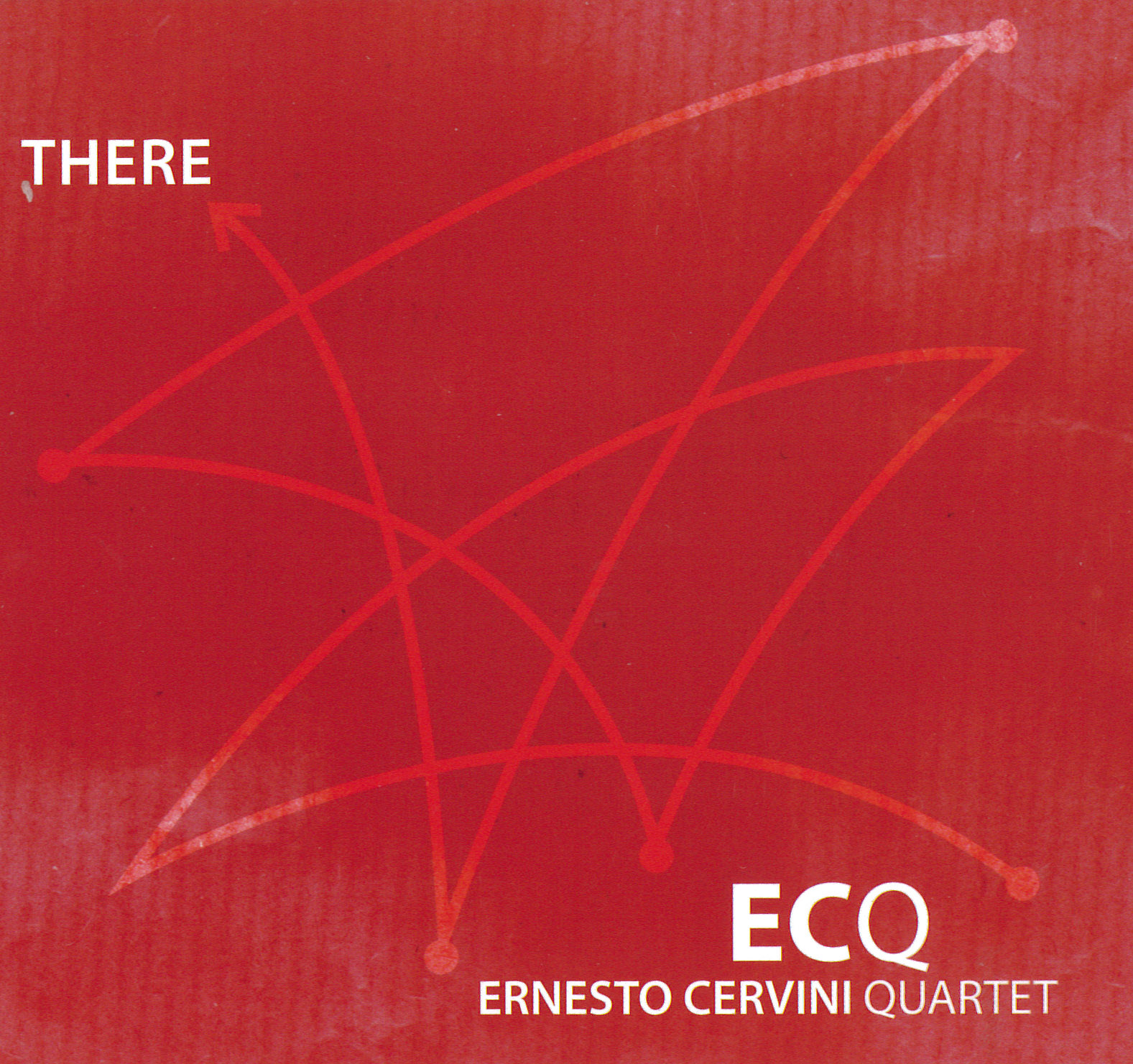
03_ernesto_cerviniDrummer Ernesto Cervini is a relative newcomer who’s blazing a path through contemporary jazz with smart new ideas and a burning intensity that shouts to be heard. Taped live over two nights at Vancouver’s Cellar Club, he illustrates his achievements with terrific young sidemen in tow – versatile American saxophonist Joel Frahm, pianist extraordinaire Adrean Farrugia and bassist Dan Loomis. On Ernesto Cervini Quartet - There (Anzic Records ANZ-3200 www.ernestocervini.com) there’s nine tracks, six by him, that illustrate individual skills and group cohesion with Frahm’s spiky lean notes, Farrugia’s dynamic imagination and Loomis’ solid core bass keeping energy levels high despite formidable rhythmic shifts. They even reimagine the soul ballad Secret Love into helter-skelter mode rooted in bop with Frahm’s tenor referencing Sonny Rollins. These performers always complement each other, notably on the Andalusian-flavoured Granada Bus, the reverential Gramps and the clever, quirky The Monks of Oka. Farrugia’s rollicking Woebegone is a meaty treat and the exhilarating Little Black Bird is a blast on an album that has to be one of 2011’s best.
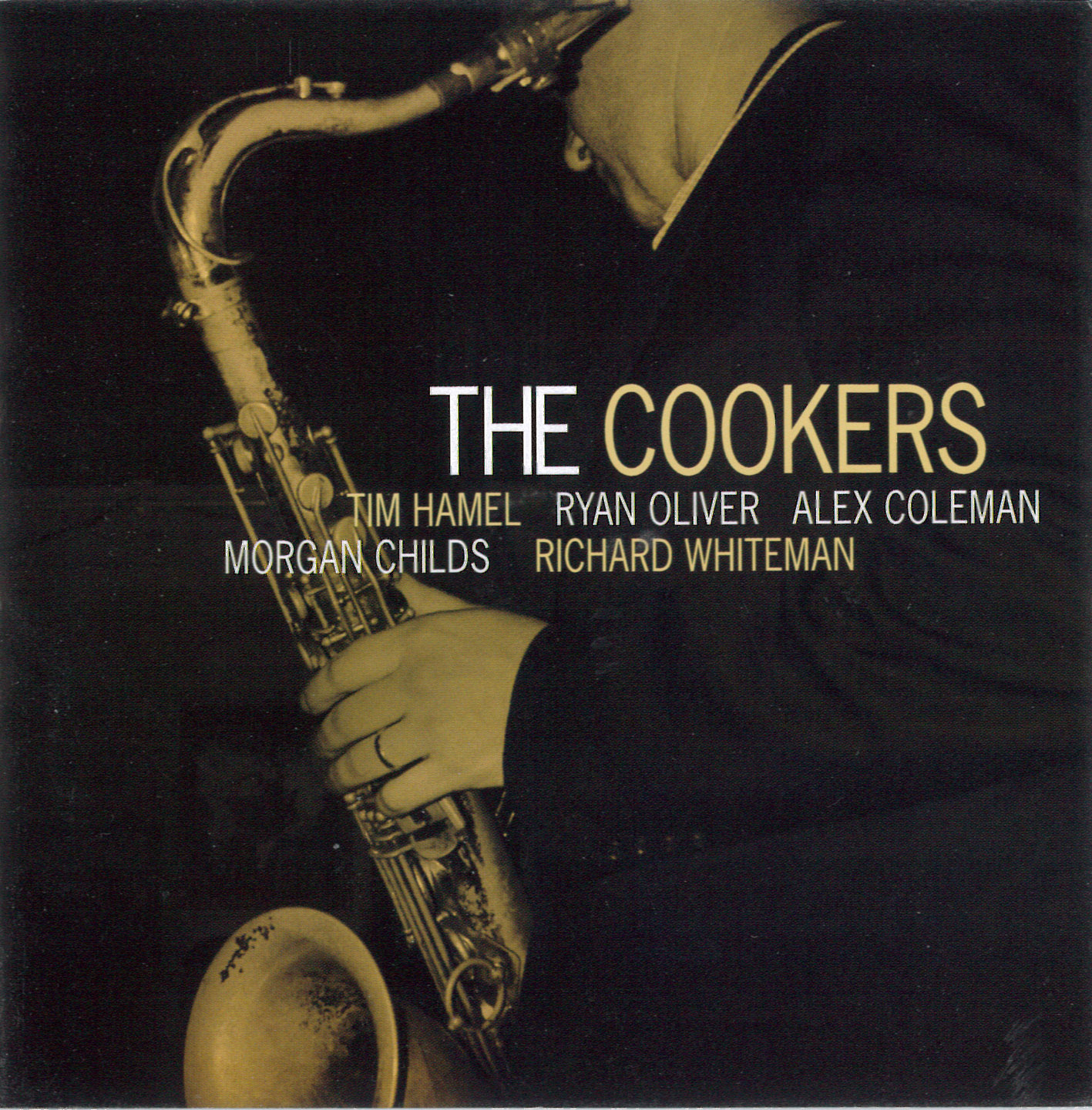
04_cookersThe Cookers are a back-to-basics hard bop quintet, nowadays an attractive voice in the land of quasi-intellectual trickery, avant-garde noodling and jazz’s black sheep cousin, smooth jazz. Formed last year, the fivesome comprises veterans and newbies but they’re close companions on The Cookers - Volume One (TC69420 www.thecookers.ca) and its eight originals supplied by bandsmen. Immediately you know this group’s best heard live with its mix of bop, soul, jazz and the blues, with trumpeter Tim Hamels and saxman Ryan Oliver swinging hard, pianist Richard Whiteman reliable as ever in all modes and a lively pulse generated by tuneful bassist Alex Coleman and drummer Morgan Childs. The trumpet’s crisp, rough-toned precision matches Oliver’s full-range warm horn, the former occasionally offering full rasp Roy Eldridge, the latter bringing to mind Eric Alexander. Top tracks: The Ramble, Blues to Booker and The Pork Test, but all have merit. Pity there’s just 47 minutes on offer.
05_5_after_4Drummer Vito Rezza’s pounding jazz fusion band 5 After 4 makes a mostly welcome return on Rome In A Day (Alma ACD62112 www.almarecords.com) with its sixth album, the first since 2004. Backing the powerhouse leader on 11 originals are versatile woodwind ace John Johnson, Matt Horner on piano, Rhodes and organ, and bassist Peter Cardinali. The musical architecture is as always firm, groove and vigour uppermost. Johnson enjoys himself throughout, setting out his keen priorities on the fiery opener 10,000 Days with Cardinali’s bass sound big and booming, a combination that works well with tried and trusted drumming and complementary subtleties from Horner. The bluesy Top Hat is spelled out neatly with Rhodes and agile bass followed by a surprisingly serene ballad caressed by tenor and then the dense, off-kilter Mr. Govindas. Perhaps the most appealing tune is Changes Of Season with marked contrasts employing speed, delicacy and finally fury, Johnson leading the charge. The only problem here is a sameness in composition and execution, as if the ensemble’s wound too tight.
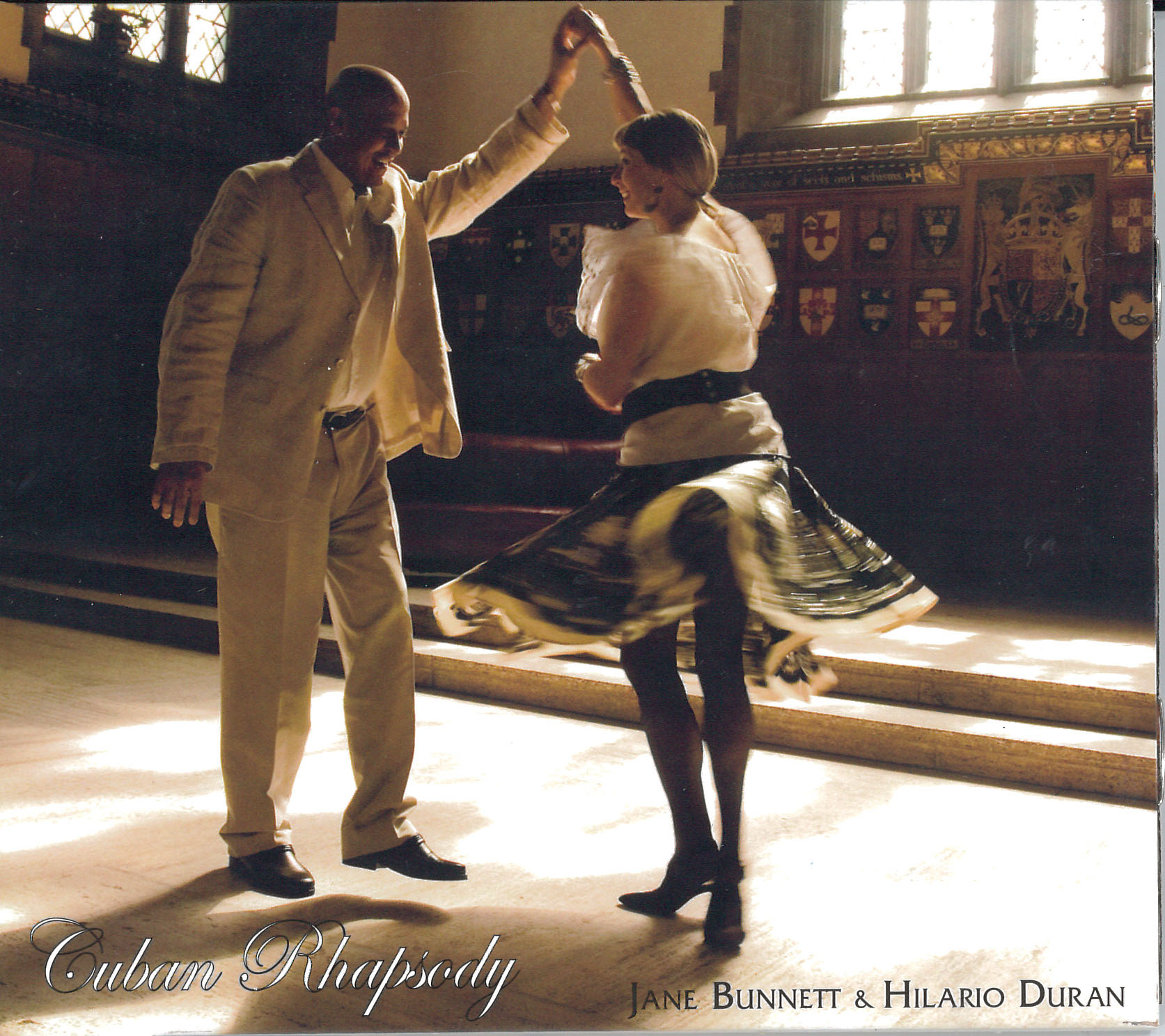
06_bunnett_duranLovers of Cuban music will rejoice in Jane Bunnett & Hilario Duran - Cuban Rhapsody (Alma ACD67112 www.almarecords.com), a vast survey of the island nation’s music from the mid-19th century to the mid-20th. Virtuosos Bunnett (flute and soprano sax) and Duran (piano) play with passionate vitality and gracious charm as they canvas traditions established by such valued composers as Ernesto Lecuona and Frank Emilio Flynn. The heart of this album, crammed with dancing beats and lilting melody, is a five-tune medley of contradanzas by Manuel Saumell. The duo plays with intimate chemistry and still adds jazz improv fuel to a sterling session that integrates European music with classic Cuban folkloric styles.
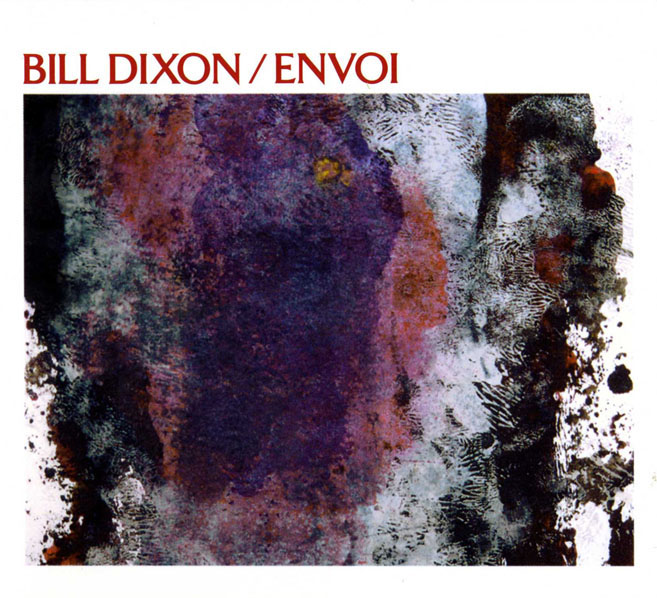
01_bill_dixonPraised and reviled in equal measure during his 40-year career, Vermont-based trumpeter Bill Dixon was finally recognized as one of improvised music’s most original stylists and theorists before his death at 84 in June 2010. Fittingly his final concert took place a mere three weeks previously at Quebec’s Festival International de Musique Actuelle de Victoriaville, where a hand-picked octet played this composition under his direction. Luckily the performance has been released as Envoi (Victo Records Victo cd 120 www.victo.qc.ca). Not only do the two sections illuminate Dixon’s particular mixture of formalism and freedom, but with a horn section of four playing cornet, bugle and flugelhorn, Envoi also demonstrates Dixon’s influence on a younger generation of brass players. Famously prickly and opinionated, Dixon organized The Jazz Composers Guild, one of the first musicians’ self-help organizations in the mid-1960s. A long-time professor at Bennington College in Vermont, Dixon recorded sparingly over the years, which makes this session doubly valuable. Impressionistic and dramatic, Envoi is organized with classical precision in varied sequences. Most involve muted, shaded bent notes from the brass players in counterpoint to the spiccato string swipes of cellist Glynis Loman and bassist Ken Filiano, or, in the first section, tart slurs from Michel Côté’s bass clarinet. Additional unifying motifs come from Warren Smith’s resounding kettle drumming, and, in the second section, his ringing vibes, which soften the interface as it moves forward. In that same section the unison strings maintain a menacing undertow, breached only occasionally by heraldic brassiness or dissonant grace notes, plus at one point echoing stillness from Graham Hayes’ bugle. True to Dixon’s style, most of the brass tones are segmented sound shards which waft pure air through the horns. Following nearly 40 minutes of quivery tremolo theme variations, a spectacular example of the trumpeter’s measured art arrives near the end. After one cornetist sounds heraldic tones at a higher pitch among the others’ capillary whispers, all harmonize for a protracted section of legato impressionism, only scattering at the end as one puffs quietly while another exposes plunger tones. Finally, call-and-response vamping from all marks the climax.

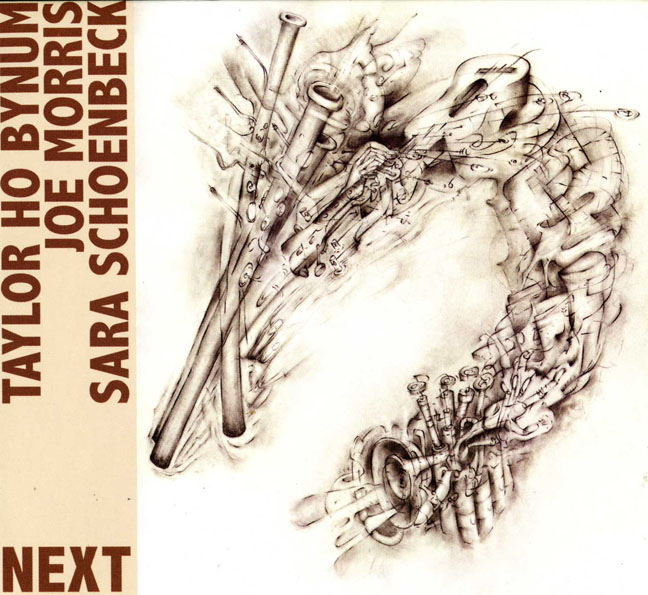
02_next_thbNew York’s Taylor Ho Bynum and Chicago’s Rob Mazurek, both featured on “Envoi”, have been marked by Dixon’s compositional and improvisational skill, as has Montreal’s Ellwood Epps. On his own, Bynum is probably closest to Dixon when it comes to voicing. Atmospheric textures on the six instant compositions that make up Next (Porter Records PRCD-4058 www.porterrecords.com) are built up from his cornet, flugelhorn or trumpet, Sara Schoenbeck’s bassoon and Joe Morris’ guitar. With no instrument in the so-called front-line, and each player capable of extended techniques, it’s often difficult to separate timbres. Schoenbeck may use her burbling pedal-point as a foundation, but on a tune like Next, she splinters her tone into tiny reed bites, and later harmonizes intense growls with Bynum’s triplet patterns. On Next the guitar texture is all bottleneck licks. Yet on pieces such as Consensus Struggle Morris’ percussive strumming emphasizes the beat, allowing the bassoonist to solo with hoarse multiphonics, and giving the cornetist room for peeping squeals and trippy tongue flutters. The trio’s interface is most appealing on Fireside. Morris’ below-the-bridge plinks are further coloured by Schoenbeck’s burbling bluster as Bynum’s staccato, off-centre trills soar upward to lip-twisting brassiness.

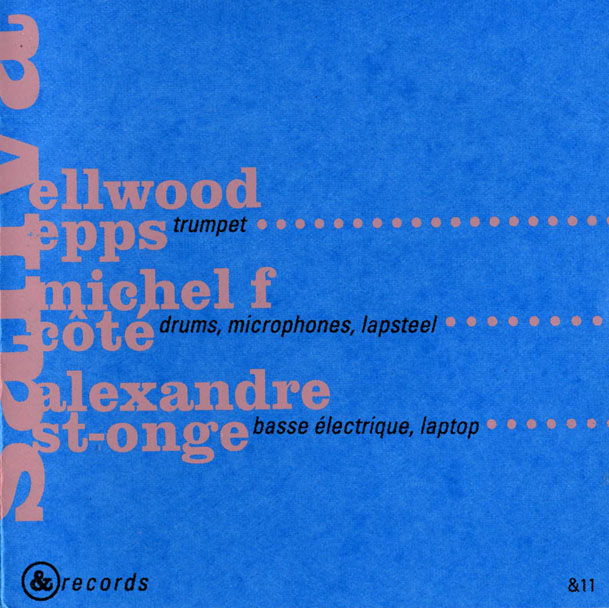
03_pink_salivaSomeone who took lessons with Dixon and – at least in choice of band name – has inherited the older man’s impudence, is Ellwood Epps, whose Pink Saliva trio (& Records &11 www.etrecords.net), is filled out by Alexandre St-Onge on electric bass and laptop and Michel F Côté on drums, microphones and lap steel guitar. Although Dixon only dabbled in electronics, Epps, a Toronto native, and his Québécois confreres embrace it wholeheartedly, adding oscillated wave forms and crackling drones to everything they play. Negotiating the line between indie-rock and jazz-improvisation, the CD is studded with irregular ruffs and drags on Côté’s part, rumbles and pops from St-Onge’s string set and dial-twisting buzzes. At points overdubbed, Epps’ trumpet soars over these wiggling sequences, repeatedly shifting from low-pitched inner-horn gurgles to piercing trills, adding additional touches of soaring lyricism.

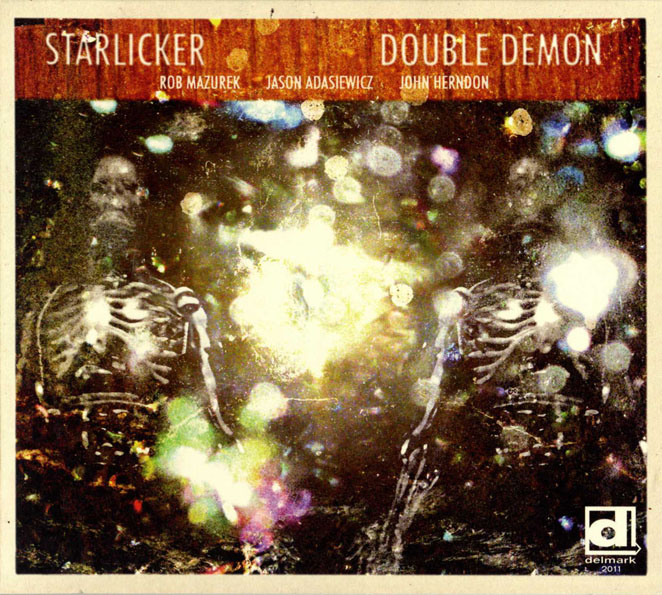
04_double_demonA similar brass lyricism is evident on Starlicker’s Double Demon (Delmark DE 2011 www.delmark.com) featuring Rob Mazurek. Instructively it’s also the cornetist who impels the tunes towards jazz improvisation, while John Herndon, of the Tortoise rock band, concentrates on gutsy backbeats. Meanwhile the six Mazurek compositions are given distinctive shape by mallet-driven staccato juddering from Jason Adasiewicz’s vibraphone. With the vibist’s ringing gamelan-like tones a constant leitmotif, whether playing in ballad time or much speedier, Starlicker’s appeal lies in continuous contrast among three intense instrumental textures. The title track finds the vibist’s blurred tremolo lines matching the cornet’s strident brays; whereas the brass man uses finesse and moderated splutters to create a chromatic line alongside Herndon’s ratcheting and discordant pops on Triple Hex. However on Skull Cave, the cornetist’s Dixon-like melodic release which recaps the initial theme, moderates sequences of metal bar smacks and a thick drum backbeat.

Regularly operating outside of jazz’s mainstream, Bill Dixon’s brass sound and ideas actually influenced more musicians than is generally acknowledged. It’s both ironic and appropriate then, that it was an experimental Canadian festival which gave him a platform for his final performance.

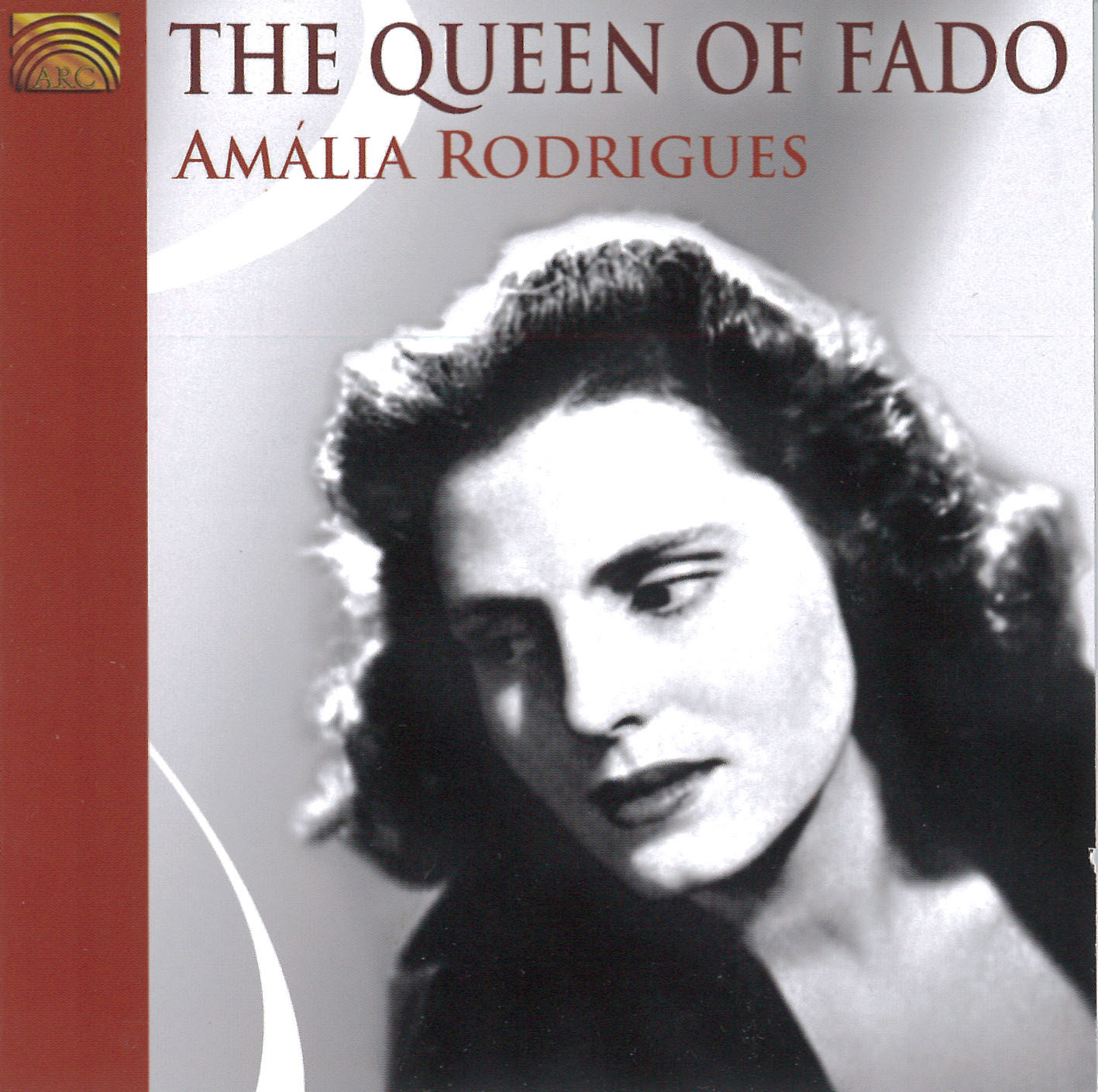
01_queen_of_fadoFado is a traditional art of singing in Portugal. The word comes from the Latin, fatum meaning Fate. The songs, while quite beautiful and moving, “relate a general sense of frustration and a unique Portuguese fatalism.” Amália Rodrigues - The Queen of Fado - was born in Lisbon in 1920. She sang when only four or five years old, revealing a natural talent. In 1935 she became a serious amateur and in 1939 made her formal debut. In the 1950s and ‘60s she was considered the prime exponent of Portuguese popular music, a celebrity appearing not only in Portugal but around Europe and just about everywhere else including the USA, Japan and, of course, Brazil. She died in her sleep in 1999. 15 of her songs presented in a new CD from ARC Music (EUCD2337) convey feelings of “beautiful sadness” and even though I neither speak nor understand Portuguese, I am touched by these performances, finding them very satisfying and settling. In 10 of the 15 she is accompanied by the distinctive timbre of a guitarra portuguesa. There are no texts but the song titles are translated, including: Curse; Sad Inside; Oh! To die for you; Yellow Breasted Sparrow; and One year ago today.

SONY Classical has issued four new CDs (all Verdi) and four DVDs in their ongoing series of notable performances from the Metropolitan Opera’s archives, newly remastered by The Met.

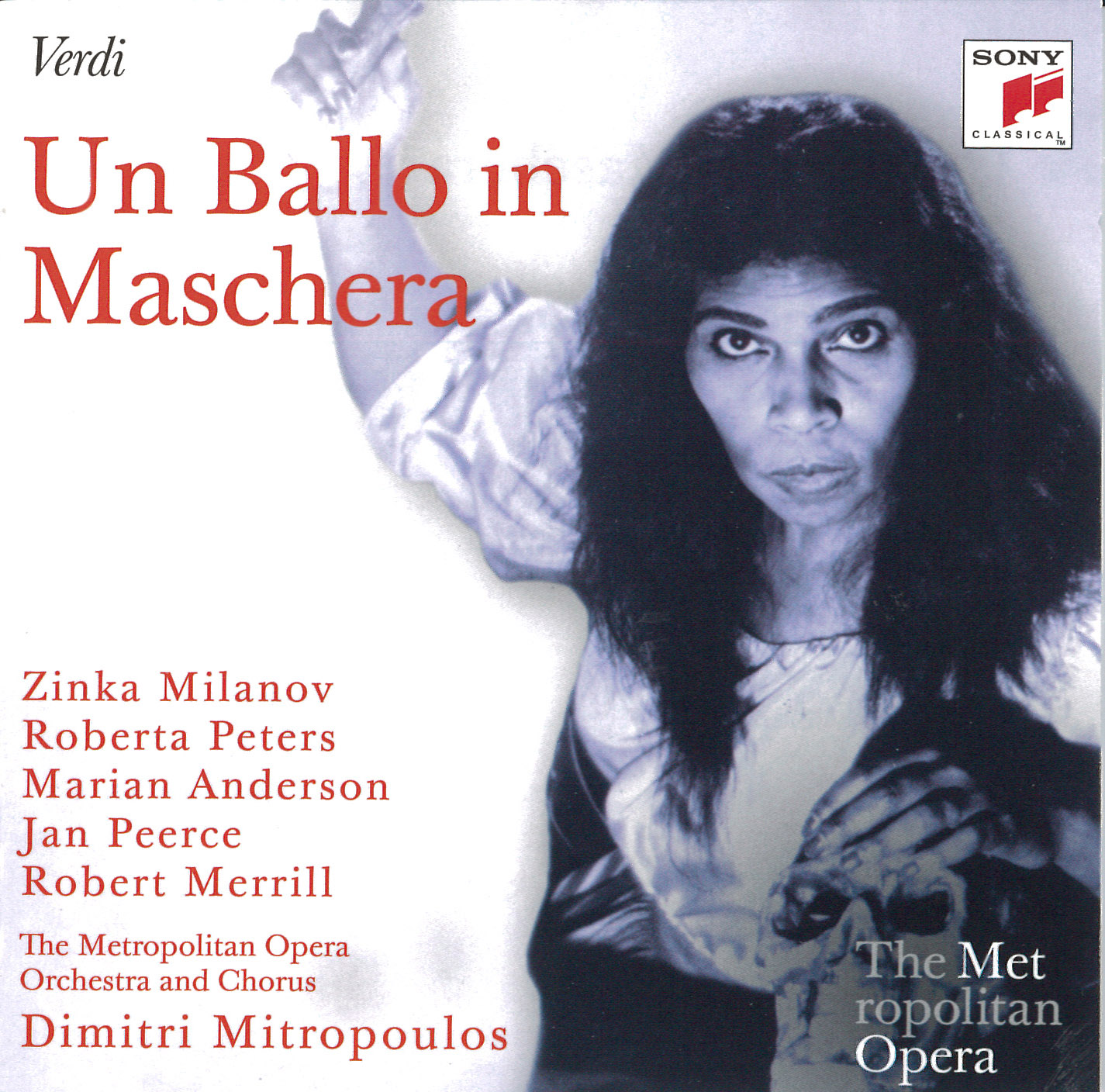
02_ballo_mashupMarian Anderson was the first African–American artist to be given a leading role at the Metropolitan Opera. She sang Ulrica in Un Ballo in Maschera on January 7, 1955 and reprised that role on the afternoon of Saturday, December 10 in a performance that was heard by countless millions via the live radio broadcast. That afternoon’s stellar cast included Met regulars of the time: Zinka Milanov, Robert Merrill, Roberta Peters, Jan Peerce, Giorgio Tozzi and Norman Scott. Dimitri Mitropoulos conducted. (88697 91002, 2CDs)

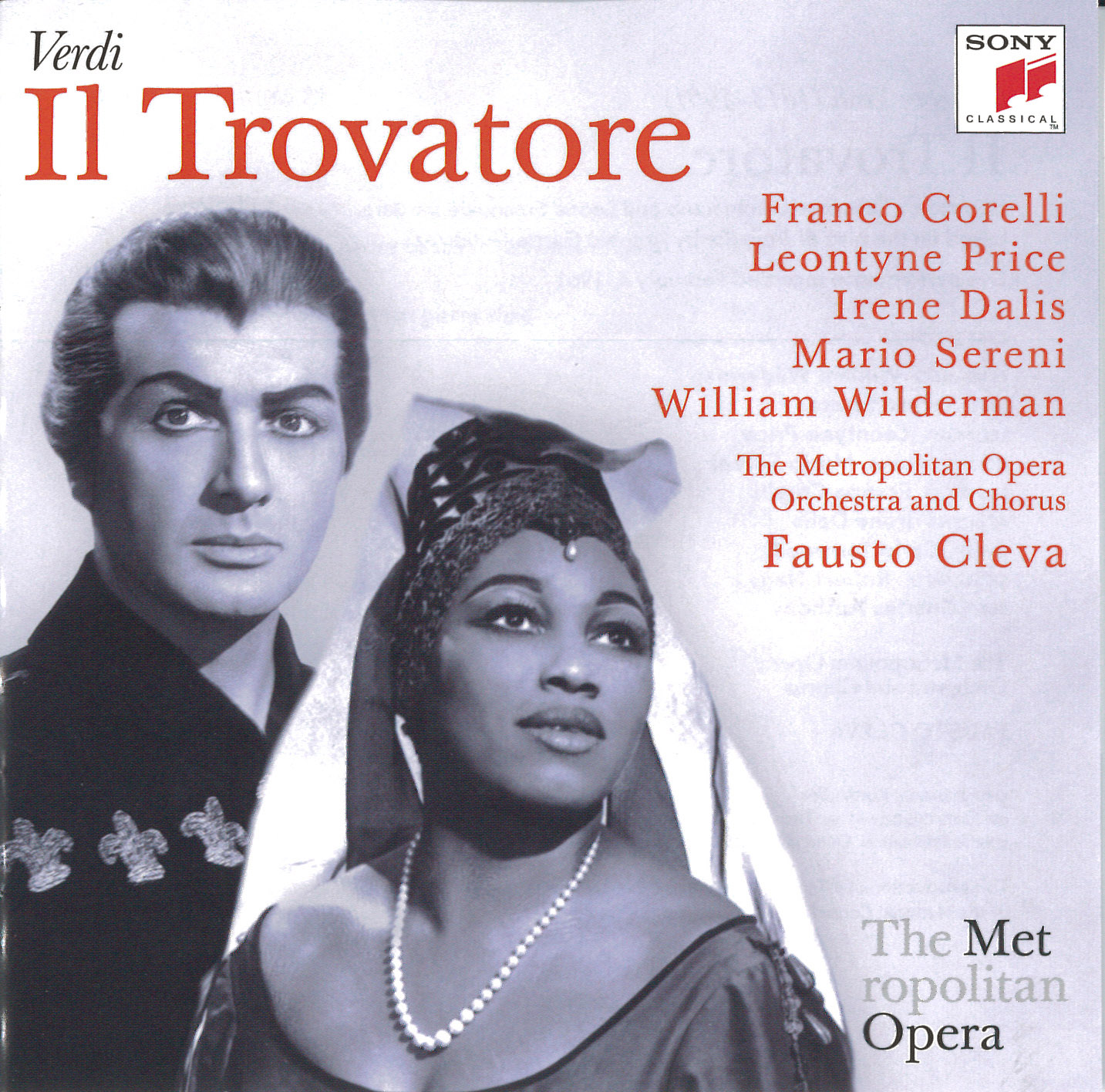
03_il_trovatoreIl Trovatore from February 4, 1961 was also a gala event. Leontyne Price and Franco Corelli had made their Met debut a week earlier to wild acclaim and now millions in the radio audience could judge for themselves. Today, fifty years later a new audience can hear exactly what all the excitement was about... and exciting it is! How could it not be? Price and Corelli both at their spectacular best, together with a fine cast including Mario Sereni, Irene Dalis, William Wilderman, and a fresh Teresa Stratas (as Ines). Fausto Cleva conducted. As usual in this series, the sound is untroubled by sonic artifacts, has realistic dynamic range and a good sense of the front-to-back perspective (88697 91006, 2CDs).

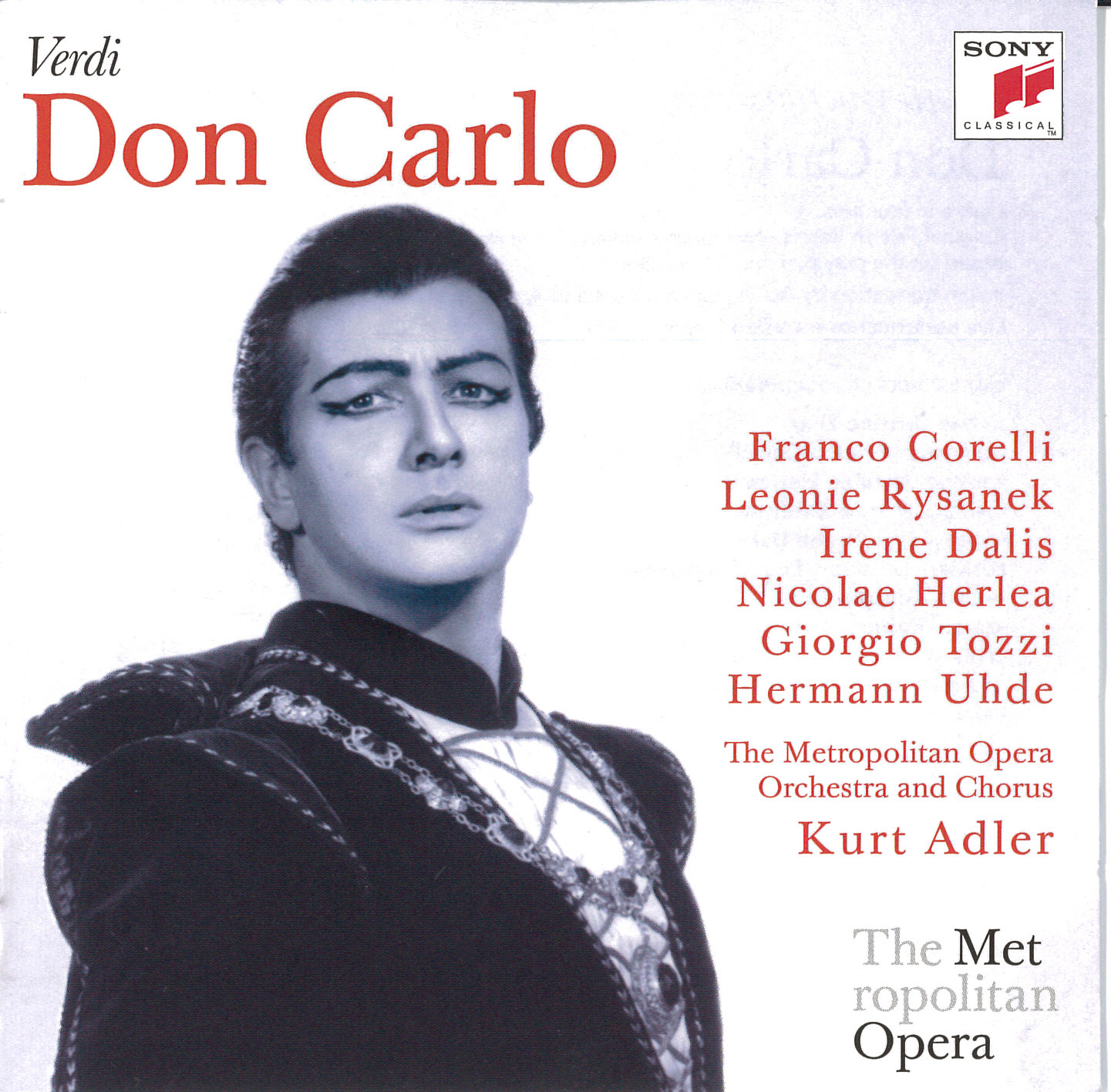
04_don_carloDon Carlo featured Franco Corelli in the title role in the broadcast of March 7, 1964 supported by Leonie Rysanek, Irene Dalis, Nicolae Herlea, Georgio Tozzi, Hermann Uhde and others. This performance makes a good case for the four act version heard here. Kurt Adler conducts (88697 91004, 2 CDs).

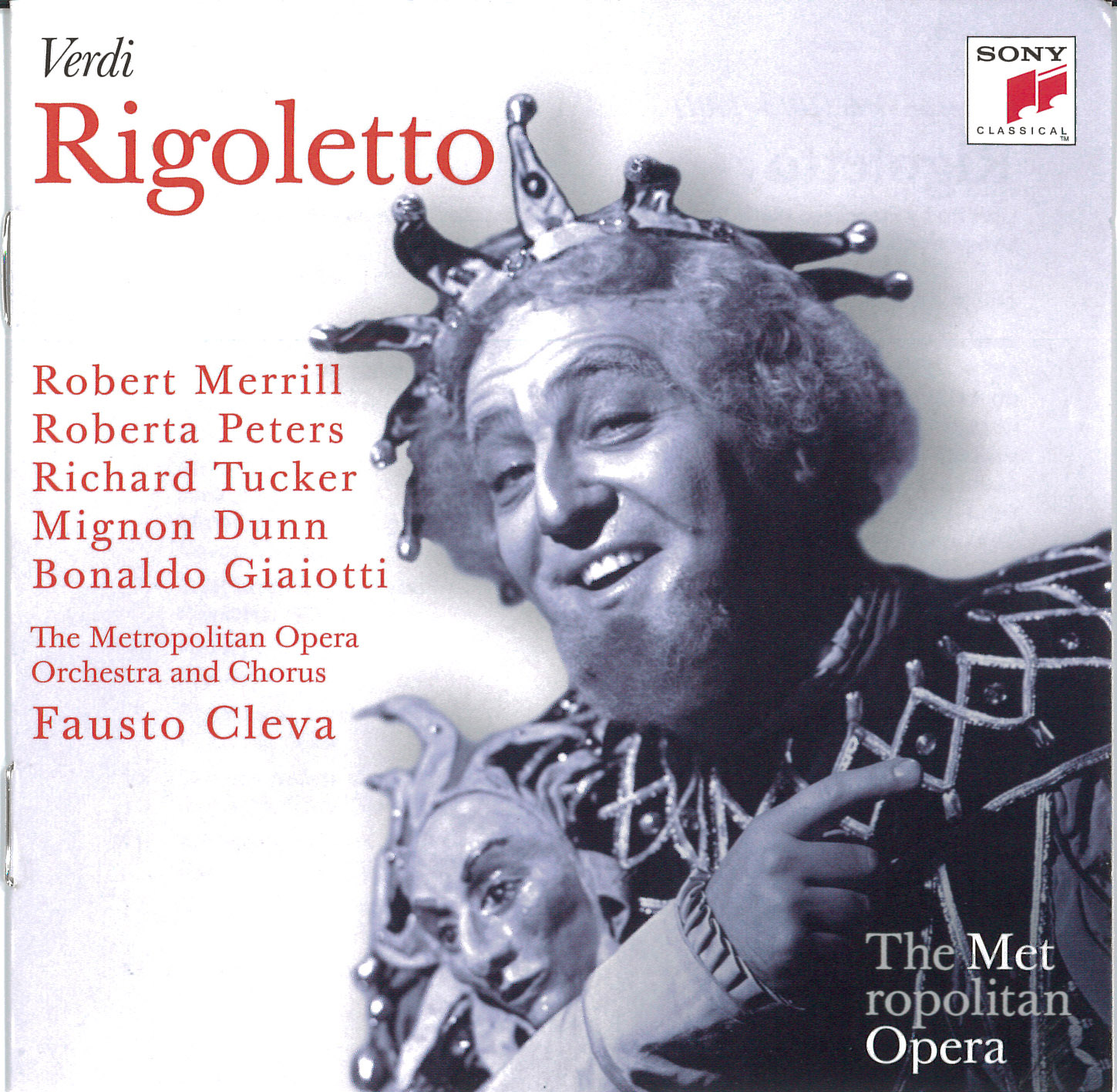
05_rigolettoRigoletto dates from February 22, 1964 and stars these familiar Met alumni: Robert Merrill as Rigoletto and Richard Tucker as the Duke of Mantua, Roberta Peters as Gilda, Mignon Dunn as Maddelena and Bonaldo Giaiotti as Sparafucile. Fausto Cleva conducts this stunning performance that brings this treasure trove of great arias, this cautionary tale of bad karma, to its tragic ending (88697 91005, 2 CDs).


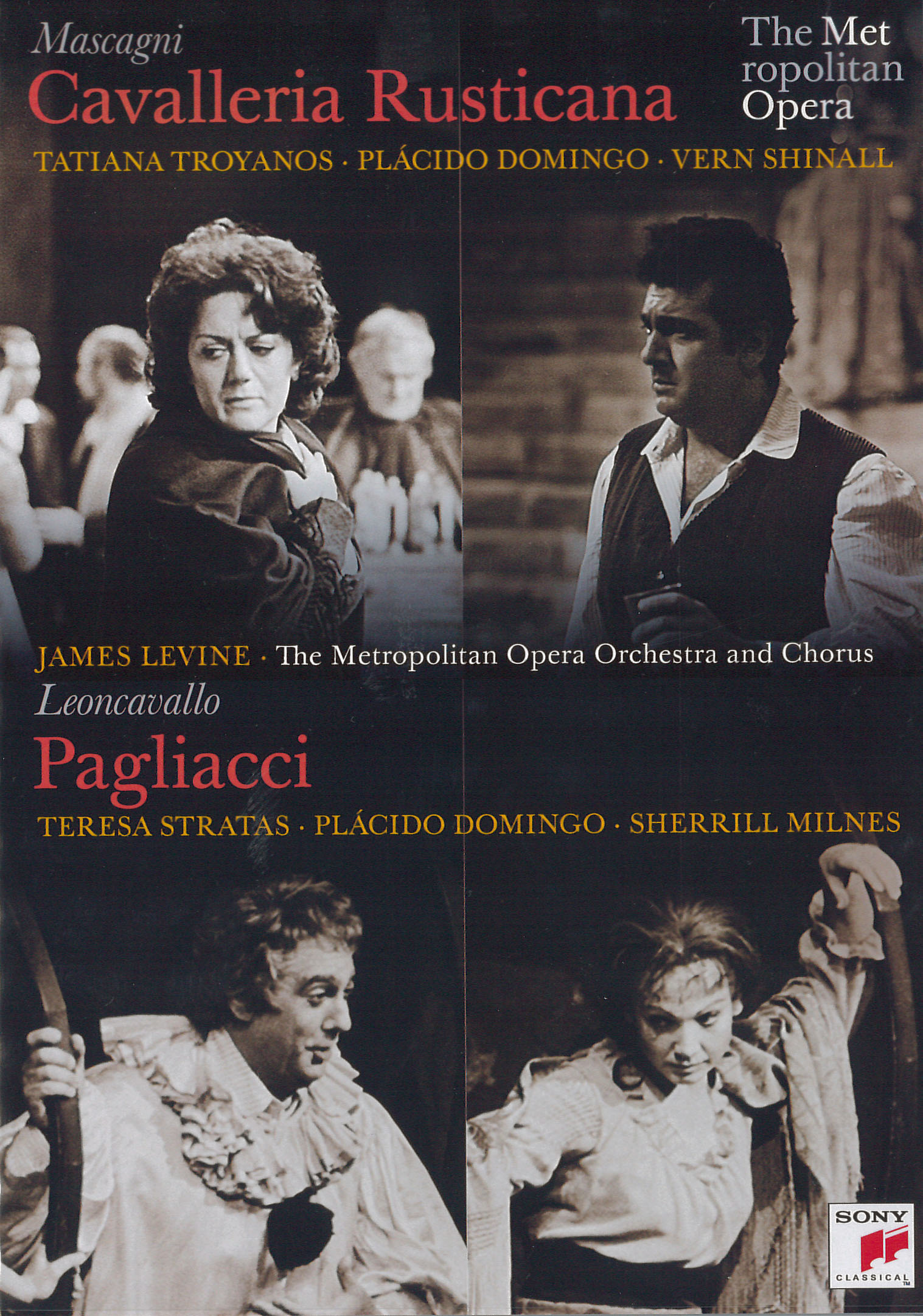
06_cavalleria_rusticanaThe first of the four SONY DVDs from The Met dates from April 5, 1978 and features the usual double bill of Mascagni’s Cavalleria Rusticana and Leoncavallo’s Pagliacci. As originally telecast, images and a bare outline of the plot are silently seen while the two preludes are played. The 37 years young Placido Domingo stars in both operas in performances that define the roles of Turiddu and Canio, supported by Tatiana Troyanos as Santuzza in Cavalleria and by Sherrill Milnes (Tonio), and Teresa Stratas (Nedda) in Pagliacci. The sets were designed by Franco Zeffirelli and James Levine conducts these performances that remain a lasting memento of a memorable evening (88697 91008-9, 1 DVD).


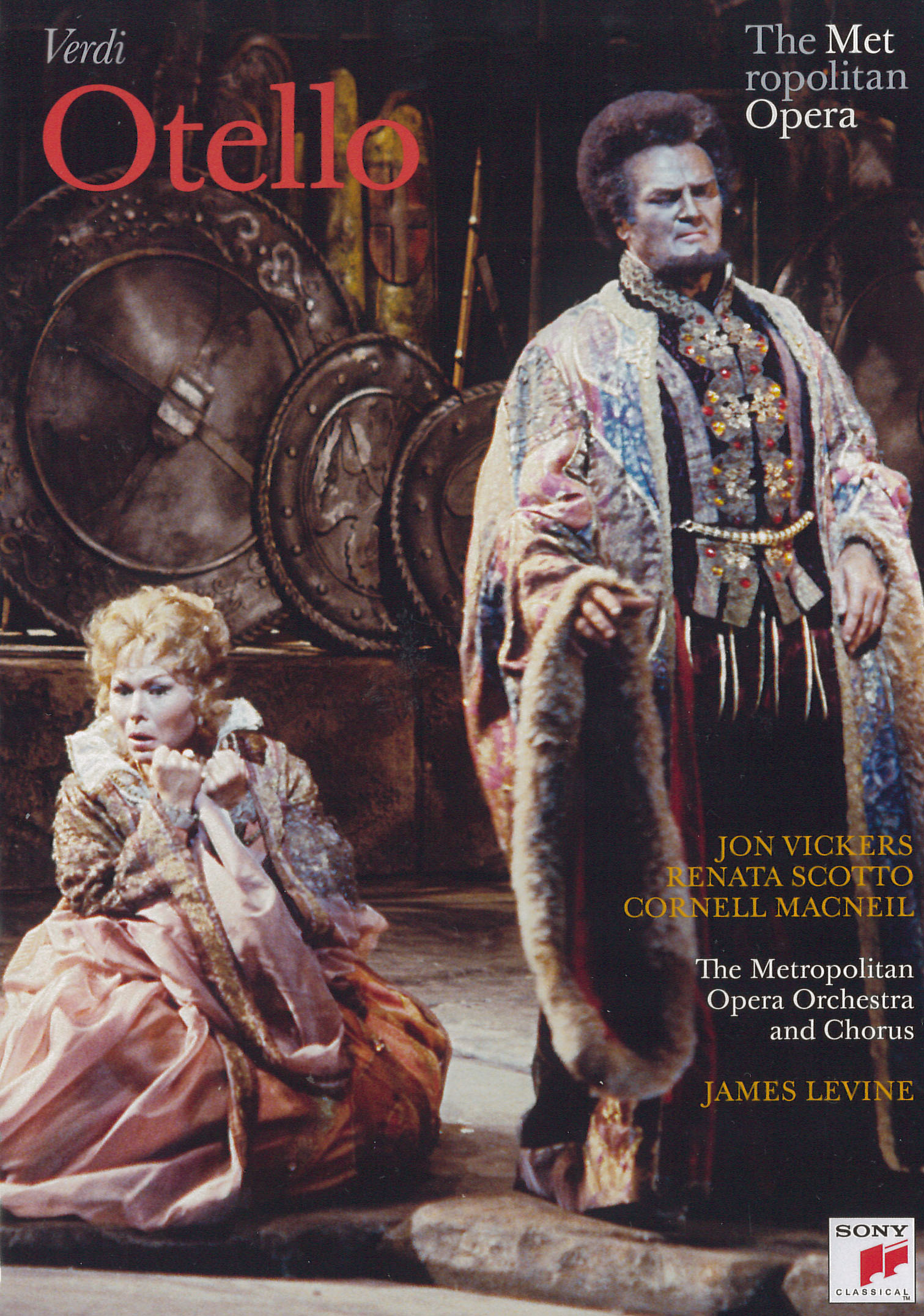
07_otelloVerdi’s Otello, live from September 25, 1978, has the incomparable Jon Vickers in the title role supported by Cornell MacNeil (Iago), Renata Scotto (Desdemona), Andrea Velis (Rodrigo), James Morris, and others. This was some four years after Vickers filmed Otello in Karajan’s production in Berlin. Cornell MacNeil, who died in July this year, is perfectly cast as the schemer who brings down Otello. Production and sets by Zeffirelli (88697 91012-9, 1 DVD).


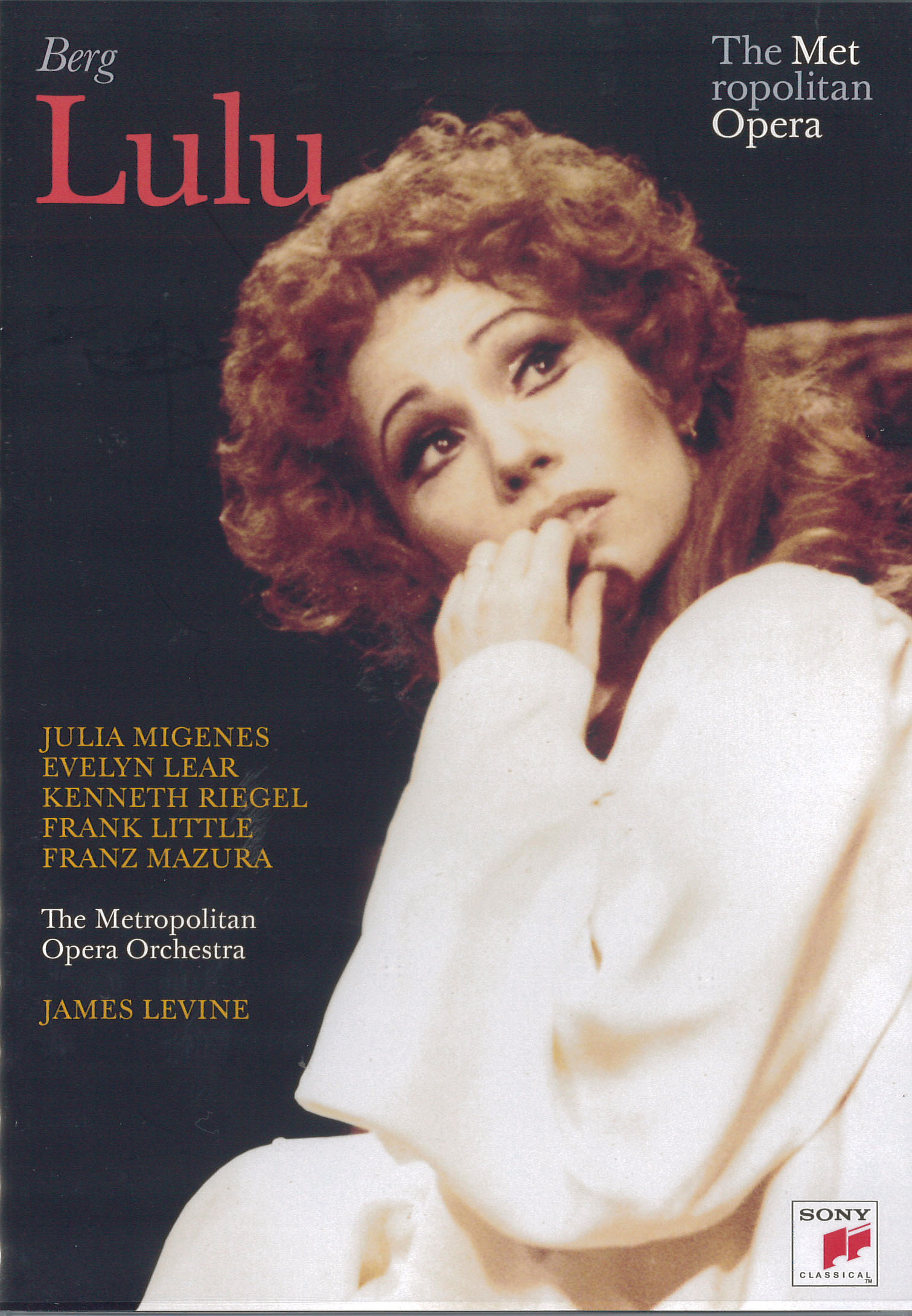
08_luluOf the four operas in this release, I found Alban Berg’s Lulu the most engrossing. Perhaps it is the lingering impression of Louise Brooks’ portrayal in Georg Pabst’s 1929 German film, Pandora’s Box. John Dexter was the producer and Jocelyn Herbert was responsible for the sets and costume design of the Met’s Lulu, all coming together in a mise en scène that is appropriately surreal and decadent, as it would be in productions of the time of Pandora. Julia Migenes is the ill-fated Lulu and Franz Mazura is Jack the Ripper, Lulu’s last customer. The Countess is sung by Evelyn Lear and Kenneth Riegel is Alwa. There are over 20 singing roles in Lulu, too many to list here. Suffice to say, this is an unusually compelling and enthralling performance in dynamic stereo or 5.1 surround sound. James Levine conducts (88697 91009-9, 2 DVDs).

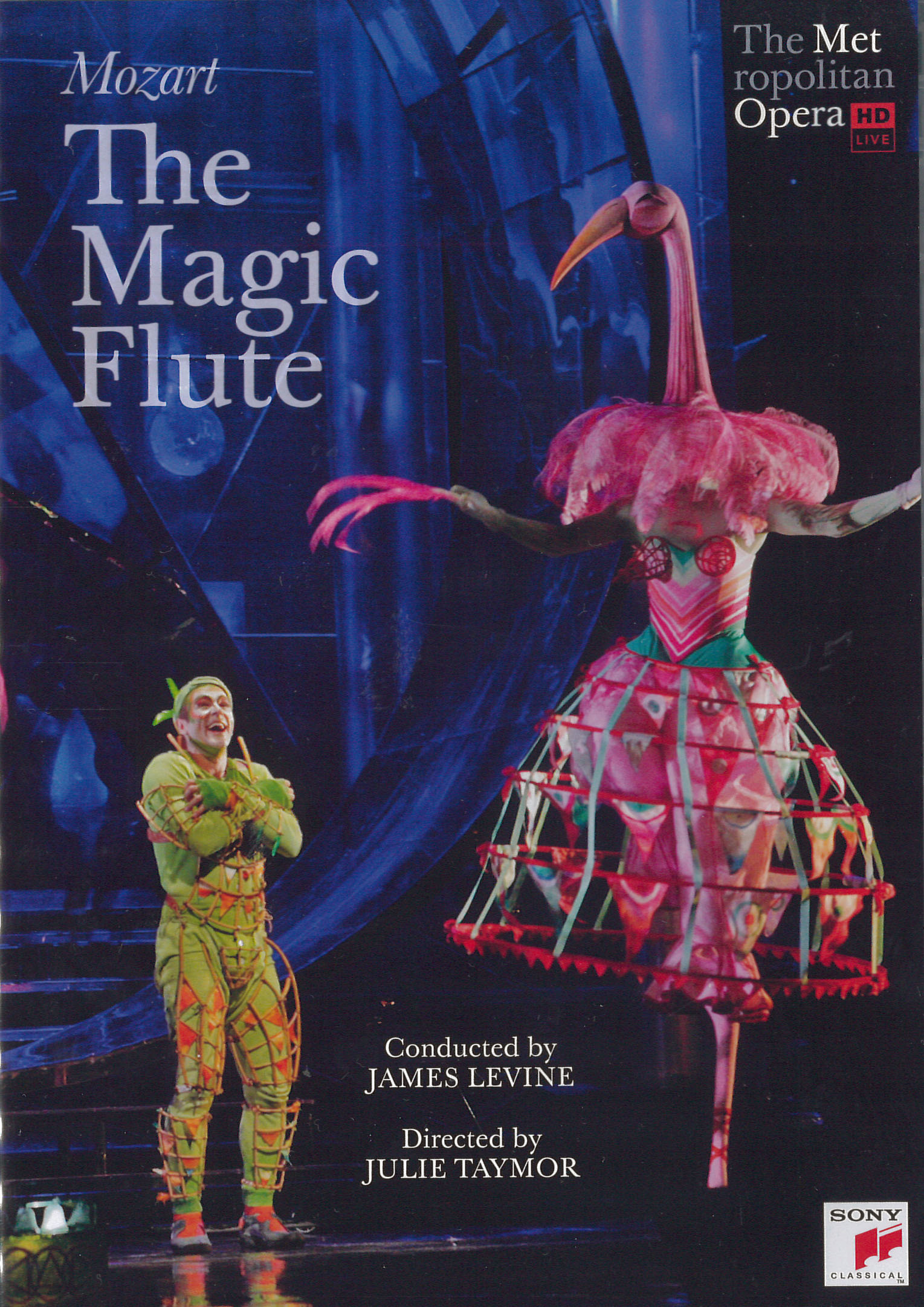
09_magic_fluteThe Magic Flute is the abridged, English language version as seen December 30, 2006, the first season of the Met’s “Live in HD” in theatres around the world. Intended for children of all ages, this pantomimed version has innocent charm and may be an entertaining introduction to Mozart’s masterpiece (everything by Mozart is a masterpiece). Outstanding are Nathan Gunn (Papageno), Erika Miklosa (Queen of the Night), Ying Huang (Pamina), René Pape (Sarastro) but there doesn’t seem to be any role not ideally cast. Sub-titles in many languages, including English are accessible. James Levine conducts this exuberant, brilliantly staged, happy event (88697 91013-9, 1 DVD).


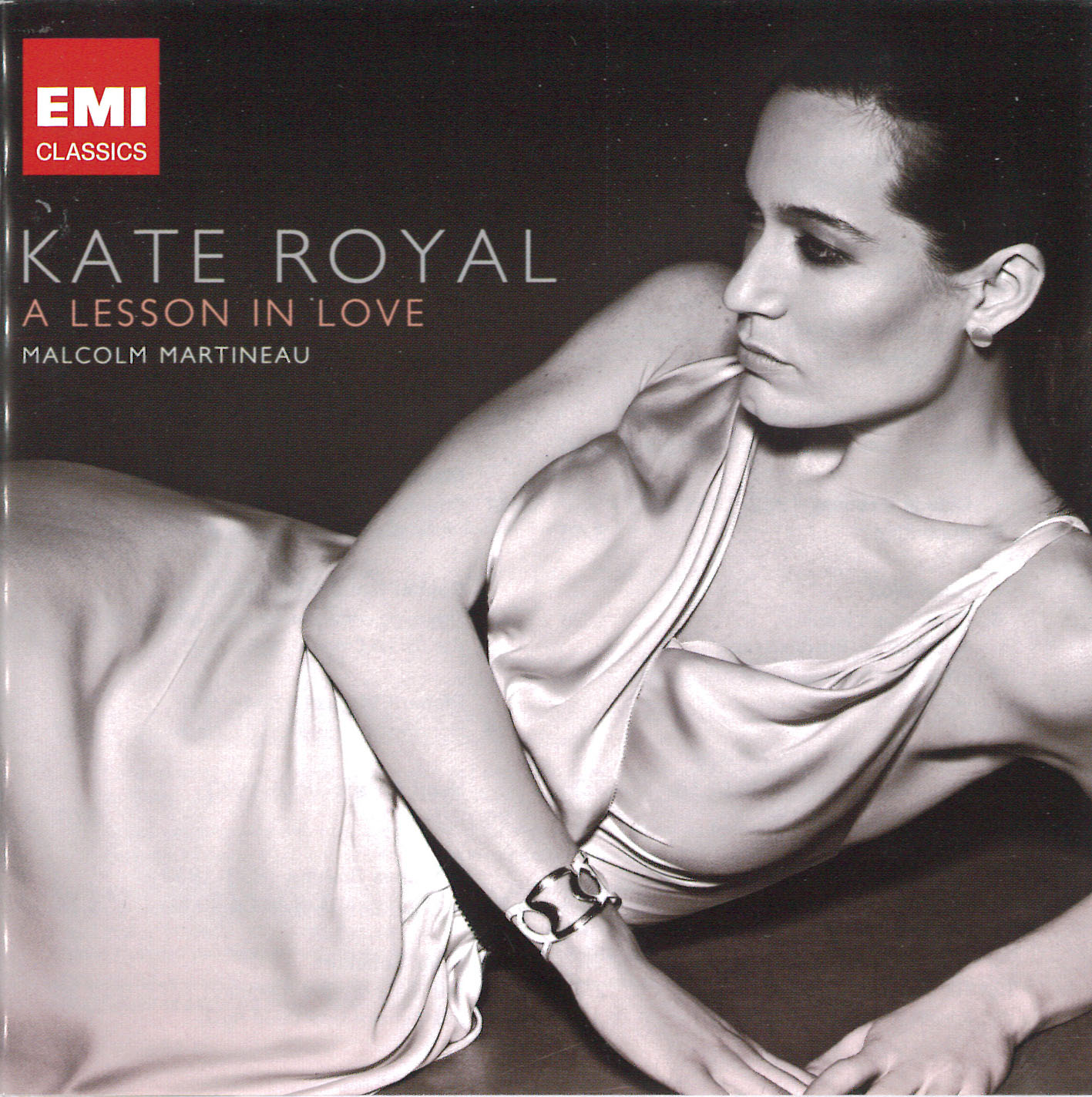
01_kate_royalA Lesson in Love

Kate Royal; Malcolm Martineau

EMI 9 48536 2

No, Kate Royal is not a stage name of the Duchess of Cambridge. It is the real name of a young English soprano, whose ascent to fame has accelerated since one special evening in 2004, when as an understudy in The Magic Flute at Glyndebourne Festival Opera she got to sing Pamina when a diva got sick. Sounds like a typical operatic story, except there is nothing typical about Ms. Royal. The child of singers, she studied at the Guildhall School and won the Kathleen Ferrier trophy. Her happy association with Glyndebourne continues, with great results such as the recently-reviewed Don Giovanni, with Royal as Donna Elvira.

Her lyric soprano seems particularly adept at conveying emotion – her heartbroken and confused Elvira was, well, haunting. But Ms. Royal also reserves 5 months of the year for concert performances and rather than relying on existing song cycles, she has created her own – with some great collaborators. “A Lesson in Love” is an extensive cycle of songs penned by Schumann, Wolf, Schubert, Tosti, Bridge, Copland, Ravel, Fauré, Britten, Debussy and Strauss. They are artfully woven into four stages of a woman’s life, being “Waiting,” “The Meeting,” “The Wedding” and “Betrayal.” These phases are neatly spanned by two versions of William Bolcom’s Waitin (sic). Royal navigates without effort through English, German and French texts, infusing each song with her personal mark. How personal? Well, dear reader, listen to Canteloube’s “Tchut, tchut” from the Songs of the Auvergne and judge for yourself!


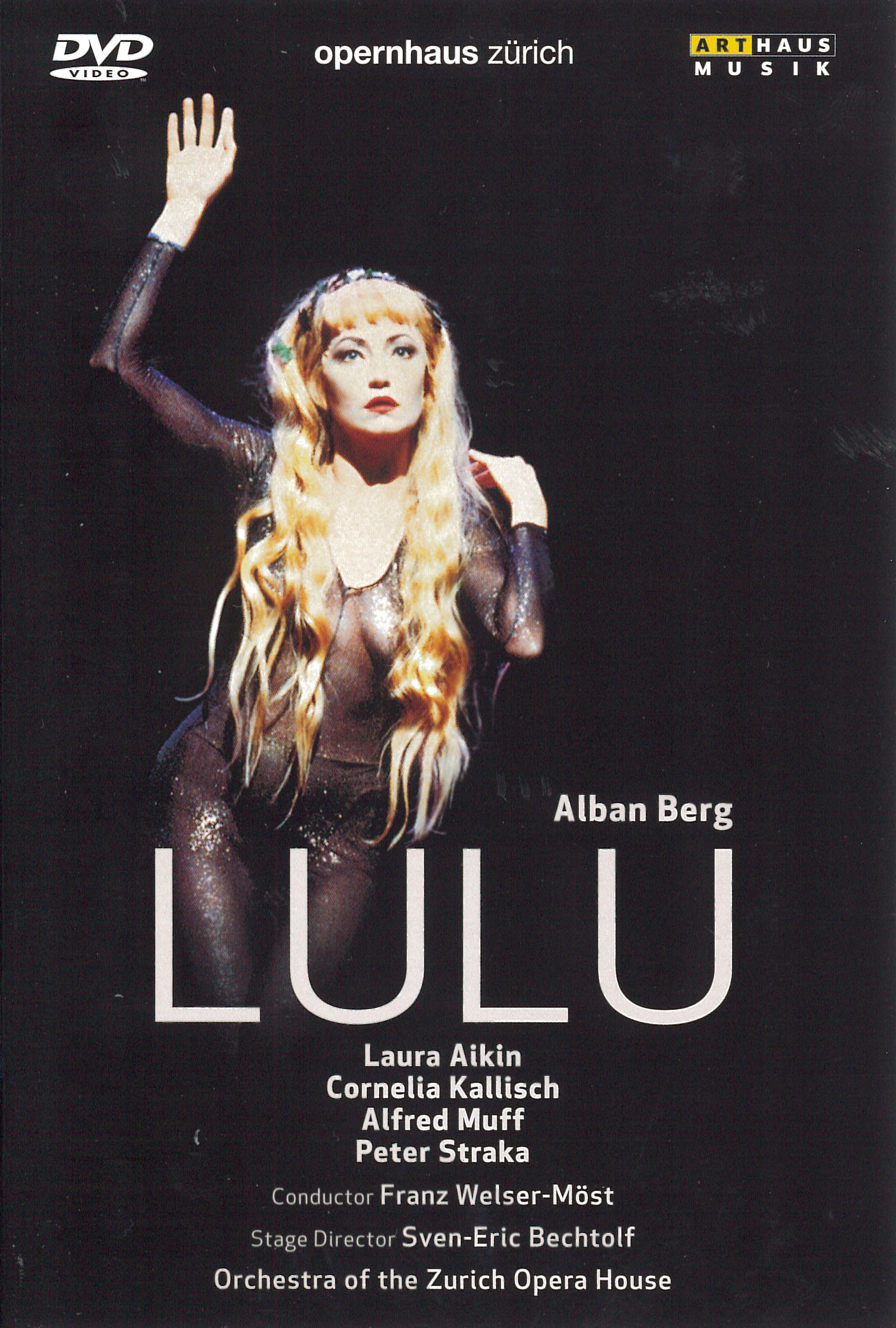
02_luluBerg - Lulu

Laura Aikin; Cornelia Kallisch; Alfred Muff; Peter Straka; Zurich Opera; Franz Welser-Möst

ArtHaus Musik 101 565

Since its premiere in Zurich in 1937 Lulu cannot escape controversy. Granted, in 1937 the subject-matter of a sociopathic prostitute was as controversial as it is today, but there is so much more at stake here. Left unfinished by Berg, the opera was completed in the 1970s from Berg’s sketches and discarded drafts. Even so, this recording features the original, unfinished score, both to commemorate the 65th anniversary of its premiere and to satisfy those, who claim that Berg left the work unfinished on purpose.

It is an opera with probably the most complex female character in history. In parts Violetta, Lady Macbeth and Mélisande, Lulu is as conflicted as she is beguiling. The production takes a deep, psychological view of her character. She is a victim of childhood sexual abuse, illuminated by silent vignettes projected throughout. She also is treated by her husbands and lovers in a proprietary, misogynistic way - illustrated by female mannequin body parts encased in plastic that populate the stage. Like some macabre Damien Hirst sculptures, the body parts point to the commodification of Lulu and explain her coldness and at times hatred towards others. This approach actually works, portraying the heroine as damaged beyond repair and thus tragic, not just loathsome. As the principals sing the difficult music of Berg with ease (with Laura Aikin and Alfred Muff deserving of a special mention), Franz Welser-Möst handles the orchestra beautifully. Fair warning, though: given the graphic nature of the projections, this may be difficult for some viewers to watch. This Lulu is not for the faint of heart.


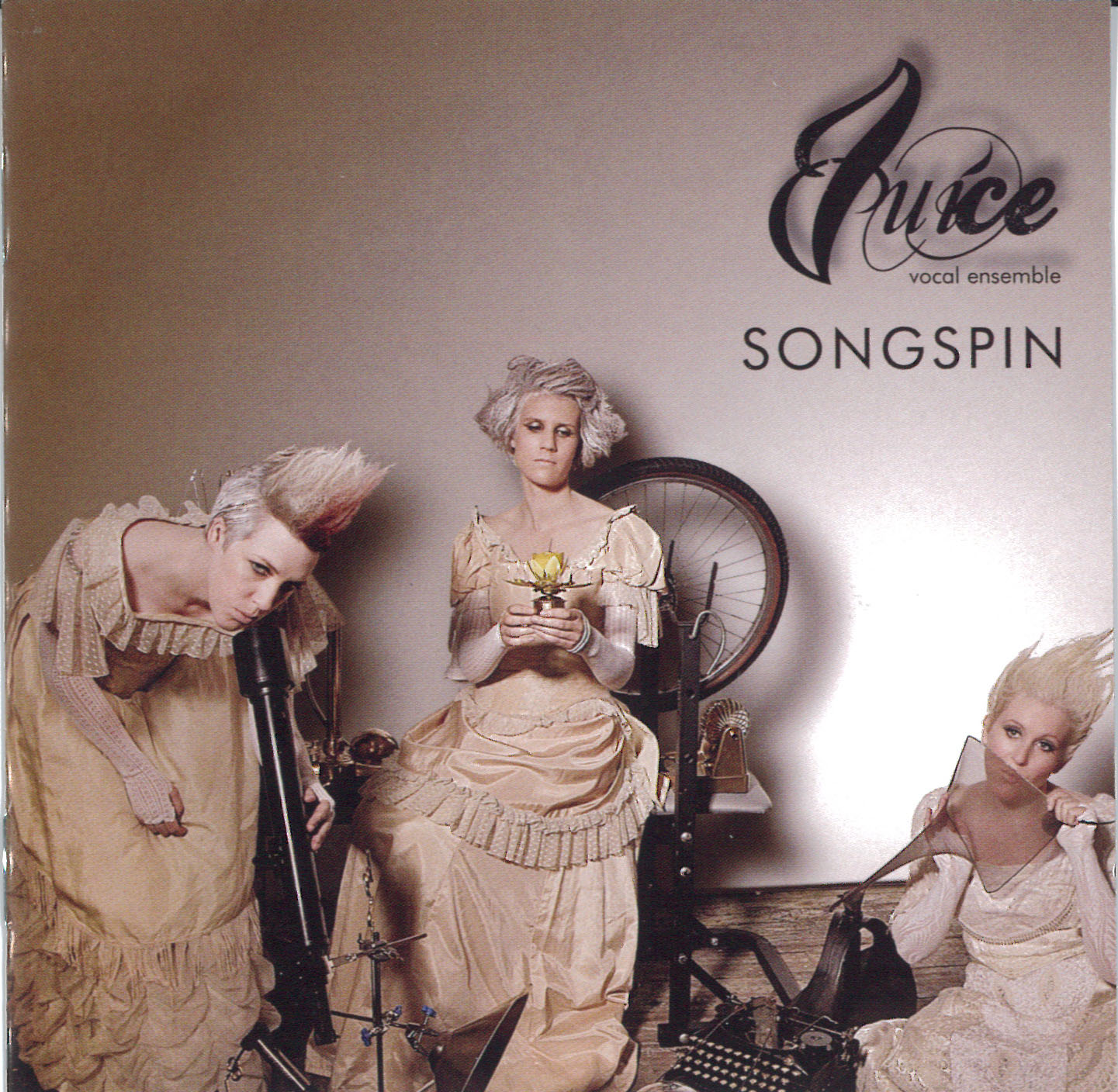
03_juiceSongspin

Juice vocal ensemble

Nonclassical Recordings (www.nonclassical.co.uk)

Traditional, classical and new music meet head on in the debut album by a cappella vocal trio Juice. Bringing art music forward to a hip, modern sensibility, their performances are enjoyed from Wigmore Hall to Austin's SXSW festival. Despite arrangements that are incredibly complex and vocally demanding, their delivery is crystal clear, clean and precise whether mimicking the babbling brook in Paul Robinson's Triadic Riddles of Water or a pointillistic, northern lights-like brilliance in Elisabeth Luyten's Of the Snow. With the use of breath, sighs, sonorous and dissonant harmonies, these women demonstrate how the primal resonance of the human voice has the ability to shape (or even bend) our psyches. Downright eerie are arrangements of the traditional English folksong Cruel Mother as well as group member Kerry Andrew's compositions Lullaby for the Witching Hour and luna-cy. Both a sense of wonder, and fear of the tenuous relationship between mother and child is evoked through the use of punctuated breath and long, languorous sighs in an arrangement of Gillian Welch & T-Bone Walker's Didn't Leave Nobody but the Baby. Extremes in rhythmic complexities are perfectly executed in James Lindsay’s Sanbiki No Kasikoi Saru sounding almost like a game of skill in which none of the three voices trip or falter. They end off the recording with seven playful, quirky remixes; having already taken the listener to the edge, they then extend far beyond.


01_jadinJadin - Quatuors a cordes, Oeuvre 1

Quatuor Franz Joseph

ATMA ACD2 2610

Child prodigy Hyacinthe Jadin premiered his own piano concerto at the age of 13 during the French Revolution, an event which both inspired and overshadowed him. He composed in almost every contemporary genre, including harpsichord and piano pieces, revolutionary hymns, conventional sonatas and trios and chamber music when it was exclusive to the aristocracy.

Quatuor Franz Joseph is certainly conventional: two violins, viola and cello. However, it introduces us to Jadin’s first quartet with a largo which very soon becomes an allegro that is tackled with relish by the quartet. The allegro and following adagio, minuet and second allegro combine to create chamber music at its most exhilarating.

Much less serious in tone are the two other quartets, in A major and F minor. Both exemplify the conventional chamber music of the pump room, albeit enlightened with the demands of the presto last movement of the A major and the folkloric quality of the F minor’s polonaise.

Jadin is said to have been influenced by Haydn, highly likely as Haydn’s influence was by then ubiquitous. Jadin was unique first in that he wrote chamber music when it was almost never publicly performed and second in that he was influenced by Haydn’s slow introductions to his symphonic works. All from a 19-year-old!

We are lucky that Quatuor Franz Joseph is bringing Jadin to the ATMA label; his spirited music makes his death at 24 all the more tragic.

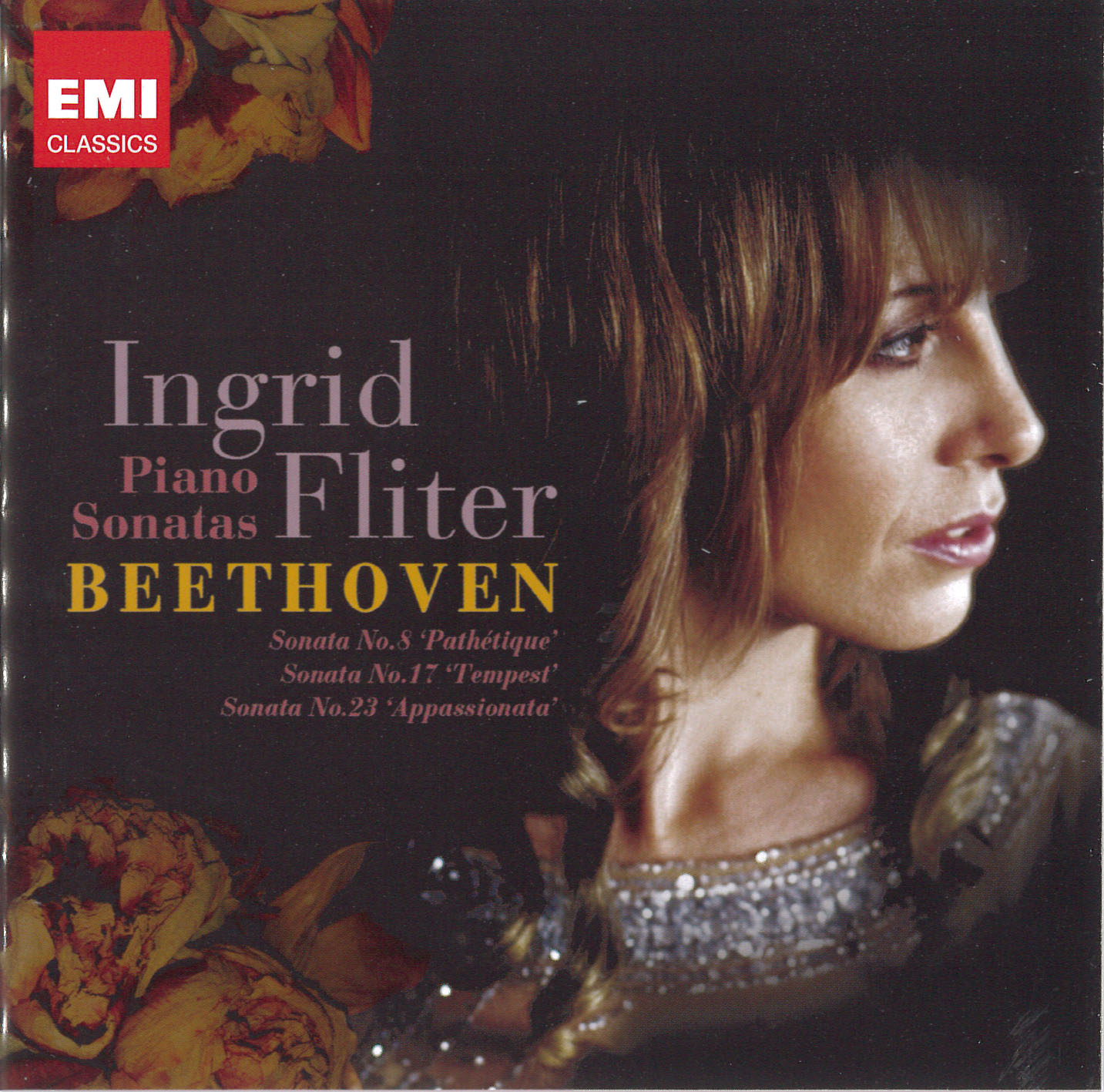
02_beethoven_fliterBeethoven - Piano Sonatas 8; 17; 23

Ingrid Fliter

EMI 0 94573 2

Beethoven’s 32 piano sonatas, with his symphonies and string quartets are among the supreme achievements of civilization in the same sphere as the work of Shakespeare, Dante and Michelangelo. The best pianists have recorded them, like Schnabel, Backhaus, Gieseking, Kempff, Rubinstein, Horowitz and Richter to name only a few. Now a new challenger by the name of Ingrid Fliter has arrived to add to the roster.

Born in Buenos Aires and studied in Europe, she has already won prizes at numerous international competitions and received the prestigious Gilmore Award. This is her 3rd issue with EMI after two very successful Chopin recordings. Here she selected works that probably best suit her temperament, three of the Master’s most turbulent and passionate sonatas, all with a nickname: Pathétique, Tempest and Appassionata.

She plays with great fervour, almost reckless passion, abandon, phenomenal technique, precision and imagination rarely found in other pianists. Nowhere does this come out better than in the performance of Op. 57, the “Appassionata”, where the nearly deaf Beethoven with violent outbursts is virtually shaking his fist to the heavens. Interestingly, it is somewhat related to the 5th Symphony. Notice the four note motive in the bass - D flat, D flat, D flat, C - very similar to the Fate motive that permeates the 1st movement of the 5th. The whirlwind, turbulent last movement where the speed and excitement just builds and builds to the breaking point, ending with an even faster frantic gypsy dance coda is guaranteed to lift you out of your seat, that is if you are not already standing.


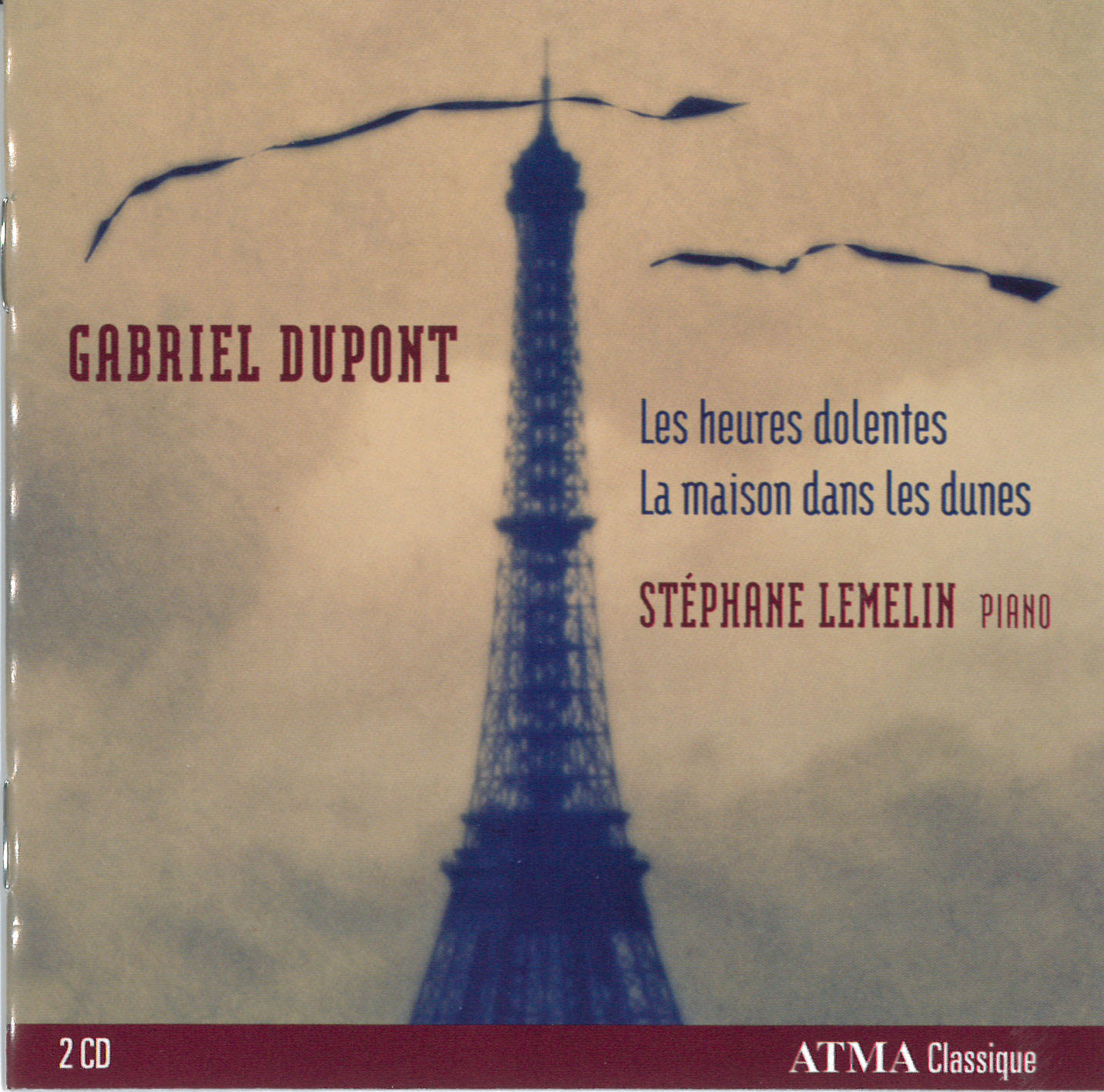
03_dupontGabriel Dupont - Les heures dolentes; La maison dans les dunes

Stéphane Lemelin

ATMA ACD2 2544

In this terrific 2-CD release, pianist Stéphane Lemelin makes a strong case for the remarkable piano music of French composer Gabriel Dupont (1878-1914). These works amalgamate late romantic and impressionist elements into a personal voice that meaningfully conveys the composer’s struggle with tuberculosis. Dupont was known in his day for operas; here too melody pours out and harmony is intriguing. The 14-piece set Les heures dolentes (Doleful Hours) is a diary from the composer’s sickbed at a spa. Particularly touching is the charming “A Friend has Come with Some Flowers” at the work’s midpoint. The last four pieces suggest confrontation and resolution: “Death Grinds,” “Some Children Play in the Garden,” the truly great “White Night - Hallucinations” with its terrifying bass figurations and dissonant harmony, and finally “Calm.”

The ten pieces of La maison dans les dunes (The House in the Dunes) reflect nature, especially the sea. Water has life-giving status in both the playful “The Sun Plays in the Waves” and the dissonant, surging menace in “Sea Swells at Night” where Lemelin delivers a tour de force of “maritime pianism.” The penultimate “Star Light” I found to be the most spiritual piece of all, on the level of the “In Paradisum” from Fauré’s Requiem. Whether the pianistic challenge is handling soft, rapid filigree around a singing melody, pedalling dense passages without getting waterlogged, or achieving transcendent calm, Lemelin can do it. Highly recommended.


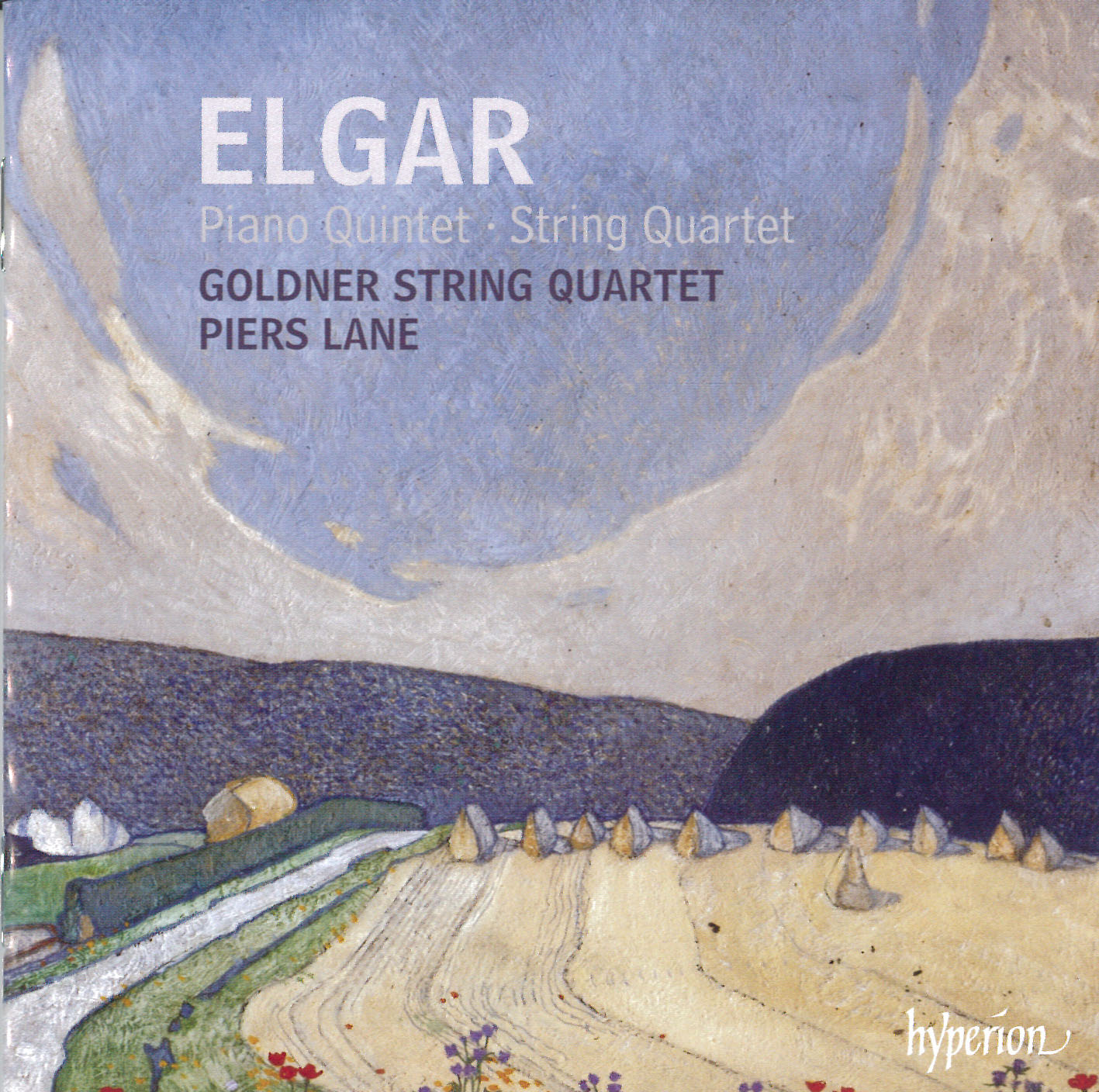
04_elgar_quintet-quartetElgar - Piano Quintet; String Quartet

Piers Lane; Goldner String Quartet

Hyperion CDA67857

Elgar has always been more famous for his large-scale orchestral and choral works than for his chamber music, but included among his output are a fine string quartet and a piano quintet. Both pieces were written over a two year period between 1918 and 1919 when the aging composer was residing in a cottage in West Sussex – and both are presented here on this Hyperion recording by the Australian-based Goldner String Quartet with pianist Piers Lane.

The quartet is an appealing anachronism. After all, only six years before, Stravinsky’s Rite of Spring had caused a scandal in Paris, while in Vienna, the Second Viennese School was making strides with serialism. Elgar himself admitted, “It is full of golden sounds… but you must not expect anything violently chromatic or cubist.” Nonetheless, this is elegant music, elegantly played, and the Goldners handle the intricate string writing with its subtle harmonic shifts with great precision and warmth.

The more expansive piano quintet is equally conservative, but is marked by a considerably more serious tone. Piers Lane and the quartet are perfectly matched, treating the tempestuous opening movement with bold assurance. Similarly, the middle movement adagio is given the pathos and anguish it deserves, while the finale, with its mood of buoyant optimism, brings the disc to a satisfying conclusion.

Between the two chamber works are four hitherto unrecorded solo piano pieces, two dating from the early 1930s, and all of them, charming examples of Elgar’s keyboard style. In all, this is an exemplary recording of music written by a composer who was nearing the final chapter of his creative life - there’s hope for us all!


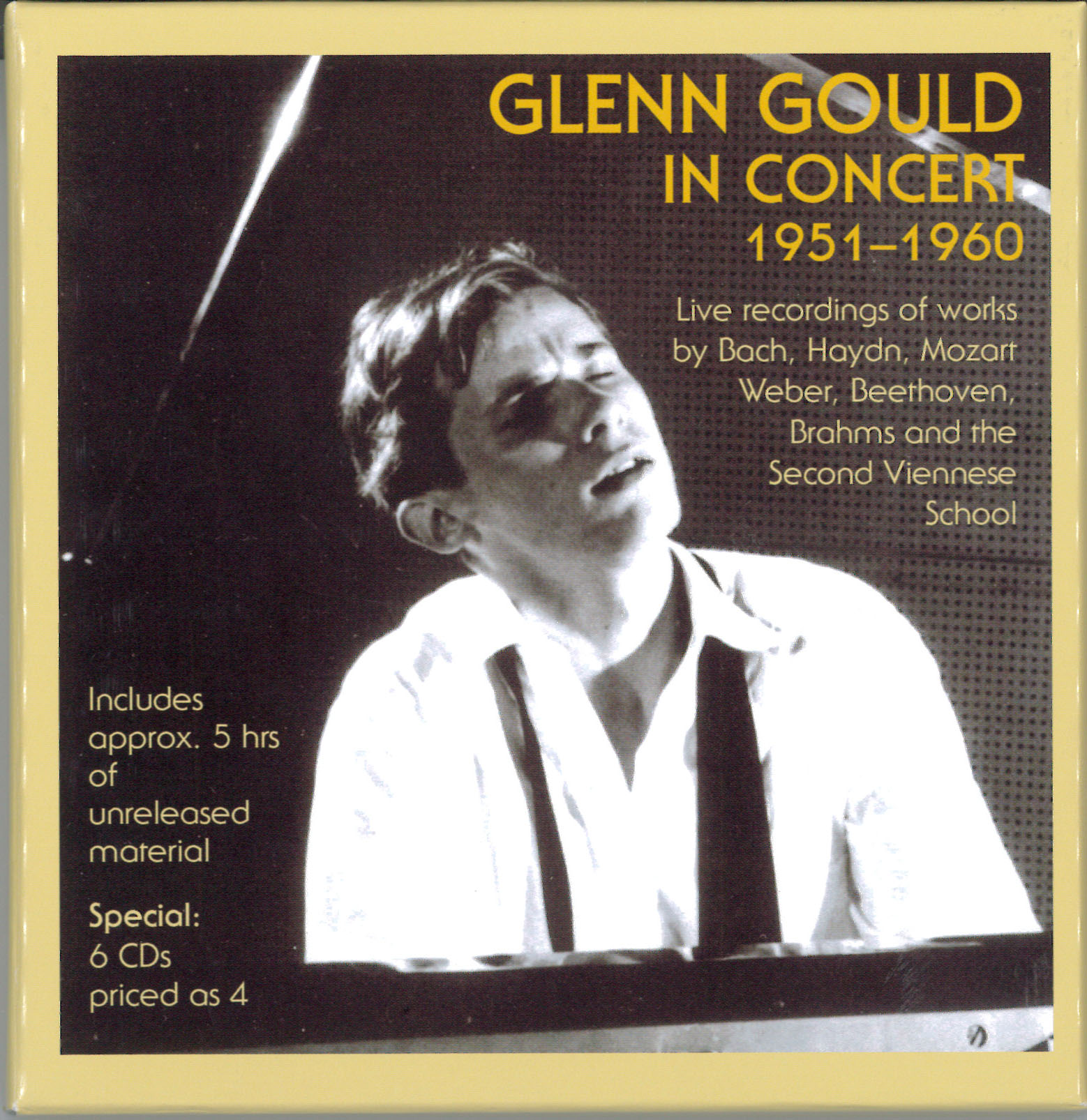
05_glenn_gould_liveGlenn Gould in Concert 1951-1960

Glenn Gould

West Hill Radio Archives WHRA-6038

The tragedy of Glenn Gould as concert pianist is seldom discussed. He faced crippling performance anxieties he could not overcome, and abandoned his flourishing career in his early thirties. He then commenced to become even more famous in his subsequent life as a combination recording artist, CBC arts producer, music journalist, and general Toronto eccentric.

Here we have the Glenn Gould most of us never knew, the concert artist, in some five hours of previously unreleased recordings. All of this material is unedited, taken from radio broadcasts or private recordings: it is raw Gould, so to say, with the occasional smudges and wrong notes of all pianists, from an artist who in later life insisted on zealous control of his work, in his bid for edited perfection. The performances are from Canada, the USA, Russia, Austria, and Sweden. Gould biographer Kevin Bazzana has supplied lengthy biographical notes, in extremely small print. The release itself is Canadian/German and cryptic, except for a clear warning label: “Not available in the USA.”

A 1958 Vancouver Festival performance of - guess what? - Bach’s Goldberg Variations opens this boxed set. The Aria dances with tremendous musicality and contrapuntal verve. It feels more elastic and personal than the famous Columbia debut release of 1955. Variations 29 and 30 are electric and wild, and played interwoven as one.

There’s a wonderful performance of the Beethoven Second Piano Concerto with Paul Paray and the Detroit Symphony, with an aching slow movement. We tend to put Gould in a cerebral, clinical camp of pianism: not here. With the same conductor and orchestra - on the same night, no less! - Gould then teamed up with the DSO’s concertmaster Mischa Mischakoff and principal flutist Albert Tipton for a splendid, warm performance of the Fifth Brandenburg Concerto. Gould’s long solo cadenza, written by Bach, is muscular and songful.

Other treasures abound, including a gentle reading of Beethoven’s Sonata Op. 109 from a Vienna recital, Schoenberg’s intimate, spiky Piano Concerto with the Cleveland Orchestra, and some gorgeous Beethoven chamber music from the Stratford Festival.

There’s an oddly dreary Gould performance of the Brahms First Concerto - with a fine Winnipeg SO led by Victor Feldbrill - that then roars to life for our hero in the finale.

Swedish mezzo-soprano Kerstin Meyer joined him for Schoenberg’s song cycle Book of the Hanging Gardens at the 1960 Vancouver Festival. She tells us in the notes that Gould was a superb and deferential accompanist, who followed her “like a shadow.”

Sound quality throughout these CDs is so-so, yet very present and alive. Engineer Albert Frantz did the digital restorations: you know right away these are dated performances, but you also feel like a time-traveller, sitting in a good seat at each concert venue.

It is sad to recall that this brilliant young Toronto pianist of the 1950s could still be concertizing today, had he lived, and had he continued a normal path. Gould would turn 80 next year. He was a contemporary of Paul Badura-Skoda, Alfred Brendel and Martha Argerich. But something went wrong, and Gould’s retreat into the recording studio brought a more mannered musical trajectory that still confounds many.

Strongly recommended! Order online from www.canadacd.ca ($52.99).


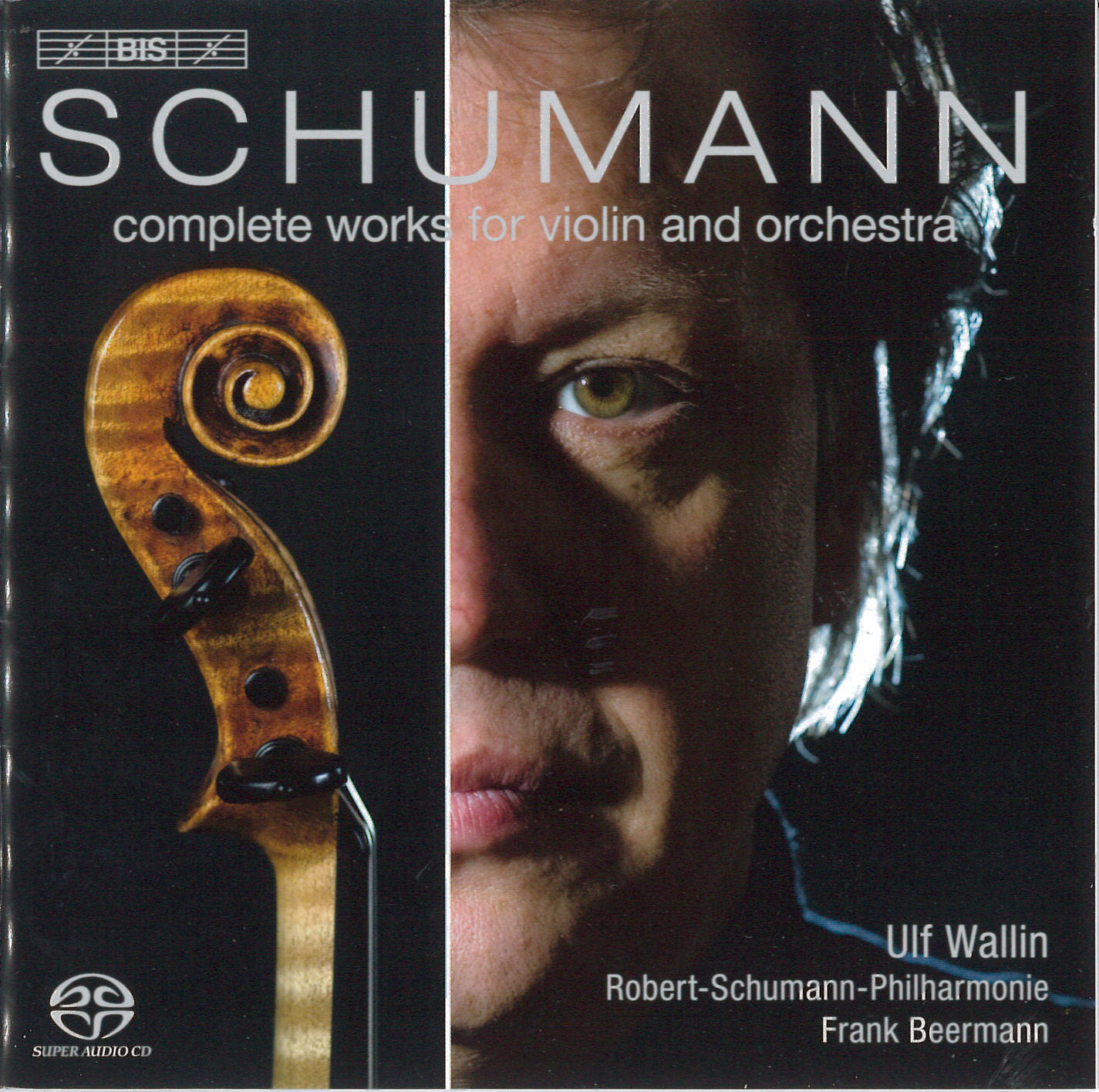
01_schumann_violin-orchestraThroughout his life, Robert Schumann tended to concentrate on one particular form of composition at a time, and in 1853 he produced his only three works for violin and orchestra, although only one – the Fantasy in C minor – was premiered before his death 3 years later. BIS has released an outstanding SACD of the Complete Works for Violin and Orchestra (BIS-SACD-1775) featuring Ulf Wallin with the Robert-Schumann-Philharmonie under Frank Beermann. The Concerto in A minor is Schumann’s own transcription of his 1850 Cello Concerto, and it works remarkably well, given the two instruments’ differences in pitch and tone. It was premiered as recently as 1987 after a copy was found in the papers of the violinist Joseph Joachim, to whom both the Fantasy and the Violin Concerto in D minor were dedicated. The Fantasy, an attractive work with a striking cadenza, fell out of favour after Schumann’s death, and the D minor concerto fared no better, with several projected premieres being cancelled before Clara Schumann and Joachim lost faith in it and decided against publishing it. Joachim’s resistance was probably due to the concerto’s technical and musical challenges: it’s a large work with a beautiful slow movement, but has never really established itself in the repertoire since finally being published and premiered in 1937. If anything can change that, it’s this recording. Ulf Wallin (who also wrote the outstanding booklet notes) uses Schumann’s original solo part, wisely choosing to ignore the later unauthorized “corrections and alterations” apparently made by Joachim. The result is a definitive performance, full of strength and beauty, and perfectly displaying the mix of Classical and Romantic styles that typify the music of this still often misunderstood composer.

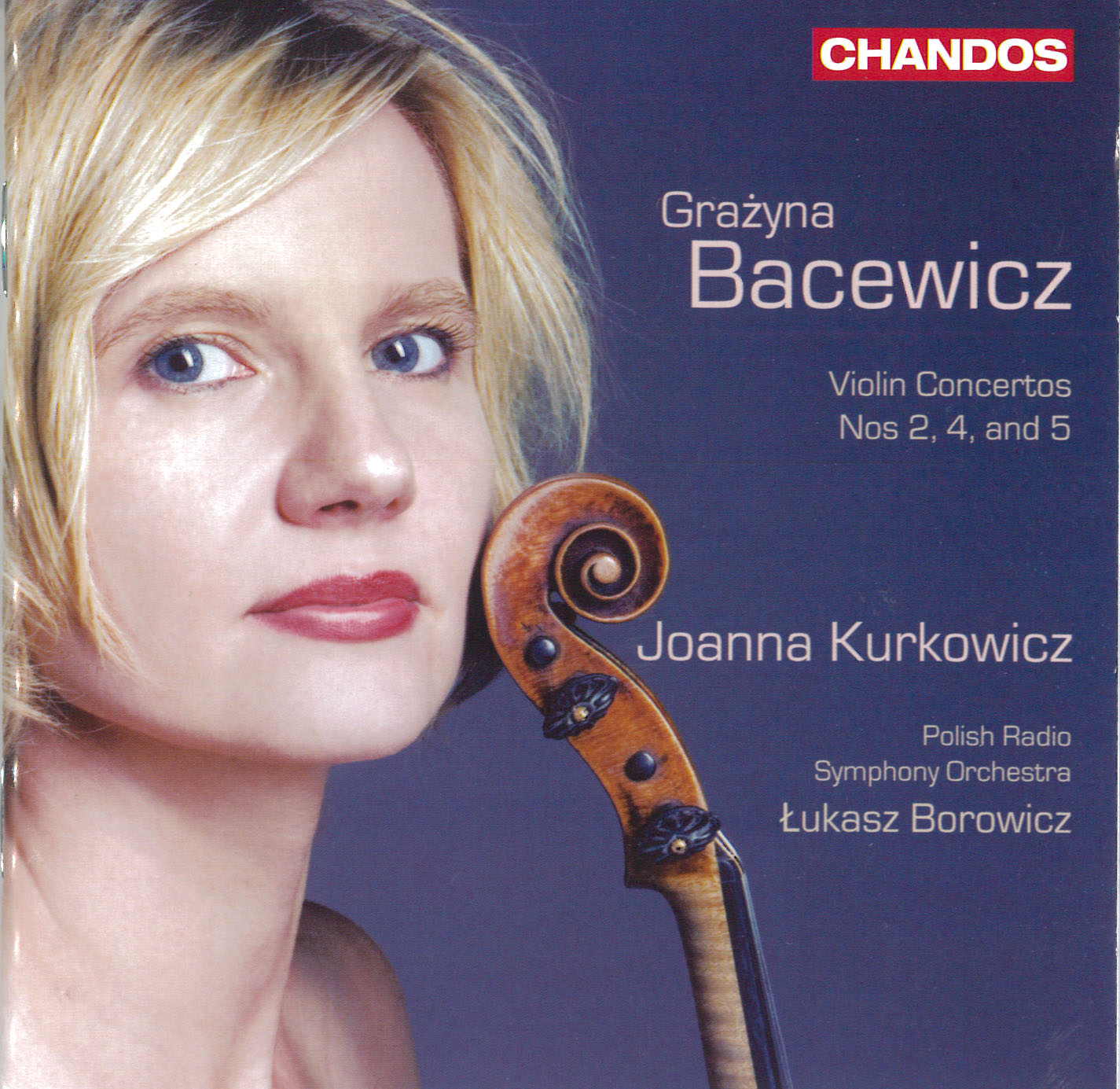
02_bacewicz_violin_concertosCHANDOS has issued Volume 2 of the Violin Concertos of the Polish violinist and composer Grazyna Bacewicz (CHAN 10673), and it’s quite stunning. Bacewicz (1909-69) was that 20th century rarity – a world-class violin virtuoso with compositional skills to match. Volume 1 featured Concertos 1, 3 and 7, and this new CD completes the set with Nos. 2 (1945), 4 (1951) and 5 (1954) (No.6 exists only in manuscript, and has never been performed). The three works here range from the somewhat Prokofiev-like No.2, with its mix of melodic and strongly rhythmic material, to the much tougher, terser world of No.5, as Polish music began moving away from the “formalist” Communist days. All three demonstrate Bacewicz’s innate understanding of the instrument, and her assured grasp of form and orchestration. The Polish-born violinist Joanna Kurkowicz, now resident in the United States, is wonderful throughout, and given terrific support by the Polish Radio Symphony Orchestra under Lukasz Borowicz. An absolutely essential addition to the 20th century violin concerto record catalogue.

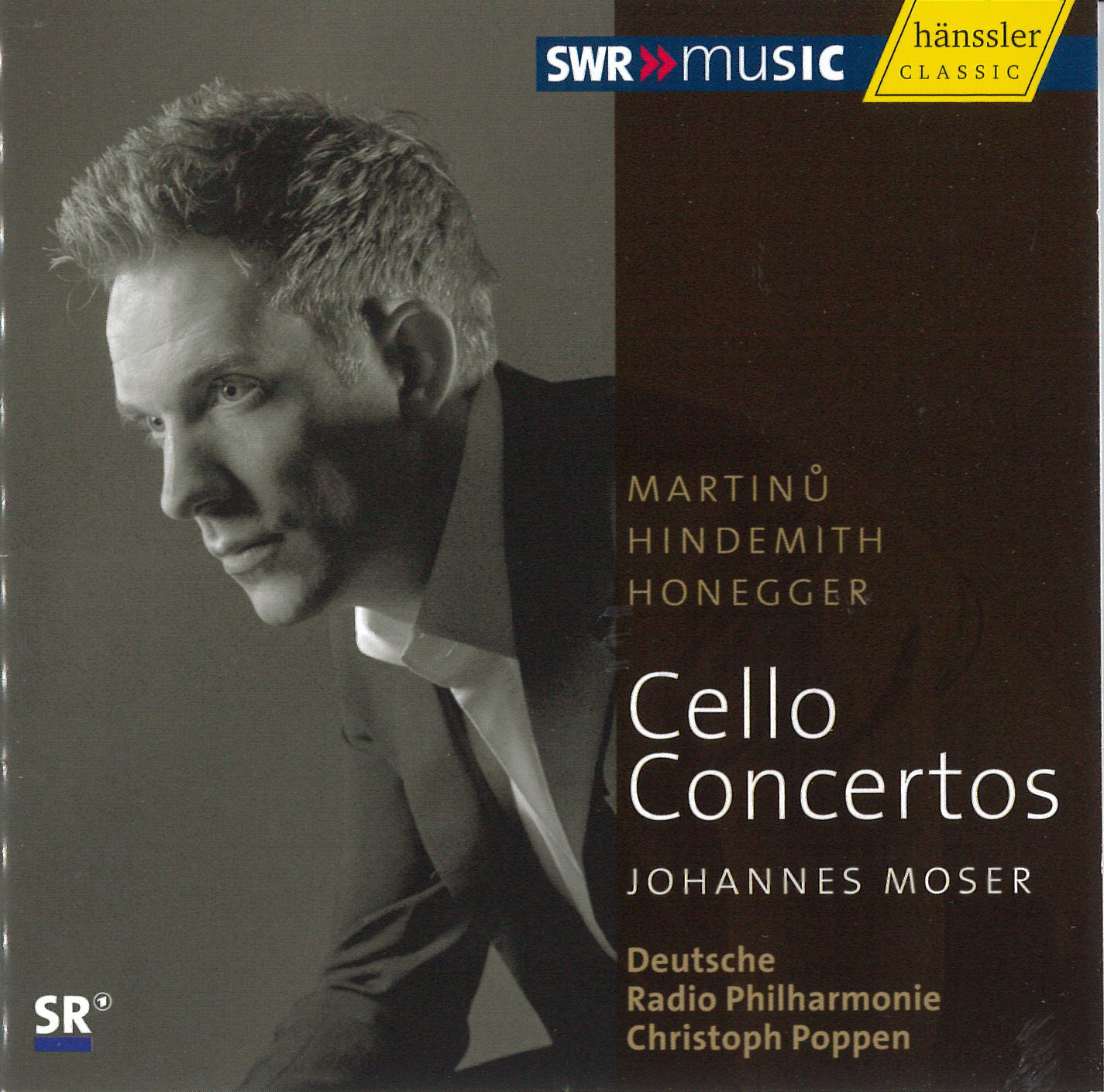
03_cello_concertosBohuslav Martinu, Arthur Honegger and Paul Hindemith lived almost exactly contemporaneous lives, being born within 5 years of each other in the early 1890s and all dying in their 60s between 1955 and 1963. As cellist Johannes Moser perceptively notes in the booklet for his latest CD, Cello Concertos (Hänssler CLASSIC CD 93.276) they had one other thing in common: they all consciously avoided the path of serialism and consistently developed their own very individual styles. Moser’s idea of bringing their cello concertos together in one programme is a real winner, and results in a terrific CD. All three works are in the traditional three-movement form and are immediately accessible, while clearly imbued with each composer’s individual voice. The Martinu, from 1930, has its roots firmly in the Czech tradition, with a soulfulness very reminiscent of Janáček at times. The Honegger is a short (15 minutes) but very effective work from the same year. The Hindemith, from 1940, is classic Hindemith: a strong, rhythmic opening; an immediate melodic entry for the soloist; an instantly identifiable and highly personal use of tonality; stunning orchestration. It’s a wonderful partner for the Violin Concerto from the previous year. I’m completely at a loss to understand why Hindemith is still regarded in some circles as a dry, theoretical musician – it’s a view completely at odds with his mature orchestral works, and one completely destroyed by performances like this. Moser is outstanding throughout the disc. The recorded sound is warm and resonant, and the Deutsche Radio Philharmonie and conductor Christoph Poppen are ideal partners.

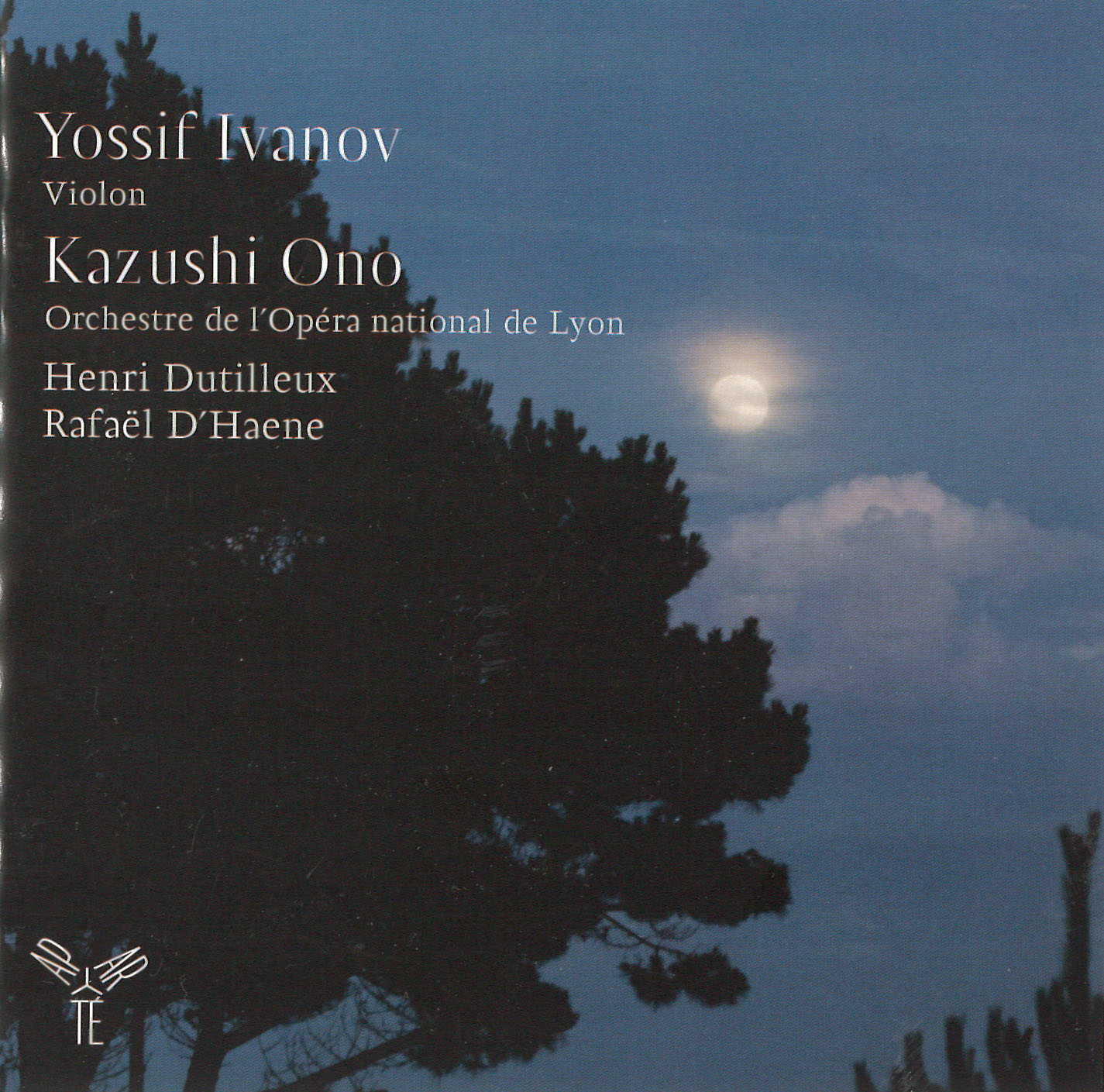
04_yossif_ivanovTwo late 20th century violin concertos are featured on a Harmonia Mundi CD (AP007) of works by Henri Dutilleux and Rafael D’Haene, with the Belgian violinist Yossif Ivanov and the Orchestre de l’Opera national de Lyon under Kazushi Ono. Dutilleux was born in 1916, and is still with us at 95! His violin concerto L’arbre des songes (Tree of Dreams), finished in 1985, took a while to write: it was commissioned by Radio France in 1979 for Isaac Stern’s 60th birthday the following year. It’s an intriguing work, consisting of four main sections joined by three orchestral interludes, and shows a tremendous range of orchestral colour and timbre. The Belgian composer Rafael D’Haene was born in 1943, and was a pupil and consequently a close friend of Dutilleux. His violin concerto (1990) is a two-movement work which has as its theme the myth of Orpheus, with which the composer has always been fascinated. It’s maybe less immediately accessible than the Dutilleux, but is no less striking a work for that. Dutilleux's Nocturne for Violin and Orchestra, sur le meme accord, completes the CD; it's a short but brilliant piece built on a 6-note chord, composed in 2002 and dedicated to Anne-Sophie Mutter. Ivanov and the orchestra are in top form throughout a disc that has to be listened to – no simple background music here – but that amply rewards the effort.

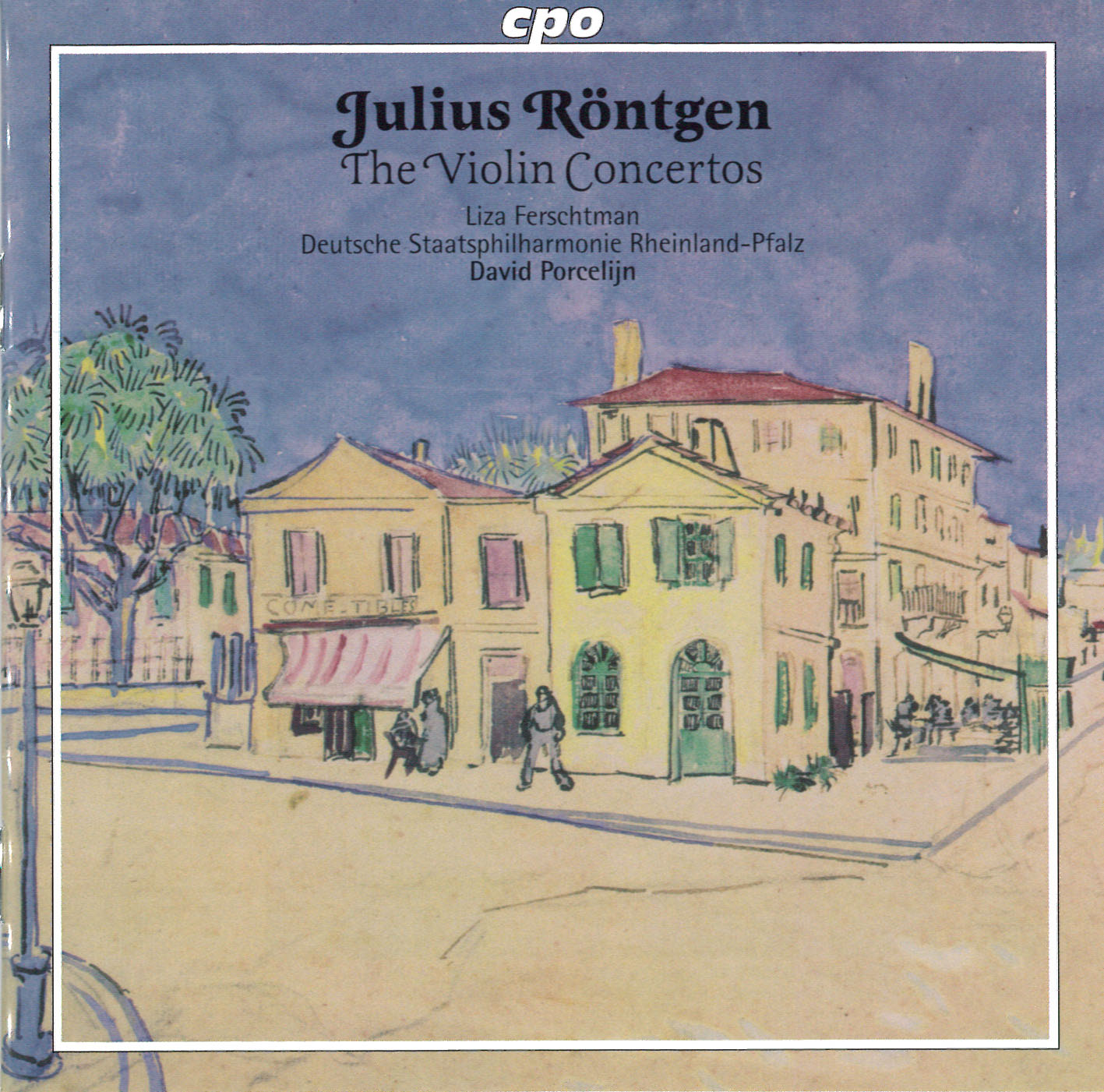
05_rontgenThree more 20th century violin concertos – although you would never guess to listen to them – comprise the programme on a CD of music by the Leipzig-born composer Julius Rontgen (1855-1932), who spent most of his life in the Netherlands, but remained firmly rooted in the German tradition of Mendelssohn, Schumann and Brahms. The German label CPO has issued an interesting and thought-provoking CD of his Violin Concertos (777 437-2) featuring the Concertos in A minor from 1902 and F sharp minor from 1931, together with the Ballad from 1918. Although I know the name, I can’t recall ever hearing any of Rontgen’s music, and listening to this CD it’s perhaps easy to understand why: despite all three works dating from the 1900s you’re constantly reminded of 19th century composers – Sarasate, Dvořák, and particularly Bruch and Brahms – and while it’s all very competent and makes for pleasant listening there doesn’t seem to be a great deal of substance or individuality. It always seems to fall just short of memorable. Brahms, himself a friend of Rontgen’s, was among those - both critics and colleagues - who commented that Rontgen’s musical voice was simply not original enough. That’s not to say that his voice was without talent, however. Rontgen may have been stylistically stuck in 19th century Germany, but he clearly knew his craft. These works display skill and taste, together with a real melodic gift and a fine grasp of orchestration; what he apparently lacked was that true spark of genius that would have infused his music with a strong personal identity. Dutch violinist Liza Ferschtman makes the most of the material here, with fully committed playing that presents the music in the best possible light. The Deutsche Staatsphilharmonie Rheinland-Pfalz under David Porcelijn provides excellent support. It might be easy to see why this music has remained in a backwater instead of drifting into the mainstream, but don’t be misled: there are many really lovely moments throughout this CD.

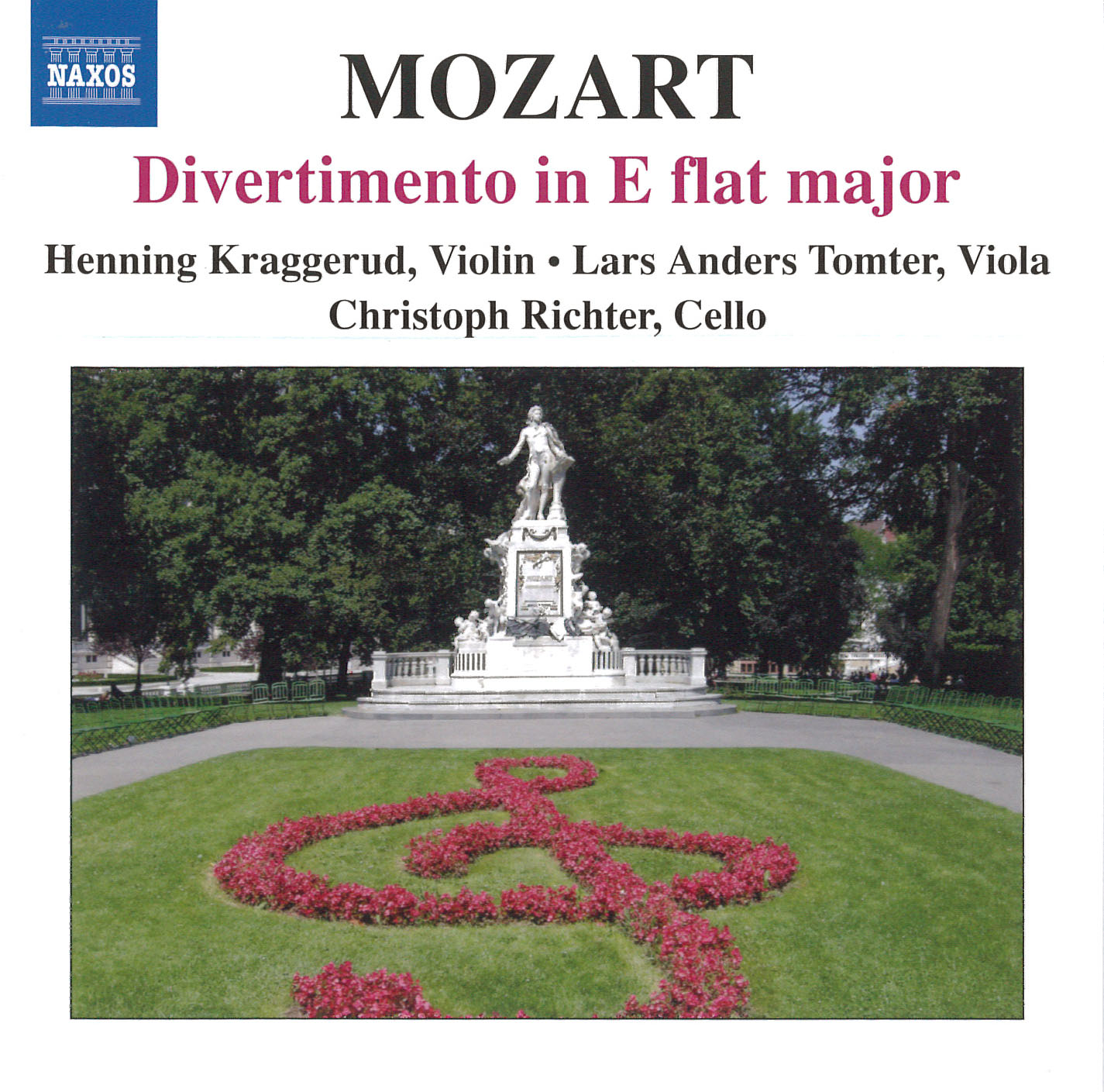
06_mozart_divertimentoThere’s another recording of the wonderful Mozart Divertimento K563 - the String Trio in E flat – one of Mozart’s most glorious keys. I raved about the Trio Zimmermann’s recording of this work earlier this year, and now Naxos has issued an excellent performance by violinist Henning Kraggerud, violist Lars Anders Tomter and cellist Christoph Richter (8.572258). Again, don’t be fooled by the designation Divertimento: although this normally signified light entertainment music where the composer was free to choose a mixture of movements and forms, this six-movement work is, as Ingrid Anderson’s booklet notes so rightly point out, “far from pure entertainment.” She echoes the Alfred Einstein quote from my previous review when she calls the first two movements “…among the most sonorous and masterful examples of chamber music ever written.” And they are. This performance may be slightly less intense than the Zimmermann at times, but it’s a warm, rich reading that is beautifully recorded. At the bargain Naxos price it’s a great way to obtain a superb work that is quite simply Mozart at his best.

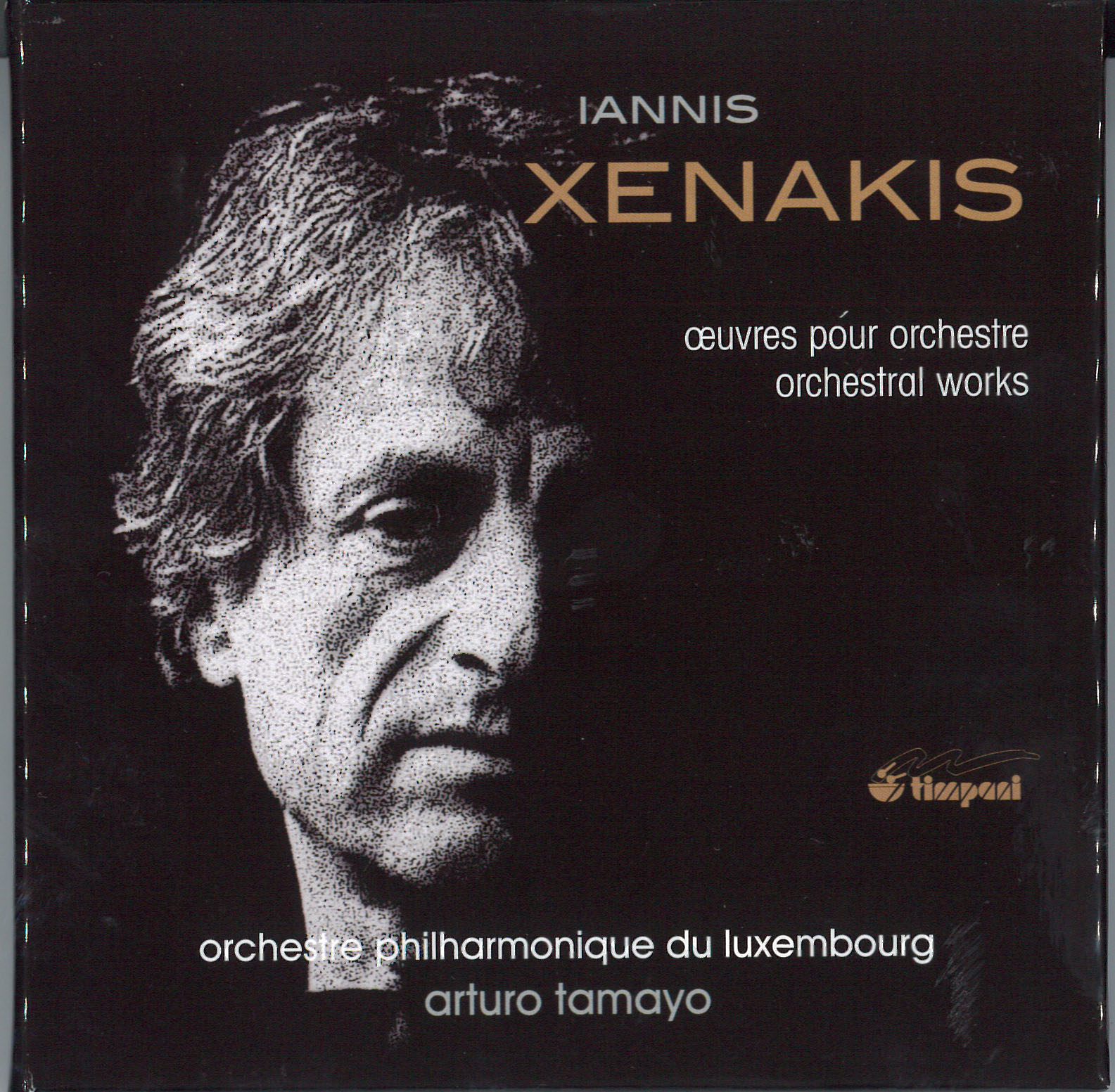
01_xenakis_orchestralXenakis - Orchestral Works

Orchestre Philharmonique du Luxembourg; Arturo Tamayo

Timpani 5C1177 (www.timpani-records.com)

Iannis Xenakis (1922-2001) was a Greek composer based in Paris, with a long relationship to Canada: four premieres and many visits going back to the 1960s. For all that, there have been just two orchestral performances in Canada. Luckily, next March Esprit Orchestra will reprise its 2006 performance of Jonchaies (1977), a major work included in this set.

Over the 40-some years of his career, Xenakis wrote 40 orchestral scores, an amazing output considering that he composed 100 or so other works as well. Until recently, few of the orchestral pieces were available on disc. Thankfully, in 2000, conductor Arturo Tamayo and the Orchestre Philharmonique du Luxembourg began recording these works for Timpani Records, a French label. Over the past decade, five discs have been released, now collected in a handy box set. Of the 23 works presented, only a few have been recorded before. The fifth disc includes Achorripsis (1957) for ensemble rather than orchestra. As it is out on disc already, one wonders why it was included. That quibble aside, this is an important collection, very well recorded and performed. Tamayo is a fine, intelligent conductor who performs a great deal of contemporary music all around Europe.

Xenakis’s seminal scores, Metastaseis (1954) and Pithoprakta (1956), have long been available on disc through reissues of early recordings. This new one is a revelation, not only for the pristine quality but for the assurance of the string players, who now very well know how to perform the glissandi, steely non-vibrato, and other extended techniques that earlier musicians struggled with. Hiketides (1964) is a little-known orchestral suite derived from incidental music for the Aeschylus tragedy The Suppliants, and is a fascinating mixture of textural music and archaic-sounding modal passages.

The majority of the works recorded for this set date from the 1980s and 1990s. Most are scored for full orchestra, although Syrmos (1959) and Shaar (1983) are for strings alone, and Akrata (1965) is for winds. Two are concertante works for piano, dazzlingly performed by the young Japanese pianist Hiroaki Ooï: Synaphaï (1969), where the piano part is infamously written on 10 staves, and Erikhthon (1974). The other work in this set featuring soloists is Aïs (1980), written for the extraordinary voice of Spyros Sakkas, jumping between baritone and falsetto. He is heard along with a solo percussion part ably performed by Béatrice Daudin. This work opens the set, and is truly evocative and emotionally gripping. The latest pieces included in the set date from 1991: Roaï, Kyania and Krinoïdi. An extraordinary year! Even more amazing is the variety of character and material between these works. While Xenakis was at that time already suffering from ill health, it certainly does not show in these forceful, sophisticated, beautiful works.

In listening through all this music, various strands of the composer’s thought and expression surface; some — like the glissando textures, the layered polyrhythms, or the modal melodies harmonized in blocks — reappear. Others appear then submerge, giving rise to new ideas. The evolution from one orchestral score to the next is quite organic, and the visceral intensity of the music remains constant. Try listening chronologically as well as following the order presented on the discs.

What is most apparent, in the end, is that all his life Xenakis drew extraordinary inspiration from the symphony orchestra. The important contribution he made to the genre can start to be understood and appreciated with this fine box set.


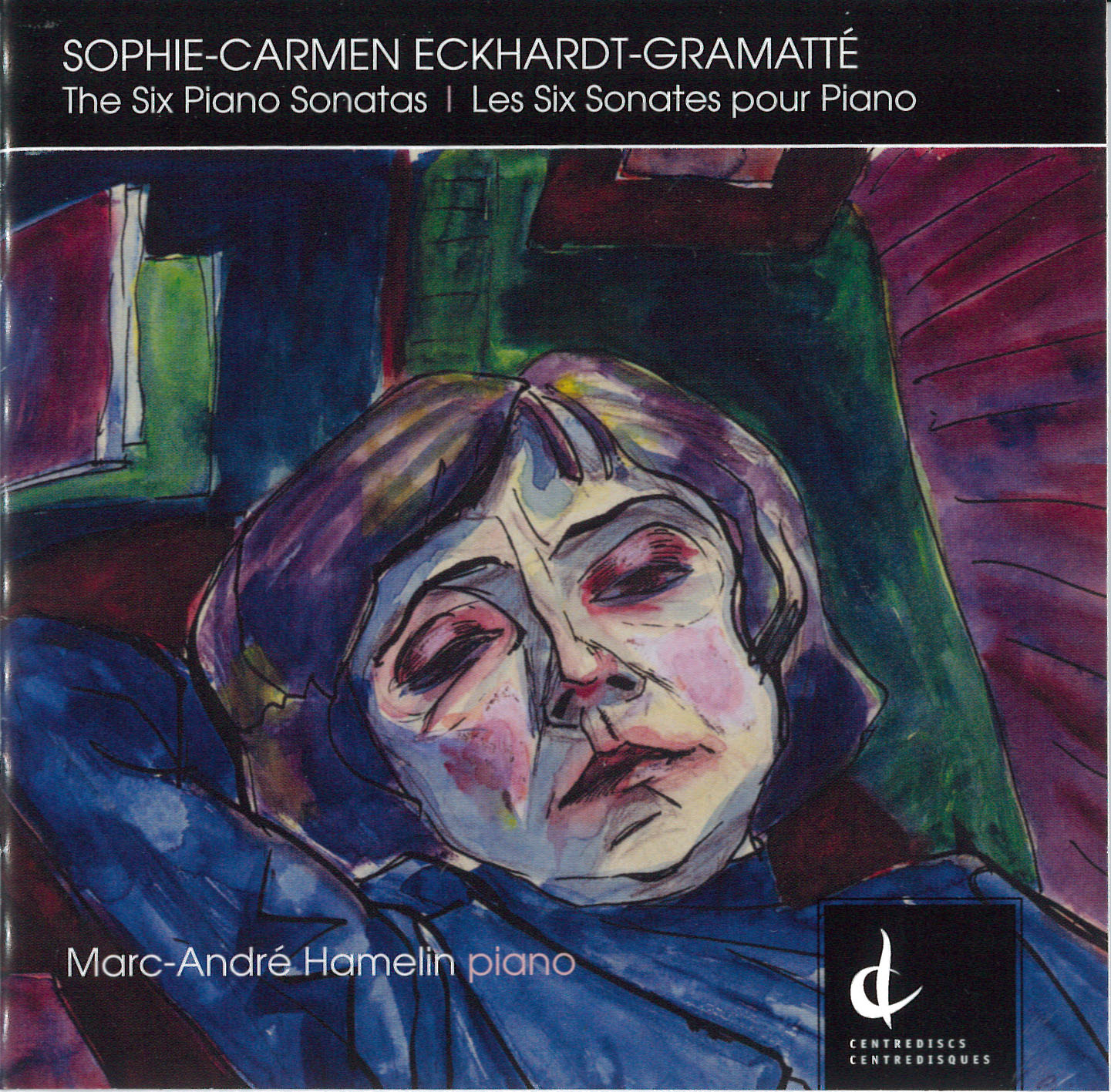
02_e-greS. C. Eckhardt-Gramatté - The Six Piano Sonatas

Marc-André Hamelin

Centrediscs CMCCD 16611

Outside Canadian music circles where her legacy lives on in a prestigious music competition, the colourful name of Sophie-Carmen Eckhardt-Gramatté (1899-1974) might not be particularly well known. But rest assured, this woman led an equally colourful life as performer, composer and pedagogue. Born in Moscow, she entered the Paris Conservatory at age eight, studying piano and violin, and went on to a successful concert career on both instruments. Later, two marriages brought her to Barcelona, Berlin, Vienna, and finally to Winnipeg where she settled in 1953 when her second husband Ferdinand Eckhardt became the director of the Winnipeg Art Gallery. There she broke new ground as a teacher and composer, her contemporary style very much steeped in the romantic tradition. Among her compositions are six piano sonatas, written between 1923 and 1952 – and who better to perform this technically challenging music than piano titan Marc-André Hamelin? This two CD Centrediscs set is a re-issue of an Altarus recording from 1991.

These sonatas, covering a thirty year period, display a wealth of contrasting styles. The first, written in 1923, pays homage to the Baroque period – think 1920s neo-classicism. Conceived as a two-part invention, the mood is buoyantly optimistic, and Hamelin easily meets the technical demands required to bring it off convincingly. Considerably more subjective is the second sonata, completed only a year later. In four movements, the piece aptly describes Eckhardt-Gramatté’s emotional state over a two year period, from the dark days in Berlin during the Great War to the more cheerful time when she and her first husband, artist Walter Gramatté settled in Spain.

The mercurial nature of these sonatas, with their ever-changing moods presents no challenge to Hamelin. The vivacious finale from the fifth sonata is handled as deftly as the languorous Nocturne of the Sonata No.4.

Eckhardt-Gramatté’s music might not be to everyone’s taste. Some might find it too strident, while others, too deeply-rooted in late romanticism. Nevertheless, she occupies a unique place in 20th century music, and this set is a fine tribute to a composer who undoubtedly deserves wider recognition.


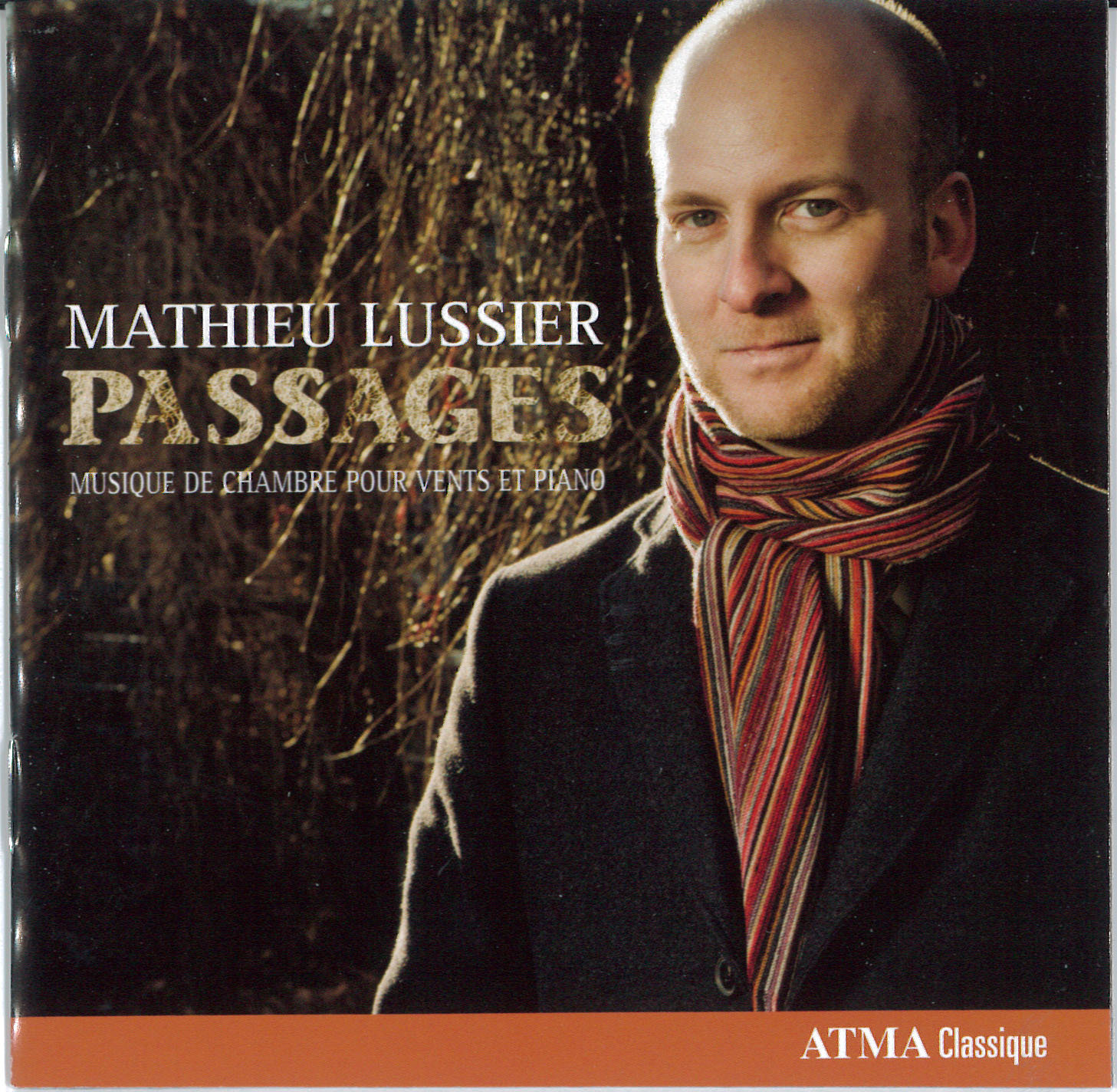
03_lussierMathieu Lussier - Passages

Pentaedre; Louise Lessard; Claudia Schaetzle; Fraser Jackson

ATMA ACD2 2657

Bassoonist and composer Mathieu Lussier’s compositions here feature wind instruments and piano in various combinations, some conventional and others unusual. Lussier writes fluently and eclectically for winds in solo and chamber music that has won support of major performers. His works align with the French neoclassical woodwind tradition, and add distinctive touches. I particularly like his Sextet for wind quintet and contrabassoon, a concise three-movement work in which the contrabassoon provides both weight and wit!

Lussier plays and conducts early music, and a baroque influence is noticeable. It shows up in harmonic progressions and in the presence of the siciliano and chaconne, for example. Also, there are popular elements along with the baroque; after all, repeated chord progressions in pop songs can be compared to the ground bass which appears in the last movement of the Sextet and in Passages for bassoon and piano. In the White Rock Sonata syncopation provides a rhythmic spark to the earlier style.

The latter two works show Lussier himself to be an expressive and technically facile bassoon soloist. I am also particularly taken with clarinettist Martin Carpentier’s performance of the Introduction and Sicilienne. In fact the wind soloists are all of high calibre, including also flautist Danièle Bourget, oboe d’amore player Normand Forget, alto saxophonist Claudia Schaetzle, French horn player Louis-Philippe Marsolais, and contrabassoonist Fraser Jackson. Finally, Louise Lessard’s exemplary pianism not only accompanies but periodically steers well-paced and convincing interpretations.


04_PRESPRES Revisited: Józef Patkowski in Memorium

Various Artists

Bolt Records DUX 0812/13 www.boltrecords.pl

Fascinating in its bravado, this set joins one CD of 1960s and 1970s recordings of important musique concrète by five Polish composers with another CD of acoustic improvisations on these themes by three British and two Polish players. The result not only captures cerebral variants of the compositions but also affirms the originality of the sounds created in the days of bulky tape recorders and thick coaxial cables.

Honouring Józef Patkowski (1929-2005), co-founder of the Polish Radio Experimental Studio (PRES) in 1957 and its director for 28 years, the original recordings revisit the musical freedom offered by PRES during those Cold War years. For instance Krzysztof Penderecki’s Psalmus (1961) uses electronic filtering and flanges to deconstruct vowels and consonants initially created by the bel canto gurgles and quivering yodels of male and female singers. John Tilbury’s contemporary piano version is more chromatic, with vibrating and strumming strings resonating on top of basso keyboard rumbles. After the tune reaches satisfactory linearity, he shatters the mood by shrilling a lifeguard’s whistle.

Or compare Eugeniusz Rudnik’s 1967 recording of his Dixi with cellist Mikolaj Palosz’s reimagining of it four decades later. Originally a tape collage, the performance swells to forte as dissonant, processed delays almost visually pulsate then dissolves in gradually less audible undulations. Taking an opposite approach, Palosz’s variant mixes strident, spiccato string squeaks at different tempos, reaching raucous volume that sound as if the strings are being splintered as he plays and concluding with string popping fading into dissolving shrills.

Appropriately the final track is a Hommage to Bogusław Schaeffer’s Symphony. Here Tilbury, Palosz, violinist Phil Durrant, guitarist Maciej Śledziecki and percussionist Eddie Prévost combine to coalesce stretched string glissandi, snare ratcheting and cymbal clangs plus faux-romantic piano chording into an ever-shifting performance, which like the Polish composer’s work is both aleatory and multiphonic.


Back to top