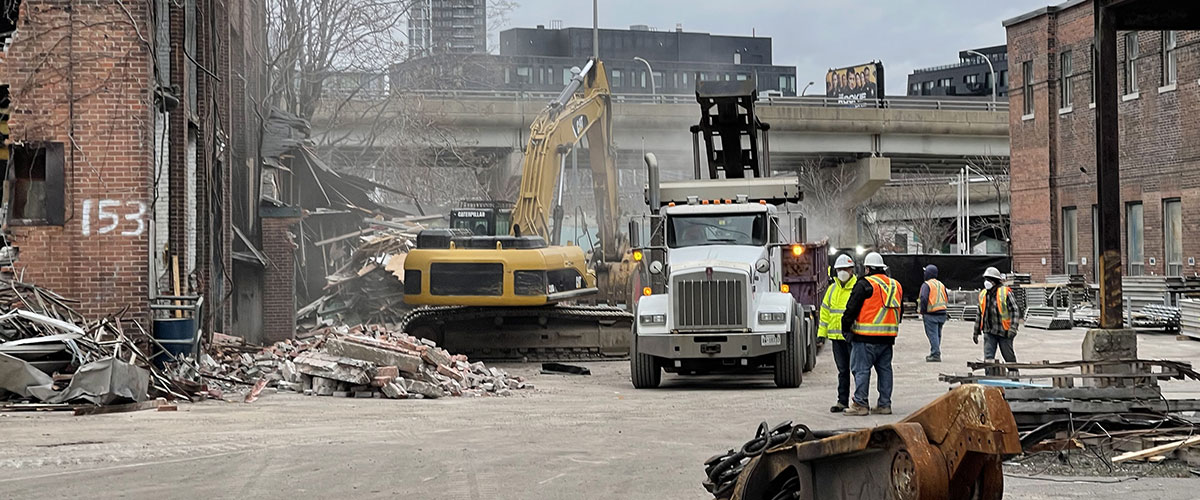
153 Eastern Avenue: The destruction of landmark heritage properties would represent both the loss of something that was, and a lost opportunity for what could be.A couple of blocks from the Distillery District in the downtown Toronto Port Lands, there is a series of buildings, over a hundred years old, that once made up the Dominion Wheel and Foundries, manufacturing railway equipment for Canadian National Rail. With the decline of rail transportation and manufacturing, the area had become derelict until revitalization that began with the adjacent Distillery District and continued through the Pan Am Games. 

On January 18, 2021, with no notice or consultation, demolition crews erected fences and began preparations to dismantle these heritage buildings under the instruction of the Government of Ontario. Community members, neighbourhood associations and businesses in the area were aghast at seeing these iconic buildings suddenly being demolished without warning. Elected representatives in the area were also blindsided: without access to answers because the obscure use of a Ministerial Zoning Order (MZO) issued by the Minister of Municipal Affairs, Steve Clark, allowed the demolition to bypass the City’s usual procedures.

According to City Councillor Kristyn Wong-Tam’s office, there was – and remains – no formal development application for this site. “The City has asked the province to produce or demonstrate provision for: Cultural Heritage, Archaeological Assessment, Heritage Impact, Strategic Conservation, and Environmental Site Assessment. None of this has been provided. In fact, the developer for the site has not been revealed by the provincial government.”

Read more: Dominion Foundries: Pushing Back Against Heritage Loss
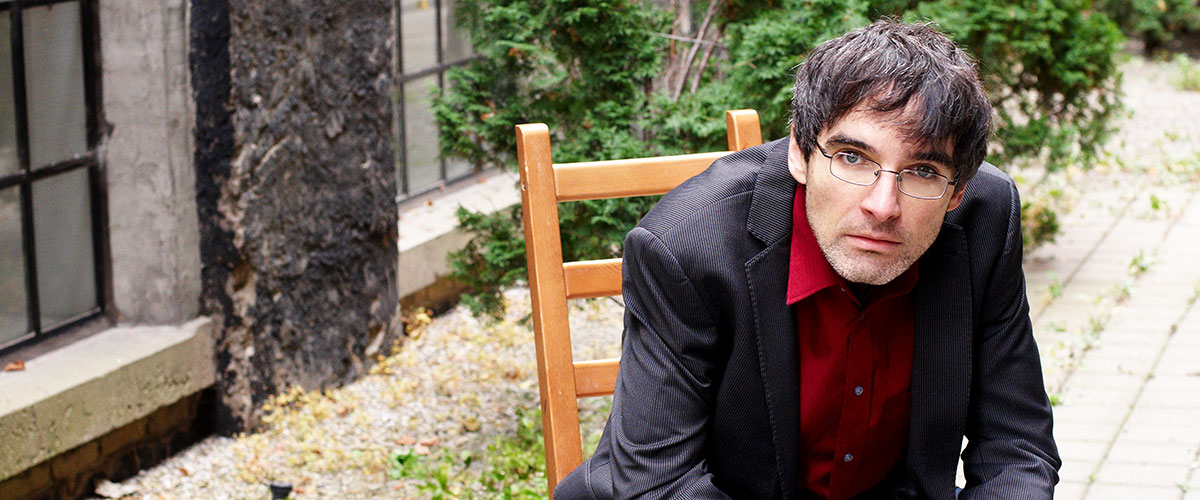
Frank Horvat. Photo by Anita ZvonarOne Sunday morning a few years ago, when the possibility of a multi-year pandemic seemed lightyears remote, I assisted in tidying up at a small event at a local community centre. Absentmindedly humming as I stacked chairs, I was unaware of my barely audible personal music-making.

Until a friend brought my attention to it asking, “What song is that?” “There’s always a song in my heart,” I blurted out enigmatically, but with a smile. Though an honest reply, it immediately felt glib. But it stuck with me, an off-the-cuff remark with implications which occasionally still bear reflection as we fast forward to the second calendar year of the current pandemic and once again try to take stock of how musicians and the venues they work in are coping with our shifting and often confusing regulatory environment. 

While most Toronto music venues have been closed for “business as usual” since last March, many had also found ways to come back to at least a semblance of life with examples of innovative livestream concerts or video productions (as I have reported in several recent stories, notably Exquisite Departures in Trying Times in November and most recently Modal Stories Are Alive and Well in the Labyrinth).

Then on January 14, 2021 the Premier of Ontario announced the latest emergency stay-at-home order. At the stroke of 12 that day almost all the province’s struggling music venues were forced to close their doors again, even virtually. It prompted a new wave of concert cancellations and postponements, an echo of the cancellation tsunami that tore up the live events calendar during COVID-19’s first wave. It sent musicians who could work back home, isolated once again.

Read more: Frank Horvat’s Music for Self-Isolation Gets in Under the Wire at RTH

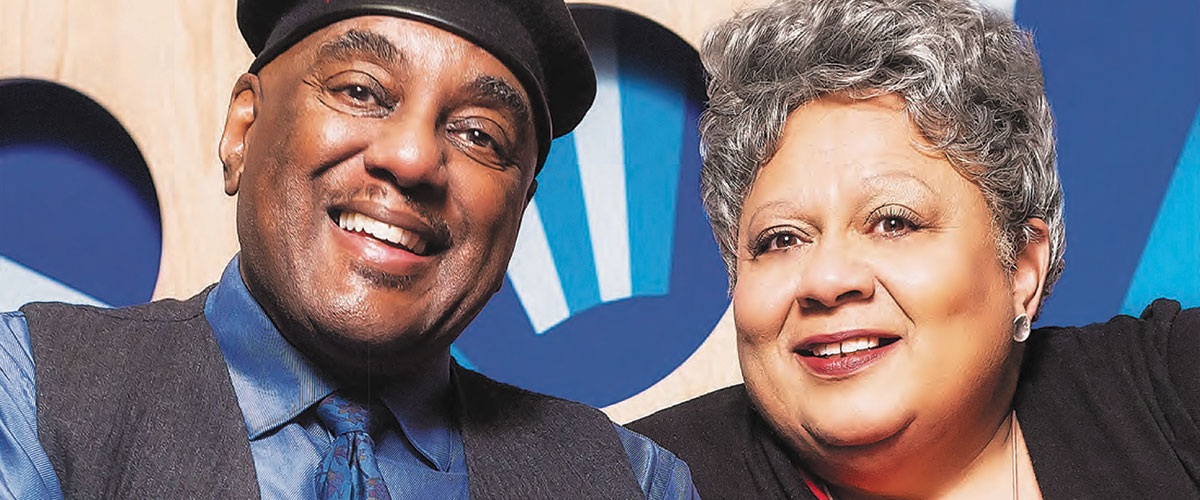
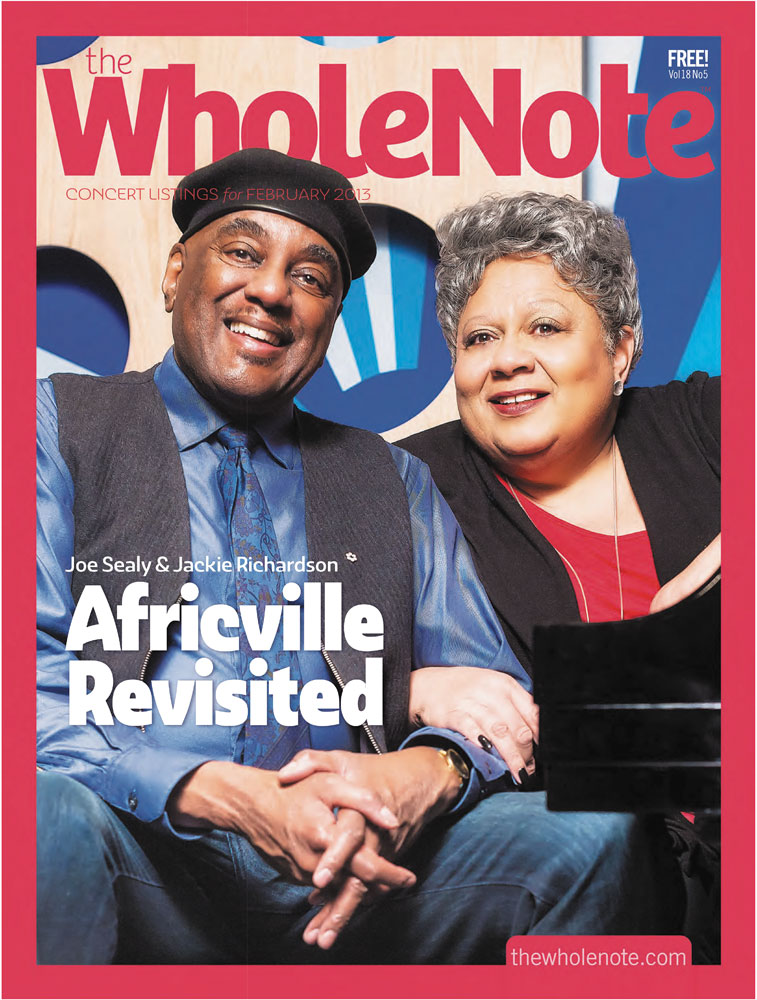
freedom banner1805 coverIn May 2019 The WholeNote had a call from Lauris DaCosta, on behalf of The Hymn to Freedom Project, asking if we’d give permission for  our Feb 2013 cover, featuring Jackie Richardson and Joe Sealy, to appear in a music video project featuring Oscar Peterson’s Hymn to Freedom. (That particular WholeNote cover was for a story by Ori Dagan called Africville Revisited). We were delighted to be asked, and sent the cover along.

DaCosta explained that for many years in the United States, Lift Every Voice and Sing has been the American “Black national anthem.” But Black history is Canadian history too, and she believed we should have a Canadian anthem for that, because getting people to sing together is a very good way of getting people to engage with that history. Her idea was that Peterson’s  Hymn to Freedom could be that anthem. With pianist Oliver Jones, who was a good friend of Peterson’s, and with Oscar’s wife Kelly Peterson, the plan was born. A stirring new choral arrangement was done by Corey Butler, musical director of Toronto Mass Choir, and it premiered in Waterloo in March 2019.

Fast-forward to January 2021, we were excited to learn that the video project was completed and available for sharing. Along with the anthem, the video The Many Roads to Freedom features an extraordinary range of images – historical through contemporary – offering “glimpses of the integral, extensive influence and part that Black Canadians have played in the building of our country, Canada.”

Read more: Singing the Way to Freedom

bannerRobert Aitken. Photo by Daniel FoleyOf late, the topic of  mentoring has been on my mind. Your Dictionary defines a mentor as “someone who guides another to greater success,” but one of my favourite quotes on this topic comes from flutist and composer, Robert Aitken: “You can only teach a person two things: how to listen, and how to teach themselves.” Particularly in this latter sense, I have experienced the joys and benefits of being mentored at various points of my life, as well as opportunities to “pay forward” what I have learned. 

Particularly memorable, in the former category were my high school band teacher, my graduate school advisor, my trainer as a new recruit at CBC Radio in 1973, and Glenn Gould, whom I worked with often in the ensuing years. 

Then, as my professional career developed, one detail of my personal history seems to have forecast how my own involvement in the role of mentor would evolve. In 1969, while still a university student, I had the good fortune to be named as a Fellow by what was then the Woodrow Wilson National Fellowship Foundation (now The Institute for Citizens & Scholars). The panel of examiners for the Foundation was charged with the task of finding scholars entering graduate schools, whom they felt possessed the potential to become outstanding future teachers. I suppose, in retrospect, those perceptive examiners were on to something, although teaching “on the job” has always come naturally for me rather than as a formal profession.

Read more: The Rocking Horse Winner and Other Tales

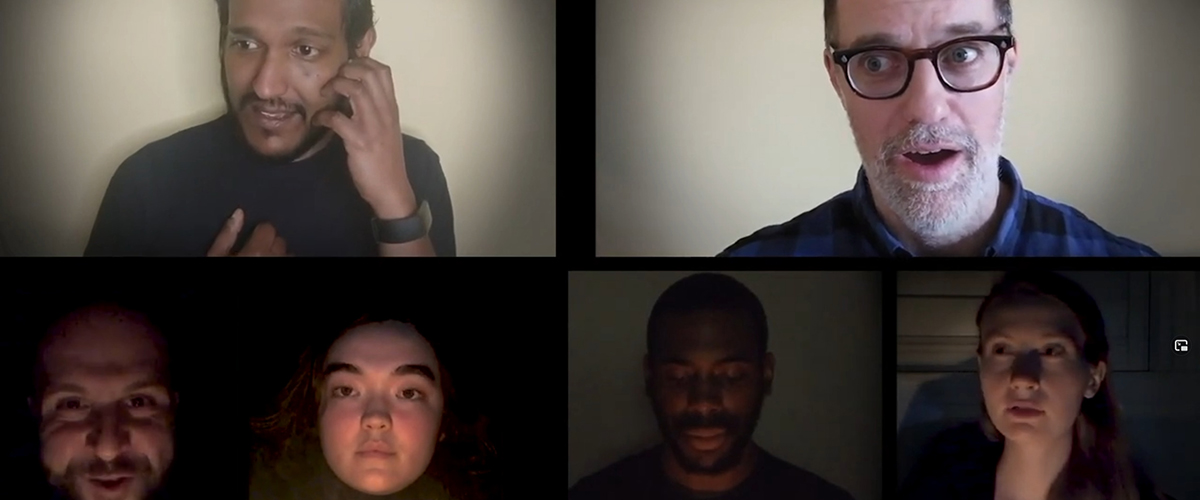
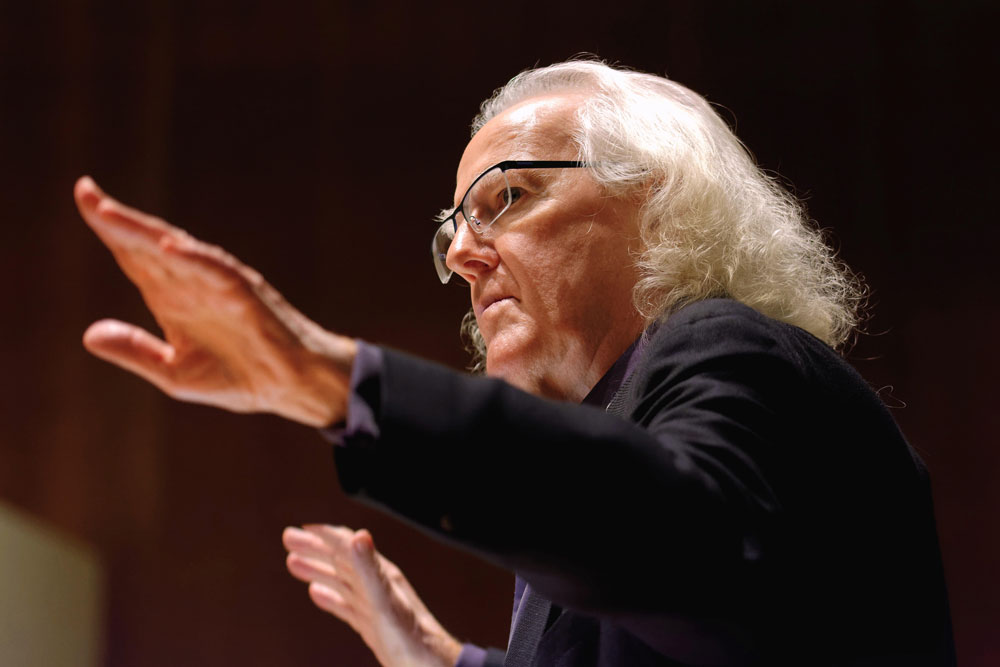
bannerAt the beginning of January, I received a call from a friend of mine – a drummer – who was in the process of applying to the Master of Music program in jazz at the University of Toronto. Had he been applying last year, he might have asked me to play with him for his live audition. This year – in the midst of January’s stringent lockdown protocols – he asked me to play on his audition video. This prompted a simple question: what does auditioning for a music program in the physically distanced winter of 2021 entail?

Many WholeNote readers – whether you’re a professional musician, community orchestra member, chorister, or the best damn Betty Rizzo that ever graced the stage of an Elgin County high school – will have some experience with the audition process, in a general sense. For what this usually looks like in an academic context – and how things are different this year – here is some background, drawn from my own experiences as a university music student, as well as two years spent as the admissions and student services manager at the RCM’s Glenn Gould School, from 2015 to 2017. 

Postsecondary music program auditions are generally relatively simple affairs: applicants come to a room at an appointed time, play selections from a repertoire list assembled by the school, have a brief interview with the audition panel, and leave. The composition of the audition panel is, typically, dependent on the instrument group auditioning, and usually involves both faculty representatives (e.g. piano faculty for piano auditions) and representatives from academic leadership (e.g. a program head). The panel takes notes, discusses the auditions, and makes recommendations to an admissions committee, which then embarks on a lengthy administrative process that addresses itself to merit-based financial aid, program number targets, teacher requests, offers of acceptance and waitlist, and other decisions. 

Read more: Assessment as a Two-Way Street | Music School Auditions under Lockdown
Back to top