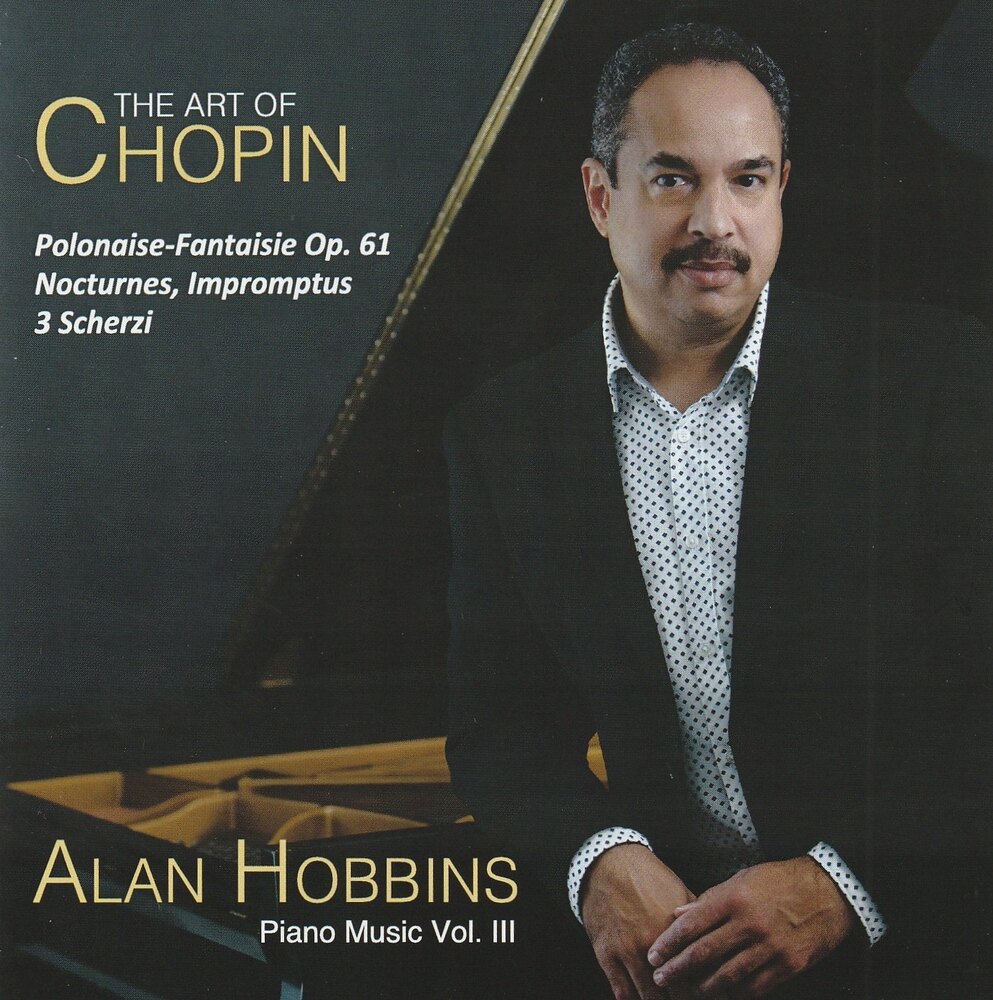
06 Chopin Alan HobbinsThe Art of Chopin
Alan Hobbins
Maestro Music Company MMCD05 (alanhobbins.com)

Canada seems to produce many first-rate pianists one after another: Hewitt, Lisiecki and Fialkowska, not to mention the immortal Glenn Gould! Into this august circle now endeavors to step Alan Hobbins. A pianist of Jamaican descent, Hobbins graduated from The Royal Conservatory and later studied at Juilliard. His teachers included the late great Leon Fleisher and Chopin specialist Marek Jablonski. Since then he has given many concerts in Toronto and New York to great critical acclaim. I met him several times in the 80s (he being my daughters’ piano teacher) and was invited to his debut concert. I was particularly impressed with his special affinity to the music of his homeland and American jazz.

Chopin is definitely his favourite composer and this is Hobbins’ third recording devoted entirely to his work. It’s a wonderful collection skilfully selected to give a good cross section of Chopin’s most beloved and immensely difficult pieces. He masters all the challenges with superb technical skill. Above all he brings “a subtlety of expression to every phrase, single chord or a note” raves one newspaper.

From the program of Scherzos, Nocturnes and Impromptus, some of my favorites are the majestic Nocturne in D-flat Major with its grand melody. This is followed later by a masterly performance of the Scherzo No.2 in B-flat Minor that opens with those powerful chords from which a beautiful, emotionally charged melody emerges followed by that peaceful meditative mid-section and the magnificent super bravura coda. 

And dare I mention the explosive, tremendously passionate, heroic Nocturne in C Minor that makes me shiver every time I hear it?  This is truly grand-scale pianism with the ebb and flow of emotion superbly controlled.
Listen to 'The Art of Chopin' Now in the Listening Room

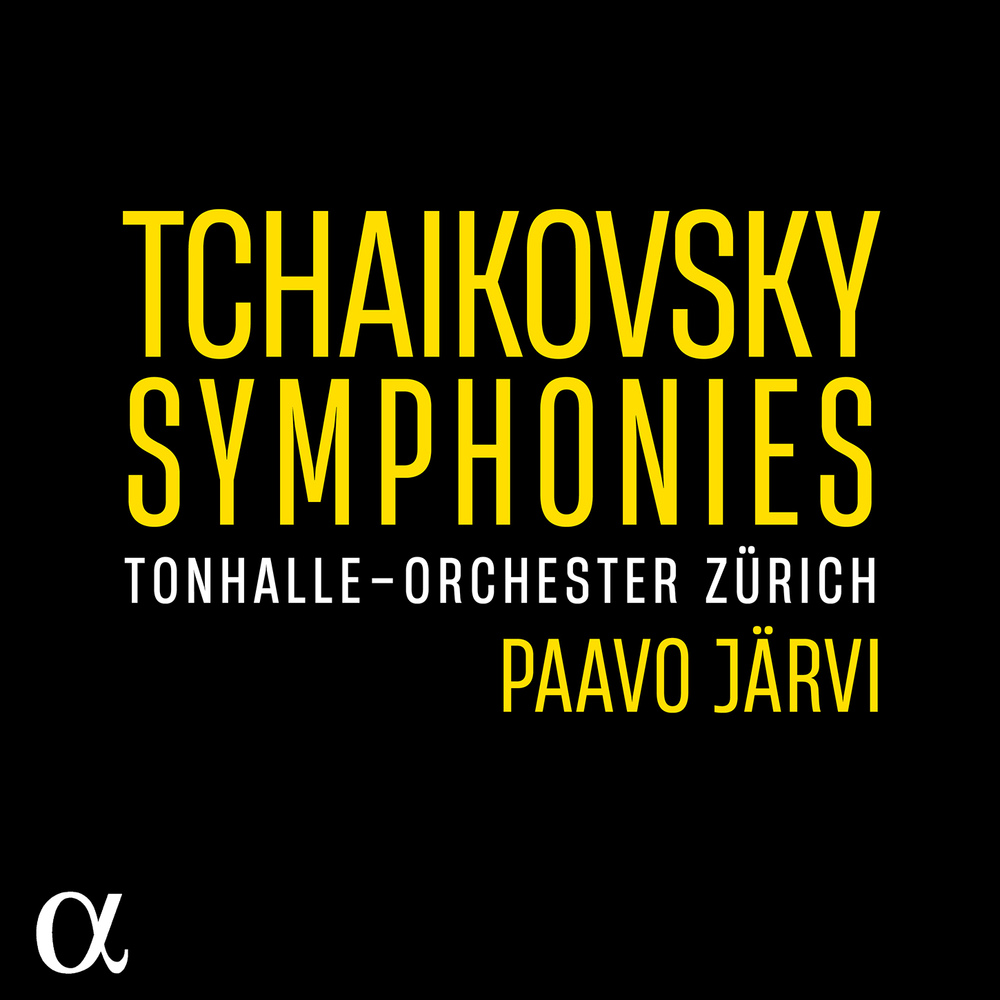
07 Tchaikovsky JarviTchaikovsky Symphonies
Tonhalle-Orchester Zurich; Paavo Järvi
ALPHA 778 (naxosdirect.com/search/alpha778) 

I have been a longtime admirer of the conductor Paavo Järvi since the release of his live Beethoven cycle with the Kammerphilharmonie, Bremen of September 2009. At that time, I was very impressed by his ability to beautifully balance the orchestra.

Now we have a box set of Tchaikovsky symphonies together with various orchestral works and here it is again, the orchestra balanced so well that every instrument is clearly audible, still in its natural balance without being spot lit. This five-CD set from Alpha Classics has been so well recorded that you can map out the entire orchestra, the Tonhalle-Orchester Zurich, of which Järvi is music director. His presentation of these works is more thoughtful and sensitive than some other recorded versions from the likes of Karajan, Mravinsky et al, but no less powerful

Symphony No.1 “Winter Daydreams” is eloquently gentle and Symphony No.2 “The Little Russian, positively optimistic, patriotic and joyful. We move through the power and cumulative intensity of the Third “Polish” to the power of the Fourth and unbounded exuberance and positive optimism of the Fifth to the overwhelming sadness and ultimate resignation of the final movement of the Sixth Symphony, “Pathétique”.

The six orchestral works accompanying the symphonies include Francesca Da Rimini, Capriccio Italien, two pieces from Eugene Onegin, the Waltz and the Polonaise, as well as Romeo and Juliet and the Festival Coronation March. All enjoy the same meticulous attention to detail that we now expect from Järvi.

After a lifetime of listening to these works conducted by so many others, this recording may very well be my preferred version. Here the music unfolds as a narrative. It flows. These are well-considered new readings that may have you rethinking certain passages and perhaps reappreciating others. The five discs are also available separately.

08 Mahler 4Mahler – Symphony No.4
Chen Reiss; Czech Philharmonic; Semyon Bychkov
PentaTone PTC5186972 (naxosdirect.com/search/ptc5186972)

Four decades have passed since the Czech Philharmonic completed their first edition of the complete Mahler symphonies under Václav Neumann in 1982. Mahler was born in Bohemia and raised in Moravia (born in 1860 during the Hapsburg era, he considered himself an Austrian and spoke mainly German) so this first instalment of a new cycle can be considered a festive homecoming for a favourite son. Mahler’s Fourth Symphony is relatively compact in comparison to its gargantuan predecessors in the so-called “Wunderhorn” cycle of symphonies inspired by the 19th-century collection of folk-song texts known as The Youth’s Magic Horn, portions of which Mahler had previously set to music. Despite this economy of means, the symphony’s mischievous antics, ironic stance and complex structure confounded the critics of his time. Today it is regarded as one of his most accessible works.
Mahler himself once observed, “The real art of conducting consists in transitions.” Mahler’s own constantly shape-shifting music teems with kaleidoscopic tempo fluctuations which not every conductor can interpret convincingly. Bychkov’s mastery in this regard marks him as a genuine Mahlerian. The finale of the symphony features Israeli soprano Chen Reiss in an ingenuous rendition of the song Das himmlische Leben from which this work was spawned. 

The distinctive sound of the Czech Philharmonic is gorgeously captured in this Pentatone production; the strings are lustrous, the winds and brass incisive and the dynamic range is vast. Recorded in August 2020 from the confines of a shuttered Dvořák Hall in Prague, this is a very auspicious start to what promises to be an exceptional Mahler cycle.

09 EbenbildEbenbild
Juri Vallentin; Trio d’Iroise; Bernward Lohr; Caroline Junghanns
PASCHEN Records PR 220072 (paschenrecords.de/katalog/pr220072/)

Only to be described as unique and colourfully unconventional, the newly released album Ebenbild, featuring oboist Juri Vallentin and the Trio d’Iroise, is a blend of recited song text, choruses by J.S. Bach, as well as five pieces from various eras and styles all married together with one common theme: J.S Bach’s O Haupt voll Blut und Wunden (O Sacred Head, Sore Wounded). 

Originally derived from the madrigal Mein Gmüth ist mir verwirret (My mind’s confused within me) by Hans Leo Hassler (1564-1612), this theme was repeatedly used by Bach throughout his life in many works, including the St. Matthew Passion and the Christmas Oratorio. Arranged for oboe quartet, the album begins with the original madrigal and then is followed by the recited text of the first stanza, a chorus using the theme from one of Bach’s works and then the Sonata da camera in G minor O Haupt voll Blut und Wunden by Johann Gottlieb Janitsch. The album continues in this format with four other recited stanzas, four choruses and four works: Frederick Kelly’s Romance from the String Trio in B Minor, Charles Bochsa’s middle movements from two of his oboe quartets, Four Preludes to Infinity by Theo Verbey and the unfinished final fugue written by J.S. Bach shortly before his death.

The performances by Vallentin and Trio d’Iroise are virtuosic and thoughtful, showing a range of musical knowledge and sensitivity. A polished gem, this album is truly a heightened experience.

10 Dinnerstein UndersongUndersong
Simone Dinnerstein
Orange Mountain Music OMM 0156 (orangemountainmusic.com) 

A lyrical rubato-laden, eminently shapely Les Barricades Mystérieuses by Couperin opens Simone Dinnerstein’s solo piano recital Undersong, brilliantly captured in the warmth of this recording by Orange Mountain Music. But arch-Romantic Robert Schumann’s Arabesque, Op.18, with its rippling arpeggios and translucent glissandi that follows will likely take your breath away. 

The pianism is impressively nuanced throughout the program. Dinnerstein displays her strong rhythmic backbone with the bubbling lilt of Philip Glass’ Mad Rush but it is, to my mind, at any rate, Schumann’s Kreisleriana Op.16 that is the apogee of this recording. Rarely has the restless romance of this work been captured with greater imagination. Its heavenly, mercurial luminescence is tempered by the pianist’s intellectual rigour through its eight dazzling vignettes. 

Dinnerstein has long been one of the most articulate pianists in the world, remaining technically sound and musically eloquent no matter what the repertoire. Her Satie and Glass is a case in point. On the latter’s Mad Rush she tames the composer’s abrupt changes in tempo and performs the piece with a strong sense of dance braving its knuckle-busting challenges with a kick in her step. 

Her interpretation of Satie’s Gnossienne No.3 is eloquent and direct, quite without impediment or undue idiosyncrasy, yet musical to the core. Meanwhile, she approaches Couperin and Schumann with uncommon refinement of colour and texture. All of this makes for a disc to die for.

Back to top