OneNightOnly.jpg

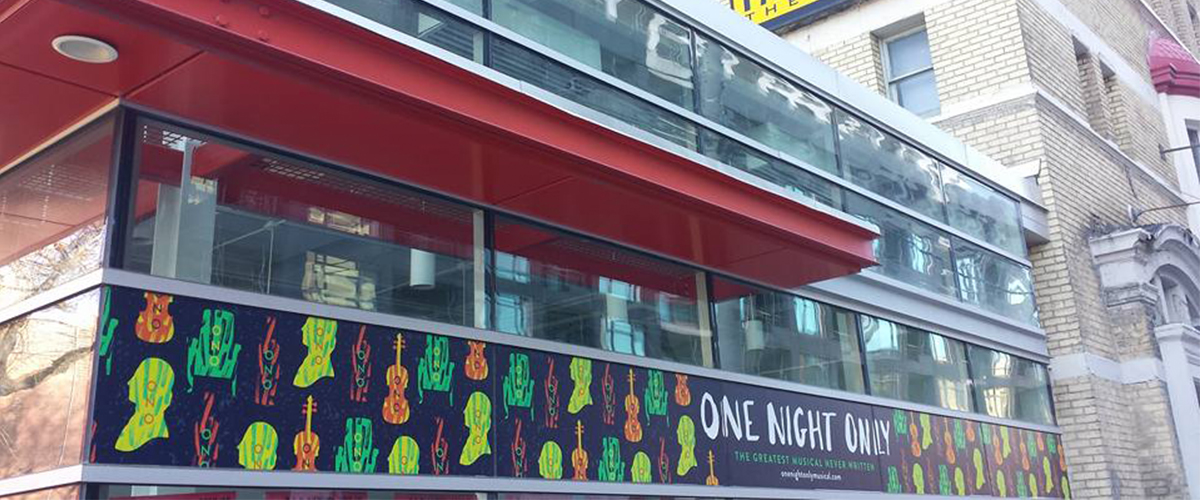
In one sense (and lucky for all of us), One Night Only isn’t one night only – its sold-out official opening is tonight (Thurs Jan 28) on the mainstage at the Factory Theatre (Bathurst and Adelaide) and it runs Tuesday to Sunday till February 14. But every one of those performances will be unrepeatable, which makes it a laughter-filled thrill ride unlike anything I’ve seen.

The show’s ingredients are enticing enough: a five-piece stage band combo with serious chops (under the musical direction of keyboardist Jordan Armstrong); six of the city’s finest improvisers, most of them Second City alumns; a couple of canny pit singers; a spotlight operator with nerves of steel; a motley array of props and costume bits (flowers, police hats, scarves, ribbons, mustaches ...); a few chairs, a table or two.

A well-rehearsed opening ensemble musical number gets things going, showing off the cast’s beautifully forged triple-threat credentials, and setting what feel like impossibly high musical standards for the rest of the evening. But what follows is different, every time the show is presented.

The formula will be familiar to those of you who are followers of improvisational comedy, but perhaps less so to the other audiences I hope this show will attract. Three audience members are trapped in the glare of the follow spot, one after the other,  and asked to offer up suggestions for the evening’s plot – a technique known in the improv trade as “pimping the audience.”

At last night’s preview, the asks were “an exciting Toronto location,” a “recurring nightmare” and “something that really intrigues you.” The reponses were St. Lawrence Market, failed high school exams and drug cartels. Without further ceremony we were off on a mesmerizing two-hour romp (including 15-minute intermission) that wove together the lives of a paperless, lame, immigrant flower seller (Ron Pederson), a mustachioed and skirted police chief (Jan Caruana), along with his burly, butchy sidekick (Carly Heffernan) and flower-seller-besotted daughter (Ashley Botting), with a couple of Etobicoke pot-dealing hosers (Alex Tindal and Reid Janisse) seeking greener pastures completing the cast of characters who came to life before our eyes.

It’s not the formula that is unique – genre-based scene play of this type, from the sophomoric to the super skillful, with and without music, takes place in venues like Comedy Club, Bad Dog, Second City and various classes and schools, formal and informal, around the city, all the time. What is different about this version of it, is the ensemble artistry on display. And it’s that, more than anything else that makes me say go see this show, whether you be a classical musician or a jazzer, or a mainstream WholeNote reader who has never been to an improv show, or someone like me who needs no persuading that improv is ART in the best and liveliest sense of that all-too-often stultified word.

There’s a core improv concept known, at least theoretically, even to dabblers like me. It’s called “Yes, and-ing the offer ...” It means that if you walk into a scene and say to me “The parrot on your shoulder is giving me really dirty looks, Pete.” then I don’t block the offer by saying something like “What parrot?” or “Do I know you?” Instead, after a delicious moment of terror something falls out of my mouth like “Yes, well, what do you expect, Rita, after what you did last night?” – and bingo, the roller coaster ride is under way.

So if you are a performer who finds it hard to stray from the pre-arranged, or an audience member who thrills to those moments when well-rehearsed performers find themselves face to face with the unexpected and survive the encounter, go see this show. What you’ll see is a masterclass in delighted playful fearlessness, by performers, musicians and actors alike, at the top of their collective game. You’ll learn something new about ensemble work. (Oh, and you’ll get to laugh your ass off.)

Photo Credit -  Chia MessinaMusic Toronto has always specialized in piano recitals and in concerts of chamber music, particularly string quartets. Once a year, however, the organization offers a vocal recital. These recitals are part of Music Toronto's Discovery Series, oddly, perhaps, since many of the singers featured, like the soprano Erin Wall (in the 2012/13 season) or the baritone Phillip Addis (in the 2013/14 season) do not need to be discovered any more. I think this is also true of Andriana Chuchman,  although most of her performances have taken place in western Canada or in the United States (including four appearances at the Metropolitan Opera in New York as well as several performances with the Lyric Opera of Chicago). She was a student at the Ryan Opera Center in Chicago and also at San Francisco Opera's Merola program. She has not appeared in Toronto often, but I have vivid memories of her stunning Olympia in Tales of Hoffman for the Canadian Opera Company a few seasons ago.

Chuchman chose a demanding program for her January 21 recital at the St. Lawrence Centre. It included songs in five languages (German, French, English, Russian, Ukrainian) – six if one counts the Puccini encore. She began with four songs by Robert Schumann, in which there was passion but also restraint. These were followed by two of Henri Duparc's greatest songs (Chanson triste and L'invitation au voyage) which were impassioned and not at all restrained. The first half of the program ended with Pat Nixon's monologue from Nixon in China by John Adams, a soliloquy which gave us a very different aspect of Chuchman's artistry.

Chuchman is proud of her Ukrainian heritage and has often said that it is that heritage which makes her singing distinctive. I think it would be difficult to pinpoint that influence but there is no doubt that she was at her very best with the Slavic songs that comprised the second half, both the Russian romances by Tchaikovsky and the more modern Ukrainian songs which closed the recital. 

Craig Terry, the pianist, is the music director of the Ryan Opera Center and an assistant conductor at the Lyric Opera of Chicago. He has collaborated with many eminent singers and has recorded with three of them (Patricia Racette, Stephanie Blythe and Nicole Cabell). The support which he gave to the singer was exemplary.

BergeronSylvain BergeronThe lute, the archlute and the theorbo are soft instruments and it needs an exceptional player like Paul O'Dette or Jakob Lindberg to make a solo recital work. In Canada we are fortunate to have two such players: Lucas Harris and Sylvain Bergeron. Harris is based in Toronto and we have in recent years been able to hear him play with ensembles like Tafelmusik. Bergeron lives in Montreal but he too has often played in Toronto, with Tafelmusik and the Canadian Opera Company among others. This concert at St. David’s Anglican Church on January 10, however, was his first solo recital in Toronto. As he himself wryly put it: "Better late than never."

The contents of his program were contained in the early 17th century manuscript lute book of Gioseppe Antonio Doni, preserved in Perugia. Not much is known about Doni but he appears to have been an amateur player who wrote down pieces that he could use as exercises. Many of these are anonymous compositions but there are also movements by Andrea Falconieri, Giovanni Girolamo Kapsberger and Arcangelo Lori. Many  are dances (galliards and courantes); others are chaconnes and toccatas, with one passacaglia.

In his recital Bergeron followed the format of his recent ATMA CD, Livre de Luth de Gioseppe Antonio Doni. Of the almost 100 pieces in the Doni Manuscript, he chose 25, He grouped the music in five sections, according to their tonality: F Major, G Minor, B-flat Major, G Minor again and C Minor. Restricting himself to flat keys, he pointed out, meant that he did not have to retune after each suite. What I carried away from the recital more than anything else were Bergeron's superb sense of rhythm, his sensitiveness of touch and the expressiveness of his playing. Thirty or 40 years ago early music performances tended to be strictly metrical. Now rubato is no longer a dirty word and, provided there is a clear sense of the underlying beat, the kind of rhythmic flexibility which Bergeron provided is to be welcomed.

These hour-long concerts are presented by the Toronto Early Music Centre (PWYC). In the next recital on January 31at 2:30pm, Patricia Ahern will perform solo violin works of the German Baroque: Bach’s Partita No. 2 and Telemann’s Fantasies Nos. 8 and 9.

BravissimoKrisztina SzabóFor several years Roy Thomson Hall and Attila Glatz Productions have jointly presented “Bravissimo,” a program of the most famous arias, ensembles and choruses in opera, on New Year's Eve. Care has always been taken to achieve a balance between Canadian performers (usually well-known to Toronto audiences) and foreign singers (generally new to Toronto). This year the number of soloists was pared down to four, one for each voice category.

The most impressive of the singers was the mezzo Krisztina Szabó. We have heard her a number of times in the last few seasons, with the Canadian Opera Company (in Schoenberg's Erwartung and, more recently, in the COC's triple bill of Monteverdi and Monk Feldman) and with Against the Grain Theatre (in their Schubert-Messiaen program). This recent concert, on December 31, 2015, gave us an opportunity to hear her in more familiar repertoire. That included Musetta's Waltz from Puccini's La Bohème, a role more usually sung by a soprano (although it is in Szabó's repertoire) as well as the Habanera and the Seguidilla from Bizet's Carmen. What a formidable Carmen she would make! She sang the middle line in Mozart's Soave sia il vento from the first act of Così fan tutte and the lower part of the Flower Duet from Delibes' Lakmé. In both cases she gave her part a stronger vocal presence than is normally the case in performance.

The soprano Karina Gauvin has not performed in Toronto for some time and her return was a pleasure. She is noted for her Handel and Mozart and there was a great deal of Mozart and one Handel aria (the first time Handel has been featured in a “Bravissimo” program) but there was also Delibes' Flower Duet as well as O mio babbino caro from Puccini's Gianni Schicchi. The baritone, Lucio Gallo, impressed me, particularly in Iago's Credo from Verdi's Otello and in Scarpia's monologue Tre sbirri from Puccini's Tosca. I was less impressed by the tenor, Stefano La Colla. He gave a strong performance of Calaf's aria, Nessun dorma, from Puccini's Turandot, with a good sense of dynamics but elsewhere his singing was unremittingly loud. Verdi's Celeste Aida suffered especially.

Orchestra and chorus were good. They could be described as ad hoc ensembles but a look at the cast list would indicate that most of their members came from the COC Orchestra or Chorus. There were several encores, the last of which was Auld Lang Syne. In the past that was merrily sung by the Canadian singers as well as by many in the audience. The Italian singers were generally noplussed, however, by that exotic tune. This year La Colla and Gallo were carefully briefed. That made sense, though I regret the passing of a quaint older tradition.

Back to top