During 2017 it seemed that most community ensembles focused their programming on music which, in some way or other, related to the fact that it was Canada’s sesquicentennial. This year, when we took our usual WholeNote summer break for July and August, focusing on anniversaries seemed to have tapered off somewhat. Then, out of the blue, we learned of two very special anniversary-themed events in the region.

Anglo Canadian Leather Company Band

The first of these events was in Huntsville to celebrate the hundredth anniversary of the arrival in town of Herbert L. Clarke to take on the leadership of the Anglo-Canadian Leather Company Band. The company, also known as the Anglo-Canadian Tannery, was, at that time, the largest tannery in the British Commonwealth. Charles Orlando Shaw, an American businessman who had built the Bigwin Island Resort, moved to Huntsville, bought the tannery and built it to prominence.

As it happens, Shaw, who had also been a keen cornet player in earlier years, discovered groups of tannery workers getting together to make music in their off time. For Shaw it sparked the idea of getting back to his playing cornet again after having abandoned the instrument for some years. Over a period of time a band gradually developed. After a while the tannery workers were given free musical instruction and time off to practise. Then at some stage, he purchased an old school building and had it converted to a band hall.

In those days many companies sponsored company bands, so it was not that surprising that Shaw, a keen amateur musician, would want a top company band. What was unusual was the lengths he was prepared to go to to improve the band. It is reported that within a few years, money was no object when it came to buying instruments or hiring instructors; as a result, 100 years ago, the Anglo-Canadian Band was considered the “best industrial band in North America.”

But Shaw wanted a big name in the music world in his band. In the early part of the 20th century it would be a rare band concert which did not include significant solos to highlight the dazzling talents of the soloist. Therefore, it was not surprising that Shaw, a cornetist himself, sought out a top cornetist for his band. Luckily one was close at hand.

In the decade from 1910 to 1920 one of the world’s most renowned cornet virtuosos was Herbert L. Clarke. Clarke’s father was choirmaster, organist and bandmaster of the band at Jarvis St. Baptist Church in Toronto. Clarke was a member of the band of the Queen’s Own Rifles, touring the world as a featured soloist with leading bands of the day. Yet, after many years as featured soloist with the band of John Philip Sousa in Washington DC, in 1918 Clarke was lured to Huntsville, Ontario by Shaw to be the leader and featured soloist with that band. The sum that Clarke was paid was anything but typical – amazing, in fact, for the year 1918 – rumoured to be somewhere between $15,000 and $18,000 per year!

To celebrate the 100th anniversary of Clarke’s arrival in Huntsville, and as a tribute to the Anglo-Canadian Leather Company Band itself, two special band concerts titled “Brilliance” took place in late July. Since I had other musical commitments elsewhere, I was not able to attend, so I am deeply indebted to my friend Barrie Hodgins, who was there. Barrie provided me with more information about the concerts than I can do justice to here, including the program and a copy of a 40-page booklet about the history of the band, compiled in 1986, Huntsville’s centennial year, and containing many programs and photographs of the band from as early as 1915, and numerous reviews of the band’s performances from the Toronto Daily Star and The Mail and Empire.

This year’s 100th-anniversary program featured concerts on July 21 and 22 in Huntsville’s Algonquin Theatre, under the direction of Neil Barlow with a core group from the Muskoka Concert Band, augmented by some 30 talented musicians from other parts of Ontario and the USA.
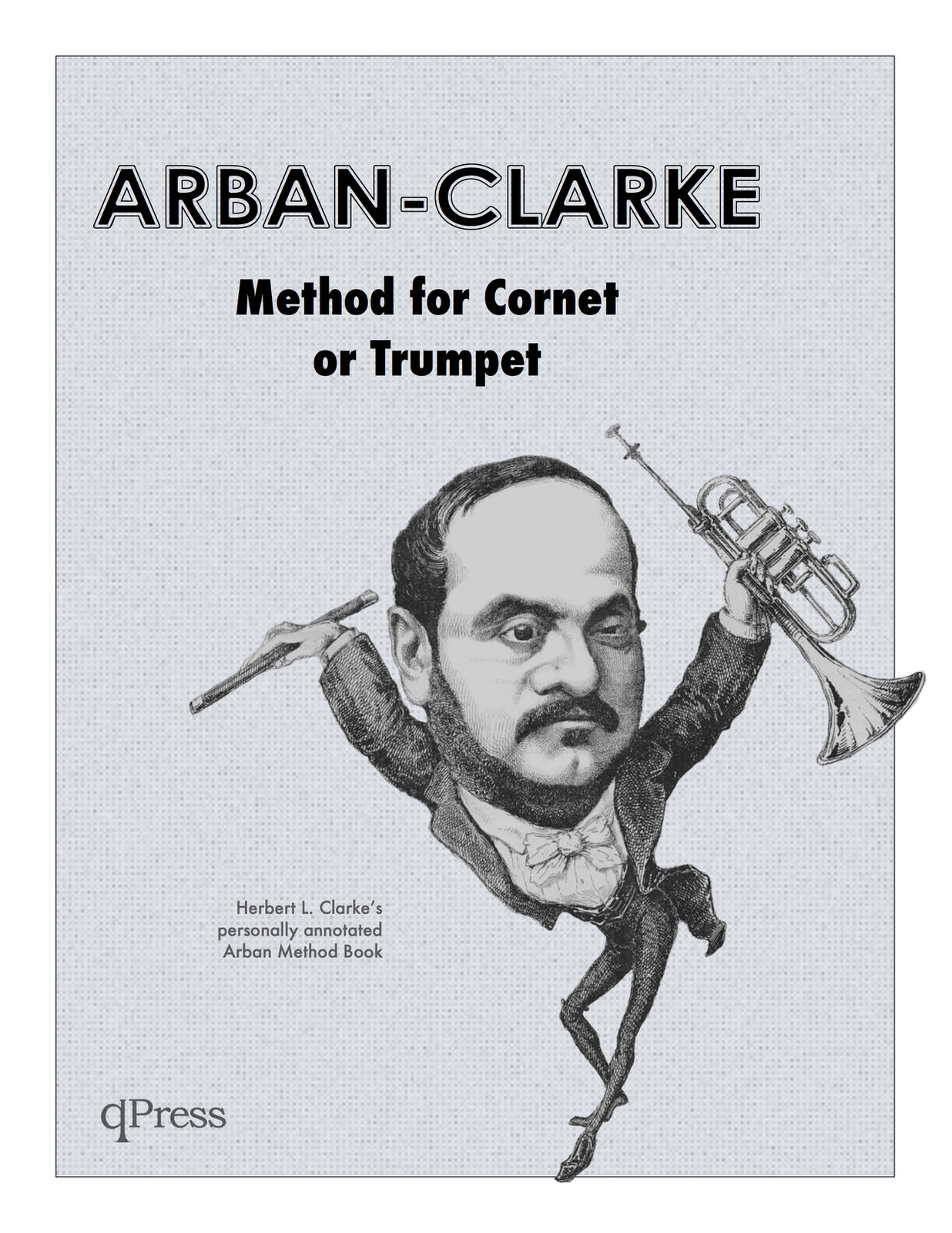
Herbert L. Clarke’s personally annotated Arban Method BookAs one might expect, the featured solo number was for a cornet solo. In Clarke’s day the standard method from which brass musicians honed their craft was Arban’s Tutor. (Author Jean Baptiste Arban was a virtuoso cornetist and teacher in Paris.) To this day, over 100 years, later Tutor is still the preferred method book; and perhaps the most popular all-time solo work for cornet is Arban’s variations on the traditional Italian work The Carnival of Venice. Since Clarke was noted for his performances of Carnival of Venice, I thought that this might be the solo selection, but I should have realized that, at this concert, the solo work would be a Clarke composition. It was Clarke’s From the Shores of the Mighty Pacific, performed by Robert Venables, one of the top freelance cornet and trumpet players in Canada, best known in the local band world for his work with the Canadian Staff Band of the Salvation Army and with the Hannaford Street Silver Band.
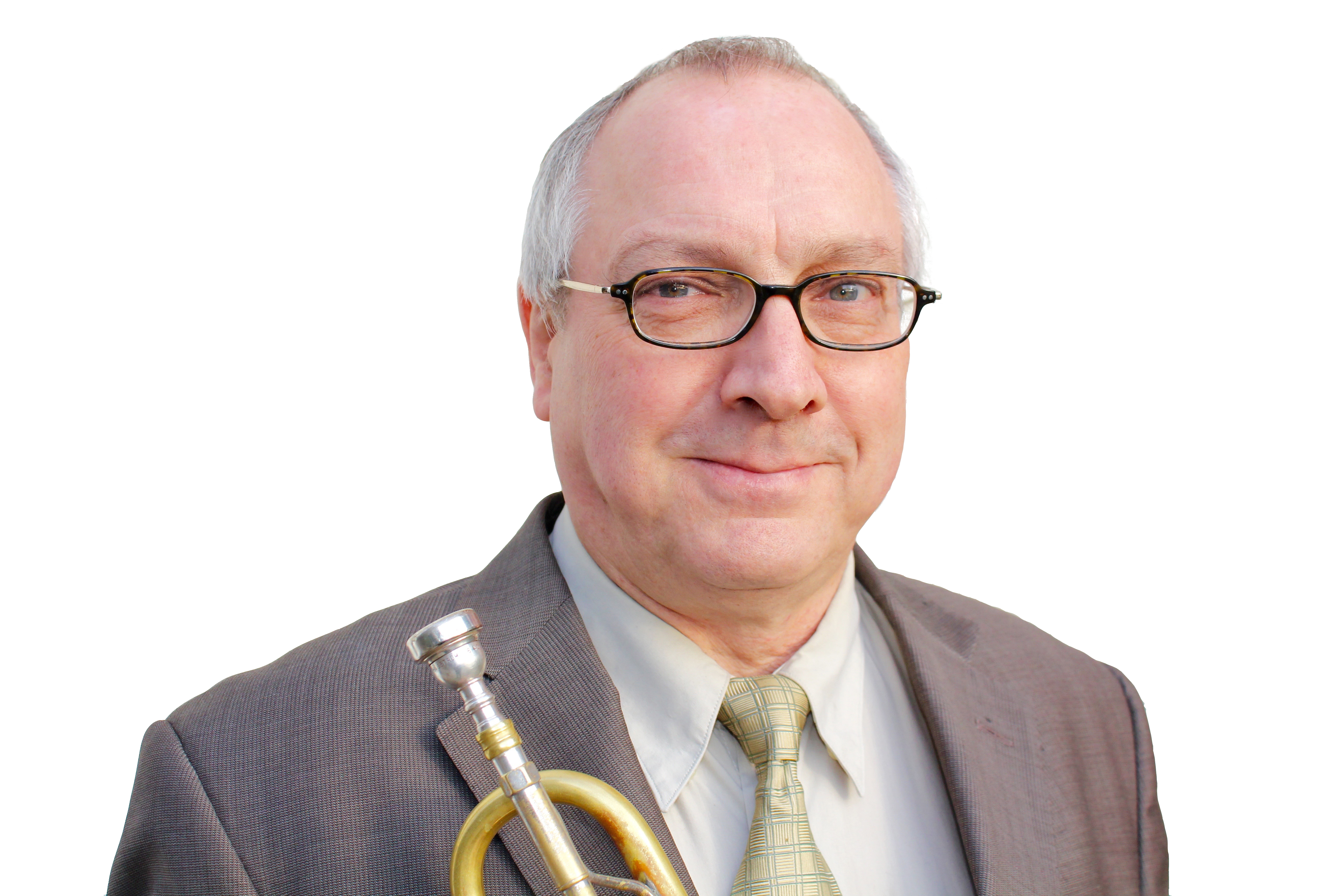
Robert VenablesThe Anglo-Canadian Leather Company band was officially formed in 1914 just before war broke out. For six years this band was the feature at the Canadian National Exhibition at a time when most feature bands were, more often than not, highly paid professionals. By 1926, Shaw realized that he would not be able to raise his great dream band to the even higher status he aspired to, and the band was broken up.

Rebel Heartland

In another form of anniversary event, over the weekend of September 22 and 23, the Newmarket Citizens Band will be joining in “Rebel Heartland,” a 2018 re-enactment of the 1837 Upper Canada Rebellion, under the auspices of a committee, comprised of the Newmarket Historical Society, Heritage Newmarket and the Elman W. Campbell Museum. Some of the events will be in the downtown core and some at Fairy Lake Park.

Established in 1872, the band has a long history in the community and was thrilled to be asked to participate in this historic re-enactment in their hometown.

On Saturday morning, the band will be part of the drama on Main Street, where the rebels recruit followers at the Farmer’s Market and William Lyon Mackenzie makes a rousing speech encouraging armed rebellion against the colonial government. On Saturday afternoon a battle re-enactment will take place at Fairy Lake Park. This will be followed by the capture, trial and subsequent “hanging” of rebel leaders, Samuel Lount and Peter Matthews, in front of the Old Town Hall.

On Sunday, social life in the colony will be on display at Fairy Lake. There will be demonstrations, church services, a boxed lunch social and entertainment. That’s where the Newmarket Citizens Band comes in again. Clothed in period dress, the band will host daily concerts showcasing music that would have been familiar to residents of the day. In addition, the concerts will also include smaller ensembles, to represent how music was commonly shared in the community in 1837. For more information go to newmarketcitizensband.ca

Seasonal Changes

Here it is almost fall, and that means seasonal changes for some bands. For the Uxbridge Community Concert Band, a summertime-only group, Saturday, August 25, was the final concert of their 2018 season. Last year the band’s founder and music director Steffan Brunett took a year away to travel and to study composition. With no one to take the helm, there was no band in 2017. Now, after a year’s hiatus, the band has a well-organized committee in place to share the administrative load. Brunett can now concentrate on his job as artistic director. As a simple but effective example: rather than place the whole load of collecting and filing the season’s music on one person, the band has an “End of Season Music Sorting Party”.

As previously reported, there are also seasonal changes in the air for New Horizons Bands. After many years at the helm, Dan Kapp, founder and director of the Toronto groups, has retired and moved to Wolfville Nova Scotia with his wife Lisa. Now settling in, he already has New Horizons plans for Wolfville, and also intends to study composition at Acadia University.

With his departure, the Toronto New Horizons groups now have an executive committee with Randy Kligerman, a member of the original Toronto NHB at the helm as president, and with a number of conductors. Head of education, and director of the senior band, is Donna Dupuy, who may be contacted at nhbteducation@gmail.com. As in past years, they will have an open evening for prospective band members. Previously billed as “The Instrument Petting Zoo,” this year the event is being called “The Instrument Exploration Workshop.” It will take place at Long and McQuade’s Bloor Street store on Thursday, September 13, at 6:30. These workshops are for those who have never played an instrument and for those who currently play an instrument, but would like to try playing a different one, bassoon to piccolo, in a fun, non-stressful environment. For more information go to newhorizonsbandtoronto.ca.

Having started a few years later than in Toronto, The New Horizons Band of York Region, with Doug Robertson at the helm as conductor, will be starting their season in a similar fashion. Their “Test Drive a Musical Instrument” event takes place on Thursday, September 6, at 7pm at the Cosmo Music store in Richmond Hill. Come out and “test-drive” 17 different instruments. Experienced players from the NHBYR as well as Cosmo Music staff will be on hand to help you get a sound out of any of the 17. Regular music classes begin the week of September 10. For more information contact nhbyrdirector@gmail.com.

Yet another band starting up, after a summer break, is Resa’s Pieces Band. Started 20 years ago by Resa Kochberg, Resa’s group’s evolution over the years has been different from that of the New Horizons groups. Rather than a number of concert bands rehearsing at different levels, Kochberg, over time, started different kinds of groups. Now, there are also the Resa’s Pieces Strings and Resa’s Pieces Singers, sometimes performing separately, and sometimes jointly. For more information on all these groups contact conductor@resaspieces.org.

Jack MacQuarrie plays several brass instruments and has performed in many community ensembles. He can be contacted at bandstand@thewholenote.com.

A few months ago I mentioned a trip to Ukraine by Bob Gray, a local band conductor, teacher and trumpet player. What he learned on that trip inspired him to pay another visit, with two primary goals in mind. The first was to investigate the feasibility of start-up brass bands in Ukraine during his eight-week stay in Kiev. The second was to be there for the celebration of the 25th anniversary of the Salvation Army’s ministry in Ukraine. In a recent email from Kiev, Bob reported on how things are going there, and unfortunately his first goal is not working out as easily as he had hoped. The idea was to investigate the feasibility of establishing new brass bands there. However, at present, there are no Salvation Army bands in Ukraine to use as models. Since there is no tradition upon which to build, there are no qualified leaders or instructors already active within the Salvation Army organization, making it difficult for some of the congregations to sustain and support the start and development of any band. Other setbacks: he has also learned that their music for worship in Salvation Army services differs greatly from the rest of the Salvation Army world. There are no brass band arrangements of the songs used there. Even for Christmas, the carols used in many places elsewhere differ from those familiar and popular in Ukrainian culture.

His second purpose for his extended trip will likely have a happier outcome. He will be there for the celebration of the 25th anniversary of The Salvation Army’s ministry in Ukraine. This event will take place on the weekend of June 8 to 10 in Victory Park and Hotel Bratislava. For this occasion, the Salvation Army band from Winton Corps, in Bournemouth, England will be participating. Bob has been asked to sit in with that band, as one of their cornet players is unable to make the journey to Kiev. It is the hope that the activities of this well-established band will stir some interest in resurrecting the brass band movement within the ranks of the Salvation Army in Ukraine. We wish him every success, and hope to hear of the establishment of new bands there in the near future.

Strings Attached

From messages about all-brass music thousands of miles away, we move to news about all-strings music right here in town. We have just heard from Ric Giorgi about the next concert of the Strings Attached Orchestra, their final concert for this year on June 3, again at the Isabel Bader Theatre. As usual, the program was designed to span a wide spectrum of music from such classics as Handel’s Arrival of the Queen of Sheba and Bach’s Brandenburg Concerto No.6 to Ashokan Farewell and the Best of ABBA.

The Plumbing Factory

Speaking of all-brass bands, we also just had a message from Henry Meredith of the Plumbing Factory Brass Band where he referred to the “devastating and relentless winter” we’ve all just been through. Rather than paraphrase what he said, here is his musical response to Mother Nature, verbatim: “Because of the ice storms only a week before our ‘spring’ concert, and the snowstorm on the night of our dress rehearsal, the PFBB has now decided to expand our concert season into the late spring and early summer. It is hoped that this will make it easier on both us and our audience, not to have to battle the weather to prepare and enjoy our brass band music. So we have decided to keep rehearsing, and to develop a brand new concert for you, to be performed on June 27.”

In typical Henry Meredith style, he outlines the program in one of his poems.

This little rhyme will explain the reason
Why we established a new summer season
It also provides a few hints about
The music which you will enjoy, without doubt.

The concert, “Summertime Musical Adventures” (June 27, 7:30pm at Byron United Church, 420 Boler Rd., London), will include such band favourites as Ringling Bros. Grand Entry, Barnum and Bailey’s Favorite, Bernstein’s Candide and The Whistler and his Dog by Arthur Pryor.

A Musical Movie

Something entirely new appeared on my radar screen recently: a Russian-Canadian film production company that is in the process of making a documentary about Benny Goodman’s historic tour of the USSR in 1962. Now, over 55 years later, this story is still alive in the minds of people who remember those concerts of the jazz orchestra of Benny Goodman, those “strange” but incredibly attractive American musicians. They remember the joy of buying scarce tickets and enjoying music, and screaming “encore” up to ten times. The whole world as we knew it was struck by the headline at the time. “The King of Swing Benny Goodman Plays Yankee Doodle Dandy on Red Square.” Certainly Russians had never seen anything like that before.

This full-length feature film, Trojan Jazz, will retell the events of the exchange of talented musicians between the US and the Soviet Union. The anticipated appeal is to jazz enthusiasts in both English- and Russian-speaking cultures. The concept of Trojan Jazz likens the Benny Goodman Orchestra to members of a Trojan horse that brought Western jazz culture into an isolated Eastern jazz culture. The impact was unpredictable. Jazz musicians of both cultures exchanged written ideas, which began a collaboration second to none.

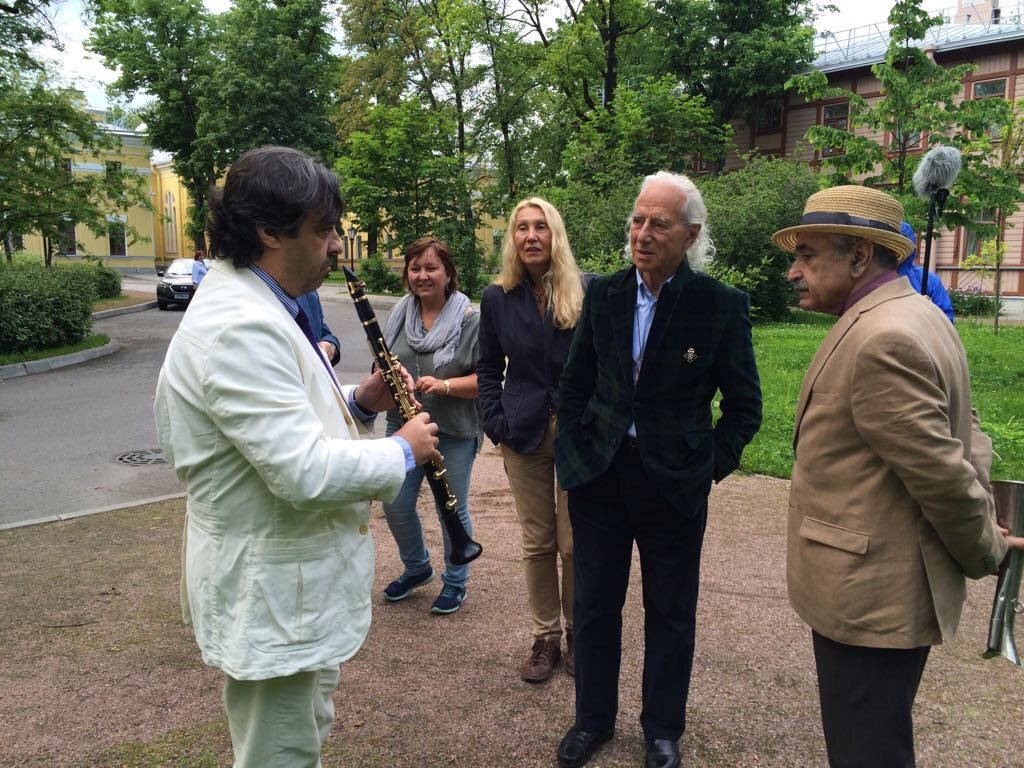
Julian Miklis (at left)Local concert clarinetist Julian Milkis, son of former TSO concertmaster Yasha Milkis, is cast as Benny Goodman. Milkis actually studied with Goodman while attending the Juilliard School of Music in New York City. He can be seen in a variety of ensembles recreating some of Goodman’s hit songs.

To illustrate the Goodman legacy of playing big band music continuing to this day in community groups around the world, the producers wanted to show such a group in rehearsal So, all of a sudden, one evening a few weeks ago, I and my bandmates found ourselves being bombarded by bright studio lighting and surrounded by at least a half-dozen cameras. The Toronto-based rehearsal band Swing Machine, of which I have been a member for many years, was chosen and filmed to exemplify this ongoing tradition. There we were many years later, still enjoying the performance of big band music. We haven’t heard anything of when or where this movie might be seen, but I am told a visit to https://firstjazztourinussr.com will provide more in-depth information as the project develops.

Mikhail Sherman

A few weeks ago, at a regular rehearsal of the Swing Machine Big Band, I looked across at the saxophone section. The usually very reliable baritone saxophone player, Mikhail Sherman, was missing. We later learned that he had decided to have a nap before leaving for the rehearsal, but never woke up.

Born in the USSR, Mikhail grew up with a love of music in a country famed for great classical musicians. After serving time in the army and playing in a military band, he went on to become the principal clarinet and saxophone player for the famed Moscow State Circus, City of Lviv, for seven years.

In 1979 he left and came to Toronto to pursue more opportunities. He started his life here as a refugee with nothing. He washed dishes and became a cook at the Windfields Restaurant. His love for music led him in another direction. It was here that he met Frank Fermosi and Rocco Nufrio, the owners of the then-successful Saxophone Shop. They quickly spotted Mikhail’s love for music. He, in turn, showed a keen ability to learn the trade of repairing instruments. They offered him a job and training, in which he quickly excelled!

In 1986, when the Sax Shop closed, Mikhail decided to would open his own shop in North Toronto. Still with little in his pocket, he started Mikhail Sherman Music Service, which was to become one of the most successful woodwind repair shops in Canada, servicing the educational system and many top professional musicians. Mikhail passed away peacefully and suddenly in his sleep on April 26, 2018. Many of the great musicians and music educators in the GTA will miss his quick response and expertise. A true rags-to-riches story.

Uxbridge Community Concert Band

After a year’s absence from the local band scene and some questions about the band’s rebirth, the Uxbridge Community Concert Band, with Steffan Brunette at the helm, has now had its first rehearsal. Steffan took a year off to study composition and to do some travelling. Rather than assume all of the many duties required to operate a band successfully, Steffan now has an executive team to help with the many details, but it is, once again, a superbly organized band. After their first rehearsal it became evident that a few more trumpets would be welcome. The band is a summertime-only group that rehearses in Uxbridge on Wednesday evenings. For information, email uccb@powergate.ca.

Toronto Summer Music Festival

On Sunday, July 29 at 2pm, the 2018 Toronto Summer Music Festival will commemorate the 100th anniversary of the end of WWI with a concert titled “Reflections on Wartime” at The Bentway. This will include a full afternoon of events with a feature performance by theCanadian National Brass Project.” For those not familiar with it, The Canadian National Brass Project brings together many of the best brass players from professional symphony orchestras throughout North America, and each summer this all-star ensemble, led by conductor James Sommerville, joins forces and performs across the country. The program will include Tchaikovsky’s 1812 Overture, Mussorgsky’s Pictures at an Exhibition, and Mars from Gustav Holst’s The Planets. Concertgoers can also take in the sights and sounds of the Fort York Guard, enjoy a demonstration of artillery firepower, and hear military music by the Fort York Drums. There will also be a “Musical Petting Zoo” for children to test out a variety of musical instruments. For those not familiar with it, The Bentway, 250 Fort York Boulevard adjacent to Old Fort York, is being described as Toronto’s most exciting new outdoor concert venue.

A few days later, on Thursday, August 2 at 7:30pm in Koerner Hall, TSM will present “A Big Band Celebration,” which will focus on music of World War II. During the darkest days of the war the big band music of Benny Goodman, Count Basie, Glenn Miller and others was a major source of entertainment for life on the home front. As the presenters suggest, these familiar tunes became a metaphor for the way of life soldiers were fighting to preserve. This promises to be a stimulating evening of the best of the big band era as interpreted by music director Gordon Foote and featuring JUNO Award-winning jazz singer Ranee Lee.

Ranee LeeComing Events

By the time this issue is available in print, some of the events mentioned below will have taken place, but for the record and for online users, they are included here. Now that summer is close at hand, Resa Kochberg’s three musical groups have announced their current concert plans:

On Sunday, May 27 at 7:30pm, Resa’s Pieces Concert Band will perform at the Flato Markham Theatre, 171 Town Centre Blvd., Markham.

On Sunday, June 3 at 7:30pm, Resa’s Pieces Strings Ensemble will be at St. Basil College School, 20 Starview Ln., North York.

On Monday, June 4 at 7:30pm, Resa’s Band will present another concert at Mel Lastman Square in Toronto.

On Monday, June 11 at 8pm, Resa’s Singers Ensemble will perform at Beth Emeth Bais Yehuda Synagogue, 100 Elder St., North York.

Jack MacQuarrie plays several brass instruments and has performed in many community ensembles. He can be contacted at bandstand@thewholenote.com.
Last month’s column began with some comments about the fact that spring had officially arrived, but that Mother Nature was not agreeing. Now, one month later, what do I see when I look out the window? I see my neighbour, large shovel in hand, trying to remove large quantities of some white material from his driveway. At the side of the house I see a delightful, but unusual sight. Yes, there was a beautiful bright purple crocus surrounded by glistening white crystals. The snow is still here. So it is with this month’s column that we stay with the same theme. Last month we were talking about bands in transition evolving one way or another. Here we are with more stories.

Uxbridge Community Concert Band

The Uxbridge Community Concert Band (UCCB) is another band in transition. This time, rather than some gradual change, we have a one-year interruption. Founded by Steffan Brunette in 1992, the UCCB has been silent for a year. Brunette, a high school music teacher, took a year off from his teaching to study composition and do some travelling.

Steffan BrunetteSince its founding in 1992, the Uxbridge Community Concert Band has been a volunteer organization from its director down to its youngest player. Its original intention was to allow school musicians to bridge the gap between their spring concert ending the school year and their first rehearsal at school in September. Over the years the UCCB became a band where adult musicians could rediscover their love of playing music as a member of an ensemble.

For most of the first 25 years of its existence, the UCCB was run solely through Brunette’s leadership. To encourage new growth and new directions, the band is rebuilding itself with the assistance of a new executive committee. Since the band only rehearses during the months of May through August, committee members are currently planning the recruitment drive, promotional strategies and laying out the performance plans for the coming summer season, all the while learning the processes which were normally overseen by only one. Brunette is no longer jack of all trades. He is now artistic director.

It is hoped that by bringing in additional people, the range of talents and skills for running a musical organization will also grow and allow the UCCB to grow as well. Committee members are taking over publicity, membership, logistics, venue booking, transportation, music folder preparation, uniform distribution and concert planning.

The UCCB is currently recruiting members for its 26th summer season, set to begin on Wednesday May 23 at 7pm in the music room of Uxbridge Secondary School. Rehearsals will continue every Wednesday until the end of August. The band performs two major concerts in Port Perry and Uxbridge at the end of the summer. The ensemble is non-auditioned and welcomes players who have had at least two years’ of playing experience, so students as young as Grade 9 and adults as old as 90-plus are encouraged to come out and join. For those interested, the band now has a Facebook page; it is simply Uxbridge Community Concert Band. For more information, contact Terry Christiansen at uccb@powergate.ca.

Resa’s Pieces Band

Resa’s Pieces first came together in the year 2000. The creation of what has evolved into a very special group was a dream born out of Resa Kochberg’s life experiences, and it was many years in the making. When she was growing, up there was nothing else that she ever wanted to do but study music. As a little girl she would watch her eldest brother wave his arms around as if he were a virtuoso conductor. She says that she could feel the music radiate and come alive visually through his passionate motions. Her very first album of recorded music was Peter and the Wolf. She says that she loved listening to the different instruments mimicking the sound of animals, Peter, the grandfather and the hunters. 

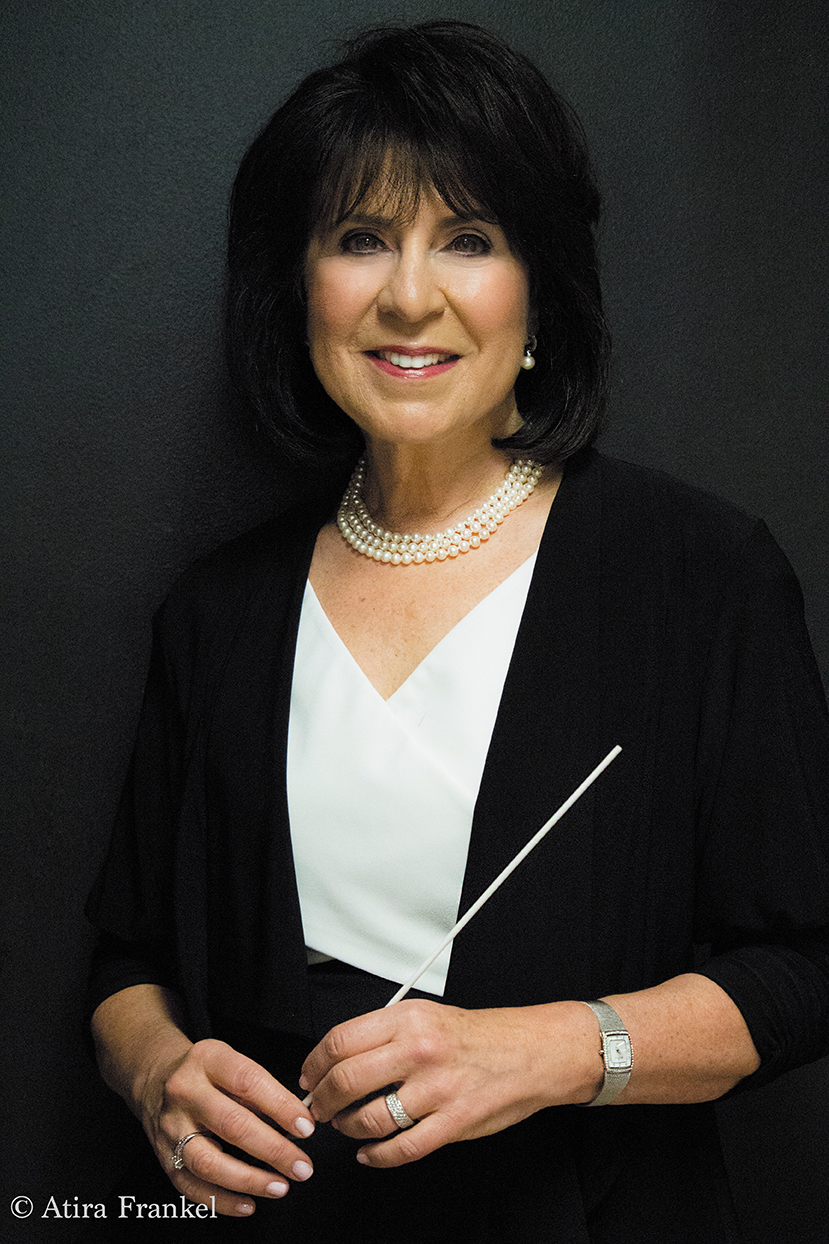
Resa Kochberg. Photo by Atira Frankel.At an early age her mother gave her some choices for after-school activities. She chose piano lessons. As it turned out, that decision determined her career. After studying piano and playing flute during her high school years, She knew that the only thing she wanted was to study music at university. After graduation with a bachelor of music degree from U of T, she taught music for the Scarborough Board of Education until she put her school teaching on hold to raise three children.

As a stay-at-home mom, after so many years of playing music and being surrounded by music every day, the only music she listened to was on the radio. For 23 years her flute never came out of its case. One day she realized that she missed the camaraderie and the excitement of playing music with other people, and the joy of musical expression. She knew that somehow she had to get music back into her life. So in 1998 she returned to teaching, and after that 23-year hiatus, she finally took her flute out of its case and joined the North York Concert Band.

Although quite rusty, after putting her daily routine behind, she would concentrate on the music. As she says, she was once again surrounded by like-minded people, all of whom wanted to create music together. She soon loved the challenge, the frustration and the sense of accomplishment, as she continued to improve with practice and support from new music friends.

With the resurfacing of her “musical urge” she thought of the many others in similar situations. In her words: “I realized that there were so many others who had also temporarily abandoned their instruments due to life circumstances, and I saw this as an opportunity to create a fun-filled, social atmosphere where people could return [as she had] to playing music. I hoped that by creating such an environment it would also give others the same joy and pleasure while also providing the opportunity for them to learn and then share their accomplishments with each other. My ultimate goal, which has been realized, was to have members of the band learn repertoire, perform to audiences and share their expression of music within the community.”

That’s how Resa’s Pieces was born. Then, as Resa put it, “one magical day” in late 1998, it actually began. Resa says that one day, she was talking to the music director at the Koffler Centre of the Arts about her idea for a band. The response that she received couldn’t have been more encouraging. “Resa,” she said, “I don’t like your idea – I love it!” Then and there Resa knew that it would happen. “When would you like to start?” the director asked. “How about next September?” That would give her enough time to spread the word and recruit. How many people would join? She was hoping for 18 as it’s a symbolic number for life, and music is so much part of everyone’s life. A few weeks later, while at a party, she took advantage of this great opportunity to announce her idea, and it became the buzz of the evening. Surprisingly, those interested didn’t want to wait until September. 

Shortly afterwards, with the 18 names gathered, and long before September, they held their first rehearsal at the Jewish Community Centre on Bathurst Street. They began with a basic review of the names and values of the notes. Then all of the fundamentals were reviewed, such simple facts as how to hold the instrument and make the first sound. Everyone left excited and eager to practise. In June 2000 they held their first concert. The band could now play eight notes and seven songs. Seventy-five people sat in the audience, the concert was 25 minutes long and the band got a rousing standing ovation at the end.

In Resa’s words: “Members are guided by the mantra, do your best and have FUN.” As for the band’s name, it was chosen by the band members.

Resa’s Pieces is now an active diverse group of amateur musicians who range in age from their 20s to their 90s, and who come from all over the GTA with the common goal: “Reawaken that Talent – Rediscover making Music.”

Then what? The birth of Resa’s Pieces Strings began. After one band concert a violinist approached her and asked to join the band. She felt terrible having to say “no” because stringed instruments require a different approach and, other than a double bass, there is simply no place for them in a concert band. As more and more string players approached, and walked away disappointed, she decided to start a string group. Thus, Resa’s Pieces Strings began in September 2010, not coincidentally also with 18 members.

A few years later Resa began wondering about all of those people who’ve never played an instrument but who love to sing? Is it fair that they should be left out of the FUN? No! She knew in her heart that a vocal group had to come next! So, after a successful trial run in the spring of 2013, Resa’s Pieces Singers began. Under the direction of Robert Graham, the ensemble is now in its third season of weekly rehearsals with growing membership and more smiling faces.

As is not uncommon for community bands, as they prepared for their “Spring Concert Band Gala,” they found themselves short of people in a couple of spots. Suddenly, I found myself joining Dan Kapp, of New Horizons renown, to play euphonium. If that wasn’t coincidental enough, as we looked over our shoulders, we saw our two spouses. (Or should that be spice?) There they were, two accomplished flute players, playing percussion.

So, on Sunday, May 27 at 7:30pm they will present their Concert Band Gala, featuring a wide range of music from rock ‘n’ roll, classical, jazz standards and marches. That’s at the Flato Markham Theatre, 171 Town Centre Blvd. in Markham. As for the String Ensemble Gala, it will take place on Sunday, June 3; the Singers Gala will be on Monday, June 11.

Strings Attached

After not hearing from him for some time, we just received information from Ricardo Giorgi, conductor of the Strings Attached Orchestra, about their final concert of the year, scheduled for Sunday, June 3 at 7pm, again at Toronto’s Isabel Bader Theatre. With an impressive and varied program planned, they intend to show how they have grown bigger and better over the past year. With that, of course, they are anticipating that they will attract a larger audience. They may have sprung up as a small fish in a very big pond, but it’s time to support them and attend this concert. It’s not possible to list their complete program here, but it varies from Handel’s Arrival of the Queen of Sheba and Villa-Lobos’ Bachianas Brasilieras No. 5 to The Best of ABBA and Pirates of the Caribbean. For more information go to www.stringsattachedorchestra.com

Jack MacQuarrie plays several brass instruments and has performed in many community ensembles. He can be contacted at bandstand@thewholenote.com.
Looking out my window, Old Man Winter is still with us, but according to my calendar, spring has officially arrived. However, the fact is that this is the time of year when community bands frequently experience transition, if not evolution. Organizations, just like humans, age, and have growing pains or other disruptions which require timely attention. With the passage of time every band will have changes in membership, leadership, sponsorship, rehearsal locations and performance venues. Similarly, some new groups will arise while a few may not survive another season. In some cases, if a group prospers and grows, much of the administrative workload must be delegated to a broader crew. So it is with that in mind that I decided to see how some such transitions are in progress this spring. If you are a member of a musical group and have not gone through the problems of some sort of transition, be patient. Your day will come.

New Horizons

Currently the most dramatic of these is New Horizons Band of Toronto. When Dan Kapp first started the New Horizons Band of Toronto, little did he know how many adults were looking for places to learn and play music. They started their first year with only 25 people of varying degrees of musical experience, and a small executive of five people. Through Kapp’s dedication, expertise and enthusiasm for music, the program has grown to seven concert bands and two jazz bands, with six music directors, as well as a number of other New Horizons Bands in surrounding communities.

I remember well their very first concert in the Glenn Gould Studio. When I first heard that this startup amateur band, with many who had never played a concert in their lives, was scheduled to present their very first offering in this prestigious venue, I questioned the sanity of leader Dan Kapp. As would be the case with any such startup group, a few vacancies had to be filled with ringers. In retrospect I can now say that I am proud to have been one of those ringers. How did it go over? To my surprise the hall was packed.

Almost immediately the year-end showcase concerts became a major goal to work for. The next performance step other than full band concerts was the establishment of small ensembles which provide an excellent practice mode for developing musical skills, particularly the skill of listening to the other members of the group. Soon came the Chamber Sweets program, which features ensembles from all band levels playing in concert for family and friends. These have become great social gatherings around the GTA, particularly at holiday times, and include a large array of tasty treats in addition to the music, hence the name.

As is the case with any organization, growth comes with its challenges. One man, now with nine bands and six music directors, can’t be expected to assume the multitude of responsibilities. To ensure their future success, last year the entire association was registered as a not-for-profit organization and established a formal board of directors. Randy Kligerman, one of the original band members, was named as president and Dave Barnes, another early member, as secretary. Soon after, Donna Dupuy, conductor of the most senior band, was contracted to be head of education for NH Bands in Toronto. 

Next year they are planning to offer sectional masterclasses to members, thereby providing further support to enhance their learning and playing experience. This appears to be the first time that this type of program will be will be offered in a community band environment. As the numbers grew they required larger, reliable rehearsal space; they were fortunate to get a long-term commitment for the use of the Salvation Army Hall in Toronto at Dovercourt Rd. and Bloor St. W. in central Toronto. They have been able to lease space to store their equipment and hold practice five days per week. They would never be able to run such a program without this help.

As for Kapp, director since the band’s inception, he is moving on. During a vacation trip to Nova Scotia last summer he and his wife Lisa fell in love with the town of Wolfville. They purchased a home there and will be moving this summer. Consequently, he announced his retirement from New Horizons Band of Toronto, as he and Lisa prepare for their big move. I understand that their reputation precedes them, as the New Horizons Band and local theatre/music groups in Wolfville have already been in contact with them. They may well be busier than ever. As they leave, their legacy will continue, as NHB Toronto starts preparing for next year’s registration. Toronto’s loss will be Wolfville’s gain.

For those not familiar with New Horizons, the Toronto band is a member of a much larger group, New Horizons International Music Association. (Their website is newhorizonsmusic.org.) Roy Ernst, a professor at the Eastman School of Music in Rochester, New York, founded the New Horizons movement in 1991, emphasizing entry and reentry points to music-making for older adults. His motto of “Your best is good enough – no auditions required” has inspired over 6000 people in approximately 200 bands across North America to get involved with music.

New president Kligerman says: “I felt very lucky to have met Dan seven years ago, as the band has been a truly enriching part of my life.” Three years ago Kligerman became a member of the NHIMA board, so that he could “further help spread the word of this amazing opportunity to learn music, to anyone looking to enrich their lives through music.”

Having not had much contact with the Toronto New Horizons groups for some time, I decided to visit the most senior group with which I have had contact over the years and also to visit their jazz band. After I introduced myself to the jazz band’s director Patricia Wheeler, I was invited to sit in. Since they did not have a bass trombone in their group and I had one in the car, I was soon holding my own at the bottom of the band. I was very impressed at how Wheeler helped instill the concepts of the jazz idiom into those new to that type of music. After that rehearsal I stayed to listen to the newest of the many groups. This was a woodwind choir with a difference; it consisted of three flutes, four clarinets and one bass clarinet but augmented by piano, bass and drums, similar to their jazz band. The key was to make a different form of music.

My next visit, a few days later, was to the rehearsal of the concert band. Still with several members of that original band, which began seven years ago, the band is now under the direction of Donna Dupuy. Here again, band members don’t just sit down and play the notes from the printed page. They are challenged to get comfortable with the finer aspects of the harmonies and rhythms to produce a distinctive quality performance.

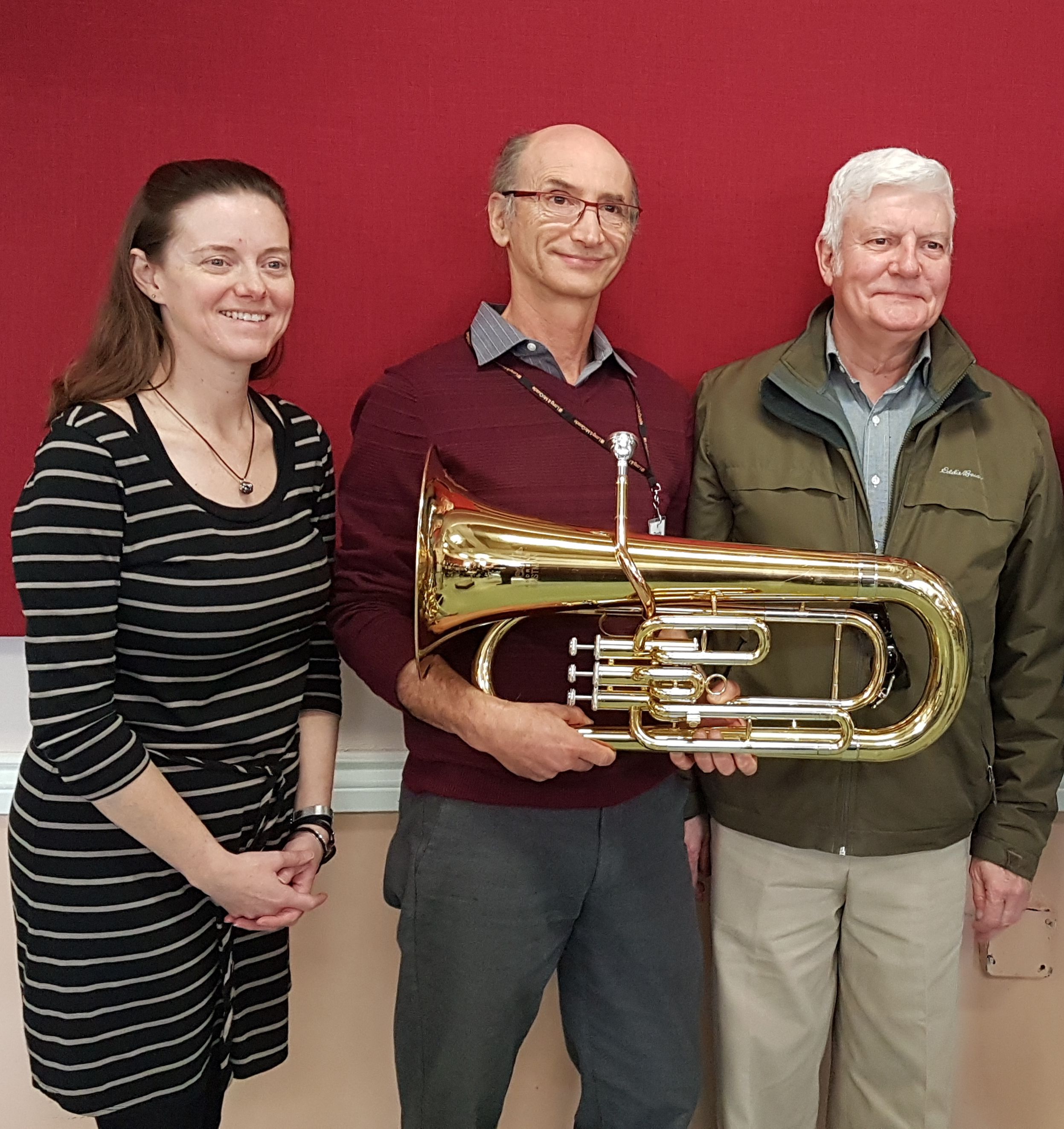
(from left) Donna Dupuy (concert band conductor); holding euphonium, Randy Kligerman (president, NHB Toronto); Bill Condon, who gifted the euphoniumShortly before it was time to wind up that rehearsal there was a visit by Wheeler and her husband Bill Condon. In a brief ceremony Condon was there to present the surprise gift of a euphonium to the NH bands. My timing couldn’t have been better: a rehearsal, the most senior band, the president, two conductors and a generous friend of the band. What better instrument to receive as a gift! When prospective members attend a session to learn about band instruments, more often than not the euphonium is the one instrument they have never heard of. After this brief ceremony I was granted the honour of being the first to make sound on this euphonium. With great flair, the band members heard a B-flat major chord on their new instrument.

Anyone interested in learning more about New Horizons Band of Toronto can contact them at newhorizonstoronto.ca. Remember their motto: “It’s never too late!” Or you can contact Randy Kligerman directly, at randy@jaragroup.org.

Other news

Although I wrote quite a bit about Johnny Cowell last month, I would be remiss if I didn’t mention the recent Celebration of the Life of Johnny Cowell, which took place on March 12 at Scarborough Bluffs United Church. With friend and colleague Stuart Laughton acting as MC, we heard not only reminiscences from many, but an amazing musical program. There were recordings of Johnny’s performances, as well as a wide spectrum of live performances of his compositions, from the song Walk Hand in Hand to a number of works for trumpet. The most stirring moment for me was a flugelhorn solo by Jens Lindemann, who came to Toronto specially for the occasion. Normally, the tune Amazing Grace is close to the top of my dislike list, but Lindemann’s rendition was so emotional that I was speechless. I have never heard that number or the flugelhorn sound so wonderful.

From time to time we hear of unusual instruments arriving on the local scene. A couple of years ago it was Jeff Densham with his subcontrabass flute from the Netherlands. He first saw such an instrument when a visitor from overseas played one with the Flute Street ensemble. Now, Nancy Nourse, director of Flute Street, is showing off her new contr’alto flute, also from the Netherlands. In her words: “It has such a rich, flutey baritone voice, capable of reaching well past the tenor range into the mezzo-soprano.”

This instrument’s very first outing with Flute Street will be on April 6 in Reston, VA in the Washington DC area, at the First International Low Flutes Festival (lowflutesfestival.org). Flute Street is one of a number of invited ensembles, amidst groups from Hungary, USA, England and Japan. Then on Sunday, April 15 at 7:30pm, Flute Street will present the same program, including a special contr’alto flute feature, at Christ Church Deer Park in Toronto.

Speaking of new groups, Borealis Big Band, mentioned last month, has risen to local stardom, in a recent edition of snapd Aurora. For those interested visit https://aurora.snapd.com/events/view/1118828. 

Jack MacQuarrie plays several brass instruments and has performed in many community ensembles. He can be contacted at bandstand@thewholenote.com.
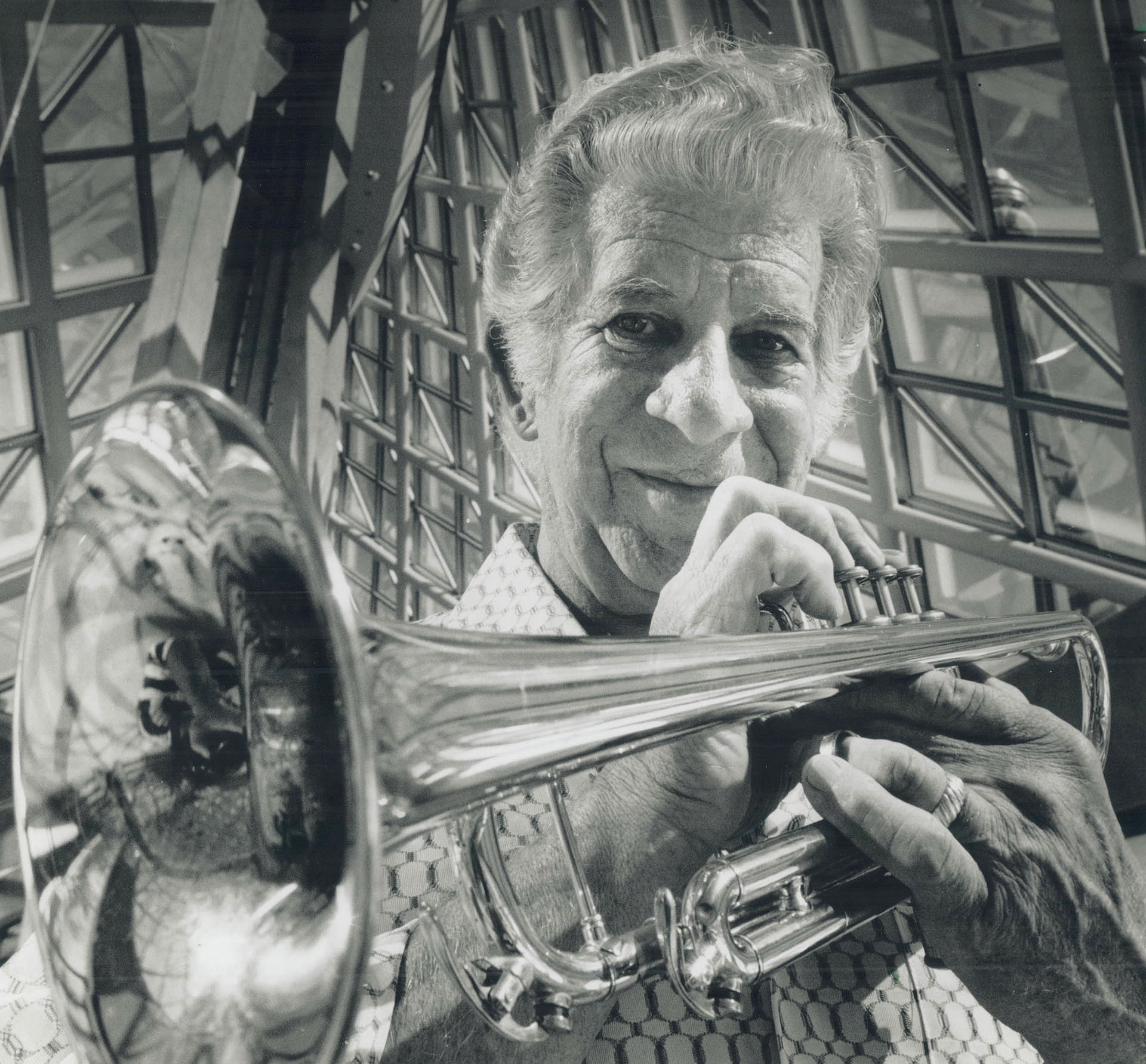
It is with deep sadness that I have to report on the loss of another giant from our musical world. On January 22, just 11 days after his 92nd birthday, we lost Johnny Cowell, one of Canada’s most outstanding trumpet soloists. Rather than write some form of formal obituary, I would prefer to just recall a few situations over the years where our paths crossed. As is so often the case in the world of music, I cannot state with any certainty when or where I first heard the name Johnny Cowell or when I first met him. As I have mentioned in previous columns, there was a time when band tattoos were a significant part of summer festivities in many towns in southwestern Ontario. I know that his first band experience was with the Tillsonburg Citizens’ Band. At that time, I was a regular member of the Kiwanis Boys’ Band in Windsor. In a conversation with Johnny a few years ago I learned that we had both played in many of same tattoos. I know that he had played trumpet solos in some of these events. I may well have heard his solos then. However, the only young star trumpet player from those days that I remember was Ellis McClintock, later with the Toronto Symphony for many years.

Johnny CowellFast forward 20 or more years, and there I was playing in the same band as Johnny, with Ellis as the leader. It was a band, now long forgotten, for the Toronto Argonaut football club. Yes, even though the Argonaut head office appears to have no record of this band, from 1957 to 1967 the Argos had a 48-piece professional marching band which performed fancy routines on the field at all home games. Why would musicians of Johnny’s stature play in a football club band. Well, if you like football, why not get well paid union fees to watch a game? Since I was playing trombone in the front row and Johnny was playing trumpet in the back, we certainly had no contact with each other during rehearsals or performances. However, that is where we first met.

During the times between rehearsals and performances there were usually small groups chatting. Frequently, the topic would turn to Johnny’s many compositions, particularly those on the hit parade. His 1956 ballad Walk Hand in Hand, which was just one of his many hits, could be heard on every radio station in those days. Actually, it was reported that at one time Johnny had more numbers on the US hit list than any other writer of popular music. However, his writing wasn’t limited to that genre. He was equally at home writing for trumpet and brass ensembles. I frequently play selections from the Johnny Cowell CDs in my collection. I am amazed at the gamut his trumpet works run. At one end of the spectrum there is his dazzling Roller Coaster and on the other end, his Concerto in E Minor for Trumpet and Symphony Orchestra.

My contact with Johnny was limited over the years, but there are a few meetings that come back to me regularly. Shortly after I began writing this column, I arranged to meet Johnny to get an update on his musical activities. Our meeting was anything but formal. It wasn’t at his home or at The WholeNote office. It was on a park bench in the town of Stouffville, not far from my home and close to the home of a family member of his. A few years after that it was a chance meeting during a break in one of the Hannaford Silver Band’s weekend events. Along with Jack Long of Long & McQuade, we discussed a somewhat less-than-serious subject, i.e. whether or not the names that we were using were the names on our birth certificates. The name “Johnny” was, in fact, the name on his birth certificate. For the other two of us, “Jack” was not our given name.

Then there was the time two years ago when I had the privilege of attending Johnny’s 90th birthday party. During that event, for a short while, I was flanked by two great figures in the Canadian music scene, Johnny and Eddie Graf. Now we have lost them both. At times one wonders how things might have been if Johnny had not turned down attractive offers which might have brought him fame by writing for stage productions or getting involved in the Nashville scene. While the trumpet was his all-abiding first musical love, that for his wife Joan and their family always had precedence.

By the time this issue is released, the Encore Symphonic Concert Band will be presenting a “Tribute to Johnny Cowell” in their regular noon hour concert, playing many of Johnny’s arrangements, on Thursday March 1. I’m sure that similar tributes will be presented by many other bands in the area over the coming months. Tell me about them and I’ll pass the word along.

A public memorial/celebration of life for Johnny will be held on Monday, March 12 at 7:30pm. It will take place at Scarborough Bluffs United Church, 3739 Kingston Rd, near the intersection of Kingston Rd. and Scarborough Golf Club Rd.

Junior Bands

Speaking of junior bands, it has just come to our attention that the 2018 National Youth Band will be hosted this year in Montreal by the Quebec Band Association. The guest conductor will be Wendy McCallum from Brandon University. We understand that this will be taking place in May, but don’t yet have confirmation on precise dates or location. The Yamaha Guest Soloist, on clarinet, will be Simon Aldrich from McGill University.

Changes

Over the years new bands spring up, old ones disappear and some undergo a significant transition. One group undergoing a major transition is the several New Horizons Bands in the Toronto area. Since their beginning close to ten years ago, the man at the helm has been Dan Kapp. However, not only is Dan relinquishing his leadership on the Toronto New Horizons scene, he is moving to Wolfville, Nova Scotia, soon after his wife Lisa retires from her teaching post this coming June. Rather than have a single person at the helm, now with quite a number of New Horizons bands in the Toronto area, there is scheduled to be a governing committee made up from the membership of the various NH bands. I hope to have more details on New Horizons activities soon.

It is always refreshing to learn of new groups arising from scratch. We just learned of a new swing band which is starting to make its mark. A frequent dilemma is how to give a new band a distinct name for people to associate with them. So, last summer a group forming up in Aurora decided that they should have a name that was unique, but easily recognized as having an affiliation with the name Aurora. Their name: the Borealis Big Band. The band is under the musical direction of Gord Shephard, a longtime resident of Aurora. He is the music director of the Aurora Community Band, as well as an instructor and conductor at York University where he is a PhD Candidate studying community music.

I was invited to attend one of this band’s rehearsals on January 31 and was almost blown away by a group that had just had its first rehearsal in September 2017. I heard a real powerhouse with a repertoire unlike that of any group that I have known. I asked a couple of members to describe this, and I received a variety of answers. The answer from Shephard was: “The Borealis Big Band was set up to provide an opportunity for members to play a wide variety of big band jazz styles including swing, funk, smooth and Latin/Cuban, and to play it to the highest quality possible with lots of room for improvisation for all interested members.” Unlike most such groups, when the band was formed they had designated leaders for each section. Their Debut Concert” went amazingly well. In the words of bassist Carl Finkle: “It was so much fun playing to a sold-out house for our first ever gig.” Their next scheduled performance will be on Friday June 22 at 8pm at the Old Town Hall, Newmarket, 460 Botsford St. We’ll have more on that in a later column.

Coming

On Sunday, March 4 at 3:30pm, the Wychwood Clarinet Choir will present their “Midwinter Sweets” program featuring an assortment of selections arranged by Roy Greaves, Alan Witkin, Richard Moore, Maarten Jense and Frank J. Halferty. Featured will be Five Bagatelles, Op.23 by Gerald Finzi, with artistic director Michele Jacot as clarinet soloist. Steve MacDonald, as tenor saxophone soloist, will perform Hoagy Carmichael’s Georgia on my Mind. Also on the program will be Minuet from “A Downland Suiteby John Ireland, Rikudim, Four Israeli Folk Dances by Jan Van der Roost and Henry Mancini’s Baby Elephant Walk. This concert will be held at The Church of Saint Michael and all Angels, 611 St. Clair Ave. W.

While it is a bit in the future, we might as well look ahead a bit to spring. The Clarington Concert Band’s annual spring concert will take place at 7:30pm on Saturday April 21 at Hope Fellowship Church in Courtice. As always, the program has something for everyone, with music from the band Chicago, to jazz and Broadway standards sung by their popular vocalist, Liza Heitzner. Clarinetist Katherine Carleton will perform Gordon Jenkins’ Blue Prelude and alto saxophonist Liz Jamischek will pay tribute to longtime Ellington soloist Johnny Hodges, with her rendition of Harlem Nocturne. The band’s regular conductor will be away and the band will be under the direction of Shawn Hills. Now retired after decades of heading the music program at Bowmanville High School, she is excited to direct her inaugural post-retirement concert with the Clarington Concert Band.

Jack MacQuarrie plays several brass instruments and has performed in many community ensembles. He can be contacted at bandstand@thewholenote.com.
With this first issue for the year, we are, in a way, wondering in what fresh directions 2018 might take the Bandstand beat. For over a year we have been hearing about and reporting on the many sesquicentennial events in the community band world. For almost all of the bands that we heard from, their repertoire seemed to focus on works which had some connection to that 150th anniversary for the country. To top that off, there was the usual festive season offerings ranging from medieval carols to Frosty the Snow Man and Rudolph. Now that these are all in the past, what are we going to be offered now? There were hopes that we would hear from the banding community all about their plans for the coming year. Alas: no news! Perhaps all of the bands are taking a rest after a busy season. Usually, prior to each issue, we receive a good number of notices from bands about upcoming events. So far, we have received little information.

In the meanwhile, how about we take the time to look past winter altogether, into the topic of park concerts and parades, their origins and evolution?

Welcome to the Bandshell

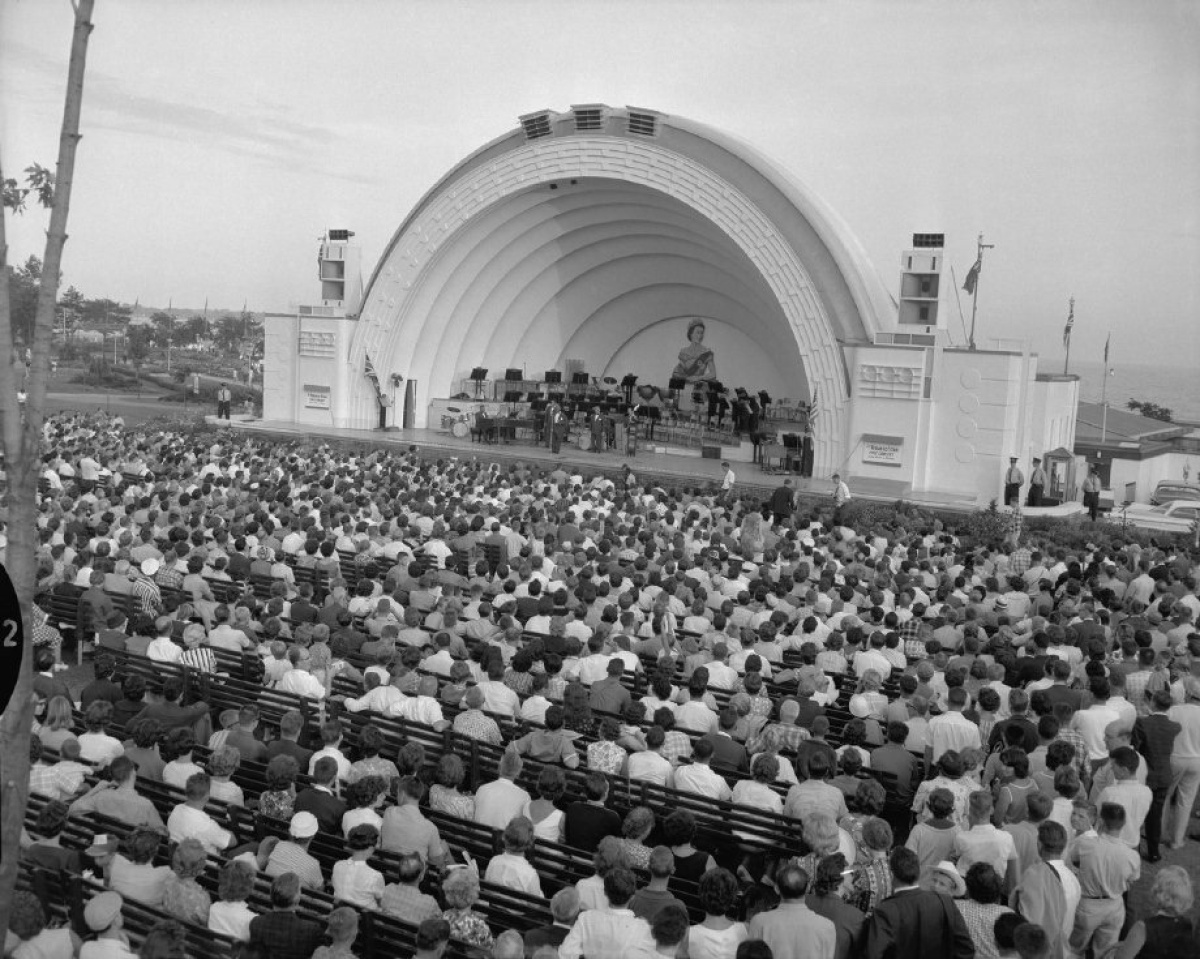
CNE Bandshell in the late 1950sSince arriving in the Toronto area after WWII I have witnessed quite an evolution in the band world. During the war the Canadian National Exhibition did not operate because most of the buildings were used as barracks. In 1948, for the reopening of the CNE, the main Bandshell was updated with the finest theatre-quality sound system, and the first of a series of feature bands was booked to appear. The feature band that year was the Band of His Majesty’s Royal Marines, Plymouth Division under the direction of Major F. Vivian Dunn. I had the privilege of discussing the format of each concert with Major Dunn and operating the sound system for all concerts. In that and ensuing years band concerts were the prime form of entertainment at the CNE. There were two concerts per day by the feature band and two per day by local bands on the Bandshell. There were also at least two concerts each day on the North Bandstand. That practice continued for some years. Similarly, Toronto Parks and Recreation sponsored regular band concerts during the summer months at Kew Gardens, High Park on Sundays and in Allan Gardens in downtown Toronto on weekday evenings. They seemed to be at their height during Centennial Year in 1967. These did not all end suddenly, but within the next 20 years they had all disappeared. Will the end of Canada’s sesquicentennial year see a change in direction?

A Major Anniversary

As mentioned, we have not yet received any indication of significant band plans for the coming year from any band. However, on the bright side, we did receive some wonderful information on the activities of the Concert Band of Cobourg during the past year. Not only did they stage a variety of events for Canada’s 150th anniversary, but they channelled the bulk of their resources into the celebration of the band’s 175th anniversary.

The Cobourg Concert Band has a long and varied history, and has had quite a range of names over the 175-year period since the first town band appeared in Cobourg in 1842. During the late 1960s the band went through a period of gradual decline. By 1970 it was in a rather sad state. That was when Roly White appeared on the scene as director of music. Before immigrating to Canada, Roly had served for 12 years in bands of the Royal Marines under the same conductor whom I mentioned above, now bearing the title Colonel Sir Vivian Dunn. With his previous Royal Marine connections, Roly managed to have the Cobourg band officially designated as “The Band of Her Majesty’s Royal Marines Association, Ontario.” With that new designation, the band was outfitted with almost identical uniforms to those of the Royal Marines. Over the years, the band progressed in other ways to the point where they have their own building with fine space for rehearsal, storage and socializing. After many years at the helm, Roly turned the baton over to longtime band member Paul Storms 17 years ago.

As a part of the band’s anniversary celebration, longtime band member, Robert Irvine, authored an extensive history of the band called Journal of a Band. Mr. Irvine spent over ten years researching and documenting each of the entries that went into the Journal. This detailed history of over 700 pages, looks back to band activities since 1842. That made 2017 the 175th year that a community band has been part of the daily life experience in Cobourg. With this documentation, band members believe that theirs is the oldest community band in Canada. However, they may get some challenges on that. The Newmarket Citizens Band has some documented information indicating that their band was also active during that time period.

According the Cobourg band president, Brian Clarkson, “Irvine’s book is full of rich detail concerning the band and the members of the band, all set in the context of key world events that transpired over the last 175 years. Many pictures help bring into view what life must have been like, how important music has always been in Cobourg, and how some families had members spanning several generations – right up to and including the present day. From our early roots as offshoots of the local fire brigades, through independent membership, and all the way to our current affiliation with the Royal Marines Association - Ontario, you can see the band evolve and grow in importance both locally and internationally.” He tells me: “It is a great read for any musician, historian, or lover of small town Ontario.” The book sells for $35 plus any shipping charges that may apply and can be ordered from the same website as the CDs: cbcrmab@cogeco.net.

While on the subject of the Band’s new CD, I would like to add a few comments about it that are not in my review of the CD elsewhere in this issue. One comment would be on the talent in the band. There are several members with music degrees, including at least two Masters degrees, from the University of Toronto and the prestigious Berklee College of Music. How often are you liable to find such composing and arranging talent in a small town band? Another comment concerns the cover design. As part of the CD project, the band sponsored a contest at all of the local high schools for a piece of art work for the cover. The winners, Sarah McLoughlin and Annie Sawyer, produced a vibrant design depicting the band performing under the Canadian flag.

Before leaving the subject, I would like to share a story from a conversation I had with Roly White some years before he joined the Concert Band of Cobourg. He told me about an incident, at some point while he was serving as assistant under Sir Vivian Dunn. He was chastised for conducting with his left hand and told to change over to using his right hand as this was the norm. After some time away from the band to study conducting with Sir John Barbirolli, he returned to the band. Once again he was conducting with his left hand. When queried by Dunn about reverting to his left hand, Roly simply stated “Sir John conducts left-handed.” That ended the discussion and Roly was still conducting left-handed in Cobourg when he retired.

Changes coming

We have just learned of two significant changes in local bands. The Whitby Brass Band, which will celebrate 155 years this year, is looking for a new conductor. The band rehearses on Thursday evenings, and like other bands, has performances at various times throughout the year. Preference will be given to someone with previous brass band conducting experience. Applications will be accepted until March 2. Information is available at whitbybrassband.com.

The other change is the possible return of the Uxbridge Community Concert Band. After 25 seasons, conductor Steffan Brunette took a year off last year to pursue some other interests. He is now back in town, and with the assistance of other interested musicians, hopes to have something to report on possible future directions for another season of summer music.

Sam Caruana

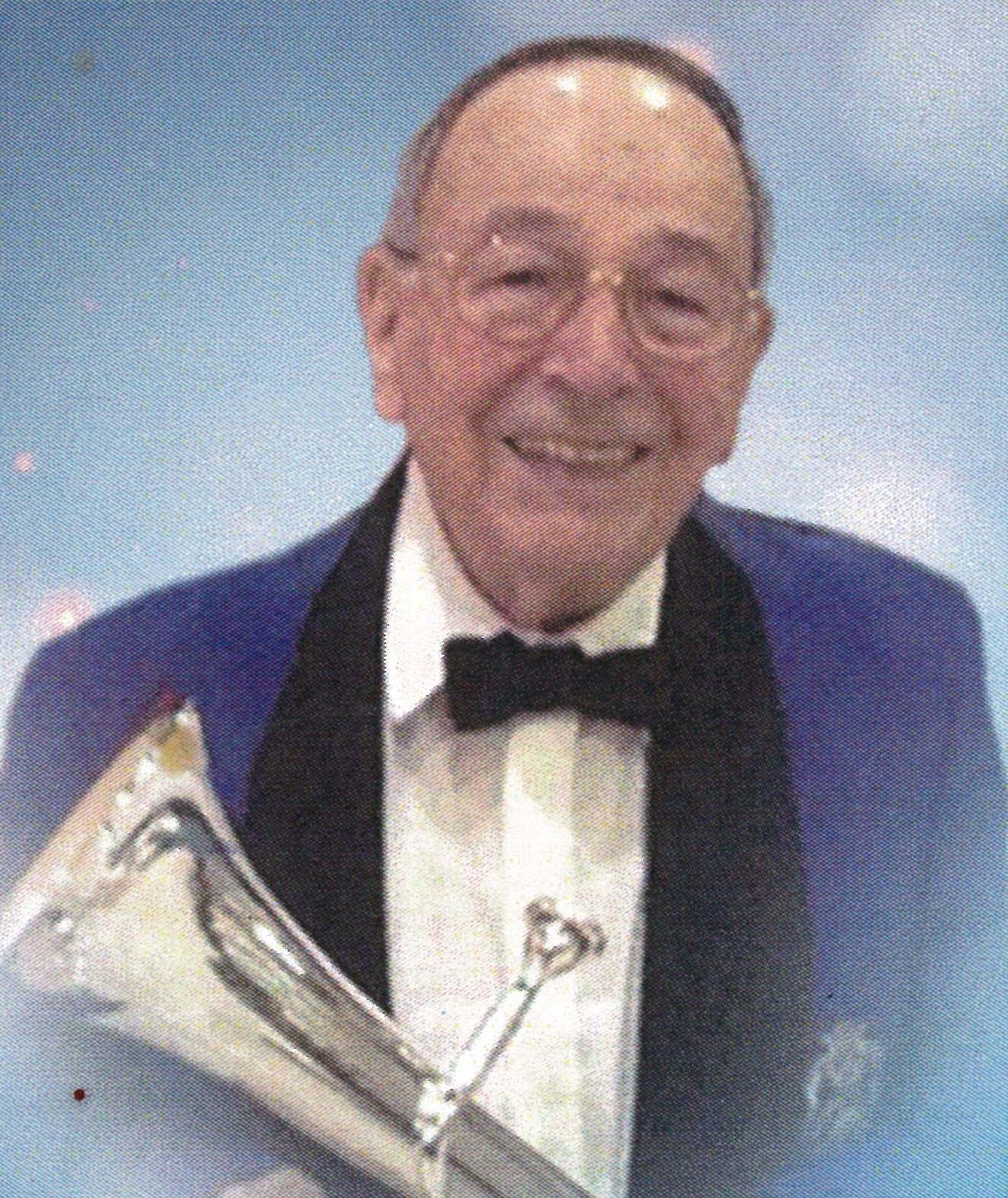
As is so often the case in relationships in the world of music, I can’t recall where or when I first met Sam Caruana. All I know is that I played alongside Sam in many groups over many years. Having chatted with Sam just a few weeks before, I was shocked to learn of his passing on December 16, 2017. Sam served in the King’s Own Royal Malta Regiment during WWII, then moved to England after the war for a job in music. While touring with the Benny Daniels Dance Band in Belfast, Northern Ireland, Sam met Kay and they married in 1952.

Sam CaruanaAfter a musical career in Britain, Sam moved to Toronto in 1974, initially staying with his sister in the Junction (Little Malta) neighbourhood of Toronto. He was joined by Kay and son Paul shortly thereafter. Sam is survived by his wife Kay, sons Benny and Paul and their families. Sam will certainly be missed by his many musical friends, including those in the Metropolitan Silver Band, The Encore Symphonic Concert Band and the Malta Club Band. He played in all of them until very recently.

In a recent email his daughter-in-law Joanna told me that she had “forgotten to say that in addition to the Benny Daniels band in Britain, Sam also played with the BBC and for a circus band, where his paper-bag lunch got stolen daily, until he discovered that an elephant was stealing it from under his chair on the raised stage! In Toronto he played for too many bands to mention, including a Schwaben Oompah band, and more recently, the Toronto Mambo Project.”

Coming Events

Feb 1 at 12pm the Encore Symphonic Concert Band presents “In Concert.” Big band swing, jazz, film scores and marches. Wilmar Heights Centre, 963 Pharmacy Ave., Scarborough.

Feb 25 starting at 10am, this year’s York University Community Band Festival will begin. The four bands participating will be the Newmarket Citizens Band, the Aurora Community Band, the Thornhill Community Band and the Richmond Hill Concert Band. In the morning each band will rehearse their selections in separate rooms. After lunch, each band will have 15 minutes to perform their own numbers and then the massed band will perform the finale for the afternoon.

Feb 25 at 3pm, the Guelph Concert Band presents “Broadway Showstoppers,” selections from Frozen, Hamilton, Wicked, 42nd Street, Chicago, Phantom of the Opera, Les Misérables and others; Patrick Stiles, vocals/piano; Bridget Walsh, violin; guests: Kelly Holiff and Jeigh Madjus, vocals. River Run Centre, 35 Woolwich St., Guelph. 519-763-3000.

Mar 4 at 3pm, the Weston Silver Band will present “Kaleidoscope,” including Blue Rondo a la Turk (Brubeck), Impressions (Kevin Lau), Pink Panther (Mancini), The Red Novae (Graham), David of the White Rock, and the march, The Thin Red Line, at Glenn Gould Studio, 250 Front St. W.

Mar 4 at 3:30pm, the Wychwood Clarinet Choir presents “Midwinter Sweets” featuring Five Bagatelles Op.23 by Gerald Finzi; Minuet from “A Downland Suite” by John Ireland; Georgia on my Mind by Hoagy Carmichael, Steve Macdonald tenor saxophone soloist; Rikudim, “Four Israeli Folk Dances” by Jan Van der Roost; Baby Elephant Walk by Henry Mancini. Artistic director and clarinet soloist Michele Jacot. Church of St. Michael and All Angels, 611 St. Clair Ave, W; wychwoodclarinetchoir.com.

Jack MacQuarrie plays several brass instruments and has performed in many community ensembles. He can be contacted at bandstand@thewholenote.com.
Here we are, it’s December already, but with many community ensembles still more focused on sesquicentennial projects as the year draws to a close than on events that could be described as special for the Christmas season. Let’s start with two band projects we have recently learned of that warrant mention, both of which have significant historical aspects.

Cobourg: The first of these is the announcement of a CD by the Cobourg Concert Band. Although this CD, Pride of Performance, was officially released on Canada Day at the band’s concert in the Cobourg Victoria Park Bandshell, it did not come to our attention until a few days ago. There are a number of ways in which this CD is special. Not only is it a sesquicentennial project, but it marks the 175th year that there has been a town band in Cobourg. That’s 25 years longer than Canada has been a country. Whether that sets a record for the establishment of a town band in Canada will be left for this Cobourg band to dispute with the Newmarket Citizens’ Band and any others that might claim such a title. Every track on this recording is either a new arrangement of an established work or a completely new composition. All are by local musicians, including some band members. Even the cover artwork was created by contest winners from the local St. Mary’s High School. I hope to see a review of this CD in a future issue of The WholeNote.

(A side note: this band also bears the title The Band of Her Majesty’s Royal Marines Association – Ontario, and is allowed, by royal assent, to wear the uniform of the Royal Marines. How could this be, you might ask. Some years ago a man named Roland White moved from England and took up residence in Cobourg. He just happened to have been an assistant bandmaster in the Royal Marines working under the renowned conductor Sir Vivian Dunn, and had studied conducting under Sir John Barbirolli. When the town band needed a new conductor, there was White to take over, get that royal assent and change the image of the town band to its present pride of Cobourg.)

London: Where else might we look for a sesquicentennial band project? The first place that comes to mind, of course, is Henry Meredith’s Plumbing Factory Brass Band in London. On Wednesday, December 13, 7:30pm at Byron United Church – 420 Boler Rd., London, Ontario – the PFBB will celebrate Canada’s 150th birthday with “The Golden Age of Brass,” featuring music from the 1800s on period instruments. Since Confederation-era music will be highlighted, von Suppé’s exuberant Jolly Robbers Overture, written exactly 150 years ago in 1867, will open the program. Then, band music by big name composers will include Beethoven’s Marsch des Yorck’schen Korps and Mendelssohn’s War March of the Priests. The centrepiece of the program will be the challenging Raymond Overture by Ambroise Thomas.

Last month I mentioned the importance of musicianship for ensembles to really tell their story. Well, in this program, Dr. Hank has selected a set of four up-tempo compositions to test the skill of his band’s musicians. One highly regarded composer of the 1800s, famed for his toe-tapping pieces based on popular dance forms of the mid-19th century, was Claudio Grafulla. To demonstrate their skills, the band will play a set of four of his works: Cape May Polka, Freischutz Quick Step, Skyrocket March, and Hurrah Storm Galop. Another seasonal favourite, Johann Strauss Sr.’s famous Radetzky March from 1848, will bring the concert to a rousing close. I’m sure that many instruments from Dr. Hank’s vast collection will be front and centre at this concert.

(Another sidenote: While brass bands have many loyal followers, particularly in England and much of North America, that has not always been the case. With the origin of the brass band movement coming largely from company “works bands” in England, there were often considerable derisive comments about them. Sir Thomas Beecham was famous (or infamous) for two of these comments. “The British Brass Band has its place – outdoors, and several miles away” is perhaps his most often quoted. But the one that drew the most ire was  when he referred to the brass band as “that superannuated, obsolete, beastly, disgusting, horrid method of making music.” However, attitudes gradually changed, and in 1947 Beecham even guest-conducted a mass band concert at Belle Vue.)

Ukraine: Speaking of brass bands, recent Salvation Army news caught my attention. The Salvation Army is represented and active in 127 countries around the world. In many of these countries, Salvation Army groups have brass bands. Ukraine, in particular, is a country where there is a will but not the required leadership to develop the brass band movement. Several attempts have been made over the last 25 years to stimulate interest. While some attempts have been successful, with the political unrest of recent years, these have been difficult to sustain.

Enter Bob Gray, a Toronto high school music teacher, trumpet player and conductor with whom I play regularly, who has been active in the Salvation Army for many years. About six years ago, at the Salvation Army’s music camp at Jackson’s Point, he met two young men from Kiev, a cornet player and a euphonium player. After they had returned to Kiev, Bob decided to look into the SA band situation in Ukraine. After the revolution of 2014, Salvation Army churches throughout Ukraine closed, and now there are only two remaining in Kiev. Having learned of the demise of that Salvation Army movement, Gray decided to try to do something to rectify the situation. Item one on his agenda was language study. For over a year he actively studied in preparation for visits to Ukraine for Salvation Army activities. He went to Kiev for the first time in June 2016, then in May 2017, and again in October 2017. Gray, along with the people he met at Jackson’s Point years ago, are trying to resurrect the brass band movement in the Ukraine and, in particular, Kiev. A survey showed that there were 25 instruments in working order and a few players who were willing to commit time and effort to form what would be a divisional band base in Kiev.

The Salvation Army will be celebrating their 25th anniversary of operations in Ukraine this coming June. It is hoped that the divisional band in Kiev will have its debut during that weekend of activities. The Winton Citadel Band from Bournemouth in the United Kingdom will be the featured band for the festivities. The city of Kiev hosted the Eastern block countries Eurovision Song Festival this past June. During the event many groups entertained in local parks and squares. The Salvation Army provided a musical presentation in Victory Park. Bob Gray was a featured cornet soloist as part of these outreach concerts.

A trip to Belgium: A couple of months ago I heard from longtime friend Colin Rowe that he would be travelling to Belgium. I first met Colin some time around 1984 when we were both playing in a swing band at the Newmarket Jazz Appreciation Society. After that, he played trombone in the Governor General’s Horse Guards Band and subsequently became their drum major. Having moved East some years ago, Colin now has the same duties with the Cobourg Concert Band.

Drum major Colin Rowe with the Cobourg Concert Band in Plattsburgh NY, 2013 - Photo by Jack MacQuarrieTo commemorate the 100th anniversary of the battle of Passchendaele, Veterans Affairs Canada decided to mount a very different form of memorial. Specifically they identified nine recipients of the Victoria Cross from that era and the nine regiments in which they served. Then they selected a living representative of each regiment to go to Belgium, but that person could not be a currently serving member of the regiment. One of those VC recipients was Private Tommy Holmes VC from the 48th Canadian Mounted Rifles. At some time after WWI that unit’s name was changed to the Governor General’s Horse Guards. As the representative from the GGHG, Veterans Affairs selected Colin Rowe. All of regimental representatives, along with the band of the Royal 22nd Regiment, embarked on an RCAF transport for their trip to Belgium on November 5.

Another formerly local musician was Kevin Fleming, who was originally introduced to the GGHG by Colin as a trombone player. Later, like Colin, he continued to play trombone, but became Drum Major of the GGHG. Some time later Fleming transferred to the Regular Force, and a while ago to the Royal 22nd Regiment, nicknamed the Van Doos. Their band was selected as the lead band because Passchendaele was one of that regiment’s battle honours. While there were many ceremonies, the highlight for Fleming was at Passchendaele, with a torchlight parade from the WW1 monument to the town square followed by a concert.

Those who went on that trip commented that it had been meticulously organized by Veterans Affairs, and that on the flight over, they were presented with a six-page detailed itinerary for their ten-day visit to memorials and cemeteries, informing them of the time and place of their every move.

(Aside, again: speaking of Belgium, one significant recent event I attended was a concert by Toronto’s Wychwood Clarinet Choir on November 19. While most of the works performed at their concerts are special arrangements, the opening work, Claribel, was written by Belgian composer Guido Six specifically for his Claribel Clarinet Choir in Ostend. This was a wonderful rousing opening. The arranging talent of choir member Roy Greaves was certainly on display as the choir’s moods traversed from the Irish folk song The Lark in the Clear Air and a Mozart Serenade to three tangos by Astor Piazzolla. Harmonically the choir sounded better than I had ever heard it. Their harmonies were so well blended that one might think that their sounds were coming from a single source.)

Greenbank, Ontario: From the tiny Ontario hamlet of Greenbank, conductor and composer Stuart Beaudoin brought his Orpheus Symphonietta to the small town of Uxbridge for another memorable recent event – a concert featuring his new composition Elegy II: Lament and Tchaikovsky’s Symphony No.5. This was the first performance of his composition which conveys, in musical terms, some of the spectrum of the composer’s emotions arising from world events during his lifetime. It’s an interesting work which bears more listening. This same man will be back two weeks later with his Greenbank Cantorei sine Nomine choir and the same orchestra for a three-hour performance of Bach’s Christmas Oratorio in English.

Flute Street: That other local same-instrument-family group, Flute Street, unfortunately had their most recent concert on the same date as the aforementioned Wychwood Clarinet Choir. Their featured soloist was Christine Beard playing alto flute and piccolo. Those types of same-instrument ensembles would seem to be competing for the same audiences, and it is unfortunate that there is not a central registry to avoid such overlaps. Flute Street’s Nancy Nourse had hoped to have her new contra alto flute, but it wasn’t available on time. She says that it will be the first of its kind in Canada. She intends to unveil it in time for their next concert, possibly in March. It’s an unusual instrument made in Holland. She may even travel there to get it and bring it home.

Jack MacQuarrie plays several brass instruments and has performed in many community ensembles. He can be contacted at bandstand@thewholenote.com.
What a way to kick off the fall music season. Although I had often heard of Quartetto Gelato since they first hit the Toronto music scene 25 years ago, I had never had the opportunity to hear them in person. Now, here they were almost on my doorstep, at the classic Uxbridge Music Hall, 15 minutes from home. If you have not heard of Quartetto Gelato, you have been missing out on first-rate entertainment provided by a very skilled, classically trained ensemble with the most unusual instrumentation of violin, oboe, accordion and cello. The group has had numerous personnel changes since 1992 with violinist and tenor singer Peter De Sotto being the only original member still in the group. Alexander Sevastian, who joined in 2002, was the winner of the renowned Coupe Mondiale International Accordion Competition in Washington in 2007. In 2009 they were joined by Colin Maier on a wide range of instruments including oboe, clarinet, violin, five-string banjo, electric/acoustic bass, flute, guitar and musical saw. In that year Elizabeth McLellan also joined the group on cello.

With the unique sounds of this instrumentation, and their years of classical training, the ensemble boasts an eclectic repertoire that ranges from Brahms, Bach and Weber to Argentinian tangos, gypsy music and much more. Initially, from my vantage point in the balcony, I assumed that the accordion was the fairly well-known large piano accordion. After watching the dazzling movement of the fingers of Sevastian’s right hand, I realized that this was not the instrument that I had assumed. It is a rare Bayan accordion where the right hand has an amazing array of buttons. (For those who might be curious about the Bayan accordion there is a 30-minute lecture on YouTube detailing its complexities.)

There was not a scrap of music in sight the entire evening. All of the shows musical and choreographic intricacies were performed by memory, with De Sotto switching routinely from violin to his fine tenor voice. Other than the cellist, who remained on her private podium, the others were often in movement. At one point, with De Sotto playing his violin while kneeling on centre stage, Maier put down his oboe, removed his shoes and socks and began a gymnastic routine flip-flopping back and forth over the violinist. It turns out that he is also a dancer and acrobat who spent a time in his career with Cirque du Soleil.

How does this musical group get away with such histrionic showmanship, and what does this all have to do with this column? The answer: first and foremost, is that, for community bands there is a lesson to be learned here. Quartetto Gelato displays outstanding musicianship. With the music under complete control, then a musical group can afford to indulge in showmanship. Unfortunately, in many community bands, either showmanship takes precedence or remains completely hidden. Either way, the end result can be a lacklustre show.

Musicianship

What’s the best way for a community band or orchestra to achieve their musicianship goals? I’m sure there are many ways, but we just heard of an interesting procedure used by Ric Giorgi, conductor of the Strings Attached Orchestra. Here’s the kind of email message he sends to members of his group after a rehearsal: “1. Keep working to make a difference in the sound of notes according to the staccatos, tenutos, caps or accents etc they have over or under them. The rhythm was starting to sound pretty classy once you started playing these. Check your accidentals and see how far into the section after letter E you can get. 2. After letter E the arranger throws the melody around in bits to different sections, so write in (in pencil) the beat numbers and sub-beat ‘and’s with vertical lines over them so it’s clear how much you have to rest between notes as well as how you play when you have notes. Remember that an accidental affects every note in a bar after the accidental and any note that’s tied into the next bar.”

This may all sound very elementary, but it certainly doesn’t hurt to honour the basics.

While on the subject of Strings Attached, we just received word of their Young Composers Initiative (YCI). In November they will be performing Cassiopeia with the 2016 YCI winner in Orangeville. Last year’s second-place winner (now 12 years old) has said that he’s determined to outdo his previous effort. More power to him.

A trip to London

Next recent musical journey for me was a trip to London, Ontario. The first part of this trip was to sit in as an observer of a class reunion of music graduates from Western University. While I did not attend this university, it was interesting to observe class mates of years gone by. Having not seen each other for years, they soon coalesced into a band and a choir in the morning and performed on stage in the afternoon. Again: musicianship at play.

Henry Meredith with part of his collection.The other part of my journey took me to the home of Professor Henry Meredith, also known as Dr. Hank, the conductor of the noted Plumbing Factory Brass Band. Having donated some of my older instruments to his collection of old brass instruments, I was expecting to see a large array of instruments including some obscure vintage items rarely seen in public these days. Astounding would be a better to describe what I saw. On the ground floor of his house there were a few instruments. Then, in the basement I saw rows of trumpets, cornets and bugles hanging six deep on pegs in one section, with larger instruments in nearby nooks. Then it was off to the two-car garage. There were two cars in the driveway, but no room for them in the garage. Hanging all over were framed pictures of town and military bands from years gone by. How many forms of tubas, sousaphones, ophicleides and other bass instruments could there be? Then we went up to the loft over the garage. More varieties of instruments, row on row, greeted us.

More about all this later, but, in short: I’d say all that Dr. Hank wants for Christmas is a museum to display his collection of 6.000-plus musical instruments.

Eddie Graf

It is with great sorrow that I report on the passing of Eddie Graf. Edwin John Graf was a composer, arranger, musician and bandleader. During WWII Eddie was a band leader in an army entertainment troop in Europe. It was there that he met his wife-to-be Bernice (Bunny), who was at his bedside when he passed away 73 years later. I first met Eddie in the late 1960s when I was acting as MC for many concerts in Toronto parks. Over the past few years Eddie had been gradually declining, but continued playing and writing music. He played in and wrote music for the Encore Band and his son Lenny’s band. He last played his clarinet at a band concert just a few days before his passing.

On my return from London I headed straight to a service to celebrate Eddie’s life. Such services are frequently very sombre memories of a person’s life, but not this time. This was truly a celebration of Eddie by hundreds of fellow musicians and family members. Son Lenny spoke and showed a video which he had compiled about his father. This was followed by music from a small band of friends. I personally met up with many people with whom I had played as long as 50 years ago. Before we knew it, people were dancing to the band’s music. Why, I even had a dance with Resa Kochberg the founder and director of Resa’s Pieces Band. (By the way, Monday, December 4 at 7:30, Resa’s Pieces, which over the years has grown to four distinct ensembles, presents “Music from your Favourite Films” at York Mills Collegiate, 490 York Mills Rd.)

Missed

Too late to attend, we learned of an interesting evening in Richmond Hill called “Notes and Quotes” on October 22. There was a lecture and concert on the music history of York Region by professor Robin Elliott, Chalmers Chair, University of Toronto. This was a partnership with the Richmond Hill Historical Society and Richmond Hill Heritage. The Richmond Hill Concert Band performed a newly commissioned piece by Bobby Herriot.

A different kind of missed concert for me, will be the Northdale Concert band’s 50th anniversary concert which will take place on Saturday, November 4, 3pm, at the Salvation Army Citadel on Lawrence Ave. E., at Warden. Having been a member of the band for several years, I had hoped to be able to attend their special concert but a long-term prior commitment has to be given precedence. On a visit to one of their recent rehearsals, however, I did manage to hear Gary Kulesha’s new Dance Suite for Concert Band and guest trombone soloist Vanessa Fralick’s stunning performance of Arthur Pryor’s Thoughts of Love.

Upcoming

Nov 2 and Dec 7 at 12pm: The Encore Symphonic Concert Band presents their “Monthly Concert” of big band, swing, jazz and film scores. John Liddle, conductor. Wilmar Heights Centre, 963 Pharmacy Ave., Scarborough.

Nov 3 at 8pm: Etobicoke Community Concert Band presents “Movie Magic” featuring current and past motion picture box office hits; Hollywood blockbusters, Disney at the movies, Queen’s Bohemian Rhapsody and more. Etobicoke Collegiate Auditorium, 86 Montgomery Rd., Etobicoke.

Nov 19 at 3:30pm: The Wychwood Clarinet Choir presents “Harvest Song” featuring Claribel by Roland Cardon, The Lark in the Clear Air (arr. Roy Greaves), and many others too numerous to mention; conductor and clarinet soloist, Michele Jacot. Church of St. Michael and All Angels, 611 St. Clair Ave, W.

Nov 25 at 7:30pm: Silverthorn Symphonic Winds open their 2017/2018 season with “Fall Festival” at the Wilmar Heights Event Centre Concert Hall, 963 Pharmacy Ave, Toronto (just north of Eglinton).

Jack MacQuarrie plays several brass instruments and has performed in many community ensembles. He can be contacted at bandstand@thewholenote.com.

My calendar says that fall has begun, but the weatherman tells me that he has declared a “weather alert.” Whichever it is doesn’t make much difference for the community band scene. The summer events have passed and the events scheduled for this time of year will go ahead as planned unless our weather deteriorates to the kind we have seen in the Caribbean recently.

The Summer Scene

The Shimoda Family Consort - In the left hand of the performer at far right is a recorder even smaller than a piccolo.In some ways, from my perspective, the local community music scene has been a bit benign, with most groups emphasizing Canada 150 and the works of Canadian composers. Over the official summer period I heard many of the same works many times over with only minor variations. The one musical event which stood out for me was not by a community band, but by an excellent Baroque recorder consort. In the June issue I mentioned that I was looking forward to hearing the Shimoda Family Consort at the Foster Memorial. Well, on August 25 I was not disappointed. This is truly a family ensemble. Mother, father and two sons all move around playing an amazing array of recorders, from one somewhat smaller than a piccolo to the largest, which is taller than a contrabassoon. In this concert, in addition to playing a couple of different recorders, the mother also accompanied the others on harpsichord and played one harpsichord solo.

While I used the term “Baroque” to describe this group, most of their repertoire was from a period earlier than that usually referred to as Baroque. From such well-known names as Bach, Vivaldi and Telemann backward in time to such unknowns as Ludwig Senfl (1486-1543) and Gregorio Allegri (1582-1652), the music was all very enjoyable. Newest works on the program were two pieces from Mozart’s The Magic Flute. Such music on a beautiful summer evening in this architecturally stunning venue has left its mark in my memory.

Coming soon

The most notable event on the community band horizon this fall – that we are aware of – is a “50th Anniversary Concert” and banquet for the Northdale Concert Band. Having played in this band for some years in the late 1970s and early 1980s, under the direction of conductors Carl Hammond and James McKay, this event is of particular personal interest.

The Northdale Concert Band had its beginnings in 1967, with a group of students who had originally met and first played instrumental music together at Willowdale Junior High School and later played together at Northview Heights Secondary School in Toronto. There, along with other interested music students, they formed the band. The name Northdale came from the names of these two schools. Music teachers Ted Graham and Wayne Moss took on the band, held rehearsals once a week, and gave concerts open to the public. As time passed, the band became an adult group.  None of its original members remain in the band today. However, the band has its roots in the community, and has developed into a skilled group of dedicated amateurs and many music professionals, with a number of the members having been with the group for several decades. Many members play and teach music professionally; others teach music in the elementary and secondary schools; and others are students in the music faculties of York University or the University of Toronto. Other members are in varied careers, but all turn out reliably to rehearse and perform in various community venues.

Through the years, there have been many fine Northdale conductors, too numerous to mention here. Stephen Chenette, professor emeritus, Faculty of Music, University of Toronto, was the conductor from 1996 until 2010 when the present conductor, Joseph Resendes, took over the baton. Born in Toronto, Resendes has extensive professional credits as an active conductor, composer, performer and educator, and is currently in the process of completing his PhD in the field of musicology, ethnomusicology focusing on wind studies, conducting and the development of community music in Canada. As well as being the musical director and conductor of the Northdale Concert Band, he also currently holds positions as the music director of East York Concert Band, St. Mary’s Church Choir, VL Sax Quartet and as assistant music director of Ecos of Portugal.

A feature of this anniversary concert will be the world premiere of a newly commissioned piece, Dance Suite, by renowned Canadian composer Gary Kulesha, composer advisor to the Toronto Symphony Orchestra since 1995. Although principally a composer, Kulesha is active as both a pianist and conductor, and as a teacher. In 1986, he represented Canada at the International Rostrum of Composers in Paris, and has twice been nominated for JUNO awards, for his Third Chamber Concerto (in 1990) and again in 2000 for The Book of Mirrors.

Another feature of this Northdale anniversary program will be guest soloist Vanessa Fralick, associate principal trombone of the Toronto Symphony Orchestra. Prior to joining the TSO, she played three seasons as acting associate principal trombone of the St. Louis Symphony, after winning her first orchestral position with the San Antonio Symphony in 2009 while pursuing her master’s degree at The Juilliard School with Joseph Alessi of the New York Philharmonic. She completed her undergraduate degree at the University of Toronto, and is an alumna of the Toronto Symphony Youth Orchestra, National Youth Orchestra and the National Academy Orchestra of Canada. She occasionally plays alongside her brass-playing parents in the Niagara Symphony Orchestra in her hometown of St. Catharines, Ontario.

The concert and banquet take place on Saturday, November 4 at 3pm, at the Salvation Army Citadel, Lawrence and Warden Ave. (2021 Lawrence Ave. E.) in Toronto.

A unique aspect of Northdale Concert Band is their music publishing venture known as Northdale Music Press Limited. The project of issuing new works by Canadian composers for concert band began with Ontario Arts Council funding in 1985, when six new works were commissioned by Northdale Concert Band. The band travelled to Expo 86 in Vancouver and performed the world premiere of these compositions at the Canada and Ontario Pavilions. The scope of publication has increased, and today, Northdale Music Press publishes compositions for other ensembles, including brass band, stage band, and wind octet.

CBA Community Band Weekend

As if they didn’t have enough to plan for with their anniversary concert and banquet, the Northdale Concert Band is hosting the Canadian Band Association’s Fall Community Band Weekend, Friday October 13 to Sunday October 15 at the Church of St. Jude’s Wexford, 10 Howarth Avenue in Toronto. Visit either Northdale or CBA websites for details.

New Horizons Bands

As in past years the news from New Horizons Bands is great. The Toronto group’s annual “Instrument Exploration Night” was a huge success, with 22 participants and six instrument coaches honking, tooting and banging on all the instruments. Many signed up for beginner classes. With 45 new members this year, total membership now stands at well over 260, spread out over eight bands and two jazz groups. And it’s still not too late to join for this year.

Their annual Remembrance Day concert, “A Night to Remember,” is scheduled for November 10 at 7:30pm at Church of the Holy Trinity, 85 Livingston Rd., Scarborough; their annual band festival is set for January 27, 2018.

With this kind of growth it was decided that the organizational structure should be updated. So, New Horizons Toronto incorporated last year to facilitate adding stability to the group should Dan Kapp and his wife Lisa decide to move on to new challenges. The board is working to figure out how to cover all of the activities that need to be done to run such a large group.

Meanwhile, the York Region New Horizons group, which just started last year, held an event which they called “Test Drive a Band Instrument,” and will have started classes by now at Cosmo Music in Richmond Hill. Their classes are all on Mondays with morning, afternoon and evening sessions. For information contact Doug Robertson at 416-457-6316 or nhbyrdirector@gmail.com.

Hannaford Street Silver Band

As they enter their 34th season, the Hannaford Street Silver Band is adding even more colour and variety to their annual concert programming. Over the years they have gradually added other musical artists to broaden the taste and colour from the traditional all brass band repertoire. This year it is even broader. Every concert will have a unique flavour. Their opening concert “Tango!” will feature, as guests, the Payadora Tango Ensemble. This quartet of violin, accordion, piano and double bass with their traditional Argentine Tango music will certainly be a departure from what we have come to expect at an all brass band concert. That’s Sunday, October 22 at 3pm in the Jane Mallett Theatre.


As I sit down to put pen to paper (sit down to the keyboard; this is 2017!), and muse on where to start for this September issue, after our two-month hiatus, one question seems to be: What was significant in the summer in the band world? The answer which keeps coming up is just another question: What day was summer on this year? What with cancelled concerts and rained-out festivals I’m going to have to dig back all the way to June for some of my highlights.

Three of the Best

In the June column I mentioned that I was looking forward to attending the final concert of the season of the Wychwood Clarinet Choir. I certainly was not disappointed. In particular, the arrangement of Calixa Lavallée’s Bridal Rose Overture by Richard Moore and Roy Greaves surpassed my expectations. In a previous column I had also mentioned that I hoped to meet Wynne Krangle, the clarinet player from Whitehorse who rehearses with the choir over the internet. There she was in the choir, and we managed to have a brief chat after the concert.

Another concert I mentioned in the June issue as one I hoped to attend was that of the Strings Attached Orchestra. Here again the concert exceeded my expectations. The orchestra has developed their Young Composers Initiative (YCI) where they “hope to encourage the writing of contemporary works for strings by composers 16 years of age and younger.” In this concert they performed Viaggio delle Farfalle by Damiano Perrella, a 16-year-old Grade 11 student from Port Credit Secondary School. In simple terms, one might say that it describes the evolution of a caterpillar to a butterfly. The title, translated from the Italian, means “the voyage of flight of the butterflies.” The composer states that he was inspired to write this during a stroll where he came across a butterfly flying away, and was immediately curious as to how he could translate this grace into music. In his words: “I wanted to convey the emotions related with flight starting from a caterpillar.” As Franz Liszt once said: “The musician who is inspired by nature exhales in tones nature’s most tender secrets without copying it. He thinks, he feels, he speaks through nature.” This young composer did just that.

Dan and Lisa Kapp (with Alphorn)The third musical event of the summer which stands out in my memory was by the Resa’s Pieces Concert Band. Not only were they joined for some numbers by Resa’s choir and strings, but they had a featured alphorn solo by none other than Dan Kapp of New Horizons fame. This was Dan’s arrangement for band of Ballad for Alphorn and Frustrated Percussionist by composer Dennis Armitage. He was aided by his wife Lisa who, as the frustrated percussionist, displayed her virtuosity on the triangle, cow bell, small and large cymbal, slide whistle, police whistle, bird call etc. Having never heard of this composer, I checked and learned that he was born in England, but lived most of his life in Switzerland. Hence the interest in the alphorn. We have learned that Dan and Lisa will be performing this work in Lindsay on October 28 with piano and organ accompaniment. Hopefully, we’ll have details of that event in time for the October issue.

Other

For those concerts which were not cancelled because of weather conditions, the common theme was the Canada 150/sesquicentennial. For most that meant a major component of the programs had to be Canadian content. In most of the programs this Canadian content was largely by lesser-known contemporary Canadians. As a form of memorial, almost every concert that I was aware of featured something by Howard Cable. Unfortunately I saw little, if any, 19th-century or early 20th-century Canadian works. Although there are several fine concert band arrangements of his work, the only work by Calixa Lavallée in any concert program which came to my attention was O Canada (other than, as mentioned, Calixa Lavallée’s Bridal Rose Overture at Wychwood).

Trivia

To lighten things up for the coming musical season it might be time for a bit of trivia. In the spring I had the pleasure of attending a fun-raising trivia night for the Amadeus Choir. Based on the popular Trivial Pursuit, attendees formed teams around tables and provided team answers to questions posed. Each team had to choose a team name. There were prizes for correct answers, but there was also a prize for the best team name. The name which struck the chord with me was “La Triviata.”

Anyone who plays a musical instrument knows only too well that one of the perils on the learning curve is learning the meaning of the multitude of stylistic markings which lie beneath the notes on any score telling us how that bit should be played. During a recent rehearsal, while sight reading a new work, I realized that I had never seen a warning of an impending awkward, difficult or tricky passage. Ergo, it is time to add to the lexicon. How about jp or justo pretendo as a recognized warning for such situations?

Hail (and Farewell?)

On a recent TV news broadcast there was a brief showing of US President Trump arriving at some ceremonial function. He was greeted by a military band in full dress regalia with ceremonial trumpeters at the fore. After suitable trumpet flourishes and fanfare, the president stepped down to the tune of the traditional Hail to the Chief. Having heard of a controversy about this particular music, I dug into some notes which I had made some years ago. The first question might be why this music, written by an Englishman? Based on a Scottish Gaelic melody, it was written around 1812 by James Sanderson who added words from Sir Walter Scott’s Lady of the Lake. It seems that Chester Arthur, US President in the late 1880s questioned why important ceremonial occasions would require music by anyone but an American composer. Based on this, a call went out for an American composition. While there may have been other submissions, John Philip Sousa submitted his new Presidential Polonaise. It never caught on, and Hail to the Chief is still the choice. But with his emphasis on buy American, will the current president reconsider? Several renditions of Presidential Polonaise are available on YouTube.

Coming

The Toronto New Horizons bands will be starting back soon with their annual Instrument Exploration Workshop to be held Friday, September 8 at 7:30pm at the Long and McQuade store on Bloor Street. As in the past, this will be an excellent opportunity for anyone, considering taking up music or getting back after an absence, to consider which instrument might appeal to them. Just a few years ago the first New Horizons band was formed in Toronto with modest hopes. This year there will be a second beginner band bringing the total number of NH bands in Toronto to ten. Classes begin September 11.

On Tuesday, October 10, Silverthorn Symphonic Winds presents the first concert of their season in the series, 59 Minute Soiree. Wilmar Heights Event Centre – Concert Hall, 963 Pharmacy Ave, Toronto (just north of Eglinton). These informal musical entertainments feature a variety of lighter music.

The Hannaford Youth Band is preparing for an interesting season including a concert with the West Humber Steel Band in their “Rising Stars Brass and Steel” concert in the new year. For anyone interested in joining this great band, auditions are Saturday, September 16. Applications may be submitted online.

The York Regional Brass are preparing for another season of brass band music. They are looking for new members and would welcome inquiries. They rehearse in Aurora on Wednesday evenings. If interested, contact Peter Hussey at pnhussey@rogers.com.

Jack MacQuarrie plays several brass instruments and has performed in many community ensembles. He can be contacted at bandstand@thewholenote.com.
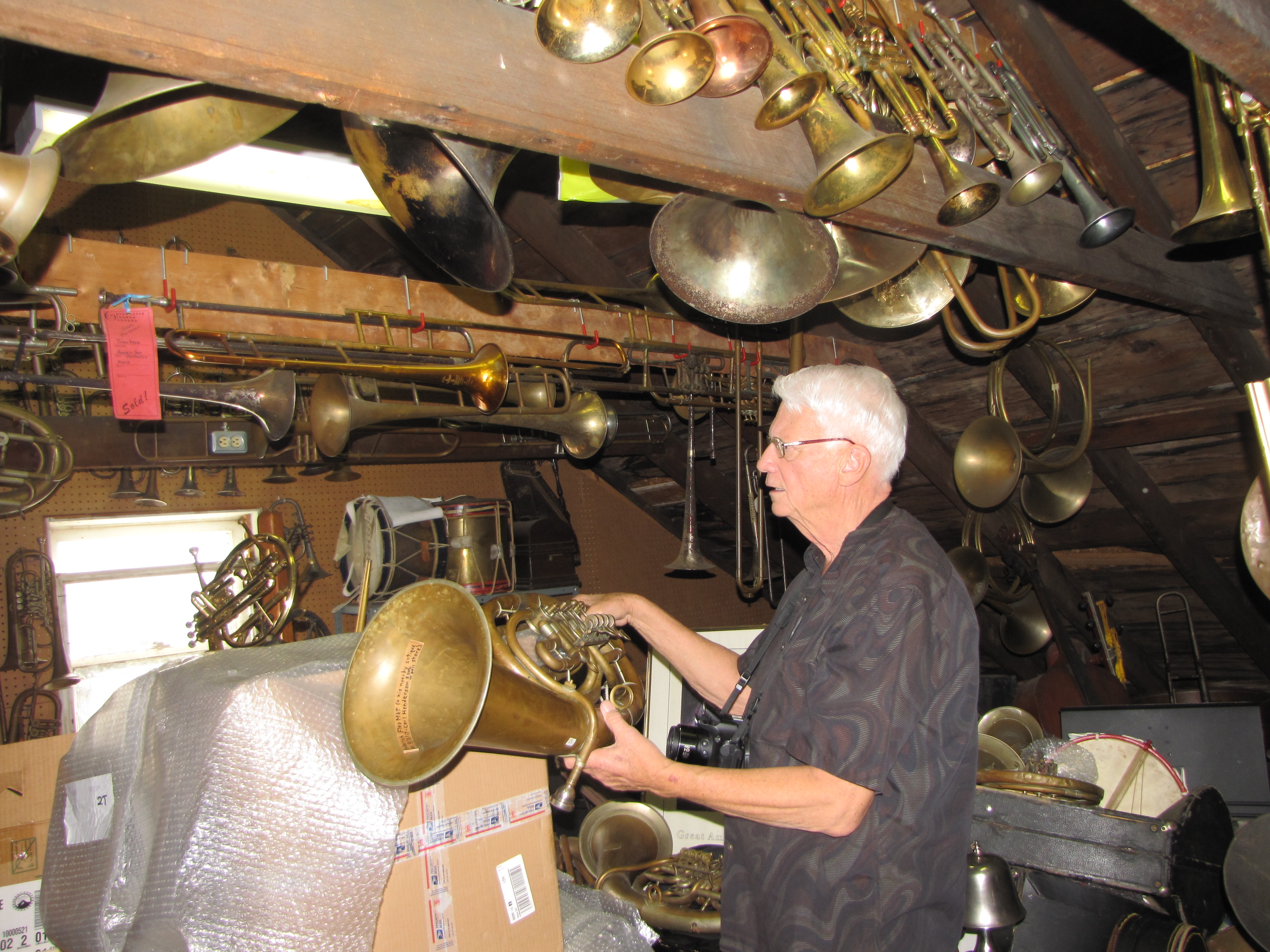
2209 BBB BandstandIn last month’s column, while talking about the characteristics of various performance venues, I mentioned the Foster Memorial. You might ask: where and what is the Foster Memorial, and why should it be of interest to music lovers?

This architectural gem, little known to most people in the GTA, is less than an hour’s drive from Toronto and if you are not familiar with “The Foster,” this summer could be the ideal time. In their Ontario’s Choice Awards in November 2016, Attractions Ontario named the Thomas Foster Memorial as the Top Small Performing Arts Attraction in Ontario. In the words of Troy Young, CEO of Attractions Ontario, “These awards are unique because they were chosen exclusively by the consumers that visit these sites.”

So what exactly is the Foster Memorial? Located four kilometres north of the town of Uxbridge, it is actually a mausoleum built by Thomas Foster as a memorial to his wife. Thomas Foster was born and raised in Scott Township just north of Uxbridge where his father ran the Leaskdale Hotel. He became a butcher in Cabbagetown in Toronto, was elected as an MP, and served as mayor of Toronto from 1925 to 1927. He also made a large fortune from real estate.

In his late seventies, while on a visit to India, Foster was inspired by the Taj Mahal. On his return, he built this family memorial in the rolling countryside of Uxbridge Township. While the architecture was originally inspired by Foster’s trip, its design is greatly influenced by the architecture of the early Byzantine churches. Entering through the heavy bronze doors, one is struck by the beauty of the marble and terrazzo interior, flooded by the soft light coming through the stained glass windows. The Foster Memorial is truly a unique structure. Completed in 1936, it contains three crypts: for Mr. Foster, his wife and his daughter.

In recent years this “Diamond of the Durham Region” has been the venue for a wide spectrum of events, from weddings to concerts. As for musical performances, it’s “Fridays at The Foster” at 7:30pm all summer from the beginning of May until the end of September. For soloists and small groups, the acoustics are excellent, but the layout and acoustics do not work for large groups. As for repertoire, it ranges from Irish music, traditional folk ballads, bluegrass and Broadway hits to Diana Davis performing using quartz crystal singing bowls and flute. One group which really impressed me when they performed at The Foster a few years ago was the Shimoda Family recorder ensemble. I certainly intend to be in the audience when they return on August 25 with their rarely heard authentic Baroque music.

Another Uxbridge gem: While on the subject of lesser-known performance venues, the town of Uxbridge has another gem. Since its grand opening in December 1901, the Uxbridge Music Hall, with its excellent acoustics, has been blessed with a wide range of concerts and stage productions. In 2011, for its 110th anniversary, there was a reenactment of the hall’s very first concert. On that occasion I had the privilege of performing in the recreated “Town Orchestra” for that reenactment. I even had the honour of supplying the anvil and hammer for our rendition of the Anvil Chorus from Verdi’s opera Il Trovatore. (As for coming events, the only one that I am aware of at the moment in this significantly under-utilized venue is that of the small ensemble Quartetto Gelato, who will be performing there on September 30.)


Recent Events

Wellington Winds: When one looks at the scores of most works for concert bands, one finds that they frequently call for instruments that rarely get any consideration for even minuscule solos. One such instrument is the E-flat alto clarinet. If the band has an alto clarinet, it is rarely heard on its own. More often, it spends its time hidden and doubling the parts of other instruments. More often than not this instrument is the butt of uncomplimentary jokes. Rarely, if ever, is it the first choice for young players or their teachers. Now, enter Stephen Fox. A distinguished Canadian clarinetist and instrument historian, as well as a world-class clarinet builder, Fox has recently attracted attention for his new model of alto clarinet which has been receiving accolades for its warm compelling tone. Apparently, up till now, there was no known work for solo alto clarinet and wind ensemble. Enter Michael Purves-Smith: “Such a wonderful instrument deserves a significant solo voice,” he says and rose to the challenge. His concerto for alto clarinet and wind ensemble needed a name. When he asked his wife, Shannon, for a suggestion, possibly influenced by the common prejudices against the instrument she immediately responded, “Why not call it the Seven Deadly Sins”? The Seven Deadly Sins received its first performance by Stephen Fox, as soloist, and the Wellington Wind Symphony under the direction of Daniel Warren, April 30 in Kitchener and the following week in Waterloo.

New Horizons: The last time we heard from the New Horizons Band of York Region was some months ago. On a visit to one of their rehearsals in Richmond Hill there were fewer than 15 members. As with all New Horizons bands, this group is for active adults who want to learn music in a friendly, supportive atmosphere with other active adults. Now, with almost 30 members near the end of their first year of learning together, they had their first concert ever on May 25. If you have considered taking up a musical instrument, director Doug Robertson would love to hear from you. He can be reached at nhbyrdirector@gmail.com.

Silverthorn Symphonic Winds concluded their 2016/17 season on May 27 at the Wilmar Heights Event Centre with “Spring Celebration,” honouring Canada’s 150th. The repertoire featured works by Canadian composers and arrangers, including Morley Calvert, John Herberman and Howard Cable.

Wychwood: Finally, as I write this, I am looking forward to attending the final concert of the season of the Wychwood Clarinet Choir on May 28, so by the time this issue is on the streets the concert will be past history. At time of writing, I am looking forward to two matters. I hope to meet Wynne, the clarinet player from Whitehorse who rehearses with the choir over the Internet. I am also looking forward to hearing The Bridal Rose Overture by Calixa Lavallée, as arranged by Richard Moore and Roy Greaves.

Coming Events

Luminato: Fresh from their recent stunning victory at the Brass Band competition in the US, the Weston Silver Band is now taking on a very different role. This time they are onstage as part of a major musical event in this year’s Luminato Festival in Toronto. A hit of the 2015 Edinburgh International Festival, En avant, marche! is a genre-defying tragicomedy from acclaimed Belgium choreographer Alain Platel. It’s the story of a trombone player, no longer able to play his instrument due to illness, who is demoted to playing the cymbals. Throughout band practice, the larger-than-life protagonist terrorizes fellow band members, confides in the audience, sings arias and dances an unlikely ballet duet, all with exuberance and a riotous slapstick edge. Four actors and seven musicians are joined onstage by Toronto’s Weston Silver Band, playing marching band classics along with 19th- and 20th-century pieces ranging from Verdi to Beethoven and Schubert to Mahler. If there ever was a true, and truly unforgettable, celebration of the power of making music together, this sounds like it. Performances are from June 21 to 24 at the Bluma Appel Theatre.

Looking Ahead

One band which has been on the local concert scene for years will not be there this coming year. After 25 years, the Uxbridge Community Concert Band (UCCB) will be absent. Music director Steffan Brunette is taking a year off from the band and from his school, teaching and studying composition. In September he will take on new duties as Head of Music at a new high school in Markham. Hopefully, the UCCB will be back next year.

Saturday, June 3, at 2pm, the Festival Wind Orchestra will present their 2017 summer concert at North Toronto Collegiate (17 Broadway Ave., Toronto). Founded in 1996, the Festival Wind Orchestra is an adult community wind orchestra, which rehearses weekly under the direction of Keith Reid at Riverdale Collegiate in Toronto. Their concert will feature music by Canadian composers, including: Overture: St. John’s, 1828 by Ben Bolden; Sodbuster by Elizabeth Raum; Genesi by Vince Gassi; and Canadian Folk Song Fantasy by William McCauley. Also featured will be Jason Dallas performing Joseph Horovitz’s Euphonium Concerto. Since I am a dedicated euphonium aficionado, and having never heard of this composer, I decided to check for information on him. As professor of composition at the Royal College of Music since 1961, he is someone that we should have heard of before.

Sunday, June 4, at 7pm, Strings Attached Orchestra, under the direction of Ricardo Giorgi, will present their final concert of the season at the Isabel Bader Theatre. In the words of director Ric, “We have new, old and middle-aged music for you,” from Ravel’s Bolero and the last movement of the Brandenburg Concerto No. 4, to the rarely performed Concerto for 2 Recorders in B-flat by Telemann and a musical hoax by Samuel Dushkin. They will also give the first ever performance of the winning composition of Ric’s second annual Young Composers Initiative, called Viaggio delle Farfalle by Damiano Perrella.

Tuesday, June 6, at 8pm, Resa’s Pieces Concert Band will present their 18th annual gala at the Toronto Centre for the Arts.

Tuesday, June 13, at 7:30pm, Silverthorn Symphonic Winds will present their final concert in their series of 59 Minute Soirees. These informal musical entertainments feature a variety of lighter music. Guests are invited to enjoy refreshments and conversation with the musicians after the concert. Wilmar Heights Event Centre – Concert Hall, 963 Pharmacy Ave., Toronto (just north of Eglinton).

Saturday, November 4, the Northdale Concert Band will present their 50th anniversary concert with the title “The Big 5-0h!” The program will include a newly commissioned work by Gary Kulesha. The concert will feature as trombone soloist Vanessa Fralick, associate principal trombone of the TSO.

Finally, in last month’s column I mentioned my belated introduction to the longtime Hart House Symphonic Band. The concert dates for their next academic year are: December 3, 2017 and April 8, 2018.

Jack MacQuarrie plays several brass instruments and has performed in many community ensembles. He can be contacted at bandstand@thewholenote.com.
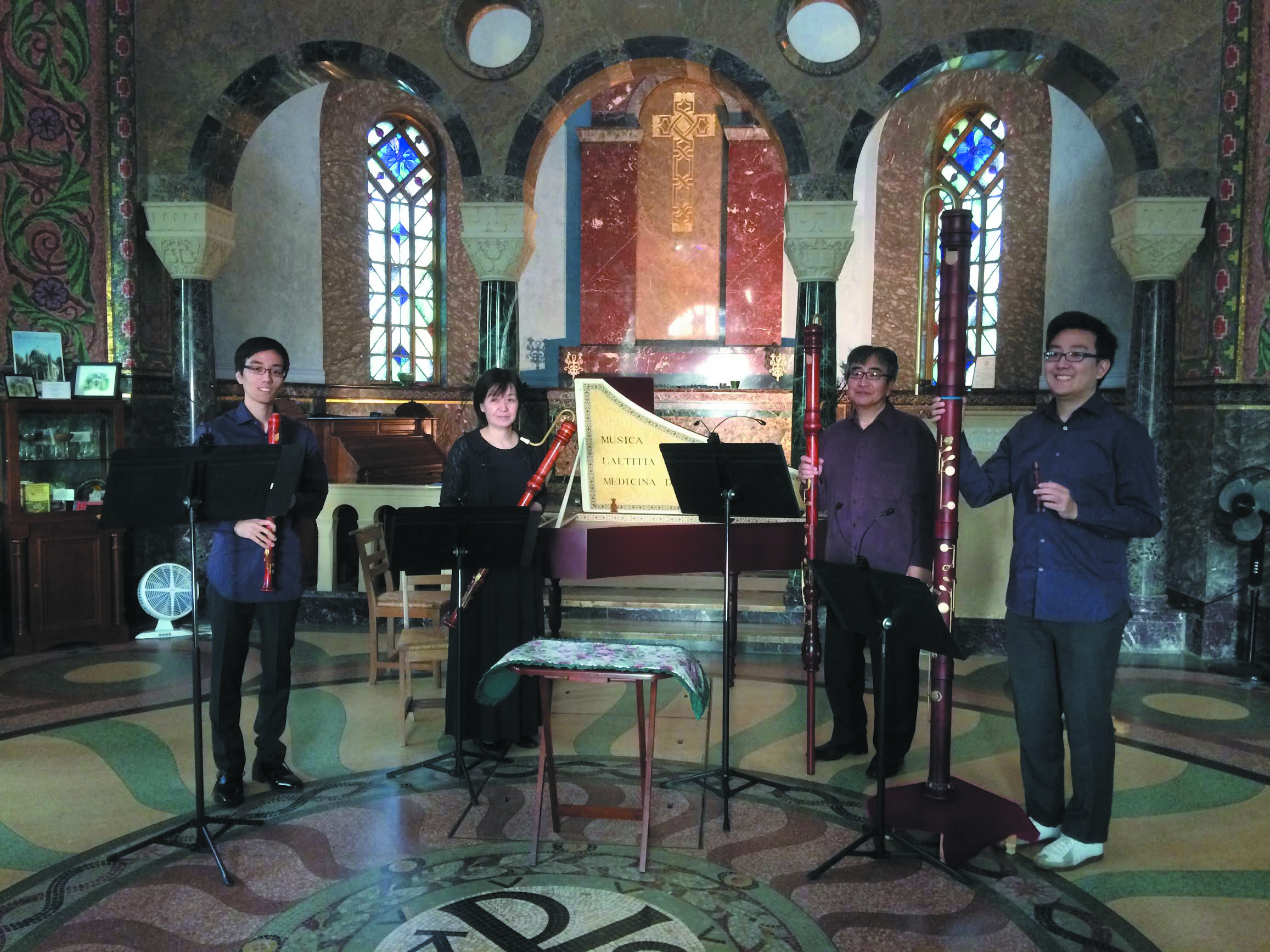
Back to top