We are fortunate in Southern Ontario to have access to a large number of live-music venues. In the listings below, you will find over 30 clubs and restaurants that regularly present jazz and creative music, including Grossman’s Tavern, which celebrated its 70th birthday in September; The Rex, which has been in operation for over 40 years; and Burdock, which, having opened in April of 2015, is a mere three-years old. Mixed in among many exciting one-off events in these listings are a number of recurring gigs, most commonly once a week or once a month. These residencies form a vital part of the Toronto gig ecosystem, playing an important role for musicians, venues, and audience members alike.

To begin, a working definition: to qualify as a recurring gig for the purposes of this article, a gig must happen at regular intervals and feature the same artist(s); a one-off, two-or three-night run at a club does not qualify. A residency is also functionally different than a series, in which a presenter (not necessarily the venue itself) books artists who may be representative of a certain genre or theme. A residency, as the name implies, is about the creation of a kind of home base for musicians, a (hopefully) comfortable space in which they build a show and grow over time. As guitarist and York University instructor Robb Cappelletto puts it, a residency provides an opportunity “to try out new music, new players, new gear, [and] new approaches in a real-world setting.” Cappelletto performs regularly at Poetry Jazz Café with his trio, as well as at 416 Snack Bar with the group re.verse (with bassist Damian Matthew and drummer Chino De Villa).

There are a number of different residencies that take place in Toronto on a regular basis. In addition to a full calendar of (typically) standalone shows that take place in the late slots throughout the week,

The Rex has a number of different residencies every month. If you visit on a Friday at 4pm, you’ll hear the Hogtown Syncopators; on Saturday at noon, the Sinners Choir; on Sunday at noon, the Excelsior Dixieland Jazz Band; on Mondays at 6:30, U of T Jazz Ensembles (at least throughout the school year); and, on the last Monday of every month, the John MacLeod Rex Hotel Orchestra, which features many of Toronto’s more established musicians. The Rex also features month-long weekly residencies in early evening slots; often dubbed “Rexidencies” on social media promotional material, these short-term weeklies are unique in the Toronto club scene. In November, watch out for the Brodie West Quintet on Tuesdays, JV’s Boogaloo Squad on Wednesdays, Kevin Quain on Thursdays, and the James Brown Trio on Fridays.
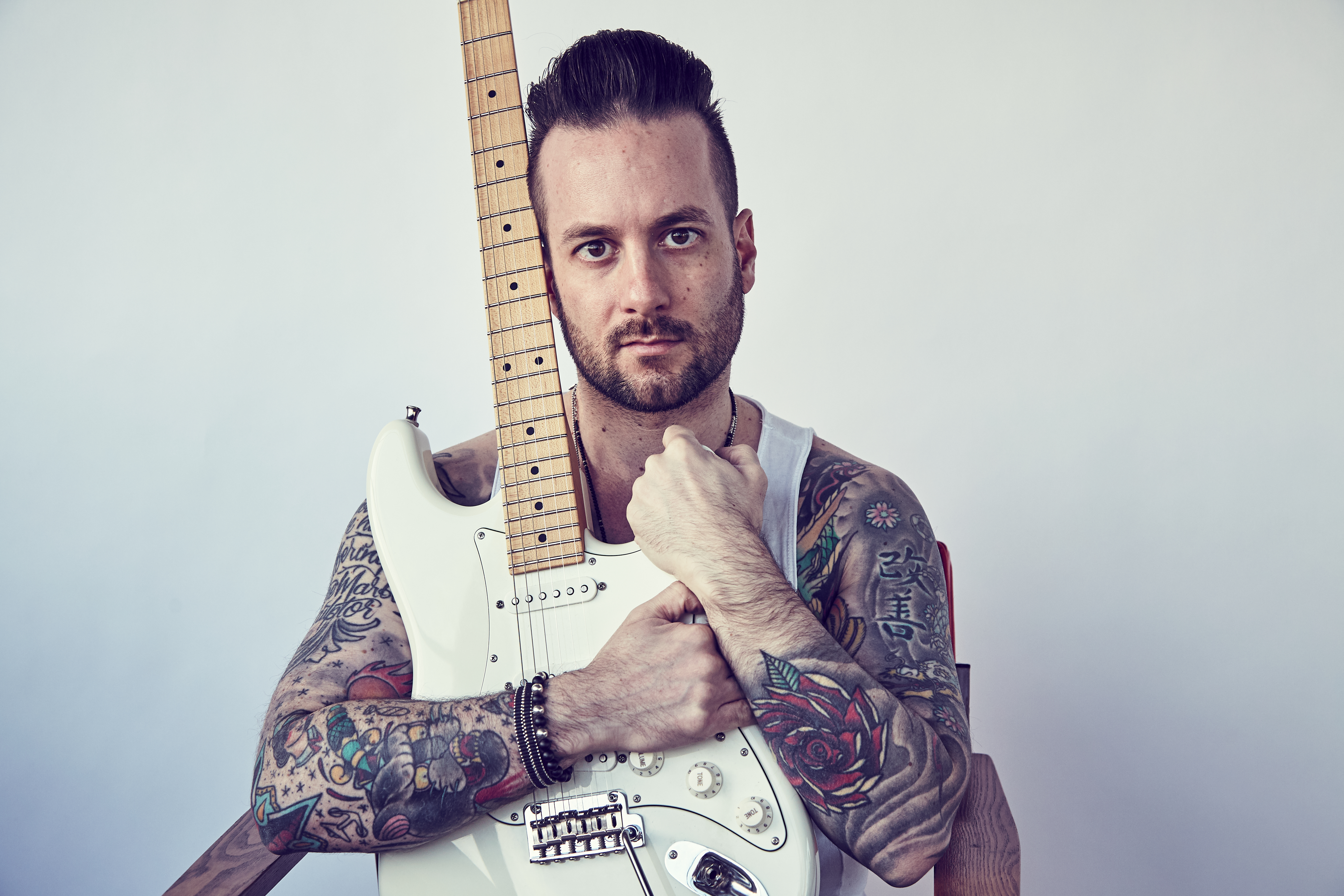
Dan McKinnon. Photo by Jen Squires.Beyond The Rex, many other local venues support residencies. At The Tranzac, the JUNO-nominated band Peripheral Vision (Don Scott, guitar, Michael Herring, bass, Trevor Hogg, saxophone, Nick Fraser, drums) hosts the first Tuesday of every month at 10pm. As Peripheral Vision typically books a band to play an opening set, this residency is also something of a series, as there is a curatorial component beyond the musical work that the band undertakes. Bassist Michael Herring plays regularly on Wednesdays with a guitar trio at the tequila bar Reposado, which also features its house band – the Reposadists – on Thursdays and Fridays. At Poetry Jazz Café, in Kensington Market, artists such as the guitarist Luan Phung, vocalist Joanna Majoko, vocalist/pianist Chelsey Bennett, guitarist Robb Cappelletto and singer/guitarist Dan McKinnon play monthly gigs. The structure provided by regular performances can give musicians the opportunity to focus on growth and development in a manner that isn’t always accessible in one-off gigs. Having a residency at Poetry, says McKinnon, “was pivotal to my development as a musician, bandleader and artist. Since that first gig over three years ago, my group won the 2017 Toronto Blues Society Talent Search, the Amy Louie Grossman’s Music Scholarship, and recently put out a well-received album this spring. None of this would have been possible if not for the residency I had at Poetry.”

The issues: There are many positive aspects to Toronto’s many fine residencies, but they are not without their issues. The first, and most obvious, is financial: for most of the aforementioned gigs, there is no financial guarantee. Musicians are typically compensated by passing the hat, through a percentage of bar sales, and occasionally through a percentage of a cover charge. This is not to say that it isn’t possible to make a fair fee playing in a residency – it can sometimes be the case, on a good night, that a group earns more than they may have if they were playing for an average preset guarantee – but it is certainly not always the case. There can also be other, unforeseen musical consequences of playing the same music with the same people in the same venue over an extended period of time. Nick Teehan, who held residencies at The Cameron House and The Rex for a number of years, makes the point that while playing consistently “really cemented the sound of [his] band,” providing “a regular audience who knew what to expect,” it also, unexpectedly, made the recording process harder. It “took a lot of effort to re-configure the songs” for the studio, Teehan says, as “some of the energy we felt was propelling our shows didn’t sound so great in a studio setting.”

Even with these issues, however, residencies are an important part of any healthy live-music scene, and, for most of the musicians who spoke to me about this column, participating in a residency is an overwhelmingly valuable, positive experience that fosters the growth both of individual musicianship and of the community at large. So, this month: check out a residency! As an audience member, it may become your regular gig, too. 

MAINLY CLUBS, MOSTLY JAZZ QUICK PICKS

NOV 1, 9:30PM: Saxophonist Jeff LaRochelle celebrates the release of his new album Lenses Extend at Burdock; with opening set from singer/guitarist Sabine Ndalamba.

NOV 6, 10PM: JUNO-nominated modern jazz quartet Peripheral Vision plays at The Tranzac in the November installment of their monthly residency.

NOV 7 AND 8, 9:30PM: Leading alto saxophonist Dave Binney returns to The Rex for two evenings with his new quartet.

NOV 30, 9PM: Guitarist Robb Cappelletto brings his electric trio to Poetry Jazz Café as part of his monthly residency.
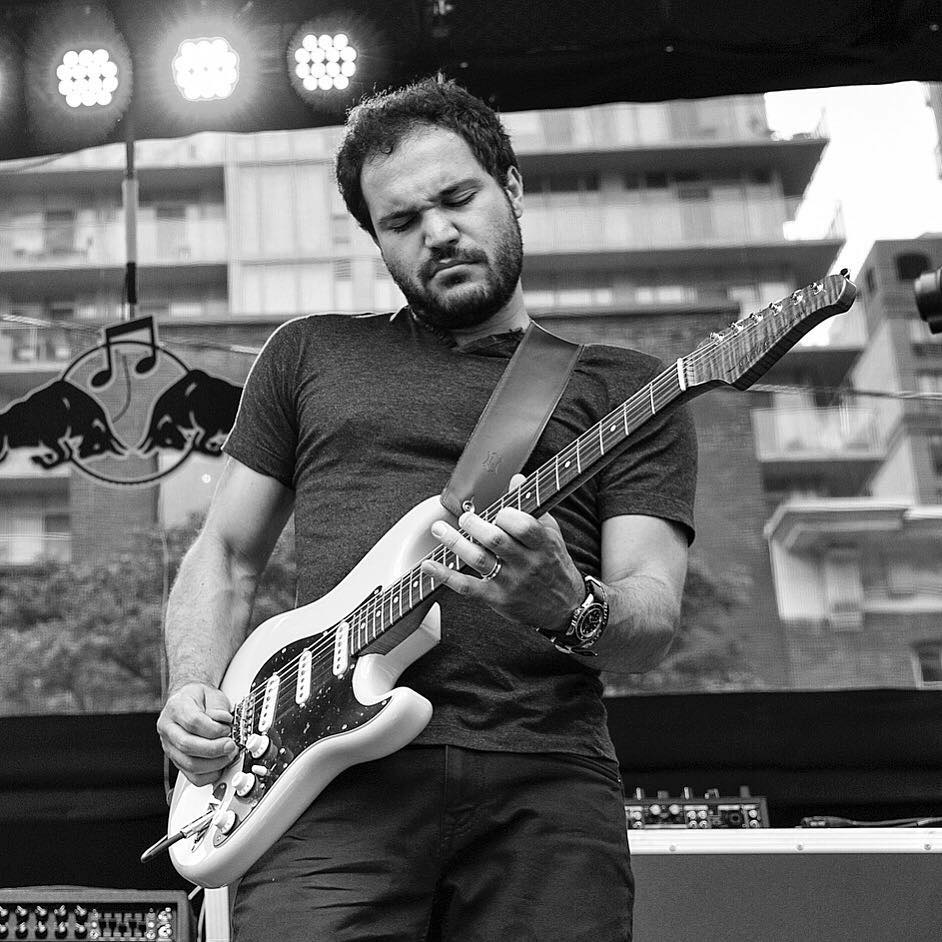
Robb CappellettoColin Story is a jazz guitarist, writer and teacher based in Toronto. He can be reached at www.colinstory.com, on Instagram and on Twitter.
For many, September marks a transitional period: we go back to school, back to work, back to a daily routine that can either feel welcome (structure! responsibility!) or unwelcome (structure! responsibility!), depending on the quality of our summer experiences. Whatever the case may be, the calamities of our collective re-entry into the real world usually resolve themselves by October, giving us all a bit more time to go out and enjoy live music, at venues both familiar and not. In addition to discussing exciting upcoming performances by the legendary jazz singer Sheila Jordan and the Afro-Cuban group OKAN, the focus of my column this month is on Burdock, a relatively new venue that may be a familiar name to some, but which, I suspect, may be unfamiliar to many readers. (In this month’s listings, you’ll find the full monthly schedule for Burdock.)

In a short amount of time – it opened in April of 2015 – Burdock has emerged as one of Toronto’s most important live-music venues. Located on Bloor, just west of Dufferin, Burdock is divided into two parts connected by heavy, soundproof double doors. On one side is the Music Hall, an intimate space that can accommodate about a hundred people, complete with its own bar, seating (depending on the show), and an excellent sound system. (Burdock consistently sounds great, owing, in no small part, to the talents of their live audio engineers, Aleda Deroche, Matthew Bailey and Jess Forrest.) On the other side is the brewpub, with a rotating tap list of beers, brewed in-house, and a full menu of seasonal food, including both small and larger plates, such as their summer tartine, crispy ribs and wild mushroom taco, all on the menu at the time of the writing of this column. As a brewery, Burdock has found a niche in the busy Toronto beer market by focusing on saisons, sours and wine/beer blends, such as their ever-popular BUMO series, brewed in conjunction with the Niagara-based winery Pearl Morissette. This decision has proven fruitful: by avoiding entering into the high-ABV arms race, Burdock’s brewery has found success at their bottle shop, their own bar, and on the beer list at many of Toronto’s best restaurants.

Through the double doors in the Music Hall, venue coordinator Charlotte Cornfield books acts from a variety of different genres. (Cornfield is an accomplished musician in her own right, touring and releasing music regularly under her own name.)

While many of the musicians who play at Burdock come from Toronto’s creative indie scene, Burdock also regularly features jazz and blues, as well as the occasional classical performance, including, in October, an installment of Haus Musik, presented by the Toronto-based Baroque orchestra Tafelmusik. (The concert will feature members of the orchestra and special guest percussionist Graham Hargrove performing music written by Italian composer Luigi Boccherini.) Beyond its regularly scheduled programming – which has recently jumped from one to two shows per day, due to increasing demand – Burdock also hosts a number of special events throughout the year. Their annual Piano Fest, which celebrated its third birthday this past January, is built around the simple premise of temporarily installing a high-quality grand piano on stage and booking piano-centric acts in complementary double bills; this year’s festival featured artists such as Joanna Majoko, Chelsea Bennett, Tim Baker and Jeremy Dutcher, the latter of whom would go on to win the Polaris Prize in September of this year for his debut album Wolastoqiyik Lintuwakonawa.

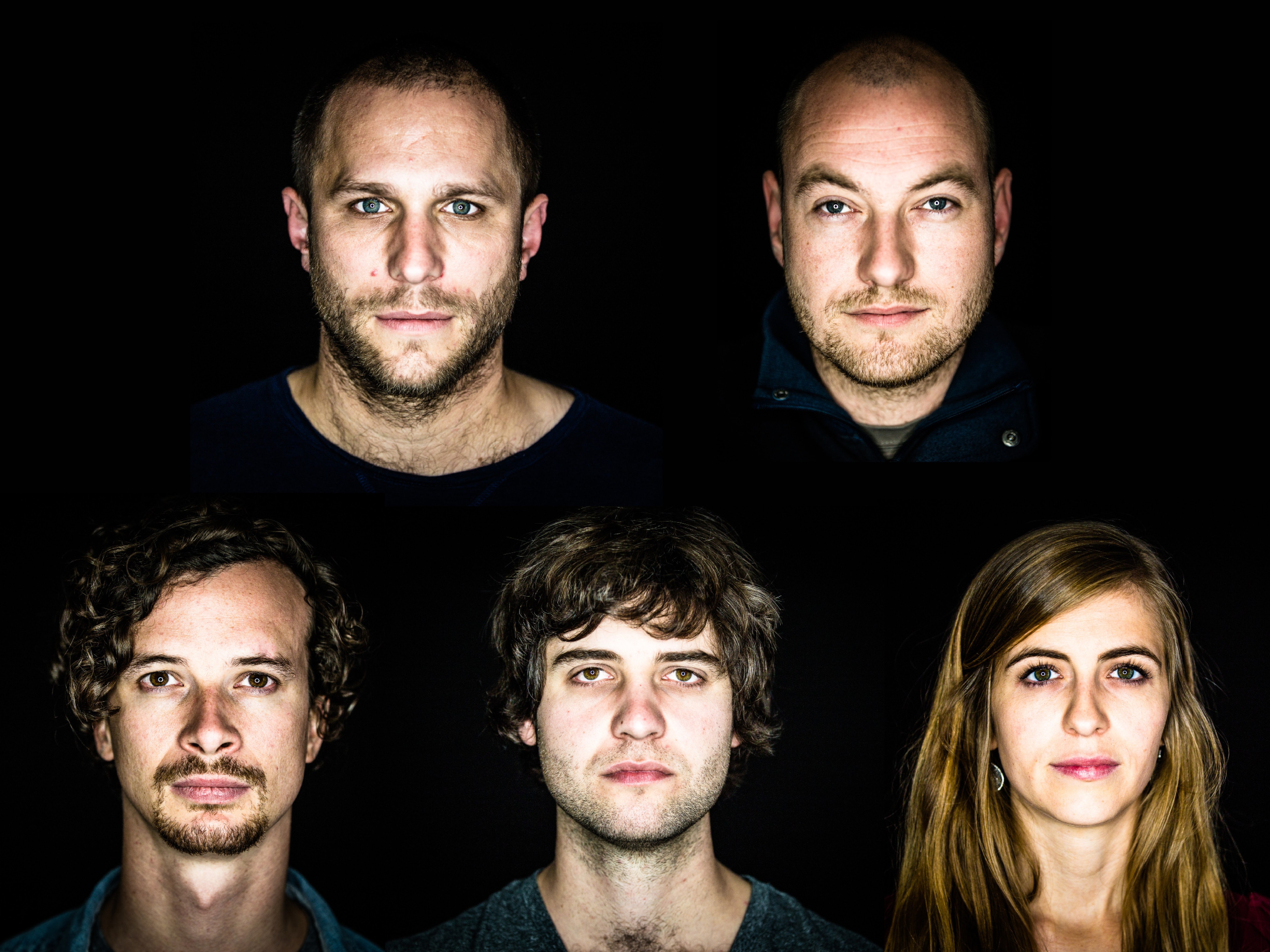
AKKU QuintetIn addition to Tafelmusik’s show, there are a number of notable performances that will be taking place in October. These include a modern jazz double bill, with AKKU Quintet and Living Fossil, on October 2 (Living Fossil’s debut album NEVER DIE! was reviewed in our March 2018 issue.); a live recording of radio personality Laurie Brown’s Pondercast podcast, with music provided by Joshua Van Tassel, on October 9; jazz bassist Robert Lee’s Big Band, celebrating the release of the EP Blink, on October 14; and francophone singer/songwriter Safia Nolin, fresh off the release of her third album, performing on October 25.

It also seems important to note, for those who have not yet visited, that the Burdock Music Hall is an uncommonly comfortable venue that shifts its seating structure around to accommodate the needs of specific acts and their audiences, even when those audiences comprise a variety of different demographic representatives. In a recent show I attended at Burdock, the open area in front of the stage was flanked by a few narrow rows of chairs. While enthusiastic attendees danced, those audience members who desired a bit more comfort – some of whom, let it be said, were quite possibly related to the musicians on stage – sat and enjoyed an unobstructed view of the performance. At no point did this mixed setup feel divisive or contrived; as is typically the case at Burdock, the vibe was relaxed, inclusive, and fun.

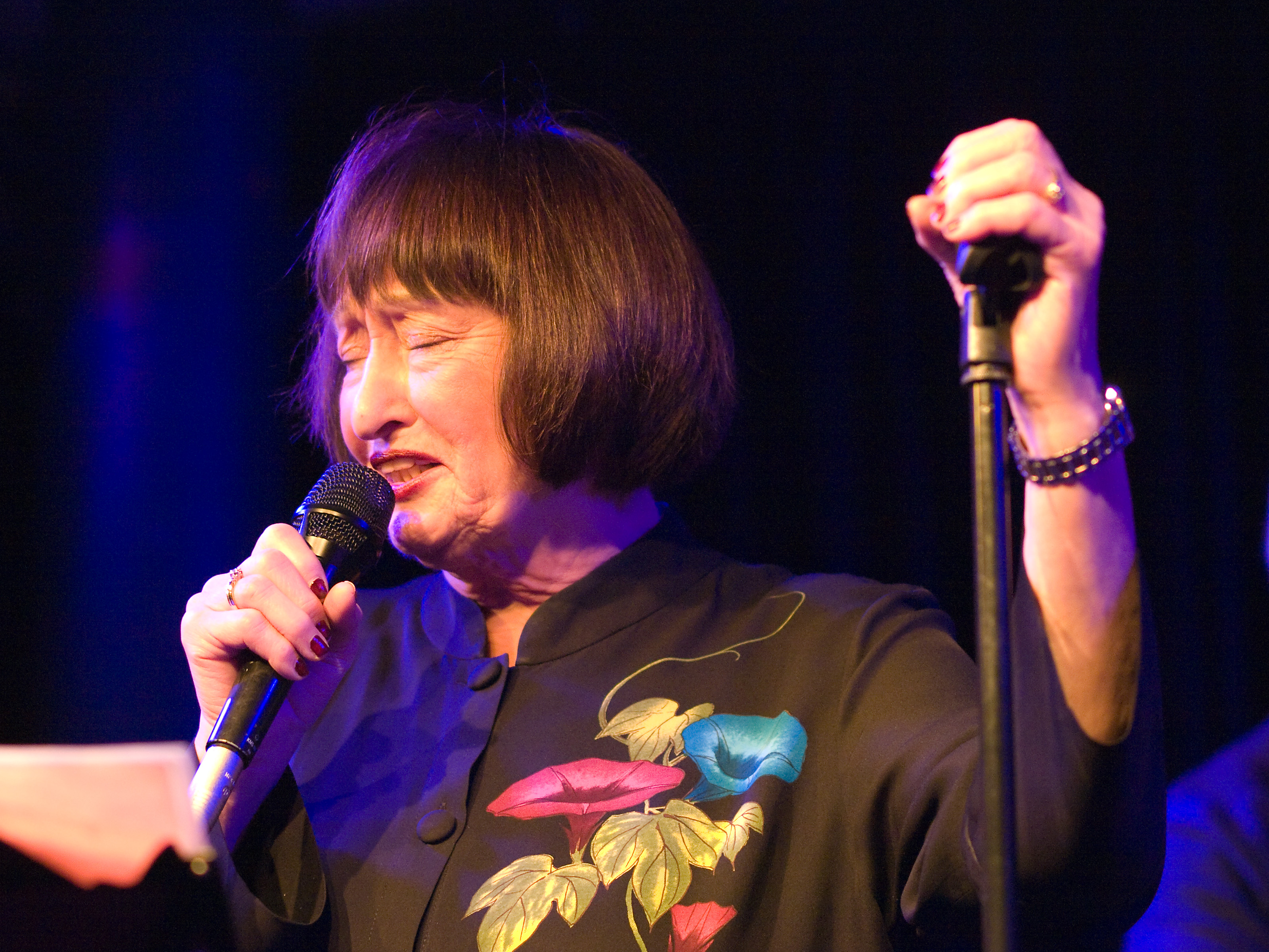
Sheila JordanSheila Jordan at the Jazz Bistro

There are a number of excellent shows happening in other venues this month, not the least of which will be Sheila Jordan’s three-night engagement at Jazz Bistro, on October 4, 5 and 6. Jordan, now 89, has a storied history within the jazz community, studying with Lennie Tristano and Charles Mingus in the early 1950s, performing and recording with Herbie Nichols, George Russell and Lee Konitz in the 60s and 70s, and teaching, as artist-in-residence, at City College of New York, from 1978 through to the mid-2000s. Jordan – who was referred to as “the singer with the million dollar ears” by Charlie Parker – will be joined by pianist Adrean Farrugia and bassist Neil Swainson in an intimate trio format, whose instrumentation should prove well-suited to Jazz Bistro’s ecclesiastical acoustics.

OKAN at Lula

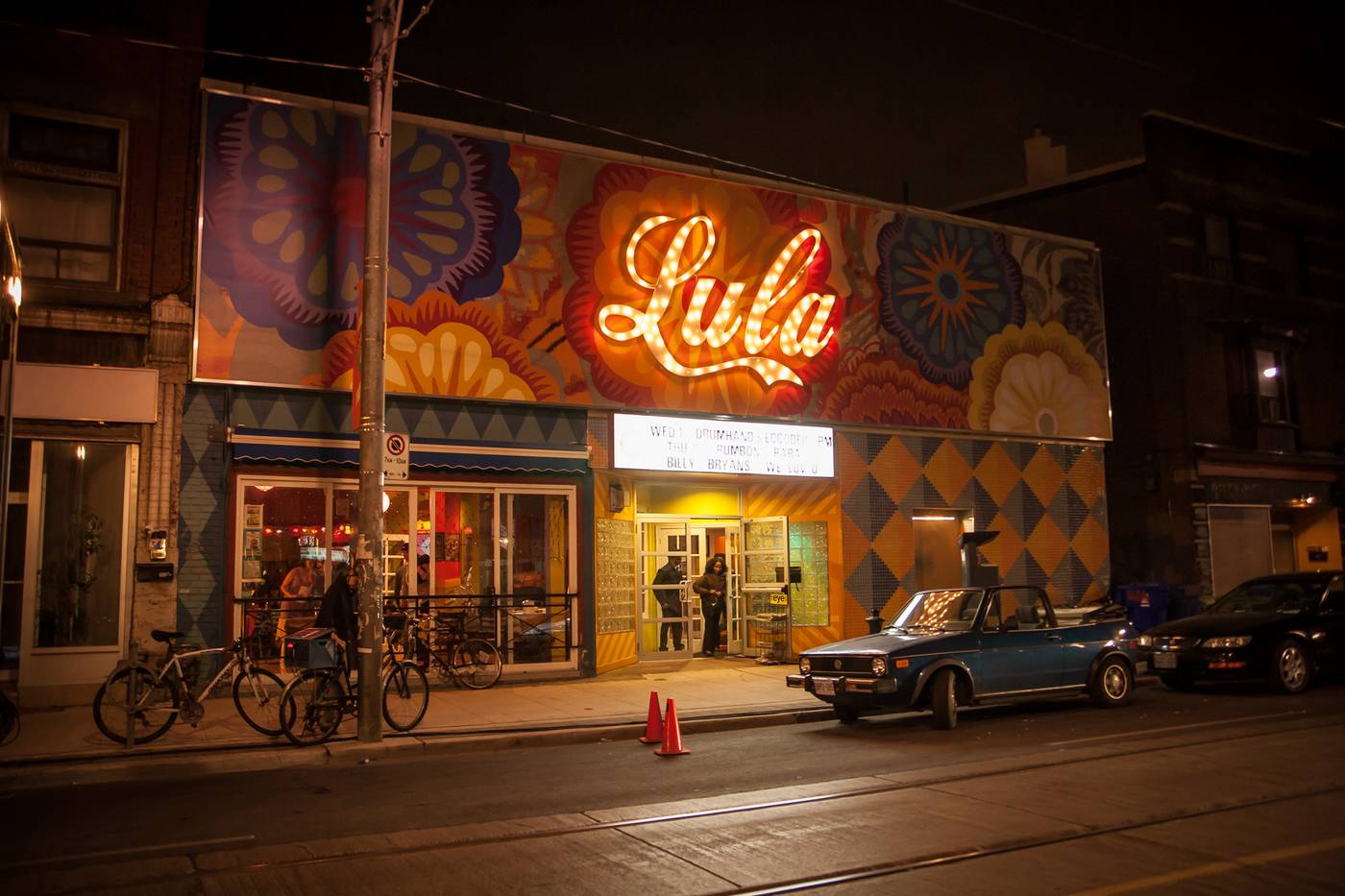
At Lula Lounge, OKAN celebrate the release of their debut EP recording on October 21. Co-led by Cuban-born, Toronto-based multi-instrumentalists Elizabeth Rodriguez and Magdelys Savigne – both of whom are veterans of saxophonist/flutist Jane Bunnett’s Maqueque group – OKAN fuses traditional Afro-Cuban music with jazz, pop and soul. In their live show, Rodriguez and Savigne find success both in the complementary chemistry they share as performers (Rodriguez typically stands and plays violin, while Savigne sits behind her congas; both sing.) and in their talent for deftly borrowing from various musical sources. At times OKAN’s music sounds distinctly Afro-Cuban; at other times, like pop-inflected R&B. Anchored by Rodriguez and Savigne, this month’s show should prove to be a worthwhile reason to visit Lula Lounge. 

MAINLY CLUBS, MOSTLY JAZZ QUICK PICKS

OCT 4 TO 5, 9PM: Sheila Jordan, Jazz Bistro. Accompanied by local mainstays Adrean Farrugia (piano) and Neil Swainson (bass), legendary jazz singer Sheila Jordan performs in this three-night run at Jazz Bistro.

OCT 14, 9:30PM: Robert Lee, Burdock. Upright bassist Robert Lee leads his big band in celebration of the release of his EP Blink, a collection of modern jazz pieces inspired by pop, folk and classical music.

OCT 25, 9:30PM: Safia Nolin, Burdock. Francophone singer/songwriter Safia Nolin – 2017 Félix Award winner for Female Artist of the Year – performs in support of her new album, releasing October 5.

OCT 21, 6:30PM: OKAN, Lula Lounge. Co-led by Cuban-born multi-instrumentalists Elizabeth Rodriguez and Magdelys Savigne, OKAN celebrates the release of their debut EP.

Colin Story is a jazz guitarist, writer and teacher based in Toronto. He can be reached at www.colinstory.com, on Instagram and on Twitter.
It’s September, and, for students and faculty members of the Toronto jazz community, it’s time to head back to school. While not all who play jazz in Toronto teach or study, the scene is still very much tied to the academic calendar, and, as the pervasive humidity of summer gives way to the first crisp whispers of autumn, everyone is suddenly back in town, venues return to their regular post-festival-season programming, and a variety of new musical ventures are suddenly at hand. September heralds the coming of a new artistic year, and, in the spirit of yearly reassessment and rejuvenation, September prompts the jazz community to undertake new projects.

Despite the persistent sentiment that performance opportunities for jazz musicians are shrinking by the minute, it is reassuring that the past few years in Toronto have seen new jazz programming efforts in festivals, clubs and other venues. These larger efforts reflect the ideals found, at the best of times, in post-secondary music programs: namely, that new opportunities and resources should be developed not for the gains of the individual, but for the betterment of the community.

TUJF: One of the best examples of this community spirit comes in the form of the Toronto Undergraduate Jazz Festival, now in its fourth year (having had its inaugural run in 2015), running from September 4 to 8. Helmed by David M.J. Lee, Dave Holla and Eunsang Edwin Yu – all of whom attended post-secondary jazz programs in Toronto – the festival’s mandate is to “bring attention to the younger generation of musicians” in Toronto, with an emphasis on musicians currently enrolled in (or recently graduated from) post-secondary music programs at the University of Toronto, York University and Humber College. This mission is commendable, as it can take a considerable amount of time for young jazz acts to establish themselves and book the larger shows necessary to the process of audience development; by programming a number of these acts together, the TUJF has created both a valuable opportunity for musicians and a compelling package for audiences who, in other circumstances, might not connect with these performers for several years.

With main festival grounds at Mel Lastman Square and additional performances at Jazz Bistro, Memorial Hall, and The Frog: A Firkin Pub, all of the TUJF performances and masterclasses are open to the public and free to attend. In addition to performances from young musicians, Toronto jazz mainstays Mike Downes and Larnell Lewis are also playing with their respective bands. (Both Downes and Lewis, it should be noted, are also prominent jazz educators, and are on faculty at Humber College.) In addition to these performances, highlights from the festival include The Anthology Project, playing at 8:30pm on September 6, guitarist Luan Phung, playing with his quintet at 6pm on September 7, and Montreal pianist Marilou Buron, whose sextet will be playing at 6pm on September 8. Other notable attractions, according to the 2018 festival map: food trucks, a VIP section, and multiple bouncy castles. Check out listings in this issue of The WholeNote and tujazz.com for full schedule and additional information.

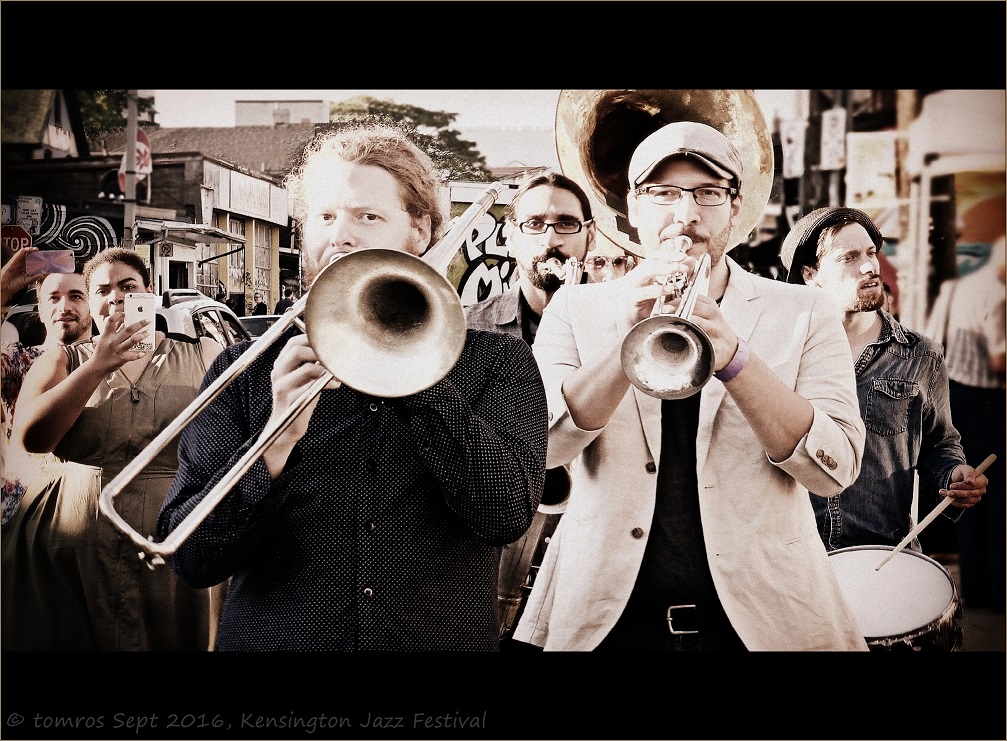
The Heavyweights Brass Band return to this year's Kensington Market Jazz Festival. Photo by Tom Rose.The Heavyweights Brass Band return to this year's Kensington Market Jazz Festival. Photo by Tom Rose.

Kensington Market Jazz: September will also feature the third annual edition of the Kensington Market Jazz Festival, another relatively new enterprise started by local musicians looking to fill a gap in pre-existing jazz programming. Led by Molly Johnson, Ori Dagan, Genevieve Marentette, and Céline Peterson, the KMJF will take place from September 14 to 16, with a large number of different artists in various formats, from solo pianists (including Nancy Walker, Robi Botos and Ewen Farncombe) and guitarists (such as Margaret Stowe, Harley Card and David Occhipinti) to full big bands (including the John MacLeod Orchestra, the Brian Dickinson Jazz Orchestra and the Toronto Jazz Orchestra), with all manner of acts in between.

One of the most interesting aspects of the KMJF is its engagement with Kensington Market businesses in the creation of new performance spaces: while many shows will be taking place at venues that present music throughout the year, including Poetry Jazz Café, Supermarket and LOLA, a large number of shows will be held at businesses that are not regular music venues. Some, like the coffee shop Pamenar and the Hotbox Lounge and Shop, are venues that do host live events, although they do not usually present jazz. Other businesses, like the discount suit shop Tom’s Place, are functioning as special venues specifically for the festival.

Beyond the shows previously mentioned, highlights include Joanna Majoko, playing at 1pm on September 15, Tania Gill and Friends, playing at 5pm (also on September 15), and Anh Phung, who will be playing at 6pm on September 16. Please check out listings in this issue and kensingtonjazz.com for full schedule – and please note that ticketed events are cash only (although the festival features both free and ticketed shows).

Apart from new programming at emergent jazz festivals, September sees the return of post-secondary ensembles to the Toronto club scene, with representation from U of T, York and Humber: U of T jazz ensembles resume their weekly slot on Mondays at 6pm at The Rex, the Humber College Faculty Jazz Jam will be taking place at 9:30pm on September 18 (also at The Rex), and the York Jazz Ensemble will be performing in the matinee slot on September 22 at Alleycatz. Beyond school-associated acts, there are several other exciting shows taking place throughout the month, including Sam Kirmayer, at Jazz Bistro, on the 16th; The Rex’s Annual Birthday Tribute to John Coltrane, with the Pat LaBarbera and Kirk MacDonald Quintet, on September 20, 21 and 22; Christine Duncan, Laura Swankey and Patrick O’Reilly at the Tranzac, on September 23; and the Nick Fraser Quartet at The Emmet Ray, on September 24.

September marks the beginning of a rich artistic cycle within the improvised music community that will play out through summer 2019. For the concert-going public – from the most casual fan to club regulars – September is a wonderful opportunity to become reacquainted with your favourite performers, check out a few new venues, and set the tone for the rest of the 2018/19 scholastic year, regardless of your own educational status. Enjoy.

MAINLY CLUBS, MOSTLY JAZZ QUICK PICKS

Pat LaBarbera (left) and Kirk MacDonaldSEP 7, 6PM: Toronto Undergraduate Jazz Festival: Luan Phung Quintet. Drawing from the work of Boulez and Schoenberg as well as the jazz tradition, guitarist Luan Phung brings his exciting quintet to Mel Lastman Square for a free show at the TUJF.

SEP 16, 6PM: Kensington Market Jazz Festival: Anh Phung. Equally at home playing orchestral music and the music of Jethro Tull, flutist and singer Anh Phung performs at LOLA as part of the KMJF.

SEP 20 to 22, 9:30PM: The Rex’s Annual Birthday Tribute to John Coltrane: Pat LaBarbera & Kirk MacDonald Quintet. An annual event at The Rex featuring master saxophonists Pat LaBarbera and Kirk MacDonald leading a world-class quintet, celebrating Coltrane’s life and music.

SEP 23, 10PM: Christine Duncan, Patrick O’Reilly, and Laura Swankey at The Tranzac. Leading improvising vocalist Christine Duncan is joined by guitarist Patrick O’Reilly and vocalist Laura Swankey for an evening of new music at The Tranzac.

Colin Story is a jazz guitarist, writer and teacher based in Toronto. He can be reached at www.colinstory.com, on Instagram and on Twitter.
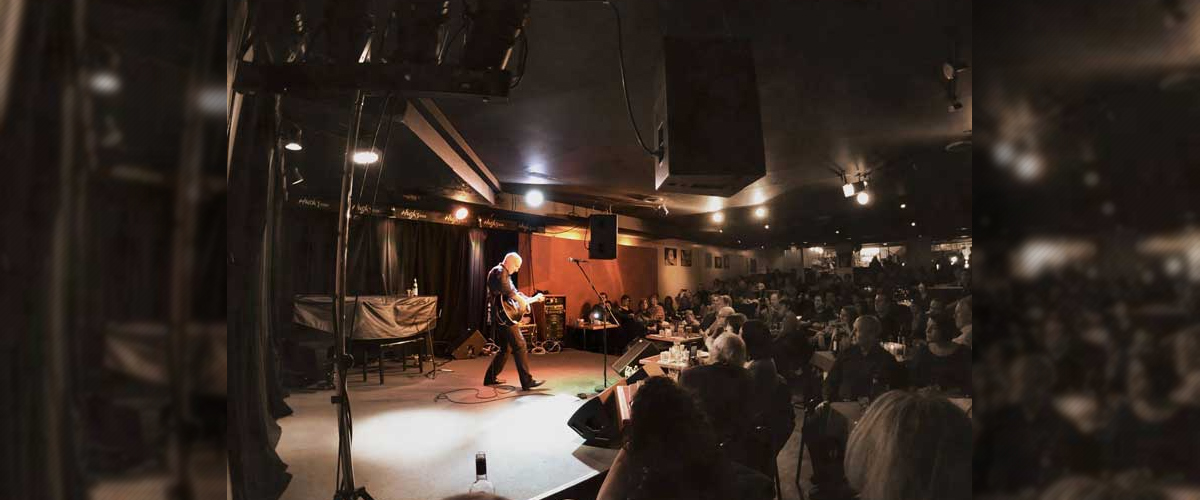
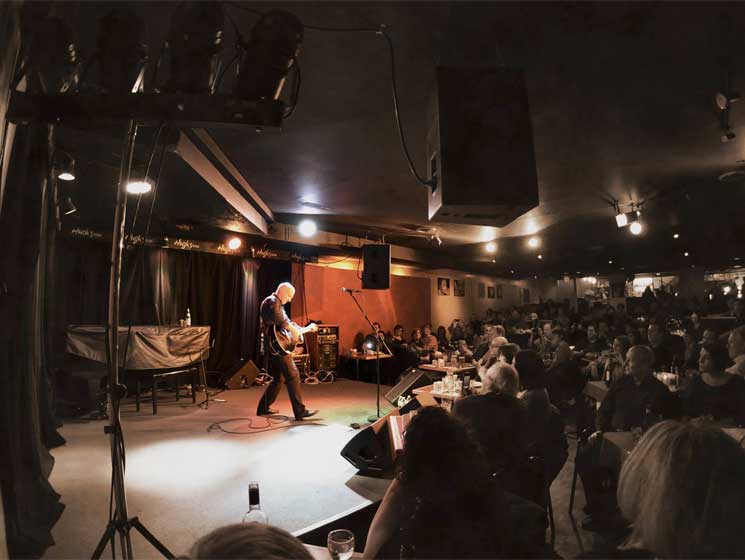
HughsRoom bannerHugh's RoomIt’s a time of year when a distinct trend emerges insofar as traditional concert venues are concerned. A bunch of the year-round busy ones tend to go dormant. And places one might never have thought of as concert venues become the sky-lit backdrop for all kinds of music that more usually remain indoors.

A parallel syndrome manifests itself on the club scene – the mainstay, bastion venues (the “real listening rooms,” as we like to call them), concede defeat to the beach, the cottage and the patio. “You can’t fight patio syndrome. We’ll be back in the fall when you’re ready to get serious again.”

On the other side of the coin, dozens if not hundreds of other clubs, bars and restaurants, all over the map, get drawn into the ever-growing summer scene and buy into the music venue idea, for a brief and glorious explosion of musical activity. After which the potted plant gets put back on the piano, where it belongs, and the extra table or two gets put back in place where the temporary stage inconveniently was.

Festivals have a lot to do with this explosion of activity, of course: within Toronto, TD Jazz, Kensington Jazz Festival and the granddaddy of them all, the Beaches Jazz Festival, turn whole districts into summer postcard illusions of Basin Street. Music festivals all over (Westben, Montreal Baroque, TD Niagara Jazz and Music at Port Milford jump to mind) forge intricate partnerships with networks of eateries and imbiberies (to coin a phrase) that more usually primarily cater to other-than-musical appetites. It’s a win-win. Festivals get to add new audiences, and sometimes a broader range of music, to their usual fare. Eateries get to add music to the menu.

All of this is of course a huge generalization. Certain mainstay venues, like some of the regulars in these listings, are largely immune to seasonal vicissitude. But it’s useful background information to the interesting announcement that Toronto venue Hugh’s Room Live has decided this year to ramp up its programming rather than go quiet through the dog days of the summer. The Hugh’s Room battle to keep its doors open got a lot of press some 18 months back; relaunched cooperatively under the name Hugh’s Room Live, it has now successfully negotiated a full comeback year (including a complete makeover of its previously ponderous and predictable dinner menu in favour of an agile, sharing-friendly, tapas-style approach).

Derek Andrews (who among many other things in his curatorial career programmed memorable public stage lineups at David Pecaut Square for Luminato) is the programming lead for Hugh’s Room Live. For this particular venture, billed Summer Nights Festival, he has to date lined up close to 50 shows between June 15, when it kicks off with a Stevie Wonder Tribute show, and August 23 (We Banjo 3 from Ireland) when it officially ends.

In between, Andrews’ (and Hugh’s Room’s) creative eclecticism will be on full display: check out the recurring “Solo Piano Double” series (which brings together unlikely pairings like Robi Botos and Suba Sankaran, for example) to see what I mean. Look at a Hugh’s/Andrews’ lineup and no matter what your musical tastes are, you will likely not know half the names on the list. Chances are once you’ve heard them, you won’t forget them either.

Talking about when Summer Nights officially ends is a bit like talking about when summer itself “officially” ends, because the whole point of the venture is to emphasis that places like Hugh’s are neither fair-weather friends nor just a shelter from the storm. They are part of the necessary musical fabric. Live. Local. Musically intentional.

As for the fair-weather venue phenomenon mentioned at the outset of this story – there’s maybe a bright side there too. How would it be if each year even a few more of the venues that come on board for music during summer festival times decided to stay the course for the rest of the year? And, as important, what would the neighbours think?

Food for thought.

Hugh’s Room Live’s Summer Nights Festival runs from June 15 to August 25, 2018.

David Perlman can be reached at publisher@thewholenote.com.

In the February issue of HalfTones, our between-print-issues e-letter, we ran a story by Sara Constant on this year’s recipients of the TD Toronto Jazz Discoveries Series Awards, now in its eighth year.

As described in that story, the series started in 2011 as a part of the TD Toronto Jazz Festival’s outreach to local performers creating original work, and to year-round, multi-venue jazz programming in the city. “Each year, an assembled Toronto Jazz Fest jury selects four projects to receive support and funding from the festival. Over the last eight years,” the story continues, “the series has accumulated an alumni list that serves as a veritable who’s who of local jazz innovators –[helping] transform the festival from an annual affair into a year-round showcase of local music-making.”

It’s not hard to see how this year’s four recipients fit the bill: Harley Card’s Sunset Ensemble at Lula Lounge, March 1; the Heavyweights Brass Band at Lula Lounge, March 29; Adrean Farrugia and Joel Frahm at Gallery 345, April 27; and a show curated by Aline Homzy titled The Smith Sessions Presents: Bitches Brew at Canadian Music Centre, April 28.

Just as interesting as the alumni, from the perspective of this column, is taking a look at the venues that have been the most active participants in this initiative over the years, both the ones you’d expect to find mentioned regularly here, and also the ones you might not usually associate with jazz.

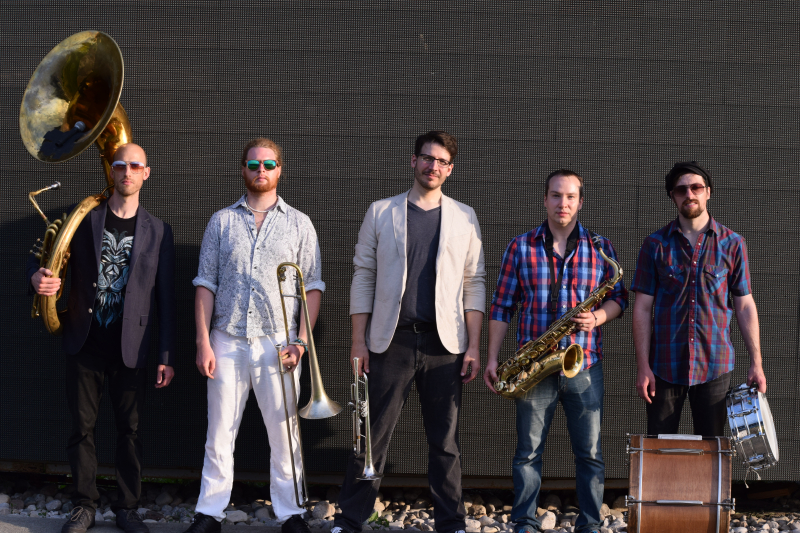
The Heavyweights Brass BandLula leads: of the usual venues you’d expect to be involved, Lula Lounge leads the pack, starting with the series’ first-ever concert, a Fern Lindzon CD release in April 2011. Since then the Dundas St. W. venue has hosted series concerts by Jaron Freeman-Fox in February 2013, a Heavyweights Brass Band CD release concert in March 2014, Alexander Brown in March 25, Sundar Viswanathan’s AVATAAR in March 2016 and Chelsea McBride’s Socialist Night School CD release in January of last year. And this year the beat continues with Harley Card, March 1 and The Heavyweights in a return visit on March 29.

The Rex and Jazz Bistro: as you might expect, the city’s two premier mainstream venues are both in the running for silver and bronze, with three appearances each over the eight years. The Rex has been venue of choice for a Barry Elmes Quintet CD Release in March 2011, a Nick Fraser double-CD release in May 2016, and The Further Adventures of Jazz Money (Dillan Ponders, Apt and Ghettosocks) in March 2017. And the Bistro has hosted a Beverly Taft Meets the Nathan Hiltz Orchestra CD release concert in April 2014, a first big gig for the Alex Goodman Chamber Quintet in April 2015 and Robi Botos’ Movin’ Forward CD Release in March 2015.

Gallery 345: When you get past those three obvious choices, though, you’re entering some interesting territory – venues with audiences more often in other genres but offering fertile ground for jazz. Gallery 345 on Sorauren heads the list: Mike Downes in March 2012, Shannon Graham and The Storytellers in April 2013, and the Nancy Walker Quintet in 2014. Adrean Farrugia and Joel Frahm (April 27 this year) will actually push Ed Epstein’s little-gallery-that-could ahead of its more storied mainstream colleagues into the silver medal spot.

The Best Rest

Space doesn’t permit the same level of detail for the rest of the venues used to date for the series, but the point is that there are venues out there for putting on shows for audiences that are there to listen. The Music Gallery, previously at St. George the Martyr Church on John St., and its new housemates at 918 Bathurst Cultural Centre have been used four times so far. Small World Music Centre, Alliance Française, the late-lamented Trane Studio, the Lower Ossington Theatre, Knox Presbyterian and Beit Zatoun have also all been used. This year the Canadian Music Centre on St. Joseph joins the list.

If the series continues to encourage adventurous venue hunting as much as it does adventurous music-making, it will continue to serve a worthwhile purpose.

publisher@thewholenote.com

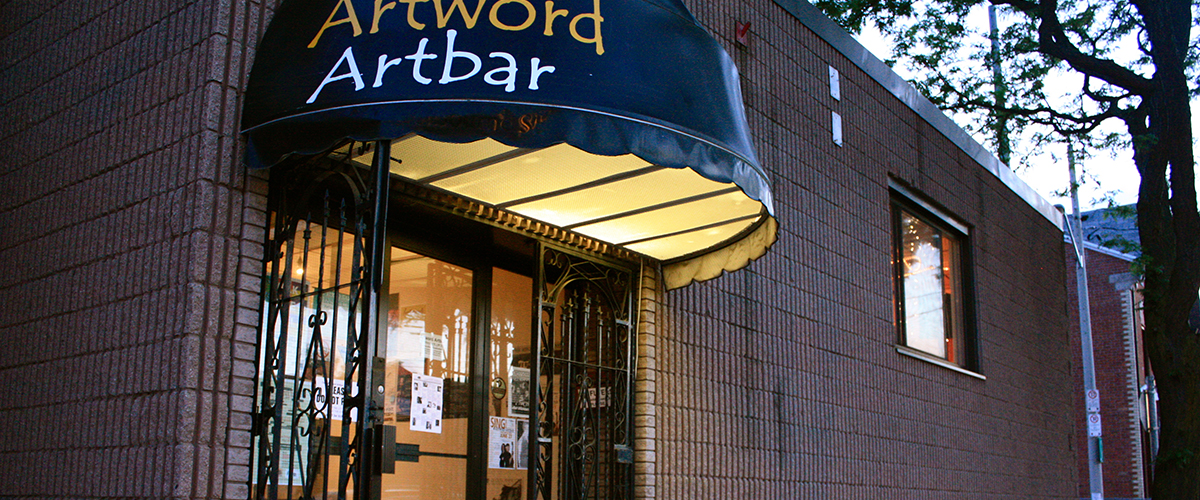
Artword ArtbarArtword, as a name for what Judith Sandiford and Ron Weihs have always wanted to do, had its roots, as Artword Theatre, in Toronto’s King/Portland area – where, as my memory serves, it got overtaken by what gets called progress. So when we were contacted by Chris Ferguson, curator of Hamilton’s Steel City Jazz Festival, celebrating its fifth year from October 24 through 29 at Artword Artbar in the rapidly gentrifying James St. N. area of Hamilton, it felt like a good time to reach out to Weihs, for a little bit of looking back and looking ahead.

WN: Are there things in your present location that remind you of what you recognized “back then” starting up at King/Portland?

Ron Weihs: When Artword Theatre started, the King/Portland area was in a very depressed state. We began in what was essentially an abandoned, empty building. The building, and an adjacent building, were bought for a very low price. The new owners encouraged us to stay as tenants and helped us with practical and financial support in developing our theatre. We were also helped greatly by the city’s “Two Kings” policy, which encouraged development in King-Parliament and King-Bathurst by removing many of the zoning restrictions. We were surprised that it was easier than we expected to get approvals to do an extensive renovation.

The revitalization of the area went faster than we expected, and we certainly contributed to this! We knew all along we would not be there forever, that the building would be sold when the market went high enough. We were amazed how quickly the area was transformed, though. Our building was sold to a condo developer. We had four months to leave, but it really came down to eight days, because of commitments we had made. We cleared out as much as we could manage and packed it all in a 48-foot trailer.

Although we were sad, we were not resentful. We understood that “Two Kings” was designed to bring real estate investment into the area. The overheated real estate market was inevitable, as was the fact that this prime location would become unaffordable for us. It was that wonderful early revitalization phase when new ideas are springing up, artists are moving in, and people are discovering how much fun urban life can be. It would be lovely if it could stay that way, but it hardly ever does.

What’s different this time?

For us personally? When we came to Hamilton, we were determined that this time we would buy a building. Prices were low, and the downtown was in desperate need of revitalization. The city was specifically encouraging development along James Street, formerly the hub of the downtown, but fallen on hard times. Although we looked very hard, we couldn’t find a potential theatre, but we did find a lovely sports bar for sale just off James Street, a turn-key operation with everything we needed – glasses, cutlery, fully-equipped kitchen. We decided that Hamilton didn’t actually need a theatre, it needed an Artbar! And Artword needed a home, a laboratory, a haven for artists and musicians, and a laboratory to develop and showcase our own theatre work.

Do you end up involuntarily contributing to the gentrification problem the same way all again?

The gentrification of James Street is accelerating just as it did in Toronto. The big question is whether condos will be allowed to take over, or the essential character of the street be maintained. The political and economic battles are being waged. The downtown councillors are good, but amalgamation means that politicians who have no stake in the downtown can determine its fate. Very much like Toronto. We expect to continue to enjoy the same wonderful revitalization phase as in Toronto, for a little while.

When we moved to Hamilton, we knew nothing of its cultural life. We thought that we would be bringing culture to the frontier. We were humbled and delighted to discover how wrong we were. We discovered a firmly established and vibrant cultural scene that has flourished for many years, basically outside that formal support and funding structures. Theatre, visual arts and music all have deep roots and wide participation. In particular, the music scene in Hamilton is remarkable. Hamilton and the Niagara region are home to original musicians in every genre. Mohawk College has a first-rate jazz program, and we were impressed with the calibre of the students. We were happy to provide a place for them to play, and watched them mature into notable musicians.

Does the city of Hamilton understand how easily, in terms of arts and culture, progress could kill the goose that lays the golden eggs? I mean in terms of maintaining affordability for arts workers and their audiences?

The city is making a significant effort to understand the needs of artists, and to provide an encouraging environment in which they can flourish. They are proceeding cautiously, and in consultation with artists. I think this is wise.

And  Artword Artbar’s role?
Essentially, Artword Artbar is “by artists for artists.” We look on Artword Artbar as an oasis where performers, artists and people who appreciate these things can meet together in a respectful environment. We are known as a “listening room.” People come to hear the music. There is no television, no clatter, no chatter; just people watching and listening intently to performers communicating to them. It seems odd to us that this is unusual, but it seems that it is.

Advice for others?
Probably not. In creating this kind of place, you have to believe in what you’re doing, and stick with it. Don’t listen to all the advice you get about programming this, or that. You have to be able to hang in without obsessing about the bottom line every week; it will take longer than you think. It helps to be a “Mom and Pop” operation, so that you can get through the lean times. And keep things simple. You don’t have to do everything, just a few things really well.

It was Chris and Linda Ferguson who got in touch with us about Steel City Jazz Festival’s relationship with you.

The Steel City Jazz Festival reflects our philosophy. It was started by Chris Ferguson just because he thought Hamilton needed a jazz festival. He did it on a shoestring, largely by himself with a few friends. When we found out what he was creating, and that he didn’t have either deep pockets or a support system, we offered Artword Artbar as a venue at no cost. We just sell beer, and the Festival keeps the box office. (This is our policy for musicians as well.) Judith [Sandiford] also offers advice and organizational help. We like the festival because it provides a mix of local and outside musicians, and a variety of flavours of jazz.

Postscript: Steel City Jazz Festival director Chris Ferguson offers this: “Listening to music at Artbar is such a pleasure. The bar has a really classic ‘jazz-club’ atmosphere, from the packed seating and round cocktail tables to the in-house grand piano. You feel so close to the musicians because you literally are, but this produces some of the most intense musical experiences.”

The Steel City Jazz Festival runs from October 24 through October 29, 2017. Most performances will be at Artword Artbar at 15 Colbourne St., in the James St. N. area. Tickets will be available at the venues or online in advance via Bruha and Ticketfly.

Lula Lounge at 1587 Dundas W. in Toronto describes itself as a “music club, venue, bar, restaurant, community centre, ground zero to the exploding world music scene in Toronto ... home to Latin, salsa, jazz, reggae, indie, and more.” So when a place like that shuts up shop in the middle of summer, people notice.

We certainly did. So we decided to ask José Ortega, Lula co-founder and artistic director, what was up.

WholeNote: Can you say something about the reno — is it mainly cosmetic or also functional?

Ortega: It’s a facelift, for sure: it vastly improves the washrooms and installs a wheelchair accessible washroom on the main floor. The reno will also give us more room in the lobby area, which Lula patrons know can become really crowded on a busy night. But it’s more than just a facelift. Making Lula more accessible will let us serve clients and communities better and more safely.

And in terms of your overall Lula mandate and your relationship with the surrounding community?

We do a lot of educational programming for youth and host many public meetings. The barrier free, universal washroom will make it easier for clients of all ages with mobility challenges to enjoy the music and activities presented here. Lula programming is done by the not-for-profit organization Lula Music and Arts Centre, which allowed us to get help from the City of Toronto Culture Build fund as well as from Enabling Accessibility, a national program. It’s encouraging because we see both the municipal and federal government stepping up to invest in cultural projects that serve diverse communities. 

Lula LoungeSo what can we look forward to when you re-open September 9?

This is the second stage (the first was removing the drop ceiling in 2015 to reveal the true height of the main room) of what we hope will be a multiphase project. Within the next couple of years, we’re hoping to open up a enlarged mezzanine area so that we can increase our capacity and can accommodate more music lovers in an even better, more beautiful venue!

I recognize what you say about encouraging support from the city’s Culture Build fund and the federal Enabling Accessibility program. But what kind of risk is undertaking something like this at a moment in time when local street level venues in the city seem to be under siege on many fronts?

That’s an interesting question. We want to make sure that as leaders at city hall put forth the idea of a music city, that they understand that our city of music includes salsa, reggae, samba, jazz, classical Indian, soca and many other genres. Toronto can be a leader in all of these areas, not just in pop and indie forms. The folks down at the city’s music office have been very open to hearing about this but we need to keep delivering this message.

I sometimes get the feeling that various topdown initiatives intent on “making us into a music city” take priority over initiatives to nurture the music city we already are.

We’ve been very involved with the efforts to look at the challenges facing Toronto music venues and have been working with the Toronto Music Office, TMAC and other venues to see explore how bylaws and enforcement of those bylaws can create almost impossible situations for responsible live music venue operators. We’ve also been working with Music Canada Live on their Regional Advisory Committee on Toronto Venue Health. We do see a need to recognize what grassroots venues contribute to the culture and economy of our city. It’s easy to take this stuff for granted but it takes a huge amount of energy, money and dedication to keep a music venue going. 

So you’re hopeful?

We’ve been at this for 15 years and have learned by trial and error how to survive in this market with its challenges and benefits. We’re feeling like the model we’re working with is supporting our mandate and should allow us to present live music for many years to come.

I noticed, from another story we’re following, Lula’s name among the organizations signing up for the new Polyphonic Ground collective. What’s your take on that?

We’re part of the Polyphonic Ground collective, which is currently a pilot project led by Small World Music to see what potential exists for small presenters who are serving diverse audiences and artists, to work together to lobby for resources, share best practices and develop audiences together. We’ll see where it goes but it’s bringing to light some interesting issues about access within the music industry.

On October 13, we’ll be hosting the first of a Polyphonic Ground panel series, which Lula has helped to put together, alongside the City of Toronto, Music Canada Live, Music Canada and Music Ontario. The series builds on a panel talk that we organized back in May and will look and diversity and inequities in the music industry. Ideally the series of conversations will lead to some clear recommendations about how to ensure that the festivals, conferences, funding, etc., better reflect the makeup of Toronto. As I say, we’ll see where it goes.

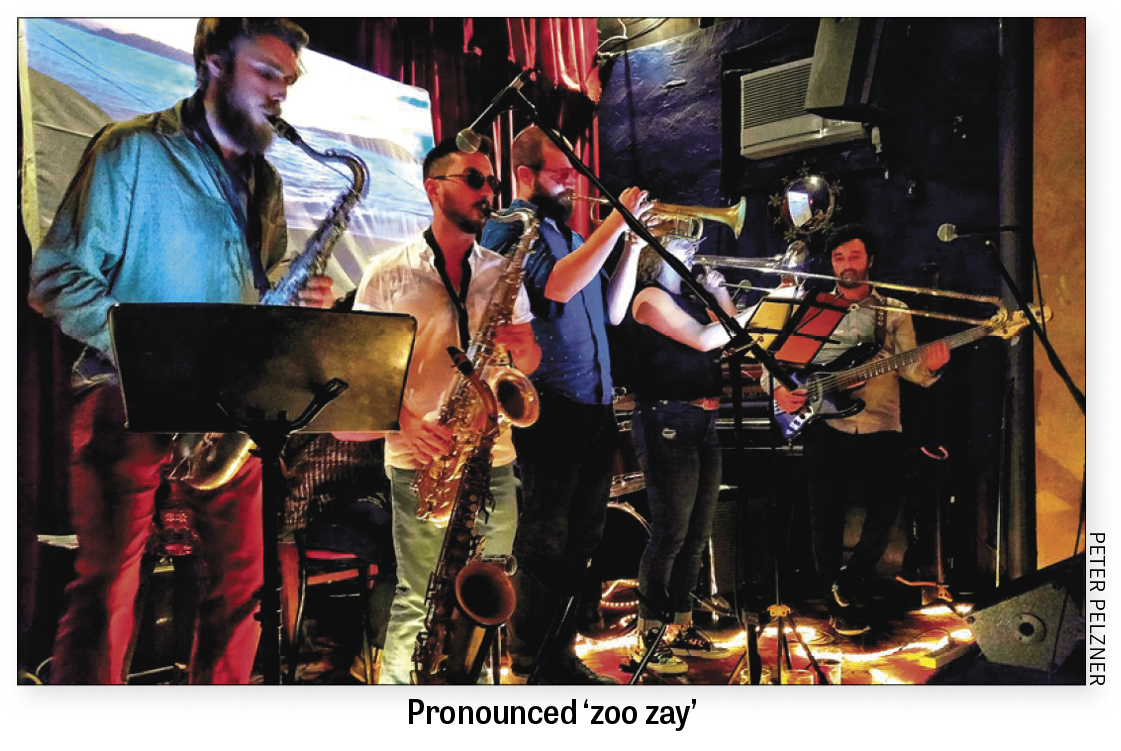
2209 BBB Mainly MostlyZuze – pronounced “zoo zay” – is a project which communicates musically, instrumentally, what it means to straddle the lines of two or more different cultures. Its essence is emblematic of the experience of many first-generation citizens, especially immigrants. One such citizen is Zuze’s bassist, Arif Mirbaghi, whose interest in these blurred lines became a foundational stepping stone to the band’s inception.

Mirbaghi explains: “I wanted a project that spoke to the way culture shifts around identity across generations. Canada is built on nascent identities, and Zuze aims to prove just how beautiful that diversity can be.”

The collective draws its repertoire mostly from popular tunes familiar to folks from Iran, especially the northern region. This is my ancestry, too: my paternal ancestors were Jewish Kurds living in the north of present-day Iran, so when I showed Zuze to my dad, he recognized some of the tunes (none of which were familiar to me) from his youth, and demanded to know why I was all of a sudden interested in Persian music.

The folk and popular music of Iran is, on its own, a fascinating study in the way cultures bleed into each other. Zuze, though, muddies the waters further, by filtering these melodies through multiple sets of multicultural ears: those of Mirbaghi who knows them intimately, those of band members including co-arranger and alto sax player Bruce McKinnon, to whom they’re a little more novel, and finally, ours – the listeners’.

I’d been interested in Zuze for a while, but it wasn’t until this week that I went to see them live, in the back room of the Tranzac Club. Before they went on, the audience was given a short dance lesson. I observed from the sidelines, because I cannot and do not dance, but if any music was the stuff to dance to, this was it.

Mirbaghi banters with the audience between songs, and it seems very improvised, but less off-the-cuff, and more stream-of-consciousness. It’s kind of poetic sometimes, in an off-kilter way. But then they launch into these grooves, these very groovy grooves, these destined-for-restless-feet grooves, which serve as a red carpet for the incoming melody, played assertively or sweetly or coyly by up to five melodic instruments: trombone, trumpet, two saxes and violin, often in a tight unison.

Very little emphasis is placed on solos (not that they don’t happen) because, to my mind, this music is geared more towards showcasing beautiful songs in tight arrangements than using known songs as vehicles for improvisation.

Going to a Zuze show can be a rowdy experience or a contemplative one, I think. You can dance, or you can sit on the sidelines and think about things – for example, about how far removed you may or may not be from the cultures that effectively created you, and how important (or how unimportant) it may be for you to reconnect. Or you could do both.

I have to say, lately, I have started to find that a lot of live music that I like and I think is good doesn’t sound fresh anymore, and Zuze is one of a few groups that’s scratching me where I itch. Maybe they’ll scratch you, too.

Zuze will be heard at Mel Lastman Square on the afternoon of July 1. Keep an eye out for more future gigs at Zuze.ca.

Bob Ben is The WholeNote’s jazz listings editor. He can be reached at jazz@thewholenote.com.


received 832710110228698I first met and heard the painter and singer Laura Marks four or five years back at Lisa Particelli’s singer-friendly jam about which I’ve written before. The first time I heard Marks, my impression was that she had a nice voice but was timid. Since then, one or both of us, her voice or my ears, has matured, probably the latter. Listening more recently, I hear a cool confidence, a clear sense of purpose and an unmistakable character. That character is quaint and charming, introspective and sincere – as is demonstrated clearly on her debut album, 57 Minutes. The album is a Marks-illustrated work (Marks is primarily a visual artist), and it features the instrumental prowess of Chris Gale, Reg Schwager, Mark Kieswetter, Ross MacIntyre and Ben Riley, on sax, guitar, piano, bass and drums, respectively.

Although Marks has only been playing jazz gigs about town for the last eight or nine years, her first public performance as a jazz singer happened in the early 70s at Toronto’s Poor Alex Theatre; her experiences with jazz in private reach even further back. “My dad was a jazz fan so we were exposed very early,” Marks explains. “He met Dizzy Gillespie on an airplane twice. The second time Dizzy said to him, ‘How are you, Mr. Marks?’ He remembered him.”

One of the last tracks on the album is Body and Soul, a standard which all jazz musicians know, but which also happened to be an early influence on Marks: “I used to listen to the jazz programs on radio and when I heard Billie Holiday sing Body and Soul that was it. I started to sing jazz. I remember the moment and where I was in my parents’ house. I think I was 15.”

Marks doesn’t have dazzling, virtuosic chops, but she is and has always been an artist: prone to exploring, and creating, and expressing, relentlessly and endlessly; no exceptions are made behind the microphone. I recommend you go to see her at Jazz Bistro on May 21. There’s something special about her performance, her laid-back sensibility, that aforementioned character. I just love hearing her sing and I suspect you will too.

Bob Ben is The WholeNote’s jazz listings editor. He can be reached at jazz@thewholenote.com.

Lately, I have been walking around and humming the melody of You Must Believe in Spring, partially because it’s a nice melody, and partially as a reminder – sometimes it’s easy to forget that warmer days are in fact on their way. As we wait for our little corner of the world to thaw, it may help our collective state of mind if we listened to some music that carries in it echoes of warmer places. Like, for example, South Asia, or West Africa, or the Mediterranean. Such echoes can be found in the lineup of the eclectic So Long Seven, which showcases Neil Hendry on the mandolin and guitar, Tim Posgate on the banjo, Ravi Naimpally on the tabla and the remarkably young (barely out of his teens) William Lamoureux on the violin. With this unusual blend of instruments, and a collective and unmistakable jazz sensibility, So Long Seven’s highly organized, mostly non-hierarchical approach to composition and improvisation constitutes what I would call cross-cultural chamber music.

A year ago – almost to the day, as I write this – the band released their eponymous debut album, a colourful and contemplative work of art, and a formidable effort that will be tough to follow.

Aside from the quality of the music, what captures me about this album is the fact that, from top to bottom, each tune seems to share a goal; this is not just a collection of tracks that will demonstrate the versatility and skill of a band, but a cohesive work that is united by one purpose. What that purpose is, I suppose, up to each individual listener. When the music has no words, it can be tough to pinpoint or articulate these things, even though you may have a strong sense of them. My first instinct would be to call it music to meditate to, but that may be too restrictive since not everyone meditates (and I don’t). I’ll call it music to think to.

My favourite track by far is the one which opens the album, Torch River Rail Company. The introspective and rhythmically driven melody, which rolls like a train over the five-beat pattern that underlies it, maintains its momentum through these almost arbitrary - though definitely not arbitrary - pauses; as Lamoureux takes his bow off the strings, or as the rhythm section freezes, you can almost hear it continue, and you are not the least bit startled when it comes back in. The melody and accompaniment - separately - continue to weave in and out like that, and it’s fascinating to hear.

You’ll have two opportunities to hear So Long Seven in Southern Ontario this month. If you’re in or around Hamilton, you can catch them at Artword Artbar on April 7; if you live closer to Toronto and you aren’t able to get out to Hamilton, you can catch up with them the very next day, April 8, at the Small World Music Centre, a short walking distance from the corner of Dundas and Ossington.

I’ll level with you on this one: while I’m confident that I’ve seen all the footage of them that exists on the Internet, I’ve never seen So Long Seven live. I have a friend who used to invite me to their shows constantly back when they were known as Oolong 7, but it wasn’t until recently that I started to dive into their recorded music. So if I make it out to Hamilton, I’ll be discovering them right alongside you.

I hope to see you there.

Bob Ben is The WholeNote’s jazz listings editor. He can be reached at jazz@thewholenote.com.

I really hate the term “world music,” as it’s used today. It seems to me that it oversimplifies things. It lumps music that isn’t familiar to North American ears all in together and calls it foreign and exotic (as though North American is not part of the world). It implies that some musics are worthy of being divided up by genre and closely examined, and some musics aren’t.

With that said, I think jazz, at its best, can rightly be called world music. Jazz has been called a uniquely American art form, but I like to think of it as a music that only gestated in America, but was conceived elsewhere. Loath as I am to oversimplify things, European harmony and African rhythm and melody came together to make this music possible.

As more and more distinct cultures with distinct musical traditions adopted and blended – and continue to adopt and blend – with jazz, it became closer to what I would call an international, or worldly, music than a uniquely American one.

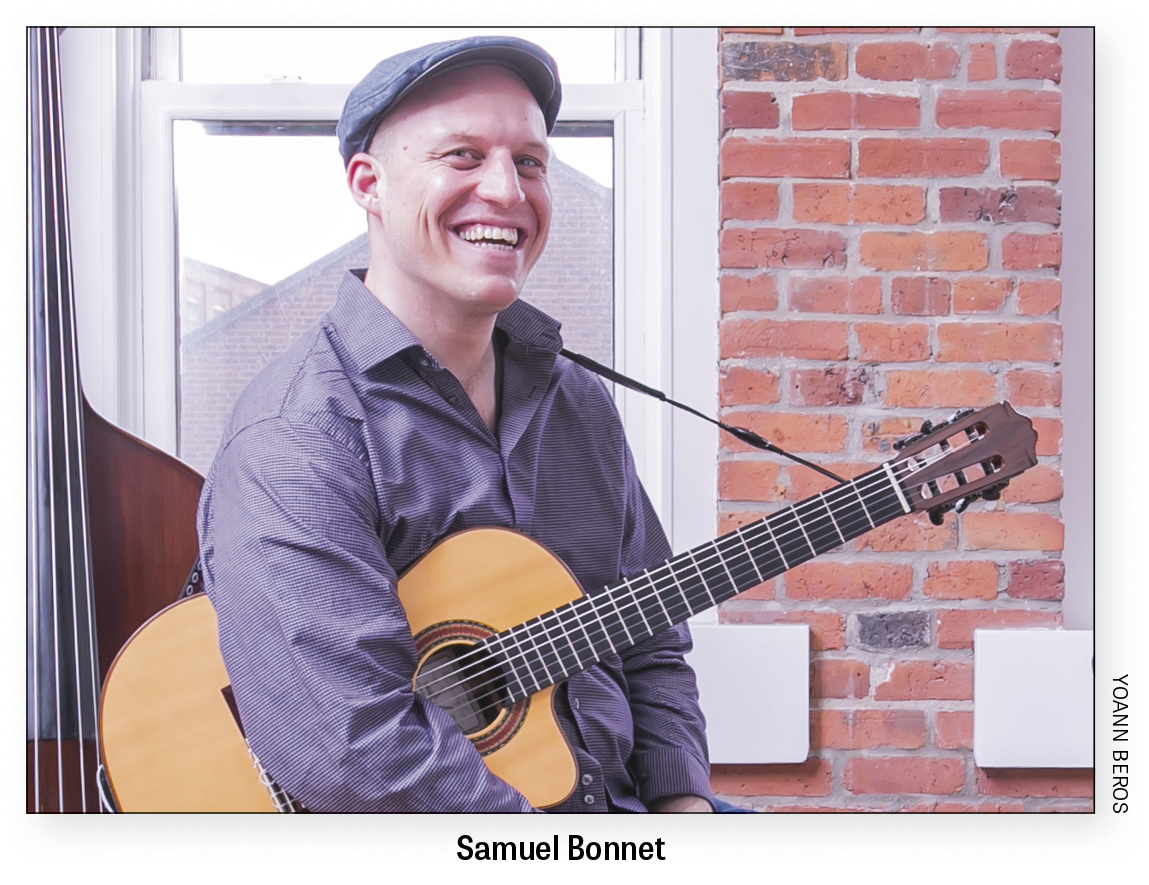
2206- BBB - Mainly Mostly 2.jpgI love listening to jazz musicians who have lived in another country or two. Moving place to place (Place to Place being the title of a Robi Botos album; Botos is a good example of this.), I think, especially if you’ve grown attached to those places and been uprooted, gives one a unique perspective on music. That’s one of the reasons I’m excited to see the Israeli-born and Parisian-raised guitarist Samuel Bonnet doing his first mini tour of Southern Ontario this month, playing dates in Toronto, Guelph, Hamilton and more.

 Bonnet’s music is hard to nail down, because the influences are not only wide-ranging, they are compartmentalized to some degree. He is a formidable classical guitarist; he plays jazz and funk; much of his compositional output reflects a love of traditional Jewish musics; some of his solo works sound like explorative improvisations, others sound like pristine and carefully crafted compositions. These different sides of him can be exposed on various recordings; I recommend Aotefeis, New York Shuffle, and Two Preludes to get an introductory sense of who Bonnet is as a musician and perhaps where it all comes from.

The common thread amongst all of this is a virtuosic skill which enables completely authentic communication; when you listen to Bonnet, there’s no mistaking who you are listening to, or what he’s saying to you.

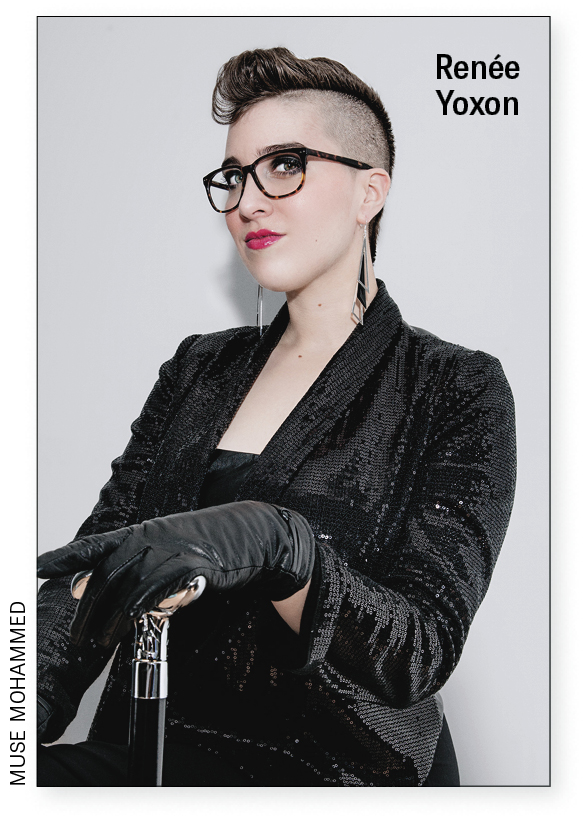
2206- BBB - Mainly Mostly 1.jpgThere’s one more gig I’d like to mention for now: singers in town – amateur and professionals alike – may be interested in knowing that Renée Yoxon, the crossover jazz-folk-pop etc. singer from Montreal, will be performing and running a vocal workshop at 120 Diner on the afternoon and evening of March 12. The young Yoxon’s voice is clear and precise, the manner of delivery, frank and direct, honest. You may feel as though they are speaking directly to you. Adept at interpreting standards, covering and writing pop songs, scat singing, blending in with horns as though their voice were one, and so on – it seems that taking the opportunity to participate in this workshop would be a wise choice.

 I hope to see you folks in at least one of the clubs, without your winter coats. Happy March! Happy vernal equinox! Be well!

Bob Ben is The WholeNote’s jazz listings editor. He can be reached at jazz@thewholenote.com.

Back to top