Still from Art of Time Ensemble’s ‘A Singer Must Die’. Singer: Sarah Harmer.What would Leonard Cohen make of the moment we are in? I found myself asking that question while watching an all-star group of Canadian artists perform a selection of songs from his vast catalogue in A Singer Must Die, Art of Time Ensemble's virtual concert celebrating the life of the musical titan.

Over the course of his six-decade long literary and musical career, Cohen’s enigmatic works probed deep into isolation, loss and death – themes which many of us have become intimately familiar with. I guess the next best thing to hearing Cohen’s reflections on this period in history is seeing his old works being reimagined by an eclectic mix of Canadian singers and musicians breathing new life into his songs.

There is former Barenaked Ladies front man Steven Page crooning his way through “A Singer Must Die” with his mellow tenor voice. Then there is singer-songwriter Sarah Slean, who puts a classical twist on “Anthem,” a solemn hymn of optimism and redemption that has been belted on the frontlines of social justice movements around the world. “Ring the bells that still can ring,” she sings with a warm mellifluous vibrato that floats above the string accompaniment.

Still from Art of Time Ensemble’s ‘A Singer Must Die’. Singer: Sarah Slean.The power of Cohen’s lyrics is in their stinging precision that, paradoxically, makes them hauntingly universal at the same time. Sarah Harmer’s silvery jazz-imbued rendition of “Dance Me to the End of Love,” struck deep as she sang the lyric “dance me through the panic till I'm gathered safely in.”

No matter the genre or manner in which Cohen’s song are performed here – be it Tom Wilson’s brooding soft rock interpretation of “Who By Fire” on acoustic guitar or Gregory Hoskins’ folk rock take on “Treaty” – there are always new contours to be discovered in Cohen’s melodies, fresh messages to be mined in his lyrics, in a craftily diverse program that places Cohen’s biggest hits – “Hallelujah” and “Anthem” – alongside some of the lesser known works from his back catalogue, like “Treaty” and “Boogie Street.” It’s all packaged in a 70-minute recording, filmed in the intimate Harbourfront Centre Theatre in 2018 with a live audience.

The videography by Q Media Solutions, Steven Field and Mike Fiore is superb, with wide-angle shots of the stage paired with close-ups of each singer and instrumentalist. But the real winner in this recording is Earl McCluskie’s impeccable sound mixing, which crisply captures each singer’s voice and makes the six-piece backing band sound like a full jazz ensemble.

Otherwise, the setup is simple. The singers step up to a mic at the lip of the stage to perform each number, surrounded by the musicians. Interspersed between the musical numbers are short readings by four Canadian authors who reflect on Cohen’s legacy and his impact on their lives. Madeleine Thien describes the makeshift memorial that formed outside the Cohen’s former Montreal home after his death; Ian Brown comically tries to decipher his enigmatic lyrics; Steven Heighton recites “You Have the Lovers,” one of Cohen’s early poems that is a meditation on the sensuality of love and intimacy; and Marni Jackson talks about how his poetry and novels guided her through adolescence.

The most moving moment of the evening, however, came in the encore. Basking in Kevin Lamotte’s atmospheric lighting design, Page and Hoskins deliver a stirring rendition of “Hallelujah” – their voices melding into blissful harmony above Robert Carli’s soothing saxophone accompaniment.

Before the last chorus, the pair slowly step away from their microphones, their voices fading off into the distance. Page mouths the lyrics to the audience, indicating for them to join in. And in one collective breath, they do.

A Singer Must Die was originally presented by Art of Time Ensemble at the Harbourfront Centre Theatre in Toronto from February 22 to 24, 2018, and was streamed online by Art of Time Ensemble from May 6 to 9, 2021. For full production credits and more information about the show, please visit their website at https://artoftimeensemble.com/a-singer-must-die-virtually-live.

Joshua Chong is a Toronto-based freelance performing arts critic and journalist whose work has been featured in The Globe and Mail, The Dance Current and Intermission Magazine.

Pianist Nate Ben-Horin (L) and soprano Jaclyn Grossman.On Sunday, April 4, the Harold Green Jewish Theatre Company presented a new series by Likht Ensemble involving five installments of rarely-performed music by Jewish artists, composed during the Holocaust. The Shoah Songbook online performances launched on the eve of Yom HaShoah, or Holocaust Remembrance Day, with Part One: Terezín.

Theresienstadt was a concentration camp located in the city of Terezín, in what’s now the Czech Republic. In dire circumstances, imprisoned artists occupied their minds writing and performing music to keep joy and hope alive, long beyond the time they themselves were murdered.

Likht Ensemble’s 35-minute streamed concert included the music of multifaceted musician Gideon Klein, famed pre-war composer Viktor Ullmann, as well as the joyous tunes of cabaret artist Karel Švenk and the haunting lullabies of Ilse Weber, who all found themselves in Terezín over the course of the Second World War.

In the concert’s introduction, Jaclyn Grossman, soprano and co-creator of The Shoah Songbook, said she found a recording of Ilse Weber’s music and it opened the gates to a “goldmine of extraordinary music.” Grossman said she was “disappointed that as a classical artist and as a Jewish person,” she had never heard any of these composers before.

When Ilse Weber—a poet and musician—was forced into a concentration camp, she worked as a nurse in the children’s infirmary and sang songs to the children there. When children in her care were ordered to a death camp, Weber volunteered to go with them. Legend goes she sang her lullaby “Weigela” in the gas chamber to soothe the children in their final moments, taking comfort in soothing others. Grossman sang “Weigela” gracefully and woefully, conjuring images of pastoral breezes and bright moonlight—a performance suggesting that “Weigela” is overdue to take its rightful place in the lullaby canon alongside the best-loved classics.

After the war, what remained of Weber’s music were fragments of melodies she would have accompanied herself on the guitar. Many had never been arranged for the piano by a Jewish composer until these thoughtful arrangements by pianist and co-creator Nate Ben-Horin, such as “Und der Regen rinnt” (And the rain falls)—an arrangement replete with tinkling notes in the upper register of the piano, like drops of rain hitting a tin roof. 

During the presentation, Ben-Horin recalled that the first thing he and Grossman had ever performed together was a set of songs by Wagner—an infamous anti-Semite. “There’s actually a long-standing tradition of anti-Semitism in classical music, not just Wagner,” Ben-Horin explained in the stream. “It’s really powerful to find music by Jewish composers because it gives us a point of identification within this tradition that we felt like we’d been missing.”

Grossman had command over a powerful range of expressive emotion throughout the concert. She sang Weber’s “Ade kamerad” with particular awe-inspiring exuberance and masterful rolled r’s, capturing the power of this music to bring light to the darkest places. She also recited gut-wrenching verses of Weber’s original poetry. As for the recording itself, video quality was crystalline and professional but the piano sounded distant, making Ben-Horin’s beautiful arrangements sound too quiet at times.

The jubilant music of Švenk, who continued to produce cabarets in the ghetto, ended the concert on a powerful and victorious note for those that survived to pass on his message: “And on the ruins of the ghetto shall we laugh!”

The next concert will be in November 2021, in time for the sombre anniversary of Kristallnacht. Grossman says the repertoire will focus on music from the Kovno ghetto, specifically the music of Edwin Geist, a German composer and librettist banned from creating music in Nazi Germany. Geist created music including symphonic works, chamber music and opera before he was killed in the ghetto in 1942. After World War II, much of his music was lost in Germany but some survived in Lithuania.

“To our knowledge, his music has never been recorded and it has rarely—if ever—been performed,” Grossman wrote in an email to The WholeNote. “Bret Werb from the Washington Holocaust Memorial Museum shared his archived manuscript music with us, and [Ben-Horin] and I are working to decipher the music and re-notate it now.”

The Harold Green Jewish Theatre Company presented The Shoah Songbook Part One: Terezín online on April 4, 2021, featuring soprano/co-creator Jacyln Grossman, pianist/co-creator Nate Ben-Horin, creative directors Ilan Waldman and Madison Matthews, and audio engineer Jonathan Colalillo.

Leah Borts-Kuperman is a Toronto-based journalist whose arts reporting has also been featured in The Dance Current, Opera Canada and The Hoser. She has a Master's of Journalism from Ryerson University and a Bachelor's in Political Science and Art History from the University of Toronto. 

John Beckwith has lived in Toronto’s Annex neighbourhood for more than 30 years, with his life-partner, Kathleen McMorrow.  Beyond his musical career Beckwith’s interests include cycling and Scottish country dancing. Beyond cycling, as a contribution to environmental preservation he collects elastic bands which he donates to a local supermarket.Confluence Concerts most recent event was a marathon of composer John Beckwith’s music for solo voice – three 90-minute back-to-back online recitals. The production was a family affair, curated and co-hosted by the composer’s son, Larry Beckwith, and granddaughter Alison Beckwith. Confluence Concerts is a relatively new presenter on the Toronto scene with their concert debut occurring in September of 2018, with deep previous roots in Larry Beckwith’s Toronto Masque Theatre, but a unique and diverse artistic manifesto, with artistic associates Marion Newman, Andrew Downing, Suba Sankaran and Patricia O’Callaghan joining Larry Beckwith to create a variety of intimate and stimulating concert events. 

This particular series, celebrating the 94th birthday of the esteemed composer, writer, pianist, teacher and administrator, was available on YouTube from March 7-21. Interspersed between performances of the music were interviews with colleagues and with the composer himself, as well as special birthday greetings from a number of wellwishers. One of them, the current Dean of the Faculty of Music at the University of Toronto, Don McLean, described Beckwith’s songs as capturing the “essence and range of his musical personality – his lyricism, pianism, craft, conceptual focus and wit.”

Beckwith’s song repertoire featured in this series was composed from 1947-2014, with performances from an astonishing array of singers in all stages of their careers, from students to seasoned professionals.  Each performer created their own performing environment, filming in classrooms, living rooms, empty concert halls, and churches using portable cameras, iphones, and other devices. Many of the singers performed while listening to the piano accompaniment through ear buds with the video screen split between the two performers. 

One of my favourite locations was a classroom at U of T’s Faculty of Music, featuring large glass windows with protective bird decals, overlooking the campus’s Philosophers Walk and other university buildings, and with car traffic visible in the distance.  It brought the outside world into the performance and because of the preponderance of natural light, reflections were cast in a variety of directions, all contriving together in making a most out-of-the-ordinary concert setting.  Having the performances in settings of the performers’ choosing created not only a wide range of different visual elements but also the challenge of a series of constantly changing acoustic spaces. 

In one of the recorded interviews, colleague and pianist William Aide spoke about how one the strong characteristics of Beckwith’s music for voice arose from his close association with words and with literary people. “He has a perceptive response to the rhythm of the words”, Aide said.  When Beckwith himself was asked about his relationship with text and poetry, he explained how he has always allowed himself to be guided by the way the poetry is spoken.  “This gives you a guide to the tempo, inflection, melodic ups and downs you would use in setting to music – the pauses and musicality of speech.”  Throughout the three concerts, his close association with a variety of poets and authors was clearly evident.

Another compelling feature of these concerts was the inclusion of performers of all ages as in the performance of his Ten English Rhymes (1963) by various members of the Canadian Children’s Opera Company. The texts were taken from a collection of nursery rhymes entitled Lavender’s Blue that John Beckwith’s own children had loved.  Many of the rhymes already had traditional tunes, but for those that didn’t, Beckwith made up the tunes. As music director Teri Dunn stated in her comments about working on this production, the challenge for the performers, ranging in age from 8 to 15, was going from singing and learning in an ensemble to singing alone in front of a camera.

 Mary Morrison and Larry Beckwith in conversation. Photo courtesy of Confluence ConcertsThe first concert of the series showcased two works set to texts by e. e. cummings. The first of these, Four songs to poems by e. e. cummings was commissioned in 1950 by soprano Lois Marshall for her professional debut at the Eaton Auditorium.  One this occasion one of Marshall’s prize students, Leslie Fagan, performed the piece in a classroom setting, with a Happy Birthday greeting written on the white board behind her.  The second work, for baritone, Six songs to poems by e. e. cummings from 1982 was performed by three different singers, including Cameron Martin who performed in the glass-window classroom environment mentioned above.  During an interview with singer and teacher Mary Morrison, she spoke of how unique the first four e.e. cummings works were in the early ’50s, and how her students throughout the years have loved to perform them. She also spoke of her friendship with Beckwith during their student days in the late 1940s, and of how there was a close-knit circle between Canadian composers such as Beckwith, Harry Somers, Harry Freedman and Oskar Morawetz, and performers such as herself interested in what Canadians were writing. “It was a very rich time,” she said.

Beckwith also consistently championed Canadian writers, and throughout the three-concert series, we hear works set to texts by Miriam Waddington, Colleen Thibaudeau, Margaret Laurence and bp Nichol.  In 1985 Beckwith collaborated with the sound poet Nichol to create the tour de force work entitled avowals performed for this occasion by tenor Benjamin Butterfield and keyboardist Robert Holliston who moved seamlessly between piano, celeste and harpsichord. Due to some inventive camera work, we were able to see close-ups of each of the keyboards as well as shots of the score.  William Aide’s comments about this piece sum it up quite comically:  “I never played anything so crazy in all my life.” He stated that the keyboard performer has to have a wide wingspan in order to get from one instrument to the other.  In Beckwith’s book Unheard Of: Memoirs of a Canadian Composer, he describes the unfolding drama of the piece.  “The soloist personifies a pop singer who is unable to detach his own love pangs from the lyrics he is performing on stage.  Besides three fragments in a realistic crooning style, the inventive script offers vocalizing sections on plain vowels, some with double meanings and some without.” 

Not only does Beckwith champion Canadian writers, but also traditional songs from the diverse cultures that make up Canada.  Over the course of these three concerts we hear four different collections that feature his arrangements of songs from the Hungarian, Lithuanian, Ukrainian, Doukhobor, Mennonite, Quebecois, and Atlantic Canadian communities. 

One stand-out is a touchingly intimate performance by soprano Barbara Hannigan accompanying herself on piano from the living room of her rural home in northern France while singing Müde kehrt ein Wanderer zurück, a song from the Mennonite community in Manitoba. This song is featured in Beckwith’s collection of traditional songs entitled I love to dance, written in 1999.  Fittingly, these songs end the third recital, mirroring the song collection titled Young Man from Canada, written in 1998, which opened the first recital. 

Beckwith’s contribution to establishing a Canadian musical identity is enormous, being a life-long creator and advocate for the country’s many singers, writers and performers, as well as being himself, in the words of Don McLean, one of Canada’s most diversified musical presences. On a personal note, it was in Beckwith’s History of Canadian Music course at the University of Toronto that my own awareness of local musical traditions such as the Sharon Temple just north of Toronto expanded in a course that gave new meaning to musical history previously relegated in a Faculty context to a distant Europe. 

The series ended with the raising of a glass and a toast given by Larry Beckwith “to the memory of all the poets, novelists and playwrights whose words we heard; to all the traditions represented in the Canadian cultural mosaic of traditional songs; to dad, Dean Beckwith.” And when singer Mary Morrison was asked if she had any words for Beckwith on this occasion of celebration, her answer was simply – ONWARD! 

Wendalyn Bartley is a Toronto-based composer and electro-vocal sound artist. sounddreaming@gmail.com

Still from the Toronto Consort’s Of Tricksters and Trolls.A wraithlike water-dweller, a covetous goddess, a phantom bride. Welcome to the world of Of Tricksters and Trolls, the Toronto Consort’s latest performance released March 16 on their new streaming platform, Early Music TV. Filmed earlier this year at the 918 Bathurst Centre for Culture, Arts, Media and Education, the virtual performance features traditional music from Scandinavia alongside dramatic retellings of medieval and folk tales from similar regions. Don’t be fooled by the whimsical premise – the Consort wades into the murk of early Scandinavian repertoire to retrieve pieces that are merry, mournful and haunting in turn. It is a seriously transporting concert.

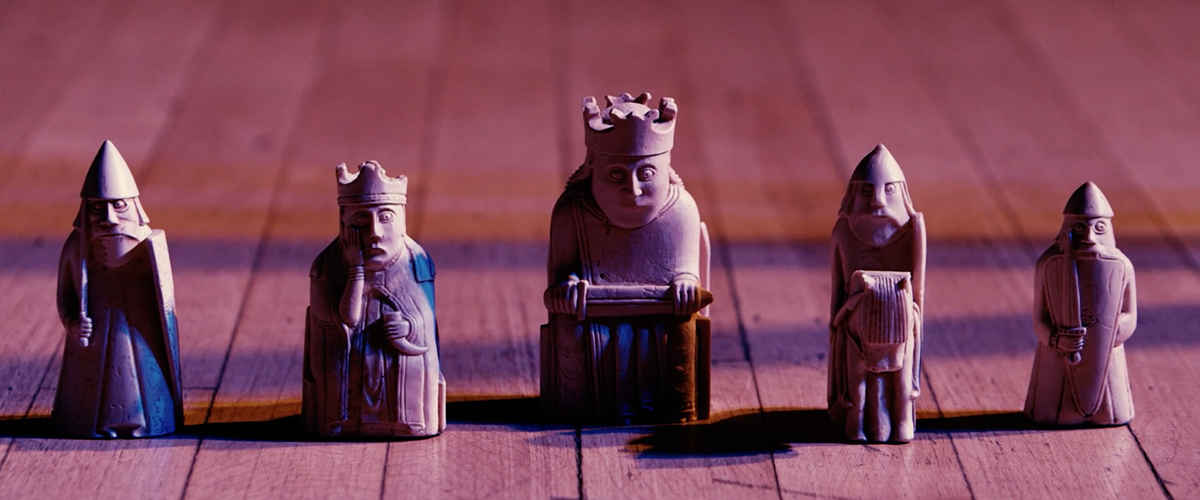
The show opens with the eerie, decaying notes of a vielle à roue (hurdy-gurdy) played by Ben Grossman, and a close-up shot of five ivory figurines clutching knives, horns and shields – keen medievalists will recognize the Lewis Chessmen, 12th-century playing pieces carved into fierce Viking warriors. (We’re not in Kansas anymore.) Then Peter Tiefenbach, the evening’s storyteller, launches into the first of many tales starring the fickle and vindictive, yet beautiful and funny, Norse gods, as well as the shadowy creatures of later oral tradition.

Suspenseful sound effects are woven delicately into the narrative. Soft, spaced notes from harpist Paul Jenkins mimic falling snowflakes, while Grossman on drum and Katherine Hill on the nyckelharpa create rumbling, Thor-triggered thunder. Tiefenbach stays in character, if you will, easily flipping between whiny dwarves and breathy goddesses, without descending into pantomime. Refreshingly, nobody interrupts the flow to announce names or historical anecdotes; the tension is sustained, the spell unbroken.

Read more: Concert Report: Toronto Consort’s Of Tricksters and Trolls - a whirl of haunting repertoire
Back to top