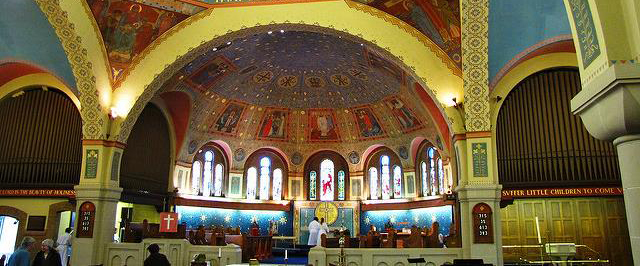
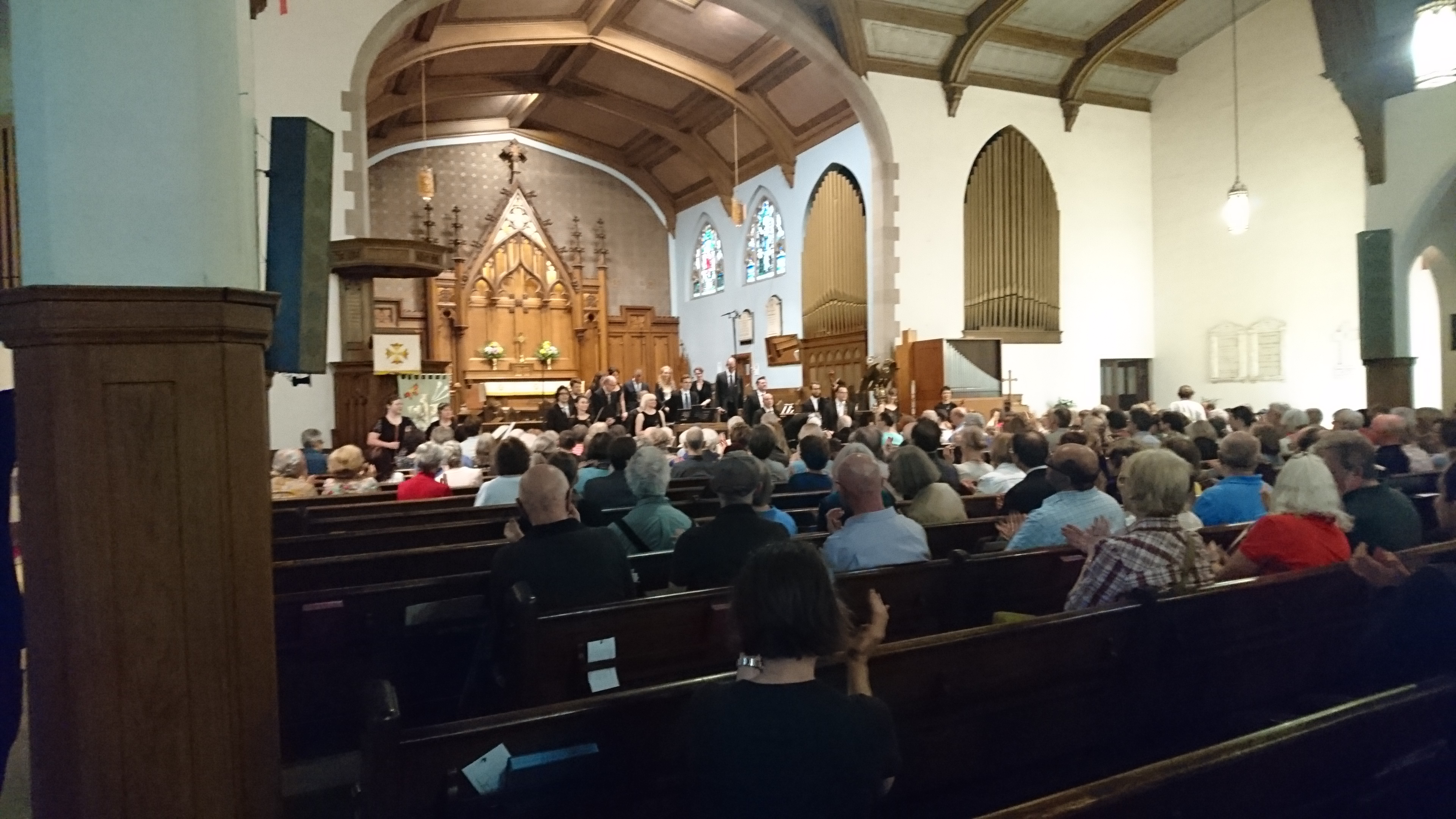
annes cropped finalSt. Anne’s Anglican Church is a beautiful, welcoming environment in which to hear a performance. Entering the church on Sunday, May 28, I was greeted with an exhibition of Indigenous artists, on the theme of reconciliation. The first piece I noticed was a striking silk dress with a subtly integrated traditional star quilt pattern created by designer and artist Sage Paul. Placed about the auditorium are other works of art, including paintings and a beautiful birch bark canoe. Beyond that, in front of the altar, the Evergreen Club Contemporary Gamelan (ECCG) was assembled to add its musical voice to the conversation.

St. Anne’s ensemble-in-residence, the Junction Trio, opened the concert – titled “Post-Industrial Gamelan!” – with a Haydn divertimento, and the St. Anne’s Choir further quieted the mood with Tallis’ If Ye Love Me, Mozart’s Ave Verum Corpus, and Canadian composer Rupert Lang’s Kontakion.

After the release of two new recordings recently, the ECCG returned to more familiar territory for this performance. They began their portion of the set with a staple of the group’s repertoire, Anjeun (you), by the late Indonesian composer Nano Suratno. The piece was a pop hit in Indonesia in the 90s, but is a much subtler composition than any of the pop versions would have you believe, and is also a great introduction to the degung orchestra (and the ECCG is first and foremost that).

Rengga Renggi by Burhan Sukarma (arranged by ECCG member Bill Parsons) featured a lively section of “trading fours” between hand drums and other percussion, an energetic highlight of the performance.

Another mainstay of the ECCG repertoire, Lou Harrison’s Ibu Trish, a gently contemplative piece, was well suited to the ambience of the room. Canadian film composer Paul Intson’s Rainforest rounded out the program as the least traditional-sounding piece, full of melodic and rhythmic twists and turns, and fully utilizing the timbral possibilities in the gamelan.

The ECCG’s part of the program came to a close with a loosely-structured vehicle for joint improvisation between the gamelan and the Junction Trio. No one really took any risks, but the tremolos and long tones made for a gentle landing at the end of the program. In all, a subtly diverse set of compositions played with a relaxed familiarity, giving evidence to the ECCG’s long history of working together.

I feel compelled to commend St. Anne’s for its annual series of diverse programming, and even more so for its series of events on the theme of reconciliation (the current art exhibit but one of many this year). The concert performance of the ECCG, Junction Trio and St. Anne's Choir proved a powerful example of the diversity of music on offer at this venue. And as for the art exhibit that set the tone for afternoon, I was reminded, first, of the systematic persecution of local Indigenous communities, and second, of the Louis Riel quote: “My people will sleep for one hundred years, but when they awake, it will be the artists who give them their spirit back.”

"Post-Industrial Gamelan! took place on Sunday, May 28 at 2pm, at St. Anne's Anglican Church in Toronto.

John Carnes is a multi-instrumentalist, composer, jewellery designer and skateboarder.
The Toronto Bach Festival performance of the St Mark Passion. Photo by the author.Toronto has a thing for early music. Audiences in this city can’t seem to get enough of baroque-era music, including chamber, orchestra, choral and opera works. Into this community, there’s a new festival in town: the Toronto Bach Festival, running this year from May 26 to 28. Just concluding their second year, a third is already on the books for 2018. Celebrated historical oboe specialist John Abberger is the festival’s artistic director. Focusing on all things Bach, early music lovers in this city have much reason to support this venture.

The festival is based out of the Anglican Church of St. Barnabas on the Danforth – a sizeable church that provides ample room and appropriate acoustics. Three days of programming made up this year’s festival: “Cantatas & Brandenburgs,” featuring a host of local artists well-known to early music audiences including Asitha Tennekoon, Larry Beckwith, and Brett Polegato; a harpsichord recital by Christopher Bagan, known for his extensive work with Tafelmusik and the Canadian Opera Company, amongst many others; and a finale performance of the St Mark Passion. Many of the instrumentalists involved come from various Toronto-based early music groups, including the Theatre of Early Music, Tafelmusik and Opera Atelier.

The biggest work featured was the final Sunday concert, the St Mark Passion. Featuring Asitha Tennekoon in the very-hardworking role of the Evangelist, familiar faces Daniel Taylor and Agnes Zsigovics were also soloists. Joined by a small chorale of nine voices, this was an intimate performance, incredibly well-executed.

Bach’s original score for this work does not survive in full to present-day; this performance followed the reconstruction by musicologist Simon Heighes. St Mark Passion is one of those examples of a historical relic that has come to us in very different shapes and sounds over the centuries. I know that there are many opinions amongst early music lovers about stringency to source material and performance practice of this piece – yet I won’t try to be a Bach historian myself and delve into the intricacies of editorial decisions made in this particular performance. This was a beautiful delivery of music from Bach, even if it has passed through many hands in between.

The assembled musical forces were small but mighty. The orchestra was spirited and played very well for the choir, who took the lead with energy and artistry. The nine voices blended together seamlessly and should perform together regularly. Tennekoon’s Evangelist was exceptionally well-delivered and a feat of endurance, as he performed probably close to half of the sung material in the entire work. Various solos throughout the performance were equally well-executed, including Brett Polegato’s effortless but emotional “Eli, eli, lama sabachthani” (My God, my God, why have you forsaken me?)

Bach’s St Mark Passion is not often performed because it is considered incomplete. The piecemeal assembly of this work makes it all seem a bit mismatched, unlike the superior Mass in B Minor or the Christmas Oratorio. Roseen Giles, in the program notes, provides us with an answer why this is so. Bach frequently reused his work, written in different contexts for different reasons, assembling them into “parodies”. Almost all the choruses are church hymns, from performances during Lutheran ceremonies. There are hymns that make an appearance throughout the work in the Heighes version, including “Das Wort sie sollen lassen stahn” (A Mighty Fortress is Our God), the great Lutheran anthem. But this tune was not written by Bach, but rather, Martin Luther. “Ich will hier bei dir stehen” (O Sacred head, now wounded) makes an appearance as the last part of Act I, also written centuries before Bach, but with different text. A greater historian than I will have to explain why this might be and the relevance of these disparate hymns in this work.

Regardless of the history, this type of elite-level performance is unique to the choral world of Toronto. Early music is big here and certainly has an audience. But, with early music ensembles and audiences very much a homogenous group, I can’t help but wonder who this music is meant for – and how its reach can extend further beyond those already active in the scene.

The final performance of the Toronto Bach Festival, of Bach’s St Mark Passion, took place on May 28 at the Church of St. Barnabas on the Danforth in Toronto.

Follow Brian on Twitter @bfchang. Send info/media/tips to choralscene@thewholenote.com.


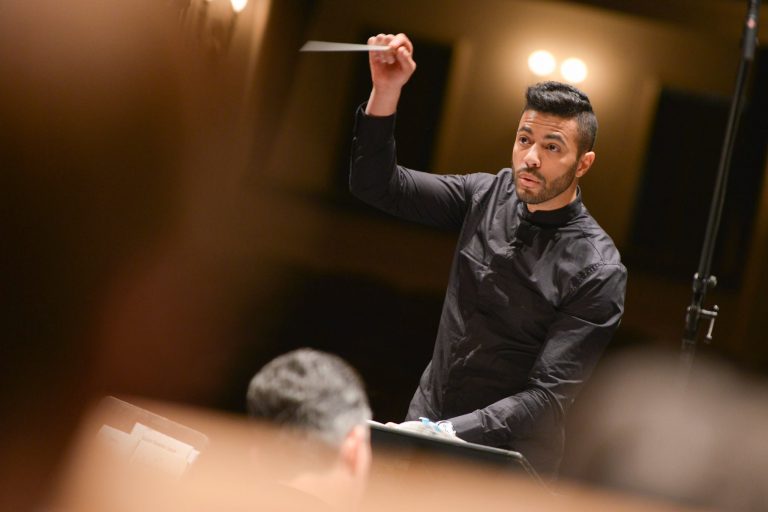
Composer Samy Moussa.21C, the reliably stimulating and boundary-pushing new music festival, opened last night at RCM’s Koerner Hall with concert that was a bit of a mixed bag, program-wise and in execution. Canadian Opera Company Orchestra and its music director Johannes Debus gave us a world premiere – Brian Current’s Naka / Northern Lights – and a selection of recent works by Unsuk Chin, Samy Moussa, Matthew Aucoin and Current. Mezzo Emily D’Angelo sang with verve the wittiest part of the program, Chin’s snagS&Snarls, the song-studies for what was to be Chin’s Alice in Wonderland opera which was premiered at the Bavarian State Opera in 2007. Two songs were particularly captivating: “The Tale-Tail of the Mouse”, with voice required to writhe and wind itself down as if through a mouse hole, and “Speak roughly to your little boy”, with some well-managed screaming that grows in intensity. There were, however, serious issues with the voice-orchestra balance, and most of the cycle D’Angelo found herself drowned by the orchestra. The intricate textual lace of “Twinkle, twinkle, little star” was completely erased and there was very little voice heard amid the fervent orchestra.

D’Angelo was much better heard in Matthew Aucoin’s dramatic cantata on the theme of Orpheus, The Orphic Moment (2014). Hearing it sung by a mezzo is a treat: the history of the piece shows a countertenor singing the role every time. Aucoin assigned the role of Eurydice to the first violin (here the COC Orchestra’s concertmaster Marie Bérard) and there were some exquisite moments of attempted communication and unbridgeable distance between the voice and the instrument in the Moment. Composer’s notes in the program hint at a flippant, hubristic Orpheus, but it wasn’t possible to observe those nuances without the text which was, you discover after a good chunk of time into the performance looking for it, left out of the booklet.

Brian Current’s Naka, a northern lights-themed work for orchestra, choir and narrator, came out of the composer’s residence in the Northwest Territories and his collaboration with the Tłı̨chǫ First Nation (in anglicized spelling: Tlicho). Richard Van Camp, who also wrote the libretto, narrated the text in Tlicho and English. Rosa Mantla, a Tlicho Elder, translated the text and was the pronunciation coach for the Elmer Iseler Singers choir. It is a serene, playful, occasionally droll, animated through-and-through piece, set up as a conversation between the Tlicho-speaking choir and the bilingual narrator. Van Camp’s twinkle-in-the-eye delivery was a particularly effective foil to the choir’s more ghostly character that spoke as forces of nature.

Current’s second piece in the program I found, at best, puzzling. Is Current taking a mystical turn? He of all composers, who is often heard saying that what contemporary music does best is trying to explore and express how we live our lives today? The composer is, we learn from the program, at work on a multi-movement cycle The River of Light with the texts of several religious traditions (Hindu, Christian, First Nations Canadian – which was Naka – Sufi, etc.) “that describe mystical journeys towards an exalted state.” The Seven Heavenly Halls from the concert program was composed on the texts from a particularly mystical book of the Kabbalah. The passage through the heavenly halls is the passage of a man through the levels of  heavenly exaltation. Or something? Reader, I lost interest halfway through the program note, and the music didn’t manage to draw me back in at any turn. The music, alas, sounds almost programmatic: vast, swelling, spirit-rousing sounds, meant to evoke solemnity, meant to be epic; suitable enough for a religious ceremony. Tenor Andrew Haji maintained a modicum of individuality and pushed through amid all the choral and orchestral solemnity, but not even his precise and warm – if occasionally drowned by the orchestra – tenor could breathe life into this religious painting. My first question to composers eager to explore this or that side of religion in their new work is Why? If most of western choral music is religious already, and where are we, the non-religious, to go?

But then there was the Samy Moussa piece in the program, the orchestral non-concerto cheekily titled Kammerkonzert which he wrote ten years ago, just before he left Montreal for Berlin. My Samy Moussa luck has been such that whenever I happen to attend a concert containing a piece by him, that piece will be unlike anything I’ve ever heard before. This happened again last night. Kammerkonzert is a series of sound explosions multiplying into a theatre of war that is somehow contained within a symphonic orchestra of unamplified instruments. This comes nowhere near exhausting its interpretation – and another person would probably tell you they heard something different – but I witnessed something akin to a camera zooming out from sporadic shots to a bird's eye view of an out-and-out battlefield.

Or were we thrust in a particularly noisy cacophony of a large city, distilled to its harshest sound essence? Or should we abandon the imagery and the narrative altogether, and take Kammerkonzert as a visceral sound onslaught to be experienced and not overanalyzed? I hope I get a chance to hear it again in some form and make up my mind – or abandon any attempt to contain it in words.

Lydia Perović is an arts journalist in Toronto. Send her your art-of-song news to artofsong@thewholenote.com.


Johannes Debus.Johannes Debus, music director of the Canadian Opera Company Orchestra, speaks about his orchestra with love at a May 24 post-concert chat. “This great orchestra deserves to be onstage,” he says. The orchestra is one of the finest in the country, but is almost always in the pit of the Four Seasons Centre, barely visible to audiences. As part of 21C, the Royal Conservatory’s new music festival running May 24 to 28, the COC orchestra was onstage at Koerner Hall, fully visible and remarkable as always.

Mervon Mehta, executive director of performing arts at the Conservatory, is thrilled that the COC orchestra has appeared at Koerner Hall. What began as a phone call led to this concert, which featured mostly Canadian works as well as music by Unsuk Chin – the South Korean, Berlin-based composer whose work is the focus of much of this year’s festival. The performance marked the festival’s opening night.

“I tried to put together a menu that offers many flavours,” says Debus, who selected the concert program so as to bring out different themes within new music (rather than focusing ‘newness’ alone). American composer and poet Matthew Aucoin’s work The Orphic Moment had its Canadian premiere. The unusual choice of only one player in each of the 1st and 2nd violins and one viola was an odd pairing for the robust percussion demanded by the piece. The mallets featured prominently, played with athletic effectiveness by the musicians, dashing about onstage. The overall effect of this song was unnerving and creepy – not unsurprisingly, as it is meant to invoke a journey to the underworld.

Canadian composer Samy Moussa, whose piece Kammerkonzert was also on the program, was in town to catch the concert. A resident of Berlin for the last 10 years, he told the audience in the post-concert chat that Kammerkonzert was one of the last pieces he wrote before he left Canada. He reflects that his music since then has “become softer, more lyrical.” Kammerkonzert was chosen by Debus, who described it as an obvious choice for a new music concert. The compositional techniques at play, especially the numerous slides and pitch bends, make the piece interesting and exciting to listen to. It’s also not often that one sees a bass flute in action.

Unsuk Chin will later be featured in 21C with Soundstreams in the festival-closing concert, and was represented here by her piece snagS&Snarls, based on Alice in Wonderland. Emily D’Angelo, mezzo-soprano, provided a spirited, comical, and articulate performance. Her charismatic acting livened the work. Debus programmed Chin’s work not only because he knew she would be featured at the festival, but also because he describes her music as having “a sparkle…and a sense of humour.”

Debus chose Canadian composer Brian Current to open and close the concert. The opening was a new commission, the 2nd movement of the River of Light song cycle Current is aiming to complete in 2018. Naka is the Tłįchǫ word for the northern lights, and references Dene traditions from the Northwest Territories. Current’s inspiration has been the universal “fascination with transfiguration of light” common in most world religions. Naka opened the concert, preceded by drum thunder and the Canadian national anthem sung in Tłįchǫ by elders and members of the Tłįchǫ First Nation, who visited from the Northwest Territories. It also felt incredibly appropriate to have an Indigenous land acknowledgement read out by Mehta prior to the start of the performance.

The Elmer Iseler Singers excelled in both of Current’s works. Naka demanded their full attention and talent, requiring them to learn Tłįchǫ accurately from Elder Rosa Mantla. At times with open harmonics and swoops, the choir often evoked the northern lights themselves, providing ethereal, complex sounds at times. Positioned in the loft, physically above the orchestra, they seemed to be singing down into the world. The singers, with Lydia Adams at the helm, have consistently proven themselves the definitive choir for new and diverse music.

The closing piece was The Seven Heavenly Halls, the opening movement of the River of Light song cycle. Andrew Haji, tenor, was bright and expressive as the pilgrim journeying through the halls described in the Zohar. Special commendations go to the percussion players, who had more than enough work cut out for them. All of these songs included a fair amount of percussion work. The Seven Heavenly Halls in particular included three sets of steel pans, bells played with violin bows, sound tubes, and much more.

There is a powerful capacity for music to have difficult conversations about the relationship between newcomers, longtime Canadians and Indigenous peoples in this country. Richard Van Camp, a Tłı̨chǫ writer who served as librettist and narrator for the work, said it best: “What a perfect Canadian evening. This is how it’s done…when we listen and learn from one another.” With a little more intentionality and openness, opportunities like this can be the transformative light we so desperately need.

The Canadian Opera Company Orchestra, conducted by Johannes Debus, performed at the opening of the fourth annual 21C Festival at the Royal Conservatory of Music, joined by Emily D’Angelo (mezzo-soprano), Andrew Haji (tenor), Richard Van Camp (librettist and narrator), Elder Rosa Mantla, other members of the Tłįchǫ First Nation, the Elmer Iseler Singers and the 21C Ensemble, on Wednesday, May 24, 8pm at Koerner Hall in Toronto.

Follow Brian on Twitter @bfchang Send info/media/tips to choralscene@thewholenote.com.

Back to top