02 Worlds ApartWorlds Apart
Christina Petrowska Quilico
Centrediscs CMCCD 23717

Canadian pianist Christina Petrowska Quilico unleashes the eight works here with such immediacy that she creates a special kind of pianistic excitement. Her technique is brilliant, and her imagination boundless. But it’s not just the thrill of the keyboard that drives her – above all you feel the fierce conviction that underlies her vision of each composer’s score.

This is the latest release in Petrowska Quilico’s ongoing recording project covering works from the Canadian piano repertoire. It’s as though she’s out to singlehandedly show just how rich it is. These works were written during a period of just over 20 years, from 1969 to 1992. They all, more or less directly, invoke historical sources – musical, literary or visual.

Peter Paul Koprowski’s Rhapsody on a Theme of Brahms and Steven Gellman’s Fantasia on a Theme of Robert Schumann take full advantage of Petrowska Quilico’s virtuosity. Koprowski gives the elements of Brahms’ Lullaby a Chopinesque treatment, only gradually revealing the familiar theme, while Gellman introduces his theme, from the slow movement of Schumann’s Piano Quintet, then lavishes embellishments.

In Las Meninas, John Rea follows the structure of his source, Schumann’s Scenes from Childhood. But he filters it through his viewing of Velázquez’s iconic, complex painting, Las Meninas by recasting Schumann’s 13 movements in various composers’ styles – Romanticism, impressionism, minimalism, jazz, and so on. Petrowska Quilico has a field day.

Her energy infuses Patrick Cardy’s mythologically based The Masks of Astarte with narrative force. In contrast, her incisive control allows a sense of space to envelop Micheline Coulombe Saint-Marcoux’s lyrical yet monumental Assemblages like a multidimensional sculpture (I thought of Anthony Caro’s works currently on display at the AGO).

In Quivi Sospiri by David Jaeger (who produced this set, and whose writings appear in this magazine), Petrowska Quilico is joined by computer-generated sounds. The rhapsodic yearnings of the piano confront the ominous electronics, then blend in a moving evocation of the sounds that swirl around the hopeless souls condemned to darkness in Dante’s Inferno.

Diana McIntosh’s atmospheric Worlds Apart, which gives this collection its title, weaves a shimmering fabric of intricate patterns. But it’s Geste by Michel-Georges Brégent, Petrowska Quilico’s first husband, who died in 1993, that forms the spiritual heart of this set – especially in the way he invites the performer’s interventions in shaping what happens and when. Brégent’s own description likens his score, mounted on a scroll, to a Calder mobile. In PQ’s hands the sense of urgency never lets up, even in the contemplative passages.

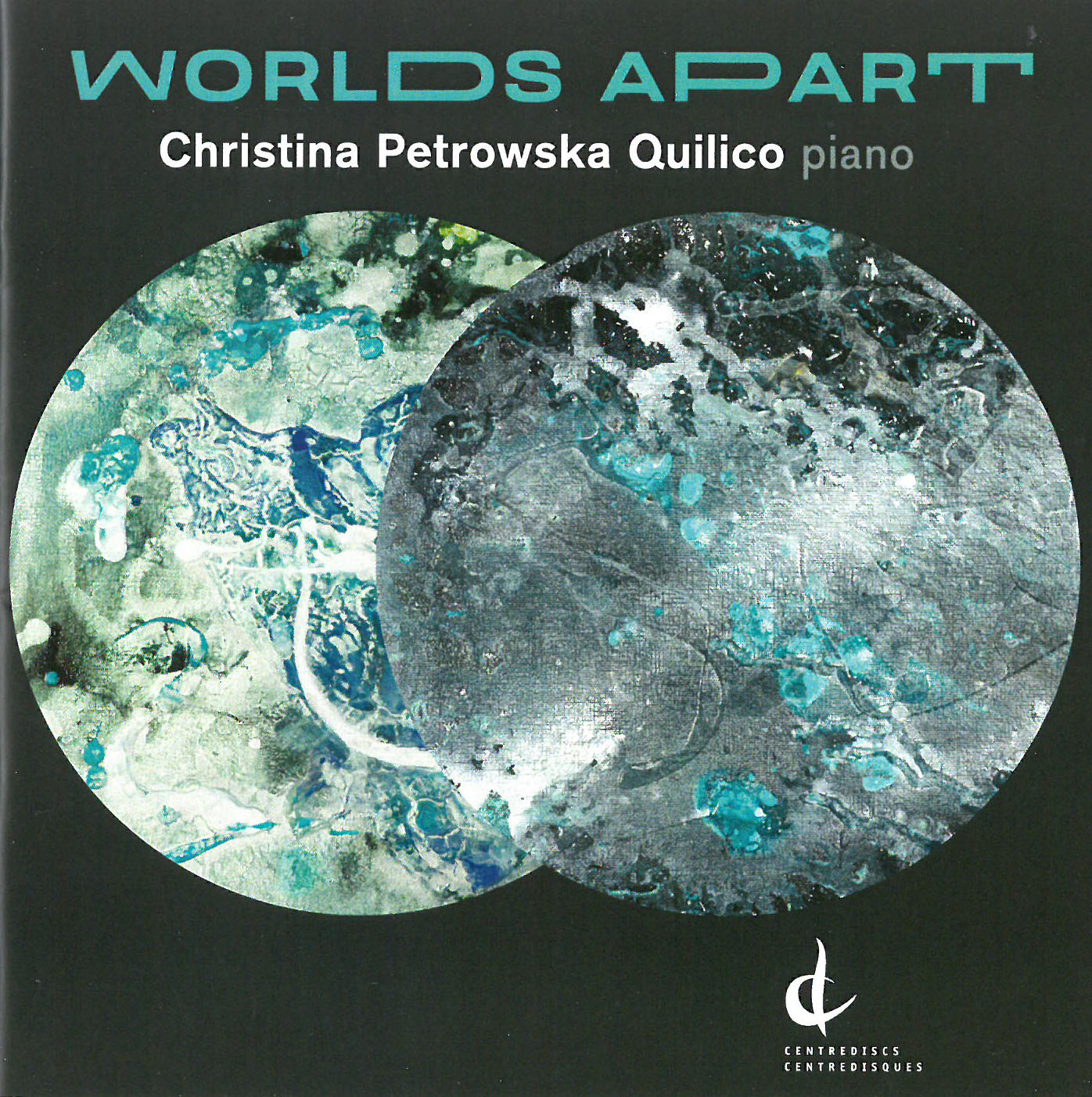
This set certainly showcases Petrowska Quilico’s talents, including her talent as a painter. The painting by her on the booklet cover, called Other Worlds – Light and Dark, beautifully sets the tone for this terrific collection.
03 Golijov Yo YoGolijov – Azul
Yo-Yo Ma; The Knights; Eric Jacobsen
Warner Classics O190295875213 (theknightsnyc.com)

The Knights is a collective of younger generation New York-area musicians specializing in programs that encompass received classics of Western music as well as embracing vernacular and world-music genres. The orchestra is led by artistic directors and brothers, Colin and Eric Jacobsen.

This CD begins with Ascending Bird, a reimagining of a Persian instrumental folk tune by Iranian musician Siamak Aghaei and The Knights’ principal violinist Colin Jacobsen. Jacobsen’s initial solo evocatively imitates the Persian kamancheh’s ornaments and melodic gestures in a languid rubato before the drum section kicks in. The second half of Ascending Bird is marked by straightforward harmonic changes elaborated by swooping melodic fragments and highly saturated orchestration.

The title track of the CD is Osvaldo Golijov’s Concerto for Cello “Azul” (2006), composed for and performed by master cellist Yo-Yo Ma. Partly inspired by a poem by Pablo Neruda, it’s a major statement extending over four movements lasting over 26 minutes. The first movement Paz Sulfúrica evolves from a falling minor second interval in the strings, elaborated by Ma’s beautifully rendered sustained cantabile tonal cello melody, flecked with instrumental birdsong.

The work’s last movement Yrushalem, initially recaps the first movement, but eventually explodes in two brass-heavy climaxes, twin codas titled Pulsar and Shooting Stars. The second coda is perhaps the most cosmic-sounding and impressive moment of the work, in which the eerie denatured music very slowly disappears into the sonic ether.

04 Boyle clarinetRory Boyle – Music for clarinet
Fraser Langton; James Willshire; Trio Dramatis
Delphian DCD43172

Composer Rory Boyle should be a better-known quantity than he is. Music for Clarinet, presented by Fraser Langton on clarinet, (with pianist James Willshire and violist Rosalind Ventris) on the Delphian label, frames Boyle as creative and crafty, thoroughly versed in the capacities of the instruments, free to generate an easy and broad spectrum of mood and character. Boyle’s modest bio in the liner notes hints at what his music makes explicit: he is a musician who became a composer by thorough study and application, with commendable results.

Listen to the aptly named Burble (2012), a brief and hilarious bit of nonsense for solo clarinet. Part mad dramatic monologue, part exploration of the extremes of range, volume and articulation, loaded with fascinating extended techniques, not a single second of these seven-plus minutes is wasted. Tatty’s Dance (2010) is a lyrical and loving ode to the composer’s wife, reworked as a duet from the original for solo piano. Dramatis Personae (2012) gives a compelling psychological triptych portrait in sound, in a three-movement sonata form. Earlier works (the Sonatina and Bagatelles both date from 1979) show the composer influenced by structural classicists like Paul Hindemith. Arthur Honegger is evoked in the final work, Di Tre Re e io (2015), a challenging and substantial trio that draws reference to that composer’s Fifth Symphony.

Throughout, the performances are rewarding and equal to the composer’s musical demands. For the most part I felt the sound engineering was perfect, but on my system the mic placement for the trio seemed to put the voices into distinct rooms rather than enhance the blend.

05 Amirkanian LexicalLexical Music
Charles Amirkhanian
Other Minds OM 1023-2 (otherminds.org)

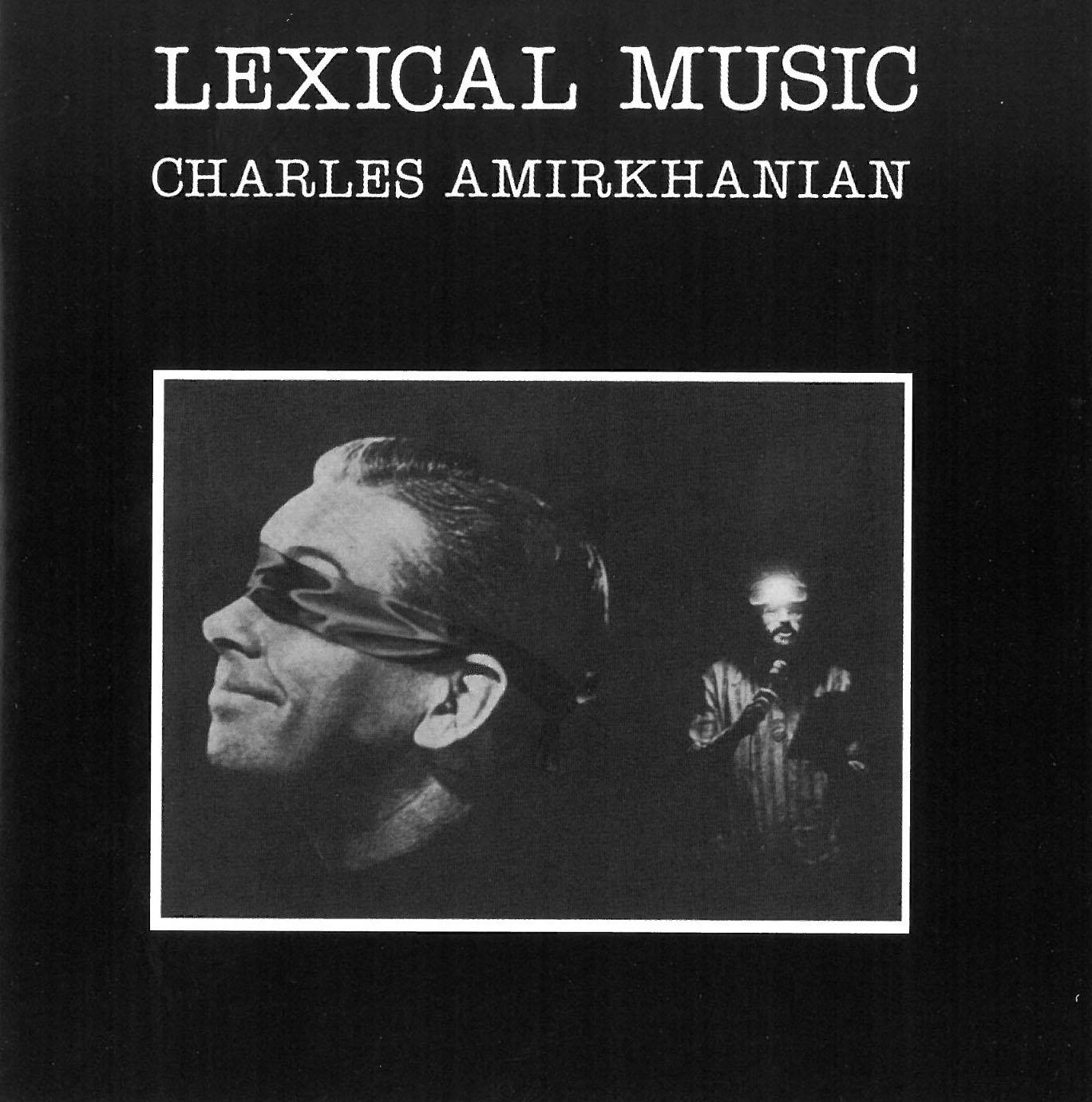
Composer Charles Amirkhanian’s Lexical Music, originally released as an LP in 1980, was quickly recognized as a milestone in the emerging American text-sound poetry scene. Its roots can be traced to the European Futurist and Dadaist movements whose participants first pioneered several forms of sound poetry after World War I. In the late 1960s and 1970s this work was further developed in electronic music studios across Europe, especially in the well-equipped Swedish public-radio studios.

The performance genre trolling the borders between music and poetry also had a few key early American practitioners. William S. Burroughs’ audio cut-ups and the early tape loop experiments of Steve Reich, Terry Riley and Pauline Oliveros come to mind. California-native Amirkhanian was also an early adopter. He participated in the 1972 Text-Sound Festival in Stockholm where he was introduced to the European sound-poetry scene. He soon adopted the moniker “sound-text composer.” Amirkhanian’s support of the genre through his position as music director of Berkeley’s KPFA-FM Radio helped enrich the ground for the production and reception of text-sound work on the West Coast.

I should add that Canadian poets also played an early and significant role in the genre. For example, Steve McCaffery and bpNichol were among the local poets instrumental in organizing the ambitious seven-day Eleventh International Sound Poetry Festival (1978) held in Toronto.

Amirkhanian’s landmark recording Lexical Music, sensitively remastered from the original analogue tapes, is accompanied by two informative critical essays in the 31-page booklet. Amirkhanian also serves as the primary vocalist on the album. His percussionist training coupled with his mellow, articulate, radio voice lends rhythmic precision, polished tone and a sense of gravitas to his recordings.

Through extensive repetition and stereo-channel (dis)placement, individual words are bleached of their usual meaning. Non-sequitur text-phrases are transformed into hypnotic washes of pure music. Amirkhanian masterfully challenges and plays with the borders between intelligible text and organized sound throughout the six works here. Just try to get the 2’02” Dutiful Ducks (1977) out of your mind once you’ve heard it.

02 Adam SchoenbergAdam Schoenberg – American Symphony; Finding Rothko; Picture Studies
Kansas City Symphony; Michael Stern
Reference Recordings RR-139 SACD (referencerecordings.com)

Another Schoenberg? Anyone who thinks even one is too many can relax, as Adam Schoenberg (b.1980) bears no relation to Arnold, genealogically or musically. Currently teaching at Occidental College in Los Angeles, he’s a rising star, his tonal, tuneful, colourfully scored music performed by orchestras across the US.

Schoenberg composed Finding Rothko (2006), depictions of four Rothko paintings, while a doctoral student at Juilliard, mentored by John Corigliano. The music successfully mirrors Rothko’s art – atmospheric, meditative and imposing, with shimmering colours that effectively play against each other in unexpected ways.

Schoenberg’s five-movement American Symphony (2011) begins and ends with buoyant optimism, powered by quasi-minimalist ostinatos. Two solemn, slow movements, built on sustained Coplandesque pastoral harmonies, frame the jazzy, syncopated middle movement. Schoenberg says, “I set out to write a modern American symphony that paid homage to our past and looked forward to a brighter future.” Indeed, it all sounds very “American.”

In 2011, the Kansas City Symphony and the city’s Nelson-Atkins Museum commissioned Schoenberg to compose “a 21st-century Pictures at an Exhibition,” based on pieces in the museum’s collection. Picture Studies (2012) depicts paintings by van Gogh, Kandinsky, Miró and Albert Bloch, a Calder sculpture and three photographs. The brilliantly orchestrated music is variously perky, sentimental, vehement and exultant.

Conductor Michael Stern elicits playing with rhythmic brio, precision and wide dynamics in these audience-pleasing works. Whether Schoenberg can create music that digs deeper than “audience-pleasing” still remains to be heard.

03 Amy BrandonScavenger
Amy Brandon
Independent (amybrandon.ca)

The first sounds to greet the listener on Amy Brandon’s debut CD are electronic swirls and squiggles, likely guitar-based and clearly running backwards. Within seconds, however, one is in for a surprise, as the very pure sound of her acoustic, nylon-string guitar emerges. Brandon is a Nova Scotia-based musician whose work here regularly combines contrasting elements: her musical identity is a composite, arising in the gap between the electroacoustic elements and acoustic melodies and improvisations.

On Scavenger, most tracks include these pre-recorded sounds, some of them clearly reworked from her own guitar tapes, others likely using other elements, whether the sound source of the War Games backing tape is thunder, actual combat, a reverb unit or the resonant bass strings of a piano. The results are fascinating, in part because of Brandon’s instrumental approach: it’s a model of classical guitar clarity in the tradition of Segovia, Yepes and Bream, with lyricism and triadic harmony that can suggest idiomatic composers like Villa-Lobos and Rodrigo.

Along the way, Brandon invites others into her musical world. VL is a duet with the distinguished Montreal jazz guitarist Mike Rud, his glassy sound contrasting with Brandon’s warmth between otherwise similar approaches; in contrast, her duet with Ottawa-based acoustic guitarist Roddy Ellias on Ecoando is a clear mirroring of sound. This is a fascinating debut, and one looks forward to Brandon’s further explorations.

01 RomanzaRomanza – Music from Spain and South America
Azuline Duo
Independent (azulineduo.com)

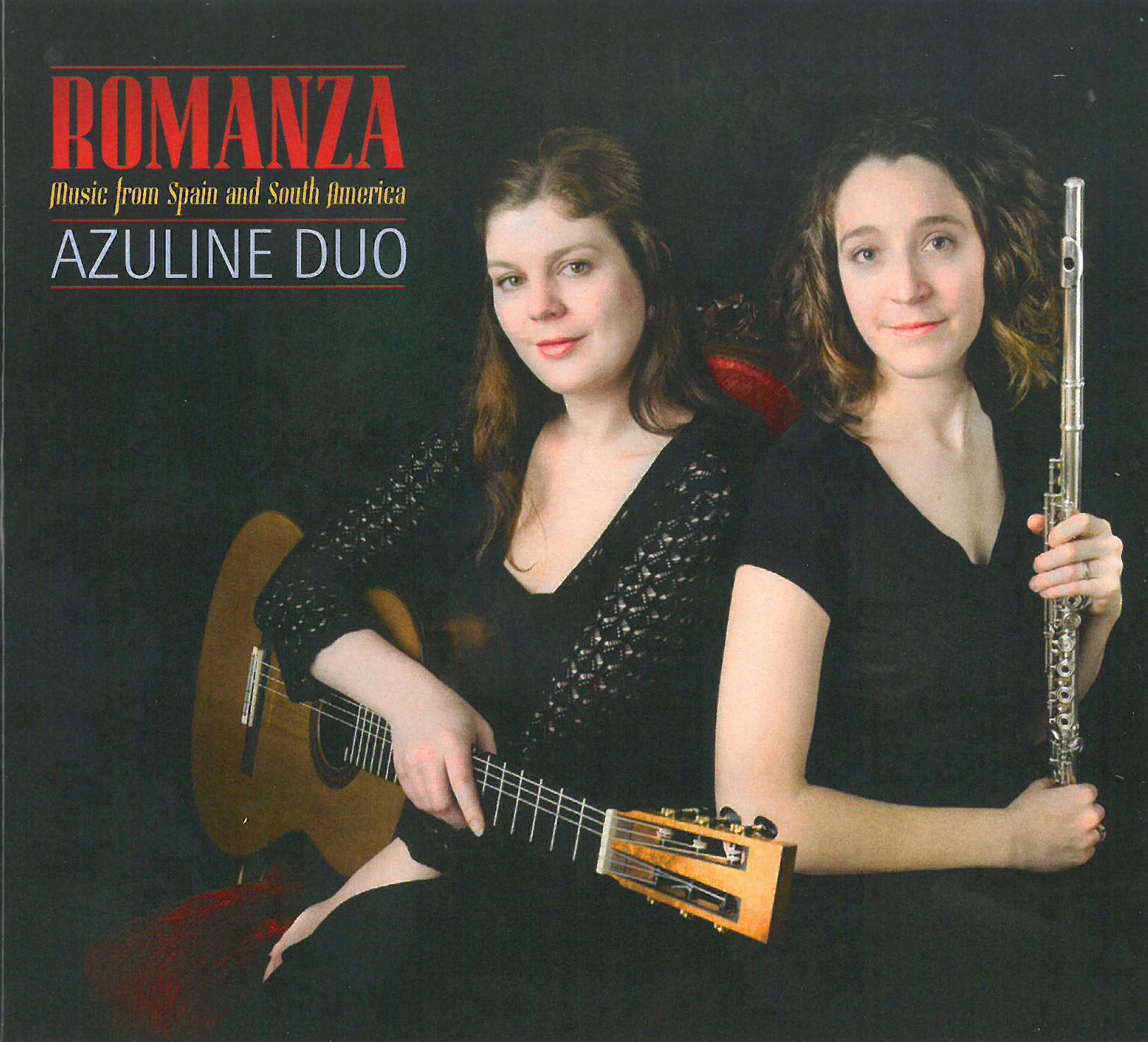
The Azuline Duo’s program on this, their first CD, is a winning combination of well-known pieces by Granados, Villa-Lobos, da Falla and Piazzolla and music new to most of us by two Argentinean guitarists/composers, José Luís Merlin and Máximo Diego Pujol.

Some highlights are Villa-Lobos’ Distribuiçao los flores, where flutist Sara Traficante’s controlled vibrato and evocative changes of tone colour and dynamics are just right. In Piazzolla’s Libertango her extended technique tone-bending gets things off to a great start and she plays the tango as if she knows how to dance the tango (maybe she does!). She brings a lovely, haunting sound – a bit husky and not too loud – to Merlin’s Evocacion – conjuring up an air of mystery; and in his Joropo (a joyful Venezuelan dance, according to the notes) she handles the technical challenges with verve. However, particularly in the Spanish Dances by da Falla and Granados and in the Suite by Pujol I longed to hear more depth in her sound.

Emma Rush is a fine guitarist, a rock of stability, poised and rhythmically solid – a joy to play with, I’m sure Traficante would agree – although sometimes I found myself wishing she would let down her hair a bit and let her guitar “gently weep.”

These qualities, we all understand, take time and life experience to develop, and the excellent work so evident in this CD gives me confidence that they will come.

02 Hat TrickGarden of Joys and Sorrows
Hat Trick
Bridge Records 9472 bridgerecords.com

Review

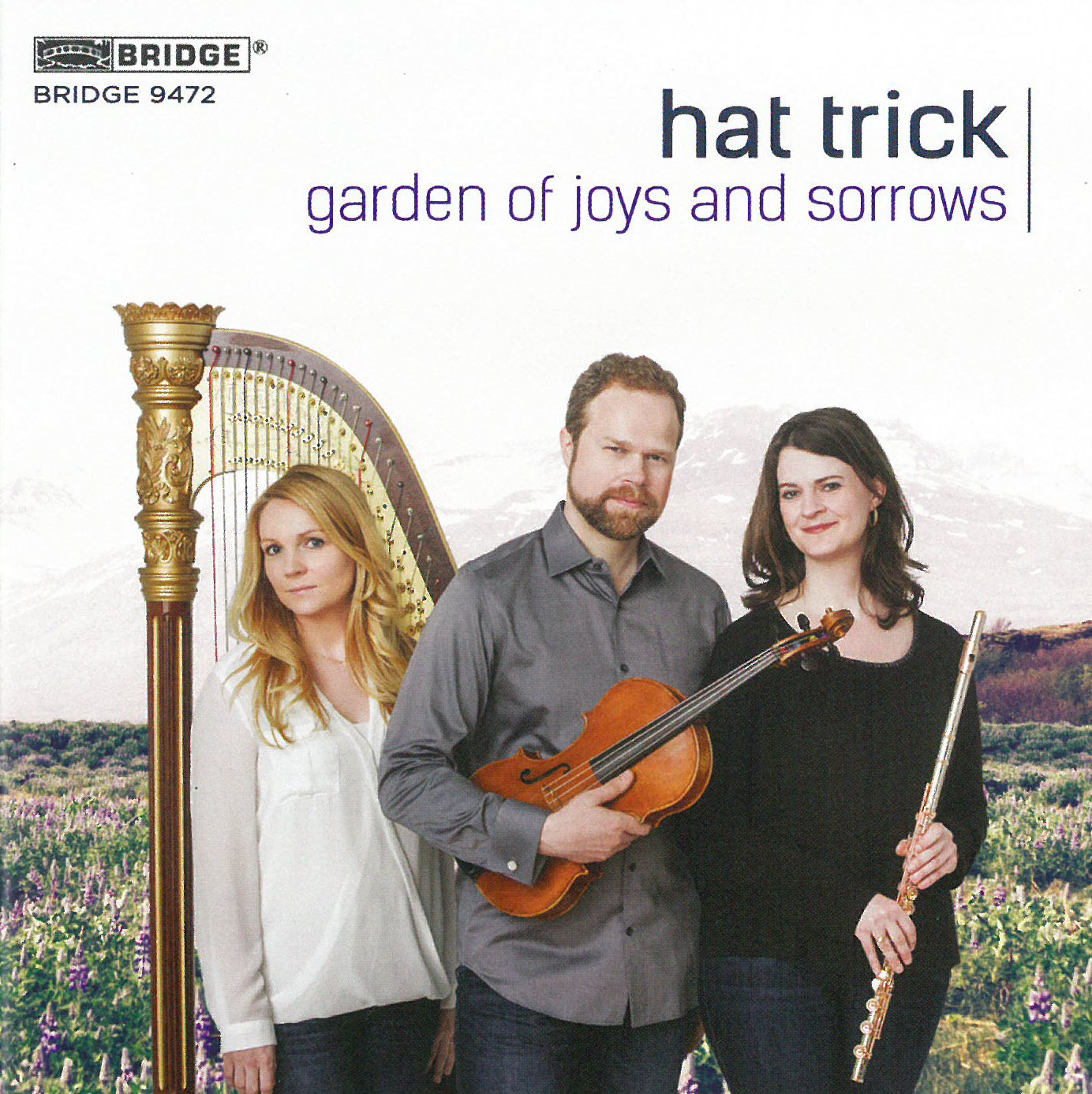
This CD features the first recording of Debussy’s Sonata for Flute, Viola, and Harp (1915) using the new Carl Fischer edition, incorporating original score details differing from the initial publication. The opening Pastorale is somewhat reminiscent of Debussy’s piano prelude The Girl with the Flaxen Hair, yet more mysterious. The New York-based trio Hat Trick plays it with suggestions of light and colour, but without the languorous drooping at cadences I have heard sometimes. In the Interlude following, Hat Trick again resists over-interpretation, letting the tonal feast proceed unhindered. Articulation and ensemble are precise in their spirited Finale.

A conventional Terzettino (1905) by Théodore Dubois was the first piece for flute, viola, and harp, given here with appealing French sentiment. Uruguayan-born Miguel del Aguila’s commissioned work Submerged (2013) here receives its CD premiere. Hat Trick brings excitement and commitment to its dance rhythms and under-the-sea imagery. The group plays Toro Takemitsu’s And then I knew ’twas Wind (1992) with sensitivity to evocative contemporary timbres and textures, the work’s main attractions. I find the tonal material much derived from Messiaen’s scales, though. Sofia Gubaidulina`s 1980 Garten von Freuden und Traurigkeiten (Garden of Joys and Sorrows) is the lengthiest work. Its extended exploration of harmonics, glissandi, percussive harp and many other effects is realized here with maximal facility. Altogether this is a stellar production by Hat Trick – April Clayton, flute; David Wallace, viola; and Kristi Shade, harp – who indeed make every shot count.

03 Weinberg KremerMieczyslav Weinberg – Chamber Symphonies; Piano Quintet
Kremerata Baltica; Gidon Kremer
ECM New Series 2538/39

Review

In his late 60s, Mieczyslav Weinberg began reaching back over 40 years, transforming three unpublished string quartets into three Chamber Symphonies for string orchestra, making numerous changes and composing new movements for each. Many Hindemith-like neo-Baroque melodies and sequences indicate Weinberg’s early stylistic orientation.

 Chamber Symphony No.1 (1986) is sunny, graceful and dance-like, its Presto finale resembling an episode from Prokofiev’s Romeo and Juliet. No.2 (1987) is darker and more dramatic, the newly composed middle movement a wry Mahlerian ländler. No.3 (1990), based on a quartet from 1945, is darker still, its first and third movements sombre reflections of their wartime origins. The vigorous second movement suggests the influence of Shostakovich, Weinberg’s friend and mentor whose stylistic fingerprints cover many pages of Weinberg’s scores, including the newly composed, eerily haunting Andantino that ends No.3.

 As much as I enjoyed No.3, I was unprepared for the emotional impact of Chamber Symphony No.4 (1992), Weinberg’s last completed work, containing quotations from several of his mature compositions. Here, Weinberg truly sounds like no one else but himself. In this profoundly affecting music, I hear a lifetime of experiences – long-ago loves, losses, pleasures and griefs, the klezmer clarinet an aching echo from Weinberg’s childhood in Poland, before he fled the Nazis to live in Russia. I consider it a masterpiece.

 Weinberg’s youthfully robust Piano Quintet (1944), arranged by Weinberg enthusiast Gidon Kremer and percussionist Andrei Pushkarev, completes this very significant and satisfying 2-CD set.

04 KurtagGyörgy and Márta Kurtág play Kurtág
György Kurtág; Márta Kurtág
BMC Records CD 233 (bmcrecords.hu)

In February 2016 the city of Budapest celebrated György Kurtág’s 90th birthday with something few living composers receive: an eight-day festival. The internationally renowned Hungarian composer is also a pianist, who for decades served as an influential professor of piano and later of chamber music at the Franz Liszt Academy of Music. Márta, his wife of over 65 years, is also a pianist, and they have performed and recorded together for almost as long.

Of the 43 pieces/tracks on the CD, 39 are from the composer’s Játékok (Games). Begun in 1973, Játékok is an ever-growing extensive collection of aphoristic solo and duo piano “pedagogical performance pieces.” Presently numbering eight volumes, they mark significant stages in the development of Kurtág’s oeuvre.

Kurtág explains his initial motivation for the Játékok series was “suggested by children playing spontaneously…for whom the piano still means a toy.…They pile up seemingly disconnected sounds, and if this happens to arouse their musical instinct they look consciously for some of the harmonies found by chance and keep repeating them.”

This disc presents previously unreleased live concert recordings as well as those made by the Kurtágs for Hungarian Radio over a period of 23 years. Performed close to the date they were composed, they preserve the composer’s germinal vision for the works, many of which are meant as miniature memorials for friends or musicians. Here is one of the paradoxes of these works: the remarkable power of a sonic fragment to suggest vast space or timelessness.

Not simply a series of dry pedagogic piano exercises, Játékok explores Kurtag’s signature sound world marked by concentration and sonic intensity hand in hand with the exploration of a very wide range of human experience. It’s a world in turns playful and intellectually exploratory, evoking flowers as much as death and tears. This is music which richly rewards repeated visits.

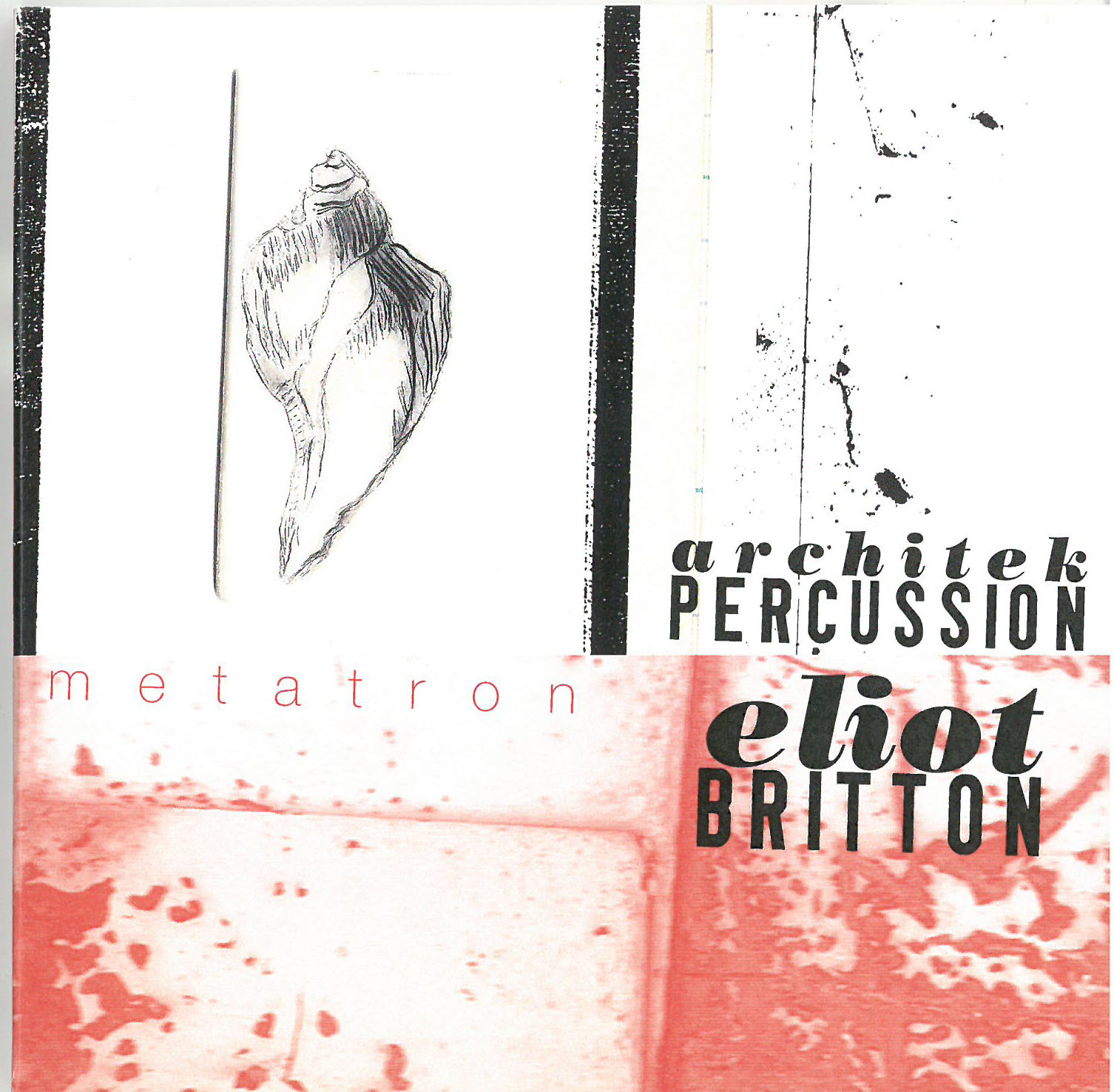
05 Eliot BrittonEliot Britton – Metatron
Architek Percussion
ambiences magnetiques AM 232 CD (actuellecd.com)

Metatron was composed as part of Eliot Britton’s doctoral dissertation at McGill a couple of years ago, and it has now happily been recorded by Montreal-based quartet Architek Percussion. This music is the result of a very purposeful collision of two different sound worlds: the kaleidoscopic sounds of Architek’s drums, cymbals, other percussive instruments and synthesizers are woven together with recorded samples of old vinyl, mostly jazz and swing music. Britton has deftly integrated these two sources, not only exploiting the obvious sonic dissonances between them, but also finding surprising ways to bring them into harmony with each other.

The liner notes say that Britton was partly inspired by memories of destroying his childhood piano with a chainsaw, an experience that led him to reflect on the relationships between technology, history, and our musical lives. At times the pummelling power of the percussion certainly feels like it is annihilating the sampled music, but Britton also reserves sparser passages for the samples to stand on their own, offering brief glimpses of earlier musical aesthetics between the percussion and electronics.

Metatron is a thrilling record, though perhaps not one for all occasions. Bristling with a youthful energy and fearlessness, at times it reaches the same rhythmic intensity as techno, making it a record that is more likely to give you a jolt than soothe you.

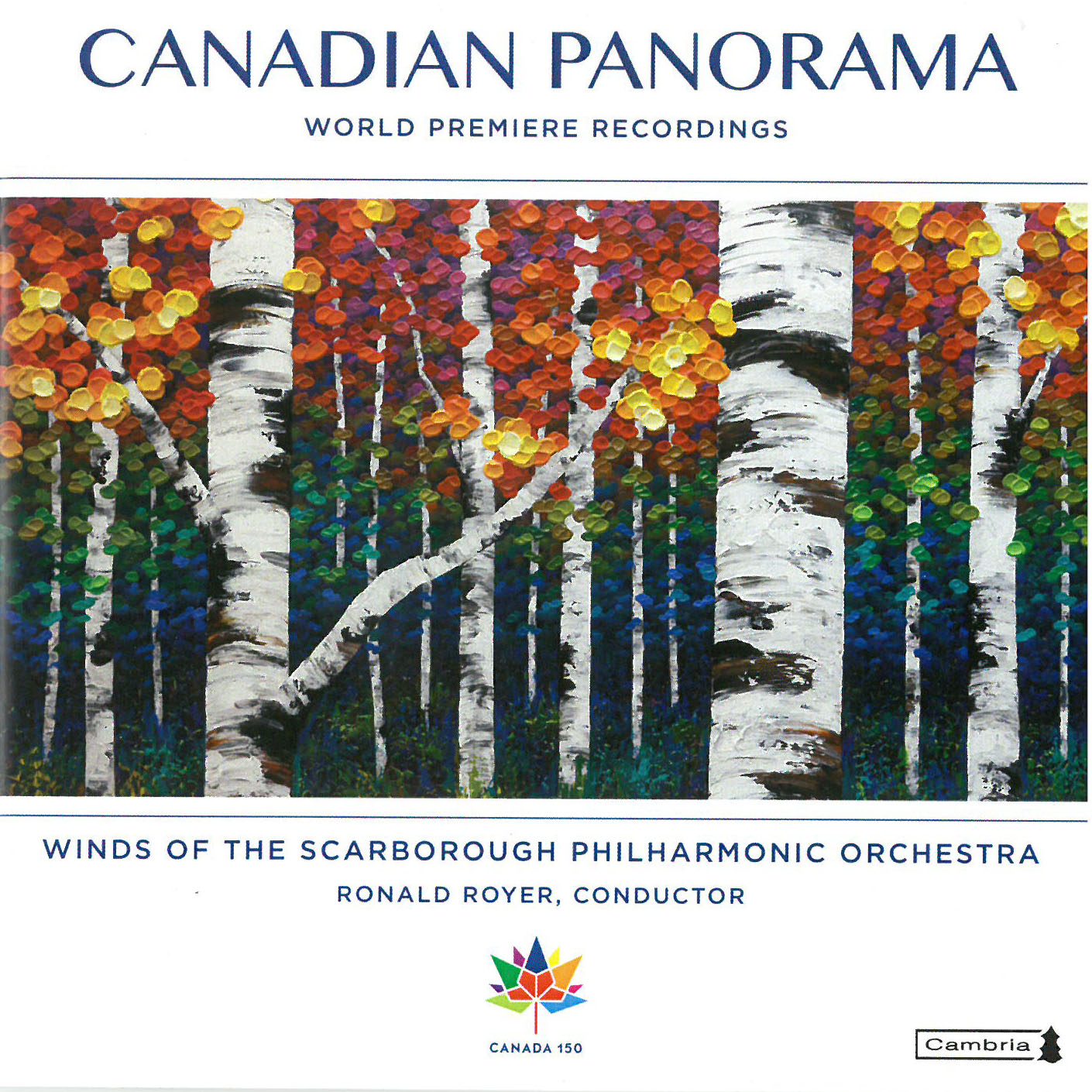
01 Canadian PanoramaCanadian Panorama
Winds of the Scarborough Philharmonic Orchestra; Ronald Royer
Cambria CD-1227 (spo.ca)

Under the inspired leadership of music director Ron Royer, the Scarborough Philharmonic Orchestra not only presents an annual concert series but has also created an identity for its woodwind, brass and percussion sections as a professional level wind ensemble in its own right, performing demanding music for wind ensemble and now recording a complete CD of music commissioned for it as part of the orchestra’s dynamic composer-in-residence program.

Seven of the eight Canadian composers on the CD (the eighth was the late Howard Cable, a longtime associate of the SPO) were commissioned in 2013 to compose “music that would celebrate Canada’s cultural heritage and expand the repertoire for our talented wind players.” They have done their job brilliantly: while all eight are very capable orchestrators, three in particular stand out: Chris Meyer’s control of tone colour in Fundy is striking, as is Alexander Rapoport’s in his spiralling virtuosic writing in Whirligig, flawlessly played by this ensemble of virtuosi. Howard Cable’s mastery, more traditional perhaps and understated, in McIntyre Ranch Country was, nevertheless, a very welcome addition to the mix.

In Royer’s Rhapsody for Oboe, Horn and Wind Ensemble the confidently virile solo horn of guest soloist Gabriel Radford and guest oboist Sarah Jeffrey’s poignant lyricism were highlights. There was also some very fine solo work by regular members of the ensemble: Scott Harrison on trumpet in Alex Eddington’s Saturday Night at Fort Chambly, Kaye Royer on the clarinet in Jim McGrath’s Serenade and Iris Krizmanic on horn in McIntyre Ranch.

In short, this recording and the music so beautifully performed on it are, and will continue to be for many years, a precious gift to us all in the year of our nation’s 150th birthday.

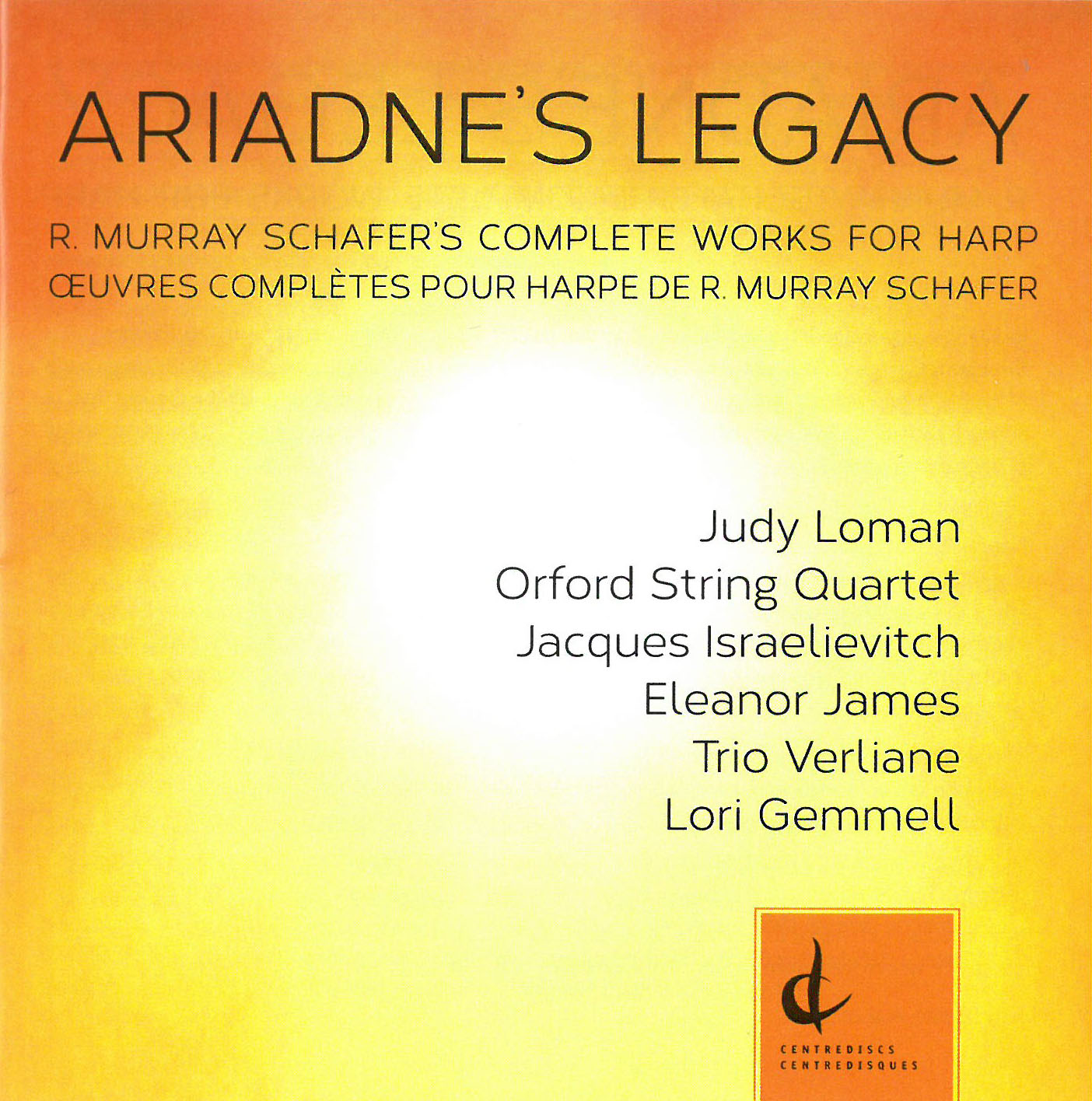
02 Schafer AriadneR. Murray Schafer – Ariadne’s Legacy
Judy Loman and Various Artists
Centrediscs CMCCD 23316
(musiccentre.ca)

Judy Loman, principal harpist with the Toronto Symphony Orchestra from 1960 to 2002, is a graduate of the Curtis Institute of Music where she studied with the innovative harpist Carlos Salzedo. In her many years here and abroad she has championed numerous new works for her instrument. Many of these compositions involved Canada’s internationally renowned polymath R. Murray Schafer and in celebration of Loman’s 80th birthday Centrediscs has re-issued from various sources Schafer’s works for the harp in their entirety. Their first collaboration, The Crown of Ariadne (1979), is a technically demanding six-movement suite in which Loman must also play a number of small percussion instruments. It is derived from Schafer’s vast environmental music drama, Patria 5. A companion work, Theseus (1986), was also drawn from this segment of the 12-part Patria series and features Ms. Loman with the Orford String Quartet. Both works involve the extended harp techniques pioneered by Salzedo with delicate, echoing microtonal inflections pitted against incisive percussive effects. Schafer’s subsequent Harp Concerto (1987) is drawn upon a much larger canvas. Its conventional three movements achieve an almost cinematically epic character in this rousing performance by the Toronto Symphony Orchestra led by Andrew Davis.

A second CD devoted to Schafer’s later chamber music features the intimate duet Wild Bird (1997) with violinist Jacques Israelievitch, commissioned by the late TSO concertmaster’s wife and performed with Loman on the occasion of his 50th birthday. Trio (2011) commissioned by the BC-based Trio Verlaine (Lorna McGhee, flute, David Harding, viola, and Heidi Krutzen, harp) was designed as a companion piece to Debussy’s work for the same forces. Here Schafer strikingly abandons the evocative sound events of his earlier works in favour of a persistently linear melodic profile. Among these late works are two vocal settings: Tanzlied (2004) and Four Songs for Mezzo-Soprano and Harp (2011), both sung by Schafer’s life partner and muse, Eleanor James, the former with Loman and the latter with her former student Lori Gemmell. Tanzlied is a setting of verses by Friedrich Nietzsche and includes quotations from that philosopher’s own little-known Lieder. The surprisingly well-mannered Four Songs was initially composed as a wedding present for Schafer’s niece.

It is doubtful that any further harp works will be forthcoming, as Schafer’s program note for these late songs reveals his recent diagnosis of Alzheimer’s disease. All the more reason then to celebrate these definitive and expertly recorded performances from a golden age.

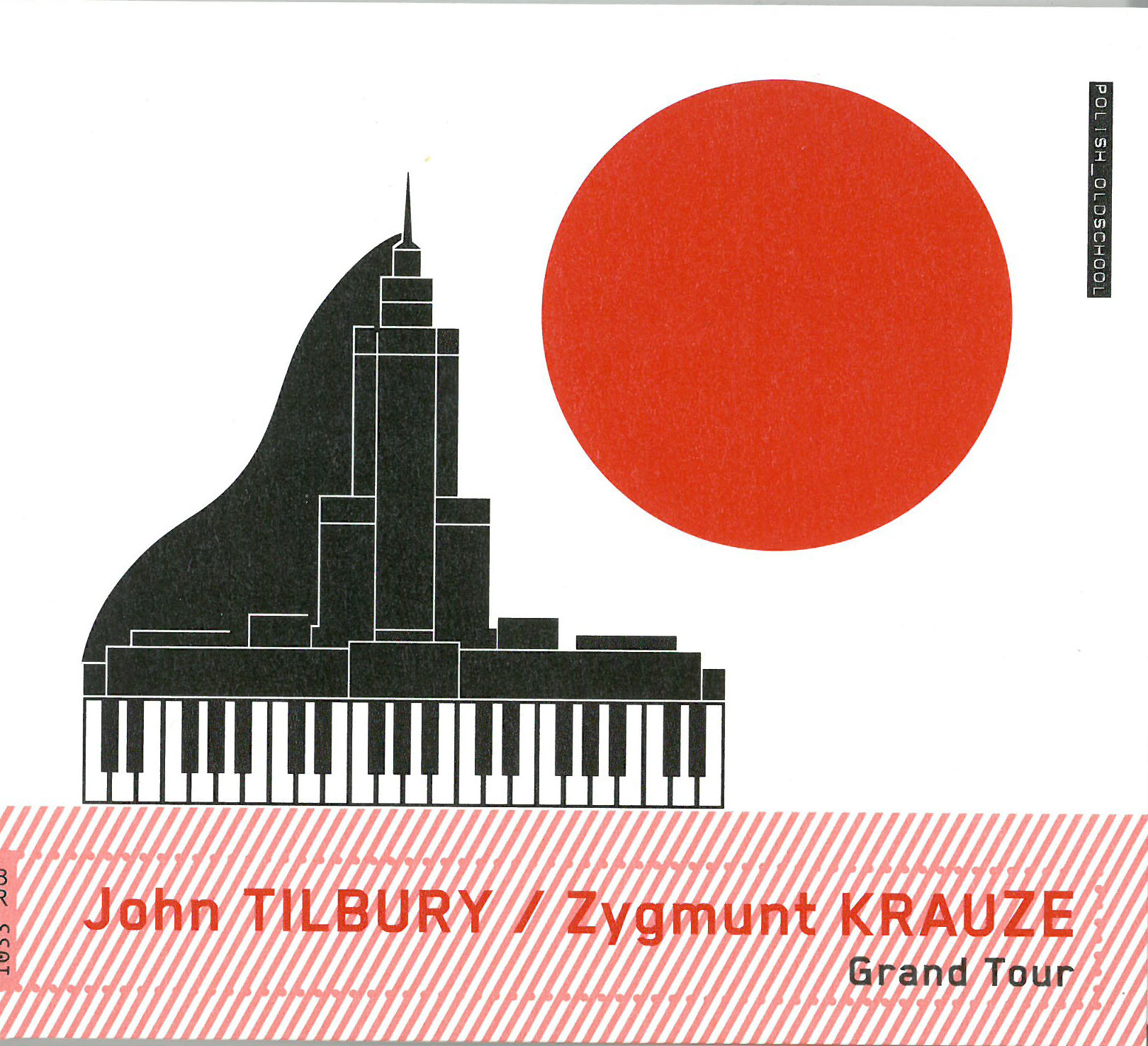
03 Tilbury KrauzeGrand Tour
John Tilbury; Zygmunt Krauze
Dux DUX 1288 (dux.pl)

Maybe it’s just me, but I find this album of 60s and 70s post-classical piano-centric music a supremely relaxing listening experience. Then again as a high school senior I used to do homework with John Cage records playing on the stereo. I wanted to get my modernist/postmodernist cred clearly on the table before digging into details of this Grand Tour. It documents the onstage reunion of two old colleagues, the British pianist John Tilbury and Polish composer, educator and pianist Zygmunt Krauze in the studio of the Polish Radio, performing repertoire from the era when they first met.

The liner notes narrate the backstory. Krauze co-founded the avant-garde-leaning Warsaw Music Workshop in 1967 along with other musicians. Tilbury. who was in Warsaw on scholarship at the time. is credited with introducing his Music Workshop colleagues to the latest classical music trends via scores – a scarce commodity behind the Iron Curtain in the 1960s – “including many minimalist compositions.” These represented an exciting though quite unknown language there at the time.

All the works here bear repeated pleasurable listening, but my favourite track on the album is Terry Riley’s Keyboard Studies No.2 (1965), in which the two pianists play through a series of notated modal cells of different lengths at their leisure. It’s a repetitive developmental strategy Riley also employed in his better-known In C (1964). It may well have been among the pieces introduced by Tilbury to his Warsaw friends back in the day. Keyboard Studies No.2 receives a lovely, nuanced performance by Tilbury and Krauze. Perhaps it’s a fanciful notion, but I imagine its sonic patina, coloured by the canny application of the pianos’ sustain pedal, is more deeply the result of half a century of living with and performing this charming music. For me 60s-era Riley will never get old.

04 Polish clarinetMusic for Clarinet by 20th Century Polish Composers
Mariusz Barszcz; Piotr Saciuk; Jacek Michalak
Dux DUX 1258 dux.pl

This collection could be renamed music by Mid-20th-Century Polish Composers, roughly following as it does a chronology of three decades beginning in the early 1950s. One finds in many of the selections a homogenous tonal and stylistic range, possibly reflecting the somewhat insular world of Polish composition during the Communist era. Happily, one also hears committed and honest performances by clarinetist Mariusz Barszcz and pianist Piotr Saciuk. While tending sharp in some of the slower and quieter selections, Barszcz has a peckish and puckish articulation, and the rhythmic agreement in the very challenging Dance Preludes by Witold Lutosławski is admirable.

This work, along with Krzysztof Penderecki’s Three Miniatures, are the only ones likely to be performed with any frequency in North America, so it is welcome to hear some of the more avant garde selections toward the end of the disc. Music for magnetic tape and solo bass clarinet by Andrzej Dobrowolski (1980) comes out of the dark corners of one’s psyche and invites itself in for a terrifying and confusing visit. Barszcz can manage the bass clarinet’s registers well and gives a fine accounting of the extended techniques required by the composer. Not Sunday afternoon listening by any stretch, but excellent rainy Monday fare. Krzysztof Knittel’s Points/Lines (for clarinet, tapes and slides, 1973) steps back into the laboratory, a controlled and tidy experiment carried out by a harried researcher.

Wedged between these two works is a Trifle (in two parts), for accordion and bass clarinet by Andrzej Krzanowski (1983).

05 American MomentsAmerican Moments
Neave Trio
Chandos CHAN 10924

“American” moments? Twelve-year-old wunderkind Erich Korngold was living in Vienna when he composed his Trio, Op.1 (1910), a well-constructed, exuberantly expressive piece already evincing some distinctive melodic turns that would reappear throughout his mature music. The Neave Trio seems to approach it from the perspective of those later works, with a sense of nostalgia rather than youthful ardour. (Korngold emigrated to the US in 1938.)

Leonard Bernstein’s Trio dates from 1937, when he was 19, studying at Harvard. Unpublished until after his death, it opens meditatively, leading to an extended Fugato and an exultant climax. The second movement anticipates the jazzy Bernstein, with pizzicato, blue notes and dancing syncopations. The finale begins with a questioning melody, answered by a rousing Jewish-klezmer romp. New to me, I quite enjoyed it.

Arthur Foote, in contrast, was 55 and well-established when he wrote his Piano Trio No.2 (1908). Considered the first significant composer trained entirely in the US, he, like most of his American contemporaries, still drew inspiration from European models. The first two movements, lilting, sweet and sentimental, are perfumes from a Viennese salon; the weightier finale evokes Foote’s much-beloved Brahms.

America, like Canada, is a nation of immigrants, making the Neave Trio, currently visiting artists at Brown University, truly American, with its violinist from the US, cellist from Russia and pianist from Japan. Their performances of these stylistically varied works amount to a concert program for home listening that’s highly entertaining.

Back to top