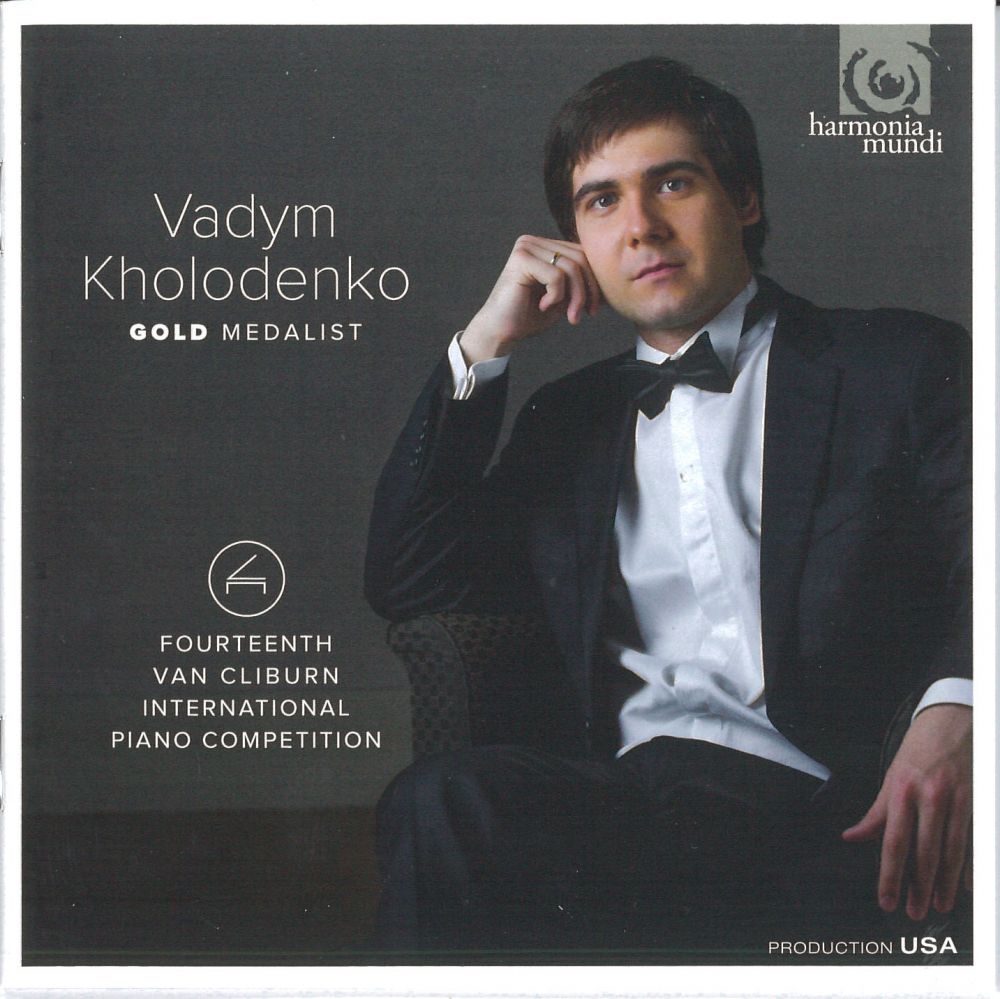
Gold Medalist
Vadym Kholodenko
Harmonia Mundi HMU 907605

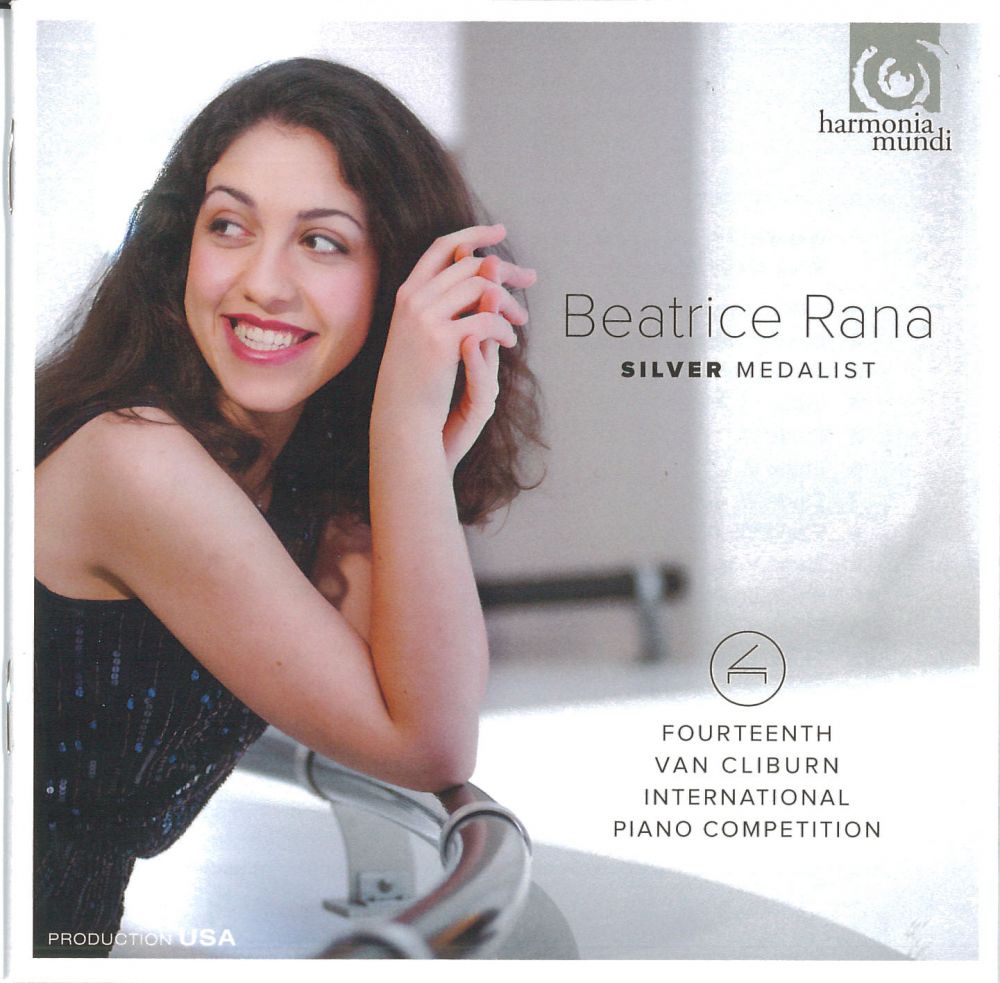
Silver Medalist
Beatrice Rana
Harmonia Mundi HMU 907606

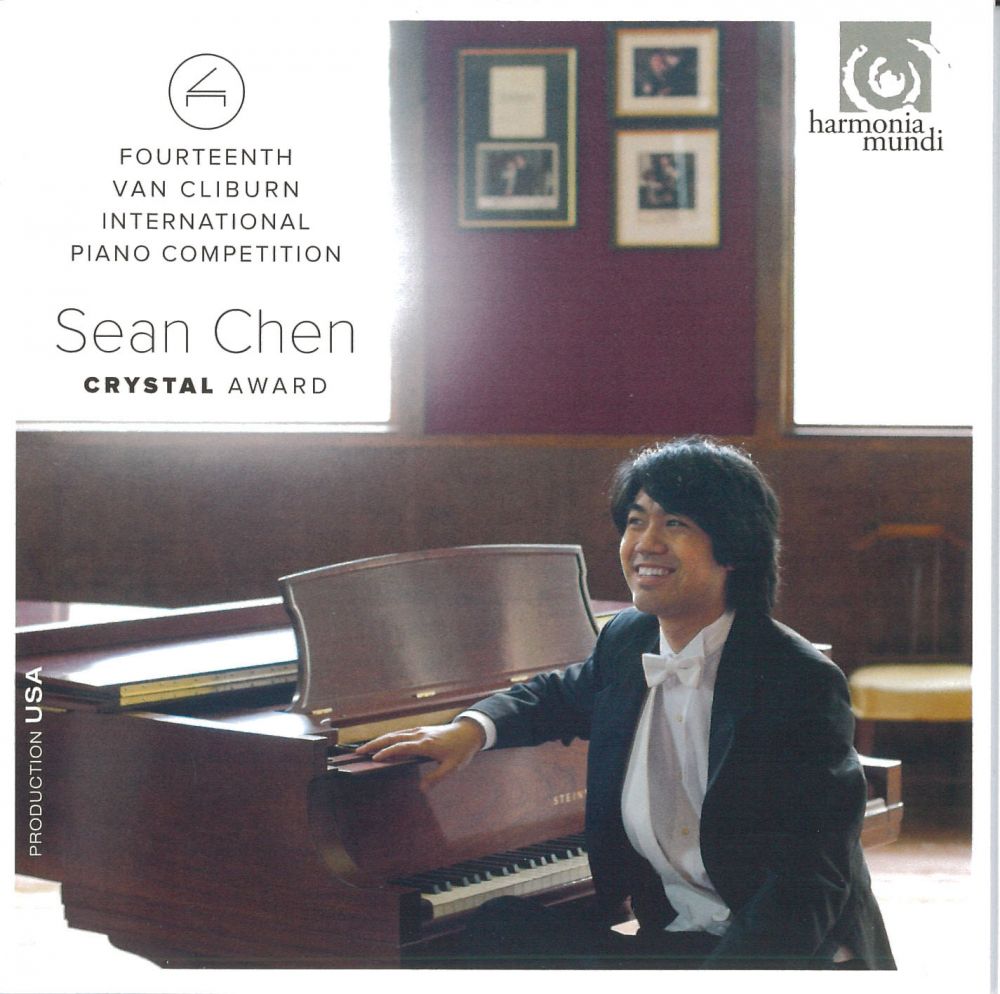
Crystal Award
Sean Chen
Harmonia Mundi HMU 907607

Three winners emerged from the 14th Van Cliburn Competition in May/June 2013 to prove once again how unique and individuated such pianistic brilliance can be. A Ukrainian, Vadym Kholodenko, age 26, won the gold. Silver went to 20-year-old Italian Beatrice Rana and an American of 24, Sean Chen, received the crystal award. In addition, the winners also received three years of commission-free career management. These performances were recorded live in Fort Worth with audiences barely able to withhold their applause until the final chords faded completely. Considered together, these three young artists offer intriguingly different approaches to their music and its instrument.

04 classical 02a van cliburn kholodenkoGold medalist Kholodenko chose an endurance program of Stravinsky (Petrouchka) and Liszt. The Transcendental Etudes, best known for the broad range of their technical demands, never seem to tax Kholodenko. He rises easily above them to allow himself generous interpretive ground. Here he plays wistfully with the melodies of Feux Follets and Harmonies du Soir, drawing out Liszt’s inner themes woven across left and right hand parts. His muscular approach to Mazeppa and Wilde Jagd leave no doubt about his power over the instrument as he makes it roar louder than either of his winning competitors. Similarly, his approach to Petrouchka demonstrates a remarkable clipped staccato in the very opening phrases that adds razor sharpness to the phrasing unlike what most other pianists are able to achieve. This power is beautifully contrasted with his playing of the second movement where a gentle legato and light touch confirm exactly why his medal was the gold.

04 classical 02b van cliburn ranaRana, the silver medalist, brings an elegant, dance-like style to her Schumann, Ravel and Bartók. Schumann’s Symphonic Etudes are very dense at times requiring the utmost in accuracy and articulation. Rana is wonderfully adept at drawing out melodies from within this quasi-orchestral score. The ninth etude, although only a few seconds in duration, is an excellent example of how she does this while sustaining a relentless driving pulse around the theme. Her performance of Ravel’s Gaspard meets every expectation for superbly fluid playing in the opening “Ondine.” “Le Gibet” and “Scarbo” each show us how well Rana can shift to a portrayal of darkness and mystery.

Perhaps most convincing is her primal and somewhat savage approach to Bartók’s Out of Doors. Despite the gentler requirements of the second and fourth movements, the opening almost puts the piano at risk as she astonishes the audience with her raw power. A performer with a demonstrably impressive interpretive ability, one understands why she also won the Audience Award.

04 classical 02c van cliburn chenFinally, Chen, winner of the crystal award performs a program of Brahms, Beethoven and Bartók. This young American pianist takes his Bartók just as seriously as his formidable Italian competitor but regards the composer’s rhythmic and harmonic angularity with more romance and less anger. A very different but very creditable approach. Chen is a thinker, a pianist who clearly appreciates clean structure. This is what informs all his playing. Nowhere is this more evident than in the closing epic fugal movement of Beethoven’s Hammerklavier. Adjectives simply fail to describe Chen’s grasp of how Beethoven built this complex edifice. He plays it brilliantly. The cheering audience reaction says it all.


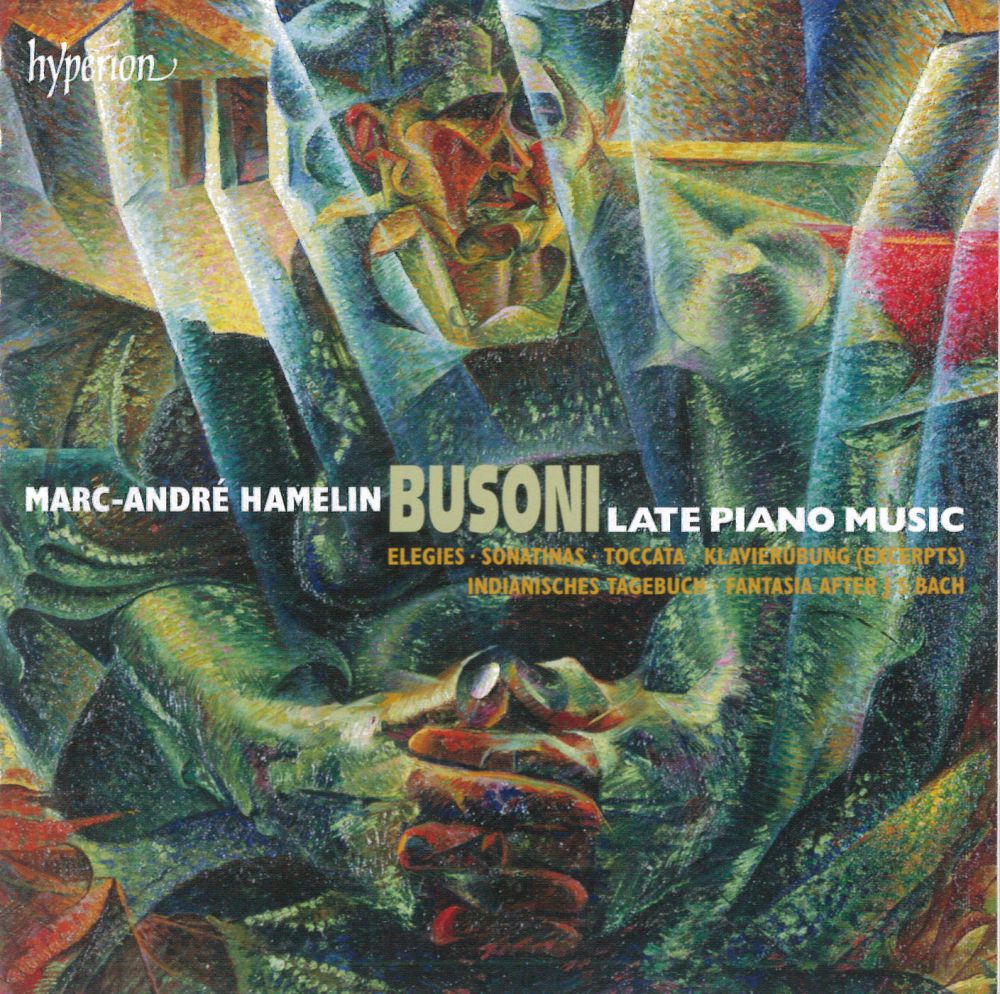
04 classical 03 busoni pianoBusoni – Late Piano Music
Marc-André Hamelin
Hyperion CDA67951/3

Canadian pianist Marc-André Hamelin has recorded some 50 albums on the Hyperion label of generally unfamiliar and often extremely virtuosic repertoire to great critical acclaim. His recent release of three CDs devoted to the late piano music of Ferruccio Busoni represents another milestone in an outstanding career.

The repertoire covers the last 15 years of Busoni’s life and includes a number of pieces which self-reference his lesser-known orchestral works. CD 1 opens with the pivotal collection of seven Elegies composed in 1907. According to the composer, “My entire personal vision I put down at last and for the first time in the Elegies.” These works reveal a tonal expansion of his earlier, more facile and traditional approach. The title is misleading, as these works are far from funereal. As might be expected from the only child of an Italian father and German mother, both of them professional musicians, Busoni’s style is cosmopolitan in the extreme, freely mixing influences ranging from an exuberant Italianate Tarantella (later incorporated into his massive Piano Concerto, recorded by Hamelin in 1999 in a staggering performance) to variations on the well-known English folk song Greensleeves (strangely, Busoni had been led to believe this melody was of Chinese origin and had used it as such in his opera based on Gozzi’s play Turandot).

CD 2 is largely devoted to Busoni’s six Sonatinas, again of exceptional emotional range, from the inward-looking Sonatina seconda (containing thematic references to his opera Doktor Faust) to the sixth, overtly Lisztian, Kammer-Fantasie über Carmen that concludes the cycle. One even finds an intriguing example of “World Music.” Busoni had toured the United States repeatedly in the early 20th century and while resident there took a keen interest in the Native American music which had been brought to his attention by Natalie Curtis, a former piano student of his who gifted him a copy of her massive 1907 volume of pioneering ethnomusicological transcriptions, The Indians’ Book. Busoni responded with a handful of Indian-inspired works including his Indian Diary in which short motifs from her collection appear as thematic springboards for his kaleidoscopic inventions.

Many of the pieces included on CD 3 have a pedagogical purpose. Opening with a fabulously fleeting performance of the demanding Toccata of 1920, the bulk of the disc is devoted to a generous sampling from his late Klavierübung volumes which explore technical issues involving trills, staccato passages and polyphony as well as an intriguing set of variations on Chopin’s familiar Prelude in C Minor. These three discs contain a number of pieces not previously recorded and also include a sampling of the numerous Bach arrangements Busoni is best known for. The programming is exemplary, the sound is alluring (from a Steinway piano recorded in London’s Henry Wood Hall) and the program notes are excellent. Bravo Hamelin!


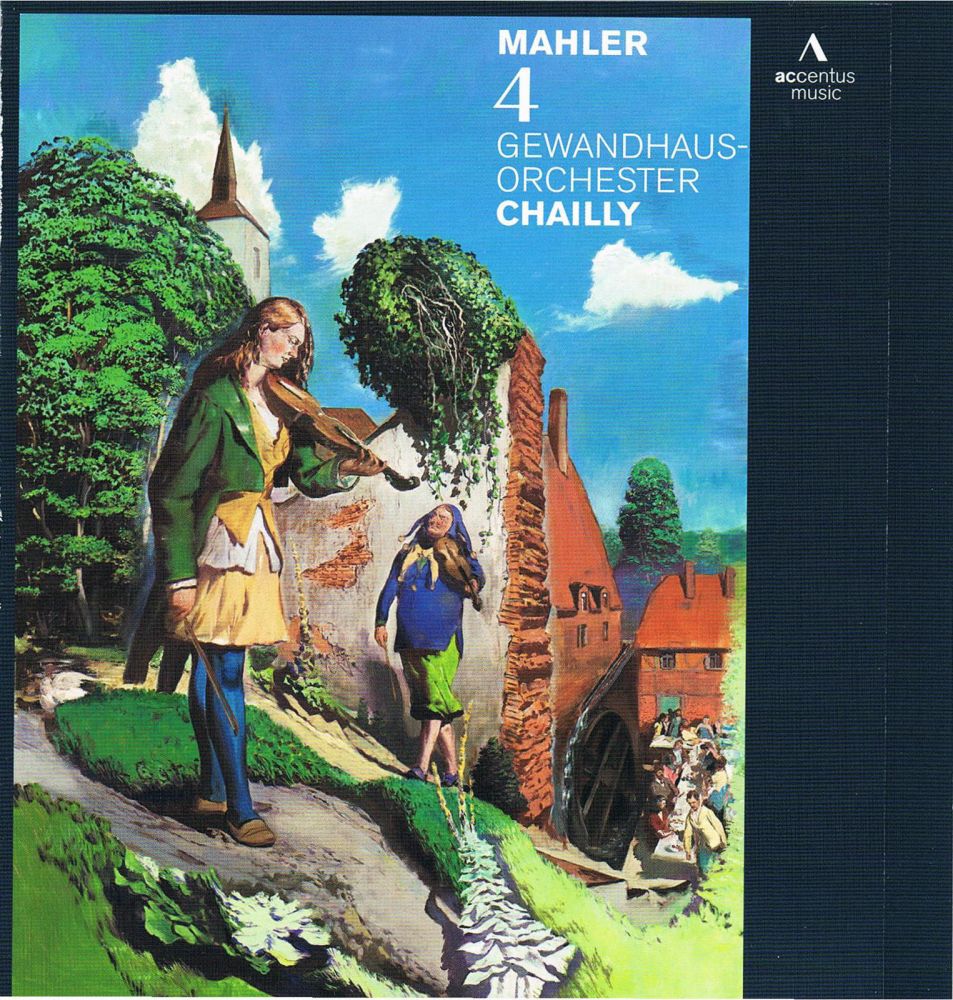
04 classical 04a mahler 4 chailly04 classical 04b mahler 6 chailly - from amazonMahler – Symphony No.4 in G Major
Christina Landshamer; Gewandhaus Orchestra; Riccardo Chailly
Accentus Music Blu-Ray disc, ACC10257

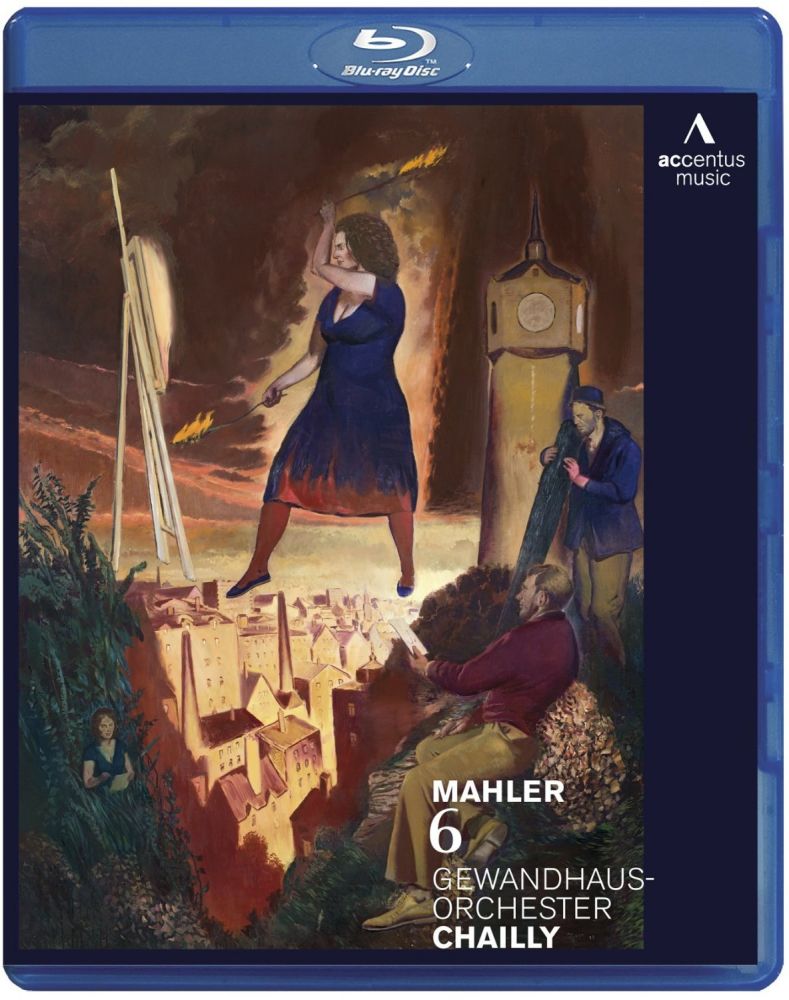
Mahler – Symphony No.6 in A Minor
Gewandhaus Orchestra; Riccardo Chailly
Accentus Music Blu-Ray disc, ACC10268

The new Mahler cycle by Riccardo Chailly and the Gewandhaus Orchestra continues. Chailly already has a complete cycle on CD (which includes Cooke’s realization of the 10th with the Berlin RSO), with the Concertgebouw recorded between 1994 and 2003 when he was their music director, succeeding Bernard Haitink who also had set down a cycle. Both these Concertgebouw performances are cast in the traditional mould.

Most conductors and orchestras that include Mahler in their repertoire are on firm ground delivering performances that do not stray beyond the, by now, traditional way the scores unfold. Tradition, to paraphrase Toscanini, is what you heard in the last bad performance… and so on back down the line.

This new Fourth Symphony disc contains, in addition to the revelatory, searching performance, two bonus features. Mahler is heard playing from the fourth movement on the 1905 Welte-Mignon piano rolls, and Chailly expounds on his new interpretation of the symphony with illustrations from the rehearsals and performance. Chailly: “It is important to take the time to study music you’ve performed many times before. I hadn’t conducted Mahler’s Fourth for 11 years and it felt like unfinished business. I’ve tried to rethink my interpretation from start to finish and give this great symphony a far stronger sense of structure. I’ve started again from scratch. Mahler takes everything to extremes: he takes his climaxes to the limit, and the movement lengths, so you have to pay close attention to the enormous extremes in dynamics…”

The Sixth is immediately arresting.  Chailly reverses the order of the middle movements, returning the “Andante” to second place followed by the “Scherzo,” now an hysterical danse macabre, distanced from the Allegro energico of the first movement. The total performance is a new experience, to say the very least. On the 15-minute bonus track, Chailly and Reinhold Kubik of the International Gustav Mahler Society discuss many aspects of the symphony including, of course, how many hammer blows. Chailly talks about and illustrates, as before, his break away from destructive traditions.

As do the Second (Accentus ACC10238) and Eighth (ACC10222) released in 2012, these nonpareil performances realize Mahler’s genius as an orchestrator and music visionary. As before, no one on the stage is on automatic pilot…they are all in the moment. My attention was rapt through gossamer pianissimos to translucent, shattering tuttis. I’m sold.

Bruce Surtees


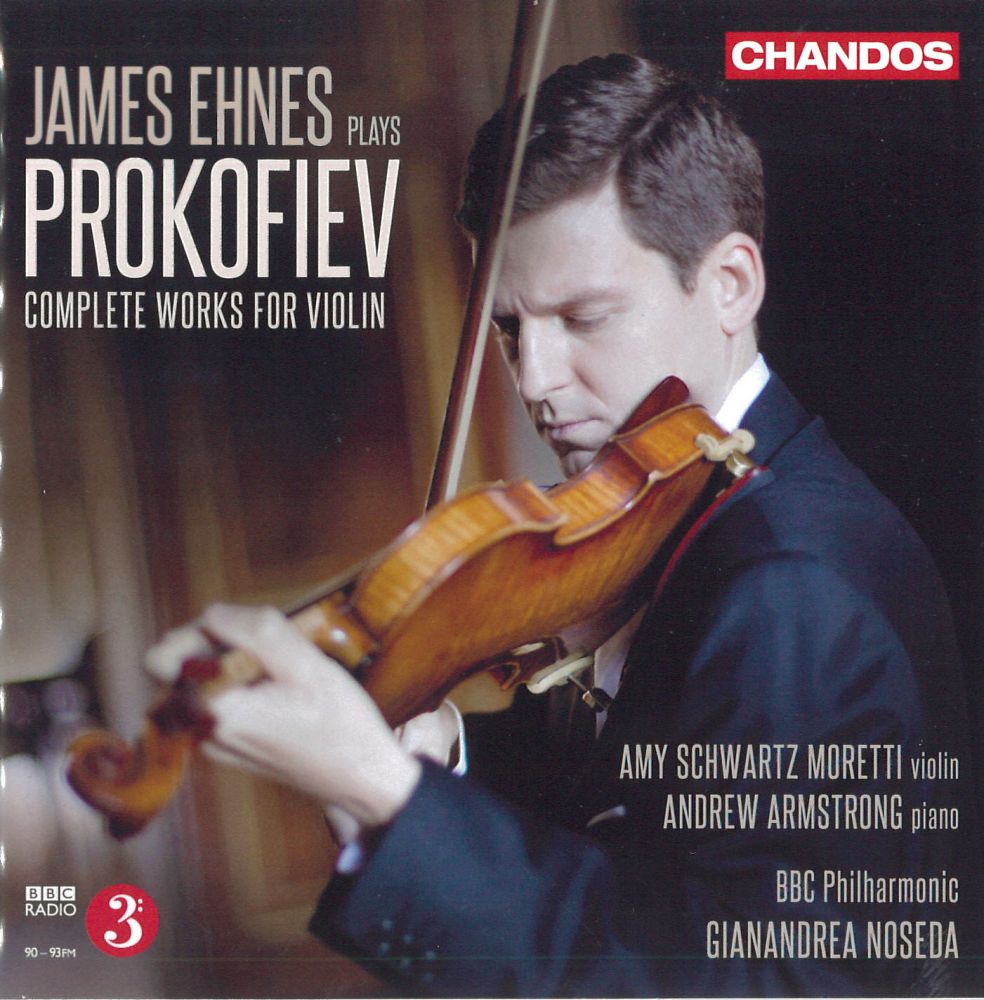
robbins 01 prokofiev ehnesThe latest offering from James Ehnes is an outstanding 2-CD set of the Complete Works for Violin by Sergei Prokofiev (Chandos CHAN 10787(2)). Gianandrea Noseda conducts the BBC Philharmonic in the Violin Concerto No.1 in D Major and the Violin Concerto No.2 in G Minor on disc one, and Andrew Armstrong is the accompanist for the violin and piano works on disc two. Ehnes gives thoughtful and sensitive performances of the two concertos, and is given perfect support by Noseda, a conductor who has few equals when it comes to drawing nuanced, sensitive playing from a large orchestra.

Violinist Amy Schwartz Moretti joins Ehnes in the Sonata for Two Violins, Op.56, and Ehnes gives a spirited performance of the lovely Sonata for Violin Solo, Op.115. The difficult and engrossing Sonata No.1 in F Minor, Op.80, is the major work on disc 2, and Ehnes and Armstrong are outstanding. Although completed in 1946, three years after the sonata we know as No.2, Prokofiev had started work on it in 1938.

The Five Melodies Op.35bis were transcribed by Prokofiev in 1925 from his original 1920 version for voice and piano. The final work on disc two is the Sonata No.2 in D Major, Op.94bis, the composer’s transcription of his Flute Sonata from 1943.

Balance and sound quality throughout are up to the quality you would expect from a thoroughly satisfying CD set.

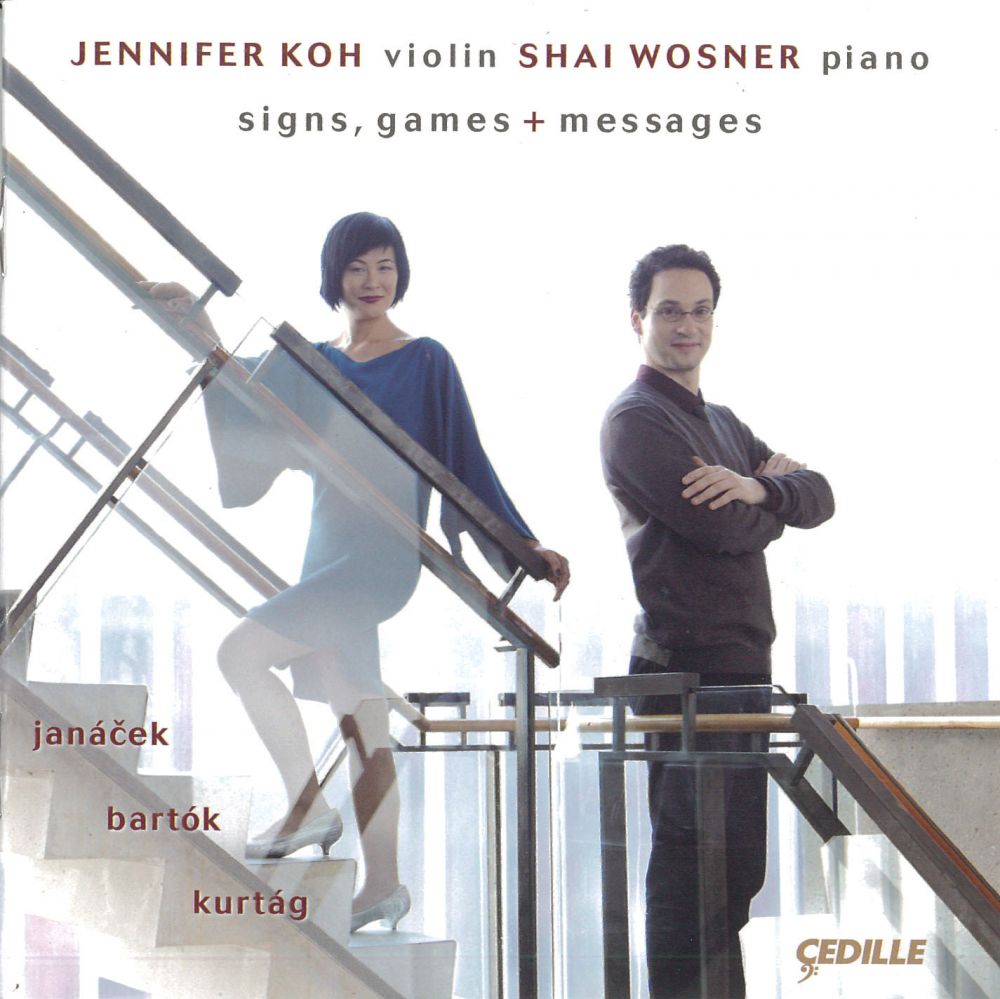
robbins 02 jennifer kohMy eyes light up whenever I see a new Jennifer Koh CD from the Cedille label, and the latest release from this most intelligent of performers, signs, games + messages (CDR 90000 143) certainly doesn’t disappoint. Koh is joined by pianist Shai Wosner in a recital that features works by Leoš Janáček, Béla Bartók and the 87-year-old Hungarian composer György Kurtág. Koh and Wosner, in a joint statement in the excellent booklet notes, cite their desire to explore the tension between the visionary modernism of the works and the pull of the folk and cultural memory that is so essential to the personal language of these composers, as the spark for this recital.

There really does seem to be a logical progression through the program, from Janáček’s Violin Sonata, through a selection of short aphorisms by Kurtág, to Bartók’s First Violin Sonata. There are four solo piano pieces from the Játékok series and four solo violin pieces from Signs, Games and Messages in the Kurtág works in addition to three duo works, and the piano pieces in particular have echoes of Janáček’s piano series On An Overgrown Path. The Bartók sonata seems to follow naturally from the final Kurtág work, the In Nomine – all’ongherese for solo violin.

Needless to say, the performing and recording standard throughout is of the highest quality. Once again, Koh provides us with a fascinating journey through a carefully chosen and perfectly balanced program.

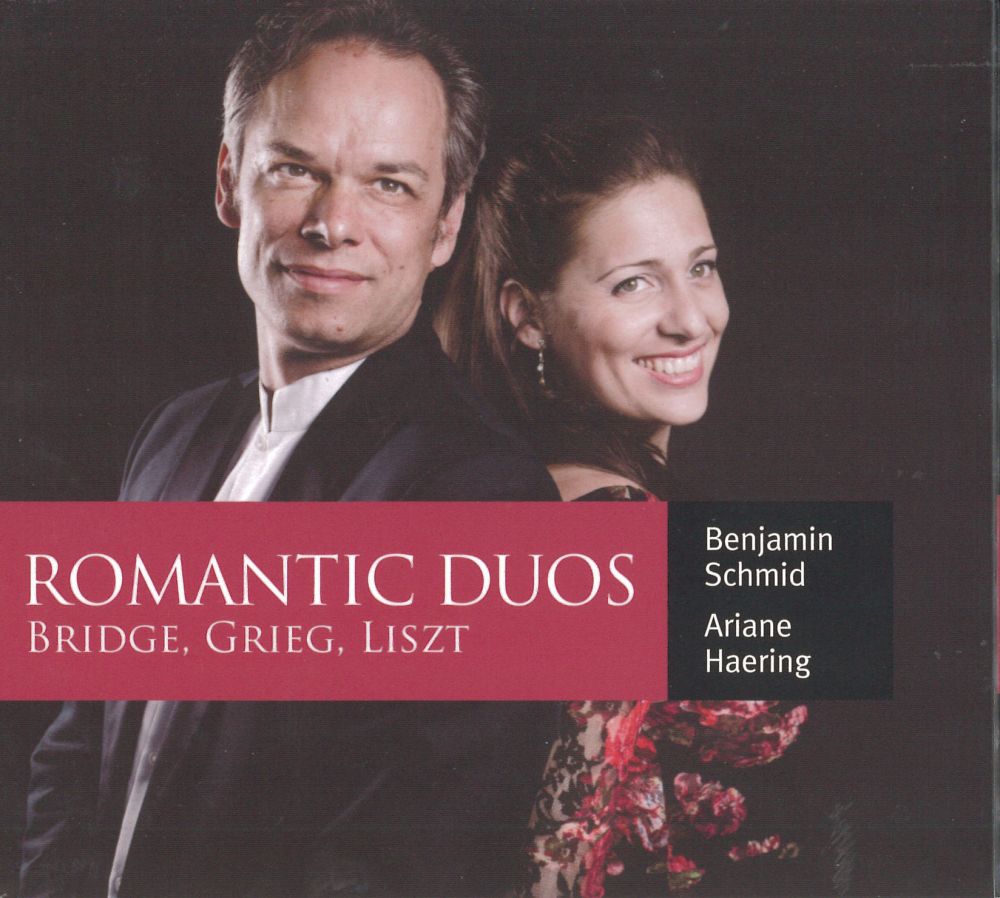
robbins 03 romantic duosThe husband and wife team of violinist Benjamin Schmid and pianist Ariane Haering are in superb form on the CD Romantic Duos, featuring works by Franz Liszt, Frank Bridge and Edvard Grieg (TwoPianists Records TP1039299). Schmid’s tone throughout is rich, warm and full-blooded; Haering is a true partner with a beautiful piano tone, and the balance and sound quality are perfect.

Although usually attributed solely to Liszt, his Grand Duo Concertant was actually a collaborative effort between Liszt and the violinist Charles-Philippe Lafont, whose Romance, Le Marin is the basis for a set of short variations. It’s a lovely work. Liszt’s brief Consolation No.3 was originally one of six solo piano works, and is presented here in a transcription for violin and piano by Nathan Milstein.

The English composer Frank Bridge only published one acknowledged violin sonata, in 1922, but there is an incomplete sonata that pre-dates the Great War, comprising an opening movement and an unfinished second movement. It is this work that is recorded here, with the second movement completed by the Bridge authority Paul Hindmarsh. It’s a beautifully rhapsodic work that draws terrific playing from the performers. Two short pieces by Bridge are also included: Romanze, from 1904 (the same year as the unfinished sonata); and Heart’s Ease, written in the early 1920s. A passionate performance of Grieg’s Violin Sonata No.3 in C Minor, Op.45, completes an outstanding disc.

robbins 04 duo renard

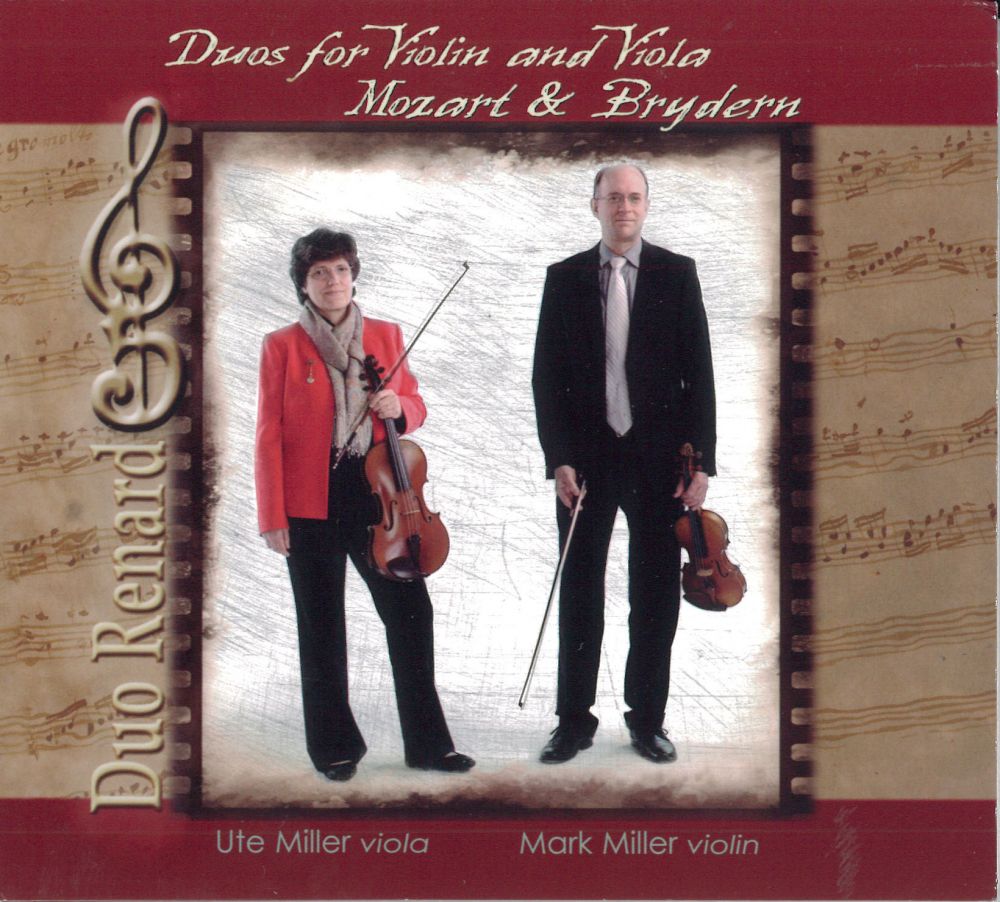
Another husband and wife team, Mark and Ute Miller, perform as the Duo Renard on a CD of Duos for Violin and Viola in works by Mozart and Brydern (Fleur de Son Classics FDS 58011).

It’s clear from the outset that this will be a “sit back and enjoy” CD:  the intonation is spot on; the ensemble playing, phrasing and articulation are all excellent; the tone, balance and recorded sound are beautiful.

The two Mozart works – the Duos in G Major, K423 and B-Flat Major, K424 – were written to complete a set of six duos that Salzburg’s Archbishop Colloredo had commissioned from the ailing Michael Haydn, Mozart’s friend and the brother of Joseph Haydn. Mozart was a superb viola player as well as a first-class violinist, and his understanding of both instruments is clear for all to hear.

The two works by the German-born and U.S.-based Benedikt Brydern (b.1966) are an interesting contrast. The seven-movement suite Bebop for Beagles was commissioned by Duo Renard, and is a tribute to the couple’s two pet dogs. From My Notebook Vol.2 is a collection of four short pieces from 2000, following an earlier series with the same title for solo violin. Movement titles like “Cookies in Space” and “Flea Control: Mission Impossible” give you a good impression of what to expect here: both works are great fun – and very, very good.

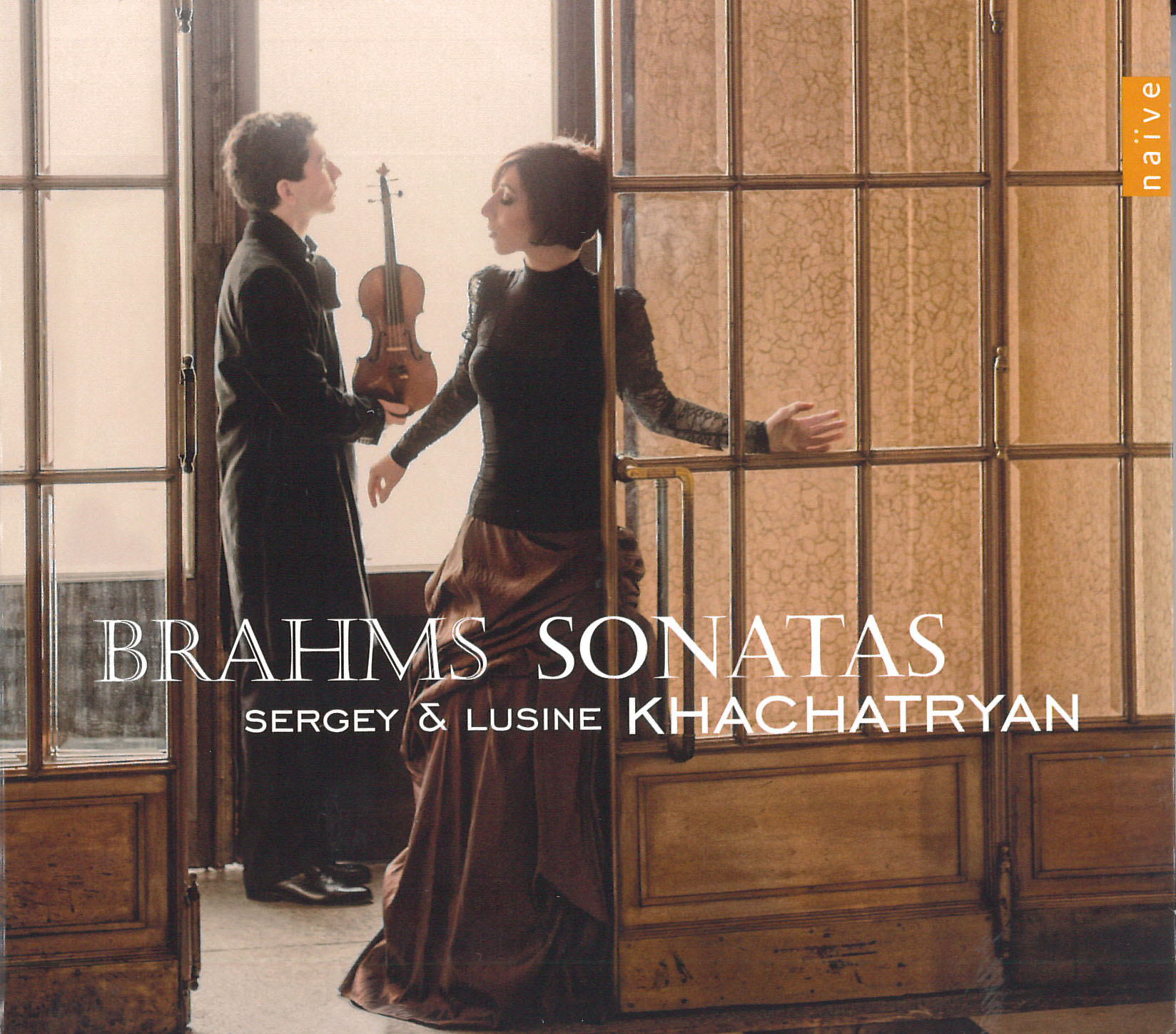
Brahms KhachatryanThe brother and sister violin and piano duo of Sergey and Lusine Khachatryan are back with a beautiful CD of the three Brahms Sonatas (naïve V 5314). These glorious works are the perfect length for a CD and always a great listen; indeed, it would take a pretty bad performance to spoil them.

The Khachatryans make you sit up and take notice right from the start, but for all the right reasons. There is a quiet, introspective start to the G major sonata, and some beautifully expansive phrasing, especially in the piano. The violin vibrato tends to be fairly fast and narrow and is rarely missing, but the sweet tone and thoughtful phrasing mean that there is never any sense of harshness or tightness. The CD was recorded at London’s Wigmore Hall, and the balance and sound quality are ideal.

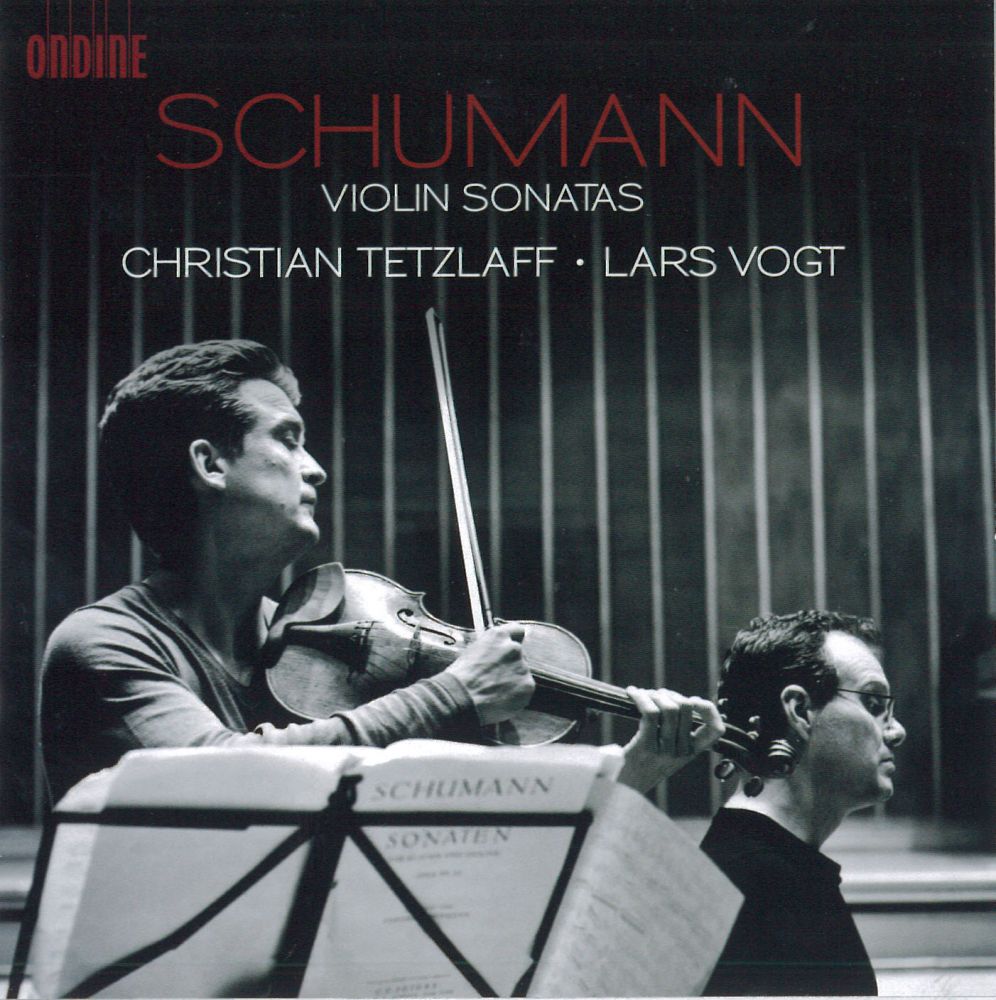
robbins 05 schumann tetzlaffViolinist Christian Tetzlaff and pianist Lars Vogt are in great form on their CD of the Schumann Violin Sonatas (Ondine ODE 105-2). All three sonatas were written towards the end of Schumann’s life, the Sonata No.1 in A Minor and the Sonata No.2 in D Minor within a few months of each other in late 1851. The Sonata No.3 in A Minor has an odd history. Immediately after contributing two movements to the “F.A.E” Sonata on which he, Brahms and Albert Dietrich collaborated in October 1853 as a birthday gift for Joseph Joachim, Schumann added a further two movements to complete the new work; Clara Schumann and Brahms apparently prevented its being included in the complete edition of Schumann’s works though, and it wasn’t published until 1956.

Tetzlaff and Vogt apparently immersed themselves in Schumann’s late works in preparation for this recording, and it shows; their playing is warm and fluent, and they clearly have a great affinity for the material on a terrific CD. Their performance of the third sonata in particular makes you wonder why it was suppressed for so long.

Two ongoing string quartet series came to an end with recent releases; by coincidence, in-depth reviews of earlier volumes in both series were included in the same Strings Attached column in March 2012:

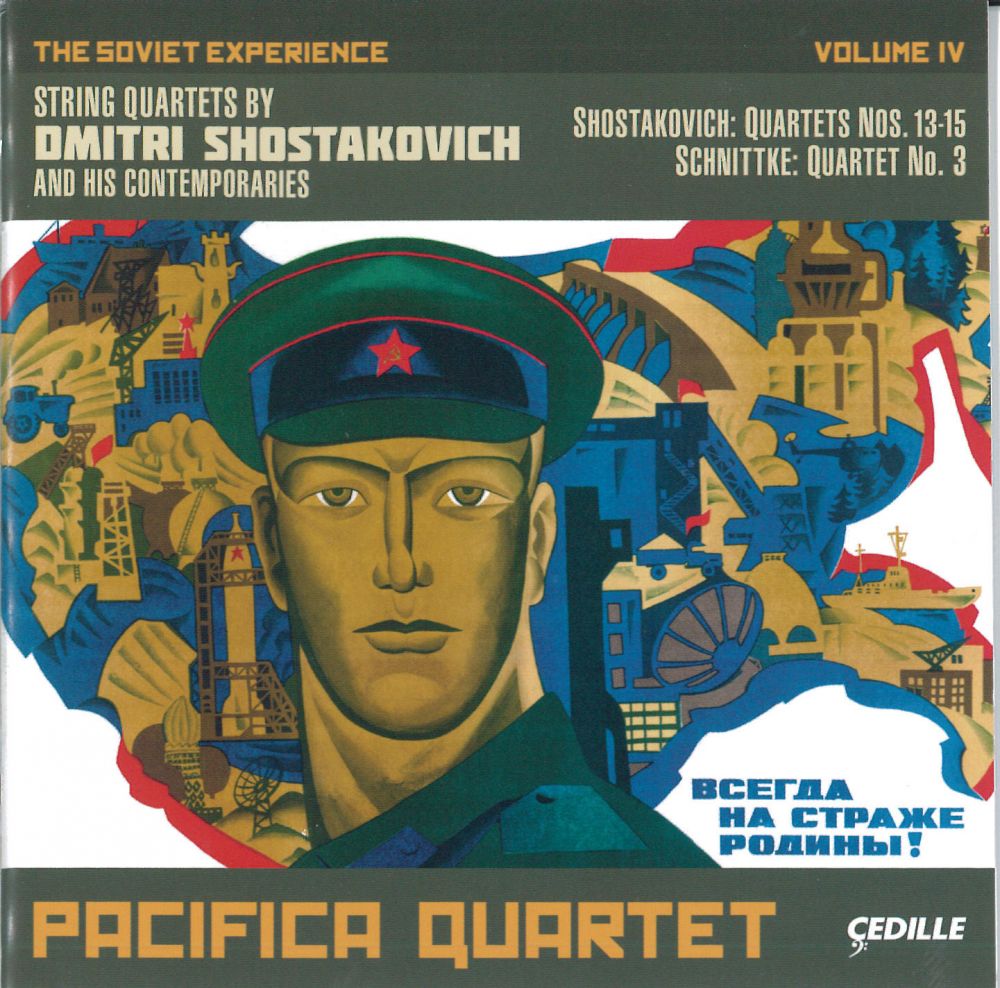
robbins 06 pacifica shostakovich ivVolume IV of The Soviet Experience, the outstanding Cedille series of String Quartets by Dmitri Shostakovich and his Contemporaries, features quartets numbers 13 to15 by Shostakovich in stunning performances by the Pacifica Quartet (CDR 90000 145). What has added immeasurably to this series, though, is the addition of contemporary Russian string quartets to each volume. This time it’s the String Quartet No.3 by Alfred Schnittke that completes the 2-CD set. Everything about this wonderful series has been of the highest order: the performances; the recording quality; the cover artwork; the booklet notes; the choice of contemporary works. The word “definitive” keeps cropping up in the various reviews of previous sets in this series, and even in the face of some extremely strong competition it’s very difficult to imagine a more compelling or satisfying collection of these wonderful works. Add the fact that all four volumes are currently on sale on the Cedille website for around US$13 each, and the words “must buy” come to mind!

robbins 07 meyer quartetsThe Naxos release of the String Quartets Nos.1, 2, 3 and 4 by Polish composer Krzysztof Meyer is also a fourth and final volume, this time in the series of the complete quartets performed by the Wieniawski String Quartet (8.573165). These early works run from the Op.8 of 1963 to the Op.33 of 1974, and show a developing but confident composer willing to experiment with sounds and forms. The members of this Polish ensemble are completely at home with these important works by their compatriot, and the four volumes constitute an impressive set.

Two other CDs continue ongoing series:

robbins 08 saint-saens sonata 2French violinist Fanny Clamagirand is joined by her regular duo partner, pianist Vanya Cohen in the second volume of Saint-Saëns Music for Violin and Piano (Naxos 8.572751). The main works here are the Suite in D Minor, Op.16 and the Violin Sonata No.2 in E-Flat Major, Op.102; there is also a very early – and very brief – unfinished sonata, although “hardly started” might be a better description. A short Méditation and two works originally for cello – the Romance in C Major, Op.48, and The Swan – round out the CD.

Saint-Saëns’ music may not have impacted the course of musical history, but it’s of a very high quality. Clamagirand and Cohen have exactly the right mix of technical bravura and musical insight to make these works sound terrific. Volume 1, featuring the Violin Sonata No.1, is available on Naxos 8.572750.

robbins 09 maxwell davies concertosThe Naxos series of the 10 Strathclyde Concertos by Peter Maxwell-Davies continues with the Concerto No.5 for Violin, Viola and String Orchestra, coupled with the Concerto No.6 for Flute and Orchestra (8.572354). Both works were written in 1991, and were recorded two years later for the Collins Classics label by the artists to whom the works were dedicated and who gave the premieres: violinist James Clark; violist Catherine Marwood; flutist David Nicholson; and the Scottish Chamber Orchestra conducted by the composer. This Naxos CD is a reissue of those recordings. The performances of these high-quality works are clearly definitive, although there is little to stir the blood in either concerto.


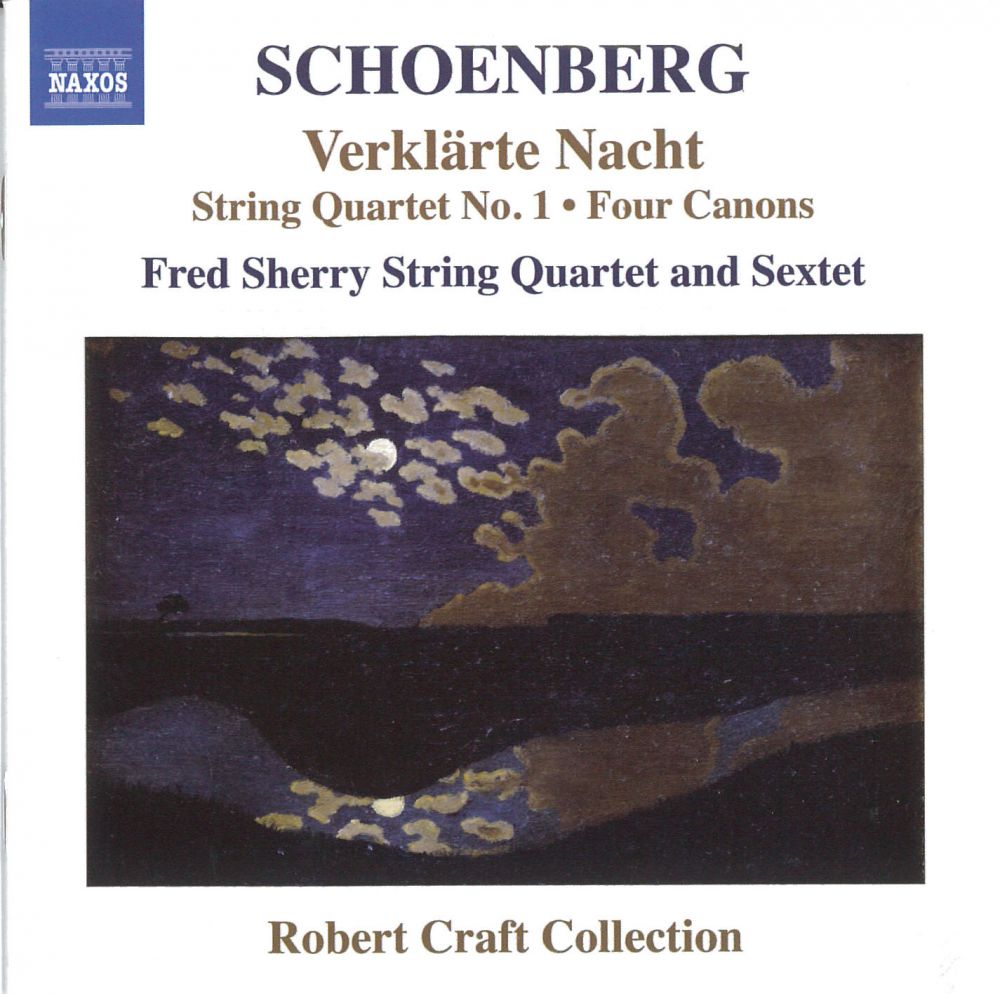
robbins 10 schoenberg sherrySchoenberg’s Verklärte Nacht
is available in a new version, this time coupled with the String Quartet No.1 in performances by the Fred Sherry String Quartet and Sextet (Naxos 8.557534). Leila Josefowicz is the first violin here, and the disc is part of an ongoing series of Schoenberg recordings under the direction of the legendary Robert Craft. Despite this noteworthy pedigree, however, I don’t think this performance of Verklärte Nacht quite matches the version by Janine Jansen and friends reviewed in this column in June 2013.

The String Quartet No.1 is worth the price of the CD on its own, though. It’s a large, deeply chromatic work from 1904/05, a pivotal point in the composer’s career, and it’s made even more interesting by the knowledge of where it would lead in just a few years. Four short canons from the series of Thirty Canons that Schoenberg wrote between 1905 and 1949 close out the disc.

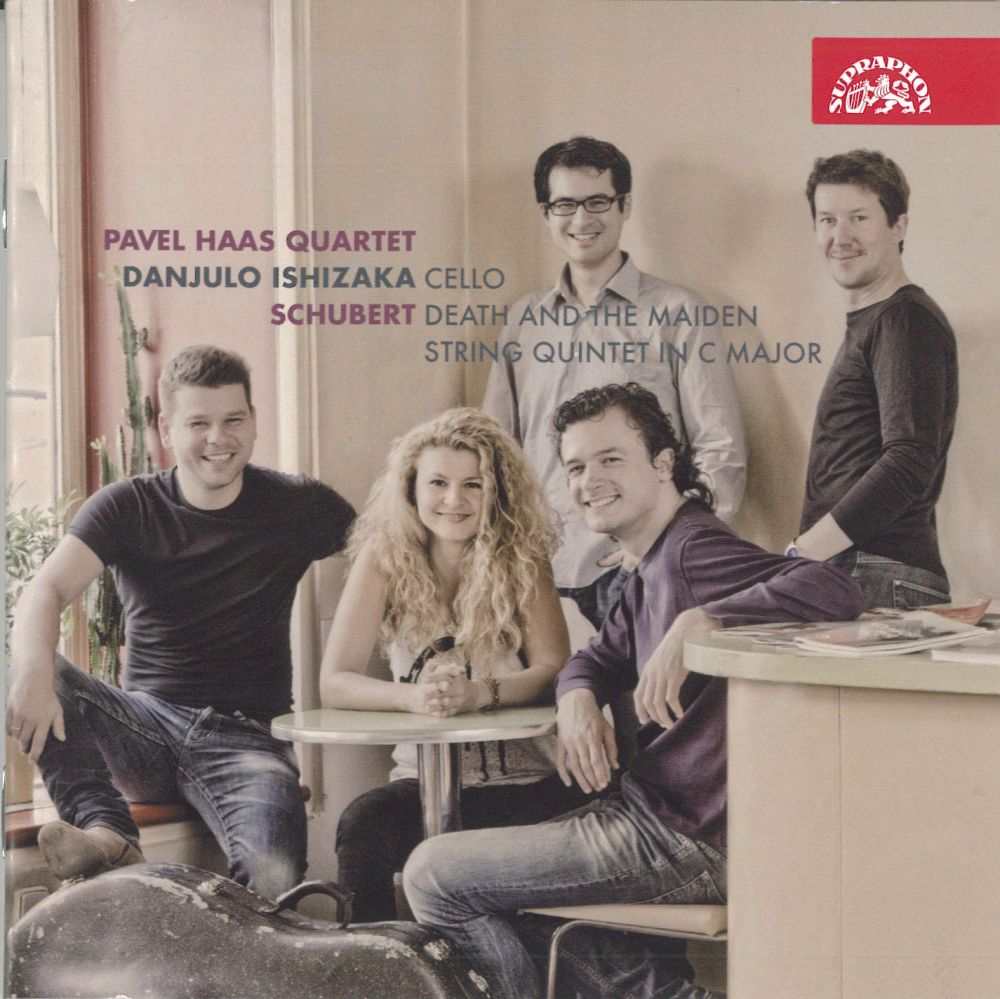
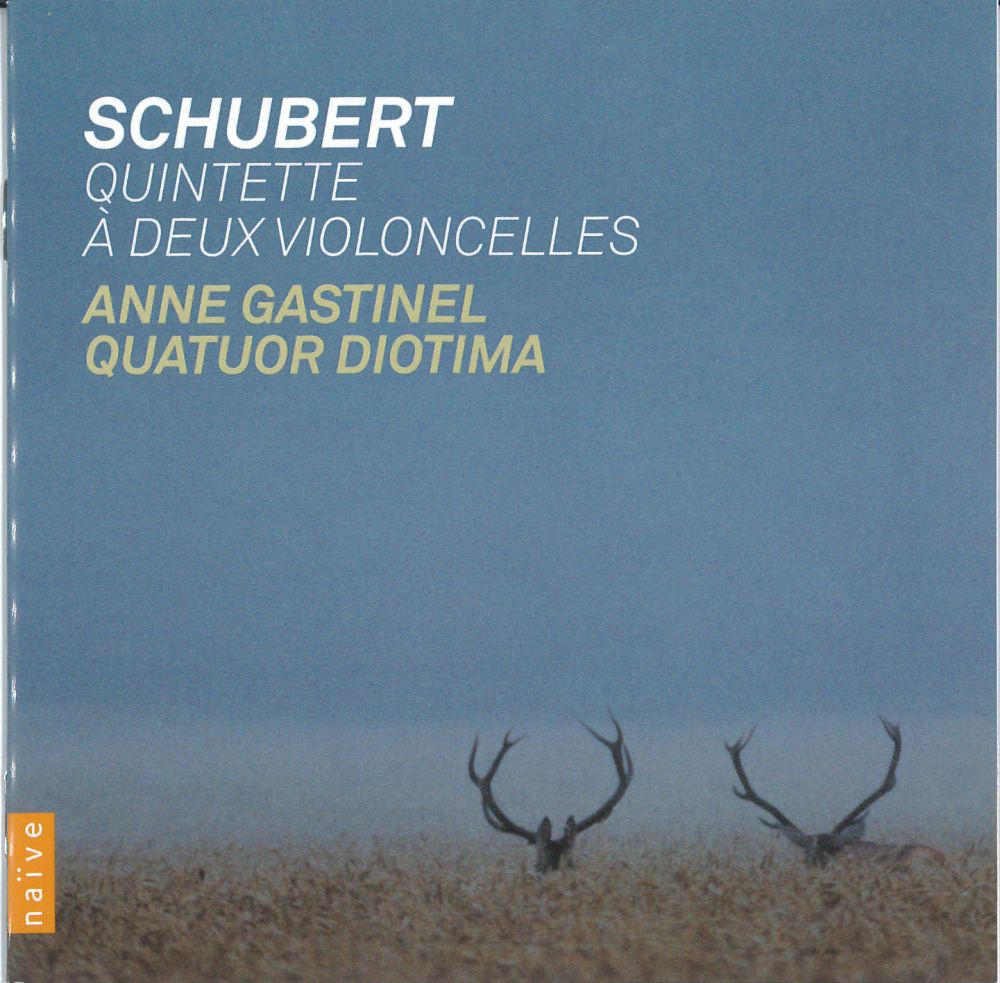
robbins 11b schubert haasrobbins 11a schubert diotimaSeveral other works also seem to be cropping up quite regularly these days. There are two new recordings of the Schubert String Quintet in C Major, for instance, although it’s difficult to imagine having too many versions of this outstanding work. Cellist Anne Gastinel joins the Quatuor Diotima in a beautiful performance on naïve (V 5331), while Danjulo Ishizaka joins the Pavel Haas Quartet on a 2-CD Supraphon set that also features Schubert’s String Quartet No.14 in D Minor, Death and the Maiden (SU4110-2). A wide range of dynamics in the latter release makes for some terrific moments in passionate but sensitive performances of both works.


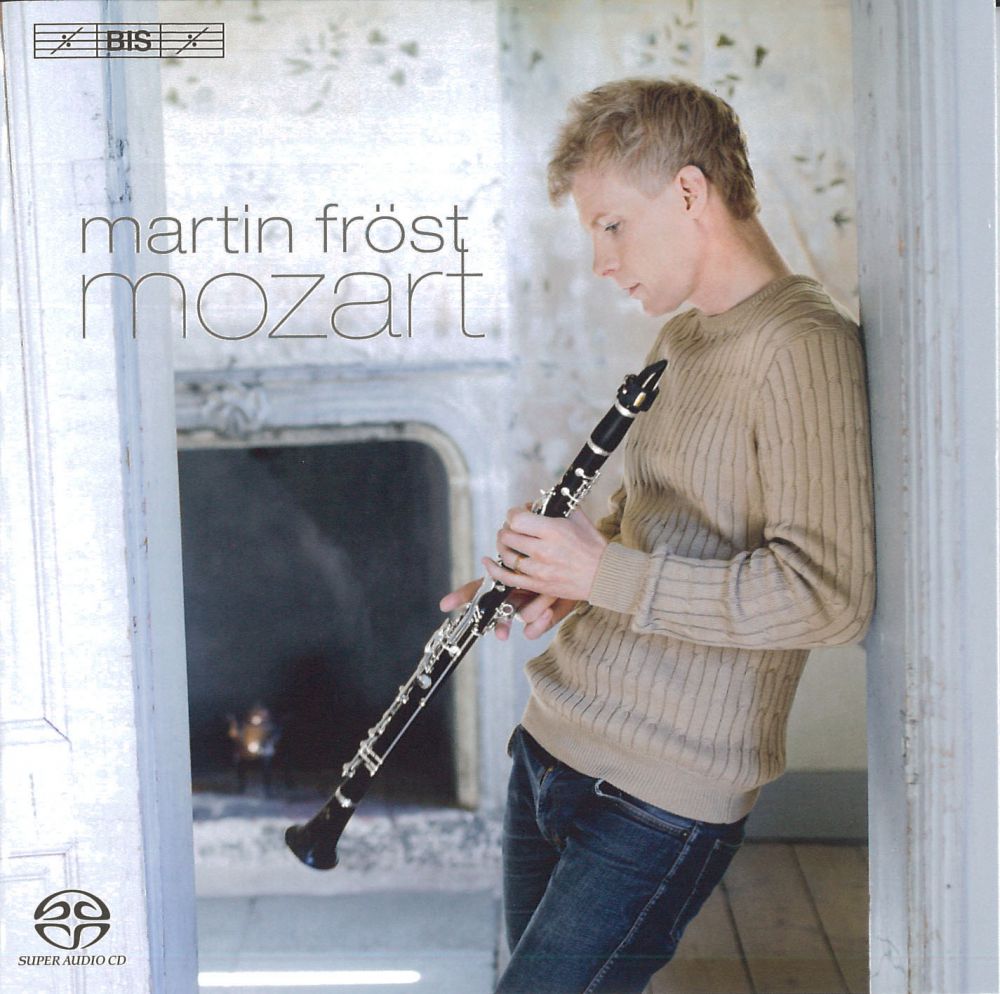
mozart martin frostMozart - Clarinet Concerto; Kegelstatt Trio; Allegretto 
Martin Frost; Deutsche Kammerphilharmonie Bremen
BIS 1893

Clarinetist Martin Frost can play anything anyone puts in front of him. He’s that kind of monster. He can conduct and dance and who knows maybe serve toast and tea while doing so. He’s musical, he’s tall and Swedish, and he works with really good musicians on this release of Mozart works for the clarinet. So it’s heartening to this envious hack that even he can’t make me like the basset-clarinet, an ungainly extended clarinet with an out-of-proportion lower range that somehow makes me think of Jennifer Lopez.

It is the fashion to try to reproduce the lost or stolen manuscript version of the clarinet concerto K622 by revising the first edition such that certain passages make use of the extra four semitones at the bottom of the basset extension. To this ear that range is an ugly ostrich-ling, and the pitch wonkiness of a normal clarinet is exponentially worsened by the physical length of the lower joint.

Who besides Mozart wrote for the instrument? Franz Sussmeyer, that’s who. The guy who completed the scores of late Mozart works. After that… (deafening silence). Never mind, Frost is wonderful, his musicianship  impeccable and the orchestra he leads is a flexible and united band. I say the rondo is too fast, but after that J Lo crack who’s listening?

Once you’ve enjoyed the concerto, hit pause and let things settle a bit before you jump into the Kegelstadtt Trio K498. The jump in key from A major to E-flat is likely an unintended jolt; some might like aural palate cleanser before continuing. Too rarely-recorded, the trio is a genial conversation. Written for his buddy Anton Stadler, like the quintet and the concerto, Mozart’s trio is named for the hangout where he may have spent many a dissolute hour: a bowling alley. He wrote the piano part no doubt to test a favoured student; it is a mini-concerto for the keyboard, especially the final rondo. The group makes interesting decisions regarding a problem posed by the piece: how to vary the pulse from one movement to the next. Their sense of ensemble is fantastic. The final selection is a reconstruction by Robert Levin of a fragment (93 bars) of a work Mozart began for clarinet and string quartet: a welcome addition to the chamber rep for clarinetists, and a terrific vehicle for Frost’s virtuosity, it’s full of lovely late-Mozartian surprises and innovation.


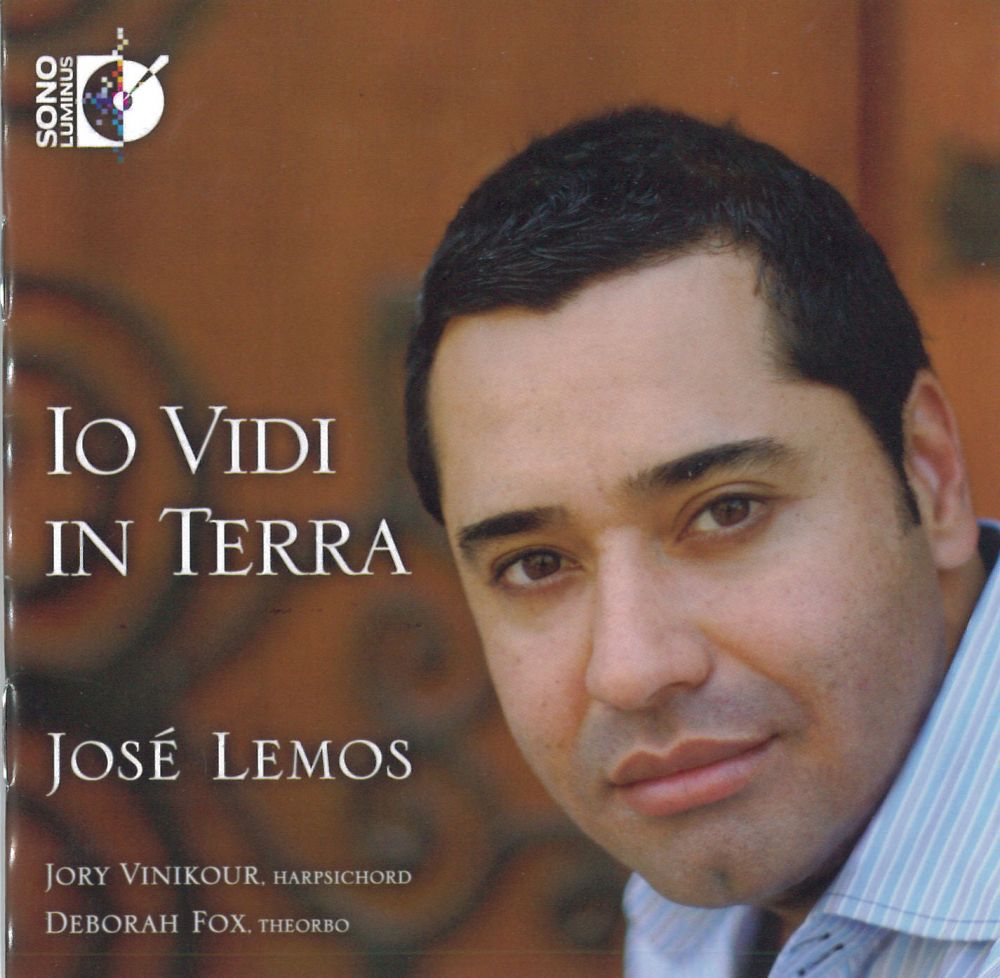
03 early 01 jose lemosIo Vidi In Terra
José Lemos; Jory Vinikour; Deborah Fox
Sono Luminus DSL-92172
sonoluminus.com

Seventeenth-century Italy presents us with images of love, debauchery, power games, murders and ruthless ambition — but at least there were some great Italian composers around to set the romantic elements to music!

Brazilian José Lemos displays his in-depth love for Italian vocal music by selecting not only giants of the period but also lesser-known composers. It is, indeed, a less-well-known composer, Tarquinio Merula, with whom José Lemos opens his recital. His rendition of “Su la cetra amorosa” draws on a very wide range of skills as it combines an almost rushed score with a sometimes highly exhilarating one.

“Io Vidi in Terra” sets lines by Petrarch, and it is a tribute to both Marco da Gagliano and José Lemos that poetry and song of such beauty and sensitivity are to be found on this CD. Just as anguished by love’s pains is “Ardo” by Benedetto Ferrari, bringing out the best in Lemos’ longer notes and drawing on Vinikour’s harpsichord and Deborah Fox’s theorbo.

Instrumental solos feature. Spagnoletta was one of the most popular and longest-lived pieces of the entire Renaissance. Vinikour gives a spirited interpretation of Storace’s complex score — the most demanding this reviewer has heard. And for good measure there is the exuberant Balletto by the same composer.

Lemos starts and finishes his recital with songs by Merula, who deserves to be better known. Listening to this choice of songs, it is easy to see why — this is a wonderful collection of early Italian baroque music.

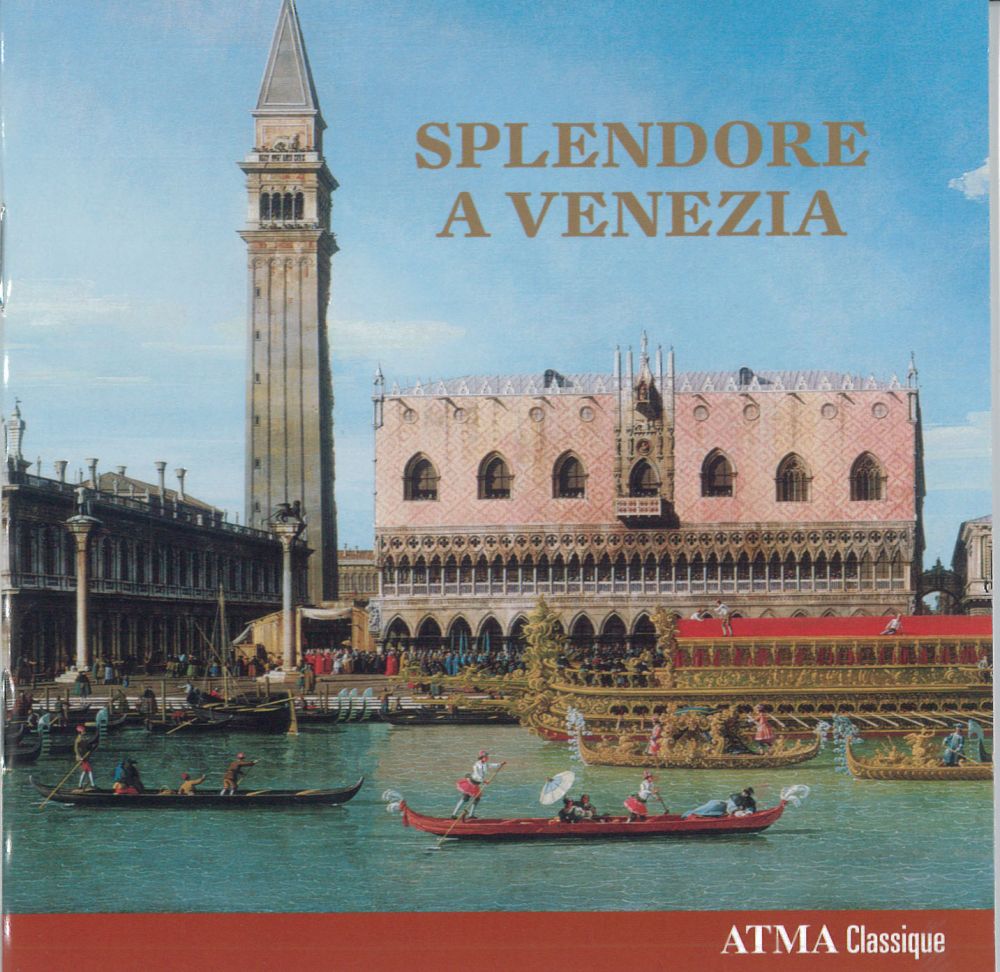
03 early 02 veneziaSplendore a Venezia – Music in Venice
from the Renaissance to the Baroque
Various Artists
ATMA ACD2 3013

This compilation disc was created to accompany the exhibition presented at the Montreal Museum of Fine Arts this season from October to January focusing on the interrelationship between the visual arts and music during the 16th, 17th and 18th centuries, In addition to paintings, the show features historical instruments, musical texts and manuscripts. For the recording, the ATMA label draws from its catalogue works by composers who figure in the exhibition, including Monteverdi, Gabrieli, Rossi, Vivaldi andAlbinoni, performed by local Montreal artists and their guests. There is a cornucopia of instrumental and vocal works offered, bringing to life the rich, festive tapestry of Venetian society. The Académie baroque de Montréal offers a stunning performance of a Vivaldi concerto with the late Washington McClain as oboe soloist. Perhaps in honour of the string instruments on display at the gallery, such as the Koch archlute, a lovely Ballo secondo by Kapsberger features chitarrone and harp.

Vocal ensemble Les Voix Baroques and Tragicomedia perform Gabrieli’s madrigal Due rose fresche and Monterverdi’s Laetatus sum. Charles Daniels and Colin Balzer delight in Monterverdi’s whimsical Zefiro torna and the superb voice of Karina Gauvin soars through the lovely Vivaldi aria “Addio Caro. A delightful surprise is Benedetto Marcello’s setting of Psalm 15 gorgeously sung by Israeli mezzo Rinat Shaham. For those looking for a reason to brave the cold in Montreal this winter, the exhibit is a must-see; for all others, vicarious enjoyment through the music, complete with a full-colour booklet illustrated with several of the works presented in the MMFA exhibition.

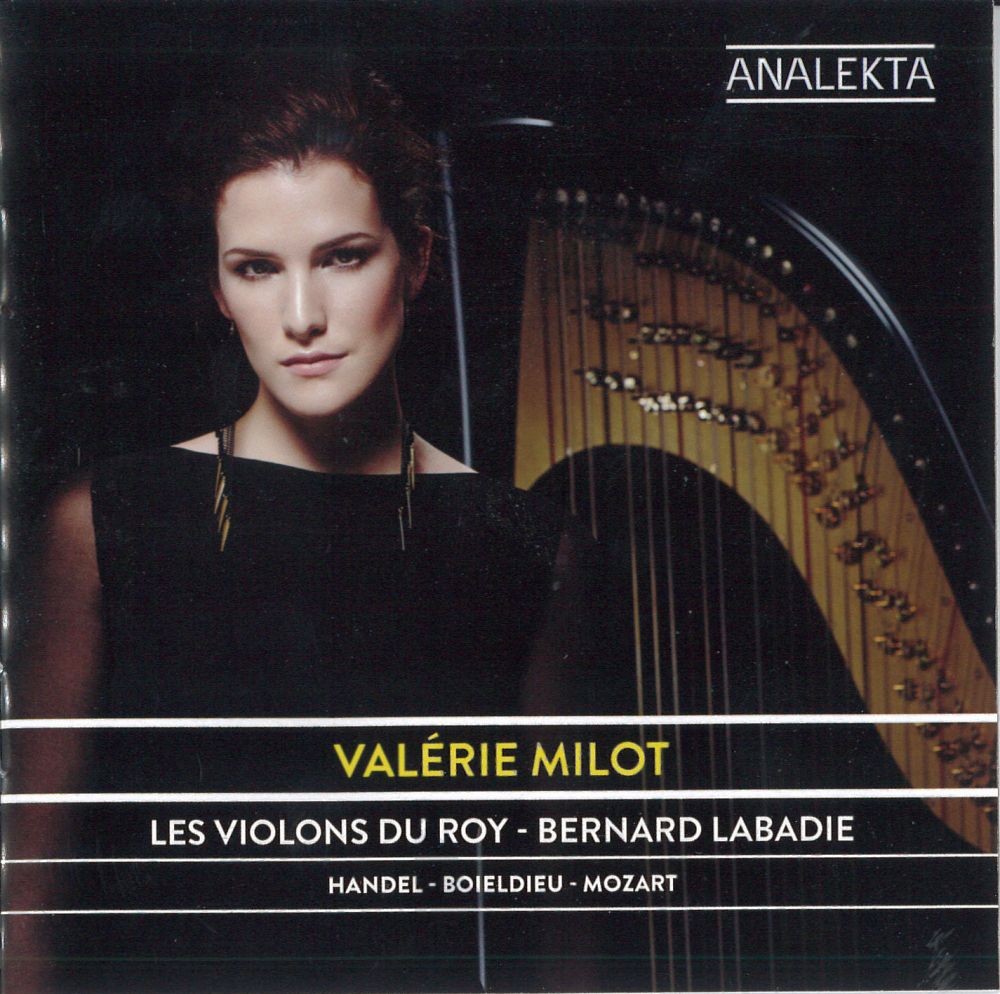
03 early 03 harp concertosHandel; Boieldieu;
Mozart – Harp Concertos
Val
érie Milot; Les Violins du Roi;
Bernard Labadie
Analekta AN 29990

The three concertos on this recording remain a major part of the harp repertoire today even though they were written at the time when the harp was not considered much more than a salon instrument, due to the defects of the single pedal mechanism. Interestingly enough, it was Sébastien Érard, a roommate of Boieldieu, who invented the double-action pedal mechanism that greatly improved the sound and the ability of the harp. All three concertos, featuring Valérie Milot as soloist, were recorded on the modern harp thus adding an array of colours and textures that would have been impossible to achieve at the time they were composed.

Handel’s Concerto in B flat Major is my personal favourite on this recording. It was premiered in 1736 at Covent Garden in London, at a concert dedicated exclusively to Handel’s compositions. This concerto has a wonderfully intimate sound throughout. Elegant baroque phrasing of Les Violons Du Roy complements the crispy, sparkling harp sound — creating an atmosphere that is not overly dramatic yet containing a wide range of emotions.

François-Adrien Boieldieu (1775–1834) may not be a familiar name but he was a popular opera composer and piano teacher at the Conservatoire de Paris. His love for opera is evident in his concerto for harp — dramatic orchestra opening of both the first and second movements and many ornaments in delicately virtuosic harp lines. The last movement has a very enjoyable swaying momentum, evoking the spirit of the times.

Mozart wrote the Concerto for Flute and Harp in C, K299 while he was visiting Paris and happened to become a composition teacher for the Duc de Guines’ daughter, who, in turn, occasionally played the harp accompanied by her father on the transverse flute. This concerto is signature Mozart, bursting with melodies and brightness. The flute soloist, Claire Marchand, plays with sensitivity and clarity, and the two instruments blend very well. Milot has composed cadenzas for both Handel’s and Mozart’s concertos, in keeping with the practices of the times and contributing more authenticity to this recording.

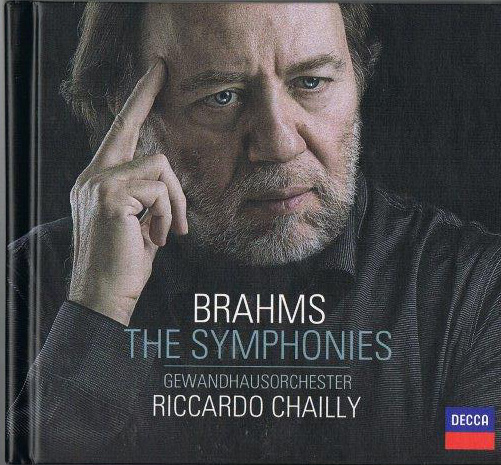
04 classical 02 brahms symphoniesBrahms – The Symphonies
Gewandhausorchester; Riccardo Chailly
Decca 4785344

The Four Symphonies including some revised and original material: Tragic Overture, Haydn Variations, Academic Festival Overture; Intermezzi, Liebeslieder Waltzes, Hungarian Dances (3 CDs in a hard-bound book). Here are some notes to myself as I made them listening to this set in preparation to write a review:

Hits the ground running ... Not traditional weighted-down performance ... Keeps moving ... The music flows ... Thrilling ... Could be the Beethoven Tenth ... Hearing with new ears ... Perfect balances ... Translucent ... Clearly hear the pluck in the plucked basses.

Vivid recording, you can see the orchestra ... Outstanding string section that doesn’t swamp the woodwinds ... Instruments clear without spotlighting ... Clearly hear the inner instrumentation in true perspective.

Feels like hearing the works for the first time ... Outstanding dynamics ... Texture in the horns reminiscent of Szell ... Tempos fluid and forward-looking ... Well-rehearsed but no sense of hearing a routine performance ... No trudging through well-worn paths ... Not dutiful or obligatory.

Gorgeous singing winds ... Excitingly fresh ... Spectacular ... Confident ... Brahms restored ... Chailly, the orchestra a perfect match ... Brings to mind Toscanini’s 1951 recording of the First ... Unique interpretations ... Enthusiastic, firm, clear, articulate, translucent ... This is how Brahms was heard at the first performances before there were any coats of traditions to wear.

I guess what I’m saying is “Highly recommended!”

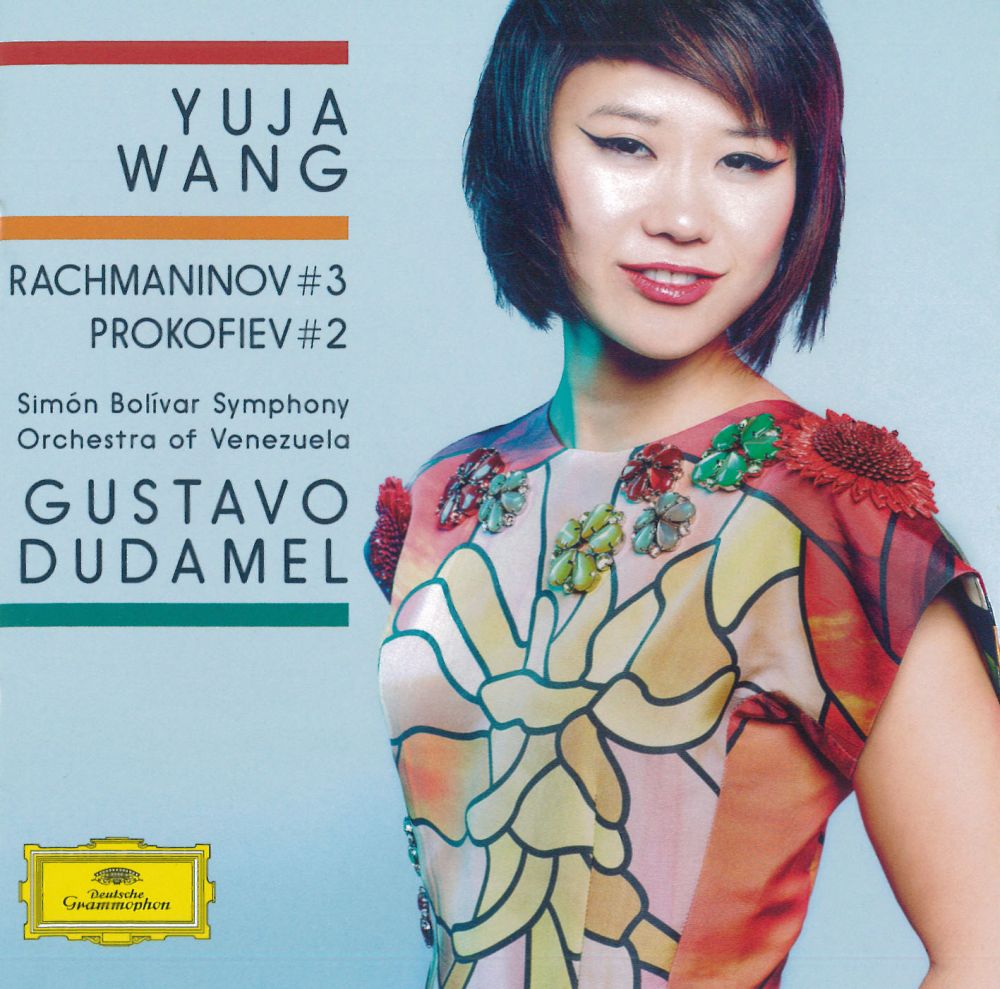
04 classical 03 yuja wangRachmaninov #3; Prokofiev #2
Yuja Wang; Simon Bolivar Symphony Orchestra of Venezuela; Gustavo Dudamel
Deutsche Grammophon B0019102-02

This CD is a wonderful pairing of two of the greatest piano concertos ever written and two young superstars, Yuja Wang and Gustavo Dudamel. The orchestra, a third superstar, is made up of young players mainly in their 20s. The combined energy of these artists explodes in these live recordings made in Caracas, Venezuela. Yuja Wang impresses with her intensity and spectacular technique. She performs the Rachmaninov with passion but her playing is also refined and polished. She listens to the orchestra and in Dudamel she has a most sympathetic accompanist. In fact, pianist, conductor and orchestra were so in tune together that some of the concerto even sounded like chamber music and many nuances were brought out that are not normally heard. Reactions to performances of this piece can be sentimental and we all have our favorites. However, Wang’s CD will certainly join my top ten list.

The Prokofiev Second Piano Concerto is a dark masterpiece in four movements. It is an extremely challenging work both for the pianist and the orchestra. Wang gives a thrilling performance. Her voicing of chords in quiet introspective moments achieves a bell-like sonority. Her virtuosic power never overwhelms but enhances the music and her astounding technique is used to shape and sculpt the music. Wang’s intensity and the fiery emotion of the orchestra is hard to resist. This CD is highly recommended, especially for pianists who long to play these two great masterpieces.

Concert Note: The Toronto Symphony Orchestra presents “The Year of the Horse: A Chinese New Year Celebration” hosted by Dashan, featuring Yuja Wang with a special appearance by Song Zuying Monday, February 3 at Roy Thomson Hall.

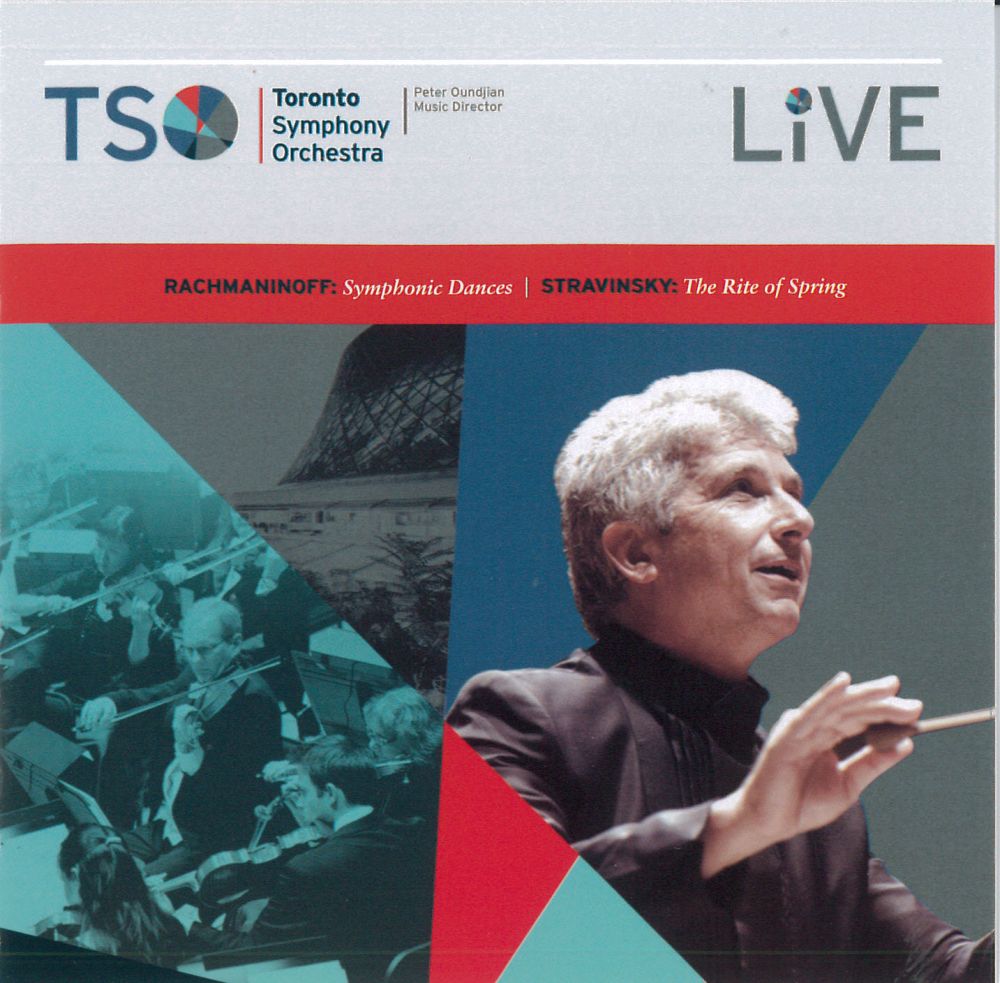
04 classical 04 tso rite of springRachmaninoff – Symphonic Dances; Stravinsky – The Rite of Spring
Toronto Symphony Orchestra;
Peter Oundjian
TSO Live
tso.ca/tsolive

TSO Live is a self-produced label of live concert recordings, established in 2008 by the Toronto Symphony Orchestra and its music director Peter Oundjian. Their newest release features Rachmaninov’s Symphonic Dances and Stravinsky’s The Rite of Spring, two works that share a common thread of experimental harmonies and prominent rhythms.

Rachmaninov composed this orchestral suite in three movements in 1940, shortly after escaping the war in Europe and moving to the United States. It was originally conceived as a ballet; its final version retained complex rhythms but also became very symphonic in nature. The first movement starts with a marching fast section, with beautifully rendered dynamic contrasts in the orchestra. Shifting harmonies and elements of sarcasm continue in the second movement, combining folksy melodies with waltz-like lilts. The last movement is inspired by the chants of the Russian Orthodox Church and the Gregorian chant of the dead. In a way, it was as if Rachmaninov had a premonition — Symphonic Dances was to be his last original composition. The TSO maintains a cohesive expression with many beautiful textures throughout this piece.

The star of this recording, in my opinion, is The Rite of Spring. It is dark, it is pagan, it is mystically powerful. It contains complex rhythms and metres, experiments in tonality and dissonance. Stravinsky wrote it 100 years ago, in 1913, for a Paris season of Sergei Diaghilev’s Ballets Russes company. The premiere caused a riot in the audience — many were escorted outside and the reaction barely subsided by the end of this 35-minute ballet. It was said that Nijinsky, who choreographed this piece, had to keep shouting the number of steps to the dancers as they could not hear the orchestra at times. It was a pleasure hearing the TSO playing with such gusto and precision. The avant-garde elements that caused a disturbance 100 years ago are almost certainly the same elements that appeal to the contemporary audience. It is not a surprise that The Rite of Spring remains one of the most recorded works of the classical repertoire. This recording has a freshness that captivates the listener.

04 classical 05 pentaedreStravinsky – Rite of Spring;
Moussorgski – Pictures at an Exhibition
Pentaèdre
ATMA ACD2 2687

Canadian quintet Pentaèdre tackles the rhythmic complexities and melodic nuances in wind transcriptions of two works by Russian composers, Igor Stravinsky and Modest Mussorgsky.

Stravinsky’s Rite of Spring is surprisingly musically successful in this wind transcription by Michael Byerly. Shorter in length here than the original composition, the flute, clarinet, oboe, bassoon and horn parts are remarkable in their loyalty to the original score. The driving rhythmic patterns and twirling melodies that shocked audiences when first performed continue to shock and amaze here. The quintet is a tightly knit ensemble which works to its advantage in this colourful and virtuosic performance.

In contrast, the Mussorgsky Pictures at an Exhibition is, though performed exquisitely, not as successful. The transcription by Stéphane Mooser is perhaps too much of a good thing here as his goal was to expand the wind instruments’ tonal palate in contrast to his liner notes comment that “the other existing versions for wind quintet are too limited in colour range.” These occasional dense sections take away from the overall beautiful phrasing and melodies of both performance and individual parts.

The high production quality allows for each wind instrument to sound “live.” Pentaèdre needs to be congratulated for expanding the woodwind repertoire with these transcriptions of audience-loved works. The ensemble’s fresh musical approach and technical acumen brings new life to established repertoire.

04 classical 06 quartetskiQuartetski Does Stravinsky
Quartetski
Ambiances Magnétiques AM 213 actuellecd.com

Jazz and modernism both erupted in the early 20th century, and the lines of concordance are many, including the polyrhythms of jazz in Igor Stravinsky’s masterpiece of primordial impulses, Le Sacre du printemps. Its opening melody has been referenced by jazz musicians such as Carla Bley, Rahsaan Roland Kirk and Ornette Coleman. Celebrating the work’s 100th anniversary, Montreal’s transformative Quartetski Does Stravinsky, follows a loose and reduced score while interpolating and overlaying improvisations either anarchic or folk-inspired. The instrumentation is constructed for maximum chronological association, leaping from the sound of a medieval consort with founder Pierre-Yves Martel’s viola de gamba, Phillippe Lauzier’s bass clarinet, Isaiah Ceccarelli’s percussion and Josh Zubot’s violin to guitarist Bernard Falaise’s very electronic approach. Alternately homage and deconstruction, it’s a fearless work, casting Stravinsky’s masterwork in a new light — at once more intimate, flexible and playful.

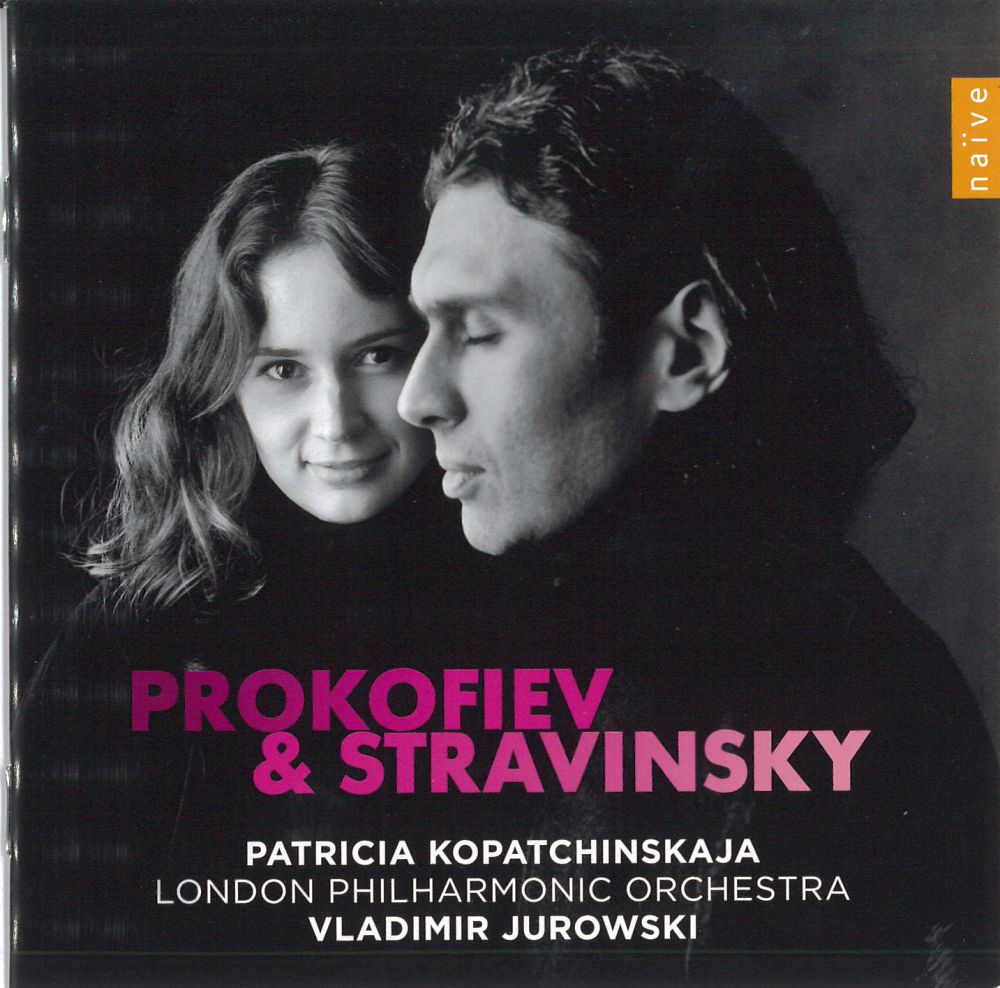
Two Russian violin concertos written within four years of each other by composers who had both left their native country for political reasons are featured on the new CD Prokofiev and Stravinsky, with Patricia Kopatchinskaja and the London Philharmonic Orchestra under Vladimir Jurowski (naïve V 5352).
robbins 01 prokofiev stravinskyStravinsky’s Concerto in D was written in 1931; it takes more than just its individual movement titles from the Baroque era, and is in the composer’s neoclassical style. It’s probably heard less frequently than the Prokofiev, and with its prickly nature seems to be slightly less approachable. Kopatchinskaja, though, is a wonderful interpreter, capturing the strident nature of the music while fully illustrating that this is not a work lacking in colour and warmth.

The concerto is followed on the CD by a short uncredited cadenza in which Kopatchinskaja is joined by the LPO’s leader Pieter Schoeman.

Prokofiev’s Concerto No.2 in G minor dates from 1935, when Prokofiev had decided — unlike Stravinsky — to return to the Soviet Union. It’s a beautifully lyrical work, albeit with typical Prokofiev moments of spiky percussiveness, and Kopatchinskaja always finds the perfect balance. The opening of the slow middle movement is particularly striking, with the solo line held back in a quite mysterious way, but with beautiful tonal colour and shading. The orchestral support is excellent on a truly outstanding disc.
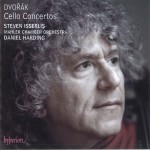
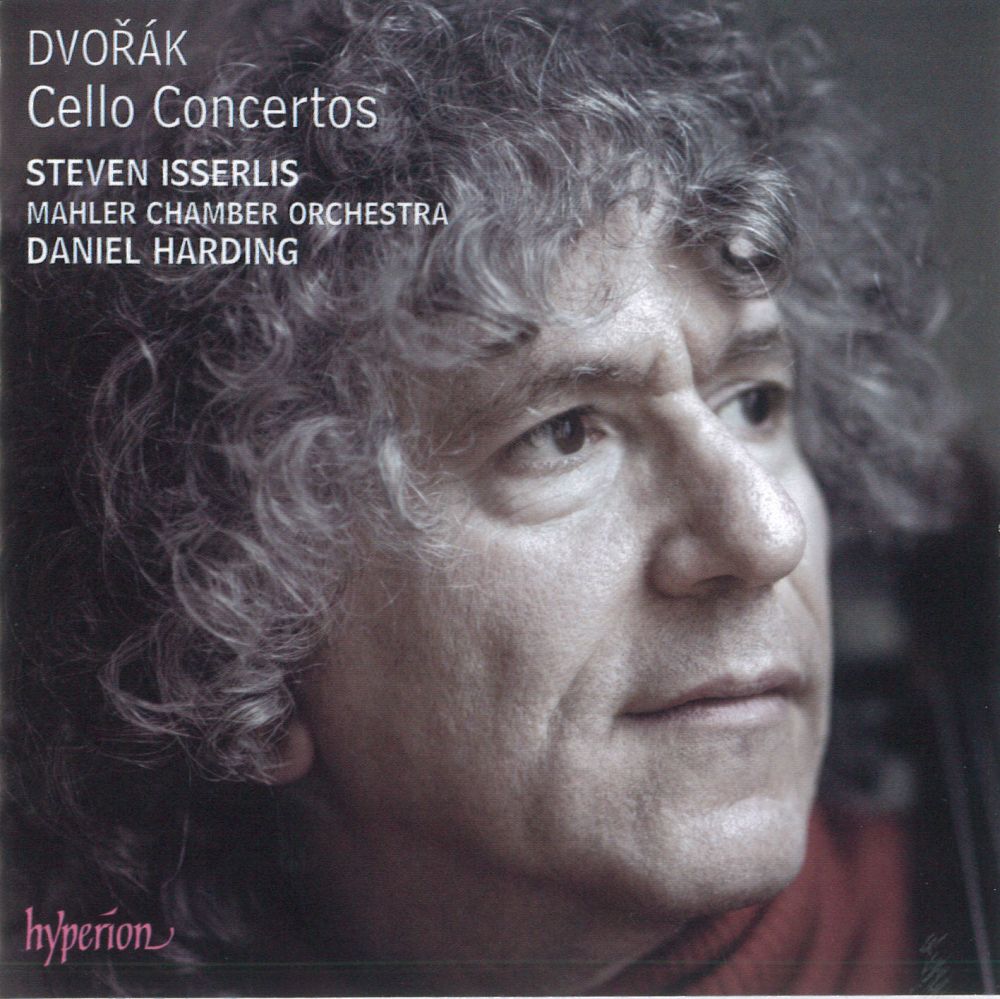
robbins 02 isserlis dvorakAnother excellent concerto CD is Dvořák Cello Concertos, the latest issue from Steven Isserlis and the Mahler Chamber Orchestra under Daniel Harding (Hyperion CDA67917). Concertos,” you say? — “Surely there is only one?” Well, yes and no. Some 30 years before his celebrated B minor concerto, the young Dvořák had written an A major concerto for the cellist Ludevit Peer, an orchestral colleague of the composer’s in Prague. It was never orchestrated, and the piano score manuscript stayed with Peer when he moved to Germany; Dvořák presumably considered it lost. It is now in the British Library.

There have been two attempts at orchestrating it, the latest in 1975 closely following the manuscript; Isserlis, however, has chosen a 1920s reworking of the concerto’s material by the German composer Günter Raphael, who clearly envisioned the mature Dvořák returning to the work with a critical eye. It’s understandably not in the same class as the B minor concerto, but it does have some lovely moments and a particularly beautiful slow movement. However, given that Dvořák’s original work was virtually rewritten by Raphael, who also provided all of the orchestration, it’s a bit difficult to regard it as anything other than an interesting hybrid. Isserlis plays it beautifully, though, as he does the real concerto on the disc.

There are two interesting additions to the CD. On learning of the death of his sister-in-law and first love, Dvořák rewrote the ending of the concerto to incorporate her favourite of his songs, “Lasst mich allein”; an orchestral version of the song is included here, along with the original ending of the concerto.
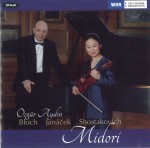
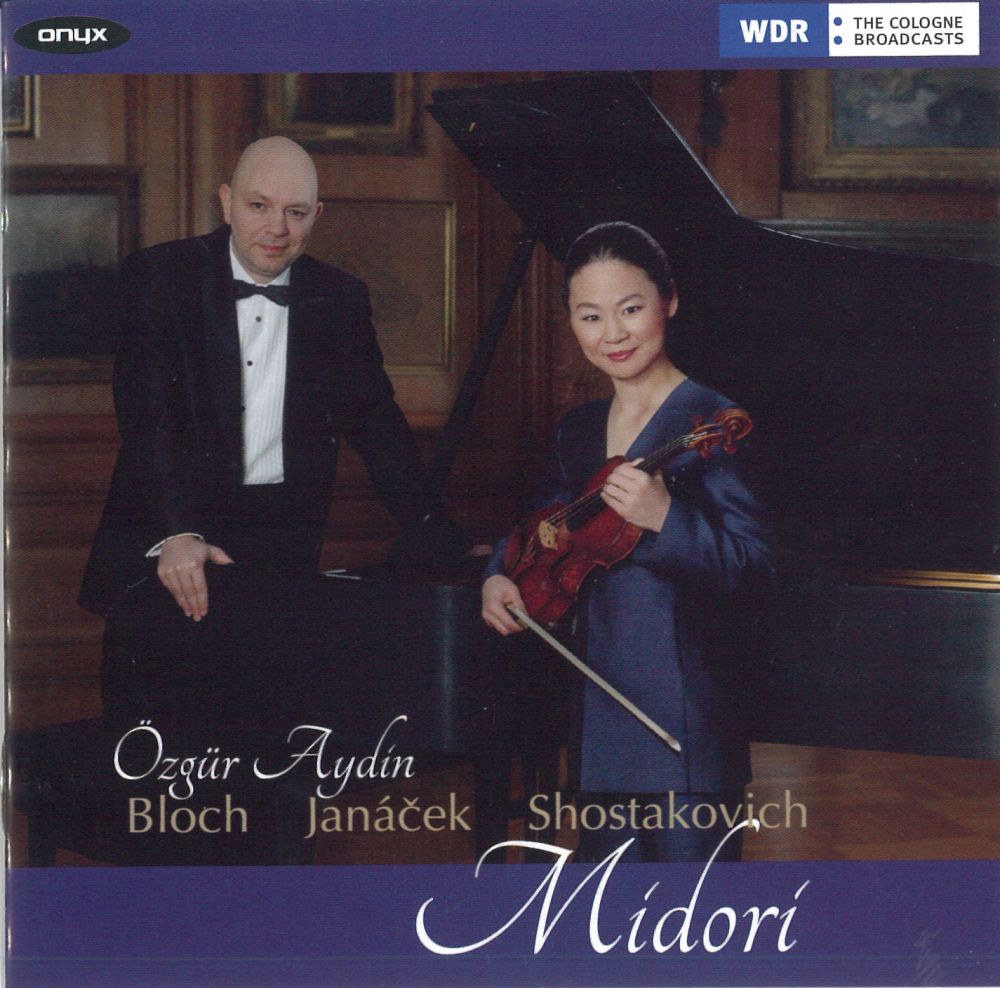
robbins 03 midoriMidori performs Violin Sonatas by Bloch, Janáček and Shostakovich on her latest CD, accompanied by Özgür Aydin (Onyx 4084). During the early years of the 20th century — and especially after the Great War — many composers strove to find a new expressive language, and each of the three represented here developed a highly individual voice. Midori says that the sonatas drew her in, “as they represent a new era in their genre.”

Ernest Bloch’s Sonata No.2 “Poème mystique” is a lovely, rhapsodic single-movement work from 1924, written as a counterpart to his war-influenced first sonata from 1920. Leoš Janáček’s lone violin sonata spanned the years of the Great War and the composer’s sixth decade, the period in which his unrequited love for a young woman led to an outburst of highly personal and idiomatic compositions; started in 1914, it was completed in 1922.

The Shostakovich sonata, written in 1968, is everything you would expect from this most tortured of composers: an ominous slow first movement; an explosively percussive “Allegretto”; and a devastatingly personal closing movement which seems to end in bitterness and resignation, and devoid of any hope.

Midori and Aydin are superb throughout a recital recorded by the German radio station WDR in Cologne, and first broadcast there in 2012. 
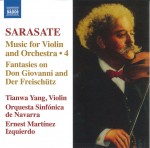
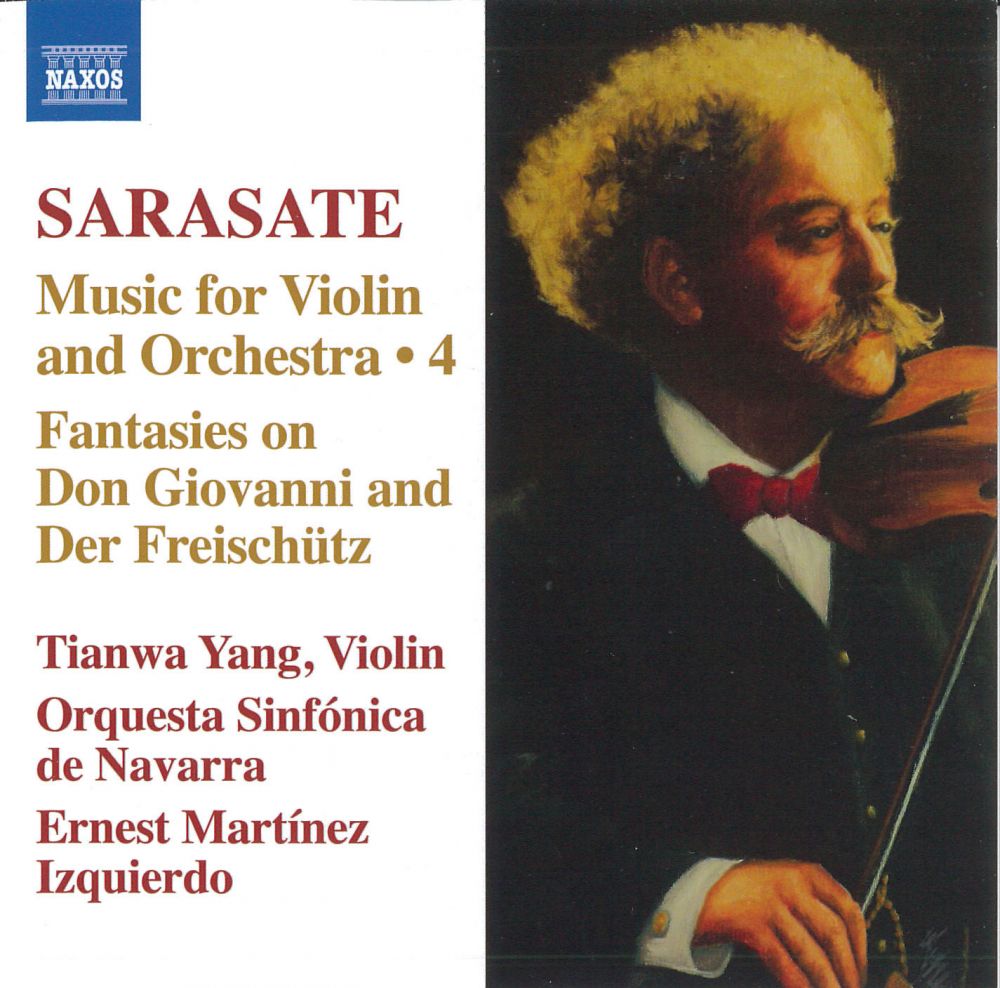
robbins 04 sarasate 4Naxos has issued the fourth and final volume of Sarasate’s Music for Violin and Orchestra (8.572276), featuring the outstanding team of Tianwa Yang and the Orquesta Sinfónica de Navarra under Ernest Martínez Izquierdo. Sarasate was not only one of the greatest players of his or any era, but also a prolific composer for his instrument. What is remarkable, however, is not simply the number of works he produced but their consistently high musical quality. They are, needless to say, extremely difficult, fully exploiting every technical trick in the book while never becoming mere pyrotechnic displays. The range of technical challenges is huge, but Yang once again surmounts them all with apparent ease. Yang sets the bar extremely high right from the opening track, with a pure, bright tone at the start of the Introduction et Tarantelle, Op.43 before the Tarantelle simply explodes in a stunning display of agility and virtuosity.

The larger works on this disc are the Fantasies on Mozart’s Don Giovanni and on Weber’s Der Freischütz, and the absolutely beautiful Le Rêve. The shorter works are: Jota de San Fermín, Op.36; Jota de Pamplona, Op.50; Airs écossais, Op.34; and L’Esprit follet, Op.48. There are some really lovely touches in the orchestration here, an aspect of Sarasate’s composition that is often overlooked and under-appreciated.

Yang’s playing is absolutely top-notch throughout, with some outstanding double-stopping and immaculate bowing. The booklet notes tell us that Sarasate was noted for “the purity and beauty of his tone, perfection of technique and musical command.” That’s also just about a perfect description of Yang’s playing on this outstanding CD.

The orchestral support is again of the highest calibre, and stylistically perfect – hardly a surprise, as this is the orchestra founded by Sarasate himself in his home town of Pamplona in 1879. Yang’s Naxos series of Sarasate’s Music for Violin and Piano, currently at three volumes, is apparently due for completion in 2014. It will surely round out one of the best series of complete violin works currently available.
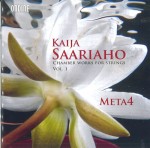
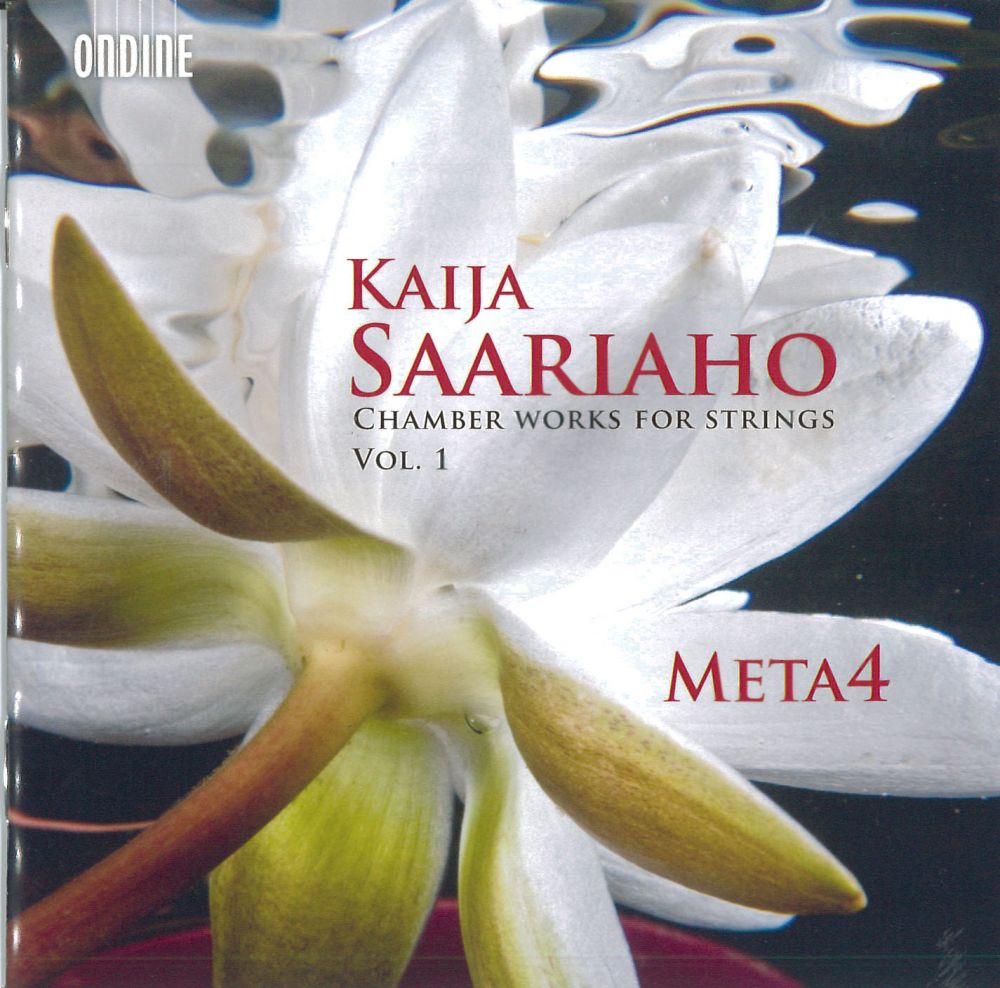
robbins 05 saariahoAnother new Ondine CD features the chamber music of the Finnish composer Kaija Saariaho, who turned 60 last year, on Chamber Works for Strings Vol.1 (ODE 1222-2). The performers are members of the Finnish string quartet META4, pianist Anna Laakso and Marko Myöhänen on electronics. The works are described as a broad cross-section of Saariaho’s writing for strings and her various approaches to this group of instruments, and the compositional years range from 1987 to 2010. The two works for violin and piano are the most recent: Tocar is from 2010, and Calices, a three-movement work close to a sonata in feel, is from 2009.

The two solo works – Nocturne for violin (1994) and Spins and Spells for cello (1997) – are both quite sombre, effective pieces, with extensive and imaginative use of harmonics. The violin piece was written at very short notice for a memorial concert one week after the death of the Polish composer Witold Lutosławski; the cello piece was the compulsory competition work at the Rostropovich Cello Competition in Paris. Vent nocturne for viola and electronics (2006) has an electronic contribution that is mostly the sounds of breathing and wind. Nymphéa for string quartet and live electronics (1987) is the longest piece on the disc, and also the earliest, although it doesn’t sound like it; it’s certainly the most challenging work on the CD on first hearing. It was written for the Kronos Quartet, so it should come as no surprise to read that the electronic sound processing “extends the scope of expression far beyond that of a traditional string quartet.” Indeed, the extreme sounds that the string players are required to produce seem to be part of the electronic score at times.

The technical level of the playing throughout the CD seems to be extremely high, and while it’s always difficult to tell exactly how good the interpretations are when you listen to works of this nature for the first time, the booklet portrait of the composer with the META4 quartet members suggests that we are certainly in good hands.
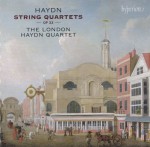
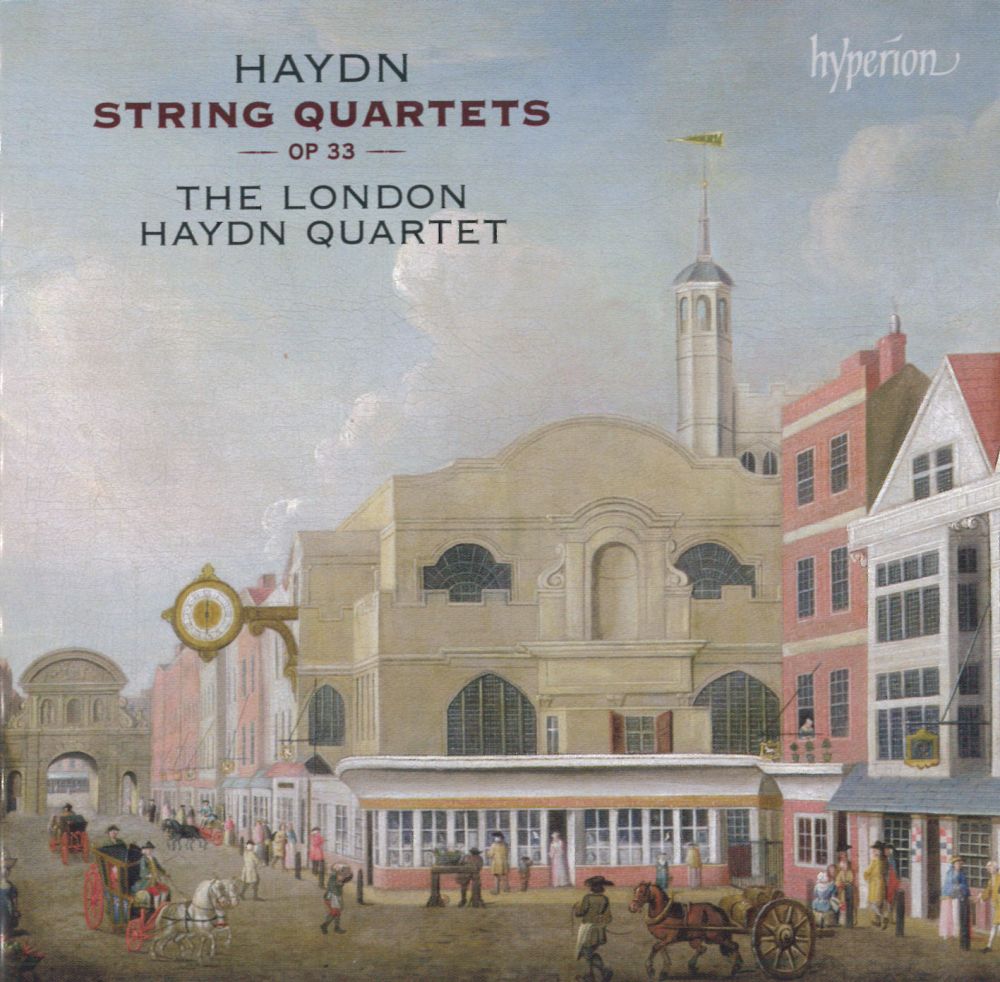
robbins 06 haydn 33In the past six years or so the London Haydn Quartet has been making people sit up and listen with its “historically informed” performances of the Haydn string quartets, and their recent 2-CD set of the six String Quartets Op.33 on the Hyperion label (CDA67955) makes it easy to understand why. Previous releases of 2-CD sets of the Op.9, Op.17 and Op.20 quartets drew absolutely rave reviews from journals such as The Strad, The Times, Gramophone and other music magazines, and much was made of the fact that the group plays so perfectly on gut strings, usually an invitation to intonation problems. Certainly the sound is somewhat softer and sweeter than you might expect, but that shouldn’t for a moment imply any lack of strength – these performances are simply bursting with life. The dynamics are terrific, and the articulation and the ensemble playing quite astonishing, especially in the dazzling “Presto” movements. And yes, the intonation is faultless.

Classic FM magazine called the 2007 Op.9 set “Without a doubt one of the all-time great Haydn quartet recordings…” and it would appear that the standard is in no danger of falling as this remarkable series of recordings continues.
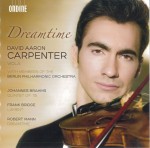
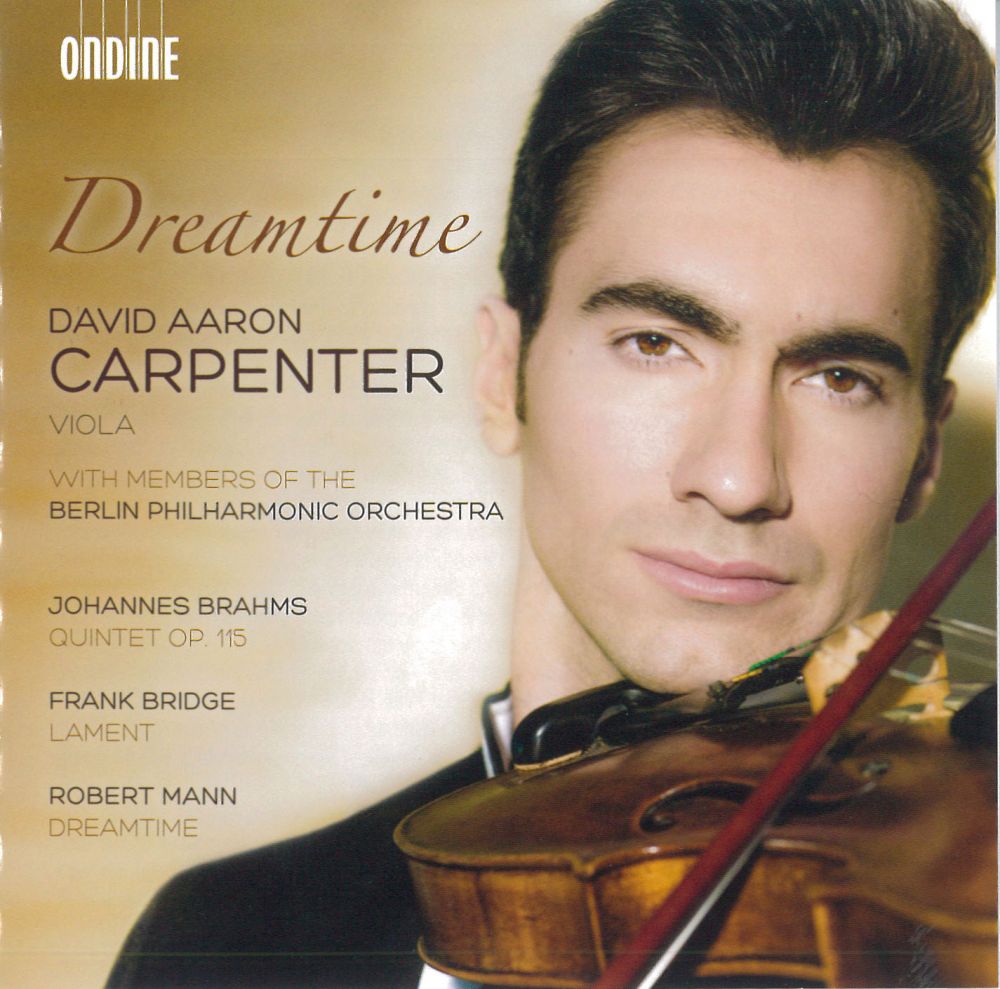
robbins 07 dreamtimeDavid Aaron Carpenter is back with another CD of viola music on Dreamtime, with members of the Berlin Philharmonic Orchestra (Ondine ODE 1246-2). The music is by Brahms, Bridge and Robert Mann, but unfortunately the major work on the disc is something of a disappointment. Although I’ve long been aware of the viola transcriptions of the Brahms clarinet sonatas, I didn’t realize that there was also a viola version – prepared by Brahms himself – of the Clarinet Quintet in B minor, Op.115. It appears to have been more a straight substitution of viola for clarinet than a true transcription, as the two instruments essentially share the same range – and therein lies the problem. The clarinet part is intricately woven into and around the string writing in the original version, but its sound qualities – the warmth of the lower chalumeau register and the plaintive higher register – always allow it to stand out. Replace it with a viola, however, and the very qualities that make the clarinet an integral part of the work are mostly lost: what you now have is essentially a string quintet with two violas, and what was the solo clarinet part becomes all too frequently buried in the general string writing. At times it is simply not possible to tell how well Carpenter is playing, because you just can’t tell which voice is his. The work still has some truly beautiful moments in this version, but it simply can’t touch the original. Bernhard Hartog and Rüdiger Liebermann are the violinists; Walter Küssner the violist; Stephan Koncz the cellist.

Two short pieces – less than 15 minutes combined – complete the CD. Küssner joins Carpenter for the Lament for Two Violas by Frank Bridge. Bridge wrote the work in 1912 to perform with Lionel Tertis, but it was not a success; in fact, the somewhat sparse booklet notes tell us (somewhat puzzlingly) that there wasn’t even a published performing edition until “another violist-composer, Paul Hindemith, prepared his own version 68 years later” – by which time Hindemith had been dead for 17 years! It’s a very careless error: the edition was actually edited by Paul Hindmarsh, whose Thematic Catalogue of Bridge’s music has become the standard reference work on the composer. At least the track listing gets it right.

The final track is the album’s title track: Dreamtime for solo viola by Robert Mann, the founder and former first violinist of the Juilliard String Quartet. Originally written in the early 1980s as a solo violin piece for Itzhak Perlman, it’s a two-part work with a “Slow Rubato” section followed by a quite discordant “Presto Tarantella.”

The Brahms and Bridge works were apparently recorded in concert in Berlin this past February, but there is no trace of audience noise. The sound quality is excellent throughout.
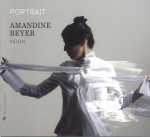
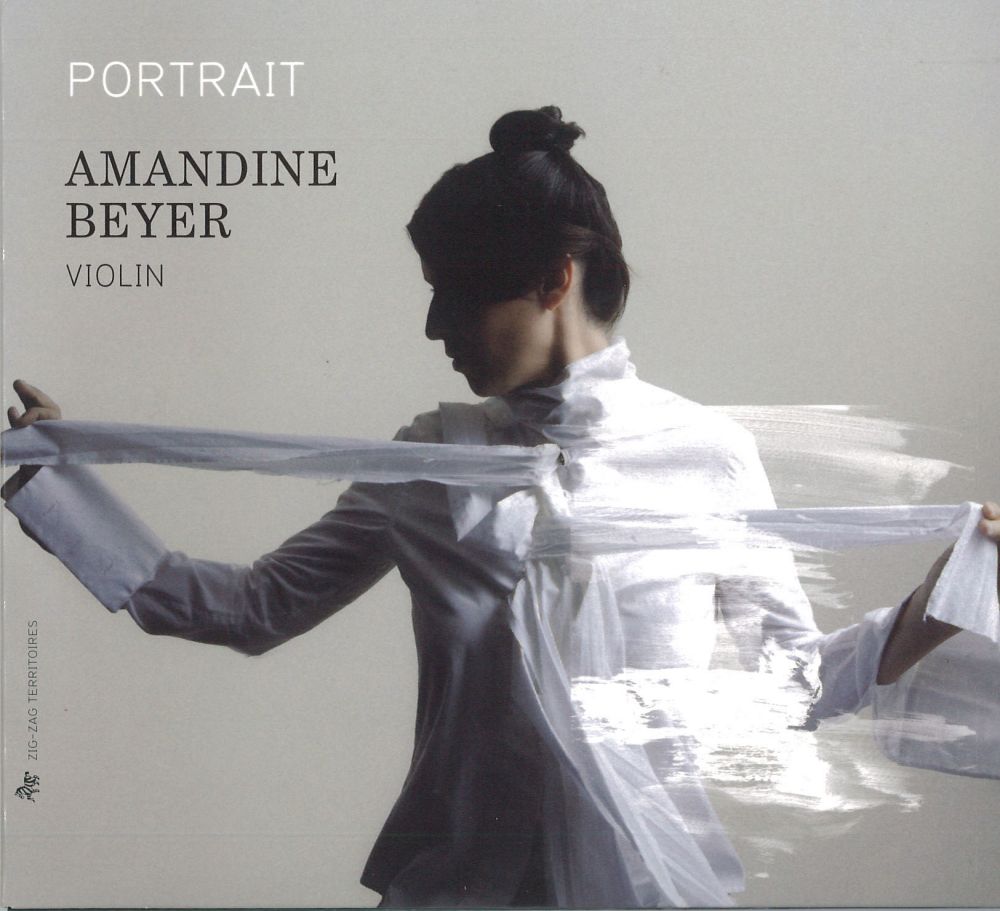
robbins 08 amandine beyerI’m normally a bit wary of compilation CD sets, as they tend to highlight works rather than present them in full, but the 2-CD set Portrait (outhere music/Zig-Zag Territoires ZZT325) by the French Baroque violinist Amandine Beyer is a welcome – and simply terrific – exception. The works included here, selected from nine of her CDs, were recorded between 2005 and 2013, mostly with the musicians from her own outstanding group Gli Incogniti. Disc 1 features short works by Nicola Matteis, De Visée’s Suite for Theorbo and Violin, sonatas by Jean-Féry Rebel and C. P. E. Bach, and the Partita No.2 in D minor of J.S. Bach. Disc 2 has Corelli’s Concerto grosso in G minor, Op.6 No.8, Bach’s E major Violin Concerto and three concertos by Vivaldi, including “Winter” from The Four Seasons. The latter is a dazzling performance, with a very distinctive and quite different slow movement.

There is an exceptional fluency, warmth, character and sense of freedom in Beyer’s playing, and something quite magical and captivating about her performances. If you haven’t heard her, then you’ve really been missing something; this eminently satisfying set at a really attractive price is the perfect opportunity to put that right.
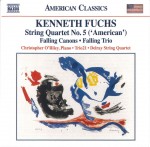
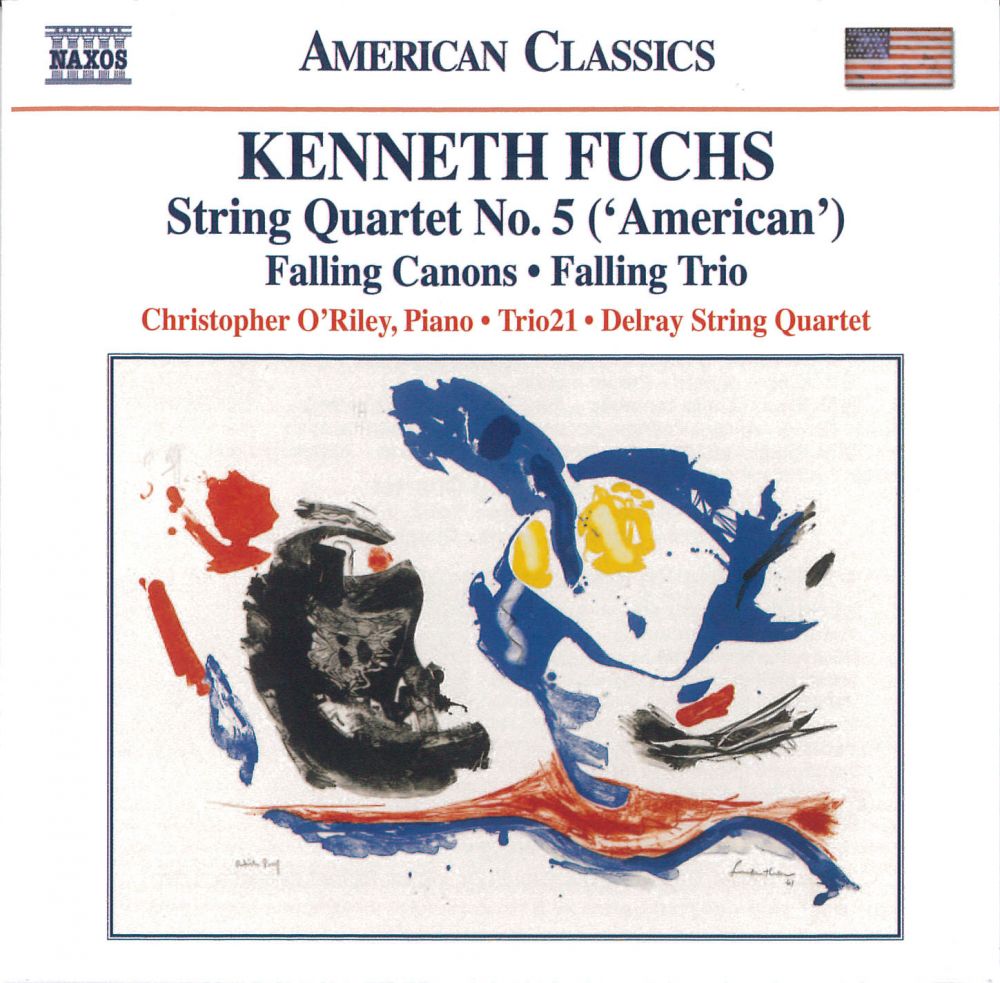
robbins 09 fuchsA new Naxos release in its American Classics series features the String Quartet No. 5 (“American”) of Kenneth Fuchs performed by the Delray String Quartet (8.559733), together with Falling Canons (seven movements for piano) with Christopher O’Riley as soloist, and Falling Trio (in one movement), a piano trio performed here by Trio21. All three works are thematically related in some way to Fuchs’ Falling Man, a work for baritone voice and orchestra based on the post-9/11 novel of the same title by Don DeLillo.

The string quartet takes up almost half of the CD, and was commissioned for the Delray ensemble. Like much of Fuchs’ orchestral music it’s a strongly tonal and immediately accessible work, Fuchs noting that it embraces the stylistic influences of the American symphonic school that were reflected in such recent scores as Atlantic Riband and Discover the Wild, both of which were featured on a recording reviewed in this column in October of 2012.

Falling Canons is a highly effective piece consisting of seven canons written at the unison and at intervals of the second, third, fourth, fifth, sixth and seventh, and pitched on each of the seven degrees of a descending C major scale. Falling Trio works in a somewhat similar manner, with a three-part canon followed by a set of seven variations, this time on an ascending series of pitches. Falling Man, incidentally, has recently been recorded by Naxos at the Abbey Road Studios in London, and on its release will be the fourth CD of orchestral music by Fuchs available on the label.


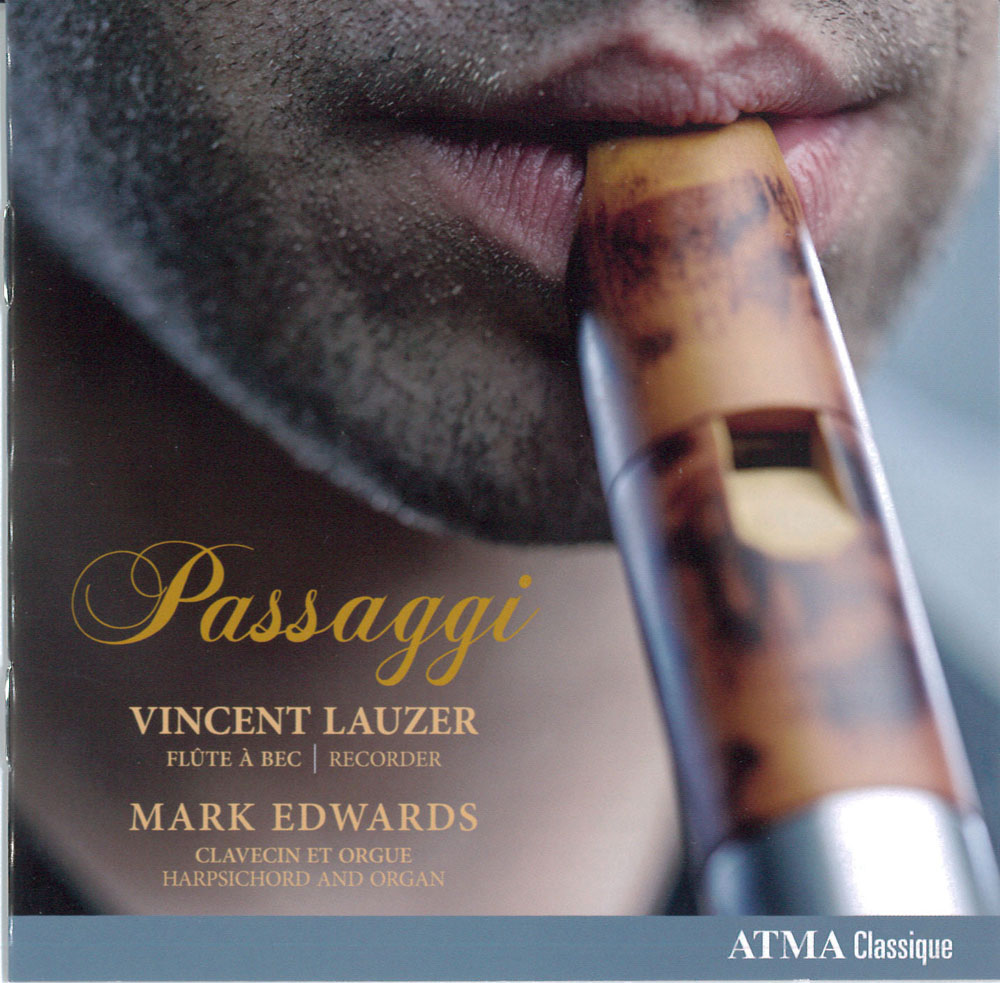
03 early 01 passaggiPassaggi
Vincent Lauzer; Mark Edwards
ATMA ACD2 2637

Having just recently enjoyed a CD of late 16th and 17th century music for the cello, it’s timely to hear Passaggi, a recording of repertoire from the same era but this time for recorder and keyboard. This disc includes diminutions, sonatas, sinfonias, canzonas and Frescobaldi’s extravagant Cento Partite for harpsichord, and features two players familiar to Montréal audiences, Vincent Lauzer and Mark Edwards.

They work well as a team and play this program with affectionate invention. Edwards’ alternation between organ and harpsichord is often witty, for example in Berardi’s Canzona and Schmelzer’s sonatas, and his take on Frescobaldi’s Cento Partite is impressive. I particularly enjoyed his laid-back ambling through the sections displaying the savoury nature of the temperament he’s chosen. Lauzer provides impressive displays of nimble fingerwork, for example in the Notari canzona and the Schmelzer, and plays with a sweet sound. It’s also very good to hear him employ the g alto recorder, the favoured “solo” recorder of the era, as well as the soprano. He creates some nice changes of colour and volume with the use of alternate fingerings, but in the 17th-century pieces I miss the ornamental affetti described by musician/composers of the time, which are commonly heard in baroque violin and cornetto performances of this repertoire. They provide a broader expressive palette to the wind player and assist in making a greater distinction between diminution practice and the “seconda prattica” of the 17th century.

That aside, this is an enjoyable musical exploration of some wonderful music, from two of North America’s fine younger generation of players. Kudos to all involved!

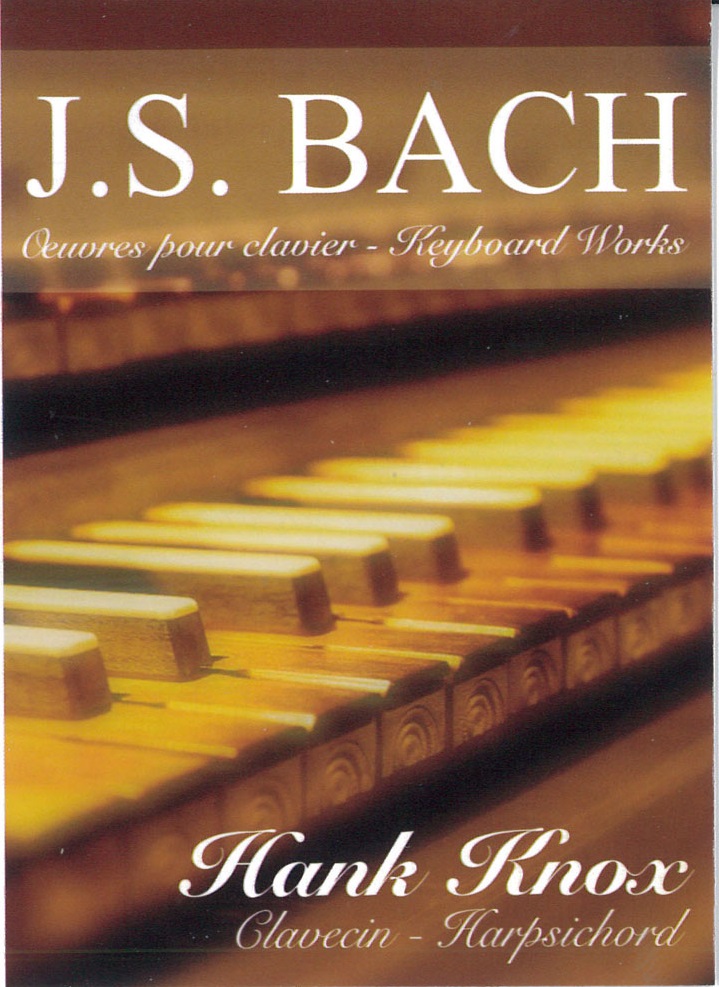
03 early 02 bach knoxBach – Keyboard Works
Hank Knox
EMCCD-7775
earlymusic.com

It took performers like Wanda Landowska — and more recently, William Christie and Kenneth Gilbert — to take the harpsichord out of the museum and put it into the concert hall or the recording studio. Among the instrument’s most recent champions is the Montreal-based performer and pedagogue Hank Knox, whose talents are admirably showcased on this recording on the earlymusic.com label featuring selected works by J.S. Bach.

Early keyboard instruments have been a big part of Knox’s life for many years. He studied harpsichord with Kenneth Gilbert in Paris and also at McGill University, where he currently directs the Early Music program. A founding member of the Arion Ensemble, Knox has also performed, toured and recorded with the Tafelmusik Baroque Ensemble and the Studio musique ancienne de Montréal, and this newest release is further evidence of his deep affinity for music from this period.

What a wonderful program this is! The disc features some of Bach’s most formidable works for solo keyboard, including the Toccata in E minor, the great Chromatic Fantasy and Fugue, the Fantasia in C minor and the French Overture BWV831. From the opening chords of the Toccata, it’s clear to the listener that Knox is in full command of this repertoire, the playing confident and self assured. The challenging Chromatic Fantasy — a true “tour de force” among Bach’s solo compositions — displays not only his redoubtable technique, but also a deeply-rooted musicality.

Published in Leipzig in 1735, the Overture in the French Manner was undoubtedly Bach’s way of transferring the French orchestral suite to the keyboard. Knox has no difficulty in conveying the subtle nuances required of the music, from the stately “Ouverture” to the brisk “Echo,” bringing this most satisfying disc to a close.

Back to top