May offers opera lovers productions on both a large and small scale. The Tales of Hoffmann and the double-bill of The Florentine Tragedy and Gianni Schicchi continue at the Canadian Opera Company and are joined in May by Handel’s Semele. Meanwhile, a new opera company also presents a Handel opera, but in a deliberately minimalist fashion, and Against the Grain Theatre moves its next production from the pub to a theatre.
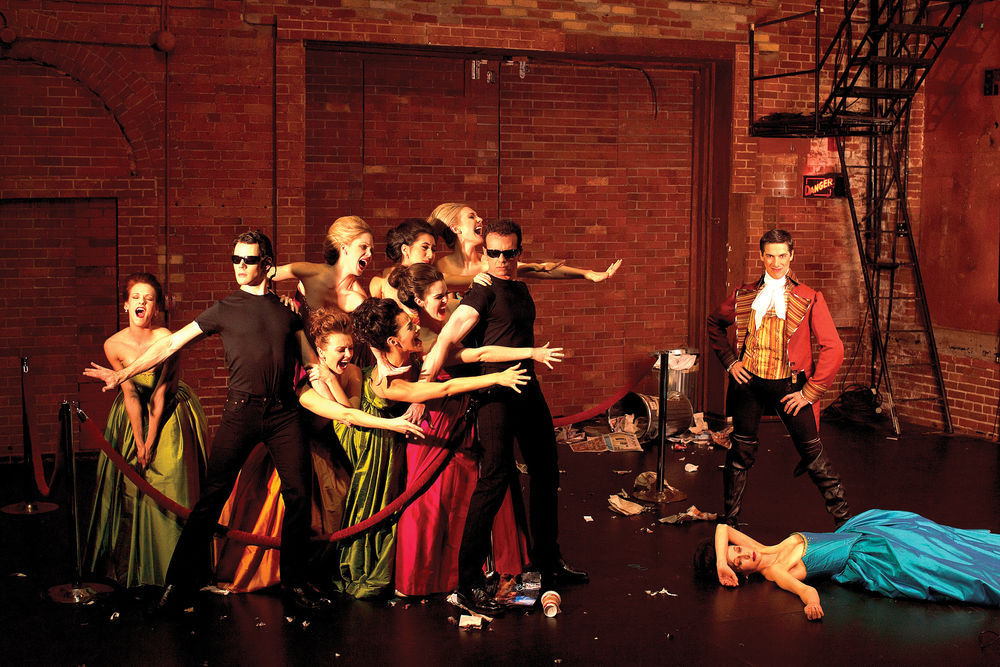
14_opera_essentialopera-promo2_katie_cross_photography_bardua_and_battThe Canadian Opera Company’s first-ever production of Handel’s Semele runs May 9 to 26. Like Handel’s Hercules (1745), seen earlier this year in a staged concert performance by Tafelmusik directed by Opera Atelier’s Marshall Pynkoski, Semele (1744) was written as an oratorio. The audiences of the day found that Semele was so operatic in its conception and execution that they suspected Handel was presenting them an opera (inappropriate for the Lenten season) in the guise of an oratorio. Consequently, it, like the Hercules that followed, was a failure and fell into neglect until the 20th century — neither revived until 1925. Since then, it has become one of Handel’s more frequently-performed operas.
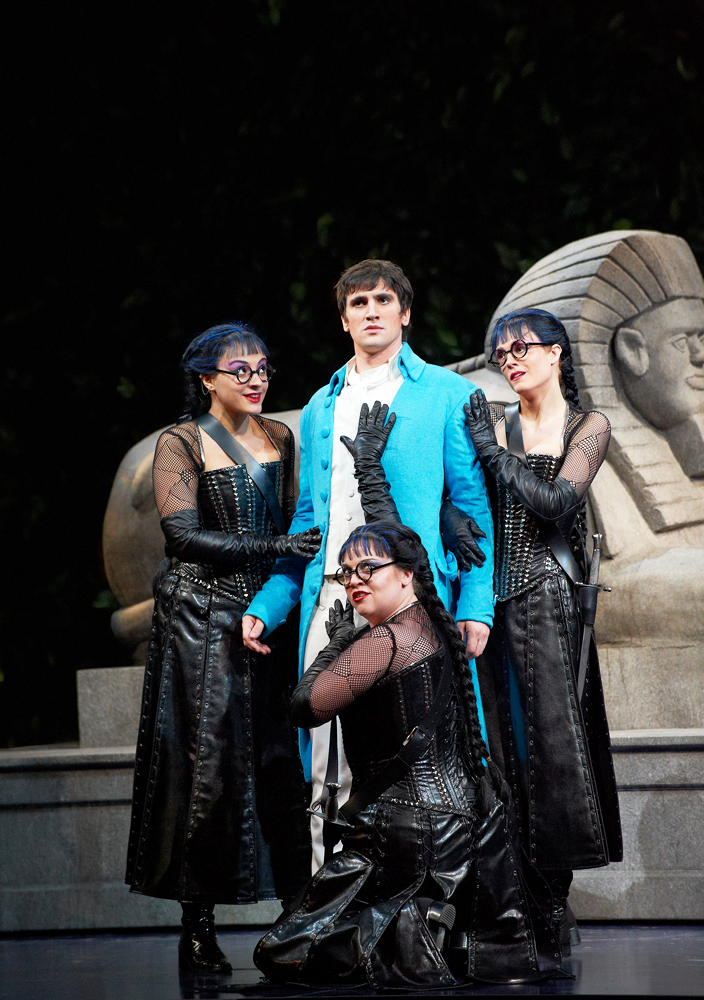
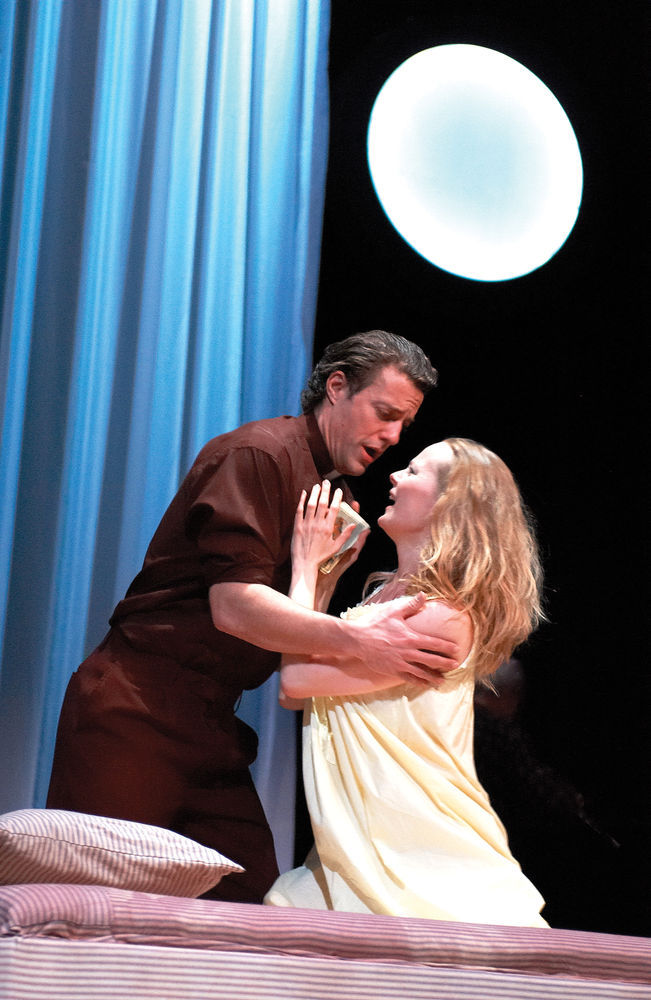
14-opera_christopher-enns_coc1107taminothreeladiesHandel chose for his libretto one written by famed English playwright William Congreve in 1707 for an opera by John Eccles. The story found in Ovid’s Metamorphoses, Book III, is set at the Temple of Juno in Thebes, where King Cadmus is preparing for the marriage of his daughter Semele to Prince Athamas. Semele has been trying to postpone the marriage because she has a secret lover — none other than the god Jupiter himself who disguises himself as a mortal. Spurred on by Juno, enraged that her husband is yet again seeking pleasure elsewhere, Semele demands that Jupiter show himself to her in all his godlike splendour. Jupiter warns her of the consequences but she cannot be dissuaded and as a result is burned to ashes by the flames of his glory. The one positive outcome (which the COC production omits) is that Jupiter is able to rescue his son from Semele’s womb, who will become Bacchus (Dionysus in Greek), god of wine, epiphany and tragedy.

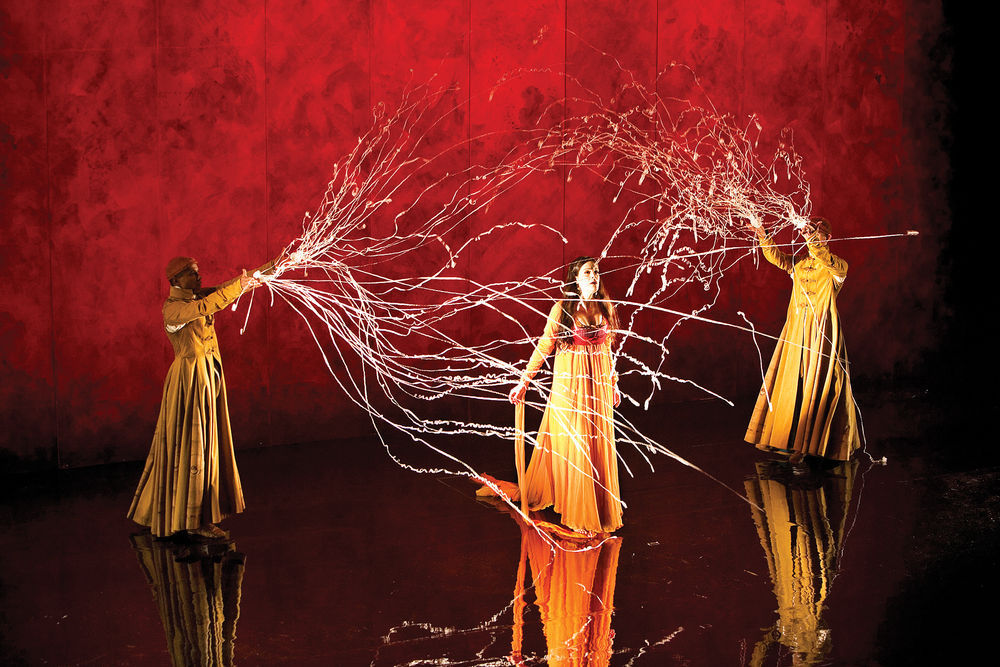
The COC production, designed and directed by Chinese artist Zhang Huan, was first presented at the Théâtre Royal de la Monnaie in Brussels in 2009 and then in Beijing in 2010, where it became the first major production of a baroque opera in China. Zhang provides an Eastern take on Western subject matter, but it is worth bearing in mind that the story of Semele and Dionysus is not originally a Greek story. It is a myth that the Thracians assimilated when they were resident in Asia Minor before finally settling in Greece. The name “Semele” itself comes from a proto-Indo-European root meaning “earth” and Dionysus is one of numerous gods in world mythology who die and are resurrected and are related to primordial vegetation cults. James Frazer’s The Golden Bough (1890) is devoted to this subject and finds parallels for Dionysus in Osiris in Ancient Egypt, Tammuz in Ancient Babylon and Krishna in Hinduism, among many others.

What makes this production so unusual is that it features an actual 450-year-old Ming Dynasty ancestral temple on stage. Zhang salvaged the temple from destruction after its owner was executed for murdering his wife’s lover. As Zhang says in his Director’s Note, “This old temple is the chapel where Semele is to get married, the heaven where she creates love, the crematory where she is destroyed, and the holy land that she is reborn in.”

At the podium is Rinaldo Alessandrini, who has recorded baroque repertoire extensively with Concerto Italiano and is considered one of the world’s leading specialists in baroque opera. The cast includes Jane Archibald as Semele, Allyson McHardy as both Semele’s sister Ino and as Juno, William Burden as Jupiter, Anthony Roth Costanzo as Athamas and Steven Hunes as both Cadmus and Somnus, god of sleep. On May 23, members of the COC Ensemble Studio take over the roles at a special performance. For tickets or more information, visit www.coc.ca.

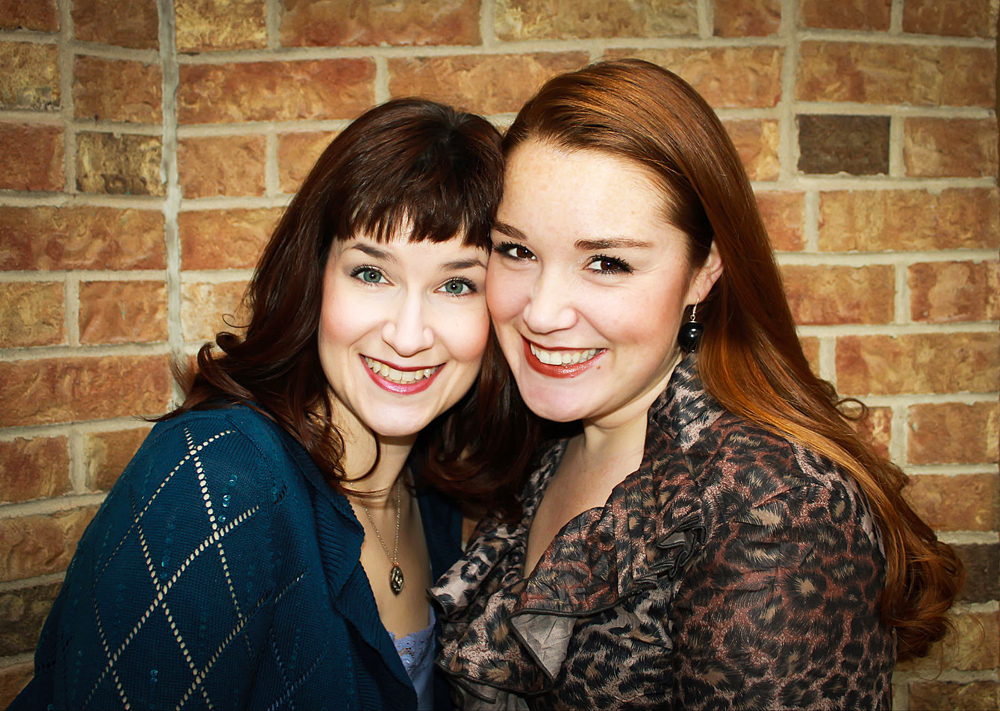
Lovers of Handel’s operas should consider performances of Alcina (1735) presented in concert by a new arrival on the opera scene, Essential Opera, founded by sopranos Erin Bardua and Maureen Batt. Though Alcina is one of Handel’s most popular operas, it has never been staged by the COC. Essential Opera presents the work accompanied by period instruments at the Trinity-
St. Paul’s Centre on May 25 and as part of the New Hamburg Live! festival in New Hamburg, near Stratford, on May 31. The cast includes Bardua and Batt as the sorceresses Alcina and Morgana; Vilma Vitols as the knight Ruggiero entrapped by Alcina’s love-spells; and Vicki St. Pierre as both conductor and the heroine Bradamante, who disguises herself as a knight, to rescue her betrothed Ruggiero. Alcina is sung in Italian with English surtitles. For tickets and more information, see www.essentialopera.com.

Switching to the 20th century, Against the Grain Theatre, known for its popular pub presentations of Puccini’s La Bohème, moves to the 112-seat Helen Gardiner Phelan Playhouse on the U of T campus, for an intimate production of Benjamin Britten’s The Turn of the Screw (1954).

This is only the second fully-staged production by AtG, whose goal is to make opera a cozier, more relaxed experience. The show will have sets by Camellia Koo and costumes by Erika Connor. AtG founder Joel Ivany directs with Christopher Mokrzewski at the piano. Miriam Khalil will sing the role of the troubled Governess, COC favourite Michael Barrett will be the mysterious Peter Quint, Megan Latham will be Mrs. Grose and Johane Ansell and Sebastian Gayowsky will be Flora and Miles, the two children who fall under Quint’s malign influence. For tickets and more information, visit againstthegraintheatre.com.

Editor’s Note: Information about this AtG production arrived too late for our concert listings deadline: performances are May 24, 25, 26 and 27, at 7:30pm.

Christopher Hoile is a Toronto-based writer on opera and theatre. He can be contacted at opera@thewholenote.com.
on_opera_opera_atelier_company_of_armideAs this column has frequently noted, April has developed into the most opera-heavy month of the year. This year, because of an early Easter, many companies like Opera Kitchener and Opera York staged their season finales in March. Yet, even so, April still presents quite a heady concentration of opera. Opera Hamilton, for instance, presents Verdi’s Il Trovatore starring Richard Margison April 14, 17, 19 and 21. Toronto Operetta Theatre closes its season with a medley of Gilbert and Sullivan tunes called Topsy-Turvydom from April 27 to 29 replacing the previously announced H.M.S. Pinafore. Opera Belcanto presents Puccini’s Tosca at the Richmond Hill Centre for the Performing Arts on April 5 and 7. And Opera by Request has two favourite operas in concert — Mozart’s The Marriage of Figaro on April 20 and Don Pasquale on April 25 — both at the College Street United Church.

What is surprising this month is that the larger opera companies are offering works seldom or never seen in Toronto. Even Opera in Concert, which specializes in rarely-heard operas, outdoes itself this month with Die Freunde von Salamanka (The Friends of Salamanca) by Franz Schubert (1797–1828), surely one of the most obscure pieces they’ve ever presented. Schubert, who died at age 31, composed nine symphonies, innumerable chamber and piano pieces and over 600 Lieder, still managed to complete nine operas. Die Freunde von Salamanka was written in 1815, but, like many of his operas was not staged during his lifetime. It had to wait until 1928, the 100th anniversary of his death, for its premiere.

Freunde is a comic opera in the form of a Singspiel (like The Magic Flute) where spoken dialogue connects the arias. Three friends — Alonso, Diego and Fidelio — all try to help the Countess Olivia to break off her engagement to the foolish Count Tormes, whom she has never met. Shannon Mercer sings Olivia, James McLean is Alonso and Michael Ciufo is Diego. Kevin Mallon conducts the Toronto Chamber Orchestra. The opera is sung in German with surtitles in English. For tickets, see www.stlc.com.

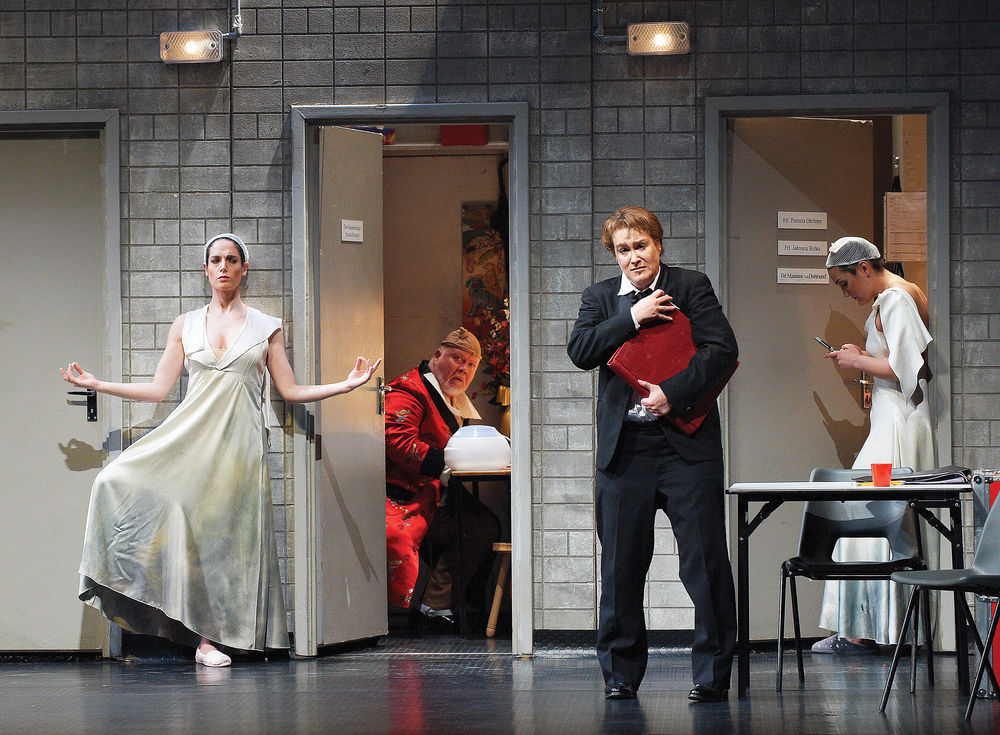
While the role of Opera in Concert is regularly to fill in gaps in our operatic experience, this month the Canadian Opera Company takes on a similar task. From April 10 to May 14 it presents The Tales of Hoffmann (1881) by Jacques Offenbach and from April 26 to May 25 it presents the Canadian premiere of A Florentine Tragedy (1917) by Alexander Zemlinsky coupled with Puccini’s comic one-act opera Gianni Schicchi (1918). With Hoffmann, COC general director Alexander Neef has clearly studied the production history of the company, and has seen that certain aspects of the repertory were neglected under his great predecessor Richard Bradshaw. For example, it was no secret that Bradshaw was not a fan of operetta. So when the COC performs Die Fledermaus beginning October 4 this year, it will be the first operetta the company has staged since The Merry Widow in 1987. Die Fledermaus was once one of the company’s most popular works. Its previous COC staging in 1986 was the seventh since the COC was formed. Bradshaw also did not care much for 19th-century French opera and programmed only Berlioz’s Béatrice et Bénédict, Bizet’s Carmen and Verdi’s French version of Don Carlos during his tenure as general director. In the case of the upcoming Hoffmann, it will be the first time the COC has staged that work since 1988.

It’s a strange fact that many successful operetta composers have felt the compulsion to prove themselves by writing a full-scale opera. Arthur Sullivan was obsessed with his Victorian duty as composer and produced the noble failure Ivanhoe (1891). Even Franz Lehár longed to see one of his works on the stage of the Vienna State Opera and was pleased when the company produced Giuditta in 1934. Though the work, unlike Ivanhoe, is still performed, the consensus at the time was that it was too grand to be an operetta yet too light to be an opera. Jacques Offenbach (1819–80) then, is the only major operetta composer (he wrote over 100 of them!) to have achieved the goal, with Hoffman, of also writing a grand opera. Offenbach died four months before the opera premiered which has meant that the work had been presented in widely varying versions ever since.

The most common scenario has three acts with a prologue and epilogue. In the Prologue, we meet the German writer E.T.A. Hoffmann (1776–1822) himself, his muse who appears as his best friend Nicklausse, his unobtainable love Stella and his nemesis Councillor Lindorf. In the three ensuing acts, Hoffmann recounts one of his great loves, each based on one of Hoffmann’s fantastic tales (which would later influence those of Edgar Allen Poe among many others). In Act 1 Hoffmann falls in love with Olympia, who, unknown to him, is an automaton created by the mad scientist Coppélius. Act 2 focusses on Hoffmann’s second love, Antonia, who is doomed to die if she sings for too long. The evil Dr. Miracle, however, encourages Antonia to do just that in the guise of a cure. In Act 3, Hoffmann falls in love with the mysterious Giulietta, who is only seducing the writer under orders from the nefarious Captain Dapertutto, who wants her to steal his reflection.

Offenbach intended that the four soprano roles be sung by the same soprano and the four villains be sung by the same bass-baritone. While the second requirement has become standard, the first is considered a daunting tour de force. In the COC production, borrowed from De Vlaamse Opera, John Relyea will sing all four villains. The four sopranos, however, will be sung by separate artists — Ambur Braid as Stella, Andriana Churchman as Olympia, Erin Wall as Antonia and Keri Alkema as Giuletta. Russell Thomas will sing Hoffmann and Lauren Segal will sing Nicklausse. On May 3 and 8, David Pomeroy substitutes for Thomas.

The COC’s second spring offering breaks new ground. Not only will the Florentine/Schicchi double bill represent the first professional production of a Zemlinsky opera in Canada, but it will also be the first time these two works have been presented as a double bill in North America. (The Wuppertaler Musiktheater presented the same pairing in 2010.) When Neef announced the 2011/12 season last year, he said that this was a combination he had always wanted to stage. There are valid reasons to combine the two. While one is a tragedy and the other a comedy, both take place in Florence and both were written during the same period and premiered within two years of each other, thus affording many fascinating points of comparison and contrast. Gianni Schicchi is one part of a triple bill by Puccini entitled Il trittico (The Triptych) that premiered at the Metropolitan Opera in New York in 1918. The triptych begins with the melodrama Il tabaro (The Cloak), continues with the sentimental story of Suor Angelica and concludes with Schicchi. The COC has never presented Il trittico as Puccini intended and has instead combined each of the one-acters with other operas — Il tabaro with Pagliacci in 1975 and with Cavalleria rusticana in 2001, Suor Angelica with Pagliacci in 1991 and Schicchi with Pagliacci in 1996.

Florentine composer Alexander Zemlinsky (1871–1942) was a pupil of Anton Bruckner and teacher of Arnold Schoenberg who became Zemlinsky’s brother-in-law when he married Zemlinsky’s sister. Zemlinsky conducted the premiere of Schoenberg’s Erwartung in 1924. Zemlinsky was one of the many artists who fled Central Europe with the rise of fascism and whose works, condemned by the Nazis as “degenerate music,” have only been rediscovered in the last two decades. In Europe Eine florentinische Tragödie is usually paired with another Zemlinsky one-acter, Der Zwerg (The Dwarf) from 1922. The two make a sensible double-bill since both are based on lesser-known plays by Oscar Wilde. By coincidence, it happens that Isabel Bayrakdarian is singing the soprano roles in this very double-bill at the Liceu in Barcelona in April, leading one to wonder if Alexander Neef has plans to stage Der Zwerg coupled with another part of Il trittico.

The new production will be directed by famed soprano-turned-director Catherine Malfitano. The conceit behind the production is that the same palazzo, designed by Wilson Chin, will serve as the site of the events in both operas — events in the 16th century for Zemlinsky and in the 14th century for Puccini. In Zemlinsky’s opera, Bianca, the wife of the merchant Simone, is having an affair with Guido Bardi. Given the title we know that it will not end happily. Malfitano links Zemlinsky’s opera to Puccini by having two of its singers appear in the second opera. In the Zemlinsky, Alan Held sings Simone, Gun-Brit Barkmin is Bianca and Michael König is Guido. In the second work, Held sings the title role while Barkmin sings the minor role of Nella, the wife of Gherardo (sung by Adam Luther), cousin to the dying Buoso Donato, whom Schicchi is impersonating. The primary female role is that of Lauretta (sung by Simone Osborne), who sings the most famous aria of the piece “O mio babbino caro.” The last time the COC presented the work an over-enthusiastic audience interrupted the short aria at least five times, mistakenly thinking at every pause that it was over. If you are in doubt, just wait until the conductor, Andrew Davis, puts down his baton. Then you will know for sure that the lovely aria has ended. For tickets and more information, visit www.coc.ca.

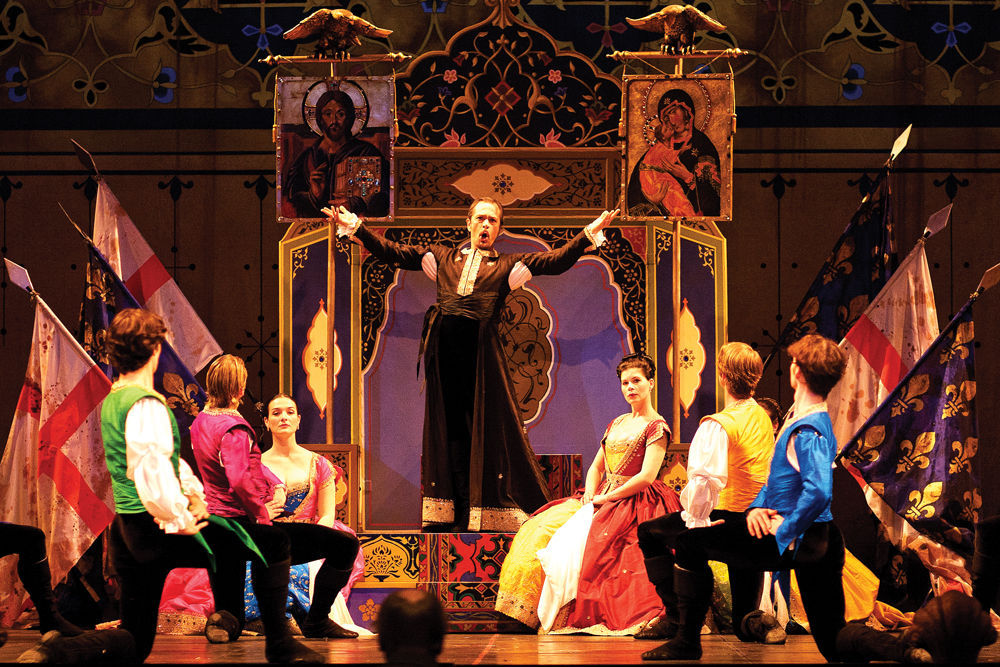
Turning towards rarities of the Baroque, in 2012 only three cities in the world will see a production of Jean-Baptiste Lully’s Armide (1686) — Toronto from April 14 to 21, Versailles from May 11 to 13 and Cooperstown, New York (i.e. Glimmerglass Opera) from July 21 to August 23. As one may have guessed, it is Opera Atelier’s production, first seen here in 2005, that has been invited by the other two opera houses.

The topic of the love between the Christian knight Renauld and the Muslim princess Armide against the backdrop of the Crusades has only become more reverent over time. Colin Ainsworth returns to sing Renault, Peggy Kriha Dye is Armide and they join João Fernandes, Aaron Ferguson, Vasil Garvanliev, Carla Huhtanen and Olivier Laquerre, among others, and the full corps of the artists of Atelier Ballet. David Fallis conducts the Tafelmusik Baroque Orchestra and Chamber Choir, Marshall Pynkoski directs and Jeannette Lajeunesse Zingg choreographs. Opera Atelier claims that the partnership with Glimmerglass has allowed it to add major design elements to make Armide “the most sumptuous production in OA history.” That is quite a statement coming from a company already renowned for its sumptuous productions. For more information, visit www.operaatelier.com.

All in all, April again lives up to its reputation as Toronto’s most exciting month for opera.

Christopher Hoile is a Toronto-based writer on opera and theatre. He can be contacted at opera@thewholenote.com.
In february, the winter season of the Canadian Opera Company ended. In April its spring season begins, as does Opera Atelier’s. In between, opera-lovers need not despair because Toronto also boasts a host of smaller companies offering unusual fare. (If there has been any downside to the COC’s move to the Four Season’s Centre, it has been the elimination of the separate opera productions that the COC Ensemble Studio used to produce in venues like the Imperial Oil Opera Theatre and the Enwave Theatre. The repertoire alternated between the baroque and the modern and gave Toronto audiences the chance to sample the wide range of chamber operas intended for more intimate spaces. While it is great experience for the COC Ensemble Studio members to take over roles in an opera in the Four Seasons Centre, they do miss out on the chance to be reviewed in their own productions and Toronto misses out on more varied operatic offerings.)

The various opera schools around Ontario help fill this gap. In December last year, the University of Toronto Faculty of Music’s Opera Division staged the Poulenc double bill of La Voix humaine (1959) and Les Mamelles de Tirésias (1947), and this January it presented a new opera about Toronto’s own larger-than-life mayor. From March 8 to 10 it returns to more conventional fare with Mozart’s Così fan tutte. Performances take place at the U of T’s MacMillan Theatre. See www.music.utoronto.ca/programs/opera.htm for more information.

On March 21 and 23, the Glenn Gould School Opera presents La Calisto (1651) by Francesco Cavalli (1602–76), which was a big hit when the COC Ensemble Studio presented it back in 1996. Cavalli wrote for the smaller forces necessitated by the smaller public opera houses of Venice where he worked. La Calisto premiered in a house seating only 400. Of his 41 operas, only 27 are extant and provide the key examples of mid-17th-century Venetian opera, which, unlike the later opera seria, took a decidedly satiric view of the amorous escapades of gods and mortals. Here, Jove and Mercury plot to deflower Calisto, a follower of Diana, while Pan tries to draw Diana away from her lover, Endymion. It is a thoroughly delightful work and will surely whet opera-goers’ desire for more Cavalli in future. Brent Krysa directs, Adam Burnette conducts and Michael Gianfrancesco designs the sets and costumes. Performances take place at Koerner Hall. See www.rcmusic.ca for details.

Venturing farther afield, Laurier Opera at Wilfrid Laurier University in Waterloo is offering quite an innovative Canadian double bill. From March 2 to 4 it will present Gisela in Her Bathtub (1991) and City Workers in Love (1992), both composed by Vancouver-based Neil Weisensel to libretti by Michael Cavanagh, better known to the opera world as an opera director. The first one-act opera focuses on the bathing Gisela, who is reading a novel that suddenly comes to life around her. The second opera takes place on a typical Canadian construction site and exposes the foibles and fortunes of the city workers. Both works have been expanded and revised for this production. You can hear three excerpts from City Workers in Love on Weisensel’s website, www.neilmusic.com. Rob Herriot directs and Leslie De’Ath conducts a chamber ensemble. Performances take place at Theatre Auditorium on the WLU campus. See the WLU website for details.

While opera schools do their share in keeping the operatic offerings in Toronto and environs diverse, so do the various companies that present opera in concert. The most established of these, Opera in Concert, has provided this service since 1974. Coming up on March 4 is the Canadian premiere of Giuseppe Verdi’s first opera Oberto (1839). The opera is a fictionalized account of the life of Cunizza da Romano (born c.1198), who appears in the Third Sphere of Dante’s Paradiso. Here in his first opera, Verdi is already exploring in Oberto and Leonora the dynamics of the father-daughter relationship that threads through all his work. Giles Tomkins sings Oberto, Joni Henson is Leonora, Michele Bogdanowicz is Cuniza and Romulo Delgado is Riccardo, Cuniza’s fiancé who seduces Leonora. Alison d’Amato is the music director and pianist and Robert Cooper prepares the Opera in Concert Chorus. Visit www.operainconcert.com for more.

31_Michelle_Minke_Headshot_1Meanwhile, Opera by Request celebrates its fifth anniversary on March 10 with a gala presentation of Verdi’s Don Carlo. For those who saw the COC’s production of Verdi’s French version of the Don Carlos story in 2007, this will be an easy way to compare it to Verdi’s later Italian version. OBR is unusual in that the cast comes together to choose the repertoire, not the company directorate. Yet, for this special celebration, OBR’s artistic director, pianist William Shookhoff, says he has departed from the mandate and has personally chosen the production and cast, which consists of “people who have contributed in a special way over the past five years.” He notes, “With the fifth anniversary comes the 50th production (not performance). And, by the time the fifth anniversary occurs, we will have engaged 150 singers, many of whom I did not know five years ago, and some of whom I only met through their colleagues who invited them to participate.” Paul Williams sings the title role, Michelle Minke is Elisabetta, Steven Henrikson is Rodrigo, Monica Zerbe is Eboli, Robert Milne is Philip and Larry Tozer is the Grand Inquisitor. The performance takes place at the College Street United Church. Visit www.operabyrequest.ca for more information.

Christopher Hoile is a Toronto-based writer on opera and theatre. He can be contacted at opera@thewholenote.com.
This february has become a month for new opera. Toronto will see a world premiere of a Canadian work, the professional world premiere of another Canadian work and the Canadian premiere of an acclaimed 21st century opera. In the depths of winter we already see the new growth of spring. The world premiere is Obeah Opera by Nicole Brooks running February 16 to March 4. For more on that work, see Robert Wallace’s interview with Brooks in this issue.

18First to appear is the Canadian premiere of L’Amour de loin (Love from Afar or more accurately “The Far-Away Love”) by Finnish composer Kaija Saariaho at the Canadian Opera Company. Not only will this be the first time the COC has staged an opera by a Finnish composer, it will also mark the first time it has staged an opera by a female composer.

This opera that premiered in 2000 at the Salzburg Festival tells the story of a world-weary 12th century troubadour from France who carries on a long-distance love affair with a beautiful woman living in Tripoli, Lebanon, whom he called in Languedoc his “amor de lonh.” Although they never see or speak to each other, their feelings develop and grow through the efforts of an enigmatic Pilgrim, who carries messages of love and yearning between the two. Saariaho drew her inspiration for the work from the life and song texts of Jaufré Rudel (died c.1147), a French prince and troubadour who wrote of his obsessive love for an ideal, unattainable woman. This is the well-known theme known as “courtly love” that swept Europe during this period. The yearning expressed has a religious component, due to the rise of Mariolatry, that leads the poet to ask whether such a love is best preserved from afar.

Reviewing the opera in 2000, New York Times critic Anthony Tommasini wrote that Saariaho’s music “combines vivid orchestration, the subtle use of electronic instruments and imaginative, sometimes unearthly writing for chorus ... The vocal writing is by turns elegiac and conversational. Her harmonic language is tonally grounded, with frequent use of sustained low pedal tones, but not tonal. Bits of dissonance, piercing overtones and gently jarring electronic sound spike the undulant harmonies, but so subtly that the overall aural impression is of beguiling consonance … Her evocations of the troubadour songs, with medieval modal harmony and fragments of elegiac tunes, are marvelous.”

The new COC production is conducted by COC music director Johannes Debus and directed by Daniele Finzi Pasca, known for his work with Cirque du Soleil. It features an all-Canadian cast. Baritone Russell Braun is Jaufré Rudel, soprano Erin Wall is his beloved Clémence and mezzo Krisztina Szabó sings the role of the mysterious Pilgrim. Sung in the original French of Lebanese librettist Amin Maaloof, L’Amour de loin (which, unlike other companies, the COC insists on calling Love from Afar) runs for eight performances from February 2 to 22. For more, visit www.coc.ca.

Taptoo! is the opera receiving its professional world premiere, with music by John Beckwith and libretto by James Reaney. The opera written in 1995 was given its world premiere by Opera McGill in 1999 and was later staged by the University of Toronto Opera Division in 2003. Toronto Operetta Theatre is presenting its professional premiere as part of the national commemorations of the bicentennial of the War of 1812. The title refers to the last drum-and-bugle signal of the day that would later expand into what is now known as a military tattoo.

19bThe work was conceived as a prequel to Harry Somers’ opera Serinette which had had a highly successful premiere in 1990 at the Elora Festival. As Beckwith writes in Unheard Of: Memoirs of a Canadian Composer, to be published in February 2012, “Where Serinette was set in York and Sharon during the 1830s, the new piece deals with the founding of York by John Graves Simcoe in 1783 and covers a time period from the American War of Independence to just before the War of 1812.” Beckwith says that the opera features a number of Reaneyesque devices: “Cast members assume a variety of roles, changing age or gender rapidly, functioning solo for one scene and in the next, as part of a chorus; the orchestral players are sometimes required to join in the action.” In the TOT production, he says, a cast of 18 singers will cover 26 characters including historical figures, like Simcoe and Colonel “Mad Anthony” Wayne, and other imaginary ones like boy soldiers Ebenezer and Seth, the aboriginal Atahentsic, settlers and adventurers.

TOT lays claim to the work because Beckwith himself says he was inspired by ballad operas, the earliest examples of what would later become operetta. As Beckwith says, “Two period productions of early music theatre affected me around this time [of composing]. John Gay’s The Beggar’s Opera and Thomas Arne’s Love in a Village were the most-often-performed ballad operas of 18th century England … I saw Taptoo! as the modern equivalent of a ballad opera, in which scraps of familiar songs and dances would now and then drift into the musical score. I included about 20 such musical references — hymn tunes, popular sentimental or patriotic songs, dances, marches and, of course, historical military music.”

The TOT cast includes Michael Barrett as Seth, Robert Longo as Wayne, Todd Delaney as Simcoe, Allison Angelo as Atahentsic, with Mark Petracchi and Sarah Hicks as Mr. and Mrs. Harple, Eugenia Dermentzis as Mrs. Simcoe and boy sopranos Daniel Bedrossian and Teddy Perdikoulias. The composer’s son, Larry Beckwith, conducts and TOT general director Guillermo Silva-Marin directs. Taptoo! runs only February 24 to 26. For more information see www.torontooperetta.com.

Beckwith says of his collaborations with James Reaney, “Without articulating our objectives further, I believe we wanted to affect our audiences in two ways — to move them and to cheer them.” We must thank TOT for giving Taptoo! a chance to achieve these goals.

Christopher Hoile is a Toronto-based writer on opera and theatre.  He can be contacted at opera@thewholenote.com.
In toronto’s opera scene, the last month of the old year and the first of the new provide a mix of old and new themselves. There is the Toronto premiere of a work that is standard repertoire in many central European countries, an unconventional production of a warhorse and an unconventional production of a seldom seen work.

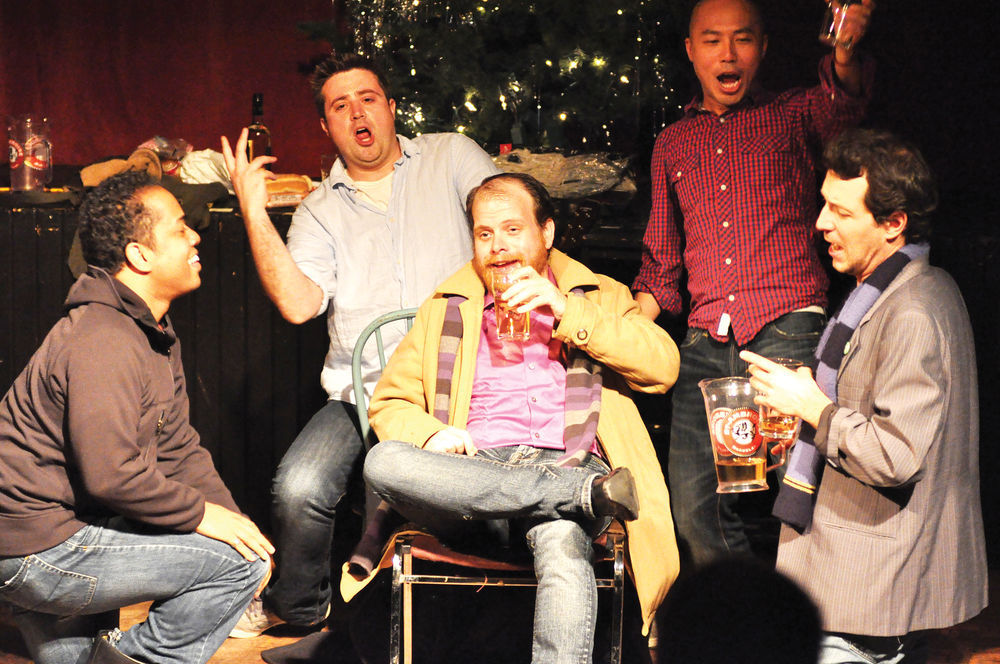
Back by popular demand: Against the Grain Theatre remounts its acclaimed production of Puccini’s La Bohème not in a theatre but in a pub, the Tranzac Club at 292 Brunswick Ave. to be precise, December 1 to 3. The opera is directed, adapted and translated into English by AtG co-founder Joel Ivany, a frequent assistant director of productions for the Canadian Opera Company.

Inspired by the success of the musical Rent, in which the late Jonathan Larson updated the story of Puccini’s opera to the artistic community of 1990s New York, Ivany and company thought, “Why not set the opera itself in the bohemian atmosphere of contemporary Toronto?” The Tranzac Club, a favourite of indie musicians, home to several arts groups and central meeting place during the Toronto Fringe Festival, seemed like the perfect location. There’s no proscenium to separate the audience from the performers; in fact, the soloists are scattered among the patrons during the performance. AtG follows in the success of pub opera performances in the UK. In 2011, OperaUpClose won the Olivier Award for Best New Opera Production over productions from the Royal Opera House and the English National Opera.

On his blog, Ivany heaps praise on the cast he has assembled: “We’ve got a fabulous cast lined up. Miriam Khalil, as Mimi, is a young soprano who recently made her debut at Glyndebourne Festival Opera in the UK. Our Rodolfo, Ryan Harper, is a former member of the Atelier Lyrique program at Opéra de Montréal and our Marcello, Justin Welsh, is a former member of the Ensemble Studio at the Canadian Opera Company. Our cast is rounded out by cabaret singer Lindsay Sutherland Boal as Musetta, current COC Ensemble member Neil Craighead as Colline, baritone Keith Lam as Schaunard and Gregory Finney as Benoît/Alcindoro.”

Christopher Mokrzewski, the pianist and music director, has been on the music staff for both the COC and Opera Atelier, for the latter as coach and répétiteur for La Clemenza di Tito. This season he will be giving a solo recital of Liszt and Messiaen as well as serving as accompanist for both classical and jazz vocal recitals.

For tickets and more information about Against the Grain, visit www.againstthegraintheatre.com.

26_againstthegrain-boheme_operaSeldom seen: The programming slot after Christmas to just beyond Epiphany has been filled for more than two decades by productions from Toronto Operetta Theatre. This year from December 28, 2011, to January 8, 2012, TOT presents its first-ever production of The Gypsy Princess (Die Csárdásfürstin) by Imre Kálmán (1882–1953). While the TOT has presented Kálmán’s Countess Maritza (1924) twice and even the rarity Gypsy Violins (1912) once, it has never staged the Csárdásfürstin (1915), which brought Kálmán his greatest success. According to the data gathered by Operabase, in the last three years there were 39 productions of Csárdásfürstin, 12 of them new, in 29 cites, in 11 countries including not just Germany, Austria, Switzerland and Hungary — that one might expect — but also Bulgaria, Estonia, France, Macedonia, Norway, Poland and Slovakia.

The plot about an aristocratic family’s distress that their young heir is in love with a cabaret singer plays out much like a story by P.G. Wodehouse. The TOT production will feature Lara Ciekiewicz as the glamorous Sylvia Varescu, Elizabeth Beeler as Countess Stasi, Keith Klassen as Prince Edwin in love with Sylvia and Ian Simpson as Count Boni in love with Stasi. Derek Bate will conduct the TOT Orchestra and Guillermo Silva-Marin will direct. The production premieres under the honourary patronage of Hungarian ambassador His Excellency László Pordány. For tickets visit www.stlc.com.

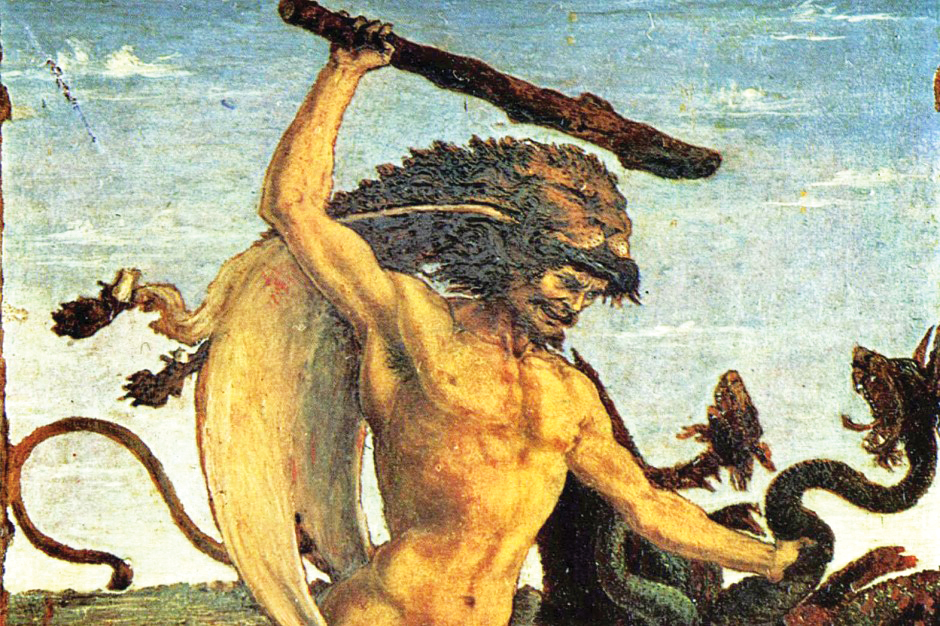
27_hercules_hydra_-paintingHandel’s Hercules: From January 19 to 22, 2012, Tafelmusik will celebrate the 30th anniversary of the Tafelmusik Baroque Choir with a “staged concert” version of Georg Frideric Handel’s Hercules. The piece will be staged by none other than Marshall Pynkoski, stage director for Opera Atelier. When I asked Pynkoski back in September what a “staged concert” would be, he answered that a lot would depend on what was and was not possible in Koerner Hall. What we could be sure of is that the soloists would be off book and interact as characters and that the Opera Atelier corps de ballet would be involved in the dances.

27_hercules_allysonmchardyThe question of Hercules’ genre has existed since the work premiered in 1745. Handel called it a “Musical Drama” and indeed its English-language libretto by Thomas Broughton is based on Sophocles’ tragedy The Women of Trachis. The work was first performed in a theatre, not a church, but as an oratorio without any stage action. Modern critics have since suggested that this confusion of genre led to its later neglect. Handel had the same experience with Semele (1744) which was also first presented as an oratorio, but since oratorios were supposed to take biblical stories as their subject matter, it was also rejected by the public and suffered similar obscurity until the 20th century. Now Semele has been fully embraced as an opera and will conclude the COC’s 2011–12 season.

The plot concerns the circumstances of Hercules’ death. When Hercules returns to his wife Dejanira after his 12 labours, he brings the captive Iole in tow. This arouses Dejanira’s jealousy and she seeks to retain Hercules’ love through a tunic imbued with the blood of Hercules’ enemy, the centaur Nessus, which supposedly can render the wearer faithful to the giver. In fact, the garment is Nessus’ revenge on his opponent since it causes unendurable pain that leads Hercules to ask his son to set him upon a funeral pyre.

For Tafelmusik, Sumner Thompson will sing the role of Hercules, Allyson McHardy will be Dejanira, with Nathalie Paulin as Iole, Colin Blazer as Hercules’ son Hyllus and Mireille Lebel as the herald Lichas. Jeanne Lamon will conduct. For tickets and more information, visit www.tafelmusik.org.

Christopher Hoile is a Toronto-based writer on opera and theatre.  He can be contacted at opera@thewholenote.com.
November offers those in Toronto and vicinity a chance to see the Canadian premiere of a new Scottish opera with a Canadian connection, and the revivals of seldom-seen American and Canadian operas. This is a further demonstration, if anyone needed one, of how vital such companies are in maintaining the diversity of Toronto’s opera scene.

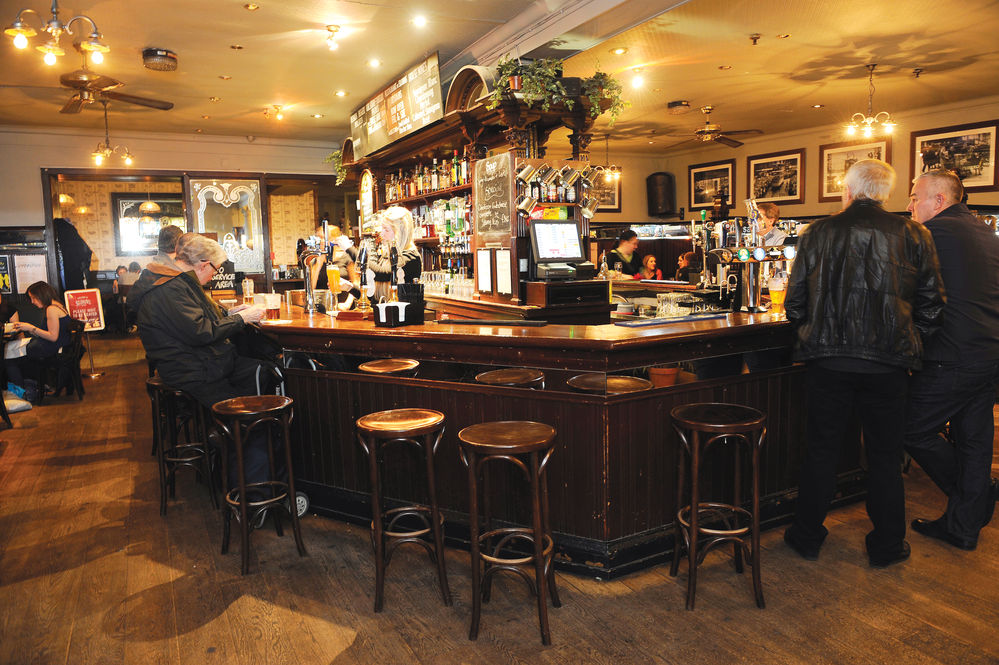
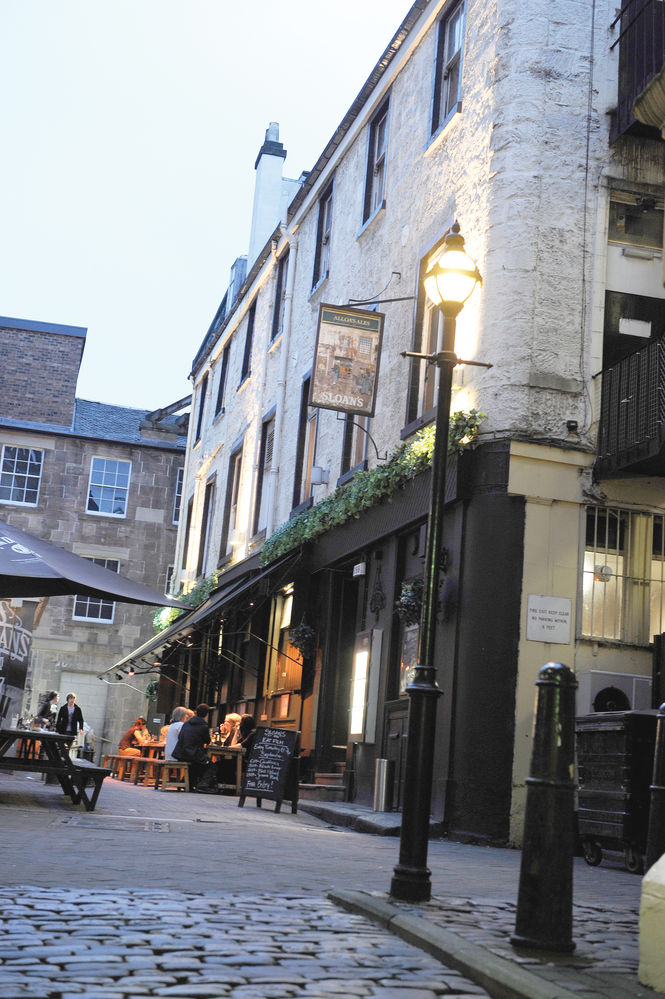
18_opera_sloans_inside18_opera_sloans_outsideFirst to appear, on November 10, 11 and 12, is Pub Operas by Scottish composer Gareth Williams, to a libretto by Canadian David Brock. The two met in 2009 at Tapestry New Opera’s LibLab, Tapestry’s composer/librettist incubator, and the project grew out of that meeting. The opera premiered earlier this year in July, at Sloan’s Bar in Glasgow as part of the Merchant City Festival. The venue was no quirk because Pub Operas was written specifically to celebrate the history of Sloan’s, which is Glasgow’s oldest pub, having been founded in 1797. The libretto, about life’s cycle of love, marriage, birth and death, is based on letters sent in by the public for whom Sloan’s played a real role at key points in their lives.

For the performance, the Ernest Balmer Studio in the Distillery District will substitute for Sloan’s. The singers will be Xin Wang, Heather Jewson, James McLean and Benjamin Covey with Wayne Strongman leading a six-piece band. Sue Miner directs. For more information about the opera, visit www.tapestrynewopera.com; and for the history of Sloan’s visit www.sloansglasgow.com.

18_john_beckwith_photo_andre_leducAlso playing on November 11 and 12 will be the Toronto premiere of the 1989 opera Crazy to Kill by John Beckwith to a libretto by James Reaney. Toronto Masque Theatre will mount this production of “Canada’s first detective opera” at the Enwave Theatre starring singers Kimberly Barber, Doug McNaughton and Shannon Mercer and actors Brendan Wall and Ingrid Doucet. The work, scored for piano and percussion, wiill feature Greg Oh as pianist and conductor and Ed Reifel as percussionist. David Ferry will direct.

18_opera_puppets_218_opera_puppets_3The story for the libretto comes from the 1941 novel of the same title by Ann Cardwell (pseudonym of Jean Makins Pawley) that is still in print. It concerns Detective Fry who, with the help of “model patient” Agatha Lawson, investigates a series of murders at Elmhurst, a private mental asylum for the wealthy in Southwestern Ontario. Reaney has stated that it was reading this novel that inspired him to become a writer. The commission (from the Edward John Music Foundation and Billie Bridgman for the Guelph Spring Festival) limited the cast to three singers and two actors. To get around these constraints Reaney had the idea of giving Agatha the habit of making life-sized doll puppets, eighteen in all, who, manipulated by the performers, also portray characters at Elmhurst. After a workshop at Banff in 1988, the one-act opera premiered at the Guelph Spring Festival on May 11, 1989, with Jean Stilwell as Agatha, Paul Massel as Fry and Sharon Crowther as Mme Dupont, an Elmhurst patient. For more information visit www.torontomasquetheatre.com. Also note that the fall edition of Opera Canada includes an article adapted from a chapter from Unheard Of: Memoirs of a Canadian Composer by John Beckwith, to be published in 2012 that deals with the background of Crazy to Kill and other of his operas of the period.

On November 23 and 26, Opera by Request (OBR) and Ensemble TrypTych (ET) co-produce the first Canadian performance of The Saint of Bleecker Street by Gian Carlo Menotti. The 1954 opera had its Canadian premiere at the University of British Columbia in the 1980s, but as far as OBR artistic director William Shookhoff can determine, has not had a full performance in Canada since then. OBR and ET chose the opera in consultation with the performers to celebrate the centenary of the birth of the composer. OBR traditionally does one choral opera per season with the University of Toronto Scarborough Concert Choir, and as this is Menotti’s only choral opera it fit the bill. Besides, this seldom-heard opera provides something more out of the way than The Medium (1946) or The Consul (1950).

Bleecker Street, which won the 1955 Pulitzer Prize for Music and the New York Drama Critics Circle Award for Best Musical, is set in New York City’s Little Italy, where a young woman named Anina manifests the stigmata and begins to see angels. A conflict develops between her atheist brother Michele, who thinks she needs medical attention, and the neighbourhood which regards her as a saint. Shookhoff says, “As with The Consul, there is a timelessness to it which resonates particularly with younger participants, as it does with all of us: the conflict between tradition and new surroundings; between faith and rationale; and the stigma of relationships which go against the norm.”

The work will be performed in concert with Shookhoff as pianist on November 23 at the University of Toronto Scarborough Campus and on November 26 at Trinity Presbyterian York Mills. Deena Nicklefork will sing Anina and Avery Krisman will sing Michele with six other soloists rounding out the cast. For more visit www.operabyrequest.ca.

Christopher Hoile is a Toronto-based writer on opera and theatre. He can be contacted at opera@thewholenote.com.
opera_opera_atelier_don_giovanni_photo_by_bruce_zinger._phillip_addis__curtis_sullivan_and_artists_of_atelier_balletFrom October 29 to November 5, Opera Atelier premieres its new production of Mozart’s Don Giovanni. Phillip Addis sings the title role with Carla Huhtanen as Zerlina, Vasil Garvanliev as Leporello, Peggy Kriha Dye as Donna Elvira and Meghan Lindsay as Donna Anna. Italian conductor Stefano Montanari leads the Tafelmusik Baroque Orchestra and Marshall Pynkoski directs.

During an extensive telephone interview with Pynkoski, I raised the question, “What can be called ‘new’ in a period production?” In answer, he had much to say about Opera Atelier’s goals and what a period production is:

“By period production we’re not talking about a museum. We’re not talking about reproducing something someone did at an earlier time. We could do that if we wanted to, and at times we do, but when we say ‘period production’ we mean we are taking elements of every discipline involved in the production — the acting style, the singing style, the dancing style, the orchestral playing — all of those things, not so that we can copy what they did in the 18th century, but to see if there is anything that we’ve missed in the past and anything that we’ve lost that will challenge us as artists in the 21st century.”

“Our goal is to be more linear. We want to be storytellers. We’re going to follow the text and we’re going to try to figure out how to make it make sense. For example, we’re taking a look at what happened in the early productions of Don Giovanni so that we can challenge ourselves in a new way. Of course, we’ve done Don Giovanni before, but I think we’ve learned a great deal about it over the years. Initially, we were unable to build the production we wanted and had to cobble it together from what we had in stock. This is our first complete statement of what we’d like Don Giovanni to be.”

“The most important thing I want to get across is that it is a comedy. That doesn’t mean that there are no tragic or dark moments. All great comedy has moments that are poignant. But what I have right in front of me is a letter Andrew Parrott gave me, where Mozart refers to Don Giovanni as an opera buffa. I don’t care if everyone else called it a dramma giocoso with an emphasis on the drama. Mozart called it an opera buffa and I’m following what he said, because I think it makes the opera absolutely make sense.”

“I’m sick of seeing a Don Giovanni about a middle-aged Lothario who hates woman and can’t achieve intimacy. It never makes sense because it means every woman on stage is insane. How exactly can a horrible, dirty old man be irresistible? On the other hand, we find things amusing, even charming, in young people that we would find reprehensible in middle age. Just think, the first Don was under 20. The second Don was under 25. Therefore I have to find someone like Phillip [Addis] who registers young, innocent, fresh, irresistible.”

“Basically, Don Giovanni is Cherubino at age 25. He says all the same things. He falls in love with every woman he sees. He doesn’t hate women — he loves them. And women adore him. There has to be something adorable about him, but I have yet to see a Don Giovanni where I understand why women love him. To my mind Don Giovanni is the most innocent and the most honest man on stage. He’s a comic character and everything on stage revolves around him.”

“Anyone in the 18th century would have known from the first scene that we’re in the world of the Italian commedia dell’arte with the servant, like a Harlequin, outside a tavern who wants a drink but has no money while his master is inside drinking. The design will not be as strongly commedia as it was last time. I think we made our point. Martha [Mann]’s costumes will be more Spanish but will still retain very clear commedia touches.”

“What makes it ‘new’ when talking about period is to say it’s a comedy and to discover what that means. It means we have to re-examine every character and fight the stereotypes that have been built up over the past hundred years or so. It’s a big challenge for everyone, especially the singers, because they come in with so much baggage from other productions that we have to strip away.”

“We’ve recently learned that in the original production the Commendatore and Mazetto were played by the same person with little time for a costume change at the finale. This immediately tells us something about the opening. The Commendatore is not some doddering old man who staggers around the stage before Don Giovanni kills him. He has a daughter, after all, who is probably 17. Therefore he’s a vital, strong, dangerous middle-aged man. Of course, the Don calls him ‘old’ as any young person would. As soon as you see that the duel at the beginning is thus more on an equal footing, itchanges everything. It’s no longer the brutal murder of a senile old fool. Once we learned this we thought, ‘Let’s do it. Curtis [Sullivan] will play both roles. It’s a challenge, but we’re just doing what Mozart did.’”

For tickets and more information visit www.operaatelier.com.

THERE’S MORE!

For devotees of Music Theatre in its many forms, Atelier’s “Don Giovanni” won’t be the only event of interest this month.

On the afternoon of Sunday October 2, Opera in Concert presents a concert titled L’accordéoniste: Latin Heat with Kimberly Barber, mezzo; Peter Tiefenbach, piano; Carol Bauman, percussion; and Mary-Lou Vetere, accordion. The same day, at 7:30pm, Solomon Tencer Productions presents An Evening at the Opera at the Studio Theatre, Toronto Centre for the Arts.

Monday October 10, 8pm, sees the opening of an extended run of Art of Time Ensemble’s “I Send You This Cadmium Red,” an evening of theatre, dance and music, exploring correspondence between artist John Berger and filmmaker John Christie.

Wednesday October 12 at noon Canadian Opera Company/ Queen of Puddings Music Theatre showcase Ana Sokolovic’s new a cappella opera “Svadba — The Wedding.”

Wednesday October 19 at 7:30pm Opera Belcanto’s “Cav/ Pag” double bill kicks off a two-night stand at the Richmond Hill Centre for the Performing Arts.

Friday October 21 at 7:30pm, Opera By Request presents Handel’s “Orlando” at College Street United Church; Markham Theatre for Performing Arts has Isabel Bayrakdarian in recital at 8pm; and also at 8pm at St. John’sYork Mills Anglican Church is What They Did For Love, the debut concert of a newly formed opera ensemble, Opera Rouge.

Sunday October 23 brings Zarzuela Gold from Toronto Operetta Theatre, an opening gala concert; the same day, the University of Toronto Faculty of Music’s perennially popular Opera Tea features a Menotti Double Bill in celebration of the 100th anniversary of the composer’s birth.

Saturday October 29 sees not only the start of the aforementioned Atelier “Don Giovanni,” but also what might be described as the “final return” of “Two Pianos Four Hands,” Ted Dykstra and Richard Greenblatt’s musical comedy. about, what else, music.

Thursday November 3 and Saturday November 5 Opera York’s Madama Butterfly is on the boards at Richmond Hill Centre for the Arts. Friday November 4 Opera By Request presents Massenet’s “Herodiade.”

Details on all these, and more can be found in the listings.

Christopher Hoile is a Toronto-based writer on opera and theatre. He can be contacted at opera@thewholenote.com.
So far over 35 productions have been announced for the 2011/12 opera season. Since so many of these are Toronto premieres or unfamiliar repertoire this looks to be quite an exciting season.

opera_oksana1The Canadian Opera Company has several fascinating offerings. The fall season opens with Gluck’s Iphigénie en Tauride (1779) starring Susan Graham — the world’s foremost Iphigénie. The production, running September 22 to October 15, continues Robert Carsen’s series of interpretations of Gluck that began last season with his highly acclaimed Orfeo ed Euridice. February brings the Canadian premiere of Love from Afar (L’Amour de loin) (2000) by Finnish composer Kaija Saariaho. This continues COC General Director Alexander Neef’s plan to include a contemporary work every season and it will also mark the first time the COC has staged a work by a female composer. In April, the COC will mount A Florentine Tragedy (1917), its first-ever opera by Alexander Zemlinsky, on a double bill with Puccini’s Gianni Schicchi. And in May, the company will stage its first-ever Semele (1744) by George Frideric Handel. For more information visit www.coc.ca.

Opera Atelier’s season premieres a new production of Mozart’s Don Giovanni, October 29, and remounts Jean-Baptiste Lully’s Armide (1686) in April, last seen in 2005. Toronto has to count itself as very spoiled to have a second chance to see an opera like Armide. In January, Opera Atelier Co-Artistic Director Marshall Pynkoski will direct a concert production of Handel’s oratorio Hercules (1744) with Tafelmusik at Koerner Hall. For more see www.operaatelier.com and www.tafelmusik.org.

Toronto Operetta Theatre charts new ground with its first-ever staging of Imre Kálmán’s Die Csárdásfürstin (1915), in late December. The TOT has presented other Kálmán works but strangely not The Gypsy Princess (as it is known in English), even though it’s regarded as one of the pinnacles of “Silver Age” Viennese operetta. In February it will present the first professional staging of John Beckwith’s opera Taptoo!, an opera with a War of 1812 theme given its world premiere by the University of Toronto Opera Division in 2003. Toronto Masque Theatre coincidentally will stage another opera by Beckwith, also to a libretto by James Reaney, Crazy to Kill (1989), earlier in November.
For more information see www.torontooperetta.com and www.torontomasquetheatre.com.

opera_kaija_saariahoNormally, the double bill of Mascagni’s Cavalleria Rusticana (1890) and Leoncavallo’s Pagliacci (1892) would not count as unusual, except that the COC last staged this traditional pairing way back in 1966. Since then, the company has yoked one or the other to various parts of Puccini’s Il Trittico (1918). This season, those who would like to “Cav and Pag” together have three choices: Opera Lyra Ottawa has scheduled them for September 10 to 17; Opera Belcanto presents them October 19 and 21; and Opera Hamilton has them on April 21 and 23. See www.operalyra.ca, www.operabelcanto.net and http://operahamilton.ca for more.

The tradition of presenting operas in concert has immeasurably widened our knowledge of works now rarely staged. This year two companies offer some especially unusual items. Opera in Concert has planned Giacomo Meyerbeer’s once-popular Les Huguenots (1836) for November 27, Verdi’s first opera Oberto (1839) for March 4 and for April 1, Franz Schubert’s virtually unknown Die Freunde von Salamanka (written in 1815 but not performed until 1928). Meanwhile, Opera by Request has scheduled Handel’s Orlando (1733) for October 21, Massenet’s Hérodiade (1881) for November 4 and Giancarlo Menotti’s The Saint of Bleecker Street (1955) for November 23. Look for more information at www.operainconcert.com and www.operabyrequest.ca.

Tapestry New Opera has three unusual offerings. Its season opener, “Opera Briefs,” gives us exciting new works from the Composer Librettist Laboratory, “Liblab,” September 23 and 24, at Theatre Passe Muraille. In November, it presents Pub Operas by Gareth Williams that premiered in Glasgow in July earlier this year. The libretto (by David Brock) is based on the stories of the patrons of Sloan’s Bar, Glasgow’s oldest pub, that has played host to the citizens’ betrothals, weddings, christenings and wakes. Then in June 2012, it will mount the first full workshop production of The Enslavement and Liberation of Oksana G. by Aaron Gervais and Colleen Murphy, excerpts of which have been tantalizing audiences for several seasons now. See www.tapestrynewopera.com for more.

Those with a taste for ground-breaking new operas will have much to cheer them. On February 2, Soundstreams will present The Sealed Angel (1988) a liturgical work by Russian composer Rodion Shchedrin that will be staged at Koerner Hall as choral opera with choreography by Lars Schreiber and sung by the combined forces of the Elmer Iseler Singers and the Amadeus Choir. See www.soundstreams.ca for more.

The 2011/12 season ends with a bang with the Canadian premiere of Philip Glass’s seminal 20th-century opera Einstein at the Beach (1976). This, the North American premiere of the first new production of the work in 20 years, will be the centrepiece of Luminato 2012 that runs from June 8 to 17. More information will become available. www.luminato.com.

Christopher Hoile is a Toronto-based writer on opera and theatre. He can be contacted at opera@thewholenote.com.
This summer there is not quite as much opera on offer in town in July and August as there has been in past seasons. Yet, it is not totally absent and nearby summer music festivals should hold much of interest for opera lovers.

16For staged operas with piano accompaniment, Summer Opera Lyric Theatre is always reliable. This year SOLT (www.solt.ca) is presenting Mozart’s Idomeneo on July 29 and 31 and on August 3 and 6 with Michael Rose as music director. Playing with it in repertory is Verdi’s La Traviata on July 30 and August 2, 4 and 6 with Jennifer Tung as music director and Aaron Copland’s seldom-staged The Tender Land on July 30 and August 3, 5 and 7 with Nicole Bellamy as music director. The Tender Land, which premiered at the New York City Opera in 1954, concerns Laurie, a girl about to graduate from high school, who falls in love with an itinerant worker. It was staged at Glimmerglass just last year. All performances take place at the intimate Robert Gill Theatre on the University of Toronto campus.

On July 9, Opera by Request (www.operabyrequest.ca) will present a concert performance of Verdi’s Il Trovatore with Steven Sherwood (Manrico), Carrie Gray (Leonora), Karen Bojti (Azucena) and Yevgeny Yablonovsky (Count di Luna) with William Shookhoff as music director. The performance takes place at the College Street United Church, 452 College St.

The 24th annual Brott Music Festival in Hamilton (www.brottmusic.com) offers several enjoyable options. Opera Ovations! on July 7 presents well-known opera excerpts sung by Ermano Mauro, Sinead Sugrue, Lauren Segal and Peter McGillivray accompanied by the National Academy Orchestra under Boris Brott himself. On August 6 the festival presents Bizet’s Carmen in concert with Lauren Segal (Carmen), Keith Klassen (Don José), Gregory Dahl (Escamillo) and Sinead Sugrue (Michaëla). Brott again conducts the NAO and Giandomenico Vaccari oversees the production. The previous day, Signore Vaccari will hold a dress rehearsal chat about the opera and discuss his role in rebuilding Bari’s famous Petruzzelli Theatre. The festival concludes on August 18 with a performance of Carl Orff’s Carmina Burana with John McMaster, Leslie Anne Bradley and Theodore Baerg.

To the west, Stratford Summer Music is presenting A Serenade for Maureen Forrester at the Avon Theatre on July 25 commemorating her life and career. Soloists include Kimberly Barber, Allyson McHardy, Catherine Robbin, Krisztina Szabó, Jean Stilwell and Mary Lou Fallis. In addition to musical performances will be tributes from music critic William Littler, director Brian MacDonald, prima ballerina Karen Kain and composer R. Murray Schafer. Video tributes will come from conductors Zubin Mehta and Sir Andrew Davis. For more information and to book tickets visit www.stratfordsummermusic.ca.

To the northeast the Westben Arts Festival in Campbellford is mounting a fully-staged production of Benjamin Britten’s Albert Herring from July 1 to July 3. The UBC Opera Ensemble is directed by Nancy Hermiston and Philip Headlam conducts the Westben Festival Orchestra. On July 14 well-known singers like Donna Bennett, Gabrielle Prata, Colin Ainsworth and Robert Longo take a break from opera to explore musicals from West Side Story to A Little Night Music and beyond. On July 24, Isabel Bayrakdarian with Serouj Kradjian at the piano presents a concert titled Sunday Afternoon at the Opera. Visit www.westben.ca for more information.

If you’re looking for rarities and would rather stay in Canada, head over to Quebec to the Festival de Lanaudière (www.lanaudiere.org) near Montreal. On July 30 it will present what must be the first fully-staged performance in Canada of the romantic opera Der Vampyr (1828) by Heinrich Marschner (1795-1861), a composer whose operas are known to have heavily influenced Wagner. Wagner, in fact, conducted the work in 1833 with his brother in the tenor role. The opera is ultimately based on the first vampire story in English, the short novel The Vampyre (1819) by John Polidori, doctor to Lord Byron and friend to Percy and Mary Shelley. The singers include Phillip Addis in the title role, Frédéric Antoun, Nathalie Paulin and Robert Pomakov. Alain Gaulthier directs and Jean-Marie Zeitouni conducts the Orchestre du Festival. Toronto last had a chance to hear the work in 1994 when Opera In Concert presented it. Since then others have championed it including Roberto Abbado, who conducted it in Bologna in 2008.

Opera productions in the US within a day’s drive of Toronto include Luigi Cherubini’s Medea (1797) in Italian at Glimmerglass Opera (www.glimmerglass.org) July 8 to August 16; Richard Strauss’s Die Liebe der Danae (1940) at the Bard Music Festival (http://fishercenter.bard.edu/bmf) July 29 to August 7; and at the Ohio Light Opera (www.ohiolightopera.org) July 15 to August 6, Cole Porter’s Jubilee (1935), Victor Herbert’s The Fortune Teller (1898) and Leo Fall’s Madame Pompadour (1922).

Christopher Hoile is a Toronto-based writer on opera and theatre. He can be contacted at opera@thewholenote.com.
Opera in Toronto no longer ends with the close of the Canadian Opera Company’s season. This month sees the world premiere of Svadba – Wedding, a new a cappella opera by Montreal composer Ana Sokolovic commissioned by Queen of Puddings Music Theatre.

p15_opera_the_midnight_courtAny opera by Queen of Puddings is an event, especially when it is on a large scale, this time involving six singers. According to the QoP press release, Svadba – Wedding “takes place the night before a fiancée, Milica, leaves for her wedding. Her girlfriends keep her company all night long and engage in raucous girltalk, invoking pagan rituals as they prepare her for the impending wedding. What elevates this ‘girltalk’ to a supernaturally exhilarating experience is Ana Sokolovic’s style of composition. Using existing Slavic/Balkan peasant folk tales, myths and traditions as her text source, she draws on her native Balkan folk music as a source of inspiration for all her music. She transforms the music and text into her own unique onomatopoeic language and transports listeners to a world of magic realism. The singers have to use every single possible vocal technique – combining opera singing with Balkan folk singing, overtones, extreme chest voice, heightened nasal voice, whispering, creating a wildly inventive intense palette of colours.”

This is Sokolovic’s fourth collaboration with QoP after Love Songs (2008), The Midnight Court (2005) and Six Voices for Sirens (2000). Born in Belgrade, Serbia, in 1968, she studied composition with Dusan Radic and Zoran Eric. She completed a master’s degree at the Université de Montréal under the direction of José Evangelista. Her catalogue includes orchestral and piano works and several chamber music compositions, and she has written numerous scores for the theatre. This year she has been unanimously chosen by the SMCQ (Société de musique contemporaine du Québec) for its 2011-2012 season Homage Series. This season the entire Québec cultural community will recognize and celebrate the work of Ana Sokolovic by programming her music.

Via e-mail, Dáirine Ní Mheadhra, co-founder with John Hess of QoP, writes of Sokolovic and her inspiration for this new work: “The genesis of Svadba was Sirens, that ten minute work for six female voices we commissioned from Ana in 2000. We adored that work and anyone who heard it has never forgotten it and we’ve performed it many times since. She used Balkan vocal techniques in Sirens, something akin to what you hear in that famous Bulgarian women’s choir, Le Mystère des Voix Bulgares. While we’ve commissioned other works from Ana since 2000, we’ve always wanted to revisit a full-length scenario for six female voices in which Ana would again be drawn towards Balkan vocal techniques, as she always is when writing vocal music.”

“Balkan folkloric music has always been the inspiration for all of her music. Love Songs included three Serbian poems, and now in Svadba she has come full circle as it’s completely in Serbian. She had the idea of really exploring Balkan literature and folk texts for Svadba and the wedding rituals and texts were the ones that caught her attention. She spent time in Belgrade poring over hundreds of texts. While Ana lives in Montreal, married to a Québécois with two Canadian children, she is never far from her Serbian background in her art. Igor Stravinsky’s Les Noces (a choral ballet from 1923 based on Russian wedding lyrics) may not have been Svadba’s immediate inspiration but it was probably there subliminally.”

In answer to questions about the nature of Svadba as opera, Ní Mheadhra says, “Svadba is more about ritual than narrative, although it does unfold in seven consecutive scenes where the bride and her girlfriends stay up all night long before the impending wedding as they prepare her for the ceremony. It includes scenes like colouring her hair, bathing her in the hammam, dressing her, etc., leading to the farewell, and the music is completely onomatopoeic. The catharsis is a purging through emotion, most definitely, as the forcefield of sound set up by those female voices singing nasally pushes into the far reaches of your cranium and makes your head buzz and your body vibrate so much that you feel totally exhilarated! It’s primal stuff and communicates so viscerally that you want more and more and more … which is after all how those Sirens could lure those sailors onto the rocks with their sound that was so seductive!”

Svadba will be sung in Serbian with English surtitles. The cast is comprised of singers Jacqueline Woodley, Shannon Mercer, Laura Albino, Carla Huhtanen, Andrea Ludwig and Krisztina Szabó, under the music direction of Dáirine Ní Mheadhra. The creative team consists of stage director Michael Cavanagh, set and costume designer Michael Gianfrancesco and lighting designer Kimberly Purtell. Performances take place in Toronto June 24, 25, 28, 29, 30 and July 2 at the Berkeley Street Theatre Downstairs. For tickets phone 416-368-3110 or visit www.canadianstage.com/alsoatberkeley. For more about Ana Sokolovic, see www.anasokolovic.com and for more about Queen of Puddings see www.queenofpuddingsmusictheatre.com.

Christopher Hoile is a Toronto-based writer on opera and theatre. He can be contacted at opera@thewholenote.com.
Once singers have graduated from Opera School, how do they get a job? How do they know what repertoire to sing? How do they prepare for auditions? If you’ve ever wondered about these questions, a special event in May will show you the answers. The International Resource Centre For Performing Artists (IRCPA) presents Opera Week in Toronto from May 5 to 9. During this period, Vincenzo Scalera of the Teatro alla Scala, Milan, and Joan Dornemann of the Metropolitan Opera, New York, will be in Toronto to work intensively with Canadian opera singers with the goal of helping them learn what their possibilities might be in the international market and how to prepare for important auditions for employment. The information garnered at these sessions will also be of interest to coaches, pianists, conductors, stage directors, teachers and managers.

17a17bBest of all, the coaching sessions are open to observers for $20 a session. Morning and afternoon sessions will take place May 5 to 9 at the Gallery Theatre Space, Toronto Centre for the Arts. Opera Week will then culminate in a Toscanini Celebration Concert on Wednesday, May 11, at 8pm, at the George Weston Recital Hall, Toronto Centre for the Arts. Singers for the May 11 concert will be chosen during the week’s coaching sessions by Mr. Scalera and Ms. Dornemann, together with Canadian operatic divas Clarice Carson and Lois McDonall, both retired after illustrious international careers, and now active members of the IRCPA. May 11 is a significant date as it marks the 65th anniversary of the reopening of La Scala by Arturo Toscanini on May 11, 1946, after its restoration following the bombing of Milan in 1943. Tickets are $30, and $25 for seniors and students, and are available at 416-872-1111 or at www.ticketmaster.ca. More information is available at www.tocentre.com.

The IRCPA has designed programs since 1983 to make artists ready for employment. Its mandate is to help all performing artists in the classical music and ballet fields to move into professional careers, with special attention to singers and dancers because of their short career spans. After years of formal training, singers need guidance in auditioning for national or international markets, and the IRCPA gives them the opportunity to learn from artistic directors and high-level coaches who work with international casts and know what they need to be hired. The artists thus gain rare access to people currently at the pinnacle of their field while saving on the costs of travel and an accompanist.

These sessions (also called “encounters”) are often supplemented by panel discussions and information on the “business” of performing – including contracts, protocol and the expectations presenters and employers have of artists. The IRCPA program also includes “Encounters with Employers” and the “Business of Career Development.” The next such encounter is scheduled for November 2011.

Ann Summers Dossena, IRCPA founder and the producer/organizer of Opera Week, had been working with Joan Dornemann and other major people, including Joan Ingpen (who was head of the Metropolitan Opera’s young artists programme). When Ann returned to Canada in 1977, she realized that there wasn’t anything similar in Toronto. Artists were asking for management but they weren’t ready for it. Ann spoke to Joan Dornemann, who said, “You do it and I’ll come.” That was in 1983. Joan Dornemann began her Israel program two years later, and Ann went there twice to help her.

Ann continues: “We soon realized that the coaching wasn’t enough because languages were a problem, so we expanded to include Nico Castel for languages. Then it became apparent that stage protocol and interpretation were needed, so we expanded further and brought in Leon Major, a Canadian stage director working in the U.S. who created the Opera Centre at the University of Maryland.”

Artists the IRCPA has tracked include Adrianne Pieczonka, Isabelle Bayrakdarian, Measha Bruggergosman, Colin Ainsworth, Jean Stilwell, Kimberly Barber and also actor Adam Brazier. Summers says, “We’ve also helped accompanists and they are working in theatres outside Canada. We hope they will bring back their experiences to Canada.”

Famed Canadian voice teacher Mary Morrison has said, “Many years ago, I attended Joan Dornemann’s classes as an observer. Her fabulous ears and acute musicianship have inspired some of our budding professional singers, and have certainly influenced my own teaching. I always encourage students to participate in any of her courses. How fortunate for singers to have this experience.” Soprano Adrianne Pieczonka agrees, saying, “As a young student aspiring to become an opera singer, I had the good fortune to benefit from the IRCPA. I participated in a masterclass given by Joan Dornemann which was a revelation! Her expertise and energy inspired me very much and I can still recall the suggestions she made.”

Opera Week is an event that benefits not just the participants but the public curious about the complex process of becoming an opera singer. For more information about the IRCPA, visit
www.internationalresourcecentreforperformingartists.com.

Christopher Hoile is a Toronto-based writer on opera and theatre. He can be contacted at opera@thewholenote.com.
Back to top