06_if_a_birdIf I Were a Bird - A Piano Aviary
Michael Lewin
Dorian Sono Luminus DSL-92103

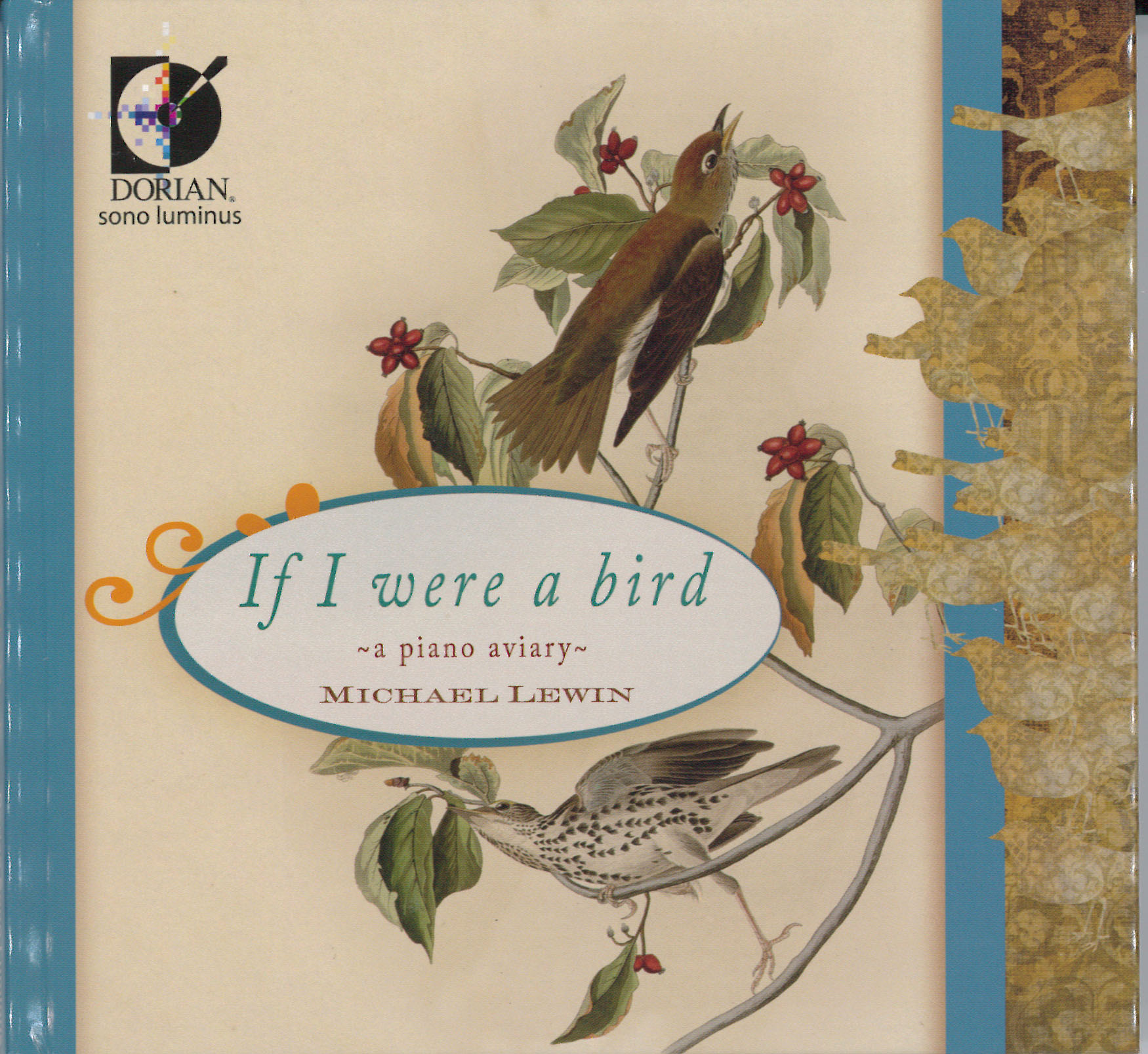
Olivier Messiaen once opined that birds were probably the greatest musicians to inhabit our planet, and they have indeed been inspiring many a composer and musician for centuries. With this disc, Michael Lewin pays homage to our feathered muses with a fascinating and entertaining mixture of works for solo piano.

Music by a rich array of composers is found here, and the diversity works brilliantly. There are whimsical offerings by Hoffman, MacDowell and Jensen; touches of delicate melancholy by Grieg, Granados and Schumann; and Rameau and Daquin are tastefully played on a Steinway concert grand. Transcriptions of Glinka, Saint-Saëns, Alabieff and Stravinsky are included, of which the Danse infernale from Firebird is most grand; and Messiaen himself is exquisitely represented by The Dove, written when he was twenty. Lewin also knocks off an enthusiastic rendition of the Joplinesque Turkey in the Straw and it fits the program to perfection.

The pacing of this ‘piano aviary’ is delightful and Lewin plays to dazzling and touchingly expressive effect. Highlights for me are the Messiaen and Schumann, and his renditions of Ravel’s Sad Birds and Cyril Scott’s Water Wagtail, but I will listen to this entire disc repeatedly with great pleasure. Kudos also to the designer of the booklet in which this CD is housed – the design with its rich colours and elegant illustrations is as impressive as the music within.
05_palmer_chopin_dvdThe Strange Case of Delfina Potocka –
The Mystery of Chopin
Directed by Tony Palmer
TP-DVD160

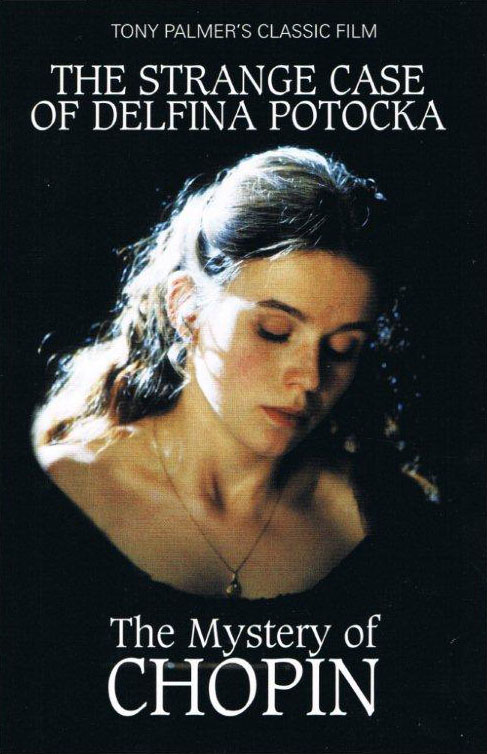
This is a thought-provoking, intriguing film about an extremely controversial subject. The argument of this DVD is set down in the enclosed notes: “It was a matter of national and socialist pride when, in November 1945, the new Communist Government of Poland asked for, and received, the heart of Chopin previously buried in Paris. Against this background, a woman called Paulina Czernika approached the Polish Minister of Culture, claiming to have some love letters from the composer to her great-grandmother, the Countess Delfina Potocka. At first curious, but eventually alarmed, the Ministry began a witch-hunt against Madame Czernika. For while it was true that there was an historic figure called Delfina Potocka – she was the only lover to whom Chopin dedicated any music – these letters were said to be pornographic, anti-Semitic and thoroughly damaging to the image of the composer as a Polish hero which the Communist government wished to promote. Czernika ‘committed suicide’ on October 17, 1949 one hundred years to the day after the death of Chopin. Or was she murdered, and if so, why? Were the letters in fact forgeries? And what was the truth about Delfina Potocka?

As Czernika encounters publishers and persons in authority, we are privy to selected personal, confidential and intimate details from the composer’s letters. The events revealed in the letters are enacted, in chronological order, by a thoroughly believable cast.

In his book Chopin the Unknown, Polish music scholar, conductor and composer, Matteo Glinski delves deeply into the Delfina Potocka affair (Assumption University of Windsor Press, 1963). Glinski’s credentials are impeccable and of this book, Roman V. Ceglowski, President of the International Chopin Foundation, wrote “I think it is the most provocative study on Chopin in our times” and commended it to Chopin scholars. Glinski quotes convincing evidence of Chopin’s character and his “elusive secret” all lending authenticity to the Delfina letters.

Is Palmer tipping his hand by entrusting the roles of Paulina Czernika and Delfina Potocka to the same actress in this unusual production?     

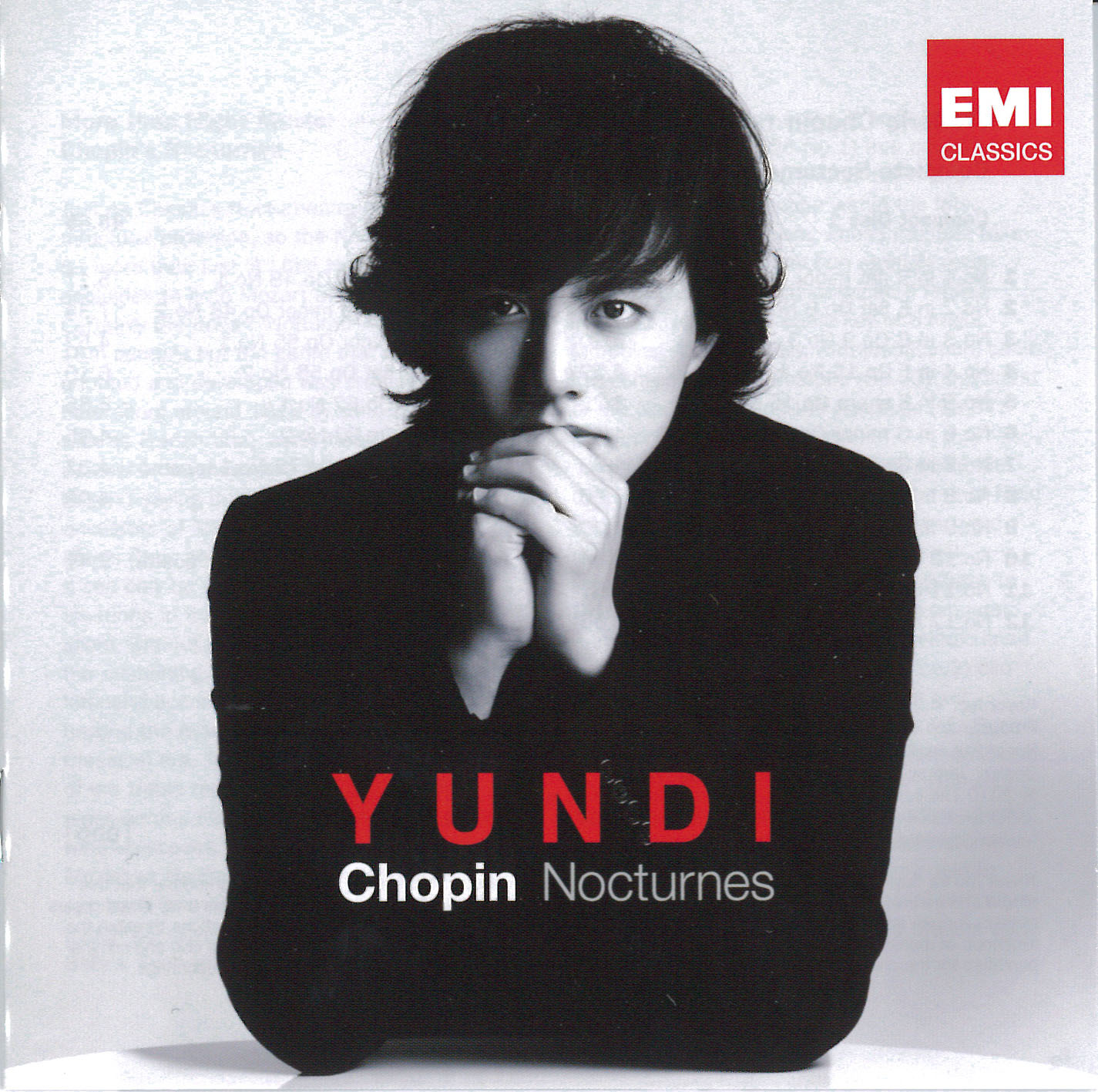
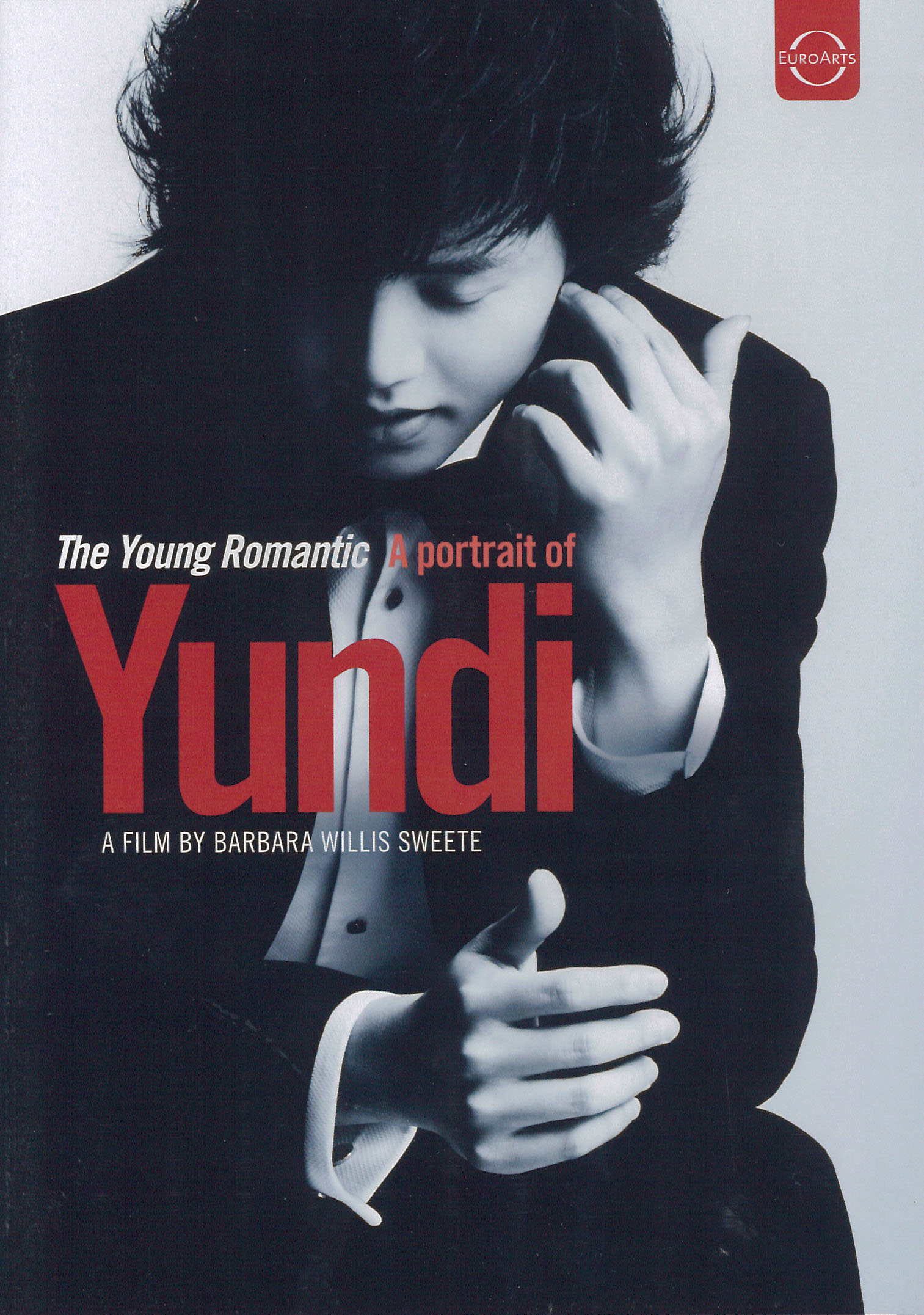
04a_yundi_dvdThe Young Romantic - A Portrait of Yundi
Barbara Willis Sweete
EuroArts 3079058

Pianist Yundi (he has dropped the use of his last name Li!) is an almost mythical celebrity in China. Since winning the Chopin piano competition at the young age of 18, he has captured the hearts of the people of China, and has a busy international performing schedule, much to the credit of his highly emotional and theatrical performance style. So how then to portray him on film, without the finished product becoming an advertorial to the young pianist?

Director Barbara Willis Sweete’s approach is brilliant – her premise seems to be to present him in a series of contrasting milieus: Yundi on tour in China versus Yundi in Berlin preparing for a recording/concert with the Berlin Philharmonic; The youthful serious soloist Yundi working with the senior witty Maestro Seiji Ozawa; Yundi as a child accordionist versus Yundi the young classical star; Yundi the classical pianist performing with Jay Chou, the pop star keyboardist; His family lovingly reminiscing about his childhood while also lamenting with justifiable sadness that he just doesn’t visit them enough now. Only the segment with Yundi playing ping pong with TSO conductor Peter Oundjian seems idiosyncratic and out of place. Be prepared to be shocked as well – Yundi practiced up to eight hours a day as a child and some of the teaching methods employed are questionable too!

04b_yundi_cdThis is a beautiful flowing film that gives a well rounded portrait of the globetrotting pianist as a young man. The high Rhombus production standards are maintained – the visuals, storyline and editing are seamless. Bonus tracks of Chopin performances are an added treat. Fans and critics alike will enjoy, and also at times be disconcerted, by this superb Canadian made documentary.

Editor’s Note: Yundi’s latest CD release is the complete Chopin Nocturnes on EMI Classics (6 08391 2).

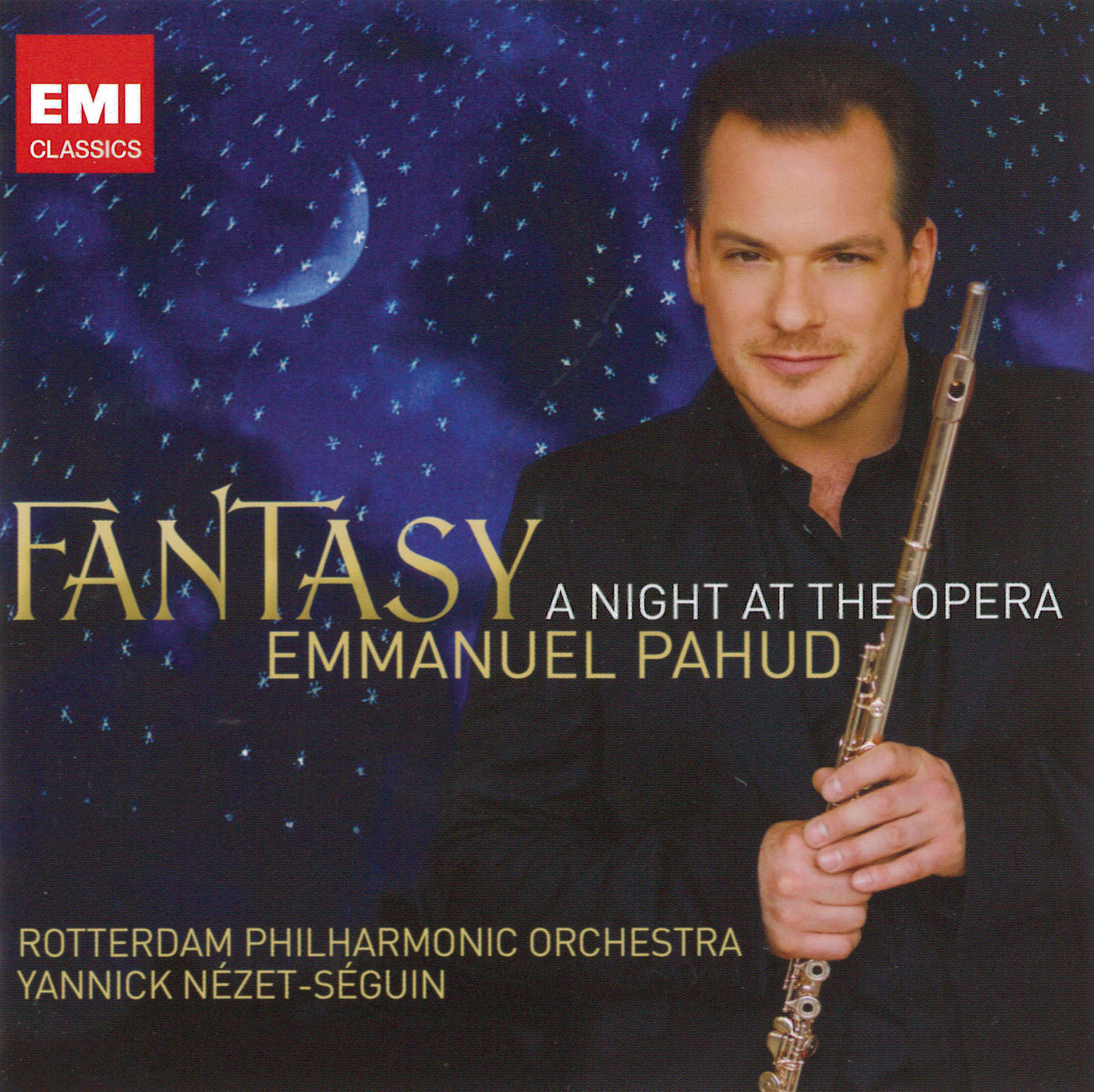
03_fantasy_pahudFantasy - A Night at the Opera
Emmanuel Pahud; Rotterdam Philharmonic Orchestra; Yannick Nézet-Séguin
EMI Classics 4 57814 2

During my period in music retail many years ago, I was once asked by a customer, “I need a disc of operatic arias, but I don’t want the singing, only the music”(!). I’ve undoubtedly told this story before, and I repeat it now only because it ties in so well with this new EMI recording titled “Fantasy – A Night at the Opera” featuring flutist Emmanuel Pahud with the Rotterdam Philharmonic under the direction of Canadian conductor par excellence Yannick Nézet-Séguin.

As the name suggests, this disc comprises an attractive collection of opera arias as arranged for flute and orchestra. While the operas from which they are derived are familiar, such as Verdi’s La Traviata, and Bizet’s Carmen - the arrangers are decidedly less so, and contrary to what one might think, not all date from the 19th century. For example, the Fantasy on Mozart’s Magic Flute, was composed by Robert Forbes (born in 1939), and the paraphrase from Tchaikovsky’s Eugene Onegin was written by Guy Braunstein, born as recently as 1971. Also included on the disc is a sensitive (and unarranged) performance of the lyrical Dance of the Blessed Spirits from Gluck’s 1762 opera Orphée et Eurydice.

Not surprisingly, Pahud has no difficulty in meeting the technical demands of the virtuosic and high-spirited writing inherent here, while the Rotterdam Philharmonic, under Nézet-Séguin’s competent baton provides a tasteful and strongly supportive accompaniment.

While most of these arrangements wouldn’t really be classified as Great Music, the disc is nevertheless entertaining and diverting, a true showcase for Emmanuel Pahud’s talents, and proof indeed that Nézet-Séguin is just as at home with this lighter more flamboyant repertoire as he is with music of a more serious nature. Recommended.

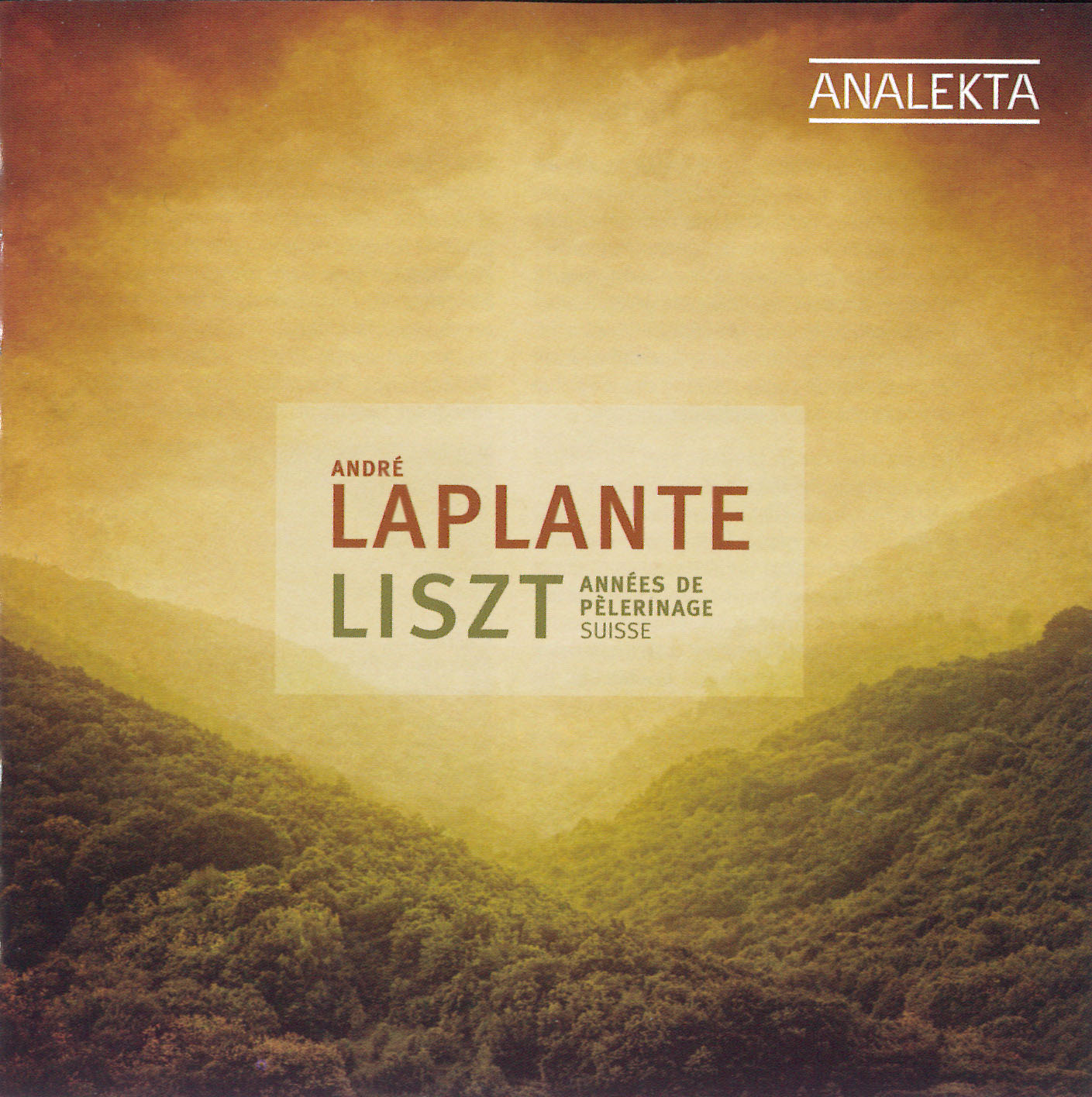
02_liszt_laplanteLiszt - Années de Pelerinage Suisse
André Laplante
Analekta AN 2 9980

André Laplante by now can be referred to as Canada’s ‘national treasure’. He is a well established artist especially in the Romantic repertoire and has a worldwide reputation with critics comparing him sometimes to Richter and Horowitz. This new recording for the Analekta label tackles Liszt in an ambitious, rarely recorded program of the first book of the 21 year old Liszt’s romantic wanderings with Countess Marie d’Agoult.

Liszt met the Countess in 1832 in Paris, a married woman 6 years older, but this did not prevent one of the century’s most famous and productive love affairs from developing. Three years later Marie left her family and ran off with Franz to Switzerland, later to Italy. There were 3 children born out of this union, among them Cosima who eventually married Richard Wagner.

As we listen, the pieces vary in character from invocations of natural beauty (Lac de Wallenstadt), literary associations with Byron, Schiller, Goethe, Senacour (Vallée d’Obermann), to force of nature (L’Orage), pastoral melodies (Pastorale, Eglogue) and homage to Swiss history (Chapelle de Guillaume Tell).
Many of the pieces even appear improvised. We can just see after a day of admiring the majestic Swiss countryside, Liszt composing on the piano and playing to his object of affection. Often the quiet, self searching beginnings develop into passion with great intensity.

To capture the many layered complexities of this set, Laplante is the ideal choice and this recording shows it. Being an unassuming, introspective personality, his performances have insightful sensitivity, but never overt emotionalism, dazzling power and virtuosity that never is meant to show off and rich imagination characteristic of a great artist.

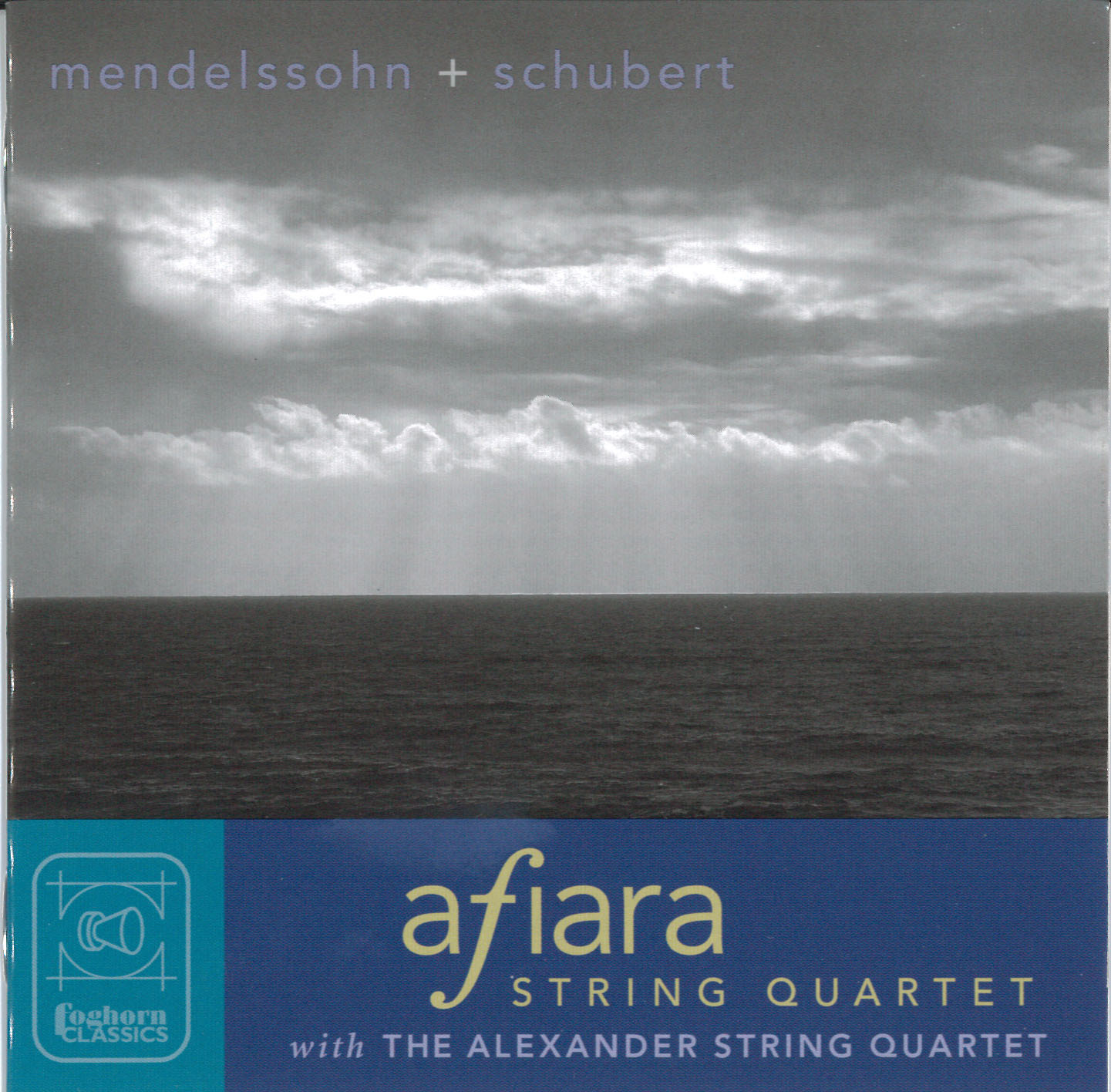
01_afiara_mendelssohnMendelssohn - Schubert
Afiara String Quartet;
Alexander String Quartet
Foghorn Records CD 1995
(www.afiara.com)

A debut CD is something like a “rookie year” hockey card. It makes you wonder where the talent behind it will ultimately end up – in stardom or in obscurity? Based on this disc, I’m prepared to go out on a sturdy limb and predict a bright future for the Afiara String Quartet.
In case you don’t know, the Afiara Quartet is a young group of Canadians: Valerie Li and Yuri Cho, violins; David Samuel, viola; and Adrian Fung, cello. From 2006 to 2009 the quartet had a residency at San Francisco State University (where they studied with the Alexander Quartet), and they were recently named the graduate quartet-in-residence at the Juilliard School.

For their debut disc, this young group has chosen to perform works by two composers in their teens and early 20s (indeed, neither composer ever got to be very old): Mendelssohn’s Quartet in A Minor Op. 13, Schubert’s Quartettensatz in C Minor D. 703, and Mendelssohn’s Octet Op. 20, written when the composer was just 16.
In this clearly recorded CD, the Afiaras have tapped into the youthful vitality displayed in these scores. Tone is bright and tempos are perky; intonation and balance are excellent. As well, in the more introspective passages (such as the second movement of the Quartet in A minor) playing is delicate yet warm.
In the Octet, the Afiaras are joined by their mentors, the Alexander Quartet, and the two groups merge seamlessly into one glorious ensemble. This is exciting playing – a rich performance that does full justice to Mendelssohn’s youthful masterpiece.

Editor’s Note: At a recent Mooredale Concert where they performed with renowned flutist Robert Aitken, the Afiara Quartet was presented with the $25,000 2010 Young Canadian Musicians Award. The quartet will return to Mooredale Concerts on October 31 to perform with co-winner of the award, pianist Wonny Song.

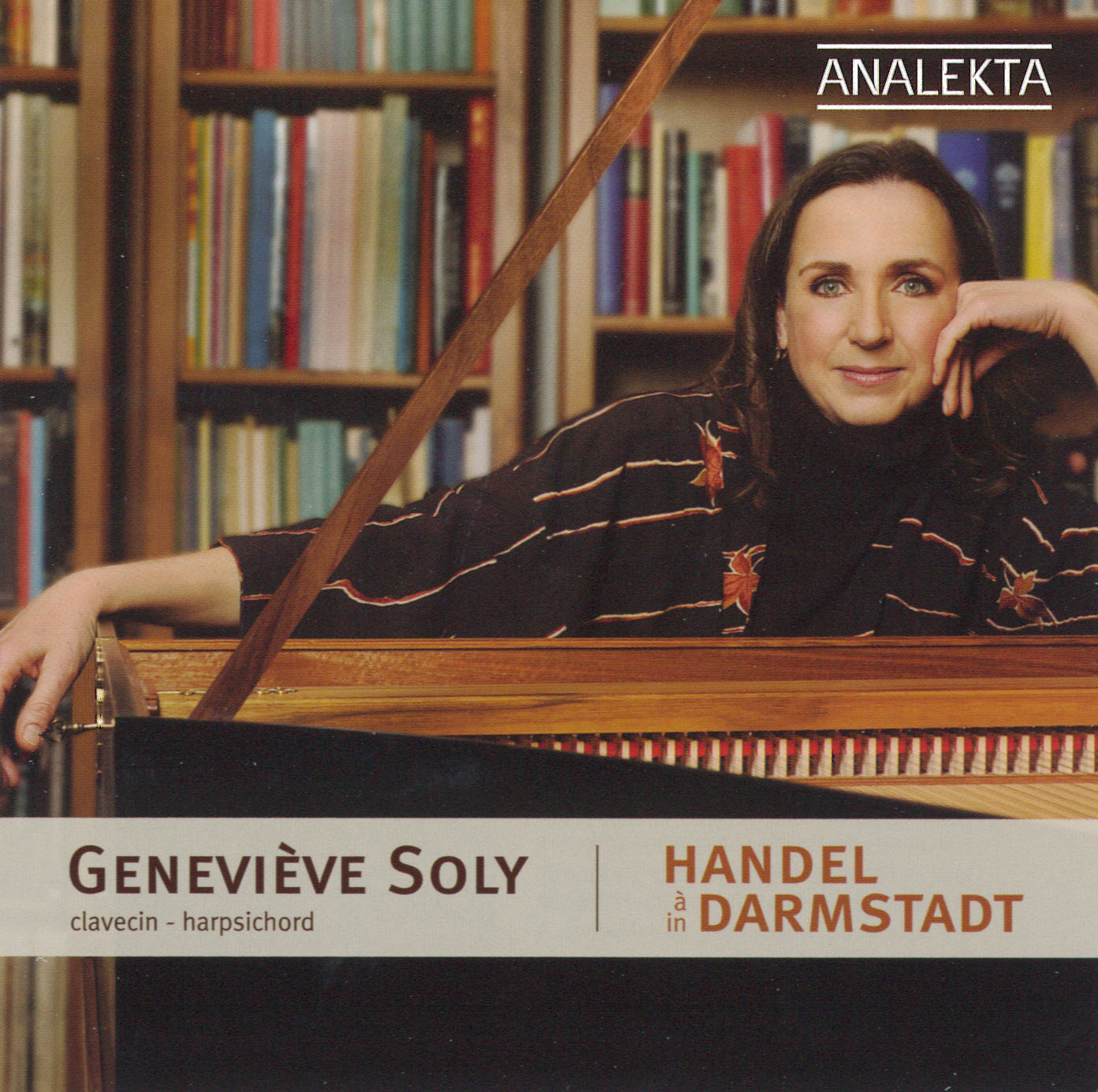
02_handel_darmstadtHandel in Darmstadt
Geneviève Soly
Analekta AN 2 9121

Researching the music of Christoph Graupner led Geneviève Soly to the Darmstadt Harpsichord Book, which features works by four German composers: Graupner, Handel, Telemann and Kuhnau. Twenty-nine works by Handel are found in the collection and Ms Soly performs twenty-one on this CD - plus a parody on Graupner.

Handel’s Chaconne in G major receives the lively interpretation from Soly that this varied and florid piece deserves. The CD-notes - by Soly - are right to stress Handel’s lyricism.

Some cynically note that Handel was England’s best composer between Purcell and Elgar. The Sonata del Signor Hendel (sic), published in London in 1720, can justify this view. The second allegro and adagio are both testing pieces for any harpsichordist, the former with its two-voice structure of soprano over bass, and the latter sounding as if it were directly transcribed from organ to harpsichord.

Ms Soly adores Handel’s music. As well as meeting the challenge of the adagio already mentioned, she tackles the traditional stylised Baroque dance movements (the sarabande, gigue, allemande and courante). For this reviewer, however, the really inspired playing comes in the Sonata in G major. A test on account of its complexity, its speed, and even its pure stamina, this is Geneviève Soly at her most driven.

Soly’s choice of compositions by Handel is varied to say the least. A traditional German air and variations make up eight of the tracks - Handel at his jolliest. There is even what appears to be a parody of Graupner by Handel, a marche en rondeau.

At the age of eight, Ms Soly knew she would become a performer of classical music. How grateful we are for her ambition.            

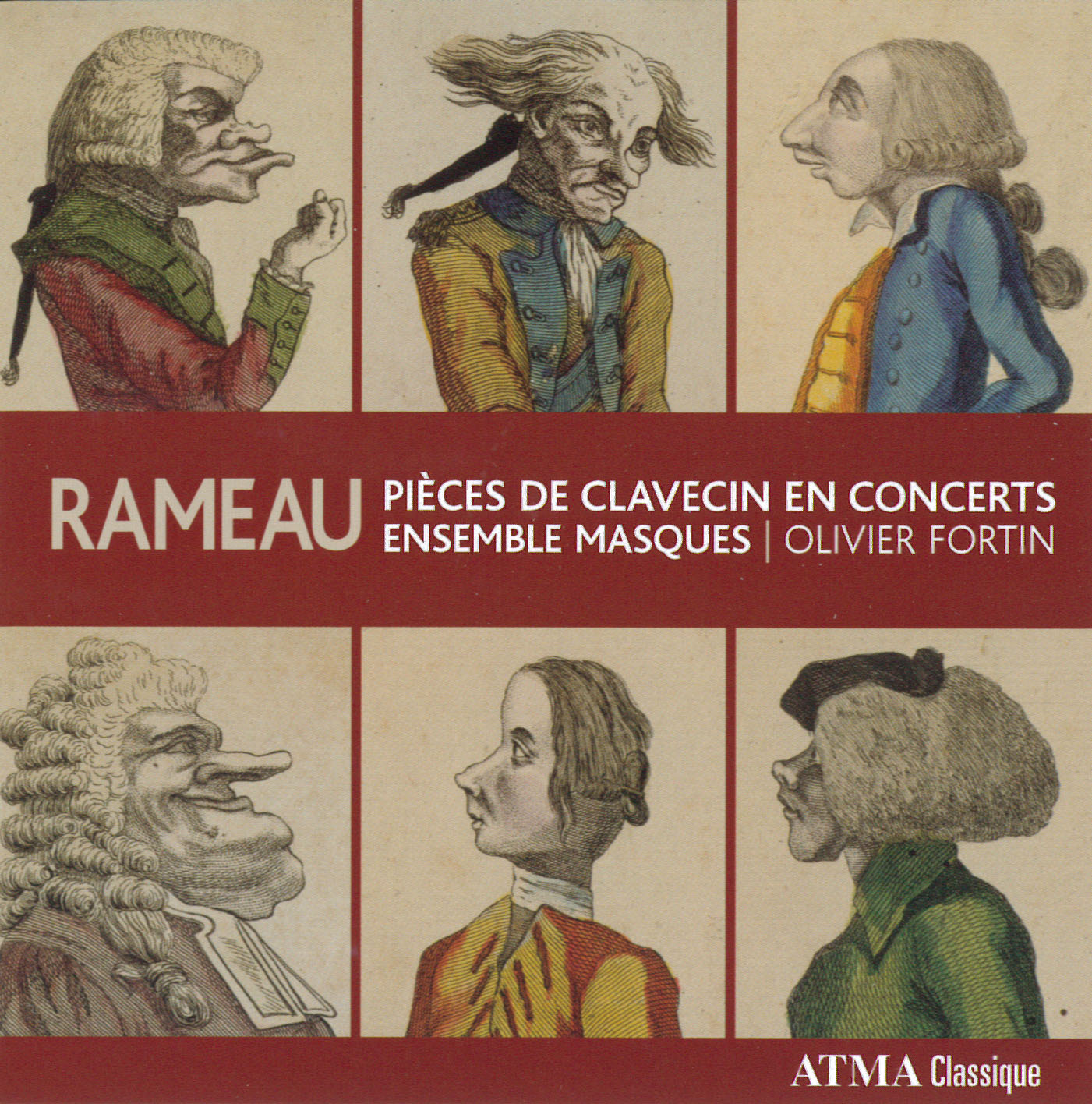
01_rameau_masquesRameau - Pieces de clavecin en concerts
Ensemble Masques; Olivier Fortin
ATMA ACD2 2624

No, Jean-Philippe Rameau was not a sympathetic man. He was a misanthropic individual who lost no opportunity to start arguments with Jean-Jacques Rousseau during the heated discussions on the merits of French versus Italian opera.

From its very first tracks, La Pantomine and L’indiscrète, this is mercifully not apparent on this CD. Both display the virtuoso techniques of the baroque harpsichordist, in particular that French operatic style which Rameau came above all others to dominate.

There is an element of caricature to most of the sixteen movements in the collection. Speculation about the intended target - if any - for La Laborde remains to this day, but it is still a highly charming if eccentric composition. Possibly composed, one pundit says, to honour the inventor of an electric piano in 1759...

Of course, the Pièces de clavecin are not just about the harpsichord. Spirited violin-playing gives L’Agaçante its name and places La Coulicam in its grand and exotic context. Measured flute-playing imparts a slightly sombre quality to La Livri, a lament on the passing of a musical patron.

To describe this CD as varied is a gross under-statement. Pieces are scored for harpsichord, strings and woodwind, for personal acquaintances of Rameau and for his musical friends - in view of his hostile opinions they could hardly be for his enemies.

05_saint-saensSaint-Saëns – Piano Transcriptions
Lucille Chung
XXI XXI-CD2 1682

The late Arthur Fiedler once said: “there are only two kinds of music: The good and the boring kind.” Well, Saint Saëns may not be the greatest composer or even one of the greatest, but he certainly never wrote boring music. And he couldn’t have picked a better performer of his piano music than the young, immensely talented Montreal-born virtuoso, Lucille Chung. Since 1989, when only 10 years old, she has built an impressive career with the world’s leading orchestras and performed in over 30 countries. Her playing has self assured attack, virtuosity, romantic abandon and a sense of youthful exuberance, but there is still room for more subtlety.

She hasn’t recorded much as yet and this unorthodox disc proves that she is not afraid of taking chances. My first approach was sceptical. What would the 2nd Piano Concerto sound like on solo piano? One of the most impressive openings in the piano concerto literature is the impassioned solo cadenza that develops into a breathtaking crescendo leading up to the ff entry of the orchestra, a big moment indeed, which cannot be duplicated by piano solo, but this problem notwithstanding the 1st movement takes shape almost like the original. As she proceeds, the Mendelssohnian scherzo is fluttering like a butterfly over a field of flowers and the rumba-like middle section seductively swings with no effort at all. She has the time of her life, totally relaxed and happy.

The works that follow, except for the ubiquitous Bacchanale, are mostly piano/orchestra pieces transcribed for piano solo by the composer, who was a tremendous pianist in his own right. An interesting curiosity is Africa with its exotic and oriental atmosphere, ending with the Tunisian national anthem carried off triumphantly by our pianist.

04_tchaikovsky

Tchaikovsky – Romeo and Juliet; String Serenade; Francesca da Rimini; Victor Ewald – Brass Quintets
Philadelphia Orchestra; Christoph Eschenbach
Ondine ODE 1150-2D


The Philadelphia Orchestra became famous, both live and, since 1926, through recordings, for the opulence of its sound. One has only to experience Ormandy conducting the Rachmaninov Second Symphony on the EuroArts DVD (EA 2072258) to hear exactly what I mean. Christoph Eschenbach was one of the recipients of this legacy, serving as the orchestra’s Music Director from 2003 to 2008.

Francesca da Rimini has been a favourite of mine since time began. I enjoyed it as a rather lurid piece, with swirling strings and winds, much percussion and tormented passages from the whole orchestra (I was very young). Eschenbach has a broader, romantic view of the work, perhaps prosaic, focusing more on the emotions of the condemned Francesca than on her surroundings in a sensational performance that is more expressive than ever. As he does in his Houston recording for Virgin, Eschenbach broadens out the final ten chords to make them a statement of finality. Romeo and Juliet, too, is unhurried with meticulous attention to detail, conveying the poignant tragedy of this oft told tale. Similarly, the Serenade for Strings may be the best you’ll ever hear.

Victor Ewald (1860-1935) was a contemporary of Tchaikovsky… at least for a while, and his compositions for brass are highly regarded… at least by the members of the orchestra who perform them here. These Quintets present no problems to the listener and are, in fact, rather pleasant to hear.

The sound throughout is clear, spacious, and well suited to the repertoire.

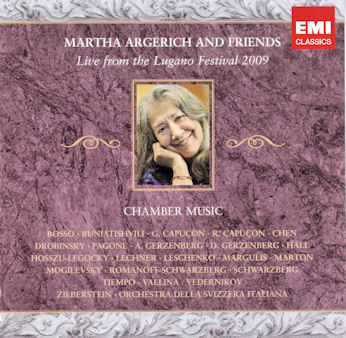
03_argerichLive from the Lugano Festival 2009
Martha Argerich and Friends
EMI Classics 6 07367 2

For your next trip you travelers, why don’t you try Lugano, capital of the Italian speaking canton Ticino near the sun drenched southern slopes of the Swiss Alps. Preferably in June when Martha Argerich’s annual festival takes place. Since 2002, BSI Bank has sponsored this event, focused on the once raven haired (now completely grey) Argentinean beauty and pianiste extraordinaire, along with a coterie of young musicians to rehearse and perform concerts of the highest caliber and inspiration.

The 3 discs are nicely subdivided into the chamber music of 1) Schumann, Mendelssohn and Chopin, 2) the Hungarians and Russians, and 3) the Spanish and French.

Already on CD 1 there is a stunning piano duet version of the Midsummer Nights Dream Overture where the shimmering pp strings are transcribed into translucent, lightning fast and wonderfully controlled virtuoso piano playing of Argerich and Cristina Marton. Chopin’s early work from his years in Poland, Introduction and Polonaise Brillante, is guaranteed to raise everyone’s blood pressure played with extraordinary flair and abandon by Martha Argerich and Gautier Capuçon (cello).

More unusual pieces follow on CD 2. First the inimitable young violinist Renaud Capuçon plays Bartok’s 2nd Violin Sonata, a “multilayered study in sonority, predominantly discordant harmony and structure yet still traceable to Hungarian folk tradition.” From the Russians we encounter Glinka and Rachmaninov, from the latter a curious rarity, a Waltz for 6 hands at a single piano(!). I would have liked to see this as I’d imagine there could be some logistical problems here.

The third disc features larger scale works and here my favorite was Ravel’s Rapsodie Espagnole transcribed for two pianos by the composer and played atmospherically and with imagination by Sergio Tiempo and Karin Lechner. A set to treasure. State of the art recordings.

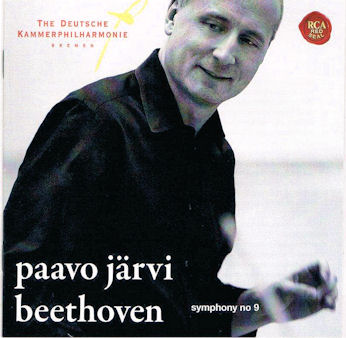
02_beethoven_9Beethoven – Symphony No.9
Christine Oelze; Petra Lang; Klaus Florian Vogt; Matthias Goerne; Deutscher Kammerchor; Deutsche Kammerphilharmonie Bremen;
Paavo Järvi
Sony 88697576062

The Deutsche Kammerphilharmonie Orchestra was founded in 1980 by a group of exceptional young students and went on to become one of the most sought-after chamber orchestras, appearing at the UN in 1983. They were invited to play at Gidon Kremer’s Lockenhaus Festival where their 1986 performance of Gubaidulina’s Seven Words was issued by Philips. Since 1992 they have been based in Bremen and are self governing, owned by the players. Paavo Järvi has been their conductor since 2004 and in August of that year they began recording a new Beethoven cycle using the Barenreiter Urtext Edition, starting with the Eighth.

The reduced strings contribute to the creation of new textures that are in no way less satisfying for the audience. The winds and brass are more present without losing perspective. Listeners will have a new appreciation of the genius and beauty of Beethoven’s scores.

Järvi has a clear stamp on these performances wherein he refreshes the scores with his own phrasing and accents, with tempi that adhere to Beethoven’s metronome markings. Diehard fans of the traditional school are likely to find Järvi too acerbic and will not easily accept his approach. Even though I was very familiar with Järvi’s performances of all the others, this Ninth came as a quite a shock. It is as if Järvi has finally taken the wraps off, stepped aside and let Beethoven speak for himself, unencumbered by generations of well meaning interpreters. It works well for me and I find Järvi’s non-routine, clear headed interpretations throughout the nine fully justify their existence among a plethora of sets, new and re-issued, which are mostly indistinguishable from each other.

The state-of-the-art hybrid SACD/CDs, whether heard in stereo or surround, are of audiophile quality accurately delineating the instruments exactly as the conductor intended. The executive producers of these recordings are the orchestra itself and Maestro Järvi, which just may account for their excellence.

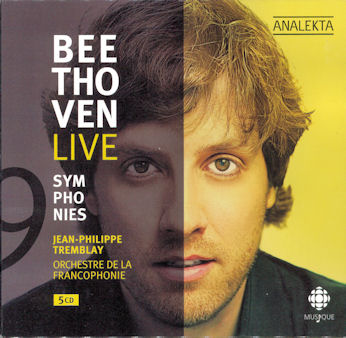
01_beethoven_9symphonies_liveBeethoven – Live Symphonies
Orchestra de la Francophonie; Jean-Philippe Tremblay
Analekta AN 2 9975-9

If I’m not mistaken, a particular musicologist once said, “French orchestras are incapable of playing German music.” Whoever it was who made this claim would surely have second thoughts upon hearing this fine five-disc Analekta recording of the complete Beethoven symphonies featuring l’Orchestre de la Francophonie under the direction of Jean-Philippe Tremblay. Founded in 2001 for the fourth Jeux de la Francophonie in Ottawa-Hull, this ensemble has earned a reputation as one of the country’s finest youth orchestras, having given more than 200 concerts across Canada, and undertaking a successful tour of China in 2007.

There is certainly no dearth of Beethoven complete symphonies sets, so do we really need one more? Having said that, I can assure you that this one, recorded live at Québec City’s Palais Montcalm in July of 2009, can easily hold its own against the older more established recordings. From the opening hesitant measures of the Symphony No. 1, the listener is immediately struck by the youthful freshness of OF’s approach. The playing is noble and elegant, and when dramatic intensity is called for, it is achieved without the heavy-handed bombast that has sometimes characterized Beethoven recordings from the past.

Admittedly, one of my favourite symphonies of all time is Beethoven’s No.7. I’m pleased to report that the interpretation here is splendid, particularly in the first and final movements, where the strings seemingly shimmer in joyful exuberance. The second movement, mysterious and somewhat cryptic, is treated in a deservingly subtle manner, while the boisterous finale, at one time compared to the merry-making of peasants, brings the symphony to a rousing conclusion. Wagner, who also happened to love this work, (once referring to it as “the very apotheosis of the dance”), would be pleased indeed!

The climax of the set comes with the powerful Symphony No. 9, a true world unto itself. Soloists Marie-Josée Lord, Geneviève Couillard Després, Guy Bélanger, and Ētienne Dupuis together with the Choeur de la Francophonie maintain a wonderful vocal cohesion, admirably blending with the orchestra to form a unified whole.

Despite this being a live recording, extraneous noises are minimal, and the burst of enthusiastic applause at the end of each symphony seems particularly fitting in light of the superb performances. My only quibble concerns the flimsy packaging – it may have been a cost-cutting measure, but a fine recording such as this deserves better. Kudos to l’Orchestre de la Francophonie, to the soloists, the chorus, and to Jean-Philippe Tremblay for breathing some overdue fresh air into this well-trodden repertoire.

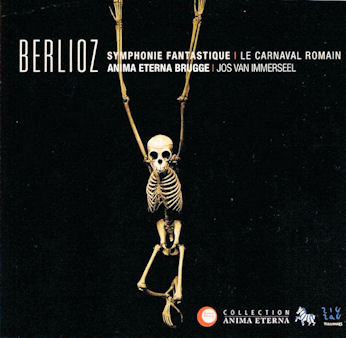
03_berliozBerlioz: Symphonie Fantastique op.14;
Le Carnaval Romain
Anima Eterna Brugge; Jos van Immerseel
ZIG-ZAG CD ZZT100101

• I am always leery about ‘period instrument groups’ tackling post 1800 repertoire. Although I am not about to change my prejudice, right from the first bars this recording impressed me as something very special. The uniqueness of this performance is not so just because of the period instruments; conductor van Immerseel brings a fresh approach in colour, tempo, balance, articulation, phrasing and dynamics.

For rabid fans of this symphony (myself included) the experience of first hearing this performance is startling. The presentation is so transparent that details of the scoring, invariably obscured in modern performances, are revealed, particularly from the winds, affirming that Berlioz was a peerless innovative genius.

And what about the ‘period instrument’ component? The Anima Eterna Orchestra, particularly the winds, are superb, playing with joie de vivre, gorgeous sound and beautiful tone colours. As a group they create an irresistible, luminous texture throughout the work. Listeners will be surprised to hear, not the usual bell sounds in the Witches Sabbath but the sustained piano chords as specified in the Berlioz manuscript. The piano strings blend with the orchestra to solemn effect adding a new sense of gravitas with a sobering subterranean effect, quite different from the mood of the tolling bells.

Without any doubt, Van Immerseel and his group daringly demonstrate the originality and genius of the composer. The recording, captured in faultless sound, was made in the sonically impressive Concertgebouw in Bruges to which this group is very well attuned. For me, this has been an unexpected and rewarding discovery.

02_biberBiber – Mensa Sonora; Battalia
Baroque Band; Garry Clarke
Cedille CDR 90000 116

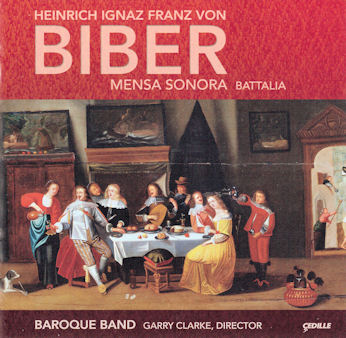
Pity the poor composer who needs must provide music meant to be ignored! Such is the case for Biber’s collection of genteel pieces for dining, the six suites for strings entitled Mensa Sonora (Sonorous Table) served up in 1680 for the gustatory delectation of his then employer, the Archbishop of Salzburg. Not initially expecting anything special, I was pleasantly surprised at the cunning of Biber’s art. He manages by dint of the off-kilter asymmetries of his melodic craft to project a sub-text of sophistication completely over the head of his patron. Biber marvellously subverts the conventions of the genre, concluding the whole enterprise with a disjointed denouement worthy of Haydn. He proves himself a visionary as well with the celebrated, outlandish Battalia in 10 parts of 1673 in which one finds innovations not to be exploited again until centuries later: the snap-pizzicato of Bartok; playing with the wood of the bow à la Berlioz; and, in the loopy inebriation of a scene depicting drunken soldiers, the polytonality and collage technique of Charles Ives. As director and concertmaster Gerry Clarke mentions in his liner notes, Biber (1644-1704), the Bohemian-Austrian violin virtuoso and composer, was regarded by Paul Hindemith to be “the most important Baroque composer before Bach”, yet it is only in recent decades that his music has seen a significant revival. The Chicago-based Baroque Band, formed in 2007, plays this music to perfection with a highly effective blend of subtlety and precision. Truly delicious!

01_viola_damoreViola D’Amore
Hélène Plouffe
Analekta AN 2 9959

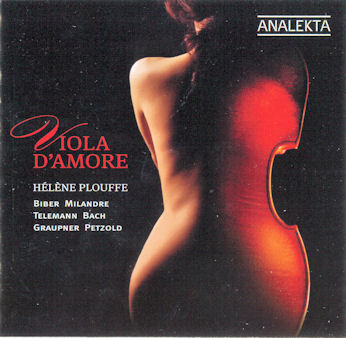
The viola d’amore was demanding. It has the complication of resonating strings, is crafted as if it were a viol but is played like a violin, and is the size of the already-existing viola. And yet it survived throughout the Baroque and has even inspired modern composers.

Hélène Plouffe’s selection shows how sensuous this instrument is, notably in von Biber’s Partia VII, with its soothing praeludium, allamande and aria. The skill it requires is demonstrated in the concluding arietta variata.

If the viola d’amore is rare in North America, try finding a bass chalumeau - the link between recorder and clarinet. Hélène Plouffe did so and Graupner’s Trio in F major is the result, the allegro and vivace above all expressing both instruments’ qualities.

Bach’s St. John Passion allows us to see the viola d’amore supporting the human voice but those wishing to hear the instrument at its plainest will enjoy Ah que l’amour, an extract from Milandre’s Méthode facile pour la viole d’amour. This exercise proves that the instrument does indeed have an individual sound.

And so to Petzold’s Partita in F major, a collection of early baroque dances. As with the Milandre piece, the music for solo viola d’amore played here best shows off what the instrument can bring to its audience, particularly with Hélène Plouffe’s interpretations.

Back to top