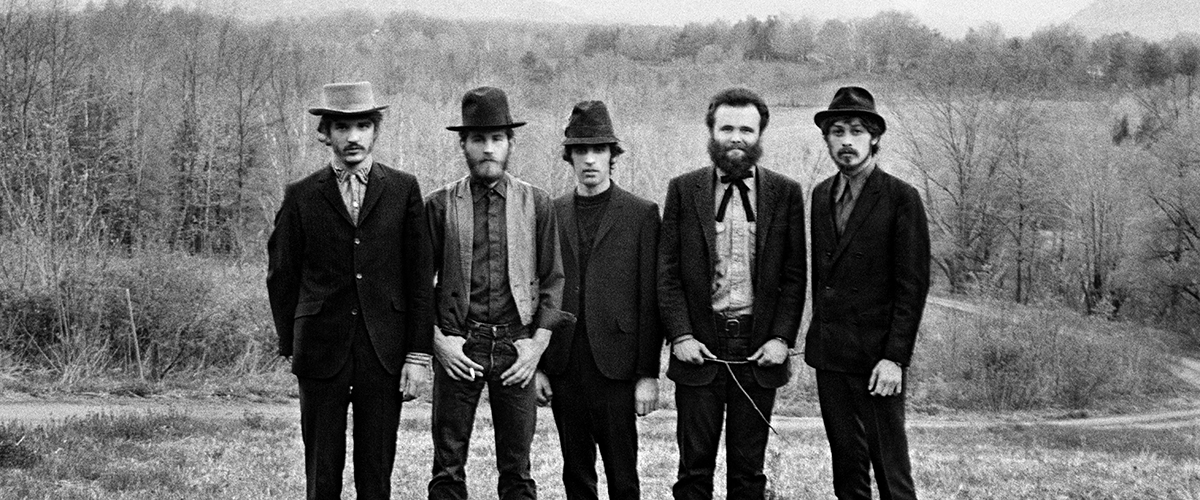
Once Were Brothers: Robbie Robertson and The Band. Photo by Elliott LandyOnce again, it’s time for The WholeNote’s annual guide to films of the Toronto International Film Festival (TIFF) in which music plays an important role. This year, circumstances prevented me from viewing more than a few movies in advance so the current guide is based on track record, subject matter and gleanings from across the Internet. Out of the 245 features from 83 countries and regions that make up the festival’s 44th edition, I’ve focused on 25, beginning with a handful of documentaries directly linked to music.

Directly Musical Documentaries

TIFF opens with the world premiere of Daniel Roher’s Once Were Brothers: Robbie Robertson and The Band, inspired by Robertson’s revealing autobiography, Testimony (2016). The book is a well-written page-turner, filled with surprises and musical insights, painting a vivid picture of Toronto’s music scene in the 1950s and 1960s before Robertson et al made their name backing up Bob Dylan and transformed into The Band. The movie promises even more, blending rare archival footage and photography with iconic songs and appearances by Martin Scorsese, Bruce Springsteen, Dylan, Robertson, Eric Clapton, Peter Gabriel, David Geffen, Rick Danko, Van Morrison, Ronnie Hawkins, Taj Mahal, Jann Wenner and Dominique Robertson – a host of built-in star power, much of which will likely be present at the premiere. (And if you do take this one in, consider also checking out the TIFF screening of The Last Waltz (the nominal conclusion of the book), which will feature a live appearance by Scorsese and Robertson.)

Another Springsteen appearance: he shares the director credit with longtime collaborator Thom Zimney in Western Stars, a filmic record of his latest album. “It’s largely performance, but there is a framing to it,” TIFF co-head Cameron Bailey said [quoted by indiewire.com]. “It’s very filmic, which is what attracted me. The album and the film are both about this fading Western movie B-level star who’s looking back on his life and the decisions he’s made. That narrative and that character shape all the songs. In between the songs, you’ve got Bruce really talking about this character he invented, the story he wrote for the character, and how it reflects back on his own life as he ages and other kinds of narratives he’s had in his previous albums.”

Alla Kovgan’s Cunningham is said to be an eye-popping, entertaining 3D documentary about Merce Cunningham, the legendary American choreographer who died in 2009 at age 90. The film features 14 dances that were originally created by Cunningham between 1942 and 1972 – including 1942’s Totem Ancestor (his first collaboration with composer/life partner John Cage), 1958’s Summerspace (where Robert Rauschenberg’s pointillist costumes and decor – see our cover photo – create a camouflage effect to Morton Feldman’s music) and 1968’s Rainforest (in which Andy Warhol’s silver pillows wander around the stage; music by David Tudor). The film also mixes in archival material – some never before seen – touching on Cunningham’s early years, rehearsals, tours and “chance dance” technique, with his wry wit emerging in anecdotes.

With his latest film, David Foster: Off the Record, Canadian director Barry Avrich mixes rare archival footage, interviews and unprecedented access to the Victoria, BC-born musician, producer, songwriter and composer who has helped sell more than a half-billion records and won 16 Grammy Awards and whose collaborators include Chicago, Barbra Streisand and Andrea Bocelli. Among others, he’s discovered and/or worked with Celine Dion, Michael Bublé and Josh Groban, many of whom (and more) are featured in the doc.

As part of TIFF’s Special Events programming, triple-platinum artists The Lumineers bring their talents to Toronto with III, a visual companion to their upcoming third record of the same name. Split into three chapters, the visual album follows three generations of a working-class family in the American Northeast. Following the screening, fans will have the opportunity to experience some of The Lumineers’ upcoming release in a live performance, followed by a Q&A with the band and III’s director Kevin Phillip.

Music-Themed Movies (Including Two Musicals)

Cameron Bailey writes in his program note for Red Fields, “From award-winning dramatic filmmaker Keren Yedaya (Or, Jaffa) comes a complete surprise: her first musical. Adapting Hillel Mittelpunkt’s rock opera Mami, Yedaya fast-forwards this story of a gas station cashier from its original 1980s setting to the present day. Gorgeous traditional music shares the soundtrack with pulsing electronic beats, while inventive dance numbers lift this wild fantasia into La La Land territory.”

Programmer Diana Sanchez on Lina from Lima: “At once a delightful renovation of the musical comedy and a timely examination of the realities of migrant labour, the inventive debut fiction feature from Chilean director María Paz González tackles weighty themes with a light touch and a saucy sense of humour . . . Most remarkable are the moments when Lina’s humble surroundings transform into soundstages upon which she bursts into songs that fuse Peruvian folk music with music-video tropes and, in one of the film’s most dazzling sequences, a miniature version of a Busby Berkeley extravaganza.”
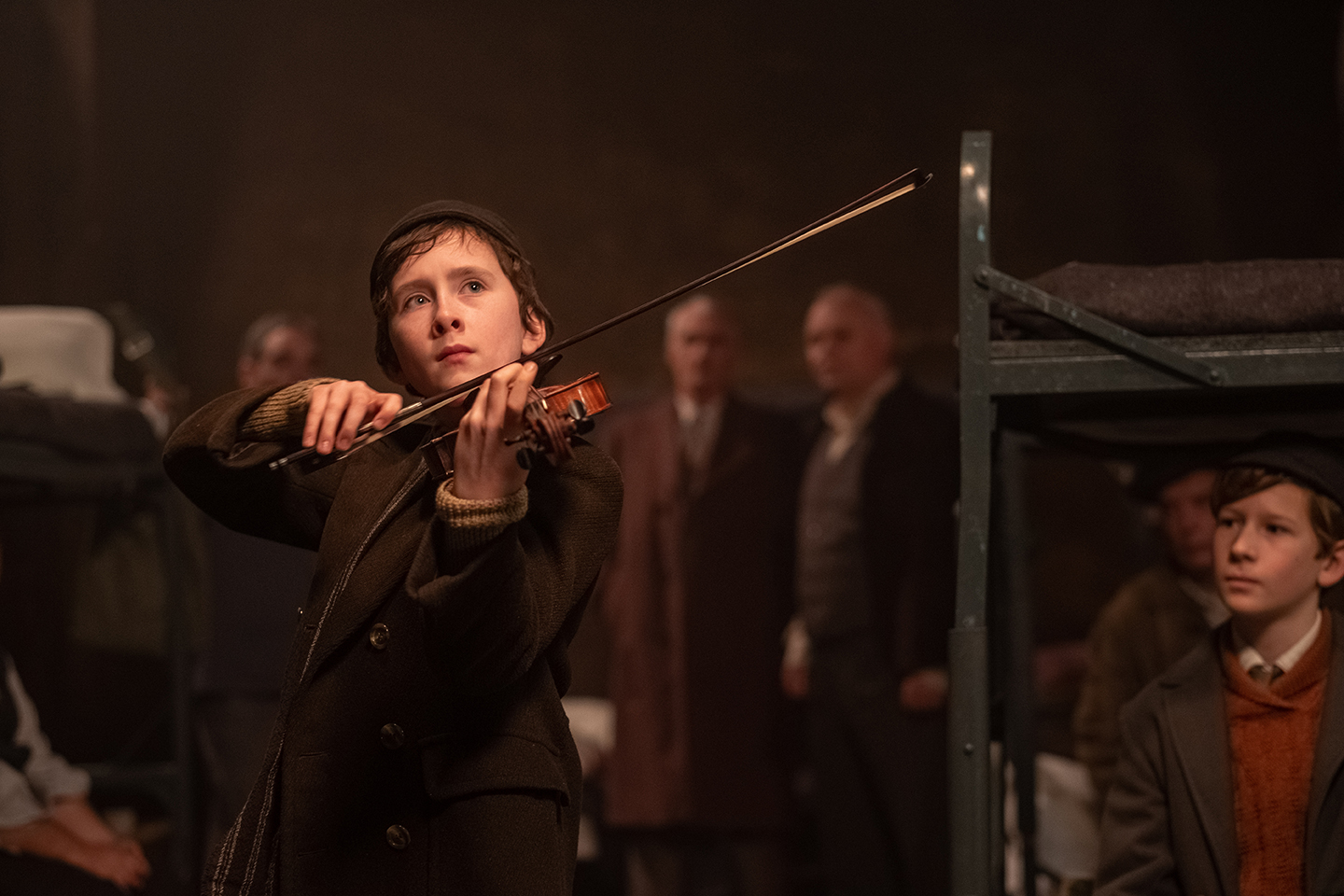
The Song of Names. Photo by Luke DoyleFrançois Girard’s The Song of Names, from the book by Norman Lebrecht (slippedisc.com), is the director’s latest sweeping historical drama, about a man searching for his childhood best friend – a Polish violin prodigy orphaned in the Holocaust – who vanished decades before on the night of his first public performance. Clive Owen and Tim Roth star in Girard’s return to a music-themed film (after 32 Short Films About Glenn Gould and The Violin).

The Audition, Ina Weisse’s follow-up to her acclaimed film, The Architect, focuses on a violin teacher in a music high school in Germany who favours one of her students over her own son. “What fascinates me is the process of how music is created,” Weisse told cineuropa.org. “The husband of [star] Nina Hoss’ character is a violin maker, so this will be an opportunity to show how sounds evolve. Featuring the German-based Kuss String Quartett.

Renée Zellweger plays Judy Garland in English theatre director Rupert Goold’s Judy, an adaptation of Peter Quilter’s successful musical End of the Rainbow, which chronicles the final months of Garland’s life in London before her death in 1969. As she prepares for her five-week sold-out concert run, Garland battles with management, charms musicians, reminisces with friends and adoring fans and begins a whirlwind romance with Mickey Deans, her soon-to-be fifth husband. According to Vanity Fair, Garland’s daughter Liza Minnelli wrote on Facebook in June that “I have never met nor spoken to Renée Zellweger . . . I don’t know how these stories get started, but I do not approve nor sanction the upcoming film … in any way.”

Australian director Unjoo Moon makes her feature film debut with I Am Woman, the story of Helen Reddy who, in 1966, landed in New York with her three-year-old daughter, a suitcase and $230 in her pocket. Within weeks she was broke. Within five years she was one of the biggest superstars of her time, the first ever Australian Grammy Award winner and an icon of the 1970s feminist movement. She wrote the anthem, I Am Woman, a rallying cry for a generation of women to fight for change. Tilda Cobham-Hervey plays Reddy and Danielle Macdonald plays her friend, legendary New York-based Australian rock journalist and club owner Lillian Roxon.

With their significant others away on the battlefields of Afghanistan, a group of British women form a choir and discover the infectious joy of music in Military Wives, directed by Peter Cattaneo (The Full Monty) and inspired by true events.

Riz Ahmed (The Night Of) and Olivia Cooke star in Sound of Metal, the directorial debut of Darius Marder. According to Variety, the story follows a drummer (Ahmed), whose life and relationship with his bandmate girlfriend are turned upside-down when he unexpectedly begins to lose his hearing and he must go to great lengths to recapture the woman and the music he loves. A large number of the cast has been drawn from the deaf community.

In Coky Giedroyc’s How To Build a Girl, based on the semi-autobiographical novel by Caitlin Moran (who shares the screenplay credit), Beanie Feldstein plays a 16-year-old aspiring music critic who lands in London in the 1990s and succeeds despite the boys’ club culture of the day.

Seamless Soundtracks/Notably Musical
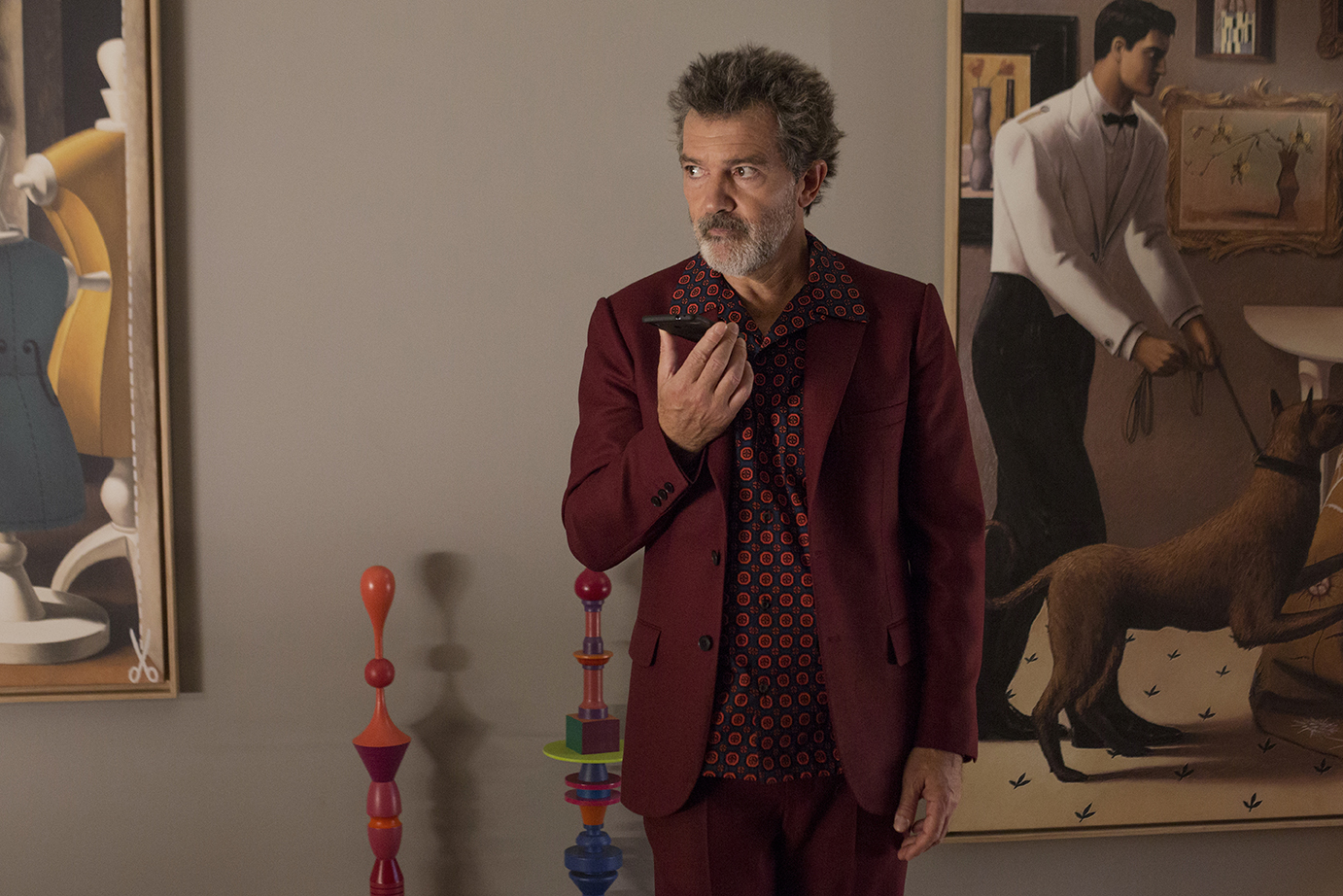
Pain and Glory. Photo by Nico BustosAntonio Banderas won Best Actor at Cannes this year for his role as a film director who reflects on the choices he’s made as his life comes crashing down around him in Pedro Almodóvar’s warmly received semi-autobiographical fable, Pain and Glory. Composer Alberto Iglesias, who has scored every Almodóvar film since The Flower of My Secret (1995), won the Cannes Soundtrack Award for his score which has been described as intense, emotional, highly inspired and moving, with echoes of impressionism imbued with melancholy.

Peter Bradshaw wrote in The Guardian last May of Céline Sciamma’s Portrait of a Lady on Fire, the film that would ultimately win Cannes’ Best Scenario Prize: “I was on the edge of my seat. Portrait of a Lady on Fire has something of Alfred Hitchcock – actually two specific Hitchcocks: Rebecca, with a young woman arriving at a mysterious house, haunted by the past, and also Hitchcock’s Vertigo, with its all-important male gaze, [which] Sciamma flips to a female gaze.” Sciamma’s film takes place in 1770, so Vivaldi for one plays a part in the score. But Para One (Jean-Baptiste de Laubier), who has worked on each of Sciamma’s films beginning with Water Lilies, contributed a poignant, indelible moment of great emotional power heard at the 78-minute mark. In a recent interview he said that they thought a lot about the rhythms and dances of 18th-century music, specifically in Brittany, the film’s setting. But they also talked about Ligeti and the modernity of the film. “So [Sciamma] went back to listen to Ligeti for three days and came back with a frantic pace; it was a great inspiration. We found the tempo.”

Senegalese filmmaker Mati Diop’s haunting debut feature, Atlantics, won Cannes’ Grand Prize for the story of marginalized young lovers in Senegal desperately seeking a better life. Cinezik called Berlin-based electronic-music artist Fatima Al Qadiri’s score “captivating” and published part of a recent interview with the composer. “The most important [thing] in my music is the melody. This is my obsession. The repetition of melodic lines in my music gives the feeling of a meditation . . . the director wanted minimalism, with very little musical information, not to overwhelm the characters.”

A symbiotic relationship between two families, one rich, the other poor, is at the root of Parasite, Bong Joon-ho’s socially conscious thriller that won the Palme d’Or at Cannes this year. Called ingenious and unpredictable and a twist-laden black comedy, its musical component by Jung Jae-il consists mostly of a solo piano melody playing against cello, guitars and orchestral strings with an original song with lyrics by the filmmaker performed by Choi Woo-shik, an actor in the film.

Bradley Warren wrote in The Playlist about Bacurau, the film that shared the Cannes Jury Prize with Les Misérables: “For his third feature film, Brazilian filmmaker Kleiber Mendonça Filho splits directorial duties with Juliano Dornelles, the production designer on his first two features. It’s a logical progression for a body of work known for rich soundscapes and vivid images, but it’s also a game changer for his style. … Bacurau is the duo’s most political work yet ... it’s also their most playful effort to date. ... Music may not be as foundational to the plot of Bacurau as was the case with Aquarius, but its use still manages to stir the soul.” Mendonça Filho, quoted in the film’s presskit, described their approach: “The greatest challenge for the music in the movie is knowing when to shut up, which often happens with me. When you embrace the genre with all its narrative twists and turns, it’s better to have music. And when it all comes together, it’s very beautiful.”

Ladj Ly’s Cannes Jury Prize–winning debut feature, Les Misérables, ingeniously weaves the thematic threads of Victor Hugo’s masterpiece into an explosive contemporary narrative spotlighting France as a place of seismic political and social change. According to cinezik.org, the score by Canadian rock band Pink Noise (founded by Toronto-based Mark Sauner) is made up of consistent, unchangeable, undifferentiated electronic tablecloths that serve to maintain the film’s tension.

Terrence Malick’s A Hidden Life, according to Justin Chang of the LA Times, tells the story of an Austrian peasant farmer who was imprisoned and executed in 1943 for refusing to fight for the Nazis. The film’s composer James Newton Howard said (in the film’s press notes) that scoring the film was a highly collaborative process, which began with Malick sending him a series of short clips from the film without any sound or music. “I wrote very loosely to picture, but we were able to establish the key thematic material and sonic identity of the score ... One of the early ideas Terry brought to me, was to incorporate sounds he had captured during production such as church bells from the villages, cow and sheep bells, the saw mill, sounds from the prison, and scythes in the fields,” said Howard. “I took many of those sounds and processed them into musical elements that are woven throughout the score. We chose to work mostly scene by scene where I would write something that he would react to, and then he would often mould the edit to what I had done.” The score focuses on the emotional journeys and crises of conscience of the characters with a solo violin throughout the film, embodying the connection between the two main characters, performed by none other than violinist James Ehnes.

Two Teasers

According to TIFF senior programmer Steve Gravestock, Louise Archambault’s And the Birds Rained Down features one of the most beautiful musical moments of the year, when Rémy Girard, as an ailing musician living in the Quebec countryside, is coaxed into performing at a nearby club and delivers a soulful and heartbreaking rendition of Time (from Raindogs), one of Tom Waits› best tunes.

And Jessica Kiang wrote about The Whistlers in Variety: “Corneliu Porumboiu goes large with the soundtrack, smashing into and out of scenes on abrupt, bombastic tracks, which often mimic the [film’s] whistling motif in the vibrato of an opera singer’s voice, or the exaggeratedly rolled ‘r’s and hissed ‘s’-es of Ute Lemper’s Mack the Knife, sung in the original German.”

White Lie: The Making of a Soundtrack

White LieWhite Lie is a gripping new psychodrama, by Toronto-based co-directors Yonah Lewis and Calvin Thomas, that oozes unease as it follows a university student on her duplicitous route to crowd-funded dollars by pretending to be suffering from melanoma. It’s the duo’s fourth feature and second to be invited to TIFF (Amy George, their 2011 debut, was the first). Marked by nuanced, naturalistic acting (Kacey Rohl, Amber Anderson, Martin Donovan) and set off by striking cinematography, its mood is buttressed by a quietly disturbing score.

The film’s large musical component (by Yonah’s brother, Lev Lewis) is strikingly judicious: it doesn’t overwhelm and the filmmakers know when to remove it entirely. I was curious about the working relationship among Thomas and the Lewis brothers vis-a-vis the music in the film, so in a recent email I asked Yonah to describe their process.

[Full disclosure: while not members of my immediate family, Yonah and Lev are related to me.]

“We (Yonah and Calvin Thomas) always attempt the assembly and first cut without a temp track, but temptation quickly arises and pretty soon we begin to pull tracks that help us envision how we want the final scenes to feel. Lev tends to source most of the music, but the two of us occasionally bring in pieces we think might send us in the right direction. At this point in the edit, much of this is just us trying to locate the feeling and scope of the music. Sometimes we want something orchestral, maybe even bombastic, but ultimately feel that the music has to match the size of the production.

“On White Lie, we used a number of tracks from the Wojciech Kilar We Own the Night soundtrack, as well as pieces by Yusef Lateef, Steve Roach, Pere Ubu and Wadada Leo Smith, until Lev began recording his own temp score a few months into the editing process.

“We were a little rushed getting a cut ready for festival submissions and Lev had a whirlwind long weekend writing and recording a temp score in the edit suite, just him, a guitar and a MIDI keyboard. That stage of the score turned out to be a more post-punk, Sonic Youth feel than what we eventually landed on, but it helped us start to set a tone for what the music eventually became. We ended up gravitating to more strings and piano than originally discussed, but still incorporating that jagged, jarring feeling of the distorted guitars and loose percussion.”

I then contacted Lev Lewis about how he had approached writing the score, indicating that I was impressed with the depth of the recurrent cello line, the inherent pull between the jazzy foreground walking bass and the tension drip of the synths and background percussion, the way that the music gently adds to the web of deceit.

“Initially, the score was going to dominantly rely on guitars and keyboards, and since those are instruments I can play (unlike strings or woodwinds or what have you), I ended up putting more effort into the temp music than is typical,” he replied. “I recorded in the editing suite we were cutting in, using Logic and an Apogee ONE for guitars. We used this temp music for about six weeks until picture was locked and I moved onto writing the score full time. I spent about two-three weeks composing to picture and then another three weeks or so recording. Most of the recording was done out of Victory Social Club in a small office with Lucas Prokaziuk engineering. We recorded guitars and live synths there, finding the right sounds and tweaking the cues.

“We had three great string players (two violins, one cello) come in for a whirlwind day where we recorded something like 19 cues in maybe four hours, and a drummer to play the kit. I performed the piano and just banged on the percussion until we got the sounds we were looking for. Working with live synths was probably the biggest learning curve for me as it was my first time, but also quite fun, especially interesting to realize how alive they are.

“Writing a score for such a psychologically damaged character immediately gives you a lot of options, some of them interesting, some of them obvious. I had recently heard a record by Chris Corsano and Bill Orcutt which is made up of these interlocking guitar-drum runs. Really rough and abrasive but fully integrated. I incorporated (or stole) that idea and placed it overtop a more conventional horror movie melody played on piano and cello. This came together pretty quickly and became the main theme.”

And, finally, this from Calvin Thomas:

“Having the score come together really solidified the tone of the film. It made her more fascinating, more cunning, more complicated. And ultimately that’s what we were striving for: the audience should leave the theatre feeling deeply unsettled by the character they’ve been following through every scene, and conflicted by their own attachment to her.”

White Lie plays the Toronto International Film Festival September 7 and 13. Consult tiff.net for more information.

The Toronto International Film Festival runs from September 5 to 15. Please check tiff.net for further information.

Paul Ennis is the managing editor of The WholeNote.
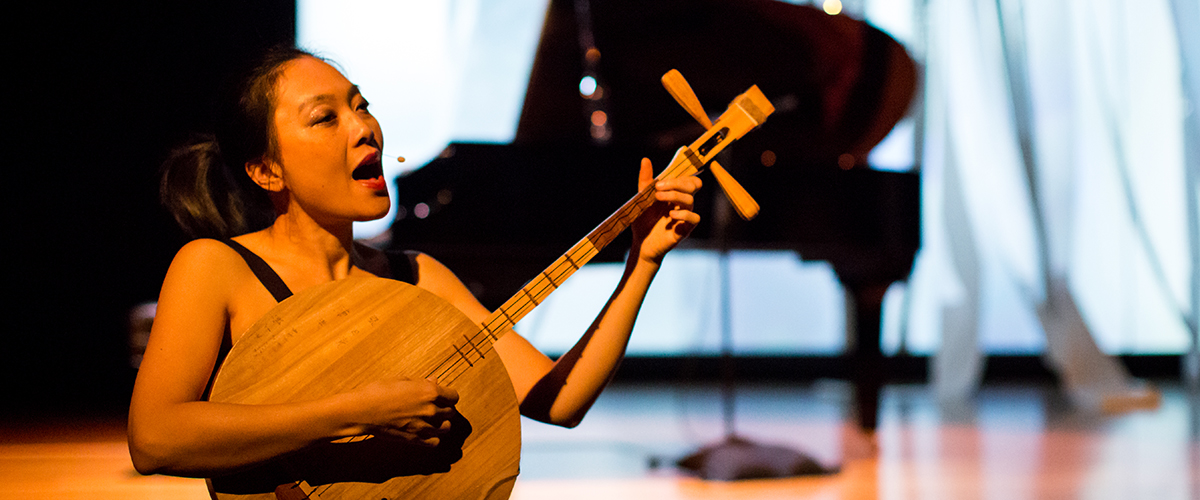
Jen Shyu. Photo by Lynn LaneSince its inception in 1994, the Guelph Jazz Festival has devoted itself to the music’s creative and committed dimensions, the sound of surprise rather than the lounge. Its founding artistic director, Ajay Heble, presented vigorous and innovative figures like Randy Weston, William Parker and Milford Graves; he also commissioned large-scale creative projects from Canadian musicians, including improvised chamber operas. The festival has become interwoven with the city, with two days of outdoor music stretching from traditional jazz to fusion and ticketed concerts that make creative use of churches, a youth music centre and a performing arts centre.

Ajay Heble. Photo by Trina KosterIn 2017, Heble ceded the reins to Scott Thomson, whose previous festival activities included the AIMToronto Orchestra’s 2007 project with Anthony Braxton. Thomson has since been named artistic and general director with Toronto saxophonist/programmer Karen Ng as assistant artistic and general director. Their collective vision is evident in a program that’s alive with fresh voices. Guelph is one of the few festivals where the music is getting younger, sparking with its own creative zeal. Thomson remarks, “I see my task as a balance between preserving continuity and evolution: the former to maintain the event’s signature that my predecessor worked so hard to establish; the latter as an animating impulse to keep the programming fresh and at least a bit surprising. Karen Ng feels the same way.”

For 2019, The Guelph Jazz Festival presents jazz as a spontaneous global music that can arise anywhere and be played on any instrument, an inventive, creative response to the times, or maybe a time of its own: young Argentinian pianist Paula Shocron and drummer Pablo Diaz are joined in a trio with the émigré senior clarinetist Guillermo Gregorio (September 14) in a lilting, spontaneous take on the Second Viennese School; meanwhile, Brodie West’s Quintet (September 13) is all about time, right down to its two drummers.

Scott Thomson. Photo by Jean MartinThomson, a master of finding associations among musicians, makes the most of his resources. The NAIL concert (September 12) presents two outstanding duos, the Montreal partnership of clarinetist Lori Freedman and bassist Nic Caloia and the Amsterdam team of violist Ig Henneman and saxophonist-clarinetist Ab Baars, then the duos join to explore connections long forged through the Canadian band Queen Mab and Henneman’s sextet, creating the quartet (and anagram) NAIL.

Another international duo, saxophonist Ingrid Laubrock and drummer Tom Rainey, expands to a rarely heard trio – suggested by Karen Ng – with cellist Hank Roberts (September 13). In other duo formations the great Chicago drummer Hamid Drake appears with a regular associate, percussionist Adam Rudolph (September 13), and then (on another day) with Breton piper Erwan Keravec (September 15).

Piper? Yes, Keravec improvises on Scottish bagpipes, creating complex, noise-rich polyphony that suggests factory and cathedral as well as the instrument’s primal roots, and he’s just one of the solo improvisers applying novel approaches to unlikely instruments, sharing a double bill (September 14) with John Kameel Farah playing pipe organ and electronics.

More? One triple bill (September 13) presents three soloists: Guelph-resident Ben Grossman finds new sounds in the antique hurdy-gurdy; Nova Scotian chik white turns the humble jaw harp into an intensely expressive (and sometimes “prepared”) instrument; Susan Alcorn plays pedal-steel guitar, extending her roots in country and western to work of soaring beauty and grace.

Scott Thomson explains the explosion: “It’s important to present these artists as soloists because that’s the context in which we have heard them play so compellingly. It just worked out that they all reached the top of our ‘would-love-to-present’ list this year, and that they play instruments that one seldom or never hears at anything called a ‘jazz festival.’”

No one, however, is likely to take the challenge of solo performance further than American composer, multi-instrumentalist, dancer and vocalist Jen Shyu, presenting her Nine Doors (September 14), a moving tale in which a young woman travels through space and time meeting spirit guides. Along the way, Shyu sings in eight languages, while playing piano and various strings and percussion from Korea, Japan and Taiwan.

The Guelph Jazz Festival plays September 12-15. For information go to guelphjazzfestival.com

Stuart Broomer writes frequently on music (mostly improvised) and is the author of Time and Anthony Braxton. His column “Ezz-thetics” appears regularly at pointofdeparture.org

Neil Crory 2015. Photo by Linda LitwackMuch has already been penned in celebration of the remarkable career of the late Neil Crory (1950–2019). The tributes often focus on Crory’s enthusiasm for and support of classical singers in Canada. And indeed Crory’s influence in the musical community was far reaching.

Surprisingly little has been mentioned thus far, though, about his strong support of Canadian composition. But in fact, Crory had a keen interest in the development of Canadian composers. Through his activities as a member of the national radio music department of CBC Radio, he initiated numerous commissions and creative projects for CBC Radio music programs. The program I created for CBC Radio Two, Two New Hours (1978–2007), was fortunate to be the place where many of Crory’s projects were aired, enabling our listeners to witness the exuberant programming that was the hallmark of his creativity.

Some of our most ambitious Two New Hours productions, in the cause of original Canadian music, benefited from Crory’s participation. An example of this: Glenn Buhr’s large-scale work, Cathedral Songs, commissioned as an expression of musical community building, to celebrate the newly opened Canadian Broadcasting Centre in Toronto and to be performed in-the-round in the Barbara Frum Atrium, by the Toronto Symphony Orchestra, Nexus, the Toronto Children’s Choir, and the Hannaford Street Silver Band. In March of 1995, these forces duly assembled for a concert titled “Cathedral Songs,” in which the eponymous composition by Glenn Buhr had its premiere. As the CBC Radio Music liason with the Toronto Symphony, Crory made sure that the TSO was at the centre of it all. The Atrium’s 700 seats were full, and the concert was broadcast live-to-air, serving an audience of thousands of listeners across Canada. The concert, the broadcast, Buhr’s new work and all the other pieces performed in that broadcast made a statement: Canadians creating together and aspiring for excellence can achieve greatness by harnessing the creative juices of a community. Alec Frame, vice president of CBC Radio at the time told me, “I wish that concert could have gone on forever!”

Another example: Crory was involved with commissioning the late Harry Freedman’s (1922–2005) major composition, Borealis, in 1997, which combined the forces of the TSO, the Danish National Radio Choir, the Swedish Radio Choir, the Elmer Iseler Singers and the Toronto Childrens’ Chorus, all under the direction of conductor Jukka-Pekka Saraste and deployed surrounding the audience, from the ground floor up into the various levels of balconies, ringing the ten-story Barbara Frum Atrium. The occasion in this case was our collaboration with the “Northern Encounters Circumpolar Festival of the Arts,” organized by Soundstreams Canada. The effect of the music was stunning. Freedman himself considered it one of his finest achievements in writing for large-scale musical forces, calling it “A summation.”

Chris Paul Harman (b. 1970) was one of the Canadian composers that Crory commissioned several times. Harman was, at age 19, the youngest Grand Prize winner in the history of the CBC/Radio-Canada Council National Competition for Young Composers (1973–2003). Crory was a close follower of all the various CBC/Radio-Canada music competitions, and he was impressed by the promise of this talented emerging composer. “Neil’s commissions, especially those for the St. Lawrence String Quartet (SLSQ) and for the CBC Radio National Competition for Young Performers would have lasting impact on my career,” Harman told me. The SLSQ went on to commission a second quartet from Harman, and played both works in Canada, the US and abroad. Later, Harman’s Globus Hystericus, commissioned for the Young Performers’ competition, was subsequently taken up by several pianists including Christina Petrowska Quilico, (who recorded it for Centrediscs), as well as Stephen Clarke and Simon Docking, among others.

Hong Kong-born Chan Ka Nin (b.1949) was another Canadian composer for whom Crory had a special affinity, and he commissioned several of Chan’s works. Chan told me, “As I was starting out to teach at the University of Toronto after my graduation, Neil commissioned me to write Among Friends in 1989 for the Amici Ensemble. The piece won the Juno Award for Best Classical Composition in 1994, and has since been performed numerous times. I am not exaggerating to say that Neil and the CBC were instrumental in launching my career. I always remember him to be a gentle person with thoughtful insights.” Among Friends, and other works that Crory commissioned Chan to compose for the Amici Ensemble, were recorded in Glenn Gould Studio and released on a CBC Records CD titled Majestic Flair. Copies of that CD are available through the Canadian Music Centre.

Later on, Chan was among the group of Canadian composers Crory commissioned to write preludes and fugues in honour of a very special Glenn Gould anniversary. Crory wrote: “In searching for a manner in which CBC Radio Two could pay tribute to pianist Glenn Gould on what would have been his 75th birthday (September 25, 2007,) I was reminded of the means by which composers throughout history have honoured the memory of Johann Sebastian Bach – the composer most associated with Glenn Gould. Composers from Robert Schumann, Franz Liszt and Max Reger to Hanns Eisler, Walter Piston and Nino Rota have all celebrated Bach’s genius with works based upon the letters of his name: B-A-C-H (Note: in German, B equals B flat; and H equals B natural.) In this spirit, CBC Radio 2 commissioned 11 composers, from coast to coast, each to write a prelude and fugue for piano based upon the available letters in Glenn Gould’s name (G-E-G-D). I think that you will be pleasantly surprised by the range and diversity of approaches that our composers have taken in realizing their individual commissions.”

In addition to Chan, Crory chose composers Kati Agócs, Malcolm Forsyth, Gary Kulesha, Andrew Paul Macdonald, Diana McIntosh, Jocelyn Morlock, André Ristic and Ana Sokolović, to write for a top-flight group of pianists, together with pianist-composers Stewart Goodyear and Heather Schmidt who recorded their own pieces. The resulting CD is also available on the CMC’s Centrediscs label, titled So You Want To Write A Fugue, a title shared with one of Gould’s own compositions.

Alexina Louie. Photo by Bo HuangGould also led Crory to Toronto composer Alexina Louie. In 1982, when Louie was in the midst of composing a string orchestra work for the Faculty of Music of McGill University, she received the news of the Gould’s premature death. Louie’s response took the form of an outpouring of grief expressed through the music as she completed the work. The heartfelt hommage to Gould touched Crory deeply, so much so that thereafter he sought out Louie whenever her works were performed by the TSO. They became friends, and in 1999, Crory commissioned Louie to compose the Gouldberg Fanfares, to be performed at the Glenn Gould Prize ceremony for Yo-Yo Ma. Crory also brought CBC Radio in as a co-commissioner, together with the TSO, of Louie’s 2008 Pursuit, a concerto for string quartet and orchestra written for the Tokyo String Quartet.

Louie told me that Crory was an enthusiastic adviser for her whenever she was casting singers for her opera projects. For example, he strongly suggested she cast the rising young tenor, Lawrence Williford in two of her television operas, Burnt Toast (2004) and Mulroney: the Opera (2011.) She remembers visiting him as he was in failing health, and that upon leaving his apartment he handed her a pencil, asking her to autograph the concrete inside the front door. She noticed the wall was filled thick with such autographs.

This past summer, at the premiere of her Summer Music, a quintet commissioned by Toronto Summer Music, Louie wrote that the work is, “Dedicated to the memory of my friend, Neil Crory who, as a CBC Music Producer, tirelessly promoted and supported the careers of so many singers, instrumentalists and composers with selfless devotion.”

In light of the depth and impact of his work, and to celebrate his extraordinary life and career, a group of Crory’s friends and colleagues have organized a Neil Crory Tribute Concert, scheduled for Friday, October 11, 2019 at Jeanne Lamon Hall, Trinity-St. Paul’s Centre. Participating artists will include Phillip Addis, Isabel Bayrakdarian, Isaiah Bell, Benjamin Butterfield, Tracy Dahl, Nathalie Paulin, Brett Polegato, Jean Stilwell, Krisztina Szabó, Daniel Taylor, Erin Wall and Monica Whicher, along with CBC Radio-Canada personalities Ben Heppner, Eric Friesen, and Françoise Davoine. Fittingly, the concert will be recorded by CBC Radio Music for future broadcast. Tickets and information are available at  tafelmusik.org/crory.

David Jaeger is a composer, producer and broadcaster based in Toronto.

In the Spirit of Glenn Gould (1932–1982)

Returning to the topic of Glenn Gould, the ongoing annual observance of September 25 as Gould’s birthday, will bring with it some announcements by the Glenn Gould Foundation. On this day, the Glenn Gould Foundation will officially open the nomination process for the Thirteenth Glenn Gould Prize, defined by the Foundation as “an international symbol of creative excellence awarded to an individual for a unique lifetime contribution that has enriched the human condition through the arts.” As always, members of the public from anywhere in the world will be invited to submit the name of an artist they passionately believe deserves to become the next Glenn Gould Prize Laureate. Nomination forms are at glenngould.ca.

The Foundation will also offer two presentations to mark the occasion, by renowned professor of political philosophy, Joshua Cohen. On September 25 at 6:30 pm, Cohen will speak on the theme, “Gould’s Variations and the Human Qualities that Foster Remarkable Creativity” at the Al Green Theatre, Miles Nadal Jewish Community Centre. And on September 26, at 6:30, he will speak at the Isabel Bader Theatre, University of Toronto, on the topic. “Central Park: A Design for Democracy.” Tickets for both presentations are also available online at glenngould.ca.

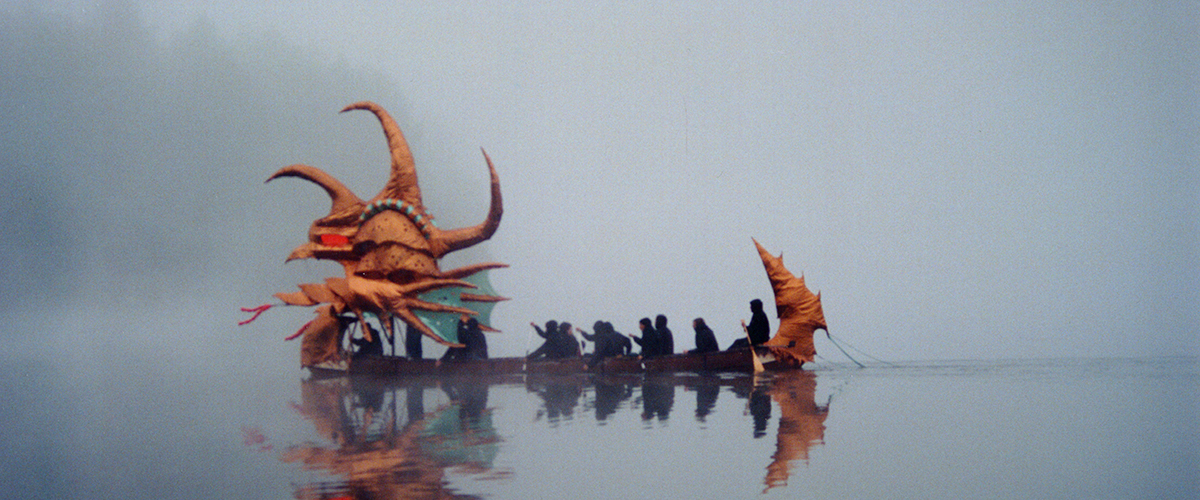
The Horned Enemy from The Princess of the Stars, (Wildcat Lake, 1997) designed by Jerrard and Diana Smith. Photo by Sean HagermanOn a particularly sunny and warm May day in Belfast – one might even have called it summery – my thoughts turned to the coming season, and to the phenomenon of music performed in the great outdoors, or even deep in the wilderness, if the friends and followers of Murray Schafer are to be emulated. My reverie gradually took me back to a much earlier time when such thinking was a fresh idea.

I recalled that in the summer of 1979 my CBC Radio colleague, John Reeves, approached me with an unusual proposal for a broadcast. He asked if I would consider funding an episode he wanted to produce for my recently established contemporary music series, Two New Hours (1978–2007) on what was then known as the CBC FM Network. The notable aspect of his proposal was that it would feature a composition by Murray Schafer, to be recorded on a wilderness lake. The title of the episode was simply, Music for Wilderness Lake. The performance of the work would be by an ensemble of 12 trombonists, ringing the lake, and the recording would be made from the perspective of microphones positioned in a canoe in the middle of the lake.

I thought about Reeves’ proposal, reflecting on other Schafer compositions I had already broadcast on the series, such as his now iconic Third String Quartet, which I had commissioned. The quartet had been a highly unconventional piece, one which begins with only the cellist on stage and in which the other three string players gradually join after slowly progressing, one by one, from the back of the hall to centre stage. In the middle movement, the string players perform all manner of un-string-like sounds. They shout, growl, stomp their feet, and generally carry on in an unhinged and bellicose manner. Needless to say, this kind of innovative writing worked beautifully both on stage and on the radio! The idea, therefore, of a new Schafer composition to be recorded from a canoe in the centre of a wilderness lake was only momentarily surprising. I responded by authorizing the necessary budget to Reeves to produce the segment.

I subsequently discovered that the audio recording was only part of the project. A film crew would accompany Reeves and his recording engineer into the wilderness. The filmmakers eventually contracted for the rights to synchronize and mix our CBC recording as a part of the soundtrack of their film were Barbara Willis Sweete, Niv Fichman and Larry Weinstein; it was released as the first ever film by their new company, Fichman-Sweete Productions, which later evolved into Rhombus Media.

Schafer mentioned in his 2012 autobiography, My Life on Earth & Elsewhere, that Music for Wilderness Lake was his first environmental piece. “I had been canoeing around one of the many unpeopled lakes in the Madawaska area and had noticed how the sounds changed throughout the day and evening. I decided to write a work for the lake and take advantage of those changes,” he wrote. “Just at this time I was approached by a group of 12 trombone players who wanted me to write a piece for them. I suggested my idea and they liked it.” The book, published by The Porcupine’s Quill in Erin, Ontario, is not the focus of this article, but bears mentioning; it is a remarkable read, divided into two parts. Part one is subtitled Student, Sailor, Wanderer and part two is The Music of the Environment. It’s furthermore am increasingly valuable document, since Schafer has become afflicted with Alzheimer’s disease, and unable to further share his remarkable story.

Brooke Dufton, a soprano and scholar who has devoted much of her career to studying and performing the works of Schafer told me: “Given the many obstacles to presenting this music publicly – gathering a dozen adventurous trombonists at once, to play at dawn, and getting performers and audience to that location, and at those times – it is remarkable how frequently Music for Wilderness Lake is professionally performed. In the last three years alone, almost 40 years after its creation, it has been featured in at least seven events. These are ones I know about: Stratford Summer Music, Stratford ON; Make Music New York, New York Central Park Lake; Nuit Blanche, Huntsville ON; The contemporary Austin Sound Series, Austin, Texas; Kalvfestivalen, Gothenburg, Sweden; and Living with Lakes, in Sudbury ON.” Dufton herself is often included in such performances, positioned in the front of a distant canoe, singing Ariadne’s Aria by Schafer.

Music for Wilderness Lake proved to be pivotal for Schafer’s subsequent works for performance in the natural environment. Schafer wrote: “Following the success of Music for Wilderness Lake, I began to think of a larger, more theatrical work in which the action would take place on a lake with the musicians situated around the shores.” The resulting piece, Princess of the Stars, composed in 1981 is an environmental opera, which also serves as the prologue for the 12-part Patria Cycle, which revolves around the journeys of three central characters: the Princess of the Stars, the Wolf and the Minotaur.

In 1997 our Two New Hours production team was able to record and broadcast a production of Princess of the Stars, staged on and around Wildcat Lake in the Haliburton Forest and Wildlife Reserve by Patria Music/Theatre Projects. This was a large- scale undertaking, requiring advance research of the lake itself in order to determine ideal locations for microphone placement. Once the locations were set, our team constructed simple floats, which were anchored at those precise locations with microphone mounts. For each performance, we paddled out to these positions with the mics themselves, installed them, together with the portable recording devices, and then ditched our canoes behind large boulders on the nearest shore, becoming invisible. This was all accomplished before the pre-dawn glow and the arrival of the audience. After the performances, we collected the recording gear and headed to the mixing station. Listeners to Two New Hours across the nation were thus transported to the lake to experience the opera.

Prior to that, in 1995, as a sort of warm-up to the Princess of the Stars opera broadcast, Schafer prepared several pieces from the final movement of Patria, the Epilogue, titled, And Wolf Shall Inherit the Moon. Several musicians travelled with us to Wildcat Lake, where recordings were made using those same methods that we would subsequently employ for the later production of Princess of the Stars. The resulting broadcast, titled Wolf Music, was heard on Two New Hours in 1996 and subsequently leased to Centrediscs, the record label of the Canadian Music Centre. This recording is still available through the CMC and Centrediscs. Wolf Music was also entered by CBC Radio as a submission to the 1996 Prix Italia, an international competition for public broadcasters, where it earned a special mention from the jury.

Two New Hours was also involved in the commissioning, recording and broadcasts of two more parts of the Patria Cycle: Patria 5 – The Crown of Ariadne and Patria 8 – The Palace of the Cinabar Phoenix.

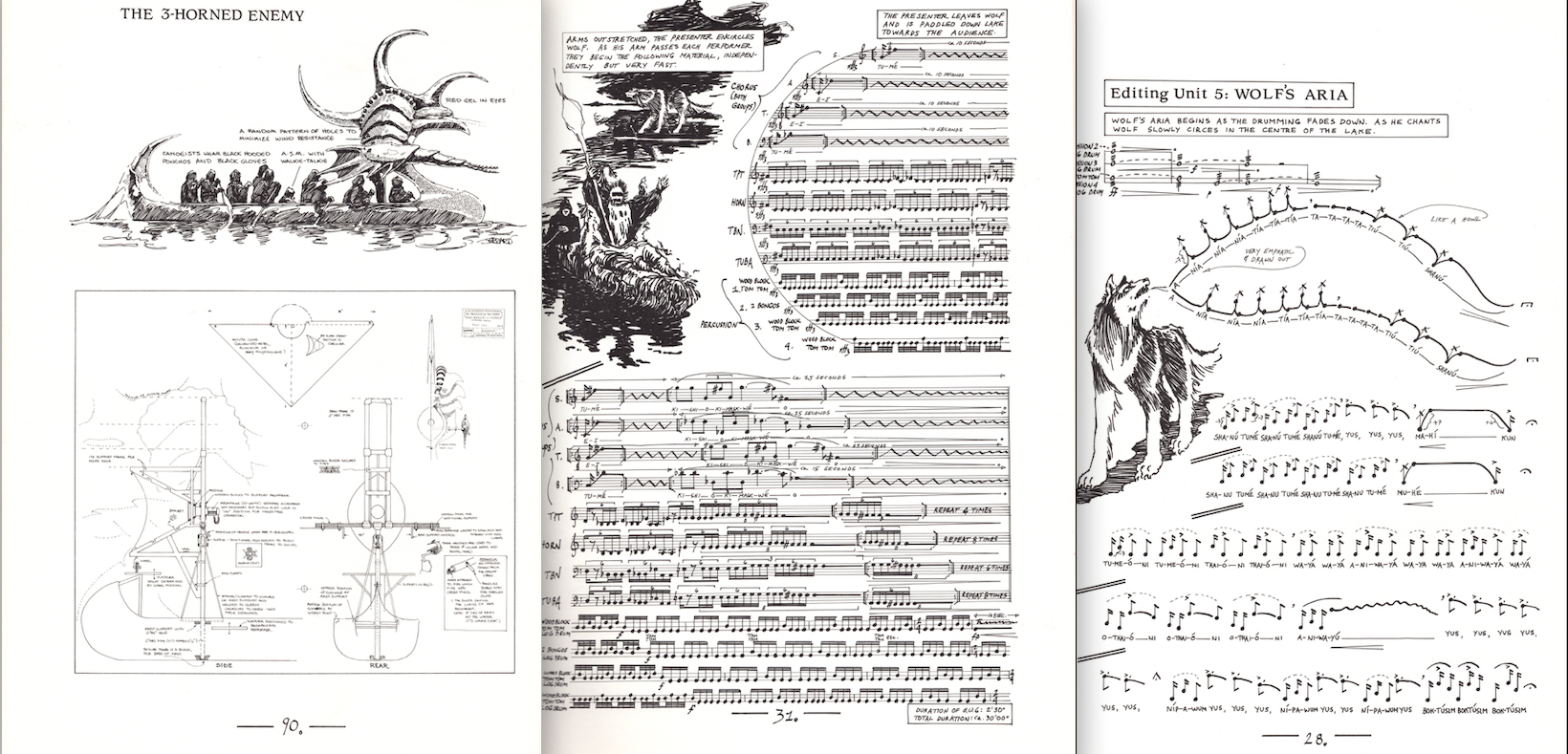
Scanned scores courtesy of Neil DallhoffAnd Wolf Shall Inherit the Moon lives on, continues each summer in the Haliburton forest as a cohort of up to 64 participants who spend a week and a day in the forest, organized in packs, to live in the wild creating music and performing together. Poet and essayist Rae Crossman describes it as, “an annual pageant involving musicians, actors, dancers, artists and storytellers who create musical drama in the Haliburton Forest and Wildlife Reserve, on the edge of Ontario’s Algonquin Park.” Crossman explains: “This is music theatre like no other: the stage is a moose meadow, a rock-strewn gorge patterned with moss, a raft assembled from rugged cedar driftwood, or a quiet forest pool, fringed with cardinal flowers. The lighting: dawn through filigree of pine, intense noonday sun on a burnished lake, flickering campfire flames, or a million stars. Flute music accompanies birdsong. A trombone echoes across the bay. Is that wind in the tamarack or an ethereal voice singing sibilant notes of sorrow? “

Double bassist Neal Evans says: “One of my chief impressions from participating in several Murray Schafer works is that everything he does creates community.” Evans, together with his wife Peg and their two sons, have been long-term participants in The Wolf Project, as it’s also known. They told me that over the space of eight days it “creates a community of people who feel a close bond, much closer that would be achieved by a regular week-long camping experience.” The reason, they explain, is because participants’ days together are purposeful. “There is the immediate need to create short ‘pieces’ (Encounters) to perform for the rest of the group, and the overarching need to create the large-scale composed piece (Great Wheel Day) for the final day. What makes this experience so different, is that at the end of our ‘creative’ work periods, we continue working together to prepare meals, set up a campfire, dig a latrine, hang a tarp or paddle in some supplies. There is no audience, only members of the group, which means that our guards do not/cannot effectively go up on the final day. There is a heightened sense of ‘performance,’ of course, tempered by the awareness and understanding of our shared humanity.”

Given the current fragile state of his health, Schafer no longer participates in this ongoing Epilogue to the Patria Cycle. But his story continues to be told. There are two large-scale projects in process that aim to put his life and career into perspective. One of these is a documentary by filmmaker Neil Dallhoff with the working title, R. Murray Schafer: Into the Mouth of the Wolf. Dallhoff told me he has spent countless hours with Schafer and his wife, mezzo-soprano and doctor of divinity, Eleanor James, talking, planning and filming at their rural home in Indian River. Dallhoff says: “The film is going to strongly represent Murray’s outdoor works, mostly through archival drawings, participant accounts and Murray’s writings. As we continue filming, the theme of the Patria Cycle is emerging in parallel with the story of his life and work.”

And filmmaker Barbara Willis Sweete, our cinematic partner in crime for the CBC Wilderness Lake recording, 40 years ago, is creating Schafer’s Labyrinth for the 2020 edition of Luminato. It will be a multimedia work in which, according to the project proposal, the Molinari String Quartet will perform live on stage in front of a giant movie screen showing motion picture images that include choreographed dance, shots of nature, archival and present-day images from Schafer’s life, visual effects, graphics and animation. “More than 50 years ago,” the proposal goes on to point out, “Schafer envisioned a Theatre of Confluence that would combine elements of opera, theatre, dance, music and projected images – and which would immerse its audience in a totally unified multi-sensory and multi-disciplinary experience.”

Schafer’s Labyrinth will include all 13 of Schafer’s string quartets, performed over two consecutive days in four distinct programs, each lasting between 60 and 85 minutes. “Schafer’s quartets embody his entire philosophy and symbology and are filled with visual allusions and extra-musical references,” the proposal continues. “Images invoked in his quartets include the behaviour of water (Quartet No.2), the sounds of birds and the howling of wolves (Quartet No.10) and the movements of Tai Chi (Quartet No.6). The quartets also reflect Murray’s preoccupation with mythology. Traces of the Greek myth of Theseus, Ariadne and the Minotaur are threaded through all his quartets, taking the form of musical leitmotifs that interact with each other in fascinating ways. The archetypes within this myth form the primary thematic underpinning of Schafer’s Labyrinth.”

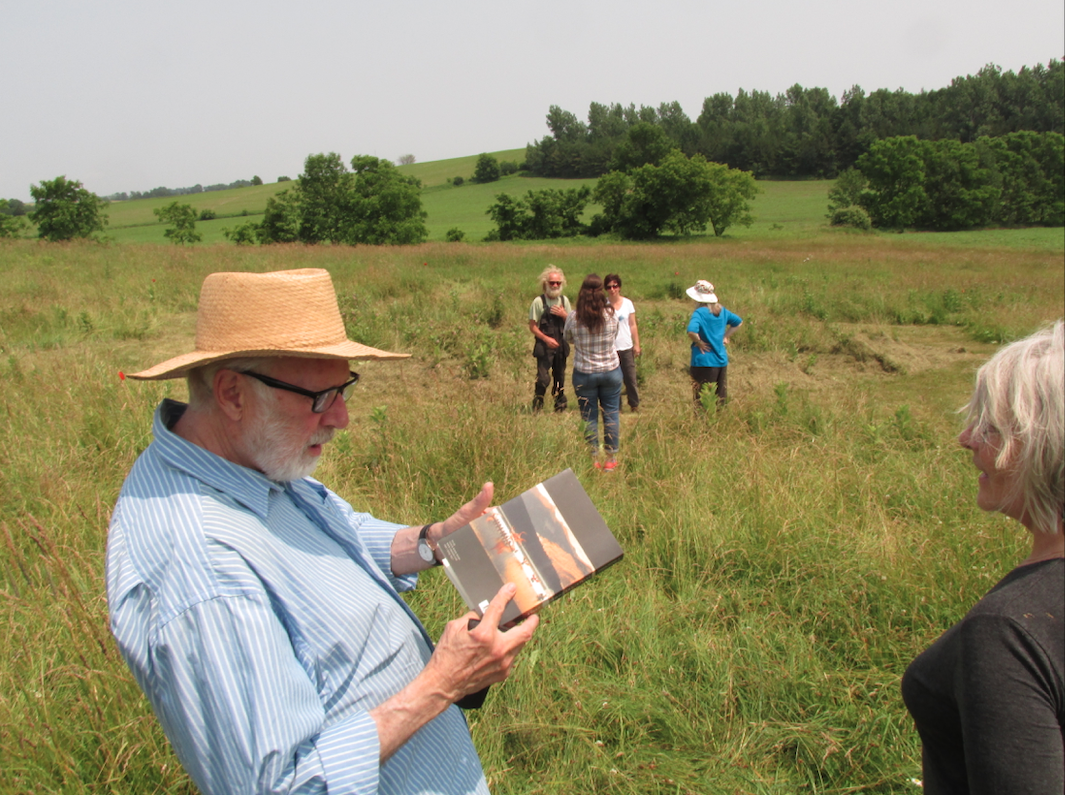
Murray Schafer. Courtesy of Neil DallhoffAs I open my autographed copy of his book, My Life on Earth and Elsewhere, which I acquired on the occasion of Schafer’s 80th birthday, I see his inscription: “For David: New sounds every day of your life! Listen!”

David Jaeger is a composer, producer and broadcaster based in Toronto.

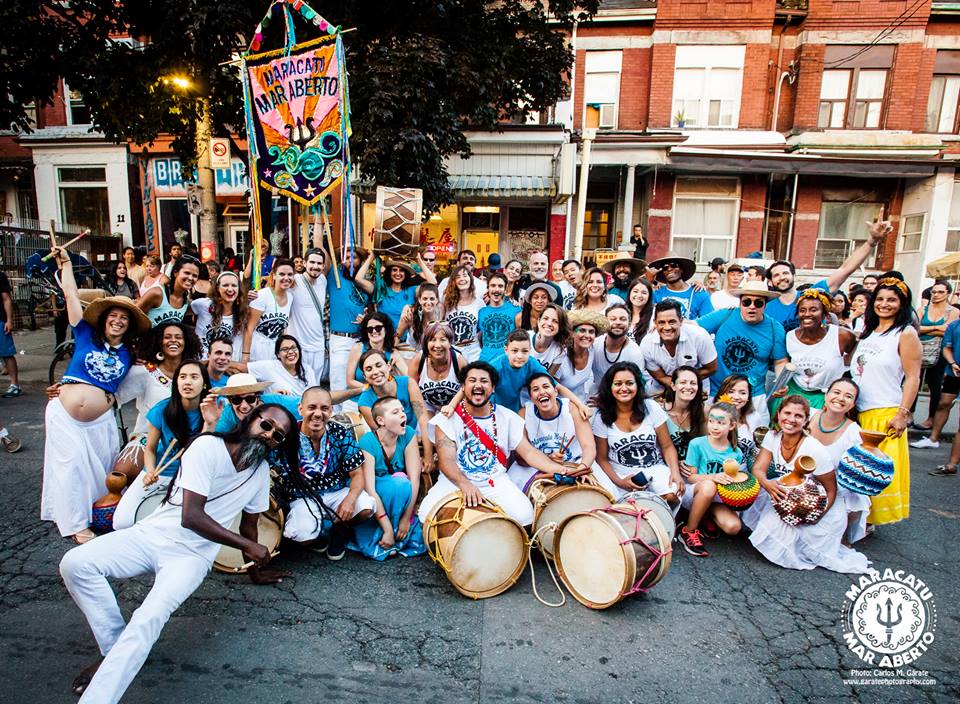
Maracatu Mar Aberto. Photo by Marcela Boechat You’ve seen them. Actually, you probably heard them long before you saw them, when the sound of funky, rhythmic pounding drifted past your ears as you made your way to a street festival in Toronto. I’m talking about those big Brazilian-style drum groups that pop up whenever there’s a festival in the summer. Loud, exuberant and infectious, baterias have become mainstays in multicultural Toronto. Sometimes there will be dancers – usually women – all decked out in feathers and sequins, shimmying along in high heels, deftly navigating the streetcar tracks. (How do they do that?!)

Mostly though, it’s simply a group of drummers and percussionists emulating the massive Brazilian samba clubs, albeit on a much smaller scale. With their matching T-shirts, jaunty hats and big smiles, they bring a little taste of Carnaval, the huge celebration that happens every year before Lent in Rio de Janeiro, to the streets of Toronto.

Samba as a way of life

Samba is a cultural icon of Brazil, with its roots in Africa, and an integral part of life for the majority of Brazilians. Throughout the country, samba is played, danced and sung in various styles and settings.

Samba de roda (samba circle) and samba de raiz (roots samba) involve smaller groups with guitar, cavaquinho (a small ukulele-type instrument) and percussionists getting together at parties and taverns to sing and dance. Ballroom samba dance (samba de gafieira), similar to Argentine tango, became popular in the 1940s and is still danced today.

Toronto musician, music professor and ethnomusicologist, Gordon Sheard sees samba as a central part of life in Brazil. “Starting in the early 20th century, it played a key role in the formation of the Brazilian national identity,” explained Sheard. “It’s both a unifying element and an instrument of diversity, as its outgrowths evolve to serve the needs of specific communities – from the bossa nova of Rio’s middle classes to the samba reggae of the Afro-Brazilians of Bahia.”

The massive drum groups (known as samba schools, although they aren’t schools in the traditional structured sense) formed to take part in the pre-Lenten Carnaval. Samba schools became fixtures in the community throughout the country and especially in Rio de Janeiro in the poorer neighbourhoods (favelas). They provide a social life as well as musical training and are a part of life for many in Rio.

“We need to have a beach; We need to have futbol; We need to have samba. It’s all linked and part of the culture. We grow up knowing that,” says Maninho Costa, a Rio de Janeiro native.

For the samba schools, Carnival parading has become a major competition, with different levels of schools – similar to professional sports leagues – competing against each other every year over a four-day period. The biggest Carnival is, of course, in Rio de Janeiro, where some legendary schools, like Mangueira, have been playing and competing since the 1930s. Samba squads often have hundreds of members and each of the main schools spends many months each year designing their theme, holding a competition for their song, building the floats and rehearsing. Each school’s parade may consist of 3,000 participants, including celebrities, dancers, singers, veteran performers and elaborate floats.

The preparations, especially producing the many different costumes, provide work for thousands of the poorest in Brazilian society. The resulting competition is a major tourist draw and media event, with tens of thousands attending in the Sambadrome and the event televised to millions across South America.

Baterias in Toronto

The Brazilian percussion groups here are about more than drumming and often become like little communities or families for the participants. And samba can get under your skin, whether you’re Brazilian or not.

Torontonian Gloria Blizzard started playing with a drum group 15 years ago until a hand injury forced her to back off the practising. So she switched to dance so she could continue to “stay deeply connected to the music in a different way. Samba is something that you catch. Once you’re in, that’s it.”

AlanHetherintonThe first samba school to appear on the scene in Toronto in 1994 was Escola de Samba de Toronto, led by Alan Hetherington. Although born and raised in Canada, Hetherington is an expert in Brazilian music through his frequent travels to Brazil, playing with some of the famous samba schools in Rio and Sāo Paulo and studying with several of the master sambistas of Brazil. Finding suitable rehearsal space was a challenge for drum groups then and Escola de Samba started out in Christie Pits park, until noise complaints chased them out. When Lula Lounge opened it was a fitting home for the group for many years, being a hub of Latino culture in Toronto’s west end.

In 2003, Hetherington moved the Escola de Samba Toronto to the Royal Conservatory of Music on Bloor Street. Today he teaches beginner and intermediate classes there every Sunday from September to May with opportunities for students to perform at the school and local street festivals. Hetherington also draws from the class to populate his professional samba groups, A Fantástica Bateria and Batucatronica, the latter of which is a mashup of samba drums and electronic dance music.

Samba Squad was the second bateria-style band to form in Toronto and is led by percussionist Rick Shadrach Lazar, who founded the group in 1999. Samba Squad has played virtually every festival in the Toronto area and beyond over the years and is one of the most recognizable groups. Lazar describes the style of music as inspired by the Escolas de Samba of Rio, the Afro Blocos of Salvador, Bahia and the Maracatu nations of Recife, Pernambuco. “I see it as following the path of the drum along the African Diaspora,” said Lazar. “Our repertoire also includes gahu from Ghana, sabar and donba from Senegal, comparsa and salsa/mambo from Cuba, soca from Trinidad, funk from the USA and baladi from Egypt.”

In 2005, Lazar continued the tradition from Rio of support for the community, especially at-risk youth, by holding workshops, along with partners Janet McClelland and Gili Zemer, at Rose Avenue Public School where McClelland taught. That grew into a full-fledged Samba Kidz program with workshops for at-risk youth. Kids who came through the Rose Avenue and Jane-Finch programs grew up in Samba Squad and went onto post-secondary programs at Ryerson and York Universities.

“The program developed student leaders and the student leaders, in turn, became the teachers of our summer camps and workshops,” said Lazar. “We’re proud of the program and the progress the kids made.”

Aline MoralesTwo natives of Brazil have become prominent band leaders and teachers in Toronto – Maninho Costa and Aline Morales. Costa’s group, Batucada Carioca is in the traditional style of the bands from his native Rio de Janeiro. Costa brings his experience playing in elite groups in Rio from a young age – including the renowned Uniao da Ilha do Gobernador run by his uncle – to the tight, swinging shows of Batucada Carioca. Costa regularly holds Women’s Samba Bateria workshops for women wanting to learn the basics of Brazilian drumming with a chance to try out all the instruments.

Baque de BambaMorales hails from Belo Horizonte and her group, Baque de Bamba focuses on a style of folk music from the northeast region of Brazil called maracatu de baque virado. The group is largely made up of women but all genders are welcome. Their performances include some dancing and singing of traditional maracatu songs and the joy is infectious. “Some people say that you don’t choose maracatu, that maracatu chooses you. And I’m starting to believe that,” said Morales. “I wasn’t born in Recife where this tradition came from, but since the day I started to play, I couldn’t respect more what maracatu represents.”

Morales holds evening workshops that have often been taught by veteran members of the group such as Mari Palhares, who has gone on to form her own groups, and Ana Maria Higuera, who started playing with Baque de Bamba when she was just 12 years old. Morales explains that “Big groups like ours need this kind of support from the members. It’s vital for the growth of the community.”

Maracatu Mar AbertoMaracatu Mar Aberto, led by Alex Bordokas, also performs maracatu de baque virado and plays regularly at festivals around town, such as Pedestrian Sundays in Kensington Market. “We have a collective approach where the sound and impact of the group is greater than the sum of our parts,” said Borodakas. “Our focus is on the creativity of Mar Aberto and not any one artist in the group.”

Among the newer bands on the scene is Tdot Batu. Led by Patricio Martinez, the group focuses on the samba reggae rhythms from Martinez’s home of Salvador, Bahia, in Brazil’s northeastern region. Performances are high energy and the infectious rhythms get their audiences partying and dancing.

Started just three years ago by Adam Kafal, a member of Batucada Carioca, Blokoloko is the latest group to emerge on the scene. Their rhythmic style is inspired by the samba carioca of Rio and they are also mainstays of Kensington’s Pedestrian Sundays and a few other festivals. But performing isn’t everything for them. “I think the process of creating and sustaining a rhythm is more of a joy than performing,” said Kafal. “Blokoloko started because I wanted to play samba with an emphasis on more complex breaks and arrangements.”

At the end of the summer of 2018, a Brazilian supergroup comprising about 70 members from Batucada Carioca, Blokoloko, Samba Squad and Escola de Samba – and led by Maninho Costa – rocked Kensington Market with an afternoon of exuberant percussion. A similar event is being planned for the summer of 2019.

Joining a bateria

Almost all of the groups in Toronto hold beginner workshops for people interested in trying their hand at Brazilian percussion. All that’s needed is a good sense of rhythm. From these workshops members for the performing group are often chosen.

The groups in Toronto follow the aural teaching tradition of Brazil for learning songs. The use of written notation is rare. New members learn through attending workshops and rehearsals and listening, as well as studying audio clips or videos. “Samba is hard,” explained Adam Kafal. “It’s not something you can pick up by coming to a single two-hour rehearsal per week. My goal is to make people care a little more about the music and show them the way.”

The seasoned players are encouraged to help the novices. Emphasis is on watching and listening and, often, singing the parts and keeping time with your feet before an instrument is ever picked up and played. It can be a long process for people who don’t have a background in drumming and students need to have patience and openness in order to gradually learn enough to contribute to the group. It’s a lesson that can be applied to life as well as music.

“Learning to listen and absorb and digest before jumping in, is a tool I try to equip my students with,” said Hetherington. “And it can serve us well in many other aspects of our lives, too.”

Brazilian Music 101

Percussion groups are just the tip of the iceberg that is Brazil’s vast, varied musical culture. Toronto is lucky to benefit from an influx of Brazilian immigrants who have brought their skills to our city. Plus we have plenty of local musicians who are adept in these musical styles.

Here is just a handful of the other styles of Brazilian music and bands you can enjoy:

Choro, which means “cry” in Portuguese, is anything but sad. It’s a happy, upbeat music and is often compared to ragtime or New Orleans-style music. It’s primarily instrumental and is covered authentically by Tio Chorinho. Led by mandolin player, Eric Stein, the band plays festivals and does the occasional club gig.

Samba de roda (samba circle) is a mix of guitars/cavaquinho, percussion and singing. Musicians get together to jam and go through popular samba tunes. In Toronto, Roda de Samba plays every other Saturday at Yauca’s, where expat Brazilians and Brazilophiles gather to dance and sing along. Good times.

Although the source of the name is unclear – it may be derived from the term “for all” – forro is a lively folk music from the Northeast region of Brazil. Trio PernamBahia, led by Carlos Cardozo, plays at Lula and other bars and Forrobodo is a monthly event, produced by percussionist Mari Palhares, that delivers a full cultural experience of traditional food, dance lessons and music.

Of course, bossa nova is one of the most famous Brazilian musical imports, with Stan Getz bringing it to North America in the 60s. A crop of young expat Brazilian performers are keeping classic bossa nova, MPB and samba alive – Aquarela Brasil, singers Babi Mendes and Giovanna Correia and guitarist-singer João Leão, who channels João Gilberto in clubs around Toronto.

A couple of songwriters producing beautiful
Brazilian-esque music are guitarist André Valério and multi-instrumentalist Louis Simao. Catch them in concert if you can (or buy their CDs).

And a final note!

Don’t miss Festa Brasileira – Um Grande Encontro as part of the TD Toronto Jazz Festival, Saturday, June 22, 2019, 3pm to 6pm, Bloor Street at Avenue Road

Cathy Riches is a self-described Toronto-based recovering singer and ink slinger.

Back to top