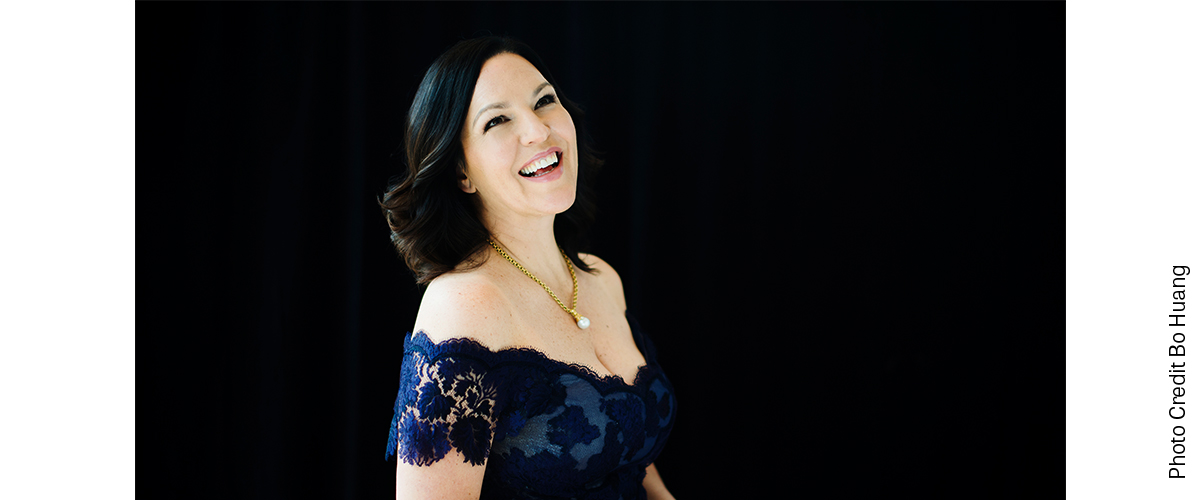
Adrianne PieczonkaImagine you got to know a house by groping in the dark, its curtains always drawn, no light switch, its shapes many and varied learned and remembered for night navigation only.

Then imagine somebody opening the curtains and letting a blast of sun in. It’s a very different house. We see, rather than infer, what it looks like. We experience more fully.

Such was the effect of hearing soprano Adrianne Pieczonka sing Schubert’s song cycle Winterreise February 12 in the Mazzoleni Masters Series with Rachel Andrist at the piano. Rendered in a powerful soprano voice with an unfailingly brilliant top and a magnificent Technicolor middle, the Winter Journey is a different trajectory indeed from what we’ve grown accustomed to in the company of baritones and tenors.

The opening Gute Nacht unfolded at a good pace: everything was clearer under the soprano light, the plodding rhythm of a walk through the snow, the wayward energy of the words. But then the key changed from minor to major before the final stanza. In regular rendition, it’s the moment of an infusion -- a brightening -- of sadness while the text begins to address the lost beloved directly. (“I don’t want to disturb your dreaming / It would be a shame to wake you” etc.) Here, it was so close and visible it felt as if a raw nerve were grazed. So this is how it’s going to be with a soprano, then? Good to know.

And so it continued. The second stanza in Der Lindenbaum, usually a moment of calm beauty, tugged at the tear reservoirs in Pieczonka’s rendition. Never was the fairly mundane “So manches liebe Wort” – the many words of love carved on a linden bark – floated and held to such effect. A bit later, the branches too rustled with unexpected intensity in “Und seine Zweige rauschten” verse and so did the entire stanza.

Rückblick, in tempo and mood a fairly manic evocation of the times of early acquaintance and of spring, suddenly breaks down at “Und ach, zwei Mädchenaugen glühten,” a cry of unbearable joy, or memory of joy that still overwhelms. In the following, sombre song, Irrlicht (Will o’ the Wisp) the last two verses which translate as “Every river finds its way to the ocean / and every sorrow to its grave” in Pieczonka’s hands become a mini scena. “Jeder Strom” starts very low and shoots up across the stave seeking its final destination up on high, followed by “auch sein Grab,” through the long, feline portamenti that make this inexorable direction of life almost bearable.

Der Wegweiser is delivered mostly softly, being an introspective moment where the poet, finding herself at the crossroads, wonders where to go. The törichtes in “Welch ein törichtes Verlangen” (“What is the foolish compulsion that drives me into desolation”) is a case of the famous Pieczonka high piano, the word here vibrating with a hidden sob.

When the light is on, details are clearer, and there were a number of times when I wondered if ornaments were added in certain places. Some of that is the effect of all the notes being made visible. In other cases, it is the honouring of the trills as they should be honoured: Frühlingstraum, (Dream of Spring), has trill suggestion written in on specific words like “Wonne” and “Seligkeit” (joy and delight, appropriately), and they were heard. In Der greise Kopf I thought I heard some masterful trilling in the last stanza on the “Kopf” and particularly “Greise” and went to the score after the concert; of course the markings are there.

Contrasts within the songs are also heightened with a soprano, and Wasserflut (Flood) could easily be an aria, clouds of anger flaring and subsiding across the bleak inner landscape. Der Leierman brought this atypical Winterreise to an equally atypical ending: the final stanza was whispered to the old man, almost flirtingly, certainly femininely and equally fearlessly, the question “Shall I go with you, will you play to my songs” given as the ultimate offering.

Rachel Andrist at the piano was a perfect partner in this macabre dance, playing as the score demands, sometimes against, sometimes alongside the voice. Her introductions and interludes offered as much in the way of text as the vocal parts themselves.

Let’s hope for a repeat of this sold-out concert, either in Toronto or on tour. More people deserve to hear it.
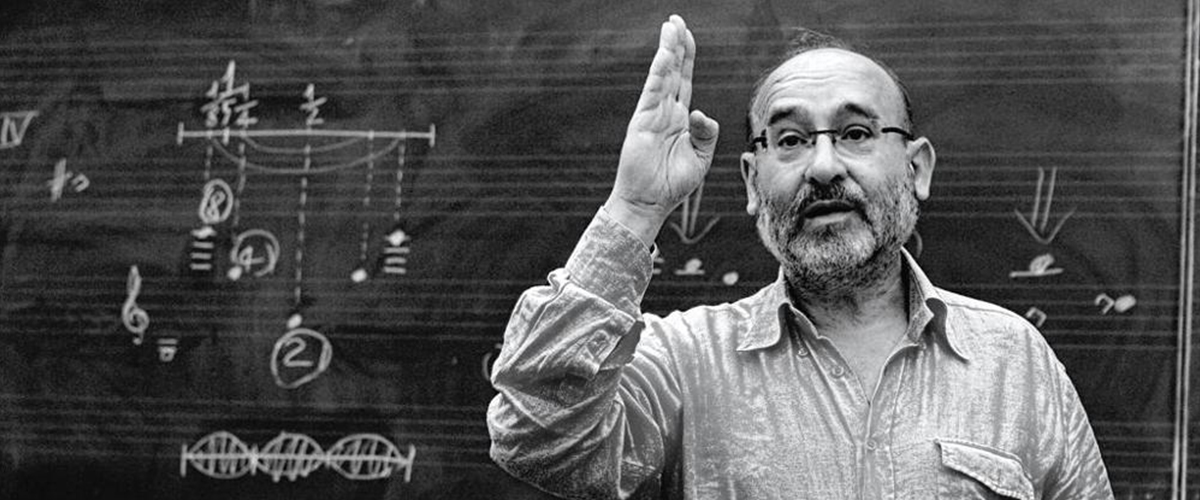
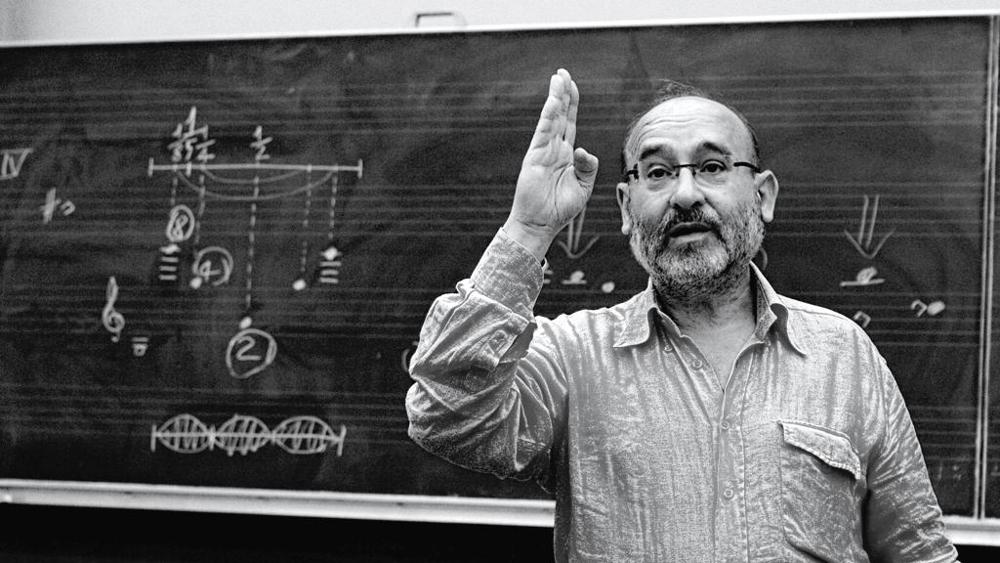
Sciarrino Jaeger blog Banner Feb 2017Composer Salvatore SciarrinoNew Music Concerts' (NMC) A Portrait of Salvatore Sciarrino, a concert jointly presented with the University of Toronto at Walter Hall the evening of Sunday, February 5, was the final event of the U of T New Music Festival this year. During the pre-concert introduction, NMC artistic director/flutist Robert Aitken described his long-held enthusiasm for Sciarrino's music. He said the opportunity to finally work with the Italian composer appeared when U of T composition professor and festival coordinator Norbert Palej and several of his Faculty of Music colleagues revealed their mutual interest in the distinctive music of Sciarrino, who was then invited to Toronto as U of T’s Roger D. Moore Distinguished Visitor in Composition.

In his introduction, Aitken referred to Sciarrino as a “philosopher of music,” in reference not only to the questions raised in Sciarrino's music, but also to the many sage statements about the practice and perception of music he had heard Sciarrino make during the festival. Sciarrino stated that he has tried to invent a sonic vocabulary and create a new musical language in each piece. In response to Aitken's observation that it took great concentration and effort to constantly play the long pianissimos often found in his music, emerging from silence and then fading back to silence, Sciarrino agreed, noting that “at times the silences are noisier than the noises I ask the musicians to produce.”

Sciarrino's 1981 composition Introduction all'oscuro (Introduction to the Obscure), for a mixed ensemble of twelve instruments, uses sounds that imitate heartbeats and breathing – especially with the bassoon, clarinet and oboe – to create feelings of waiting and expectation. The question, naturally, becomes: waiting for what? The answer, however, remains obscure, and perhaps it's simply in the act of listening.

Sciarrino has composed several works for the Italian flute phenom Matteo Cesari, including his 2015 Trovare un equilibrio, è necessario?, for flute and string quartet. “My titles,” he wrote, “have often included a question mark. It tells of the behaviour and discipline at the heart of artistic language, where concision and subtraction are the secret principle and goal. Art demands effort, and it bores only those who are unable to conquer it.” The behaviour and discipline of the fine ensemble of flutist Robert Aitken, violinists Stephen Sitarski and Aysel Taghi-Zada, violist Douglas Perry and cellist Amahl Arulanandam revealed a delicate weave of fragile and mysterious sonorities, which seemed to have found the perfect balance.Sciarrino Jaeger blog Banner Feb 2017

Accordionist Branko Džinović has had Sciarrino's Vagabonde Blu (1998) for solo accordion in his repertoire for some time, but he told me that, since working directly with the composer for this concert, his interpretation has become considerably refined. He said that Sciarrino encouraged him to develop an elastic sense of phrase, where contrasting ideas stretch away from one another, but without breaking the musical line. Astrophysicists refer to certain bright blue stars that wander aimlessly in intergalactic space as “Blue Vagabonds”. “Beautiful and unstable,” Sciarrino notes, while borrowing the term to title his composition.

The final work may have embodied Sciarrino's artistic philosophy the most clearly: his 2005 composition, Archeologia del telefono, a concertante for 13 instruments. In his notes he wrote that “the artist interprets history; he reads the complexity of the world.” He said that every new work “should try to change society. When it is new, it burns, it is inherently problematic.” In his concertante, Archeology of the Telephone, Sciarrino admits he is trying to play with the listeners' attention span, creating hints of ideas that might be the leading motives, and then hiding them behind static moments. He wants us to become active listeners, and to feel rewarded for venturing through the music, along with the musicians.

This was both a provocative and stimulating concert, and the performances were meticulously prepared and executed. It was also a fitting conclusion to a week-long festival that succeeded in giving Toronto listeners a thorough chance to discover one of the most advanced musical minds of new classical composition. From the Karen Kieser Prize concert on opening night, through Sciarrino's opera The Killing Flower and the many other talks and concerts, to this musical portrait of Sciarrino, the 2017 edition of the U of T New Music Festival might have been the most compelling yet. Let's hope for more of the same next season!

The 2017 edition of the University of Toronto New Music Festival, featuring Salvatore Sciarrino as composer-in-residence, ran this year from January 29-February 5.

David Jaeger is a composer, producer and broadcaster based in Toronto.

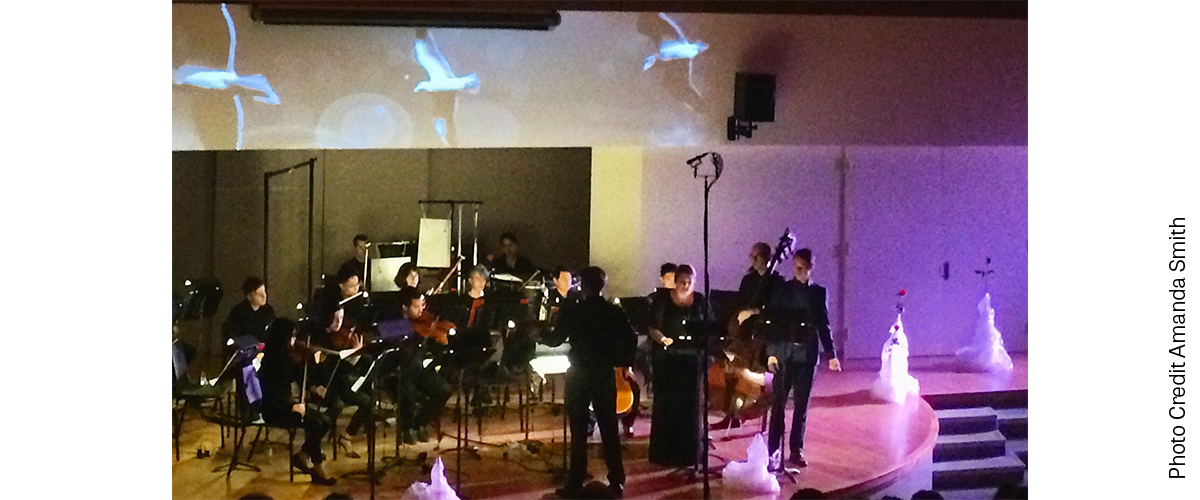
Sciarrino Banner2The Canadian premiere of Italian composer Salvatore Sciarrino's (b. 1947) opera The Killing Flower (Luci mie traditrici) was presented on February 1, at Walter Hall in the Edward Johnson Building of the University of Toronto. Sciarrino has been the Roger D. Moore Distinguished Visitor in Composition at the U of T Faculty of Music during the 2017 edition of the U of T New Music Festival. It had been originally billed as an “on book” (not acted, with the singers reading their parts) performance, by producer Wallace Halladay. But in fact, even with minimally added elements of stagecraft devised by stage director/designer Amanda Smith, such as discrete projections, simple props and appropriate stage direction, the performance had the feeling of a production, rather than a reading.

The story of the opera, as told by Sciarrino (who wrote both libretto and score), is based on the life of the unusual Renaissance composer, Carlo Gesualdo (1566-1619) – a composer Sciarrino has admired since youth, who was also Prince of Venosa and Count of Conza in southern Italy. The tragic story of the opera focuses not on the Prince's creative genius, but rather on his role in the murders of his wife and her lover. It's told in two acts, divided into a prologue, eight scenes, three instrumental intermezzi and two brief movements titled Darkness I and Darkness II. The two main characters are the Duke and the Duchess, initially an apparently happy couple. They are joined by the Guest, who precipitates an affair with the Duchess, and the Duke's servant, whose report of the affair leads to the murders.

In his artistic statement, Sciarrino stated that this opera “was meant to be a statement on the reform of theatre.” He said, “The use of voices, the invention and maturation of the vocal style, allow us to delve into the realm of theatre, rather than simply putting vocalists on stage and having them sing. Its strength lies in the expression of song, in the creation of a vocal style – a newly invented style.”

True to this philosophy, the entire drama appeared to be contained in and conveyed through the vocal lines. For example, the Duke is given a stiff, commanding vocal style, while the Duchess's style is pliable, sensitive and fluid. The Guest sings in a languid, probing and seductive style, while the servant has a jerky, abrupt style, making him seem nervous and insecure. The cast was superb in conveying this “drama of styles.” Baritone Geoffrey Sirett was commanding as the Duke; soprano Shannon Mercer was a sweet and sensitive Duchess, vulnerable and ready to please; countertenor Scott Belluz (the guest) was seductive and not to be resisted; and tenor Keith Klassen played a supremely neurotic servant. A recording of soprano Nathalie Paulin conveyed the prologue, sung in an elegant, fluid yet slightly mournful style that floated over the beginning of the piece.

It was easy to track the course of the drama, thanks to the composer's carefully crafted melodic characterizations. The commanding Duke, the compliant Duchess and obedient servant were all crystal clear in their roles. In the erotic scene with the Guest and the Duchess, the intertwining melodies wrapped themselves up in all manner of contortions, just as bodies might have. Sciarrino's orchestration was just as notable, supporting the action with the most remarkably vivid noises to come from a chamber orchestra. For example, brass instruments provided plenty of wind sounds when needed, the thunder sheets were wonderfully ominous, played softly, but with sufficient gravitas, and the flutes followed the singers with ample amplifications of their heightened emotional states as the drama unfolded. Conductor Chad Heltzel, a DMA candidate at U of T with Uri Mayer, balanced the ensemble nicely and sustained the many moods of the piece. At several times, the effect of high, chirping violins combined with deep, grunting trombones was positively creepy!

An added feature of the evening was a pre-performance discussion with the composer, Salvatore Sciarrino, the producer, Wallace Halladay, and U of T New Music Festival coordinator, Norbert Palej, coordinated by musicologist Catherine Moore. Among various revelations, we heard of Sciarrino's fascination with the music of Gesualdo, and also of Halladay's determination to produce The Killing Flower. Five U of T Theatre for Early Music madrigalists, sopranos Julia Morson and Maeve Palmer, countertenor Ryan McDonald, tenor Cory Knight and bass Andrew Adridge sang two Gesualdo madrigals, Mercè, grido piangendo and Asciugate I begli occhi, and established the flavour of music in Venosa during the Renaissance. It was a memorable evening!

The University of Toronto New Music Festival runs from January 29-February 5. For details, visit https://music.utoronto.ca/concerts-events.php.

David Jaeger is a composer, producer and broadcaster based in Toronto.

Photo c/o Haus Musik.Leave it to Tafelmusik to make a phrase like ‘futuristic baroque’ actually make sense.

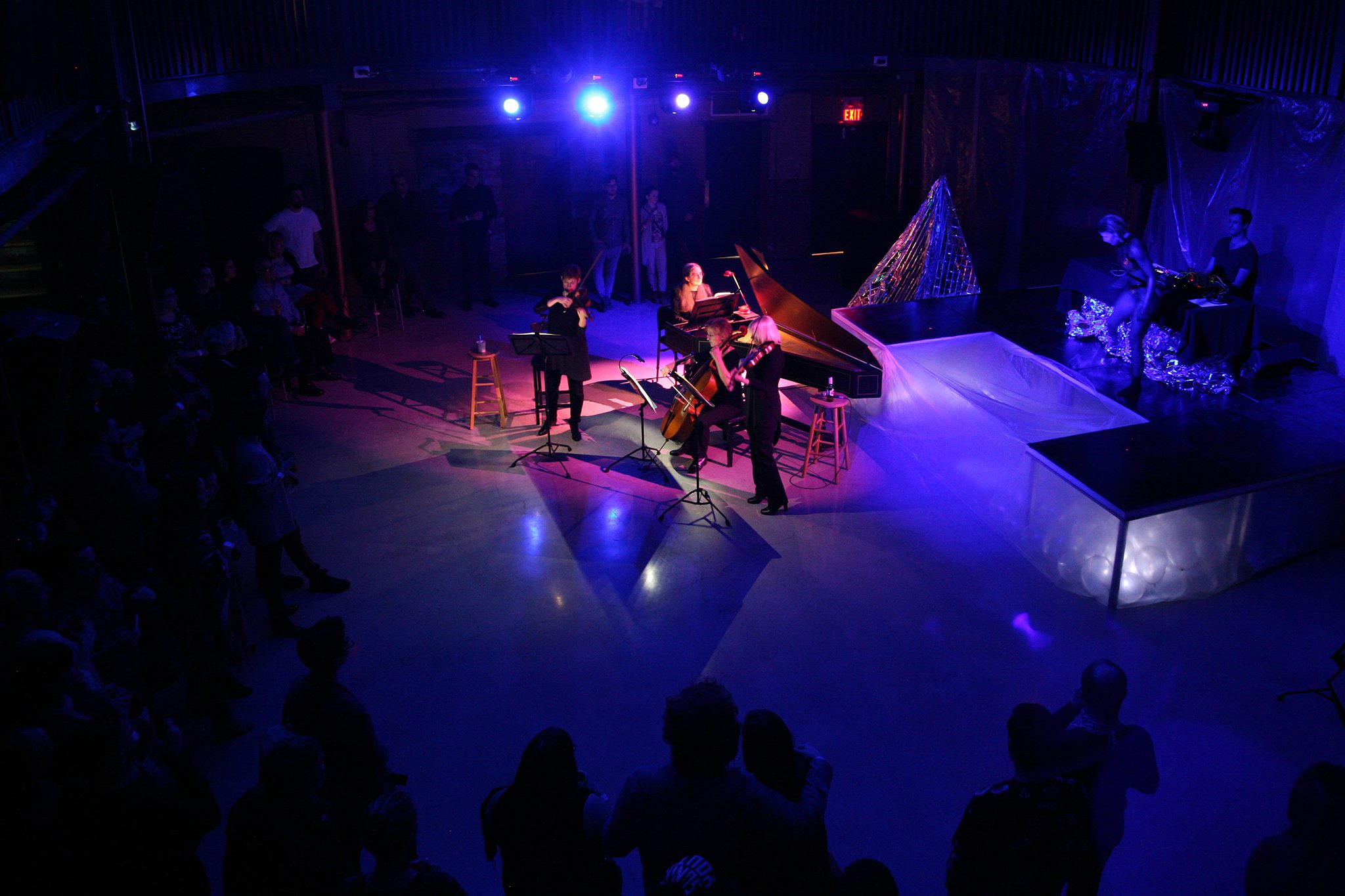
On Thursday, February 2 at Longboat Hall (in the Great Hall), Tafelmusik presented the latest instalment of Haus Musik, its series dedicated to combining electronic and baroque music in alternate venues around the city. The premise is to turn the early music that Tafelmusik plays into the type of party it always was in its time: these shows are standing-room only, dispensing with the traditional ‘stage-and-seats’ configuration in favour of having the musicians (for the most part) on the ground with the audience; there are always opening or closing sets from a local electronic artist; and there’s always a bar.

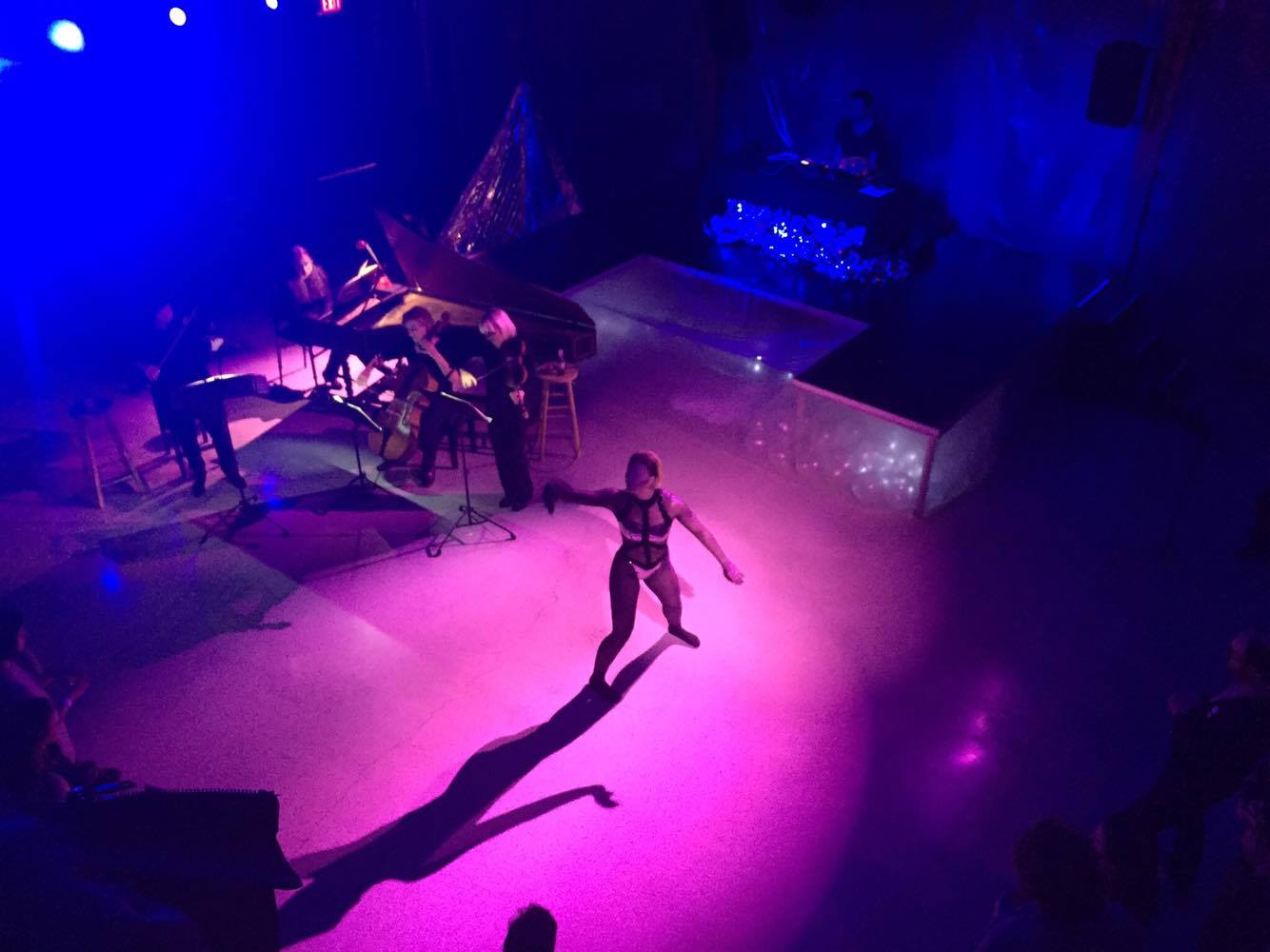
Thursday was my second time at Haus Musik; it was the series’ third show overall. This concert featured four members of Tafelmusik (Julia Wedman and Cristina Zacharias, violins; Christina Mahler, violoncello; Charlotte Nediger, harpsichord) playing French and English music from before 1750, alongside modular electronic musician ACOTE and dancer/choreographer Mary-Dora Bloch-Hansen, who played the part of an alien girl named Leeka with an affinity, strangely, for spoons. The visioning and staging for the show came as always from Amanda Smith, of FAWN Chamber Creative.

After an hour-long opening set by ACOTE, violinist Julia Wedman made the official introduction. Notably – and thankfully – absent were the typically-classical instructions to turn off cell phones and applaud during the proper times (“no flash photography please: it blinds us and then we play wrong notes” was all she said, understandably, on that front). After that, the music was more-or-less continuous, with a set list cleverly placed at the bar for those early music fans who wanted to know the titles and specifics of the works.

Mary-Dora Bloch-Hansen's character Leeka, dancing alongside the musicians. Photo credit: Wei Ning Shen.It was unapologetically a meeting of worlds. Tafelmusik’s baroque set, along with occasional electronic interludes by ACOTE, was performed in dialogue with Leeka’s dancing, which had a theatricality and musicality of its own. Both Leeka’s choreography and ACOTE’s music seemed baroque-inspired, but only in the loosest of ways – with Leeka incorporating motions into her contemporary choreography that felt somehow related to baroque dance, and ACOTE (according to Wedman) using samples from recordings of early music in his work. The drama of Leeka’s own story, who apart from occasional body percussion was silent throughout, was particularly striking; at times she included (tentative) audience participation, and at one point poured salt on the ground to draw a giant spoon (a move that, at least for those of the generation that grew up watching Neil Buchanan’s Art Attack, felt strangely nostalgic). It was all vague enough to not reduce the music to a mere accompanimental role, but clear enough for the audience to follow along.

With an economy of means, the Haus Musik team managed to put on a show that felt well-considered, cool, and distinctly classical, without any of the clichés that normally go along with classical concerts. I didn’t feel stressed about getting there on time; I didn’t feel weird standing at the bar, talking with friends, or pulling out my phone. Above all, it felt like a good party, something it can be easy to forget that classical music can be.

Between the late-night feel of Longboat Hall, the staging of the show, and the music performed, baroque music felt shiny and new last night, reflected in a fresh and fearless light.

Haus Musik will continue intermittently this year alongside Tafelmusik’s mainstage series at Trinity St. Paul’s Centre. The next Haus Musik show is scheduled for April; for details and updates, stay posted on their website (www.tafelmusik.org) and here at www.thewholenote.com.

Sara Constant is a Toronto-based flutist and musicologist, and is digital media editor at The WholeNote. She can be contacted at editorial@thewholenote.com.

Back to top