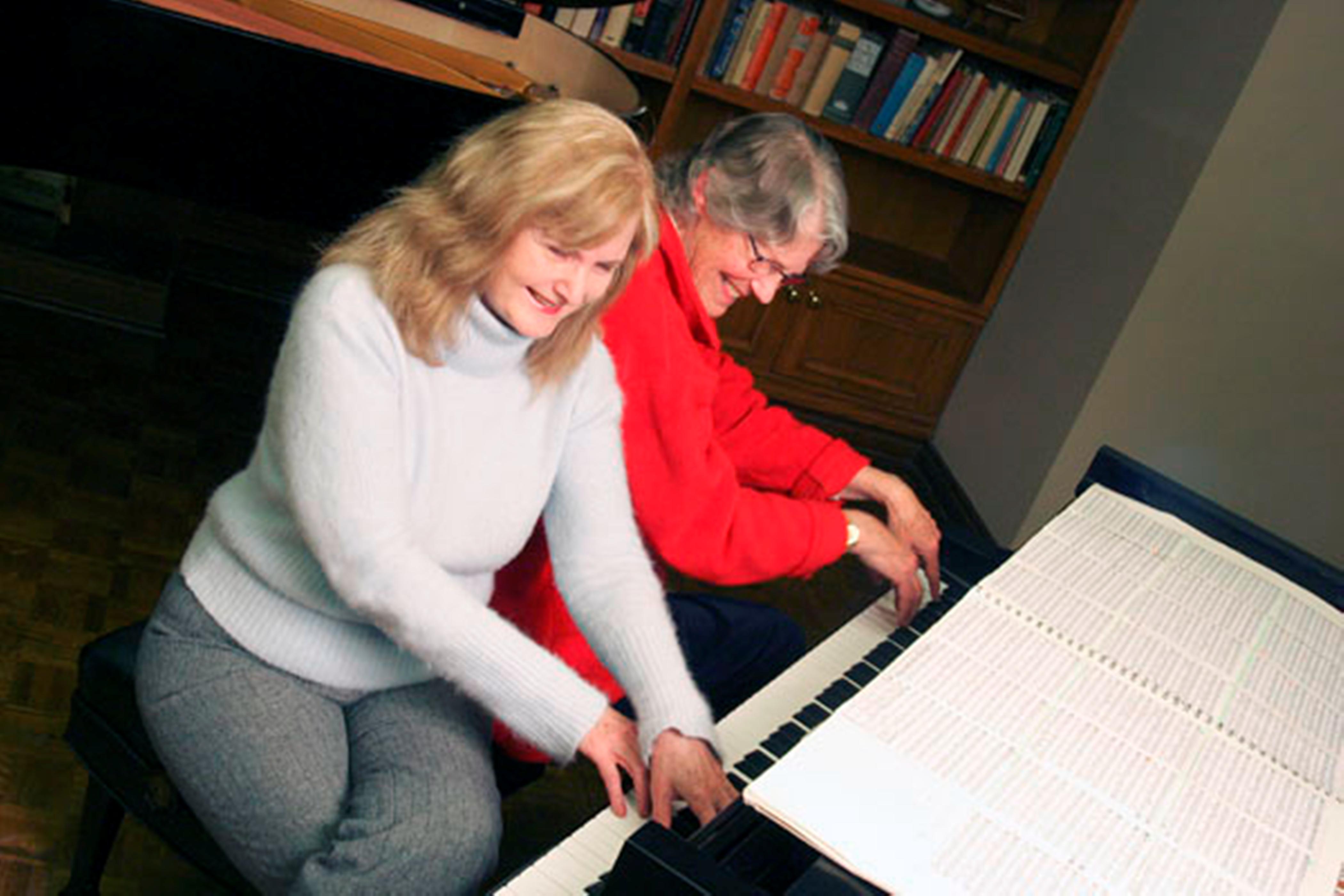
Christina Petrowska Quilico (left) and Ann Southam at the launch of the Rivers CD. Photo by André LeducFor the opening column of the new season, I thought I’d take a look at two new CDs being released by the prolific and virtuosic Canadian pianist Christina Petrowska Quilico. The first CD, Soundspinning, offers a series of older works composed by her friend and colleague, the late Ann Southam. It will be released on the Canadian Music Centre’s (CMC) Centrediscs label, with the official launch happening on September 25 at the CMC in Toronto. The second CD, Global Sirens, on the Fleur de Son/Naxos label, features the music of 15 different internationally-based composers and includes a total of 19 compositions, including two works by Canadians.

Southam: Petrowska Quilico is well known for her interpretations of Southam’s music, having already released seven CDs of Southam’s compositions including Glass Houses, Pond Life and Rivers, each one released as box sets. However, this recent CD is unique, as it consists of a number of rarely heard Southam works from 1963 to 1999. As Petrowska Quilico told me in our recent interview, Southam used to joke: “I love it when you root around in my old pieces and come up with something new.” When it came to choosing repertoire and creating an order for this new CD, Petrowska Quilico crafted it with careful attention to the flow of changes in mood and tempo between the works, quipping that in a sense she was creating a sonata in a very unorthodox way – a sonata whose contrasting movements were being fashioned from the different Southam compositions.

The album opens with Stitches in Time, composed in 1979 and revised in 1999. This work is comprised of two small collections of pieces: three pieces in Sonocycles and eight in Soundspinning. They are all short and fast pieces that reflect Southam’s love of nature, and are precursors to the larger Rivers and Glass Houses works. Petrowska Quilico spoke about how they were harder to play than they look, and have no indications regarding phrasing, dynamics or pedalling. Because of the 30-year working relationship she had enjoyed with Southam, this didn’t create a stumbling block for her. She approached them in a similar way to Rivers, accentuating hidden melodies and altering the tempos to create a more shimmering effect, making each one shine with its own unique characteristics. During their work together in preparing the Rivers CD, Southam had told her she trusted Petrowska Quilico’s musical judgment completely. And even though they are fast virtuosic pieces, they still require control, which Petrowska Quilico admits may seem like a bit of a contradiction.

She follows this intense, fast-flowing opening cycle of pieces with Slow Music (1979), a more meditative work composed using Southam’s signature 12-tone row, one that she used repeatedly for many of her pieces. One distinguishing feature of Southam’s approach to working with the serial technique was the freedom and openness she allowed herself, in comparison to the more strict approach used by composers such as Webern or Boulez. Altitude Lake is next, described by Petrowska Quilico as “massive” due to the presence of so many large chords that suggest images of immense landscapes and intense weather activity. It was written in 1963 at the same time as Southam began working in the electronic music studio at the University of Toronto. (As an aside: Southam also began teaching electroacoustic composition in 1966 at the Royal Conservatory of Music in a small studio in the sub-basement that she and composer John Mills-Cockell started up, offering drop-in classes for $10 each.) The score that Petrowska Quilico had of this early piece was handwritten and was so hard to read that she had to use a magnifying glass. Once she figured out the notes, she discovered how much she loved the piece, describing it as “a real treasure. It was written so early in such a different style, that you’d never realize it was her.”

The next few works are a series of Southam’s jazz-inflected pieces – Three in Blue (1965), Five Shades of Blue (1970) and Cool Blue; Red Hot (1980), all of which Petrowska Quilico selected due to her own love of playing jazz. The concluding work on the CD is Remembering Schubert from 1993 – a piece that also appears on the CBC album Glass Houses: The Music of Ann Southam, performed by pianist Eve Egoyan, who also enjoyed a special bond with the composer.

Petrowska Quilico spoke about how joyful and fluid Southam’s music is, and how the composer loved watching the light refracting on the water. She described playing Southam’s works as being similar to performing pieces by Chopin and Liszt, all of which require fast fingers. “If you don’t have good technique and are not in control, it will sound heavy, choppy and muddy. At the same time, you can’t think about the technique or all the notes you’re playing, otherwise you won’t be able to get through it. You have to think about the long line.”
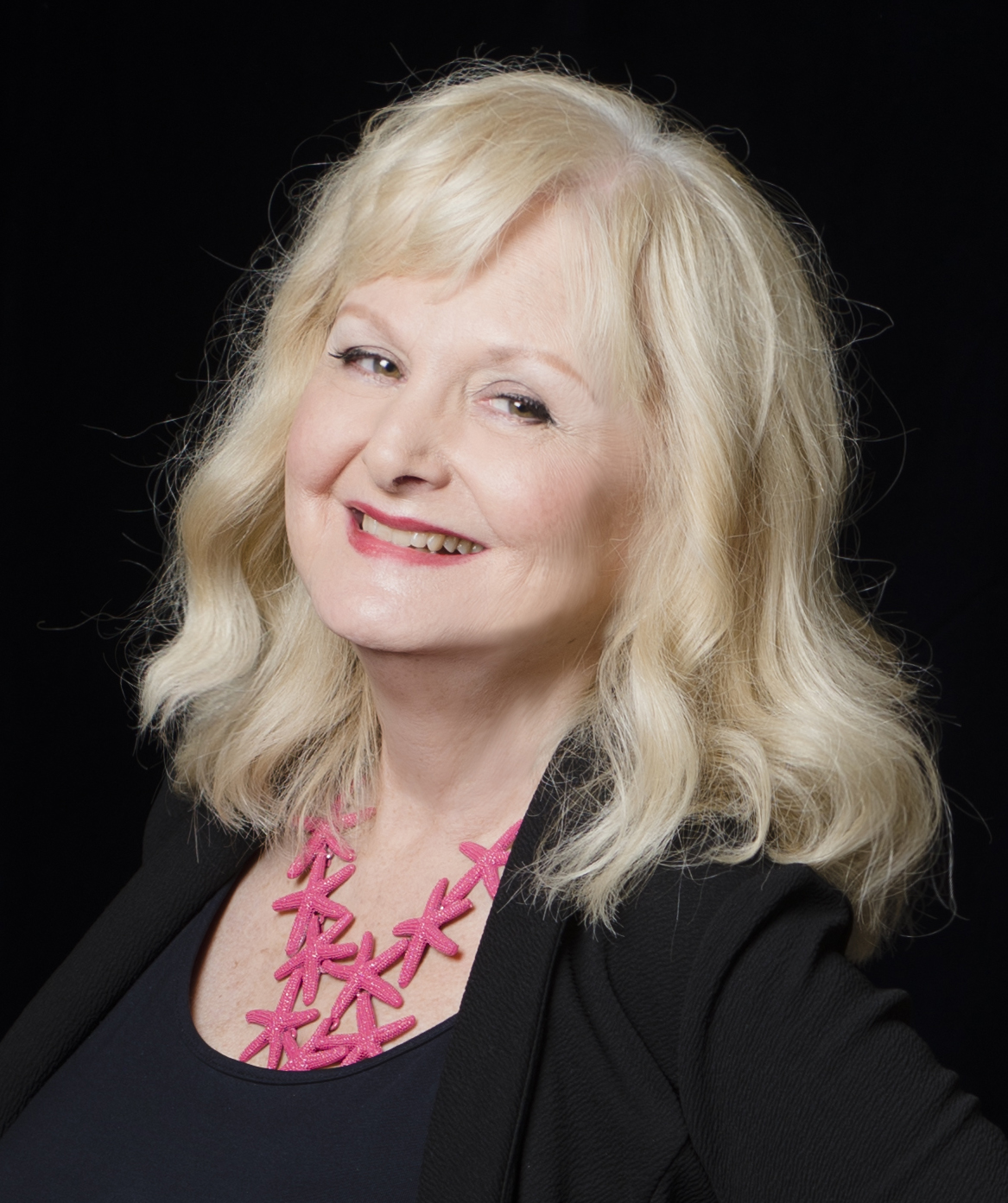
Christina Petrowska Quilico. Photo by Bo HuangGlobal Sirens: Petrowska Quilico has spent a good deal of her career promoting the music of women composers, and this love and commitment is reflected in her second CD coming out this fall – Global Sirens. Her desire with this CD is “to show the great wealth of women’s compositions. Not to denigrate men’s compositions, but we hear more of them than we do the women,” she said. Arising out of the research she’s undertaken for her York University Gender and Performance course, she has uncovered many lost compositions and composers, a selection of which are on the CD. Primarily these are works that span the 20th century, and include composers from numerous backgrounds. One such example is the opening piece Langsamer Waltz composed by Else Fromm-Michaels, whose compositions were banned during the Nazi period because her husband was Jewish. Other composers represented include Else Schmitz-Gohr and Barbara Heller, also from Germany, Ada Gentile (Italy), Priaulx Rainier (South Africa), Peggy Glanville-Hicks (Australia) and French composers Lili Boulanger and Germaine Tailleferre, who was one of Les Six along with Milhaud, Poulenc and others. The two Canadians represented are Larysa Kuzmenko and Sophie-Carmen Eckhardt-Gramatté. Petrowska Quilico has included four pieces by American composer Meredith Monk, whose music she loves, as well as Wireless Rag (1909) by Adaline Shepherd, a woman who was forced by her husband to give up composing, until she was able to resume her creative life after his death (an event which made her quite happy, Petrowska Quilico remarked). Shepherd had great success with her rag Pickles and Peppers, which sold over 200,000 copies in 1906 and was used as a theme song by William Jennings Bryan during his presidential campaign in 1908.

This little slice of Shepherd’s experience offers us just a glimpse at the hostile environment many women composers faced in the past. But what about now? I asked what she thought about the current climate for women music creators in Canada and Toronto. She began by recounting the story of performing Violet Archer’s Piano Concerto No.1 in 1982. At that time, an entry in an American encyclopedia had listed it as one of the major concertos written in Canada – it had been composed in 1956 – and despite this acknowledgement, the piece had only received one performance in 1958 under the baton of Victor Feldbrill with the CBC Symphony. This was something that was quite upsetting to Archer, and so Petrowska Quilico set out to perform it again and eventually released it as a recording. It’s now available on the Centrediscs album 3 Concerti, which also includes works by Alexina Louie and Larysa Kuzmenko. On the subject of gender parity in programming, Petrowska Quilico feels that music composed by women should definitely be played more often, and concerts should include a good balance of pieces by both genders, as well as older works along with newer ones. “Let’s make sure we don’t forget the women and Canadian composers of the past, and sprinkle them through the programs.” The problem, she stated, is that the emphasis is on premieres, and it is often a fight to get women’s music played more than once.

In looking at the overall scope of Petrowska Quilico’s prolific career, the question that comes to mind is how she manages to do it all. Her discography alone is extensive – 50 CDs with four JUNO nominations. Many of these recordings are from live performances – and even when in the recording studio, her preference is to record with only one or two takes. Regarding her technique, earlier in her career she undertook a process of slowly relearning everything, which was particularly important after suffering a broken wrist. She described how she approaches her touch on the keyboard as being like Zen meditation. “The fluidity comes from the fingertip – that’s where you have to focus your energy. All extra movements such as in the elbows take away from the energy you need to play a line. The body needs to be aligned, and you need to be both flexible and strong at the same time.” Another important aspect that she learned early on was the importance of maintaining the electrical current within the music itself, a current that begins with the first note and continues up until the last one. Keeping the energy moving requires focus on the melodic line. “No matter how many chords and notes, what is important is the melodic line.”

All the training, practice and inner focus come together for the performance – and these two new CDs will be a welcome addition to her ongoing contribution to Canadian musical life.

IN WITH THE NEW QUICK PICKS
Brodie West Quintet. Photo by Martin ReisSEP 8, 7:30PM: CMC Centrediscs, Bekah Simms’ impurity chains CD launch, Canadian Music Centre. In the spirit of celebrating new CDs by women creators, this launch marks the first recording of Simms’ music that abounds with the sounds of 21st-century chaos. Combining both acoustic and electroacoustic soundworlds, Simms weaves references to diverse traditions, from folk to concert.

SEP 12, 8PM: Guelph Jazz Festival. SUNG RA, Guelph Little Theatre. Rory Magill’s take on the legendary Sun Ra with his own Rakestar Arkestra combined with Christine Duncan and the Element Choir.

SEP 16, 8PM: Guelph Jazz Festival. Allison Cameron and Ben Grossman, Silence. These two eclectic composers join forces to perform improvisations on a wide array of instruments and objects, percussion, and electronics.

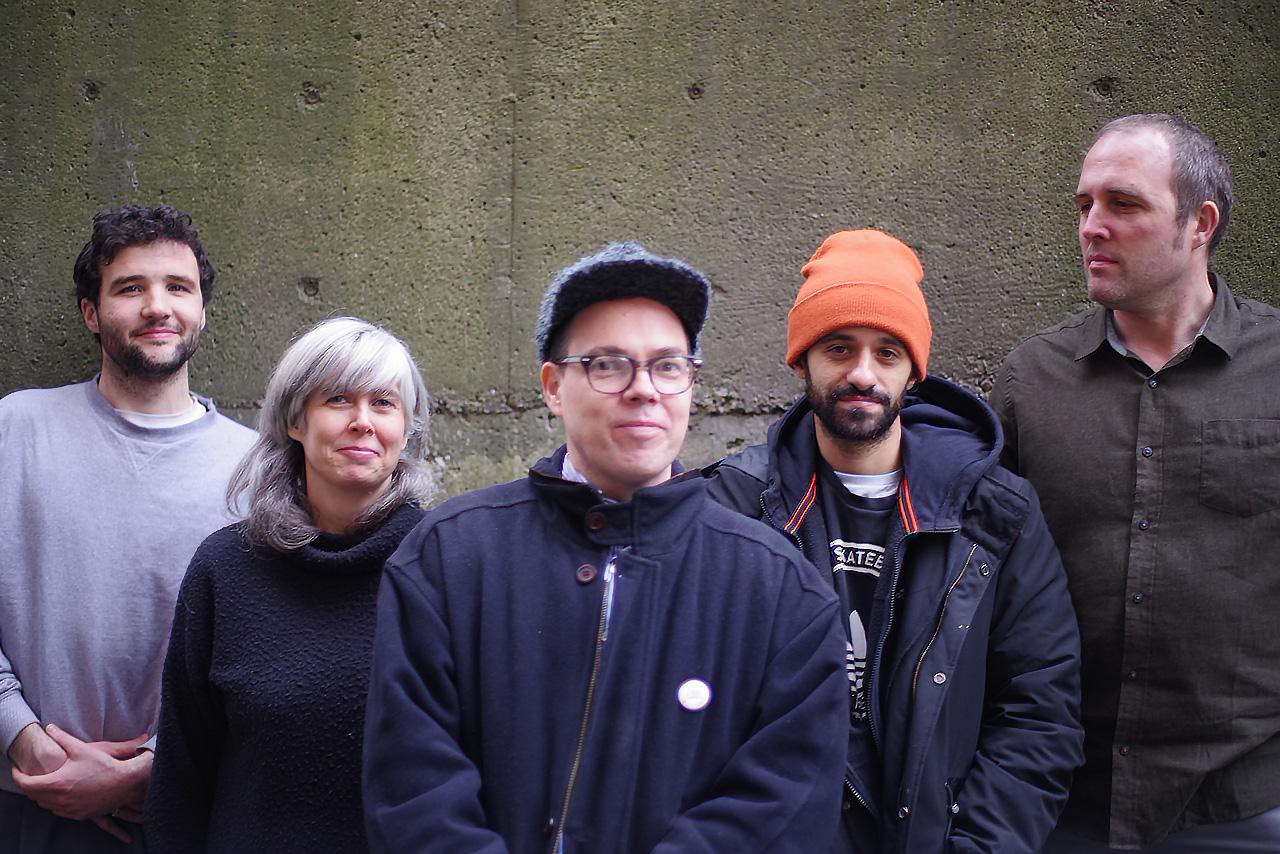
SEP 21, 6PM & 8PM: Music Gallery and Musicworks, The Brodie West Quintet “Clips” album release + Wow And Flutter. Join hosts Fahmid Nibesh and Joe Strutt for an interactive look-back at the 40-year legacy of Musicworks magazine & CD, to be followed by the music of the Brodie West Quintet for their Clips album release and the improvisations of the Wow & Flutter trio

SEP 27, 12PM: Canadian Opera Company, Awasaakwaa (Beyond, on the Other side of the Woods), Richard Bradshaw Amphitheatre. A solo recital by acclaimed Odawa First Nation composer and performer Barbara Croall, presenting her own compositions for voice and pipigwan (Anishinaabe cedar flute). Croall is currently preparing for a major performance piece about Saint Kateri Tekakwitha, a Mohawk woman who was made a saint. More details about that coming later this fall.

OCT 6, 8PM: New Music Concerts, Linda Bouchard’s Murderous Little World, Betty Oliphant Theatre. NMC begins its new season with this music and theatre performance work, directed by Keith Turnbull with texts by Anne Carson. Combining an electronic score with live performers who double as actors, this event promises an emotional experience full of artistic electricity and intellectual prowess.

Wendalyn Bartley is a Toronto-based composer and electro-vocal sound artist. sounddreaming@gmail.com

With the arrival of warmer weather, it’s time to dive into the world of summer music festivals. One that caught my attention this year is Festival of the Sound, located in the heart of vacation country, the town of Parry Sound. This year’s festival, which runs from July 20 to August 11, is offering two unique contemporary music events, both of which focus on themes related to cultural identity, history and place. I’ll be concluding the column with a summary of a few new music events happening this summer within the city of Toronto.

Ensemble Made in Canada (from left) Elissa Lee, Angela Park, Sharon Wei and Rachel Mercer - Photo by Bo HuangThe piano quartet Ensemble Made in Canada will be premiering their unique and ambitious Mosaïque Project at Festival of the Sound on July 26. The ensemble got their start in 2006 at the Banff Centre for the Arts, when Angela Park (piano) and Sharon Wei (viola) were inspired to begin a chamber music ensemble that would enable the two of them to play together – thus a piano quartet was formed rather than the usual choice for chamber ensembles, the string quartet. Additional members of the current quartet include Elissa Lee (violin) and Rachel Mercer (cello), and it was Lee who I had a conversation with about Mosaïque.

A few years ago, the quartet began brainstorming about future projects, and had the vision of travelling across the country by train. Not able to physically manage it – since until recently taking a cello on VIA Rail was not allowed – they came up with the idea of commissioning a piece of music that would do it for them.

The original idea was to commission 13 composers (one for each province and territory), but later this increased to 14 composers, who were then selected based on the quartet’s attraction to their individual compositional styles rather than on where they lived. After the composers were on board, the quartet then came up with a strategy to allocate a specific province/territory to each composer to serve as the initial starting point for their compositions. As things turned out, even though each composer was given free reign to find their own inspiration related to the assigned province/territory, a majority of them chose the theme of water as their point of departure. In our conversation, Lee remarked how nature is “so close to our hearts as Canadians,” so it’s no surprise that this would emerge as a common thread amongst the creators. Each of the pieces is four minutes in length, and in the premiere performance in Parry Sound, all 14 of these miniatures will be woven together. An extensive tour is planned across the country after the premiere, with dates and locations scheduled into the fall of 2019 and a changing set list of Mosaïque selections for each show. Audiences in Toronto will be able to hear the complete set of 14 works on November 15, as part of Music Toronto’s concert season and their full touring schedule is available on their website.

One of the distinctive features of this project is a visually based component that will engage the audience. During the concert, audience members will have the opportunity to doodle or draw while listening. Lee explained that many audience members only want to experience familiar music and are more skeptical of contemporary pieces. Based on Lee’s own practice of doodling while talking on the phone, she had the inspiration that if people were doing something more unconscious like doodling, “they could abstract the music and be less apt to judge it. By engaging in a drawing experience, people are able to tap into their own creativity and draw something based on what they’re hearing to inspire them. It opens up a different approach to how you digest the music and is much more friendly. People may find themselves hearing something in the music they would otherwise miss,” Lee said. The other goal of the visual element is to concretely capture how the music is inspiring the audiences. “Canada is inspiring the composers, the composers are inspiring the ensemble, and since the concert is travelling throughout the country, the music is inspiring a nation-wide audience. We can capture what is being created and put it on our website, creating a visual mosaic as another layer to how we celebrate and represent our country.” Through the Mosaïque Project, Canada’s diversity and richness are celebrated not only through the music, but also through the eyes and ears of its people.

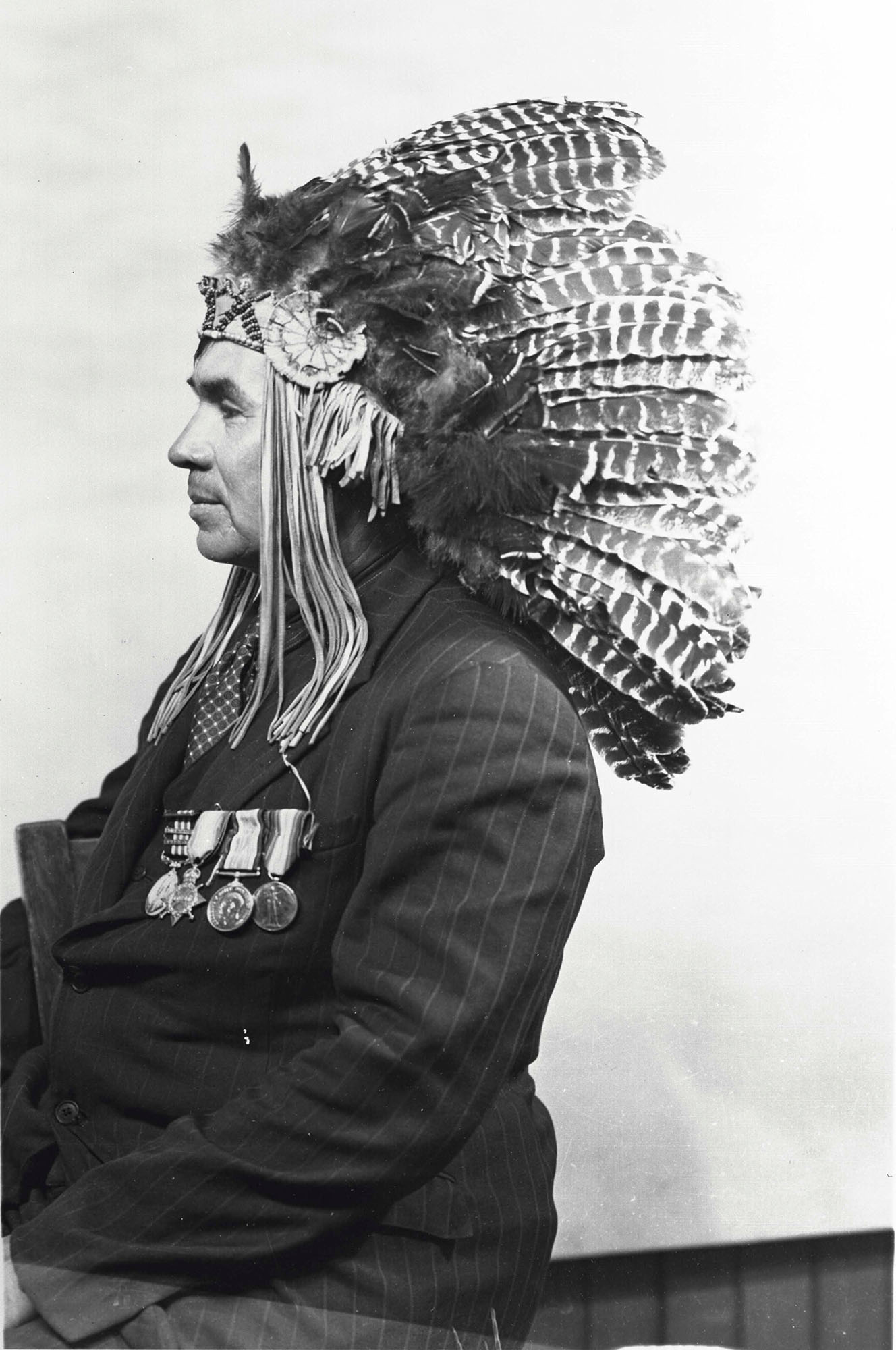
Francis Pegahmagabow (1945)Sounding Thunder

The second contemporary music event at the Festival of the Sound is the world premiere of Sounding Thunder: The Song of Francis Pegahmagabow, composed by Timothy Corlis and written by Ojibwe poet Armand Garnet Ruffo. Corlis explained that the work is not an opera, but rather a story that includes a narrator, a chamber ensemble of instrumentalists, three Ojibwe singers and an actor who plays Pegahmagabow. Performing this role is Brian McInnes, the great grandson of Pegahmagabow and writer of an extensive biography of his great grandfather. Other direct descendants have acted as advisors for the project. Pegahmagabow was born in 1889 on the Parry Island Indian Reserve (now the Wasauksing First Nation), an Ojibwe community near Parry Sound, Ontario. He was considered the most effective sniper of World War I and was decorated with various military medals. The writer Armand Ruffo took great pains to reference real events in the script, Corlis told me, using either things commonly talked about in the family or documentation from books.

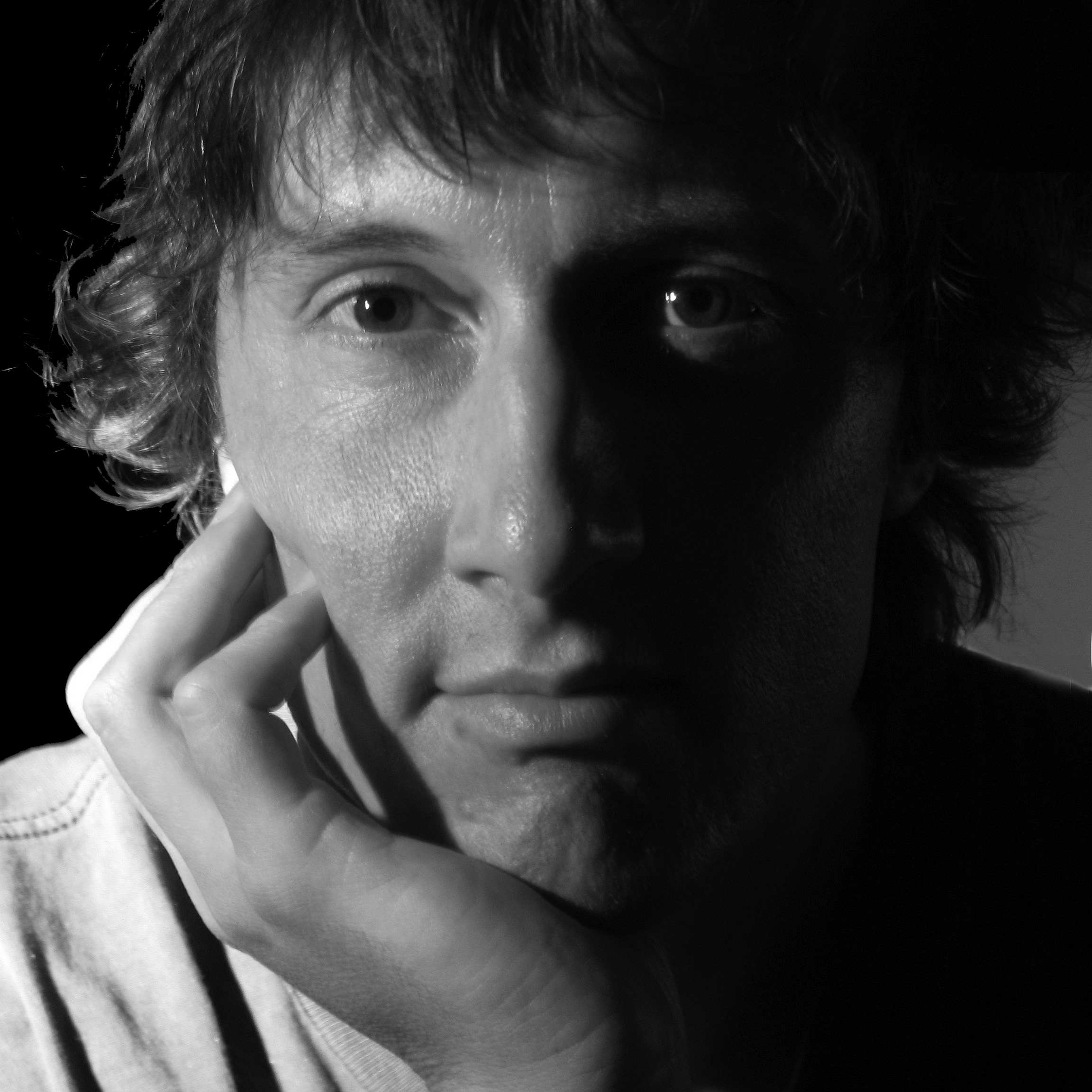
Timothy CorlisThe instrumentation of the music was designed to be a copy of what is used in L’Histoire du Soldat, Igor Stravinsky’s piece about World War I. Corlis’ vision is that for future performances, excerpts of Stravinsky’s work will be performed on the same program, thus presenting different viewpoints of this cataclysmic world event. Sounding Thunder is divided into three acts, with the first focusing on Pegahmagabow’s childhood and formational spiritual experiences, including an encounter with the spirit of his clan – the Caribou. In the music, Corlis has created a Caribou motive using interlocking patterns invoking the sounds of a large herd. One of the singers will portray the spirit of the Caribou throughout the work, which opens with Pegahmagabow acknowledging the four directions while vocables are sung. At another point, the instruments foreshadow the war with rippling gunshot sounds on the drum. Act Two takes us to the battlefield in Europe and musically, the score has many references to European music and its harmonic traditions. Corlis said that the music even sounds a bit like Bach’s St. Matthew Passion, yet there is another unmistakable component – the presence of the drum, which is played with great force underneath the European-based music. This was one way Corlis brought together references to both cultures, as the drum is a significant element in Ojibwe culture and customarily resides in the home of its owner.

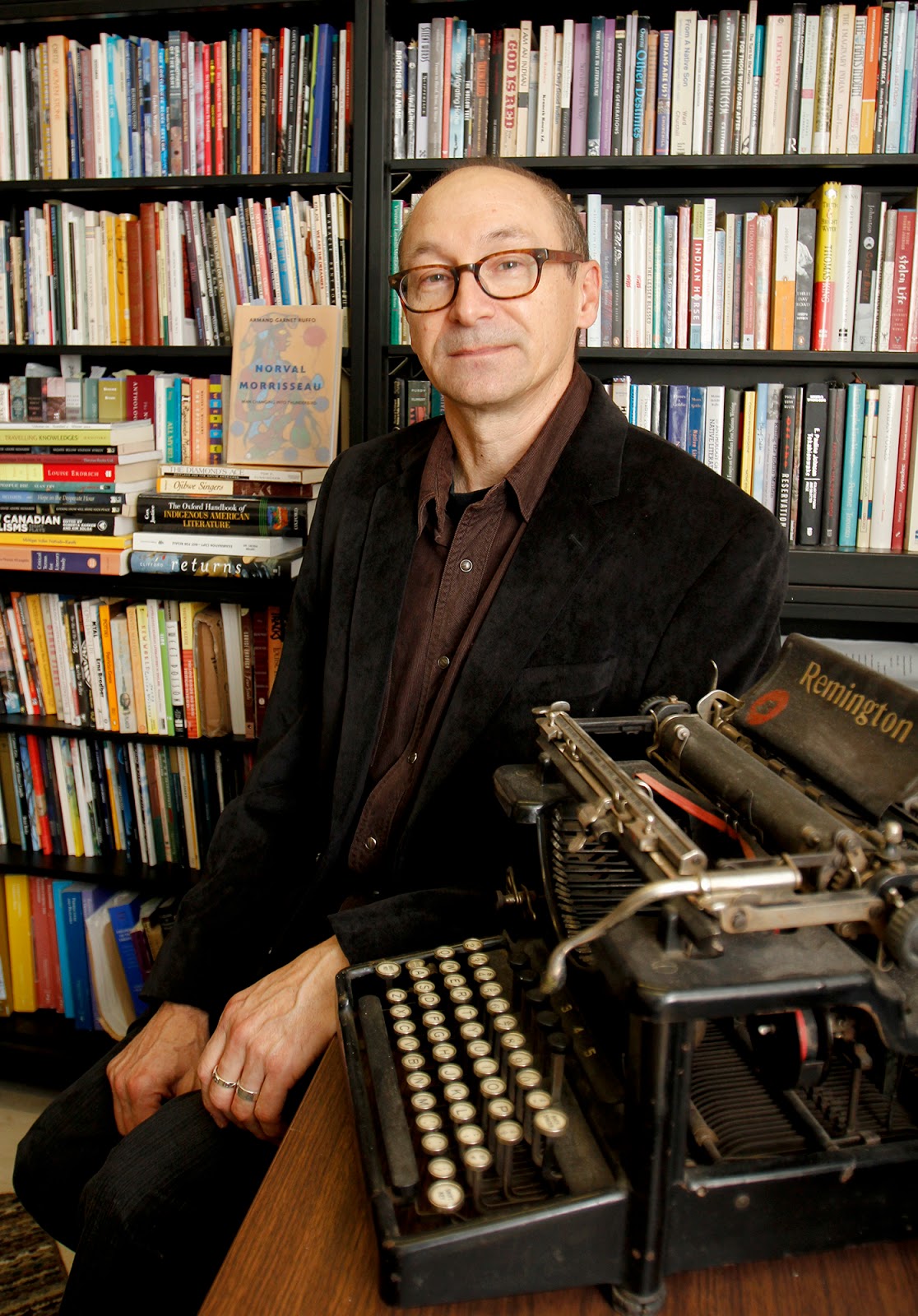
Armand Garnet Ruffo in his office at Queens University CREDIT Julia McKayAct Three focuses on Pegahmagabow’s life after returning to his home after the war. Despite his many accomplishments on the battlefield and his ability to gain loyalty and trust in his role as an army sergeant, when back on the reserve, he had to once again face the systemic racism towards First Nations people. Much of the third act portrays his struggles with the Indian agent, fighting for the rights to receive his military pension and for all Indigenous people to have access to legal advice. Writer Armand Ruffo is a strong activist for Indigenous rights, and this is very evident in the script. The work ends with Pegahmagabow’s death, with the instrumentalists surrounding him onstage while playing gentle light trill motives to represent the ascension of his spirit, with the finale being the performance of a traditional Ojibwe song.

City Summertime Listening

Somewhere There: On June 10, at Array Space, Somewhere There will present the first screening of Sound Seed: Tribute to Pauline Oliveros, a performance by Vancouver-based integrated media artist Victoria Gibson. The piece draws on Gibson’s 2009 encounter with composer Pauline Oliveros and members of the Deep Listening Band, who invited her to document their 20th anniversary that took place in the underground cistern in Fort Worden, Washington with its spectacular 45-second reverberation. This was the site of the groundbreaking 1989 recording Deep Listening, which launched both the term and concepts of Deep Listening, Oliveros’ signature work which invites us to engage with and contribute to the sonic environment from a place of inner focus and awareness. The concert includes a launch of the DVD along with two sets of music. Vocalist/composer Laura Swankey opens the evening, with the closing set featuring Gibson performing with Heather Saumer (trombone) and Bob Vespaziani (electronic percussion), a version of Gibson’s variable-member project, Play the Moment Collective.

Contact Contemporary Music: A unique concert on June 14 co-presented by ContaQt and Buddies in Bad Times Theatre, “Many Faces: We Are All Marilyns,” will explore the themes of vulnerability, strength and defiance, topics that are particularly relevant in light of recent issues of violence within Toronto’s queer community. Music by Eve Beglarian, Amnon Wolman and John Oswald will be performed, along with choreography by Laurence Lemieux. Fast forwarding to the Labour Day weekend, Contact’s annual multi-day festival INTERSECTION takes place from August 31 to September 4, and is a co-presentation with Burn Down the Capital. This year’s event offers an extensive lineup of musicians, with their opening concert featuring NYC-based experimental metal guitarist and composer Mick Barr, the Thin Edge New Music Collective, and heavy metal band Droid. The day-long event on September 2 will take place as usual at Yonge- Dundas Square, with music performed in the midst of an intense urban scene. By contrast, the final concert will take place at Allan Gardens, with another opportunity to hear Laura Swankey, amongst others.

Luminato: An exciting new work which combines sound, image and an unspoken narrative, Solo for Duet: works for augmented piano and images, will be performed by pianist Eve Egoyan on June 19 and 20. I refer you to my April column, which features a more detailed description of this work, along with a look at Egoyan’s performances of long-duration works. On June 24, Icelandic composer and musician Ólafur Arnalds premieres his new work All Strings Attached, featuring a wired ensemble of string quartet and percussion, with Ólafur performing on an array of pianos and synthesizers. A highlight of this work will be Ólafur’s use of intricate algorithm software, which he designed to control two self-playing pianos acting as one.

Wendalyn Bartley is a Toronto-based composer and electro-vocal sound artist. sounddreaming@gmail.com.

Keeping apace of new music events in the city is like a never-ending discovery of new ideas, initiatives and opportunities to expand one’s horizons on both the local and international scenes. The Royal Conservatory’s annual 21C Music Festival, running from May 23 to 27, provides an opportunity to experience all this within a five-day span, with eight concerts and 37 premieres. The Kronos Quartet, along with composer and multi-instrumental performer Jherek Bischoff, will open the festival, followed by concerts featuring a number of different international and national pianists, including Anthony de Mare with his special project Liaisons: Re-Imagining Sondheim From the Piano, Sri Lankan-Canadian composer and pianist Dinuk Wijeratne performing with Syrian composer and clarinetist Kinan Azmeh, and the French sibling pianists Katia and Marielle Labèque.

As is customary for 21C, one of their concerts is a co-presentation with an established Toronto new music presenter – in this case, New Music Concerts, who will bring a Claude Vivier-inspired program to Mazzoleni Hall on May 27. This year, however, a second co-presentation also caught my eye: Grammy Award-winning vocal ensemble Vox Clamantis with Maarja Nuut & HH, presented on May 26 in collaboration with Estonian Music Week, running concurrently in the city from May 24 to 29.

The Estonian Music Week co-presentation is one of two concerts at 21C that combine music by contemporary composers with music of the past – thus creating a blurring of time, as it were. Vox Clamantis will offer both Gregorian chant music alongside contemporary works by primarily Estonian composers – while in another 21C show on May 25, pianist Simone Dinnerstein and the A Far Cry chamber orchestra will combine two works by J.S. Bach and two by Philip Glass.

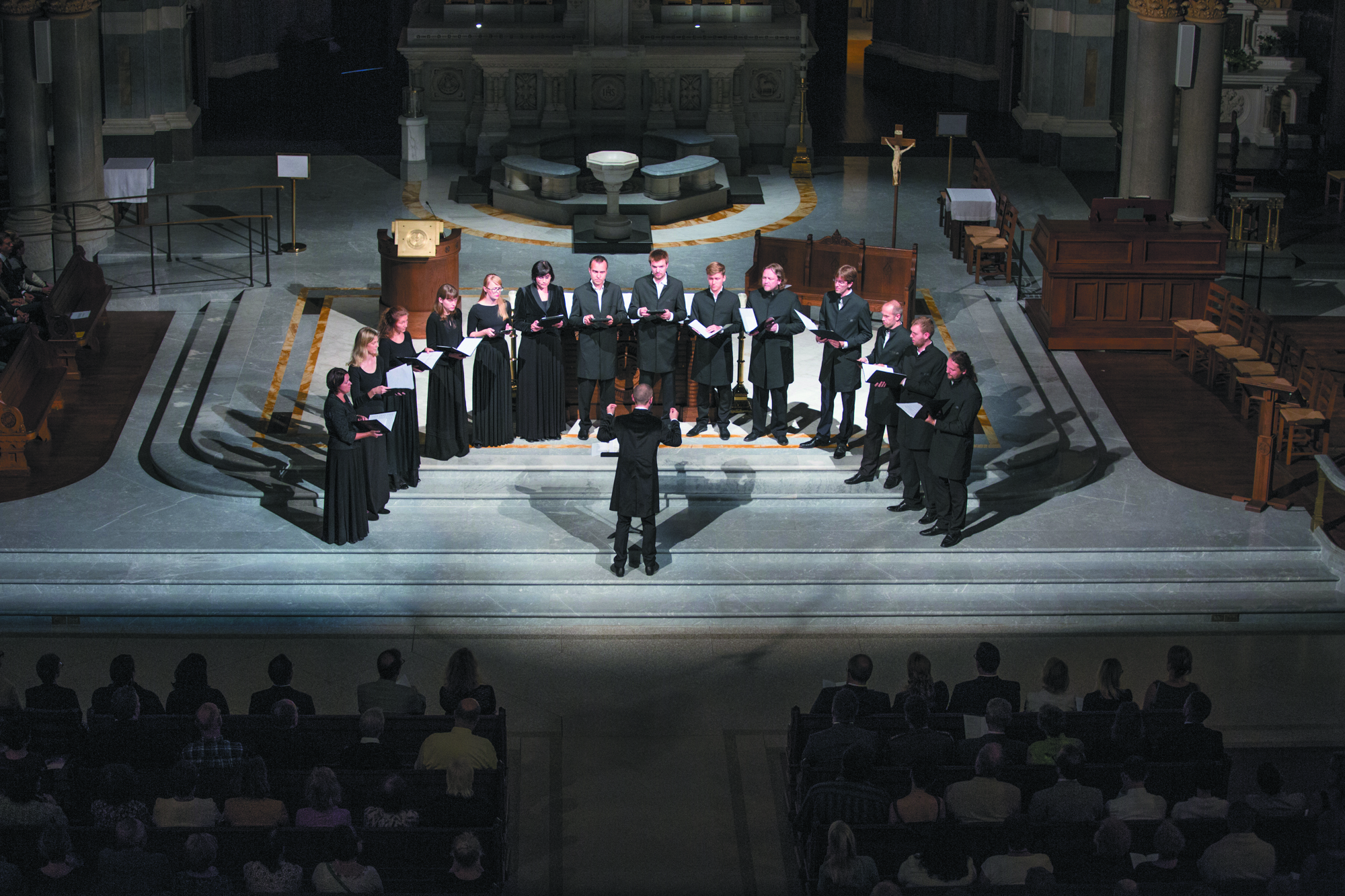
Vox ClamantisVox Clamantis

I had an opportunity to speak with Jaan-Eik Tulve, the conductor of Vox Clamantis, about the ensemble, the connections between Gregorian chant and contemporary music, and the legendary singing tradition in Estonia. Vox Clamantis was formed 20 years ago by Tulve as a way to continue singing the Gregorian chant he had studied in Paris in the 1990s. However, it quickly expanded into an ensemble that embraced the music of contemporary Estonian composers, who were keen to write music for them. One of the key reasons for this desire to compose for Vox Clamantis, Tulve told me, “was because they found that our musicality, phrasing and voices are different from classical singers. Even though Gregorian chant is the basis for classical music, the differences are that it is unmetered and monophonic music, so you must pay close attention to phrasing and listening to each other.”

Jaan Eik Tulve. Photo by Bartos BabinskliOne of the composers the ensemble has a very close working relationship with is the esteemed Estonian composer Arvo Pärt. Back in 1980, Pärt was forced to leave Estonia, which was part of the USSR at the time, in order to have his creative freedom. He lived in Berlin for 30 years, only returning to Estonia in the late 1990s after the country regained its independence. A strong relationship between Pärt and Vox Clamantis was quickly established, strengthened by the fact that Pärt had studied Gregorian chant when he was young. “We found a lot of similarities in our musical expressions and understandings of music, and little by little we sang more and more music that he wrote for us. He also often comes to us with new compositions while he is working on them so he can hear what they sound like,” Tulve said. The program at the 21C Festival will include five pieces by Pärt, all of which are on The Deer’s Cry CD, an album fully dedicated to performances of Pärt’s music by Vox Clamantis. As well, one of the repertoire programs that the ensemble regularly performs is comprised of a mixture of Pärt’s music with Gregorian music, a program designed by both Tulve and Pärt.

Other contemporary composers whose works will be on Vox Clamantis’ 21C program include the music of Helena Tulve, Jaan-Eik’s wife, who also studied Gregorian chant along with contemporary composition. “It’s a very short but concentrated monophonic piece which is quite different from most of her other instrumental compositions,” Tulve said. It will be paired with Ave Maria by Tõnis Kaumann, who is also a singer in the ensemble. And finally, a work by American composer David Lang will round out the concert, demonstrating Lang’s ability to write in a wide range of styles. When I asked Tulve about the connection between the ensemble and Lang’s musical language, he remarked that Lang’s music “was perfect for our ensemble as it is quite close to our musicality. It’s minimalist music, and we find minimalism in Pärt’s music, Gregorian chant and Lang’s music. Minimalism is the one common point.”

I concluded my conversation with Tulve by asking him to speak about the relationship between singing and the Estonian national identity. In what’s known as the Estonian Age of Awakening, which began in the 1850s and ended in 1918 with the declaration of the Republic of Estonia, the Estonian Song Festival was established in 1869. It is one of the largest amateur choral events in the world, held every five years, bringing together around 30,000 singers to perform the same repertoire for an audience of up to 80,000. “This festival was very important during the Soviet occupation” Tulve told me, “and helped Estonians survive this period by strengthening their own national identity. To preserve this strong link between singing and the Estonian identity, every child learns to sing in choirs at school, and the singing is at a very high level throughout the country with many good amateur choirs.”

Two other Estonian performers will also take to the stage that same evening – Maarja Nuut, performing on vocals, violin and electronics, along with Hendrik Kaljujärv on electronics. For the evening finale, the choir and these two young experimental performers will come together with a work performed by Vox Clamantis with improvisations by Nuut and Kaljujärv.

Simone Dinnerstein with A Far Cry

One of the pianists the 21C Festival is programming is Brooklyn-based Simone Dinnerstein, who burst onto the international scene with her self-produced recording of Bach’s Goldberg Variations in 2007. Since that time, she has performed internationally, with repertoire spanning from Baroque to select 21st-century works especially composed for her. Recently, she entered into a creative collaboration with composer Philip Glass, whose Piano Concerto No. 3 for piano and strings will receive its Canadian premiere at 21C along with pieces by J.S. Bach and Glass’ Symphony No.3. The concerto was a co-commission from a consortium of 12 orchestras; it was premiered in Boston in 2017 with string orchestra A Far Cry.

Simone Dinnerstein. Photo by Lisa Marie MazzuccoIn my recent phone interview with her, Dinnerstein spoke about how this came about. The idea arose in 2014 when both artists discovered that they had a mutual interest in the music of Bach. Glass was interested in writing a work for her and Dinnerstein proposed that it be a concerto for piano and string orchestra. “I thought it would be interesting if the performance of the piece was paired with a Bach concerto,” she said. “All of Bach’s keyboard concertos are for keyboard and string orchestra, and there haven’t been many pieces written for that combination since Bach’s time. Glass liked the idea and from there, along with A Far Cry, we all decided it would be interesting to create a whole program with music by Bach and Glass.” At the May 25 concert, the first half includes Glass’ Symphony No. 3 followed by Bach’s Keyboard Concerto in G Minor BWV1058, and in the second half, Bach’s Orchestral Suite No. 2 in B Minor will be followed by Glass’ new Piano Concerto. And just in time for the festival, the two keyboard concertos on the program will be available on a CD titled Circles.

Glass’ concerto is written in three movements, with some parts more flowing and others quite dynamic. Dinnerstein said that in the second movement, some parts remind her of rock music in terms of sonority and rhythm. “At times the orchestra almost sounds like one of those 1970s synthesizers and it’s a really amazing sound. The third movement is definitely what I call transcendental music.”

In a an accidental but striking instance of synchronicity between 21C and Estonian Music Week, this third movement is dedicated to Arvo Pärt. “I can see why he dedicated it to Pärt,” Dinnerstein commented, “because there is a stillness to it that is present in a lot of Pärt’s music. But to me, it still sounds very much like Philip Glass. It’s a very slow-paced movement and is extremely difficult to rehearse because you need to be an active listener all the time. Everybody in the orchestra and the pianist have to be really aware of each other and of the music moment by moment, which takes a great deal of focus. I’ve now played this with a number of orchestras and one of the things that is wonderful about playing it with A Far Cry is they are an ensemble that really spends a lot of time listening to each other since they have no conductor. It’s part of their artistic personality to be able to respond to each other in a very instantaneous way, so we’ve tried different things with that movement. I might suddenly change something I’m doing and they have to respond to it without having a plan, so it’s much more improvisatory. That kind of thing is very hard to do with a larger orchestra and a conductor, but with them, it’s really possible.”

Dinnerstein went on to describe the commonalities between the music of Glass and Bach. “Both of their writing deals a lot with sequences of patterns and they have a common interest in the larger architecture of a piece. As well, they have written relatively very little regarding the interpretation of a performance. Their use of tempo, articulation and dynamic markings is quite bare, so that leaves a great deal up to the interpreter to try and delve into the music and see what the music is saying to them. I love that about those composers. As a result, when you hear different people play their music, it can sound wildly different.”

As for commonalities between Baroque and contemporary music, Dinnerstein commented: “I’ve always thought there’s a stronger connection there than between Romantic music and contemporary music. There’s a kind of abstraction to both Baroque and contemporary, and if you listen to Chopin for example, it feels very much of its time. You’re very aware of Chopin the artist. With Bach and Glass, the expression is less tied to the composers themselves – I don’t feel a sense of them as people. Rather, I feel that whoever is playing their music can bring out something quite different. The personality of the composer feels less dominant and there is a wider spectrum that lies within the music itself.”

What is striking about both these concerts I’ve highlighted here is the way contemporary music is linked with the sensibilities of both medieval Gregorian chant and Baroque music. It will definitely make for some fascinating listening – and an opportunity to experience music in all its timelessness. 

Wendalyn Bartley is a Toronto-based composer and electro-vocal sound artist. sounddreaming@gmail.com.

Bekah Simms - photo by Bo HuangOne of the inspiring things about the new music scene in Toronto is the plenitude of presenter organizations and collectives that are constantly springing up, each one with their own unique vision and mandate. One of the newer players in this trend is the Caution Tape Sound Collective, formed in the summer of 2015 by composers Bekah Simms and August Murphy-King. On March 24 in Array Space, Caution Tape will present “Spark to Stone” in collaboration with the Association of Canadian Women Composers (ACWC).

The concert features the work of seven Canadian composers, including five world premieres and two Toronto premieres. I invited Bekah Simms to have a conversation about the concert, the collective and her own compositional work.

Caution Tape has a unique combination of elements in their artistic mandate. One focus is on repertoire development for both underused combinations of instruments and instruments that don’t have a lot of solo works. Another strong aspect of their vision is the incorporation of electronics and influences from sound art and drone music into the repertoire they support. As Simms pointed out: “Toronto doesn’t have much concert activity of electroacoustic music, unlike Montreal for example, so Caution Tape seeks to make the technology more available for younger composers, as well as offering mentoring and pedagogical support for those who wish to combine the worlds of sound art and concert music.”

The core membership of the collective is made up of Simms, Murphy-King, Julia Mermelstein and Patrick Arteaga. They also support a rotational membership, since bringing in new voices is important. There is no core performer ensemble, but they generally draw from the same pool of people interested in new and experimental music, with the key goal being to experiment with creating unusual instrumental combinations. An example of this was an ensemble used in their last season that was made up of bassoon/contrabassoon, synthesizer, piano, percussion and viola. “It sounded really great,” Simms commented. And not least, they are committed to representational programming. Simms explains: “If you are working with living composers in a city like Toronto, the demographics of your concert programming should roughly represent the demographic of your city. This includes gender, race, experience, age, emerging and early career.”

Their upcoming March 24 concert is one example of their focus on representational programming as they join forces with the ACWC, which was formed in September of 1981 with the aim of addressing the lack of women composers being programmed in the Canadian music scene. The Caution Tape/ACWC collaboration is a natural one: Simms has served on the board of the ACWC, and together they put out a call for works – both existing as well as proposals for new pieces. As a result of this call, the Spark to Stone concert will include works by composers Amy Brandon, Sarah Reid, Ivana Jokic, Hope Lee and Lesley Hinger, along with Caution Tape core members Simms and Mermelstein.

Mermelstein’s work is an acousmatic piece, a form of electroacoustic music that is specifically created as a listening experience using only speakers, as opposed to a live instrumental performance. She has used the mundane and background sounds of everyday life and through various forms of digital processing brought this world to the forefront of an intriguing listening experience. Brandon’s work uses a soundscape created from unique piano preparations – nylon fishing wire attached to the wall and woven into the lower strings of the piano. Jokic’s piece uses the concept of the palindrome, a sequence of events that reads the same backward as forward. There is an allusion to matryoshka dolls, the Russian nesting dolls, as the snaking palindromes weave their way throughout the ensemble. Reid, a trumpet player who is both an improviser and composer, created a piece for prepared piano, cello, and amplified objects performed by a percussionist. This includes the playing of the grain of a piece of wood that has been covered with contact mics, a pair of vampire-like chattering teeth and a cassette player. Lee’s work …I, Laika…, composed in 1996, will finally receive its Toronto premiere. A 20-minute work for flute, cello and piano, the piece is based on the idea of doomed flight, referencing Laika, the first dog launched in space by the Russians, as well as the loss of Lee’s father who went missing in a military plane in China.

Hinger’s participation is an example of the value of putting out a call and connecting with unfamiliar voices. Once the jury for the concert heard her music, they unanimously agreed that her work must be selected. Hinger’s piece for solo violin is informed by her current studies in spectralism and focuses on slow microtonal unravelling over time.

The concert will also present the world premiere of Simms’ piece Granitic, a word she was initially exposed to a few years ago when used by her composition professor to describe one of her compositions. Surprised by this unfamiliar word which means “unyielding firmness and aversion to soft emotions,” she decided it resonated with her and wanted to explore more of what was stylistically emerging for her. Granitic is her Toronto Emerging Composer Award-winning composition, and is scored for a large ensemble including electric guitar, electric bass, percussion, synthesizer, violin, viola, cello, clarinet, trumpet and flute. In this piece she explores the world of just intonation, a tuning system based on pure or just intervals between the notes of the scale, rather than the standard equal temperament system that uses the same or equal distance between intervals. For the performers, this means playing in microtones, something that is difficult and challenging to do when playing on instruments designed for equal temperament. Simms described her emerging style as “event and sound based. I don’t map out harmonies or melodies, but rather focus on timbre, colour and the unravelling of initial ideas. I’ve become interested in distortion, quotation and using degraded allusions to other styles of music, using noise-based techniques on instruments and transitions from noise to sound. Electronics also help to obscure the original source material.”

As for future directions, what drives her is to integrate more complex and intricate technologies into her music. In a recent mentorship with Montreal acousmatic composer Martin Bédard, she was able to learn a variety of electroacoustic techniques, and had an opportunity to work with live diffusion, the process of moving the sound amongst a multi-speaker system. The next step for Simms will be to work in partnership with a programmer to create an intuitive interface to perform live processing of instrumental sounds. The composition she is creating will be scored for solo cello, electronics and orchestra, and is scheduled to be performed by Esprit Orchestra in February 2019 during their New Wave Festival. Having a skilled electronics performer working alongside her is her ideal situation, for it allows her to focus on composing the electronic component, which can then be realized externally by an expert.

Representational Programming

As mentioned above, Caution Tape is committed to representational programming. One reason for this is that “we found the local programming disappointing” Simms acknowledges. As an example, she mentions the upcoming 21C Music Festival that promotes itself as bringing forward fresh new sounds and ideas. Looking at this year’s press release, of almost three dozen premieres being programmed (which includes both world, Canadian, Ontario and Toronto premieres), there is only one work by a woman composer. (I noted in my February column a similar thing occurring in this years New Creations Festival happening from March 3 to 10, with only one composition by a woman being programmed, despite last year’s festival having highlighted diversity.)

Simms notes the tendency for presenters to be satisfied with having had one successful experience and then to stop thinking about it. “You have to be actively questioning your programming every step of the way. It’s so easy to find good and interesting work by women that if you’re not programming it, you’re just being lazy.” She mentioned a 1990s article in the Toronto Star that noted the lack of programming of works by women amongst the new music organizations – and that was 25 years ago!

Caution Tape attempts to “be steadfast about our programming. If one concert ends up being a 70/30 mix between male and female composers, we shuffle things around in the overall season to get closer to 50/50.” She noted that it’s easier for chamber music groups to have more diverse programming, and that many local groups regularly program music by women on every concert. “The problem is with the larger ensembles, that’s where the numbers are the worst. You hope that your efforts in the chamber music realm will bleed into the larger sphere of orchestral music,” Simms says, mentioning as an example, that the rising star of orchestral composition globally is Icelandic composer Anna Thorvaldsdottir who was chosen in 2015 as the New York Philharmonic’s Kravis Emerging Composer. The Philharmonic will give the world premiere of Thorvaldsdottir’s latest commissioned work, Metacosmos, on April 4 to 6.

(Coincidentally, during the writing of this column, I received a press release regarding the Chicago Sinfonietta’s concert on March 11 celebrating women composers. This orchestra is dedicated to modelling and promoting diversity, inclusion and racial and cultural equity in the arts. In light of these initiatives, it feels like Toronto is lagging behind; all the more reason why the Caution Tape Sound Collective is a much-needed voice in the city.

Vivian Fung

An important footnote to this conversation about orchestral programming: I would be remiss not to mention two upcoming orchestral performances of works by composer Vivian Fung. On March 24, the National Arts Centre Orchestra will give the Toronto premiere of her newly commissioned piece Earworms, and on March 3, Fung’s 2011 piece Dust Devils will be performed by the TSO as part of the New Creations Festival. 

Wendalyn Bartley is a Toronto-based composer and electro-vocal sound artist. sounddreaming@gmail.com.

The year 2017 was one in which women broke barriers in speaking up against abuse, particularly within the powerful corridors of the entertainment industry, political institutions and the media. Time magazine honoured this historical breakthrough by naming their Person of the Year for these women who dared to speak up, calling them “The Silence Breakers.”

Yoko Ono Revisited

In the autumn of 1961, Yoko Ono created her Voice Piece for Soprano, a conceptual score with instructions to “Scream
1. against the wind; 2. against the wall; 3. against the sky.” In the late 50s, Ono was part of a constellation of creative people connected to composer John Cage, and began experimenting with what she called “instruction works,” meaning “paintings to be constructed in your head.” Her Voice Piece for Soprano was one of these works, and was published a few years later in 1964 as part of her book Grapefruit. She speaks of this work as giving her an opportunity to express her rebelliousness as a woman and the need to scream against certain situations in life. She also saw it as an act of resistance, stating in a 2015 interview connected to a performance of her Voice Piece, that if women don’t express their emotions, they can become ill.

This coming February 23, in a co-presentation between the Music Gallery and the Gardiner Museum, Ono’s Voice Piece for Soprano will be explored by three local artists who have been invited to respond to Ono’s instructions for screaming. These performers include Lillian Allen, a pioneering voice of dub poetry in Canada; the Element Choir, an improvising choir directed by Christine Duncan; and Mamalia, the former lead singer of the JUNO-nominated contemporary jazz troupe Sekoya. The concert, titled “Voice Pieces,” is being held as a companion event for the Gardiner Museum’s exhibition Yoko Ono: THE RIVERBED, running from February 23 to June 3.

Ono’s resistance piece remains as timely now as when first created, since the need for women to speak out with force against how they have been treated within patriarchal institutions has reached a tipping point. However, I’m certain that Ms. Ono would not concur with the descriptive phrase used in the Music Gallery’s press release, describing this voice as the “out of control female voice pushed to its supposed limits,” nor with using the word “hysterical” to describe the type of voice that engages in therapeutic screaming. It’s time to reframe how we think of the female voice, long held in contempt, mistrust and suspicion from the days of early Christianity up to the present.

Lillian Allen

I approached Allen to speak about her work as a leader in spoken word and dub poetry, her understanding of the voice, and of her plans for the Voice Pieces concert at the Gardiner Museum. Back in 1988, I had interviewed Allen for Musicworks magazine, and so I began with asking her how she would describe the evolution of her career over these past 30 years. She described her work as “helping to innovate, motivate and originate the form of spoken word which has become so important in the worlds of hip-hop and rap.

“I went out into the culture, combining words, music and experimentation and this influence can be traced in the work of many people, including Canadian rappers Saukrates and Drake. This hidden influence has given me great satisfaction. As Leonard Cohen says in his song: ‘There’s a crack in everything, that’s how the light gets in.’ I helped to make a crack in a few things. I could have gone the pop commercial route myself, but I stayed with my own work of writing, performing and touring, and also went into teaching at OCAD, which gives me an opportunity to be out there and to give back. I’m still involved in initiating and supporting groups, individuals, and the whole movement of putting voices out in the world.”

Lillian Allen. Photo by Karen Lee.Allen continues to be both excited and challenged by her work. In 2012 she released her album Anxiety, created through a process of working in her living room with various audio devices to create layerings and sonic manipulations of her voice. She explored pre-language sounds and misconfigurations of the voice while also staying close to language in order to bring out a narrative message. She did it for the love of exploration, and not with any preconceived ideas of whether it would become a product or if it would sell. “I was just grooving with it, listening to it, having a conversation with it, and being there with the totality of it.” Her approach was to simply “work and experiment, and out of that I could then pull something.”

On Voice

We then turned to speaking about the voice and I asked her to comment on the voice itself and her relationship to her own voice. “Voice is the thing that gives you motion, gives you vibrational motion. It is vocalized emotion that makes you larger than whatever moment you are in, both in sound and in what you have to say. There is a time to be still, and the inner voice is there. But the voice itself is so full of life, it’s almost a symbol for life and growth. It is that channel inside the unknown, it gets into things we don’t know we know, or that we know but forget. It’s like a path in a forest that you either cut or make. In your psyche, the voice makes that path for you, and you can journey with it, see things and go into imaginary places. It’s the power of YOU, its part of your heartbeat, it’s the power of your lungs, your muscles, it’s not just your fingers on a keyboard. You connect with it, it’s floating in and out of you.

“The physical resonance of the voice is something I love. The resonating voice is almost like beings existing, as if you are creating beings and they are existing in each note, in each sound. You can feel that vibration in the room, in your body. It’s a beautiful thing, and is the reason I love performing and being out there. It creates real magic. Everybody connects to sound. They might not connect to a phrase or image in the English language, but they’ll connect to sound. That was so evident when I did a tour in the UK and France with my CD Anxiety. People connected to the sound – it needed no interpretation.”

She then spoke about the fears people have around the voice. “I do find that people are scared of sound, scared of hearing their voices, scared of messing with language. They need permission. I find adults to be more like this. They feel confronted because they wonder – what does this new territory mean, where will it take me? But once they get into it, once they’re in the water and the waves are there, they can’t help but smile and be happy.”

We spoke about Yoko Ono’s Voice Piece for Soprano, the scream, and so-called uncontrolled sound. “This is an artist construction, highly crafted, highly controlled. There’s a sophisticated thought process in even arriving at that concept, it’s a breakthrough. Then to shape it, to rehearse it at different levels – in your mind, on a mic, in a room – you want to know what the impact is, you want your artistic vision to land in a certain way. Women have always gone outside the strictures of language and the hierarchy of various language forms to express themselves. Maybe that’s where the original scream comes from. Do not control, do not get us to conform to your realities and your knowledge that shapes that reality. We know that more exists and that the emotive parts of our existence are essential and important to our lives. We know it’s important to create and communicate something more meaningful and textured that people can connect to.”

Allen is still reflecting on the nature of her contribution to the Voice Pieces concert but plans to include some pieces from her Anxiety album. She will also likely bring in either students or young people from the community to join her, something she now does regularly when performing. She also envisions layering and texturing the sounds, pushing the sound and the conversation into different aspects. “Right now as I prepare, I’m listening and working with my concept, bringing in materials from my own experience as well as researching history.” I may place the students in the space to echo or reverb what I’m producing, and the performance could also include creating a sound improvisation with the audience.”

I expect that this event will be another important moment in the reclamation of the female voice. All three invited artists will add their own unique perspective on the power of vocal expression, and in particular, “the scream.”

Not So New Creations

John Adams

Other upcoming events include the Toronto Symphony’s New Creations Festival, running this year from March 3 to 10. In a departure from previous years, there will be no featured guest composer or curator. Instead the programming will feature three concerts of TSO music director Peter Oundjian’s personal favourites as a way of celebrating his 14th and final season as music director, which has included the successful New Creations Festival. We will hear works by Vivian Fung, Larry Alan Smith, Daníel Bjarnason (March 3); Wolfgang Rihm, James MacMillan and the festival composer competition winner (March 7); and Esa-Pekka Salonen, Gary Kulesha and John Adams (March 10).

Last year’s festival curated by indie musician Owen Pallett highlighted a diverse array of composers and performers, attempting to address issues of race and gender inclusion. Alas, I note that it appears this initiative was not continued in this year’s offerings.

Wendalyn Bartley is a Toronto-based composer and electro-vocal sound artist. sounddreaming@gmail.com.

Nicole Lizée - Photo by Steve RaegaleEach year at the University of Toronto’s New Music Festival, a composer is invited to be the Roger D. Moore Distinguished Visitor in Composition. This year the festival, which runs from January 21 to 28, will host Canadian composer, sound artist and keyboardist Nicole Lizée. I’ve been fascinated by Lizée’s unique approach to working with technology and instruments, so this felt like a perfect opportunity to learn more.

One of the key features of her work is the use of what she calls “glitch.” In our recent interview she offered an inspiring description of her unique relationship to working with media-based technologies and what it is that fascinates her about malfunctioning machines.

“I was born into that world. My father is an electronics repairman, salesman and collector who was always repairing or beta testing new technologies and devices. During the 1960s, 70s and 80s there was a lot of experimentation, and many of the machines didn’t always work at first. I grew to love these machines – the way they looked and smelled, as well as the sounds and visuals they would produce.”

Lizée’s parents were huge fans of music, including classical, soundtracks and easy listening, and had an extensive LP collection. Old films were also a favourite, and she grew up watching films on video by Hitchcock, Kubrick and Bergman. “We would watch on repeat, repeat, repeat, and inevitably the tapes would melt or malfunction. This is when those movies became the most interesting to me. The version of The Sound of Music that I know is not the version most people know.”

Nicole Lizée - Photo by Murray LightburnLizée’s passion for both music and film led to a desire to merge these worlds. This, in combination with her strong emotional connection to the malfunctioning analogue technologies of her childhood, inspired her vision to bring this world into the concert hall and to mix it with live instrumental performers.

The main source of fascination was the glitch – machines malfunctioning and not behaving as planned. “Analogue devices have a life beyond what they’re intended to do. They continue to live. The tapes would become chewed or worn down, but would still play back. Their material would then become altered and new rhythms would emerge.” She gives the example of a video game machine that would play, “but if you pushed a certain button in a particular way, something else that wasn’t supposed to happen would start happening. It was crazy – and like going into a portal. I wanted to capture those sounds and those visuals, and compose with that in mind. Capturing glitch means capturing the malfunction, the stuttering, the rhythms and sounds that would be produced.”

Many of her works also use video, but not as accompaniment to the music – rather, the video becomes an instrument itself that the performer engages with in a synced-up dialogue. Even the glitches themselves become instruments.

On the stage, Lizée uses both malfunctioning technologies such as reel to reel tape recorders and old synths, as well as “behaving ones” – usually performed on by others. The glitching devices are unpredictable, so she needs to perform with that in mind and often she has no idea what will happen with them. It requires keeping an open mind and working with whatever happens. Using such devices gives new colours such as hums and hisses, and even when they don’t work properly, other things will be present. Despite the glitches, the analogue machines will always offer her something to work with. They won’t shut off or fail to function – unlike digital devices. “I have never come across an analogue device that completely shuts down. It may go crazy and be unpredictable in a concert, and sometimes there will be a malfunctioning cable, but it will never shut down. It just keeps going.”

Nicole Lizée - Photo by Chris HutchesonWhat enables Lizée to use these glitch features in the composing process is the notation system she has devised. And she doesn’t just approximate the sound, but rather employs great precision to accurately translate what is occurring within the glitch. Using changing time signatures for example, rather than adjusting everything to regular 4/4 time, is one outcome of her approach. Spending years developing her transcription process was essential to developing her perspective on composing music.

And yes, she admits, it is labour intensive, but “ultimately it has pushed me in many ways, and performers tell me repeatedly how it has made them play differently. They all have their stories and it’s extremely interesting to hear how their relationship to this element has pushed them. It taps into different emotions and requires a spot-on precision. The stops and starts, changing tempos, metres, volume extremes, this all requires a player to completely commit to delving into this world.”

Working with glitch brings up emotions in players that are of a different order than usual. The glitch often creates a “forlorn and plaintive sound which gets into the ears and head of the player. People tell me how they’ve gone through shock, fear and sadness, and that’s because of the source material and the way it is dealt with. It is being torn apart, hacked and taken into a different direction than originally intended.”

At the U of T New Music Festival, Montreal’s Architek Percussion will be joining forces with Lizée’s ensemble SaskPwr on the evening of January 25 to perform selections from Lizée’s The Criterion Collection. These short works are an homage to both glitch and to her favourite film directors, Alfred Hitchcock and Stanley Kubrick. While watching these films growing up, “I was getting into the language and techniques of the director, but also while watching it, the tape was deteriorating and this whole other world was being created by the glitch and malfunction. The sound and image are completely synonymous and intertwined. When the glitch happens, it happens to both. The performance will be one hour long, nonstop. Everything will be live and synced, with heavily glitched scenes.”

Another of her works, Malfunctionlieder, will be performed during the festival’s noon concert on January 25. This piece was commissioned as a test piece for voice and piano for the 2017 Eckhardt-Gramatté Competition, which is designed to encourage the performance of Canadian and contemporary music. Lizée’s piece includes an accompanying soundtrack and video and represents the first time in the history of the competition (which began in 1976) that the repertoire has included the worlds of both acoustic music and technology. This work also represents a more recent direction for Lizée – to write works for voice. Writing for the voice “opens up the possibility of a whole other world where the live human voice engages with the glitched characters on the screen as well as with the audience.”

And finally, her work Isabella Blow at Somerset House will be performed on January 24 by the Cecilia String Quartet, who played the work earlier this year at the 21C Festival in May. Lizée wrote the piece as an acoustic representation of fashion designer Isabella Blow and what her impact on the fashion industry might sound like. If you are intrigued to experience more of Lizée’s fascinating work, I encourage you to attend not only the concerts, but also her composition masterclasses on January 24 and 26, and the composers’ forum on January 23.

The festival will also feature concerts from the Faculty of Music’s opera, chamber music and orchestra series, a night of improvising music from the jazz department and a concert devoted to electroacoustic music. In addition to Lizée’s Isabella Blow, the Karen Kieser Prize Concert on January 24 features Tyler Versluis’ 2017 prizewinning work 3 Unuttered Miracles for accordion and percussion, along with past prize winner Riho Maimets’ Three Movements for Marimba.

Nicole Lizée - Photo by Steve RaegaleWhat's New? In the New Year (and Previously Mentioned)

On January 26 in the Array Space on Walnut Ave., The Array Ensemble performs four new works by four Canadian composers: Rebecca Bruton (Calgary), Marielle Groven (Montréal), Stephen Parkinson (Toronto) and Holger Schoorl (Toronto). Bruton’s work happens in the intervening spaces between avant-pop, experimental chamber music and noise, and one of her current projects is co-creative producer of Tidal ~ Signal, a Vancouver-based festival dedicated to increasing representation of women and transgender artists within the fields of sound art and experimental music. Groven’s work draws on raw and emotionally charged sounds, with attention to connections between evocative human and instrumental sounds. Parkinson is a composer and performer with the Drystone Orchestra. His work, Desires Are Already Memories, is part of Arraymusic’s New World CD. Schoorl is a guitarist who is an active participant in Toronto’s improvisation community. The day following the concert, all four composers will re-gather and spontaneously compose together in various combinations.

Many of early December’s events of new music were mentioned in my November column, including the “Urgent Voices” concert presented by Continuum Contemporary Music on December 8 and 9 at the Daniels Spectrum Aki Studio, ...as well as New Music Concerts’ “Concertos” on December 3 at the National Ballet School’s Betty Oliphant Theatre.

Upcoming New Music Concerts productions in the new year include “Kammerkonzert” on January 14 at the same venue, with a focus on music by the primary composers of the Second Viennese School, Arnold Schoenberg and Alban Berg. Michael Oesterle’s Chamber Concerto will also receive its world premiere there. Then on February 4, NMC presents Calgary’s Land’s End Ensemble at Gallery 345 on Sorauren Ave., performing compositions by Canadians Hope Lee, Sean Clarke and Matthew Ricketts. Anton Webern’s 1922 chamber arrangement of Schoenberg’s Kammersymphonie Op.9 will round out the program.

And finally, the Music Gallery presents their first Emergents Concert of the season on December 7 at the the 918 Bathurst Centre for Culture, Arts, Media and Education, with four contemporary song cycles created as part of the Sounds Of Silence Initiative. After just one year, this initiative has brought together over 50 composers, poets and musicians to create new Canadian art song that tells the story of a diverse Canadian cultural identity, and supports, in particular, artists from Indigenous, immigrant, black, refugee and LGBT communities.

For details on all these and other performances of interest, consult our comprehensive concert listings in this December-January double issue of the magazine, or online at thewholenote.com/just_ask, where you can filter the listings by genre to simplify your search.

Wendalyn Bartley is a Toronto-based composer and electro-vocal sound artist. sounddreaming@gmail.com.

Often in this column I write about what’s happening in the world of new contemporary music from the composer and presenter perspective – their ideas, visions and inspirations. However, this month I want to focus on those who undertake to bring these ideas to life – the performers. New Music Concerts’ event “Concertos” on December 3 provides the perfect context for this conversation as it will feature three works designed to highlight the role of the solo performer. The concert will present concertos written for soloist and chamber ensemble by composers Robin de Raaff (Netherlands), Linda C. Smith (USA/Canada) and Paul Frehner (Canada), featuring percussionist Ryan Scott, pianist Eve Egoyan and clarinettist Max Christie, respectively. Frehner’s piece, Cloak, is a newly-commissioned work for clarinet and chamber ensemble, so I contacted Christie to find out more about the work from his perspective and also about his extensive career performing contemporary music for a number of the new music presenters in the city.

Christie began by explaining how he sees his role as a performer. “My job is to observe the language of the composer and then utter it. Every voice is unique, whether a performer’s or a composer’s. I don’t try to make my voice suit the music, I just try to hear and understand the piece and bring it out from the potential into the actual. That is often fun for me. I love puzzles. A new piece is a puzzle to solve. I don’t think that’s the composer’s intention, it’s just part of learning music of any era.”

Christie says that the musical language in Frehner’s Cloak makes sense to him. “He’s done a good job of choosing the multiphonics for the opening section, which is extremely mysterious yet approachable from a performance standpoint. The title, Cloak, is a hint; it’s word play really. There’s a masked quality to the opening, whereas the thematic material from the later movements could almost be from a noir thriller soundtrack What’s mysterious for me right now is what’s going on with the ensemble while I’m playing these long, held notes. Sometimes you get something to work on and it’s really hard, and you’re working on the hope that you hit 60 to 70 percent -- and if I can’t get 90 to 100 percent of this piece, I’m just bad. It’s definitely the kind of writing that makes you realize how wonderful it is to encounter a composer who writes that well for your instrument. It makes you look good and therefore you have a better chance of making him look good.”

Christie has been an active performer within the contemporary music community over the years as an ensemble member of Continuum, Esprit Orchestra and New Music Concerts. I asked him what it was about new music that sparked his interest and had him pursue a career with such commitment. “A huge part of what used to be my profile in so many groups was just my willingness to try stuff, and my flat-out refusal to give up on the hardest pieces. As you keep working in a particular area you get pegged as a such-and-such type of player. I’m pretty much at home with any era of music where the clarinet is involved, but I’ve come to accept this designation because it’s at least partly true.”

Max Christie - photo by Daniel FoleyThere is often a lot of additional pressure performing new music due to the usual constraints of limited rehearsal time being compounded by the challenge of the music itself. Christie enjoys rising to the challenge. “If something is difficult, I work hard to get inside the piece. I’m not so good at faking it.” Asked what he meant by “faking,” he explained. “Faking is doing things not being asked for, and most players do it. Sometimes it’s a necessary evil or skill to be able to come up with something. I once played a piece with a passage that was so hard that by the concert I realized I was never going to play it exactly right. So I composed something myself that took on the character of what was written. Not that what was written was impossible or wrong. What matters is that the character of what you’re playing reflects what the composer was after. A few years ago NMC played a concert of music by Jörg Widmann, an excellent clarinetist, composer and conductor. He realized how difficult a certain section was that had a large number of notes per second. During rehearsal, he admitted it – there was a recognition from this great musician that [while] we were mimicking an effect he had written out in great detail .... in fact he was just asking for an effect that was similar to what was written. That’s a good composer – when they recognize that what they’ve written is beyond the possible. It stretches you towards the impossible and makes you creative enough to solve some of the issues. That kind of faking is totally legitimate.”

Currently, Christie is only performing contemporary music with New Music Concerts, an ensemble that over the years has given him many opportunities to work with some of the great composers of our era. I asked him what experiences have stood out, and even though there have been so many, he immediately mentioned Elliott Carter. He had performed Carter’s solo clarinet work, GRA, and due to this experience, he had the opportunity to record it for the Naxos label. “Carter signed my copy of the piece and thanked me for the performance. Being able to record it was me putting a stamp on a particular piece – here’s one of the standards of how the piece can go. I hope it has had some influence, because it’s a great piece.” He also mentioned working with Pierre Boulez, commenting on how clean and crisp he was as a conductor, as well as with Michel Gonneville. “Being part of NMC has meant working regularly with Bob Aitken. He has tremendous knowledge and experience and his patience with me is all part of what makes NMC great.”

The “Concertos” concert includes a performance by Eve Egoyan of Path of Uneven Stones by Linda C. Smith. Egoyan has had a busy summer schedule and has just returned from a European solo recital tour. A recent residency in Quebec City gave her the opportunity to be involved in the creation of an intuitive interface for the piano that “explores the frontiers between notes played, those heard and those transformed until they meet the imaginary.” Elliott Carter’s 2011 String Trio is also part of the program, along with Ryan Scott performing the Canadian premiere of Robin de Raaff’s Percussion Concerto.

Beyond his role as an outstanding percussionist, Scott is also the artistic director of Continuum Contemporary Music, which will be launching its new season with “Urgent Voices” on December 8 and 9. This event is Continuum’s contribution to the commemoration of Canada 150, and they are doing so with a series of compositions by Anna Höstman, James Rolfe, Ann Southam and Scott Wilson that combine stories, reflections and dreams using song, spoken word and multimedia. They are also weaving in the honouring of Glenn Gould’s 85th birthday. While film is shown of Gould performing music from Bach’s Well-Tempered Clavier, Book 2, Steinway’s latest player piano innovation called the Spirio will interpret Gould’s finger depressions and releases to recreate a live rendition of the original performance.

Additional Highlights

Esprit Orchestra’s November 19 concert offers an opportunity to hear Concerto for Violin and Orchestra by French composer Marc-André Dalbavie, with a performance by Véronique Mathieu. Mathieu is another performer who has made the performance of contemporary music a priority, particularly music by Canadian and American composers. The program also features works by Icelandic composer Daníel Bjarnason, as well as by Canadians Douglas Schmidt and Ana Sokolović.

The Thin Edge New Music Collective presents “Sensing” with three shows at the Canadian Music Centre on November 11, featuring music by composers Höstman, Scime and Morton Feldman. Arraymusic has two events coming up – the first on November 22 is a celebration of the music of Wilhelm Killmayer, an underappreciated German composer whose surreal music is ardently supported by Array’s artistic director Martin Arnold. Then on December 2, American Sarah Hennies will perform her piece Gather & Release for vibraphone, sine waves, field recordings and bilateral stimulation. Her music is an immersive psycho-acoustic experience often realized by an endurance-based performance practice.

And finally, as we prepare to enter that ambiguous state of “holiday time,” Soundstreams presents a more edgy twist to the usual stream of music one hears. Their Electric Messiah returns for the third year December 4 to 6, with a special performance on November 24 by their resident artist, sci-fi turntablist SlowPitchSound. This will be part of a behind-the-scenes look by SlowPitchSound and other Messiah performers at what goes into the making of this fast-growing holiday favourite.

Wendalyn Bartley is a Toronto-based composer and electro-vocal sound artist. sounddreaming@gmail.com.

Kelly Marie Murphy - Alan Dean PhotographyPart of the life of being a composer is filling out grant applications and submitting proposals. Living with the uncertainty of not knowing the outcome of all this work is part of the lifestyle. So imagine the feeling when you find out you just won a major prize, a $50,000 prize – the largest one available for Canadian composers. This was the experience that Ottawa-based composer Kelly-Marie Murphy had recently when she got the phone call from the Azrieli Foundation informing her she had been chosen as the winner of the Azrieli Commission for Jewish Music. Murphy was recently in Toronto attending the rehearsals and world premiere performance of her work Curiosity, Genius, and the Search for Petula Clark by the Toronto Symphony Orchestra on September 22 and 23, so I was able to sit down with her and talk about this exciting new development in her life.

To enter the competition, composers are required to submit a proposal as to what they would write if they received the prize. The only requirement is that the piece of music is to reflect Jewish culture in some way. Murphy began by asking friends and associates for ideas. Her daughter’s singing teacher suggested she look at Sephardic music, and once she began listening to the music that originated from the cultural mix of Jewish, Arabic and Spanish cultures from the Iberian Peninsula during medieval times, she was hooked. She loved the expressive quality of the music, the ornamentation, and the pitch bending similar to that in blues and slide guitar music, which she also has a passion for. After the Jews were expelled from Spain and Portugal, the music also travelled with them, picking up influences from Morocco, Argentina, Turkey and Bulgaria for example. The question of how music changes in different contexts is what fascinates Murphy. The wonderful thing about winning this prize, Murphy says, is that it’s an “open invitation to explore the music of this culture, and to make it into something new and different with my own understanding. This is what makes me grow.”

As part of the process, she is consulting with music scholars who are experts in the field of Sephardic music traditions. One such person is Toronto-based Judith Cohen, who has carried out extensive fieldwork and research among Sephardic Jews in the Mediterranean, Portugal and Spain. Murphy sees her role not as a collector of sources however, but rather preparing herself to allow these musical influences to become part of her consciousness and eventually become part of her sound. Early on in her life as a composer, it was the music of Stravinsky and Bartók that really woke her up to different possibilities. She allowed the essence of that music to mix with jazz, bebop, and slide guitar influences to create her own expression. “Influences are a wonderful thing,” she says. “I like to bring it all in, let it steep, live with it and see what happens.”

She acknowledges that working with materials from cultures outside one’s own is a hot topic of debate in the cultural community. However, she states “I’m not appropriating, I am acknowledging and learning something and isn’t that a good thing? I’m learning about a culture I wouldn’t have known about.” The open invitation from the Azrieli Foundation is a perfect opportunity for this type of exploration. It also gives composers such as Murphy a chance to keep her orchestral writing skills in shape, which she admits is a challenge these days with limited opportunities to take on writing a lengthy work for orchestral forces. Murphy’s completed composition will be a 20-minute double concerto for cello and harp, premiering October 15, 2018 in Montreal and featuring the McGill Chamber Orchestra.

This has turned out to be a golden year for Murphy, as she is the winner of two other composition awards – the Maria Anna Mozart Award from Symphony Nova Scotia, as well as being selected by the Women’s Musical Club of Toronto as their annual commissioned composer. For the WMCT commission, Murphy will compose a piece for eight cellos for a performance on May 3, 2018 at Toronto’s Walter Hall. This piece will be inspired by a story of painter Jackson Pollock who “went off the rails” during a Thanksgiving dinner, sending food and dishes flying. His wife’s response was simply: “Coffee will be served in the living room.” Murphy is intrigued by the dramatic and emotional possibilities of this scene, and will use the various combinations of duets, solos and quartets amongst the eight cellists to play out the tensions and dynamics suggested by this story.

Murphy’s curiosity and sense of musical adventure can be summarized by this question she poses: “If you don’t explore, don’t connect outside of yourself and your own experience, how can you move on? Wouldn’t you just keep creating the same sound?”

Canadian Electronic Ensemble

It’s a new look for the Canadian Electronic Ensemble, which can proudly boast of being the oldest continuous live-electronic group in the world. Formed in 1971 by David Jaeger, Larry Lake, Jim Montgomery and David Grimes, the CEE is gearing up for “New Look CEE,” their October 13 concert at the Canadian Music Centre. This concert marks their new configuration as a quintet, with the addition of David Sutherland to the current ensemble membership made up of founders Jaeger and Montgomery, Paul Stillwell (who joined in 1995) and John Kameel Farah (who joined in 2011) – fellow current member Rose Bolton is not playing in the October 13 concert.

In the early days when it wasn’t so easy to use synthesizers in live performance, members of the group would design and build their own instruments. Performing concerts of their own music as well as works by other composers became their focus, with their first Canadian tour happening in 1976. Other activities in the 1970s included being consultants for a sound synthesis project at the University of Toronto, as well as coordinating a research project on the work of electronic music pioneer Hugh Le Caine. Browsing through their website, one gets a strong impression of life as a pioneering electronic music ensemble, and all the rich experiences and professional associations that were had.

With improvisation being their standard mode of performance, the instrumentation is varied, using both old and new analog instruments, laptops, acoustic instruments, found sound and field recordings. So what will the new look sound like? Impossible to know at this point, but the group is excited to welcome Sutherland aboard. He brings expertise from both the digital and analog worlds, including a mastery of the EMS Synthi AKS (the iconic 70s analog synth). Definitely worth checking out this enduring ensemble whose activities span four and a half decades.

Spectrum Music

Heavyweights Brass BandOn the other end of building ensemble legacies, Spectrum Music continues its energetic agenda of bringing audiences a series of themed concerts that combine diverse traditions and intriguing cultural issues. This collective of composers and curators came together in 2010 with a mission to celebrate difference, inclusivity and community. Their October 28 concert is organized around the topic of legends and lore, combining mythologies about the lost city of Atlantis, Dutch folklore about the mermaid and stories of the Aztec deity Quetzalcoatl. The Heavyweights Brass Band are the featured performers in this concert, which aims to bring jazz, classical and pop audiences together.

Worthy Mentions

Flipping through the pages of this month’s issue of The WholeNote, the reader will no doubt notice the abundance of events celebrating the music of Claude Vivier, an important Québécois voice who left behind an enduring body of musical works after his untimely death in 1983. I just happened to be in Montreal studying composition at McGill University during that year, and this devastating news shook the musical community there profoundly. Fortunately, his powerful and compelling music lives on, and the month of October will be an excellent opportunity to hear and experience the magic of his musical imagination with concerts by both Esprit Orchestra and Soundstreams.

Finally, an important reminder of two events I wrote about in my September column – the Music Gallery’s X Avant XII Festival (October 11 to 15), organized around the theme of Resistance, and New Music Concerts’ first program of the season featuring the Meitar Ensemble from Tel Aviv (October 22). The X Avant festival offers a variety of approaches and soundworlds created by artists who seek to combat the various threats currently facing the world – from oppressive regimes (including the USA) to climate disasters. Check out the listings for a full menu of what is on the agenda for this hot and cutting-edge festival. The Meitar Ensemble is a virtuoso group dedicated to commissioning and performing new works. Five players from their core membership will be visiting Toronto to perform compositions by Philippe Leroux, Ofer Pelz, Ruben Seroussi and Uri Kochavi. This concert will be a great chance to hear some leading-edge music by stellar performers.

Welcome back to another season of auditory excavation and resistance. For isn’t that what diving deep and creating new expressions using sound is all about? During the upcoming X Avant Festival produced by the Music Gallery – which takes resistance as its theme – this is definitely what will be occurring. Using this theme as a lens for this month’s column, I will be taking an overall survey of what you can expect both in the upcoming season and also during the month of September.

The Music Gallery

The big news at this hotbed place of sonic experimentation this fall is their change of venue. Due to renovations both at their usual home at St. George the Martyr church and in the neighbouring church lot, the Music Gallery’s programming will be happening at a variety of different venues for the foreseeable future. In my conversation with artistic director David Dacks about what sort of impact this change in venue will have, he noted that the Gallery’s Departure Series has already been creating programming in different venues for the last few years. The goal of this series is to make sure that the MG isn’t just identified with one place and to highlight their role as a presenter.

Man Forever aka Kid Millions - photo by Lisa CorsonFor the fall of 2017, the Gallery’s programming will be happening at 918 Bathurst, a not-for-profit arts and culture centre located in the heart of Toronto’s Annex neighbourhood. Dacks mentioned that this location is actually closer to where many of the gallery’s patrons live, and this new location will provide opportunities for audience outreach in a more residential area of the city. And so it is fitting that the first show of the season on October 11 at 918 Bathurst will be a concert in the Departures Series with a performance by Man Forever aka Kid Millions touring a new album, Play What They Want. Joining the bill on that night will be Toronto-based percussionist, performer and composer Germaine Liu and her ensemble, along with Luyos MC/Reila. Expect an evening of indie rock, water-based music, electronic soundscapes, traditional chant and frequency art.

While changing location could pose a potential hazard for audience attendance, Dacks isn’t too worried. Last year was the MG’s biggest year to date where attendance was up by 40 percent, with seven sold-out concerts within the year. Each of those seven events was a partnership, thereby boosting audience numbers and reaching out to new communities. As I mentioned above, “Resistance” is the theme of this year’s X Avant Festival running from October 11 to 15. “It’s the thing to do right now, for obvious reasons, and more artists are exploring ideas that fit into this theme,” Dacks said.

One of the festival concerts will feature the music of composer James Tenney, who lived and taught in Toronto from 1976 to 2000 and had an important influence on many local composers during his time here. The program will include Pika-Don, which Tenney composed in 1991, a piece that features the voices of many local artists, including my own, which was a surprise to me when Dacks mentioned it. Rusty memory! Preceding the concert will be a panel discussion on questions such as what it means to be a socially conscious composer now as opposed to 20 to 30 years ago, and what audiences expect from socially conscious music in the concert hall.  The festival is also hosting another Deep Listening workshop led by Anne Bourne, taking place at the Tranzac Main Hall. In last year’s festival, Deep Listening pioneer Pauline Oliveros was a featured guest, and her sold-out concert was the last time she appeared in Toronto shortly before her passing in November.

Meitar EnsembleAnd of course the Music Gallery will continue its tradition of co-presenting with various partners. One such concert to note coming up on October 22 is the New Music Concerts’ season opener. It will be an opportunity to hear Tel Aviv’s Meitar Ensemble, whose membership comprises quite an array of virtuoso performers specializing in contemporary music.

Indie Opera

Tapestry Opera: Bandits in the ValleyToronto is becoming known as a major centre for contemporary indie opera. In the recent summer issue, I wrote about one such opera, Sweat, performed by the Bicycle Opera Project. I had an opportunity to experience the performance of this work of “resistance” this past summer and one of the highlights for me was the ensemble singing, which composer Juliet Palmer spoke about in our interview. The stage dynamics between the a cappella singers intermixed with their interlocking rhythms made for a stunning and compelling performance. The mere fact of giving such a prominent role to an ensemble of singers breaks operatic traditions while laying new ground for a different approach to this older art form.

Sweat was originally workshopped by Tapestry Opera, a major player in the current indie-opera scene, who are starting their season early this year with a performance of Bandits in the Valley. This opera is set in 1860s Toronto, and will be performed at Todmorden Mills, located, appropriately enough, in the Don River Valley. The story brings together a local bandit group with a troupe of travelling Gilbert and Sullivan singers who conspire to steal a mysterious object from a wealthy home situated in the valley. This story is reviving part of Toronto’s history by highlighting the fact that the valley was a haven for smugglers and bandits during the late 1800s. The work was composed by Benton Roark with libretto by Julie Tepperman, and features six performers moving throughout the various locations at the Todmorden site while singing and playing a variety of instruments. It will be an intimate setting with limited space, so audiences must reserve tickets. The good news is that the performances are free and run throughout the month of September.

Gallery 345 with Arraymusic

Quatuor BozziniGallery 345, located at 345 Sorauren Avenue, is another hotspot of performances spanning many genres. This month sees them partnering with Arraymusic on September 19 to present Montreal’s Quatuor Bozzini performing Cassandra Miller’s Jules Léger Prize-winning piece About Bach. Miller began this work as a solo piece for viola specifically for violist Pemi Paull. She focused in on Paull’s musicality, first creating a transcription of his performance of Bach’s Partita No. 2. She then added her own harmonies to create something akin to a chorale, while setting up a process that takes the musical materials through a meandering journey. This version for string quartet is the result of many years of working with Quatuor Bozzini. The evening will also include a performance of Bryn Harrison’s new Piano Quintet by English piano virtuoso and experimental music champion Philip Thomas.

Toronto Symphony

Later in September, the TSO will be performing two newly commissioned works by Canadian composers. First of all, on September 22 and 23, their “Tribute to Glenn Gould” concert will include the world premiere of Kelly-Marie Murphy’s Curiosity, Genius, and the Search for Petula Clark, a work that the composer wrote based on the impact that Gould had on her creative life. The evening will begin with a performance of Wīhtikōw, composed by Yannick Plamondon, another in the series of "Sesquies" that have been occurring all year. A few days later, Alexina Louie’s Triple Concerto will have its world premiere. This piece was co-commissioned by the TSO, the Montreal Symphony and the National Arts Centre Orchestra, and will feature the concertmasters of all three orchestras. The Sesquie for that evening is Hyacinth, by composer Rolf Boon. I will be writing more about Murphy and Louie in upcoming issues this season, so stay tuned to hear more about these pieces as well as what is currently, and coming up, on the composing plates of these two dynamic and innovative creators.

Wendalyn Bartley is a Toronto-based composer and electro-vocal sound artist. sounddreaming@gmail.com.

2209 NewExperiencing music and sound in different places and environments is increasingly becoming a regular part of the summer experience. Starting things off this year in early June will be a new collaboration between Continuum, Jumblies Theatre and Evergreen Brick Works in their event Four Lands, which combines both a concert and an interactive installation on June 3. The concert will feature three new works by composers Jason Doell, Erik Griswold and Juliet Palmer. Palmer is also involved in a few other intriguing projects and collaborations this summer, so I contacted her to find out more about what was new and upcoming. Her piece for the Four Lands project is titled Quarry, an homage to the large quarry hole on site at the Evergreen Brick Works where the performances will occur. At one time in Toronto’s history, stones from this quarry were excavated for both city homes as well as iconic buildings such as Queen’s Park and Massey Hall. Palmer’s piece is created from a series of texts written by participants from Jumblies community projects across the country, as well as Toronto-based participants, with the theme of excavating memory to envision possible worlds as well as describe the current worlds they live in.

Sweat: Envisioning change in one’s life and living circumstances is a theme that carries through into another of Palmer’s works that will be widely performed this summer – her opera, Sweat, with libretto by Anna Chatterton. Originally workshopped in 2013 by Soundstreams and performed in New York in the fall of 2016, the piece has undergone several rewrites, including changes of perspective in the storyline and the addition of more characters. This summer, it will be the intrepid Bicycle Opera Project that takes the piece to the next level, performing the work in eight communities throughout the province, starting in Hamilton on July 15 and 16 and concluding in Toronto from August 3 to 6. The company distinguishes itself by cycling from one performance to the next and is committed to bringing Canadian-written opera into smaller communities in intimate spaces.

Sweat takes on a critical global issue, weaving stories from around the world of women’s experiences working in the garment industry. Palmer was inspired by the questions “who makes my clothes, and what are the dreams and ambitions of those whose hands created the clothes I’m wearing?” It’s a diverse cast, representing the different communities impacted by the garment industry, and is written for nine performers – a chorus of five plus four soloists, with libretto in English, Cantonese, Ukrainian and Hungarian. During the performance in New York, Palmer realized that the “main character” of the piece is really the workers who are portrayed by the chorus – an approach outside the usual expectations for opera, where the focus is typically on soloists. Palmer elaborates: “The chorus is where you experience the sense of collective action and cooperation and the strength that comes from building on each other’s sound. Musically, there are a lot of patterns, some machine-like, reflecting the idea that you’re part of a big process which can be depressing, and then on the other hand, when you’re working for change, your small action builds on the small actions of others, which make a compelling voice that is impossible to ignore.”

Unsilent: The third summer project for Palmer is her involvement in the Unsilent Project, a new work being created through a collaboration with the National Youth Orchestra, Signal Theatre and its artistic director Michael Greyeyes (Plains Cree) and the family of the late Piikani Blackfoot spoken-word artist Zaccheus Jackson. Palmer is writing a piece using one of Jackson’s poems to be performed by two spoken-word Indigenous artists from Saskatchewan, while the other composer, Ian Cusson (Métis), is also creating a piece from one of Jackson’s poems. The project is inspired by the vision that there can be no reconciliation until we all work together, one of the important principles that came from the Truth and Reconciliation Commission process. Orchestral performances will be interpolated among the spoken word compositions, and together with projected images, the end result will be a performance piece celebrating the life and creative power of Zaccheus Jackson and the themes so important to him – healing, empowerment and hope. Palmer is eagerly anticipating the outcome of combining orchestral traditions with Indigenous spoken-word performances. The piece is part of the NYO’s summer tour, with the Toronto performance happening on July 25 at Koerner Hall.

Barbara Croall’s Wiikondiwin: Another opportunity to hear the worlds of Indigenous performance traditions and European musical forms coming together will be in a new opera written by composer Barbara Croall of Odawa First Nation. The work is entitled Wiikondiwin, which means feast or feasting. The idea originated with Valerie Kuinka, one of the directors of the Highlands Opera Studio. In our conversation, she told me that after listening to a lecture by Peter Schleifenbaum, owner of the Haliburton Forest reserve, on the impacts of climate change on the forest, Kuinka imagined an opera that would portray the forest environment of 150 years ago, of current times, and of 150 years into the future. She approached Croall with the idea, as well as production collaborators L’Atelier Lyrique de l’Opéra de Montréal. The first workshop performance will take place this summer on August 19 in the Haliburton Highlands area, with a full premiere to take place in Montreal on December 5.

Croall proceeded first by writing a story from these initial ideas from Kuinka, out of which came the libretto and music. It is set for a core of six performers – three opera singers (drawn from participants in the Highlands Opera Studio Program) and three Indigenous performers who will perform vocally and play drum. One of these performers will be Croall herself, who will also play the pipigwan, an Anishinaabe cedar flute. The libretto for the opera uses Odawa, Métis French and English. The other main performing component will be community choirs: for the performance in August, choirs from the Haliburton Highlands area will participate, with choirs from the Montreal area joining in for the December performance. The story of the opera revolves around the response of forest animals to the earth’s suffering due to the abuses caused by humans. They hold a feast, a wiikondiwin, and decide that their solution will be to infiltrate the human world to effect change. Short excerpts from the opera will be presented as a sneak preview on July 29 at the Elora Festival at the “With Glowing Hearts” concert and at a special private event on June 28 hosted by the Lieutenant Governor.

Stratford Summer Music: Croall will also be appearing at Stratford Summer Music, performing a work titled Morning during the “Music for an Avon Morning – A First Nations Experience” event happening from August 4 to 6. During a lecture she will give on August 4, she will also perform and discuss how the history of the pipigwan guides her creative work. Another intriguing performance at Stratford Summer Music will be the work 100 Very Good Reasons Why_for 100 Spatialised Electric Guitars on July 23, an experience created by composer/guitarist Tim Brady. For this event, 100 local electric guitarists, both amateur and professional, will be joining Brady in an installation-like concert, where the audience is invited to walk amongst the performers on the floor of the Allman Arena.


Other Summer Festival Highlights

Luminato: Continuing with the theme of new music created by Indigenous performers, there are two works at the Luminato Festival that deserve mention. On June 16, Jeremy Dutcher, a Toronto-based composer and vocal artist with Wolastoq First Nation roots will be performing his unique compositions created from melodies he transcribed from the oldest known field recordings of the Indigenous peoples along the St. John (Wolastoq) River basin. Then on June 22-24, Signal Theatre will present a dance-opera entitled Bearing, with Michael Greyeyes (Plains Cree) working as co-director alongside Yvette Nolan (Algonquin) and librettist Spy Dénommé-Welch (Anishnaabe). The music will include works by Claude Vivier, as well as a commissioned work from Dénommé-Welch and Catherine Magowan. The National Youth Orchestra will appear as performers, along with mezzo-soprano Marion Newman (Kwagiulth and Stó:lo).

Ottawa Chamberfest: At the Ottawa Chamberfest, Sweat will be performed twice, on July 23 (Almonte) and 24 (Ottawa). On July 25, the Architek Percussion ensemble will explore the sounds of minimalist electroacoustic music using a range of percussion instruments. On July 31, the festival’s annual New Music Now series returns with three concerts, including works by composers Current, Schafer, Sokolović, Llugdar, Schmidt, Palej, Daniel and others. Performers include the Canadian Art Song Project, Penderecki String Quartet, Land’s End Ensemble and VC2. The Cris Derksen Trio performance on August 1 will include master hoop dancer Nimkii Osawamick and percussionist Jesse Baird. The Canadian premiere of Stewart Goodyear’s Piano Quartet will be performed on August 2 by Ensemble Made in Canada.

Harbourfront and Westben: Summer Music in the Garden at Harbourfront features two concerts of new music. On June 29, cellist Elinor Frey will perform Ricercar by Linda Catlin Smith and, on August 17, the Taktus marimba duo will play arrangements of music by Ann Southam and Philip Glass. On July 21 at the Westben Festival in Campbellford, the emerging pianist Rashaan Allwood’s interest in birdsong will be highlighted. This will include his own interactive performance adaptations of two of Messiaen’s piano works, with further inspiration drawn from artworks he commissioned from Avery Kua. These images will be projected along with other photos and videos during the performance. In addition, on July 21 and 22 the festival will also offer an opportunity to experience a soundwalk led by Parker Finley, an activity focused on listening to the environment.

Music From Scratch: Contact Contemporary Music, in partnership with the Canadian Music Centre, is once again offering Music From Scratch, their free creative workshop for youth from July 10 to 14. This year, guest facilitator Tina Pearson will join Jerry Pergolesi and the Contact ensemble to delve into creative listening, writing, vocal performance, movement and improvisation exercises, with a final concert on July 14. Pearson brings her work influenced by the Deep Listening tradition of Pauline Oliveros and her unique explorations in Biospheric Art Practice and Sonic Mimicry to the participants. She will also lead a Deep Listening workshop for members of the public at the CMC on July 8 and perform on July 16 with the Contact Ensemble in a collaboration entitled Without a Net. Also, come Labour Day weekend, you’ll want to check out Contact’s lineup for their annual INTERsection event.

Additional Summer Quick Picks

June 3: Spectrum Music presents Tales from Turtle Island. Spectrum composers create music to playwright Yolanda Bonnell’s pieces. Performers include members of the Métis Fiddler Quartet, DJ/electronic artist Classic Roots, who will also perform a solo work with Pow Wow dance, and violinist Alyssa Delbaere-Sawchuk performing an excerpt of her own work Memere Colibri.

June 10: Blythwood Winds presents “Voices of Canadian Women,” with works by Höstman, Beecroft, Catlin Smith, Raum, Richardson-Schulte, Simms and Sokolović.

June 17: Canadian Women Composers Project. She’s In the House! Works by Coulthard, Weaver, Sokolović, Duncan, Skarecky and others.

July 10, 17 & 31: Church of the Holy Trinity. Music Mondays. Concerts include works by Canadian composers Burge (10th), Murphy-King (17th) and Doolittle (31st).

Jun 22: “Crossroads.” Works by Ivana Popovic and Michael Gfroerer.

Jun 23 & 25: Jumblies Theatre’s Touching Ground Festival, featuring Under the Concrete composed by Martin van de Ven.

July 5: Music and Beyond Festival. The Kronos Quartet performs original and arranged works including pieces by Canadians Nicole Lizée and Tanya Tagaq (arr. Jacob Garchik).

August 4-6: Electric Eclectics: an outdoor festival with an eclectic program of avant-garde and crossover musicians, as well as art installations, DJs and films.

August 9-12: Toronto International Electroacoustic Symposium (TIES), 2017. The featured artist is Quebec sound artist Chantal Dumas, whose work encompasses production of audio fiction and docufiction, sound installation, composition and sound design.

Wendalyn Bartley is a Toronto-based composer and electro-vocal sound artist. sounddreaming@gmail.com.


2208 In with the New 1The month of May brings a full blooming spring along with a packed 21C Music Festival, now in its fourth year. Running from May 24 to 28, the festival has had a significant impact on bringing new music to a wider audience, with five days of a wide range of musical voices and approaches to sonic experimentation spread over nine concerts, including 31 premieres. One of the themes this year, Canada 150, will be marked through collaborations with the Canadian Opera Company, the Canadian Art Song Project and Soundstreams.

Another is the festival’s strong focus on women composers and performers, with Korean-born Unsuk Chin as the featured composer. This focus makes for a perfect follow-up to my last two columns in which I explored stories about how issues of gender, race and musical diversity are impacting both large festivals such as the TSO’s New Creations (March issue) and individual projects, such as the work Century Song (April issue) performed and co-created by Neema Bickersteth.

Cecilia String Quartet: One of the 21C concerts that caught my attention is “Cecilia String Quartet Celebrates Canadian Women” on May 25 by the Toronto-based Cecilia String Quartet. In a conversation with the Quartet’s cellist Rachel Desoer, I discovered that the vision for the project began three years ago when the all-female quartet was inspired to encourage the representation of women’s music within their own genre. After looking at some of the existing string quartet repertoire, they decided to get involved in the curating process and commissioned four different composers as a way of encouraging these talented women to write for string quartet. The composers they chose were Katarina Ćurčin, Kati Agócs, Emilie LeBel and Nicole Lizée.

There has been much conversation over the years around the pros and cons of creating concerts that feature only women composers, but that is not the topic I particularly wish to delve into here. Rather, as I took a look at each piece on this program, I saw something else emerging that I hadn’t noticed so distinctly before in other women composer concerts. The pattern I noticed here was that the focus each composer chose for their piece harkened back to topics that characterized earlier movements of feminist art practice. Back in the 1970s, American women such as visual artist Judy Chicago and performance artist Suzanne Lacy, for example, began creating work organized around specific feminist principles. Their goal was to create work that influenced cultural attitudes so as to transform stereotypes. Strategies they employed included bringing awareness to women’s experience and history, as well as incorporating traditional forms of women’s creativity into their own work. This may seem not so revolutionary now, but at the time it was a bold departure from accepted practices. This movement however did not create strong inroads into the contemporary music world, although there was definitely a movement to research and perform music by women composers from the past.

So it was through this lens that I observed that each of the four works on the Cecilia String Quartet concert program shared something in common with these earlier feminist practices. When I asked Desoer if the quartet had given any guidelines for the pieces, her response was: “At the beginning of the project we wondered about creating a theme or having another piece of art for the composers to respond to. But instead, we let the artists decide, and were curious about what they would choose.” The quartet was delighted to discover that each composer found their inspiration in other art forms, texts and other women artists without any direct request.

Katarina Ćurčin’s String Quartet No.3 is based on a folk-song melody from her Serbian roots. The song tells the story of a young woman who feels trapped inside the house, expressing outrage at her mother for keeping her housebound. In Ćurčin’s quartet, her characteristic vibrant and rhythmic style aptly captures the song’s strong emotional journey, beginning with expressions of anger and finally dissolving into resignation. This work captures well the sense of limitation that has characterized women’s lives over millennia.

Kati Agócs’s music has been described as encouraging audience members to listen and be changed. In Tantric Variations, she bases her musical explorations on the word tantric, which means woven together. Using a one-bar motive as the basis, she weaves “a landscape that really goes everywhere you could imagine,” Desoer said. Desoer was originally drawn to Agócs’ music when she performed her Violoncello Duet (I And Thou) and was inspired by all the sounds she didn’t know her instrument could make. Starting with a word referring to the practice of weaving, Agócs is able to both reference the traditional craft as well as evoke the universal idea of weaving strands together to create a unified whole.

With Emilie LeBel’s Taxonomy of Paper Wings, we get a glimpse into one aspect of the work of writer Emily Dickinson, who lived a mostly introverted and confined life. Dickinson wrote a series of poems on fragments of used envelopes, using the shape of the paper to influence her placement of words on the page. LeBel uses the shape and structure of one of these envelope poems, which resembles the hinged wings of a bird, to inform the musical structure of her piece. The bird element translates into an ethereal texture in the music and as Desoer describes it, LeBel “explores the subtleties of softer sounds on string instruments in a way that is rare.”

Risk-taker and fashion designer Isabella Blow is the figure behind Nicole Lizée’s work entitled Isabella Blow at Somerset House. The composition is a response to a posthumous Blow photo exhibit of disembodied mannequin heads wearing Blow’s designs. These macabre images inspired Lizée to translate techniques from her background in vintage technologies and looping into instrumental gestures that “ride a beautiful line between roboticism and humanity,” says Desoer. This is a rare acoustic work for Lizée and yet she manages to expand the sound world of the string quartet with a few additional sources.

For a project that began with a search for repertoire by women, it’s inspiring to see how each of the composers addresses themes important in the early days of feminist art practices. For the quartet, the project has blossomed into something for which “it’s hard to see an end date” Desoer said. It certainly has inspired them with a desire to commission more repertoire for string quartet by women composers and to encourage other quartets to do so as well. (The quartet will also be performing both the Lizée and Ćurčin works on May 6 as part of a program presented by the Kitchener-Waterloo Chamber Music Society.)

2208 In with the New 2Unsuk Chin: There will be plenty of opportunities at 21C to hear the music of featured composer Unsuk Chin. On May 24, the Canadian Opera Company Orchestra will perform her work snagS&Snarls in Koerner Hall and on May 27, her Piano Étude will be performed in a concert in the Temerty Theatre that also includes works by Alexina Louie, Raphael Weinroth-Browne, Kotoka Suzuki, and Aaron Parker. Chin will also join Canadian composer Chris Paul Harman as mentors for Soundstreams’ Emerging Composers Workshop with the final concert featuring world premieres by the six composers on May 26.

The showcase concert of Chin’s work will be on May 28 in a co-presentation with Soundstreams with performances of her Advice from a Caterpillar and Cantatrix Sopranica. (The concert will also include Harman’s works Love Locked Out along with the world premiere of It’s All Forgotten Now.) A major theme that emerges in Chin’s music is her fascination with word play and word games. In a written correspondence, I asked Chin to describe the relationship between the music and the projected text one sees during the performance of Advice from a Caterpillar. This piece for bass clarinetist is “part of my opera Alice in Wonderland, in which the performer is dressed up as a caterpillar” she replied. “In my opera, the caterpillar, one of the grotesque characters in the Wonderland, questions Alice, who is in the midst of an identity crisis and seeks advice. Instead of replying to her questions, he talks to her in bizarre riddles. By playing the bass clarinet, the Caterpillar ‘speaks’ his lines and the musical gestures are inspired by the Caterpillar’s words.”

In speaking about her work Cantatrix Sopranica, she expands upon her fascination with “the threshold regions between music and language. The piece was inspired by the ideas of OULIPO (a loose group of French-speaking writers and mathematicians), and the texts, which I wrote during the process of composition, mostly consist of palindromes, acrostics, anagrams and other wordplays. I used the texts as totally flexible musical material – just like pitches, timbre or rhythm. The piece is “about the act of singing itself, and plays with all kinds of clichés about singing. There is a good dose of black humour in it.”

Regarding questions of identity of gender or race in music, she responds that she has not “pondered [the subject] during the 30 years I’ve been in the business since that would have been stifling for my compositional work.” However, she did bring up a more pressing concern for her – “that young musicians (female, but also male) who refuse to play the glamour game are easily disadvantaged. There is the problematic tendency that the focus is less and less on music and more on marketed image.” She did note too the growing number of excellent female conductors, “one good example being the Los Angeles Philharmonic’s new principal guest conductor Susanna Mälkki.”

The question of gender in contemporary music is varied and complex and I’ve tried to shine a light on some aspects of the issue within the context of the 21C Festival offerings. There is much more to explore in the festival programming than is possible to cover here, so I encourage you to check out the listings. As for other goings-on in May, here is a quick look at upcoming concerts by local new music presenters:


QUICK PICKS

May 17: The Evergreen Club Contemporary Gamelan will be celebrating their new double CD release, performing arrangements of Indonesian songs as well as Translating Grace, for gamelan, voice, cello, organ, bass clarinet and film.

May 19: Contact Contemporary Music is back with two programs: “Without a Net” with works by Tina Pearson, John Mark Sherlock, Anna Hostman and Jerry Pergolesi; and Jun 2: “Feeling Backwards” with works by Christopher Reiche, Allison Cameron, Nephenee Rose, Annette Brosin, and Julius Eastman.

May 24: The Thin Edge New Music Collective also has two upcoming programs with their “Keys, Wind and Strings Festival, works by Allison Cameron, Gregory Lee Newsome, Solomiya Moroz, Uroš Rojko and Marielle Groven; and May 25 works by Jason Doell, Germaine Liu, Fjóla Evans, Kasia Czarski-Jachimovicz and Tobias Eduard Schick.

Jun 3 and 4: Continuum Contemporary Music presents Four Lands in collaboration with Jumblies Theatre.

Jun 3: Spectrum Music presents “Tales from Turtle Island” featuring new compositions along with storytelling.

Additional events:

May 10: Burdock. “A Strange Impulse.”

May 12: Anne Mizen in concert: “Celebrating Canada” includes Schafer’s Snowforms.

May 12: Gallery 345. “From Sea to Sea: A Celebration of Canada 150 in Poetry and Music.” David Jaeger, composer.

May 14: Orpheus Choir of Toronto. “Identities: Glorious and Free,” with compositions by Kuzmenko and Estacio

May 27: Array Ensemble. “Young Composers’ Workshop Concert.”

Wendalyn Bartley is a Toronto-based composer and electro-vocal sound artist. sounddreaming@gmail.com.

Back to top