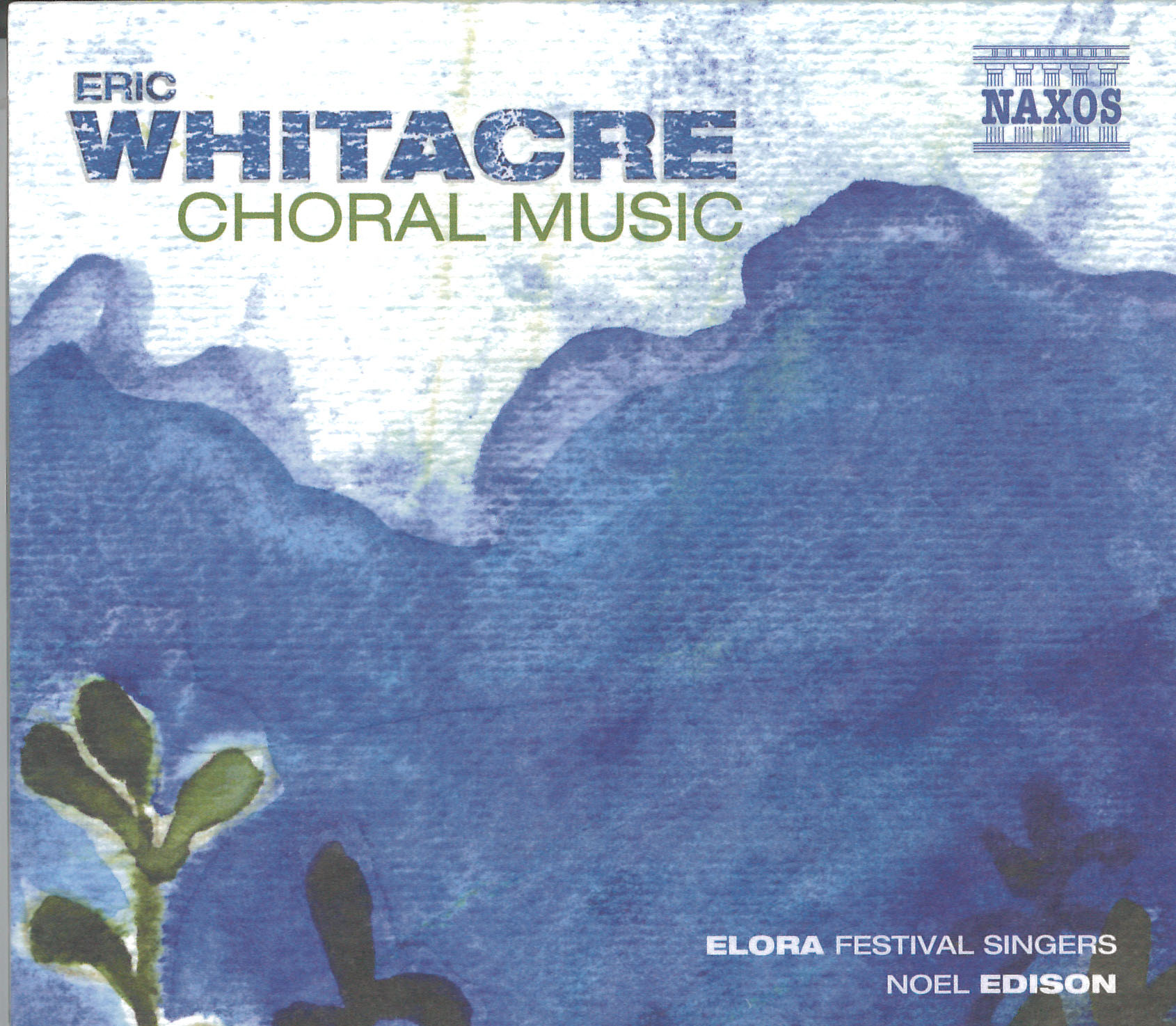
06_whitacreEric Whitacre - Choral Music

Elora Festival Singers; Noel Edison

Naxos 8.559677

This recording will appeal to admirers of well-crafted choral music that judiciously incorporates contemporary musical techniques. American composer Eric Whitacre (b. 1970) has cultivated a style where added notes and tone clusters are the norm in higher registers. With careful attention to pitch content, texture, register, and dynamics, seldom is an unattractive sound heard. Though based in innovations by other composers great and small, Whitacre’s music shows special artistry in focusing technique to ends. In Her Sacred Spirit Soars, simply thickening and thinning sonorities as pitches rise and fall conveys the sacred spirit of the music’s long-breathed motion. I particularly like the mystical sense in Lux aurumque (Light of Gold), about which the composer aptly speaks of spiritual processes: “blossoming” and “surrendering” to light.


There are effective piano-accompanied settings, of E.E. Cummings’ little tree with its ecstatic ending, and of Octavio Paz’s Little Birds which includes whistling, repeated consonants and quasi-aleatoric (random) singing. I prefer the sensitivity to mood in the short lyrical works; When David Heard and percussion-enhanced Leonardo Dreams of his Flying Machine have longer minimalist passages I find less convincing.


Noel Edison’s splendid Elora Festival Singers are up to Eric Whitacre’s every challenge. Perfectly pitched, vibrato-less sopranos in multiple parts produce sounds of wonderful life. All sections contribute to the tour-de-force with well-balanced sonorous blocks and long-decaying tones evoking reverberant space. Which brings me to close by noting the fine production and engineering by Bonnie Silver and Norbert Kraft of this important recording.
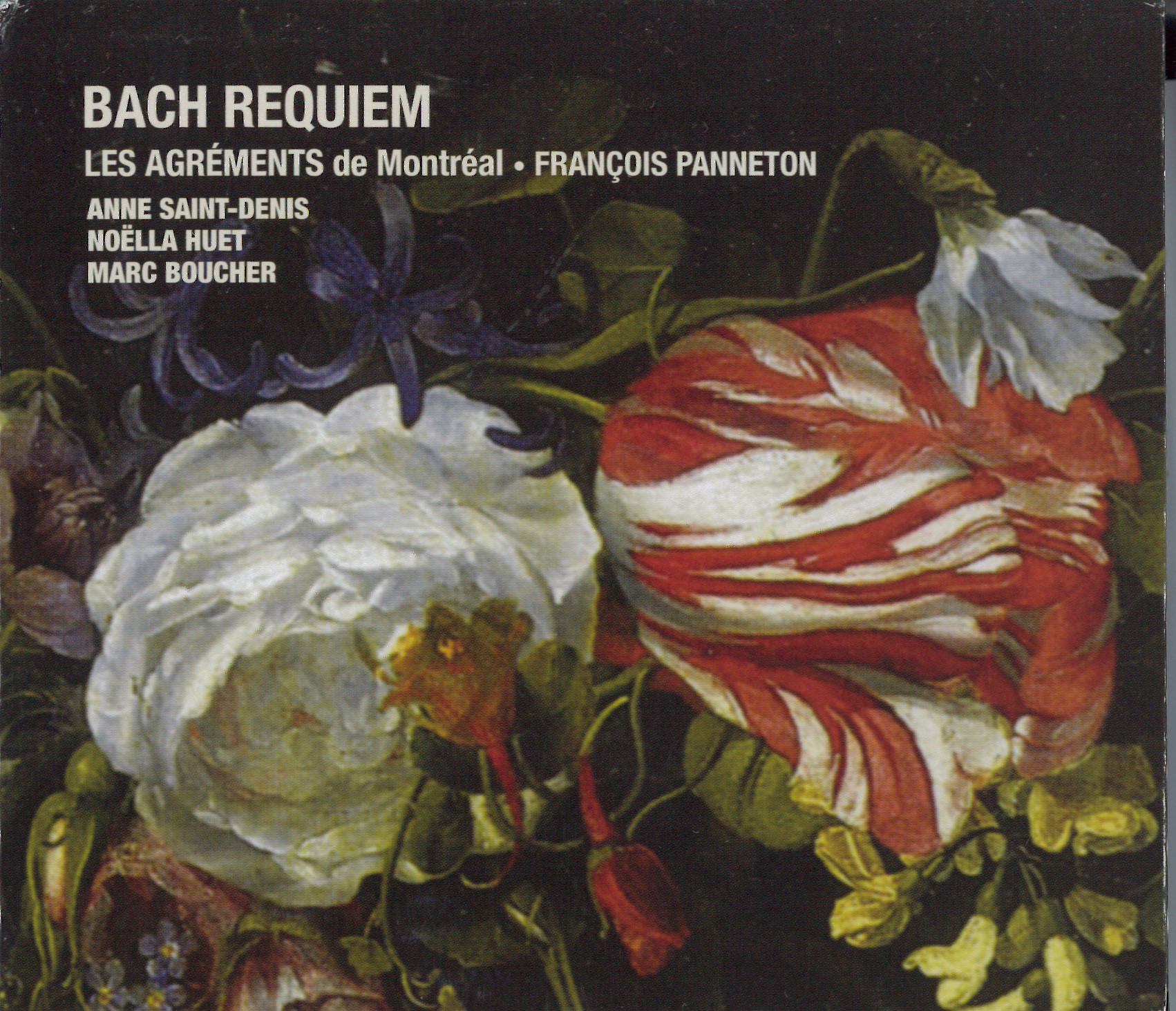
01_bach_requiemBach Requiem

Les Agréments de Montréal; François Panneton

XXI XXI-CD 2 1679 (www.XXI-21.com)


The sheer volume and inventiveness of Bach's work is astounding to us all. Yet we often ask the question: what else would J.S. Bach have accomplished given a different set of circumstances in his life? Those exploring the same question have interpreted Bach on modern instruments, jazzed up his rhythms, and substituted new lyrics. But what would Bach have created given a wider audience than his humble life in Leipzig as organist and schoolmaster provided? What if he were granted commissions beyond the scope of the Lutheran Church? We already have a hint of this with his Mass in B minor in Latin which he composed with the intention of widening his prospects.


It seems that scholar and conductor François Panneton has mused long and deliberately on this very question. The result is a Requiem that Bach could have written, given the opportunity. It is indeed his music; seamlessly patch-worked together are a number of movements from cantatas, keyboard works and the St. Matthew Passion organized into the standard requiem structure. As we know from Bach's cantatas, meditations on the agony and ecstasy of death appear frequently, and every chorus, aria and duet appearing in this work is chosen for its poetic similarity to the Latin section of the Requiem that replaces it, thus preserving the character. Thoughtfully crafted, beautifully performed, this recording provides a refreshing new perspective without compromising the integrity of the original sources.


02_handel_bereniceHandel - Berenice

Il Complesso Barocco; Alan Curtis

Virgin Classics 6 28536 2


Berenice may not be as gripping as Handel’s greatest operas, such as Julius Caesar, Ariodante and Rodelinda. But by any standard it is a magnificent work, melodically rich and psychologically insightful. Yet since the rather unsuccessful premiere in 1737, it is rarely performed or recorded. So this splendid new recording by Alan Curtis and his Venice-based Il Complesso Barocco is welcome – all the more so since Curtis restores the music Handel cut in an attempt to improve the opera’s fortunes.


This is a lively, energetic, elegant, spontaneous yet unmannered performance, with Curtis leading from the harpsichord. Curtis has been a talent-spotter right from his ground-breaking 1977 recording of Handel’s Admeto, which was the first recording of a complete Handel opera on period instruments. Here he once again manages to offer a relatively unknown but terrific cast of young singers.


Klara Ek is lovely in the title role of Berenice, Queen of Egypt. Her clear, animated voice is delightful in the moving dialogue with oboist Patrick Beaugiraud, “Chi t’intende”, though her “Traditore, traditore!” doesn’t convey the delicious ferocity of Handel’s more dramatic writing. Soprano Ingela Bohlin, bass Vito Priante, and especially countertenor Franco Fagioli are all standouts. But the most exciting singer here is Romina Basso, whose passionate characterization of Berenice’s sister Selene is riveting.


The booklet is generous, especially by today’s standards. It contains the full libretto with English translation, informative notes, and photos of the singers as well as the superb orchestra.


03_canadian_song_cyclesTo Music - Canadian Song Cycles

Wanda Procyshyn; Elaine Keillor

Carleton Sound CSCD-1013 (www.carleton.ca/carletonsound)


The previously unrecorded song cycles from nine of Canada's finest composers are performed with intelligence and sensitivity by soprano Wanda Procyshyn and pianist Elaine Keillor in this new recording.


A song cycle is comprised of a number of songs interconnected thematically by the lyrics and/or music. The form was very popular in Europe during the 19th century. “To Music” showcases the evolution of the form in Canada over the course of the 20th century. With an eclectic mix of composers - Healy Willan, Gena Branscombe, Edward Manning, Robert Fleming, John Weinzweig, Jeanne Landry, Euphrosyne Keefer, Patrick Cardy and Deirdre Piper - comes an eclectic mix of topics and compositional choices.


My initial trepidation quickly dissipated upon hearing the interpretations. From Willan's lush To Music to Weinzweig's 12-tone Of Time and the World to the rhythmically challenging Autumn by Patrick Cardy, there does not seem to be anything that Procyshyn and Keillor cannot do. There is the occasional high pitch vocal discrepancy, and the piano may be a little too forward in the mix at times, but these little faux-pas are overshadowed by the sincere performances.


Most striking is the intricate love of detail that surfaces in every song cycle. “To Music” is a recording that demands careful and studied listening to be truly enjoyed and appreciated, but the rewards are well worth the effort.


01_beatae_mariaIn Nativitate Beatae Mariae Virginis
Schola Sanctae Sunnivae; Anne Kleivset
Lindberg Lyd AS 2L-069

Norway’s Reformation of 1537 was harsh on liturgical codices; very few survived. Ten folios from a choir book from Nidaros Cathedral in Trondheim did survive (having been cut into strips for ledger covers!) and they are the basis of this celebration of the Nativity.

In fact, thirteen sung antiphona are interlaced with five interludia for melodic percussion by the Norwegian composer Henning Sommerro. Under the title Maria, the work as a whole was performed for the 800th anniversary of Our Lady Church, Trondheim. A transcription for melodic percussion was then made especially for this recording.

Twelve female voices and their conductor explore the nativity in the greatest detail on this CD. As no individual singers are singled out, the entire ensemble may claim collective success in an uplifting rendition of this collection of simply-written but richly spiritual pieces.

There is, it must be said, a contrast, perhaps a void, between the chanted antiphonae and the instrumental interludia, which are modern in their style. This can not distract from the purity of the voices of Schola Sanctae Sunnivae.

One criticism. The final interludium unfortunately does not blend in with the remaining pieces - its own style is out of place, not least as in the preceding track, the last sung piece, singers and percussionists join in a celestial plea to observe the birthday of Mary.

02_stabat_mater_jarousyStabat Mater - Motets to the Virgin Mary
Philippe Jaroussky; Marie-Nicole Lemieux; Ensemble Artaserse
Virgin Classics 693907 2

The beauty of the countertenor voice has always had its sway over me. The same can be said for contralto. These are extraordinary voices, pushing the limits of human singing ability and delivering rewarding, sometimes unexpected results. When you add to these inherent voice attributes the individual gifts of Philippe Jaroussky and Marie-Nicole Lemieux, the resulting disc should be stunning to listen to. And yet, it isn’t. Oh, it is very good, meticulously produced, well played and very well sung. Unfortunately, the freshness and youth of Jaroussky’s voice, which is usually an attribute, renders the material too light and airy, as if this Stabat Mater Dolorosa did not suffer at all. Where you would hope for some audible anguish and sorrow, there is instead the solid, new-knife steely shine of the young artist’s voice, unperturbed by the matters at hand. Lemieux, usually a dark and mysterious voice, joins in this light-music making and allows herself to be carried towards almost a celebration – not exactly the mood called for. There are so many better recordings of the two, especially in the celebrated Vivaldi series on the naïve label; it would not do justice to the artists to recommend this particular disc.

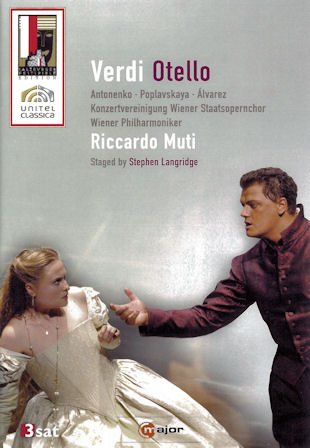
03_verdi_otelloVerdi - Otello
Aleksandrs Antonenko; Marina Poplavskaya; Carlos Alvarez; Wiener Staatsopenchor and Philhamoniker; Riccardo Muti
Unitel Classics 701408

With the first ff shrieking chords of the orchestra Verdi forcefully draws us into the world of Shakespeare’s horrifying tragedy, one of fullest embodiments of evil ever created. Each of the characters is widely different from one another: Otello the accomplished fearless hero, but insecure and gullible; Desdemona full of love, but naïve; and Jago congenitally and relentlessly evil. Their interaction is the stuff of drama and of one of the greatest in Verdi’s oeuvre.

Salzburg hasn’t seen a production of Otello since 1970 when Karajan conducted it in a noble, unforgettable performance with our Jon Vickers in the title role. Now it’s Riccardo Muti’s turn. Muti today has become a conductor of stature and a true master of Italian opera repertoire since his early years as a young firebrand when I saw him a few times here in Toronto. His usual forceful style helps ‘shine a light on Otello’s violence’ and turns the orchestra into a snarling monster when required. His orchestra is well balanced throughout, swift moving yet he finds time to bring out much of the richness, hidden meaning and delicacy of the score.

The extraordinary width of the stage of Grosses Festpielhaus has always been difficult to handle for stage designers and directors. Director Stephen Langridge with George Souglides solved the problem by subdividing it into multiple elements: galleries, stairs, projection screen and a fragile transparent platform that shatters at the end of act 3, symbolizing Otello’s descent into insane jealousy.

The cast is international, nearly all young, very talented singers with spectacular voices. Latvian Aleksandrs Antonenko is a powerful, clear heldentenor whose ‘ringing’ entry ‘Esultate!’ sets the tone for his performance. Russian soprano Marina Poplavskaya brings much richness to the part of Desdemona not just with her voice but her wonderful acting. Famous Spanish baritone Carlos Alvarez’s turncoat portrayal of Jago, alternately evil and suave, is skilfully acted and brilliantly sung. His shattering ‘Credo’ is one of the best I ever heard. This is a performance worthy of Verdi and Shakespeare, highly recommended.

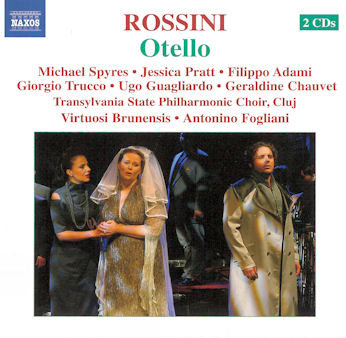
04_rossini_otelloRossini - Otello
Michael Spyres; Jessica Pratt; Filippo Adami; Gerogio Trucco; Ugo Guagliardo; Geraldine Chauvet; Transylvania State Philharmonic Choir, Cluj; Virtuosi Brunensis; Antonino Fogliani
Naxos 8.660275-76

Justifiably overshadowed by Verdi’s penultimate masterpiece, Rossini’s Otello has suffered terribly in the last 150 years. This beautiful opera, first performed in Naples in 1816 and very popular soon thereafter, was nearly ignored after the composer’s death and in the 20th century. Rossini wrote it for Naples at age 24 about the same time as his ever popular Barbiere and La cenerentola. However, anyone seriously interested in the Othello of Shakespeare will be severely disappointed. Except for the 3rd act, the libretto by the Marchese Berio di Salsa took extreme liberties with the play, changed the plot, the location; no love duet, no Cassio…, no Cyprus…, no handkerchief. Everything takes place in Venice and the chief competitor for Desdemona’s hand is Rodrigo, a minor character in Shakespeare.

But the opera! A wonderful collection of arias, trios and ensembles here immaculately performed by a group of young artists at the Rossini festival in Wildbad, Germany. Antonino Fogliani, young Italian conductor vigorously conducts with great flair and sensitivity in the great Rossinian style. His success is much helped by the Czech orchestra with their legendary wind players.

There are 3 major tenor roles in the opera (Otello, Rodrigo & Jago) perhaps because the original theatre group in Naples had an overabundance of tenors. Each of these are murderously difficult, especially Rodrigo who is a high tenor, and Filippo Adami is sensational with the Rossini fioraturas. Powerful American tenor Michael Spyres is in lower tessitura and sings Otello characterfully and flawlessly. English soprano Jessica Pratt, is strong and heartfelt in the role of Desdemona. All supporting roles are equally fine.

Before ending I’d like to commend Naxos for undertaking the huge task of recording all of Rossini’s operas and if I may add, their uncompromising excellence overshadows many earlier recordings of other famous recording companies. Bravo Naxos!

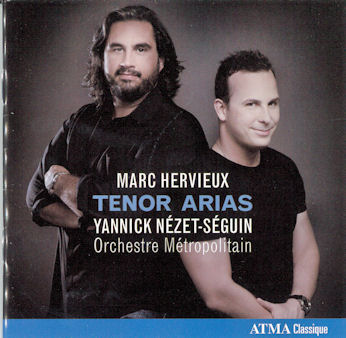
05_tenor_ariasTenor Arias
Marc Hervieux; Orchestre Metropolitain; Yannick Nézet-Séguin
ATMA ACD2 2618

After years of writing CD reviews for this magazine, it’s time to come out of the closet: I am a big, loud, unabashed snob. I believe that cross-over artists are sell-outs and that Il Divo, Andrea Boccelli and Charlotte Church cheapen, not popularize, classical music. A personal opinion, to be sure, but one augmented by many years of education, listening to music and developing some discernment. The battle lines drawn, I can now review the latest disc from the quintessential cross-over artist, Marc Hervieux. The Quebec singer did not read music until his mid-twenties, sang in a rock band and still cannot pass over an opportunity to sing for kings, presidents or with Patsy Gallant (don’t ask!). Except for the fact that Hervieux has a great, undeniable talent with a capital T. His voice, a spinto tenor in full Italian style, invites positive comparisons with young Pavarotti. This truly wonderful recording spans all the classics – from Verdi, Mascagni, Cilea, and Leoncavallo to a good dose of Puccini. Moreover, it allows the music, deftly handled by Nézet-Séguin (whose own meteoric rise takes him onto podiums of the greatest opera houses in the world) breathe in unison with the voice. At the end, you are left with a feeling of peaceful contemplation – not at all a feeling I expected from a “cross-over” artist. So as long as Monsieur Hervieux continues to record discs as beautiful as this one, I will keep on listening to them, my snobbery be damned!

Back to top