Liszt - Années de Pelerinage Suisse - André Laplante
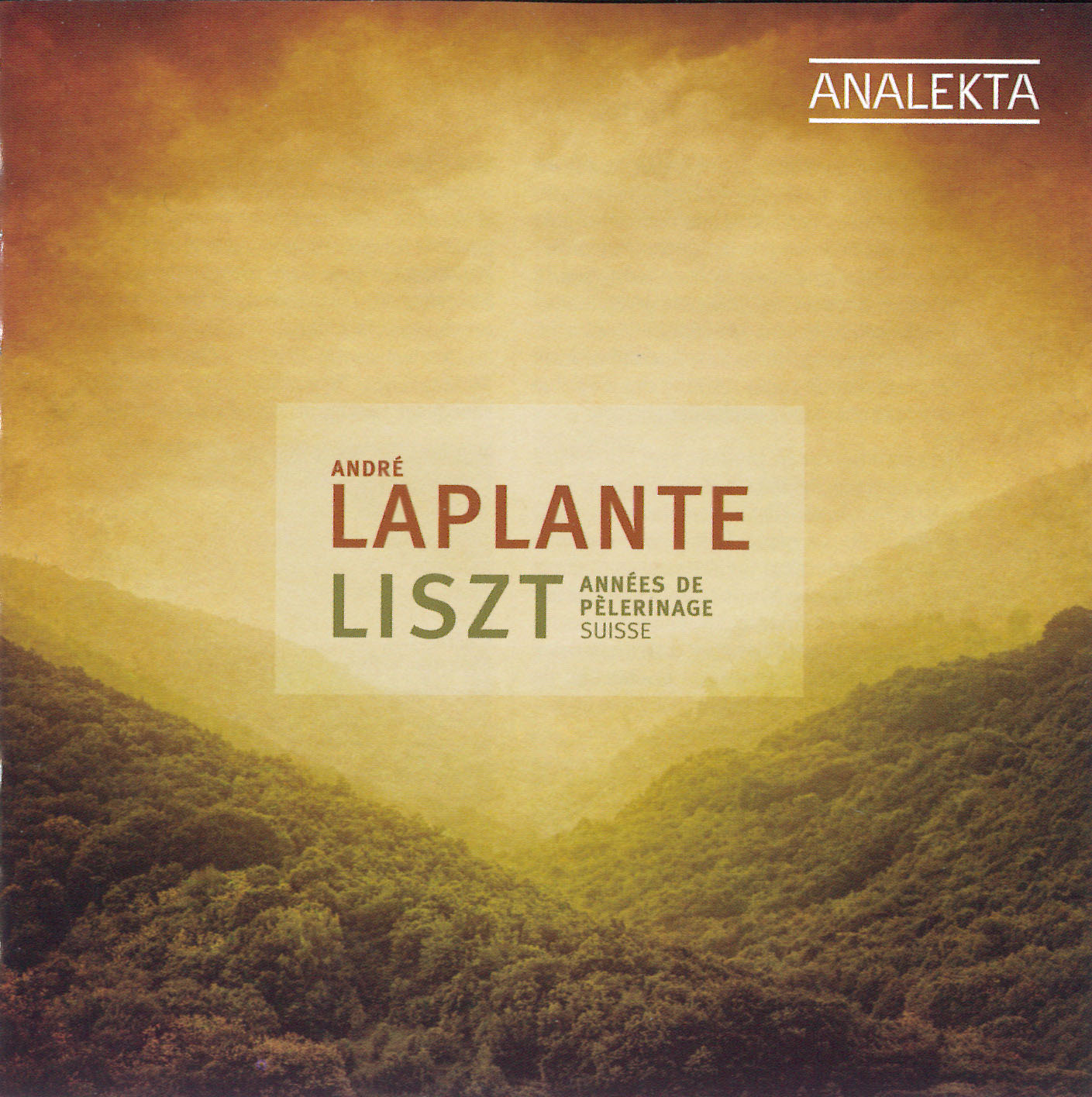 Liszt - Années de Pelerinage Suisse
André Laplante
Analekta AN 2 9980
André Laplante by now can be referred to as Canada’s ‘national treasure’. He is a well established artist especially in the Romantic repertoire and has a worldwide reputation with critics comparing him sometimes to Richter and Horowitz. This new recording for the Analekta label tackles Liszt in an ambitious, rarely recorded program of the first book of the 21 year old Liszt’s romantic wanderings with Countess Marie d’Agoult.
Liszt met the Countess in 1832 in Paris, a married woman 6 years older, but this did not prevent one of the century’s most famous and productive love affairs from developing. Three years later Marie left her family and ran off with Franz to Switzerland, later to Italy. There were 3 children born out of this union, among them Cosima who eventually married Richard Wagner.
As we listen, the pieces vary in character from invocations of natural beauty (Lac de Wallenstadt), literary associations with Byron, Schiller, Goethe, Senacour (Vallée d’Obermann), to force of nature (L’Orage), pastoral melodies (Pastorale, Eglogue) and homage to Swiss history (Chapelle de Guillaume Tell).
Many of the pieces even appear improvised. We can just see after a day of admiring the majestic Swiss countryside, Liszt composing on the piano and playing to his object of affection. Often the quiet, self searching beginnings develop into passion with great intensity.
To capture the many layered complexities of this set, Laplante is the ideal choice and this recording shows it. Being an unassuming, introspective personality, his performances have insightful sensitivity, but never overt emotionalism, dazzling power and virtuosity that never is meant to show off and rich imagination characteristic of a great artist.
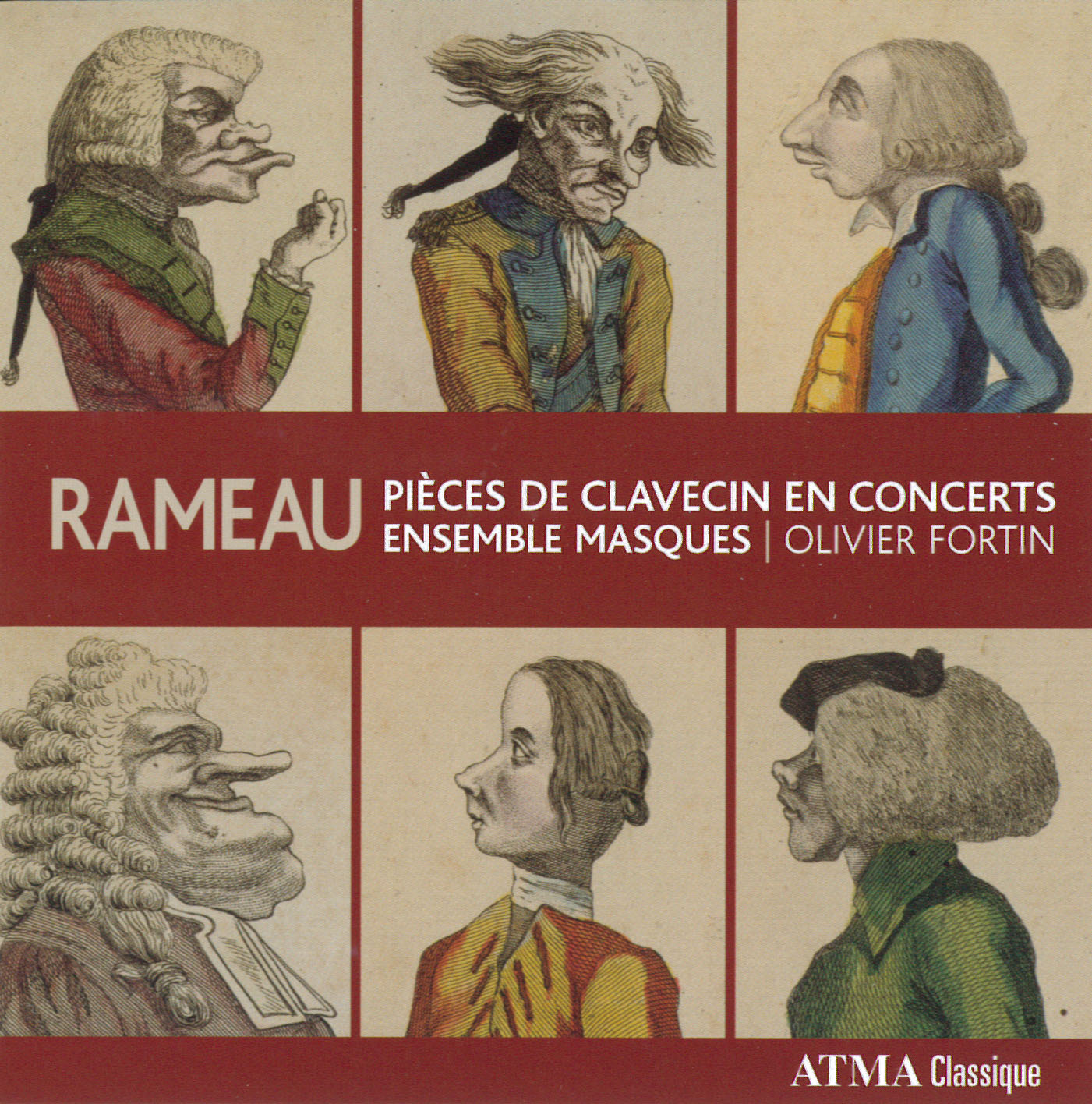
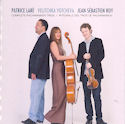 Although resident in Quebec since 1993, Paris-born Patrice Lare studied in Moscow for 8 years, and is steeped in the Russian piano school tradition. His playing provides a massive foundation for the Complete Rachmaninov Piano Trios (XXI-CD 2 1700) with his wife, cellist Velitchka Yotcheva (also Moscow-trained), and Canadian violinist Jean-Sebastien Roy. Rachmaninov’s Trios Elegiaques are both early works in his Romantic, post-Tchaikovsky mold. No.1 is a single-movement trio in G minor from 1892, and No.2 a three-movement work in D minor, written after the death of Tchaikovsky in late 1893 and dedicated “To the Memory of a Great Artist”. This is big but always sensitive playing, perfectly attuned to the style and nature of the music. Recorded at the Radio-Canada studios in Montreal, the sound quality matches the tremendous performances.
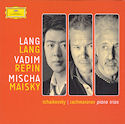 I’ve sometimes wondered if the technical heights reached by Lang Lang are always matched by the depths of his interpretations, but he certainly does his artistic reputation no harm with his first chamber music CD, Tchaikovsky and Rachmaninov Piano Trios with Vadim Repin and Mischa Maisky. Presumably this is his final major release from Deutsche Grammophon (477 8099), following his $3 million signing with Sony; if so, it’s a fascinating farewell, suggesting chamber music as a new field with huge potential for him. The Rachmaninov trio is the G minor, and both here and in the Tchaikovsky A minor trio Lang Lang really seems to avoid “showy” playing, getting to the heart of the music and clearly sharing the interpretative view of his Russian colleagues. Again, the standard of the recording matches that of the two outstanding performances.
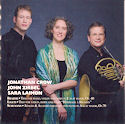 At first sight, there doesn’t seem to be any connection between the works on the latest CD from faculty members at McGill University’s Schulich School of Music (XXI-CD 2 1699), but they are in fact closely related. Jonathan Crow (violin), John Zirbel (horn) and Sara Laimon (piano) open with a beautifully warm reading of the Brahms E flat Horn Trio. This was the first work written for this instrumental combination, and was inspired by the death of the composer’s mother. Brahms chose to use not the newly-developed valve horn but the natural waldhorn, with its sentimental ties to his family and his youth in Hamburg. It was, in turn, a request from a Hamburg pianist for a horn trio to be played along with the Brahms that led György Ligeti to write his own Horn Trio in 1982; moreover, Ligeti had also lost his own mother earlier that year. Sub-titled “Hommage à Brahms”, it is a demanding, complex and multi-layered work in the same four-movement form. Again, the performance is exemplary. Brahms’ mentor Schumann wrote his Adagio & Allegro for horn and piano in 3 days in February 1849; the first substantial solo work to fully explore the potential of the new valve horn, it is still a demanding piece, and Zirbel and Laimon are terrific. Recorded at the acoustically-excellent Schulich School, the sound quality is outstanding.
 Stravinsky - Pulcinella; Symphony in Three Movements
 Tchaikovsky - Rococo Variations; Prokofiev - Sinfonia Concertante
 Mahler - Symphony No.7