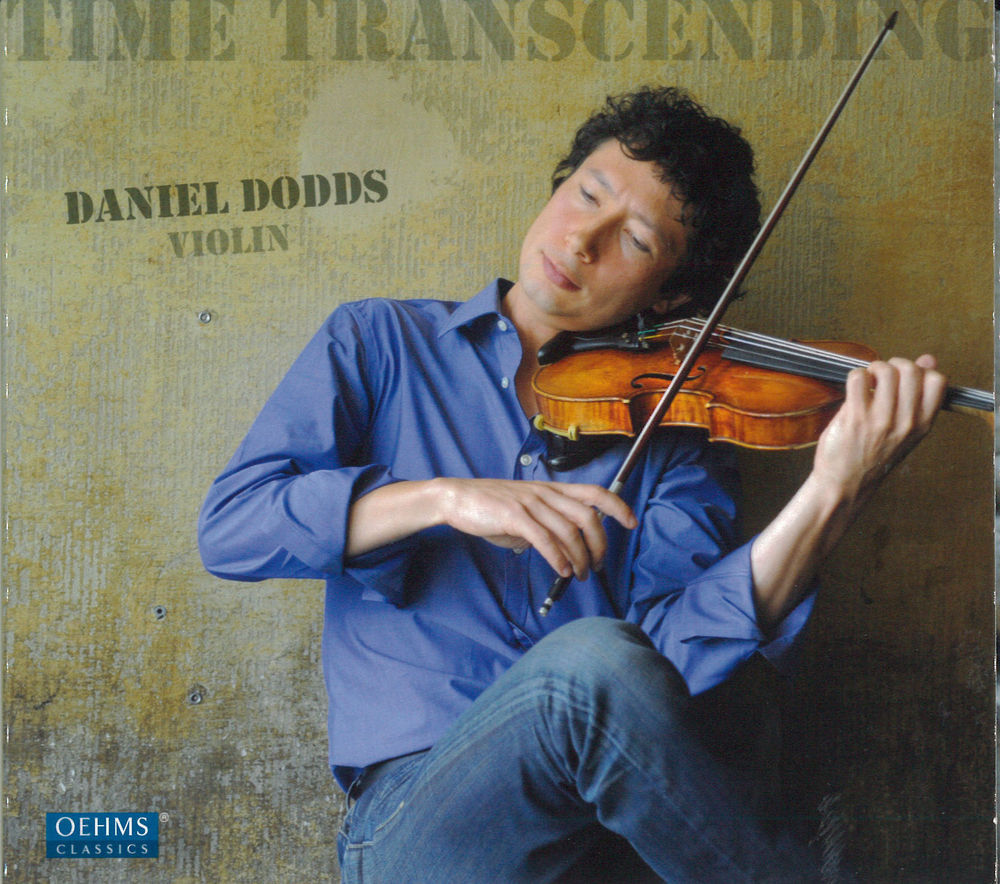
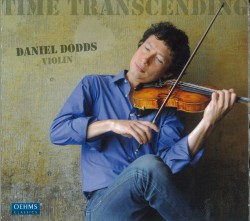
 Time Transcending (Oehms Classics OC 832) is the first solo recital disc of the Australian-born violinist Daniel Dodds, and it’s quite stunning. The works range from Bach through Paganini, Ysaÿe and Ernst to 20th century works by Rochberg, Berio, Bram and Messiaen. You’ll find better — or, at least, more nuanced — versions of the great Chaconne from Bach’s Partita in D Minor, but you’d be hard pushed to find anything anywhere to match the playing on the rest of the CD. There are terrific performances of Ysaÿe’s Sonata No.3, Ballade, and Luciano Berio’s Sequenza VIII from 1976, followed by a stunning Caprice No.24 from the Paganini Op.1. The American composer George Rochberg published 50 Caprice Variations on this particular piece in 1970, and 12 of them are here, played with a quite startling range of tone, colour and special effects. The Etude VI by H. W. Ernst is his famous 1864 set of variations on The Last Rose of Summer, and a work of almost ridiculous technical difficulty — but apparently not for Daniel Dodds.
The phenomenal playing continues in Swiss composer Thuring Bram’s Uhrwerk (Clockwork), written in 1976; Dodds is called on to play a dazzling array of effects — thumps, harmonics, bow scrapings, left-hand pizzicato and more — in an engrossing piece that treats the violin, in the composer’s words, as “a sophisticated percussion instrument.”
Dodds is joined by pianist Tomasz Trzebiatowski for the final track, Messiaen’s Louange a l’immortalité de Jesus, the final movement from his Quatuor pour le fin du temps. The beautifully sustained long, high melodic line brings a breathtaking CD to a serene close.
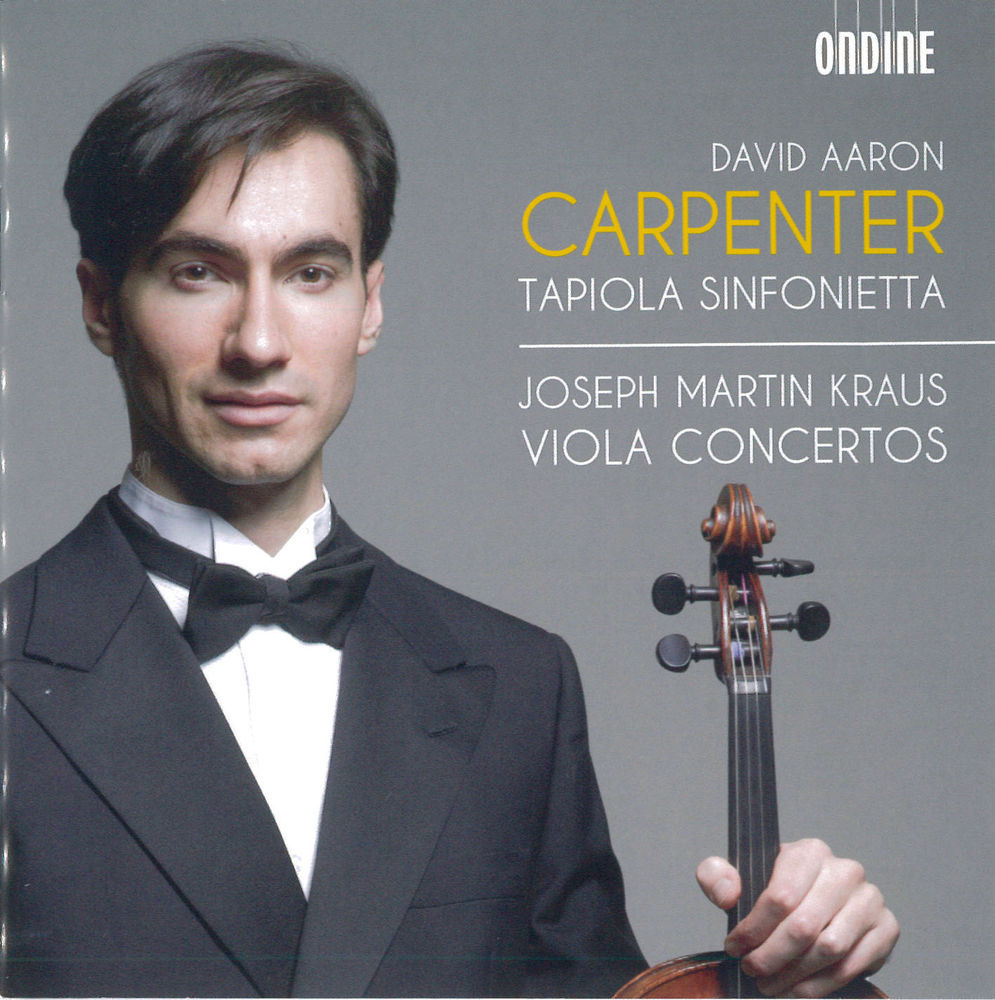
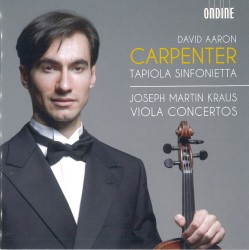 We’re not exactly overwhelmed with viola concertos, so I was delighted to receive the latest CD by the marvellous young American violist David Aaron Carpenter, which features world premiere recordings of three Viola Concertos by Joseph Martin Kraus (ONDINE ODE 1193-2). Kraus, a German composer who spent most of his working life in Sweden, was an exact contemporary of Mozart, born in the same year and dying just 12 months after Mozart’s death. Until just a few years ago, however, these works were mistakenly attributed to his friend and compatriot, Roman Hoffstetter.
There are two solo concertos, in e-flat major and c major, and a double concerto for viola and cello (although really viola with cello obbligato) in which Carpenter is joined by Riitta Pesola. All three works were probably written around the time that Kraus moved to Sweden in 1778; not surprisingly, there are stylistic similarities with both Mozart and Haydn — who, apparently, named Mozart and Kraus as the only two geniuses he knew — but all three works are full of melodic and harmonic surprises.
Carpenter’s playing is superb: warm and rich across the entire range, and wonderfully expressive. He also directs the Tapiola Sinfonietta, an orchestra which has the Viennese music of this period as part of its core repertoire as is clear from their perfectly-judged accompaniment.
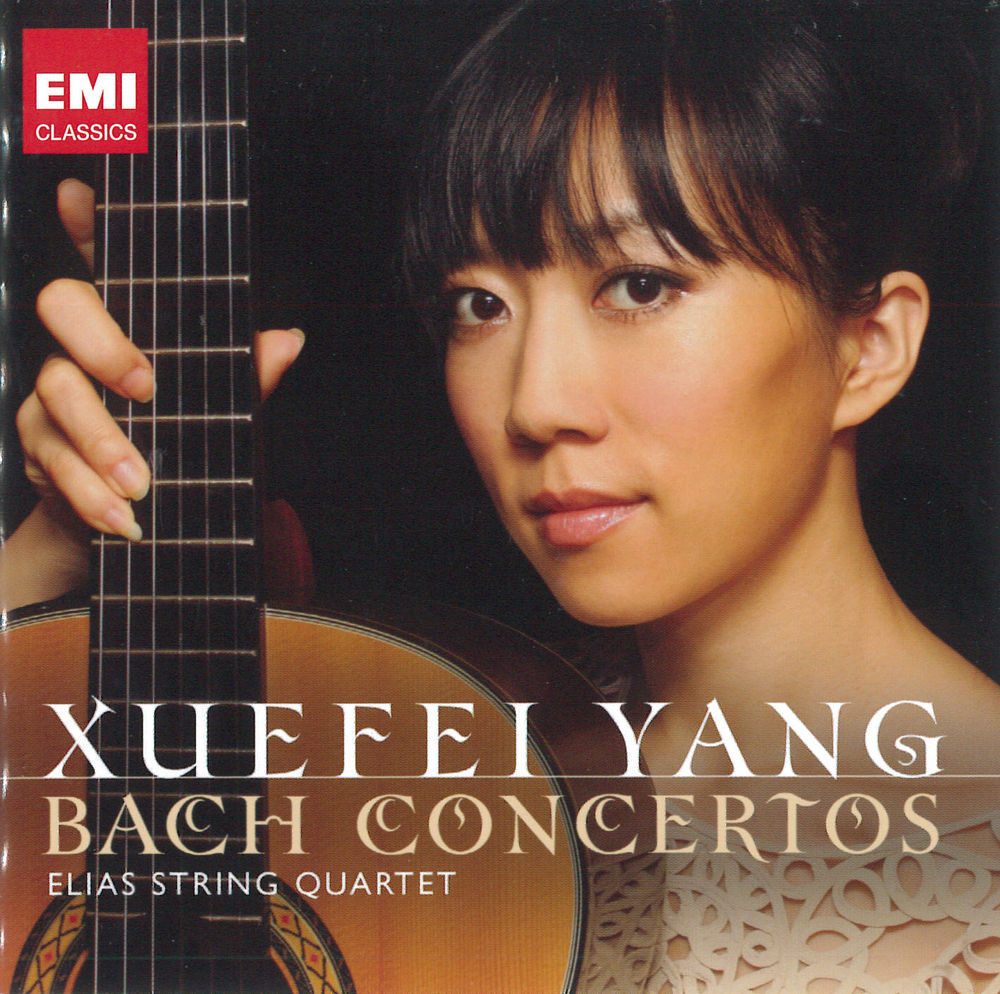
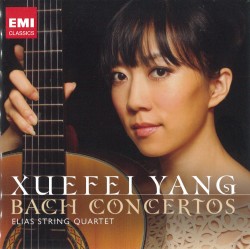 The Chinese guitarist Xuefei Yang, who is currently based in the UK, presents her own transcriptions and arrangements of three Bach Concertos on her latest CD (EMI Classics 6 79018 2) with the Elias String Quartet. The two solo Violin Concertos, in a minor and e major, are here, as well as the Harpsichord Concerto in D Minor BWV1052, which is believed to be based on a now-lost violin concerto.
Yang found the solo parts in the violin concertos to be perfectly playable on the guitar, but the real masterstroke here is her arrangement of the orchestral accompaniment for string quartet, thus ensuring that the guitar’s softer voice can always be heard. Her playing is clean, precise and beautifully shaped, and the balance with the quartet is excellent throughout.
Yang was drawn to the violin concertos by the guitar transcriptions of Bach’s solo violin sonatas and partitas, and this disc includes the Sonata in G Minor, transcribed by her to a minor. Nothing seems to be lost in the transcription; indeed, many sections sound smoother than in the violin original. The Prelude in C Major from the Well-Tempered Clavier, again transcribed by Yang to a major, and played on a seven-string guitar, and the Air on the G String complete an excellent and generous — almost 80 minutes — CD.
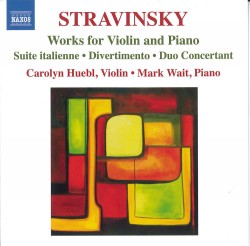 Carolyn Huebl (violin) and Mark Wait (piano) are the performers on a new Naxos CD of Stravinsky Works for Violin and Piano (8.570985). All of Stravinsky’s works for this combination were the result of his partnership with violinist Samuel Dushkin, with whom he toured throughout the 1930s, and this disc features the three most substantial pieces: the Suite italienne and the Divertimento, both arranged by the composer and Dushkin; and Stravinsky’s only original work for the medium, the Duo Concertant.
Mark Wait certainly has the credentials for these works, having recorded Stravinsky’s solo piano music for Robert Craft’s series of the complete works of Stravinsky some 20 years ago.
The performances here are solid and carefully considered if not spectacular, and tend to be a bit pedestrian at times. They were recorded at the Blair School of Music in Nashville’s Vanderbilt University, where both performers are on the faculty.
The low Naxos price makes this a decent buy, but if you’re seriously interested in Stravinsky’s music for violin and piano then for an even lower per-disc price you can buy the excellent Newton Classics 2-CD reissue set of the complete works by Isabelle van Keulen and Olli Mustonen that I reviewed last October. Their interpretations tend to be a bit “spikier” and capture the Stravinsky character more fully. There is also a Hyperion two-CD budget-price set with Anthony Marwood and Thomas Adès that I have not heard, but that should be well worth tracking down.
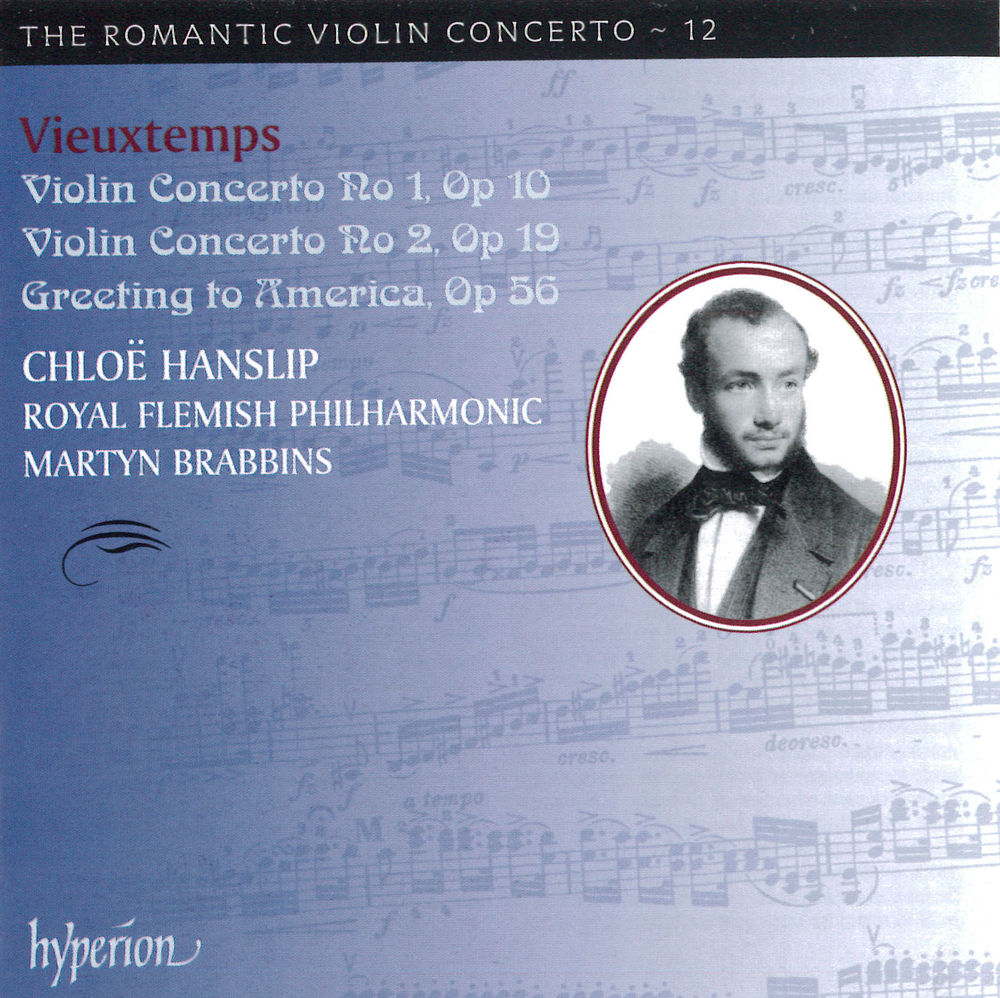
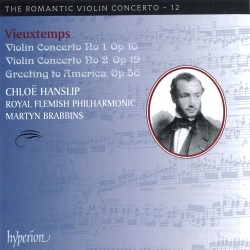 Volume 12 of the outstanding British series The Romantic Violin Concerto (Hyperion CDA67878) features the first two Violin Concertos of Henri Vieuxtemps in lovely performances by Chloë Hanslip and the Royal Flemish Philharmonic Orchestra under Martyn Brabbins.
The Concerto No.1 in E Major was actually written after the Concerto No.2 in F-sharp Minor, but the numbering follows the order in which they were published. The E major is a huge work, running over 40 minutes, and with a first movement that is longer than many full concertos. Written when Vieuxtemps was 20, it feels a bit episodic at times – perhaps not surprisingly, given its size – but is full of lovely moments. The F-sharp minor concerto pre-dates the E major by four years, and understandably shows signs of immaturity as a composer; the booklet notes correctly comment that it “makes more of a classical impression than a romantic one” with the influence of Mozart and Beethoven in evidence. The real forgotten gem here, though, is the Greeting to America Op.56, written for Vieuxtemps’ concert tour of the USA in 1843-44. It’s a fantasia on both The Star-Spangled Banner and Yankee Doodle for violin and orchestra, and brings another terrific Hyperion CD to a rousing close. Hanslip is in great form throughout, and given excellent support by Brabbins and the orchestra. The recording quality, as you would expect from this label, is exemplary.
Incidentally, Volume 8 of this series features Vieuxtemps’ concertos nos.4 and 5 (the “famous” one) in performances by Viviane Hagner and the same orchestral team.
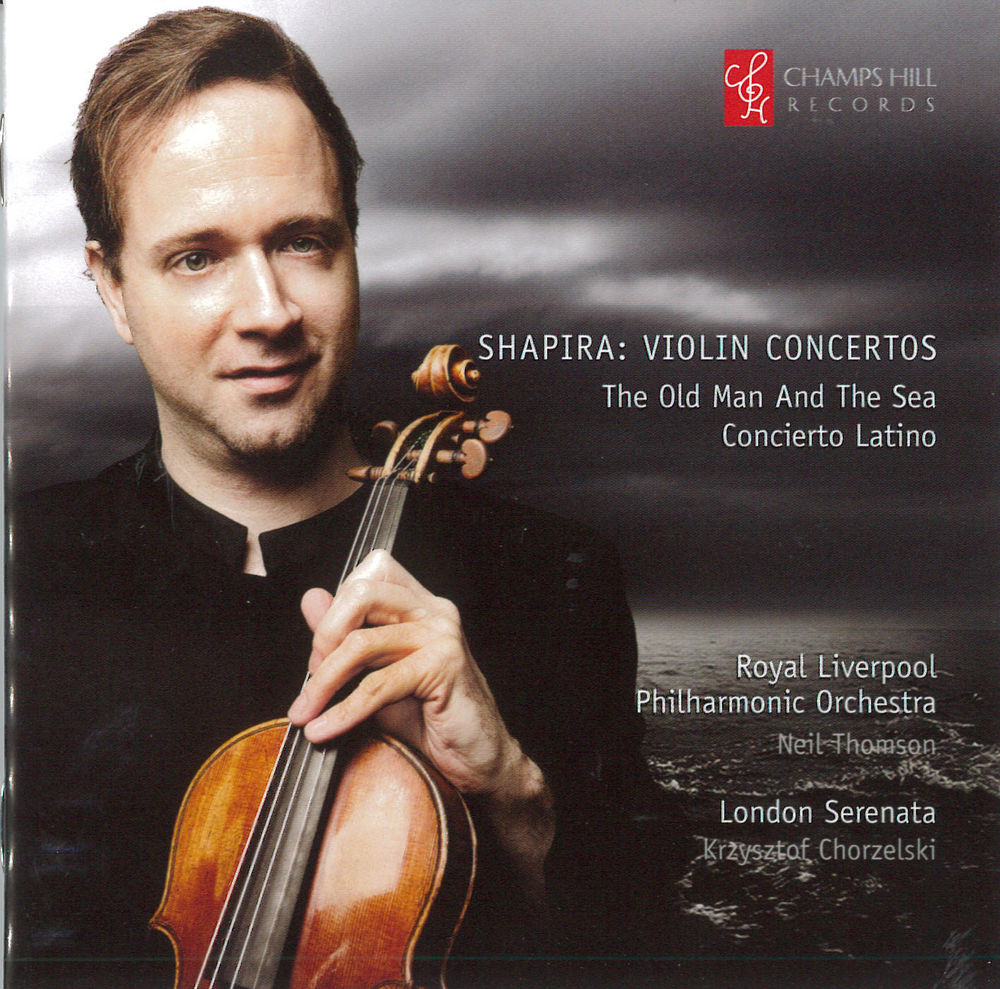
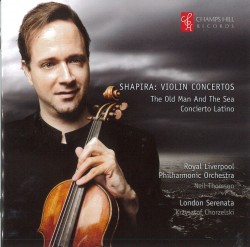 In last year’s summer edition of this column I reviewed a short CD of the Concierto Latino by the Israeli violinist/composer Ittai Shapira. The same recording has now turned up on a full-length disc of Shapira: Violin Concertos, coupled with The Old Man and the Sea and the solo violin piece Caprice Habañera (Champs Hill CHRCD032).
The Old Man and the Sea was inspired by, and based on, Ernest Hemingway’s short novel of the same name; the idea came to Shapira, coincidentally, when he was in Florida for the US premiere of his Concierto Latino. Hemingway wrote his novel in Cuba, and it is the influence of Cuban music that is the common link between the three works on this disc.
The writing throughout both major works is accessible and highly idiomatic, although it is difficult to determine a truly individualistic voice; it tends to be music that keeps reminding you of something else. The Concierto Latino seems to be the stronger work on re-hearing, but that may well be due to the therapeutic nature of its composition, Shapira having written it in the aftermath of being the victim of a gang attack in New York City in January 2005. The Caprice Habañera is a short virtuosic solo encore piece with some innovative technical challenges.
The three works were all recorded on different dates, and the two concertos with different partners: the London Serenata under Krzysztof Chorzelski accompanies the Concierto Latino, and Neil Thomson conducts the Royal Liverpool Philharmonic Orchestra in the Hemingway-inspired work, recorded this past January.
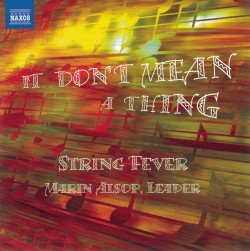 The conductor Marin Alsop, who is also a fine violinist, founded the ensemble String Fever with a group of top New York instrumental friends in 1981, partly to try to break down some of the classical boundaries, and partly just to have some fun as string players. Naxos has issued It Don’t Mean A Thing, an album of tracks recorded in 1983 and 1997 that shows just what they got up to when they weren’t on their “serious” gigs (8.572834).
It’s an odd offering from several aspects. For a start, it’s not clear if the group is even still in existence: in the sparse booklet notes Alsop refers to the group in the past tense, thanking those “who played in String Fever over the years” and citing the “many adventures over our 20 year career together,” all of which suggests that the ensemble ceased performing about 11 years ago. Secondly, despite the cavalcade of great standards from the likes of Duke Ellington, Cole Porter, Harold Arlen, Dave Brubeck, Benny Goodman, Harry Warren and Richard Rodgers, the album really falls between two stools. There’s much more of an attempt at originality here than in the Angèle Dubeau CD of movie hits last month, but it’s less of a success precisely because of that fact. The heart and soul of jazz is improvisation, but however good the players are you can’t really have a number of first violins all improvising at the same time. The answer? Jazz-style “arrangements” that are written out and fully notated. The problem? The moment the notes are written down, they lose all sense of spontaneity and hence aren’t either straight renditions or true jazz performances. Classically-trained players are always going to maintain respect for the written note, but in jazz and swing music it’s not how it’s written, but how it’s played that is the crucial element. If you have any trouble appreciating this, then just listen to the numerous albums Stephane Grappelli made with Yehudi Menuhin, where Grappelli, with his inimitable invention allied to his impeccable technique, plays Menuhin – with his written-out parts – out of the studio, down the road, around the corner and completely out of sight.
There are some decent arrangements here, and some really good playing, but even with the addition of a trap drum set and also an electric bass on some tracks, the overwhelming impression is of classical players having fun, but also having problems really letting loose.
I’m not sure what market Naxos has in mind for this release, or for the subsequent volume of original material from 1991, Fever Pitch (8.5722835); they categorize it as “contemporary jazz” in their catalogue, but with the most recent tracks already 15 years old it’s not really either.
And, of course, when today’s players like Judy Kang can shred electric violin with Lady Gaga’s Monster Ball tour, cross-over playing is not such a ground-breaking concept any more.
Strings Attached continues at thewholenote.com with works for baroque guitar performed by David Russell, violin and piano by Stravinsky performed by Carolyn Huebl and Mark Wait, early violin concertos of Vieuxtemps featuring Chloë Hanslip, Cuban-inspired concertos composed and performed by Israeli violinist Ittai Shapira and some jazzy offerings from Marin Alsop’s all-star ensemble String Fever.


 I Saw Eternity