As Torontonians learned several years ago when Dundas Square was renamed, the word Sankofa, originating from the Akan people of Ghana, comes from a Twi expression whose literal meaning is “Go back and get it!” a command to pay due regard to the lessons and practices of the past and to draw on them to inform the present and the future. The symbol of Sankofa, is often depicted as a bird with its feet facing forward (progress) while its head is turned backward (reflection), carrying a precious egg in its mouth (future/wisdom).

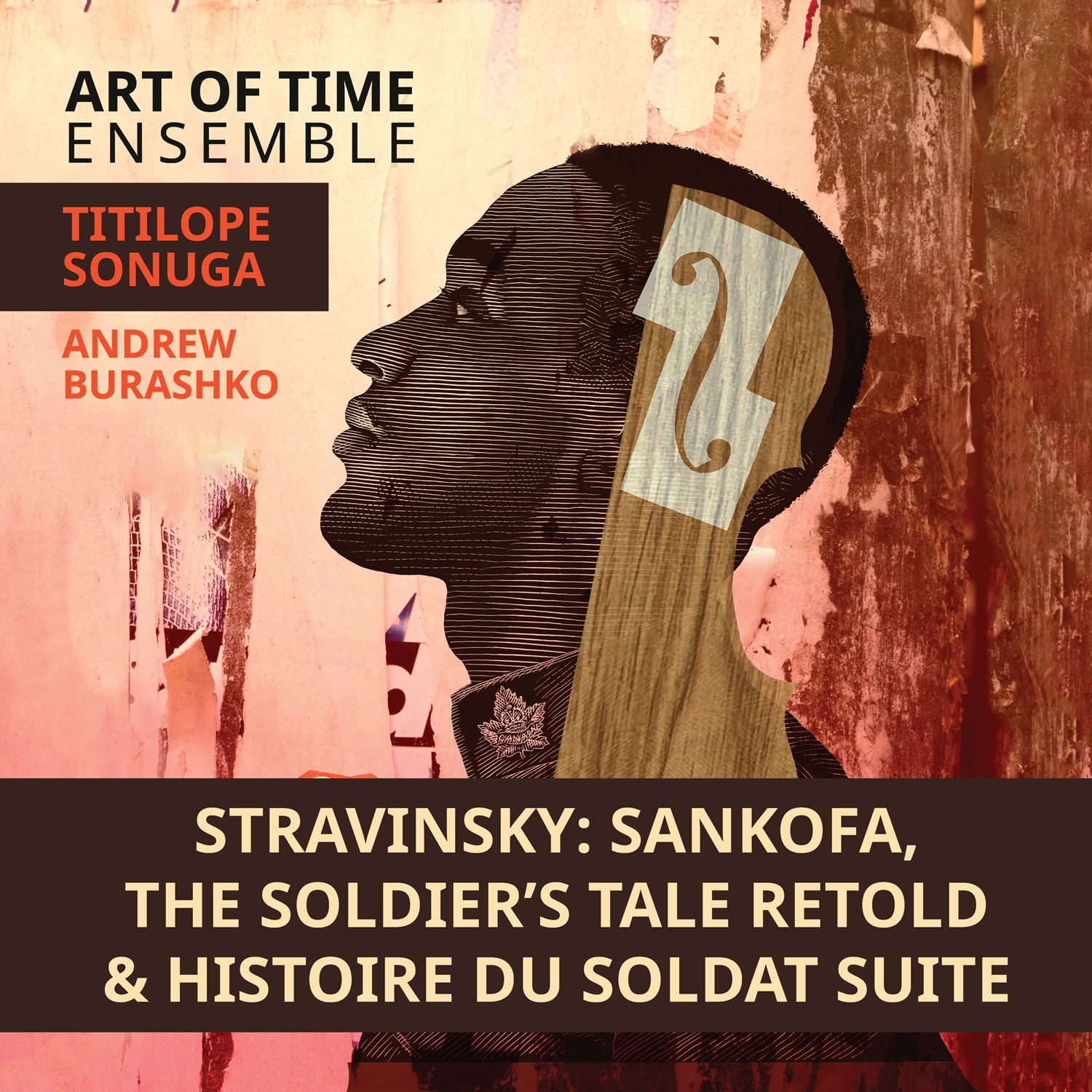
01 Stravinsky SankofaIn October 2024 the Art of Time Ensemble produced Sankofa: The Soldier’s Tale Retold under Andrew Burashko’s direction, Nigerian-Canadian poet Titilope Sonuga’s reimagining of Stravinsky’s L’Histoire du Soldat. As their contribution to this year’s Black History Month Leaf Music released a recording of this stunning work (LM304 leaf-music.lnk.to/lm304c)

The original story by Charles-Ferdinand Ramuz told of a First World War soldier who encounters the devil to whom he barters his violin for the promise of eternal riches, a bargain that has dire consequences. Sonuga’s version tells of a (fictional) Jamaican man of African heritage in Halifax in 1914 who wants to enlist in the Canadian army but is turned down because people of his skin colour are not welcome to join. He meets the devil who cajoles him into accepting a magic violin in exchange for his bird amulet, a gift from his mother. “Sankofa, is what he calls the bird, who holds his history in a word. A symbol, an ancient guide, resting near his heart with pride.” With the devil’s help he is accepted into the only entirely black battalion in the Canadian army, the historical No.2 Construction Battalion, which suffered abuse at the hands of their white officers and was relegated to digging ditches because their commanders refused to give them arms. 

Spoiler alert: As in the original, and many other such tales, selling your soul to the devil never turns out well, although there are a number of exhilarating moments along the way. 

Stravinsky’s music is used throughout the hour-long performance. Burashko says “I asked [Sonuga for] an homage to the original in the following ways: that the libretto be written in rhyming verse; for the same characters (Soldier, Devil and Narrator); that it follow the original structure by having the Devil appear in different guises and that the new libretto make perfect sense with the original music.” It does indeed, and also makes for a powerful story. 

The skeletal orchestration – violin, clarinet, trumpet, trombone, bassoon, double bass and percussion – is said to represent the scarcity of musicians in Stravinsky’s Paris in the wake of the devastation of WWI. The excellent members of the Art of Time Ensemble, led by violinist Benjamin Bowman, capture the score brilliantly, and the actors – Ordena Stephens-Thompson (Narrator), Olaoluwa Fayokun (Soldier) and Diego Matamoros (Devil) – bring the story compellingly to life. The jam-packed disc also includes a stellar performance of the 28-minute instrumental suite that Stravinsky extracted from L’Histoire. Kudos to all concerned.

Listen to 'Sankofa: The Soldier’s Tale Retold' Now in the Listening Room

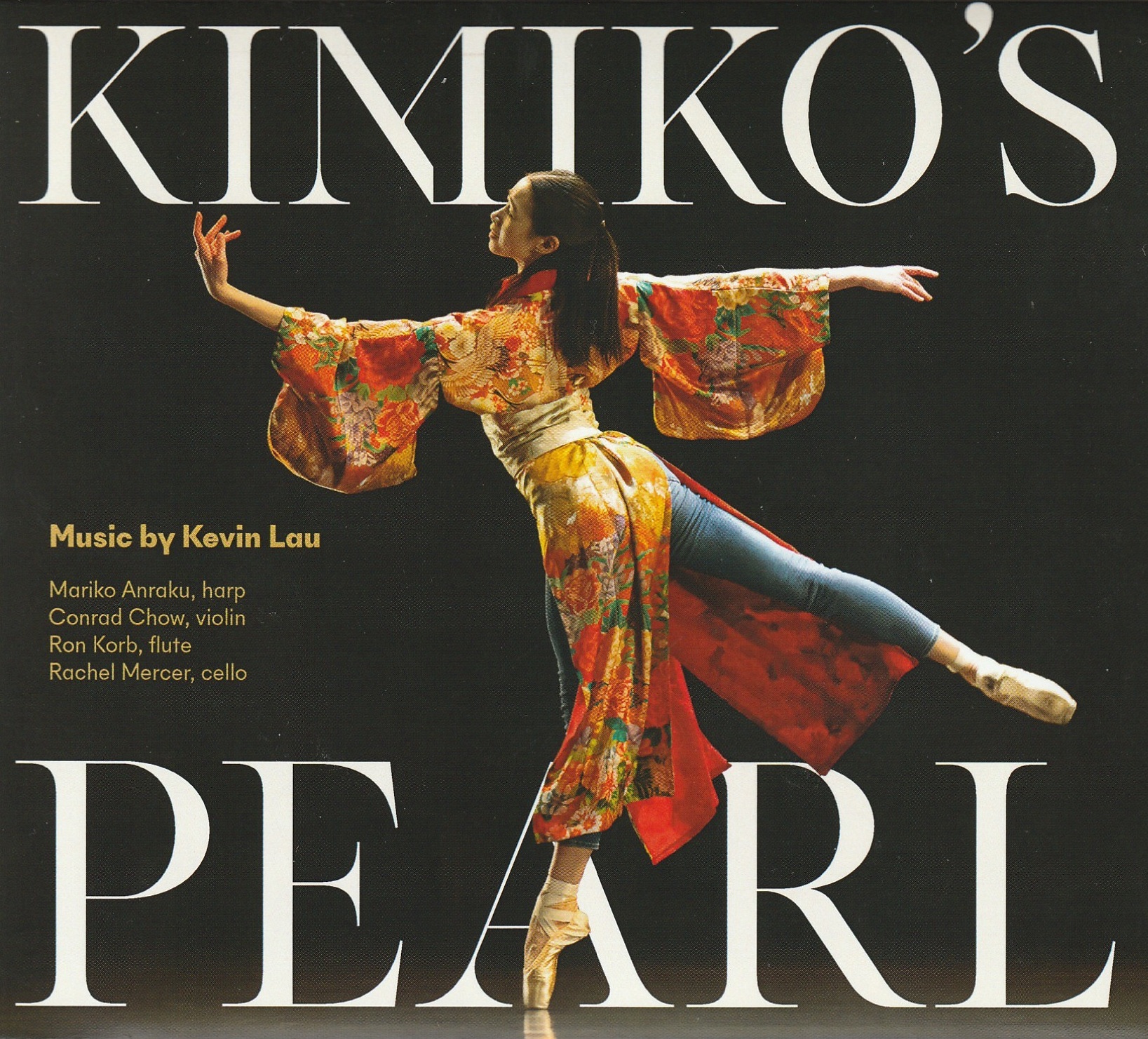
02 Kimikos PearlThere are many parallels between Stravinsky’s tale and Kevin Lau’s Kimiko’s Pearl, a ballet developed in conjunction with Bravo Niagara in 2024, now available on CD (BNCD001 kimikospearl.com). The story is centred around the internment of Japanese Canadians during the Second World War and, like the Stravinsky, also uses minimal instrumental forces: harp (Mariko Anraku), violin (Conrad Chow), Japanese and Western flutes (Ron Korb) and cello (Rachel Mercer). 

Founded in 2014 by mother-daughter duo Christine Mori and Alexis Spieldenner, Bravo Niagara is based in Niagara-on-the-Lake and dedicated to amplifying underrepresented voices through the arts. Lau says Mori and Spieldenner’s family experience of the Japanese Canadian internment inspired the narrative with its encompassing of universal themes: love, devastation, grief, resilience, and the reclamation of identity. Based on a story by Howard Reich, four generations of the Ayukawa family are represented from the great-grandfather’s arrival in Canada in 1917 through to 15-year-old Kimiko’s discovery of a mysterious trunk in their basement in Toronto a century later. There are some magical moments, such as when an antique radio broadcasts news of the Second World War, along with a wedding dress, a pearl ring and the diary also found in the trunk that help bring the family story to life for Kimiko. 

The Ayukawa family trunk, currently in the collection of the Canadian War Museum, is a real artifact built by Shizuo Ayukawa in the New Denver internment camp in British Columbia. Kimiko’s Pearl reflects the tragedies, triumphs and perseverance of Japanese Canadians before, during and after the internment they endured during WWII. A parable particularly relevant today, it attests to heroism and hope in the face of racism and intolerance. 

Lau’s lush yet crystalline score is brilliantly realized by the quartet of musicians with supplemental sound design aspects (including taiko drums and other enhancements) developed by Aaron Tsang. The CD booklet is beautifully illustrated with stunning photos from the stage production. It includes a detailed synopsis of each of the eight scenes and biographies of all involved. It’s easy to see why this very impressive package has received two JUNO-nominations, for Classical Album of the Year (small ensemble) and Classical Composition of Year.

Listen to 'Kimiko’s Pearl' Now in the Listening Room

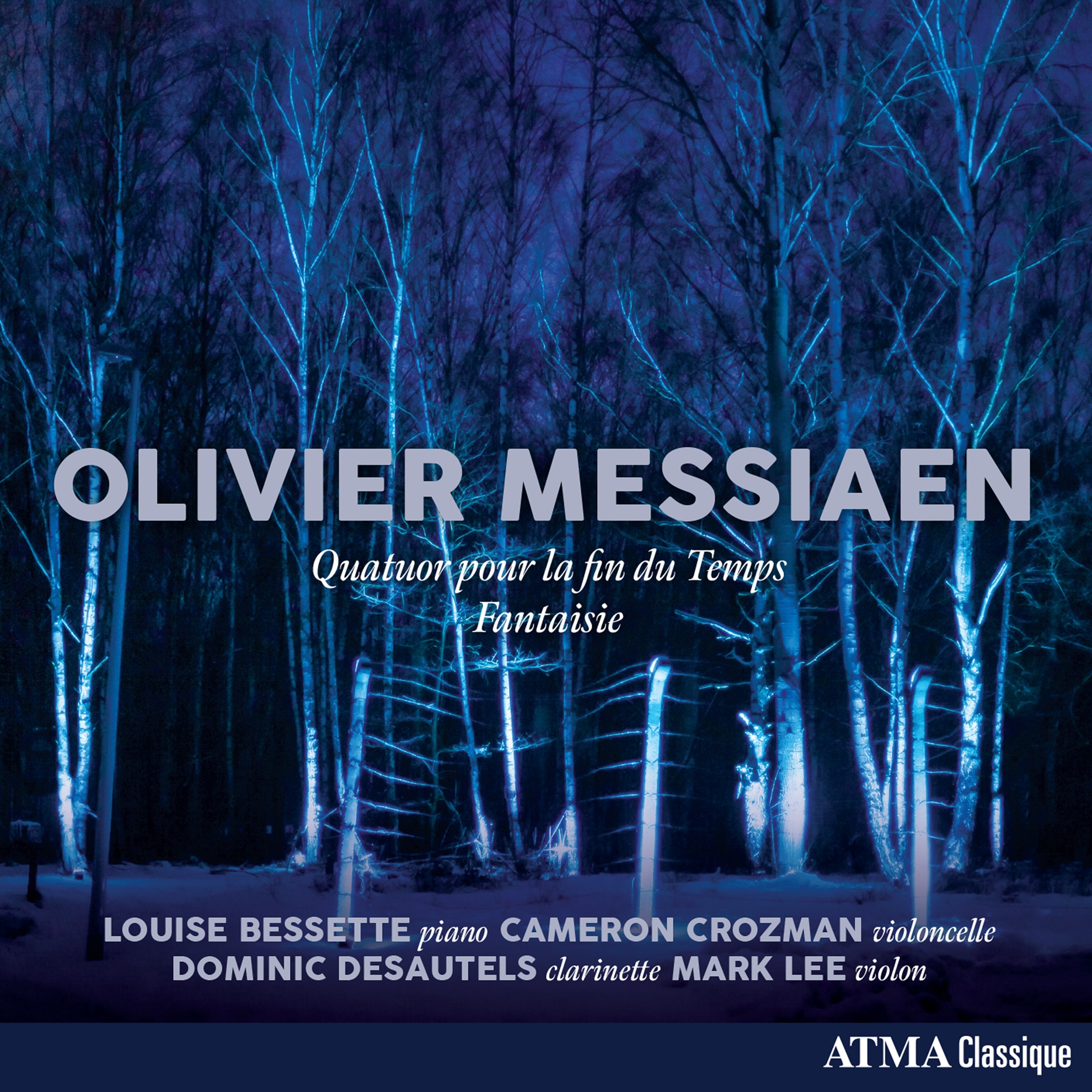
03a Messiaen ATMAPerhaps the most famous example of military imprisonment leading to the creation of a masterpiece is the story behind Olivier Messiaen’s Quatuor pour la fin du temps. Messiaen was serving in the medical auxiliary of the French army when he was captured by the Germans near Verdun in 1940 and transported to Stalag VIII-A, a prisoner-of-war camp in Görlitz, Silesia (then German territory, now Poland). During the nine months he spent there he was treated decently and with the help of a friendly German guard, Carl-Albert Brüll, who provided manuscript paper and pencils, Messiaen was able to compose. Using the meagre materials at hand – a dilapidated upright piano, a cello with just three strings, a violin and a clarinet – he wrote what would go on to be recognized as one of the greatest chamber works of the last century. The quartet reflects Messiaen’s profound religious faith, with each of its eight movements devoted to a different aspect of praise to God and Nature. The instrumentation changes from movement to movement, with each musician, except for the piano, given a solo turn. Most striking is the Abîme des oiseaux, where the clarinet, alone, rises out of nothingness to depict the abyss of the birds. 

There are two new recordings of this iconic work, and I confess that I am hard-pressed to choose between them. Thankfully I don’t have to! The first features Montrealer Louise Bessette, renowned for her performances and recordings of Messiaen’s solo piano music, having worked extensively with the composer’s wife Yvonne Loriod. She is joined by young cellist Cameron Crozman, the recipient of the 2021 Canada Council for the Arts Virginia Parker Prize, the Council’s largest award for emerging classical musicians, Dominic Desautels, principal clarinetist at the Canadian Opera Company and violinist Mark Lee, assistant concertmaster of Symphony Nova Scotia. This new disc (ATMA ACD22940 atmaclassique.com/en/produit/olivier-messiaen-quatuor-pour-la-fin-du-temps-fantaisie) is available on streaming platforms in the immersive Dolby Atmos process with exceptional clarity and depth of sound. As a bonus the disc also gives a taste of a younger, pre-mystical Messiaen with the less frequently performed and somewhat bombastic Fantasie for violin and piano (1933). 

03b Messiaen AnzuFormed in 2020, the Anzû Quartet is dedicated to the music of our time and the recent canon. Comprising Olivia De Prato (violin), Ashley Bathgate (cello), Ken Thomson (clarinet) and Karl Larson (piano), Anzû pays homage to Olivier Messiaen’s Quatuor pour la fin du temps by actively commissioning and performing new works for this iconic instrumentation. The name anzû refers to a massive, fire and water breathing bird found in Babylonian and Sumerian mythology. In these ancient texts, Anzû is linked to death and destruction as well as birth and creation, reflecting the juxtaposing themes of calamity and salvation often expressed through birdsong in Messiaen’s quartet. 

The notes to this recording (Cantaloupe Music anzuquartet.com/quatuor-pour-la-fin-du-temps) include “Thoughts about Quatuor pour la fin du temps” by Anzû’s mentor, cellist Fred Sherry, whose own group Tashi studied the work with Messiaen in the late 1970s, so advice from the horse’s mouth, if once removed. The resulting performance is one to be treasured, with all the nuance and dynamic range this exhilarating work demands. 

04 Osvaldo Golijov Ever YoursThe music of Argentine-born American composer Osvaldo Golijov is featured on a new disc entitled Ever Yours (Phenotypic Recordings phenotypicrecordings.com). Golijov tells us “Ever Yours was the last piece I wrote for and dedicated to Geoff Nuttall, who was, and still is, my brother in music and life. I was inspired primarily by two things: brotherhood, as embodied in the letters that Vincent van Gogh wrote to his brother Theo—which he always signed with the words ‘Ever Yours’—and the String Quartet, Op.76, No.2 by Joseph Haydn, who was the composer Geoff loved and admired the most […] I wrote Ever Yours, primarily, as a conversation about music, Haydn, friendship, life, and death, between Geoff and me. Geoff is now gone, and his (and my) beloved St. Lawrence String Quartet, which he co-founded and led for more than 30 years, has disbanded. But the idea of a conversation between friends continues to live…” 

Haydn’s quartet finds its way into each of the four movements, but we also hear snatches of Beethoven’s final quartet in the third. Originally written for string octet, Golijov has added a double bass in the current version for which the Arethusa and Animato Quartets are joined by bassist Nicholas Schwartz. For Tintype, violist Barry Shiffman, another founder of the St. Lawrence Quartet joins the Arethusa in a work that began its life as a soundtrack for the film Elie Wiesel: Soul on Fire. A theme inspired by several animated sequences in the film, in which Wiesel dreams of his father, who died in the Holocaust, was later expanded and became the second movement of Tintype. The first movement is based on a traditional Hebrew melody, and the third is based on a version of the prayer, “Ani Maamin” [I Believe], that Wiesel sings in the last minutes of the documentary. Here, Golijov says, “it alternates between sparse, expressionistic fragments of the prayer, and driven, motoric sections inspired by Philip Glass’s string writing. I hear the spirit of Schubert in his chamber music, as I hear it in my own music.”

The disc concludes with two shorter tracks. K’vakarat [As a Shepherd…] is a prayer from the Yom Kippur liturgy originally written for cantor Misha Alexandrovich and string quartet here performed in an arrangement for viola and strings by Shiffman. The concluding Esperanza [Hope] from 2025 is a love theme composed for the soundtrack of Francis Ford Coppola’s film Megalopolis, performed by the same nine musicians from Ever Yours, bringing the disc full circle.

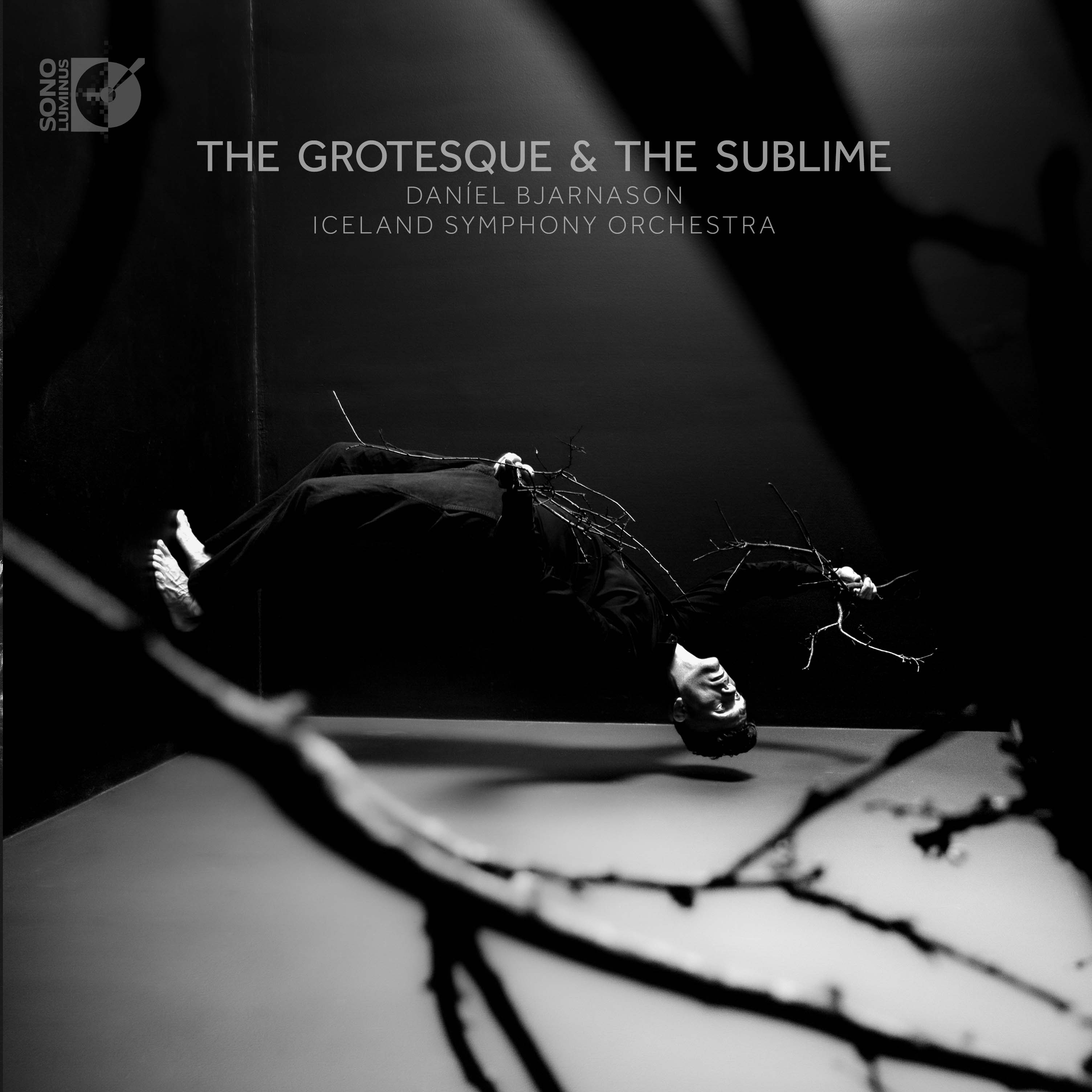
05 Daniel BjarnasonIn June 2023 the Toronto Symphony Orchestra under the direction of Gustavo Gimeno gave the premiere performances of Daniel Bjarnason’s Trilogy for Orchestra: I Want to be Alive, a work they had co-commissioned with the Cincinnati and Iceland Symphony Orchestras and the Helsinki Philharmonic. Bjarnason is currently Artist in Collaboration: Iceland Symphony Orchestra, where he previously held posts as Principal Guest Conductor and Artist in Residence. He has also worked extensively with the Los Angeles Philharmonic and one of his collaborations there resulted in the piano concerto FEAST performed by its dedicatee Vikingur Ólafsson in 2021 under Gustavo Dudamel. 

That majestic near-half-hour work opens the CD The Grotesque and the Sublime in a new performance with pianist Frank Dupree and the Iceland Symphony Orchestra, who are featured throughout the recording with the composer conducting (Sono LuminusDSL-92287 sonoluminus.com/sonoluminus/grotesque-and-sublime). Bjarnason is a hub-like figure in the group of composers who could be said to constitute a First Icelandic School. But his own music sprawls beyond the borders of the school’s typical aesthetic, its characteristic gradual transformation of vaporous orchestral sounds, akin to the shifting shape and colour of a North Atlantic cloud. This difference is amply displayed in FEAST with its seven dramatic and dynamically boisterous movements. Also of note here is an external narrative – Edgar Allan Poe’s short story The Masque of the Red Death – reflected in the phantasmagorical movement titles such as “the brazen lungs of the clock” and “domination over all (skeletal procession).” The score follows the trajectory of Poe’s story, opening with a dense and decadent party punctured by its own ‘reverie’ for solo piano. Some 25 minutes later, after the skeletal procession, the flamboyant concerto dissolves into dust.

The centrepiece of this recording, Fragile Hope – In memory of Jóhann Jóhannsson, is more like the atmospheric works of the Iceland School, and fittingly so as Jóhannsson was a seminal figure in that movement. It is dark and brooding, full of angst and longing, although there are bright moments where hope shines through. 

The final work Inferno is a percussion concerto featuring the rising young German star Vivi Vassileva. Although the three orchestral percussionists play a vast range of instruments, the soloist is limited to only a few: drum kit, wood blocks, txalaparta (a traditional Basque instrument constructed of wooden boards on a platform), marimba, Japanese taiko drums, kick drum and timpani. Bjarnason says “the primary objective was sonic: a focus on particular sound worlds, rather than a mad dash between many instruments.” The unusual sound of the txalaparta, which is featured extensively in the first and third movements, is especially intriguing and to my ear reminiscent of some of the instruments invented by Harry Partch. There is an extended and effective timpani cadenza reinforced by low strings and woodwinds. Inferno provides a stimulating climax to a scintillating disc. 

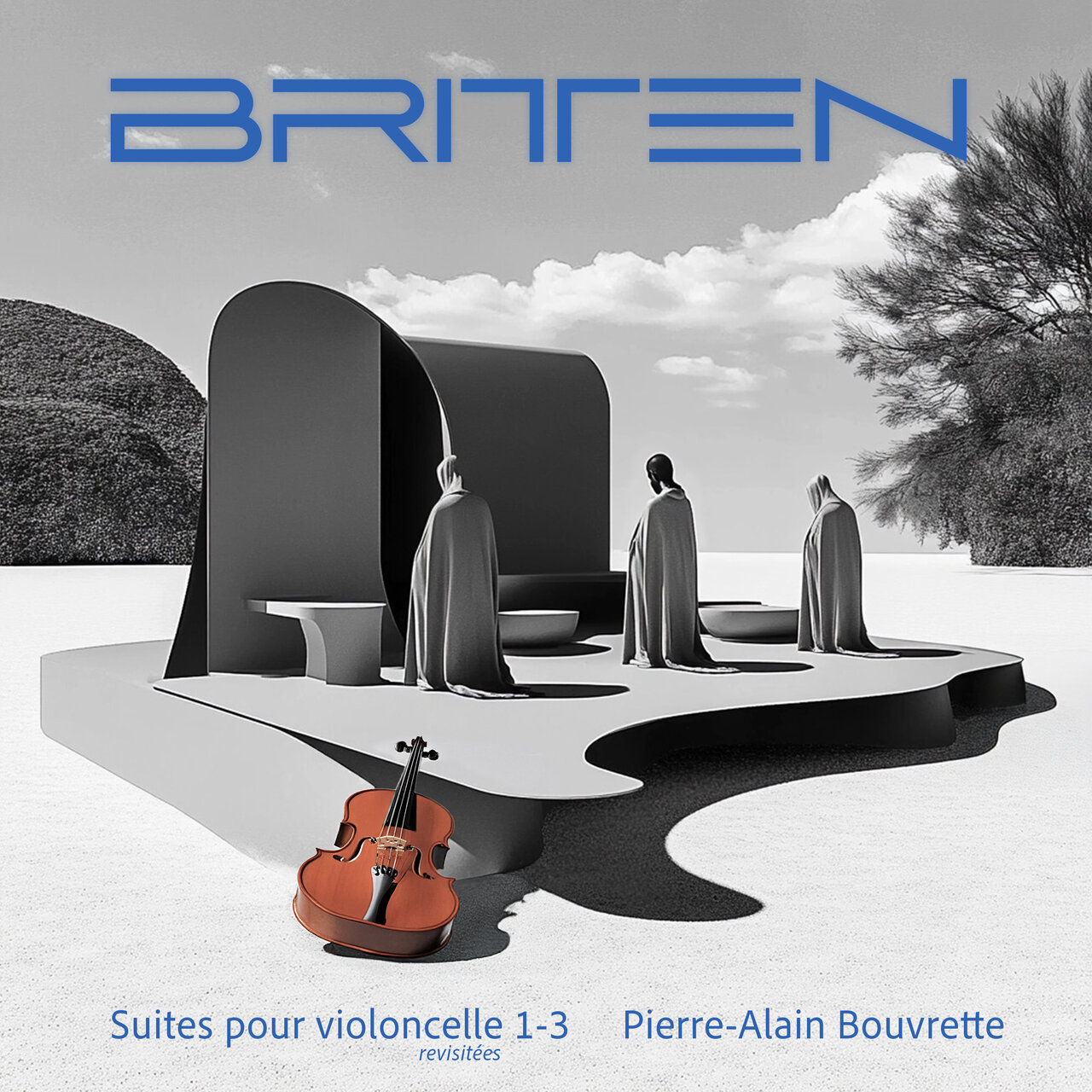
06 Bouvrette BrittenBritten – Suites pour violoncelle 1-3 (revisitées) features Montreal cellist Pierre-Alain Bouvrette. This is a digital release which unfortunately does not come with much documentation. I say this because these are very complex works, unlike most of Britten’s oeuvre and it would be useful to be given some analysis or at least some background and context to their composition. When I asked Bouvrette about this absence he responded that many digital platforms don’t support anything but audio files and cover art, so he did not produce a programme booklet. He did however send me an artist’s statement from which I have adapted the following: 

The leading element of my approach was driven by the nature of these works with their polyphonic ambitions for an instrument that is mostly monophonic. The cello can certainly be bi-phonic but it is realistically impossible to play more than 2 notes at the same time. Therefore, polyphony becomes a pure illusion. […] I have produced a studio recording, exempt from the constraints of a false linear time frame, existing only as a sound object on its own. Using every tool available in the studio I have created a version of this music, one that could be imagined through the lens of an interpreter/sound technician/sound designer. […] This was made with utmost respect for these works that I love but not without a touch of humour and lightness, which I hope may be forgiven. This version should not be taken as a reference for these works and I hope that if a listener falls in love with what they hear, they will also go listen to a more traditional version.

That all being said, I find Bouvrette’s renditions convincing and satisfying, with all the extreme dynamics and rhythmic nuances intact. The recorded sound is exemplary, and I was not aware of any obvious instances of studio manipulation. I did, however, take his advice and listened to my traditional favourite performances, those by the dedicatee Mstislav Rostropovich, and more recent recordings by Truls Mørk and Pieter Wispelwey. It was great to have an excuse to immerse myself again in these masterworks. You can find Bouvrette’s Britten on most streaming platforms, or here: palmaresadisq.ca/en/artist/pierre-alain-bouvrette/album/britten-suites-pour-violoncelle-1-3-revisitees

David Olds can be reached at discoveries@thewholenote.com

Why do I so often talk about myself as I write this column? Personal connections open doors, and ears, especially with the esoteric field of contemporary music. As I learned during my time as general manager of New Music Concerts from founder Robert Aitken, hearing firsthand from the composer – for the audience at pre-concert chats and post-concert receptions – can really foster understanding and curiosity about challenging repertoire and approaches to music-making. Of course, I also had the opportunity to get to know the composers during their often-week-long rehearsal sessions with our musicians.

01a Tim Brady Possibility of a new work for String QuatetBrady: New Music Concerts was not my first opportunity to meet composers in person and discuss their work, however. From 1984 through 1991 I was the host of “Transfigured Night” on CKLN-FM and in my first year of broadcasting I had the pleasure of meeting Tim Brady, an accomplished jazz guitarist who also composes for the concert hall. I believe he was the first guest on my overnight radio program. We discussed an album of his piano music recorded by Marc Widner on the Apparition label. This was the first of many encounters with this prodigious artist over the past 40 years, including a subsequent interview about his Chamber Concerto commissioned for New Music Concerts’ 15th anniversary event in 1986. There were numerous collaborations during my own tenure with NMC, most notably when we presented his opera Three Cities in the Life of Doctor Norman Bethune in 2005 and the evening-long multi-media creation My 20th Century in 2009. I also had the opportunity to perform in Brady’s Instruments of Happiness project While 100 Guitars Gently Weep – Concerto for George at Luminato in 2018, so my relationship with Tim is many-faceted. 

In my column last issue, I speculated that Alice Ping Yee Ho may be Canada’s most prolific and most recorded composer, but I now realize that Brady’s output rivals hers, with some 30 CDs of his own, plus a dozen more that include his work. There are also four no longer available vinyl LPs, three of which are still in rotation on my turntable, including the abovementioned Music for Solo Piano

01b Tim Brady For Electric Guitar2025 saw two releases, a double CD of solo (although many layered) works, For Electric Guitar (peopleplacesrecords.bandcamp.com/album/for-electric-guitar) and The Possibility of a New Work for String Quartet: Tim Brady String Quartets Nos. 3-5 which features the Montreal-based Warhol Dervish String Quartet (leaf.music/leaf-music-tim-brady-and-warhol-dervish-string-quartet-present-the-possibility-of-a-new-work-for-string-quartet). This album’s name is derived from the String Quartet No.3 “The (Im)Possibility of a New Work for String Quartet.” 

Brady says “In March 2019 I woke up one morning with this idea in my head: It’s impossible to write another string quartet – so many have been written – there is literally nothing left to do with the medium. I needed to think of the string quartet not as a finished product (a score) but as a process for making music. So, I wrote a bunch of instructions on how the members of a quartet should compose their own quartet. These instructions are… ‘Write a fake folk tune,’ ‘Sustain notes in F minor’ ‘Make a big noise,’ etc.—it never tells them precisely where to go or what to do but jump-starts the collaborative process.” I find this iteration of the work – the players are instructed to tear up the score at the end of the performance to insure no two presentations will be alike – very convincing, and I was captivated by the “fake folk song,” a kind of a dirge reminiscent of some of the rustic children’s songs that Béla Bartók collected. Not having read the program note in advance, I had no clue that this wasn’t through-composed, it seemed so organic.

Since sketching the outline for that work Brady has evidently found a way to reconcile himself to the medium, and the two subsequent quartets are fully fledged contributions to the genre. Brady says String Quartet No.4 from 2020 is “quite sparse and transparent, and generally slow and meditative. I also use quarter-tone harmonies in a few places in this piece... It gives a soft, almost fuzzy feel to these chords which suits the reflective nature of the work.” 

“#5 was also totally unbidden. I woke up one morning in October 2022 (near the end of the pandemic when we all had time to sit and ruminate on many things, including string quartets) and had this idea: a really big multi-movement string quartet with lots of notes and big contrasts—why not? Say 30 minutes: a good chunk of time, something that the players and listeners could really sink their teeth (ears) into. The plan is five movements—including two slow movements, with ample opportunity for the players to push their rhythmic agility and ensemble acuity. It’s a bit of a ‘chops-buster,’ but Warhol Dervish give an impressive performance.” And that’s true of all three works. By the way, Brady tells us that he has since written a sixth string quartet.

Regarding For Electric Guitar I’ll simply quote from the press release: “The three works it encompasses are all solo guitar pieces that he composed for himself to play. Throughout its 80+ minute runtime… Brady manages to embrace a plethora of styles and approaches with languid ambiences and textures, driving post-minimalist composition, nods to prog and jazz, and vital gestural moments that relate to modern concert music. The titular piece even echoes the format of a concerto, with Brady varying his tone to allow him to behave as both the soloist and ensemble.” It’s a striking achievement. 

And if you found my mention of Brady’s 100 Guitars project intriguing you can check out the latest 

Installment from the 2025 Brisbane Festival on YouTube (youtube.com/watch?v=Kqfjd4aAsO4&t=11s), where you can also find the George Harrison tribute (youtube.com/watch?v=3M_4_FTW1wY).

Listen to 'For Electric Guitar' Now in the Listening Room

Listen to 'The Possibility of a New Work for String Quartet' Now in the Listening Room

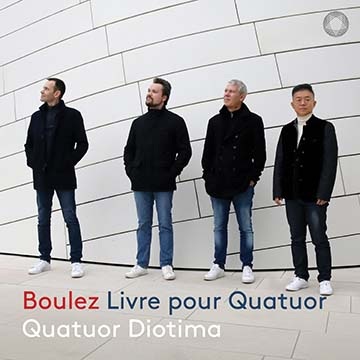
02 Boulez Livre pour QuatuorBoulez: A couple of issues ago I wrote extensively about having the opportunity to spend some time with Pierre Boulez, one of the truly great composers and conductors of our era, during my time as general manager of New Music Concerts. The context of that reminiscence was the release of a seemingly definitive set of recordings of his collected works, Boulez the Composer (DG 4847513, 13 CDs) which came out to commemorate the 100th anniversary of his birth. I recently found a stunning complement to that collection, Quatuor Diotima’s own tribute to Boulez’s centenary, a recording of his Livre pour quatuor (pentatonemusic.com/product/boulez-livre-pour-quatuor). The album features the world premiere of the piece’s fourth movement, which the composer conceived in close cooperation with the members of Diotima (who, incidentally, performed for New Music Concerts back in 2011). 

“Working on Pierre Boulez’ Livre pour quatuor was one of the founding projects of the quartet when we began in 1996. However, the project had to be postponed due to an ongoing collaboration on the same score with the Parisii Quartet. About fifteen years later, Boulez agreed to initiate a new collaboration with us around this piece. This took place within the context of a four-concert cycle project, ‘Schoenberg / Beethoven’ in which we proposed to include each of the six movements of the Livre pour quatuor between the works of those two Viennese masters, involving the creation of the fourth movement, which had previously remained unfinished… Unfortunately, severe vision problems forced [Boulez] to give up composing and conducting. The task of reconstructing this unfinished movement was therefore entrusted to Philippe Manoury. We are proud to have been associated with this project and delighted to have finally been able to record this complete version of the Livre pour quatuor.” 

The Parisii’s 2001 recording of the then existing five movements was included in the DG set mentioned above. Thanks to this exquisite new release by the Diotima I can now consider my Boulez collection complete.

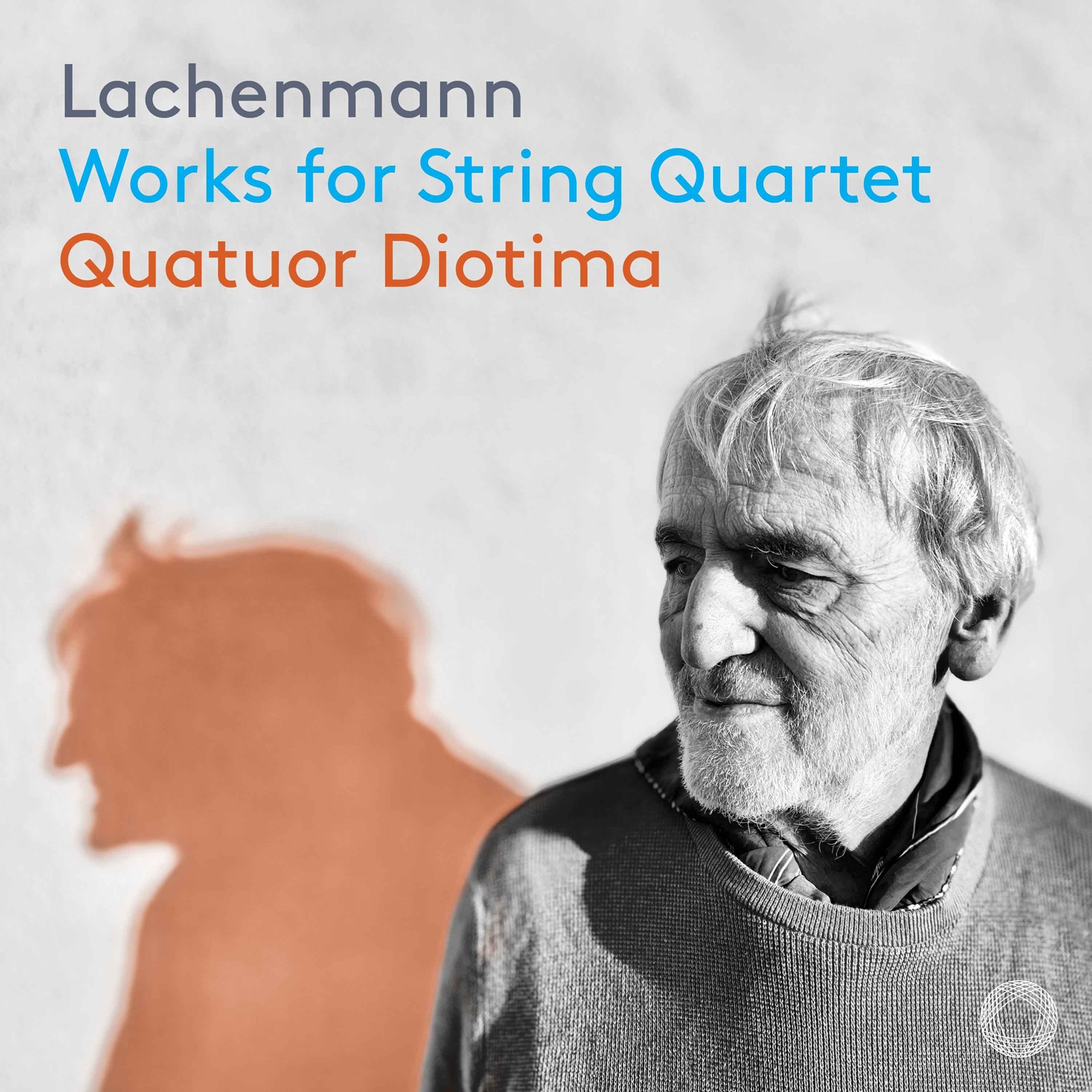
03 Lachenmann DiotimaLachenmann: Another iconic composer I had the pleasure of meeting through New Music Concerts is Helmut Lachenmann (b.1935). Known for his “musique concrète instrumental,” Lachenmann’s music makes extreme demands on the players, utilizing a plethora of unconventional playing techniques which produce unusual sounds from conventional instruments. Often entire pieces unfold without any traditionally “musical” tones, melodies or harmonies. This is exemplified on Lachenmann: Works for String Quartet (pentatonemusic.com/product/lachenmann-works-for-string-quartet), the fruit of a 25-year collaboration between Quatuor Diotima and that visionary composer. 

Their first meeting in 1998, originally just a one-week workshop, sparked a deep artistic bond and a shared fascination with his radical approach to sound and listening. This album is the result of hundreds of hours spent in rehearsal, performance, and conversation with the composer. It doesn’t make for easy listening, even in comparison to the rigours of the music of Boulez, but patient and careful listening will reward the adventurous musical soul. 

Quatuor Diotima is not the only ensemble to have benefited from working with Helmut Lachenmann. Back in 2003 an early iteration of the JACK Quartet came to Toronto for an intensive masterclass with him under the auspices of New Music Concerts. Fully matured, JACK would return to headline a concert co-presented by NMC with Music Toronto a dozen years later, but this encounter with Lachenmann was a formative experience for the young quartet. 

04 Wuorinen MeglaithWourinen: another iconic composer who graced the stage of NMC during my tenure is Charles Wuorinen (1938-2020). Perhaps best known for his opera Brokeback Mountain, Wuorinen’s uncompromising oeuvre encompassed solo works to large orchestral scores and included electronic compositions, such as 1970’s Time’s Encomium for which he won a Pulitzer Prize. A recent addition to his discography, MEGALITH (rezrecordz.com/megalith), comprises six works from the composer’s later years. JACK is joined by violist Miranda Cuckson and cellist Jay Cambell for Zoe (2012) which to my ear harkens back to the serialism of the Second Viennese School (rather than to the lush textures of Schoenberg’s own string sextet Verklärte Nacht). 

The disc begins with Spin 5, a concerted work from 2006 for solo violin (Alexi Kenney) and an ensemble of 18 musicians conducted by James Baker, and also includes a piano concerto, the title work from 2014, featuring Peter Serkin and the Saint Paul Chamber Orchestra under Matthias Pintscher. Filled out with an extended work for solo oboe (Jacqueline Leclair) and mixed sextet, Buttons and Bows for cello (Michael Nicolas) and accordion (Mikko Luoma), and Scherzo for solo piano (Tengku Irfan) this collection is a testament to the importance of one of the most challenging American composers of the last half century.

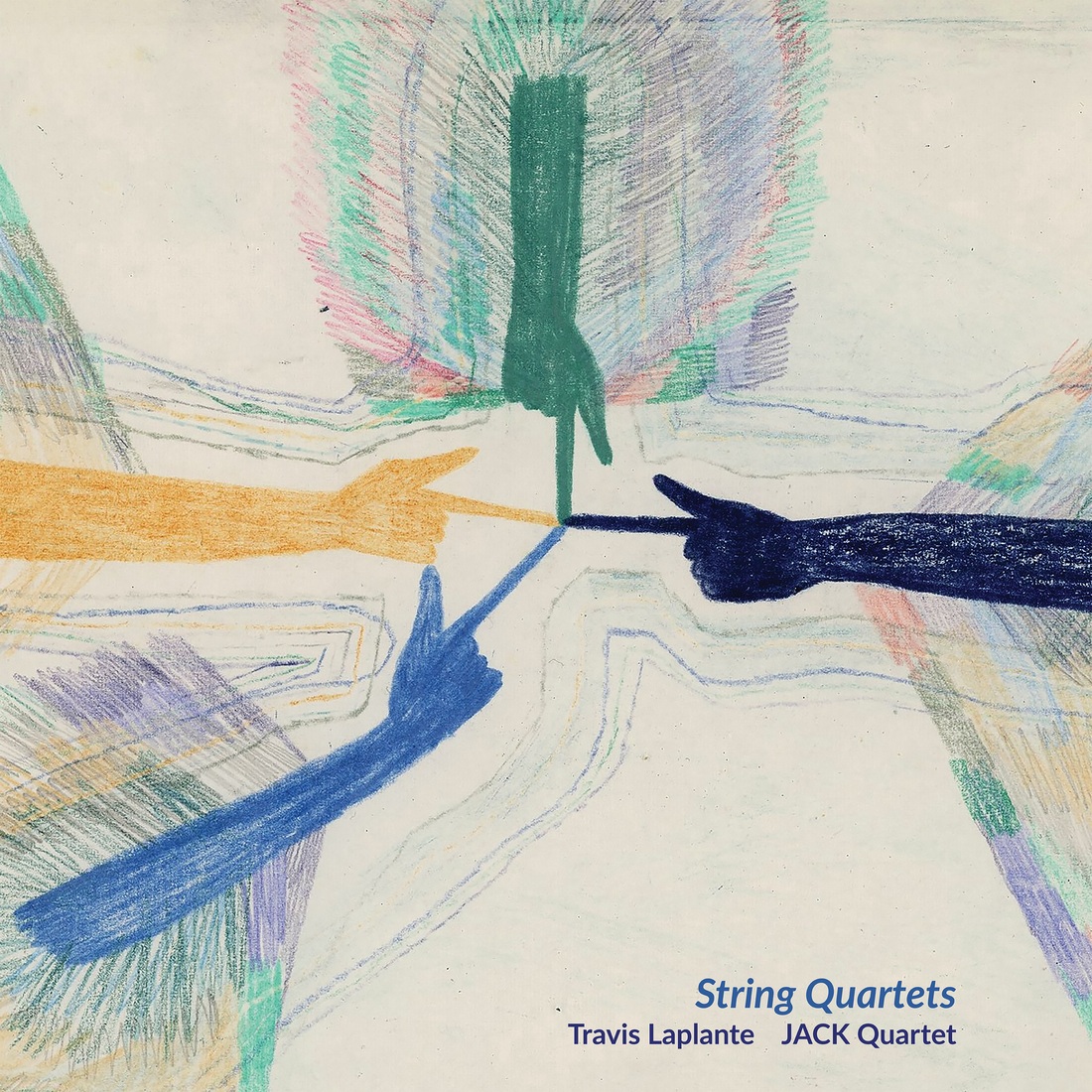
05 Travis Laplante JACKLaplante: While JACK Quartet is only peripherally involved in the Wuorinen recording, they are front and centre on Travis Laplante – String Quartets 1 & 2 (New Amsterdam Records travislaplante.bandcamp.com/album/string-quartets). The Brooklyn-based composer and saxophonist was deeply moved by the experience of reading W. A. Mathieu’s seminal theory book The Harmonic Experience. This led to an interest in resonance which led to studies with Mathieu, and ultimately to a PhD in composition at Princeton University. 

Laplante’s fascination with resonance guided him into the world of just intonation using the Helmholtz-Ellis notation system, and into collaborating with JACK Quartet who have extensive experience working within this musical framework. This is particularly noticeable in the first movement of String Quartet No.1 where the slowly unfolding muted opening has a medieval quality. The second movement, which also opens quietly, develops into minimalist textures and arpeggios referred to as [Philip] Glass-esque by the composer. 

String Quartet No.2 leads the listener to harmonic spaces that challenge our perception of beauty and resonance. The longing melodic payoff at the end of the piece comes only after moving through an intense harmonic passage that pushes and pulls consonant harmony to its extremes. JACK Quartet performs at the very edge of intensity where any push can break the music, yet they remain in total control…” 

I see I have, as usual, used up most of my allotment talking about myself, but there are several other striking discs which came our way that I want to bring to your attention before they get too “long of tooth.” To keep things brief, I’ll rely on the accompanying press releases for the basic info. I want to assure you, however, that after repeated listenings I can, in all cases, wholeheartedly embrace the publicists’ enthusiasms.

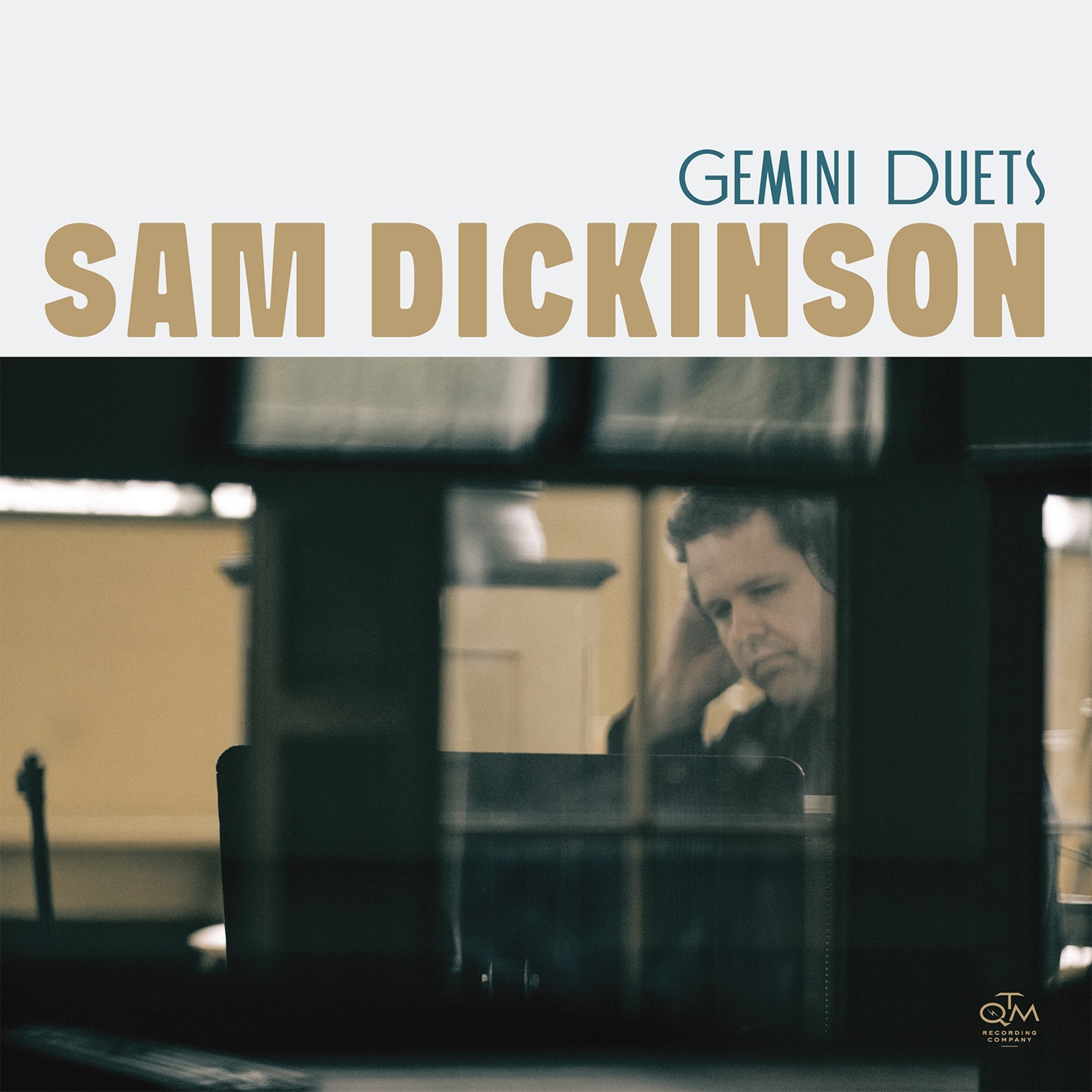
06 Sam DickinsonTo start, I want to make amends to one of our reviewers, Sam Dickinson, whose disc Gemini Duets (tqmrecordingco.com/sam-dickinson-gemini-duets) somehow fell through the cracks when it was released last spring. “Gemini Duets was envisioned as a mainly solo guitar album ‘with a few overdubs,’ but quickly grew into a broader project offering dense contemporary soundscapes, multi-tracked duets, and unaccompanied vignettes. This exciting new music was captured at the historic Sharon Temple in Aurora, Ontario by Ron Skinner. 

“Effects and electronics have been part of Dickinson’s sound since he first began playing guitar, and Gemini Duets has a healthy helping of these sounds without them taking away from the notes and song-forms.” Dickinson describes this mandate as “I’ve always been interested in how differently I play depending on my instrument and setup of choice. That said, I’m amply careful not to stray from the core of the music itself just to ‘experiment’ with new gadgets and gizmos.” 

The result is a solid offering based in straight-ahead jazz idioms ranging from contemplative and balladic tracks to playful turns and rich, resonant soundscapes.

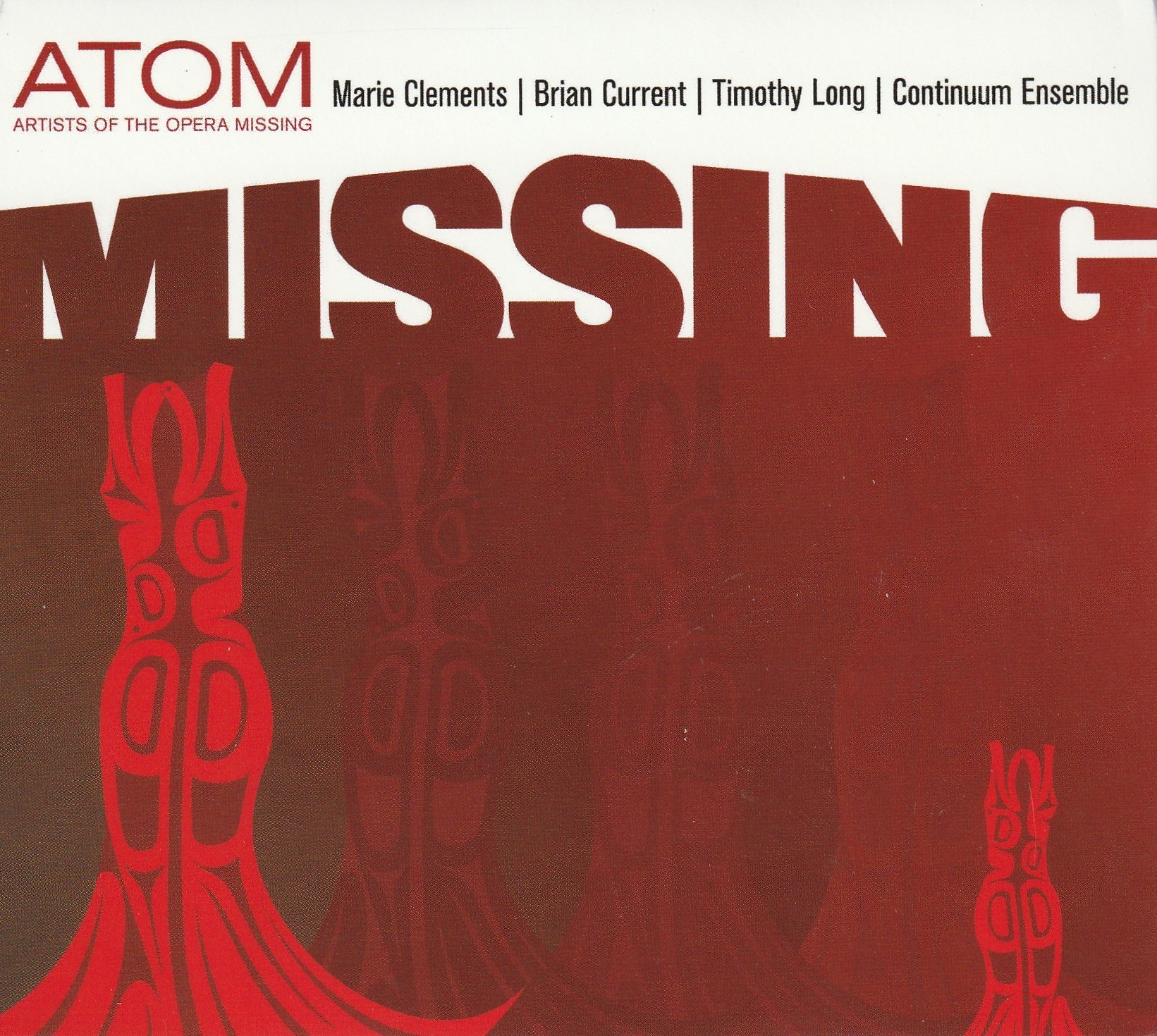
07 MissingA co-commission and co-production of City Opera Vancouver and Pacific Opera Victoria, MISSING was created to confront the ongoing crisis of Canada’s Missing and Murdered Indigenous Women and Girls (MMIWG). More than half the cast and crew are of Indigenous background, yet as librettist Marie Clements – herself of Métis/Dene heritage – comments: “To me and to so many other people, this is not an Indigenous issue; it’s a human issue. As human beings we have a responsibility to end this, and so we’re asking for people to open their hearts, to be able to comprehend on an emotional level what’s really happening.” Guggenheim Fellowship and Juno Award-winning composer Brian Current (now artistic director of New Music Concerts) joined the project after the libretto was completed and composed the music in close partnership with the cast and cultural advisors. 

Set in Vancouver and along the Highway of Tears, MISSING was premiered in November 2017 at City Opera Vancouver and toured by Pacific Opera Victoria in British Columbia and Saskatchewan in 2019. This recording (Bright Shiny Things brightshiny.ninja/missing) features ATOM (Artists of the Opera Missing, including sopranos Cait Wood and Melody Courage and mezzo Marion Newman) and Toronto’s Continuum Ensemble. Conductor and musical director Timothy Long, says: “Being a Muscogee/Choctaw man, I have often felt alone in this musical world, but MISSING revealed the purpose of my path. The victims and the families looked like my family and me. It pivoted my life trajectory towards representing all Indigenous people.”

According to Current, “Working on MISSING alongside Indigenous artists and listening to families of the missing quietly shifted how I see the world. I hope this recording invites the same kind of awakening.” I think it will. 

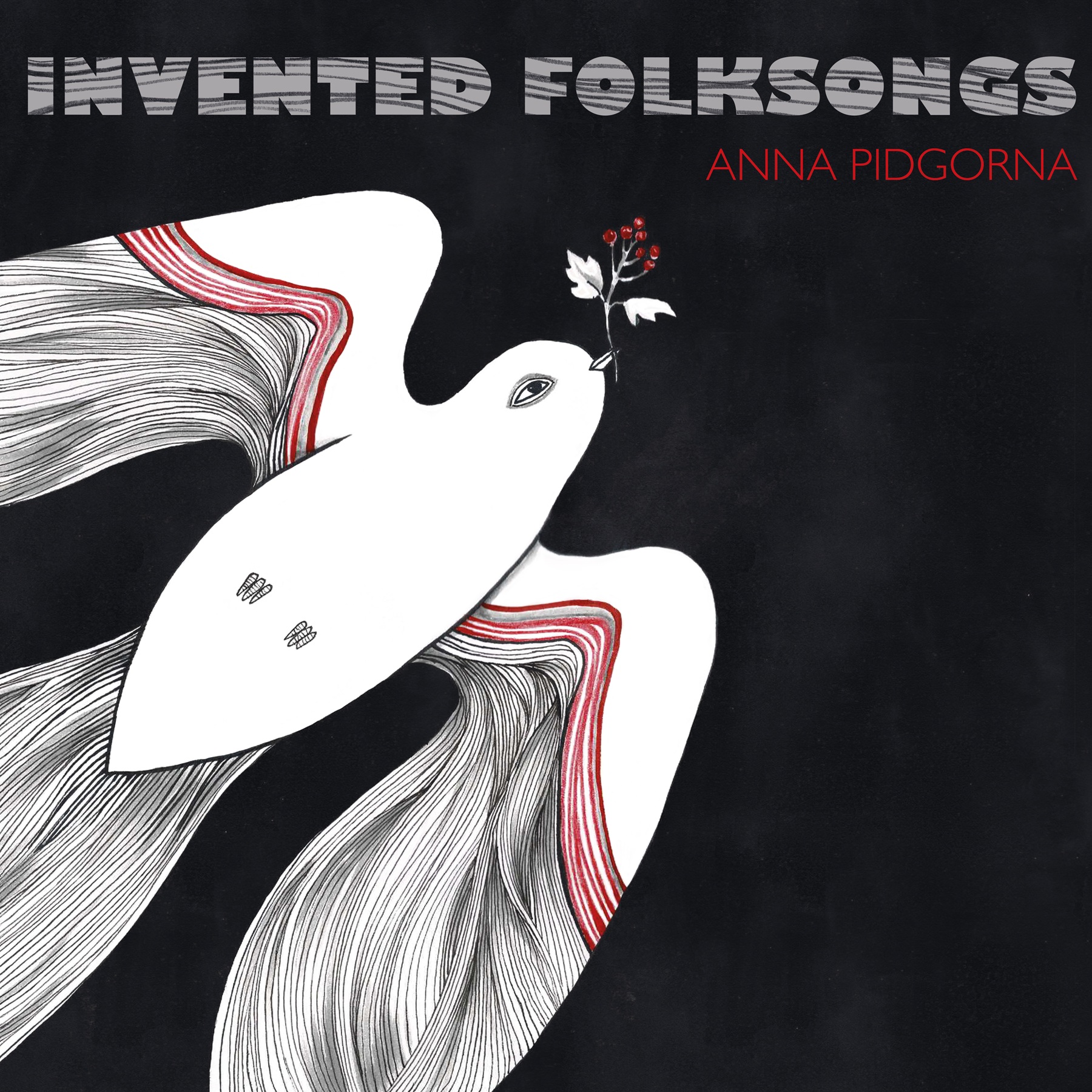
In 2015 New Music Concerts commissioned Canadian Anna Pidgorna to create a piece based on her Ukrainian heritage for a concert featuring a new work by Odessa native Karmella Tsepkolenko. The result was Weeping, for mixed sextet based on rural Ukrainian traditional mourning songs, which Pidgorna had discovered through archival recordings during field work in Ukraine in 2012. Mesmerized by the sonic qualities and emotional power of these songs, a new chapter in her musical development began.

08 Anna Pidgorna Folksongs“Invented Folk Songs (redshiftmusicsociety.bandcamp.com/album/invented-folksongs) is a set of songs resulting from her traveling to Ukraine to study with traditional music practitioners. Returning from this period abroad, she subsequently arranged to study voice [at] Princeton with the intention of building her own hybrid vocal sound. The bold, powerful voice she has since cultivated, is couched here in matching ensemble textures that capture the drive and raw emotion of folk music, yet stray far from traditionalism in their form and sound. She has harnessed the strengths of both musical realms, rather than blending superficially. She finds the places where traditional playing overlaps with so-called extended techniques, and expands upon the compositional features of these folk songs that are ripe for experimentation… The lyrics, also written by Pigorna, function similarly, drawing on folkloric imagery and tropes to formulate relevant commentary, often with a strong feminist bent.” The booklet includes the lyrics in her hybrid Ukrainian dialects with full English translations.

Pidgorna is accompanied by the Ludovico Ensemble, a Boston-based chamber group specializing in modern music, known for focusing on specific and often unusual instrumentations. For this recording the instruments are violin, cello, double bass, cimbalom, piano and percussion.

Listen to 'Invented Folk Songs' Now in the Listening Room

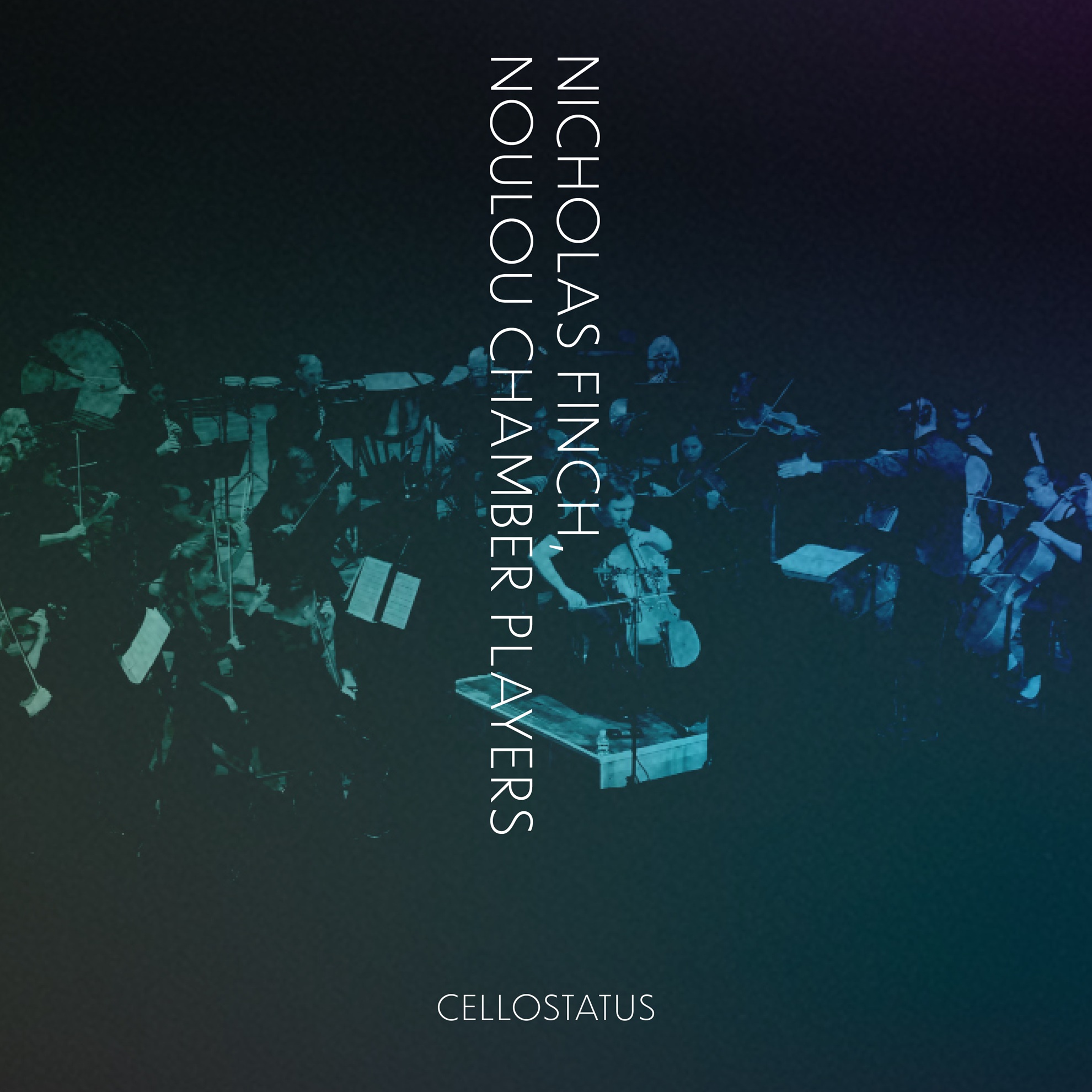
09 Nicholas Finch CellostatusWhen I first started collecting contemporary “classical” music, I was intrigued to find that the Louisville (Kentucky) Orchestra, contrary to common wisdom, was specializing in modern music and trying to support itself by commissioning and recording new orchestral works. Evidently the practice continues to this day, some 90 years after the orchestra’s founding by Robert Whitney. 

Cellostatus (brightshiny.ninja/cellostatus), is the debut album from Louisville Orchestra principal cellist Nicholas Finch and the NouLou Chamber Players (Louisville), conducted by Jason Seber. Comprising three world premiere works – by Dorian Wallace, Alyssa Weinberg, and Ljova – commissioned by Finch and the ensemble, the album’s far-flung inspirations include the Kübler-Ross stages of grief (Wallace), the Latin word caligo meaning darkness or obscurity (Weinberg), and the ubiquity of the smartphone and social media (Ljova). Finch is in fine form, ably rising to all the diverse challenges in these attractive works.

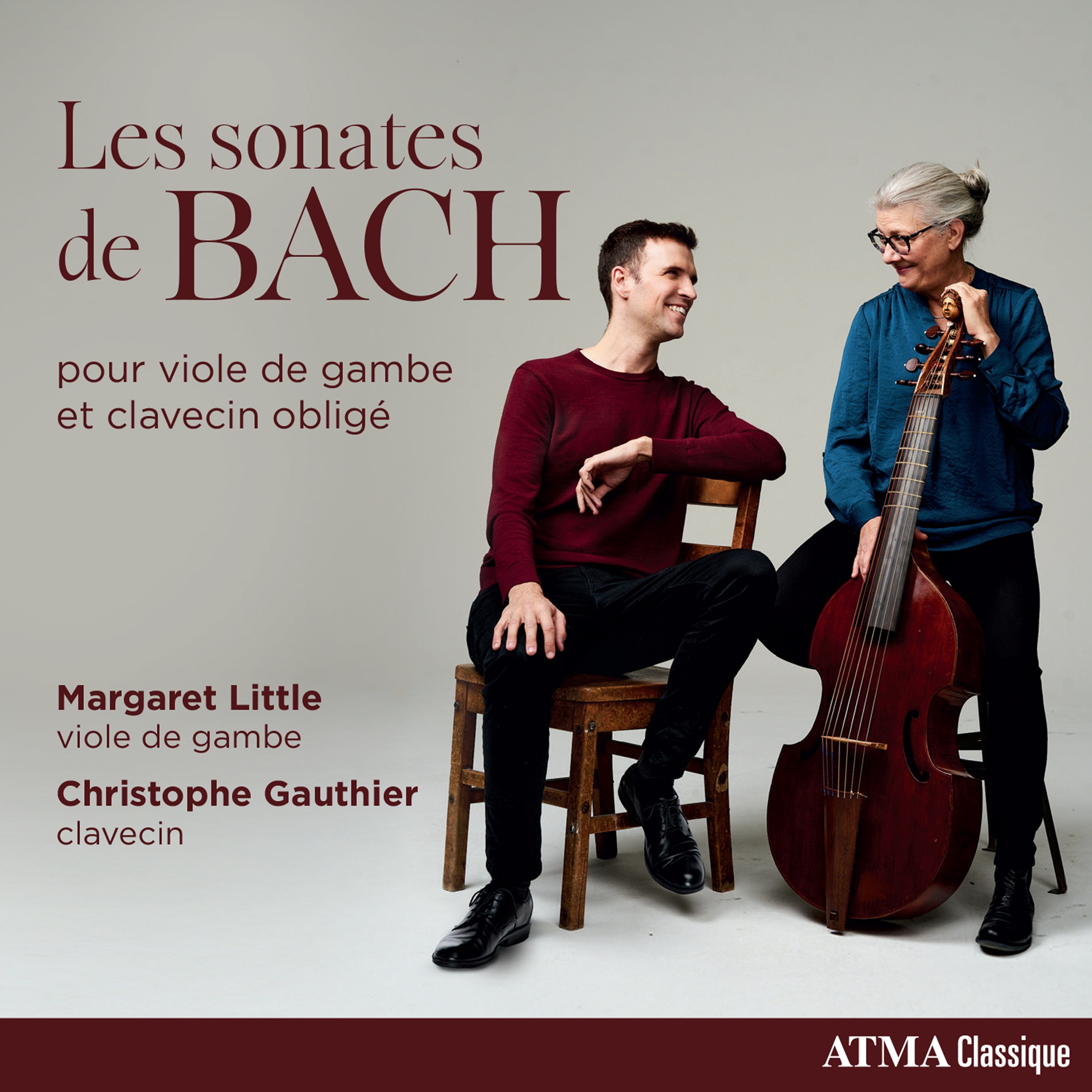
10 Bach GambaMy introduction to Johann Sebastian Bach’s sonatas for viola da gamba and obbligato harpsichord was a recording on modern instruments by Leonard Rose (cello) and Glenn Gould (piano). I became enamoured of these “true contrapuntal jewels,” but I must say that hearing them on period instruments has opened my ears in a whole new way (atmaclassique.com/en/product/the-sonatas-by-bach-for-viola-da-gamba-and-obbligato-harpsichord)

“These works offer a dialogue of remarkable eloquence between two instruments engaging on equal footing, revealing both the expressive depth and architectural refinement of Bach’s chamber writing. 

Margaret Little and Christophe Gauthier offer a performance that is at once precise, flexible, and deeply expressive. Their musical rapport highlights the nuanced palette of the viola da gamba and the brilliance of the harpsichord, illuminating the emotional power of Bach in a recording that is both vibrant and elegant.” 

Two pieces by Antoine Forqueray — La Couperin and La Buisson — complete the program with their virtuosity and distinctly French refinement. A truly refreshing experience.

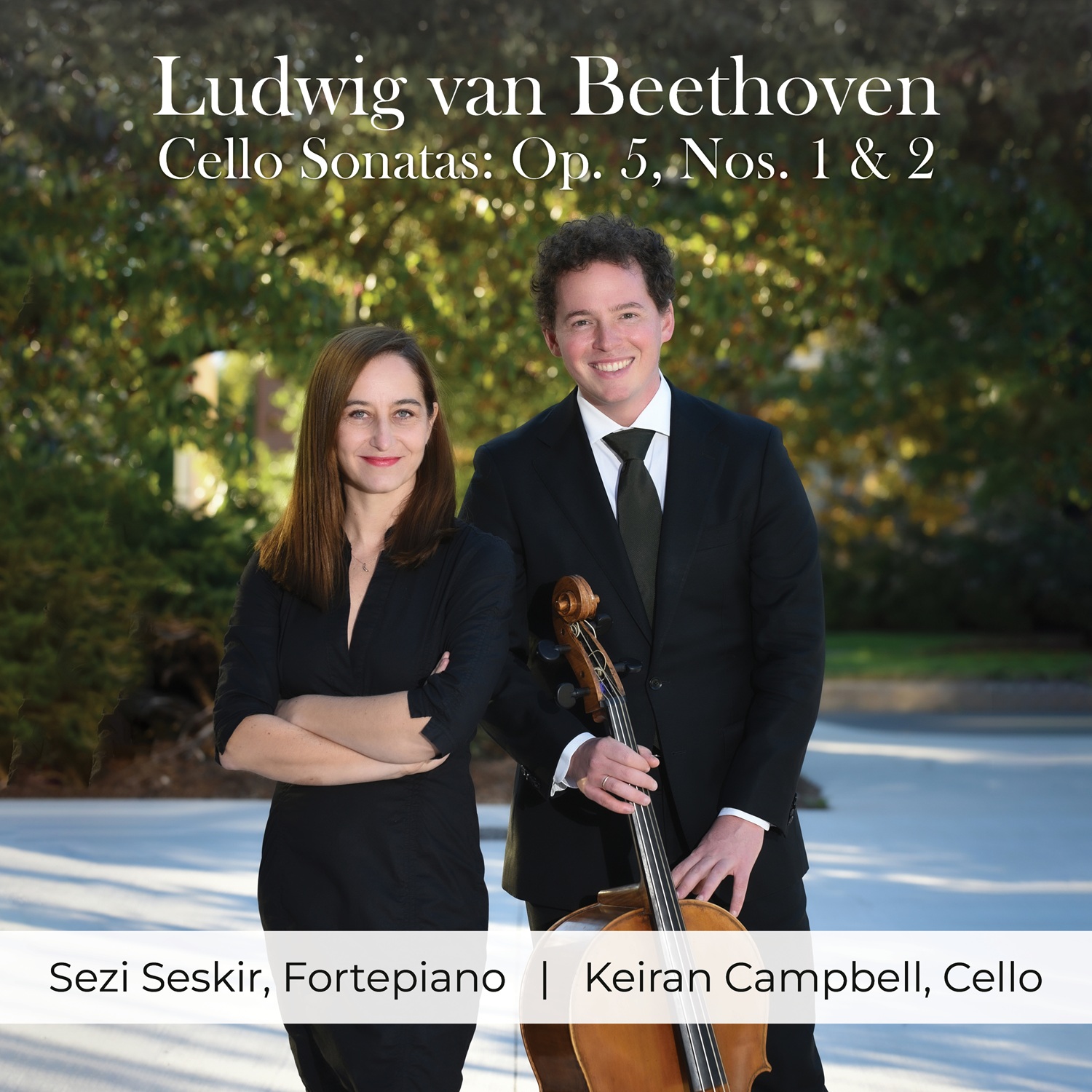
11 Beethoven Cello Keiran CampbellAs with the Bach sonatas, I first heard Beethoven’s cello sonatas recorded by Mstislav Rostropovich and Sviatoslav Richter, and my current favourite recording features Pieter Wispelwey and Dejan Lazić, again on modern instruments (Channel Classics CCS SA 22605). I must say, however, that a new period performance of Beethoven Cello Sonatas, Op. 5 by cellist Keiran Campbell and Sezi Seskir (fortepiano) (leaf.music/keirancampbell-seziseskir-beethoven) is growing on me for its sheer rawness and exuberance. 

“Performing on a fortepiano with its leather hammers, and on a gut-strung cello with a supple classical bow allows the players to recapture these beloved sonatas’ intended original sound. The two cello sonatas (Nos. 1 and 2) were composed in 1796, and saw Beethoven attempting to make the two instruments more equal while celebrating the capabilities of the five-octave piano.” 

Campbell is co-principal cello of Tafelmusik, and on faculty at the Chamber Music Collective, an intensive chamber music program on period instruments which focuses on post-1750 performance practice. Seskir is a co-founder of the Chamber Music Collective, and an associate professor of Music at Bucknell University. Together they bring new life to these timeless pieces.

Listen to 'Beethoven Cello Sonatas, Op. 5' Now in the Listening Room

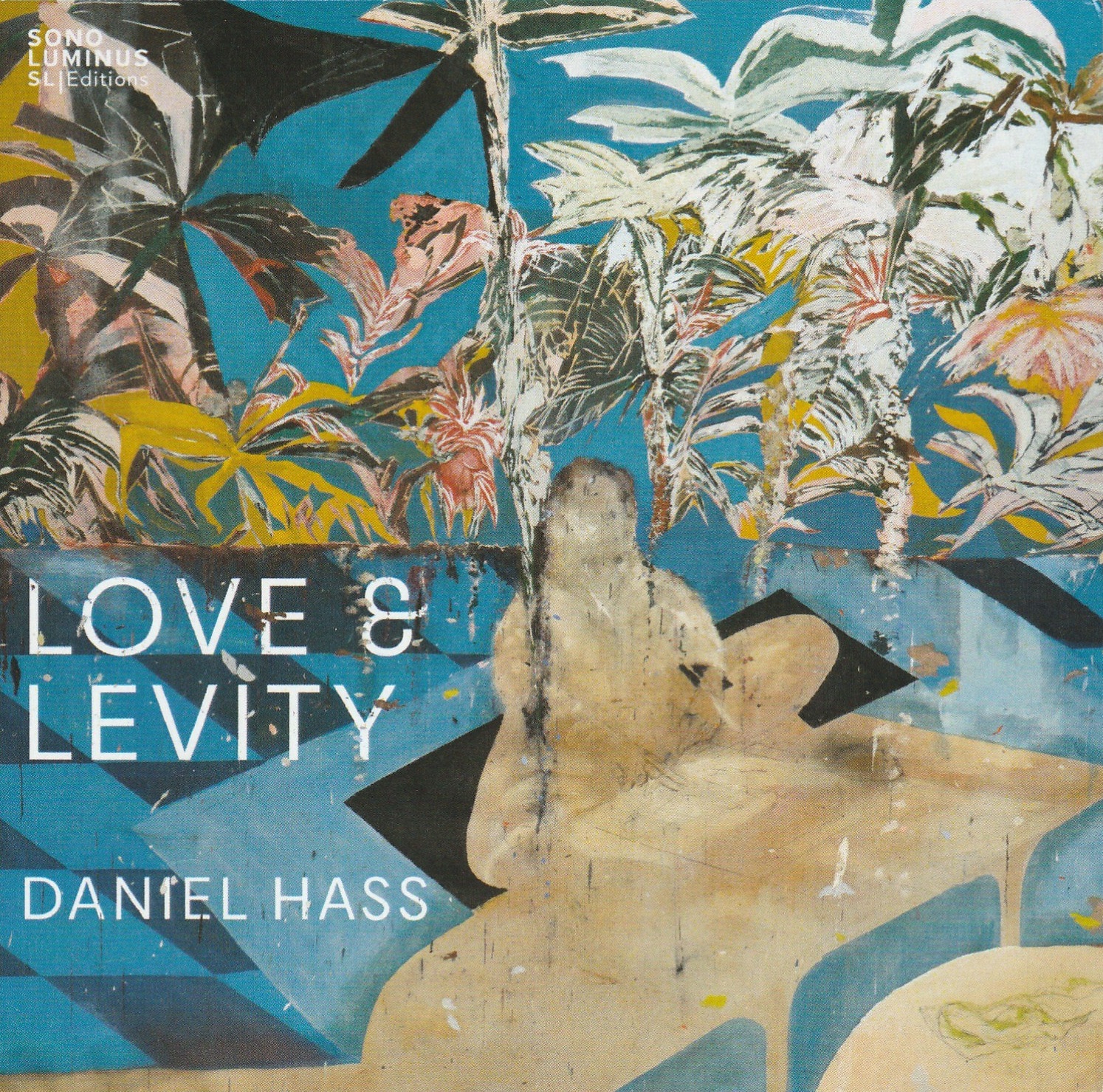
12 Daniel HassCanadian cellist and composer Daniel Hass has built an impressive career that encompasses a diverse range of pursuits, genres, and achievements. He has performed as soloist with orchestras across Canada, the United States, and Europe; and has received numerous commissions, including one from the Glenn Gould Foundation, The Lord of Toronto, His Pavin, for cello and piano dedicated to Glenn Gould.

He wrote to me earlier this year to say “I’m excited to share my next milestone: my debut album Love and Levity (travislaplante.bandcamp.com/album/string-quartets). […] This recording features my original compositions for string quartet and piano quartet, performed by the Renaissance String Quartet and other collaborating artists. These quartets are Beethovenian at heart, in their thematic and structural tautness, but draw from contemporary musics such as Jazz and Folk along the way… [They] were written in the summer of 2021. There was a pandemic going on, and I spent most of the summer in my apartment, reading books and feeling the momentum of life melting away in the heat.”

While the COVID lockdown was not such a productive time for many people, Hass certainly put his isolation to good use, crafting these fine chamber works. 

David Olds can be reached at discoveries@thewholenote.com.
As I write this my street is adorned with ornamental lights, pumpkins, goblins, skeletons and gravestones in advance of Hallowe’en, so perhaps it is fitting that I begin my column with a work based on ghost stories. Alice Ping Yee Ho is one of Canada’s most prolific composers, and surely one of the most recorded, with a discography encompassing 13 CDs devoted to her songs and solo piano works, electronic dance scores, chamber music, orchestral pieces and several operas. There are also some two dozen compilations that include her compositions.  

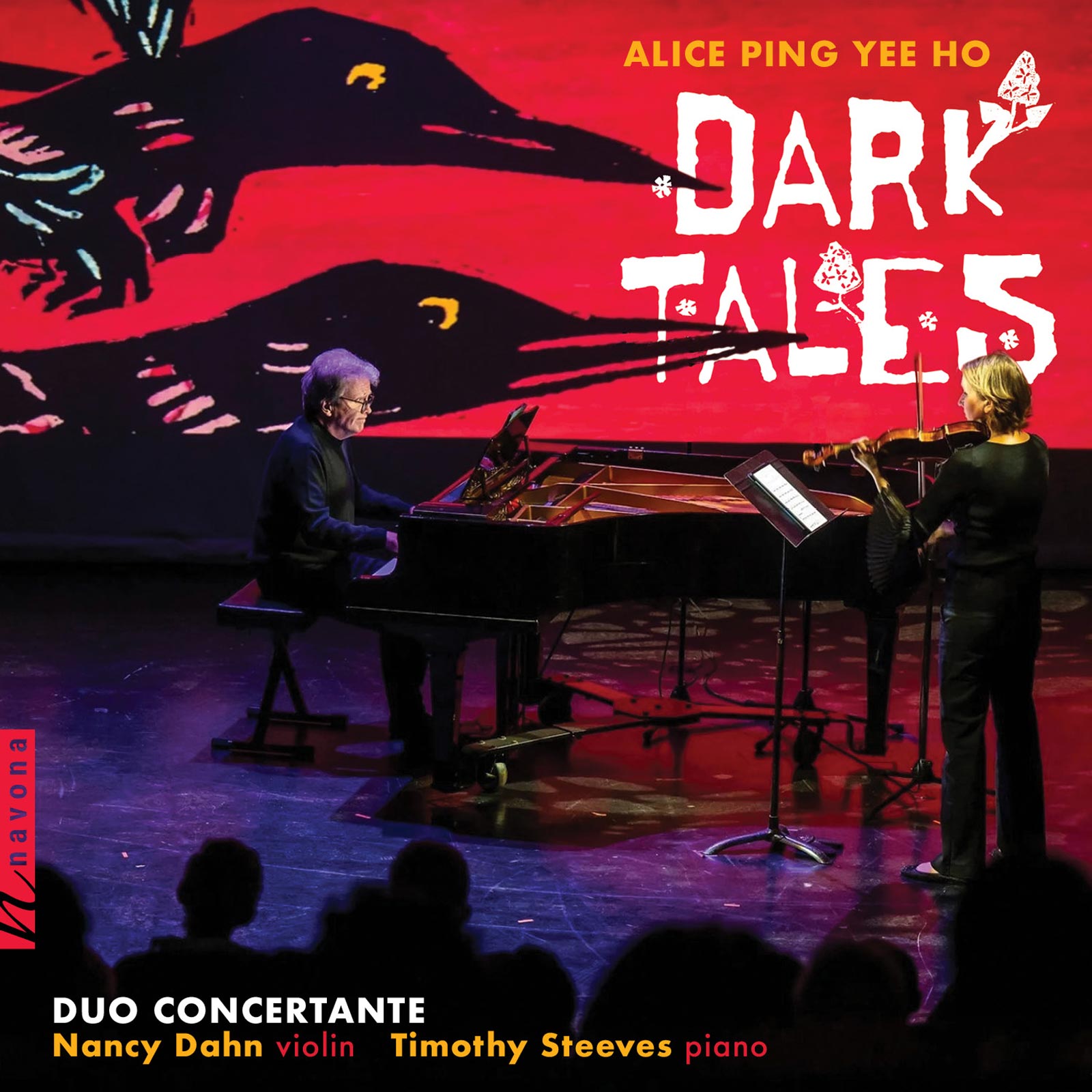
01 Alice Ho Dark TalesA recent case in point is Alice Ping Yee Ho – Dark Tales, the latest from Duo Concertante (Navona Records navonarecords.com/catalog/nv6748), an evocative five-movement work inspired by Tom Dawe’s story collection An Old Man’s Winter Night. Each movement channels a ghost story rooted in Newfoundland folklore. The Newfoundland-based duo of violinist Nancy Dahn and pianist Timothy Steeves who commissioned the work is in top form here, giving each movement a distinctive colour. 

From the brash opening of the title work, through the eerie Landwash Spirits telling of shipwrecks and ghosts at sea, Sheba, in which the narrator is saved by the dog he had previously had to put down, the hauntingly beautiful Woman in the White Dress, to the concluding House in the Drook which tells of the misfortunes that befall a house built upon a “fairy ring,” the hour-long cycle captivates our imaginations. 

Originally premiered in an immersive performance with three-dimensional projections, the audio CD captures the intensity and mystery of Ho’s vision, bristling with the enchantment of the spirit world.

Listen to 'Dark Tales' Now in the Listening Room

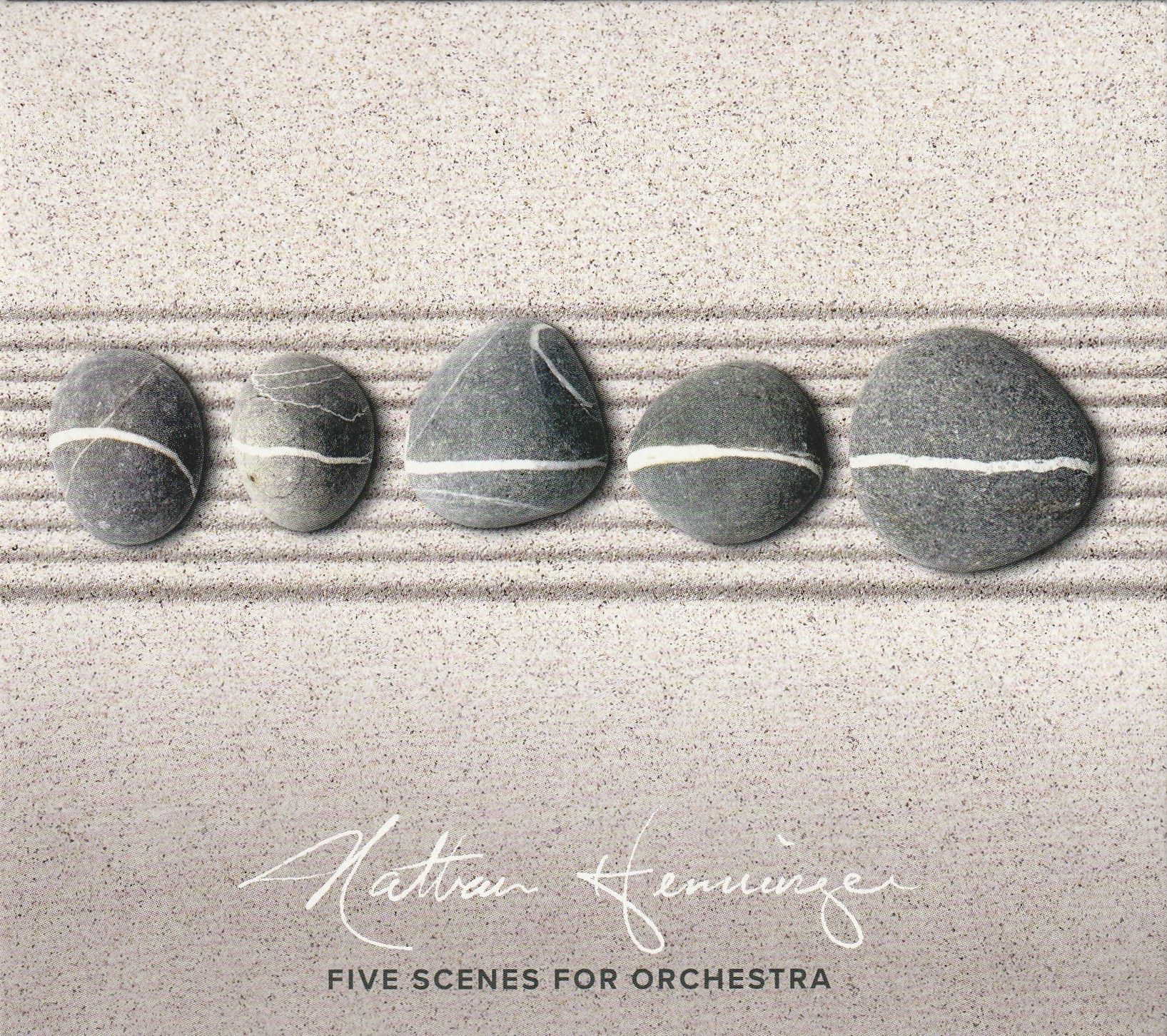
02 Nathan HenningerAlthough not eerie in the same way, Five Scenes for Orchestra by Azores- and New York City-based Canadian composer Nathan Henninger (rich records nathanhenninger.com/music) is equally dramatic. The recording features the Scoring Berlin Orchestra, session musicians drawn from Berlin’s most prestigious orchestras, with conducting duties shared by the composer and Bernhard Wünsch. Although we are not given clues to a specific story line from the movement titles – Misterioso, Maestoso, Brightly, Misterioso and Gently – if you close your eyes you can likely invent a scenario to go with the lushly orchestrated sounds. 

The 20-minute suite is introduced with a brief prelude entitled Horn (Henninger’s own instrument), setting the stage for the adventure to come. I’ll let the composer’s descriptions give you a sense of the drama that ensues: Scene 1 – a primordial or primitive space out of which emerges the principal melody in the flute; Scene 2 – opens eerily and develops the material in a spirited way; Scene 3 – a diatonic space… drawing to a serene orchestral glow; Scene 4 – a more dramatic, cinematic and dissonant exploration… as we encounter darker elements; Scene 5 – shimmers as the celesta softly chimes [and] the horn and flute share a poignant dialogue [before returning] to the romantic theme in full bloom.

Toronto-born Henninger is a composer and conductor of music for film, TV and the concert stage, all of which is reflected in this impressive orchestral debut recording. 

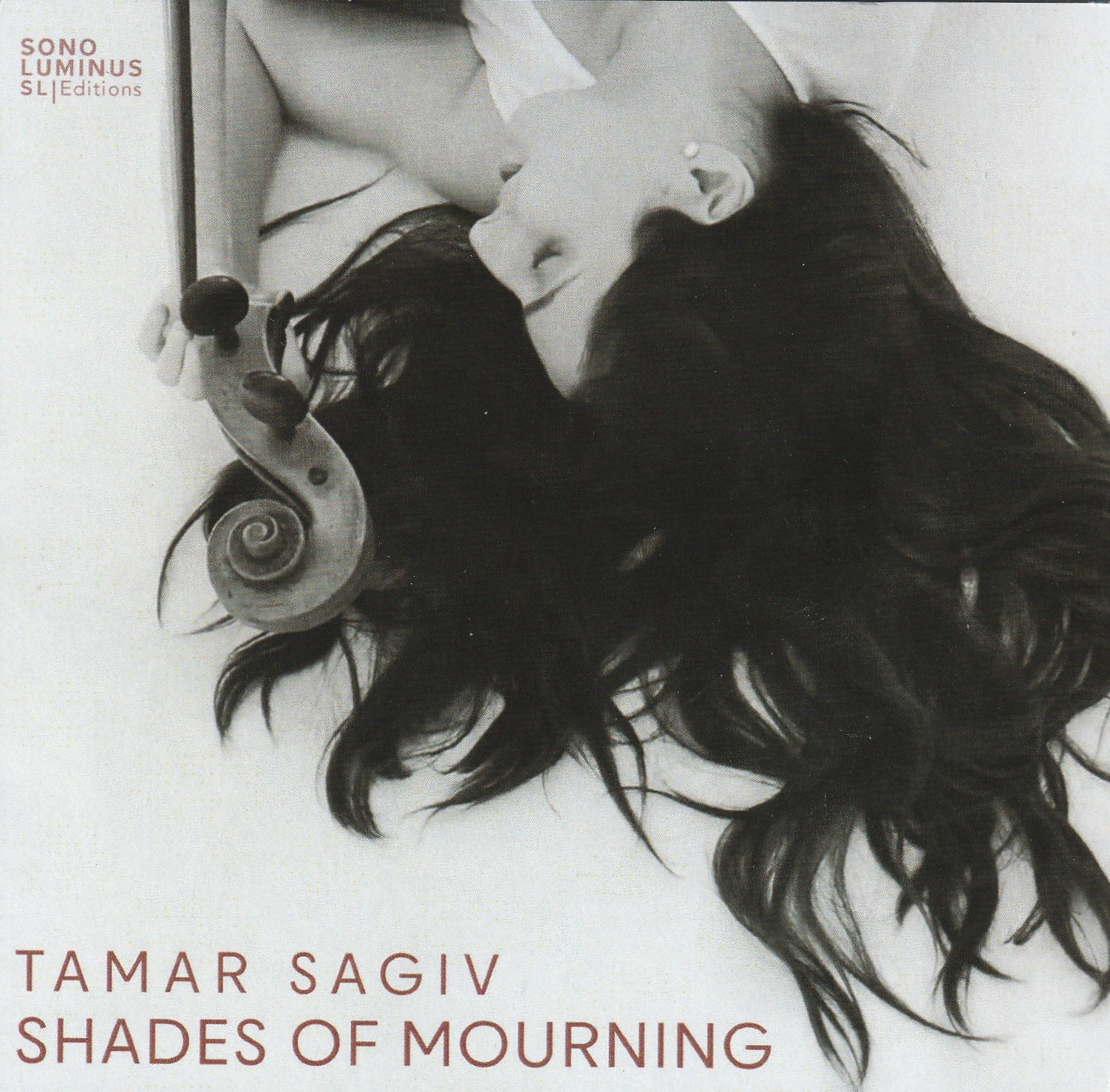
03 Tamar SagivAnother debut recording, Shades of Mouring, features Israeli-born, New York City-based cellist and composer Tamar Sagiv (Sono Luminus SLE-70041 sonoluminus.com/sonoluminus/shades-of-mourning). In the notes Sagiv says “I am writing these words while the Middle East, my place of birth, is bleeding. Like me, my friends, family, and neighbours who live on the other side of fences built to divide us carry excruciating pain that flows deep as the wars continue.” 

The title work and the following Roots include a plaintive voice – presumably Sagiv’s – rising above the solo cello line in a haunting, evocative melody interrupted at times by yelps and brutal outbursts from the cello. Intermezzo is a brief, peaceful meditation for cello quartet in remembrance of her grandmother, with all lines played by Sagiv.

For the next four pieces Sagiv is joined by Leerone Hakami, violin and Ella Bukszpan viola. The first and fourth – And Maybe You Never Used to Be and Imaginary World – show the influence of Philip Glass, in particular his Mishima Quartet in the latter. My Clouds of Grief captures the heaviness that follows mourners when “colors drain from the world around you” and The End of Times in which Sagiv grapples “with uncertainty. Will we find relief in our final movements, or will pain be our lasting legacy?”

Inspired by Chet Baker’s Almost Blue the final two tracks – a solo cello work and cello quintet, again with all parts played by Sagiv – maintain the overall sense of grief, but Sagiv says “I wanted to end this album not in sorrow, but with the same quiet hope that music has always given me. The possibility that even after profound loss, we can still move forward. Together.” Let’s hope she’s right. 

04 David OcchipintiThere are some minimalist aspects to David Occhipinti’s Camera Lucida (elastic records davidocchipinti.bandcamp.com/album/camera-lucida-elastic-recordings), a collection of chamber works that brings to my mind the music of the late Michael J. Baker, longtime artistic director of Toronto’s Arraymusic ensemble. The Camera Ensemble comprises some fine Toronto jazz players – Occhipinti on guitar, Michael Davidson, vibes and marimba, Dan Fortin contrabass, Aline Homzy violin and Virginia MacDonald clarinet – with special guests from the classical world on selected tracks: Max Christie on clarinet and bass clarinet, Fraser Jackson bassoon and Andy Ballantyne piccolo. 

Well-known in the jazz world for his electric guitar work with Mike Murley, Lorne Lofsky, Terry Clarke and others, this is not Occhipinti’s first foray into chamber music – a previous recording with the Camera Ensemble dates from in 2012. This current project combines composed works with his guitar improvisations, and in the case of Southwark a group improv. Occhipinti says “I don’t think of music as having borders or labels. I like pictures of the earth that are taken from the moon, or from space, where we see a big planet with no borderlines of the countries. […] I think of music as a whole thing, and we can take elements that have influenced us to create our own musical world.”  

Camera Lucida is a successful blending of a number of styles, not quite fitting into prescribed categories. Of particular note is the marimba-centric Promised Kiss, with exhilarating solos from violin and guitar. Although there is no rhythm section per se, there is no lack of rhythm in these often boisterous tracks. One notable exception is the quirky Playtime, an ethereal sound design piece utilizing wind sounds from clarinet, vibraphone and glockenspiel, radio sounds and whistling. But my favourite is Octavia where Jackson’s dancing bassoon is given free reign. 

05 Art DecadeAnd this just in… As the deadline for filing my column fast approaches I have just received a disc that is inspiring a nostalgic romp down memory lane. Art Decade (Cantaloupe Music contaqtnewmusic.bandcamp.com/album/art-decade) comprising some fabulous music from the time I spent at CKLN-FM in the late ‘80s, is a wonderful revisioning by Evan Ziporan and Toronto’s ContaQt (formerly Contact). Compositions by Robert Fripp, Harold Budd, Brian Eno and David Bowie are featured in stunning arrangements by Ziporan and/or ContaQt founder Jerry Pergolesi. 

Ziporan’s clarinet and bass clarinet are integral parts of the mix, with ContaQt members Allison Wiebe (piano, Rhodes, organ), Andrew Noseworthy (electric guitar and electric bass), Pergolesi (drums, percussion, trumpet), Mary-Katherine Finch (cello) and Sarah Fraser Raff (violin) all contributing to the sometimes gentle ambience and sometimes overpowering wall-of-sound. Fripp’s Red and Larks’ Tongues in Aspic Part Two best fit this latter description, guitarist Joao Carvalho adding to the forces on the former and electric bassist Alex Kotyk supporting the bottom end in both. There is an astounding energy here, and that’s not just my opinion – King Crimson composer and guitarist Fripp calls Larks’ Tongues In Aspic, Part Two “a triumph,” and describes Pergolesi and Ziporan’s version of Red as having “a wonderful manic quality that many of those who cover Red fail to get. By the end, all is good. The world may or may not be in a better place, but it feels like it is.” 

These head-bangers are contrasted beautifully by Not Yet Remembered (Budd/Eno), Sense of Doubt (Bowie), and Moss Garden and Neuköln (Bowie/Eno) with their calming and melodious textures. The disc is brought to a gently scintillating conclusion with Fripp and Eno’s Evening Star in an arrangement by Ziporan and Andrew Keeling with guitarist Rob MacDonald added to the ensemble. All in all, this is a surprising and satisfying disc. Thanks for the memories! 

Listen to 'Art Decade' Now in the Listening Room

We invite submissions. CDs and DVDs should be sent to: DISCoveries, The WholeNote c/o Music Alive, 192 Spadina Ave, Toronto, ON M5T 2C2*. Comments and digital releases are welcome at discoveries@thewholenote.com.
*Please note new mailing address.

01 Special Interest GroupI first heard Ian Tamblyn’s (Once Was A) Village, sung by our publisher David Perlman in my backyard one lovely summer day several years ago. He had learned the song after hearing it performed in Kensington Market by the SPECIAL INTEREST group. The Spark (independent KBG1905 thespecialinterestgroup.bandcamp.com/album/the-spark) is the debut CD by this self proclaimed “cultural/political project dedicated to playing music with a progressive message and providing a playlist for labour and activist groups.” Originally published digitally during the pandemic, it has now been released in physical form. The disc begins with that same Tamblyn song celebrating the small-town aspects of communities within large cities, with some added lyrics by Rebecca Campbell. As in most of the group’s repertoire the song is combined with another to make an effective medley, in this case Pat Metheny and Lyle Mays’ (Cross the) Heartland

The quintet is comprised of Campbell (lead and backing vocals, guitar and percussion), Kevin Barrett (various acoustic and electric guitars, mandolin, loops, lead and backing vocals), Jim Bish (various saxophones and flutes, backing vocals), Ian de Sousa (bass, loops) and Rakesh Tewari (drums and percussion). They are supplemented by the nine-voice People’s Chorus on two of my favourite tracks, Willie P. Bennett’s (Who’s Gonna Get The) Last Word (In) and Ed McCurdy’s classic Last Night I Had The Strangest Dream, here interpolated with John Lennon’s Give Peace A Chance. Also of particular note are Mimi Fariña and James Oppenheim’s Bread and Roses, Steven Stills’ For What It’s Worth, with Harris Seaton’s Peace, Love and Understanding, and a brilliant interlacing of Bruce Cockburn’s If I Had A Rocket Launcher and Talking Heads’ Listening Wind where Campbell’s voice, channeling David Byrne, is eerily reminiscent of both Laurie Anderson and Kate Bush. That track also includes an excerpt from Elijah Harper’s historic address to Parliament demanding that Indigenous voices be included in any changes to the Canadian Constitution. 

I also must mention the title track, Campbell’s own The Spark, an anthem of sorts that proclaims, “the spark, ignites the flame, that sheds a light, on all we once held true.” This disc is a heady throwback to the protest era of the sixties and early seventies, while addressing contemporary concerns, and with a great backbeat to get you up on your feet.

Listen to 'The Spark' Now in the Listening Room

02 Anne LindsayAnne Lindsay tells us in the notes to Soloworks 2 (annelindsay.bandcamp.com/album/soloworks-2-2), “This record is dedicated to St. Anne’s Anglican Church in Toronto where it was recorded in November 2021 during the global pandemic. St. Anne’s was built in 1907 and contained a Byzantine dome with spectacular acoustics. Murals by the Group of Seven and sculptures by Frances Loring and Florence Wyle were added in the 1920s. Sadly in June 2024 the church suffered a devastating fire and all that remains of this historic Canadian cultural gem are parts of the exterior walls. I am grateful to share a record of this outstanding acoustic space with you.” 

Lindsay’s violin (or is it a fiddle?), nyckelharpa (a “keyed” and bowed hurdy-gurdy-like instrument from Sweden) and voice fill this wondrous space with joyous and contemplative reverberant sounds. The music is lyrical and mostly folk-based, at times rhythmic as in the Celtic-sounding Carolina Parakeet where the jig-like fiddle is accompanied by the hand drumming of Mark Mariash. Fitting for the venue, several of Lindsay’s compositions – did I mention they are all originals? – are religious expressions, including the opening Votum Mane (morning vow or promise), Credo, The Lord’s Prayer and Benedictus which is introduced by the sound of the church’s bells. Others are inspired by water: Down by the Noisy River, Headwaters Ramble and The Sea and the Sky. Throughout we are treated to a thoughtful and melodious journey, with Lindsay the buoyant and entertaining guide. 

It is great to have this testament as a reminder of what a precious space we lost with the demise of St. Anne’s. It continues to serve the community, holding services in the Parish Hall on Dufferin at Dundas. From its website I take the following: “We are grateful for your continued support to our church community following the devastating loss of our historic church. Help us rebuild our ministry and create a church that reflects our faith through contemporary Canadian art and through ministry to all people. You can contribute directly to us by visiting our Canada Helps page. We are most in need of support for our general fund, which helps us with our day-to-day operations.” A truly worthy cause.  

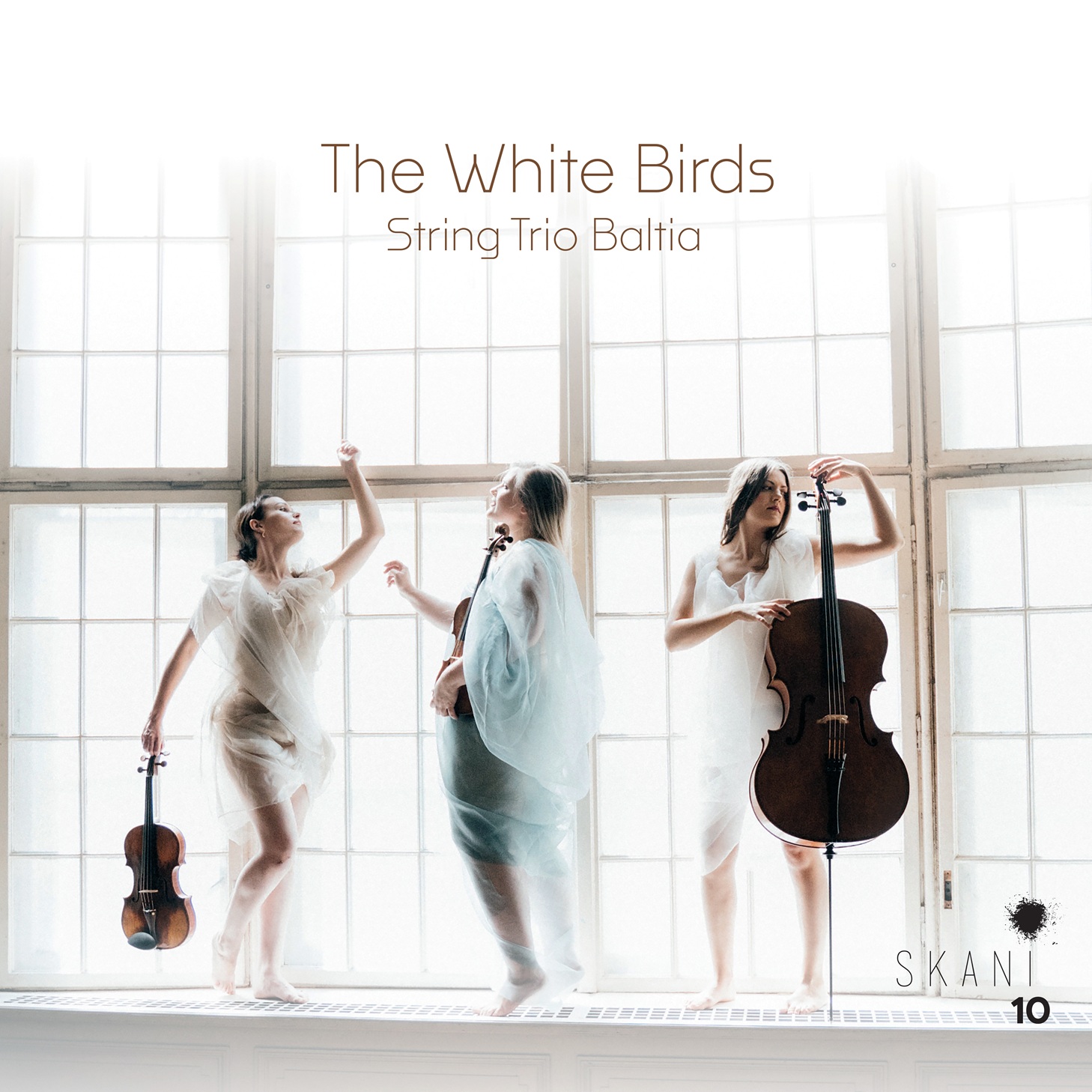
03 The White BirdsI’m a sucker for the Doppler effect, so I was immediately captivated by the title work of The White Birds, a new release from the Latvian Music Information Centre featuring String Trio Baltia (SKANI 171 lmic.lv/en/skani/catalogue?id=254). Composed by Gundega Šmite, the birds in question are mute swans, collared doves, seagulls and white storks. I was a bit surprised to realize that the siren-like opening movement depicted “mute” creatures. Also, that Baltic seagulls are quite subdued compared to local denizens of our lakefront, although they do have that same characteristic glissando cry. In between, the doves coo and peck as might be expected and in the finale the storks mostly scratch and tap rhythmically, with no discernible song. 

The real reason I was drawn to the CD is the inclusion of Latvian-born Canadian composer Tālivaldis Ķeniņš’ (1919-2008) Trio for violin, viola and cello written in 1989. That’s the same year that he visited Latvia for the first time since fleeing the country during the later days of the Second World War. At that time he returned to Paris where he had been a student before the outbreak of the war, and after completing studies (with Messiaen and Tony Aubin, among others) he emigrated to Canada in 1951. Ķeniņš was active as an organist, administrator for the Canadian League of Composers and as lecturer and professor at the Faculty of Music, U of T, retiring Emeritus in 1984. He was one of Canada’s most prolific composers, whose orchestral output included eight numbered symphonies, and more than a dozen concertante works, as well as myriad solo vocal, choral, chamber and keyboard pieces. 

Although commissioned by the Toronto Latvian Concert Association and the Ontario Arts Council almost half a century ago, like so much of Ķeniņš’ output, the trio has remained unrecorded until now. The three-movement work is lyrical and occasionally dark, beginning with a Moderato con moto where the “motor” sounds are like footsteps. Adagietto teneroso is sparse, with a mournful violin melody over simple lower string chords, which grows into counterpoint between the three players. The final Vivo e marcato starts playfully enough, with each of the instruments in turn leading a game of tag. This gives way to a sombre middle section before returning to the chase, and after another contemplative pause ends in a flurry of activity. Although the trio receives a thoroughly professional performance here, I think the work is straightforward enough to be tackled by accomplished amateur performers and I may use it as inspiration to return to my own cello, which has been mostly languishing in its case since the COVID lockdowns.

The disc also includes Castillo interior by Latvian Pēteris Vasks, a tribute to Saint Teresa of Avila originally for violin and cello and revised for string trio in 2021. In it, quiet quasi-medieval melodies alternate with rhythmic passages representing the seven courtyards through which the soul must pass to enter “the castle,” a journey that requires “prayer, perseverance, self-knowledge and awareness of sin.” This is followed by the Gran duo funebre for viola and cello by Gundaris Pone who says, “My intention was not to write mourning music but to show how Latvians regard this big, final question […] approaching the issue of death with a sunnier outlook.” I think the references to Shostakovich perhaps belie this sunny outlook, but nevertheless it is a compelling work.  

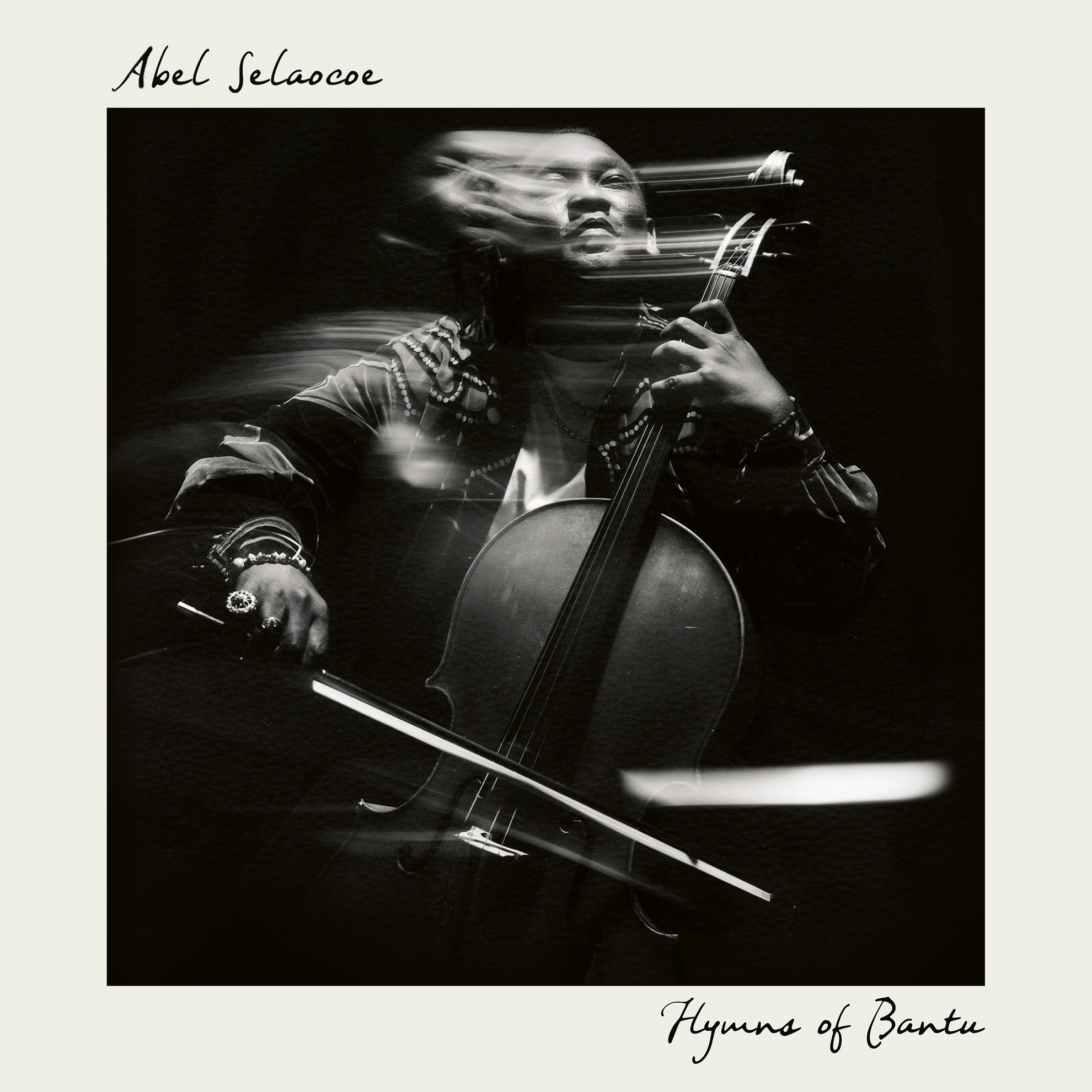
04 Hymns of Bantu Abel SelaocoeCello recordings seem to have been in constant rotation on my stereo (yes, I’m a dinosaur) for the past couple of months, with some repertoire new to me, and a couple of old favourites as well. Perhaps the most unusual, or at least the most unfamiliar to my ears, is the latest from South African cellist, singer and composer Abel Selaocoe. Hymns of Bantu (Warner Classics warnerclassics.com/release/hymns-bantu) is an intriguing blend of African popular idioms and western art music. Selaocoe is front and centre, with his virtuosic cello playing and powerful vocalizing, in arrangements of his compositions by Fred Thomas ranging from small ensembles to near orchestral forces with the participation of the Ensemble Manchester Collective. Even the small groups sound large, with rhythmic, percussion-heavy textures dominating the accompaniments. 

Mixed in amongst the mostly upbeat original tunes are two classics of the cello repertoire which appear mid-disc – the Sarabande from Bach’s Suite for Unaccompanied Cello No.6 arranged for cello and small string ensemble, and an Improvisation on Marin Marais’ Les voix humaines entitled Voices of Bantu featuring Selaocoe’s hymn-like vocal lines over contemplative solo cello. The mood then returns to flamboyance with Takamba, a moto perpetuo featuring cello, electric bass, African percussion, viola and Ensemble Manchester. Two movements from contemporary Italian cellist/composer Giovanni Sollima’s L.B. Files return us to a quasi-classical realm before we find ourselves back in Selaocoe’s growling vocal/percussion-based expanded pop sensibility in the rousing closer Camagu. For someone like me whose exposure to South African idioms comes largely from Paul Simon’s work with Ladysmith Black Mambazo, this album is really ear-opening, and just as energizing.

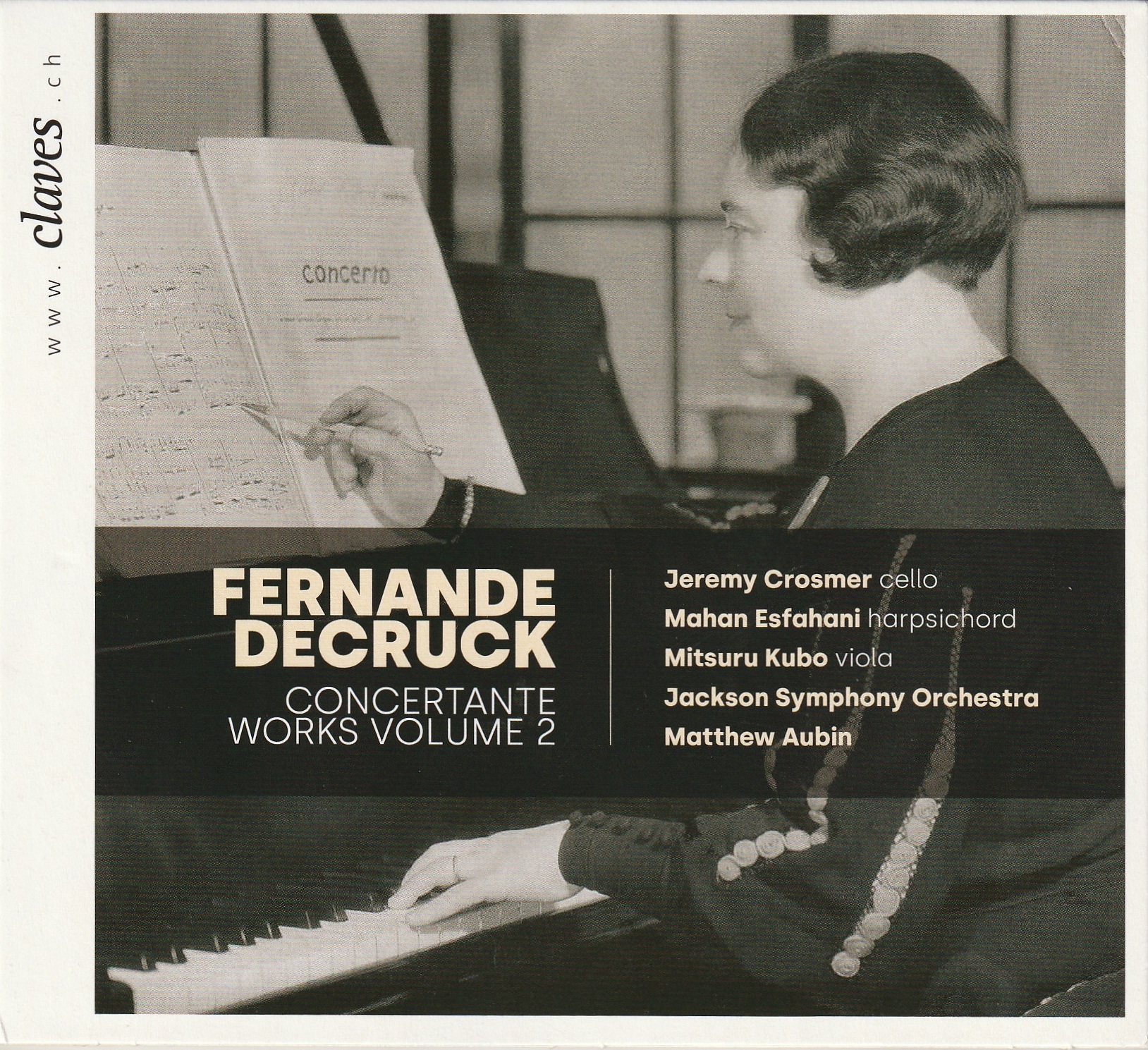
05 Fernande DecruckFrench composer Fernande Decruck (1896-1954) is one of many accomplished women to be “discovered” lately, brought to light through our expanding understanding of the shortcomings of the historically male-centric perception of classical music. Concertante Works Volume 2 (Claves 50-3108 claves.ch/fr/collections/all-albums/products/fernande-decruck-concertante-works-vol-2) features Decruck’s Concerto for Cello and Orchestra; Les Trionons: Suite for Harpsichord (or Piano) and Orchestra; Sonata in C-sharp for Alto Saxophone (or Viola) and Orchestra; and The Bells of Vienna: Suite of Waltzes, with the Jackson Symphony Orchestra under Matthew Aubin. The soloist in the cello concerto (1932) is Jeremy Crosmer and he is in fine form in this dramatic, late-Romantic tour de force. It’s in the usual three movement form, although the first is marked Andantino non troppo rather than the allegro we might expect, with the cello featured in rapid rising lines against the calmer orchestra. This is followed by an Adagietto, Molto Tranquillo with the cello in gentle singing melodies above the peaceful orchestration. A vigorous Allegro Energico with virtuosic cello interpolations brings this satisfying work to a close.

The saxophone concerto (1943) appears here in the viola version featuring Mitsuru Kubo. The viola spends most of the four-movement work in the three and a half octave range that it shares with the cello, so a casual listener might mistake this for another concerto for the tenor of the violin family, but nevertheless it is an important addition to the viola’s repertoire. Les Trionons (1946) is a playful work here presented in the version for harpsichord, featuring Mahan Esfanhani. It has a bit of a “Les Six” feel to it. The disc ends with the charming, bright and lively waltz suite. It’s an early example of the use of vibraphone in an orchestral context, an indication of the innovative nature of this too little-known composer. 

06 Weinberg CelloMieczysław Weinberg is another composer who has risen from relative obscurity in recent years. Born in Warsaw in 1919, he escaped to Minsk after the Nazis invaded Poland and spent the rest of his life in the Soviet Union where he was befriended and encouraged by Dmitri Shostakovich. There have been so many recordings of his music in the past decade that it is hard to imagine that he was virtually ignored in the years leading up to his death in 1996. Weinberg Complete Music for Cello and Orchestra (NAXOS 8.574679 naxos.com/CatalogueDetail/?id=8.574679) includes a Concertino from 1948 for cello and string orchestra, never performed during the composer’s lifetime, a Fantasia for cello and orchestra completed in 1953, and a reworking and expansion of the concertino into the Concerto for Cello and Orchestra, Op.43 (1948/56). Soloist Nikolay Shugaev is featured with the Siberian Tyumen Philharmonic Orchestra under the direction of Yuri Medianik in striking performances of all three works. 

It is particularly interesting to hear the difference between the concertino and concerto, the latter being roughly twice the length of its predecessor. Of special note is the development of the Yiddish themes in the scherzo-like second movement, the extended cadenza of the third movement and quasi-military bombast, and echoes of Shostakovich, in the finale of the concerto. Shugaev gives a lyrical and at times muscular performance somewhat reminiscent of Mstislav Rostropovich, who premiered the concerto in 1957. The centrepiece of the recording is the Fantasia Op.52, which, in the words of NAXOS’ annotator Richard Whitehouse, “is among the most appealing of Weinberg’s earlier works in the way it channels elements of the concerto format into a span as formally symmetrical as it is expressively spontaneous.” Performances and production values are faultless on this welcome release. 

07 Yo Yo Ma ShostakovichOne of the greatest thrills of my life was having the opportunity to meet Yo-Yo Ma while I was an extra in the episode directed by Atom Egoyan of Ma’s Inspired by Bach series of collaborative videos based on Bach’s Cello Suites. The day began in the green room where Ma introduced himself to all the extras, asking a little something about each of us, information which he remembered and returned to at the end of the day when we all gathered again. I was charmed. Not only that, but on the lunch break he allowed a number of the cello students among us to play his million-dollar instrument; a chance in a lifetime for many of those young musicians!

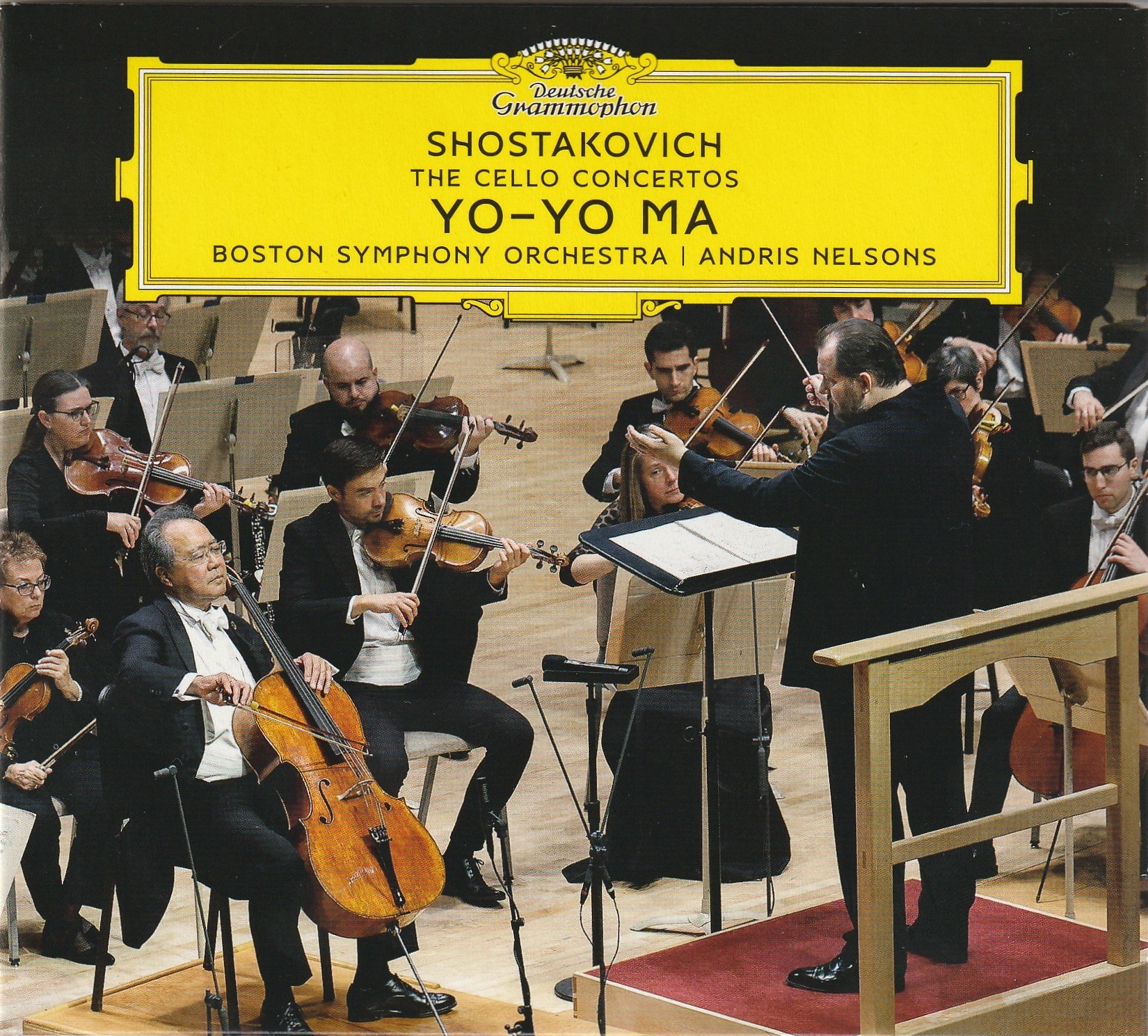
A related thrill was receiving the Deutsche Grammophon recording Shostakovich – The Cello Concertos featuring Yo-Yo Ma with the Boston Symphony Orchestra under Andris Nelsons (deutschegrammophon.com/en/catalogue/products/shostakovich-cello-concertos-yo-yo-ma-andris-nelsons-13798). The Concerto No.1 in E-flat Major, Op.107 ranks among my all-time favourites and I have in my vinyl collection both the first recording of it with its dedicatee Rostropovich and Eugene Ormandy’s Philadelphia Orchestra from 1960 and Ma’s 1983 performance with the same forces. This new recording, with its state-of-the-art technology, surpasses both of those in sound quality and dynamic range, and Ma, 40 years on, shows a maturity and an understanding of Shostakovich’s music that is formidable. 

I also have Rostropovich’s 1976 recording of the Concerto No.2 in G Major, Op.126 with Seiji Ozawa and the Boston Symphony Orchestra, but I must say that it wasn’t until Ma’s current release with that orchestra that I really got to appreciate the full sonic depth of the piece. We think of the vocal range of basso profundo as being typically Russian, but I’ve come to think that term might just as aptly apply in the percussion section. As well as prominent timpani parts in both concertos, there is a profoundly deep big bass drum featured in duet with the cellist in the first movement cadenza of the second concerto which is amazing. Wow, do my speakers pop! It’s truly visceral, a feeling which continues throughout this marvelous recording.  

08b David Olda and Pierre Boulez photo credit Andre LeducOne of the first instances, and still the most prestigious in my career as a music journalist (The WholeNote notwithstanding), was the publication (in French translation) of an article about Pierre Boulez that I wrote for the Université de Montréal’s journal Circuit: Revue Nord-Américaine de Musique du XXe siècle (Volume 3 Number 1, 1992). It was an analysis of a workshop/rehearsal of Mémoriale that Boulez gave at the Royal Conservatory in Toronto during a Canadian tour in conjunction with his residency at Festival Nova Scotia in 1991. The performers were flute soloist Robert Aitken and members of the New Music Concerts (NMC) ensemble who had first performed the work some six weeks earlier under the direction of frequent Boulez collaborator Jean-Pierre Drouet.  

This was almost a decade before my own association with NMC, where I served as general manager from 1999 until 2019. During my tenure there I met many of the world’s most illustrious composers, but the absolute epitome of this was the time I spent as escort to maestro Boulez when he became the laureate of the Glenn Gould Prize in November 2002. In the concert at Glenn Gould Studio mounted to honour the recipient of the prestigious prize, Christina Petrowska-Quilico performed Piano Sonata No.1, Fujiko Imajishi was featured in Anthèmes for solo violin, and Aitken and the NMC musicians reprised their performance of Mémoriale. Other works on the programme included Messagesquisse (with Boulez’s protégé Jean-Guihen Queyras as cello soloist), Éclats, Dérive and Pli selon pli (featuring Patricia Green). Boulez attended the final day of rehearsals, and although he was only scheduled to conduct one piece on the programme, he evidently felt that sufficient preparatory work had been done by Aitken in the preceding week and he decided to conduct the entire concert. It was a truly memorable performance and a career highlight for many of the musicians.

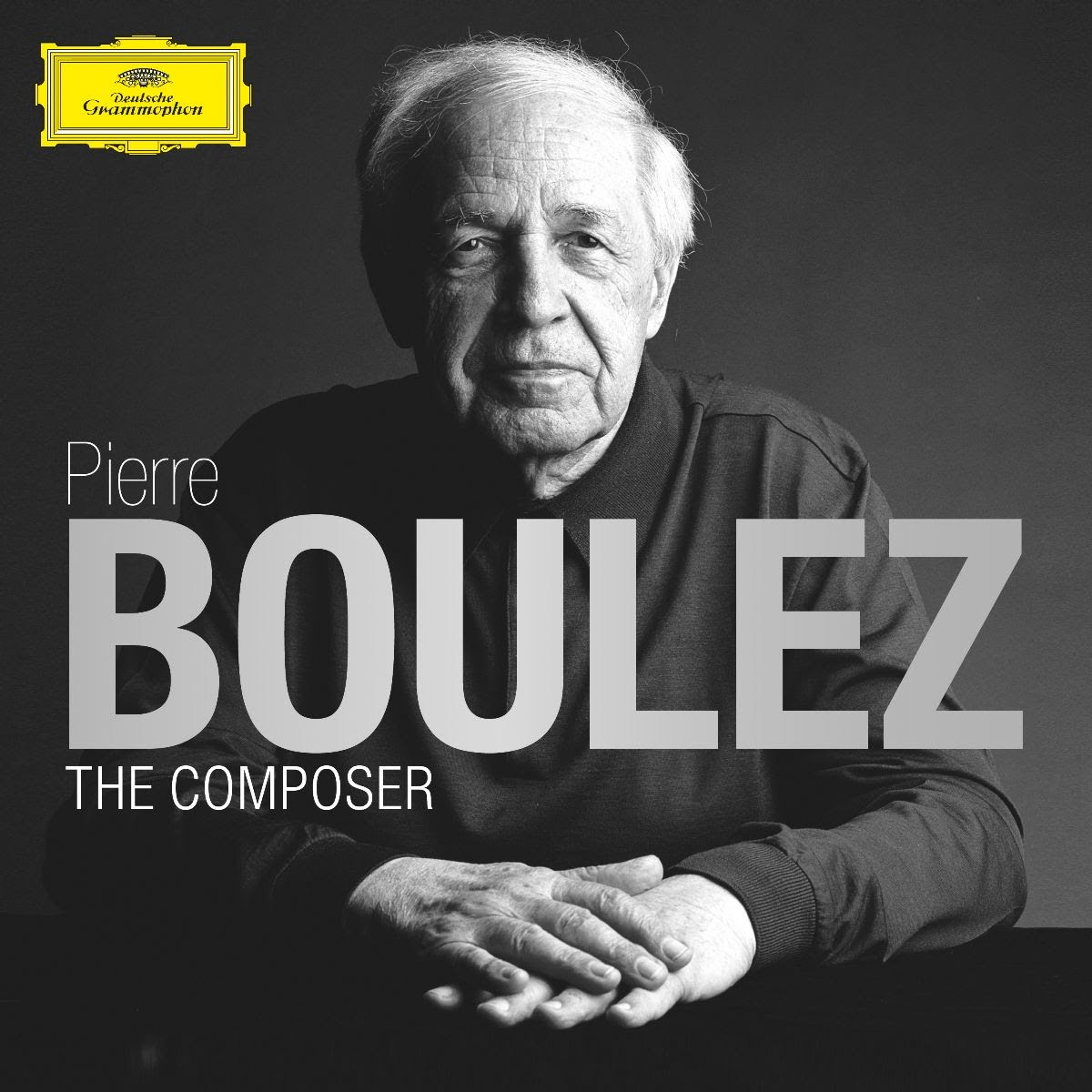
08a BoulezWell, that was a rather lengthy introduction to set up my final review for the issue. Boulez lived from 1925 until 2016 and to mark the centenary of his birth Deutsche Grammophon has released Pierre Boulez: The Composer (deutschegrammophon.com/en/catalogue/products/pierre-boulez-the-composer-9905). It’s a commemorative box set including 11 CDs of recordings hand-picked by Boulez representing virtually all of his output spanning more than half a century. There is also a disc of historic recordings of Le Marteau sans maître, Le Soleil des eaux (second version 1950) and a 1956 performance of Sonatine for flute and piano featuring Severino Gazzelloni and David Tudor, along with an hour-long conversation between the set’s producer Claude Samuel and Boulez recorded at IRCAM in 2011. The interview is in French, but there is a complete translation in the 252-page booklet that also includes an homage by Laurent Bayle, an introduction by Samuel, detailed bilingual programme notes (including some provided by Boulez himself), texts of the poetry Boulez set to music and photographs. It’s a very impressive and informative package. 

Boulez, who came to prominence shortly after the Second World War along with Stockhausen, Xenakis and a host of other seminal composers of the avant-garde, was a complex and sometimes cantankerous individual. After initially bonding with such senior composers as Messiaen (with whom he studied) and René Leibowitz, he turned on his former mentors with contempt, eschewing all that came before including the likes of Stravinsky and Schoenberg (see his essay Schoenberg is Dead). 

Boulez took Schoenberg’s 12-tone principle that no note should be repeated until all the other 11 semitones had appeared, and applied this to the other parameters of music such as rhythm, duration, attack and dynamics. In later years, as he blossomed into a world-renowned conductor, not only of the music of his contemporaries but also of earlier periods particularly in the realm of opera, in his own compositions he relaxed his strictures somewhat. 

This collection, containing virtually all the music Boulez acknowledged and even a few pieces he had not previously allowed to be performed, is presented in more or less chronological order, although this is complicated by the fact that he almost never stopped revising his works. It begins with the craggy pieces of the “angry young man,” Douze notations for piano, Sonatine, the three piano sonatas, Livre pour quatuor and Structures Livre 1 for two pianos. 

While most of the recordings date from the 1990s there are numerous exceptions, including the abovementioned Structures featuring Alfons and Aloys Kontarsky recorded in 1960, Rituel in memoriam Bruno Maderna from a 1982 Sony recording, the 1989 “definitive” version – a rare designation by Boulez – of Pli selon pli from 2002 and sur incises with Boulez conducting soloists of l’Ensemble intercontemporain (EI) in 2012. Virtually all of the ensemble pieces are conducted by Boulez, most performed by EI, but some featuring larger groups including the BBC Symphony, the Vienna Philharmonic and Ensemble Modern Orchestra. One exception is Domaines for clarinet and instrumental groups. The soloist is Michel Portal with Musique vivante under Diego Masson in a recording from 1971. Portal also performs the solo version of Domaines. There are also two versions of Anthèmes; the solo version is performed by violinist Jeanne-Marie Conquer and the version with electronics, realized at Boulez’s IRCAM facility at the Centre Pompidou, features Hae-Sun Kang. As in the Toronto performance I mentioned earlier, Jean-Guihen Queyras is the soloist in a 2000 performance of Messagesquisse, sur le nom de Paul Sacher

I have missed some important works in this list but make no mistake they are all contained in this fabulous centenary tribute to one of the most significant figures of our time, a musical genius with whom I am privileged to have spent a memorable weekend. 

We invite submissions. CDs and DVDs should be sent to: DISCoveries, The WholeNote c/o Music Alive, The Centre for Social Innovation, 720 Bathurst St. Toronto ON M5S 2R4. Comments and digital releases are welcome at discoveries@thewholenote.com.

In the last issue, due to my misreading of a liner note on Daniel Lipel’s ADJACENCE, I mistakenly said that Tyshawn Sorey’s Ode to Gust Burns was a memorial tribute. It has come to my attention that Mr. Burns is alive and well in Seattle. I would like to express my sincere apologies to both Burns and Sorey for my error and any annoyance it caused. I would also welcome you to check out Ode to Gust Burns for yourself at youtube.com/watch?v=xefu3QupKEs.

01 Goodyear PSQ HomagePianist Stewart Goodyear was the Royal Conservatory’s inaugural artist-in-residence at Koerner Hall, where in 2022 (after numerous delays due to COVID) he and the Penderecki String Quartet gave the world premiere of his Piano Quintet “Homage” which the quartet had commissioned several years earlier. At that time the piece comprised three movements, but since then Goodyear has added two interludes and a cadenza, resulting in a dazzling 22-minute work that was recorded at Wilfrid Laurier University last Spring by Chestnut Hall Music and is available on all major streaming platforms. 

The quintet is primarily inspired by the works of Beethoven, with which Goodyear is intimately familiar having frequently performed, and also recorded all 32 piano sonatas and the five piano concertos. Goodyear says the first movement is “a passacaglia on the almost atonal 11-note sequence from the finale of Beethoven’s Ninth Symphony.” 

There are myriad other works by the master referenced throughout the piece – one of my favourites is a nod to the Grosse Fugue in the finale – often infused by other diverse styles. Goodyear tells us the fourth movement is “a ländler fused with gestures of rhythm and blues and calypso,” while the last movement is “a fast toccata, sampling themes of Beethoven similarly to a hip-hop track.” You can watch a performance on YouTube (youtube.com/watch?v=WjVeWgAmYfY).

Speaking of Beethoven, it is mostly thanks to him that the name of Count Andrey Razumovsky is still known to music lovers today some two centuries after his passing – through the set of three “Razumovsky” quartets, opus 59,  commissioned in 1806. 

02 Eybler Franz WeissRazumovsky was a Ukrainian-born Russian ambassador and amateur musician based in Vienna, where he established a house quartet which included Polish violist Franz Weiss. Weiss was an accomplished composer who also wrote quartets for the count, and it is thanks to the Eybler Quartet that the Two String Quartets Op.8 “Razumovsky” have come to my attention (Gallery Players of Niagara GPN 24001 eyblerquartet.com/discography). I find both of these works delightful, and it is a mystery to me why they are not better known and part of the standard repertory. They are virtuosic, alternately lyrical and playful with some extended developmental sections. 

The Toronto-based Eybler Quartet was established in late 2004 to explore the first century and a half of the string quartet, with special attention to lesser-known voices such as their namesake Joseph Leopold Edler von Eybler. Since that time, they have released eight compact discs, first with Analekta (Eybler; Backofen & Mozart; Haydn) and later on the Gallery Players of Niagara label (Vanhal; Asplmayr; Weiss) as well as two discs for CORO Connections of Beethoven’s six Op.18 quartets. 

Current membership includes violinists Julia Wedman and Patricia Ahern (who replaced founder Aisslinn Nosky in 2022) and violist Patrick G. Jordan, all of whom are members of Tafelmusik Baroque Orchestra, with Margaret Gay, renowned in both period and modern performance, on cello. Together their approach to this little-known repertoire is committed and consummate, with nuanced dynamics and balanced performances that really shine. Kudos to the Eybler for bringing these fine works to light. 

03 Reflet du tempsMontreal’s Quatuor Cobalt was founded in 2017 for the purpose of exploring early music on period instruments and at the same time championing contemporary repertoire with modern bows, instruments and strings. Their breadth of vision is amply displayed on this debut disc Reflets du Temps (GFN Productions gfnproductions.ca/albums/reflets-du-temps). Touted as “a vibrant tribute to three female composers” – Maddalena Laura Lombardini Sirmen (1745-1818), Fanny Mendelssohn Hensel (1805-1847) and Alicia Terzian (b.1934) – it certainly lives up to that. 

Sirmen, an Italian contemporary of Haydn, was one of the first women to achieve significant success as both a violinist and composer in Europe. Her String Quartet No.2 in B-flat Major, Op.3 begins with a lyrical Andantino and concludes with a sprightly Allegro at times suggestive of a Mozart overture. Hensel’s String Quartet in E-flat Major, known to me through several other recordings (including that of Victoria’s Lafayette String Quartet for CBC Records), is a delight from its stately Andante opening through its caccia-like Allegretto and somewhat sombre Romanza, to the rollicking Allegro Molto Vivace, to my ear somewhat reminiscent of lighter moments in brother Felix’s A Midsummer Night’s Dream. And Argentinian Terzian is represented by an early work, Tres piezas for String Quartet Op.5, dating from 1954. According to the press release it has rarely been recorded in the quartet version, most recently in 1968. It’s difficult to understand why. Based on traditional Armenian music, it is lyrical and tonal in its opening movements, ending in a lively and percussive Danza Rústica

Whatever the repertoire, which spans more than a century and a half, these Montrealers rise to every challenge in sparkling performances. 

04 Ketty NezTerzian’s Danza Rústica leads me to American Ketty Nez’s recording through the light (Albany Records TROY1991 albanyrecords.com/catalog/troy1991). This disc features two works that draw on the composer’s family heritage, using folk traditions of Central Europe and Turkey, and more specifically the groundbreaking recordings Bela Bartók made in peasant villages in the early 20th century documenting the music of soon to disappear cultures. 

Through the light for string quartet references three Anatolian folk songs Bartók transcribed in 1936, a Romanian violin tune recorded in 1908 and the “ojkanje” style of singing found in Croatia. The first movement is abrasive, percussive, wild and uninhibited. The second movement is more relaxed, taking the form of a duet between two of the songs from the first movement, the cello (bachelor’s song) being juxtaposed with high voices (gazing out the window at one’s beloved) in the violins. The last movement features gentle keening representing the Croatian women singing in sustained dissonant intervals with the use of elaborate trills. The players (violinists Gabriela Diaz and Lilit Hartunian, violist Samuel Kelder and cellist David Russell) capture all the rustic cragginess and charm with enthusiasm.

5 Fragments in 3 are musical “reflections” of Romanian violin and flute tunes recorded in the 1910s by Bartók, scored for piano (Nez), viola (Daniel Doña) and soprano saxophone (Jennifer Bill). The saxophone part can also be played on clarinet, but I find the distinctive timbre of the saxophone especially appealing. The movement titles are descriptive and apt: “in the rain, an introduction,” “organum, and a dance,” “calling lost sheep,” “dance steps” and finally “postlude, a horn call” at the end of which the saxophone gently floats above the pizzicato viola and tinkling piano. A very effective performance.

05 Bartok Viola Concerto 2It was perhaps a coincidence, but a happy one, that as I was preparing this article a new recording, Bela Bartók – Viola Concerto; 44 Duos featuring Paul Neubauer and the Hong Kong Philharmonic Orchestra conducted by David Atherton, arrived on my desk (First Hand Records FHR175 firsthandrecords.com/products-page/upcoming/bartok-viola-concerto-1995-revised-version-44-duos-for-two-violins-arr-viola-viola-and-viola-cello)

When approached by music publisher Erich Doflein, Bartók embraced the idea of writing a graduated pedagogical series in which “students would play works which contained the natural simplicity of the music of the people, as well as its melodic and rhythmic peculiarities.” His 44 Duos for two violins could have been mere didactic exercises with little inherent musicality, but a plethora of recordings by professional musicians belie this. 

Peter Bartók arranged many of his father’s violin duos for two violas. I wondered why not all of the duos were included but managed to find the following on the publisher’s website: “Most of the pieces have been transposed down by a fifth interval, so that all open strings would correspond to those of the original instruments. Where lowering of the key seemed undesirable and the original key a bit too high for violas, the piece was not included in the album for violas” (P. Bartók). He also arranged some of the duos for viola and cello, saying “Only 23 of the duos were deemed suitable for this kind of arrangement.” In all, 39 of the duos are included here. Neubauer is joined alternately by violist Cynthia Phelps and cellist Ronald Thomas in very fine performances, giving these “didactic” works renewed life. 

The viola concerto, which was left unfinished at the time of Bartók’s death in 1945 and later completed from his sketches by Tibor Serly, appears here in a version revised in 1995 by Nelson Dellamaggiore and the composer’s son Peter. It is one of my favourites of Bartók’s orchestral works, and of 20th century concertos of any kind. While this version differs somewhat from the Serly completion I have been familiar with for nearly half a century, I have to agree with Neubauer, who edited the solo part, when he says “that the revised version […] is a more effective and stronger work than the original version of the concerto and no doubt closer to Bartók’s intent.” It’s a stunning achievement. 

06 KabalevskyAnother of my favourite 20th century concertos is featured on the new release Kabalevsky 2nd & Schumann CELLO CONCERTOS (Our Recordings 8.226926 ourrecordings.com/albums/cello-concertos) with Theodor Lyngstad and the Copenhagen Phil under Eva Ollinkainen. I first heard Dmitri Kabalevsky’s Cello Concerto No.2 in C Minor, Op.77 on a 1968 Angel LP release of a Melodiya recording of the premiere, featuring dedicatee Daniel Shafran and the Leningrad Philharmonic Symphony Orchestra under the direction of the composer. 

I mentioned above how much I enjoyed the timbre of the saxophone in the classical context and I believe that this recording was my first exposure to this phenomenon. The alto sax plays a pivotal role in this concerto, trading lines with the solo cello in a way that makes them almost indistinguishable. I was floored when I first heard it. This new recording, which features the young principal cellist of the Copenhagen Phil (just 25 when appointed in 2019) is just as engaging, and I hear even more of the sax in the orchestral textures later in the work. 

Kabalevsky was a somewhat controversial composer, often berated in the west for adherence to “socialist realist” doctrines and toadying to the powers that be of the Soviet Union. But this work seems removed from that. As Lyngstad points out “there is a darkness and nostalgic feel to the music. It is undeniably inspired by his professor Myaskovsky’s cello concerto in the same key, a composer that became an accused ‘formalist’ by the Soviet regime. Myaskovsky was dead by the time Kabalevsky wrote this concerto, but it could easily be seen as a tribute to him, and perhaps even a subtle criticism or defiance of the Soviet regime.”

Lyngstad has chosen to pair the Kabalevsky with the more familiar Cello Concerto in A Minor, Op.129 by Schumann. He says “I find them bound together in an introspective and somewhat defiant spirit. They are similar in form, with three continuous movements, written out cadenzas and the overall development of minor to major. But even more interestingly I see a strong link in the personality and psychology of the pieces […] Neither are written for the soloist to show off. To me they are equal conversations between the soloist and orchestra, where the music tells us something rather intimate, honest and true. With melodic styles they show a tension between minor and major, darkness and light, hope and despair.” In his intimate interactions with the orchestra Lyngstad brings all this and more to fore. It’s a very satisfying recording; one I will treasure. 

I began with a piano quintet, and I shall close with another quartet “plus one” project. In this case it was initiated by flutist/composer Allison Loggins-Hull in collaboration with the string quartet ETHEL

In my years of working with flutist extraordinaire Robert Aitken at New Music Concerts, one of his ongoing laments was that ever since Mozart wrote his quartets for flute, violin, viola and cello, that formation has become the norm. Aitken’s disappointment stemmed from the fact that when he is invited to perform with string quartets, one of the violinists inevitably must sit out. To rectify that Aitken sought out the few existing works that combined flute with full quartet and commissioned new works by Diego Luzuriaga, Alex Pauk and Roger Reynolds among others. 

07 Ethel PersistI assume that Loggins-Hull experienced the same frustration as a flutist. In Persist (Sono Luminus DSL-92281 sonoluminus.com/sonoluminus/persist?rq=persist) we are presented with post-lockdown new works by Loggins-Hull, Xavier Muzik, Migiwa “Miggy” Miyajima, Sam Wu and Leilehua Lanzilotti. 

Loggins-Hull’s title work features percussive, often driving, strings and soaring flute lines “inspired by concepts of perseverance, motivation and positive outlook […] the efforts of my relatives, and ancestors and what they went through so that I could be who I am today.” Muzik’s Pillow Talk begins ethereally with flute providing a “once upon a time” opening setting the stage for a “surreal journey that illustrates the nebulous emotions we feel when the sun is low as we bask in the morning glow with our partners…” 

Miyajima’s The Reconciliation Suite is in four movements, three depicting various traumatic episodes from the Great East Japan Earthquake of 2011 of which the composer was a survivor, and the Pandemic a decade later. The final movement celebrates renewal. It “vividly depicts the city coming to life with the sound of blooming flowers.” Sam Wu’s gentle Terraria explores the myriad ways of terrarium building and Lanzilotti’s we began this quilt there is a colourful tribute to Queen Liliuokalani, the only queen regnant and the last sovereign monarch of the Hawaiian Kingdom. It features some extended techniques and breath sounds from the flute. 

All in all, Persist is an intriguing album and a major and welcome contribution to the flute quintet repertoire. 

We invite submissions. CDs and DVDs should be sent to: DISCoveries, The WholeNote c/o Music Alive, The Centre for Social Innovation, 720 Bathurst St. Toronto ON M5S 2R4. Comments and digital releases are welcome at discoveries@thewholenote.com.

Back to top