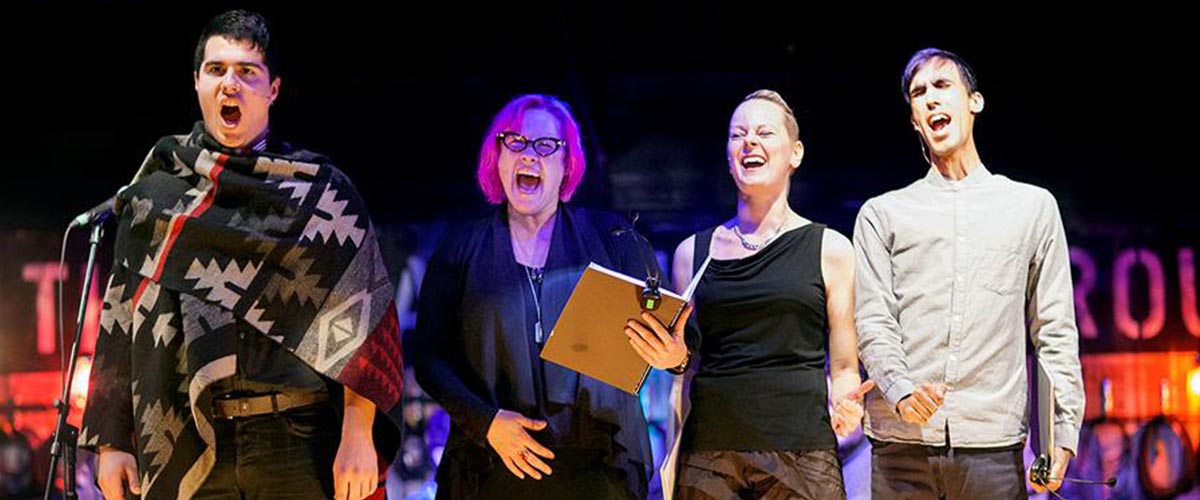
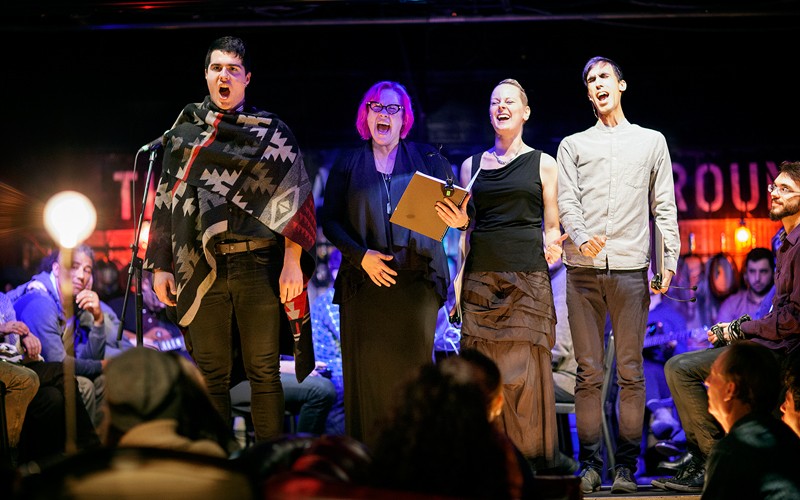
Electric Messiah BannerElectric Messiah's soloists (L-R: Jeremy Dutcher, Christine Duncan, Carla Huhtanen, Gabriel Dharmoo). Photo credit: Claire Harvie.I enter the Drake Underground with some friends. We’re here for Electric Messiah, and none of us have any idea what is in store for us. The room is lit red, chairs askew with a few centered in the room. The instrumentalists are around the perimeter of the space facing inwards. The buzz isn’t just from the Cab-Merlot I’m sipping: there’s a hum from a track playing on the speakers and an energy in the room. All the performers are wandering around the space talking to people. There are about 50 people altogether, the space full but not cramped.

The performance begins with the turning on of a lightbulb. Nature sounds, live scratching, a funk organ and guitar come together to start off the adventure. Jeremy Dutcher begins with Comfort Ye. It is loud and aggressive, and is literally in your face. The abrasiveness of the performance and the power of his voice demands attention. Shortly, the rest of the vocalists join in one by one, in various languages. Gabriel Dharmoo, a Quebecer, stands out; his raga-inspired, French-improv chant is evocative.

You’ll have to forgive me, I don’t usually pay attention to the words that soloists sing in Handel’s Messiah. I have an inkling of what the emotion is and some of the words pop through, but in Roy Thomson Hall, the choir cannot hear very much from soloists facing the audience. This performance gave me a chance to experience the solos in a way I am not normally able to.

Jeremy Dutcher’s sensual rendition of Ev’ry Valley Shall be Exalted made me recognize the innuendo of the lyrics. The sexual connotations of making the rough places plain and “exalting” ev’ry valley are indelible in my mind. Much later, Christine Duncan and Gabriel Dharmoo began the songs Why do the nations so furiously rage together and Thou shalt break them. Conventional performance of these two often removes their urgency, their invocation of war and their evocation of terror. Duncan and Dharmoo started the songs but ended up yelling violently at each other. The invocation and evocation were chillingly clear.

Insistency frames this work, gives it its engine, and drives its power. The artistic choices are strong and effective; the work felt urgent and flowing. Pieces felt like a cup under a running faucet, waiting for a moment to overflow before reaching equilibrium. I think of Carla Huhtanen’s interpretation of How Beautiful Are the Feet. Normally performed in G minor, the piece was moved down into a solid mezzo register (C minor?). Half the song was performed at this lower range, which intrigued me, leading me to want more and more. Finally, Huhtanen returned to the written key and finished beautifully.
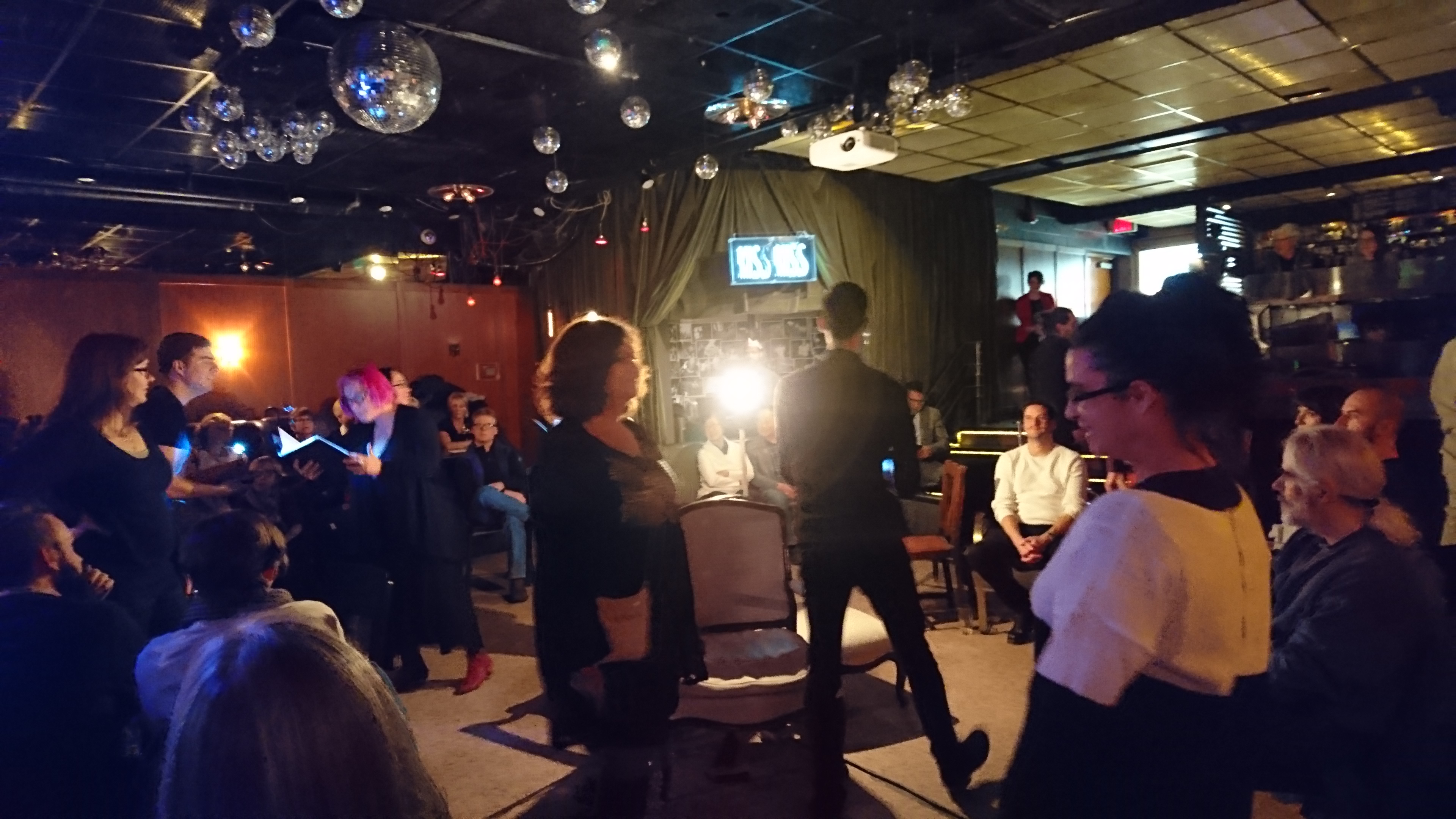
Electric Messiah. Photo by the author.Effective performances, for me, leave me with a sense of yearning. I believe that a good performance should never give you everything you want. This Messiah left me wanting to explore and know more. The minimalist instrumental accompaniment – organ, guitar and turntables – never felt lacking; the organ inhabited a much-valued presence in the music and paired well with the similarly funk-inspired guitar. The scratching and spinning added a new depth and presence, and contributed to the insistency and urgency of the performance.

Movement artist Lybido provided a dance interpretation of Jesus Christ that was particularly thought-provoking because it could have almost passed unnoticed. Inscrutable and esoteric, moving around the fringes of the room, one had to look for him, to work at seeing him. Point being, in our day and age we wouldn’t recognize Jesus if he were right in front of us. There is a great metaphor in making the actual Messiah peripheral, dancing around the room. In this case, we can only make the connection if we choose to. Recognizing the Messiah isn’t the dancer’s responsibility; it’s ours.

Hearing a work that I know so well, performed in a different way – in snippets, in pieces, with modifications, with edits – kept me engaged and excited. If you are fan of Handel’s Messiah, I recommend that you catch Electric Messiah. Pay attention to the way it makes you feel, and then see your typical Messiah, and pay attention to how that makes you feel. I believe you’ll find yourself enlightened by both, and possibly renewed. There is much to love about Messiah; let it continue.

Soundstreams’ Electric Messiah, based on Handel’s Messiah, is at the Drake Hotel Underground December 5 to 7. For details on the performers and the show, visit https://www.soundstreams.ca/performances/ear-candy/electric-messiah/.

Follow Brian Chang on Twitter @bfchang. Send info/media/tips to choralscene@thewholenote.com.
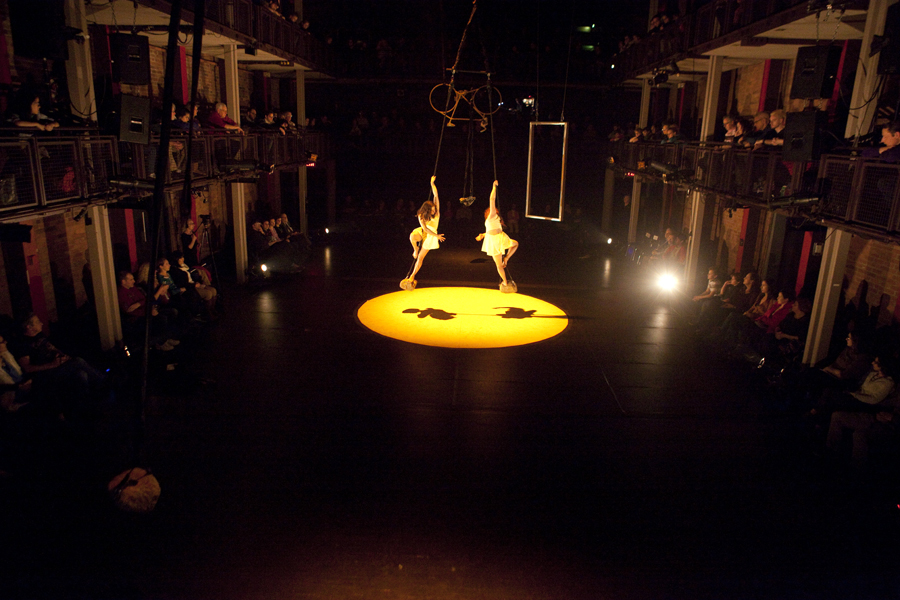
Photo credit: Miklos Legrady.New music isn’t exactly known for its accessibility. It gets a bad rap—sometimes unfairly—for being esoteric and exclusive. Circus, on the other hand, is the opposite—often stereotyped as empty, mindless spectacle.

Balancing on the Edge, a local music-and-circus collaboration at the Harbourfront Centre last weekend, showed audiences just how wrong both of those assumptions can be.

A co-production from Thin Edge New Music Collective and A Girl in the Sky Productions, Balancing on the Edge (November 18-19) combined six contemporary compositions with six contemporary circus acts. At the closing night show on November 19, the artistic directors of both companies introduced the production by bringing up their own definitions of new music, and the analogous “new circus.” Thin Edge directors Cheryl Duvall and Ilana Waniuk spoke about their focus on performing music that reflected all aspects of modern life. Rebecca Devi Leonard identified her circus company as part of a “post-Cirque-de-Soleil” tradition, and spoke about reinventing the spectacle of circus to find something imaginative and honest. The result: a performance where emotive storytelling is put front and centre—and an example of contemporary multimedia at its very best.

Photo credit: Miklos Legrady.

Each half of the two-part program comprised three main acts, as well as a transitional clowning interlude. The show featured the circus performers on aerial silks, ladder and other suspended apparatus, as well as juggling, clowning, and dancing with flaming torches. Thin Edge musicians supplied the musical component, performing works by Nicole Lizée, Iannis Xenakis, John Cage and David Lang, as well as premieres by composers Scott Rubin and Nick Storring.

Music and circus alike proved technically impressive and emotionally potent. The show opened with Magma, a double choreography with fire, stones and aerial ropework set to Nicole Lizée’s Phonographenlieder for string quartet, piano, percussion, voice and turntables. Here, circus artists Diana Lopez and Rebecca Carney performed with seamless fluidity, while DJ Paulo Kapunan and vocalist Andrea Ludwig in particular brought Lizée’s pop-like, polystylistic music to life. Other standout acts included Excavating Meaning, where aerialist Brandy Leary and composer Nick Storring took the bossa nova ballad as a starting point for a profound meditation on sadness, stillness and grief; and Ghost Bicycle, an aerial choreography on a suspended bicycle frame that followed the death and afterlife ascension of a young cyclist, set to David Lang’s 1993 piece Cheating, Lying, Stealing. Throughout, the musicians of Thin Edge were a tight ensemble, playing with conviction and settling into their new role as circus accompanists with ease.

The only moment in the night that I found wanting was Ascension, a trio act for soprano and two circus performers on a ladder apparatus, using John Cage’s Aria & Fontana Mix (1958/59). For me, Cage's repetitive glissandi in the soprano line and the act's back-and-forth ladder work lacked some of the immediate clarity of emotion and narrative that seemed so evident in the other pieces, as well as some of the internal structure necessary to generate non-programmatic interest. Having said that, soprano Stacie Dunlop’s use of extended techniques (including a visceral, amplified vocal fry-like growling effect) meshed well with the backing electronics, and the circus artists’ ladder work evoked a playful spirit of spontaneity—but I still couldn’t shake the feeling that some structural or narrative element was missing. Neither wholly abstract nor explicitly descriptive, the act seemed at first viewing to lose its bearings in a vague, unfruitful middle ground.

Taken as a whole, Balancing on the Edge deserves the highest of praise. Skillfully combining new music with new circus, the two companies together found a combined means of expression that worked. They demonstrated a profound depth of emotion, and captured a musical-dramatic clarity that should serve as a high-water mark for what multimedial storytelling can do.

The performers and crews of both companies shone Saturday night, in a production that showed the modern spirit at its best. If their goal was to redefine what contemporary music, or contemporary circus, could be, they succeeded. If it was to tell modern stories in a visceral and relevant way, I was left in awe.

TENMC and AGITS Productions’ Balancing on the Edge was presented November 18-19 at The Harbourfront Centre. For details on the show, visit www.balancingontheedge.com. Photo credits: Miklos Legrady.

Sara Constant is a Toronto-based flutist and musicologist, and is digital media editor at The WholeNote. She can be reached at editorial@thewholenote.com.


Updated: November 23, 11:15am.

DSC 0353

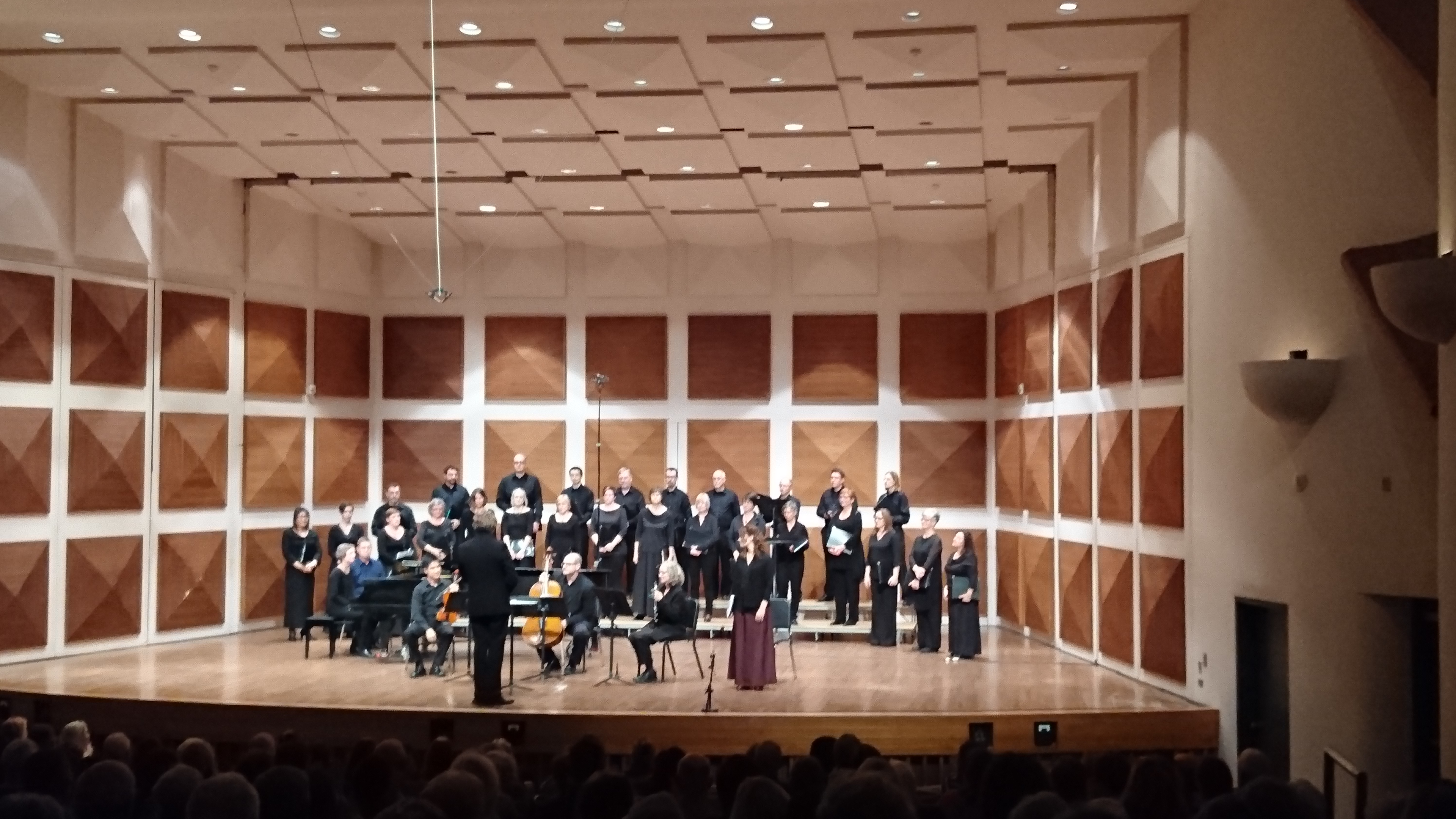
In November’s Choralscene I previewed the Grand Philharmonic Chamber Singers' performance of James Whitbourn’s Annelies, a setting of the Diary of Anne Frank. I stopped by Waterloo to catch the performance. Under the artistic direction of Mark Vuorinen, each time I’ve seen the choir in action I find them warm, balanced and talented. Soprano Natasha Campbell provided a strong and proficient solo voice for the evening.

There is nothing musically wrong with the GPCS performance of Annelies. I enjoyed their interpretation and performance. However, I find the work lacklustre and confusing. I understand using text and stories to inform choral writing. I understand that there are deliberate choices that help shape and define what a composer chooses for instrumentation and compositional tools. I just can’t actually figure out or explain the choices that James Whitbourn has made. Repetition is a core theme, both in the text and in instrumental motifs, and Vuorinen is insightful and manages to make these different and fresh every time with the ensemble. This is not an easy feat and the choir provided a superior interpretation of what the work intends to convey.

But the story falls flat because Whitbourn either forgot or chose to ignore one key thing – that Anne Frank was a child. The Diary of Anne Frank is a collection of deeply personal and remarkable thoughts from a child enduring inhumane conditions. This is my discomfort with the piece: it is devoid of references to childhood and child performers. The only overt attempt at bringing this in with the “Military marching dance” section in the middle of Number 5 Life in Hiding just came across as odd. I believe Whitbourn managed to compose this entire work about and for Anne Frank and forgot her childhood in the process.

This disconnect continues in a few other parts of note. For one, the use of a Kyrie Sinfonia was odd because Anne Frank was Jewish, not Christian. And towards the end as the diary entries end and the choir takes on a narrative tone, it is done in plainchant – again, invoking a distinctly Christian compositional tool. In the middle of the work, Whitbourn chose to set two German traditional songs. This section was the messiest by the choir and it is unfortunate because their German diction was on point.

In works like this, a strong director is a key point of reference. My conversation with Vuorinen last month showed an understanding of the work, despite its flaws. Vuorinen’s addition of Srul Irving Glick’s Radiant is the World Soul (part of the larger Triumph of the Spirit collection) to the program showed thoughtfulness, and this fit into the overall presentation of the evening very neatly. It provided a superior addition to the lacklustre finish of Annelies.

Throughout this performance, I kept thinking about the profound impact of war and conflict on the lives of children. I think of our contemporary conflicts, of which there are plenty: the hate-filled warful Daesh, the Syrian civil war, the state-sponsored eradication of the Rohingya, the US-Mexican border drug wars, and too many others to name. There is an Anne Frank somewhere in those conflicts, hiding, terrified, and awaiting death. This is my takeaway message from this performance – stories like this should never have to be told. Sadly, this isn’t the world we live in. We have far too many stories like these to tell. And there is no end in sight.

James Whitbourn's Annelies was performed at Maureen Forrester Hall, Wilfrid Laurier University on November 19, by the Grand Philharmonic Chamber Singers under Mark Vuorinen.

Follow Brian Chang on Twitter @bfchang. Send info/media/tips to choralscene@thewholenote.com.
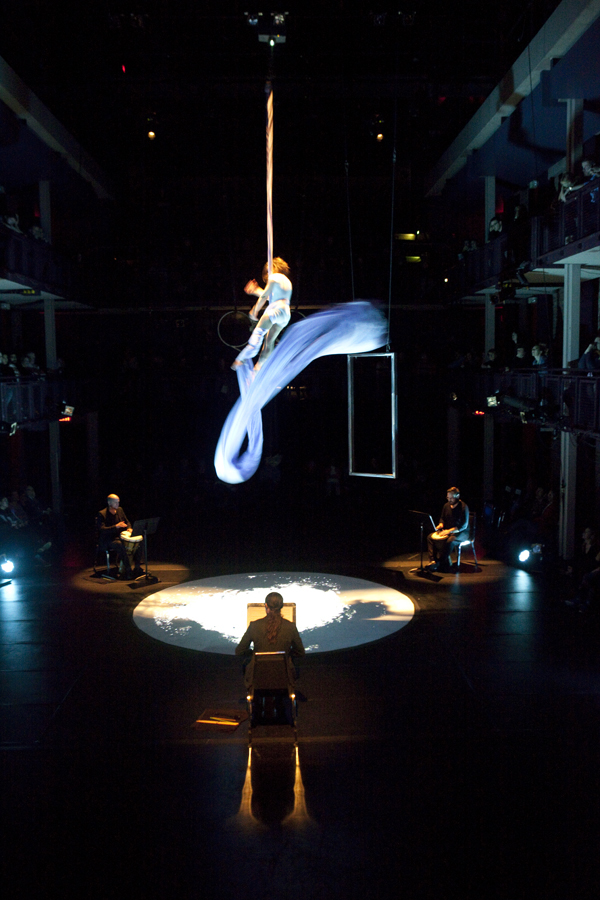
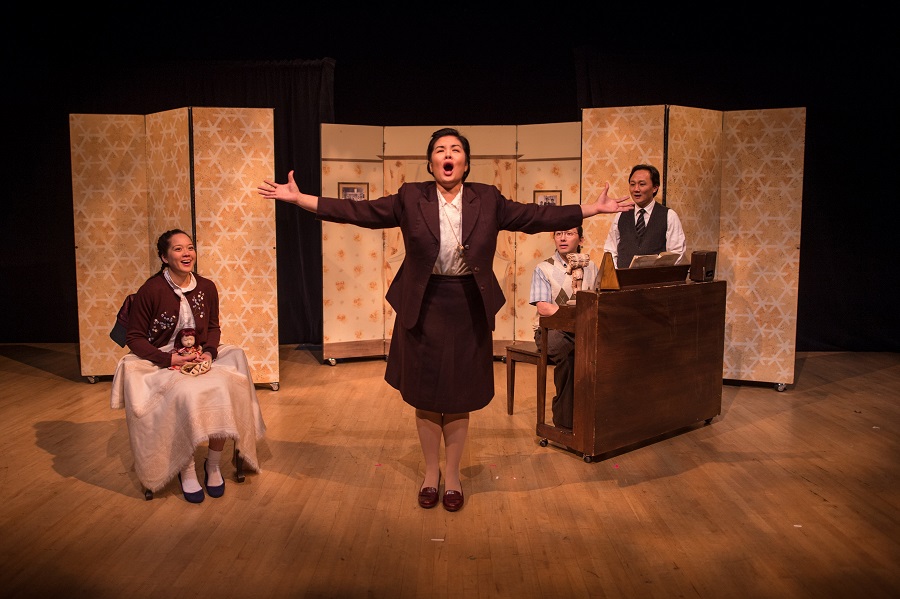
Photo by Dahlia KatzI’ve been looking forward to seeing Tapestry Opera’s opening 2016/17 production, Naomi’s Road, ever since I heard about it months ago. Running November 16 to 20 at St. David’s Anglican Church by Donlands station, the opera comes to Toronto from Vancouver Opera, and is an Ontario premiere.

Written in 2005 and based on an autobiographical children’s novel of the same name by Canadian author Joy Kogawa, Naomi’s Road presents an hour-long look at the trauma of the Japanese Canadian internment during the second World War, through the eyes of a young girl who is sent away with her aunt and brother to a camp in the BC interior. It’s a story that’s close to my own family history—and as Tapestry director Michael Mori mentioned on opening night, one that, with its themes of cultural conflict and fear politics, feels as relevant now as ever.

On opening night, that relevance was urgently heard and felt onstage. Much of the opera stayed true to the original material of Kogawa’s novel; though streamlined for the stage, the show nonetheless captured the essence of Kogawa’s story, and the polarities of hope and despair felt by the Japanese Canadian community during the war. Though technically a children’s opera, Ann Hodges’ libretto is equally engaging for an adult audience—given that the story is told from the point of view of a child protagonist, the simple language and storyline make powerful narrative sense.

Ramona Luengen’s score proved a powerful complement to the story. Ranging from narratively poignant dissonances to more structured songs bordering on the pop-music sound of musical theatre, the music felt like a natural addition to the narrative. Diegetic music in the show—children’s songs, folk tunes sung in Japanese, and even a cameo by the Canadian national anthem—provided memorable musical anchors for an audience of first-time listeners. Lyric soprano Hiather Karnel-Kadonaga shone in the title role, singing with impeccable clarity, and tenor Sam Chung, in the role of Naomi’s brother Stephen, matched her well, with a powerful emotive range. Baritone Sung Taek Chung and mezzo Erica Iris, both singing multiple roles, are to be applauded for their quick vocal and dramatic switches of character. The sets, taken from the original Vancouver production, added clever visual interest.

I wrote in the October issue of The WholeNote that I hoped this production would bring together a new type of community, during a time when community-building—especially across cultures—has felt especially urgent. The production, thus far, has succeeded. The church venue, which is home to St. Andrew’s, Toronto’s Japanese Canadian Anglican congregation, surprised opening night audiences with its beautiful acoustic—and the opera stage, built with the support of Tapestry’s production sponsor The Frank H. Hori Charitable Foundation, will remain at the venue for the church’s use, so that it can continue to build up its performing arts programming. The crowd—members of the congregation, and friends and colleagues of Kogawa’s who were first-time Tapestry audience members side-by-side with opera fans who had never before heard Japanese Canadian stories told live—was itself an encouraging sight.

In her book reading at the post-show reception on opening night, Joy Kogawa spoke about how this production grew out of her own involvement with her church community in Toronto. Kogawa already runs a monthly series at the church called We Should Know Each Other, about bringing together Japanese Canadian figures from across a still-dispersed community. “There were about 1100 Anglican Japanese Canadians in Vancouver,” Kogawa said. “They ordered us to disappear, and we did...and this church is the tail end of that story. It’s a miracle that this community exists at all. I asked them, who would you like to see? And they said, ‘we’d like to see other Japanese Canadians.’ I thought that if this opera comes, then [Japanese Canadians] will come too. So that’s why it’s here.”

Get to know this story, and the people behind it. It’s a socially and politically urgent production, with music that does it justice—and with a sense of community-building that embodies the hope Kogawa has tried to bring into the world.

Tapestry Opera’s production of Naomi’s Road opened on November 16 (with preview performances at the Japanese Canadian Cultural Centre and Momiji Health Care Society), and runs until Sunday, November 20. For details on the show, visit our listings or www.tapestryopera.com.

Sara Constant is a Toronto-based flutist and musicologist, and is digital media editor at The WholeNote. She can be reached at editorial@thewholenote.com.

Back to top