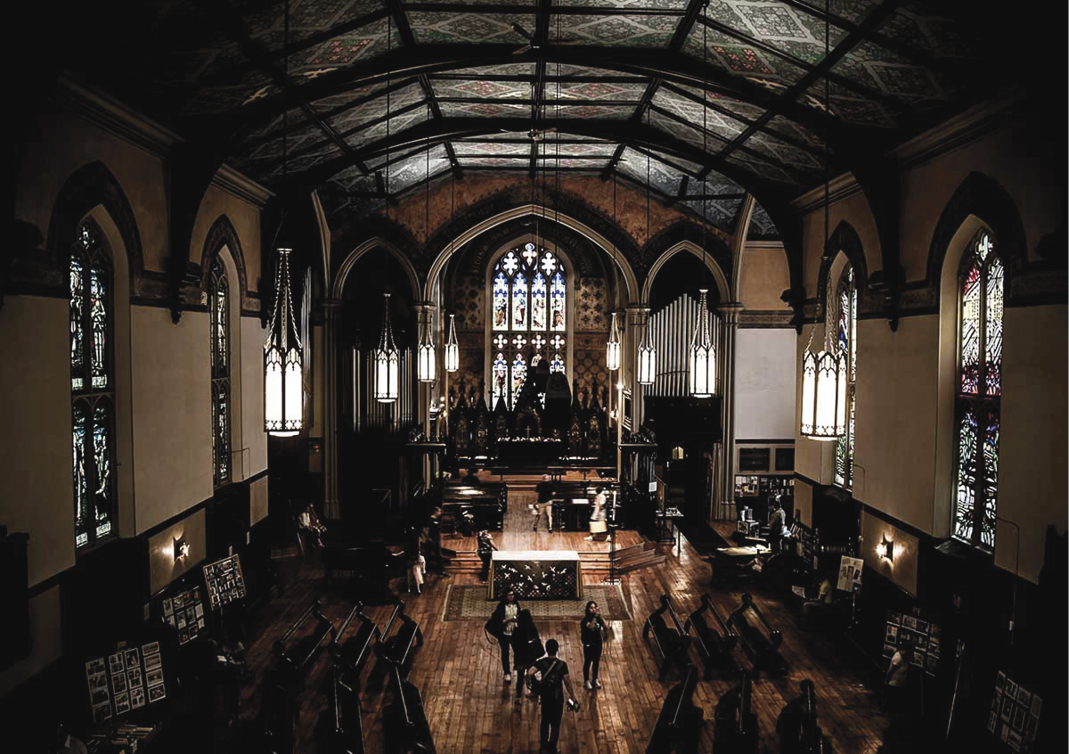
2206-Feat- Bravura 1.jpgEminent pianist, writer and pedagogue William Aide is the curator of “Piano Bravura: The New Generation,” a piano series beginning March 9 at the historic Church of the Holy Trinity.

“Last February,” Aide told me via email, “our music director Ian Grundy, Reverend Sherman Hesselgrave and I were on the hunt for a new piano for Holy Trinity, and we had already auditioned several Steinway and Baldwin instruments. All three of us play, but it was up to me to test the resources of prospective instruments with concert repertoire.” Steinway Piano Gallery’s Alex Thomson led them to a private home in Oakville where Aide tested the piano for its tonal range, colours, beauty of sound, pedalling response, and even its rapid repeating-note action, with Mozart, Chopin’s Études and D-flat Nocturne, Ravel’s Alborada del Gracioso and a Debussy prelude. “We all three fell in love with it and through a generous anonymous donation were able to acquire it,” he said. “On April 7, 2016, flutist Robert Aitken and I offered the first concert featuring the piano as an accompanying and solo instrument.”

From there it seemed obvious to Aide that a series of piano recitals would display the new instrument’s fine qualities. Aide’s decades of teaching and adjudicating had kept him in touch with “younger pianistic talent” and Piano Bravura was born. He chose the initial three pianists because “I know them and their playing at close quarters.” Aide also told me that he was pleased with the repertoire the three selected for the series. “[Their] choices cover a wide range of styles and feature some unusual items.”  
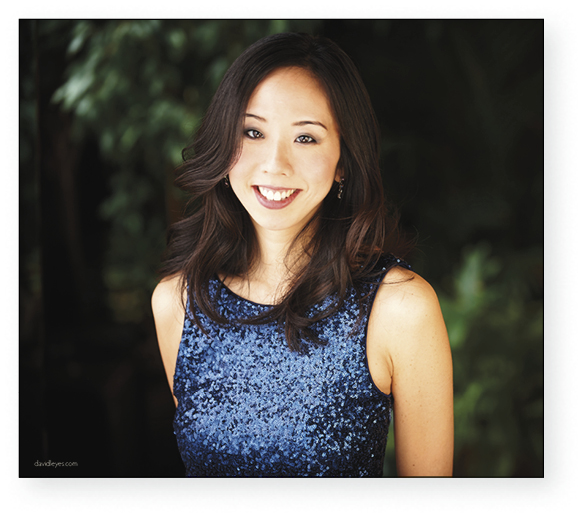
2206-Feat- Bravura 2.jpgAngela Park: “As adjudicator, I first heard Angela Park play the Schumann concerto in a London festival when she was 14. ‘This is the real thing,’ I thought. We worked together for nine years and I was so gratified to help prepare her masters’ graduating recital in 2003, the year of my retirement from U of T’s Faculty of Music. Angela is a much sought-after chamber music player, as the pianist in Ensemble Made in Canada and duo partner of such artists as cellist Rachel Mercer and violinist Jonathan Crow. Her solo playing is outstandingly expressive and her concerto performances second to none. She occasionally still plays for me and we are good friends.”

Park’s recital March 9 begins with Mozart’s irresistible Sonata K333 before moving to the impressionistic Images: Book II of Debussy and Liszt’s revolutionary Années de Pèlerinage Book I: Suisse. Aide had no part in choosing the content of the recitals but he told me that he did coach Angela in the Debussy Images II set years ago.
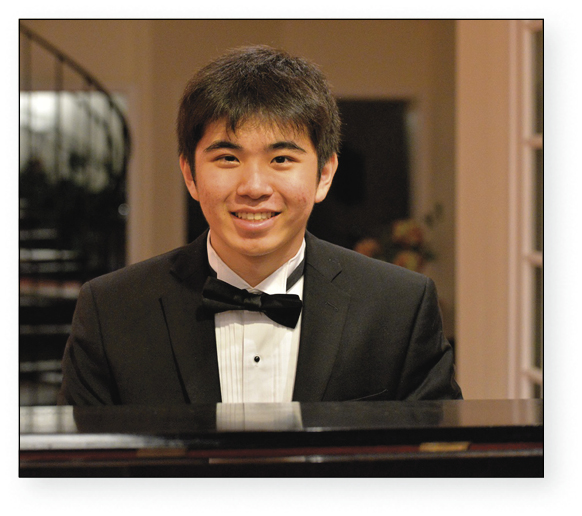
2206-Feat- Bravura 3.jpgTony Yike Yang: As a juror, Aide heard Tony Yike Yang in the last National Chopin Competition which was held in Mississauga several years ago. “I remember fondly that he liked my Chopin Berceuse, an item in a recital the jury members offered during that event,” Aide told me. “We sent Tony to the International Chopin Competition in which his laureate playing was so compelling.” Yang was 16 in 2015 when he became the youngest prizewinner (he finished fifth) in the history of the competition. “I have recently reheard his Chopin E Minor Concerto and B-flat Minor Sonata from that competition on YouTube and was astounded once again by his inspired, world-class playing. By the way, in his emails he confers an honourary doctorate upon me.”

Aide asked Yang, now 18, to include that Chopin sonata in his April 2 recital. Mussorgsky’s monumental Pictures at an Exhibition was Yang’s own choice.
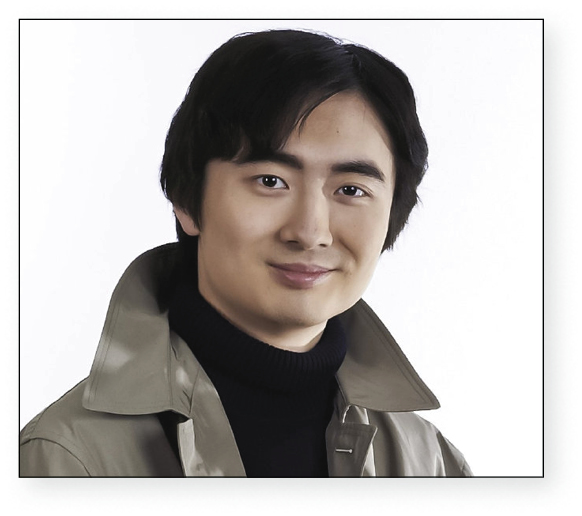
2206-Feat- Bravura 4.jpgSheng Cai: “In 2003, I was musical advisor to the Toronto Symphony Orchestra Concerto Competition,” Aide said. “That year the jury chose Sheng Cai to play the Chopin E Minor Concerto. At the reception after his incredibly poetic performance we fell into a lively pianists’ dialogue and we have continued these conversations ever since. Sheng comes over to our house several times a year and brings with him his most recent CD concerto performances. I must be some kind of mentor. At any rate we enjoy swapping CDs and discussing the challenges of forging a career as a concert artist. His exuberance is contagious.”

Cai’s program comprises two Scarlatti sonatas, Mozart’s Sonata K332, Chopin’s addictive Barcarolle and two pieces “one doesn’t often hear,” according to Aide: Schumann’s Humoresque Op.20 and Villa Lobos’ Rudepoema, written for Arthur Rubinstein.  

As for other ideas in the works for additional musical events in the church:

“There was a time, especially under the aegis of CBC producer, Srul Irving Glick, when Holy Trinity was a favoured venue for national broadcasts. Its luminous acoustic and, of course, the new piano suggest future chamber music and voice series as well as a continuation of these superb piano recitals. I know a number of musicians of the next generation who will easily fill the bill. We will keep you posted.”

Paul Ennis is the managing editor of The WholeNote.
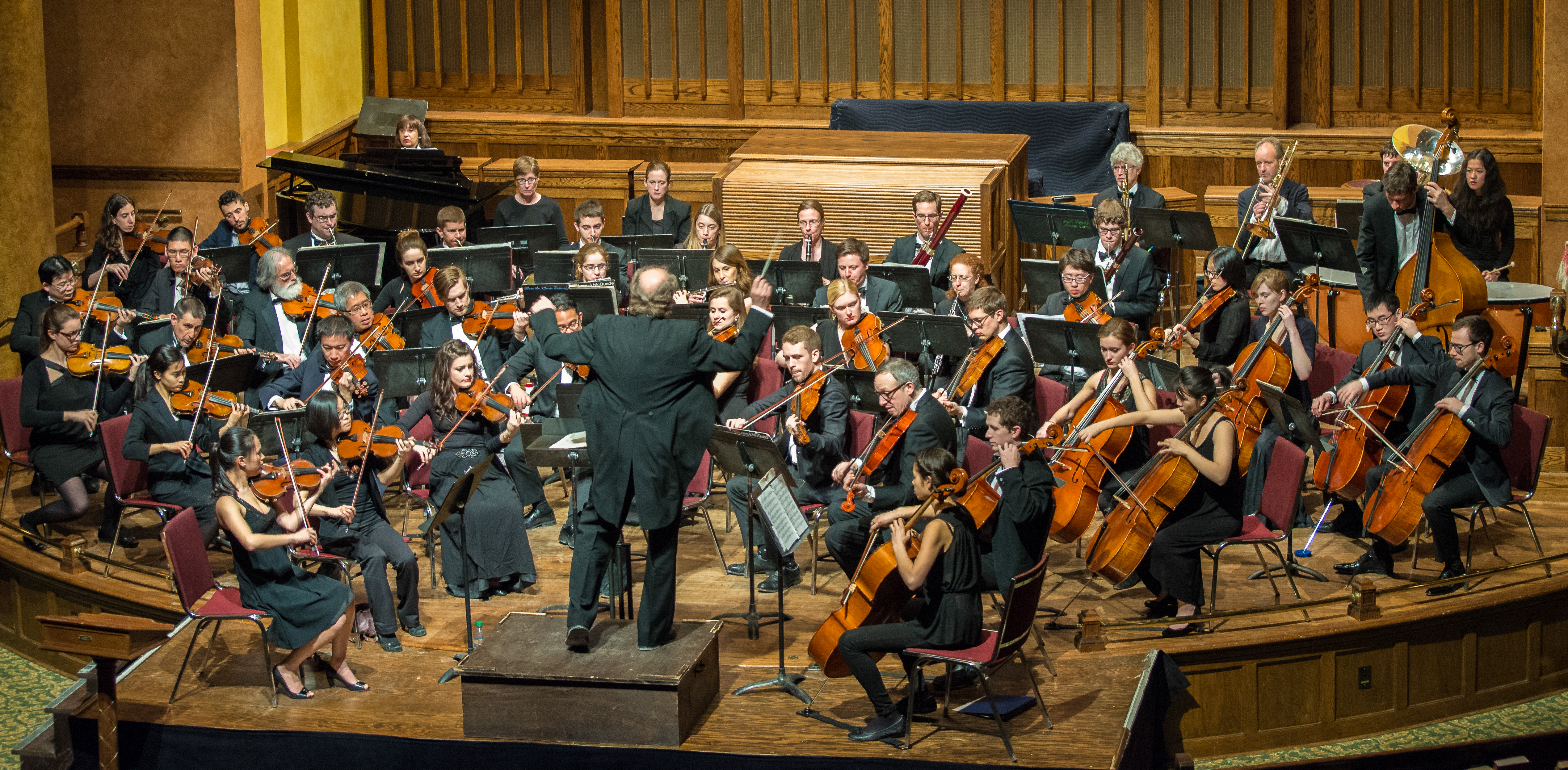
HHO OttawaThe Hart House Orchestra is used to doing tours in February—but not one like this.

A community orchestra of about 90 alumni, students, staff and faculty of U of T, Hart House typically plays a few concerts per season in Toronto, and one winter concert in another city in southern Ontario. This year, however, a significant donation, coinciding with the 40th anniversary of the orchestra, gave them the impetus they needed to take their winter concert program to New York—performing at the one and only Carnegie Hall.

It will be a whirlwind trip. The orchestra will play their concert program—Gershwin’s Rhapsody in Blue, Brahms’ Symphony No.1, Barber’s Adagio for Strings, and works by Glick and Elizabeth Raum—first in Toronto, at Hart House on Thursday, February 16. They'll then leave for the States first thing the following morning, where they will reprise their program at Carnegie on Sunday, February 19. They’ll be back by Monday.

For many, it’s a confusing and difficult time to travel to the States. And while at the Hart House Orchestra, none of their musicians expect to encounter difficulties entering the US, for some members it feels as though history is repeating itself. “The orchestra used to do trips to the States all the time,” said violinist Eric Ordonez, when I spoke with him and cellist Blanche Israel after their 3-hour Sunday rehearsal at the beginning of February. According to Eric, the orchestra was forced to make the decision to stop touring in the States in 2001, because of the difficulty of traveling across the border after 9/11. But now, 15 years since their last visit, the orchestra is determined to make international trips a regular occurrence again.

The orchestra typically rehearses weekly, on Tuesday nights, but they've been putting in extra hours this year in preparation for the trip—and it’s paying off. “This week, it’s all really starting to come together,” agreed Blanche and Eric two Sundays ago.

The orchestra had just finished playing some details in the Brahms, Glick and Barber pieces. Under the direction of conductor Henry Janzen, they sounded focused and engaged—and for a group of people who had had to come to school on a Sunday afternoon, they sounded like they were having fun. “Sometimes conductors in community settings don’t come in with the right mindset, and don’t understand the diversity of a community orchestra,” said Blanche. “But Henry gets that. He really understands that everyone is coming from a totally different place, when they show up at rehearsal on a Tuesday night.”

The range of age and experience in the orchestra is astounding. Blanche is a U of T alumna who currently teaches arts management at UTSC; Eric is a student at the downtown campus, specializing in nuclear medicine. They point out another member of the orchestra, a faculty member who is involved with the tour preparations, and note that he recently received the Order of Canada for his contributions to the field of astrophysics. Interestingly enough, all of this means that on the concert stage, the orchestra’s strengths as an ensemble are many, and wide-ranging. It’s this breadth of experience, according to Blanche and Eric, that makes community ensembles like this one so special.

“A lot of people make great connections here,” said Eric. “We have students, alumni, faculty...it’s a great place to meet people.” He and Blanche give off the impression that this ensemble is just what it claims to be: a community. One that, on top of everything else, is playing some pretty incredible music.

The Hart House Orchestra performs its winter concert, led by Henry Janzen and featuring Benjamin Smith on piano for Rhapsody in Blue, on Thursday, February 16 at 8pm, in the Great Hall at Hart House, U of T (suggested donation: $10). They will reprise the same program at the Judy and Arthur Zankel Hall at Carnegie Hall on Sunday, February 19 at 3pm. For details on both concerts, visit http://www.harthouseorchestra.ca/.

Sara Constant is a Toronto-based flutist and musicologist, and is digital media editor at The WholeNote. She can be contacted at editorial@thewholenote.com.

michael snow ccmc in front of music gallery2While trawling the internet, Joe Strutt realized that the CCMC, the famed Toronto “free music orchestra” that started the Music Gallery, didn’t have a Wikipedia page. He decided to change that.

A local sonic archivist and the person behind Toronto music blog Mechanical Forest Sound, Strutt started to organize what he calls “Wikipedia Jams”—meetings designed to bring together people interested in the documentation of Toronto’s local music history, and prep them for how to use Wikipedia to get the job done. He hosted his first-ever Jam as part of the 416 Improvisers Festival last November. His second, taking place as part of the Wavelength Music Festival, is happening this Sunday, February 19.

On the Wavelength website, Strutt describes the Jam as a time for potential music documentarians to “roll up our sleeves and deal with practical matters.” Those matters include the basics of setting up an account and editing articles on Wikipedia, finding Wikipedia-suitable sources to back up articles, and how to write about local music history in a neutral and useful way.

The free event begins at 3pm at the Melody Bar in the Gladstone Hotel, following a Mechanical Forest Sound/Wavelength Festival joint venture listed intriguingly as a “Drone Brunch.” As Strutt explains, the time won’t be used to actually write articles on Wikipedia, but as a friendly and open space for people interested in learning more about the local music community, and about how to serve that community, to get involved. At the very least, it’ll be a space for advice, conversation, and musical discovery. If you’re interested in contributing to the documentation of our music scene, this is perhaps the best possible way for you to get your foot in the door—and if you want to read up on a little piece of local history in preparation, the CCMCWikipediapage is now up and running.

Joe Strutt’s Wikipedia Jam will take place at 3pm on February 19, at the Gladstone Hotel, as part of the 17th annual Wavelength Music Festival (February 17-19). For details about this event, as well as the rest of Wavelength’s innovative programming, visit www.wavelengthmusic.ca.

Sara Constant is a Toronto-based flutist and musicologist, and is digital media editor at The WholeNote. She can be contacted at editorial@thewholenote.com.

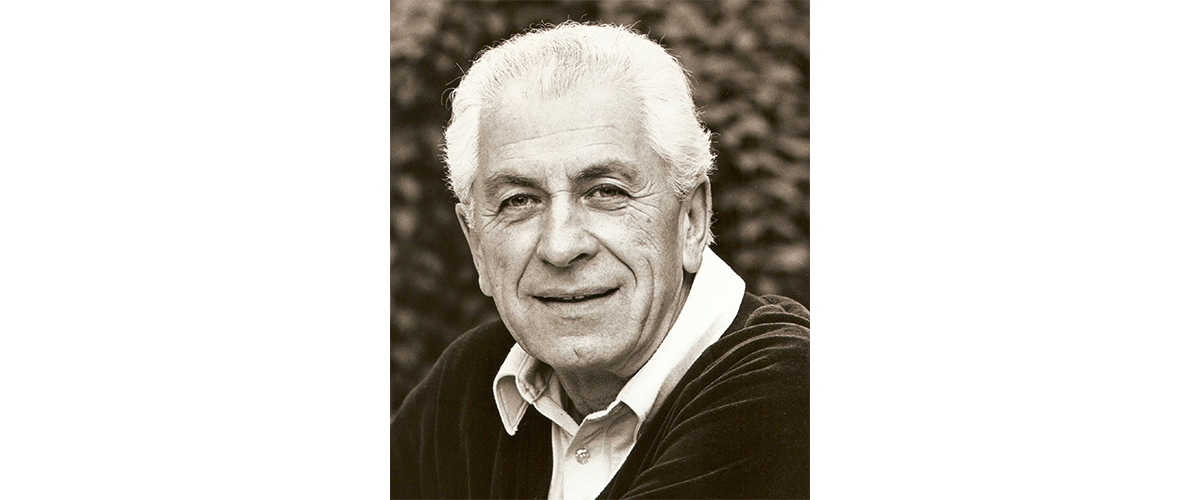
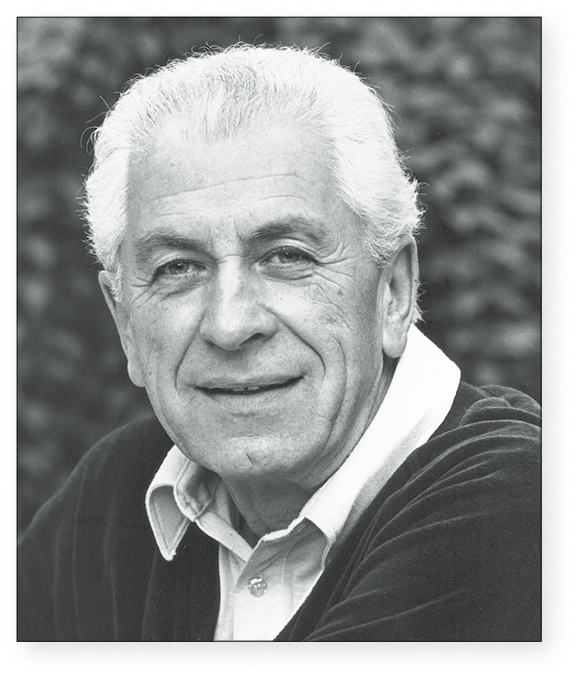
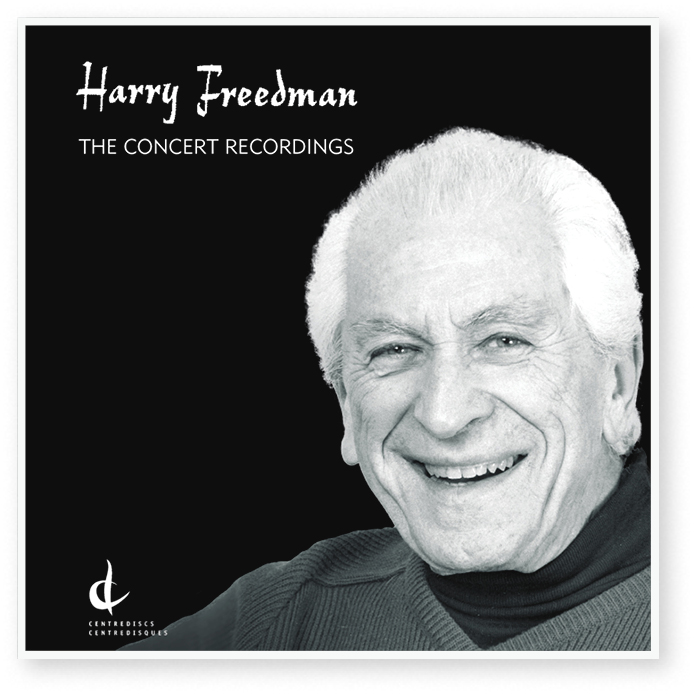
2205 CBC TwoA long-awaited and impressive new Centrediscs CD filled with distinctive orchestral compositions by Harry Freedman (1922-2005) will be launched Friday, February 10, at Chalmers House, the national headquarters of the Canadian Music Centre. Freedman was a master of orchestration, an art that was informed by the 25 years he served as English horn soloist in the Toronto Symphony Orchestra (1945-1970). He wrote for many other genres, including art song, ballet, chamber music, choral and film music, as well as incidental music for the theatre. But his orchestral music contains much of his very finest work, creating a canon of compositions that is not only large, but also diverse, both in style and creative approach. This Centrediscs compilation of Freedman’s orchestral works displays five vivid examples of his imaginative takes on orchestral composition, all beautifully recorded in live performances for broadcast on CBC Radio. The new CD is titled Harry Freedman: The Concert Recordings.

In 2002, in a broadcast interview on the national CBC Radio Two series I created, Two New Hours, Freedman spoke of how his skill with orchestration had developed during his time with the TSO. He told program host Larry Lake, “You’re sitting in the middle of an orchestra. Anything you hear that strikes your ear, thinking, ‘Oh wow, how’d he do that?’, well you can just go find out how he did it – there’s a score sitting right up on the conductor’s podium. And when I was writing and had a problem with, say something for the trombone, I could go to the trombonist and ask, ‘Can you do this? What if you did this? Would that be OK?’ And you find out so many things in the orchestra you just can’t get from reading an orchestration text. There’s no better way to learn.” Largely as a result of all this practical experience, Freedman’s orchestral compositions show refinement and sophistication and are stunningly effective works in the Canadian repertoire.

Many of Freedman’s works were the result of commissions from CBC Radio Music. I remember the first time I commissioned him, in 1977. The occasion was the approaching 50th birthday of Freedman’s good friend, the famous baritone saxophonist, Gerry Mulligan. Freedman himself was approaching his 55th birthday, but his point was, he wanted to compose a concerto for Mulligan to celebrate the soloist’s own half century milestone. Harry and I discussed the project, and I checked with Radio Music senior managers to get their support for the idea. They liked the concept of a concerto for Mulligan and orchestra and we went ahead with it. The hidden factor in this conversation was that, at this very time, I was preparing to launch Two New Hours, the new national contemporary music series on what was then called the CBC FM Network (and eventually CBC Radio Two.) We knew we would need plenty of content to support a weekly network series in which everything would be new. Freedman, who was president of the Canadian League of Composers at the time, was well aware that these plans were in the works, and he was pleased to be one of the earliest collaborators with the new series.

The premiere of Celebration, Freedman’s new concerto for Mulligan, was at Hamilton Place in September 1977, during what was called the CBC Hamilton Festival. The late Howard Cable (1920-2016) was engaged to lead the orchestra, which we called the CBC Hamilton Festival Orchestra but was largely made up of the members of the Hamilton Philharmonic. The chemistry between Freedman, Mulligan and Cable was wonderful and the premiere of the new concerto went famously. According to Walter Pittman (writing in Music Makers, his 2006 biography of Freedman and his wife, soprano Mary Morrison), Mulligan subsequently performed Freedman’s Celebration, “around the world.” Celebration was released in 2002 on the Ovation series on CBC Records.

Jazz also constituted no small part of Freedman’s musical language. On the new Centrediscs CD this is reflected in Indigo, which CBC Radio commissioned in 1994 for the Manitoba Chamber Orchestra. Although it was scored just for the strings of the MCO, Freedman’s deft and subtle inflections echo a wide palette of jazz sonorities, and show how well Freedman understood the intricacies of string writing.

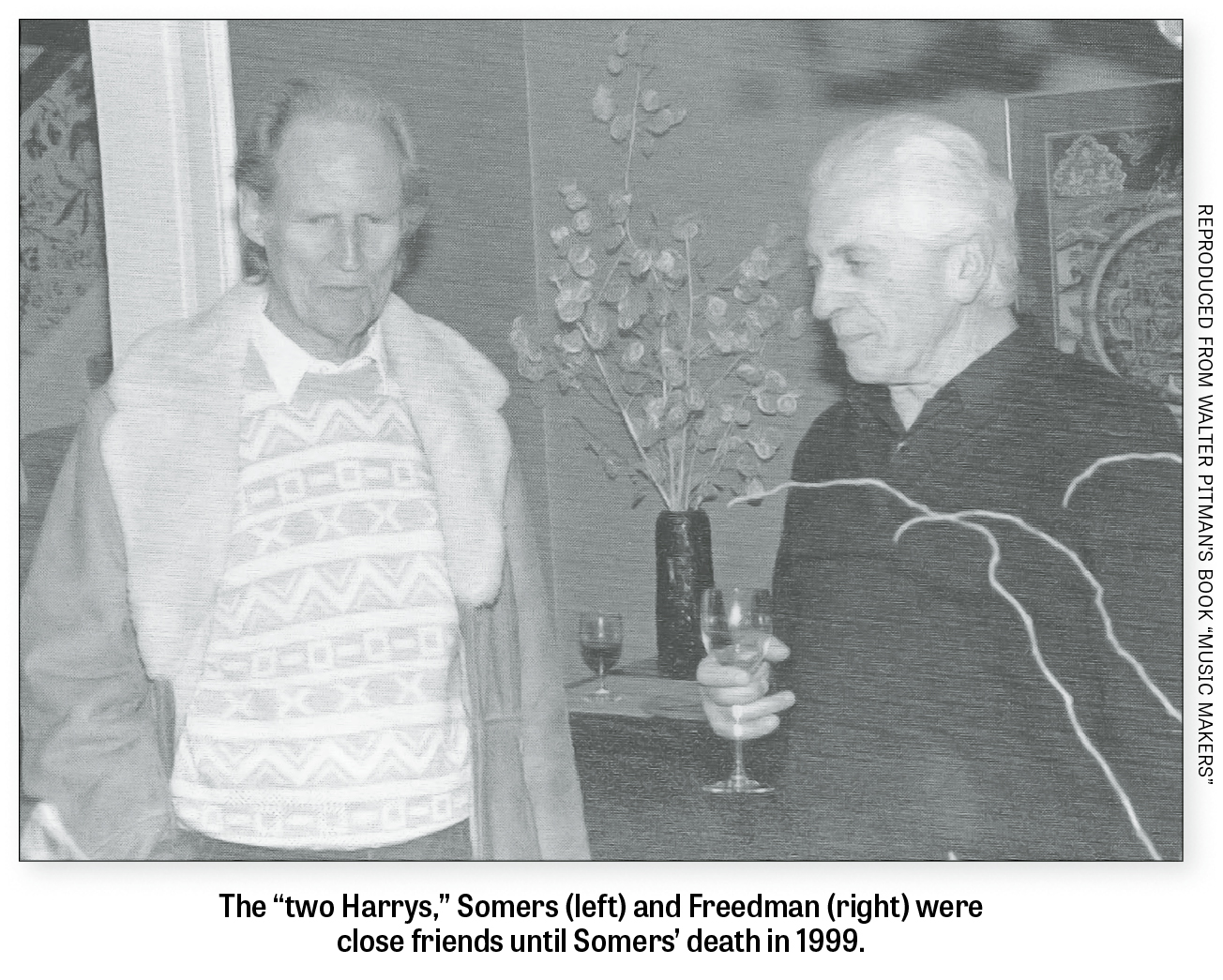
2205 CBC Two 2In contrast, Freedman’s 2000 composition Graphic IX: For Harry Somers uses strings to evoke a succession of expressive textures that reference his close friendship with Somers, who died in 1999. In the interview with Larry Lake mentioned earlier, Freedman, a lifelong student of painting, shared the story of the memory that triggered Graphic IX. He said, “Somers came over one day. I was practising Japanese sumi-e painting, particular strokes. He was watching and was amazed at the brush I was using, a sumi-e brush, made from the hairs of a male Manchurian wolf. And you can do so many different things with that one brush: you can make some very thick textures, what they call ‘broken ink,’ or, depending on how much water and ink there is in the brush, you can make a fine point and draw a hairline, so versatile that one brush. And he was looking at me and he said, ‘That’s just like your music, it’s all about the textures.’ Harry, he recognized it: he had that kind of perception.”

I was also involved with commissioning the last of the works Freedman wrote as a CBC Radio Music Commission, a large composition titled Borealis, in 1997. Borealis combined the forces of the Toronto Symphony Orchestra, the Danish National Radio Choir, the Swedish Radio Choir, the Elmer Iseler Singers and the Toronto Children’s Chorus, all under the direction of conductor Jukka-Pekka Saraste. These combined forces surrounded the audience, from the ground floor up into the various levels of balconies ringing the ten-story Barbara Frum Atrium in the Canadian Broadcasting Centre. The occasion for this commission was our collaboration with the Northern Encounters Circumpolar Festival of the Arts, organized by Soundstreams Canada. The effect of the music was stunning. Harry Freedman himself considered it one of his finest achievements in writing for large-scale musical forces. He called it “a summation.”

We subsequently presented Borealis to the International Rostrum of Composers (IRC) in Paris in 1998, where it was voted fourth overall among the submissions by the delegates from public radio services in 30 countries around the world, leading to broadcasts in all those countries. Harry was very pleased with this accomplishment, comparing it to the experience of “being shortlisted for the Booker Prize.” He pointed out that, in the big international competitions, “[the] shortlisted works receive just as much attention and visibility as the eventual winners.”

Now that Borealis has been included in this new Centrediscs Freedman compilation, many more listeners can marvel at its sonic brilliance. The sense of soaring space in the Barbara Frum Atrium was wonderfully captured by the engineers in our Two New Hours production team. And the fact that Freedman responded to the opportunity to write such a work for just such a big international occasion, with all the creative might he possessed is one of those miracles of Canadian artistic achievement.

2205 CBC Two 3It’s significant that two of the works in this new CD (Borealis and Freedman’s iconic 1960s masterpiece Images) are performed by the TSO, an orchestra he knew intimately. Two other compositions, Graphic IX: For Harry Somers and Manipulating Mario are represented in performances by Toronto’s Esprit Orchestra and their founding music director and conductor, Alex Pauk, with whom Freedman had a close relationship. Pauk commissioned several of Freedman’s orchestral compositions and frequently programmed his music on Esprit Orchestra concerts. The performance of Indigo was by The Composers Orchestra, under conductor Gary Kulesha, recorded in Glenn Gould Studio.

The five compositions in Harry Freedman: The Concert Recordings are all different in style, construction and message. This fact alone is indicative of the remarkable breadth of Freedman’s musical output. We hear, at various points, the sounds of jazz, impressionism, modernism, minimalism and many more textures and colours, all blended perfectly to serve his expressive purpose. Freedman was at ease with the music of many cultures around the world and he was always open to fresh musical discoveries. He was both an innovator and an artist who could unite different aesthetic trends.

For the more than 30 years that we were colleagues, Freedman and the orchestras who played his music fuelled an ongoing stream of broadcasts on Two New Hours. But Harry was also my friend. I respected him for his prolific creativity and we enjoyed working together on all manner of innovative musical projects. I valued that our many conversations about composition, art making and life in general were always fresh and stimulating. Harry Freedman made a deep impression on many people in the musical community, and his work remains an example of the very highest level of achievement in Canadian music.

David Jaeger is a composer, producer and broadcaster based in Toronto.

TheWholeNote 2205 Cover FINALWe tend to hear a lot these days about presenters experimenting: tinkering with the traditional concert form, making imaginative changes to programming and presentation. We hear (or care) less about the constant tinkering and re-imagining that goes on at the marketing end of things, although the creative and promotional aspects of things are inextricably intertwined. As the poet (Thomas Gray) put it, “full many a flower is born to blush unseen, and waste its sweetness on the desert air.” Translation: great concert, but the seats needed bums.

For marketers, it’s no easy task to keep up: audiences’ personal information-gathering preferences change; new sources of information and devices emerge; new ways of searching and sorting the endless stream of invitations and demands on precious, non-expanding time.

The temptation is to grasp at each new straw as it rushes by on the tide – to declare that tried and true methods of garnering audiences have had their day. An example: going into this decade, there was a lot of gloomy prognostication on the PR and marketing side of things – predicting that season ticket sales and subscriptions were about to go into a precipitous decline. Audiences are no longer in a position to lock themselves into a whole season’s worth of performances months in advance, the argument went. Not with the health of parents, the welfare of children, and our own increasingly creaky bodies making it harder to predict, months in advance, what the demands on our time and other resources are going to be on any given day.

Instead, it seems that for many, with so much uncertainty, from personal to geopolitical, rocking our worlds, looking at a calendar stretching six to eighteen months into the future has become even more important: a way of saying “well at least  I know where I will be on THAT day, right down to the specific music I will be losing (or finding) myself in.”

All this is not to say that the season launch and its accompanying rituals remain monolithically unchanged, any more than the concert form itself. Timing; whether to have a launch event and if you do who to invite – previous subscribers, sponsors, donors, the public; whether to live-stream it; whether to tie it to a particular concert in the current season; what kinds of packages, series and sub-series and “pick- your-own” mini-packages to offer; where (if anywhere) the media (if there are any left) fit in… All questions to be answered.

And hardest question of all: how do we best capture, in a few precious pages or minutes, our prospective audiences’ attention to the essence of a whole year’s inspired creative endeavour that has been months or years in the planning?

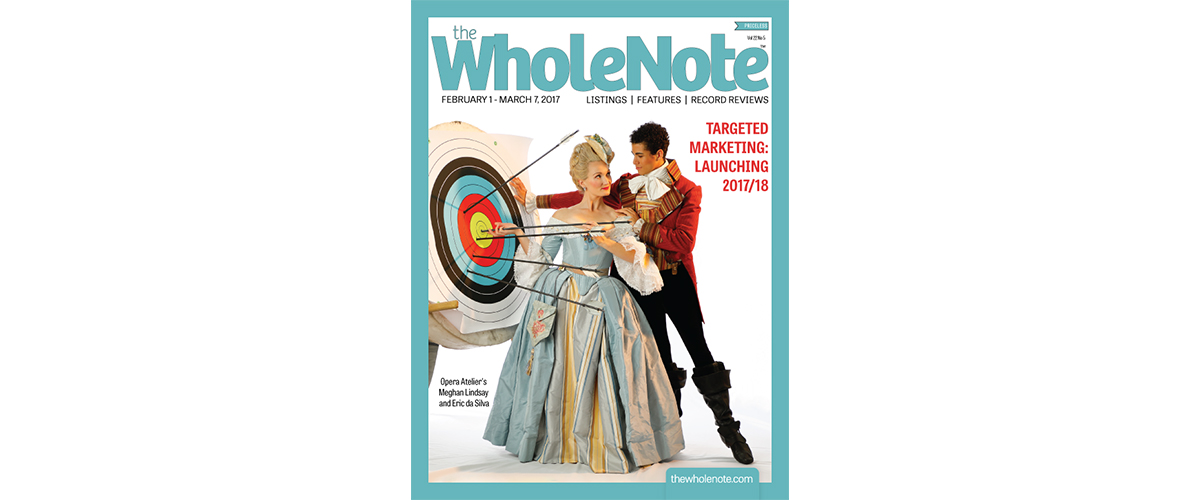
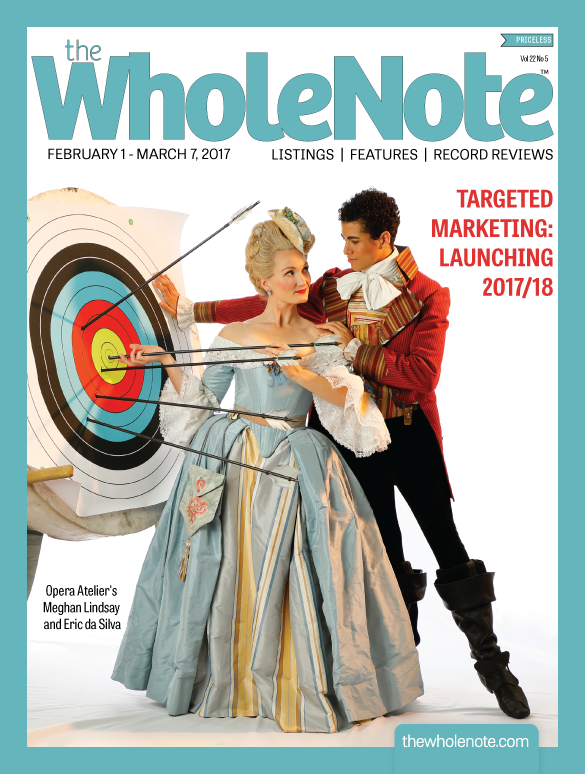
Take the Opera Atelier photograph on this issue’s cover as an example. It looks like a production shot, and in a way it is. But the production in question is not either of the two mainstage shows around which 2017/18 will revolve. Rather, it is the season itself. OA senior communications manager Bronwen Bradley explains: “We always do a photoshoot in December specifically to create images for our upcoming season. Marshall [Pynkoski] and our set designer Gerard Gauci are typically working on the concept and art direction months in advance! Meghan [Lindsay]and Eric [da Silva] are wearing Martha Mann’s Dora Award-winning costumes from Figaro, and are loosely representing Figaro and Susanna. The photo is tied to our season theme of ‘Taking Aim at Your Heart’ as Love is the driving force in our two operas next season.”

Impeccably shot by Bruce Zinger, OA’s resident photographer since the early 2000s, the photograph is instantly recognizable as Opera Atelier’s to anyone who knows OA’s work. Meticulous gestural language, minutely detailed staging, opulently detailed, yet at the same time tantalizingly non-specific. Lindsay, a company regular, is in this spring’s Medea and will return next season, but not in Figaro. Da Silva, a member of the Atelier Ballet, uncharacteristically thrust into the foreground, strikes a characteristically balletic pose. All in all it is trademark Opera Atelier, selling the brand, not a specific product: “For those of you who know us, 2017/18 is business as usual! But for those of you who don’t, oh what lovely business it is!”

As mentioned, no one size or style or date of subscription drive or season launch fits all. What follows is a somewhat random sampling of information from presenters likely to be known to our readers. It’s a handy guide to how, and when, you’ll be able to start planning out next season’s long-term musical certainties amid the vagaries of daily life.

And be sure to check back on this story online for updates and additions to the list as they become available.

Early Birds (Jan-March)

Art of Time Ensemble  February 15; artoftimeensemble.com.
Canadian Opera Company announced their 2017/18 season on January 12. coc.ca.
Isabel Bader Centre (Kingston) end of March; theisabel.ca.
Music Toronto February 16 (at their Eybler Quartet concert); music-toronto.com or 416-366-7723).
Soundstreams March 1 by media release. For advance notice, sign up for their email newsletter, at soundstreams.ca.
Tafelmusik February 13; tafelmusik.org or 416-964-6337.
Toronto Consort March 3-4, at their March concert; brochures available at the show, and details at torontoconsort.org.
Toronto Symphony Orchestra January 25, no event; tso.ca.
Women’s Musical Club of Toronto March 9, at their March concert; online (by e-newsletter at wmct.on.ca) on March 16.

Work for an ensemble, music presenter or performing arts venue and want to add your name to this list? Send us an email at editorial@thewholenote.com.

Back to top