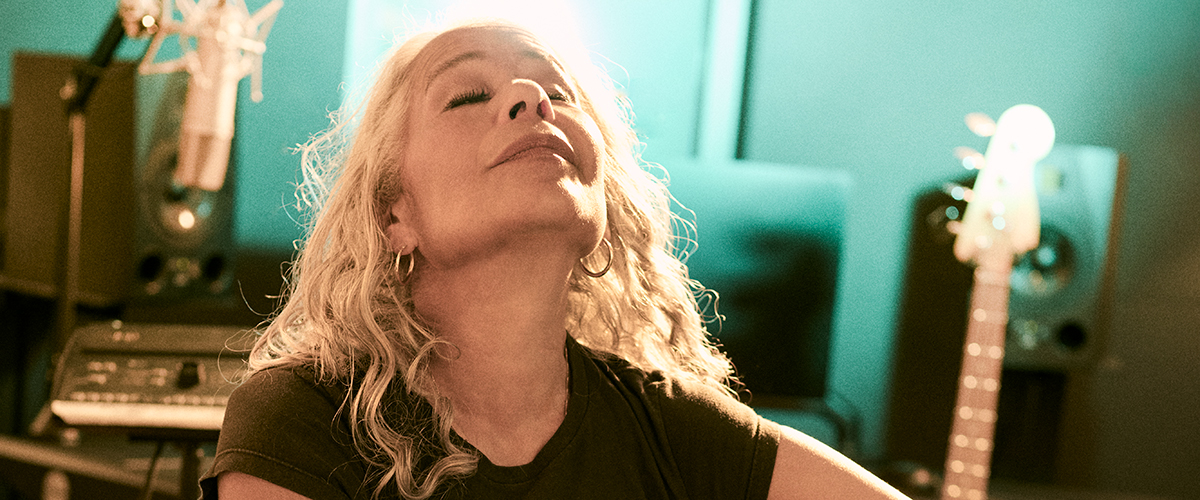
 Molly Johnson’s latest record, Talk to Me, was released mid-June at the El Mocambo on Spadina Avenue – a landmark Kensington music venue, if ever there was one. And the 11th annual Kensington Market Jazz Festival – a quintessentially Molly Johnson labour of love – is just around the corner (September 18 to 20). So what better time for a cover photo of Molly Johnson, jazz diva, in the spotlight at her own festival as it enters its second decade?
Finding a photograph like that seemed like a no-brainer. Except for one problem. There aren’t any – and that’s not likely to change any time soon. How do I know? Because I asked, and when Molly says “it ain’t going to happen,” you might as well just move on. Simply put, that’s not what KMJF is about, for her.
“I don’t really like the spotlight, as it turns out; I don’t really like being famous,” is how she explained it in a 2023 interview by Denise Donlon, television producer, author, public speaker, host and, like Molly Johnson, a member of the Order of Canada.
“As it turns out, I‘d much prefer not to be famous. But it’s part of my job. So over the years I have figured out a way to take that fame and bright light and shine it on other things, and use it to do things with. So it allows me to be more comfortable with fame because it’s a tool in my toolbelt – to help me do the things I really love doing.”
Which is what? “Putting people in a room and getting them to make things, and to stand there and watch them making things. I love that.”
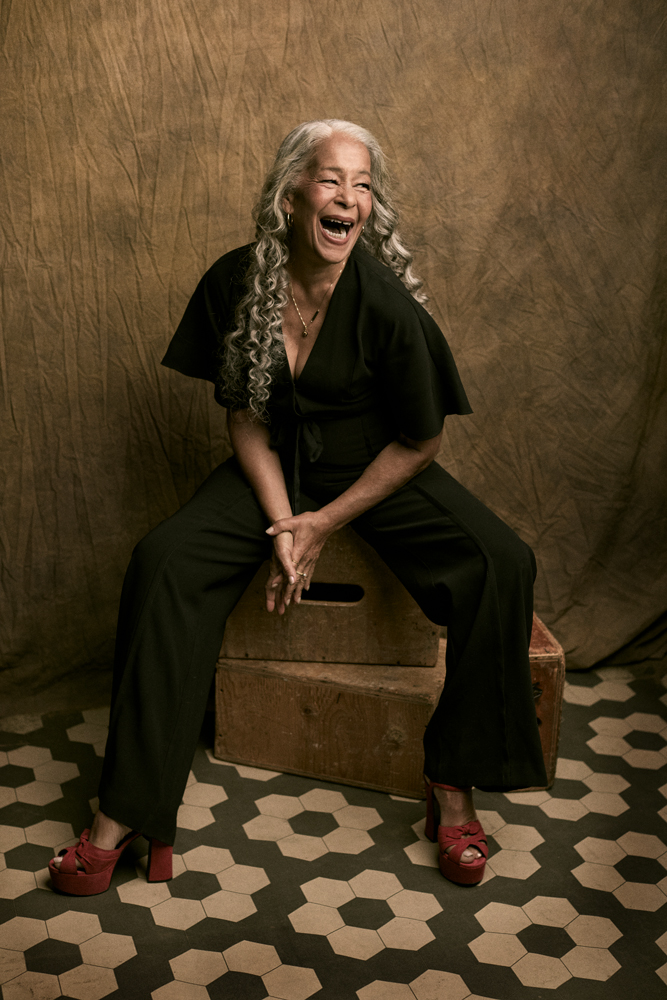
The GGs: The six-minute Donlon “legacy interview,” as it was called, took place on May 24, 2023, the day after Molly Johnson received the Governor General’s Lifetime Artistic Achievement Award in a ceremony at Rideau Hall. It is part of a cluster of material on the Governor General’s website. The cluster also includes Johnson’s brief acceptance speech (quintessential Molly, again); and an NFB “Molly Movie”, also six minutes long, directed by none other than actor/director Clark Johnson, Molly’s older brother and early confederate in child acting fame.
Both the interview and the film are well worth watching, for anyone wanting to know more about how how the various tools in her toolbelt came to be there: from the “best advice she ever received” (from Ed Mirvish, at age 5); to the tumultuous Queen West years that followed when “all I wanted was to be a rock star”; to the years when “I was the cleaning lady at the Cameron House till one of the owners said if I sang songs from the Great American Songbook, it would cover my rent. So I went from being the cleaning lady to the singer in the back room.”
Kumbaya: The years 1992-1995, with AIDS still rampant, were pivotal. As the GG Award Citation – also worth a read – describes this time: “Through her work as co-founder and producer of the Kumbaya Foundation in 1992, she has raised awareness of and funds for people living with HIV/AIDS. The associated Kumbaya Festival (1993–95) raised over $1 million and holds the record as Canada’s largest music fundraiser.”
And how does Molly describe it? “I was sick to death of showing up at benefits for AIDS that were a drop in the bucket. With Kumbaya, that was me being tired of doing benefits and being the only one not getting paid – the lighting guy, sound, the caterer, everybody else was. And then there were the artists: paying for our own cabs and dry-cleaning bills.”
The simplest solution would have been to pay the artists as well, but with activist June Callwood at her side and Denise Donlon riding administrative shotgun, she took a novel approach. “I decided let’s create something where everything’s donated. Every. Single. Thing. So when our artists walk out on the stage, they’re not the only ones giving up their royalties for a couple of days – like Rush did, like Tom Cochrane did, big, big Canadian acts, you name them. They all wrote it off, and I felt really comfortable asking them because EVERYTHING was donated, even the venue, the insurance … It’s a great way to ask an artist to do something for nothing, because everyone’s doing something for nothing.”
It would be tempting to describe the Kumbaya years as some kind of epiphany – a change of direction. Not at all, she says. “Philanthropy is in my DNA,” she is quoted as saying in the GG Award Citation. “Both my parents [Black Trinidadian-born father and white Canadian-born mother] were activists. Whenever possible, however small your powers are, you use them for good.”
From Kumbaya to KMJF: it would be equally simplistic to see her path from Kumbaya to KMJF as some kind of philanthropic full circle. Better would be to see it as some kind of Mobius loop – an inversion. Instead of musicians, and everyone else, working for free, KMJF turns that notion inside out, functioning from day one on the principle that every penny at the door in any venue goes to the musicians playing that particular set. Given the significantly different capacity of the venues, it’s not a foolproof formula. Figuring out how to tweak it, out of the limelight, is the kind of KMJF work, behind the scenes, that Molly Johnson thrives on.
Kumbaya capitalized on her ability to harness all the Canadian musicians in her musical rolodex to a life-and-death community cause. KMJF is the obverse: Kensington Market as a vibrant and resilient community doesn’t need to be the cause being supported. It is therefore ideally suited for nesting a festival where the musicians can be the beneficiaries. Kumbaya asked musicians to play real good for free. KMJF is about moving beyond the assumption that musicians should play for free just because they are doing what they love.
So, on further reflection, this “back room” cover photo does just fine. It’s from a photo shoot by Chris Nicholls for the Talk to Me recording – another Molly Johnson “pay it forward” project for Canadian artists, among them her “beloved trio” – pianist Robi Botos, drummer Davide Direnzo and bassist Mike Downes. All three have been regulars at KMJF over the years, always with their own projects and priorities, and will be back again this year. The “Cameron House Records” T-shirt is a nice extra touch too, harkening back to the Queen West days, during which Molly Johnson, as a creative artist, came of age.
Coda: Ed Mirvish’s “best advice I ever received” to five-year-old Molly Johnson was twofold: “Always look up and sing to the cheap seats. Those are the people who really love ya.” And “When they say your name, always count to five before you walk out on stage. Make people wait a little for you.”
Unless, of course, it’s the KMJF performing spotlight you’re waiting for Molly to enter, because, as she says, “It ain’t going to happen.”
Last word to Molly, from her conversation with Denise Donlon: “I started the Kensington Jazz Festival to support my many musical friends in the jazz genre. I wanted to build connection between artists and audience. It’s a wonderful festival, kind of crazy and kind of wild and really beautiful. At the end of the day, what I really love to do, I still get to do. I get together with people I really like, and I create music. That’s not a bad thing to be doing. If I can make somebody happy, or change somebody’s mood with this music, well that’s great.”
David Perlman can be reached at publisher@thewholenote.com.