 The Royal Conservatory’s early June unveiling, in Koerner Hall, of its upcoming concert season has become something of an event over the 17 years since Mervon Mehta agreed to take on curatorial responsibility, in 2008, for the RCM’s programming of Koerner Hall and the RCM’s other concert venues, going back to the Hall’s opening season. More than 1,500 concerts have taken place under his artistic aegis since then, and he has hosted an astonishing number of them himself – indicative of his own adventurous musical appetite at least as much as out of a sense of official obligation.
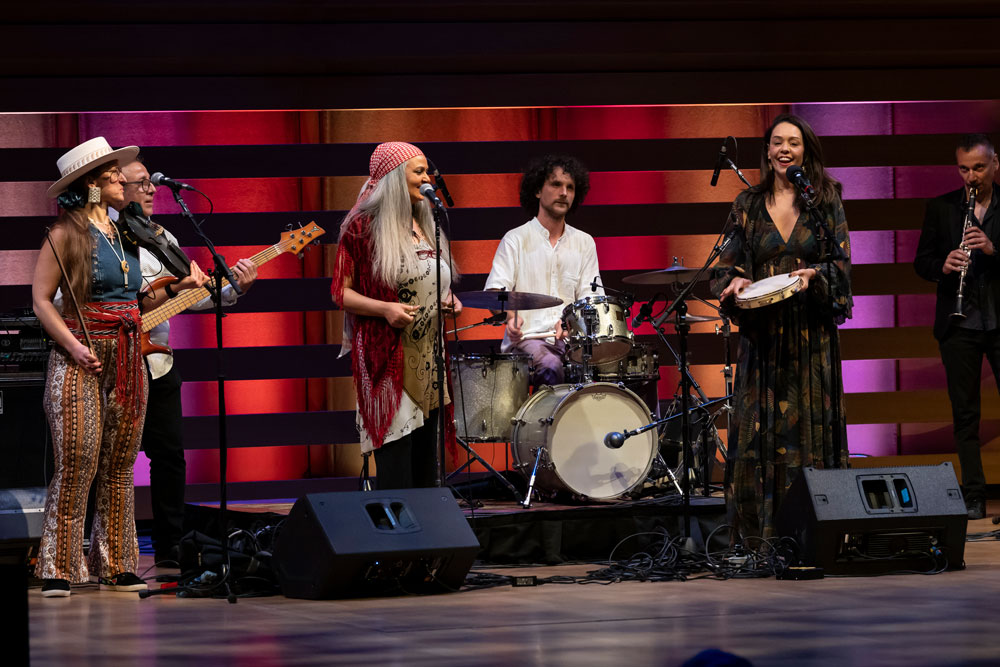
Typically he has hosted these early June season announcements himself as well, but not so this year. The packed hall, artists and audience alike, was mostly there to say goodbye to him, and he sat in the right parterre, less comfortably than in his more usual emcee role, through heartfelt tribute after tribute, interspersed with enough memorable musical moments to keep most of us comfortably in our seats.
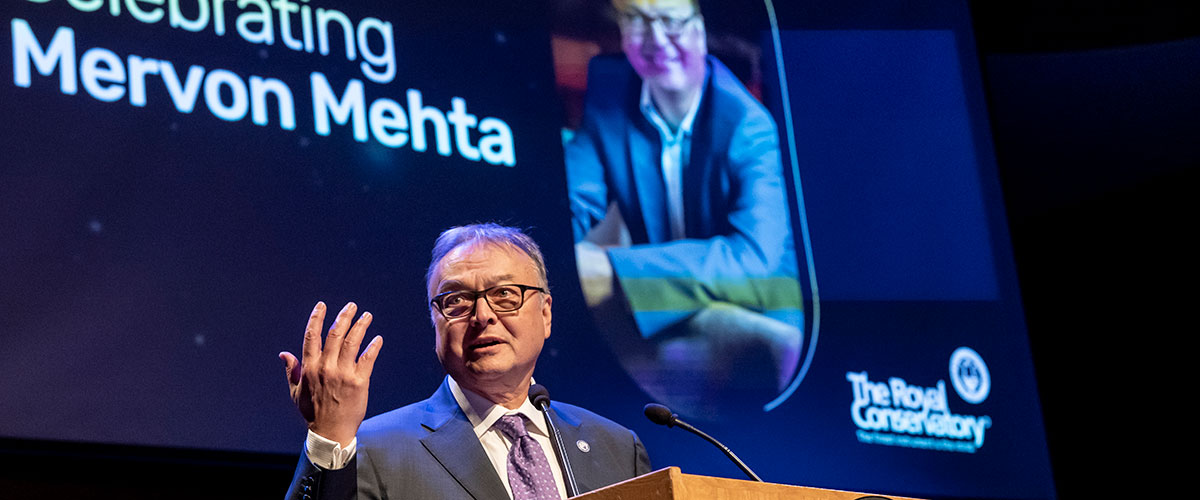
He did get his opportunity to speak, after the announcement that the stage door at Koerner would be named the Mervon Mehta Stage Door, in recognition of the seminal role he has played in expanding the RCM’s concert programming far beyond the classical core one might have assumed would be its comfortable niche.
 Here is a small slice of what he said.
On taking the job: When I was first approached about moving back home to Canada in 2008 to launch a new hall inside a conservatory, I said no. You see, I was not a particularly great student, I did not even particularly like school, how would I survive in what I imagined would be a bureaucratic and parochial environment. My great friend and former boss at Philadelphia’s Kimmel Centre, Janice Price - who is here today, urged me to [at least] take a meeting with Peter Simon. We met for a quick coffee in New York that turned into a three-hour lunch. He had me at hello. I came for a final interview on the very day of Barak Obama’s first victory. After convincing my wife and son, we sold our house in Philly and packed up for the drive across the border in summer 2009 not knowing if the venue would be as excellent as we had hoped, not knowing if I would be a good fit for the RCM, not knowing about schools, housing, employment …
On Toronto: Some colleagues in the US warned me, in their American myopia, that I would be forgotten in Canada, that nothing could compete with jobs in the US. I can say without hesitation that the decision to move home, to manage the opening of this spectacular hall, has been the highlight of my professional career. When I crossed the border in July 2009, after 17 years in the US, my shoulders dropped two inches, and I breathed deeper. This Montreal kid was home and now had to learn to love Toronto. With the notable exception of loving the Leafs, I love Toronto! It is and will remain
our home. It is the city with the most collaborative arts community I have ever known.
On music as a congregational art: Over the years, I have come to know one singular truth above all others. That is...as a species we will always gather for shared experiences ... it is a primal need. Studies show that experiencing music... or art or religion or sports... as a group is a vastly different and more satisfying experience than watching alone or with a partner on a screen. Part of that is the validation of those around you. We know that when groups gather and are engaged together with their whole selves ... mind, body and soul... human connections happen, pheromones are released, joy and sometimes sadness abound, heart rates actually synchronize, in short, it creates community. Artists feel it and send it back in a circular conversation.
Many arts organizations measure success by how many tickets they sell or by how many donations they receive. That seems very intuitive to those who think more transactionally. But what the best arts organizations do is measure other outcomes such as youth development, community safety, education, neighbourhood vitality, a sense of place and a sense of identity.
All these [things] are counter intuitive to the “you should run it like a business” crowd. They understand shareholder value, but they do not understand the value proposition in the arts.... building better citizens, teaching empathy and “holding, as it were, a mirror up to nature”. Russel Granet, an arts leader who runs the arts education programs at NY’s Times Square has said, “I have no interest in creating artists. If these kids want to go on to become actors, and dancers and painters and musicians, that’s great – but the programs I care deeply about aren’t about that. For the critical mass, it's about giving young people the skills to just imagine a different life, a different way of thinking, a level of empathy for others. It is what makes a civilization civil. It's not about creating artists; it's about creating people who think like artists.”
Next season I plan to attend as many concerts as I can, and we can continue the conversation.
To be continued, indeed.