For most Canadians, the event of the year so far has been the Winter Olympic Games in Vancouver. By an unanticipated quirk, the massive media coverage of the games spawned the overnight evolution of our national anthem into an international pop song of sorts. Canadians were joined in the spontaneous rendition of O Canada in the spectator seats at the events and in the streets by visitors from around the world. It even made its way on to more than one late night American TV show.

For me, this sudden unprecedented attention to the national anthem, and the not-infrequent controversies surrounding some performances, put my curiosity into overdrive and spawned a series of questions. What were the origins of national anthems in general, and Canada’s in particular? What should be the criteria for a good national anthem? How and where should the national anthem be performed? Should all those present at an event sing or should it be left to a soloist? Should a soloist be permitted to improvise on the melody? How should our citizens behave during its performance? Who wrote the music? Who wrote the words? Are the words appropriate, or should they be changed to placate the wishes of various interest groups? And so it goes.

According to most authorities, national anthems had begun to appear in a number of European countries by the beginning of the 18th century. However, the practice of having a government designate a particular patriotic song as the country’s official anthem didn’t become widespread until late in the 19th century. As for criteria for a good national anthem, the general consensus is that it should have a good melody, meaningful words, be easy to remember and easy for the average individual to sing.

As for Canada’s national anthem, like the country’s progress to nationhood, the process was evolutionary rather than revolutionary. As early as 1836 we had a list of acceptable patriotic songs. Over the years, O Canada, The Maple Leaf Forever and God Save the Queen came to the fore as leading contenders. It wasn’t until 1964 that Prime Minister Lester Pearson proposed some government action to proclaim an “official” national anthem. By 1967 a parliamentary committee unanimously recommended that O Canada be so designated. It wasn’t until June 27, 1980, three days after the one hundredth anniversary of its first performance, that parliament passed the bill making it official. It was actually signed into law on July 1, 1980 as part of that year’s Dominion Day celebrations (Now changed to Canada Day).

The song O Canada was originally commissioned by the Lieutenant-Governor of Quebec, the Honourable Théodore Robitaille, for the 1880 Saint-Jean-Baptiste Day ceremony. Calixa Lavallée wrote the music, which was a setting of a patriotic poem composed by the poet and judge Sir Adolphe-Basile Routhier.

Calixa Lavallée was born in Verchères Quebec in 1842, studied for a while in Paris and eventually settled in Boston. He was well regarded in his day as a performer, composer and conductor, and performed regularly throughout North and South America.

The original lyrics were in French, and it wasn’t until 1906 that they were translated into English. While the original French words have remained unchanged and spared from tampering over the years, the same can’t be said for English words. Two years after the original literal translation appeared, Robert Stanley Weir wrote another English version, one that is not a literal translation of the French. In October 1969 the government accepted the offer of publishers Gordon V. Thompson to sell to the Crown, for the sum of one dollar, the copyright to the Weir words for O Canada. Weir’s lyrics have been “officially” revised by parliament at least twice. On a number of occasions, the 1980 version has been under attack by special interest groups.

With Olympic fervour running high, Prime Minister, Stephen Harper suggested that he might legislate the words “all our sons command” out, in favour of more “gender neutral” wording. It didn’t take long for the Prime Minister to beat a hasty retreat from that front when the responses from many quarters came thundering in. Some of the most interesting came from Ottawa correspondents for news organizations. One such response was the suggestion that the idea had been hatched by a group from the Prime Minister’s office while hung over after celebrating the victory of the Canadian men’s hockey team.

Canada’s only woman Prime Minister, Kim Campbell, also stepped into the fray. She did not just want the words “all our sons command” changed to something “gender neutral”. On a national radio interview she objected to “our home and native land,” and suggested that be changed to “our home on native land.” That did not sit well with all people born here, whose ancestors arrived a few centuries ago before Canada was a nation. In any case, for now at least, the storm on words has subsided. When it might return is anyone’s guess.

The criterion of being easy for the average individual to sing is certainly not a characteristic found in the US Star Spangled Banner. This may be the reason why it has become the norm at major sporting and cultural events in the US to have a soloist sing the national anthem. Perhaps the original intent was to have the audience join in with the soloist providing a solid base. Unfortunately, that is rarely the case. Which brings up a pet peeve of mine, that of a soloist improvising on the melody. In some cases this might better be described as butchering the melody.

One reader of a small town community newspaper summed up his reactions to the rendition at the official opening of the Olympics as follows: “Is it just me or is there anyone else tired of hearing our national anthem twisted into some artistic ego trip? There should be a level of respect required by the artists selected to represent us on the international stage. A performer or an event organizer has no right to re-work the song. It is not open to interpretation.”

He then goes on: “The publicity of the moment should be enough of a thrill and a boost to a performer’s career without the need to hijack a country’s national anthem. If they wish to put their own spin on the song, they can do so on their own album and take their chances on whether the consumers appreciate it.” I concur. Any organization engaging the services of a vocalist to perform the national anthem should write into the contract that the “official” melody is not to be changed in any manner.

At some stage somewhere around 1900 it had become the accepted custom to have a “national song” performed prior to every concert, theatrical production and other similar public event. In fact, the city of Toronto for many years had by-law requiring such a performance. That by-law was not abolished until 1967. For most community bands the national anthem is an integral part of most programmes. On the other hand, I can’t recall ever hearing it at any community orchestra performance. Why the different standard?

Next month we’ll be back to the community music scene after the huge Hannaford Brass Band Binge. We also hope to have a better look at the Johnny Cowell tribute concert next month.

Definition Department

This month’s lesser known musical term is APPROXIMENTO: “A musical entrance that is somewhere in the vicinity of the correct pitch.” We invite submissions from readers.

Coming Events: See the listings section for full details.

Weekend of April 9, 10 and 11: The Hannaford Street Silver Band presents its seventh annual Festival of Brass at the St. Lawrence Centre. See listings for details.

Wednesday, April 14 7:30: The Plumbing Factory Brass Band, Henry Meredith, conductor, presents “Heros – ordinary and extraordinary.” Byron United Church, 420 Boler Rd., London, Ontario.

May 7 8:00 pm: The Etobicoke Community Concert Band, John Liddle, conductor, presents “Glorous and Free,” a programme of brilliant marches, grand anthems and beautiful songs – a stirring musical tribute to our Canadian military featuring Kathy Thompson, guest vocalist. Silverthorn Collegiate Auditorium, 291 Mill Rd.

Down the Road

Saturday, May 15 2:00 pm: The Northdale Concert Band, with conductor Stephen Chenette, pays tribute to legendary Canadian composer and trumpet player Johnny Cowell. The concert will feature some of Cowell’s most famous solos as performed by well-known trumpet player John Edward Liddle, plus a special guest appearance by Johnny Cowell himself. Scarborough Civic Centre, 150 Borough Dr.

Jack MacQuarrie plays several brass instruments, and has performed in many community ensembles. He can be contacted at: bandstand@thewholenote.com.
I’m going to start this month’s column with four only somewhat related anecdotes, then, with luck, connect the dots between them.

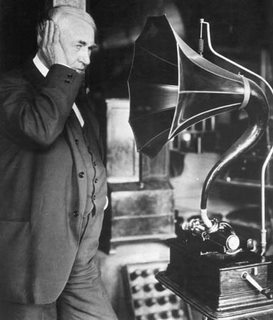
Page 24 Thomas_EdisonIn December 1877, a young man walked in to the office of the Scientific American magazine, and placed before the editors a small, simple machine about which very few preliminary remarks were offered. The visitor, without any ceremony whatever, turned the crank and, to the astonishment of all present, the machine said: “Good morning. How do you do? How do you like the phonograph?” The young man was Thomas Edison.

One of my prized possessions is an old Edison cylinder phonograph with a few cylinders. One of those cylinders contains a conversation between Edison and Johannes Brahms where Brahms asks Edison about how his new invention might influence music.(Little could either have known that in just a few years, as recording technology advanced, performer and listener could be separated by time and distance, and a single performance could be heard many times at many different locations.)

Twenty-nine years after Edison introduced his phonograph, in December 1906, a Canadian, Reginald Fessenden, was the first to transmit sound by radio. In the world’s very first radio broadcast, Fessenden played his violin to the astonishment of the crews aboard ships in the Atlantic and Caribbean. The age of broadcasting had begun.

In a recent broadcast of the CBC Radio programme “The Sunday Edition,” host Michael Enright had as his guest music guru Robert Harris, who was there to “teach us how to listen to music without straining ourselves.” The Enright programme was interesting in many ways. One idea, though, made me stop in my tracks: it was when Harris suggested that we consider all of the elements making up the “infrastructure” of a modern concert performance.

Some are obvious: performers, conductor, composers; repertoire; presenter; venue. But what of all the other less obvious factors? How did each of the composers on the programme come to be a composer, for instance? Childhood ambition to compose? Experience as a performer? How did their first musical thoughts gel, evolve and end up on a printed page? And speaking of the printed page, how many people, over a period of several centuries were involved in the development of the notation system for Western Music that is now universally used? For that matter, where would music performance be today if the art of printing had never been invented?

And what about the instruments? The trombone was certainly the first fully chromatic member of the brass family of instruments, and is generally considered to be the oldest instrument, in unchanged form, of the modern symphony orchestra. All of the other instruments in a modern symphony orchestra, including the strings, have undergone varying degrees of change over the past two centuries.

In short, once we start, we can’t possibly count the number of individuals who have directly or indirectly had an influence on any given performance we hear or play in.

Now, let’s look back over the past one hundred plus years since Edison and Fessenden. Since those early days, sound recording devices and media have become more compact and much more portable. The media have evolved from cylinders through 78 rpm records, LPs, reel-to-reel tapes, cassette tapes, eight-track tapes to CDs, and now to various forms of solid state gadgets like MP3 players and iPods. Similarly, broadcasting has changed considerably. Compare the Metropolitan Opera’s “revolutionary” Texaco live radio broadcasts to their current HD “Live from the Met” telecasts, and you’ll see what I mean.

Another example: look at the evolving major role of electronics in music in recent years. Some years ago MIDI appeared on the scene to harness the power of digital computers. This was closely followed by various music notation programmes to minimized the drudgery of writing out parts by hand. Then, of course, the ubiquitous internet is having a profound influence on many aspects of music. Whether it be downloading actual music, looking for publisher’s catalogues, purchasing instruments, researching composers and their works, reviewing performances, or visiting band or orchestra websites, the internet has become an essential part of our musical toolbox.

The point? Rather than trying to experience music as something distinct from the social forces shaping and reshaping it – what Harris might call “straining ourselves” – we should enjoy the way music performance reects our changing world.

Which brings us to requesting your comments. How is technology impacting on the bands or orchestras you are interested in? What can (and should) band and orchestra websites set out to do, beyond such obvious things as giving you the name of the group, the conductor, their concert schedule, rehearsal time and location? From the perspective of the music you love to play or listen to, what are the history-making changes now getting under way?

Coming Events

The Etobicoke Community Concert Band, John Edward Liddle, Music Director, present “That’s Entertain ment” featuring special guest, Juno-nominated jazz pianist Chris Donnelly. Etobicoke Collegiate Auditorium, 86 Montgomery Road.

The City of Brampton Concert Band with music director, Darryl Eaton, will close its 125th Anniversary Concert Series with “2010: A Space Odyssey” at the Rose Theatre.

The Hannaford Street Silver Band pre sents: “Trumpet Spectacular” with trumpet soloist Allen Vizzutti.

The Plumbing Factory Brass Band, Henry Meredith, Conductor present “Heroes – ordinary and extra ordinary.” Byron United Church, 420 Boler Rd., London, Ontario.

Jack MacQuarrie plays several brass instruments, and has performed in many community ensembles. He can be contacted at: bandstand@thewholenote.com.
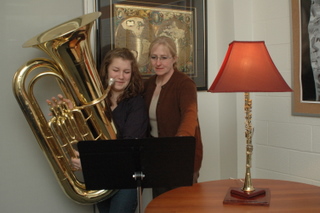
Having spent some years in the Navy, it’s become a tradition for me to attend the New Year’s levee at one or more of the military messes in the Toronto area. At this year’s event I spent some time chatting with a friend who had joined the service as a musician, but had, after a time, set her clarinet aside and gone on to pursue a very rewarding career elsewhere in the service. Perhaps her timing was opportune in having enlisted when many traditionally male only roles were opening up for women. Now, well ensconced in a position with considerable responsibility, might she return to music for recreation? Her answer is “not in the foreseeable future.” Alas, she’s had her clarinets made into table lamps. She had no New Year’s resolution for 2010 to return to music making.

P24
As I write this, the year is now two weeks old. Some people will already have abandoned their well-intentioned resolutions made in haste over a midnight toast. For most of us though, there’s still time to resolve to pursue some course for personal betterment in the months ahead. While no statistics on the subject have crossed our desk, it’s generally agreed that a very high percentage of those who study instrumental music in high school do not continue with their instrument after graduation. For most, it is not a conscious decision to stop playing. They still enjoy music as listeners, but the time pressures of further education, marriage, family and career responsibilities have consumed most of their waking hours. That is barrier number one.

Frequently there is the additional barrier of the lack of an instrument. Most students who participate in school music programs learn on and use school instruments. This barrier is easily overcome by renting an instrument, until the return to playing is a firm decision. Renting also provides time to research the market, and determine the type of instrument best suited to one’s needs.

If you’ve decided that such a New Year’s resolution is for you, where do you start? What are your goals? There are many questions to be answered. The first ones are: What instrument do I want to play and what type of music appeals to me most? For many, the choice of instrument will be to get back to the once familiar. For others it will be to answer a long-time urge to try a different challenge.

Having chosen the instrument, then there is some research to locate possible groups that perform your kind of music. Do they accept novices? Joining a group which consistently performs above your ability level would be frustrating and slow your personal progress. When and where do they rehearse? You want to be in a situation where you will look forward to your weekly music venture rather than worrying about how to fit it in. Once you’ve made contact, attend a few rehearsals to determine whether you and the group are compatible. Most community bands are open and welcoming, but there is a wide spectrum. On the one hand there are groups with a fixed instrumentation where all members are required to audition. At the other end there a few true “beginners bands.”

Over the past few weeks we had the opportunity to visit and sit in with one such group. Starting from scratch a year ago September, a small group in Newmarket organized The Stepping Stone Band. After a bit of a shaky start, the band is now prospering under the direction of a local music teacher. With a regular membership of about 25, they are honing their reading skills with a broad range of music, from basic instructional type music to works from the standard band repertoire.

Some members are getting back after a prolonged absence, while others are rank beginners. On more than one music stand there are fingering charts. One member loved to play his alto saxophone at home, but had never learned to read music. Now that is rapidly changing. Since the band’s inception, some members have gone on to a more advanced band in addition to their regular Monday evening rehearsals. They are sharing their common interest in a friendly non-threatening group. The New Year looks good for them. For information on this group contact Joe at joemariconda@gmail.com.

Harking back to my opening remarks, within a few days of hearing of the sad fate of my friend’s clarinets, I learned of an innovative project at a local school. The problem was not an unusual one. Like most schools, Uxbridge Secondary School wanted more serviceable instruments than their budget would permit. Tucked away in various corners were several unused instruments, but they were deemed to be beyond economical repair.

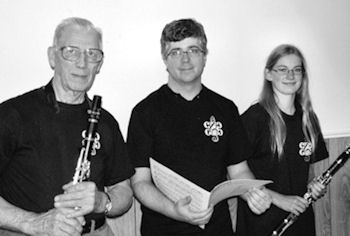
The solution: turn those old instruments into cash. Students in technology classes took the old clarinets and flutes and made table lamps with a musical motif and offered them for sale in the community. The result: winners all around. The school receives money for some new instruments, the old instruments go on to a new life and some homes in town have lamps which are topics of conversation and useful. The photo accompanying this column shows music student Caitlin Jodoin and music teacher Deb Thompson checking over some music by the light of one of the lamps. When not playing in the school band, Caitlin is a regular member of the Hannaford Youth Band.

Definition Department


This month’s lesser known musical term is “APPOLOGGIATURA”: A composition that you regret playing.” We invite submissions from readers.


Coming Events


The Etobicoke Community Concert Band
presents “That’s Entertainment” featuring jazz pianist Chris Don- nelly. Etobicoke Collegiate Auditorium, 86 Montgomery Road.

The City of Brampton Concert Band will close its 125th Anniversary Concert Series with “2010: A Space Odyssey” at the Rose Theatre.

The Hannaford Street Silver Band presents “Trum- pet Spectacular” with trumpet soloist Allen Vizzutti.

Jack MacQuarrie plays several brass instruments, and has performed in many community ensembles. He can be contacted at: bandstand@thewholenote.com.


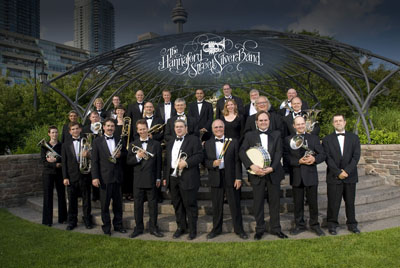
p25_HannafordAs the notices started to arrive for December musical offerings, one trend was abundantly clear. Bands and smaller brass ensembles are getting together with choirs to celebrate the Christmas season. In December, more than at any other time of the year, concert programmes for all forms of musical organizations rely heavily on “seasonal music” and few bands resist the temptation to augment their forces. Of the December band concerts brought to my attention, and mentioned below under Coming Events, only two do not include choirs as guests.

The first such choir-and-band concert I had the pleasure of attending was the Hannaford Street Silver Band’s, with the Nathaniel Dett Chorale as guests early in November. That’s to be followed in succeeding weeks with offerings from a number of bands in the Toronto area as listed below.

Last year the Etobicoke Community Concert Band had planned on joining forces with the Village Voices choir of Markham. However, the forces of Mother Nature were stronger, and a massive snow storm forced the choir to cancel their participation in that event. The band will try again this year, with special guests the Kingsway Children’s Choir directed by Karen Sexton. As an added bonus, this concert will introduce a choir with a different ring. The Jubilate Bell Choir of Islington United Church under the direction of Steven Lundy will add the clear resonance only achieved with a choir of bells.

The one exception to this trend of a band sharing the stage with a choir, which has come to my attention, is that of the Markham Concert Band. Two years ago they had the Village Voices choir as their guests for their Christmas concert. This year they’re going contrary to the mainstream and, by promoting the idea of “two bands for the price of one,” will share the platform with the Chinguacousy Concert Band. By sheer coincidence, both bands just happen to share Doug Manning as their conductor.

Almost as though they felt obliged to reciprocate, two of the choirs mentioned above have smaller brass ensembles included in their own holiday season offerings. On December 12 the Village Voices are joined by the York Brass, and one week later the Amadeus Choir hosts the True North Brass.

How does this combination of chorus and band fare the rest of the year? Not very well. Could it be that there’s a dearth of compositions for modern concert band and chorus? In the classical repertoire there is certainly no shortage of excellent music for chorus and orchestra, but transcriptions of these works for chorus and band are almost non-existent. Original works for the combination are ever more rare. Isn’t it time for composers to write for such a combination?

At their most recent concert, the Hannaford Band, through their very active youth programme, announced the establishment of the Fred Mills Scholarship Fund. While I haven’t yet received details of this fund, I do know that its primary purpose will be to provide financial assistance for youth band members who could not otherwise afford to participate in the programme. Donations of any size will be appreciated. Anyone who has any questions about the value of this youth band programme would do well to attend any concert offered by the three bands under the direction of husband and wife team Darryl Eaton and Anita McAllister. One such event is the “Rising Star” solo competition for members of the Hannaford Youth Band. This will take place on Sunday, December 6 at 2:00 pm in Emmanuel College Chapel, 75 Queen’s Park Crescent.

Definition Department

This month’s lesser known musical term is A PATELLA “To play accompanied by knee slapping.” We invite submissions from readers.

COMING EVENTS | Please see listings for full details

The Etobicoke Community Concert Band
offer “Hits of Christmas Past and Present.

The Milton Concert Band sets the tone for the holiday season with “A Gift of Christmas.”

The Markham Concert Band welcomes the Chinguacousy Concert Band as special guests for “A Seasonal Celebration.”

The Hannaford Youth Band will perform with their guests the Cawthra Park Secondary School Chamber Choir.

Jack MacQuarrie plays several brass instruments, and has performed in many community ensembles. He can be contacted at: bandstand@thewholenote.com.
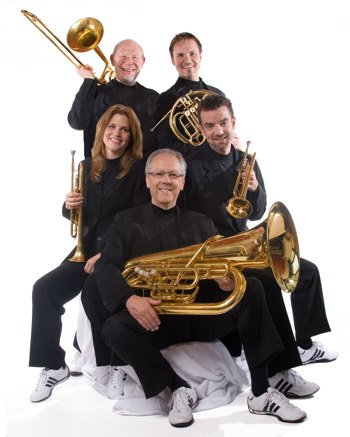
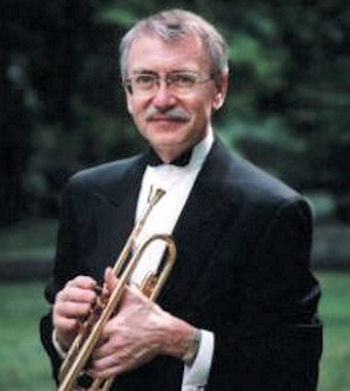
20_millsJust after the completion of last month’s column, we learned of the sudden untimely death in September of internationally renowned trumpet player W. Fred Mills. Renowned for his work over the years with the Canadian Brass, Mills died following a single-car crash while driving to his home in Athens, Georgia, from the Atlanta airport after his return from an engagement in Italy. He was 74. Most recently, he was a professor of trumpet and brass chamber music in University of Georgia’s Hugh Hodgson School of Music.

To learn more about this remarkable musician and his career, we spoke to a fellow musician who knew him well and worked with him for many years. As a founding, and still active, member of the Canadian Brass, tubist Charles Daellenbach came to know Mills very well during the 24 years that he played with that group.

Born in Guelph, Ontario, Fred Mills acquired his first instrument, a cornet, from a traveling salesman. Soon after, he had his introduction to the musical world in the Guelph Police Boys Band. While attending a youth music camp in upstate New York, he learned of the Juilliard School and set his sights on a career in music. While still at Juilliard, he was invited to audition for the renowned conductor Leopold Stokowski in that conductor’s New York apartment. Soon thereafter he was engaged as principal trumpet of the Houston Symphony. In the ensuing years he became a regular in orchestras in the New York area, and a regular at the Casals Festival in San Juan Puerto Rico.

Some time in the late 1960s, although very successful in the USA and internationally, he expressed a desire to return to Canada and was soon engaged as principal trumpet for the National Ballet of Canada. In 1967 he was lured away from that post to become principal trumpet of the newly formed National Arts Centre Orchestra. At about he same time he took up teaching duties at the University of Ottawa.

Meanwhile, Daellenbach, who was teaching in the Faculty of Music at the University of Toronto, teamed up with trombonist Eugene Watts to establish the Canadian Brass in 1970. With the inevitable turnover that such groups must face, by 1972 they were looking for two new trumpets, and invited Mills to join the group. Mills agreed, but with a condition: he recommended trumpeter Ronald Romm, a friend from his days at Juilliard. Soon it was a fait accompli, and the rest is history. The Canadian Brass put the brass quintet soundly on the world stage in the forefront of small ensembles. For the next 24 years, as the group toured the world, Mills’ dazzling trumpet work was featured in concerts and on dozens of records. During his tenure with the Canadian Brass, he arranged more than 60 pieces for Canadian Brass, many of which have since become standards in the brass repertoire.

After years of enduring the rigours of touring, Mills returned to academia and joined the brass faculty at the University of Georgia in September 1996. He was the first recipient of the William F. and Pamela P. Prokasy Professorship in the Arts, an endowed professorship that recognizes a faculty member in the Franklin College of Arts and Sciences who has an outstanding national reputation. There he remained active in faculty and student brass chamber ensembles at as a performer, arranger and coach until his death. At about the same time as Mills’ departure from the Canadian Brass, Romm followed suit and took up a teaching post at the University of Illinois.

21_canadian_brassMills recorded more than 40 albums with the Canadian Brass and was nominated for a Grammy award in 1992. The Canadian Brass website calls him a “Canadian treasure who changed the world’s musical perspective.” It goes on to say that he “spent over 50 years helping establish the trumpet as a beautiful, lyrical voice amongst solo orchestral instruments.”

The Hannaford Street Silver Band will dedicate their first concert of the season to the memory of Fred Mills, whom they describe as “their colleague.” The HSSB will pay tribute to him performing Canzon Trigesmaquinta by T. Massaino; Before thy Throne, I Now Appear by Bach (arr. Irvine); and a rousing version of Harry James’ Trumpet Blues and Cantabile. In recalling his association with Mills, the Hannaford Band’s executive director, Ray Tizzard, stated: “Twenty-six years ago Fred conducted the very first officially organized rehearsal of the HSSB, as well as the HSSB’s earliest public performances in parks around the City of Toronto.”

In Daellenbach’s opinion, one of Mills’ greatest contributions to Canadian music was his work as a coach with the National Youth Orchestra. He will be missed.

Closer to Home

Closer to home, we regret to have to report the passing of trombonist John Williams at the age of 87. Williams had been a personal friend for more years than I can count, and over the years, I had the pleasure of playing beside him in many ensembles. Until recently he played regularly in the Encore Concert Band and the Markham Concert Band. He was the last WWII veteran to play in the Band of the Royal Regiment of Canada.

On the home front, most community musical groups are now in full swing preparing for the fall concert season and many will already have at least one concert under their belts. On looking over the programmes one trend caught our attention: a number of bands are now programming original compositions by band members. Last year the Uxbridge Community Concert Band performed Eternal Flame, a work for band and soprano composed by their director Steffan Brunette. In a recent recording, the Band of the Royal Regiment of Canada included Promenade by conductor Lt. William Mighton. In their October concert, the Markham Concert Band featured two works by band members. Longtime member of the trumpet section Vern Kennedy’s latest offering is a number entitled Marmalade, while Sean Breen’s latest opus is The Woodworker. Is your group scheduling the performances of works by band members? Tell us about them!

In recent weeks we have received interesting information from Resa’s Pieces Concert Band and the Markham Concert Band regarding their activities. We hope to cover those in the next issue.

Coming Events: (Please see the listings section for full details)

November 1, 3:00: Wellington Winds, First United Church, in Waterloo. One week later they repeat the programme at Grandview Baptist Church, in Kitchener.

November 8, 3:00: The Hannaford Street Silver Band welcomes The Nathaniel Dett Chorale in the Jane Mallett Theatre. St. Lawrence Centre for the Arts.

November 18, 7:30: The Plumbing Factory Brass Band presents Musica Britannica at at Byron United, in London.

presents A Tribute to Johnny CowellDecember 4, 8:00: Etobicoke Community Concert Band presents Christmas Pops, at Silverthorn Collegiate Auditorium December 6, 3:00: The Markham Concert Band welcomes the Chinguacousy Concert Band for A Seasonal Celebration at the Markham Theatre.

Jack MacQuarrie plays several brass instruments, and has performed in many community ensembles. He can be contacted at: bandstand@thewholenote.com

22In last month’s issue we mentioned the superb organization of the summertime-only Uxbridge Community Concert Band (UCCB). After their final concert of the season the local newspaper, Uxbridge Cosmos, published an editorial praising the band and its tireless director as assets to the community. To quote a few excerpts from Editor Conrad Boyce.

All of them sacrifice a summer evening each week , some of them coming from considerable distances for the sake of a couple of concerts at the end of a season. So it’s not just the opportunity to perform that attracts them to UCCB, and not just the need to keep up their playing and music-reading skills over the summer break. So what is it that makes the band get bigger every year, and brings many of its members back year after year – ? The clue came towards the end of Sunday’s concert, when both band and audience spontaneously rose for an ovation to the UCCB’s director Steffan Brunette.”

As the editor pointed out, Steffan is a school teacher who conducts music classes at school from September to June, and teachers are supposed to have summers to escape. “How can he get a real vacation if he has a rehearsal every week?” The answer to this and other questions is obvious: “His love of music tops all other priorities.”

Two significant band events in October show similar commitments to community involvement by a number of bands in their own and neighbouring communities. Both are, in a number of ways, commemorating anniversaries.

The first takes place in the Town of Ajax. There, the town will be commemorating the 70th anniversary of the first major naval battle of World War II. The Battle of the River Plate, off the coast of Argentina and Uruguay, saw three light cruisers of the Royal Navy, the Ajax, Achilles and Exeter, take on the much more powerful German pocket battleship Admiral Graf Spee. When the wartime shell-filling plant was built on farm land East of Toronto, the new small town was named after the British cruiser Ajax.

No fewer than five bands with differing affiliations will be performing at the parade and monument unveiling ceremony on Sunday, October 4. The Cobourg Concert Band, in their role as official band of the Royal Marines Association, will be joined by the band of Toronto’s Naval Reserve Division, HMCS York, the pipes and drums of Canadian Legion Oshawa Branch 34 and the Harwood Sea Cadet Corps. This cadet corps is named after Commodore Sir Henry Harwood, the commander of that British force at the Battle of the River Plate in 1939. At the site of the new memorial, visitors will be entertained by the Pickering Concert Band. For details of this event visit the Town of Ajax web site at www.townofajax.com.

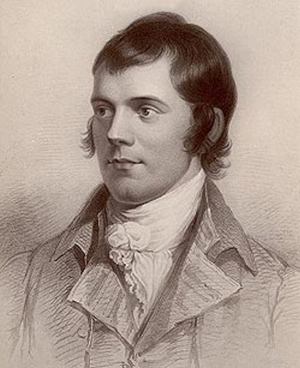
23The second Anniversary event entitled More Tunes of Glory takes place at Toronto’s Roy Thomson Hall on Sunday, October 25. This 20th Annual Massed Military Band Spectacular, sponsored by the Royal Canadian Military Institute, will feature 11 massed military bands, and pipes and drums of the Toronto Garrison. On the anniversary side, this concert will include a salute to the 250th anniversary of the birth of Scottish poet Robbie Burns. Doors and military displays open at 12:30 pm, and the concert begins at 2:00 pm.

Bill Patton, formerly of the Lydian Wind Ensemble, informs us that the new Community Concert Band of Whitby is now prospering. After struggling to maintain a one-to-a-part ensemble, it was decided to form a completely new band. With the blessing of the remaining five charter members from 1998 it was decided to seek a new beginning. The activities of the Lydian Wind Ensemble were terminated in March 2008 with an officially registered name change. Bill then advertised for the formulation of a new community band, and on January 29 the first rehearsal with 20 members took place.

Their first concert in April, 2009 was performed by 24 members. They now have 36 members ready for the coming season. Of these, only 12 play or have played in another band. The rest are all people who played in high school or university and, after establishing themselves in business and family now have time to play again. The Community Concert Band of Whitby’s 2009 /2010 concert season begins with the return to rehearsals 7:30 to 9:30 pm Thursdays under the direction of conductor Stewart Anderson. They are still welcoming prospective members. Visit their web site www.communityconcertbandofwhitby.ca, or contact the secretary at patton62@sympatico.ca, 905-666-3169.

From Newmarket we have a message from Joe Mariconda about the start of new beginners band and orchestra for adults. Here’s his message: Did you play music in high school? Do you think about playing the instrument you have in your closet. If so bring your instrument out of the closet and join a concert band for adults. You must bring your own music stand and instrument. Tuesday’s class will focus on brasswind/woodwind instruments. Thursday’s class will focus on wind/string instruments. All sheets of music will be provided. For information phone 905-895-5193 or e-mail at joemariconda@gmail.com.

Definition Department

Some months ago, while attending a rehearsal, one member of our group asked the conductor how he was supposed to know the meaning of the many musical terms which he found on his music. When the conductor suggested that he might look at the bottom of the music folder he was using, the band member sheepishly found the information required.

However, to assist with those more obscure terms not found on most folders, we have decided to provide a new definition in each issue. This month’s musical term is Allaregretto: “When you are 16 measures into the piece and realize that you took too fast a tempo.” We invite submissions from readers.

Jack MacQuarrie plays several brass instruments, and has performed in many community ensembles. He can be contacted at: bandstand@thewholenote.com.
As I return to the keyboard after my summer hiatus it was suggested that the WholeNote columnists focus on the significant new developments which were anticipated for their beats in the coming weeks. In my case that meant what interesting musical happenings were on the horizon for September and perhaps into October. After a brief and very unscientific survey of the community bands and orchestras I came up cold. Not a single communiqué reached my mailbox to tell of an exciting musical event to herald the advent of the fall season. Similarly, telephone queries drew blanks.

27 bandstandThis doesn’t mean that our community groups are languishing in some sort of apathetic stupor. On the contrary, almost without exception they are busy planning for a new season. However, for most, that season does not include any significant performances until well into the autumn, when leaves on the trees have started to change colour. It’s the start of a new rehearsal season. That is the big event.

By now, most ensembles will have established their schedule of regular concerts and may have come up with a basic framework of the sort of repertoire. In the coming months they’ll undoubtedly add extra performances as they are invited to perform for a variety of functions. What is the process of selecting the repertoire? Does the music director perform that function in isolation or is it a committee decision? Are all members invited in on the process, or are they in the dark until the music appears in the concert folders? In music selection how does one strike a balance between appeal to audiences and appeal to band or orchestra members? We know of one community group where those decisions rest almost solely with the librarian. Who should decide? Why not establish a repertoire and programme committee for your group?

Yes concert performances are important, but for most members, rehearsals fulfill an important social function. Rehearsal night is an evening out to make music with like-minded friends. This brings up the matter of difficulty level. What difficulty level is appropriate for the majority of group members? Should a rehearsal be simply an entertaining evening out to make music with friends or a challenge to the musical abilities of the members?

Should every concert have a distinctive theme, or just consist of a balanced, pleasing musical experience? While I have participated in some “themed” concerts, many, in my estimation, have fallen flat with a jungle of disjointed works that don’t provide the audience with the sense of a pleasant integration.

Are guest performers desired? Certainly they are, if they enhance the quality and variety of the experience for both the audience and the band or orchestra members. To not have soloists would remove from concert programmes a vast array of wonderful music featuring instrumental and vocal soloists. On the other hand, what about visiting ensembles? It’s not uncommon for community ensembles to invite other groups to perform as guests. If this enhances the musical experience, that is fine. However, I know of more than one such occasion where the principal motive was to fill more seats with the families and friends of the visiting group. Musical merit was secondary.

On the subject of rehearsals, my personal preference is for rehearsals that provide both a performance challenge and some pleasant melodies to remain in my head as I wend my way home. I have some anecdotal memories of rehearsals in which I was involved covering the spectrum from excellent to appalling. Let’s start with two in the appalling category.

The first occurred many years ago in a community symphony orchestra. I arrived well in advance of the scheduled 8:00pm start time, set my music on the stand, warmed up and awaited the downbeat. The conductor, a string player, started by working with the string sections on some sections where they were having difficulty. I listened with my trombone on my lap as the string players were coached on bowing techniques etc. I played my very first note at 9:30pm. I never returned.

In another community symphony, I arrived well in advance of the scheduled downbeat only to find that the librarian had forgotten all of the low brass music at home. Rather that offer to rush home to retrieve the music, it  was suggested that I “come back next week.” I didn’t.

On the excellent side, I had the pleasure, for many years, of playing under the guidance of the late Clifford Poole. From Gilbert and Sullivan pit orchestras to the York Regional Symphony, Cliff was always considerate and sympathetic to the concerns of all of his orchestra members. Rehearsals began with sections requiring all orchestra members and ended with those components requiring only the strings. In that way every member played until there were no more notes for them to play. Rather than sit around listening to other sections labouring over difficult parts, these members were free to leave when they had nothing more to do.

Also on the excellent side is the young conductor Steffan Brunette and his Uxbridge Community Concert Band (UCCB). Unlike the vast majority of community groups we discuss here, this is a summertime-only ensemble. After their final concert on August 30, members folded their respective tents and went back to their regular fall and winter groups until next May. This conductor is the most organized of any I’ve had the pleasure to work with. At the first rehearsal of the season every member is given his or her music folder for the season. In addition to the music, the folder contains a sheet with the complete rehearsal and performance schedule, detailing which selections will be rehearsed each night. Also included is a sheet covering all information from rehearsal expectations, contact phone numbers to concert information and membership fees.

Earlier, mention was made of concert programmes with a theme. The UCCB has an interesting theme this year. “The Classical Connection” features works by Bach, Beethoven, Fauré and Mozart. In contrast, we have works by contemporary composers which, if not directly inspired by these, took some inspiration from the form. The Bach Toccata in D Minor is paired with Frank Erickson’s popular Toccata for Band, The Fauré Pavane is contrasted with Morton Gould’s Pavane, and other masters are similarly paired. It works well for both the performers and the audiences.

Please write to us: bandstand@thewholenote.com


Fall Festivals

20LemelinAs urban concert seasons are just getting underway in the cities, three festivals in smaller centres offer opportunities to hear unusual repertoire and also musicians new to many of us. The earliest of these is the Prince Edward County Music Festival (Picton, September 17-19). Under the artistic direction of concert pianist, recording artist and University of Ottawa professor Stéphane Lemelin, the festival will present three evening and two daytime concerts. Distinguished Canadian composer and Bishop’s University professor Andrew Paul MacDonald, the festival’s Composer in Residence, will contribute one work to each of the three evening concert programmes, and will also perform on the guitar at the September 19 Saturday afternoon concert with clarinettist, James Campbell.

Only one day later in and near Owen Sound, the sixth annual Sweetwater Music Weekend (September 18, 19, 20) gets under way. The artistic director, Vancouver Symphony concert master Mark Fewer, has delegated responsibility for the Friday evening and Sunday afternoon concerts to the Banff Centre’s Barry Shiffman and the London Handel Players’ Adrian Butterfield, respectively. Each has come up with a programme that reflects his background and musical tastes, as does Fewer’s Saturday evening programme, which will feature a commissioned work by jazz man Phil Dwyer as well as arrangements of songs by Leonard Cohen and Edith Piaf.

By far the most ambitious of these three fall festivals is the seventh annual Colours of Music Festival (September 25-October 4), the creation of one remarkable man: Barrie lawyer and former politician Bruce Owen. Along with presenting this ten-day festival and a winter concert series, Owen also raised funds two years ago to purchase an excellent grand piano, a Shigeru Kawai. For this festival he has sagely chosen to put the piano in the foreground by selecting  the pianist-composer Heather Schmidt as his composer-in residence, and the Ames Piano Quartet as quartet-in-residence. At this year’s festival there’s also a singer-in-residence, soprano Suzie LeBlanc, who will appear in three concerts with repertoire ranging from Baroque, which is her specialty, to music by Schubert, Mozart and the little-known (except possibly to flutists), Gabriel Grovlez. Certainly the great strength of this festival is the quality of the programming and the calibre of the artists whom Owen brings in.

There is, of course, an abundance of additional information about these three festivals in our listings and on their websites.

Universities

22AinsworthThe academic year is a mere seven-and-a-half months long, which means the university concert seasons need to be among the first off the blocks. At McMaster University’s Convocation Hall, American pianist Justin Kolb will give a recital on September 25, performing works by Beethoven, Mendelssohn, Liszt, Gann and Bond. On October 6, Russian-Canadian pianist Alexei Gulenco will perform works by Mozart, Liszt and Shostakovich, also at Convocation Hall. Gulenco, who has performed all over the world and in numerous piano competitions, teaches advanced students at the Hamilton Conservatory of Music.
One of the finest, if not the finest, recital halls in Toronto is in York University’s new Accolade East arts building, so going to a recital there is doubly rewarding, as you experience not only the performance but also the venue. On September 22 former TSO concertmaster, now York University professor, Jacques Israelievitch and his music department colleague pianist Christina Petrowska-Quilico will launch this season’s Faculty Concert Series with a programme of music by Debussy, Ravel, Poulenc and Pierné. On September 25, mezzo-soprano Susan Blackisande Sinsoulier will launch the Music at Midday noon-hour series in a recital of song repertoire by Fauré, Rachmaninoff, Mussorgsky, Canteloube and Cole Porter. Tenor Colin Ainsworth will perform Schubert’s well-loved song cycle Die schöne Müllerin on September 30. Ainsworth is a rising star in the vocal firmament, and if you have heard him you know why. His voice sounds comfortable in the tenor vocal tessitura, as if it is the middle, not the top of his range. He also brings a wonderful flair and sense of style that always leave you thinking you must hear him the next time he’s performing. I’m not the only one to have noticed the quality of his work: he has performed with Opera Atelier, and this season has performances scheduled with the Toronto Symphony Orchestra and Pacific Opera Victoria. and pianist Mél

Another accomplished young singer, baritone Jason Nedecky, along with veteran collaborative pianist Che Anne Loewen, will launch the new season’s Thursdays at Noon recital series at Walter Hall at the University of Toronto, in a programme called “Music and Poetry – Puzzles and Recipes.” You’ll understand why when you read the programme in our listings! Yet another singer, tenor Patrick Raftery, with pianist Sandra Horst, will open the Faculty Artist Series for this season on September 25, in a programme of arias and songs by Handel, Brahms, Liszt, Morowetz, Poulenc and Massenet. Returning to Thursdays at Noon, the second recital in the series, on Thursday, October 1, will be given by flutist Susan Hoeppner, with pianist Lydia Wong, performing a lovely programme of music by Carl Reinecke, Henri Büsser and Robert Muczynski. Also of great value to those interested in the art of singing are the voice performance classes. These are held every Monday at 12:10 in Walter Hall. There will also be a short recital by graduate student singers on Monday, October 5 at 6:30.

The Toronto Symphony Orchestra

The TSO opens its 2009-2010 season on September 24 (repeat performance on September 26) with a tribute to the genius of Brahms. Peter Oundjian will conduct performances of Brahms’ Second Symphony and D Major Violin Concerto with soloist Joshua Bell. Also on the programme is Frenergy by Edmonton Symphony Orchestra composer-in-residence John Estacio, which Oundjian will also perform with the St. Louis Symphony Orchestra in December

Other Events

The Prater Orchestra, named after a park in central Vienna (oft frequented, we are told, by all the great Viennese composers of the classical period) was started recently by Azerbaijani-Canadians Roufat Amiraliev and Rena Amiralieva, and Iranian-Canadian Joseph Lerner. Its next concert will be on Friday, October 2, at the Richmond Hill Centre for the Performing Arts (a story for another issue) The programme, conducted by Lerner, will include J S Bach’s Piano Concerto in D Minor, with soloist Amiralieva, a Moscow Conservatory graduate, and a new work by Lerner, Through the Colours, which is a tribute to and a lament for the many Iranians who stood up for political self-determination after the recent election in Iran.


With summer approaching, most community musical groups will have finished the last of their regular concerts. Some will close down for the summer, while others will embark on a mixture of park concerts, summer festival performances and various other less formal musical events. This slowdown in more structured activities could accord band and orchestra members opportunities for revitalization and musical exploration. In chats with our editor, a variety of pathways to explore came to mind. What about trying our hands at a different instrument, a different method of studying our instrument or exploring a different musical genre?

Read more: Time for other paths

With the myriad of spring concerts behind most community musical groups, it seemed like an opportune time to express some personal opinions which have been festering in my head for some time. Over the past two weekends, during which I have attended three concerts and one play, and played in one performance, a few pet peeves have boiled to the surface of my consciousness. This seemed like a good time to pontificate on my aversion to the many distractions to which concert goers and performers are subjected. Let's just lump these all under the heading of distractions.

Before mounting my high horse about audience decorum, I feel compelled to recall two incidents years apart that evoke laughter for me. The first happened many years ago when I attended my first symphony concert after my arrival in Toronto. It was at a time when there were regular "Prom Concerts" at Varsity Arena. These were promoted as less formal than the winter concerts at Massey Hall. Unfortunately, the interpretation of the term informality by the two elderly ladies seated directly behind me, went too far for my liking. Throughout the entire concert I was "treated" to the incessant rhythm of clicking knitting needles.

Read more: Distractions

Preparing to write this month’s column, no fewer than three announcements for significant events featuring Silver Bands landed on my desk. In order: the Hannaford Silver Band’s 6th annual Festival of Brass; the Weston Silver Band’s Concert with special guest Douglas Yeo (bass trombone of the Boston Symphony); and the Metropolitan Silver Band’s 75th anniversary celebration. My editor seemed to find this more significant than I did, so I took to the internet to find out if there were important distinctions between Silver Bands and Brass Bands.

Read more: BandStand and Podium
Back to top