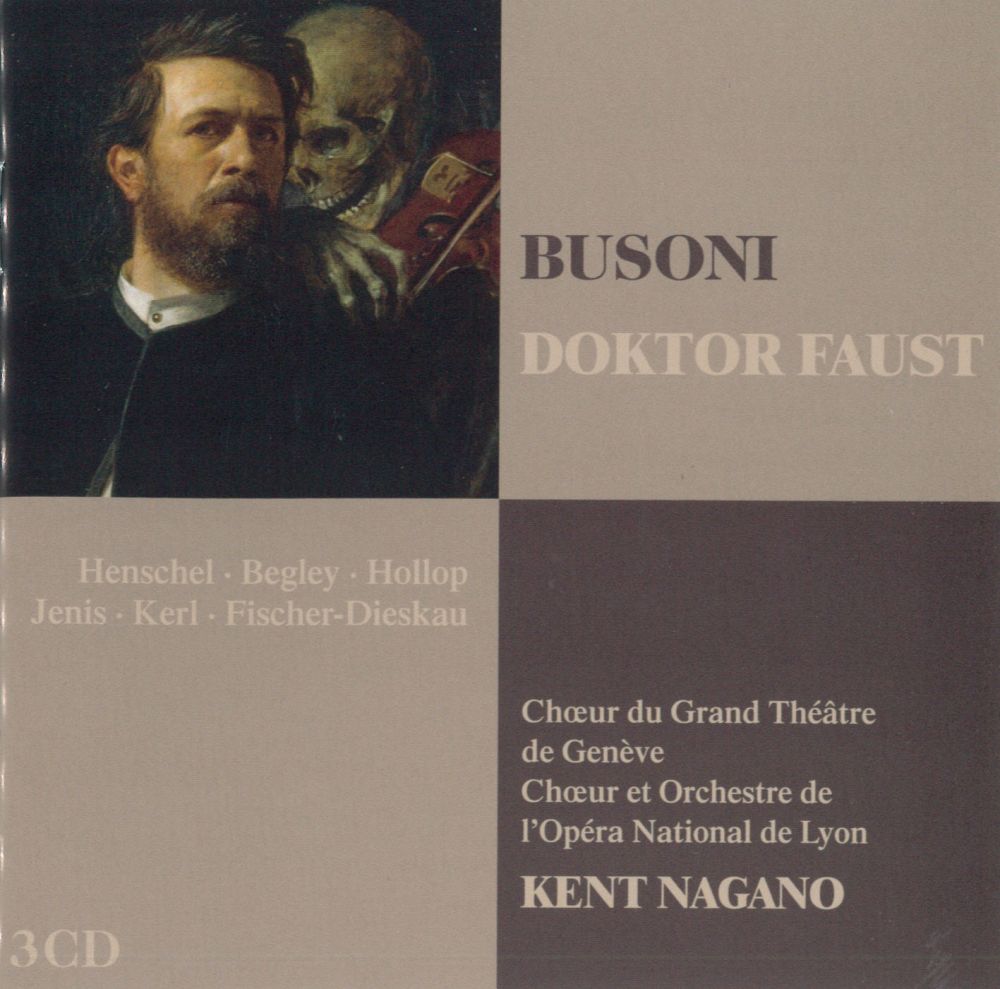
02 vocal 04 busoni faustBusoni – Doktor Faust
Henschel; Begley; Hollop; Jenis; Kerl; Fischer-Dieskau; l’Opéra National de Lyon; Kent Nagano

Erato 2564 64682-4

Ferruccio Busoni (1866-1924) was celebrated by his contemporaries as an astounding pianist and valued teacher but considered himself above all a composer. It was not until the 1980s however that his compositions began to attract the international attention they deserve. Busoni rightly considered his opera Doktor Faust as the summation of his life’s work. His interpretation of the Faust legend takes its inspiration not from Goethe but from the origins of this mythical figure in Medieval puppet plays. He wrote and published his own libretto in 1916 and devoted the remainder of his life to its composition. Sadly, he died just short of the completion of his masterpiece, which he entrusted to his student Philipp Jarnach to fulfill for the 1925 premiere.

In 1982 the musicologist Anthony Beaumont reconstructed two more scenes intended for the ending of the opera from previously unavailable sketches and this “complete” version was issued on the Erato label in 1988. The Erato firm was absorbed by Warner Music in 1992 and this important recording became unavailable. Happily, further corporate restructuring has brought it back to life in Warner’s new “Erato Opera Collection” launched in 2013. This reissue features the Opéra de Lyon production under the direction of Kent Nagano with Dietrich Henschel in the lead role, Kim Begley as Mephistopheles and Eva Jenis as the Duchess of Parma among others. Though the interpretations are immaculate and the sound is very fine the repackaging offers only a brief synopsis and no libretto is provided, though with some sleuthing an English translation of the Jarnach version can be located on the internet.

The incomparable Dietrich Fischer-Dieskau first made this work famous in a compelling 1970 recording conducted by Ferdinand Leitner with the Bavarian RSO on the Deutsche Grammophon label. Fischer-Dieskau (Henschel’s teacher from long ago) also appears in the cast of the Erato production, though his is merely a speaking role at this late point in his career. The landmark DG recording has also long been in limbo though I am happy to report it too has resurfaced in digital form on iTunes. Were it not for some major cuts to the score (not necessarily a bad thing) and the damage done by the woefully wobbly Hildegard Hillebrecht as the Duchess it would still stand as my preferred interpretation of this strangely beautiful drama.

The Beaumont additions are provided as fillers at the end of the third disc of the Erato set, with suggestions of programming the tracks to either avoid or include them clumsily sketched out, though there is no discussion of the history of the reconstruction in the documentation. Rather than ending with the melodramatic death of Faust in dismal E-flat minor the Beaumont version ends with his mystical redemption through reincarnation in a luminous C major. Take your pick then, though it seems to me that on the opera stage death wins every time. The Beaumont edition has evidently failed to catch on; the recent 2001 Metropolitan Opera and 2006 Zurich Opera productions revert to the 1925 Jarnach version. Both featured baritone Thomas Hampson in a temperamental interpretation of the title role, with the latter performance available as an ArtHaus DVD previously reviewed here by yours truly (March 2008).


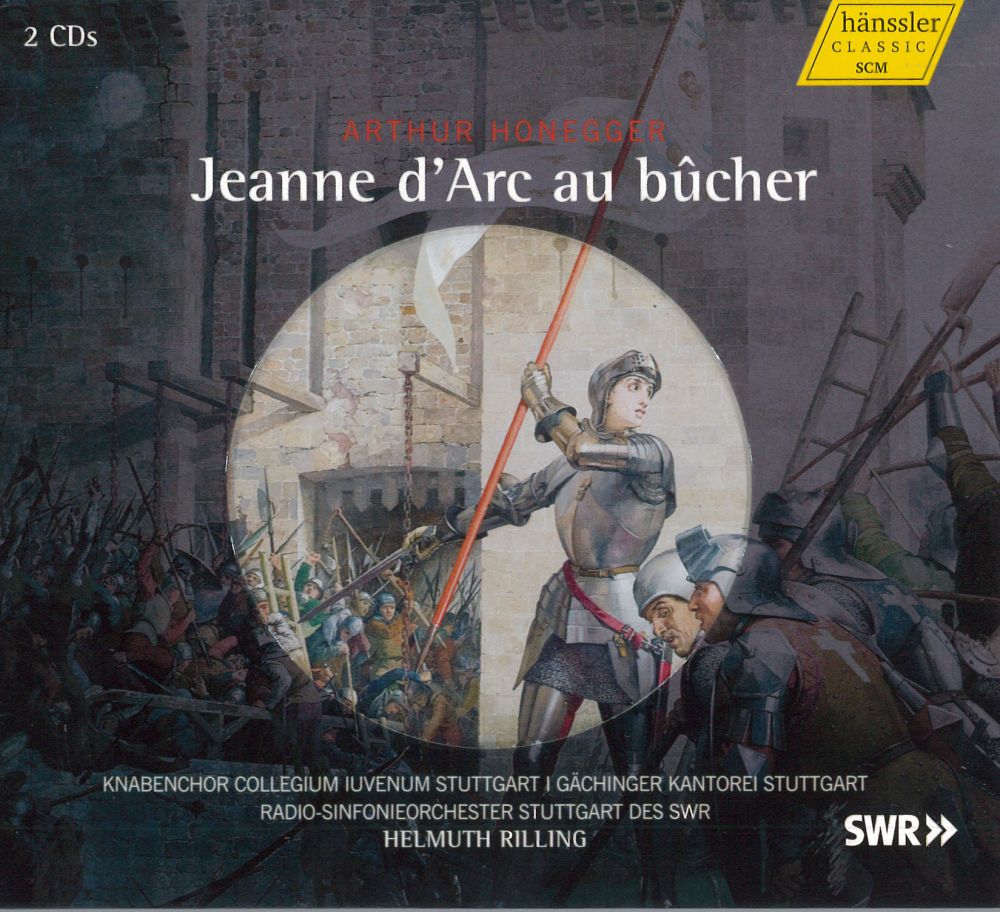
02 vocal 05 honegger jeanneHonegger – Jeanne d’Arc au bucher
Radio-Sinfonieorchester Stuttgart des SWR; Helmuth Rilling
Hänssler Classic CD 098.636

German conductor Helmuth Rilling is known here mainly for his authoritative performances of Bach. But his repertoire is, in fact, remarkably broad and adventurous, and his recorded output is prodigious. In this live recording he undertakes a magnificent work whose rarity in our concert halls is baffling.

The two leading parts, Joan and Brother Dominic, are spoken rather than sung. But for the rest, French composer Arthur Honegger drew on a mixture of musical styles, from jazz and folk song to Gregorian chant and Bach chorales. These make for many wonderful moments, but the most moving is near the end, when the Virgin, sung by Canadian soprano Karen Wierzba, soars radiantly over the huge choir and orchestra as Joan is burned at the stake and ascends to heaven.

Rilling brings out the disparate moods of the work – the irony, absurdity, humour, mystery and profound spirituality. But these disjointed elements don’t always come together in the unified vision that Honegger and his librettist Paul Claudel sought.

Sylvie Rohrer as Joan and Eörs Kisfaludy as Dominic are affecting but unidiomatic, and momentum is sapped by the slow pace of their extended dialogues. It’s the Gächinger Kantorei Stuttgart, founded by Rilling in 1954, that steals the show, especially with the soloists frequently overpowered by the massive forces behind them.

The booklet essay and soloist biographies are in French and English, but the libretto is given only in French, without even a synopsis in English.


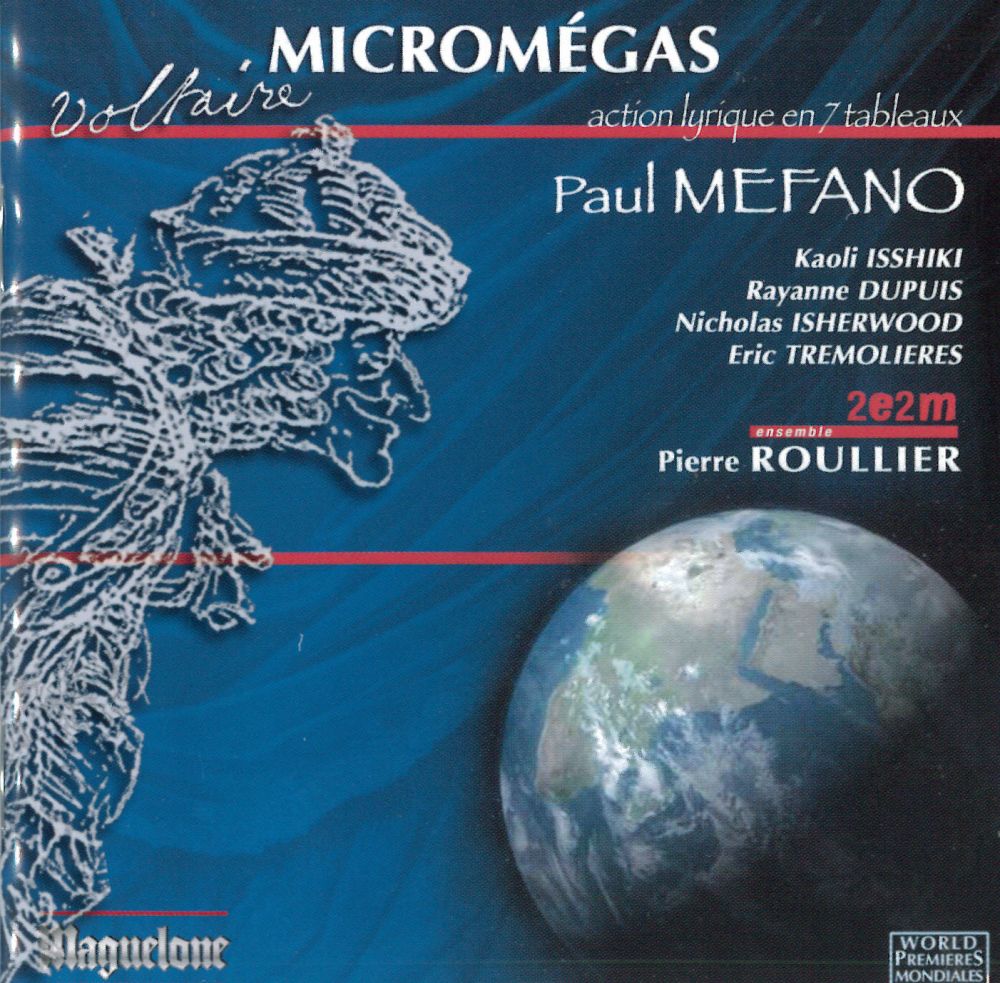
02 vocal 06 mefano micromegasMéfano – Micromégas
Isshiki; Dupuis; Isherwood; Trémolières; Ensemble 2e2m; Pierre Roullier
Maguelone MAG 111.170

Philosophical treatise from the 18th century as a libretto for a quasi-operatic work? A preposterous idea, right? Not if the librettist is Voltaire himself and the music is supplied by French composer Paul Méfano (b.1937). After all, Candide proved to be one of the best sources for the musical theatre of the 20th century. Alas, Micromégasaction lyrique en 7 tableaux – is not a straightforward story, but rather a series of musings on loosely-related topics of existence, colour, microscopic universe and human destiny. The cast of characters is more of a group of ideas, expressed through abstract, yet frequently amusing observations from the world of philosophy and, ever-important in the 18th century, science. In typically Voltairean fashion, the last line of the work, delivered by Saturnien, is “I was right to doubt it!”

This is the milieu in which Méfano develops his complex landscape of musical themes, assigning motifs to ideas and quasi-characters, endowing them with particular, easily identifiable harmonies and distinct “voices.” All of this is put in the context of a “tone poem” and “sound images,” overlapping and leading the narrative from a light, comedic touch to a much deeper, contemplative conclusion.

Méfano studied with Darius Milhaud, as well as Boulez, Stockhausen and Olivier Messiaen. All of these influences are clearly present in his music, making for a fascinating, meandering journey through the music of the 20th century and beyond.


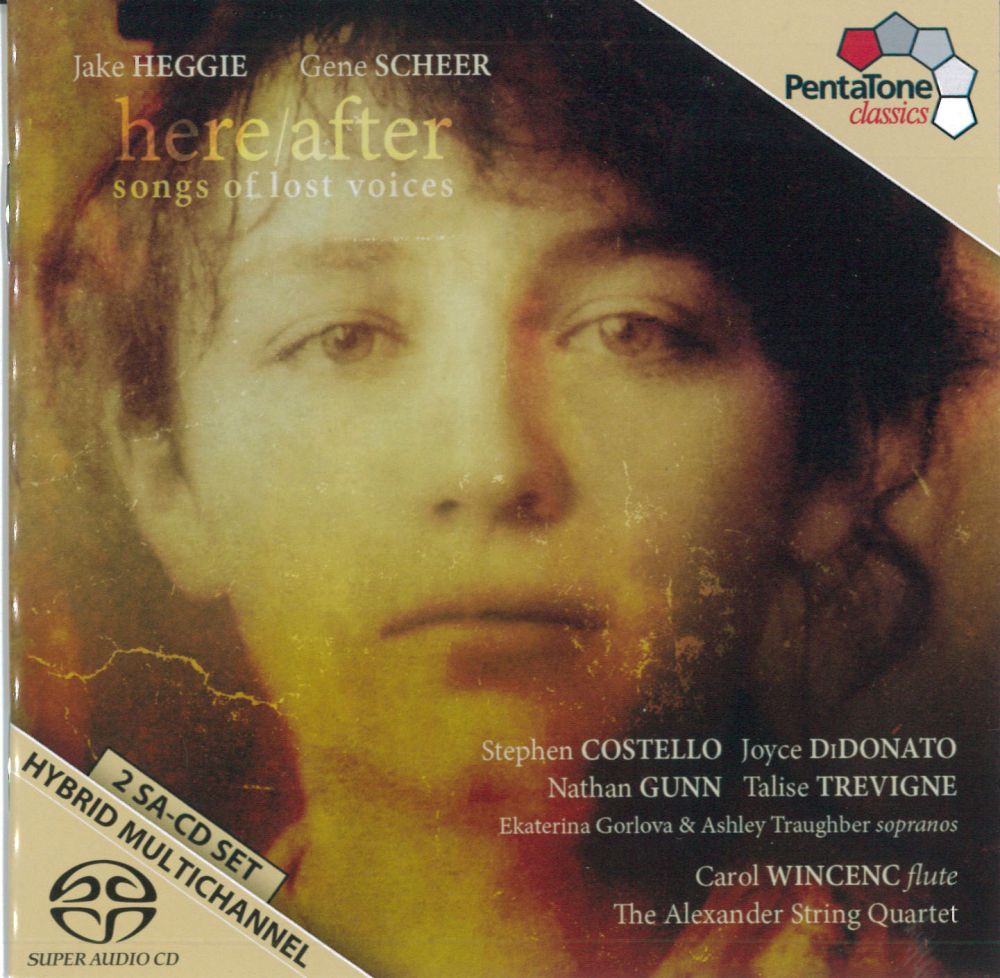
02 vocal 07 heggie hearafterHeggie – Hear/After – Songs of Lost Voices
Stephen Costello; Joyce DiDonato; Nathan Gunn; Talise Trevigne; Carol Wincenc; Alexander String Quartet
PentaTone PTC 5186 515

Art song is alive and well in North America as evidenced by this rich two disc collection of collaborations by Jake Heggie (music) and Gene Scheer (texts). The lost voices represented are “silenced individuals whose stories deserve to be heard,” including victims and survivors of 9/11 (Pieces of 9/11: Memories from Houston). In 9/11, the duo is successful in their intention to bring forward “the hope and newness that can come from grief” through excerpts obtained through 30 hours of interviews from first responders, families and community members. Woven throughout are echoes of the “Prelude” from Bach’s Cello Suite in G Major, providing a poignant and moving undercurrent to the memories.

Another of the “lost voices” is French sculptor Camille Claudel (Camille Claudel: Into the Fire) whose tumultuous relationship with Rodin and frustrated ambitions resulted in commitment to an asylum. The duo take as their inspiration six of her sculptures with each movement evoking the story that each represents. Performances by mezzo Joyce DiDonato and the Alexander String Quartet are absolutely stunning in their tender, exquisite phrasing.

Art as inspiration is a prominent theme throughout this recording with two more song cycles: Rise and Fall, which gives voice to famous sculptures, and A Question of Light, inspired by six major artworks in the Dallas Museum of Art.


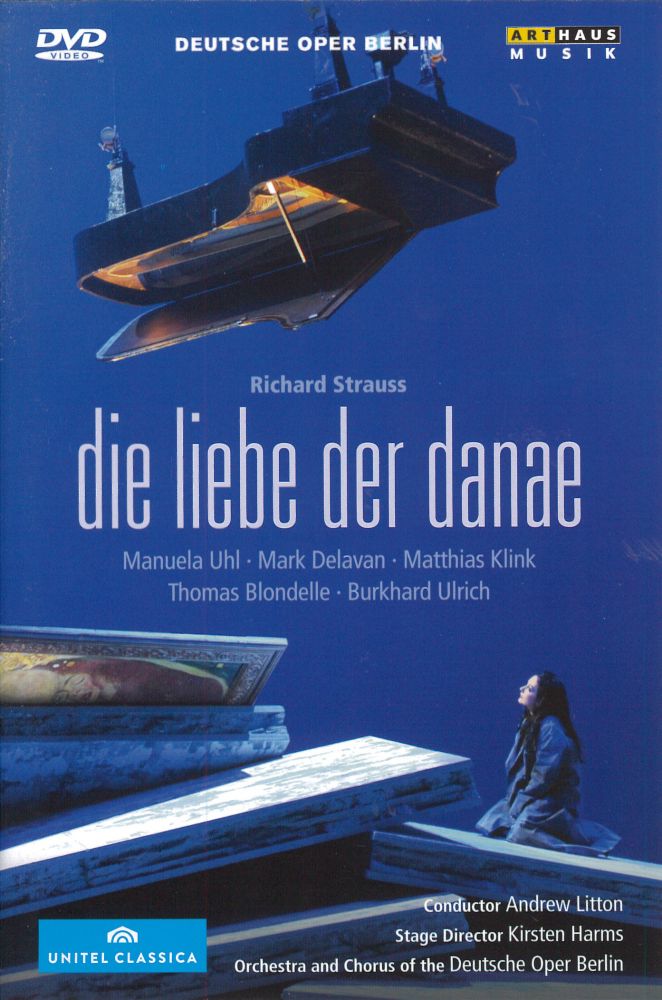
strauss danaeRichard Strauss - Die Liebe der Danae
Manuela Uhl; Mark Delavan; Matthias Klink; Thomas Blondelle; Burkhard Ulrich; Deutsche Oper Berlin; Andrew Litton
ArtHaus Musik 101 580

Strauss’ last opera had a difficult birth and even more difficult “childhood.” Written in the midst of WWII, at the imminent collapse of Germany, Strauss wouldn’t allow this seemingly frivolous “joyful mythology”  to be performed during the war, but kept nursing it to his bosom, procrastinating until he died in 1949.  It finally reached the stage for the first time in 1952 at the Salzburg festival. One wonders why Strauss wrote such a “frivolous comedy” at the end of his career. Perhaps because it is not a frivolous comedy at all!

The God Jupiter who created everything, even man’s “free will” that becomes his undoing, falls in love with the beautiful Danae and employs clever manipulations such as assuming the false identity of Midas to win her with gold and using the real young, handsome Midas as go-between. He unwittingly lets Danae fall in love with Midas out of her own free will which he, the God, is unable to control. Jupiter with enormous sadness has to renounce his love and disappear from the scene. This is the tragedy of an old man, like Strauss himself who is similarly leaving the scene, saying farewell to his love, his life, his art and the world.

Die Liebe der Danae is a beautiful, very eventful and musically rich opera that reaches sublime heights in its last scene (Strauss was always good at endings), the music soars and soars and when it finally reaches ff, leaves the audience silent in awe of its heavenly power. This production by Deutsche Oper, presented on two DVDs, makes us feel exactly that. Stunningly realized with sets of gold and azure, directed with know-how and dignity by Kirsten Harms, conducted by great Straussian Andrew Litton, the title role is sung by Manuela Uhl, who is as good a singer as she is ravishingly beautiful, paired with tenor Matthias Klink (Midas) singing with “emotional radiance.” The real hero however is the baritone, Mark Delavan (Jupiter) with his tremendous pathos, sensitivity and of course power, the power of a God.


02 vocal 01 bach matthew passionBach – Matthäus-Passion
Im; Fink; Gura; Lehtipuu; Weisser; Wolff; RIAS Kammerchor; Akademie f
ür Alte Musik Berlin; René Jacobs
Harmonia Mundi HMC 802156.58

Half a century ago there were two kinds of performances of Bach’s Passions: those that used large forces and modern symphony orchestras and those that used smaller forces as well as period instruments and baroque performance practices. Now the former kind have all but disappeared. There is, however, a great deal of variety in historically informed performances. In 1981 Joshua Rifkin proposed that there was no chorus in the modern sense in Bach’s sacred music and that choruses and chorales were sung by the soloists, one to a part. Initially that proposal was greeted with derision but over the years it has gained a great deal of acceptance.

A 2008 recording of the Matthew Passion that comes close to what Rifkin proposed is that of the Dunedin Consort and Players, conducted by John Butt (Linn Records CKD 313). In that performance the Evangelist is the tenor of the first Choir and the Christus is the bass. The singers of the arias also sing in the choral sections. Butt needed a few extra singers for the smaller parts and for the sopranos who sing the cantus firmus in the opening chorus. That gives us 12 as the total number of singers.

By contrast, Jacobs proposes that the larger of the two choirs sing at the west end and the smaller choir at the other end of the church. He divides the larger choir into two groups and also adds a boys’ choir. Those who sing the smaller parts also sing in the chorus but not the major soloists or (with one exception) the singers of the arias. That brings the total number of singers to 61. Instrumental forces are also larger: 37 as against 25 in the Dunedin Players. Jacobs also has a much heavier bass line because he has added two bassoons as well as a lute to the continuo.

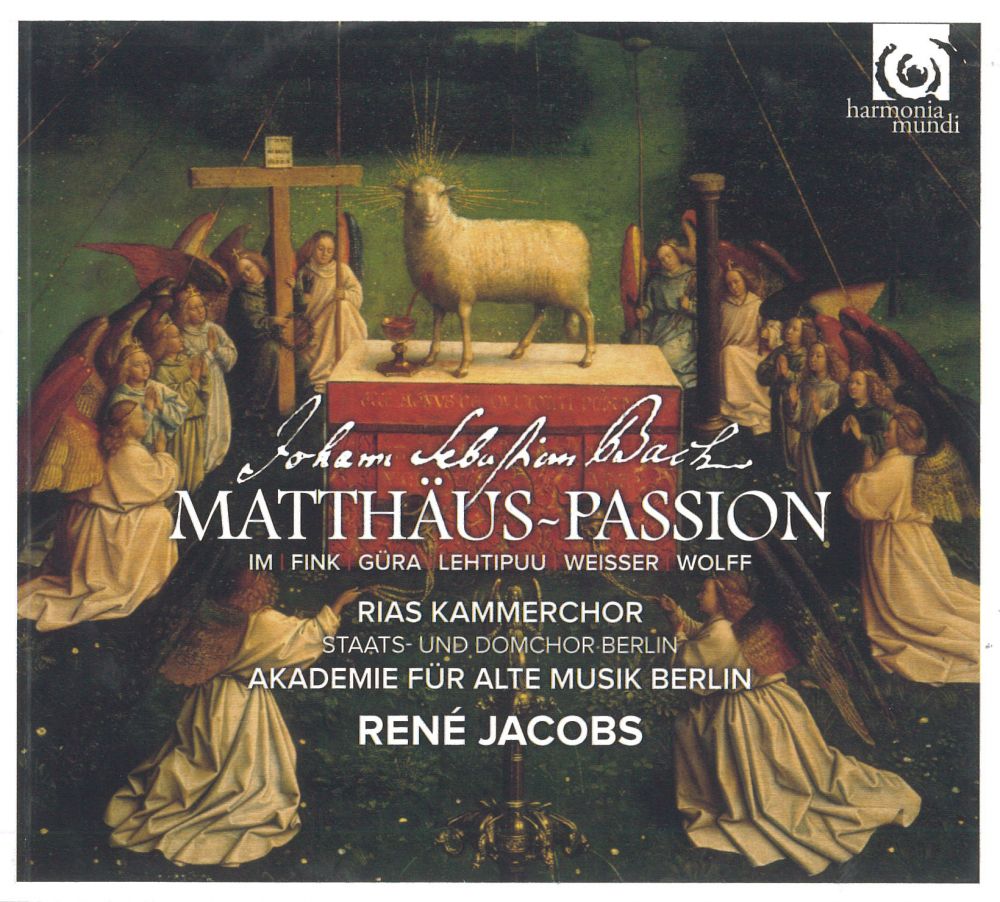
It is clear that the new recording is on altogether a different scale than that of the Dunedin Consort. While I like the lightness of the latter performance, I would concede that (whatever the historical validity) Jacobs’ interpretation has one great advantage and that is that he can scale down his large forces when needed. The performance is very dramatic and is none the worse for that. He has very good soloists. Werner Güra (the Evangelist), Johannes Weisser (Christus) and Bernarda Fink (the alto arias) are especially fine. This is Jacobs’ first recording of the work, though he has sung the alto solos many times. But his love for the work goes back further, to the time when he sang it as a boy chorister in St. Bavo Cathedral in Ghent. It is fitting that the illustration on the box of the CDs is that of Jan van Eyck’s Adoration of the Lamb, the central portion of the altarpiece in that church.

02 vocal 02 don giovanniMozart – Don Giovanni
Skovhus; Ketelsen; Petersen; Opolais; English Voices; Freiburger Barockorchester; Louis Langr
ée
BelAir BAC080

It is to the credit of Mozart’s greatest opera to be able to endure many different viewpoints, from traditional to the wildest modern interpretations. I’ve even seen one that took place in the South Bronx with an all-black cast and it was marvellous. Here the Don Juan legend, or “morality tale” is from the hand of a young, very talented Russian director Dmitri Tcherniakov with a well-thought-out and imaginative concept that infuses the action, setting and characters to the last detail. That concept puts the drama in a modern setting: a drawing room of a luxurious residence of a dysfunctional family is quite immaterial. It really is all about a man trying to live above the rules of society; although he is successful for a while, he is ultimately doomed.

To achieve this, the director, who knows the score and libretto by heart and therefore is no bumbling dilettante, selected his singing actors with utmost care, mostly young with fine voices and remarkably fit to live up to his strenuous physical, emotional demands. The dissolute Don, Danish baritone Bo Skovhus is a larger-than-life presence, alternatively charming, elegant, seductive, insolent, despondent or manic, you name it, although the superhuman demands do take their toll and his powerful voice is sometimes off pitch. The three women representing three social classes andof different ages, are all memorable, each with their own issues, but common in one respect: their uncontrollable, conscious or subliminal attraction to the Don. I was most impressed by the ingenue, exceptional Swedish soprano Kerstin Avemo, giving a simply unforgettable, many-layered emotional, heartbreakingly empathetic portrayal of Zerlina.

Under the enthusiastic, firm musical leadership of French conductor Louis Langrée driving his virtuoso period instrument orchestra with verve and brisk tempi, the show moves along seamlessly and it’s refreshing like the Provence air.

02 vocal 03 rossini ciroRossini –  Ciro in Babilonia
Podleś; Pratt; Spyres; Palazzi; Orchestra and Chorus Teatro Comunale di Bologna; Will Crutchfield
Opus Arte OA1108D

Around 1810 Rossini ran away from home as a teenager to try his luck in Venice, where he met and fell in love with a great operatic diva of the time, Maria Marcolini. This very fruitful relationship bore many successful operas written with Marcolini’s wonderful contralto coloratura in mind. Unfortunately the biblical epic Ciro in Babilonia, Rossini’s take on Belshazzar’s feast, was a fiasco according to the composer and duly forgotten over the next century. Posterity, however didn’t agree with Rossini’s modesty and the opera was revived recently in the USA at the Caramoor Festival under the auspices of Rossini scholar Will Crutchfield, who also conducted. So successful was the revival that it was soon transferred to Rossini Mecca, the Pesaro Festival where this video was filmed.

Fortunately today we have the voices capable of singing the extremely difficult lead roles. Polish contralto phenomenon, Ewa Podleśis the ideal choice for the lead, Ciro, King of Persia, the longest contralto role in opera history. No less impressive is the virtuoso soprano, American Jessica Pratt who cuts a magnificent figure with vocal acrobatics to match as Almira, his imprisoned wife. Another American is the powerful, virtuoso tenor Michael Spyres as the villainous Baldassare, the wicked ruler of Babylon who gets his just desserts prophesied by “the writing on the wall.”

The most wonderful quality of this performance is the projected scenery that conjures up in a matter of seconds vast deserts, beautiful palaces, grand ceremonial spaces or a dungeon built stone by stone in front of our eyes. After witnessing Bill Viola’s wonderful Tristan videography, this production is a step in the right direction using up-to-date cinematic technology as a way to the future.

02 vocal 04 mahler das liedMahler – Das Lied von der Erde
Sarah Connolly; Toby Spence; London Philharmonic Orchestra; Yannick Nézet-Séguin
London Philharmonic LPO-0073

This live performance recorded on February 19, 2011 in London is a welcome addition to the extensive discography of outstanding performances of Mahler’s autumnal song cycle, The Song of the Earth. The six movements of the work alternate between tenor and contralto roles, though the latter is sometimes sung by a baritone. The phenomenal English tenor Toby Spence is blessed with a voice of steel, with a bright, ringing tone equal to the challenge of cutting through the massive orchestration of the opening “Drinking Song of Earth’s Misery.” His lusty tone is also equally suited to the mood of “The Drunkard in Spring.” Only the intervening “Of Youth” movement left me a bit disappointed; I would have appreciated more tonal shading in this more reflective music. Nonetheless a voice this powerful in such a taxing role has rarely been heard of late. Mezzo-soprano Sarah Connolly maintains these high standards with her beautiful, even sound. The finely shaded intimacy she brings to “Autumn Loneliness” contrasts nicely with her sly account in “Of Beauty,” amazingly well enunciated at such a blistering tempo. The great challenge of the closing “Farewell” is artfully conveyed by her extensive vocal shadings, falling just short of the sublime in the final fading moments.

Yannick Nézet-Séguin ensures every detail of the score is heard yet beautifully balanced and brings a very Mahlerian plasticity of tempo to the work without falling into excess. The sound is closely miked yet spacious with minimal audience interference. Highly recommended.

Back to top