04 Modern 01 Metropolis saxophoneMetropolis
Harringon/Loewen Duo
Ravello Records RR7889

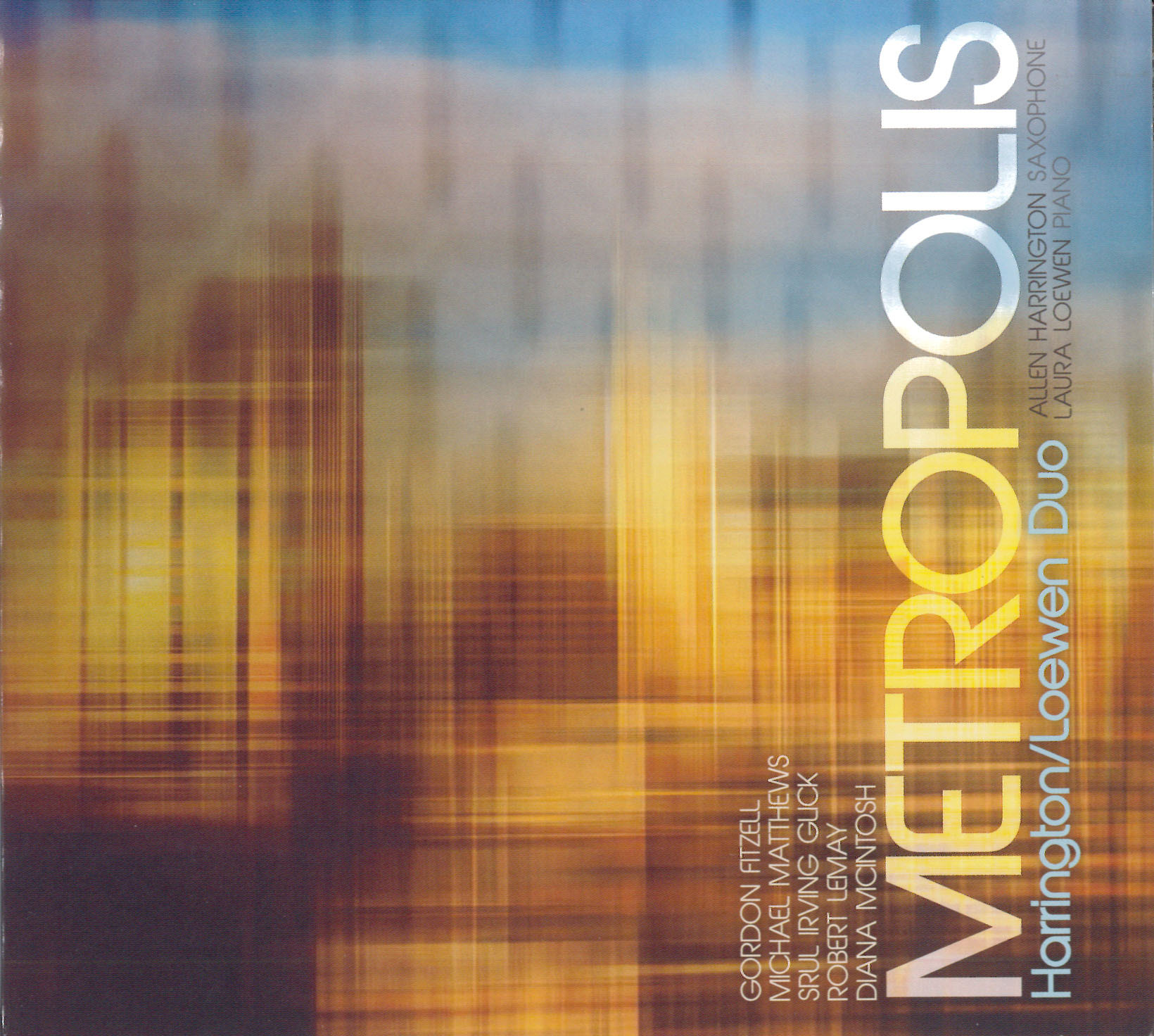
New Canadian saxophone music is taking flight recently, much as a result of the commissioning efforts of Winnipeg-based saxophonist Allen Harrington. Prairie composers Gordon Fitzell, Michael Matthews and Diana McIntosh are featured on this disc with pianist Laura Loewen.

Harrington’s debut recording begins with a bang: literally, with the saxophone screeching and popping whilst the pianist hits the strings with mallets inside the instrument. Fitzell’s Metropolis is a kind of sonic experiment, or lexicon of extended techniques for both instruments; the piece is always in motion, despite its fragmented form and sparse texture.

I find the crystalline sound and static drama of Sudbury composer Robert Lemay’s modernism more successful: this composer has written many works for saxophone – and also uses every technique available – but Oran always has a clear motivation.

Harrington and Loewen show their years of collaboration successfully in the more traditional works on the disc: Srul Irving Glick’s Sonata and Matthews’ The Skin of Night highlight their sensitivity to lyrical passages – his alto saxophone sound has a warm intensity in the middle range and she has a dramatic and articulate touch on the piano.

Being the only Canadian to place at the Adolphe Sax Competition (in 2006), Harrington is a strong soloist. But it is his collaborative efforts with Loewen that are impressive; the recording (done at the Banff Centre) masterfully captures both instruments in equality. The saxophone and piano repertoire will continue to grow as this duo continues to inspire Canadian composers.
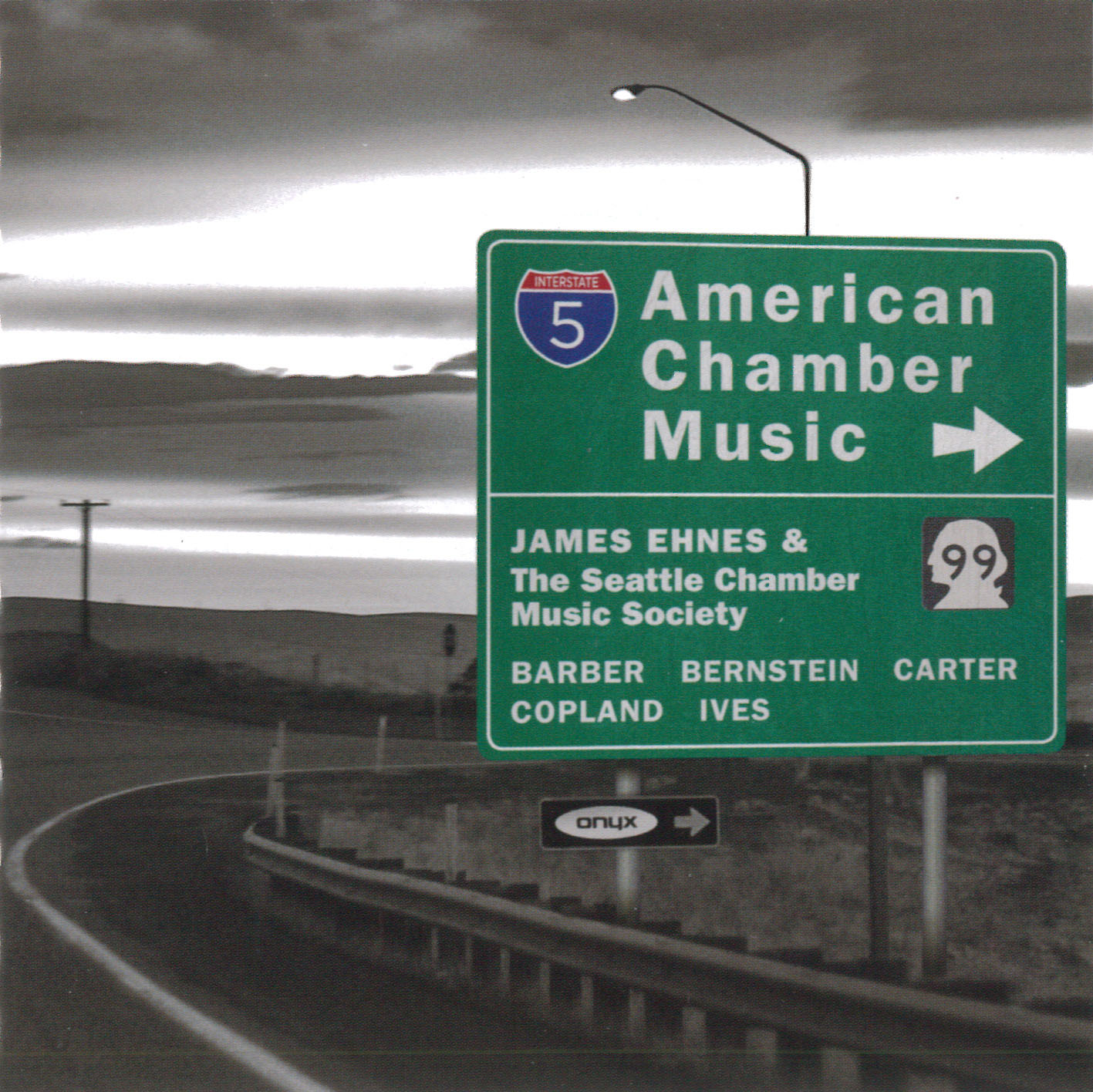
 

04 Modern 02 American ChamberAmerican Chamber Music
James Ehnes; Seattle Chamber Music Society
Onyx 4129

In addition to the great European tradition of chamber music, American composers have also made significant contributions to the genre, beginning with the works of Arthur Foote in the 19th century. American chamber music is alive and well 150 years later, and this recording is a fine representation of repertoire from the 1930s and 40s with music by Copland, Ives, Bernstein, Carter and Barber performed by Canadian violinist James Ehnes and musicians of the Seattle Chamber Music Society.

While some of the music on this CD might not be all that well known, it’s all worth investigating. Copland’s Violin Sonata from 1943 is a study in contrasts, with its buoyant opening movement, a restrained march and the rhythmical finale performed here with much panache by Ehnes and pianist Orion Weiss. Leonard Bernstein was still a student at Harvard when he composed his Piano Trio in 1937, its exuberance very much the music of a 19-year-old prodigy. The most familiar piece on this recording is surely Barber’s String Quartet, if only because of the famous Adagio, most often heard arranged for string orchestra. Here, the warmly resonant strings further heighten the movement’s elegiac mood. Equally elegiac is the brief Largo for violin, clarinet and piano by Charles Ives. Insurance broker by day and composer on the weekend, Ives was very much an individualist. His approach to music was distinctly American, and I liken the introspective mood of this piece from 1901 to those stark urban landscapes by Edward Hopper created 30 years later. Elliott Carter’s Elegy for viola and piano from 1943 is marked by a romantic conservatism not seen in his later style.

So it would seem that during the 1930s and 40s, there was more going on musically in America than the jitterbug and big bands and this CD proves it admirably. Kudos to James Ehnes and his group from Seattle for bringing to light some treasures that most certainly deserve greater exposure.


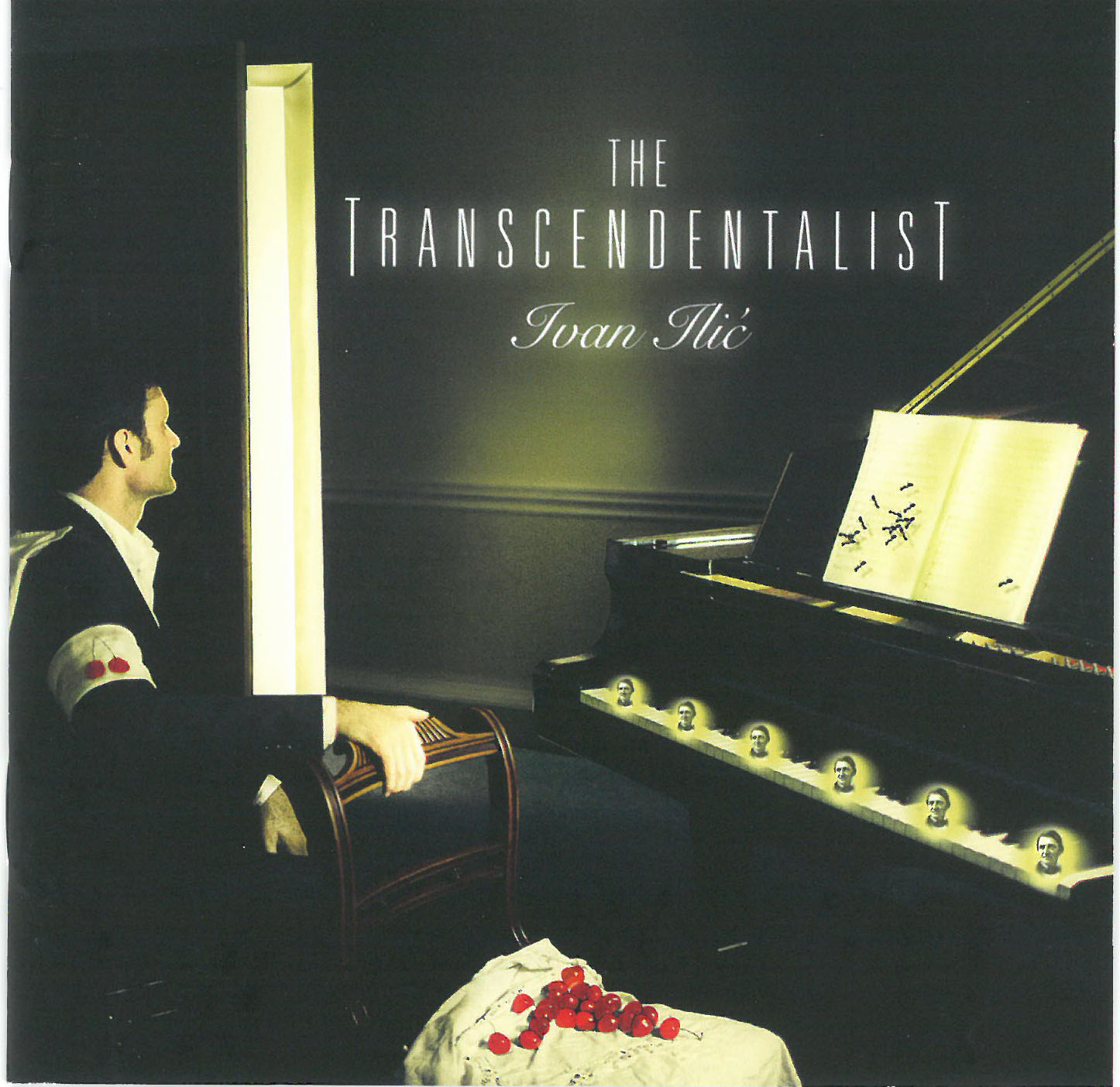
04 Modern 03 The TranscendentalistThe Transcendentalist
Ivan IlicHeresy Records 015 (heresyrecords.com)

When it comes to new music the average music lover, including myself, is in an unknown territory (or downright ignorant) and that can provoke hostility and aversion at times. This new disc by Ivan Ilic, a distinguished American pianist of Serbian descent, does an immeasurable service to smoothen the road to acceptance by the back door, so to speak.

It’s a masterstroke to devise a program with the likes of Cage, Feldman or Wollschleger by tracing them backwards to “fall on branches descending from Frédéric Chopin.” It’s also all the more surprising – says Mr. Ilic – that Scriabin, one of the greatest innovators in the early 20th century, took Chopin as a point of departure. And this is the point at which this remarkable journey begins.

Scriabin’s Prelude Op.16, No.1 indeed sounds a bit like a Chopin Nocturne with a charming little melody developed nicely and it’s over in two minutes. Fine… everyone is happy about that, but our pianist now presents an early piece by John Cage, Dream (1948), and we immediately sense the relationship to Scriabin. The hesitant fragments moving at an even pace like moving in and out of our subconscious, laying out slowly a wonderful oriental landscape, sometimes interrupted by deep and disturbing chords… yes, indeed, we feel the connection, but also experience the departure into a new world with a mesmerizing, hypnotic effect.

“Transcendental meditation?” The phrase here takes on a new meaning under the magic hands of Ilic who is guaranteed to hypnotize you like no other into the mysteries of another universe, but at the same time plays Scriabin’s gorgeous D-flat major Prelude Op.31, No.1 so beautifully that you can perhaps endure the vicissitudes of this here universe.


04 Modern 04 HosokawaHosokawa – Orchestral Works 2
Royal Scottish National Orchestra; Orchestre National de Lyon; Jun Märkl
Naxos 8.573276

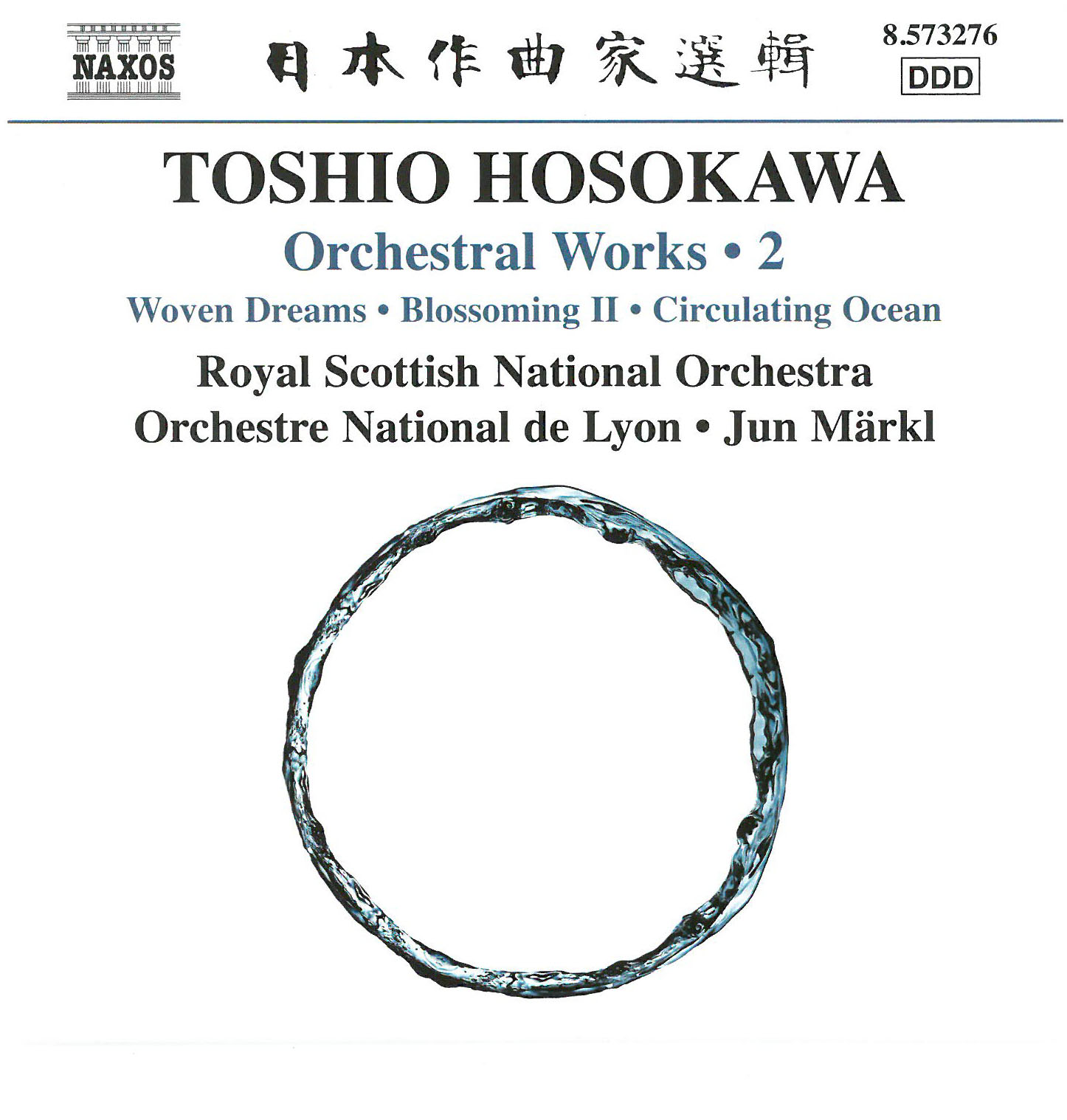
Toshio Hosokawa is in some way a visual artist disguised as a composer. The three pieces on this collection of orchestral music bear a striking similarity of form; they remind me of St. Exupéry’s descriptions of his childish drawings of boa constrictors who swallowed elephants. The author never succeeded in conveying how fearsome these images were to him; Hosokawa’s music, on the other hand, delivers moments of awe and terror, bordered by serenity and contemplation.

Each work opens with a sustained unison B flat, shimmering and pulsing; eventually each arrives at a final unison elsewhere. Hosokawa rejects artifice and architecture, preferring the organic. He depicts development, origins, growth. The first piece, Woven Dreams, traces an imaginary passage from the womb. Blossoming II and Circulating Ocean are reflections on the natural world. In the liner notes he describes the signature unison openings as fluid, amniotic or aquatic. One hears birdsong and water droplets, earthquakes and storms.

Though Hosokawa’s forms have curved edges, his orchestral effects often jar. He discovers new dissonances through note bends and microtonal juxtaposition. Deep booming percussion nearly overwhelms. At times his orchestration reminds me of Schnittke, at others of Mahler. He will use the orchestra as a huge macabre organ and then exploit individual instruments for passagework.

Unlike his senior compatriot, Toru Takemitsu, Hosokawa chose to embrace rather than distance himself from his own culture. He often uses canonic melodic entries, often cascades in the treble winds. He refers to this technique as Oibuki, featured in a style of Japanese court music called Gagaku. Where Takemitsu was repelled by the militarism he witnessed as boy, Hosokawa worries his culture is too ready to adopt external models rather than grow from its own roots.

Two different orchestras supply the music, under the able direction of Jun Märkl, whose parents bridge the east-west musical divide, a German violinist for a father, his mother a Japanese pianist.


05 Modern 01 Gabriel ProkofievGabriel Prokofiev – Selected Classical Works 2003-2012
Various Artists
Nonclassical NONCLSS017

In this release by composer Gabriel Prokofiev (grandson of Sergei Prokofiev) we get a clear sense of the composer’s predilection for displacing his various musical influences (electronica for example) into traditional classical contexts. This disc, released on Prokofiev’s own label, is a collection of works ranging from 2003-2012 that signal Prokofiev’s return to notated compositions.

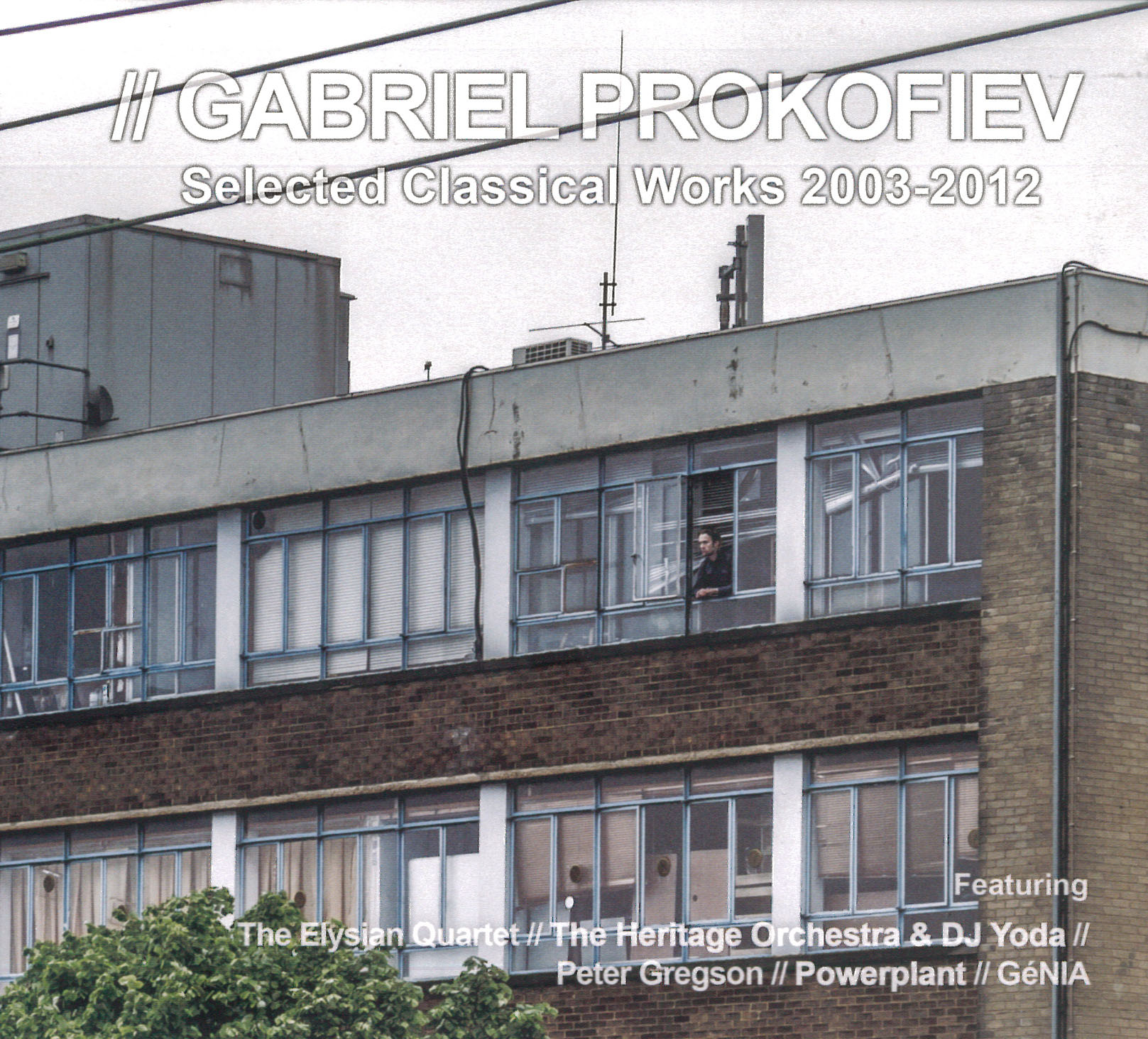
In his first and second string quartets, a series of dance grooves constantly devolve into mysterious textures. Punchy double-stops and gritty gestures remind one of Bartók or Janáček.  Rhythmic plucks and scratches lie below lyrical folk inspired melodic elements. In the second quartet, Prokofiev does away with any lyrical commitment and relies on clear rhythmic processes akin to dissonant minimalism. Both quartets possess a satisfying yet frigid mood, much like the dreariness of the CD cover image.

Next, in the Concerto for Turntables and Orchestra the turntablist creates various electronic sounds cleverly blended with the orchestra with confident rhythmic inventiveness. Imagine Stravinsky’s Rite fused with the pounding rhythms of a nightclub beneath a haunting lyricism. The second movement evokes a deranged carnival as the turntable sounds mesh with the orchestra in a bizarre and warped sound environment.

Piano Book No. 1 provides an array of moods for the performer to explore without relying on unnecessary virtuosity. Next, the Cello Multitracks for solo cello allows the performer to stack dense layers of recorded cello sounds through electronic manipulation. The result is a rich sound world moving to and from ethereal and light moments, to thick and intense passages.

The disc is an impressive culmination of confident works that span a decade of the composer’s output. Each piece shows Prokofiev’s ability to create a successful reaction to the influences of pop and electronica through a traditional application.

Editor’s Note: Gabriel Prokofiev was the Roger D. Moore Distinguished Visitor in Composition and composer-in-residence at the University of Toronto’s New Music Festival in January 2014. There were a number of performances of his works including the Concerto for Turntables and Orchestra (with DJ Madhatter and the U of T Symphony) and Cello Multitracks and Remixes performed by Shauna Rolston. 

05 Modern 02 Wesley FerreiraMadison Avenue
Wesley Ferreira
Potenza Music PM1035 (wesleyferreira.com)

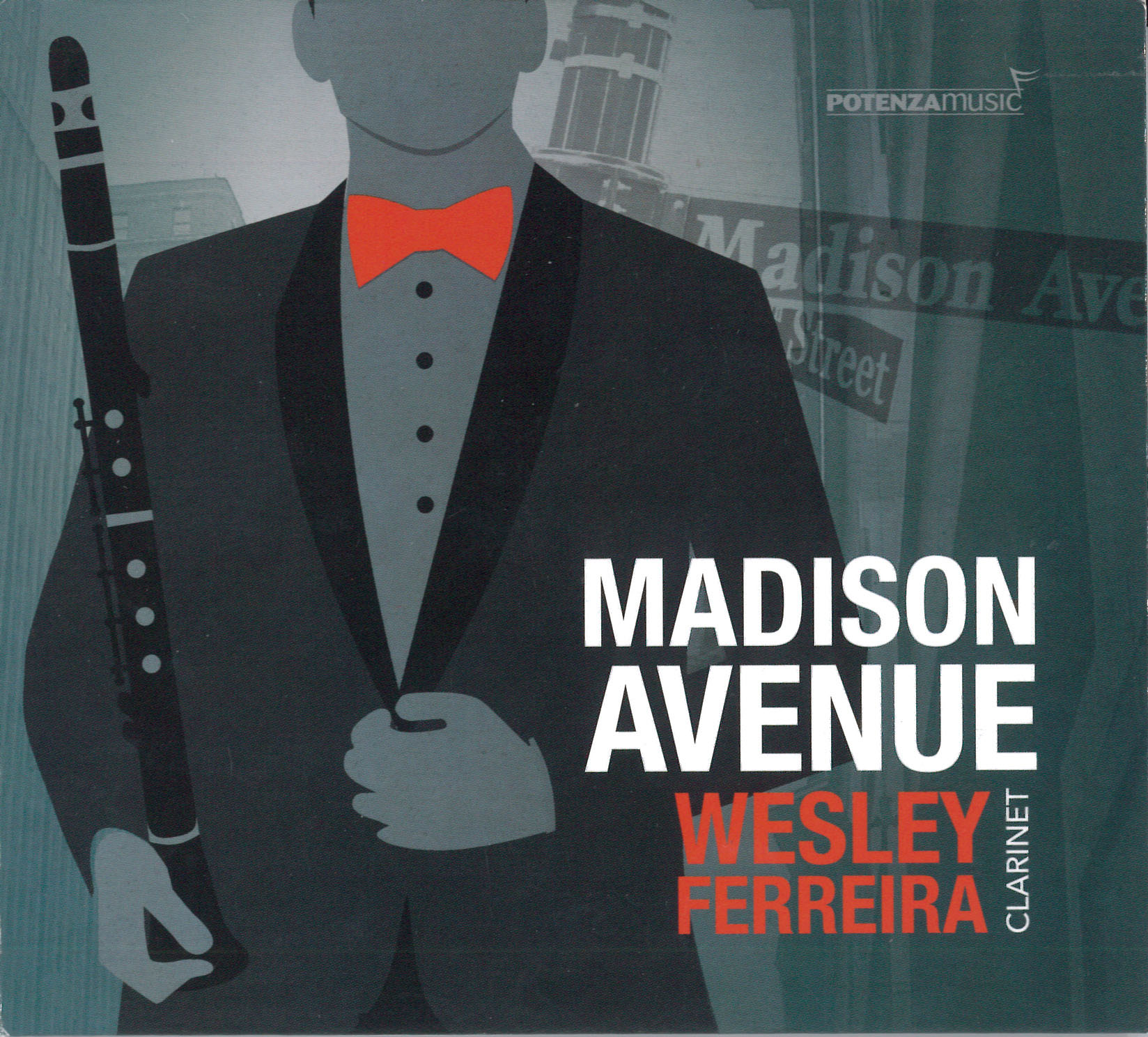
Canadian clarinetist Wesley Ferreira, now based in the U.S., has a solo release of mostly American music. The textures range from intimate and unaccompanied to wind-ensemble backing at hurricane-force. He includes nothing substantial in terms of duration, but consistently demonstrates a fine fluid technique and flexible tone. The longest work, clocking in at 13 minutes, is a tribute to the automobile called Auto ’66. This selection wheels along in spite of poor engineering (sound, not mechanical): Ferreira and the band seem to have been separated by a firewall. High rev. brassy moments are reduced to a sub-compact size, and the clarinet colour is dulled, losing the waxy lustre it displays on other tracks. Composer James M. David has a thing for cars and for Holst’s The Planets. Mercury is a source for the second movement (Mini Cooper S), which is appropriate, but what Mars has to do with a Lamborghini escapes me.

Elsewhere Ferreira knocks off blistering passagework and a great array of multiphonic effects, most notably in Mikro-Sonata by Aleksandar Obradović. The title track, by Nick DiBerardino, opens the CD with a brief and cheeky tribute to New York. Pianist Gail Novak types furiously in the background (the composer’s own suggestion, from the very useful liner notes), while the clarinet scales the skyscrapers and swings on looping Spidey-webs between them. Canadian Alasdair MacLean’s Without Further Ado II for two clarinets which immediately follows sounds like it could be a second movement to the previous track. In this as elsewhere, Ferreira is joined by his spouse Copper Ferreira. She holds her end of the bargain up well in the MacLean, but not so well as the bass clarinetist in Rotazione tre by Roberto Cognazzo, which derives much of its material from music of Nino Rota, a less instantly recognizable source than Holst.

My pick for best cut is the Sonata for B-flat Clarinet and Piano by Nikola Resanovic. At just over ten minutes, it wastes no time doing anything but providing a showcase for Ferreira and fun for the listener, especially in the Balkan-influenced finale.

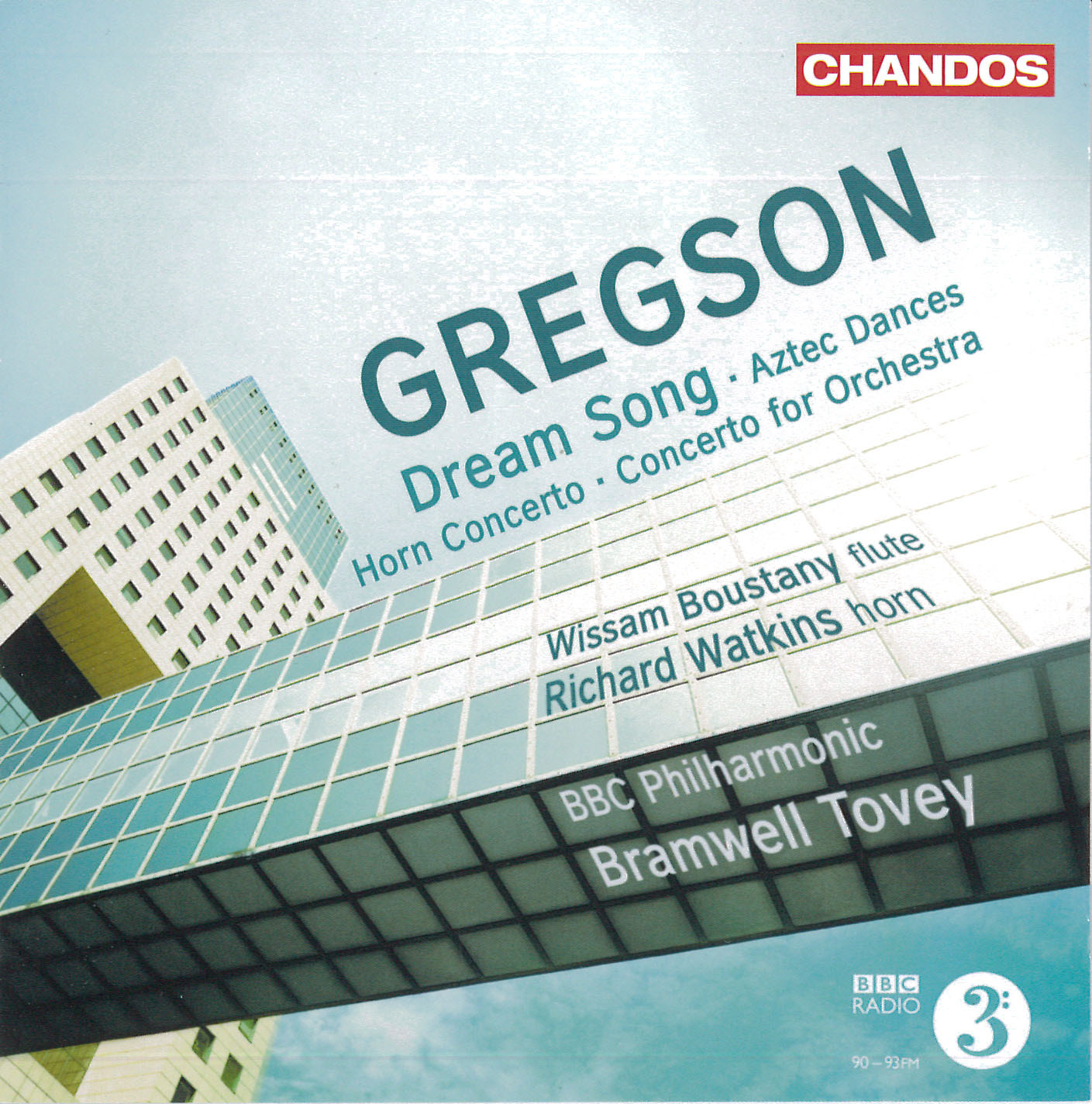
05 Modern 03 GreggsonEdward Gregson – Dream Song; Aztec Dances; Horn Concerto; Concerto for Orchestra
Wissam Boustany; Richard Watkins; BBC Philharmonic; Bramwell Tovey
Chandos CHAN 10822

Bramwell Tovey, conductor of many premieres with the Vancouver and Winnipeg Symphonies as well as abroad, guides the BBC Symphony in stunning performances of compositions by English composer Edward Gregson (b.1945). Gregson’s music speaks in a cosmopolitan 20th-century vernacular. He acknowledges influences of Shostakovich and Berg (both Mahler admirers), advantageous in Dream Song (2010) since the work is a “dream” of Mahler’s sixth symphony. From the opening complex chord “clap” Gregson demonstrates mastery of harmony and orchestration. Though abounding with Mahlerian references, the work sets up a contemporary sound world. My reservation is this: after Berio, Foss, Colgrass, Rochberg and others, neither quotation nor dream frame remain as intriguing.

The ritualistic Aztec Dances evolved from earlier versions, reaching ensemble proportions in its 2013 incarnation for flute and 14 instruments. In a brilliant performance, flutist Wissam Boustany’s tone quality is commanding, his articulation sharp and his effects palette eerie. Gregson composed his Horn Concerto (1971) for the distinguished Ifor Jones and his Besses o’ th’ BarnBbrass Band. The strings and winds on this disc’s 2012 orchestrated version provide additional contrast in support of Richard Watkins’ virtuosic yet sensitive horn. Concerto for Orchestra (2001) also achieved its current form after revisions; I found myself no longer worrying about influences, revisions, the breaking-or-not of new ground, etc., but simply sitting back to listen and admire a significant composer and a passionate conductor with a wonderful orchestra and soloists.

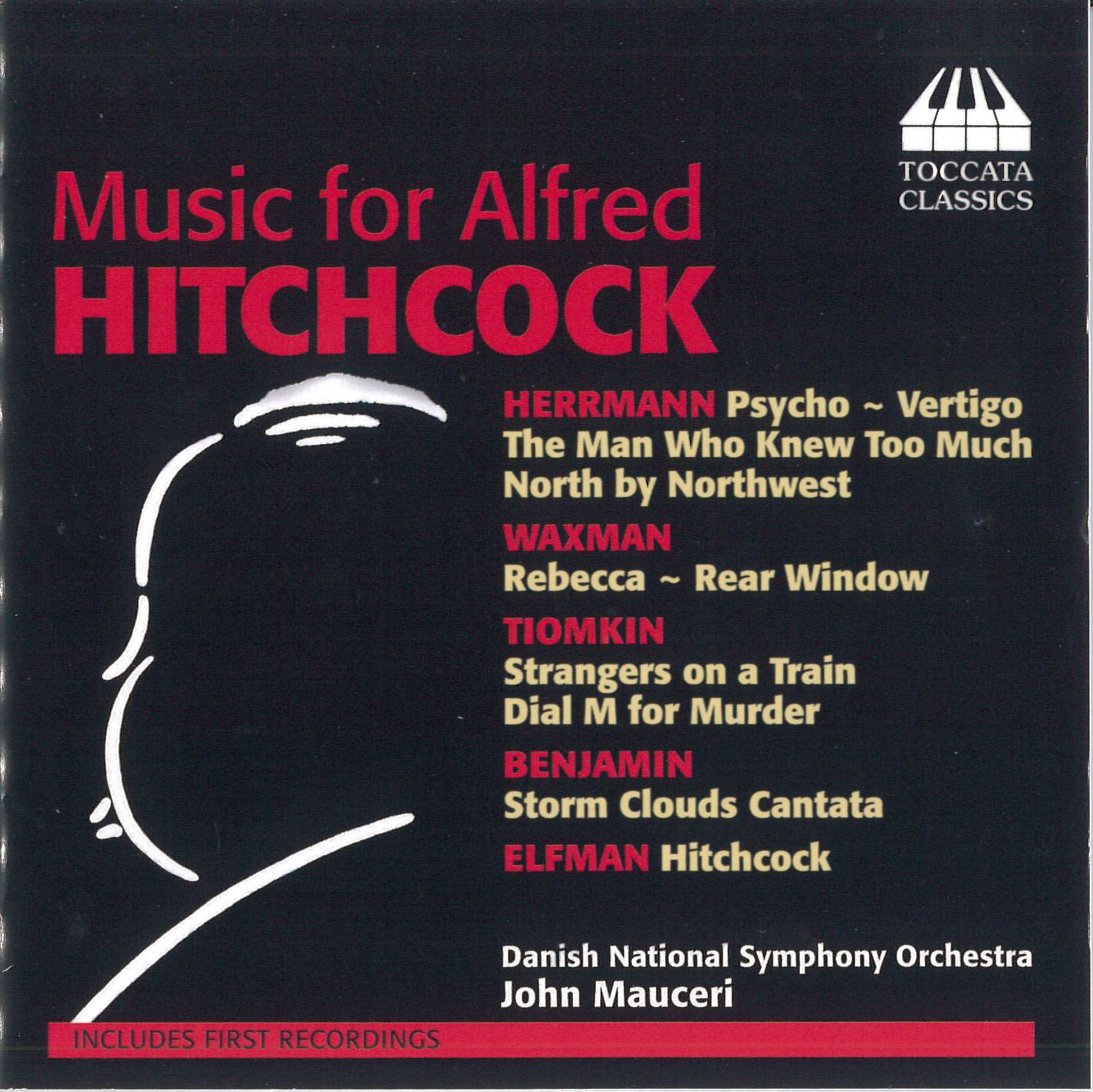
05 Modern 04 HitchcockMusic for Alfred Hitchcock
Danish National Symphony Orchestra; John Mauceri
Toccata Classics TOCC 0241

The eerie atmospheres created by the films of Alfred Hitchcock were the result of stunning cinematography and even more stunning musical backdrops. The Danish National Symphony Orchestra under the direction John Mauceri (who edited six of the works) here performs music from Hitchcock films with grace, splenduor, colour, well-placed angst and appropriate creepiness, transforming “background soundscapes” to first class orchestral works that need no visuals.

Bernard Herrmann worked closely with Hitchcock on many films. The music from Vertigo, The Man Who Knew Too Much, North by Northwest, and the in-your-face Psycho: A Narrative for String Orchestra are so familiar that they need no musical critique or introduction. The performances are astounding in clarity and tension. Herrmann then made an interesting arrangement of Arthur Benjamin’s The Man Who Knew Too Much: The Storm Clouds – Cantata. The work, with its Vaughan Williams flavoured choral and vocal solo sections, seems somewhat out of place without the visuals. Herrmann’s compositional influences can also be heard in Danny Elfman’s work from the 2012 biopic Hitchcock.

The symphony musicians prove themselves to be gifted interpreters in the jazz-flavoured sections of the “Prelude” from Franz Waxman’s Rear Window: Suite. Dimitri Tiomkin’s waltzes, bells and grounded writing technique drive the music from Strangers on a Train and Dial M for Murder.

Superb liner notes and production quality complete the package. Music for Alfred Hitchcock deserves a spot on every listener’s bucket list.

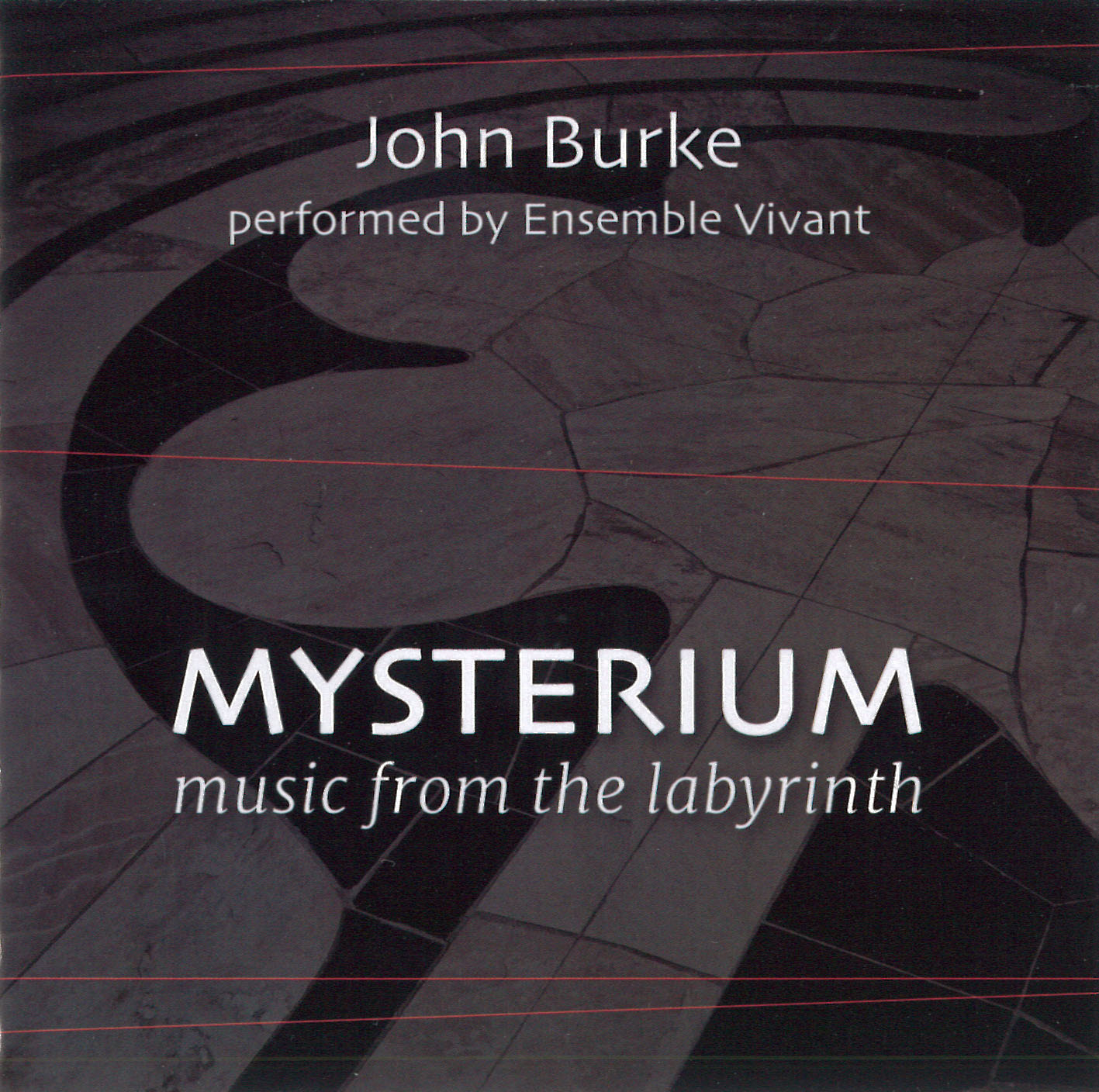
04 Modern 01 Burke MysteriumJohn Burke – Mysterium
Ensemble Vivant
Independent (ensemblevivant.com)

John Burke is a distinguished Canadian composer whose work has for two decades moved beyond the concert hall to engage with contemplative practices of several cultural traditions. This disc includes pieces from the composer’s repertoire of works based on walking a labyrinth. The informative program notes describe Burke’s music as: “Neither concert nor ritual, it accesses a third type of experience, surpassing the sum of its parts.” In my own experience, both one’s own passage and the presence of other labyrinth walkers can become uncanny. Burke’s finely wrought writing takes labyrinth music to a new level that will be especially rewarding to those interested in this work, with precisions of sonority, dynamics and rhythm that Ensemble Vivant, led by pianist Catherine Wilson, fully deliver.

Mysterium, the opener, encompasses the sequence of 12 harmonies upon which all the pieces are based. Expressive long tones played by Erica Beston, violin, and Sharon Prater, cello, over a repetitive broken-chord piano accompaniment remind me of passages in Messiaen and in minimalism; the mood is sombre. Wilson’s playing of Lungta, an improvisatory piano solo with tone clusters and flourishes, is evocative. Longest is the multi-sectional Hieratikos, with intricate ensemble writing performed magnificently by Wilson, Joseph Peleg, violin, and Sybil Shanahan, cello. Norman Hathaway, violin and David Young, bass, join in a closing variant of Mysterium, rounding off a moving experience.

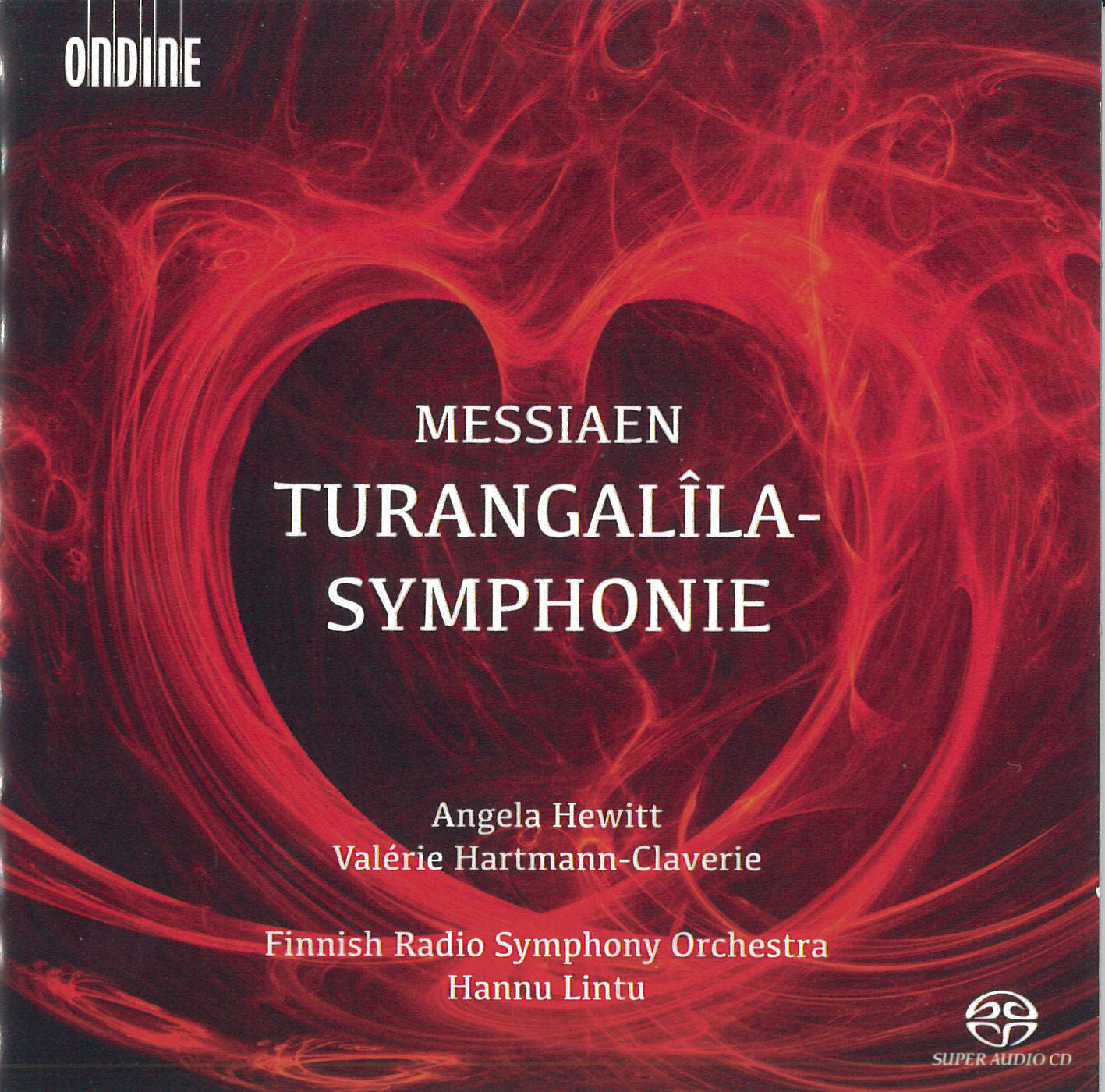
04 Modern 02 Messiaen TurangalilaOlivier Messiaen – Turangalîla Symphonie.
Angela Hewitt; Valérie Hartmann-Claverie; Finnish Radio Symphony Orchestra; Hannu Lintu
Ondine ODE 1251-5

I remember well a performance of this stunning 1948 work in the mid-1960s during Seiji Ozawa’s time at the helm of the Toronto Symphony (1965-1969). Ozawa later recorded this modern classic with the TSO for RCA to great international acclaim with the composer’s wife and sister-in-law, Yvonne and Jeanne Loriod, as soloists. This new recording also has a Toronto connection because it was here in 1985 that Canadian pianist Angela Hewitt came to the world’s attention by winning the Toronto International Bach Piano Competition, of which Olivier Messiaen was one of the adjudicators. As we know, she has since gone on to a stellar career.

Turangalîla is taken from two Sanskrit words – turanga, time and lîla, love – and this about sums up the essence of this work, perhaps the most inventive, original and forward-looking piece since Stravinsky’s Le Sacre du Printemps. The ten movements increase in complexity as the work proceeds. The odd numbers deal with serious issues, like life and death, the “tragic plane” as the great Arthur Koestler would say. The even-numbered ones like the fourth represent love with a playful scherzo that moves towards the sentimental with Janáček-like harmonies embellished lovingly by the piano solo. Hewitt conjures up marvellous sounds with the extended bird-calls in the sixth movement; this is certainly an apex of the composition, where one simply melts into the heavenly harmonies back and forth between Lintu’s virtuoso orchestra and the pianist.

For extra orchestral brilliance Messiaen added a curious electronic instrument, called ondes Martinot (played by Valérie Hartmann-Claverie ), with shivers of glissandos glistening in the love music and some weird barking shouts of joy amidst the overwhelming jollity and magnificent cacophony of the finale, a triumphant movement of total mayhem that somehow reminded me of Strauss’ Symphonia Domestica. This is a gorgeous disc, in the four-star category.


04 Modern 03 Symphonies of WindsSymphonies of Wind Instruments
Royal Norwegian Navy Band; Ingar Bergby
2L 102

The venerable Royal Norwegian Navy Band (RNNB), founded in 1820, apparently includes a mere handful of actual members of the military, yet it performs with the precision one might expect of soldiers or exceptionally sober sailors. Ingar Bergby, much in demand as a guest conductor throughout Norway, has been the principal conductor of the band since September 2008. The repertoire of this new disc includes some of the most notable works of the 20th century band repertoire. The title track, a scintillating performance of the celebrated composition by Igor Stravinsky, is likely the most familiar of these to the average listener. Stravinsky’s former nemesis, Arnold Schoenberg, is also represented by his purportedly “accessible” Theme and Variations for band, commissioned by Karl Engel in 1943 for the U.S. high school band market. Though couched in a tonal language it is both technically and intellectually more challenging than what the publisher likely had in mind. The RNNB breezes through this intriguing work without a care on that front. The bulk of the album is devoted to outstanding renditions of two major works by Paul Hindemith. The Konzertmusik Op.41 from 1926 is a rarely recorded, powerfully performed three-movement composition in an amusingly neoclassical style while the Symphony in B flat is an imposing wind band masterpiece from 1951. The performance of the latter is as fine as can be imagined, far surpassing the classic stereo version by the Eastman Wind Ensemble and Hindemith’s own recording with the Philharmonia Orchestra, in both sound and technical precision. The disc concludes with Norwegian composer Rolf Wallin’s intriguing Changes (1984), an essay in the sonic interplay of static and incisive gestures. The 2L audio production engineered by Morten Lindberg is spectacular, with a wide sound stage and vivid presence even in the conventional binaural format. In addition to the SACD layer an extra Blu-ray audio disc is provided for the hyper-discerning audiophile.


04 modern 01 shostakovich celloShostakovich – Cello Concertos
Truls Mørk; Oslo Philharmonic Orchestra; Vasily Petrenko
Ondine ODE 1218-2

These concertos, particularly the first, are on my short list of favourite cello works. The Concerto No.1 in E-flat Major, Op.107 has been recorded by almost every prominent solo cellist and is a regular on the programs of symphony orchestras everywhere. Since Rostropovich premiered and recorded the first concerto in 1959 and the second in 1967 we have heard them recorded by, to name a few, Heinrich Schiff, Mischa Maisky, Natalia Gutman and an earlier recording by Truls Mørk himself with Jansons and the LPO from 1995.

My first impression of this recording was that while it is energetic, forward moving, heartfelt and entertaining, it is also light and happy in approach from both soloist and orchestra.

Shostakovich was such a genius that even with completely different approaches his music speaks to the listener effectively. An alternative take in this music is the digging-in with acidic and sarcastic statements. Shostakovich could be great as the “war-correspondent” or the smiling composer of dance music. Shostakovich devotees explore both interpretations and in between.

This new version enjoys remarkable solo playing wrapped in beautiful and warm sound. Under Petrenko, who has as of this writing completed all but one of his Shostakovich symphonies cycle, Mørk has precise and crisp orchestral support including excellent contributions from the solo winds. In addition, the wide-range recorded sound is superb, well balanced and transparent. While I still appreciate the acerbic Shostakovich of Rostropovich (the versions on Supraphon SU 4101), Messrs Mørk and Petrenko provide a very convincing second opinion.


04 modern 02 glass houses 2Glass Houses Vol.2 – Music of Ann Southam
Christina Petrowska Quilico
Centrediscs CMCCD 20114

Glass Houses Vol. 2 is an outstanding solo piano recording that showcases the artistry of concert pianist Christina Petrowska Quilico and her depth of insight derived from the 30-year collaboration and friendshipthat she shared with composer Ann Southam (1937-2010).

Petrowska Quilico has previously recorded Southam’s Glass Houses Revisited (Centrediscs, CMCCD 16511), Rivers on the three-CD set Canadian Composers Portraits: Ann Southam (CMCCD 10505), a two-CD set Pond Life (CMCCD 14109), and multiple individual works on compilation albums. This stunning new release from Centrediscs presents six of the composition’s fifteen movements composed in 1981 and later revised for the pianist in 2009.

Inspired by the American minimalist composer Philip Glass, Southam’s Glass Houses features highly complex passagework delivered at lightning speed, with lengthy repeating figures in the left hand interacting with varying lines in the right hand. The dynamics, articulations and pedalling are left entirely to the performer’s discretion and this is where Petrowska Quilico’s interpretive powers are most impressive.

The pianist and production team have given careful thought to the order that the pieces appear on the album. From a shimmering opening to intense, driving movements, there are also playful moments with unexpected jazz riffs. Petrowska Quilico’s recording exemplifies the artistry and physical endurance that are required to create this seamless musical vision for one of Ann Southam’s masterpieces.


04 modern 03 macgregor sins fantasiesSins & Fantasies
Mark Takeshi McGregor
Redshift Records TK430
(redshiftmusic.org)

What a brilliant conceit – seven pieces, each by a different living Canadian composer, and inspired by the Seven Deadly Sins. Beginning in 2010, Vancouver-based flute virtuoso Mark Takeshi McGregor gave life to this project, and the results are gloriously presented here. The disc begins with Dorothy Chang’s Wrath, a hissing, spitting and raging exploration of tone, breath and vocal sound, followed by Gregory Lee Newsome’s Avarice and Owen Underhill’s Three Reflections on Pride which employ flute, piccolo and alto flute. Jocelyn Morlock’s take on lust makes exquisitely erotic use of the alto flute, McGregor’s voice, and words from a 20th-century icon which completely spooked me out. James Beckwith Maxwell’s Invidere (envy) wanders into the far reaches of extended techniques, and Benton Roark’s Untitled gives a meditative and melancholy spin to sloth.

In all these, McGregor’s remarkable gifts as a player are mesmerizing. Besides his extraordinary technical mastery, his is playing of the most imaginative and creative kind. And to top it off, the disc closes with McGregor’s own Le dernier repas de M. Creosote, inspired by the infamous Monty Python character and an absolute tour de force any way you slice it. Three of Telemann’s Fantasias are also included as foils to the new pieces; for me, McGregor’s sense of musical adventure here pales in comparison. But no matter: as Chaucer says in The Parson’s Tale, the deadly sins “all run on one Leash, but in diverse manners,” and here their diversity is astonishing, inspiring, and only dangerous in the best possible way.


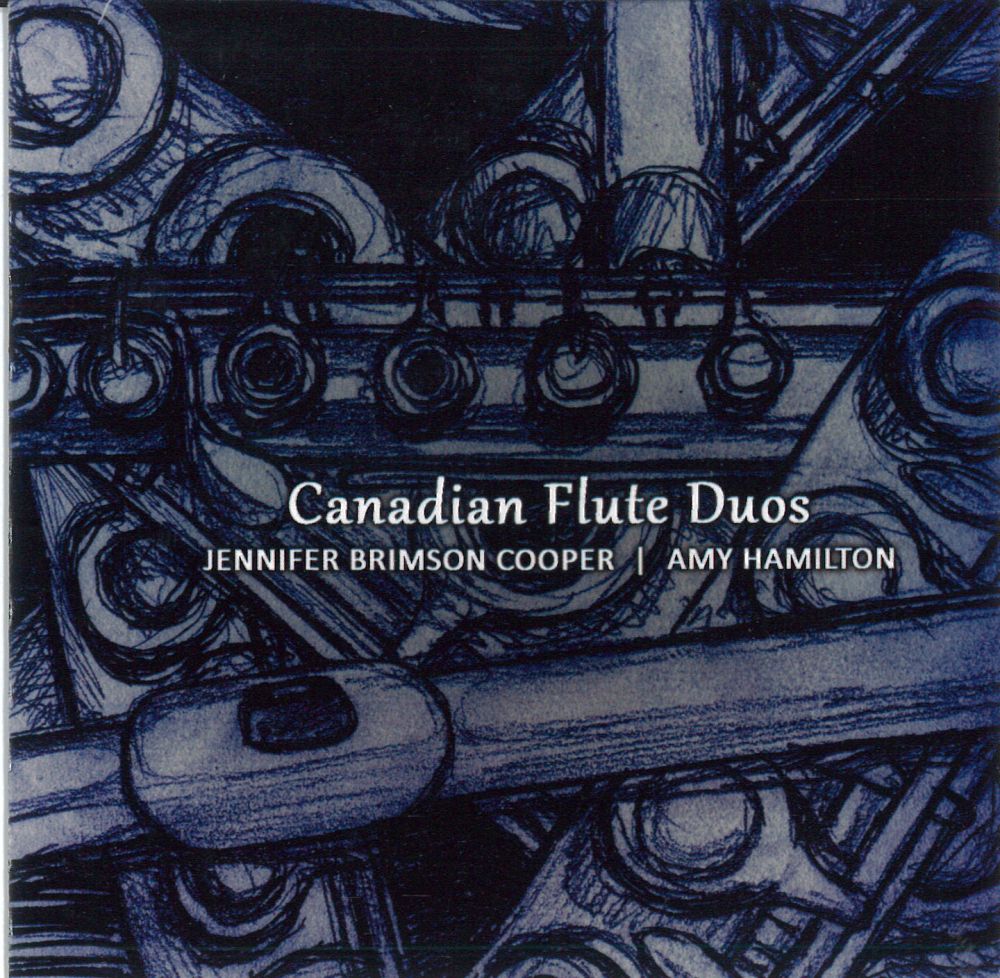
04 modern 04 canadian flute duosCanadian Flute Duos
Jennifer Brimson Cooper; Amy Hamilton
Independent (fluteworld.com)

Rich tone, extraordinarily precise ensemble playing and lyrical musical phrases highlight this new release, Canadian Flute Duos, performed by Jennifer Brimson Cooper and Amy Hamilton. Both flutists are distinguished professors at the university level, respected soloists and chamber performers. They have chosen seven contrasting Canadian works featuring varied stylistic sensibilities which illuminate the tremendous gifts of both the composers and the performers.

 Imant Raminsh’s Butterflies (Papillons) is a Romantic-like work with rapid moving flute lines and trills emulating the sound of fluttering wings against a shifting chordal piano backdrop (performed by Beth Ann De Sousa). Jim Hiscott’s Quatrain for two flutes is a four-movement work with minimalist qualities, contrapuntal lines and harmonic two-part runs. Especially beautiful is the composer’s use of lengthy held single notes which are reminiscent of his accordion works and performances. Composer/flutist Robert Aitken’s expressive Wedding Song is based on an American Sioux Indian song. The haunting melody, dynamic harmonics and swells and precise whistle tones make this track the highlight of the disc. Works by John Beckwith, R. Murray Schafer, François Morel and Tibor Polgar are also included.

 I continually forgot that I was listening to two flutes as the performers share a close musical relationship to both their instruments and each other. The precision, care, understanding and respect for the music by Brimson Cooper and Hamilton make this recording an artistic keeper.


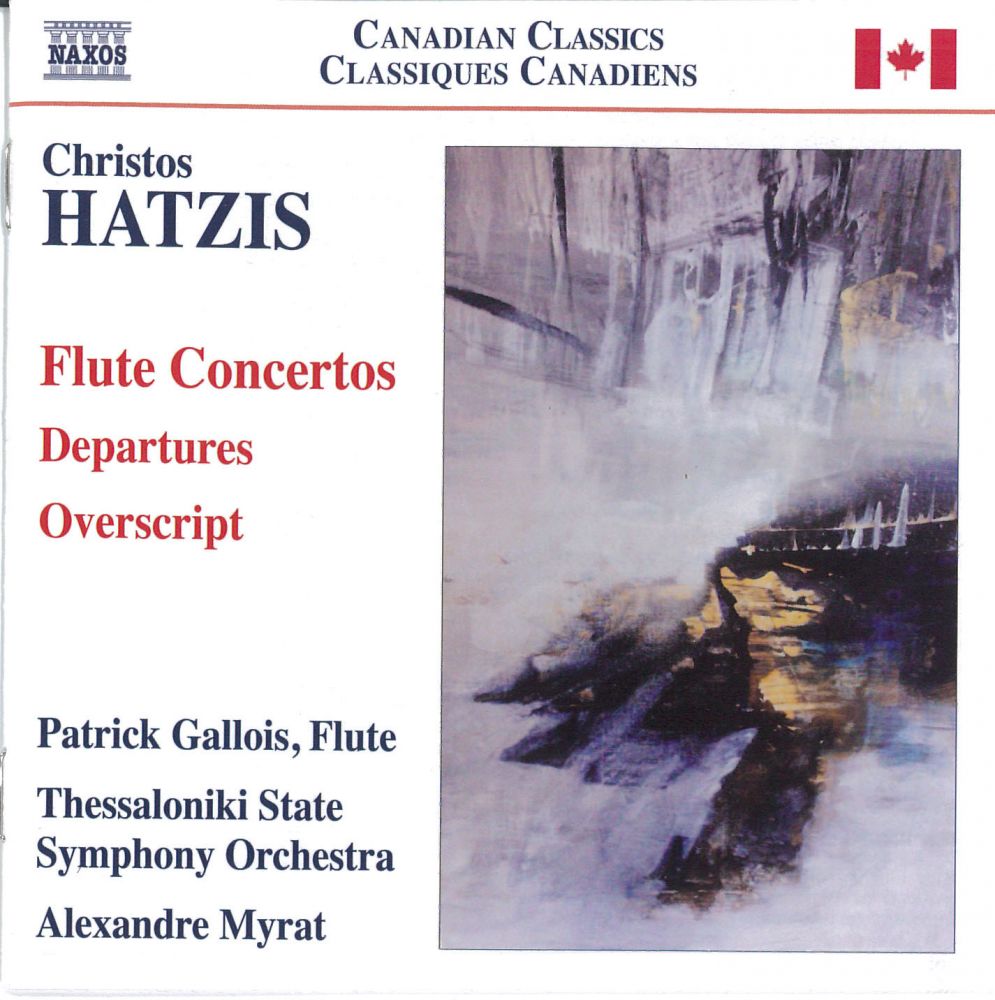
04 modern 05 hatzis fluteChristos Hatzis – Flute Concertos
Patrick Gallois; Thessaloniki State Symphony; Alexandre Myra
Naxos 8.573091

Released by Naxos on its Canadian Classics series, this CD offers the recorded premieres of two flute concertos by Christos Hatzis, one of Canada’s best-known living composers, as played by the celebrated French flutist Patrick Gallois and the Thessaloniki State Symphony. The first, Departures, is a memorial piece written in 2011, a time of personal loss for Hatzis and the year of Japan’s devastating tsunami and nuclear disasters. Hatzis is known for his use of multiple and eclectic influences, and here there are whiffs of Japanese melody, blues patterns, French impressionism and much more. In the first movement, the flute flutters deftly between traditional and extended sound worlds, with seamlessly woven interplay between soloist and orchestra. The orchestral playing in the third movement brings robust rhythms incisively to life.

Overscript, written in 1993 and revised in 2012, is described in the notes as a commentary on Bach’s Concerto in G Minor BWV 1056/1 for flute, strings and basso continuo. Bachophiles will know the root piece better either as the concerto for harpsichord in F minor or as the G minor violin concerto. Here we have a very different kind of piece, a kind of palimpset in which Hatzis superimposes his own music over Bach’s in fragmented format, making for some intriguing comparisons which the listener is invited to make. Under Alexandre Meyrat’s first-rate direction, the orchestra plays in lively and expressive fashion throughout, and Gallois is his usual elegant, musically effervescent and technically brilliant self.


Back to top