OLD WINE IN NEW BOTTLES – Fine Old Recordings Re-released
Included in the list of composers whose anniversaries are celebrated this year are two of the greatest and best loved masters of the Romantic Era, Frédéric Chopin and Robert Schumann, both born 200 years ago. It is only good business then for recording companies to issue and re-issue fine performances to feed, they hope, the heightened demand for the birthday boys’ music.
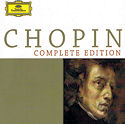 First up is Chopin (March 1) whose entire published works fit nicely on 16 or 17 CDs. The absolute pick of the packages comes from Deutsche Grammophon (4778445, 17 CDs) which also happens to be at an attractive price, particularly for German pressings. Every opus number is represented here in excellent to superlative performances. One could not hope for a better group of artists, mainly pianists, of course, than DG has assembled from their own catalogue plus Decca and Philips. Krystian Zimerman’s acclaimed 1999 performances of the two piano concertos with the Polish Festival Orchestra are on the first disc. Zimerman is heard again in the Ballades. Claudio Arrau is the soloist in the other concerted works. Maurizio Pollini plays the Etudes, the Polonaises, the Scherzos and the 2nd and 3rd Sonatas. Maria João Pires plays all the Nocturnes and Vladimir Ashkenazy plays the complete Mazurkas, the Waltzes, and a host of miscellaneous pieces. The Beaux Arts Trio plays (you’ve guessed it) the Trio in G minor. Also heard from are Anatol Ugorski, Martha Argerich, Lilya Zilberstein, Yundi Li, Mstislav Rostropovich, Anner Bylsma, and others including Polish soprano Elzbieta Szmytka in the songs. The reasonably informative booklet includes a brief chronological table of Chopin’s life, plus recording data. All in all, this is a most pleasing and very recommendable collection.
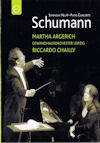 Robert Schumann was born in Saxony on June 8, 1810 and his output was many times that of his Polish contemporary including compositions in every form. Don’t expect to see a “complete” edition from any of the majors but new compilations have appeared this year from DG and Sony, neither of which I have seen or heard. EuroArts has issued a Blu-ray disc of on earlier DVD featuring Martha Argerich playing the Schumann Piano Concerto with Riccardo Chailly and the Leipzig Gewandhausorchester (EA2055494). Recorded “live” in June 2006 the Blu-ray disc presents the entire concert, adding the opening work, the Adagio and Allegro brillante from Etudes Symphoniques op.13, orchestrated by Tchaikovsky. The concerto emerges as an inspired collaboration between soloist and orchestra, without peer in this medium for sensitivity and intelligence. For an encore Argerich plays Of Foreign Lands and People from Kinderszenen, op.15. Following the intermission, the orchestra plays Ravel’s orchestration for Nijinsky of four pieces from Carnaval, op.9 followed by an enthusiastic and vital performance of the Fourth Symphony. The dynamics throughout are effortlessly true-to-life, making this a you-are-there experience.
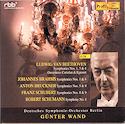 There is also a Schumann Fourth in a new boxed set from Profil featuring the late Günter Wand conducting the Deutsches Symphonie-Orchester Berlin in performances between April 1993 and April 1996 (PH09068, 8 CDs). One of the succession of famous conductors and music directors that has endowed this world-class orchestra - founded in 1946 by the American Forces in Berlin as the RIAS Symphony Orchestra - with a proud heritage, Wand looked beyond the printed score. His performances reflect the deepest commitment and focus so that it appears, at least to this listener, that in performance nothing exists but the composer’s creation. His Schumann unfolds organically with steady tempos and a true pulse. Amply dynamic, it is elegantly detailed and unusually compelling. So are three Beethoven Symphonies, one, three and four; Brahms First and Fourth; Bruckner’s Fifth and Ninth; and Schubert’s Eighth and Ninth. Brilliantly recorded, these are all from Wand’s favoured composers and his signature is on each one.
In addition to the revelatory DVD My Life and Music that traces Günter Wand’s life including his last interview (RCA 828766388893, 2 DVDs), there are two essential 4 DVD Wand sets from TDK containing live Festival performances of Bruckner’s Fifth, Sixth, Eighth and Ninth, Haydn’s 76th and the Schubert Eighth (TDK cowandbox1) and Leonore III, Bruckner Fourth, Schubert Five, Eight and Nine, and Brahms First (TDK cowandbox2). The late master at work!
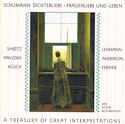 But back to Schumann... Music and Arts has issued an inspired two CD set containing historic recordings with three performances each of two song cycles from 1840, Dichterliebe and Frauenliebe und -leben (CD-1235). Dichterliebe is heard firstly by Aksel Schiøtz, the Danish tenor who recorded this cycle with Gerald Moore in 1946 just months before a necessary surgery left his face partially paralysed. Swiss baritone Charles Panzera is accompanied by Alfred Cortot in a 1935 recording that was, for many collectors, the criterion... yet Gerhard Hüsch, the German baritone, accompanied by Hanns Udo Müller, having the advantage of singing in his native tongue, sounds the most comfortable and expressive with Heine’s texts. Frauenliebe und –leben with texts by Adalbert von Chamisso is for female voice. Three singers, each indisputably legendary in the very best sense of the word, are each so individual in style that comparisons would indeed be odious. Here is Lotte Lehmann live in recital with Paul Ulanowsky in New York in 1946 and contralto Marian Anderson with Franz Rupp in 1950. Finally, Kathleen Ferrier is heard live at the Edinburgh Festival in 1949 accompanied by... no in collaboration with... her mentor, Bruno Walter. Excellent transfers make listening a pleasure. Comprehensive liner notes are included.
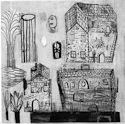 Rimouski, Quebec-based bassist/audio artist Éric Normand, who performs at Somewhere There this month, allows listeners to download sounds from his website www.tourdebras.com. One example of this is Une Règle de Trois (Tour de Bras tdbouebe002). A hand-drawn CD cover can be downloaded as well. Recorded live, this is a super-session of sorts featuring collaborations among improvisers from Rimouski, Montreal and Montpellier, France. Most of the sounds balance on steady crunches and crackles from three turntablists, with wiggling flanges and flying spiccato reprises from fiddler Catherine Massicotte and guitarist Christophe Devaux, plus puffs and bellows from Robin Servant’s diatonic accordion. Normand adds aleatoric and agitato smacks bringing the discursive theme in-and-out of aural focus, as the motor-driven clicks and clatters create a pedal point foundation.
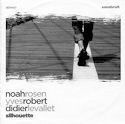 A more sophisticated version of downloadable CDs comes from the French Sans Bruit label. Featuring improvisers pianist Noah Rosen, trombonist Yves Robert and bassist Didier Levallet, Silhouette (Sans Bruit sbr007 www.sansbruit.fr) not only captures the trio live, but also provides a professionally designed front and back cover with recording details. Rosen and his confreres’ disc is as swinging as it is kinetic, highlighting an impressive admixture of timbres, not least of which includes modern gutbucket styling from trombonist Robert. Super staccato, Aesthetic Form for instance is less aesthetic than acrobatic, as Robert’s rubato whinnies slink and sway alongside Rosen’s two-handed pump in the piano’s lowest register, until he slips to the edge of the keys to link up with Levallet’s sul tasto runs. Elsewhere Rosen’s hunt-and-peck technique predominates, along with the trombonist’s triple-tonguing and mouth gymnastics. The session culminates with Bon, bref et puis… with allegro additions from each partner expressed in slaps and pumps from the bassist, cascading comping from the pianist plus foreshortened and jagged bass-pitched slurs from Robert.
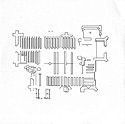 A more cerebral trombone trio is on Meshes (Another Timbre Byways at-b05 www.anothertimbre.com). This CD-R, with its well-designed cover, demonstrates another method of distribution. Certain that young improvisers wouldn’t need the number of discs in a standard official CD run, the British label created its Byways CD-R series. Certainly this gritty and pressured microtonal program from trombonist Mathias Forge, electronics manipulator Phil Julian and cellist David Papapostolou is one justification for the experiment. During two lengthy improvisations, the interaction and texture-blending is such that it’s frequently impossible to match particular timbres to individual instruments. With Julian’s electronics segmenting into chunky signal- processed lines, pulsating reverb and flat-line drones, multiplied shrills flash through the narratives like rain showers, when the static isn’t undulating underneath. Extended passages of extreme stillness also alter the tonal centre so that whistling squeaks from the cello – often hewn from the strings below the bridge – or blurry triplets strained from the trombone bell, tongue pops and flat-line blowing without valve pushes are more conspicuous. Although discontinuous in spots, the combined undulations made up of cello strings held to maximum tautness, rubato grace notes plus tremolo pedal tones from the trombonist, and electronic drones eventually reach a crescendo of inter-connected friction climaxing with a conclusive whistle and pop.
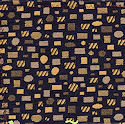 Brass and an electronic variant are also prominent on All Up In There (MrE Records 2 www.myspace.com/gordonallen) by Montreal-based, former Torontonian, trumpeter Gordon Allen, who often plays here. Figuring this concert with Frank Martel on theremin and drummer Michel F. Côté was worth preserving, Allen initially created 79 copies of the disc. With liner notes handwritten on a paper bag and the record packaged in a hand-sewn cloth bag, D-I-Y is taken to its logical extreme. But the strength of the performance suggests that more copies may eventually be needed. Sounds are cohesive and wedded to jazz-improv. Although when all musical cylinders fire at once the results appear as a solid textural block, there’s ample room for individual expression. Revealed are Côté’s anything-but-regular rhythms, the trumpeter’s choked-throat growls, and pitter-pattering string-referencing thumps from the theremin. These bass-like strokes are even more prominent midway through, when joining the drummer’s assertive backbeat, they create a solid base, allowing Allen’s plunger tones, grace note squeaks and bovine lows to float above.
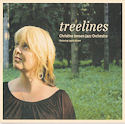 Canada owes Nanaimo, B.C. for raising artists like Diana Krall and the Jensen Sisters for its national jazz team, a thought underscored by Christine Jensen’s newest recording, Treelines - Christine Jensen Jazz Orchestra (Justin Time JTR 8559-2 www.justin-time.com). The leader, known more for her composing than sax playing, has been based in Montreal for some time and here recruits a top-flight 17-piece Quebecois band for her fourth recording as leader and first with orchestra. Within seconds of the opening tune of eight lengthy, thoughtful and stunningly-stylish compositions (Dancing Sunlight) you’re thinking here’s the nation’s answer to America’s vaunted Maria Schneider unit – and when Ingrid Jensen’s dreamy, lyrical trumpet solos starts you might well exclaim “it’s Kenny Wheeler”. In short, this is an astoundingly good album, one that surely will be a 2011 Juno contender, with seven Jensen tracks including four describing B.C. tree types. Charts are often striking, section work is sharp, subtlety abounds in the thick harmonies and there’s acres of room for effective soloing – Joel Miller on soprano sax (Western Yew), Ingrid (Dropoff) and the boss herself on Seafever and by pianist Steve Amirault throughout. Curmudgeons might sneer that there’s excessive sameness to these mini-epics - ignore them.
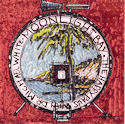 Want to keep the post-Olympic spirit? The latest disc from The Happy Pals who’ve reigned for years at Grossman’s on Spadina every Saturday afternoon, is all you need. Folk are in fine fettle here, band and audience both, enjoying music played over the 6th annual two-day Kid Bastien Forever Kick-Ass Jazz Festival – Bastien, who died in 2003, was chief Pal for more than 30 years. Moonlight Bay (New Orleans North cd-010 www.happypals.ca) has 14 tracks, good old stuff with most of the heavy performance listing falling to Patrick Tevlin’s brash trumpet and esteemed New Orleans guest Michael White’s thrusting clarinet, with big assists coming from trombonist Kid Kotowich and drummer Chuck Clarke. Enthusiastic, erratic vocals are spread around but the jollity index stays high, with upbeat slams on Je Vous Aime, Everybody Loves Saturday Night and Dinah while there’s surprising sophistication in their spin on I’ll Never Smile Again.
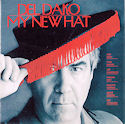 Four things make Del Dako’s My New Hat (www.deldako.com) particularly distinctive: It’s the recording debut as leader of vibesman Dako as opposed to baritone saxist star Dako; the liner notes by Jack Chambers are just about the best I’ve ever read; the determination of Dako to renew his career here is front and centre; and the choice of repertoire is extraordinary – such as the purloining of Beethoven’s 7th Theme from the Seventh Symphony and the two versions of avant pianoman Don Pullen’s Big Alice which suggest Ornette Coleman is on board. Perhaps it’s best just to say this is fascinating jazz with a vibes sheen that underlines the uniqueness of it all. The music’s drawn from two sessions, both with drummer Jeff Halischuk, one with guitarist Reg Schwager, pianist Bernie Senensky and bass Duncan Hopkins, the other with rising star guitarist Nathan Hiltz, bass Tyler Emond and reedman Alex Dean, whose bass clarinet work is terrific.
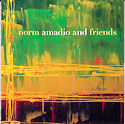 Pianist Norm Amadio has been around for ever, still happily tinkling after more than six decades as a pro and that’s just one reason why he’s so comfortable on Norm Amadio And Friends (Panda Digital ODCD00265 www.pandadigital.com), a classy, stylish treatment of a dozen songs (remarkably, seven of them originals by producer Andrew Melzer). As well as vocalists Marc Jordan and Jackie Richardson, Amadio’s buddies include elegant-as-ever Guido Basso, Phil Dwyer, Reg Schwager, and Rosemary Galloway plus, on three cuts, a string section. The result is top quality jazz, ornamented with unexpected zesty freshness. Catchy newcomers include I Love You That Way, Out Of The Cool and She Smiled. One oddity: Why was it necessary to include three tunes recorded in 1966?
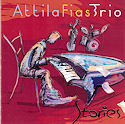 Hungarian-born pianist Attila Fias seems to have done it all during a long musical career - including playing, teaching and organizing all types of music – except make a jazz record though his work is on more than 80 discs. He’s remedied that with Stories (ESPCD-101 www.attilafias.com), 10 original compositions supported by bass Pat Kilbride and drummer Richard Brisco. A graduate of U of T’s jazz program, Fias – who on occasion is as fiery as countryman Robi Botos – hews close to mainstream’s core but he incorporates rich, rolling rhythms, elements of rock, country, classical and ethnic genres and sometimes dips craftily into free jazz. The intricate Growth Cycle threesome is the best of a bright lot.
 Spectrum
  Ranee Lee Lives Upstairs
 Blue Skies for Loveday
 New York Rendezvous
  MC Maguire - Trash of Civilizations
 A Little Dark Music
 5 X 3
5 X 3  Feldman; Babbitt - Clarinet Quintets
 Gurdjieff/Hartmann - Music for Piano Definitive Edition, Vol. 1 - Asian Songs and Rythms
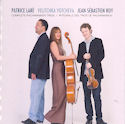 Although resident in Quebec since 1993, Paris-born Patrice Lare studied in Moscow for 8 years, and is steeped in the Russian piano school tradition. His playing provides a massive foundation for the Complete Rachmaninov Piano Trios (XXI-CD 2 1700) with his wife, cellist Velitchka Yotcheva (also Moscow-trained), and Canadian violinist Jean-Sebastien Roy. Rachmaninov’s Trios Elegiaques are both early works in his Romantic, post-Tchaikovsky mold. No.1 is a single-movement trio in G minor from 1892, and No.2 a three-movement work in D minor, written after the death of Tchaikovsky in late 1893 and dedicated “To the Memory of a Great Artist”. This is big but always sensitive playing, perfectly attuned to the style and nature of the music. Recorded at the Radio-Canada studios in Montreal, the sound quality matches the tremendous performances.
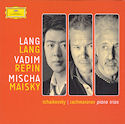 I’ve sometimes wondered if the technical heights reached by Lang Lang are always matched by the depths of his interpretations, but he certainly does his artistic reputation no harm with his first chamber music CD, Tchaikovsky and Rachmaninov Piano Trios with Vadim Repin and Mischa Maisky. Presumably this is his final major release from Deutsche Grammophon (477 8099), following his $3 million signing with Sony; if so, it’s a fascinating farewell, suggesting chamber music as a new field with huge potential for him. The Rachmaninov trio is the G minor, and both here and in the Tchaikovsky A minor trio Lang Lang really seems to avoid “showy” playing, getting to the heart of the music and clearly sharing the interpretative view of his Russian colleagues. Again, the standard of the recording matches that of the two outstanding performances.
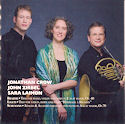 At first sight, there doesn’t seem to be any connection between the works on the latest CD from faculty members at McGill University’s Schulich School of Music (XXI-CD 2 1699), but they are in fact closely related. Jonathan Crow (violin), John Zirbel (horn) and Sara Laimon (piano) open with a beautifully warm reading of the Brahms E flat Horn Trio. This was the first work written for this instrumental combination, and was inspired by the death of the composer’s mother. Brahms chose to use not the newly-developed valve horn but the natural waldhorn, with its sentimental ties to his family and his youth in Hamburg. It was, in turn, a request from a Hamburg pianist for a horn trio to be played along with the Brahms that led György Ligeti to write his own Horn Trio in 1982; moreover, Ligeti had also lost his own mother earlier that year. Sub-titled “Hommage à Brahms”, it is a demanding, complex and multi-layered work in the same four-movement form. Again, the performance is exemplary. Brahms’ mentor Schumann wrote his Adagio & Allegro for horn and piano in 3 days in February 1849; the first substantial solo work to fully explore the potential of the new valve horn, it is still a demanding piece, and Zirbel and Laimon are terrific. Recorded at the acoustically-excellent Schulich School, the sound quality is outstanding.
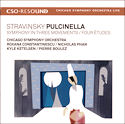 Stravinsky - Pulcinella; Symphony in Three Movements
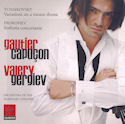 Tchaikovsky - Rococo Variations; Prokofiev - Sinfonia Concertante