WORLDS OF MUSIC IN TORONTO
WORLDS OF MUSIC IN TORONTO
 |
 |
 |
 |
Click the above covers to jump to the reviews below.


WORLDS OF MUSIC IN TORONTO
|
|
|
|
Click the above covers to jump to the reviews below.
|
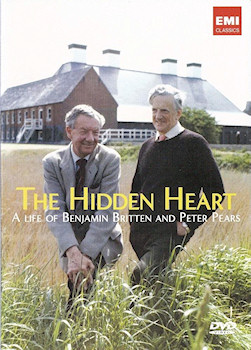
The Hidden Heart is a DVD of a 2001 TV documentary by Jake Martin concerning Benjamin Britten, his compositions and his relationship with Peter Pears (EMI 50999 21657191). Following the immediate success of Peter Grimes in 1945, Britten was acclaimed and music lovers around the world waited for his next opera. Then came The Rape of Lucretia in 1946, Albert Herring in 1947 and The Beggar’s Opera in 1948. The relationship between the composer and his tenor was no secret but it was against the law in Britain in those days. “The Hidden Heart” leads us through their lives to the last opera, Death in Venice. Some of their private correspondence is read and it is their last words which close this exceptionally well fashioned appreciation of their special relationship. Film clips of Britten, the operas, rehearsals, and many new and archival videos around The War Requiem are featured in this memorable presentation. Get It. |
 |
|
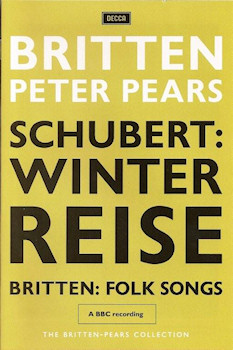
A recent Britten- Pears DVD from the BBC archives (DECCA 0743257) contains a formal Winterreise produced by John Culshaw in 1970 with Britten accompanying off-stage and also three of the songs filmed in rehearsals at home. Many of Britten’s arrangements of folk songs are heard in a recital before a select audience in 1946. For me, these little songs were worth the price of the disc... The Foggy Foggy Dew; The Ploughboy; O Waly, Waly; Oliver Cromwell; and many others. Oh, by the way... Decca has assembled their Britten recordings into several packages: Operas, volume 1 on 8CDs (4756020): Operas, volume 2 on 10CDs (4756029): Choral works on 10CDs (4656040); and a mainly instrumental collection of 7CDs (4756051). Check out the contents with your dealer or on the Decca site at http://www.deccaclassics.com. |
 |
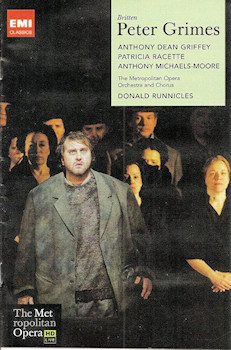 |
Last year’s MET production of Peter Grimes, as seen live in high definition on movie screens around the world, is available on an EMI DVD exactly as seen live, plus interviews and behind the scenes activities (EMI 509921 741494, 2 DVDs). Donald Runnicles conducts with Anthony Dean Giffey perfectly cast as the unfortunate Grimes. Watching at home is quite an experience, arguably better than sitting in the opera house, especially with the (optional) English subtitles to clarify the text. |
|
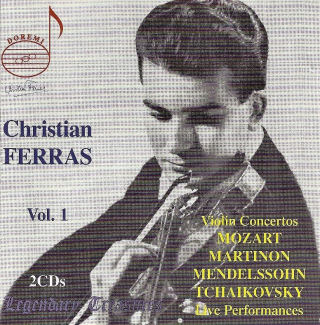
Among the foremost violin exponents of the 20th Century, Christian Ferras (France 1933-1982) holds a special place. He had a rather short career but while his playing was well in the league of the superstars of the era, Heifetz, Oistrakh and Francescatti, he suffered from severe depression which eventually led him to end his life. His achievements from an early age were so sensational that EMI placed him in their top line-up along with Menuhin and Oistrakh. His success was such that the powerhouse DGG picked him to assume the top position on their roster. In short time he recorded the four most popular concertos of the repertoire, Tchaikovsky, Brahms, Beethoven and Sibelius with Karajan and his Berlin Philharmonic. These marvellous recordings remained in the active catalogue for over forty years. DOREMI’s 2cd set of four live concerto performances from Paris confirms his place in the violinists’ pantheon (DHR-7880/1). The Mendelssohn E minor (1965) is beautifully communicative; Tchaikovsky (1968) impassioned; Mozart K.219 (1955) pure and stylistic while Jean Martinon’s intriguing, post-Berg 2nd concerto (1968) is brilliant. Derived from recently discovered pristine radio archives, this is an attractive collection. |
 |
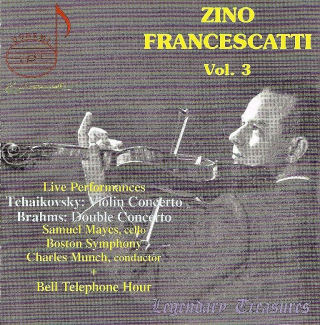 |
The illustrious Zino Francescatti (France 1902-1981) had a totally different kind of career and personal life. For more than half a century he was a frequent and favourite guest of almost every important orchestra in the world. We know him from his many Columbia recordings with the New York, Philadelphia and Cleveland orchestras but none with Boston, with whom he often performed. DOREMI has corrected this in Volume 3 of their Francescatti discs (DHR-7888) with Charles Munch conducting the Tchaikovsky (1958, stereo) and Brahms Double (1956) with first chair cellist Samuel Mayes. Hear Francescatti in his prime and his distinctive sonority and characteristic artistry. I have reservations about the sound but the three bonus tracks from The Bell Telephone Hour of 1952 are very good.
|
|
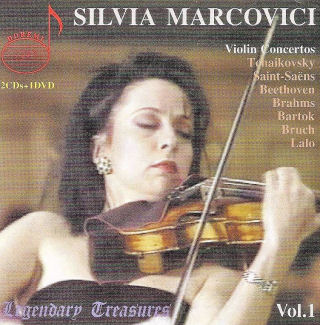
Silvia Marcovici (Romania b.1952) had a sparkling career during the last three decades of the century. Lesser known than the above, judging from these live performances she well deserved prime billing on a major label but was only heard on a number of lesser ones, except for the Sibelius on BIS and the Glazunov with Stokowski on Decca. Marcovici’s complete mastery of the instrument is amply conveyed playing seven concertos in the new DOREMI set (DHR-7942-4) containing 2 CDs and a DVD. Her characteristic sensitivity and warmth illuminate the Tchaikovsky, Brahms, Beethoven, and Saint-Saëns No.3 on the CD. On the DVD she plays Lalo, the Bruch no.1 and the Bartok 2nd to perfection, made all the more enjoyable by her striking, charismatic stage presence.
|
 |
 |
 |
 |
 |
|
|
Click above thumbnails to jump to reviews below.
|
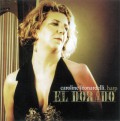
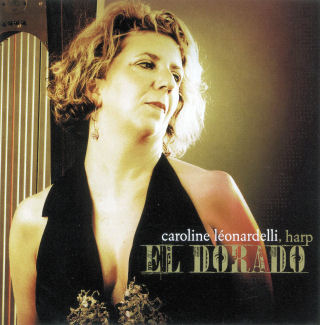
Caroline Leonardelli Centaur Classics CEN1021 Ottawa-based harpist Caroline Léonardelli’s fourth album to date offers an enticing mix of old and new: a program of beloved French standards by Debussy, Tournier and Damase book-ended by compositions by Canada’s leading composer for the harp. Devising convincing music for the so-called “naked piano” involves technical and conceptual challenges exasperating enough to discourage many a composer. Marjan Mozetich, however, composes in a style ideally suited for the instrument and has contributed greatly to its repertoire. His El Dorado was commissioned in 1981 for harpist Erica Goodman by Toronto’s New Music Concerts and was followed by several further works for the instrument. There is a pronounced minimalist influence detectable in the evocative oscillations of Mozetich’s early works which have since given way to a more supple and idyllic approach. Originally scored with string orchestra and formerly available on a now deleted CBC recording of the premiere performance, El Dorado is admirably revived here in a budget-conscious arrangement featuring the Penderecki String Quartet and double bassist Joel Quarrington. The album also features the third (!) recording of Mozetich’s 1988 cycle of four solo pieces, Song of Nymphs, in an exceptionally scintillating performance. Among the French solo pieces placed between these Canadian works Marcel Tournier’s Féerie stands out for its rhapsodic and dramatic sweep, a welcome antidote to the comparative bucolic placidity of its neighbours. The recording boasts outstanding sound engineered by celebrity tonmeister Anton Kwiatkowski. Daniel Foley |
 |
|
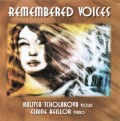
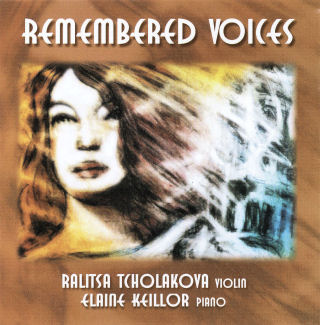
Ralitsa Tcholakova; Elaine Keillor Carleton Sound CSCD-1012 As a violin and piano recording, this one is immediately evident as being at the top of the genre. Performers are first rate, and playing with a passion. Audio production is unusually well done, with none of the bizarre qualities one finds so often nowadays, either of the violinist sounding as if she is larger than the accompanist, or the listener being right inside the piano. Excellent choices were made for the music on this CD, with special emphasis on Bulgarian iconic figure Pantcho Vladiguerov, who is represented by the Chant from his larger Bulgarian Suite, the widely-known Rhapsody Vardar, a Humoreske, plus an encore arrangement of Dinicu’s Hora Staccato. Tcholakova and Keillor show an admirable commitment to Canadian repertoire, beginning with Gena Branscombe’s unjustly neglected A minor Sonata, well represented in this performance. Violet Archer’s Fantasy and Prelude and the Prelude and Allegro are equally well served. But the best is saved for last: we get to hear the violin version of the late Patrick Cardy’s Liessel, Suse, Ilze, and Gerda, and Mary Gardiner’s monumental Remembered Voices, here finally blossoming in a hall vastly superior to the Heliconian Club. The Glenn Gould Studio’s hand-picked Steinway is on its best behaviour. No fewer than three sound engineers did the microphone wizardry. All photos are posed, with none showing the actual recording sessions. An excellent CD. John S. Gray |
 |
a
|
|
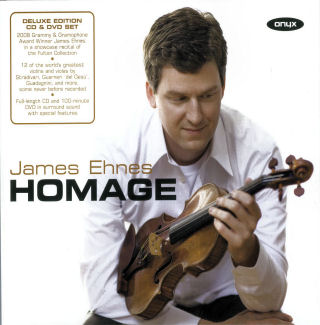
James Ehnes ONYX 4038 David Fulton has spent years assembling an astonishing collection of instruments by the great Cremonese makers, and Canadian violinist James Ehnes has selected nine violins - 6 Stradivari, 2 Guarneri ‘del Gesu’ and a Pietro Guarneri - and three violas for a dazzling recital programme designed to showcase the specific qualities of each instrument. Several, like the 1709 Stradivari ‘La Pucelle’, have never been recorded before, and one - the 1715 Stradivari ‘Marsick’ - has been Ehnes’ concert instrument since 1999. Seven different bows from Fulton’s equally superb collection of bows by Tourte and Peccatte were used in the recording, each hand-picked to complement the strengths of the particular instrument. In addition to a CD, the ONYX release includes a 100-minute DVD which features the entire 21-piece CD recital, with Ehnes describing the instrument and its qualities before each track, plus selection options and a 30-minute Extras chapter that includes the audio comparison tracks from the CD and extended commentary clips by Ehnes and Fulton. Ehnes hardly moves when he plays, but the close-up camerawork still manages to make it difficult to see exactly what he’s doing at times, especially his deceptively effortless bowing. The filming of the instruments is beautiful, though, and Ehnes is in spectacular form, with the opening track, Bazzini’s La Ronde des Lutins, worth the price of the set on its own. The violinist remarks in his outstanding booklet notes that “the difference in tone between instruments is often very subtle indeed”, especially when it’s the same player, of course, and it will take a professional ear to identify significant differences between the instruments. Still, a wonderful record of a remarkable project. Terry Robbins |
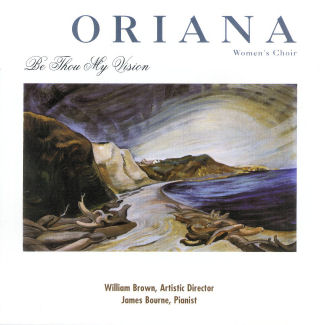 |
Oriana Women’s Choir; William Brown Independent WRC8-8072 While this fifth recording by Oriana consists of popular hymns, anthems and psalm settings, it is a treat to hear them set for women’s voices with six new arrangements commissioned by the choir by John Beckwith, Eleanor Daley, Derek Holman, Leonard Enns, Jon Washburn and Ruth Watson Henderson. Added to the stellar list of Canadian composers represented on this CD are psalm settings by Srul Irving Glick, two of which are sung in Hebrew. The women’s voices blend superbly and this repertoire is performed with skilful beauty thanks to the direction of William Brown, with expert accompaniment by James Bourne on piano or Michael Bloss on organ. Two absolute gems stand out on this recording: Fairest Lord Jesus arranged by Leonard Enns and All Things Bright and Beautiful in an arrangement by Mack Wilberg. Both employ the services of Leslie Newman, flute and Clare Scholtz, oboe with parts creatively interwoven through the fabric of these well-known melodies. Add to that the light-hearted There’s a Little Wheel A-Turnin’ in my Heart (arr. Robert A. Harris) and a heartfelt Kumbaya (arr. Paul Sjolund) at the end of the recording; this is an offering sure to inspire the spirit. Dianne Wells |
|
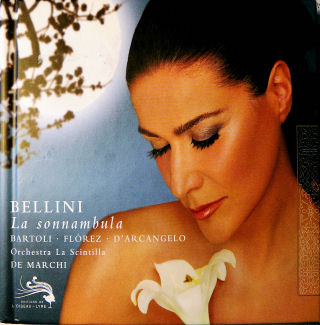
Bartoli; Flórez; D’Arcangelo; Orchestra La Scintilla; Alessandro De Marchi Decca 478 1084 The raison d’être of any recording of Bellini’s La Sonnambula, one of the most charming bel canto operas, is a great coloratura soprano. This recording offers something different – a great coloratura mezzo. Cecilia Bartoli is a remarkable singer, commanding a huge range, stunning agility, and overwhelming dramatic inclinations. But her idiosyncratic mannerisms – excessive breathiness, quiet cooing noises, heavily aspirated coloratura – are cloying, especially when she is allowed to indulge in them as often as here. While she makes great efforts to lighten and soften her voice, her rich mezzo with its tightly-wound vibrato is the wrong colour for the sleepwalking Amina. And transposing three scenes down to accommodate her lower range makes the recording more about Bartoli than Bellini. No transpositions are needed for tenor Juan Diego Flórez, who gives one of the finest performances of Elvino on record. Flórez sails through this difficult part with accuracy and élan, confirming his reputation as the finest bel canto tenor on stage today. Ildebrando D’Arcangelo gives a warm, commanding performance as Rodolfo, though the smaller roles are taken by singers of lesser talents. The Orchestra La Scintilla of the Zurich Opera House provides authentic period instrument accompaniment, and is beautifully conducted by Alessandro De Marchi. Though there is much here to enjoy, those looking for a recording of the opera in modern sound would be better off with Natalie Dessay in the title role on a recent Virgin Records release. Seth Estrin Concert Note: Orchestra La Scintilla accompanies Cecilia Bartoli in a program celebrating the life and art of the great 19th century opera singer Maria Malibran, a superstar of her era and inspiration for such composers as Rossini and Donizetti, at Roy Thomson Hall on March 1. |
 |