05_kwsoFrom Here On Out
Kitchener-Waterloo Symphony Orchestra; Edwin Outwater
Analekta AN 2 9992

These are challenging times for the classical music recording industry and it’s rare that a smaller label will produce a CD of music by three relatively unknown composers. Yet that’s just what Analekta has done on this disc titled “From Here on Out,” featuring music by Nico Muhly, Jonny Greenwood, and Richard Reed Parry, performed by the Kitchener-Waterloo Symphony under the direction of Edwin Outwater.

The piece From Here on Out by American-born composer Nico Muhly came about as the result of collaboration with the French dancer and choreographer Benjamin Millepied whose love of Bach and love of repeated notes both played a part in the creative process. The result was music decidedly neo-classical in sprit, with quirky, energetic rhythms contrasting with long expansive lines.

In total contrast is Popcorn Superhet Receiver written by Radiohead guitarist Jonny Greenwood. Despite Greenwood’s rock background, his compositional style here is decidedly contemporary, in this case involving glissando strings, microtonal clusters and the use of an Ondes Martenot. The Kitchener-Waterloo Symphony has no difficulties in mastering the textural and rhythmic complexities of the score, proof indeed that this ensemble is equally at home with 21st century music as it is with more traditional repertoire.

The most intriguing music in this collection is undoubtedly Arcade Fire multi-instrumentalist Richard Reed Parry’s For Heart, Breath and Orchestra, a musical depiction of the heart and breath rates of the human body. The piece was especially commissioned by the K-WSO, and rounds out an intriguing CD of music you probably won’t hear elsewhere. Kudos to both the Kitchener-Waterloo Symphony and Analekta for pushing the envelope!


04_nobles_undercurrentsUndercurrents - Contact performs the music of Jordan Nobles
Contact Contemporary Music
Redshift Records TK 242 www.redshiftmusic.org

On Toronto-based ensemble Contact’s excellent debut recording of music by Canadian composer Jordan Nobles, instrumental tones are pure, performer interactions retain focus and the recording team headed by Denis Tougas is superb. The meditative cast of Nobles’ music suggests retreat, even relaxation. But below the minimalist surface sheen, a certain unease of mood draws the listener’s attention and anticipation. Rhythms, melodic shapes and tone colours concentrate and shift our responses in surprising ways.

Both composer and Contact players, directed by Jerry Pergolesi, contribute to the musical content. They take up confidently the challenge of pieces that offer considerable freedom in the order and the qualities of musical events. Simulacrum, in which a melody circulates between instruments, and Stasis, an open-form work where long tones enter and exit without a fixed plan, are particularly successful examples. There is also an element of randomness in Grace, where musicians exercise choice in the presentation of grace-note (ornamental) patterns.

There are other musical processes, sometimes identified in titles: interacting metric patterns in Ostinati; tempo shift in Temporal Waves, featuring Rob MacDonald on multi-tracked guitar; and in Undercurrents, crablike motion up through ascending triads. The latter procedure occurs also in Stones Under Water for piano, played by Allison Wiebe. I look forward to much more from Nobles and from Contact members including also Sarah Fraser Raff, violin, Mary Katherine Finch, cello, Wallace Halladay, saxophones, and Peter Pavlovsky, double bass, joined here by Emma Elkinson, flute.


03_maguireMC Maguire - Nothing Left to Destroy
Benjamin Bowman; Douglas Stewart; MC Maguire
Innova 813 www.innova.mu

Once upon a time on the musical planet inhabited by wall-of-sound composer MC Maguire there must have been a catastrophic explosion, scattering the treasures of civilization together with all the cast-off junk of consumerism and the fallout of post-modern warfare. Through the blasted landscape come the remaining voices of humanity, represented on this latest Maguire release by violinist Ben Bowman and flutist Doug Stewart. The CD is called “Nothing Left to Destroy,” and for those interested in references, consider his choice of artist for the jacket: uber bad-boy Istvan Kantor.

Maguire’s works are massively layered and require repeated listenings for one to begin to sort the material out. His is a creative imagination that never seems to lack for material inspiration. Consider the sonic blast-scape of the first track, The Discofication of the Mongols. He references a contemporary icon (nay, cliché), the lonely herdsman with the iPod, to explain his thematic material. If I can decipher nothing else in his liner note explaining the piece’s structure, I can at least appreciate what he means about the loss of indigenous culture, and when you hear Bowman’s gorgeous violin playing drowned by the eventually overpowering disco beat, you understand the intent of the piece. Along the way you’ll want to listen for anything you recognize. “Paul is dead” in retrograde inversion might even be there.

Track two is somewhat shorter and much sweeter. S’Wonderful (that the man I love watches over me) is more homage than lament, remixing three Gershwin songs and quotes lifted from depression-era cinema. Stewart’s flute wanders lonely as a drunken Ginger Rogers, one busted high heel, still dancing with her imaginary Fred. Again, I want to hear the instrumentalist but lose him too often as he ducks behind the scenery. In fact, the critique that feels almost to miss the point is that Maguire’s sonic default setting is too often on “stun.” Regardless, the results are without a doubt stunning and worth the listen.


02_southam_soundingsAnn Southam - Soundings for a New Piano
R. Andrew Lee
Irritable Hedgehog IHM002 www.irritablehedgehog.com

Most people would celebrate a friend’s purchase of a new piano by bringing over a bottle of bubbly. But when Toronto pianist Jane Blackstone bought a grand piano in 1986, composer Ann Southam showed up with a magnificent new work called Soundings for a New Piano, dedicated to Blackstone. On this new release, US pianist R. Andrew Lee gives the work what I believe is its recording premiere.

Southam subtitled the piece “12 meditations on a Twelve Tone Row;” each of its 13 concise movements is like the turning of a musical kaleidoscope that enables the composer to explore a different emotional facet of a 12-interval row. Southam loved this form of musical inquiry, and used it in a number of piano works, culminating in her deeply contemplative Simple Lines of Enquiry (2007). It’s fascinating, in fact, to find several strands of musical DNA from SLoE in Soundings – not just a nearly identical tone row, but also some shared rhythmic and metric features, and a persistent questioning quality in the musical rhetoric.

Lee captures the spirit of curiosity that propels Soundings, and vividly conveys the distinctive, richly nuanced characters found in these 13 compact movements, from the bold insistence of the opening movement through complex tendernesses and passionate outbursts, all of it grounded by a gentle rocking sequence that keeps recurring, at once questioning and comforting.

A welcome addition to the Southam discography, this recording is available as a 23-minute CD or as download from www.irritablehedgehog.com.

Concert Note: Pianist Eve Egoyan launches her latest recording of music by Ann Southam - Returnings – at Glenn Gould Studio on December 2.

01_tapestriesTapestries
Christina Petrowska Quilico; Canadian Ukrainian Opera Chorus; Kitchener Waterloo Symphony Orchestra; Daniel Warren
Centrediscs CMCCD-17011 www.musiccentre.ca

Christina Petrowska Quilico’s significant contributions to the recorded contemporary Canadian piano repertoire continue to impress. As David Perlman noted in October’s WholeNote, her 26 CDs to date include many commissions. Both works on this new Centrediscs release were written for her and recorded live.

Canadian composer George Fiala’s three-movement Concerto Cantata for piano and chorus celebrates the 1988 Millennium of Christianity in Ukraine. Not only Quilico’s combination of sensitivity and virtuosity, but also Wolodymyr Kolesnyk’s informed conducting of the Canadian Ukrainian Opera Chorus, convey the work’s nobility of theme. Fiala’s combination of modernism and Ukrainian choral material, along with some incursions of late romantic piano writing, allow for an ample range of expression. I particularly like the high bell-like piano sounds in this work, even more so when actual chimes join in evoking the magnificent bells of Eastern European churches.

Heather Schmidt is a remarkable Canadian composer-pianist who early on established an international profile. Her musical language is somewhere in the same galaxy as that of Corigliano, Schwantner, or Hétu, and her individual voice is still developing. In the Piano Concerto No.2 I find the second movement’s intensity and orchestration particularly powerful. Sense of structure and pacing, idiomatic instrumental writing, and harmonic control are all notable. Making it sound easier than it is, Quilico’s performance in partnership with the fine K-WSO led by Daniel Warren is colouristic and well-paced, justifying indeed the disc’s title, “Tapestries.”

Concert Notes: The Canadian Music Centre (www.musiccentre.ca) hosts the launch of “Tapestries” in a public event on November 2. Christina Petrowska Quilico performs Grieg’s Piano Concerto with the Kindred Spirits Orchestra at the Markham Theatre for the Performing Arts on November 5.

01_ehnes_bartokWhen I saw the artistic pairing on the latest CD by James Ehnes, the Violin Concertos Nos. 1 and 2 and the Viola Concerto by Béla Bartók (Chandos CHAN 10690), my expectations sky-rocketed: not only was Ehnes playing, but the conductor was the terrific Gianandrea Noseda with the BBC Philharmonic. A dream team! For years, the Violin Concerto No.2 was assumed to be the only one that Bartók wrote, until the discovery of an earlier two-movement concerto, written in 1907-08 for the young violinist Stefi Geyer, to whom Bartók was romantically attached. The score remained unpublished and in her possession until her death in 1956. Ehnes is terrific in the lush, romantic first movement, as well as in a second half that more approaches the style of the mature composer. Despite Ehnes’ comment that this is music that has been very close to his heart since childhood, I found the Concerto No.2, one of my favourites, to be a bit less than I hoped for. It’s a passionate and lyrical reading, true, but I felt it lacked the contrasts and the sense of mystery that Menuhin – who knew Bartók – used to bring to this work. The Viola Concerto was left unfinished at Bartók’s death; unfortunately, the supposedly complete draft turned out to be just a pile of unnumbered manuscript pages with only a couple of indications of instrumentation. Bartók’s friend Tibor Serly, himself a violist, managed to solve the puzzle and complete the work, and Ehnes plays it with a commitment that never leaves its authenticity in any doubt. Noseda does his usual terrific job of bringing the very best out of the orchestra. One personal comment: the booklet bio again uses that quote from a Toronto newspaper hailing Ehnes as “the Jascha Heifetz of our day.” Does anyone else find this ridiculous? What’s wrong with Ehnes being hailed simply as one of the truly great players of his generation? If you want to appreciate how silly this is, then just imagine someone releasing a historical reissue of Heifetz recordings, and hailing him as “The James Ehnes of Yesterday.” Exactly!

02_ebene_dissonancesI know it’s a bit of a cop-out to be quoting a large chunk of the booklet notes in a CD review, but the opening remarks by the Quatuor Ebène for their Mozart Dissonances CD (Virgin Classics 50999 070922 2 0) tell you all you need to know about their approach to the music: “Mozart – despite the surface simplicity of his music – is one of the most difficult composers to interpret well, if not the most difficult of all. For his works demand two things of performers: absolute technical assurance, as anything less than perfect intonation and articulation would be all too clearly apparent in music that is so pure and transparent, …but above all the ability to let go and bare all.” And that’s exactly what you get on this wonderful recording of two of Mozart’s greatest quartets – the D minor K421 and the C major “Dissonance” – and the early Divertimento in F, K138. This is Mozart playing at its glorious best: warm, expansive, both passionate and sensitive, intelligent and thoughtful, and full of contrast and nuance. Add the simply beautiful recorded sound and you have a Mozart disc that will be hard to equal, let alone surpass.

03_sauretYou would be hard-pressed these days to find someone who would mention the French violinist Émile Sauret (1852-1920) in the same breath as Paganini, but such were his performing skills – he was giving concerts in London, Paris and Vienna at age 8! – that contemporary critics detected the same hint of the supernatural about his playing. Sauret was another of that breed that essentially died out during the 20th century: the virtuoso performer with compositional skills to match. Naxos has issued a charming CD of his Music for Violin and Piano (8.572366) played by the American violinist Michi Wiancko and the Russian pianist Dina Vainshtein. Their playing of these attractive, well-crafted pieces, that are closer to Sarasate in style than to Paganini, is an absolute delight. Recorded at the CBC’s Glenn Gould Studio by the always-reliable Norbert Kraft and Bonnie Silver, the sound quality displays perfect balance and a spacious ambience.

04_hoffmeisterViola players are not exactly overwhelmed with choice when it comes to concertos for their instrument, so the recent Naxos release of a CD of Viola Concertos by Stamitz and Hoffmeister (8.572162) is a welcome one. It’s an intriguing one as well, for viola concertos were not that common in the 18th century. Carl Stamitz, whose father Johann was the leader of the famous Mannheim orchestra, was a viola virtuoso as well as a violinist and composer, and his Concerto No.1 in D major, published around 1774, combines a technically challenging solo part with a skilful and sensitive orchestration. Although the composer Franz Anton Hoffmeister is now mostly remembered as a successful music publisher, his viola concertos in D major and B flat major were never published: each work has survived only in a single contemporary set of manuscript parts. This recording uses the new Artaria edition prepared from those parts by Allan Badley, who also wrote the booklet notes. Violist Victoria Chang is perfectly at home in this charming, if somewhat insubstantial, music and receives excellent support from the Baltimore Chamber Orchestra under Markand Thakar. The booklet notes remark that all three works remind us of the musical riches that can be found in the most unexpected corners of the 18th century. That’s quite true, but they also remind us of just how far Mozart was ahead of his contemporaries.

05_russian_viola_sonatasI didn’t know the names of any of the three composers on Russian Viola Sonatas (Sono Luminus DSL-92136), the new CD from the American violist Eliesha Nelson and the U.K.-based Nigerian pianist Glen Inanga. Varvara Gaigerova (b.1903), Alexander Winkler (b.1865) and Paul Juon (b.1872) all died between 1935 and 1944, but not – as you might suspect – as a result of the political situation in Russia at that time. Only Gaigerova died in Russia, in 1944 at the early age of 40, but her folk-inspired compositions and politically correct works in the 1930s apparently never put her at odds with the Soviet regime. Winkler emigrated to France 11 years before his death there in 1935; Juon retired to Switzerland in 1934, and died there in 1940. All the works on the CD are from the 20th century, but there is little of the sound and style that we associate with composers such as Shostakovich and Prokofiev. All three composers were influenced by Russian folk elements, making for very attractive and highly accessible works, but there’s hardly a moment when you have no doubt that you are listening to 20th century Russian music: there’s more of a German Romantic feel here a lot of the time. Winkler and Juon, of course, received their training in the 19th century, but even the Gaigerova work has turn-of-the-century echoes of Scriabin, Brahms, Ravel and Rachmaninov. Juon, whose Sonata in D major, Op.15 is the only work on the CD that is not a world premiere recording, was raised in a German-speaking household and spent virtually all of his working life in Berlin. His three-movement sonata, written in 1901, makes it clear why he was often referred to as the “Russian Brahms.” There is more than a trace of the same composer in the Winkler Sonata in C minor, Op.10, from 1920, by far the biggest work on the CD – in fact, there is an almost direct quote from the Brahms A major violin sonata in the first movement. Winkler’s Two Pieces Op.31, the slow Méditation élégiaque and the scherzino La toupie, are well-crafted and effective light music pieces. Gaigerova is perhaps the most interesting composer here – very little information is available about her – and she was the composer most strongly influenced by the folk music of the numerous Soviet Republics. Her four-movement Suite Op.8, published posthumously in 1969, is a beautiful work, and makes you wonder what we might be missing in her neglected string quartets and symphonies. Nelson’s viola tone is mostly warm, although it’s a bit thin at times in the upper register, but the tonal quality and the steady, constant vibrato hardly vary at all throughout the disc. There’s not much dynamic contrast either, and the end result is that the works tend to sound rather the same. How much this is due to the compositions themselves rather than the performance would make an interesting discussion, but I really can’t hear the power and passion or the sensitive phrasing that some reviewers of this CD have found in Nelson’s playing. Inanga is a fine partner at the keyboard, although the recorded balance makes the piano sound a bit distant at times.

04_ames_piano_quartetHahn; Schmitt; Dubois
Ames Piano Quartet
Sono Luminus DSL-92141

This is the 14th release by the Ames Piano Quartet, the resident chamber music ensemble of Iowa State University. The quartet has been hailed for their two decades worth of well-received releases for Dorian Records, subsequently re-issued as a box set by the Virginia-based Sono Luminus label. Their latest recording features French chamber music from the first half of the twentieth century.

Best known for his vocal works, the Venezuelan-born Francophile Reynaldo Hahn (1874-1947) is represented here by a late Quartet in G published in 1946. Hahn, partly Jewish and once the intimate partner of Marcel Proust, kept an understandably low profile during the war years hiding away in Monte Carlo. His elegant, finely crafted quartet betrays little personal anxiety considering the circumstances; though the tender third movement suggests a certain regret, the general tone is one of restrained optimism.

Florent Schmitt (1870-1958) enjoyed tremendous success at the outset of his career but alienated the establishment through his acidic music reviews (his habit of shouting out his verdicts in the concert hall led the publisher Heugel to brand him “an irresponsible lunatic”) and perceived pro-Germanic stance owing to his Alsatian origins. Be that as it may, his truly delightful “petit concert” Hasards Op. 96 (1944) towers over his compatriots on this recording thanks to its brilliant colours, refreshing mutability and sheer rhythmic inventiveness.

Bringing up the rear is the teacher of both Hahn and Schmitt, the distinguished Théodore Dubois (1837-1924), now mostly remembered for denying Maurice Ravel the Prix de Rome. The thoroughly conventional structure and fulsome harmonies of his impeccably proper Quartet in A minor (1907) bring to mind the music of César Franck, an impression confirmed by the cyclic return of earlier themes in the finale of the work. Schmitt remains the indubitable star of the show however and reason enough to own this intriguing collection of lesser-known repertoire.

Concert Note: Reviewer Daniel Foley’s latest composition Music for the Duke of York will receive its premiere at an afternoon concert honouring the late Antonin Kubálek at Walter Hall on November 6.

03_russian_favouritesRussian Favourites
Alexander Sevastian
Analekta AN 2 9929

“Russian Favourites” showcases Quartetto Gelato accordionist Alexander Sevastian in a number of Russian solo accordion works and arrangements.

The accordion specific works are important examples of “classical” 20th century Russian accordion repertoire. Compositional acumen and the monster virtuosic strength of the Russian players created a challenging collection. Here Vyatcheslav Semionov’s Don Rhapsody No.1 is a prime example. In just under five minutes, it showcases almost everything the accordion can do. Massive chords, lyrical melodies and blasting sound walls are all controlled brilliantly by Sevastian. The work is saved from becoming a musical parody of itself primarily thanks to the composer’s clever compositional skills. Original works by Shenderyov, Korolyov, Panitsky and Zolotaryov are also featured.

Sevastian himself arranged works by Rachmaninoff, Mussorgsky and Tchaikovsky. The success of any arrangement for the accordion from Romantic piano repertoire is tricky. The piano is a percussion instrument – finger articulation causes a hammer to hit a string which causes it to vibrate. Pedals figure prominently too. Lots of sound source possibilities. The accordion is a wind instrument – the bellows force air through metal reeds causing them to vibrate once buttons or keys are depressed. There is only has one sound source. That’s why sometimes an arrangement like Rachmaninoff’s Vocalise sings with its inherent flowing melodic beauty while Mussorgsky’s “The Gnome” from Pictures at an Exhibition stumbles with too many simultaneously vibrating reeds.

Sevastian is a sensitive and accomplished performer in this crowd-pleasing jewel.


02_tchaikovskyTchaikovsky - Symphonies 4-6
Mariinsky Orchestra; Valery Gergiev
Mariinsky DVD MAR0513; Blu-ray BD MAR0515

Philips issued CDs of these three symphonies with Gergiev conducting the Vienna Philharmonic in live performances from 2002, 1998, and 2004. Although they were very well received in some quarters, I found them to be quite perfunctory. Here is a wiser Gergiev in 2010 with his own orchestra live from the Salle Pleyel in Paris and the performances are polished, spectacular and substantial.

The first movement of the Fourth Symphony sounds eccentrically slow on first hearing but after listening to all three symphonies it now fits perfectly into Gergiev’s new understanding and appreciation of Tchaikovsky’s music. The Fifth Symphony is unusually stirring from the first notes to a hectic, triumphant finale. The Sixth can be driven too hard as Gergiev did in the Vienna recordings but here it unfolds with unusual respect and sensitivity. That is not to imply that it is not thrilling, which it assuredly is, but there is an atmosphere of inevitability throughout heard in no other performances that I know of. The tragic last movement, Tchaikovsky’s valedictory address, is played with intense passion and is quite final. I “Do not go gentle into that good night,” he seems to say.

There is a bonus in which Gergiev talks about Tchaikovsky’s orchestrations with interesting observations. Not an overly large orchestra, about 50 players, the textures and balances are never obscured. For me, these extraordinary, vital performances set a new standard. Perfect sound and thrilling dynamics throughout make this Blu-ray disc an uncontested first choice. Enthusiastically recommended.

01_beethoven_naganoBeethoven - In the Breath of Time
Orchestre Symphonique de Montreal; Kent Nagano
OSM OSMCD7437

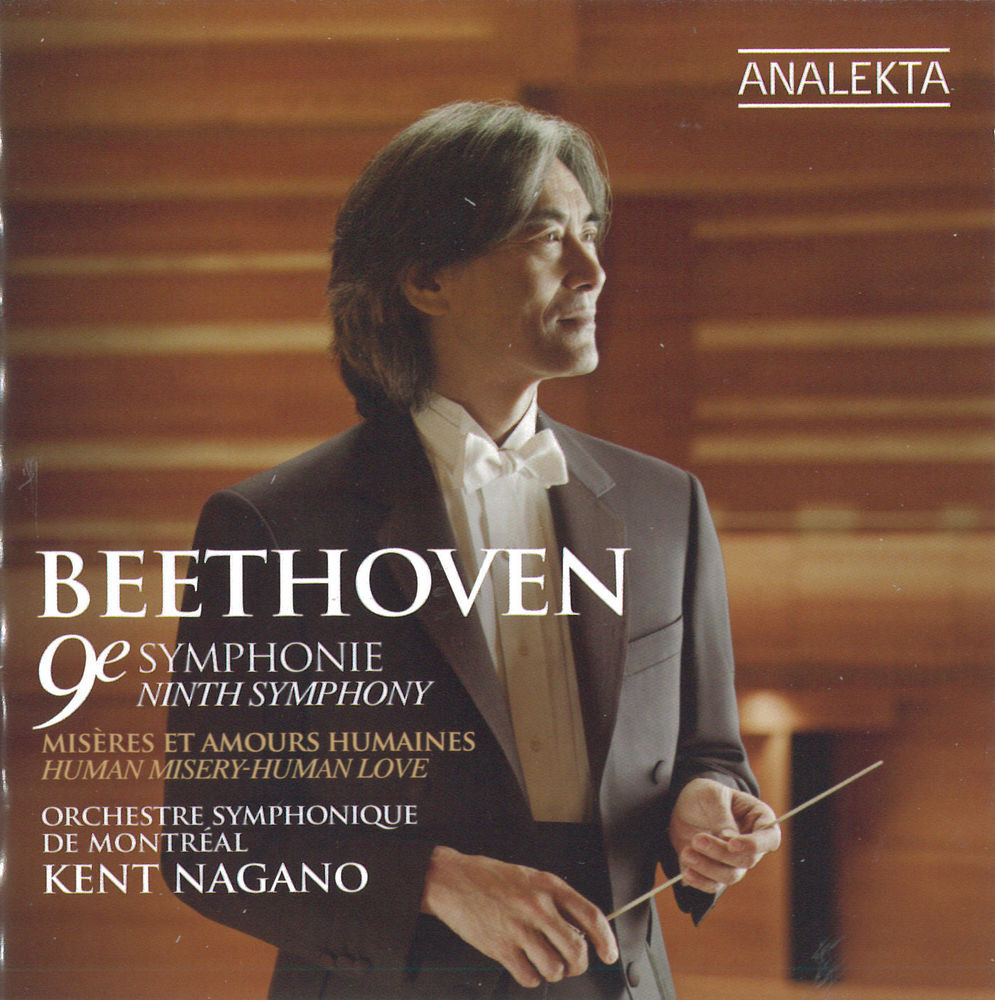
The Montreal Symphony has much to be happy about these days. Conductor extraordinaire Kent Nagano is now in his sixth season as music director and the orchestra is sounding great. This is in part because of its new hall, which opened in September and is proving to be an acoustical gem. Furthermore, the ensemble has begun to record on its own label – OSM - and this latest offering – a two-disc set titled “In the Breath of Time” is another in the series featuring music by Beethoven, specifically symphonies six and eight, in addition to the Grosse Fuge as arranged by Felix Weingartner.

As fine an ensemble as the MSO is, there are no surprises here, nor is there any ground-breaking. Instead, under Naganos’s competent baton, the orchestra concentrates on solid musicianship, performing with a particular warmth and sensitivity. The “Pastoral” Symphony is a delight – here are the familiar bird-calls, the peasant dances and the joyful mood of life in the country as Beethoven witnessed it. The more traditional Symphony No.8 is approached with a suitable spirit of nobility and the monumental Fuge – all seventeen minutes of it – with the grandeur it deserves.

In keeping with the overall theme of time and change, the second disc concludes with a brief spoken word trilogy titled Declaration of INTERdependence, written and narrated by David Suzuki. While the recitation is moving and poignant, it’s the music itself that makes this such a satisfying recording – a fine interpretation of familiar repertoire by one of Canada’s most renowned orchestras.

05_anna-nicoleMark-Anthony Turnage - Anna Nicole
Eva-Marie Westbroek; Gerald Finley; Royal Opera House; Antonio Pappano
Opus Arte OA 1054 D

Opera is probably the most democratic art form, contrary to its “elitist” reputation. Centuries ago, the librettists and composers figured out that lives of courtesans, prostitutes and comfort women are as worthy of being immortalized as the kings and nobles whose pleasure they serve. Enter “Anna Nicole.” The story of a rather Rubenesque woman famous… well, for being famous and for her enhanced chest, is pure tabloid fodder, sordid and vulgar. It is also tragic, not the least because of its final outcome.

Richard Thomas (who also created “Jerry Springer – the Opera”) seizes upon all the tabloid angles, but never loses sight of our tragic heroine. The choir, on-stage from the overture on, initially is just a Greek chorus. It quickly becomes a flock of media vultures, ready to report on the slightest non-event and to destroy Anna Nicole’s camera-seeking life in the process. You cannot help feeling as sorry for the fame obsessed small–town girl as you would for Cio Cio San. Large credit goes to Eva-Maria Westbroek’s sensational performance; Gerald Finley, who is clearly Covent Garden’s audience favourite, lends his beautiful baritone to the role of the sleazy lawyer Stern and Susan Bickley, is forced to be a modern-day Cassandra, predicting the gloom.

Turnage’s music, never very easy, gains on second hearing and is ably assisted by a rhythm section including John Paul Jones (of Led Zeppelin, I kid you not!). Should you see it? Yes! Besides, where else can you hear a soprano aria “Get me the f**k out of here!”?


03_rossini_wm_tellRossini - William Tell
Gerald Finley; John Osborn; Malin Bystrom; Marie-Nicole Lemieux; Orchestra e Coro dell'Accademia Nazionale di Santa Cecilia; Antonio Pappano
EMI 0 28826 2

With glorious C major arpeggios and a scene bathed in sunlight over the mountains above Lake Lucerne in a newly liberated Switzerland… so ends Rossini’s last work for the opera stage. Guillaume Tell, a monumental, French style grand opera and a prototype for the genre later developed by Auber, Halevy and Meyerbeer, was indeed his swan song after which, at age 48 and after 59 operas, he wisely decided to take it easy, enjoy his wealth and fame in Paris, be a great cook, give musical soirées and teach at exorbitant fees. William Tell is unlike anything he had written before in its scope, scale and musical language. Even Wagner expressed unusual interest by saying that at one point Rossini created a “perfect fusion of declamatory style and emotional content.” “So I wrote music of the future?” asked Rossini innocently. “No, Maestro, but music for all times!” was Wagner’s thoughtful reply.

The opera is seldom recorded mainly because of the strenuous requirements on singers. For example the tenor has to sing 54 B flats, 19 high C’s and 2 C sharps! Therefore it is doubly welcome to have this superb new EMI release conducted by today’s maestro of maestros of opera, Antonio Pappano. With carefully studied pacing this long, unwieldy score becomes beautifully coherent with dramatic excitement, tumultuous crowd scenes, expansive pastoral interludes and exhilarating ballet music of the finest kind. This recording bolsters our national pride with two of the principals being Canadian, baritone Gerald Finley (Tell) and Marie-Nicole Lemieux (his wife Hedwige), both in fine characterization, superior voice and impeccable French accent. But probably the greatest strength of the recording is American tenor John Osborn heroically conquering this most gruelling role of the repertoire, Arnold Melchtal.

All other principals are exemplary and form a true team effort of this surprisingly satisfying rarely performed work.

04_luluBerg - Lulu
Julia Migenes; Evelyn Lear; Kenneth Riegel; Metropolitan Opera; James Levine
Sony 88697910099

Alban Berg finished the short score of Lulu in the spring of 1934. Like Wozzeck, it was structured with what George Perle called a “recapitulatory aspect” in that large sections of the second half repeat or alter movements from the first half. Berg orchestrated Acts 1, 2, and the first 268 bars of Act 3; the orchestral interlude of Act 3 and the closing scene were thrust into the Lulu Suite as a promo piece suggested and conducted by Kleiber in November 1934. Delayed by the commission of his violin concerto, his sudden illness and death left the remainder of Act 3 unorchestrated. Erwin Stein published Acts 1 and 2 and had engraved the first 70 pages of Act 3 when the short score was locked away by the widow Helene in her lawyers' safe. Frau Berg supposedly saw uncomfortable parallels between an autumnal feminine interest of her husband and the seductive anti-heroine Lulu. Act 3 was micro-filmed, there was a legal dispute and then Frau Berg died in 1976. Contrary to some stories, all but 86 bars could be orchestrated with a mathematical conviction. Happily, the task fell to Friedrich Cerha, a composer devoted to Webern, Schoenberg and Berg. The Berg scholar Anthony Pople generously admitted: “Whatever its minor shortcomings, Cerha's realization is brilliant work, and there is no reason to think that there will ever be a necessity for the completion of Act 3 in full score to be undertaken afresh.”

The three-act version appeared in Paris on February 24, 1979 starring Canada’s Teresa Stratas to rave reviews. Franz Mazura was Dr. Schön and Kenneth Riegel his son Alwa, both of whom then appeared at the Met in 1980 in the production recorded in this beautiful DVD set. Lulu is Julia Migenes, a seductive and street-wise survivor, with a sharp dramatic edge. Evelyn Lear (a wonderful Lulu herself) plays the lesbian Countess Geschwitz, completely at home in this music and convincing as the only truly honourable character in the opera. Both the acting and the singing are compelling. James Levine loves Berg and draws a nuanced performance of this complex and fascinating work. If you have not previously been won over by Lulu, she may well seduce you with this appearance.

broken_hearts___madmenBroken Hearts and Madmen

Patricia O'Callaghan; Gryphon Trio

Analekta AN 2 9870

Classical sensibilities applied to popular music should enhance, rather than sacrifice the spirit and intent of the original music. It rarely makes sense to over-beautify the themes of everyday life and we all can site instances where the marriage of pop and classical does not quite work. In this recording, however, Patricia O’Callaghan and the Gryphon Trio, deliver savvy and artful new interpretations. It all begins with choosing ingeniously artful songs. Songs by the likes of Laurie Anderson, Nick Drake, Leonard Cohen and Elvis Costello are interspersed with those by Llasa de Sela, Los Lobos and Astor Piazzola as well as traditional Latin pieces, offering a diverse and clever mix most suitable for orchestration. Interpreted through brilliant arrangements by Roberto Occhipinti, Hilario Duran and Andrew Downing, the results are stunning, soulful and profoundly affective.

The trio’s playing is superb and complex and O’Callaghan’s vocal nuances are delivered with a heartfelt, dynamic, yet surprisingly light and subtle touch. Most notable is her ability to keep the extreme emotional intensity going despite the incessant repetition in Elvis Costello’s I want you. Along with her gorgeous singing, O’Callaghan’s expert facility with languages is remarkable in the Spanish and French selections. Through a decade developing a chamber music series for the Lula Lounge, the Gryphon Trio has finely honed their talent for skilfully adapting classical technique to the contemporary audience and this shines through beautifully in this recording.

Concert Note: Patricia O’Callaghan and the Gryphon Trio will launch “Broken Hearts and Madmen” at the Lula Lounge on October 2.

VOCAL Note: For reviews of eight new Sony opera re-issues see Bruce Surtees’ Old Wine in New Bottles

01_couperinCouperin - Concerts royaux

Bruce Haynes; Arthur Haas; Susie Napper

ATMA ACD2 2168

Around 1700 Pierre Naust crafted an hautboy in Paris – it may be the earliest hautboy (forerunner of the oboe) now in private hands. In 1703 Barak Norman created a viola da gamba in London. This recording unites these two instruments in some of Couperin’s concerts royaux, precisely the repertoire for which Naust’s hautboy would have been played.

The recording was originally released in 1999 but one very poignant reason explains its redistribution. US/Canadian Bruce Haynes, the hautboy soloist, died this year; reintroducing the hautboy into France (!) and five books and 50 articles on early music are his legacy.

Concert 7’s sarabande is the first opportunity to hear the Naust hautboy. It is both outwardly expressive and yet slightly sensitive; Couperin was well able to bring out the quality of this instrument.

In Concert 11, despite the rather stately quality of all eight movements, the standard of hautboy playing is always maintained. It is Susie Napper’s mastery of the gamba which gains exposure, reinforced in her duet with harpsichordist Arthur Haas in a track from Couperin’s third book of harpsichord pieces. In fact, Bruce Haynes returns with some of his most inspired playing in two musétes. Rural can only begin to describe the combination of hautboy, harpsichord and gamba as they imitate the sounds of the French bagpipe!

And then the even more varied Concert 3 (with another muzette - sic) to conclude this tribute to Bruce Haynes, and to the instrument he revived in the country of its birth.

02_tabarinadesTabarinades - Musiques pour le theatre de Tabarin

Les Boréades; Francis Colpron

ATMA ACD2 2658

Tabarin was the stage name of Jean Salomon. Born in 1584, he and Antoine and Philippe Girard set up an open-air theatre in Place Dauphine, Paris. Lively shows put Parisians of all classes in good humour, promoting the sale of Tabarin’s range of quack medicines.

Music accompanied the sketches; violins and bass viol are depicted in illustrations. The comparison with commedia dell’arte is too tempting for Director Colpron, who adds the latter’s recorders, lute and guitar.

From the start, this anthology (27 tracks in one hour!) features the liveliness of the French renaissance dance tune and many tracks are very familiar to early music lovers; track 2 Les Bouffons is a case in point, although one of the “outdoor” instruments of the period (crumhorn, rauschpfeife) would perhaps have made for an even livelier performance.

Several pieces are taken from more courtly circles, ballets being an obvious example. In these cases, woodwinds liven up what might have been rather subdued string pieces.

The selection is varied, as a motet and a stately pavan find their way onto a CD of essentially French secular and theatrical music. None of this should distract the listener from an hour of highly enjoyable playing, none more so than the recorder-playing of Francis Colpron (listen to the stately quality of Da bei rami scendea). His direction brings as many as 14 early musicians together, sometimes 11 on one track - a veritable crowd for early music enthusiasts!

And one man did come to be deeply influenced by Tabarin: real name Jean-Baptise Poquelin, stage-name Molière.


Back to top