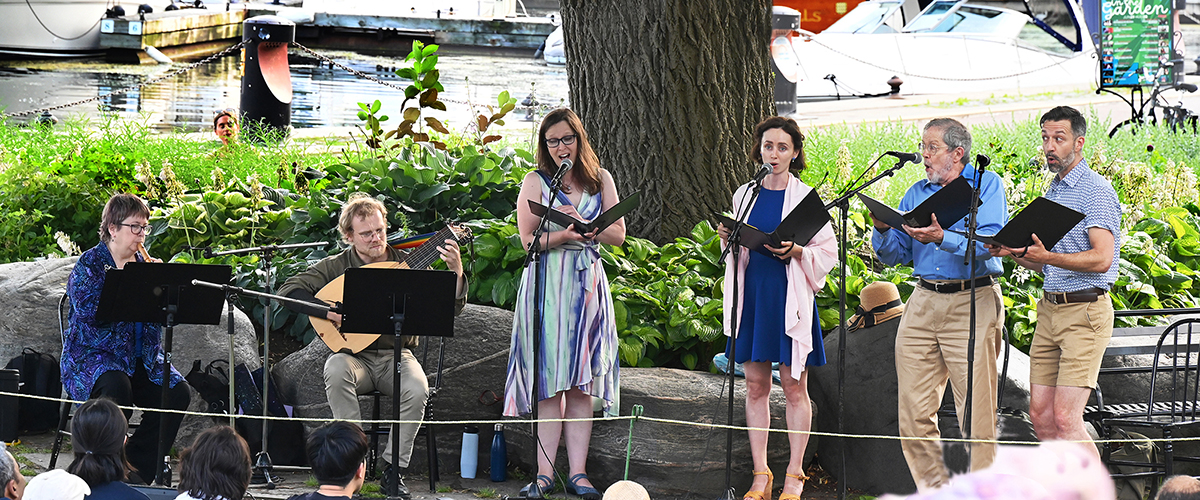
 This past summer, an early music band was asked for a promotional group photo and a name for a concert at Toronto Harbourfront’s Music Garden. They realized they had neither, so they searched for a Renaissance painting to capture their spirit. The image they chose, by a follower of imaginative painter Hieronymus Bosch, shows a group inside a giant egg gathered around a book of music, singing and playing – and so they dubbed themselves The Musicians of the Egg.
They weren’t a new group at all, though. For decades, they had delighted audiences with their fresh and engaging renditions of Medieval and Renaissance music. Known then as the Toronto Consort, they were accomplished, but never pedantic; as observed in The WholeNote in October 2024, after the Consort’s core members had resigned en masse from the organization and had been replaced by a new group, they always “wore their learning lightly.” In a subsequent open letter, the former members stated, “There were starkly differing views on what it would mean to see the Consort thrive, and the board chose to make many bold changes without involving the artists meaningfully in the process. Hence our departure.”
Undeterred by the loss of their name and despite the premature death of fellow Consort member, tenor and organist Paul Jenkins, they regrouped, encouraged by the invitation to perform at Harbourfront’s Music Garden 2025 summer series, by the support of their audiences, and by a substantial private donation. On January 24th, they will begin again under the name The Musicians of the Egg with their program Winter’s Delight: Musical Merriment with Good Company.
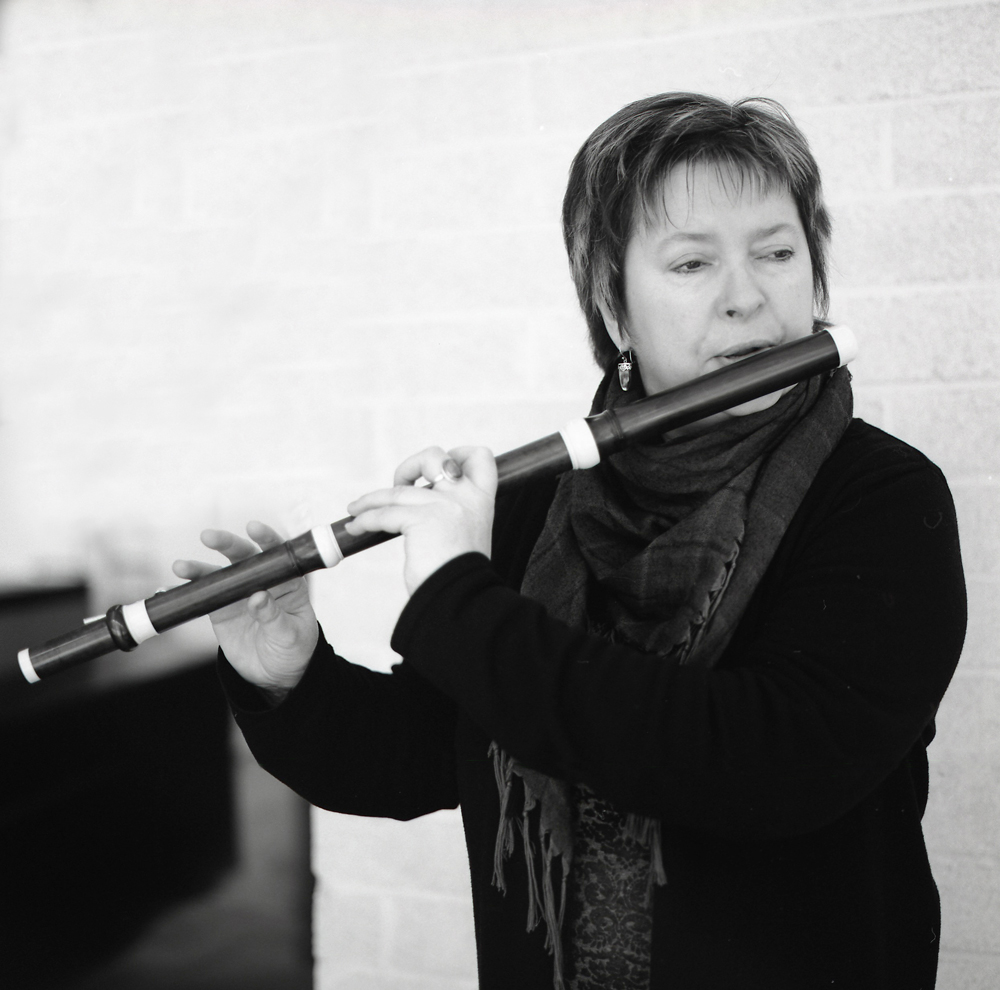
Alison Melville was a member of the original ensemble for over 30 years, as well as being involved in Baroque Music Beside the Grange (now Northwind Concerts), Polaris, and more. “The mission stays the same,” Melville assures us. “The repertoire we love, the fact that we like working together, and that audiences seem to like what we do and how we do it.” But, she says, “some things have to change. We can’t be as active as we were, at least to start, because a lot of organizational things were taken care of by a board and staff. [Also,] if you want to start over but you have no money, that’s difficult.”
They are very grateful to be backed financially by a “very, very generous” private donor who wished to see them continue, and administratively by Michelle Knight, former managing director of the Consort and now the Chair of Northwind Concerts [which presents this concert on January 26].
The invitation to perform at the Music Garden was a turning point. “Even in just a very short time of working together for that show, we realized: it really is good to make music together. It was a reminder that this didn’t happen because the group blew up. It really was of great importance in our lives,” Melville says. She muses that the new beginning might even be seen as a positive thing, since it gave members an opportunity to re-evaluate their involvement, and the group a chance to re-shape itself without conflict.
Many of the core members have come over to the Egg from the old ensemble, and new ones have joined. Alison Melville, recorder and flute, Michelle Deboer, soprano, and Cory Knight, tenor, remain; former member Laura Pudwell, mezzo-soprano, returns after an absence, as soprano Katherine Hill has moved on to other projects; lute player Jonathan Stuchbery replaces Esteban La Rotta, who is now based in Europe; long-time collaborators Ben Grossman, percussion & hurdy gurdy, and Olivier Laquerre, baritone, are on board, too.
Board v. artistic leadership: More than a few Canadian arts organizations have seen open disagreements between their Boards of Directors and artistic leadership, with widely differing outcomes. In 2024, for example, the Celtic Colours International Festival dismissed and replaced its entire board, a move made possible by how their constitution was written. But how much power does a board have, and what takes precedence when board objectives and artistic aims clash?
Melville believes that there is no “one-size fits-all” answer, and that the size and identity of the ensemble are key. With a large organization like the Toronto Symphony, the relationship seems more straightforward – you need a board to manage its many moving parts. Generally speaking, the larger the ensemble the more likely that audience loyalty is to the organization as an entity rather than to individual musicians.” Although, Melville adds, “When I was a kid going to the symphony, I paid great attention to who was in the flute section, and when there was a change, I noticed that.”
It’s true that organizations with charitable status have significant responsibilities to donors and granting bodies, but Melville points out, “You’re responsible to your audience, too. If you don’t have an audience, you don’t have a band, right? [And] if it’s a smaller band, [audiences definitely] recognize the people in it, so it seems vital, then, to have the musicians at the centre of artistic discussions.” Including orchestra members getting to vote on their new artistic director(s).
Niche within a niche: Melville is hopeful – but also pragmatic – about the continuing appeal of Medieval and Renaissance repertoire in a country like this where less than ten percent of the population is interested in any kind of classical music. [Note: in 2024 classical music accounted for just 2.5% of digital album sales].
“It’s a niche – and early music is a niche within a niche, right? But the thing is, the people who like it really like it.” Since the ’90s she’s heard ‘our audiences are aging,’ but believes that “the three or four kids from every high school, if they can find a way that they can go and hear it, those are your new young people coming into the audience [...] They’re thinking, I really want to play hurdy-gurdy. I really want to play the harpsichord, or recorder. They’re still there. I teach some of them.”
Also, despite the ensemble’s deep research, there has never been pedantry in their performances. Melville says, “It’s really about this love of the repertoire […] that’s the thing that makes you dig a little bit deeper. That’s the thing that makes you stay up another hour because you’re researching and you go down this rabbit hole about 16th-century lute tunings and the next thing you know, it’s 2.30am! It’s got to do with the love of it as well as the more cerebral thing, and as a performer you don’t necessarily know that that’s what people see, but one hopes that they do.”
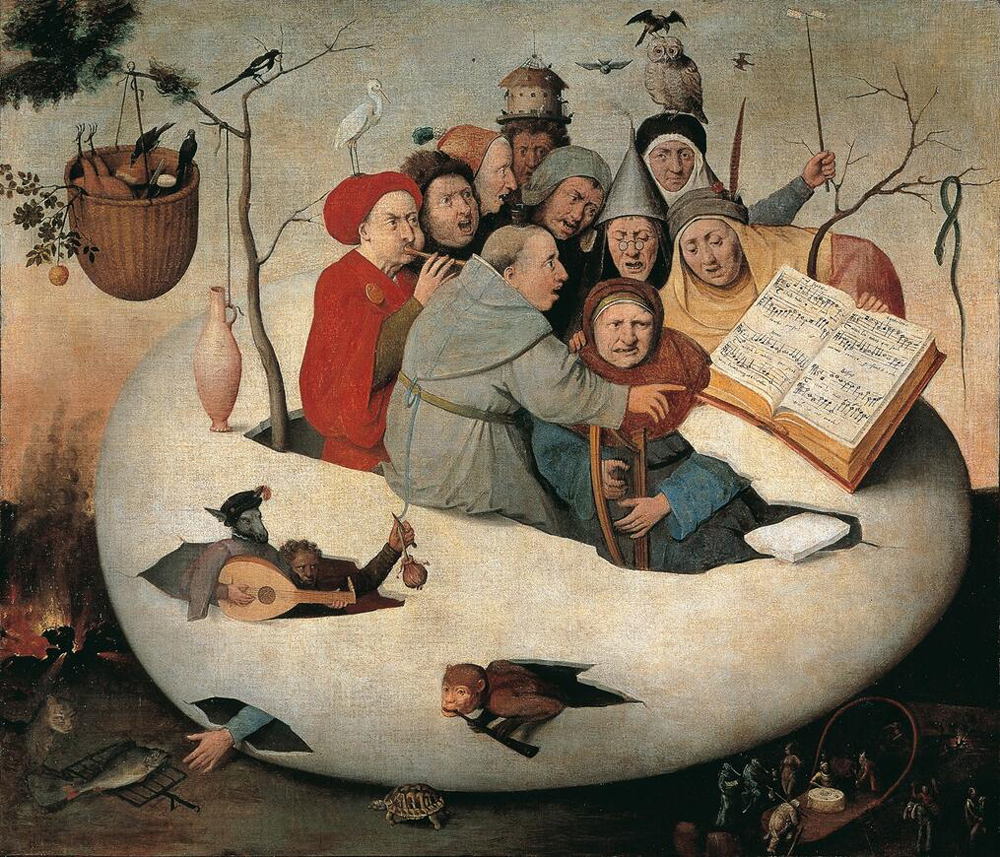
The music in the egg? In the “Egg” painting, musicians are performing the 1549 chanson “Toutes les nuitcz” by Thomas Crecquillon, so of course the piece will be included in this concert. Crecquillon might not be a household name, but Melville was already very familiar with his music. “I would say if I had to name my top ten, he would be on it. He writes beautiful chansons, and I’ve played a lot of those pieces in recorder consort versions, and we’ve played his music in previous programs. So I said, wouldn’t it be fun if we did it. But part of why it fits is because it contains this idea that we’re in the dark time of the year, and what is it that gets you through the winter? It’s being with friends, and light increasing, and things like that.” The program will therefore include contemplative pieces like the Crecquillon but also “playful, kind of jolly ones,” some from their old repertoire, but also “some new ones, because I think that’s also a way that you start developing a new repertoire and way of working together.”
Melville believes in having a sense of playfulness, which she thinks is easy to forget about, in classical music, especially. “Yes, you need discipline, and you do need to get most of the notes right – hopefully, all the notes! [But] especially when you’re reading from written music, you are not going to have a sense of freedom and playfulness, unless you lift it off the page.” She also points out the difference in the way time passes when you are in the state sometimes called “flow” and how it frees one up for creativity and spontaneity. “Maybe if we [musicians] had a different approach, people would be more connected to us. That kind of sensation coming from someone on stage— it draws people. It’s not like anybody’s sitting there analyzing; it’s just something that happens between people.”
Jan 24 7:30: The Musicians of the Egg/North Wind Concerts present “Winter’s Delight: Musical Merriment with Good Company.” Michele DeBoer, Laura Pudwell, Cory Knight, Olivier Laquerre, voices; Ben Grossman, Jonathan Stuchbery, Alison Melville, instrumentalists. St. Thomas’s Anglican Church (Toronto), 383 Huron St.
Stephanie Conn is an ethnomusicologist, writer and editor, and former producer for CBC Radio Music. As a member of the ensemble Puirt a Baroque, she sang on the Juno-nominated recording Return of the Wanderer. She has also sung with Tafelmusik, La Chapelle de Québec, Aradia and Sine Nomine, and is active as a traditional Gaelic singer and piano accompanist in Cape Breton.