02 vocal 05 birtwistleHarrison Birtwistle – The Moth Requiem
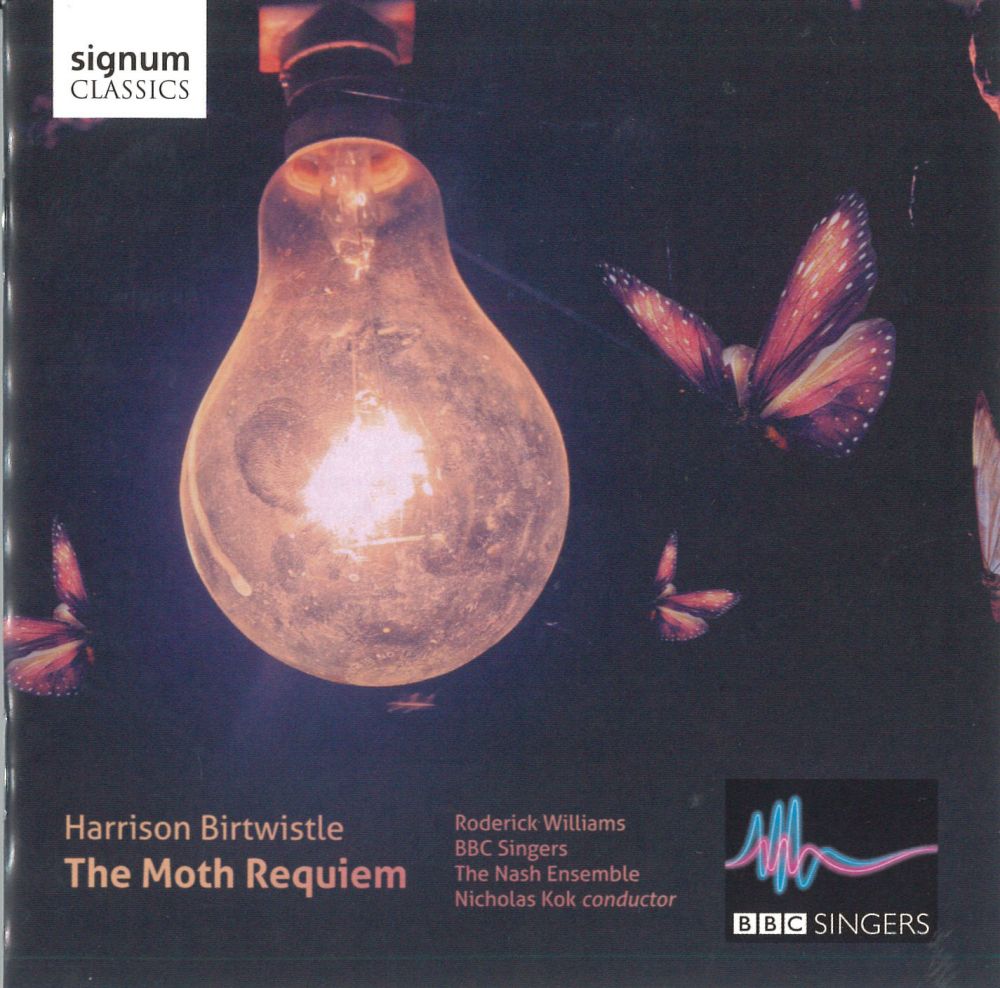
Roderick Williams; BBC Singers; Nash Ensemble; Nicholas Kok
Signum Classics SIGCD368

This fourth of Signum’s series of composer-led releases with exquisite performances by the BBC Singers is perfectly timed to coincide with Harrison Birtwistle’s 80th year. Though a mixture of recent and older compositions, this is a premiere recording for all works on the disc.

The title piece is the most recent. The Moth Requiem is composed for 12 female voices, alto flute and 3 harps. The beauty and tenuous life of the moth is explored through a text based on The Moth Poem by Robin Blaser, with the names of moth species, both common and close to extinct, intertwined throughout. An eerie, shimmering fragility is perfectly evoked by the women’s voices while the music is crafted to portray a moth trapped inside a piano, touching the strings and bumping on the lid in its efforts to escape.

This tenuous hold on life is mirrored through similar effect in Three Latin Motets employed as interludes for Birtwistle’s opera The Last Supper. In The Ring Dance of the Nazarene, Christ is alternately represented by the superb baritone Roderick Williams and the chorus while an Iranian darbuka drum is employed to evoke the dance that Christ performs for his disciples. On the Sheer Threshold of the Night, is taken from his opera The Mask of Orpheus, a setting of Boethius’ early Christian interpretation of the Orpheus myth, set underneath the motif of Orpheus and Eurydice calling out to each other over the great divide between life and afterlife.


02 vocal 01 schubert winterreiseSchubert – Winterreise
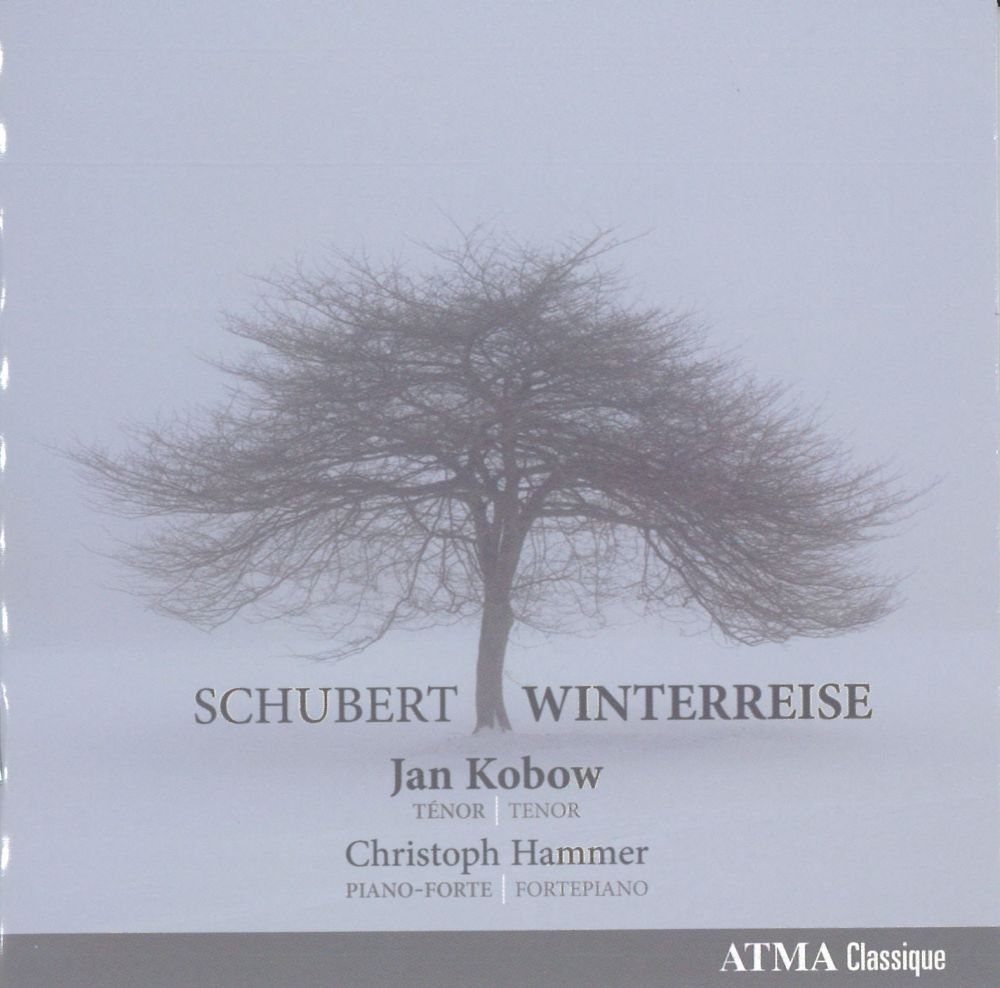
Jan Kobow; Christoph Hammer
ATMA ACD2 2536

The best live performance of Die Winterreise I ever heard took place in Edinburgh many years ago. The singer was a young German tenor, at that time completely unknown to me. His name was Jonas Kaufmann. I understand that Kaufmann’s recording of Winterreise has just been released; I cannot wait to get my hands on it.

Winterreise was composed for a high voice. When sung by a lower voice, the songs have to be transposed. There is nothing wrong with that but the character of the songs changes. When performed by a singer with a dark voice like Hans Hotter or Thomas Quasthoff, there is a correspondence between the darkness of the songs and that of the singer’s voice. But when we hear a tenor, the brightness of the voice and the sadness of the songs give us a poignant contrast. This tenor, Jan Kobow, is able to cope with the high tessitura of these songs but he also has a very even low register. The pianist Christoph Hammer is also very good; he plays not a modern grand but a fortepiano of the period (an early 19th century Brodmann).

The accompanying booklet is informative but the English translation is full of mistakes: “re majeur” is D major, not D flat major; C minor, not B minor, is the relative minor of E flat major; and so on. I also regret that the wanderer of the poems is called “a hiker.”

Of the available recordings with a tenor, I think my personal preference is with Christoph Prégardien, but that may change once I hear the new Kaufmann!


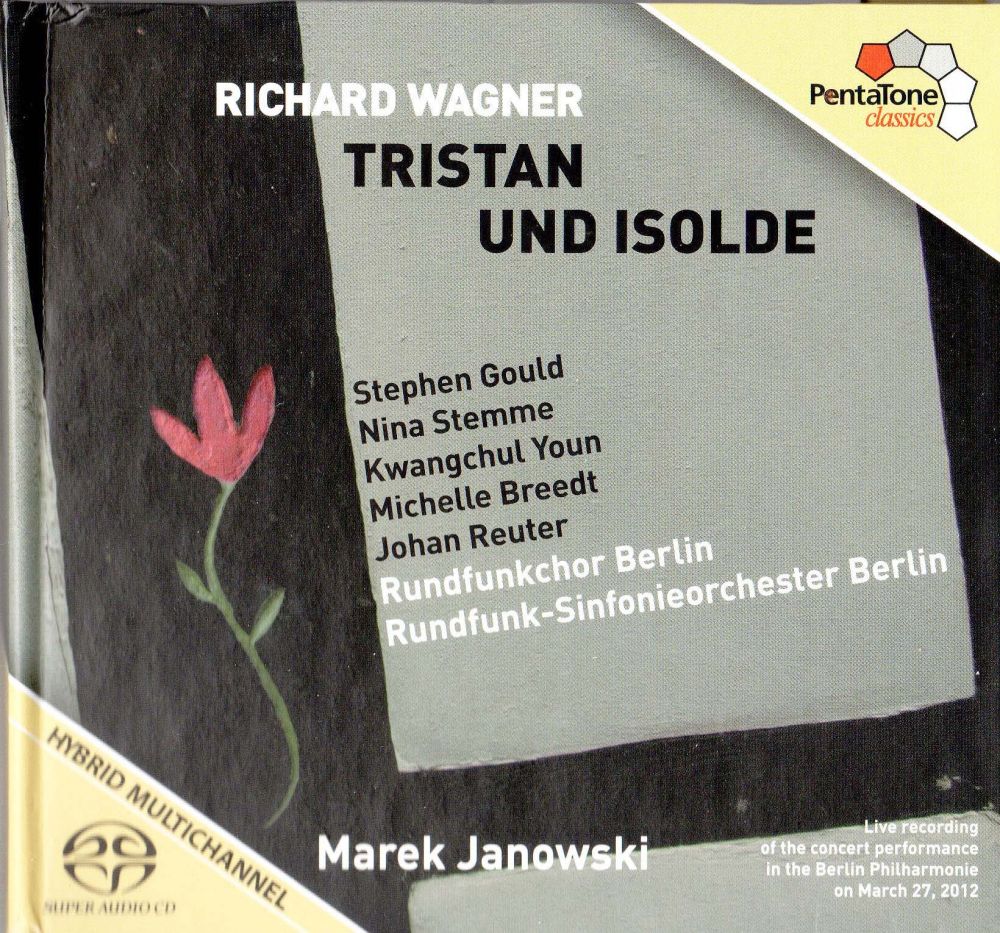
02 vocal 02 wagner tristanWagner – Tristan und Isolde
Stephen Gould; Nina Stemme; Kwangchul Youn; Michelle Breedt; Johan Reuter; Rundfunk Berlin; Marek Janowski
PentaTone PTC 5186 404

The wonderful score of Tristan und Isolde is what placed Wagner among the gods and to listen to this new PentaTone recording in natural stereo sound sensitive to the slightest dynamic change, with singers perfectly balanced, will give this statement true justification. The 200th birthday of Richard Wagner is celebrated in Germany, not by issuing more DVD’s, but recording his ten masterworks in live concert performances the best way possible, with state-of-the art technology and the best available artists.

An international cast is led by Swedish soprano Nina Stemme who literally inhabits Isolde with tempestuous outbursts, the ecstasy of love and the final transfiguration expressed by her magnificent voice and persona. A worthy partner in suffering, American heldentenor Stephen Gould journeys valiantly through the gruelling role of Tristan. South African mezzo Michelle Breedt is a passionate, deeply sympathetic Brangaene, excelling in her second act soliloquy. Korean basso Kwangchul Youn is a noble, wronged and magnanimous König Marke, while Johan Reuter’s brave and loyal Kurvenal is fine, but unfortunately no match for the Fischer-Dieskau of yore.

Marek Janowski is probably the best kept secret of our times. Now at 75 and still going strong, I always thought of him as a hard -working conductor, travelling all over Europe and bringing many orchestras up to the level of excellence and winning prizes and awards along the way. His orchestra of tenure, the Berlin Radio Symphony produces magical sounds I haven’t heard since Furtwängler, so one literally melts away in ecstasy in the welter of sound. And indeed there is ecstasy of the highest order in this performance of the Liebestod where the enigmatic Tristan chord finally gets resolved into pure harmony.


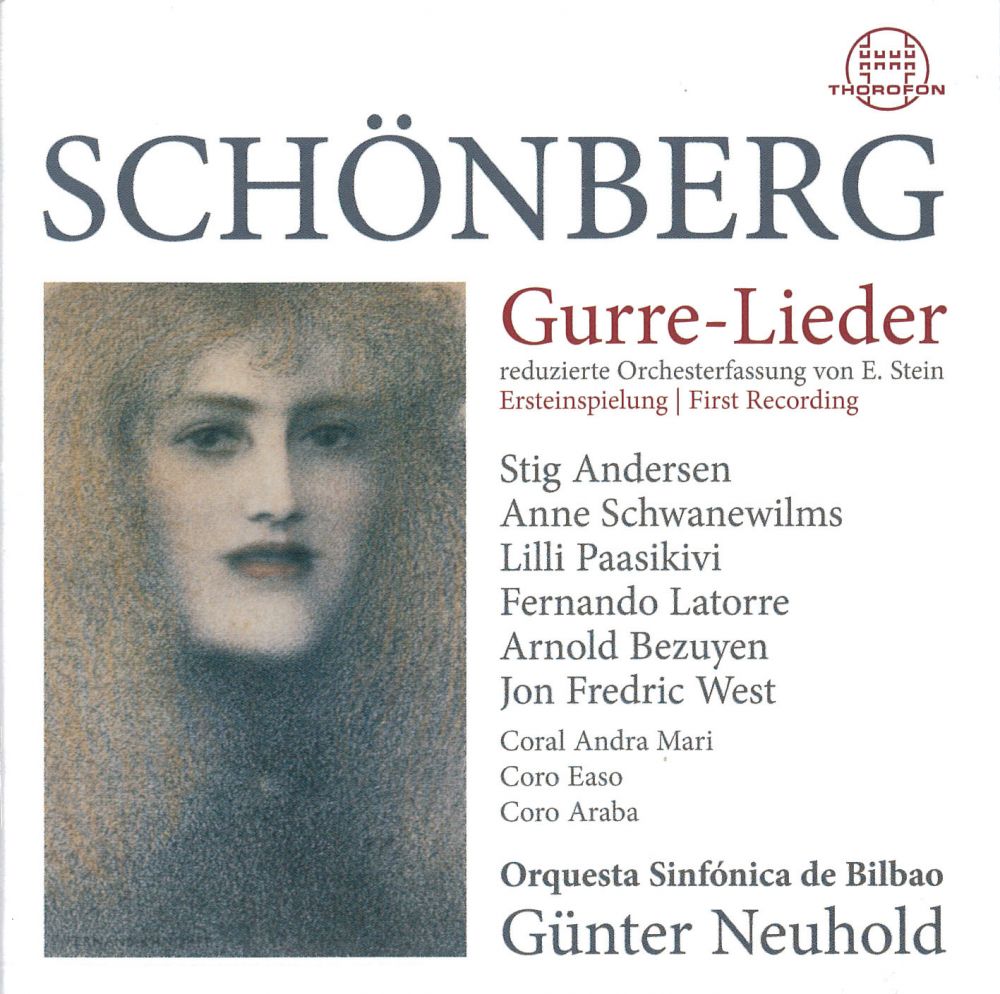
02 vocal 03 gurreliederSchoenberg – Gurrelieder (reduced orchestra by Erwin Stein)
Stig Andersen; Anne Schwanewilms; Lilli Paasikivi; Fernando Latorre; Arnold Bezuyen; Jon Frederic West; Orquesta Sinfónica de Bilbao; Günter Neuhold
Thorofon CTH2606/2

Schoenberg’s magnum opus of 1911, as written, requires many more musicians on stage that the regular symphony orchestra employs, plus six soloists and an enormous choir. Erwin Stein, a one-time student of the composer, arranged the work for fewer players in order that it would reach a wider audience. He did this in consultation with Schoenberg in 1922/23. In addition to requiring smaller orchestral forces Stein also reduced the choir and did some transposing to make it less demanding. Schoenberg approved Stein’s work, realizing the practicality of making performing Gurrelieder less demanding. In fact, in 1929 Schoenberg conducted Stein’s version of the songs from “Part 1” for broadcast on Berlin radio.

The strings in the original number 84, in Stein’s version 60; flutes 8 vs. 4; oboes 5 vs. 3; clarinets 7 vs. 4; bassoons 5 vs. 3; horns 10 vs. 6; trumpets 7 vs. 4; trombones 7 vs. 4; harp 4 vs. 2. The two timpanists, six percussionists and single celeste remain untouched. However Stein introduces a piano. That is a final total of 156 players versus 102. Still, that is a formidable number to which must be added the six soloists and the choirs.

In this first recording of the reduced forces version conductor Günter Neuhold shows that he understands the work; the orchestra is right there and I hear no reason to be picky with any member of the ensemble. So how does it sound? There is clarification in the crowded passages and the only downside (to my ears) was the absence of the richness and texture of the larger version. But the lines are easier to follow now, although I missed the complex flavours of the original to which I am accustomed. Listeners less saturated with the original will be well pleased. The recorded sound is translucent and very impressive.

Recorded in concert in Bilbao at the Palacio Euskalduna on March 8 and 9, 2012 the enthusiastic applause from the audience after the glorious sunrise scene is well deserved.


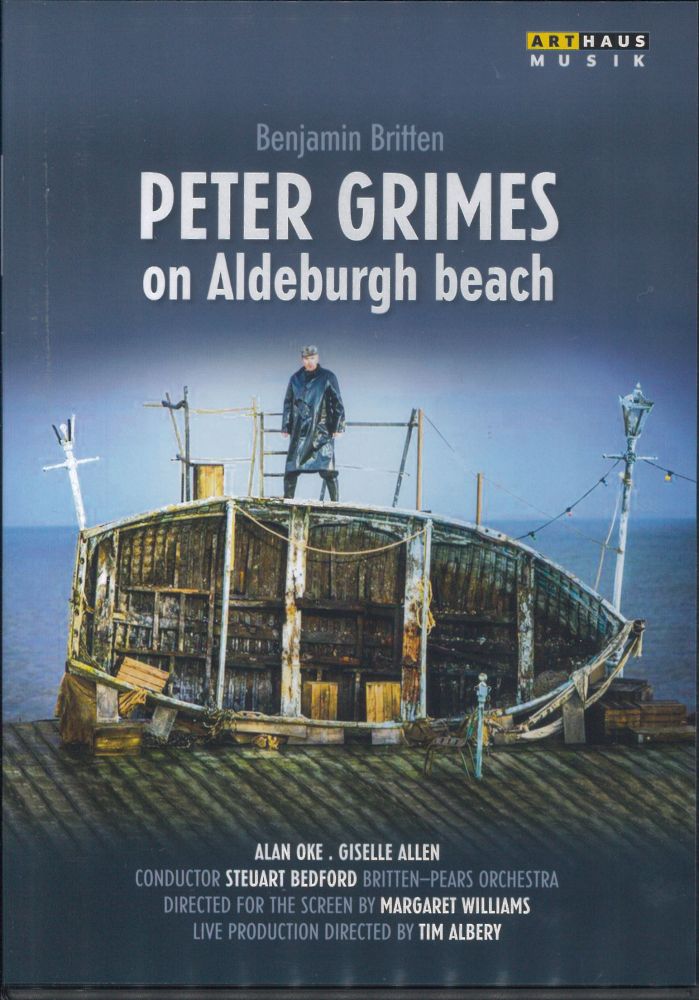
02 vocal 04 britten peter grimesBritten – Peter Grimes on Aldeburgh beach
Alan Oke; Giselle Allen; Britten-Pears Orchestra; Steuart Bedford
ArtHaus Musik 102179

The troubled Aldeburgh fisherman Peter Grimes has rowed home at last in a unique production presented on the pebbly shores of the Suffolk village by the festival that Benjamin Britten established there in 1948. Lacking a facility large enough in the town to accommodate the large chorus and sets for the presentation of this most celebrated of Britten’s stage works, Aldeburgh Music boldly proposed to celebrate the centennial of the composer’s birth with ”Grimes on the Beach.” Compromises aside (a pre-taped orchestra and headset microphones to amplify the soloists), the weather co-operated and the risk proved well worth the effort.

The three evening performances of June 2013 have been expertly assembled by Margaret Williams into a cinemascope format film which amplifies the concert experience with close-ups, cutaways and specially commissioned atmospheric videos accompanying the four orchestral interludes. The title role is sung by the redoubtable Alan Oke in his first appearance in this role, ably abetted by Giselle Allen as the ever-sympathetic Ellen Orford. The cast also includes David Kempster as Balstrode, Robert Murray as Bob Boles and Catherine Wyn-Rogers as Mrs. Sedley.

Britten stalwart Steuart Bedford pre-recorded the students of the Britten-Pears Orchestra in a raw yet energetic studio session. The excellent chorus is drawn from members of Opera North and the Guildhall. The static, multi-purpose set consists of a number of oddly angled fishing boats that serve as pub, church and shacks as needed while the costuming is vintage 1945 dowdiness. The overall solidity of the vocal ensemble and the exceptionally clear diction make for a most engaging evening best enjoyed indoors, comfortably far from the crashing waves and pesky seagulls of the rugged North Sea.


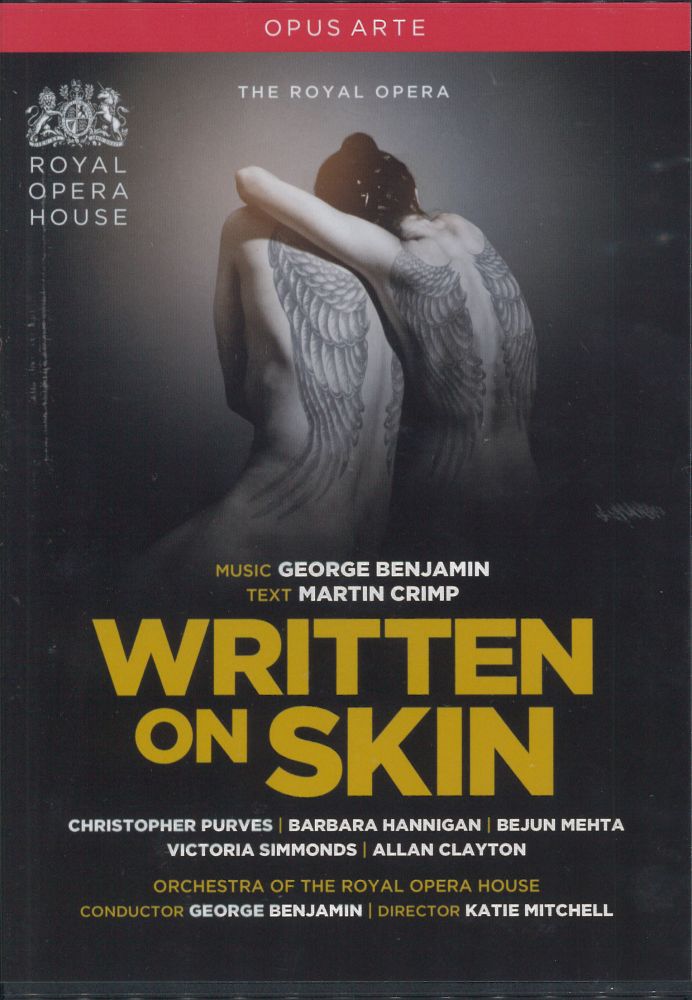
02 vocal 05 benjamin written on skinGeorge Benjamin – Written on Skin
Christopher Purves, Barbara Hannigan; Bejun Mehta; Victoria Simmonds; Allan Clayton; Royal Opera; George Benjamin
Opus Arte OA 1125 D

Composer George Benjamin and British playwright Martin Crimp’s latest project is the opera Written on Skin, produced to great acclaim in 2012. It recounts the legend of the 12th century Catalan troubadour Guillem de Cabestaing and his fatal ménage à trois, represented here by the principal roles of The Protector (baritone Christopher Purves), his wife Agnès (Canadian soprano Barbara Hannigan) and The Boy (countertenor Bejun Mehta). The Protector has hired The Boy (incongruously much balder than his employer in this production) to craft a manuscript about this medieval lord’s mighty realm and deeds (“written on skin” refers to the vellum upon which medieval calligraphers crafted their illuminated manuscripts). Soon enough Agnès and The Boy fall in love and Agnès realizes how cruel her husband really is. The Protector himself also falls under his erotic spell. The affair ends quite messily with the husband killing The Boy and serving up his heart to his wife, who elects to throw herself off a balcony rather than submit to her misogynist husband ever again.

To the left of the stage a group of contemporary scholars in lab coats act as puppet masters, putting these characters from the past through their paces. The narrative of this psychodrama is abstract and freely poetic, with the characters referring to themselves in the third person throughout and the action shifting rapidly between past and present. Benjamin’s chromatic vocal writing is consistently mellifluous and his sensitive and radiant orchestration never fails to impress. Mehta’s eerie male soprano perfectly conveys his otherworldly, angelic character, Purves’ insightful interpretation lends an element of humanity to his nefarious character and Hannigan’s moving portrayal of a woman coming to self-awareness is both vocally gorgeous and dramatically incisive.

In an age when contemporary British operas too often resort to shock-and-schlock tactics it is a pleasure to encounter such a concise and sophisticated jewel of an opera.

Editor’s Note: Composer George Benjamin and soprano Barbara Hannigan will be the featured guests at all three concerts of next year’s Toronto Symphony Orchestra New Creations Festival where an opera-in-concert version of Written On Skin will be performed with surtitles on March 7, 2015. 

02 vocal 01 salieri falstaffSalieri – Falstaff
John Del Carlo; Teresa Ringholz; Richard Croft; Stuttgart RSO; Arnold Östman
ArtHaus Musik 102306

This recording is not exactly new. It gives us a live performance from the Schwetzingen Festival, which dates from 1995. The DVD was first released in 2000 (it is still available in that format). So we are dealing with what is essentially a repackaging.

Although in the early 17th century Monteverdi’s opera had both serious and comic elements, in the 18th century these tended to be divided between opera seria and opera buffa. That division was not absolute and several of Handel’s operas (most notably Partenope and Serse) were in part comic. It was not until Mozart, however, that the serious potential of comic opera was brought out. Antonio Salieri’s Falstaff was first performed in January 1799, a little more than seven years after Mozart’s death. Yet it is a comic opera that shows little of the complexities which we find in Don Giovanni or Così fan tutte. Nor is Falstaff’s story as interestingly treated as it is by Verdi, Nicolai or Vaughan Williams.

I found much of Salieri’s opera decidedly unfunny and much of the music rather routine. There are a few exceptions such as Mr. Ford’s jealousy arias (beautifully sung by the tenor Richard Croft) and the final scene in which Falstaff is confronted with a ritual scene of torment (with the soprano Teresa Ringholz very fine as the Queen of the Fairies). It is not a coincidence that it is exactly those scenes which carry a threat which move beyond what is merely comic. 


02 vocal 02 haydn lord nelsonHaydn – Lord Nelson Mass
Mary Wilson; Abigail Fischer; Keith Jameson; Kevin Deas; Boston Baroque; Martin Pearlman
Linn CKD 426

Written when Haydn was in his mid-60s and at a time of great uncertainty for Europe, the premiere of this mass must have been an emotionally charged one for the citizens of Vienna – the threatened invasion by Napoleon’s army having been recently thwarted by British Admiral Horatio Nelson. With the start of the Kyrie featuring a terrifying military outburst of trumpets and timpani followed by a jubilant rejoicing choir, the audience must have been deeply moved by the dramatic effect. Two years later, Haydn presented this work to the conquering hero when he visited the Esterhazy palace.

Boston Baroque certainly captures the character of those times, deftly alternating huge dynamic ranges that switch from jubilant and boisterous celebration to reflective and prayerful gratitude. And the current day performers were affected by equally upsetting events. Rehearsals for the recording took place at the time of the Boston Marathon bombing, giving a much too realistic experience of the original title of the work (Mass in difficult, uncertain or anxious times). Particularly poignant is the soloist’s quartet for the Agnus Dei. Following the Mass on this recording, Martin Pearlman leads the orchestra in a lively, fast-paced and vigorous rendition of Haydn’s Symphony No.102, another exuberant offering most welcome and uplifting to the spirit.


02 vocal 03 verdi requiemVerdi – Messa da Requiem, Live at the Hollywood Bowl
Di Giacomo; DeYoung; Griglo; D’Arcangelo; Los Angeles Philharmonic and Master Chorale; Gustavo Dudamel
Cmajor 714708

Young Dudamel’s idea of bringing Verdi’s Requiem into the open air, to an unlikely venue with questionable acoustics was a risky undertaking. It was riddled with technical problems from the very beginning, but somehow it came off surprisingly well and turned out to be a huge success. And with good reason too.

Young he may be yet he is not a showman, but a very serious, dedicated and astute musician. He conducts the entire mass without a score and without a baton, using his hand gestures (like Karajan did), not at all easy when controlling the vast forces at his disposal. He says he wants to have the piece in his hands, close to his heart. Using carefully maintained slow tempi ensures every detail is moulded to perfection, but he never lets the tension sag – Verdi would have hated that! He is also fully aware of the tremendous dramatic aspects of the work: witness the sudden deep silence after the gigantic outburst of “Dies Irae” when the clouds disperse to open up to clear blue sky, with trumpets sounding from high above and one really feels God is coming to pass final judgment.

There is a fine quartet of soloists, each having their memorable moment: Juliana Di Giacomo is heartbreaking in “Libera me,” the part actually written first where the soprano reigns supreme; Michelle DeYoung shines eternal light in “Lux Aeterna.” Vittorio Grigolo is certainly no easy-going Duke of Mantua (where I saw him last) but deeply moving in his tenor solo at “Ingemisco” and Ildebrando D’Arcangelo, with his very suitable name, is a seasoned veteran in the basso role who provides a solid foundation to the numerous solo assemblies Verdi had always excelled in writing.


Back to top