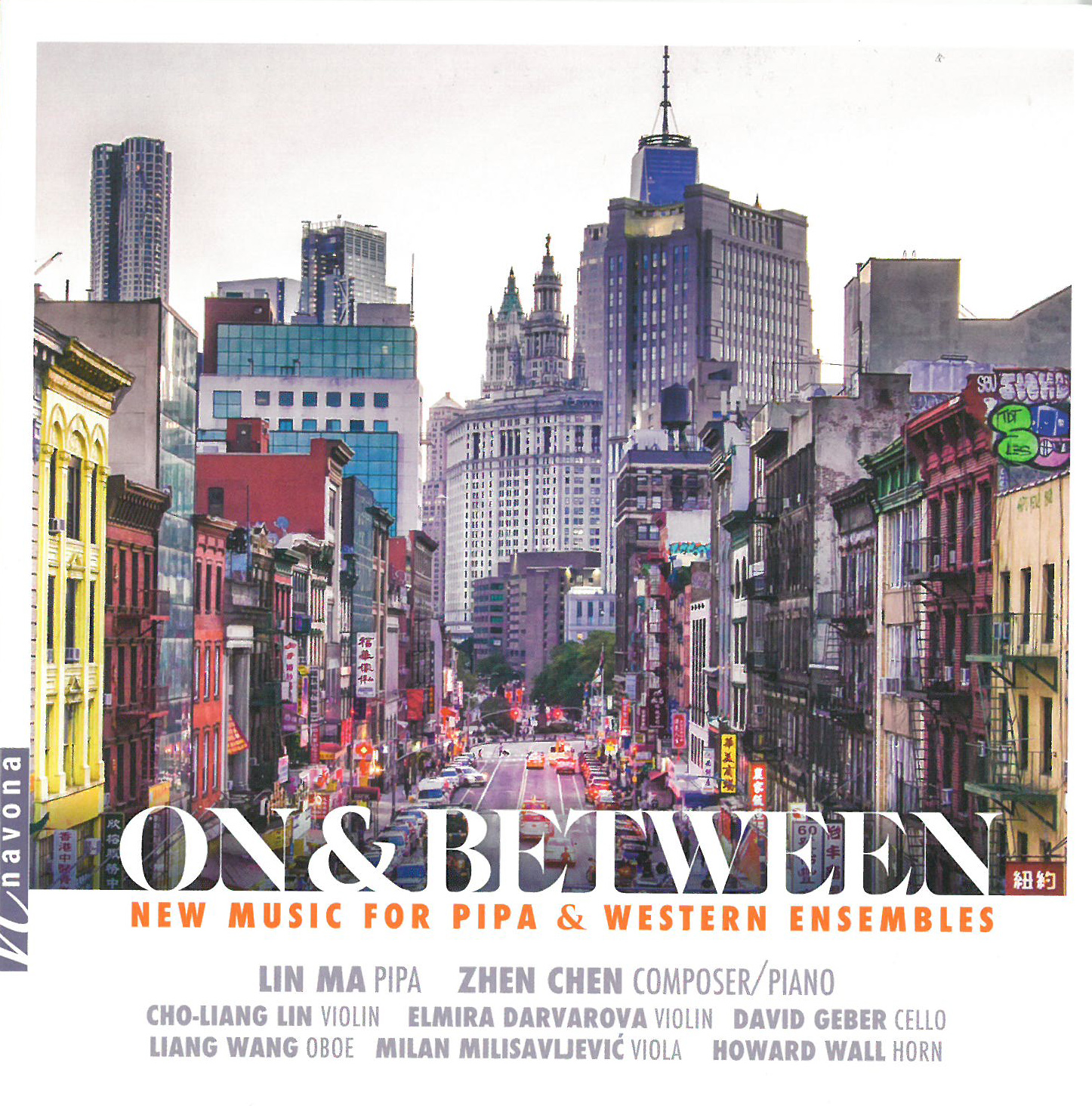
09 PipaOn & Between – New Music for Pipa & Western Ensembles
Lin Ma; Zhen Chen; Various
Navona Records NM6146 (navonarecords.com)

In On & Between, composer and pianist Zhen Chen weaves the musical tale of a Chinese immigrant newly arrived in America. Employing conservative tonal language and instrumentation (except for the pipa, the Chinese lute), the work deftly demonstrates Chen’s bicultural sensibility.

In a recent China Daily.com.cn interview, pipa soloist Lin Ma outlined the work’s narrative. “The pipa is the main character [threading] through the whole album,” Ma explained. “It stands for a Chinese girl who just came to New York City. She wandered, struggled and went through phases of growth. After years, she finally gained a foothold in the new land.” It sounds quite cinematic, and the music would be effective at the movies.

Several times in the suite Chen quotes the well-known English horn melody from Dvořák’s Symphony No.9 “From the New World” (1893), composed while Dvořák worked in the USA. In 1922 it was adapted for the song Goin’ Home by Dvořák pupil William Arms Fisher. For Chen it represents the “respect and sense of promise the United States [has] in the hearts of new immigrants.”

It’s interesting to note that Chen’s setting of the melody owes as much to neo-Romantic 20th-century Chinese patriotic compositions for Western orchestra such as the Yellow River Piano Concerto, as much as it does to Fisher’s song with lyrics cast in dialect and Dvořák’s original setting.

Then there’s my favourite track, Cocktails. It features just Ma’s cantabile pipa playing and Chen’s grand piano, effectively evoking a sophisticated, languid hybrid pipa-spiked-lounge jazz-meets-Satie atmosphere.

01 Eve EgoyanMaria de Alvear: De puro amor & En amor duro
Eve Egoyan, piano
World Edition 0033 (world-edition.com)

It’s been over 20 years since Canadian pianist Eve Egoyan gave the North American premieres of De puro amor (Of Pure Love) and En amor duro (In Hard Love) by Maria de Alvear. After hearing those performances, de Alvear, an innovative Spanish composer, performer and multimedia artist, composed three works for Egoyan. In 2001 Egoyan recorded one of those, Asking. Now, on this stunning new two-disc set, come De puro amor and En amor duro.

In her scores, de Alvear likes to give performers the freedom to make decisions about elements as fundamental as rhythm, metre and dynamics. With her fearless imagination, boundless sense of adventure and brilliant technique, Egoyan pushes beyond what seems possible on the piano. Floating melodies, expressive rhythmic shapes and ringing intervals plucked from the harmonic series weave a contemplative mood in both works, though disruptive undercurrents do intermittently surface.

De Alvear is a charismatic figure in the world of experimental music, especially in Germany, where she now lives. But her music is so personal that it either speaks to you or it doesn’t. For me, it does. I love the honesty, the passion and the openness, which lead her to colourful titles like Sexo and Vagina to evoke the more intimate aspects of love.

This set features drawings by de Alvear’s sister and frequent performance partner, Ana de Alvear, and booklet notes by Tim Rutherford-Smith, who has just published a groundbreaking book on contemporary music, Music After the Fall.

02 BozziniGyula Csapó: Déjà? Kojâ?
Quatuor Bozzini
Collection QB CQB 1821 (actuellecd.com)

Founded in 1999, Quatuor Bozzini are distinguished interpreters of contemporary repertoire, including fine recordings of John Cage, James Tenney and Steve Reich. Here they present a particularly challenging work, a three-part, 73-minute piece composed between 2011 and 2016 by Gyula Csapó, a Hungarian composer currently teaching at the University of Saskatchewan. His music suggests the influences (including scale and depth) of Morton Feldman and Arvo Pärt. Csapó’s brief note about this work is dauntingly abstract (“event-fossils,” “fractals”), but the core is in the title, Déjà? Kojâ? part French, part Persian: “Already?” is easy. “Kojâ?” comes with a poem that suggests “Threshold” as the crucial sense, and that this world is a threshold, the beginning of another experience or existence, a step both inevitable yet deferred.

The work is monumental, developing thick, often dissonant textures. Its long first section is anchored to a repeating oscillation, brief but slow, between low-register cello and viola and high, reedy violins. Seconda Parte is more varied, adding other sonic devices, including moving the contrast of registers to pizzicato lows and whistling harmonic glissandi from the violins. Terza Parte eventually expands the oscillating figures into a still minimalist, but gradually evolving melodic shape.

It’s a demanding work, a dark reverie that suggests anticipation while dramatizing its delay, a sombre meditation shot through with bright highs that are themselves dissonant. At once static and tumultuous, this is depth experience, rewarding all the attention one can give it.

03 Tymoczko Rube GoldbergDmitri Tymoczko – Rube Goldberg Variations
Flexible Music; Atlantic Brass Quintet; Amernet String Quartet
Bridge Records 9492 (bridgerecords.com)

Mid-career American composer and music theorist Dmitri Tymoczko’s music exhibits an attractive blend of jazz, Romanticism and rock, as well as influences from film and cartoon soundtracks. Demonstrating sonic imagination and frequent nods to past composers, his work appears to be equally at home in the American concert hall modernist and popular music streams, a compositional style which has been dubbed polystylistic.

Rube Goldberg Variations, the central work on this album, refers both to a certain J.S. Bach keyboard work, and to the American cartoonist known for his illustrations of machines designed to perform simple tasks in baroque, convoluted ways. The four-movement, 19-minute Variations is scored for brass quintet and prepared piano. In its movement titles Tymoczko refers to his musical ancestor Igor Stravinsky, to kinetic sculpture and to his experiences of fatherhood. Rhythmically and sonically engaging, the prepared piano part in the first movement, To a Leaf, refers to its inventor John Cage. The brass quintet flutters along with idiomatic fanfare-like wind polyphony contrasted by contrapuntal brassy sustained chords. Stravinsky Fountain is another effective movement, with its shards of jazz in a syncopated early-20th-century style, and references to the dedicatee composer’s adoption of it in his concert works. This single movement is a satisfying complete musical statement.

The other album works, S Sensation Something (string quartet and piano) and I cannot follow… (chamber ensemble), are more conventional in instrumentation and form. They are not however without the melodic invention and easygoing charm with which Tymoczko brands his mature scores.

04 Feldman for CageMorton Feldman – For John Cage
Erik Carlson; Aleck Karis
Bridge Records 9498 (bridgerecords.com)

For John Cage (1982) scored for piano and violin is late-period Morton Feldman (1926-1987). That typically means a very lengthy work in a single continuous movement – more than 71 minutes in this recording – that explores a glacially paced musical development and very quiet sound levels.

In a 1982 lecture Feldman asked, “Do we have anything in music … that just cleans everything away?” For John Cage offers his answer. A tribute to one of Feldman’s most enduring personal and professional relationships, it’s a platform for his musical concerns at the time. These include translating meaningful visual and textural effects he found in Turkish regional carpets into musical patterns and sonic gestures. The two musicians, violinist Erik Carlson and pianist Aleck Karis, render the composer’s ideas with precision and delicacy in equal measure.

Feldman was a frequent visitor to Toronto during the 1970s when he taught at the University of Buffalo. Later he married his Canadian composition student Barbara Monk, who established a home in midtown Toronto where she held soirees after her husband’s death. While attending two of these soirees, I was particularly fascinated by the walls covered with kilim carpets, a physical reminder of a source of Feldman’s late period inspiration.

Leaning toward a minimalistic aesthetic in its use of subtly varied melodic phases and a restrained abstract formalism, don’t expect tunes you can hum along with, or grooves to tap your toes to here. While this music will be challenging for some listeners, I personally find it a searching, engaging and rewarding listen.

06 Wind ConcertosWind Concertos: Ticheli; Warnaar; Ranjbaran
James Zimmermann; Leslie Norton; Érik Gratton; Nashville Symphony; Giancarlo Guerrero
Naxos 8.559818 (naxos.com)

Three very different, recent (2010-2015), ear-catching concertos in the traditional fast-slow-fast three movements, by three composers born in the 1950s, each referencing earlier music, receive vibrant performances from Nashville Symphony principals James Zimmermann (clarinet), Leslie Norton (horn) and Érik Gratton (flute).

In his Clarinet Concerto, Frank Ticheli, who teaches at the University of Southern California, pays homage to American composers in movements titled Rhapsody for George, Song for Aaron and Riffs for Lenny, adding some recognizable quotations and paraphrases to flavour his original, engaging takes on his illustrious predecessors. It’s a pops concert natural!

Michigan native Brad Warnaar wrote his Horn Concerto for the instrument he played in the Toronto Symphony and other Ontario orchestras in the 1970s, before relocating to play in the Los Angeles Philharmonic and, he claims, “over a thousand film scores.” Warnaar says his concerto embraces everything from rock to atonality, but I hear only very accessible, enjoyable, tonal mainstream music in the minimalist-energized Tintinnabulations, the ruminative Elegies, Lamentations and the jaunty Tarantella, including subtle quotations from Mozart, Brahms and Richard Strauss.

Juilliard faculty member Behzad Ranjbaran, born and raised in Iran, emulates what he calls the “mystic, melancholic” tone of the ney (Persian end-blown reed flute), enhancing the exoticism of his hybrid Iranian-Western Flute Concerto. Extended meditative passages (the Adagio cantabile is a real beauty) are offset by the sparkling finale.

These world-premiere recordings should help all three very entertaining concertos become, deservedly, part of today’s active repertoire.

Back to top