Beethoven – Symphony No.9 - Christine Oelze; Petra Lang; Klaus Florian Vogt; Matthias Goerne; Deutscher Kammerchor; Deutsche Kammerphilharmonie Bremen; Paavo Järvi
 Beethoven – Symphony No.9
Christine Oelze; Petra Lang; Klaus Florian Vogt; Matthias Goerne; Deutscher Kammerchor; Deutsche Kammerphilharmonie Bremen;
Paavo Järvi
Sony 88697576062
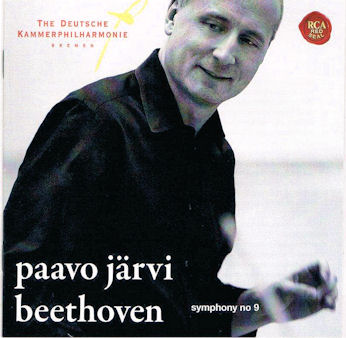
The Deutsche Kammerphilharmonie Orchestra was founded in 1980 by a group of exceptional young students and went on to become one of the most sought-after chamber orchestras, appearing at the UN in 1983. They were invited to play at Gidon Kremer’s Lockenhaus Festival where their 1986 performance of Gubaidulina’s Seven Words was issued by Philips. Since 1992 they have been based in Bremen and are self governing, owned by the players. Paavo Järvi has been their conductor since 2004 and in August of that year they began recording a new Beethoven cycle using the Barenreiter Urtext Edition, starting with the Eighth.
The reduced strings contribute to the creation of new textures that are in no way less satisfying for the audience. The winds and brass are more present without losing perspective. Listeners will have a new appreciation of the genius and beauty of Beethoven’s scores.
Järvi has a clear stamp on these performances wherein he refreshes the scores with his own phrasing and accents, with tempi that adhere to Beethoven’s metronome markings. Diehard fans of the traditional school are likely to find Järvi too acerbic and will not easily accept his approach. Even though I was very familiar with Järvi’s performances of all the others, this Ninth came as a quite a shock. It is as if Järvi has finally taken the wraps off, stepped aside and let Beethoven speak for himself, unencumbered by generations of well meaning interpreters. It works well for me and I find Järvi’s non-routine, clear headed interpretations throughout the nine fully justify their existence among a plethora of sets, new and re-issued, which are mostly indistinguishable from each other.
The state-of-the-art hybrid SACD/CDs, whether heard in stereo or surround, are of audiophile quality accurately delineating the instruments exactly as the conductor intended. The executive producers of these recordings are the orchestra itself and Maestro Järvi, which just may account for their excellence.
 Although resident in Quebec since 1993, Paris-born Patrice Lare studied in Moscow for 8 years, and is steeped in the Russian piano school tradition. His playing provides a massive foundation for the Complete Rachmaninov Piano Trios (XXI-CD 2 1700) with his wife, cellist Velitchka Yotcheva (also Moscow-trained), and Canadian violinist Jean-Sebastien Roy. Rachmaninov’s Trios Elegiaques are both early works in his Romantic, post-Tchaikovsky mold. No.1 is a single-movement trio in G minor from 1892, and No.2 a three-movement work in D minor, written after the death of Tchaikovsky in late 1893 and dedicated “To the Memory of a Great Artist”. This is big but always sensitive playing, perfectly attuned to the style and nature of the music. Recorded at the Radio-Canada studios in Montreal, the sound quality matches the tremendous performances.
 I’ve sometimes wondered if the technical heights reached by Lang Lang are always matched by the depths of his interpretations, but he certainly does his artistic reputation no harm with his first chamber music CD, Tchaikovsky and Rachmaninov Piano Trios with Vadim Repin and Mischa Maisky. Presumably this is his final major release from Deutsche Grammophon (477 8099), following his $3 million signing with Sony; if so, it’s a fascinating farewell, suggesting chamber music as a new field with huge potential for him. The Rachmaninov trio is the G minor, and both here and in the Tchaikovsky A minor trio Lang Lang really seems to avoid “showy” playing, getting to the heart of the music and clearly sharing the interpretative view of his Russian colleagues. Again, the standard of the recording matches that of the two outstanding performances.
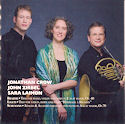 At first sight, there doesn’t seem to be any connection between the works on the latest CD from faculty members at McGill University’s Schulich School of Music (XXI-CD 2 1699), but they are in fact closely related. Jonathan Crow (violin), John Zirbel (horn) and Sara Laimon (piano) open with a beautifully warm reading of the Brahms E flat Horn Trio. This was the first work written for this instrumental combination, and was inspired by the death of the composer’s mother. Brahms chose to use not the newly-developed valve horn but the natural waldhorn, with its sentimental ties to his family and his youth in Hamburg. It was, in turn, a request from a Hamburg pianist for a horn trio to be played along with the Brahms that led György Ligeti to write his own Horn Trio in 1982; moreover, Ligeti had also lost his own mother earlier that year. Sub-titled “Hommage à Brahms”, it is a demanding, complex and multi-layered work in the same four-movement form. Again, the performance is exemplary. Brahms’ mentor Schumann wrote his Adagio & Allegro for horn and piano in 3 days in February 1849; the first substantial solo work to fully explore the potential of the new valve horn, it is still a demanding piece, and Zirbel and Laimon are terrific. Recorded at the acoustically-excellent Schulich School, the sound quality is outstanding.
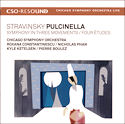 Stravinsky - Pulcinella; Symphony in Three Movements