

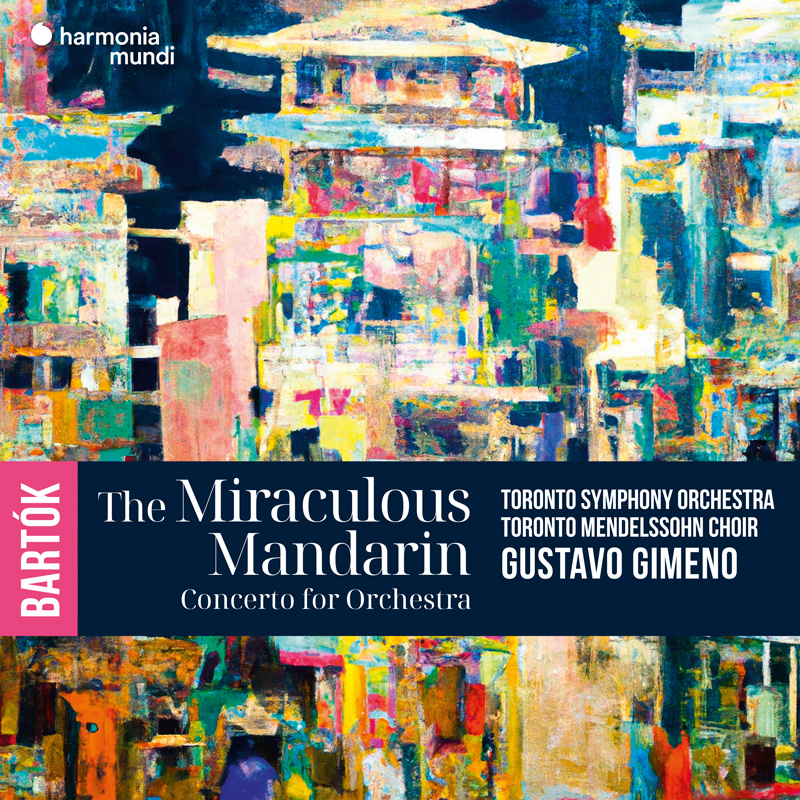
 Bartók – Miraculous Mandarin; Concerto for Orchestra
Toronto Symphony Orchestra; Gustavo Gimeno
Harmonia Mundi HMM 905365 (store.harmoniamundi.com/format/1871527-bartk-the-miraculous-mandarin-concerto-for-orchestra)
This third issue of the Toronto Symphony Orchestra conducted by Gustavo Gimeno for French Harmonia Mundi is the best yet. Bartók is another 20th century giant whose masterpiece, the Concerto for Orchestra has been paired with one of his most imposing works, The Miraculous Mandarin in its seldom performed complete version. This includes some brief but telling choral elements, provided by the Toronto Mendelssohn Choir, and this is far preferable to the usually programmed Suite. The style of this ballet-pantomime is in Bartók’s most challenging Expressionistic vein, a constant and colourful, mostly atonal setting, with a stream of motives and musical events that are hard to fit into any sense of a narrative just from the volatile music. For me this piece is best taken as purely sonic experience, and in this production the TSO gives an overwhelming performance.
The famous Concerto for Orchestra is one of the more frequently done and recorded works of the 20th century, and always shows any orchestra at its best, being not only a challenge for countless solo instrumental turns, but also in ensemble and orchestral discipline. The competition is daunting on recordings, starting with the first great recording by the Chicago Symphony conducted by Fritz Reiner, who commissioned the piece from the dying Bartók in 1941 after he made it to the United States. The Concerto has since been recorded by most major orchestras and many aspiring conductors, and this new recording must be one of the best in recent times. Gimeno is competitive with Reiner.
There is a short, commissioned piece, the sediments, by TSO associate composer Emile Cecilia Lebel. This welcome work contrasts the event-packed Bartók pieces with calmer, sustained sonorities of complex overlaid chords later mixed with tam-tams.
The sound has been perfectly captured with careful microphone placement in Roy Thompson Hall to create a resonant soundstage with a good sense of depth and uncluttered spatial openness. The annotations are especially informative.

