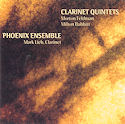
02_feldman_babbittFeldman; Babbitt - Clarinet Quintets

Mark Lieb; Phoenix Ensemble

innova 746 (www.innova.mu)


Both Milton Babbitt and Morton Feldman have had a powerful impact on the music of our time. But these two American composers, born ten years and ninety miles apart, are rarely heard together, since their music comes from such different artistic worlds. This pairing of their clarinet quintets is revelatory.


Feldman’s soulful, tender and understated lyricism has a direct appeal. His Clarinet and String Quartet from 1983 still sounds audaciously visionary today, twenty-three years after his death.


Babbitt’s music is undoubtedly complicated by his use of serial techniques for all aspects of a piece, from the pitches to the rhythm and dynamics. But the Quintet for Clarinet and Strings from 1996 is warm, jazzy, and charming. This is not wholly surprising since Babbitt, who is now ninety-four years old, once wrote a Broadway musical, as the booklet notes tell us, and analyzed Jerome Kern’s All the Things You Are in lessons, as former student Steven Sondheim once recalled.


Clarinettist Mark Lieb uses the chameleon qualities of his instrument to weave in and out of the four strings, whose immaculate and expressive playing responds to the clarinet’s wealth of colours.


This is an important and exciting disc, and it offers the first recording of Babbitt’s quintet. So it deserves better than the unattractive yellowy-brown cover art which spills onto each page of the booklet, making the notes and bios – welcome as they are – difficult to read.
01_gurdjieffGurdjieff/Hartmann - Music for Piano Definitive Edition, Vol. 1 - Asian Songs and Rythms
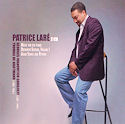
Patrice Lare

XXI XXI-CD 2


This is an intriguing CD set on several levels. First off, the very idea of co-composition, in this case the enigmatic G.I. Gurdjieff (1877? - 1949) and the Russian composer Thomas de Hartmann (1885 - 1956), is rare in the Western classical tradition.


While Gurdjieff’s musical roots are vague, de Hartmann studied with three of Russia’s leading composers: Rimsky-Korsakov, Anton Arensky and Sergei Teneyev. The 22 year old de Hartmann first made a name for himself with his 1907 ballet The Pink Flower, produced by Diaghilev at the Russian Imperial Opera.


Gurdjieff on the other hand is known primarily as a mystic, philosopher and spiritualist, though his musical practice, informed by his theories on life and energy, did take centre stage at various times in his career. The very distinct paths of these two men overlapped when de Hartmann became a Gurdjieff disciple during the First World War. They co-penned some 200 short works for the piano – or at least it seems that Gurdjieff whistled or picked out melodies he imbibed during his 20 year peregrination, which de Hartmann then scored for piano.


Another fascinating spin on this collection of 49 brief piano pieces is that they were meant to accompany “sacred dances” choreographed by Gurdjieff. The 1979 Peter Brook movie Meetings with Remarkable Men shows a scene of such a dance. Another example can be viewed online: http://video.google.com/videoplay?docid=3926028940560435071&hl=en#


How do these brief piano pieces work as listening music? A few have an innocent, evanescent charm. Much of it sounds like early 20th century parlour music with a Middle Eastern twist. The Montreal pianist Patrice Lare plays them with élan.


For seekers who wish to dive even deeper into the deep well of Gurdjieff’s music, there is a 19 hour compilation “Harmonic Development: The Complete Harmonium recordings 1948-1949” on the Basta Music label from The Netherlands.


04_fringe_percFringe Percussion

Fringe Percussion

Independent FP2009

(www.fringepercussion.com)

From the first ten seconds of the first track of “Fringe Percussion”, I was held spellbound. The Vancouver group of the same name is able to hold their own in the diverse and talented pool of Canadian percussionists and percussion ensembles by performing an interesting program with consistent precision and musicality.

John Cage’s Dance Music for Elfrid Ide was an unknown work until its 2005 discovery in the Mills College archives. Composed for dancer/student Elfrid Ide, it is a charming three movement work. The performers capture Cage’s nuances with elegance, especially in the softer sections. Jocelyn Morlock’s Darwin’s Walken Fish Quartet is all musical fun and games, with a splashy percussive ending that contemplates what life would be like if fish were four-legged creatures. The Fringe Percussion recording of John Wyre’s Marubatoo is based upon the work’s unrecorded trio version. Composer Colin MacDonald’s contribution is Enginuity. This feels more like a work in progress, with the clever idea of having the vibraphone and marimba supporting the drumming really coming to fruition in the final third of the work. The energetic Latin flavoured Los Forwards by Graham Boyle completes the release.

What strikes me in listening to Fringe Percussion is the meticulous rhythmic ensemble playing which is overshadowed only by a formidable musical sense. Jonathan Bernard, Martin Fisk, Brian Nesselroad and Daniel Tones play together like lifelong friends. Here’s hoping that they continue drumming together for a long time!


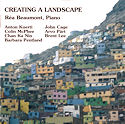
03_creating_landscapeCreating A Landscape

Réa Beaumont

Shrinking Planet Productions SPP 0089 (www.creatingalandscape.com)

Sometimes the planets align, and fortune favours the bold. These sayings only partially do justice to Réa Beaumont, who takes command of the stage of Glenn Gould Studio with a stunning set of contemporary piano works.


Opening with Arvo Pärt’s groundbreaking tintinnabular work
Für Alina, the dynamic continues to remain below mezzo piano for an astonishing 13 minutes. Cage’s very early In a Landscape, played as it was written with no prepared piano devices, rounds out this episode. As you proceed through the works, the material grows gradually denser and more adventurous. Beaumont chose another early work, Colin McPhee’s Op. 1 Piano Sketches from 1916, showing the composer in great form before his exposure to the gamelan. Barbara Pentland’s relatively late (1983) Vincula is an adventurous bit of polyphony, and sensitively played. Chan Ka Nin cascades arpeggiated lines in Vast. Brent Lee’s Subjective Geometries restores the tranquility. The surprise ending is Anton Kuerti’s 6-movement Six Arrows (1974) in a thoroughly 20th century idiom, far removed from anything remotely related to Beethoven.


Beaumont handles all this repertoire with enviable ease. Glenn Gould Studio’s hand-picked Steinway D274 is sensitively recorded by the legendary team of Jaeger and Quinney, with help from Dennis Patterson. The recorded sound is not “in your face”, but nonetheless you can clearly hear subtle nuances of pedalling. You absolutely must hear this.


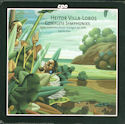
02_villa-lobos_symphoniesVilla-Lobos - Complete Symphonies

Stuttgart Radio Symphony Orchestra WDR; Carl St. Clair

CPO 777 516-2

The eminent Brazilian composer Heitor Villa-Lobos (1887-1959) took as his model for symphonic compositions the cyclic approach endorsed by Vincent d’Indy, regarded in the conservative Brazilian musical circles of his day as quite innovative. Though Villa-Lobos was to discover on first visiting France in 1923 that he was a generation behind contemporary trends in this regard, he doggedly held on to this model for the remainder of his works in this genre. The 12 symphonies are almost entirely cast in four often quite lengthy movements with very few traces of the indigenous Brazilian characteristics for which he is best known. His symphonies have never been as popular as his celebrated Bachianas Brasilieras and Chôros cycles and the majority of them have not previously been available in recordings. Fortunately the American conductor Carl St. Clair began the project of documenting these works in Stuttgart in 1997 for the innovative CPO label and we now have the complete works in an attractively priced box set.

The early symphonies date from 1917 to 1920; symphonies 2-5 are part of a cycle documenting the course of the First World War (the score of the fifth symphony however is lost). The French influence is prominent, including Debussian whole tone passages, lush harmonies and programmatic quotations of La Marseillaise. The Stuttgart forces cope admirably with the often cruel string writing and congested scoring. The later symphonies date from 1944 to 1957 and were commissions from various orchestras; the most impressive of these, the grandiose “Amerindia” choral Symphony No. 10, was written for the 400th Anniversary of the City of São Paulo. The harmonic language of these later works is considerably more interesting and the orchestration marginally more concise, though there is sometimes a surfeit of counterpoint that suggests mere note-spinning.

Carl St. Clair is to be commended for his patience in deciphering the error-ridden manuscripts and contributing the essential interpretive decisions this notoriously prolific composer neglected to indicate. Though these self-consciously cosmopolitan symphonies may lack the charm of his overtly nationalist works they are typically impassioned, energetic, and well worth listening to. This is a well-recorded landmark set and a must-have item for aficionados of Latin America’s greatest composer.

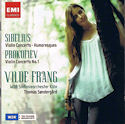
01_frangSibelius; Prokofiev - Violin Concertos
Vilde Frang; WDR Symphony Orchestra, Cologne; Thomas Søndergård

EMI Classics 6 84413 2

I don’t know how to start... she’s too good to believe! Even though Vilde Frang is new on the recording scene, her debut CD has tremendous impact, driven by her talent and intelligence. This kind of supreme violin playing is rare.

Vilde Frang was born in Norway in 1986 and made her debut with orchestra at the age of ten. She concertizes throughout Scandinavia, Europe and the Balkan countries. She has shared the stage with such luminaries as Martha Argerich, Gidon Kremer, and Maxim Vengerov. She toured Europe and the USA with Anne-Sophie Mutter (her mentor) and the Camerata Salzburg. The recordings heard here were made when she was 22.

There are several recent recordings of the Sibelius, both new and historic, re-issues and discoveries, but this one stands out. Not since Ivry Gitlis’ legendary recording from the mid-fifties (VOX) have I been so taken.

From the opening bars the mood is set and the heartfelt scenario unfolds. Her playing is not only beautiful, it is original with genuine style and personality... attributes that have characterized the greatest music masters throughout a century of recordings. From the lyrical first movement to the energetic frisson of the finale I was mesmerized. That she feels a close relationship to this concerto is unmistakable.

For the Prokofiev concerto, too, she plays with great authority. After the eerie opening, she introduces a measure of frivolity and rhythmic vitality, always with taste and respect for the composer. Altogether, another magnificent performance.

A compelling case is also made for the rarely heard Humoresques.

Throughout the coherence and rapport between soloist, conductor and orchestra is captured on a dynamic recording with a real-life balance between soloist and orchestra. I am certain that we’ll be hearing much more from Vilde Frang.

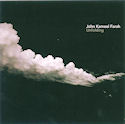
11_farah_unfoldingUnfolding

John Farah

Dross:tik Records DTK10 (www.johnfarah.com)

Toronto composer and pianist John Farah noted in a recent interview, “I wanted Unfolding to be like my favourite juggernaut classical pieces, something you could listen to hundreds of times because you're always hearing new details ..." (Hour Magazine, 2009). In this goal, it seems to me that he succeeded brilliantly. I can’t wait for a live concert version with full symphony orchestra.

Overall, the structure of Unfolding resembles a grand 20th c. piano concerto in ten movements. Its symphonic accompaniment is here deftly provided by synthesizers and acoustic drums, clarinet and cello. Its style and musical language is a veritable musical alchemical amalgam, drawing from an incredibly varied range of Western and Middle Eastern contemporary and historical sources. Established musical forms abound, both Middle Eastern (the 10 beat samai metre in mvt. 6), and Western (the passacaglia underpinning mvt. 5). Contemporary urban dance styles are welcome in Farah’s concerto too. They make guest appearances alongside advanced jazz augmented chords and tonal passages reminiscent of Schoenberg’s 12 tone musical language. The composer’s love for the keyboard music of the Renaissance is not neglected either and gets a place at the table, though the harpsichord is not included as it was on his first CD, Creation.

Unfolding reflects a mature fully-realised musical voice in the tradition of European keyboard-composers. Imagine one part rippling jazzy piano and Rhodes lines blended into crunchy augmented chords, one part chopped-up drum samples, trippy acid synth lines and drum ’n’ bass, plus another part Middle Eastern percussion and modal references, all served in a sophisticated highball glass in the form of a 20th century piano concerto. Can’t? Then you’ll just have to listen to this album.

Andrew Timar

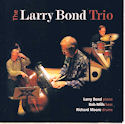
02_larry_bond_trioThe Larry Bond Trio

Larry Bond; Bob Mills; Richard Moore

Independent (www.larrybondtrio.com)

If you enjoy good quality relaxed jazz with a mix of standards and lesser known numbers, this CD may be for you. From Rogers and Hammerstein to Thelonious Monk, George Shearing and Thad Dameron, Larry Bond and his cohorts provide a solid hour’s worth of good listening. While there are no frantic tracks on this offering, it certainly would not be fair to label it with the hackneyed easy listening label. A total of nine top quality tunes with an interpretation to match, cover a spectrum of rhythms from Waltz for Debbie to Blue Bossa. Larry Bond’s piano dominates, as one might expect, but he certainly does not hog the show. Throughout, this CD is a tasteful team effort with excellent balance. Particularly interesting are the somewhat unconventional up tempo treatments of It Might as Well be Spring and Stella by Starlight. All in all an excellent addition to the library of some standards and lesser known numbers in a relaxed jazz style.

Jack MacQuarrie

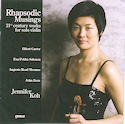
02_koh_rhapsodicRhapsodic Musings - 21st Century works for solo violin

Jennifer Koh

Cedille CDR 90000 113

Jennifer Koh has produced another outstanding CD with Rhapsodic Musings. I’ve commented before on Koh’s intelligent and imaginative programming, and this CD is no exception, Koh noting that the recording was born out of her search for “a sense of meaning” in the aftermath of the events of September 11, 2001.

There are four outstanding works here: Elliott Carter’s suite Four Lauds, completed in 2000, includes one movement from 1984 and two from 1999, making the CD’s sub-title somewhat inaccurate; Esa-Pekka Salonen’s Lachen Verlernt from 2002 has an accompanying video by Tal Rosner; Augusta Read-Thomas’s Pulsar (2002) is a short piece bursting with energy. The longest work is John Zorn’s Goetia, written for Koh in 2002; its eight short movements each repeat exactly the same sequence of 227 pitches, although the possibilities for transposition and the huge variations in note speed, tempo, dynamics, tonal colour and technique make this virtually impossible to tell.

Koh is in her usual magnificent form in these essential and significant additions to a highly demanding performing genre.

Terry Robbins

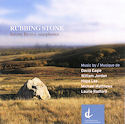
01_rubbing_stoneRubbing Stone - Music by David Eagle, William Jordan, Hope Lee, Michael Matthews, Laurie Radford

Jeremy Brown

Centrediscs CMCCD 14909

Calgary-based saxophonist Jeremy Brown compiles works by composers living in Alberta on his newest disc, Rubbing Stone.

The title track refers to a glacial erratic in Calgary used as a resting place by migrating buffalo. In this solo work, composer Hope Lee sets out to achieve a sense of “timelessness; the result is reminiscent of the music of Scelsi. Her other work, Days Beyond, is more fantasia, conjuring dreamlike reflections of nature for saxophone and piano (Ami Longhi).

David Eagle’s Intonare 2 combines the colours of the saxophone, piano and various percussion instruments, alternating chromatic stasis with primal rhythmic drive and Messiaenic homophony. Percussive electronic sounds battle for prominence with the saxophone in …que la terre s’ouvre… by Laurie Radford.

William Jordan has two sonatas on this disc: the one for alto is more saxophonistic, using jazz elements and accompanied recitative; the more playful soprano sonata was originally conceived for oboe.

Michael Matthews wrote perhaps the most ambitious work on the disc, The Skin of Night. What begins as a simple melodic cell becomes a roller coaster of flourishes, followed by a lengthy weighted decay. Both Brown and Longhi are impressive.

Recitative and fantasy as a compositional device permeate all the works, but it places Brown – the protagonist – at centre stage; his colourful sound and expressive vocabulary never tire.

Wallace Halladay

01_multiple_flutesDifferent Stones - Canadian Music for

Multiple Flutes

Mark Takeshi McGregor

Redshift (www.redshiftmusic.org)

The seven beautifully crafted compositions by young composers, magnificently multi-tracked at the Banff Centre for the Arts by Vancouver flutist, Mark Takeshi McGregor, make this CD of music for multiple flutes of interest beyond the ranks of flute aficionados and beleaguered university flute choir directors.

Meaning of music lies in the way it creates the feeling of going somewhere, moving ahead, departing and arriving. Each piece on the disc does this, developing organically and convincingly, not as in traditional music by the repetition and variety of melody and rhythm, but with different musical elements, such as dynamics, busy-ness, expanding ranges, abrupt stops, silences, and textural contrasts. Apparently random beginnings and endings of long tones in Jennifer Butler’s Sky, for example, provide both repetition and variety, and the addition of short two and three-note tonal patterns moves the piece ahead. The simple addition of a six-note “counter ostinato” to the four-note opening ostinato in Christopher Kovarik’s Dectet similarly creates a feeling of forward motion, and the climactic chord two minutes into the piece creates the feeling of having arrived at a pivotal point.

This CD is an instructive primer in a genre of contemporary composition, which, shall we say, maximises minimalism. As such, it is of interest well beyond the coteries of flute and composition cognoscenti, generating meaning by means that are equally archetypal and yet uniquely and recognisably related to the aesthetic sensibility of our time.

02_haimowitz_figmentFigment

Matt Haimovitz

Oxingale OX2016 www.oxingale.com

buy
@Grigorian.Com

Matt Haimovitz’s new solo program and CD title were inspired by American composer Elliott Carter (still with us at 100!) and his two Figments for solo cello, but the disc features a wide range of new works for cello alone or cello and electronics by established and emerging composers from Canada and the USA. Three of the works are from 2009, and five are recorded here for the first time.

The short but impressive Carter pieces were the strongest for me; in fact, I found myself preferring the non-electronic tracks throughout the CD – Ana Sokolovic’s Vez, Gilles Tremblay’s Cedres en Voile, Steven Stucky’s Dialoghi and Luna Pearl Woolf’s Sarabande all having “something to say”.

The other pieces, by Serge Provost, the Montreal-based musician/producer Socalled, and - especially - the two Du Yun works, came across less successfully, at least on initial listenings.

There is no indication of whether or not there were any improvisational or aleatoric aspects to the performances.

Unfortunately, there were no booklet notes with the digipak (although these are available on-line at www.oxingale.com). Also, the gaps between CD tracks are often way too short - as little as 3 or 4 seconds at times. Given the stops and pauses in many of the works it’s sometimes hard to tell where one piece ends and the next begins.

Haimovitz, however, is in great form, in a value-for-money CD that packs in almost 80 minutes of music.

Concert Note: Matt Haimovitz’ “Figment” tour stops in Toronto at the Music Gallery on November 8.

03_yoko_hirotaSmall is Beautiful; Miniature Piano Pieces

Yoko Hirota

Phoenix Classical PHC95252

(www.yokohirota.com)

Yoko Hirota has added another item to her impressive set of laurels in the form a new CD. Keeping things consistent, she begins with a Schoenberg work, 6 Kleine Klavierstücke, Op. 19. But Hirota advances well beyond the Second Viennese School here, with explorations that take us well into the present day, over the course of 35 different tracks. Works and composers roughly follow a chronological timeline, with non-Canadian composers ending with Elliot Carter in 2000, and the Canadians at the end, from 1951 to 2006. Hirota’s depth and control are unequalled throughout, as can be expected from one with such impressive academic credentials. But it is the works from her adoptive land, Northern Ontario, which make the disc unique. Aris Carastathis’ Traces and two recent works by Robert Lemay are remarkable.

With the recent tours of New Music North, one hopes to hear Hirota to showing pianistic muscle in an ensemble setting, but that must wait for another release. Here, we must be content with a lone Boston model D-272 piano. The recording is nicely balanced between direct and reverberant sound, although the hall is not identified. Recommended.

04_chatmanStephen Chatman - Earth Songs

Various Artists

Centrediscs CMCCD 14709

“Earth Songs” is the name of a new CD on the Centrediscs label featuring music by the west-coast based composer Stephen Chatman – a sort of “musical plea” for an endangered planet. Although the listener might rightly assume that this is a disc of choral or vocal music, it’s only the first set (and title track) that actually utilizes a chorus. Other works are scored for combinations of violin, cello, piano, saxophone, and solo harp.

The opening suite, using texts from various sources, is a wonderful study in contrasts, from the jubilance of Et inluminent terram to the delicacy of The Waterfall, an homage to ancient China. Here, the University of British Columbia Singers and CBC Radio Orchestra (sadly, in its final recording) are conducted by Alain Trudel. The set that follows, For Pent-Up and Aching Rivers, scored for violin and cello, and the piece Or from the Sea of Time, for piano and cello, are both inspired by poems by Walt Whitman. In the first, violinist Gwen Thompson (who provided the commission) and cellist Eric Wilson successfully create an impassioned mood. Or from the Sea of Time is decidedly more restrained - mysterious and introspective music, where cellist Eric Wilson and pianist Patricia Hoy are featured in a haunting dialogue.

My only quibble with this disc – and it’s a minor one – is the dark and sombre tone pervading much of the music throughout. Is there no glimmer of hope for a better (and greener) future? Nevertheless, the music is a fine representation of Chatman’s musical style – the broad sweeping lines, the lyricism, and the sensitive pairing of music and text are all very much in evidence. “Earth Songs” – what could be more fitting in these environmentally-challenged times?

05_horwoodPercussionique - The complete percussion music of Michael S. Horwood

Toronto Percussion Ensemble

Albany Records Troy1122

(www.albanyrecords.com)

This disc of percussion music by American-born Canadian composer Michael S. Horwood (b. 1947) should attract both new music aficionados and others interested in revitalizing listening experiences. Superbly performed by the Toronto Percussion Ensemble (John Brownell, David Campion, Mark Duggan, and Beverley Johnston) “Percussionique” is beautifully recorded and presented by Albany Records.

The “spine” of this chronologically presented oeuvre is a series of Pieces Percussioniques dating from 1964 to 2008. Spanning various contemporary compositional practices, a consistent voice still emerges, refined yet playful. For example, in No. 3 a sensitive xylophone cadenza leads into a pensive slow section with exquisite, soft dynamics, followed by a rondo with a Monty Pythonesque march rhythm! Piece No. 4 is finely structured in four-parts; the fast sections have for me a hint of Horwood’s passion for roller coasters. A percussionist himself, Horwood writes idiomatically. Intricate divisions of the beat layered variously between instruments give an effect of luxuriant flourishing, without cluttering the texture.

Along with the Pieces Percussioniques, individual pieces showcase particular instruments: The Shadow Of Your Drum for bass drum with 2 players; Dynamite for piano and two suspended cymbals, composed for a noir-ish film scene; and my particular favourite - the vital, carefully structured Fragments (2006) delightfully performed by mallet specialists Mark Duggan and Beverley Johnston. In a noisy world we forget to listen truly: try letting Percussionique’s sound world beguile you!

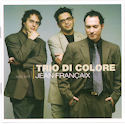
01_francaixJean Françaix 1912-1997
Trio di Colore
XXI XXI-CD 2 1580


Nadia Boulanger pronounced to the mother of 10-year old Jean Françaix: “I don’t know why we’re wasting our time teaching him harmony, which he obviously knows already. How he became so proficient at it is a mystery; he seems to have been born with it. Let us rather do counterpoint.” That love of harmony persisted throughout his life and career. Françaix was criticized in the 1950’s for not moving ahead with the serialists and dodecaphonic composers. His reply was disarming: “I would gladly be the spiritual grandson to Grand-Papa Haydn. The limpidity, the calm and the humour of his art seem to me the antidote to the contemporary idiom.”


Despite his protestations that he never changed, Françaix obviously evolved. As the composers of the minimalist movement (most notably John Adams) re-discovered harmony, so did Françaix discover his own version of minimalism. The perfect example of that evolution is one of his late compositions, the 1990 Trio for Clarinet, Viola and Piano. Together with his compositions from the 1970’s, 1940’s and even 1930’s, this disc becomes a great Françaix primer, beautifully executed by Trio di Colore. This young ensemble, formed at the acclaimed Indiana University – Jakob School of Music, received the First Prize and Gold Medal at the prestigious 2004 Fischoff Chamber Music Competition. The individual musicians are also winners of multiple competitions, guaranteeing an intelligent and beautiful reading of thes harmonic treasures by Jean Françaix.


Back to top